RF Energy Harvesting Market By Energy Source (Ambient RF Signals and Dedicated RF Transmitters), By Technology (Rectenna-Based, Resonant Circuit-Based, Antenna Array-Based, Integrated Circuit-Based, And Hybrid Systems), By Component (Antenna, Rectifier, Energy Storage, And Power Management Circuit), By Application (Consumer Electronics, Industrial, Medical, Transportation, And Smart Homes and Buildings) – Global Analysis & Forecast, 2025–2030
Industry: Energy & Power | Publishing Date: June 18, 2026 | Last Updated: October 16, 2026 | No of Pages: N/A | No. of Tables: N/A | No. of Figures: N/A | Format: PDF | Report Code: EP3765
Industry Outlook
The global RF Energy Harvesting Market size was valued at USD 24.01 billion in 2024 and is expected to reach USD 30.58 billion by 2025. Looking ahead, the industry is projected to expand significantly, reaching USD 102.64 billion by 2030, registering a CAGR of 27.4% from 2025 to 2030.
The RF energy harvesting market is an emerging sector at the intersection of wireless communication and low-power electronics. As of today, the industry has evolved from conceptual research into practical deployment, with devices capable of capturing ambient radiofrequency signals from cellular networks, Wi Fi, broadcast channels, and dedicated RF sources to generate usable electrical energy. The technology is widely applied in low-power Internet of Things (IoT) devices, wearable electronics, smart sensors, and medical implants, where replacing or recharging batteries is challenging. Advances in rectifier circuits, power management ICs, and antenna design have made harvesting more efficient, enabling reliable operation of devices in both indoor and outdoor environments.
The future of RF energy harvesting is promising, driven by the proliferation of connected devices, wireless infrastructure, and demand for sustainable energy solutions. Key use cases include industrial wireless sensor networks, building automation, asset tracking, automotive telematics, healthcare monitoring, and smart agriculture, where a continuous power supply is critical yet traditional energy sources are impractical. As integration with IoT ecosystems grows, hybrid harvesting systems combining RF energy with solar, thermal, or vibrational sources are expected to become standard. Industry focus is shifting toward modular, scalable solutions and system-level integration, positioning RF energy harvesting as a key enabler of autonomous, low-maintenance electronic devices across sectors.
What Are the Key Trends in the RF Energy Harvesting Industry?
How Is Hybrid Energy Harvesting Transforming the RF Energy Harvesting Industry?
Recent research shows that combining RF energy harvesting with solar, thermal, or vibrational energy can increase total harvested energy. This trend is reshaping the market by enabling devices to operate reliably even when RF signals are weak or intermittent. Hybrid systems allow multi-source energy capture, ensuring continuous device operation in applications like smart buildings and wearable medical sensors. Companies leverage this trend by designing modular hybrid harvesters, offering solutions that integrate multiple energy sources in compact, scalable designs. This approach not only enhances device uptime but also positions manufacturers as innovators in the sustainability-focused energy harvesting market.
How Is Multi-Band RF Harvesting Expanding Application Opportunities?
New multi-band rectennas now capture energy across cellular, Wi-Fi, and TV frequency bands simultaneously, increasing harvested power compared to single-band designs. This trend enables IoT devices and sensor nodes to operate in urban environments where multiple RF sources coexist. Multi-band harvesting allows deployment in diverse industrial, healthcare, and smart city applications without relying on a single frequency. Companies capitalize on this trend by investing in multi-band antenna design and integrated power management ICs, offering flexible solutions for clients requiring reliable energy capture across varying RF environments.
How Is Miniaturization Driving Wearable and Implantable Applications?
Advances in microfabrication have enabled RF harvesters to shrink to millimetre-scale form factors while maintaining energy output, opening opportunities in wearable electronics and medical implants. Compact harvesters now are embedded directly into devices without affecting usability, making them ideal for continuous health monitoring and low-power IoT wearables. Companies target this trend by developing ultra-compact modules with integrated storage and power management, differentiating themselves in markets where size, weight, and energy efficiency are critical.
What Are the Key Market Drivers, Breakthroughs, and Investment Opportunities That Will Shape the RF Energy Harvesting Industry in the Next Decade?
The RF energy harvesting market is experiencing significant growth, driven by the increasing demand for sustainable energy solutions and the proliferation of Internet of Things devices. As industries seek to reduce reliance on traditional power sources, RF energy harvesting offers a viable alternative by capturing ambient radio frequency energy and converting it into usable power. This technology is particularly beneficial in applications where conventional power sources are impractical, such as remote sensors and wearable devices.
However, the market also faces challenges, including technical limitations in energy conversion efficiency and the need for miniaturization of components to fit into compact devices. Despite these hurdles, ongoing research and development efforts are leading to breakthroughs that enhance the efficiency and applicability of RF energy harvesting systems. Companies investing in these advancements can capitalize on the growing demand for energy-efficient solutions across various sectors.
Growth Drivers:
How Is the Proliferation of IoT Devices Driving the RF Energy Harvesting Market Growth?
The rapid expansion of IoT devices is a significant driver for the RF energy harvesting market demand. With billions of connected devices expected to be in use in the coming years, the need for sustainable and maintenance-free power sources is more critical than ever. RF energy harvesting provides a solution by capturing ambient radio frequency energy from existing wireless networks and converting it into usable power. This technology eliminates the need for frequent battery replacements, reducing maintenance costs and downtime for IoT devices. Companies developing RF energy harvesting solutions tap into this growing market by offering products that support the autonomous operation of IoT devices, thereby meeting the increasing demand for sustainable energy solutions.
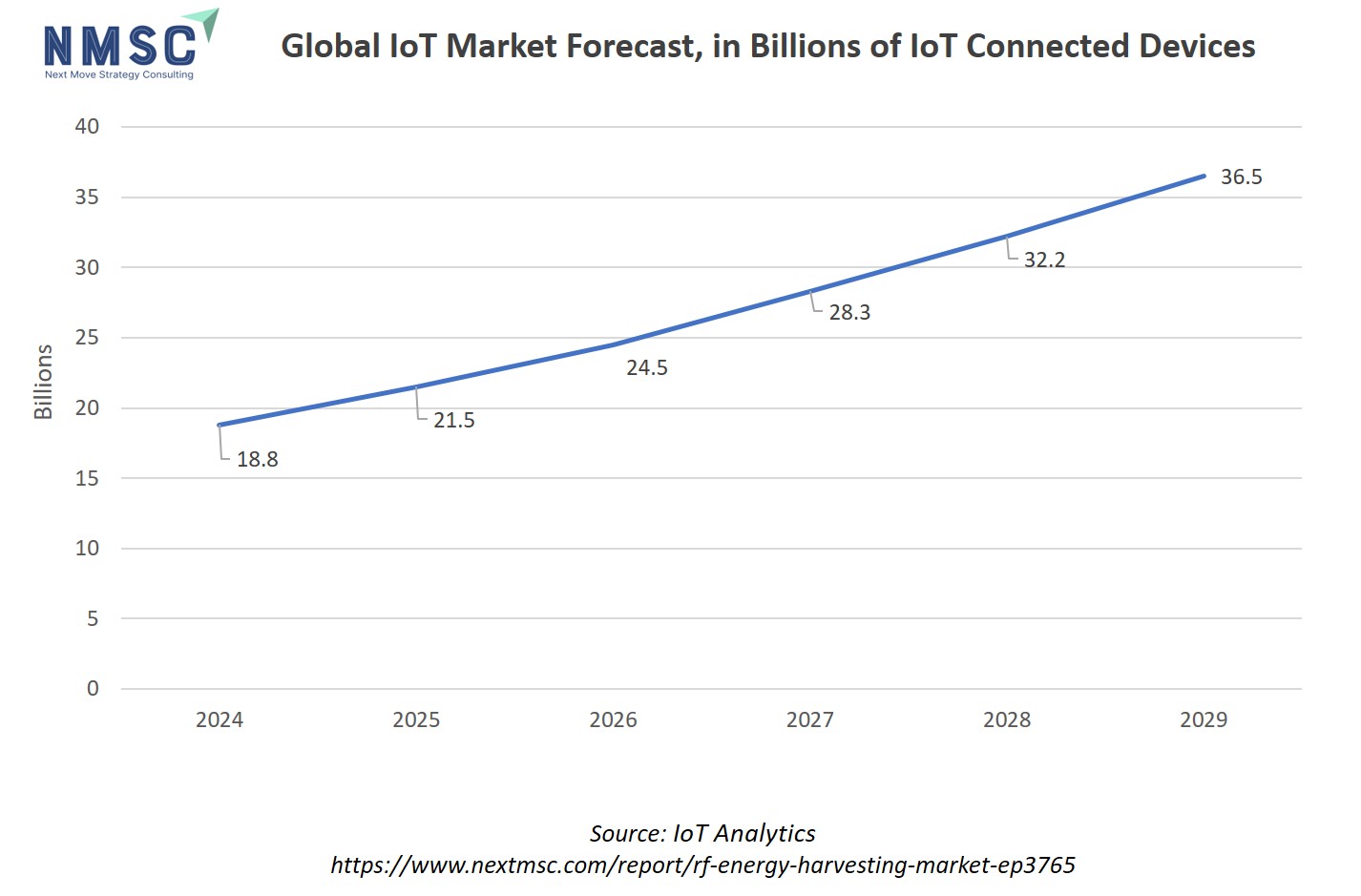
The chart depicts the projected growth of the global IoT market, measured by the number of IoT-connected devices, from 2024 to 2029. It illustrates a strong upward trend, with the number of connected devices expected to nearly double from 18.8 billion in 2024 to 36.5 billion by 2029. This exponential rise in IoT deployments significantly impacts the RF energy harvesting market trends by fueling demand for maintenance-free, wirelessly powered devices. As the population of battery-dependent sensors and nodes increases, industries seek sustainable and cost-effective energy solutions, making RF energy harvesting technology essential for large-scale IoT adoption and unlocking new market opportunities in smart infrastructure, industrial automation, and consumer electronics.
What Role Do Advancements in RF Energy Harvesting Technology Play in Market Growth?
Technological advancements are playing a crucial role in the RF energy harvesting market expansion. Innovations in rectenna design, power management circuits, and energy storage solutions are enhancing the efficiency and effectiveness of RF energy harvesting systems. For instance, the development of multi-band rectennas allows for the capture of energy from a broader range of frequencies, increasing the amount of usable power harvested. Additionally, improvements in power management circuits enable better regulation and storage of the harvested energy, making it more suitable for powering various devices. Companies investing in these technological advancements offer more efficient and versatile RF energy harvesting solutions, positioning themselves as leaders in the market.
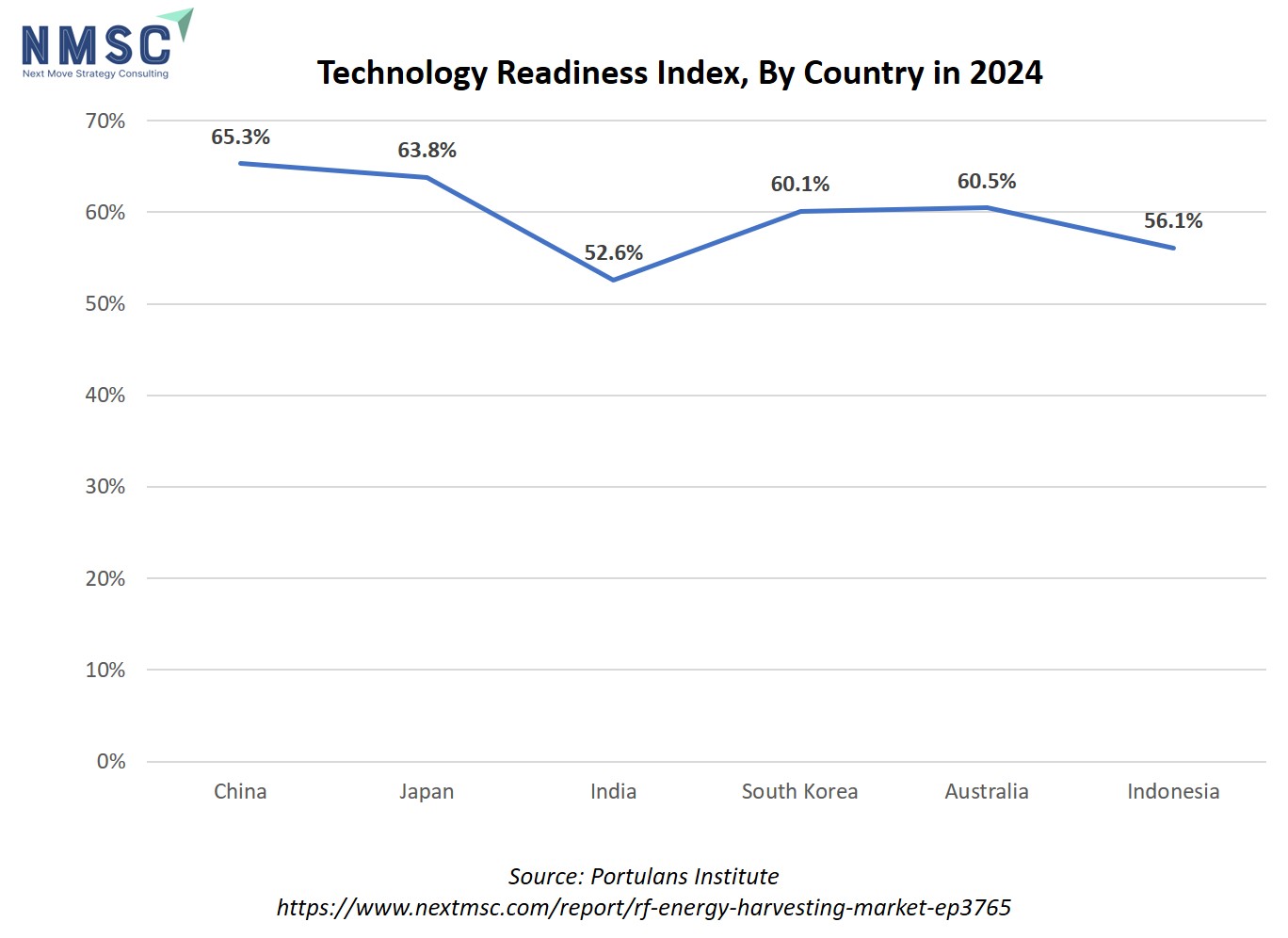
Higher technology readiness levels in countries like China, Japan, South Korea, and Australia indicate robust digital infrastructure, advanced industry practices, and a supportive innovation environment, all of which accelerate the adoption of new technologies such as RF energy harvesting. Markets with higher readiness are more likely to quickly integrate energy harvesting solutions into IoT deployments, industrial automation, and smart infrastructure, thus driving faster market expansion.
Growth Inhibitors:
What Challenges Hinder the Widespread Adoption of RF Energy Harvesting Technology?
The widespread adoption of RF energy harvesting technology faces several challenges. One of the primary obstacles is the low power conversion efficiency of current systems, which limits the amount of usable energy that can be harvested from ambient RF signals. Additionally, the need for miniaturization of components to fit into compact devices without compromising performance adds complexity to the design and manufacturing processes. These technical limitations increase costs and delay the deployment of RF energy harvesting solutions in various applications.
How Can Companies Capitalize on the Growing Demand for Sustainable Energy Solutions?
Companies capitalize on the growing demand for sustainable energy solutions by investing in the development and commercialization of RF energy harvesting technologies. As industries and consumers increasingly prioritize energy efficiency and environmental sustainability, RF energy harvesting offers a compelling solution for powering IoT devices, wearable electronics, and other low-power applications. By focusing on improving the efficiency and scalability of RF energy harvesting systems, companies can meet the evolving needs of the market and establish themselves as key players in the renewable energy sector. Strategic partnerships with IoT device manufacturers and participation in government-backed sustainability initiatives further enhance business opportunities and market penetration.
How RF Energy Harvesting Market Segmented in This Report, And What Are the Key Insights from The Segmentation Analysis?
By Energy Source Insights
Is Energy Harvesting from Ambient RF Signals Transforming the RF Energy Harvesting Market in 2025?
Based on energy source, RF energy harvesting market segments are divided into ambient RF signals and dedicated RF transmitters.
Ambient RF signals are electromagnetic waves emitted by existing communication infrastructure, such as radio and television broadcasts, mobile networks, and Wi-Fi systems. These signals are typically unintentional byproducts of communication systems but can be harnessed to power small electronic devices. The energy harvested from ambient RF signals is generally low and fluctuates based on the distance from the source and environmental factors.
Dedicated RF transmitters are purpose-built sources designed specifically to emit RF energy for the purpose of energy harvesting. Unlike ambient RF signals, which are incidental, dedicated transmitters provide a controlled and consistent energy source. These transmitters can be strategically deployed to ensure optimal energy delivery to target devices. The use of dedicated RF transmitters allows for precise control over the energy harvesting process, leading to more reliable and efficient power supply for devices.
By Technology Insights
Is Technology Innovation Driving the RF Energy Harvesting Market in 2025?
On the basis of technology, the market is segmented into rectenna-based, resonant circuit-based, antenna array-based, integrated circuit-based, and hybrid systems.
Rectenna-based systems combine an antenna and a rectifying circuit to convert RF signals directly into DC power. These systems are widely adopted due to their simplicity, high conversion efficiency at specific frequency bands, and suitability for low-power applications such as wireless sensors and wearables. Advances in multi-diode rectifiers and impedance matching have further enhanced energy capture, making them ideal for both ambient and dedicated RF energy sources.
Resonant circuit-based RF harvesters use tuned LC circuits to maximize energy capture at a particular frequency. These systems provide higher efficiency at narrow frequency bands and are particularly effective in controlled RF environments. Their design allows selective energy harvesting, reducing interference from unwanted signals.
Integrated circuit-based RF harvesters integrate antennas, rectifiers, and power management on a single chip, reducing size and enhancing reliability. These systems enable compact, low-power designs ideal for wearable electronics, medical implants, and miniature IoT devices. By adopting integrated circuit-based approaches, companies deliver fully packaged solutions that simplify device design while maintaining efficient energy harvesting and storage, opening new opportunities in miniaturized and high-density applications.
By Component Insights
Are Component Innovations Driving the RF Energy Harvesting Market in 2025?
On the basis of component, the market is segmented into antenna, rectifier, energy storage, and power management circuit.
The antenna is the primary component responsible for capturing RF signals from the environment. Its design, including size, frequency band, and gain, directly impacts the amount of energy that can be harvested. Advanced designs such as multi-band, wideband, and phased-array antennas improve energy capture from diverse RF sources. The rectifier converts the captured alternating RF signal into direct current (DC) power. The efficiency of this conversion is crucial, as losses here reduce the usable energy. Innovations such as multi-stage, diode-based, and synchronous rectifiers are increasing energy conversion rates. Companies leverage high-efficiency rectifiers to maximize harvested energy, enabling low-power devices to operate reliably even in environments with weak RF signals
Energy storage components, including capacitors, supercapacitors, and microbatteries, store the harvested energy for use when needed. Effective storage ensures uninterrupted device operation, particularly in applications with intermittent RF signals. Companies developing advanced, compact storage solutions enhance the autonomy of devices like wearable electronics, IoT sensors, and medical implants, improving reliability and extending device lifetime.
The power management circuit regulates the harvested energy to match device requirements, controlling charging, discharging, and load delivery. Efficient power management ensures that devices receive stable energy without overloading or wasting power. Companies focusing on adaptive, low-loss power management circuits improve overall system efficiency, enabling a broader range of applications and reducing energy wastage in RF harvesting systems.
By Application Insights
Is Application Expansion Shaping the RF Energy Harvesting Market in 2025?
On the basis of application, the market is segmented into consumer electronics, industrial, medical, transportation, and smart homes and buildings.
Consumer electronics, including wearables, smart devices, and IoT gadgets, are major adopters of RF energy harvesting. These devices require compact, low-power solutions that can operate reliably without frequent battery replacements. Harvesting ambient RF signals allows these devices to maintain longer operational lifespans and reduces maintenance costs.
Industrial applications leverage RF energy harvesting to power wireless sensors, monitoring systems, and automation devices in factories, warehouses, and production lines. These environments often have multiple RF sources, making ambient harvesting effective. Reliable energy supply reduces downtime and maintenance, especially in remote or hazardous locations. Medical applications, such as implantable devices, health monitoring wearables, and diagnostic sensors, benefit from RF energy harvesting by enabling battery-free or low-maintenance operation. Consistent energy supply ensures uninterrupted device functionality, which is critical for patient safety. Companies focus on developing compact, biocompatible harvesters integrated with advanced power management to serve healthcare providers and improve patient outcomes.
Regional Outlook
The RF energy harvesting market share is geographically studied across North America, Europe, Asia Pacific, Middle East & Africa, and Latin America and each region is further studied across countries.
RF Energy Harvesting Market in North America
North America is a leading region in the RF energy harvesting market, primarily due to its advanced technological infrastructure, high adoption of IoT devices, and increasing emphasis on energy efficiency and sustainability. Countries in this region, particularly the U.S. and Canada, are investing heavily in smart cities, industrial automation, and wireless sensor networks, creating a strong demand for battery-free and low-maintenance power solutions. The U.S. has witnessed growing applications in healthcare wearables, industrial monitoring, and smart home devices, driven by a need for reliable and eco-friendly energy solutions. In Canada, large remote areas and urban development projects further emphasize autonomous energy systems. These factors collectively encourage companies to innovate in high-efficiency RF harvesting modules, rectenna designs, and hybrid energy systems, ensuring consistent power delivery and contributing to the rise of the RF energy harvesting market across North America.
RF Energy Harvesting Market in the United States
The United States is a leading market for RF energy harvesting, driven by widespread adoption of IoT devices, industrial automation, and smart home technologies. The healthcare sector increasingly relies on wearable monitoring devices and implantable sensors, creating demand for battery-free or low-maintenance energy solutions. Smart city initiatives and wireless infrastructure upgrades further accelerate adoption, as ambient RF signals from communication networks provide consistent power for low-energy devices. Additionally, the U.S. government’s focus on energy efficiency and reducing carbon emissions supports R&D in sustainable energy technologies.
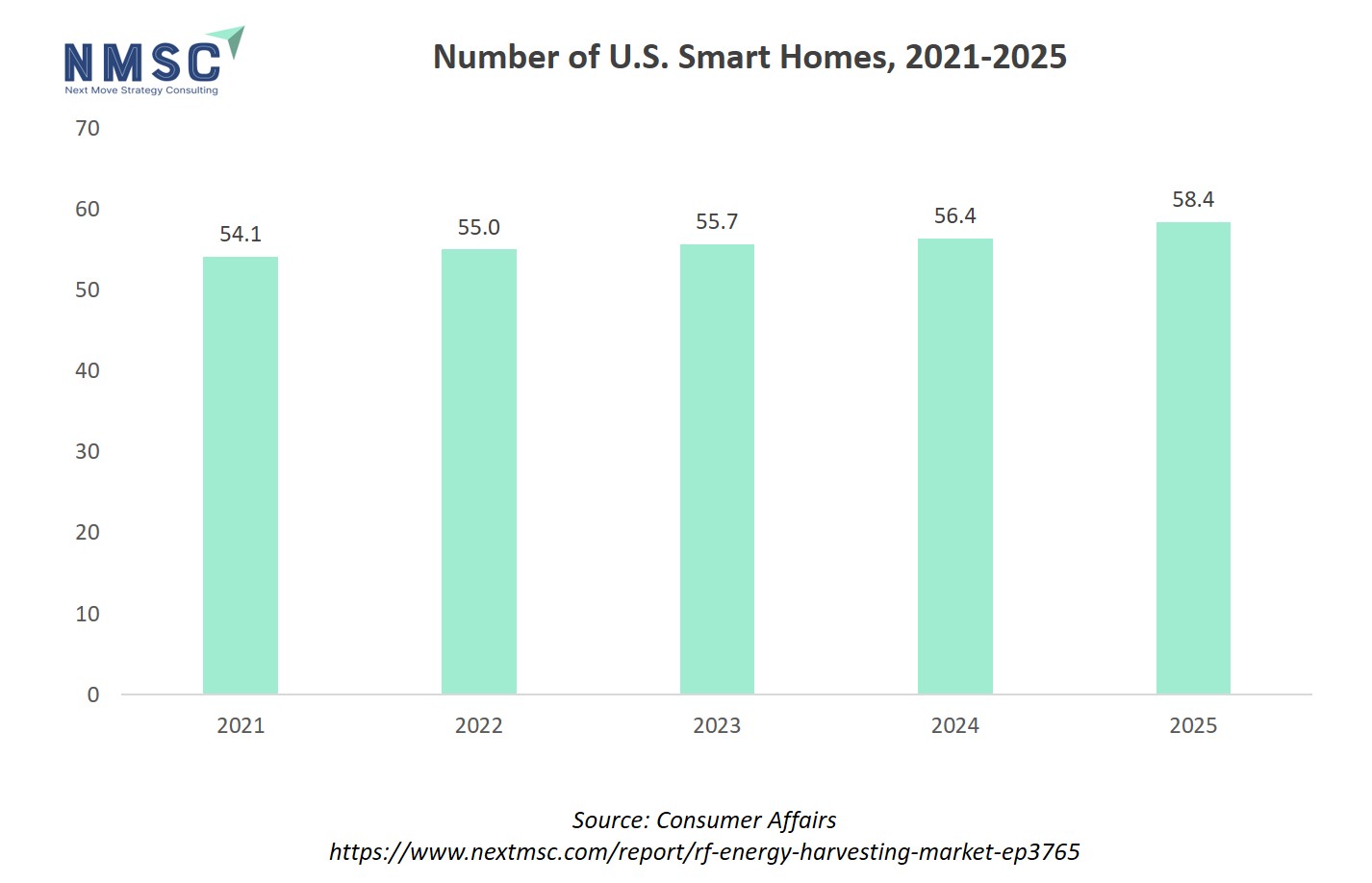
The growth in smart homes directly fuels demand for power-efficient, maintenance-free sensors and smart devices, core application areas for RF energy harvesting. As the penetration of smart homes rises, the need for decentralized, battery-less energy solutions expands, accelerating the adoption of RF energy harvesting technologies to power a diverse range of wireless IoT devices, enhance reliability, and reduce operational costs in the smart home ecosystem.
RF Energy Harvesting Market in Canada
Canada’s expansive geography and commitment to renewable energy and sustainability provide a favorable environment for radio frequency energy harvesting adoption. Industrial sectors, smart cities, and remote infrastructure projects benefit from autonomous energy solutions that reduce the reliance on battery replacements. Ambient RF signals from communication networks and dedicated transmitters power low-energy sensors in urban and rural areas, enabling efficient operation of IoT devices, environmental monitors, and wearable electronics.
RF Energy Harvesting Market in Europe
Europe’s RF energy harvesting market growth is underpinned by strong regulatory frameworks promoting sustainability, renewable energy, and energy-efficient technologies. The European Union’s focus on carbon neutrality by 2050 and smart infrastructure initiatives encourages the adoption of RF energy harvesting across industries and urban planning. Germany integrates these technologies into Industry 4.0 applications, including automated factories and wireless monitoring systems, while France leverages energy harvesting for smart city projects and low-power IoT devices. The United Kingdom, Italy, and Spain are also increasingly adopting RF harvesting in residential automation, smart buildings, and healthcare monitoring devices. The Nordics stand out for early adoption due to a strong renewable energy focus, smart grids, and high technological readiness. Across Europe, the combination of government support, advanced infrastructure, and environmental consciousness is creating a favourable ecosystem, significantly driving market penetration for rectenna technologies.
RF Energy Harvesting Market in the United Kingdom
The United Kingdom is witnessing rapid adoption of RF energy harvesting due to its focus on smart infrastructure, IoT expansion, and energy-efficient urban solutions. Smart homes, connected buildings, and industrial monitoring systems increasingly rely on low-power wireless sensors, making ambient RF energy a cost-effective and sustainable power source. Government-backed research programs and grants for renewable and low-power technologies enhance R&D activities, encouraging companies to innovate in compact, high-efficiency RF harvesters. The combination of dense urban environments, widespread wireless connectivity, and regulatory emphasis on sustainability ensures a growing demand for energy harvesting solutions, supporting long-term market expansion in the UK.
RF Energy Harvesting Market in Germany
Germany’s Industry 4.0 initiatives, smart manufacturing, and strong industrial automation ecosystem make it a key adopter of RF energy harvesting technologies. Wireless sensors and monitoring devices in factories and logistics systems require uninterrupted, low-maintenance power, which RF harvesting provides. The government’s commitment to energy efficiency, renewable energy, and sustainable manufacturing practices further drives adoption. Companies offering efficient rectenna systems, hybrid energy harvesters, and integrated circuit-based solutions can capitalize on Germany’s industrial focus, ensuring reliable wireless operation and reducing dependency on traditional power sources, while contributing to the overall growth of the RF energy harvesting market in Europe
RF Energy Harvesting Market in France
France’s adoption of batteryless IoT solutions is propelled by smart city initiatives, industrial automation, and environmental monitoring programs. The country emphasizes sustainable and energy-efficient solutions to reduce carbon footprints and optimize urban infrastructure. Applications include wireless sensors for building automation, smart energy meters, and healthcare devices.
RF Energy Harvesting Market in Italy
Italy’s smart city development and energy efficiency policies create a favorable market for RF energy harvesting adoption. Urban infrastructure projects, connected buildings, and industrial automation benefit from low-power, autonomous energy solutions. The country emphasizes integrating sustainable technologies into both residential and commercial applications, making RF energy harvesting a suitable solution for powering IoT sensors, smart meters, and wireless monitoring devices. Companies offering efficient rectifier circuits, compact antennas, and power management modules can target Italy’s urban and industrial markets, supporting continuous device operation and reducing dependency on conventional energy sources.
RF Energy Harvesting Market in Spain
Spain’s RF energy harvesting market is driven by sustainability initiatives, renewable energy adoption, and smart infrastructure deployment. Smart homes, industrial sensors, and wireless monitoring systems increasingly rely on low-power energy solutions that can leverage ambient RF signals. Urban and industrial applications benefit from efficient energy conversion, reducing maintenance costs and improving operational reliability.
RF Energy Harvesting Market in the Nordics
The Nordic countries prioritize sustainability, renewable energy, and smart grid deployment, creating early adoption opportunities for RF energy harvesting. Wireless sensors, smart building devices, and industrial monitoring solutions leverage ambient RF energy for low-power operation. Advanced regulatory frameworks and high technology readiness encourage companies to innovate in compact, efficient energy harvesting modules, supporting sustainable urban and industrial infrastructure. The combination of environmental awareness and strong IoT adoption ensures continued market growth in these countries.
RF Energy Harvesting Market in the Asia-Pacific
Asia-Pacific is experiencing rapid adoption of RF energy harvesting technologies, propelled by increasing urbanization, industrialization, and IoT deployment across multiple sectors. China, as a regional leader, integrates RF harvesting into smart city projects, industrial automation, and environmental monitoring, aligning with government policies on energy efficiency. Japan focuses on compact, high-efficiency modules for wearables and industrial IoT devices, emphasizing technological innovation. India and Indonesia are adopting RF energy harvesting in urban and rural infrastructure to address energy access challenges while promoting sustainable solutions. South Korea and Taiwan leverage high-tech industrial ecosystems to integrate RF harvesting into smart factories and telecommunication systems. Australia prioritizes smart homes and renewable energy adoption. Across the region, drivers such as government support, high wireless connectivity, and energy-conscious initiatives are fueling consistent growth, making Asia-Pacific a key driver for global RF energy harvesting market expansion.
RF Energy Harvesting Market in China
China is a dominant player in the RF energy harvesting market due to massive industrialization, urbanization, and IoT deployment. Smart cities, industrial automation, and environmental monitoring initiatives use RF energy harvesting to reduce energy costs and improve operational efficiency. Companies focus on high-efficiency rectifiers, antenna arrays, and hybrid systems to power IoT devices in urban and industrial settings, enabling battery-free or low-maintenance operation. Government policies supporting energy efficiency further enhance adoption.
RF Energy Harvesting Market in Japan
Japan’s RF energy harvesting adoption is propelled by technological innovation, energy-efficient designs, and widespread IoT and wearable device deployment. Smart infrastructure, industrial automation, and healthcare monitoring devices increasingly use compact and efficient RF harvesters. Companies focusing on miniaturized, high-efficiency modules leverage this environment to expand applications and market share.
RF Energy Harvesting Market in India
India’s growing urbanization, IoT adoption, and energy challenges drive RF energy harvesting demand. Wireless sensors for smart cities, industrial monitoring, and remote infrastructure benefit from battery-free solutions. Companies developing compact, efficient, and low-cost modules meet the growing energy needs across urban and rural areas.
RF Energy Harvesting Market in South Korea
South Korea leverages RF energy harvesting for smart city projects, industrial IoT, and wireless monitoring devices. Government initiatives promoting energy efficiency and technological innovation accelerate market growth. Investing in integrated and hybrid harvesting solutions capture opportunities in industrial and urban applications.
RF Energy Harvesting Market in Taiwan
Taiwan focuses on energy-efficient industrial and smart infrastructure applications, driving RF energy harvesting adoption. Compact, efficient harvesters enable IoT deployment in factories, urban monitoring, and consumer electronics. Companies focusing on miniaturized, low-cost, and reliable modules benefit from Taiwan’s high-tech ecosystem.
RF Energy Harvesting Market in Indonesia
Indonesia’s urbanization and infrastructure development drive demand for RF energy harvesting to power IoT devices and sensors in smart cities and remote areas. Companies developing low-cost, high-efficiency harvesters capitalize on the market’s growth.
RF Energy Harvesting Market in Australia
Australia emphasizes smart homes, commercial buildings, and energy-efficient IoT deployment, promoting RF energy harvesting adoption. Urban infrastructure and smart city projects benefit from battery-free sensors and low-power devices.
RF Energy Harvesting Market in Latin America
In Latin America, the RF energy harvesting market is emerging, driven by energy access challenges, urbanization, and the need for cost-effective power solutions for IoT and smart infrastructure. Countries like Brazil and Mexico are exploring energy harvesting technologies to power wireless sensors, environmental monitoring devices, and smart home systems, particularly in areas with limited grid connectivity. Government programs promoting renewable energy adoption, coupled with the rise of industrial IoT applications in agriculture and logistics, enhance market opportunities. The presence of growing urban centres with smart infrastructure projects further accelerates adoption. As companies focus on low-power, low-cost harvesting solutions suitable for challenging terrains and variable RF environments, Latin America is witnessing increased interest in RF energy harvesting technologies, providing a platform for innovative energy solutions and expanding the overall market footprint in the region.
RF Energy Harvesting Market in the Middle East & Africa
The Middle East and Africa represent an emerging market for RF energy harvesting, with growth driven by off-grid energy needs, industrial monitoring, and smart infrastructure development. Countries in the Middle East, particularly the UAE and Saudi Arabia, are implementing smart city initiatives, integrating IoT devices powered by sustainable energy solutions. Africa, with its large remote and off-grid areas, benefits from RF energy harvesting for wireless sensors, environmental monitoring, and low-power communication networks. The combination of limited grid infrastructure, increasing digitalization, and a focus on renewable and efficient energy solutions drives the market. Companies developing adaptable, low-cost, and high-efficiency energy harvesting modules can capitalize on these opportunities, addressing power reliability challenges while promoting sustainability, thereby contributing to the growing adoption of RF energy harvesting technologies in the region.
Competitive Landscape
Which Companies Dominate the RF Energy Harvesting Industry and How Do They Compete?
The RF energy harvesting market is characterized by a dynamic landscape of established giants and innovative specialists. Leading companies such as Powercast Corporation, Texas Instruments, EnOcean GmbH, ZF Friedrichshafen AG, STMicroelectronics, and Microchip Technology Inc. are at the forefront, offering a range of solutions from wireless power transmitters to energy-efficient components. These companies are competing by enhancing their product portfolios, expanding into new applications, and forming strategic partnerships. For instance, Powercast's recent advancements in wireless power technology have enabled U.S. retailers to scale their operations by adopting battery-free solutions for electronic shelf labels, reducing costs and waste while supporting dynamic pricing and better in-store experiences. Additionally, ONiO's USD 3.6 million Eurostars grant underscores the growing emphasis on sustainable electronics, positioning the company to revolutionize energy harvesting technology.
Market Dominated by RF Energy Harvesting Giants and Specialists
The competition in the RF energy harvesting market is intensifying as both industry giants and specialized firms vie for dominance across various niches. Established players like Texas Instruments and STMicroelectronics leverage their extensive semiconductor expertise to offer integrated solutions for industrial automation, automotive applications, and consumer electronics. Meanwhile, specialized companies such as Wiliot focus on ambient IoT applications, providing battery-free solutions for asset tracking and environmental monitoring. This diverse competition is shaping the market by driving innovation, reducing costs, and expanding the range of applications for RF energy harvesting technologies. As the market continues to grow, companies that can effectively integrate energy harvesting into existing infrastructures and offer scalable solutions will likely lead the industry.
Innovation and Adaptability Drive Market Success
Innovation and adaptability are crucial for success in the RF energy harvesting market. Companies are investing in research and development to enhance the efficiency and scalability of their solutions. For example, Wiliot's development of battery-free tags that harvest energy from ambient radio frequencies enables indefinite operation without maintenance, addressing a significant challenge in traditional IoT deployments. Similarly, ONiO's focus on sustainable electronics and energy harvesting technology positions the company to meet the growing demand for eco-friendly solutions. These innovations not only improve product performance but also align with global trends towards sustainability and energy efficiency, providing companies with a competitive edge in the market.
Market Players to Opt for Merger & Acquisition Strategies to Expand Their Presence
Merger and acquisition (M&A) strategies are becoming increasingly prevalent among key players seeking to expand their capabilities and market presence. For instance, the collaboration between Soitec and GlobalFoundries to supply RF-SOI wafers for the 9SW platform highlights the industry's move towards consolidating resources to meet the demands of next-generation devices, including 5G and Wi-Fi chips. Such strategic partnerships enable companies to enhance their technological offerings, access new markets, and accelerate product development. As the RF energy harvesting market continues to evolve, M&A activities are expected to play a pivotal role in shaping the competitive landscape, fostering innovation, and driving industry growth.
List of Key RF Energy Harvesting Companies
-
Powercast Corporation
-
Texas Instruments
-
EnOcean GmbH
-
ZF Friedrichshafen AG
-
STMicroelectronics
-
ONIO AS
-
Wiliot
-
e-peas
-
Teratonix
-
Analog Devices
-
EnOcean Alliance
-
NXP Semiconductors
-
Voltree Power LLC
What are the Latest Key Industry Developments?
-
October 2025- Powercast, in partnership with InPlay, launched a battery-free Bluetooth Low Energy (BLE) sensor tag powered by RF energy. This innovation eliminates the need for battery replacements, offering a sustainable solution for temperature and humidity monitoring in various applications.
-
September 2025- Powercast's RF wireless power technology enables U.S. retailers to deploy Electronic Shelf Labels (ESLs) without batteries, reducing maintenance costs and environmental impact. This advancement supports dynamic pricing and enhances in-store experiences, marking a significant step towards sustainable retail operations.
-
December 2024- Soitec will supply its 300mm RF-SOI wafers to GlobalFoundries for the 9SW platform, enhancing the performance of 5G and Wi-Fi chips. This collaboration aims to improve energy efficiency and reduce product sizes, aligning with the industry's push towards compact and power-efficient devices.
-
October 2024- Ligna Energy collaborates with ONiO, Epishine, and Jiva Materials to develop eco-friendly supercapacitors and components for energy harvesting applications. This partnership focuses on creating sustainable electronics for IoT devices, aiming to reduce environmental impact and enhance energy efficiency.
-
September 2024- Norwegian startup ONiO secured a USD 3.6 million Eurostars grant to develop scalable energy harvesting solutions using ultra-low-power microcontrollers and sustainable components. This initiative aims to revolutionize IoT devices by reducing reliance on batteries and promoting eco-friendly electronics.
What are the Key Factors Influencing Investment Analysis & Opportunities in the RF Energy Harvesting Market?
Investment in the RF energy harvesting market is increasingly driven by the growing demand for sustainable and low-maintenance energy solutions across IoT, smart cities, industrial automation, and wearable devices. Funding trends show a strong preference for startups and companies developing high-efficiency harvesters, hybrid systems, and eco-friendly components. Venture capital and government-backed grants are channeling resources into technologies that reduce reliance on batteries and enhance device autonomy, positioning the sector as an attractive investment opportunity for technology-focused investors.
Valuations in this market are being shaped by innovation, intellectual property, and the ability to scale applications across consumer, industrial, and medical sectors. Investment hotspots include regions with high IoT penetration, smart infrastructure development, and supportive regulatory environments, such as North America, Europe, and Asia-Pacific. Companies that demonstrate strong R&D capabilities, sustainable practices, and strategic partnerships are likely to attract substantial funding, making the RF energy harvesting market a fertile ground for growth-oriented investors.
Key Benefits for Stakeholders:
Next Move Strategy Consulting (NMSC) presents a comprehensive analysis of the RF energy harvesting market, covering historical trends from 2020 through 2024 and offering detailed forecasts through 2030. Our study examines the market at regional and country levels, providing quantitative projections and insights into key growth drivers, challenges, and investment opportunities across all major RF energy harvesting segments.
The RF energy harvesting industry creates value for a wide range of stakeholders by addressing energy efficiency, sustainability, and operational cost challenges. Investors benefit from the market’s growth potential, driven by increasing adoption of IoT devices, smart infrastructure, and industrial automation, as well as the opportunity to fund innovative startups and technology leaders with scalable solutions. Customers, including businesses and end-users, gain from reduced reliance on batteries, lower maintenance costs, and enhanced device reliability, particularly in remote or hard-to-access environments. Additionally, governments and regulators benefit indirectly as widespread adoption supports energy conservation, lowers electronic waste, and aligns with sustainability initiatives. By bridging technological innovation with practical energy solutions, the industry delivers economic, environmental, and operational advantages across its ecosystem.
Report Scope
|
Parameters |
Details |
|
Market Size in 2025 |
USD 30.58 Billion |
|
Revenue Forecast in 2030 |
USD 102.64 Billion |
|
Growth Rate |
CAGR of 27.4% from 2025 to 2030 |
|
Analysis Period |
2024–2030 |
|
Base Year Considered |
2024 |
|
Forecast Period |
2025–2030 |
|
Market Size Estimation |
Billion (USD) |
|
Growth Factors |
|
|
Companies Profiled |
15 |
|
Countries Covered |
33 |
|
Market Share |
Available for 10 companies |
|
Customization Scope |
Free customization (equivalent to up to 80 analyst-working hours) after purchase. Addition or alteration to country, regional & segment scope. |
|
Pricing and Purchase Options |
Avail customized purchase options to meet your exact research needs. |
|
Approach |
In-depth primary and secondary research; proprietary databases; rigorous quality control and validation measures. |
|
Analytical Tools |
Porter's Five Forces, SWOT, value chain, and Harvey ball analysis to assess competitive intensity, stakeholder roles, and relative impact of key factors. |
Key Market Segments
By Energy Source
-
Ambient RF signals
-
Cellular networks
-
Wi-Fi networks
-
TV and radio broadcast
-
Satellite signals
-
-
Dedicated RF transmitters
By Technology
-
Rectenna-based
-
Resonant circuit-based
-
Antenna array-based
-
Integrated circuit-based
-
Hybrid systems
By Component
-
Antenna
-
Rectifier
-
Energy storage
-
Power management circuit
By Application
-
Consumer electronics
-
Industrial
-
Medical
-
Transportation
-
Smart homes and buildings
Geographical Breakdown
-
North America: U.S., Canada, and Mexico.
-
Europe: U.K., Germany, France, Italy, Spain, Sweden, Denmark, Finland, Netherlands, and rest of Europe.
-
Asia Pacific: China, India, Japan, South Korea, Taiwan, Indonesia, Vietnam, Australia, Philippines, Malaysia and rest of APAC.
-
Middle East & Africa (MEA): Saudi Arabia, UAE, Egypt, Israel, Turkey, Nigeria, South Africa, and rest of MEA.
-
Latin America: Brazil, Argentina, Chile, Colombia, and rest of LATAM
Conclusion & Recommendations
Our report equips stakeholders, industry participants, investors, and consultants with actionable intelligence to capitalize on RF energy harvesting’s transformative potential. By combining robust data-driven analysis with strategic frameworks, NMSC’s RF Energy Harvesting Market Report serves as an indispensable resource for navigating the evolving landscape.
The RF energy harvesting market is poised for sustained growth, driven by increasing IoT adoption, smart infrastructure development, and the push for sustainable, low-maintenance energy solutions. Strategic takeaways highlight the importance of innovation, high-efficiency systems, and hybrid technologies, alongside strong partnerships and government-backed initiatives. Companies that focus on scalable, eco-friendly solutions and diversify applications across consumer, industrial, and medical sectors are well-positioned to capture market share. Regional dynamics, particularly in North America, Europe, and the Asia-Pacific, indicate robust opportunities fueled by technological readiness, regulatory support, and urbanisation.
For executives and investors, these findings suggest prioritizing investments in high-efficiency RF harvesting technologies, supporting startups with innovative solutions, and exploring strategic partnerships or M&A to expand market presence. Monitoring emerging applications, sustainability trends, and regional adoption patterns help decision-makers identify high-potential opportunities, optimize portfolios, and capitalize on the evolving landscape of the RF energy harvesting market.


About the Author
 Mayurima Roy
— Mayurima Roy is Research Analyst at Next Move Strategy Consulting, where she has spent 4 years working across the firm's full industry coverage rather than a single fixed vertical. Her work centers on structured research, ongoing trend tracking, competitive assessment, and insight-led content development, translating complex market data into clear, decision-ready narratives that support informed client decision-making across diverse global industries, market sectors, and world regions every day.
Mayurima Roy
— Mayurima Roy is Research Analyst at Next Move Strategy Consulting, where she has spent 4 years working across the firm's full industry coverage rather than a single fixed vertical. Her work centers on structured research, ongoing trend tracking, competitive assessment, and insight-led content development, translating complex market data into clear, decision-ready narratives that support informed client decision-making across diverse global industries, market sectors, and world regions every day.
About the Reviewer
 Supradip Baul
— Supradip Baul is an accomplished business consultant and strategist with over a decade of rich experience in market intelligence, strategy, technology, and business transformation. His work has included rigorous qualitative and quantitative analysis across multiple industries, helping clients shape investment decisions and long-term roadmaps. Earlier in his career, he was associated with Gartner, where he contributed to industry-leading reports and market share analyses. He has worked with leading global companies and holds an MBA with a dual specialization in Marketing and Finance.
Supradip Baul
— Supradip Baul is an accomplished business consultant and strategist with over a decade of rich experience in market intelligence, strategy, technology, and business transformation. His work has included rigorous qualitative and quantitative analysis across multiple industries, helping clients shape investment decisions and long-term roadmaps. Earlier in his career, he was associated with Gartner, where he contributed to industry-leading reports and market share analyses. He has worked with leading global companies and holds an MBA with a dual specialization in Marketing and Finance.
At Next Move Strategy Consulting, we understand that insightful market research is the cornerstone of successful business decisions. That's why we employ a robust and multifaceted approach, combining various methodologies to deliver the most accurate and actionable data for our clients.

Research Landscape
We navigate the world of research with two primary approaches:
Qualitative Approach
Our qualitative research methodologies involve immersive techniques such as in-depth interviews, focus groups, and observational studies. By engaging directly with individuals and stakeholders, we uncover valuable insights that quantitative data alone may overlook.

Quantitative Research
In tandem with qualitative methodologies, NMSC leverages the power of Quantitative Research to provide a robust foundation of numerical insights. Through systematic data collection and analysis, we quantify patterns, preferences, and market trends, offering a comprehensive view of the business landscape.
Our quantitative research approach employs diverse tools, including surveys, experiments, and statistical modelling. These methodologies enable us to gather data from a large and representative sample, ensuring the statistical significance of our findings. By employing structured questionnaires and standardized data collection methods, we guarantee the reliability and validity of the information we present to our clients.
Quantitative research is particularly effective in measuring the prevalence of trends, assessing market size, and gauging the impact of various factors on consumer behavior. The numerical precision attained through this approach equips our clients with actionable insights, facilitating data-driven decision-making and strategy formulation.


Our Specialized Toolbox for Industry-Specific Market Research
We deploy a specialized arsenal of techniques tailored to meet your unique requirements. Here's a glimpse into our comprehensive toolbox:

Information Procurement
The stage entails acquiring market data or relevant information through various sources and methodologies.


Market Research Approach
We utilize both top-down and bottom-up approaches in market research analysis to achieve a comprehensive understanding of the market dynamics, leveraging the broad perspective of industry trends and macroeconomic factors alongside detailed insights from specific segments and individual companies.

Porters Five Forces Analysis
We conduct Porter's Five Forces analysis to evaluate the competitive landscape of an industry, providing us with insights into factors that affect profitability and strategic positioning.

SWOT Analysis

Forecasting
We utilize a forecasting model to predict future consumption by considering parameters like population, economics, regulations, market competition, drivers, constraints, technology, and pricing. We also employ statistical techniques such as multilinear regression, exponential smoothing, moving average, ARIMA, and Monte Carlo simulations for accurate predictions. In econometric forecasting, we analyzed short-term and long-term event impacts, attributing values based on regulatory frameworks, economic factors, and market events.





 Speak to Our Analyst