RISC-V Processor Market by Product & Deliverable (Processor Intellectual Property (IP), Silicon Products, Hardware Development Platforms, Subsystem & Peripheral IP, Software Tools & Middleware, and Services & Support), by Business Model (IP Licensing Revenue, Silicon Sales Revenue, Software & Tool Sales Revenue, and Service & Support Revenue), by Architecture Type (Standard Unmodified Cores, and Others), and Others – Global Opportunity Analysis and Industry Forecast, 2024–2030
Industry: Semiconductor & Electronics | Publishing Date: June 6, 2026 | Last Updated: October 16, 2026 | No of Pages: N/A | No. of Tables: N/A | No. of Figures: N/A | Format: PDF | Report Code: SE3796
Industry Outlook
The global RISC-V Market size was valued at USD 1.66 billion in 2024 and is expected to reach USD 2.20 billion by 2025. Looking ahead, the industry is projected to expand significantly, reaching USD 9.08 billion by 2030, registering a CAGR of 32.8% from 2025 to 2030.
The RISC-V market is expanding rapidly, propelled by the growing demand for open-standard, customizable, and cost-efficient processor architectures across sectors such as automotive, consumer electronics, telecommunications, and industrial automation. RISC-V’s open-source instruction set architecture (ISA) offers flexibility and scalability, enabling companies to design processors optimised for performance, power efficiency, and application-specific requirements. The surge in AI, IoT, and edge computing applications is further accelerating adoption, as developers seek alternatives to proprietary architectures to reduce dependency and enhance innovation. Governments and enterprises are increasingly supporting RISC-V through ecosystem collaborations, standardisation efforts, and investments in design tools and software support. By combining openness, adaptability, and cost-effectiveness, the market is transforming the global semiconductor landscape and fostering a new era of hardware innovation and technological independence.
What Are the Key RISC-V Market Trends?
How is Vendor IP and Silicon Productization Driving RISC-V Adoption Beyond Microcontrollers?
RISC-V International’s 2024 summary shows rapid ecosystem expansion across IP vendors, silicon houses and tool vendors. SiFive’s 2024 product announcements for higher-performance RISC-V processors targeted at data center and AI workloads demonstrate supplier confidence in scaling RISC-V beyond microcontroller applications. The data point that SiFive has publicly launched performance-oriented RISC-V cores in 2024 signals a deliberate industry move to address higher-value compute segments. Analysis suggests that as IP vendors productize cores with validated physical implementations, RISC-V becomes a practical choice for SoC integrators who previously defaulted to proprietary ISAs. For companies, the actionable insight is to accelerate silicon evaluation programs and secure early IP licensing or partnership arrangements to influence core roadmap choices and optimisation for target workloads. Early validation on power, toolchain maturity and security extensions will be decisive in winning design wins.
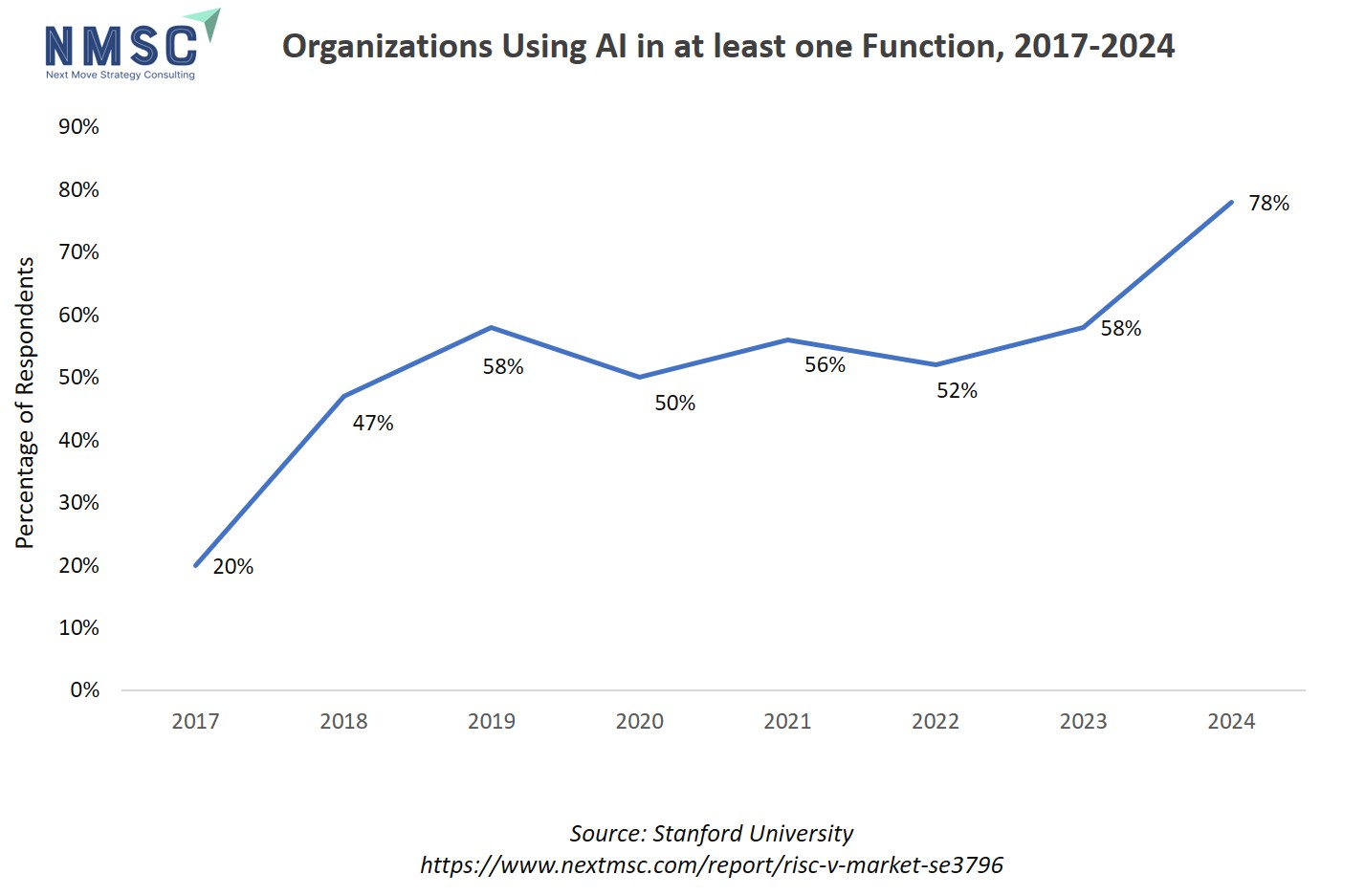
The chart shows a dramatic rise in organisational AI adoption, with usage growing from 20% in 2017 to 78% by 2024. This surge reflects the mainstreaming of AI across business functions, as enterprises increasingly rely on intelligent systems for automation, analytics, and decision-making. The rapid proliferation of AI drives requirements for flexible, customizable, and cost-efficient hardware architectures, trends that favour RISC-V, an open-source processor architecture. RISC-V's adaptability, compatibility with custom AI accelerators, and cost advantages make it an attractive option for companies deploying AI at scale, accelerating adoption in devices, edge computing, and data center environments as the AI market expands.
How are Hyperscalers and Cloud Providers Influencing RISC-V Tooling and Ecosystem Maturity?
While many hyperscalers continue to rely on established ISAs for mainstream data center CPUs, cloud providers and research groups are investing in RISC-V tooling and custom accelerators. Public primary materials and announcements in 2024 show cloud adjacent projects exploring RISC-V for accelerators and control functions, and the broader community is focusing on compiler, verification and security extensions to support these uses. Analysis indicates that hyperscaler interest accelerates ecosystem tooling (compilers, verification suites, secure boot stacks) and legitimises RISC-V for enterprise deployments. Companies should prioritise participation in community standards and contribute to open toolchain validation to reduce integration risk; establishing reference platform code and security-validated flows will shorten customer qualification cycles and increase the probability of enterprise design wins.
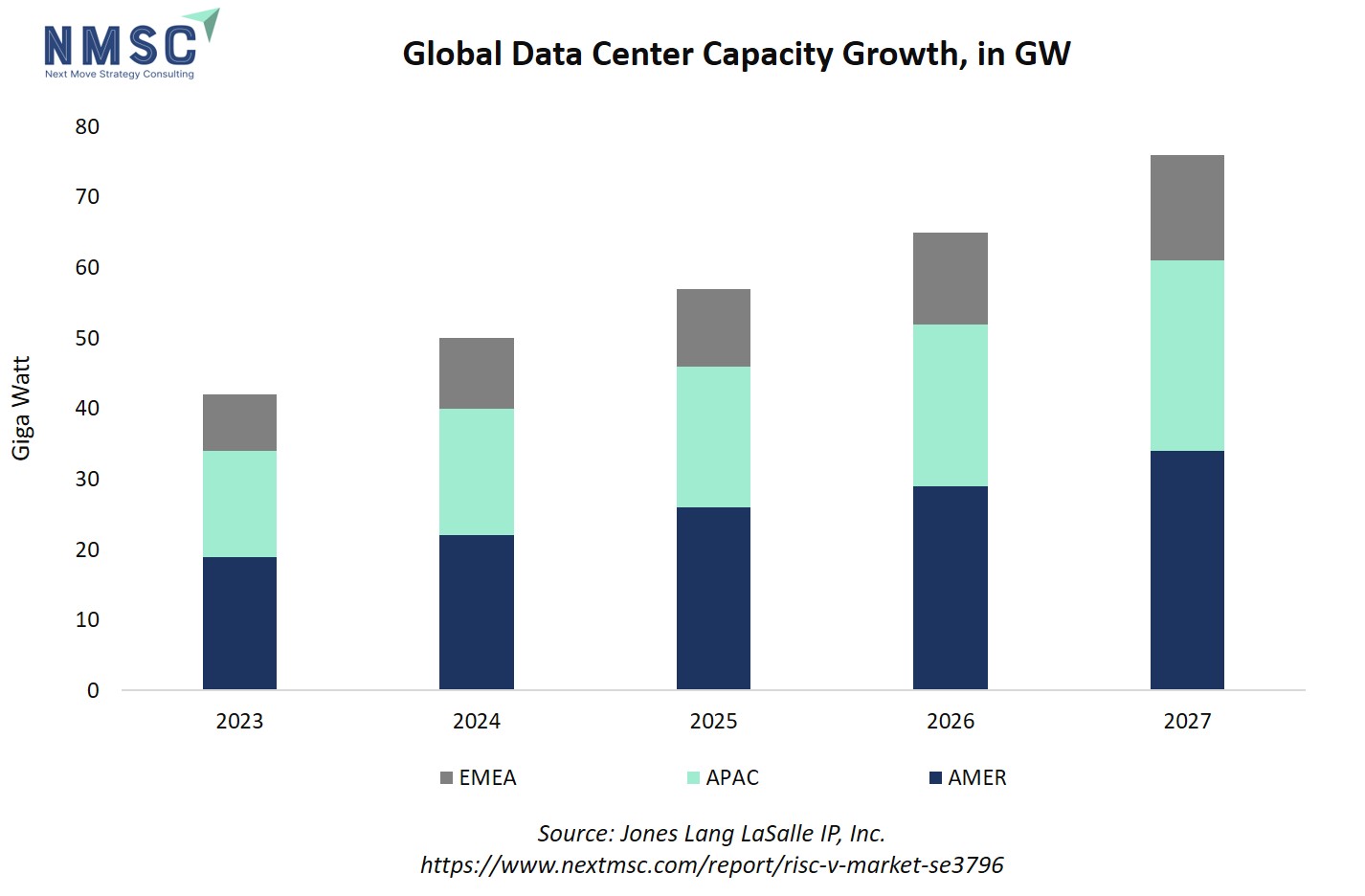
The chart depicts global data center capacity growth from 2023 to 2027, with total capacity rising steadily each year and all regions, AMER, APAC, and EMEA, showing significant contributions. This trend reflects the demand for high-performance infrastructure across diverse geographies, driven by digitalisation, cloud computing, and AI workloads. The expansion in data center capacity directly benefits the RISC-V market, as operators and enterprises seek highly customizable, cost-effective processor architectures for tailored workloads. RISC-V’s open-source nature allows for optimised, region-specific solutions and AI acceleration in data centers, making it an increasingly attractive choice as the sector scales globally and diversifies across continents.
How are National Strategic Plans and Security Assurance Activity Shaping RISC-V Market Dynamics?
Government and standards activity is increasingly relevant: U.S. congressional and government hearings have examined RISC-V’s role and assurance needs while NIST has published hardware assurance research addressing open ISAs and related verification. This primary government engagement signals both opportunity and scrutiny: governments favour open ISAs for supply chain resilience but will demand robust security assurance and provenance. Analysis shows that vendors who demonstrate hardware assurance, traceability and certified secure implementations will be preferred for government and critical infrastructure contracts. Actionable insight for firms is to invest in formal verification, provenance tracking and to participate in government-sponsored assurance activities to position offerings for public sector procurement.
What are the Key Market Drivers, Breakthroughs, and Investment Opportunities that Will Shape the RISC-V Market in the Next Decade?
RISC-V market momentum is driven by a mix of technical, commercial and geopolitical factors. Technically, the open ISA model enables flexibility, custom extensions and cost savings on license fees; commercially, IP vendors and silicon houses are productizing cores and toolchains to shorten time to market. Strategically, national technology policy and supply chain resilience considerations are encouraging adoption in certain jurisdictions. Primary source disclosures from ecosystem stakeholders in 2024 confirm multi-pronged investment in cores, tooling and assurance.
However, adoption faces meaningful challenges: toolchain maturity for high performance use cases, formal assurance and verification for security sensitive deployments, and the inertia of established ISA incumbents. At the same time, clear investment opportunities exist in hardened cores for edge AI, IP licensing focused on automotive and industrial safety, and verification and provenance tooling to meet government assurance requirements. Investors should prioritise vendors that couple IP with rigorous verification and those that have demonstrable partnerships with strategic OEMs.
Growth Drivers:
How does Cost and Design Flexibility Drive RISC-V Adoption in Embedded and Edge Markets?
The royalty-free nature of RISC-V combined with the ability to define custom extensions, enables SoC designers in IoT, consumer and edge AI to reduce per-unit licensing costs and to tailor cores to workload needs. SiFive and other IP vendors’ 2024 productization efforts make this option commercially accessible. Analysis indicates that the cost sensitivity of massive volume markets such as microcontrollers and edge processors accelerates RISC-V adoption where toolchain and ecosystem support meet product requirements. Companies should therefore prioritise creating low-power, area-efficient core implementations and reference subsystems that reduce integration work for OEMs and accelerate design wins.
How does Ecosystem Maturity and IP Productization Unlock Higher Performance Segments?
As vendors productize validated RISC-V cores with physical IP, cache coherency options and performance microarchitecture, RISC-V becomes credible for higher performance segments beyond MCUs. SiFive’s 2024 announcements targeting data center and vehicle compute are direct evidence. Analysis suggests that performance adoption depends on demonstrated parity in tooling, verification and performance per watt. Firms that invest in robust physical IP libraries, validated toolchains and ecosystem partnerships will reduce adoption friction and capture higher value design opportunities.
Growth Inhibitors:
How do verification, security assurance and software ecosystem gaps inhibit RISC-V scale in critical systems?
Widespread use of RISC-V in security-sensitive or safety-critical systems requires mature formal verification, certified toolchains and proven software stacks; NIST and government hearings highlight hardware assurance concerns for open ISA adoption. Analysis shows that the absence of demonstrated assurance and long-term software support commitments, many enterprise and government buyers reluctant to adopt RISC-V for critical workloads. The actionable mitigation is clear: vendors must invest in formal verification methodologies, third-party assurance audits, and long-term LTS software support agreements to lower procurement risk for enterprises and the public sector.
Where is the Most Promising Near-Term Investment Opportunity in the RISC-V Market?
Investment in verification and assurance tooling, secure boot and provenance stacks, and in high-quality physical IP targeting automotive and edge AI represents the greatest near-term upside. With governments and enterprises demanding assurance, companies that provide third-party validated design flows, traceability and supply chain provenance will command strategic premiums. Similarly, investing in IP vendors offering pre-validated subsystems for specific verticals like automotive safety, industrial control, and SSD controllers reduces customer integration risk and speeds adoption. Investors should prioritise startups or established IP houses with demonstrable pilots and government or OEM engagements.
How RISC-V Market Segmented in This Report, And What Are the Key Insights from the Segmentation Analysis?
By Product Insights
Is Core IP and Microarchitecture Licensing Leading RISC-V Product Growth in 2025?
Based on product, the market is segmented into core IP and microarchitecture licenses, microcontroller units, accelerator IP and inference engines, and toolchain, verification, and assurance services.
The market for open-standard core IP licenses continues to dominate RISC-V product revenues, driven by widespread adoption in embedded controllers and IoT SoCs. IP licensing enables semiconductor firms to design custom processors without paying traditional royalties. The segment’s leadership stems from rapid uptake among fabless companies and design houses leveraging RISC-V’s extensibility for domain-specific applications, particularly in automotive MCUs and smart IoT modules. As more firms shift to open instruction set architectures, core IP licensing remains the cornerstone of RISC-V commercialisation.
By Deployment Domain Insights
Are Edge AI and Vision Deployments Powering RISC-V Market Expansion?
Based on deployment domain, the market is segmented into mass volume embedded and IoT, edge AI and vision, automotive controllers and ADAS, industrial control and PLCs, storage controllers and SSD controllers, and data center accelerators and experimental CPU designs.
Edge AI and vision systems represent one of the fastest-growing RISC-V deployment domains in 2025. RISC-V’s modularity and open ISA enable efficient accelerators tailored to inference and computer vision tasks. Vendors leverage RISC-V to build lightweight, power-optimised architectures that replace proprietary alternatives in drones, cameras, and industrial sensors. This domain benefits from reduced latency, data privacy, and cost advantages inherent to open-architecture computing.
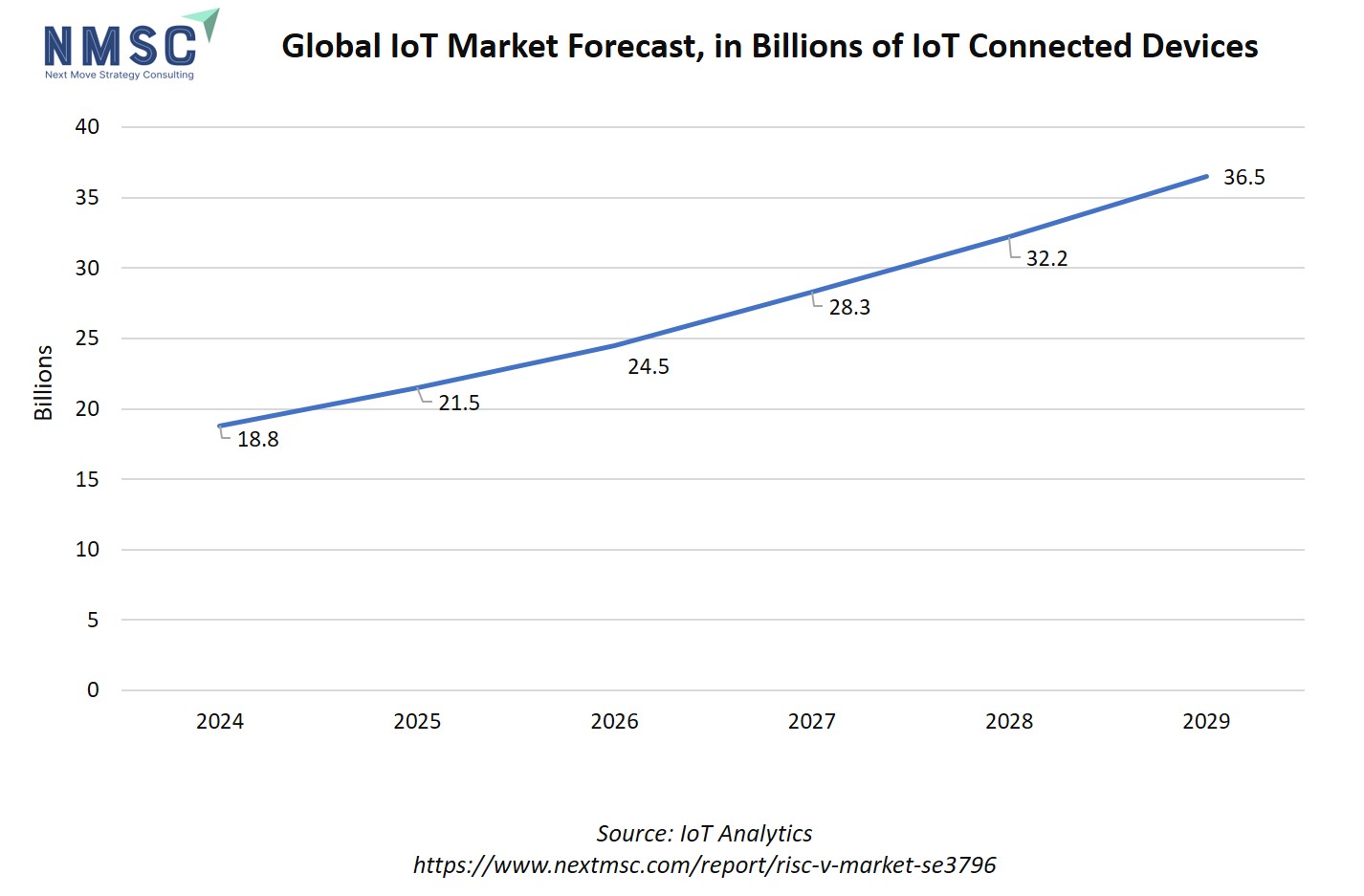
This chart illustrates a strong upward trend in the global IoT market, with the number of connected devices expected to surge from 18.8 billion in 2024 to 36.5 billion by 2029. This growth signals rapid digitalisation across industries, smart cities, and consumer sectors as adoption of IoT accelerates worldwide. As the number of IoT devices multiplies, demand for scalable, flexible, and efficient processor architectures rises, benefiting the RISC-V market growth. RISC-V offers open-source, customizable designs suited for embedded and edge applications in IoT, enabling device manufacturers to create cost-effective, energy-efficient chips that are tailored for connectivity, security, and AI workloads, fostering innovation and market expansion in the global IoT ecosystem.
By Commercial Model Insights
Is IP Licensing and Royalty Avoidance Still the Preferred Commercial Model?
Based on commercial model, the market is segmented into IP licensing and royalty avoidance, turnkey SoC supply and reference platforms, design services and integration, and tooling and verification subscription services.
IP licensing eliminates traditional per-core royalties, fostering innovation among startups and academic institutions. It also aligns with open-source principles, encouraging collaborative hardware development while retaining proprietary differentiation. The economic advantages drive sustained demand among embedded, IoT, and automotive players seeking predictable, low-cost SoC integration pathways, marking IP licensing as the most scalable revenue model.
Regional Outlook
The RISC-V market share is geographically studied across North America, Europe, Asia Pacific, Middle East & Africa, and Latin America and each region is further studied across countries.
RISC-V Market in North America
North America’s RISC-V market demonstrates a strong convergence of startup innovation, IP commercialization, and government-led assurance priorities. The region benefits from a mature semiconductor ecosystem anchored by SiFive and a network of U.S. national laboratories and universities advancing open architecture research. FY2024 government hearings and procurement discussions reveal rising attention to trusted hardware supply chains and security-verified open cores. Commercial interest is expanding beyond academic use to datacenter, automotive, and defense applications. This mix of private venture activity and public sector oversight makes North America a proving ground for secure and performance-oriented RISC-V implementations.
RISC-V Market in the United States
The United States represents the most advanced RISC-V ecosystem globally, supported by strong EDA, verification, and tooling activity. Companies are increasingly required to demonstrate secure and auditable implementations to qualify for defense and government contracts. U.S. agencies such as NIST are deepening engagement around assurance and formal verification, encouraging vendors to strengthen transparency in core design. This regulatory momentum, combined with domestic semiconductor funding initiatives, supports scalable open-architecture adoption. U.S. firms leading in IP design, compiler toolchains, and trusted foundry access stand to gain early commercial advantage in high-security computing markets.
RISC-V Market in Canada
Canada’s RISC-V momentum is being shaped by academic research networks and verification-focused industrial labs, particularly within semiconductor design hubs in Ontario and Quebec. Government innovation programs are funding exploratory work in hardware security and toolchain development, in collaboration with global ecosystem partners under RISC-V International. Commercial adoption remains limited but is expected to follow as assurance frameworks mature and domestic design capabilities scale. Canada’s policy emphasis on open technology and cross-border research integration positions it as a complementary contributor to the North American RISC-V assurance and verification landscape.
RISC-V Market in Europe
Europe approaches RISC-V through a structured and standards-driven framework that emphasizes security assurance, industrial reliability, and cross-border collaboration. Leading semiconductor nations including Germany, France, and Italy are embedding RISC-V into EU-backed research programs to reduce architectural dependency on proprietary ISAs. The region’s strong base of automotive, industrial, and aerospace manufacturers creates a natural fit for safety-certified open architectures. Partnerships between European universities, design houses, and EDA vendors are accelerating secure toolchain and verification model development, positioning Europe as a hub for trusted RISC-V industrial adoption.
RISC-V Market in the United Kingdom
The U.K. RISC-V market features active academic research programs and emerging commercial deployments, especially in defense, utilities, and critical infrastructure applications. National laboratories and startups are piloting safety-certified and security-enhanced implementations, reflecting growing interest in technology sovereignty. While scale remains limited compared to continental Europe, government research grants and strategic partnerships are helping translate R&D into prototype silicon. The U.K.’s design talent, coupled with access to both European and North American toolchain ecosystems, positions it as a potential niche leader in secure embedded and industrial control RISC-V solutions.
RISC-V Market in Germany
Germany’s RISC-V market is defined by its industrial precision culture and conservative adoption pace, centred around automotive electronics, industrial control, and safety-certified applications. The country’s robust machine and automation ecosystem creates long product lifecycles, demanding certified, predictable, and verifiable architectures. German OEMs and Tier 1 suppliers are cautiously piloting RISC-V cores within embedded control units and edge compute modules. Policy emphasis on European semiconductor independence supports localised IP experimentation under the EU Chips Act. Partnerships between national research centers, universities, and RISC-V International members aim to demonstrate formally verified and certifiable designs suitable for mission-critical use.
RISC-V Market in France
France approaches RISC-V adoption through a research-led and strategically selective industrial lens, focusing on high-assurance and sovereign computing applications. National programs coordinated by public–private consortia monitor open architectures for potential defense, aerospace, and telecommunications use. French semiconductor and embedded systems companies engage in collaborative R&D with EU peers to advance secure toolchains and low-power design frameworks. Although commercial deployment is still early stage, government-backed projects signal growing confidence in RISC-V’s viability for specialised, high-value domains. The long-term trajectory depends on aligning assurance standards with broader European certification frameworks.
RISC-V Market in Italy
Italy’s RISC-V market potential lies in its machine automation and manufacturing SME ecosystem, where cost efficiency and design flexibility are strong motivators. Local firms view RISC-V as a way to customise controllers and reduce licensing costs for embedded applications. Academic and industrial collaborations under EU programs are nurturing local IP competence, particularly for industrial and IoT controllers. Adoption remains pragmatic, piloted where open architecture offers tangible customisation or cost advantages. With adequate EDA tool support and regional integration, Italy evolve into a competitive manufacturing-oriented RISC-V adopter within Europe.
RISC-V Market in Spain
Spain follows broader European RISC-V trends, emphasising industrial applicability, security assurance, and local R&D participation. Spanish research institutions and emerging startups are piloting domain-specific RISC-V solutions in edge computing, utilities, and sensor systems. Government innovation frameworks support open-source hardware experimentation, aiming to strengthen domestic semiconductor design capacity. While market scale remains modest, collaboration through EU digital and semiconductor initiatives accelerate practical deployments. Spain’s early commitment to academic, industrial integration positions it as a contributor to the region’s collective RISC-V ecosystem evolution.
RISC-V Market in the Nordics
The Nordic region demonstrates advanced adoption of energy-efficient, secure, and sovereign computing architectures, aligning well with RISC-V principles. Countries such as Sweden and Finland prioritize low-power embedded designs for clean energy, industrial IoT, and maritime systems. Public–private projects are actively experimenting with open architectures for sustainable electronics and autonomous systems. Nordic startups and research institutions benefit from strong government funding and high digital maturity, making the region a testbed for energy-optimised and security-verified RISC-V implementations. Broader ecosystem success will depend on linking local pilots to scalable European supply chains.
RISC-V Market in the Asia-Pacific
Asia-Pacific is the largest and fastest-growing market, supported by policy incentives, manufacturing scale, and extensive local ecosystems. Governments across China, India, and Southeast Asia are promoting open architectures to strengthen domestic semiconductor self-reliance. The region’s major chipmakers, foundries, and design houses are embedding RISC-V in consumer electronics, IoT, and edge processing applications. Regional leaders like Advantech contribute through hardware integration and ecosystem enablement. Competitive intensity is high, but early local adoption creates long-term export potential. Asia-Pacific’s collective policy and industrial support make it the core engine of global RISC-V market demand.
RISC-V Market in China
China stands as the largest single-country opportunity for RISC-V scaling, fueled by policy support, local IP development, and massive design ecosystem depth. Government guidance encourages the use of open architectures to reduce dependency on foreign ISAs and strengthen semiconductor autonomy. Numerous domestic firms are building SoCs, AI accelerators, and controllers based on RISC-V cores, targeting consumer and industrial applications. However, verification rigor and interoperability remain challenges to large-scale export readiness. Sustained investment in security validation and international certification will determine China’s ability to convert its design capacity into globally trusted RISC-V platforms.
RISC-V Market in Japan
Japan’s RISC-V adoption is characterised by precision engineering, quality assurance, and long-term reliability focus. Japanese semiconductor and electronics manufacturers are integrating RISC-V into specialised controllers, robotics, and automotive components, prioritizing predictable supply and extended lifecycle support. The domestic ecosystem values stable toolchains and certification-backed implementations, reflecting the country’s disciplined industrial standards. Collaborations with global RISC-V partners focus on secure firmware stacks and real-time operating environments. Japan’s cautious but methodical approach makes it a model for industrial-grade RISC-V adoption emphasizing durability and interoperability.
RISC-V Market in India
India’s growing semiconductor ambitions and government-backed initiatives such as Make in India and the Semicon India program create fertile ground for RISC-V ecosystem expansion. National institutions and startups are developing custom processors and SoCs using RISC-V IP, targeting education, defense, and edge computing. The government’s commitment to open-source architectures aligns with its goal of domestic design self-sufficiency. With growing design houses and EDA partnerships, India is positioning itself as a regional hub for low-cost and customizable RISC-V hardware. Scaling commercialization will depend on sustained investment in verification and local fabrication.
RISC-V Market in South Korea
South Korea’s advanced semiconductor, foundry, and electronics ecosystem offers strong potential for RISC-V adoption in controllers, accelerators, and AI edge applications. National programs supporting chip diversification
include open architectures to reduce long-term IP dependency. Industry leaders are assessing RISC-V for embedded, low-power, and specialized compute workloads. Partnerships with universities and research labs are fostering localized IP and toolchain development. Given its mature manufacturing base and focus on technology independence, South Korea could emerge as a strategic RISC-V production and export hub in the Asia-Pacific landscape.
RISC-V Market in Indonesia
Indonesia’s RISC-V uptake is in the early stages, driven primarily by manufacturing modernization and education-led research. National digital transformation initiatives encourage exploration of open-source hardware for industrial automation and embedded control. Partnerships between universities, OEMs, and technology startups are beginning to pilot RISC-V-based prototypes for resource management, logistics, and IoT applications. Expansion will depend on access to affordable development tools and integration with regional design hubs across Southeast Asia. Early institutional participation positions Indonesia as a potential emerging adopter once cost-effective local supply chains mature.
RISC-V Market in Australia
Australia’s RISC-V engagement is focused on defense, research, and sovereignty-linked computing projects, reflecting national priorities for assured and transparent architectures. Public–private collaborations between research agencies and defense contractors are exploring RISC-V for secure embedded systems and AI edge deployments. Academic participation remains strong, with government-funded initiatives evaluating RISC-V for trusted computing and sustainability-driven innovation. While commercial uptake is modest, the focus on assurance, resilience, and local verification capabilities supports a long-term, policy-driven RISC-V roadmap.
RISC-V Market in Latin America
Latin America’s RISC-V development remains research-driven and project-based, anchored in universities and technology incubators. Regional semiconductor activity is limited, but academic collaborations and open hardware programs are introducing RISC-V to local ecosystems. Adoption is expected in niche industrial automation, education, and embedded control as tooling and community maturity improve. The availability of open-source IP reduces entry barriers for small design houses and academic institutions. Scaling commercial adoption will depend on regional manufacturing partnerships and government-led digital infrastructure investment.
RISC-V Market in the Middle East & Africa
RISC-V adoption in the Middle East and Africa is nascent and driven by sovereign technology ambitions and infrastructure projects. Governments exploring digital independence and localised electronics manufacturing view RISC-V as a strategic enabler of open and verifiable designs. Pilot initiatives in the UAE, Saudi Arabia, and South Africa explore use cases in defense, smart cities, and IoT ecosystems. However, limited design and fabrication capacity constrain rapid scaling. Partnerships with global IP vendors and academic collaborations are the most viable path for early commercialisation.
Competitive Landscape
Which Companies Dominate the RISC-V Industry and How do they Compete?
Market Dominated by RISC-V Giants and Specialists
The RISC-V ecosystem is shaped by a network of core IP vendors, silicon integrators, system houses, and EDA toolchain providers, all competing to offer the lowest-risk integration path for adopters. Companies such as SiFive have advanced from IP licensing toward higher-value SoC and datacenter platforms, signalling a vertical integration push within the open ISA space. Meanwhile, ecosystem partners focus on differentiation through toolchain quality, design verification, and certification readiness. Winning strategies now center on combining robust reference designs, verified IP portfolios, and turnkey development environments that minimize time-to-silicon and enhance customer confidence.
Innovation and Adaptability Drive Market Success
In the evolving RISC-V landscape, innovation in verification, security extensions, and silicon-proven cores determines market credibility. Vendors advancing formal verification frameworks and compliant secure instruction sets are gaining traction in automotive, defense, and datacenter segments. Regulatory and assurance initiatives from NIST and related agencies reinforce the importance of transparent, validated design processes. Competitive differentiation increasingly depends on suppliers offering end-to-end hardware–software stacks, long-term supported toolchains, and validated SDKs. Firms that co-develop with OS, compiler, and middleware partners accelerate ecosystem maturity and reduce evaluation friction for enterprise and government buyers.
Market Players to Opt for Merger & Acquisition Strategies to Expand their Presence
The RISC-V industry is entering a phase of strategic consolidation and partnership expansion, as IP vendors and toolchain providers pursue scale, credibility, and ecosystem depth. Collaborations with semiconductor foundries, OEMs, and national laboratories are becoming essential to validate secure design-to-silicon workflows and meet certification needs. These alliances accelerate procurement approval cycles for critical infrastructure and defense applications. Investors and OEMs should prioritise partnerships that demonstrate proven silicon, independent verification, and repeatable design success, as these represent clear inflection points for commercial maturity and long-term ecosystem confidence.
List of Key RISC-V Companies
-
SiFive, Inc.
-
Andes Technology Corporation
-
Tenstorrent Inc.
-
Xuantie (Alibaba-T-Head)
-
Synopsys, Inc.
-
Qualcomm Technologies, Inc.
-
Codasip s.r.o.
-
MIPS Tech, LLC
-
Renesas Electronics Corporation
-
Espressif Systems (Shanghai) Co., Ltd.
-
Akeana, Inc.
-
SpacemiT Technology Co., Ltd.
-
GigaDevice Semiconductor Inc.
-
Nuclei System Technology Co., Ltd.
-
Rivos Inc.
-
Sophgo Technologies
-
StarFive Technology Co., Ltd.
-
Microchip Technology Inc.
-
Imagination Technologies Ltd.
-
SEMIFIVE
What Are the Latest Key Industry Developments?
-
September 2025 – SiFive, Inc. expanded its processor IP portfolio with the launch of next-generation RISC-V Intelligence and Performance series cores designed for AI acceleration, automotive computing, edge IoT devices, and high-performance data center applications. The company also strengthened its ecosystem partnerships to accelerate enterprise adoption of customizable RISC-V architectures across global semiconductor markets.
-
August 2025 – Andes Technology Corporation strengthened its market position in the RISC-V processor industry through the expansion of its high-performance and low-power processor core portfolio targeting AI processing, embedded systems, industrial automation, and automotive electronics applications. The company also enhanced support for advanced software toolchains and ecosystem integration.
What Are the Key Factors Influencing Investment Analysis & Opportunities in the Risc-V Market?
Investment attention should focus on IP providers and verification tooling firms with demonstrated silicon outcomes and paying customers. Post 2024 primary disclosures show that vendors moving beyond proof of concept into silicon-proven cores and commercial SoC reference platforms materially de-risk adoption. Valuation premiums should attach to firms with long-term support commitments, third-party assurance audits, and partnerships with foundries or OEMs. Hotspots include low-power MCUs for huge unit volumes, RISC-V-based controllers for storage and SSDs, automotive safety-certified cores, and verification and provenance tooling. Investors should require evidence of silicon tape outs, third-party verification and at least one credible OEM or government pilot before backing scale investments.
Key Benefits for Stakeholders:
Next Move Strategy Consulting (NMSC) presents a comprehensive analysis of the RISC-V market, covering historical trends from 2020 through 2024 and offering detailed forecasts through 2030. Our study examines the market at regional and country levels, providing quantitative projections and insights into key growth drivers, challenges, and investment opportunities across all major RISC-V segments.
Report Scope
|
Parameters |
Details |
|
Market Size in 2025 |
USD 2.20 Billion |
|
Revenue Forecast in 2030 |
USD 9.08 Billion |
|
Growth Rate |
CAGR of 32.8% from 2025 to 2030 |
|
Analysis Period |
2024–2030 |
|
Base Year Considered |
2024 |
|
Forecast Period |
2025–2030 |
|
Market Size Estimation |
Billion (USD) |
|
Growth Factors |
|
|
Companies Profiled |
15 |
|
Countries Covered |
33 |
|
Market Share |
Available for 10 companies |
|
Customization Scope |
Free customization (equivalent to up to 80 analyst-working hours) after purchase. Addition or alteration to country, regional & segment scope. |
|
Pricing and Purchase Options |
Avail customized purchase options to meet your exact research needs. |
|
Approach |
In-depth primary and secondary research; proprietary databases; rigorous quality control and validation measures. |
|
Analytical Tools |
Porter's Five Forces, SWOT, value chain, and Harvey ball analysis to assess competitive intensity, stakeholder roles, and relative impact of key factors. |
Key Market Segments
By Product & Deliverable
-
Processor Intellectual Property (IP)
-
Commercial Core IP Licenses
-
Standard Performance Cores
-
Ultra-Low-Power Cores
-
High-Performance Cores
-
Safety-Certified Cores
-
Secure Cores
-
-
Open Source & Reference Cores
-
Foundation Reference Designs
-
Academic Research Cores
-
Community Developed Cores
-
-
Processor IP Services
-
Core Customization
-
Verification & Validation
-
Performance Benchmarking
-
-
-
Silicon Products
-
Microcontrollers (MCUs)
-
32-bit Embedded MCUs
-
64-bit Application MCUs
-
-
Microprocessors (MPUs)
-
Embedded Edge MPUs
-
Mobile Application Processors
-
Data Center Server Processors
-
-
System-on-Chip (SoC) & ASICs
-
SoC with RISC-V Main Cluster
-
SoC with RISC-V Subsystem or MCU
-
Full-Custom ASICs
-
-
Domain-Specific Accelerators
-
AI & Machine Learning Accelerators
-
Networking & Storage Accelerators
-
Graphics & Vision Processors
-
-
-
Hardware Development Platforms
-
Development & Evaluation Kits
-
Compute Modules
-
Single Board Computers
-
FPGA Prototyping Boards
-
-
Subsystem & Peripheral IP
-
Interconnect & Memory Controller IP
-
Security & Cryptography IP
-
Interface & Peripheral Controller IP
-
Analog & Mixed-Signal IP
-
-
Software, Tools, & Middleware
-
Development Tools
-
EDA & Design Tools
-
Compilers & Toolchains
-
Debug & Profiling Tools
-
Simulation & Emulation Platforms
-
-
Software Stacks
-
Operating Systems & Kernels
-
Middleware & Libraries
-
Virtualization Stacks
-
Safety & Security Certifiable Stacks
-
-
Services & Support
-
Design Integration & Bring Up Services
-
Certification & Safety Validation Services
-
Security Audit & Hardening Services
-
Support, Maintenance, & Training Contracts
-
-
By Business Model
-
IP Licensing Revenue
-
Upfront License Fees
-
Per-Unit Royalties
-
Subscription Access Fees
-
-
Silicon Sales Revenue
-
Chip Sales (Direct)
-
Chip Sales (Through Distribution)
-
Module & Board Sales
-
-
Software & Tool Sales Revenue
-
Perpetual Licenses
-
Subscription & SaaS Revenue
-
Maintenance & Update Fees
-
-
Service & Support Revenue
-
Design & Integration Services
-
Certification & Compliance Services
-
Training & Consulting
-
Technical Support Contracts
-
By Architecture Type
-
Standard Unmodified Cores
-
Custom Extended Instruction Cores
-
Multi-Core & Many-Core Clusters
-
Heterogeneous Compute Systems
By Technology Node
-
Mature Nodes (28nm & above)
-
Mainstream Nodes (22nm to 14nm)
-
Advanced Nodes (12nm to 7nm)
-
Leading-Edge Nodes (5nm & below)
-
Specialized Nodes (e.g., FD-SOI)
By End-User Industry
-
Consumer Electronics
-
Smartphones & Wearables
-
Smart Home Devices
-
Multimedia & Display Technologies
-
-
Automotive & Transportation
-
Advanced Driver-Assistance Systems (ADAS)
-
Vehicle Infotainment
-
Electric Vehicle Powertrain & Battery Management
-
Body Electronics & Chassis Control
-
-
Industrial & Internet of Things (IoT)
-
Industrial Automation & Control
-
IoT Edge Nodes & Gateways
-
Smart Meters & Sensors
-
Robotics & Motor Control
-
-
Data Center & Infrastructure
-
Cloud & Enterprise Servers
-
Networking Equipment & Switches
-
Telecommunications Infrastructure
-
Storage & Memory Controllers
-
-
High-Performance Computing (HPC) & AI
-
AI Training & Inference Systems
-
Scientific & Research Computing
-
Accelerated Computing Platforms
-
-
Aerospace, Defense, & Government
-
Avionics & Space Systems
-
Defense & Secure Communications
-
Government Critical Infrastructure
-
-
Medical Electronics
-
Diagnostic & Imaging Equipment
-
Patient Monitoring Systems
-
Wearable Medical Devices
-
Geographical Breakdown
-
North America: U.S., Canada, and Mexico.
-
Europe: U.K., Germany, France, Italy, Spain, Sweden, Denmark, Finland, Netherlands, and rest of Europe.
-
Asia Pacific: China, India, Japan, South Korea, Taiwan, Indonesia, Vietnam, Australia, Philippines, Malaysia and rest of APAC.
-
Middle East & Africa (MEA): Saudi Arabia, UAE, Egypt, Israel, Turkey, Nigeria, South Africa, and rest of MEA.
-
Latin America: Brazil, Argentina, Chile, Colombia, and rest of LATAM
Conclusion & Recommendations
Our report equips stakeholders, industry participants, investors, and consultants with actionable intelligence to capitalise on RISC-V’s transformative potential. By combining robust data-driven analysis with strategic frameworks, NMSC’s RISC-V Market Report serves as an indispensable resource for navigating the evolving landscape.
For executives and investors, the key to capitalising on these trends lies in identifying high-potential segments, investing in R&D for innovative RISC-V solutions, and fostering strategic partnerships to expand market reach. Prioritising regions with abundant biodiversity and favourable regulatory frameworks optimise production and sourcing strategies. Additionally, emphasising consumer education, transparent labelling, and premium product positioning enhance brand trust and accelerate adoption, unlocking significant opportunities for value creation in the RISC-V market.


About the Author
 Ridip Gogoi
— Ridip Gogoi is a Research Associate at Next Move Strategy Consulting, where he supports cross-vertical market research and analysis across multiple industry sectors, with four years of experience. His work includes market analysis, data validation, secondary research, and insight development, helping structure evidence into clear findings for business and strategy decisions. He contributes to research quality checks and reporting, with a focus on consistency, source review, and clarity accuracy.
Ridip Gogoi
— Ridip Gogoi is a Research Associate at Next Move Strategy Consulting, where he supports cross-vertical market research and analysis across multiple industry sectors, with four years of experience. His work includes market analysis, data validation, secondary research, and insight development, helping structure evidence into clear findings for business and strategy decisions. He contributes to research quality checks and reporting, with a focus on consistency, source review, and clarity accuracy.
About the Reviewer
 Supradip Baul
— Supradip Baul is an accomplished business consultant and strategist with over a decade of rich experience in market intelligence, strategy, technology, and business transformation. His work has included rigorous qualitative and quantitative analysis across multiple industries, helping clients shape investment decisions and long-term roadmaps. Earlier in his career, he was associated with Gartner, where he contributed to industry-leading reports and market share analyses. He has worked with leading global companies and holds an MBA with a dual specialization in Marketing and Finance.
Supradip Baul
— Supradip Baul is an accomplished business consultant and strategist with over a decade of rich experience in market intelligence, strategy, technology, and business transformation. His work has included rigorous qualitative and quantitative analysis across multiple industries, helping clients shape investment decisions and long-term roadmaps. Earlier in his career, he was associated with Gartner, where he contributed to industry-leading reports and market share analyses. He has worked with leading global companies and holds an MBA with a dual specialization in Marketing and Finance.
At Next Move Strategy Consulting, we understand that insightful market research is the cornerstone of successful business decisions. That's why we employ a robust and multifaceted approach, combining various methodologies to deliver the most accurate and actionable data for our clients.

Research Landscape
We navigate the world of research with two primary approaches:
Qualitative Approach
Our qualitative research methodologies involve immersive techniques such as in-depth interviews, focus groups, and observational studies. By engaging directly with individuals and stakeholders, we uncover valuable insights that quantitative data alone may overlook.

Quantitative Research
In tandem with qualitative methodologies, NMSC leverages the power of Quantitative Research to provide a robust foundation of numerical insights. Through systematic data collection and analysis, we quantify patterns, preferences, and market trends, offering a comprehensive view of the business landscape.
Our quantitative research approach employs diverse tools, including surveys, experiments, and statistical modelling. These methodologies enable us to gather data from a large and representative sample, ensuring the statistical significance of our findings. By employing structured questionnaires and standardized data collection methods, we guarantee the reliability and validity of the information we present to our clients.
Quantitative research is particularly effective in measuring the prevalence of trends, assessing market size, and gauging the impact of various factors on consumer behavior. The numerical precision attained through this approach equips our clients with actionable insights, facilitating data-driven decision-making and strategy formulation.


Our Specialized Toolbox for Industry-Specific Market Research
We deploy a specialized arsenal of techniques tailored to meet your unique requirements. Here's a glimpse into our comprehensive toolbox:

Information Procurement
The stage entails acquiring market data or relevant information through various sources and methodologies.


Market Research Approach
We utilize both top-down and bottom-up approaches in market research analysis to achieve a comprehensive understanding of the market dynamics, leveraging the broad perspective of industry trends and macroeconomic factors alongside detailed insights from specific segments and individual companies.

Porters Five Forces Analysis
We conduct Porter's Five Forces analysis to evaluate the competitive landscape of an industry, providing us with insights into factors that affect profitability and strategic positioning.

SWOT Analysis

Forecasting
We utilize a forecasting model to predict future consumption by considering parameters like population, economics, regulations, market competition, drivers, constraints, technology, and pricing. We also employ statistical techniques such as multilinear regression, exponential smoothing, moving average, ARIMA, and Monte Carlo simulations for accurate predictions. In econometric forecasting, we analyzed short-term and long-term event impacts, attributing values based on regulatory frameworks, economic factors, and market events.





 Speak to Our Analyst