Single-Rotor (Helicopter) Drone Market Global Industry Analysis and Forecast (2026–2035)

The global Single-Rotor (Helicopter) Drone Market size was valued at USD 2.68 billion in 2025 and is estimated at USD 3.08 billion in 2026, forecast to reach USD 10.65 billion by 2035, expanding at a 14.8% CAGR from 2026 to 2035. Key drivers include rising defense modernization and intelligence, surveillance and reconnaissance spending and growing demand for unmanned cargo and logistics transport, with North America leading the global market.

Download Free Sample PDF
Base Year (2025)
$2.68 Billion
Forecast (2035)
$10.65 Billion
CAGR (2026-2035)
14.8%
Top Region
North America

What Is the Single-Rotor (Helicopter) Drone Market Size?

The global single-rotor (helicopter) drone market size was valued at USD 2.68 billion in 2025 and is estimated at USD 3.08 billion in 2026, forecast to reach USD 10.65 billion by 2035, expanding at a 14.8% CAGR between 2026 and 2035. North America leads with approximately 34% share, while Small-Class platforms dominate all other platform sizes with approximately 42% share.

We observed that growth is broad-based across every segmentation axis, with heavy-lift agricultural conversions and electric propulsion adoption driving key structural shifts through 2035.

Single-Rotor (Helicopter) Drone Market Global Industry Analysis and Forecast (2026–2035) Revenue Forecast

Values in USD Billion

2025 $2.68 Billion
2025
2026 $3.08 Billion
2026
2027 $3.53 Billion
2027
2028 $4.05 Billion
2028
2029 $4.65 Billion
2029
2030 $5.34 Billion
2030
2031 $6.13 Billion
2031
2032 $7.04 Billion
2032
2033 $8.08 Billion
2033
2034 $9.28 Billion
2034
2035 $10.65 Billion
2035

Key Takeaways

By Platform Size: Small-Class held the largest share of approximately 42% (USD 1.13 billion) in 2025; Medium-Class is the fastest-growing sub-segment at 17.0% CAGR from 2026–2035.

By Propulsion Type: Piston Engine-Powered held the largest share of approximately 46% (USD 1.23 billion) in 2025; Electric and Hybrid-Electric is the fastest-growing sub-segment at 19.8% CAGR from 2026–2035.

By Application: Intelligence, Surveillance and Reconnaissance held the largest share of approximately 30% (USD 0.80 billion) in 2025; Cargo and Logistics Transport is the fastest-growing sub-segment at 19.0% CAGR from 2026–2035.

By End User: Military and Defense held the largest share of approximately 48% (USD 1.29 billion) in 2025; Commercial and Industrial is the fastest-growing sub-segment at 18.0% CAGR from 2026–2035.

By Component: Airframe and Rotor System held the largest share of approximately 38% (USD 1.02 billion) in 2025; Payload and Sensor Systems is the fastest-growing sub-segment at 17.0% CAGR from 2026–2035.

Dominant Region: North America dominated with approximately 34% revenue share (USD 0.91 billion) in 2025.

Fastest-Growing Region: Asia-Pacific has the highest projected CAGR of 18.1% during 2026–2035.

Dominant Country: The U.S. led with approximately USD 0.62 billion in 2025.

Fastest-Growing Country: India is the fastest-growing country at approximately 21.0% CAGR from 2026–2035.

What Does the Single-Rotor (Helicopter) Drone Market Encompass?

The single-rotor (helicopter) drone market encompasses unmanned aircraft that generate lift and thrust from a single main rotor paired with a tail rotor or equivalent anti-torque system, mirroring conventional helicopter aerodynamics. Our assessment indicates that the scope spans micro, small, medium, and large platform classes supplied to military, government, and commercial operators for intelligence, surveillance and reconnaissance, agricultural spraying, cargo transport, maritime patrol, and search and rescue missions. The category has evolved from remote-controlled reconnaissance platforms into certified, heavy-lift systems built on existing manned-helicopter airframes, reflecting rising demand for payload capacity and extended endurance.
Regulatory frameworks such as the U.S. Federal Aviation Administration's Part 107 waiver and Part 135 certification and exemption structures and the European Union Aviation Safety Agency's Specific Operations Risk Assessment framework shape beyond-visual-line-of-sight and heavy-payload operational authorizations, while the International Civil Aviation Organization's remotely piloted aircraft systems guidance increasingly influences cross-border operational standards. We observed that technology adoption is shifting toward autonomous flight-control retrofits of type-certified manned helicopters, reducing development risk relative to purpose-built airframes. Next Move Strategy Consulting's analysis indicates that this structural shift, combined with rising defense modernization budgets, is redefining sourcing criteria across the single-rotor (helicopter) drone market.

SWOT Analysis

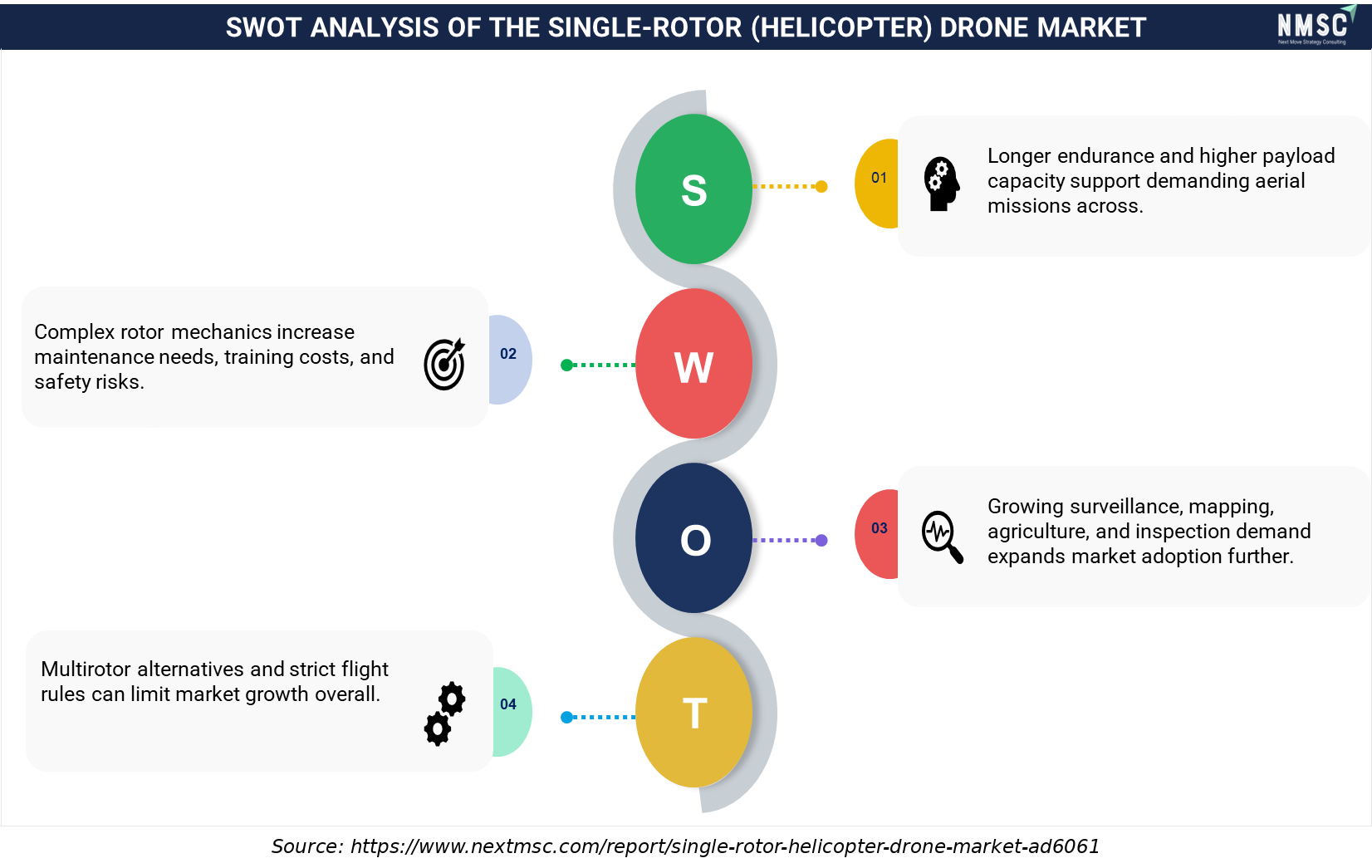
This SWOT view highlights structural strengths, strategic gaps, expansion headroom, and external risks shaping outcomes in the Single-Rotor (Helicopter) Drone Market Global Industry Analysis and Forecast (2026–2035).

Strengths

high payload capacity and extended flight endurance serve as primary strengths within the Single-Rotor (Helicopter) Drone Market.

Weaknesses

complex rotor mechanics increase maintenance requirements, training costs, and operational risks.

Opportunities

expanding demand across surveillance, mapping, agriculture, and inspection presents major growth opportunities

Threats

multirotor alternatives alongside strict flight regulations pose significant competitive threats across the global Single-Rotor (Helicopter) Drone Market.

Market Drivers & Dynamics

Interactive Dataset
Rising defense modernization and ISR spending driver +2.6% Global 2026-2035
Increasing use of unmanned helicopters for cargo and logistics driver +2.1% North America, Asia-Pacific 2026-2035
Expansion of precision agriculture spraying adoption driver +1.9% Asia-Pacific, North America 2026-2035
Growth in maritime and offshore surveillance requirements driver +1.4% Europe, Middle East & Africa 2026-2032
Advancements in autonomous flight control and navigation systems driver +1.2% Global 2026-2035
Growing search and rescue and disaster-response deployment driver +0.8% Global 2026-2032
High acquisition and maintenance costs versus multirotor platforms restraint -1.3% Global 2026-2035
Complex airspace integration and certification requirements restraint -0.9% North America, Europe 2026-2032
Limited beyond-visual-line-of-sight regulatory clearance restraint -0.7% Global 2028-2035
Source: Next Move Strategy Consulting

Growth Drivers

What Is the Primary Growth Driver of the Single-Rotor (Helicopter) Drone Market?

Rising defense modernization and intelligence, surveillance and reconnaissance spending is the primary driver of the market. The U.S. Department of Defense continues to prioritize unmanned rotorcraft procurement to support persistent surveillance and logistics-resupply missions in contested environments. We observed that this procurement priority, reinforced by allied defense-modernization programs, continues to anchor baseline demand for medium and large-class single-rotor platforms across developed and emerging defense markets alike.

How Is Cargo and Logistics Demand Driving Market Growth?

Growing demand for unmanned cargo and logistics transport is accelerating adoption of heavy-lift single-rotor platforms converted from certified manned-helicopter airframes. The U.S. Federal Aviation Administration's Part 135 certification and exemption framework supports commercial drone package-delivery operations that meet applicable requirements. Our assessment indicates that this regulatory pathway, combined with rising e-commerce and remote-site logistics demand, supports adoption of large-class cargo variants across North America and Asia-Pacific.

Growth Inhibitors

What Is Restraining Single-Rotor (Helicopter) Drone Market Expansion?

High acquisition and maintenance costs relative to multirotor drone platforms restrain adoption among cost-sensitive commercial operators. The U.S. Federal Aviation Administration's certification and authorization requirements for larger unmanned aircraft add procedural complexity relative to smaller multirotor platforms, extending time-to-revenue for new entrants. We found that smaller commercial operators face particular exposure, as limited fleet scale reduces their ability to absorb maintenance and pilot-training costs compared with larger, well-capitalized defense and logistics operators.

Segmentation Analysis

2025 (USD Billion)
2035 (USD Billion)
Small-Class (25–150 kg) 2025: $1.13 Billion | 2035: $4.36 Billion
Small-Class
Medium-Class (151–500 kg) 2025: $0.80 Billion | 2035: $3.87 Billion
Medium-Class
Micro-Class (Below 25 kg) 2025: $0.48 Billion | 2035: $1.50 Billion
Micro-Class
Large-Class (Above 500 kg) 2025: $0.27 Billion | 2035: $0.92 Billion
Large-Class
Small-Class (25–150 kg) $1.13 Billion $4.36 Billion 14.5%
Medium-Class (151–500 kg) $0.80 Billion $3.87 Billion 17.0%
Micro-Class (Below 25 kg) $0.48 Billion $1.50 Billion 12.0%
Large-Class (Above 500 kg) $0.27 Billion $0.92 Billion 13.0%

Which Platform Size Segment Dominates the Single-Rotor (Helicopter) Drone Market?

Small-Class platforms, spanning 25 to 150 kilograms maximum take-off weight, led the market with USD 1.13 billion in 2025, supported by their balance of payload capacity and operational cost across ISR and agricultural missions. We observed that Medium-Class platforms are the fastest-growing segment, expanding at a 17.0% CAGR from 2026 to 2035, as defense and cargo operators increasingly specify heavier-payload conversions of certified manned-helicopter airframes.

2025 (USD Billion)
2035 (USD Billion)
Piston Engin
Turbine-Powe
Electric and
Segment Item 2025 (USD Billion) 2035 (USD Billion) CAGR
Piston Engine-Powered $10.0 USD Billion $40.0 USD Billion 12.0%
Turbine-Powered $17.1 USD Billion $51.1 USD Billion 18.0%
Electric and Hybrid-Electric $24.2 USD Billion $62.2 USD Billion 20.0%

Segment-wise data is locked

Unlock complete segment-wise numbers for By Propulsion Type.

Unlock Full Data

Which Propulsion Type Is Most Widely Used in Single-Rotor Drones?

Piston engine-powered platforms remained dominant across the market, reaching USD 1.23 billion in 2025 due to their favorable power-to-weight ratio and compatibility with converted general-aviation helicopter airframes. Our findings suggest that Electric and Hybrid-Electric propulsion is the fastest-growing category at a 19.8% CAGR from 2026 to 2035, reflecting operator demand for lower acoustic signature and reduced maintenance burden across ISR and urban infrastructure-inspection missions.

2025 (USD Billion)
2035 (USD Billion)
Intelligence
Surveillance
Agricultural
Cargo and Lo
Maritime and
Segment Item 2025 (USD Billion) 2035 (USD Billion) CAGR
Intelligence $10.0 USD Billion $40.0 USD Billion 18.0%
Surveillance and Reconnaissance $17.1 USD Billion $51.1 USD Billion 16.0%
Agricultural Spraying and Crop Monitoring $24.2 USD Billion $62.2 USD Billion 22.0%
Cargo and Logistics Transport $31.3 USD Billion $73.3 USD Billion 12.0%
Maritime and Offshore Operations $38.4 USD Billion $84.4 USD Billion 19.0%

Segment-wise data is locked

Unlock complete segment-wise numbers for By Application.

Unlock Full Data

Which Application Segment Leads Single-Rotor (Helicopter) Drone Market Demand?

Intelligence, Surveillance and Reconnaissance remained the leading application, valued at USD 0.80 billion in 2025 on sustained defense and homeland-security procurement. Based on research conducted by Next Move Strategy Consulting, we found that Cargo and Logistics Transport is the fastest-growing application, registering a 19.0% CAGR from 2026 to 2035, as commercial operators increasingly deploy heavy-lift conversions for remote-site resupply and middle-mile freight movement.

2025 (USD Billion)
2035 (USD Billion)
Military and
Government a
Commercial a
Agriculture
Segment Item 2025 (USD Billion) 2035 (USD Billion) CAGR
Military and Defense $10.0 USD Billion $40.0 USD Billion 26.0%
Government and Homeland Security $17.1 USD Billion $51.1 USD Billion 16.0%
Commercial and Industrial $24.2 USD Billion $62.2 USD Billion 18.0%
Agriculture $31.3 USD Billion $73.3 USD Billion 8.0%

Segment-wise data is locked

Unlock complete segment-wise numbers for By End User.

Unlock Full Data
2025 (USD Billion)
2035 (USD Billion)
Airframe and
Flight Contr
Payload and
Ground Contr
Propulsion a
Segment Item 2025 (USD Billion) 2035 (USD Billion) CAGR
Airframe and Rotor System $10.0 USD Billion $40.0 USD Billion 13.0%
Flight Control and Avionics $17.1 USD Billion $51.1 USD Billion 19.0%
Payload and Sensor Systems $24.2 USD Billion $62.2 USD Billion 13.0%
Ground Control Station $31.3 USD Billion $73.3 USD Billion 11.0%
Propulsion and Transmission System $38.4 USD Billion $84.4 USD Billion 12.0%

Segment-wise data is locked

Unlock complete segment-wise numbers for By Component.

Unlock Full Data

Growth Opportunities

Our analysis shows that three forward-looking opportunities stand out for stakeholders positioning within the single-rotor (helicopter) drone market over the 2026-2035 forecast period.

How Do Heavy-Lift Cargo Conversions Unlock New Logistics Demand?

Heavy-lift conversions of certified manned-helicopter airframes present a whitespace opportunity for logistics operators seeking remote-site and middle-mile resupply capacity beyond multirotor drone payload limits. Suppliers that commercialize cargo-configured variants stand to capture recurring fleet-expansion revenue as construction, energy, and disaster-relief logistics operators shift toward autonomous rotorcraft for time-sensitive freight movement.

Where Do Maritime Surveillance Platforms Create Whitespace for Coast Guards?

Coast guards and offshore energy operators represent an underpenetrated opportunity for SATCOM-equipped single-rotor platforms engineered for extended over-water endurance. Manufacturers that validate long-range autonomous flight, as demonstrated by SwissDrones' Brazil deployment, support long-term procurement opportunities with naval and offshore commercial end users seeking recurring patrol and pipeline-monitoring capability.

How Does Precision Agriculture Spraying Benefit Large-Scale Farm Operators?

Large-scale row-crop operators create an opportunity for manufacturers offering heavy-payload spray helicopters that match manned aerial-applicator coverage rates. Early movers that secure regulatory approval for autonomous agricultural spraying differentiate with commercial agricultural service providers pursuing labor-cost reduction and pesticide-exposure mitigation across North American and Asia-Pacific row-crop regions.

Regional Outlook

2025 (USD Billion)
2035 (USD Billion)
North Americ
Asia-Pacific
Europe
Middle East
Latin Americ
Region 2025 (USD Billion) 2035 (USD Billion) CAGR (%)
North America $10.0 USD Billion $40.0 USD Billion 9.0%
Asia-Pacific $17.1 USD Billion $51.1 USD Billion 27.0%
Europe $24.2 USD Billion $62.2 USD Billion 25.0%
Middle East & Africa $31.3 USD Billion $73.3 USD Billion 23.0%
Latin America $38.4 USD Billion $84.4 USD Billion 12.0%

Regional data is locked

Unlock complete regional numbers for this market.

Unlock Full Data

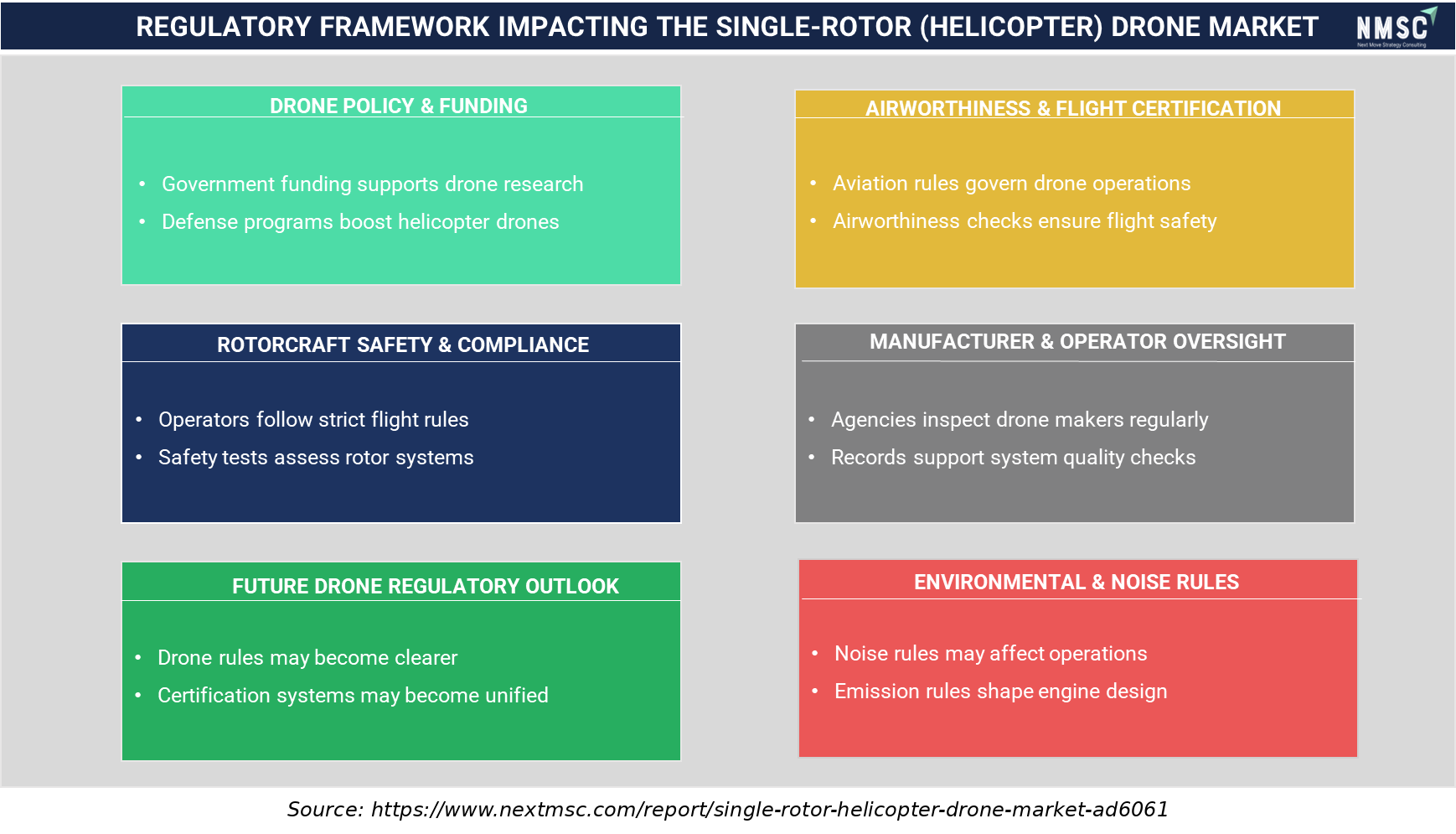
Regulatory Framework Impacting the Single-Rotor (Helicopter) Drone Market

NMSC's analysis indicates that government funding and defense initiatives drive technological innovation across the Single-Rotor (Helicopter) Drone Market. Furthermore, aviation authorities enforce rigorous airworthiness checks and rotor safety assessments to support operational safety. Concurrently, manufacturer inspections, environmental emission standards, and noise regulations govern operational compliance, while evolving certification systems seek to streamline commercial deployment throughout the expanding Single-Rotor (Helicopter) Drone Industry.

Competitive Landscape

We observed that the single-rotor (helicopter) drone market features a moderately fragmented competitive landscape, with defense-focused rotorcraft specialists competing alongside emerging agricultural and logistics-conversion entrants across the industry.

Dimension Description
Dimension Assessment
Market Structure Moderately fragmented; a handful of established defense-rotorcraft specialists account for a meaningful share of global revenue, while numerous early-stage entrants pursue agricultural and logistics conversion niches.
Innovation Focus Manned-helicopter airframe conversion, autonomous flight-control retrofits, and SATCOM-enabled beyond-visual-line-of-sight navigation dominate current innovation pipelines across leading suppliers.
M&A Activity Selective consolidation through business-unit integration, exemplified by Robinson Helicopter Company's formation of an unmanned business unit combining Ascent AeroSystems with strategic partners Rotor Technologies and Sikorsky.

How Do Companies Compete in the Single-Rotor (Helicopter) Drone Market?

Companies compete primarily on airframe certification pedigree, payload capacity, and mission-specific autonomy software across the industry. Established players such as Schiebel Corporation and Yamaha Motor leverage decades of rotorcraft manufacturing experience to serve defense and agricultural customers, while newer entrants such as Rotor Technologies compete by converting existing certified general-aviation helicopters into autonomous platforms, shortening development timelines relative to purpose-built designs.

Which Competitive Archetypes Dominate the Single-Rotor (Helicopter) Drone Market?

Two archetypes dominate the market: established defense-rotorcraft specialists offering purpose-built ISR and maritime platforms, and airframe-conversion entrants adapting certified manned helicopters for agricultural and cargo missions. Schiebel Corporation and Steadicopter exemplify the defense-specialist archetype through long-standing military procurement relationships, while Rotor Technologies exemplifies the conversion-entrant archetype through its Robinson R44-based Sprayhawk and Airtruck platforms.

How Are Companies Differentiating Through Innovation in Single-Rotor Drones?

Innovation and differentiation strategy increasingly center on autonomous flight-control integration and mission-specific payload engineering. SwissDrones' SATCOM-linked long-range navigation and Rotor Technologies' terrain-following spray-control systems both extend operational envelopes beyond conventional remote-piloted limits. Our analysis shows that suppliers unable to demonstrate certified autonomous flight capability risk exclusion from defense and commercial procurement shortlists requiring beyond-visual-line-of-sight authorization.

What M&A and Expansion Activity Is Shaping the Single-Rotor (Helicopter) Drone Market?

Mergers, business-unit formation, and strategic partnerships continue to consolidate unmanned rotorcraft capabilities within the industry. Robinson Helicopter Company's formation of Robinson Unmanned, integrating Ascent AeroSystems with strategic agreements involving Rotor Technologies and Sikorsky, illustrates how established manned-helicopter manufacturers are pursuing vertical-lift autonomy expertise, while Rotor Technologies' partnership with AG-NAV demonstrates how conversion specialists are acquiring precision-navigation capability through collaboration rather than acquisition.

Key Market Players

Our assessment indicates that the following 14 companies are actively shaping product innovation, certification progress, and mission-capability expansion within the global single-rotor (helicopter) drone market.

Schiebel Corporation Yamaha Motor Co., Ltd. Rotor Technologies, Inc. Steadicopter Ltd. SwissDrones Operating AG Alpha Unmanned Systems SL Laflamme Aero Inc. Velos Rotors Inc. CybAero AB Ziyan (Chengdu Zhiyan Technology Co., Ltd.) UAVOS Inc. VectaCore Group Flint Hills Solutions LLC Aviation Industry Corporation of China (AVIC)

Latest Developments

We found that recent product and partnership activity within the single-rotor (helicopter) drone market is concentrated on manned-airframe conversion, long-range autonomous flight, and commercial deployment, reflecting the industry's shift toward certified and heavy-payload platforms.

Date Event
December 2025 SwissDrones sold its SDO 50 V3 uncrewed helicopter to Sanwa Gikou, marking the platform’s first sale in Japan. The aircraft will support surveillance, search and rescue, infrastructure monitoring, emergency transport, and disaster-response evaluations across multiple Japanese regional organizations and public-service initiatives.
September 2025 SwissDrones and OMNI Unmanned completed an offshore-to-offshore UAV delivery proof-of-concept for a Brazilian energy company using the SDO 50. The operation demonstrated BVLOS capability with the long-range unmanned helicopter, supporting offshore logistics requirements in Brazil’s energy sector.
September 2025 Schiebel was selected by MDA Space as part of a contract to equip Royal Canadian Navy Halifax-class ships with up to six CAMCOPTER S-100 systems. The maritime-proven unmanned helicopters will support the Navy’s Intelligence, Surveillance, Target Acquisition and Reconnaissance requirements.
June 2025 SwissDrones announced its first hardware contract with Southern Company, a major U.S. energy provider, which will deploy the SDO 50 for aerial intelligence. The agreement expands SwissDrones’ North American presence and adds another major energy-sector application for its long-range unmanned helicopter.
May 2025 Alpha Unmanned Systems partnered with Airbus Helicopters España to advance manned-unmanned teaming and integrate tactical UAVs into future helicopter operations. The collaboration centers on Alpha’s A900 unmanned helicopter and follows joint participation in Spanish military exercises demonstrating coordination between crewed and uncrewed rotorcraft.

Investment Opportunities

What Capital Inflows Are Targeting the Single-Rotor (Helicopter) Drone Market?

Capital inflows into the single-rotor (helicopter) drone market are increasingly directed toward airframe-conversion engineering and autonomous flight-control software development. Venture and strategic investors continue to fund conversion specialists as they scale production, as reflected in Rotor Technologies' expansion from prototype to commercial delivery of the Sprayhawk and Airtruck platforms. We observed that investors favor manufacturers building on existing certified airframes, viewing reduced certification risk as a proxy for faster commercialization.

How Is Infrastructure Investment Supporting Single-Rotor Drone Manufacturing?

Infrastructure investment is expanding conversion and assembly capacity across North America and Asia-Pacific to serve rising defense and agricultural demand. Our findings suggest that manufacturers are investing in dedicated flight-test and certification facilities to support autonomous retrofit programs, supporting the reliability engineering required for heavy-lift agricultural and cargo variants entering commercial service through 2035.

What ESG Considerations Are Shaping Single-Rotor Drone Investment Decisions?

Environmental, social, and governance considerations are increasingly relevant to investment decisions, with reduced pilot exposure to hazardous agrochemical spraying and lower per-mission emissions relative to manned helicopter operations cited as key criteria. The U.S. Federal Aviation Administration's continued oversight of unmanned aircraft safety data informs operator risk disclosures. We found that investors increasingly favor manufacturers demonstrating documented safety records, treating certification progress as a governance indicator alongside operational compliance.

Key Benefits for Stakeholders

How Does This Report Benefit Enterprise and Industry Leaders?

Enterprise and industry leaders gain access to validated segmentation, competitive benchmarking, and regional demand forecasts that support fleet-procurement and platform-selection decisions across the single-rotor (helicopter) drone industry. Our analysis shows that detailed platform-size, propulsion-type, and application breakdowns help operations teams align procurement specifications with mission requirements while identifying underserved application segments for fleet expansion.

How Does This Report Benefit Investors and Financial Analysts?

Investors and financial analysts benefit from consistent, single-point market size and CAGR estimates that support valuation and capital-allocation decisions across the single-rotor (helicopter) drone supply chain. We observed that the report's regional and segment-level growth differentials help identify which manufacturers and conversion specialists are best positioned to capture above-market growth in cargo and agricultural application categories through 2035.

How Does This Report Benefit Technology Vendors and Product Teams?

Technology vendors and product teams gain insight into emerging design requirements, including autonomous flight-control retrofits, SATCOM-enabled navigation, and mission-specific payload integration, that are reshaping the industry. Our findings suggest that this analysis helps research and development teams prioritize roadmaps around certification-ready autonomy software increasingly required by defense and commercial procurement processes.

Key Market Segments Evaluated

By Platform Size

  • Small-Class (25–150 kg)
  • Medium-Class (151–500 kg)
  • Micro-Class (Below 25 kg)
  • Large-Class (Above 500 kg)

By Propulsion Type

  • Piston Engine-Powered
  • Turbine-Powered
  • Electric and Hybrid-Electric

By Application

  • Intelligence, Surveillance and Reconnaissance
  • Agricultural Spraying and Crop Monitoring
  • Cargo and Logistics Transport
  • Maritime and Offshore Operations
  • Search and Rescue and Disaster Response
  • Mapping and Survey

By End User

  • Military and Defense
  • Government and Homeland Security
  • Commercial and Industrial
  • Agriculture

By Component

  • Airframe and Rotor System
  • Flight Control and Avionics
  • Payload and Sensor Systems
  • Ground Control Station
  • Propulsion and Transmission System

Conclusion & Recommendations

The long-term outlook remains favorable, supported by sustained defense modernization spending and expanding commercial adoption across agriculture and logistics. Our analysis shows that the market's projected growth from USD 2.68 billion in 2025 to USD 10.65 billion by 2035 reflects broad-based demand across military, government, and commercial end users, positioning the single-rotor (helicopter) drone market for durable expansion through the forecast period.

What Strategic Positioning Should Manufacturers Pursue?

Manufacturers should prioritize certification pathways that leverage existing type-certified airframes to reduce time-to-market relative to purpose-built platforms. We found that suppliers combining autonomous flight-control capability with proven manned-helicopter heritage are best positioned to secure long-term defense and commercial procurement contracts within the single-rotor (helicopter) drone market.

How Attractive Is the Single-Rotor (Helicopter) Drone Market for New Investment?

The single-rotor (helicopter) drone market presents an attractive investment case, supported by a USD 7.57 billion absolute dollar opportunity between 2026 and 2035 and above-average growth in Asia-Pacific and cargo-logistics application categories. We observed that investment attractiveness is highest for manufacturers combining certified airframe conversion with scaled autonomous flight-control software, positioning them to serve both defense and commercial segments simultaneously.

What Market Shifts and Key Risks Should Stakeholders Monitor?

Stakeholders should monitor certification-timeline uncertainty, competitive pressure from lower-cost multirotor alternatives, and evolving beyond-visual-line-of-sight regulatory clearance as key risks to the single-rotor (helicopter) drone market. Our analysis shows that manufacturers unable to demonstrate credible autonomous safety records risk losing procurement opportunities to competitors with established regulatory approval pathways, particularly within North America's increasingly scrutinized commercial airspace environment.

What Are the Key Growth Pathways for the Single-Rotor (Helicopter) Drone Market?

Key growth pathways include expanding heavy-lift cargo and logistics portfolios, scaling electric and hybrid-electric propulsion capability, and deepening penetration into maritime and offshore surveillance channels. Next Move Strategy Consulting's analysis indicates that suppliers pursuing these pathways while maintaining certification discipline across defense-grade platforms will be best positioned to capture the single-rotor (helicopter) drone market's projected growth through 2035.

FAQs

About the Author

Saista Faiyaz

Saista Faiyaz

Saista Faiyaz is Research Associate at Next Move Strategy Consulting, where she has covered consumer markets and healthcare technologies for 3 years. Her work includes primary interview review, secondary-source validation, market sizing, and structured analysis of company and industry data. She supports research by comparing evidence across sources, organizing findings into market narratives, and documenting assumptions used in analysis. Her scope includes cross-market benchmarking, and reports.

About the Reviewer

Supradip Baul

Supradip Baul

Supradip Baul is an accomplished business consultant and strategist with over a decade of rich experience in market intelligence, strategy, technology, and business transformation. His work has included rigorous qualitative and quantitative analysis across multiple industries, helping clients shape investment decisions and long-term roadmaps. Earlier in his career, he was associated with Gartner, where he contributed to industry-leading reports and market share analyses. He has worked with leading global companies and holds an MBA with a dual specialization in Marketing and Finance.

Download Free Sample

Pratyush Kumar Das

PRATYUSH KUMAR DAS

Assistant Manager

Polycab India Limited

We would like to express our appreciation for the data and insights provided by nextmsc. We are very pleased with the quality and depth of the information, which has proven to be highly valuable and beneficial for our business decision-making.

Nishant Awate

NISHANT AWATE

Business Development Global Sales

Zehnder Group Deutschland GmbH

Our experience working with Next Move Strategy Consulting was positive. The team was responsive, professional, and open to incorporating our specific requirements throughout the project. The India AHU market study was comprehensive and well structured, covering market value and volume forecasts, product and application segments, and key industry trends. The inclusion of both AHU and residential MVHR market insights made the study particularly relevant for our strategic market assessment. Overall, the report provides a solid foundation for evaluating market potential, identifying priority segments, and supporting business-development decisions in India.

Mohit Agarwal

MOHIT AGARWAL

Chief Manager

DryChem India Pvt. Ltd.

Next Move Strategy Consulting is an amazing team of consultants. We required a market study report for our investors on top priority and the team went above and beyond our expectations to deliver the same with ample supporting data within a short time span enabling us to secure the investments and keep our project timeline maintained. Their professionalism, attention to detail, and timely delivery of actionable recommendations have left a lasting impression on our organization.

Gustaf Hummel Burstrom

GUSTAF HUMMEL BURSTROM

Founder

Revline Tools AB

Joseph and the team at Next Move Strategy Consulting have been excellent to work with, in supplying us with relevant market data and forecasts for our specific category. We had some special requirements and they were able to do a custom package to suit our needs. We would definitely recommend them to any other company needing market data and forecasts

Henri Knyphausen

HENRI KNYPHAUSEN

Partner at Singulier [Ex-BCG]

Singulier

I recently engaged NEXTMSC.com for a commercial due diligence project within the intralogistics sector, and I am pleased to provide a reference based on my experience. In utilizing NEXTMSC.com's services, I found their report to offer valuable insights into market dynamics and key industry players. The initial report provided a solid foundation for our analysis. However, as we were investigating a smaller target in the market, and I had specific customization requests requiring additional research. These requests included detailed information on product portfolios of various players and sub-market sizes, both inclusive and exclusive of certain product categories. NEXTMSC.com demonstrated commendable responsiveness and agility in accommodating these customization requests. Within a timeframe of 1-2 weeks, they delivered a revised report that met our specific needs. Furthermore, they were receptive to my follow-up inquiries, ensuring clarity and understanding of the data provided. The final deliverable significantly contributed to our due diligence efforts. One of NEXTMSC.com's notable strengths lies in their qualitative research capabilities. However, for future engagements, I would recommend the inclusion of a quantified market model in Excel format. Such a model would offer the ability to conduct in-depth analyses and explore various market segments, including country-specific data and subcomponent breakdowns. Based on my positive experience, I would not hesitate to work with NEXTMSC.com again. Their responsiveness, willingness to accommodate customization requests, and commitment to delivering actionable insights make them a reliable partner for commercial research projects.

Custom Market Research Services

We will customize the research for you if the listed report does not fully match your requirements.

Get 30% Free Customization

Select License

This website uses cookies to ensure you get the best experience on our website. Learn more

✖