Organic Soil Conditioners Market Global Industry Analysis and Forecast (2026-2035)

Organic Soil Conditioners Market size is estimated at USD 7.57 billion in 2026, projected to reach USD 13.29 billion by 2035, growing at a CAGR of 6.45% from 2026 to 2035. Key drivers include expanding certified organic farmland and rising demand for sustainable soil health inputs, with North America leading the market and Asia-Pacific registering the fastest growth.
Download Free Sample PDF
Base Year (2025)
$6.94 Billion
Forecast (2035)
$13.29 Billion
CAGR (2026-2035)
6.5%
Top Region
North America

What does the Organic Soil Conditioners Market Encompass?

The Organic Soil Conditioners Market covers naturally derived inputs applied to soil or growing media to improve physical structure, chemical balance, and biological activity, without the use of synthetic chemicals. Product categories include compost, humic and fulvic acids, biochar, worm castings and vermicompost, seaweed extracts, microbial inoculants, green manure, and peat moss. Applications span certified organic, transitioning-to-organic, and integrated sustainable farming systems across cereals and grains, fruits and vegetables, oilseeds and pulses, turf and ornamentals, and other crop types.
Structurally, the market has evolved from a cottage scale composting industry into a science driven discipline integrating soil microbiome management, carbon sequestration measurement, and precision nutrient delivery. Regulatory frameworks including USDA's National Organic Program, the EU's Farm to Fork Strategy targeting 25% organic farmland by 2030, and India's PM-PRANAM soil health scheme are directly expanding the addressable base of certified and transitioning farmers. Technology adoption trends centered on microbial genome sequencing, bio stimulants formulation science, and rapid soil-health diagnostics are accelerating product development cycles across leading manufacturers.

Market Drivers & Dynamics

Interactive Dataset
Expanding certified and transitioning-to-organic farmland base globally driver +2.1% Global 2026–2035
Rising consumer demand for organic food driving upstream certified input procurement driver +1.5% North America, Europe, Asia-Pacific 2026–2033
EU Farm-to-Fork Strategy mandating 25% organic farmland by 2030 driver +1.0% Europe 2026–2030
Government subsidies and soil health programs in India, Brazil, and ASEAN economies driver +0.8% Asia-Pacific, Latin America 2026–2035
Growth of carbon credit markets recognizing biochar and compost soil-carbon sequestration driver +0.6% North America, Europe 2026–2032
Adoption of precision agronomy and soil microbiome diagnostics expanding microbial inoculant use driver +0.5% North America, Europe, Asia-Pacific 2026–2031
High per-hectare cost of premium biochar and microbial inoculants limiting small-farm adoption restraint −0.9% Asia-Pacific, Latin America, MEA 2026–2033
Inconsistent regulatory frameworks for organic input certification across emerging markets restraint −0.6% Middle East & Africa, Latin America 2026–2030
Quality and performance variability in unbranded compost and green manure supply chains restraint −0.3% Global 2026–2029
Source: Next Move Strategy Consulting

Growth Drivers

What Is the Primary Growth Driver in the Organic Soil Conditioners Market?

The primary growth driver is the accelerating expansion of certified and transitioning to organic farmland globally, which mandates the use of approved organic soil inputs under national organic program regulations. According to the USDA Economic Research Service's Organic Situation Report 2025 Edition, inflation-adjusted organic retail sales grew at a compounded annual growth rate exceeding 7% from 2012 to 2023, sustaining the certified farmland conversion pipeline that requires NOP-compliant or equivalent organic soil conditioner products as a prerequisite.

How Is the EU Farm-to-Fork Strategy Driving Organic Soil Conditioners Market Growth?

The EU Farm-to-Fork Strategy's mandate to convert 25% of EU agricultural land to organic farming by 2030 is creating a legally enforced multi-country demand pipeline for organic soil conditioner inputs across the European Union. Our analysis shows that this regulatory tailwind directly benefits manufacturers of NOP equivalent certified organic fertilizers and biological soil amendments, as transitioning farmers must procure approved inputs throughout the three-year NOP transition period before marketing produce as certified organic. Industry derived estimates suggest EU member-state organic farmland expansion through 2030 will support incremental annual demand of 4 to 6% for approved soil conditioner categories.

Growth Inhibitors

What Is Restraining the Organic Soil Conditioners Market?

The primary restraint is the high per-hectare cost of premium organic soil conditioner products, particularly biochar and formulated microbial inoculants, which create significant adoption barriers among smallholder farmers in price sensitive Asia-Pacific, Latin American, and MEA markets. Industry derived estimates indicate that biochar application costs for field crops in South and Southeast Asian markets remain three to five times higher than comparable synthetic soil amendment rates, limiting adoption to certified organic export-oriented operations rather than broad smallholder bases.

Segmentation Analysis

2025 (USD Billion)
2035 (USD Billion)
Compost 2025: $2.01 Billion | 2035: $3.66 Billion
Compost
Humic and Fulvic Acids 2025: $1.25 Billion | 2035: $2.18 Billion
Humic and Fu
Biochar 2025: $0.76 Billion | 2035: $2.13 Billion
Biochar
Worm Castings and Vermicompost 2025: $0.83 Billion | 2035: $1.46 Billion
Worm Casting
Seaweed Extracts 2025: $0.76 Billion | 2035: $1.51 Billion
Seaweed Extr
Microbial Inoculants 2025: $0.69 Billion | 2035: $1.44 Billion
Microbial In
Green Manure 2025: $0.41 Billion | 2035: $0.57 Billion
Green Manure
Peat Moss 2025: $0.23 Billion | 2035: $0.34 Billion
Peat Moss
Compost $2.01 Billion $3.66 Billion 6.1%
Humic and Fulvic Acids $1.25 Billion $2.18 Billion 5.7%
Biochar $0.76 Billion $2.13 Billion 9.8%
Worm Castings and Vermicompost $0.83 Billion $1.46 Billion 5.8%
Seaweed Extracts $0.76 Billion $1.51 Billion 7.2%
Microbial Inoculants $0.69 Billion $1.44 Billion 7.6%
Green Manure $0.41 Billion $0.57 Billion 3.3%
Peat Moss $0.23 Billion $0.34 Billion 3.9%

Which Product Type Dominates the Organic Soil Conditioners Market?

Compost leads with USD 2.01 Billion in 2025, expanding to USD 3.66 Billion by 2035, reflecting its role as the most widely adopted and regulatory compliant soil amendment across both certified organic and integrated sustainable farming systems. Biochar is the fastest growing product type at a 9.8% CAGR, driven by its premium positioning in voluntary carbon markets and soil-carbon permanence credentials that enable dual revenue streams for producers and growers. Microbial inoculants register the second-fastest CAGR at 7.6%, reflecting the accelerating integration of precision soil-health technology with formulated biological products.

2025 (USD Billion)
2035 (USD Billion)
Fruits and V
Cereals and
Oilseeds and
Turf and Orn
Others
Segment Item 2025 (USD Billion) 2035 (USD Billion) CAGR
Fruits and Vegetables $10.0 USD Billion $40.0 USD Billion 25.0%
Cereals and Grains $17.1 USD Billion $51.1 USD Billion 11.0%
Oilseeds and Pulses $24.2 USD Billion $62.2 USD Billion 25.0%
Turf and Ornamentals $31.3 USD Billion $73.3 USD Billion 11.0%
Others $38.4 USD Billion $84.4 USD Billion 16.0%

Segment-wise data is locked

Unlock complete segment-wise numbers for By Crop Type.

Unlock Full Data

Which Crop Type Leads and Which Is Fastest-Growing?

Fruits and Vegetables leads crop-type demand at USD 2.36 Billion in 2025, growing to USD 4.39 Billion by 2035, reflecting the intensive soil conditioning requirements and high certified-organic price premiums that make per-unit input investment economically justified for horticultural producers. Turf and Ornamentals is the fastest-growing crop type at an 8.1% CAGR, driven by growing premium lawn care, golf course management, and urban landscaping demand for sustainable soil health inputs in North America and Europe.

2025 (USD Billion)
2035 (USD Billion)
Certified Or
Transitionin
Integrated S
Segment Item 2025 (USD Billion) 2035 (USD Billion) CAGR
Certified Organic Farming $10.0 USD Billion $40.0 USD Billion 27.0%
Transitioning-to-Organic Farming $17.1 USD Billion $51.1 USD Billion 9.0%
Integrated Sustainable Farming $24.2 USD Billion $62.2 USD Billion 19.0%

Segment-wise data is locked

Unlock complete segment-wise numbers for By Farming System.

Unlock Full Data

Which Farming System Dominates and Which Grows Fastest?

Certified Organic Farming dominates at USD 3.19 billion in 2025, reflecting established demand for compliant organic inputs across certified production systems. Transitioning-to-Organic Farming is the fastest-growing segment at a stated 8.5% CAGR from 2026 to 2035, supported by the expansion of organic agriculture programs, transition incentives, and policies promoting alternative and sustainable agricultural inputs. The EU has set a target of at least 25% of agricultural land under organic farming by 2030, while USDA rules require land to remain free from prohibited substances for 36 months before organic harvest eligibility. India’s PM-PRANAM scheme also promotes alternative fertilizers, organic farming, and balanced fertilizer use.

2025 (USD Billion)
2035 (USD Billion)
Dry
Liquid
Segment Item 2025 (USD Billion) 2035 (USD Billion) CAGR
Dry $10.0 USD Billion $40.0 USD Billion 14.0%
Liquid $17.1 USD Billion $51.1 USD Billion 24.0%

Segment-wise data is locked

Unlock complete segment-wise numbers for By Form.

Unlock Full Data
2025 (USD Billion)
2035 (USD Billion)
Soil Applica
Foliar Appli
Fertigation
Segment Item 2025 (USD Billion) 2035 (USD Billion) CAGR
Soil Application $10.0 USD Billion $40.0 USD Billion 24.0%
Foliar Application $17.1 USD Billion $51.1 USD Billion 22.0%
Fertigation $24.2 USD Billion $62.2 USD Billion 20.0%

Segment-wise data is locked

Unlock complete segment-wise numbers for By Application Method.

Unlock Full Data

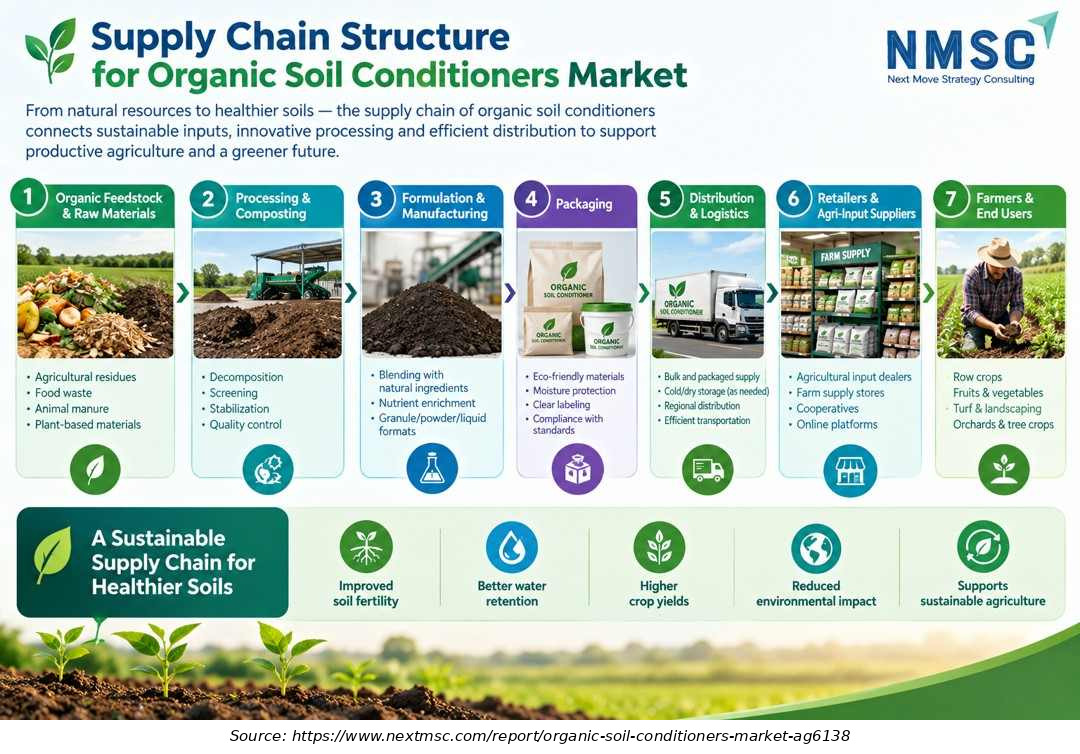
Supply Chain Structure for the Organic Soil Conditioners Market

Supply Chain Structure for the Organic Soil Conditioners Market

This infographic illustrates the supply chain structure of the Organic Soil Conditioners Market, from organic feedstock sourcing and composting to formulation, packaging, distribution, retail, and farm-level application. It highlights key inputs such as agricultural residues, food waste, and plant-based materials, while emphasizing sustainable practices that improve soil fertility, water retention, crop yields, and environmental outcomes.

Which Product Type Dominates the Organic Soil Conditioners Market?

Compost leads with USD 2.01 Billion in 2025, expanding to USD 3.66 Billion by 2035, reflecting its role as the most widely adopted and regulatory compliant soil amendment across both certified organic and integrated sustainable farming systems. Biochar is the fastest growing product type at a 9.8% CAGR, driven by its premium positioning in voluntary carbon markets and soil-carbon permanence credentials that enable dual revenue streams for producers and growers. Microbial inoculants register the second-fastest CAGR at 7.6%, reflecting the accelerating integration of precision soil-health technology with formulated biological products.

Segment Sizing: By Crop Type

Segment 2025 (USD Bn) 2035 (USD Bn) CAGR% (2026–2035)
Fruits and Vegetables 2.36 4.39 6.4%
Cereals and Grains 2.08 3.72 5.9%
Oilseeds and Pulses 1.11 1.99 6.0%
Turf and Ornamentals 0.90 1.96 8.1%
Others 0.49 1.23 9.6%
Total 6.94 13.29 6.45%
Source: www.nextmsc.com

Which Crop Type Leads and Which Is Fastest-Growing?

Fruits and Vegetables leads crop-type demand at USD 2.36 Billion in 2025, growing to USD 4.39 Billion by 2035, reflecting the intensive soil conditioning requirements and high certified-organic price premiums that make per-unit input investment economically justified for horticultural producers. Turf and Ornamentals is the fastest-growing crop type at an 8.1% CAGR, driven by growing premium lawn care, golf course management, and urban landscaping demand for sustainable soil health inputs in North America and Europe.

Segment Sizing: By Farming System

Segment 2025 (USD Bn) 2035 (USD Bn) CAGR% (2026–2035)
Certified Organic Farming 3.19 5.91 6.4%
Transitioning-to-Organic Farming 1.46 3.44 8.5%
Integrated Sustainable Farming 2.29 3.94 5.6%
Total 6.94 13.29 6.45%
Source: www.nextmsc.com

Which Farming System Dominates and Which Grows Fastest?

Certified Organic Farming dominates at USD 3.19 billion in 2025, reflecting established demand for compliant organic inputs across certified production systems. Transitioning-to-Organic Farming is the fastest-growing segment at a stated 8.5% CAGR from 2026 to 2035, supported by the expansion of organic agriculture programs, transition incentives, and policies promoting alternative and sustainable agricultural inputs. The EU has set a target of at least 25% of agricultural land under organic farming by 2030, while USDA rules require land to remain free from prohibited substances for 36 months before organic harvest eligibility. India’s PM-PRANAM scheme also promotes alternative fertilizers, organic farming, and balanced fertilizer use.

Growth Opportunities

Our analysis shows that three whitespace opportunities are positioned to generate disproportionate value for manufacturers, investors, and distributors through 2035.

Can Biochar's Carbon Credit Revenue Stream Unlock Mainstream Agricultural Adoption?

Manufacturers and agronomists who develop carbon credit integrated biochar purchase programs for large-scale grain and oilseed operators can compress payback periods below conventional input cost differentials, benefiting the Biochar product type and Cereals and Grains crop type simultaneously by expanding addressable demand far beyond certified organic acreage into the significantly larger integrated sustainable farming system base.

Does the Transitioning-to-Organic Pipeline Create a Recurring Starter-Kit Opportunity?

Producers that bundle gateway soil conditioner starter kits combining compost, microbial inoculants, and humic acids at subsidized introductory pricing can capture the growing three-year transition cohort mandated by EU Farm-to-Fork and USDA transition programs, converting trial buyers into multi-season branded customers and benefiting the Transitioning-to-Organic Farming system segment across Europe, India, and North America.

Can Urban and Controlled-Environment Agriculture Open a New Organic Input Channel?

Urban farming, rooftop cultivation, and controlled-environment horticulture operators represent an underserved premium channel for liquid humic acids, microbial inoculants, and worm casting concentrates where per-unit economics justify premium formulations, benefiting the Fruits and Vegetables crop type and Liquid form segment as space-constrained growing systems prioritize soil biology performance over input cost per hectare.

Regional Outlook

2025 (USD Billion)
2035 (USD Billion)
North Americ
Europe
Asia-Pacific
Latin Americ
Middle East
Region 2025 (USD Billion) 2035 (USD Billion) CAGR (%)
North America $10.0 USD Billion $40.0 USD Billion 9.0%
Europe $17.1 USD Billion $51.1 USD Billion 27.0%
Asia-Pacific $24.2 USD Billion $62.2 USD Billion 25.0%
Latin America $31.3 USD Billion $73.3 USD Billion 23.0%
Middle East & Africa $38.4 USD Billion $84.4 USD Billion 12.0%

Regional data is locked

Unlock complete regional numbers for this market.

Unlock Full Data

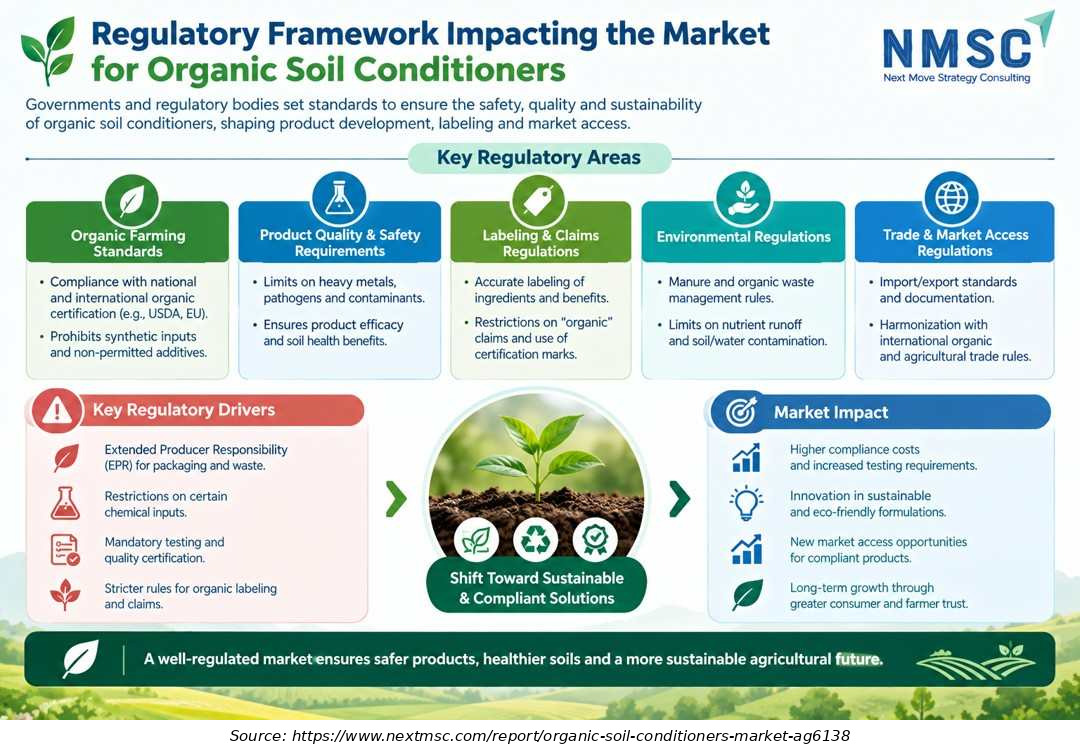
Regulatory Framework Impacting the Market

This infographic presents the regulatory framework impacting the Organic Soil Conditioners Market, covering organic farming standards, product quality and safety, labeling requirements, environmental regulations, and trade compliance. It highlights key regulatory drivers such as mandatory testing, chemical restrictions, organic claims, and extended producer responsibility, while showing their impact on compliance costs, sustainable product innovation, market access, and consumer trust.

Competitive Landscape

Dimension Description
Market Structure Moderately fragmented; top 10 companies hold an estimated 35–40% of market share, with a long tail of regional composting and biological input producers accounting for the remainder
Innovation Focus Biochar production optimization, microbial strain libraries, humic acid extraction efficiency, liquid inoculant formulation stability, and carbon credit integration for soil conditioner products
M&A Activity Targeted acquisitions of specialty biological input and microbiome technology firms by larger diversified agriculture companies seeking premium organic portfolio positioning

How Do Companies Compete in the Organic Soil Conditioners Market Industry?
Companies compete primarily on agronomic performance documentation, regulatory certification breadth across national organic programs, and distribution network depth reaching certified organic growers across multiple crop categories. Our findings suggest that manufacturers with established field trial data libraries and agronomist-supported direct to grower programs hold a structural advantage over commodity compost producers, as certified organic operators increasingly demand input traceability and performance guarantees as prerequisites for procurement decisions.

Which Competitive Archetypes Dominate the Organic Soil Conditioners Market Industry?

Diversified lawn and garden companies such as The Scott’s Miracle Gro Company dominate consumer-channel organic soil conditioner distribution through retail brand equity, while specialized biological input companies including Novozymes A/S and Bio Gro NZ differentiate on microbial strain performance and certification credentials. Regional composting operators compete on feedstock economics and bulk delivery logistics, maintaining volume-based dominance across commercial and municipal organic farming programs.

What Innovation and Differentiation Strategies Are Companies Pursuing?

We observed that leading companies are investing in liquid microbial inoculant formulation stability, precision humic acid extraction processes, and carbon measurement frameworks that enable growers to generate voluntary carbon credits from biochar and compost application programs. Differentiation increasingly rests on integrated soil-health monitoring services soil testing, application recommendations, and outcome documentation that add recurring advisory revenue to one-time product sales and deepen long-term grower relationships.

What M&A and Partnership Activity Is Shaping the Organic Soil Conditioners Market?

Recent activity has favoured strategic partnerships between biochar producers and carbon credit platform operators, as well as acquisitions of microbial inoculant developers by larger crop nutrition companies. Our analysis shows that the pace of biological input acquisition activity is accelerating as multinational crop protection and nutrition companies seek to acquire validated soil microbiome technology rather than developing proprietary strains internally, reflecting the multi-year timeline required for field validated microbial performance data.

Key Market Players

Based on research conducted by NMSC, the following companies represent the validated set of leading producers, manufacturers, and branded developers active in the Organic Soil Conditioners Market.

The Scott’s Miracle Gro Company Novozymes A/S Evonik Industries AG Profile Products LLC Sustane Natural Fertilizer, Inc. Humintech GmbH Biochar Now, LLC Bio-Works Technologies AB Verdesian Life Sciences, LLC Procter & Gamble Co. COMPO Expert GmbH Sipcam Oxon S.p.A. Florasul S.A. Premier Tech Ltd. Klasmann-Deilmann GmbH BioGro NZ Limited OMRI Listed Organics, Inc. Earthworm Castings LLC AEA — Advanced Enzymes Technologies Ltd. Valagro S.p.A.

Latest Developments

We found that recent corporate and regulatory activity across the Organic Soil Conditioners Market reflects continued investment in biological input technology, regulatory-aligned product development, and strategic partnerships between soil health companies and carbon credit platforms.

Date Event
September 2026 BASF Agricultural Solutions and IRRI extended the OPTIMA Rice collaboration to examine soil health, carbon storage and biochar in rice systems.
October 2025 BASF launched xarvio HEALTHY FIELDS for Rita in Japan, integrating the AI-powered Humus soil-improvement service into a rice yield-guarantee program.

Key Benefits for Stakeholders

How Does This Report Benefit Organic Input Manufacturers and Agricultural Suppliers?

Organic input manufacturers and agricultural suppliers gain segment-level revenue forecasts and CAGR benchmarks across all five segmentation axes product type, crop type, farming system, form, and application method enabling product portfolio decisions and regional launch prioritization grounded in the same 2025–2035 figures applied consistently throughout this report. The competitive landscape section identifies which differentiation archetypes are capturing premium share and which M&A patterns are consolidating the market.

How Does This Report Benefit Investors and Financial Analysts?

Investors and financial analysts gain a reconciled market-sizing model, named-company development tracking, and a quantified Growth Catalyst & Risk Assessment Matrix that directly supports valuation scenario modeling and capital-allocation decisions across public and private organic agriculture input companies. The country-level granularity across 38 markets enables emerging-market opportunity assessment alongside mature-market performance benchmarking within a single unified analytical framework.

How Does This Report Benefit Farmers, Retailers, and Certification Bodies?

Farmers and farm managers gain insight into which organic soil conditioner categories are delivering the highest agronomic return per invested dollar across different crop and farming system combinations, while retailers gain visibility into sourcing trends and pricing outlook. Organic certification bodies gain a market-level view of adoption rates, regulatory compliance trends, and the geographic pipeline of transitioning farms requiring approved input guidance across all five covered regions.

Key Market Segments Evaluated

By Product Type

  • Compost
  • Humic and Fulvic Acids
  • Biochar
  • Worm Castings and Vermicompost
  • Seaweed Extracts
  • Microbial Inoculants
  • Green Manure
  • Peat Moss

By Crop Type

  • Fruits and Vegetables
  • Cereals and Grains
  • Oilseeds and Pulses
  • Turf and Ornamentals
  • Others

By Farming System

  • Certified Organic Farming
  • Transitioning-to-Organic Farming
  • Integrated Sustainable Farming

By Form

  • Dry
  • Liquid

By Application Method

  • Soil Application
  • Foliar Application
  • Fertigation

By Region

  • North America 
    • U.S.
    • Canada
    • Mexico.
  • Europe 
    • UK
    • Germany
    • France
    • Italy
    • Spain
    • Sweden
    • Denmark
    • Finland
    • Netherlands
    • Rest of Europe.
  • Asia-Pacific 
    • China
    • India
    • Japan
    • South Korea
    • Taiwan
    • Indonesia
    • Vietnam
    • Australia
    • Philippines
    • Malaysia
    • Rest of APAC.
  • Middle East & Africa 
    • Saudi Arabia
    • UAE
    • Egypt
    • Israel
    • Turkey
    • Nigeria
    • South Africa
    • Rest of MEA.
  • Latin America 
    • Brazil
    • Argentina
    • Chile
    • Colombia
    • Rest of LATAM.

Conclusion & Recommendations

The long-term outlook is structurally positive, with the market expanding from USD 7.57 Billion in 2026 to USD 13.29 Billion by 2035 at a 6.45% CAGR, underpinned by mandatory organic farmland expansion under EU and Asian government programs, sustained organic retail sales growth, and maturing carbon credit market recognition of soil conditioner sequestration credentials. We observed that this trajectory is supported by policy, consumer demand, and technology tailwinds operating simultaneously rather than any single speculative growth assumption.

What Strategic Positioning Do We Recommend?

Our assessment indicates that manufacturers should prioritize liquid microbial inoculant and biochar product development to capture the fastest-growing product segments, while building carbon credit integration capabilities that enable growers to offset premium input costs through voluntary carbon sales. Companies without established organic certification credentials should pursue OMRI Listing or equivalent national approval as the foundational prerequisite for access to certified and transitioning-to-organic farmer segments.

How Attractive Is the Organic Soil Conditioners Market for Investment?
Investment attractiveness is highest in Asia-Pacific given its superior 8.4% CAGR and government-funded soil restoration programs, while North America offers the largest absolute revenue base at USD 2.36 Billion in 2025. We found that Biochar, Microbial Inoculants, and the Transitioning-to-Organic Farming system represent the three highest-growth sub-categories, offering investors exposure to above-market CAGR trajectories supported by carbon-credit supplemental revenue logic.

What Are the Key Market Shifts and Risks?

Key risks include policy reversal or timeline extension on EU Farm-to-Fork farmland targets, commodity compost price compression driven by municipal organic waste processing capacity expansion, and the potential for synthetic biology-derived soil inputs to challenge natural organic conditioner positioning in the integrated sustainable farming segment. Our analysis shows that companies dependent on a single product category — particularly peat moss — face growing regulatory risk that warrants proactive portfolio diversification investment.

What Are the Primary Growth Pathways Through 2035?

Primary growth pathways include biochar-carbon credit integration programs, transitioning-farm starter kit bundling, and urban and controlled-environment agriculture channel development. We observed that companies combining certified product portfolios with agronomic advisory services and digital soil-health monitoring tools are best positioned to capture disproportionate share of the USD 5.72 Billion absolute revenue opportunity created between 2026 and 2035, as these capabilities convert one-time buyers into multi-season recurring customers.

FAQs

Market Size & Forecast

Organic Soil Conditioners Market Global Industry Analysis and Forecast (2026-2035) Revenue Forecast
Values in USD Billion

2025 $6.94 Billion
2025
2026 $7.39 Billion
2026
2027 $7.86 Billion
2027
2028 $8.37 Billion
2028
2029 $8.91 Billion
2029
2030 $9.49 Billion
2030
2031 $10.10 Billion
2031
2032 $10.75 Billion
2032
2033 $11.44 Billion
2033
2034 $12.18 Billion
2034
2035 $13.29 Billion
2035

Key Takeaways

By Product Type — Dominant: Compost led with USD 2.01 Billion in 2025, expanding to USD 3.66 Billion by 2035; Biochar is the fastest-growing product at 9.8% CAGR from 2026–2035

By Product Type — Fastest Growing: Biochar is the fastest-growing product type at 9.8% CAGR from 2026–2035, reaching USD 2.13 Billion by 2035

By Crop Type — Dominant: Fruits and Vegetables led at USD 2.36 Billion in 2025, projected to reach USD 4.39 Billion by 2035

By Crop Type — Fastest Growing: Turf and Ornamentals is the fastest-growing crop type at 8.1% CAGR from 2026–2035

By Farming System — Dominant: Certified Organic Farming held USD 3.19 Billion in 2025, projected to reach USD 5.91 Billion by 2035

By Farming System — Fastest Growing: Transitioning-to-Organic Farming is the fastest-growing farming system at 8.5% CAGR from 2026–2035

Dominant Region: North America dominated with approximately 34% revenue share in 2025 (USD 2.36 Billion)

Fastest-Growing Region: Asia-Pacific is expected to register the highest CAGR of 8.4% during 2026–2035

Dominant Country: The U.S. leads the market, underpinned by the world's largest certified organic consumer base and USDA National Organic Program

Fastest-Growing Country: India is the fastest growing country, supported by PM PRANAM and rising domestic organic export demand

Market Opportunity: The market presents an absolute investment opportunity of approximately USD 5.72 Billion between 2026 and 2035, calculated as the difference between the 2035 forecast of USD 13.29 Billion and the 2026 estimate of USD 7.57 Billion, positioning producers of advanced soil-health inputs as high-conviction beneficiaries of the decade long regenerative agriculture transition.

According to NMSC analysis, the scalability advantage of microbial inoculants and humic acid formulations over bulkier traditional composts is accelerating adoption among large scale grain and oilseed operations, representing a structural product mix shift that will compress the share dominance of conventional compost within the overall market through 2035.

Investment Opportunities

Where Are Capital Inflows Concentrating in the Organic Soil Conditioners Market?

Capital is concentrating in microbial inoculant biotech startups, biochar production infrastructure, and platform scale composting operations with verifiable soil-carbon measurement capabilities. We found that voluntary carbon credit market participation is emerging as an additional investment thesis beyond pure input economics, with biochar facilities attracting financing from both traditional agriculture investment funds and climate-tech impact investors seeking verified agricultural carbon sequestration assets.

How Is Infrastructure Investment Shaping Long-Term Organic Conditioner Production Capacity?

Our findings suggest that infrastructure investment is shifting toward precision fermentation and controlled composting facilities capable of producing consistent, pathogen free, certifiable outputs at commercial agricultural scale. This shift Favors producers with verifiable quality management systems and third-party certification audit trails, as retailers sourcing certified organic produce increasingly require full input traceability documentation from growers who in turn demand auditable soil conditioner supply chains from their input providers.

What ESG Considerations Are Influencing Investment Decisions?

Environmental, Social, and Governance considerations in this market centre on carbon sequestration permanence, biodiversity restoration, and responsible peat moss sourcing the latter under growing regulatory scrutiny across the EU, which has proposed restrictions on horticultural peat use to protect threatened peatland ecosystems. We found that investors increasingly favour manufacturers with documented transition pathways away from peat, evidenced by growing sustainable agriculture input investments in coir, wood fibre, and biochar-based peat substitutes as replacements aligned with emerging EU peat reduction mandates.

About the Author

Liza Phukan

Liza Phukan

Liza Phukan is Research Associate at Next Move Strategy Consulting, where she has covered emerging industries and market research across sectors for 3.5 years. Her work includes analyzing industry developments, validating market data, and developing structured business content from research findings. She uses secondary research and data-validation practices to turn complex market information into clear decision-useful market analysis for business audiences and support report development and B2B.

About the Reviewer

Supradip Baul

Supradip Baul

Supradip Baul is an accomplished business consultant and strategist with over a decade of rich experience in market intelligence, strategy, technology, and business transformation. His work has included rigorous qualitative and quantitative analysis across multiple industries, helping clients shape investment decisions and long-term roadmaps. Earlier in his career, he was associated with Gartner, where he contributed to industry-leading reports and market share analyses. He has worked with leading global companies and holds an MBA with a dual specialization in Marketing and Finance.

Download Free Sample

Nishant Awate

NISHANT AWATE

Business Development Global Sales

Zehnder Group Deutschland GmbH

Our experience working with Next Move Strategy Consulting was positive. The team was responsive, professional, and open to incorporating our specific requirements throughout the project. The India AHU market study was comprehensive and well structured, covering market value and volume forecasts, product and application segments, and key industry trends. The inclusion of both AHU and residential MVHR market insights made the study particularly relevant for our strategic market assessment. Overall, the report provides a solid foundation for evaluating market potential, identifying priority segments, and supporting business-development decisions in India.

Robert Sean Trevino

ROBERT SEAN TREVINO

Sr. Director, Head of Strategic Insights & Analytics

Foundation Medicine

I realized that it was a reliable source of information. These days, there are many people who are looking for authentic data, and this is one of the only sources that can offer them with what they need;

Semih Kavaklioglu

SEMIH KAVAKLIOGLU

Co-Founder & Sales Manager

Decortie

I work a lot in the marketing industry and I know that research is an essential part of any campaign. I have used Market research reports for my own products and I found them to be very informative and well-researched. The team here produces insightful reports for a good price

Henri Knyphausen

HENRI KNYPHAUSEN

Partner at Singulier [Ex-BCG]

Singulier

I recently engaged NEXTMSC.com for a commercial due diligence project within the intralogistics sector, and I am pleased to provide a reference based on my experience. In utilizing NEXTMSC.com's services, I found their report to offer valuable insights into market dynamics and key industry players. The initial report provided a solid foundation for our analysis. However, as we were investigating a smaller target in the market, and I had specific customization requests requiring additional research. These requests included detailed information on product portfolios of various players and sub-market sizes, both inclusive and exclusive of certain product categories. NEXTMSC.com demonstrated commendable responsiveness and agility in accommodating these customization requests. Within a timeframe of 1-2 weeks, they delivered a revised report that met our specific needs. Furthermore, they were receptive to my follow-up inquiries, ensuring clarity and understanding of the data provided. The final deliverable significantly contributed to our due diligence efforts. One of NEXTMSC.com's notable strengths lies in their qualitative research capabilities. However, for future engagements, I would recommend the inclusion of a quantified market model in Excel format. Such a model would offer the ability to conduct in-depth analyses and explore various market segments, including country-specific data and subcomponent breakdowns. Based on my positive experience, I would not hesitate to work with NEXTMSC.com again. Their responsiveness, willingness to accommodate customization requests, and commitment to delivering actionable insights make them a reliable partner for commercial research projects.

Mohit Agarwal

MOHIT AGARWAL

Chief Manager

DryChem India Pvt. Ltd.

Next Move Strategy Consulting is an amazing team of consultants. We required a market study report for our investors on top priority and the team went above and beyond our expectations to deliver the same with ample supporting data within a short time span enabling us to secure the investments and keep our project timeline maintained. Their professionalism, attention to detail, and timely delivery of actionable recommendations have left a lasting impression on our organization.

Custom Market Research Services

We will customize the research for you if the listed report does not fully match your requirements.

Get 30% Free Customization

Select License

This website uses cookies to ensure you get the best experience on our website. Learn more

✖