Solar Power Equipment Market By Product Type (Solar Modules, Inverters & Power Conversion, & Others), By Cell Architecture (PERC, TOPCon, Heterojunction, & Others), By Voltage Class (Low Voltage, Medium Voltage, & High Voltage, and Not Applicable), By Power Class (Standard, High Power, & Others), By Sales Channel (Direct Sales, Distributor & Wholesale, Retail, & Others), By End User Industry (Investor-Owned Utilities & IPPs, Commercial Entities, & Others) – Global Analysis & Forecast, 2025-2035
Industry: Energy & Power | Publishing Date: March 17, 2026 | Last Updated: September 15, 2026 | No of Pages: N/A | No. of Tables: N/A | No. of Figures: N/A | Format: PDF | Report Code: EP4284
Industry Outlook
The global Solar Power Equipment Market size was valued at USD 173.52 billion in 2025, and is expected to be valued at USD 197.29 billion by the end of 2026. The industry is projected to grow, hitting USD 626.56 billion by 2035, with a CAGR of 13.7% between 2026 and 2035.
Solar Power Equipment Industry Size & Forecast
|
Parameters |
Details |
|
Market Size in 2026 |
USD 197.29 Billion |
|
Revenue Forecast in 2035 |
USD 626.56 Billion |
|
Growth Rate |
CAGR of 13.7% from 2026 to 2035 |
|
Analysis Period |
2025–2035 |
|
Base Year Considered |
2025 |
|
Forecast Period |
2026–2035 |
|
Market Size Estimation |
Billion (USD) |
|
Companies Profiled |
20 |
|
Countries Covered |
33 |
|
Market Share |
Available for 10 companies |
Based on our analysis of global deployment patterns, we found that the solar power equipment market today is marked by robust adoption across utility-scale, commercial, and residential segments. In conversations with product managers and technology providers, we observed a pronounced shift toward bifacial modules, advanced inverters, and energy yield optimisation systems as customers prioritise efficiency and lifecycle performance. Our assessment further noticed that demand is being driven not only by declining levelized costs of energy but also by stringent renewable portfolio standards and incentives from regulators in key regions. This alignment of policy support and cost competitiveness underpins strong capital inflows from investors focused on decarbonization and long-term cash flows.
In evaluating key applications and future prospects, we consistently found solar energy systems serving as the backbone of distributed energy resources, hybrid microgrids, and large-scale solar farms feeding into smart grids. Based on our interviews with energy planners and integrators, we found that use cases such as behind-the-meter self-consumption, peak shaving, and grid stabilisation with storage integration are rapidly maturing. We further project that technological innovation, including tracking systems and digital performance analytics, expands the market boundaries. As regulators tighten emissions targets and corporates set ambitious renewable procurement goals, we believe the market is poised for sustained growth and deeper penetration across emerging and developed economies.
What Are the Key Trends in the Solar Power Equipment Industry?
How is Digitalisation and Smart Monitoring Transforming the Market?
Based on our primary research with system integrators, we found that the integration of digital monitoring platforms and AI-driven analytics is reshaping operational efficiency in the solar power equipment market. Our market analysis indicates that real-time performance monitoring enables predictive maintenance, reduces downtime, and extends equipment lifespan. Product managers and operations teams emphasise that these digital tools not only optimise energy yield but also allow for data-driven decision-making on capacity expansion and asset management. We further noticed that investors and developers focus on smarter systems, which reduce operational costs and enhance return on investment, making solar projects more scalable and bankable across diverse regions.
How Is Advanced Module and Inverter Technology Driving Market Evolution?
From our interviews with R&D leads and product managers, we discovered that continuous advancements in module efficiency, bifacial designs, and smart inverters are key drivers of market transformation. In our assessment, we found that these technological improvements increase energy output per square meter, reduce system losses, and facilitate integration with hybrid and microgrid systems. Through our consultations with system integrators, we found that such high-performance equipment supports faster deployment, easier scalability, and reduced lifecycle costs. Furthermore, as efficiency gains become standard expectations, manufacturers and investors alike are prioritising cutting-edge designs to maintain competitiveness, creating long-term strategic advantages for early adopters.
How Is Energy Storage Integration Expanding the Solar Power Equipment Market?
Through our interviews with energy storage providers, it became clear that combining solar energy infrastructure with storage solutions is creating transformative market opportunities. Our analysis further indicates that integrated solar-plus-storage systems enable grid support, peak load management, and backup resiliency, thereby significantly expanding the range of feasible applications. Moreover, these systems improve asset utilisation and reduce dependency on conventional power sources, creating operational efficiencies and long-term cost savings. Our research also indicates that as storage technologies become more cost-competitive, the integration trend accelerates adoption, drives higher equipment sales, and influences strategic investment decisions across regions.
Ecosystem Analysis of the Solar Power Equipment Market
This infographic illustrates the integrated ecosystem shaping the solar power equipment market across innovation, supply, manufacturing, distribution, and regulatory layers.
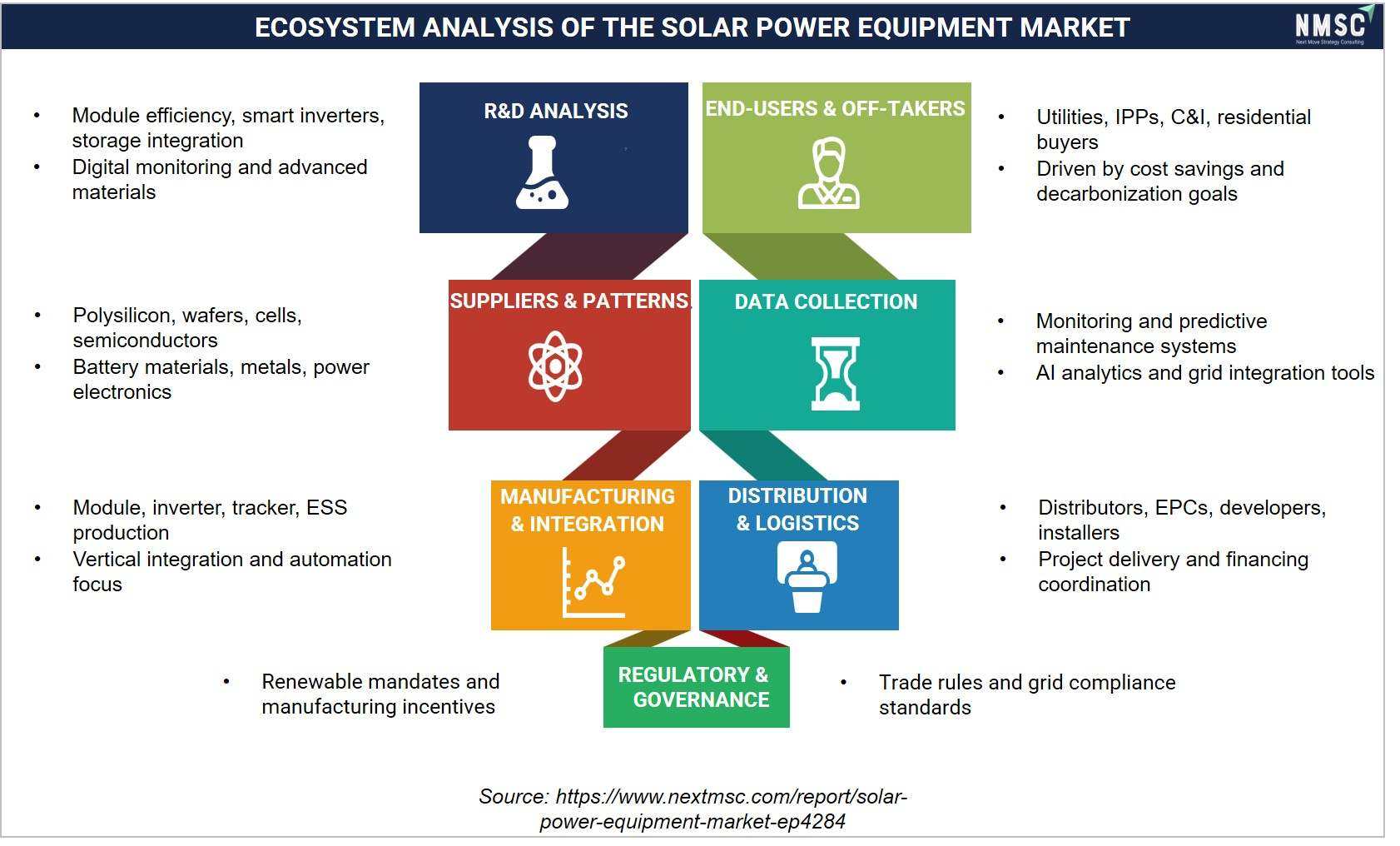
The above chart indicates how the solar power equipment market functions as an integrated ecosystem, anchored in R&D and innovation, supported by suppliers and data-driven optimisation, reinforced through manufacturing and system integration, enabled by distribution and logistics networks, and ultimately shaped by end-users and regulatory governance, collectively driving competitiveness, scalability, and long-term market sustainability.
What Are the Key Market Drivers, Breakthroughs, and Investment Opportunities that will Shape the Solar Power Equipment Market in the Next Decade?
Growth Catalyst & Risk Assessment Matrix
|
DRIVERS/TRENDS/ RESTRAINTS |
(+/-) % IMPACT ON CAGR FORECAST |
GEOGRAPHIC RELEVANCE |
IMPACT TIMELINE |
|
Declining solar technology and BOS costs driving adoption |
+4.21% |
Global (APAC, North America, Europe) |
Long‑term (≥4 years) |
|
Supportive policy frameworks and incentives expanding installations |
+3.82% |
North America & EU with spill‑over to APAC |
Medium‑term (2‑4 years) |
|
Technological innovation is boosting solar equipment performance and adoption |
+2.03% |
U.S., Australia, Germany, Global growth |
Medium‑term (2‑4 years) |
|
Energy storage integration enables solar systems to store energy and support the grid |
+1.24% |
Global (U.S., China, India) |
Medium‑term (2‑4 years) |
|
Supply‑chain and raw‑material price volatility |
-1.23% |
Global, acute in North America & Europe |
Short‑term (≤2 years) |
The global solar power equipment market is witnessing steady growth, underpinned by declining technology and balance-of-system costs, supportive policy frameworks, and rising demand from corporate and utility buyers for clean energy solutions. Based on our primary research with product managers and regulators, we observed that advancements in high-efficiency modules, smart inverters, and digital monitoring platforms are improving energy yields, operational efficiency, and scalability across residential, commercial, and utility-scale projects. Through our assessments, we also found that integrating solar with storage and hybrid systems is expanding application use cases, enhancing revenue predictability and long-term asset value.
However, supply chain volatility and fluctuations in raw material costs continue to constrain adoption, particularly in price-sensitive and emerging markets. Looking ahead, the convergence of technological innovation, policy support, and hybrid system integration is expected to sustain market momentum while creating measurable efficiency and financial gains across the value chain.
Growth Drivers:
How Are Policy Support and Incentive Frameworks Accelerating the Solar Power Equipment Market?
Based on our market analysis and discussions with regulators across North America, Europe, and the Asia Pacific, we have consistently observed that robust policy support and fiscal incentive frameworks are foundational drivers of solar equipment adoption. Through our interviews with energy regulators and utility planners, we identified that feed-in tariffs, tax credits, and renewable portfolio standards have materially lowered entry barriers for developers and end users, improving project bankability and encouraging large-scale deployment. Moreover, such policy certainty enables long term planning, affecting procurement cycles and supply chain investments, which in turn drives demand for advanced modules, trackers, and inverters.
How Is Technological Innovation Driving Solar Power Equipment Market Growth?
From our primary research involving technology providers and engineering teams, we found that relentless innovation in solar PV technology is significantly expanding both performance and application scope. Based on our assessment, we found that advancements in bifacial solar modules, integrated power optimisers, and AI-enabled performance monitoring software are improving energy yields and reliability, which resonate strongly with investors focused on total cost of ownership and return on investment metrics. These innovations reduce the balance of system costs and enhance scalability, making solar competitive with conventional generation even in markets without heavy subsidies.
Through our further conversations with R&D leads, we noticed a strategic shift toward modular, plug-and-play solutions that simplify installation and maintenance. This trend accelerates adoption among commercial and residential segments, which historically faced barriers due to complexity and installation costs. As digital analytics and predictive maintenance become standardised features within equipment offerings, customer confidence and operational efficiencies further propel market growth.
Growth Inhibitor:
How Is Supply Chain Volatility Constraining the Solar Power Equipment Market Expansion?
We found that supply chain volatility emerges as a significant restraint impeding the solar power equipment market’s broader acceleration. Our discussions with procurement leaders and logistics coordinators indicate that fluctuations in raw material costs, especially polysilicon, silver, and semiconductor components, are creating pricing and delivery uncertainties. These operational impacts reverberate through project schedules and capital planning for developers, who face tight margins and contractual obligations that cannot easily absorb cost escalations or delays.
Growth Opportunity:
How Is Energy Storage Integration Create a Key Opportunity for the Solar Power Equipment Market?
Hybrid system designers indicate that combining solar power with lithium-ion and emerging storage technologies is creating new opportunities. These developments enable applications such as peak load management, grid support services, and behind-the-meter resiliency. The opportunity not only improves the operational flexibility of solar systems but also broadens the addressable market for equipment providers. As a result, manufacturers are increasingly offering storage-compatible inverters and advanced energy management solutions as bundled offerings, driving adoption, enhancing system value, and positioning solar installations for long-term, scalable growth across global markets.
Supply Chain Structure of the Solar Power Equipment Industry
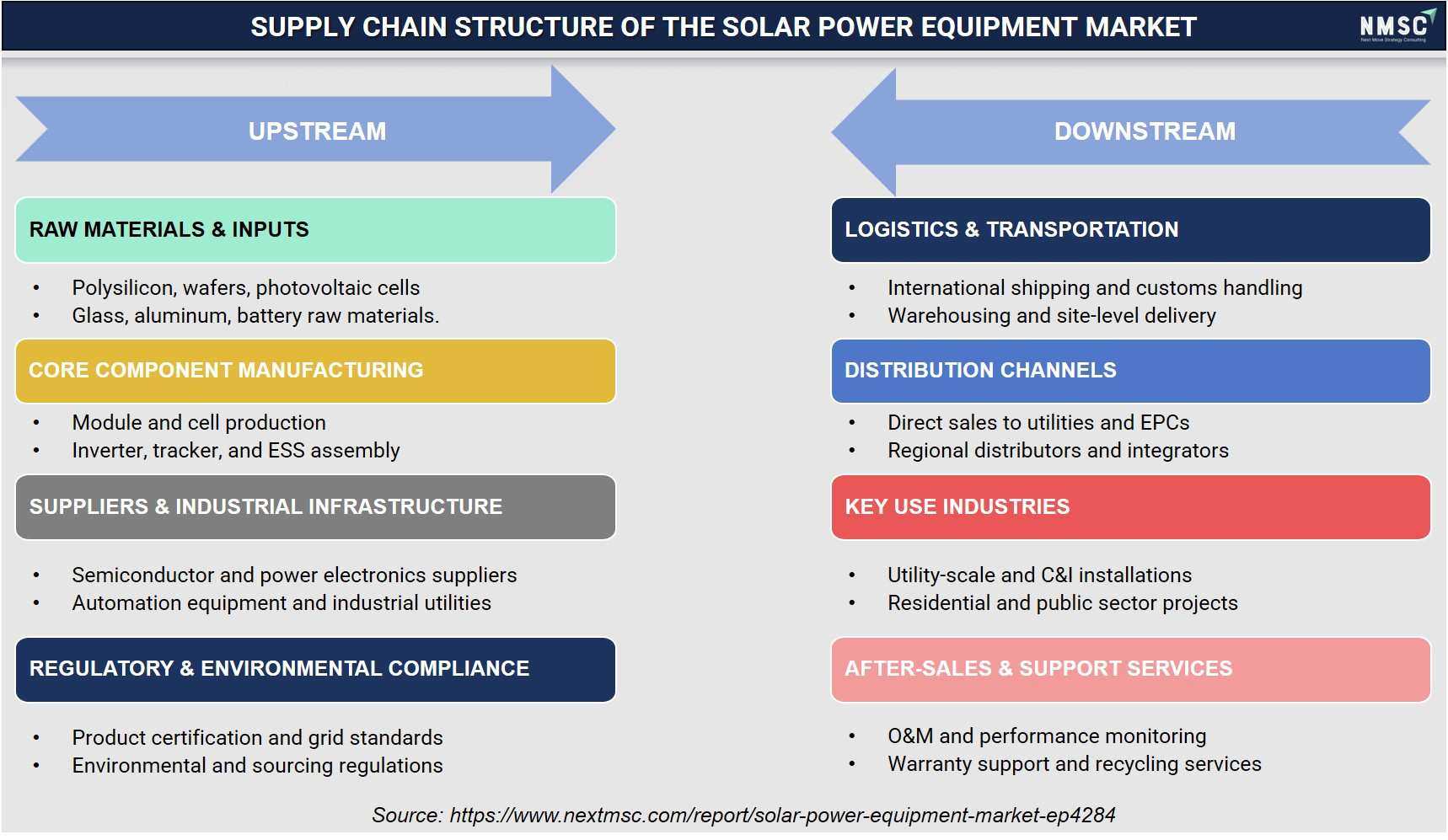
The above infographic maps the supply chain architecture of the solar power equipment market. It begins with upstream raw materials and critical inputs such as polysilicon, wafers, aluminum, and glass, advancing through core component manufacturing, supplier networks, technical and energy storage integration, and regulatory compliance requirements. It further extends downstream into logistics and transportation, direct channel and EPC engagement, distributor and integrator networks serving utility-scale and C&I deployments, and comprehensive after-sales services including operations and maintenance, warranty management, monitoring, and recycling. Collectively, it illustrates the end-to-end value flow that underpins market efficiency, scalability, and long-term competitiveness.
How Is the Solar Power Equipment Industry Segmented in This Report, And What Are the Key Insights from the Segmentation Analysis?
Market Highlights & Strategic Insights – Solar Power Equipment Market:
|
Segments |
Key Takeaways |
|
Product Type |
Solar modules dominate revenue contribution due to their core role in energy generation and continuous efficiency upgrades. However, inverters and ESS are gaining strategic importance as grid integration and hybridisation increase. Mounting & tracking systems are becoming ROI enhancers in utility-scale deployments |
|
Cell Architecture |
PERC remains widely deployed due to cost maturity, while TOPCon and HJT are gaining traction for higher efficiency and better temperature coefficients. We observe that next-generation architectures are reshaping competitive positioning and long-term margin structures for manufacturers |
|
Voltage Class |
Low-voltage systems lead by installation volume due to residential and distributed projects. Medium voltage dominates commercial and mid-scale utility plants, while high voltage is essential for large grid-connected projects. Infrastructure maturity strongly influences the regional voltage mix |
|
Power Class |
Mid- to high-power systems (>100 kW) drive revenue due to commercial and utility-scale demand. Small-capacity systems (<10 kW) contribute significantly in volume terms, especially in rooftop residential deployments. |
|
Deployment |
Utility-scale installations account for the largest equipment demand globally, supported by institutional financing and policy mandates. Distributed generation (C&I and residential) is expanding rapidly due to energy independence goals and cost savings |
|
Application |
Grid-connected applications dominate, reflecting national decarbonization targets. However, off-grid and hybrid systems are growing in emerging economies and remote installations, supported by storage integration |
|
Sales Channel |
Direct sales and EPC-driven procurement dominate utility-scale projects, while distributor and installer networks lead in residential and small commercial segments. We observe increasing digital procurement and bundled solution models |
|
End-User Industry |
Investor-owned utilities and IPPs lead total revenue contribution due to large-scale deployments. Commercial entities are rapidly increasing adoption driven by ESG commitments, while residential users drive high installation volumes in mature solar markets |
By Product Type Insights
How Is Product Type Segmentation Shaping the Solar Power Equipment Market?
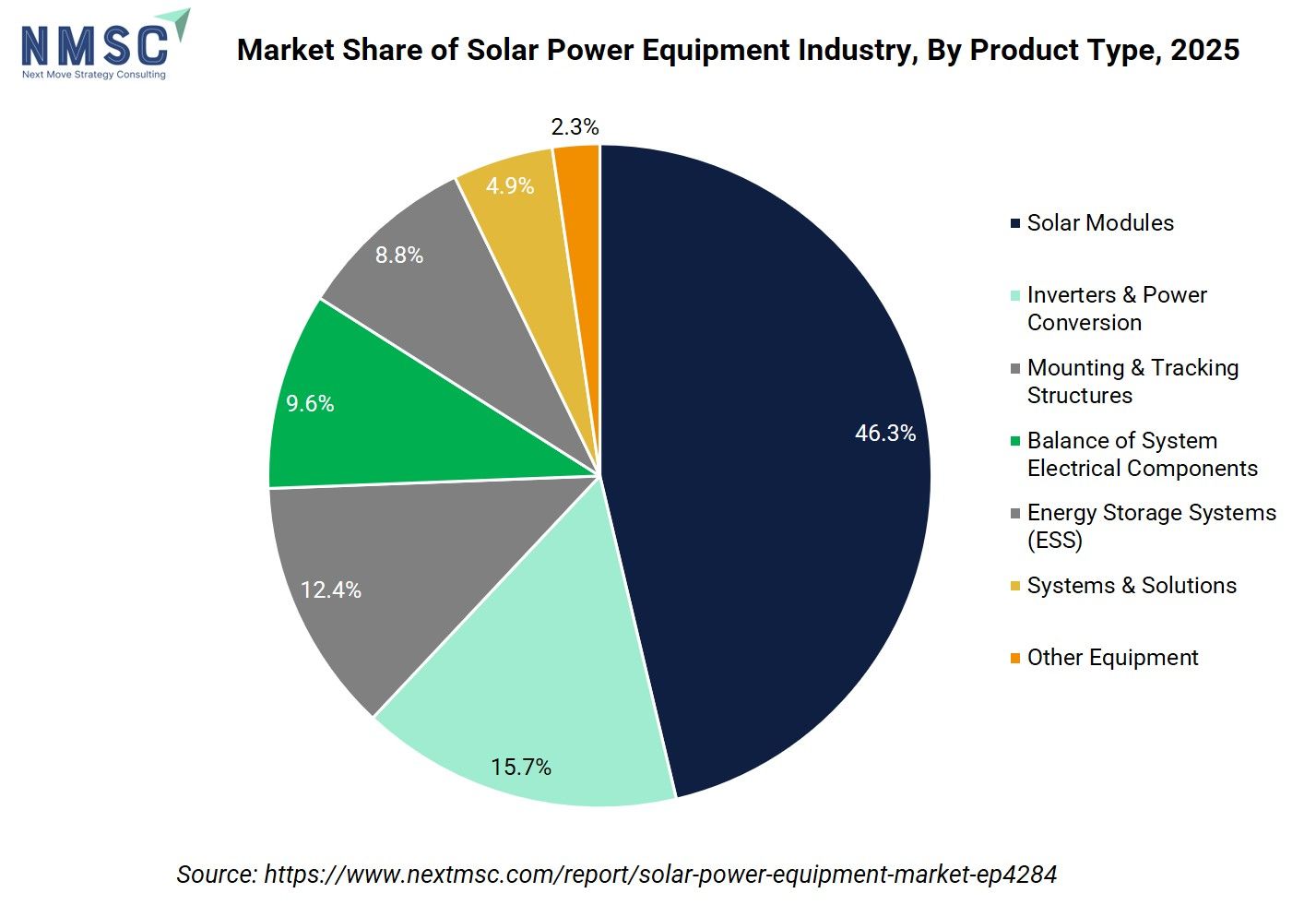
Based on our product-level assessment, the solar power equipment market is segmented into solar modules, inverters & power conversion, mounting & tracking structures, balance of system (BOS) electrical components, energy storage systems (ESS), systems & solutions, and other equipment.
Based on our assessment, we found that solar modules clearly dominate the solar power equipment market due to their indispensable role in converting solar irradiance into electrical energy and their large contribution to overall equipment revenue. Modules benefit from ongoing efficiency gains and broad deployment across utility, commercial, and residential scales, making them both a volume and value driver globally.
Inverters and BOS components follow closely, given their indispensable role in system performance and integration. Mounting structures and ESS are strategic enablers that enhance yield and dispatchability, respectively, while integrated systems & solutions are increasingly preferred by end users for simplifying procurement and operational oversight. Collectively, these segments underscore that while modules lead in absolute scale, the holistic value chain is quickly moving toward integrated, performance-oriented solutions, driven by technological advancement and end-user requirements for reliability, efficiency, and lifecycle value.
By Voltage Class Insights
Which Voltage Segment Is Fuelling Market Expansion in 2025?
Based on our voltage-level analysis, the solar power equipment market is segmented into low voltage (≤ 1000 V), medium voltage (1001 V - 35 kV), high voltage (> 35 kV), and not applicable (non-electrical equipment).
From our analysis, low-voltage solar equipment leads the market due to its extensive use in residential and small commercial installations, lower cost, and simpler integration requirements. Medium-voltage equipment follows, driven by commercial and utility-scale projects seeking optimal transmission efficiency within moderate infrastructure limits. High-voltage deployments, while limited in number, are strategically important for connecting large-scale PV farms to national grids.
Non-electrical equipment, though not voltage-specific, remains indispensable for structural and operational performance, making it a key supporting segment across all installations. Collectively, the market’s voltage-level segmentation reflects both adoption scale and project type, with low-voltage systems driving broad penetration while higher voltage solutions support strategic expansion and grid integration.
By End-User Industry Insights
Which End-User Industries Accelerated Solar Power Equipment Adoption in 2025?
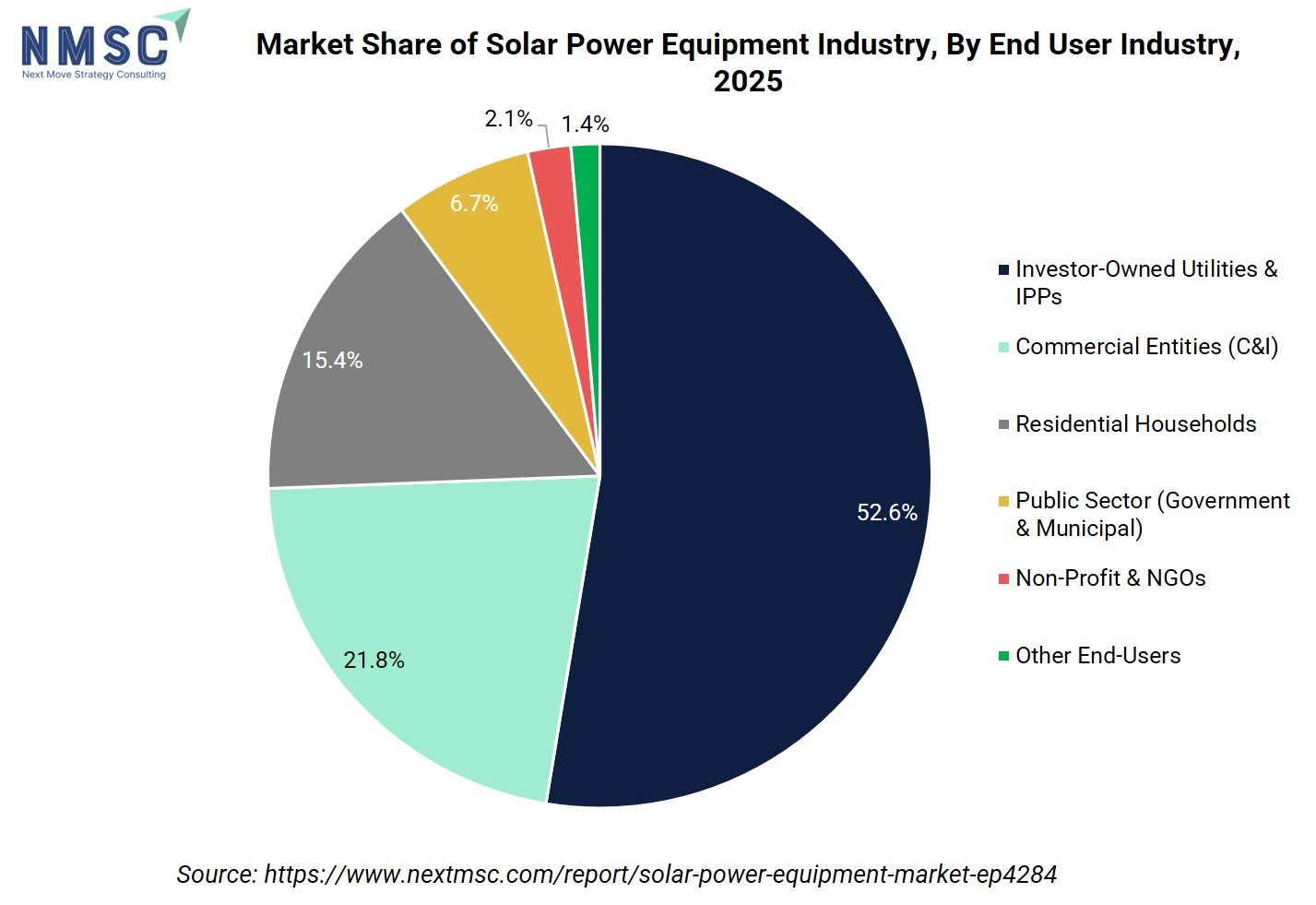
Based on our end-user industry analysis of solar power equipment, the market is segmented into investor-owned utilities & IPPs, commercial entities, residential households, public sector, non-profit & NGOs, and other end-users.
From our assessment, we observed that investor-owned utilities (IOUs) and independent power producers (IPPs) clearly dominate the solar power equipment market in terms of revenue contribution and installed capacity. Based on our analysis of deployment volumes, we found that utility-scale projects account for the majority of global solar additions, requiring high-capacity modules, advanced inverters, tracking systems, and grid infrastructure. While commercial and residential segments drive distributed generation growth and diversification, utilities and IPPs lead due to stronger financing capabilities, long-term PPAs, and regulatory mandates. We assess that although distributed segments expand steadily, large-scale utility investments continue to anchor overall market growth and equipment demand.
Regional Outlook:
Geographic Performance Snapshot:
|
Regions |
Key Takeaways |
|
North America |
North America remains a high-value solar power equipment market driven by federal incentives, state renewable mandates, and corporate PPAs. The U.S. leads utility-scale and distributed deployment, supported by domestic manufacturing incentives and storage integration trends. Canada’s growth is policy-driven at the provincial level. We found a strong demand for high-efficiency modules, smart inverters, and hybrid solar-plus-storage systems as grid modernisation accelerates |
|
Europe |
Europe is a policy-intensive and diversified solar market combining utility-scale auctions with strong rooftop adoption. Germany, Spain, Italy, and France anchor demand, while the Nordics focus on commercial and industrial installations. Regulatory clarity supports advanced inverter adoption and storage integration. We found that grid constraints and permitting remain moderate barriers, but long-term decarbonization targets sustain equipment demand |
|
Asia-Pacific |
Asia-Pacific is the largest and fastest-growing solar equipment market. China dominates manufacturing and deployment, while India’s auctions and Japan’s distributed segment drive regional expansion. Australia and South Korea show mature rooftop adoption. We observed that cost competitiveness, local production scaling, and renewable targets continue to underpin strong equipment demand across the region |
|
Middle East & Africa (MEA) |
MEA growth is led by large utility-scale projects in the GCC and South Africa, supported by sovereign clean energy strategies. Off-grid and microgrid systems remain important in Sub-Saharan Africa. We found that strong solar resources and competitive bidding frameworks drive adoption, although financing and grid infrastructure gaps persist in certain markets |
|
Latin America (LATAM) |
Brazil and Chile lead solar deployment in Latin America through auction-based frameworks and merchant projects. Equipment demand is price-sensitive, favouring cost-efficient modules and trackers. Transmission bottlenecks and regulatory shifts create periodic uncertainty, but strong solar irradiation and improving policy stability support long-term growth |
The solar power equipment market share is geographically studied across North America, Europe, Asia Pacific, the Middle East & Africa, and Latin America (LATAM), and each region is further studied across countries.
Solar Power Equipment Market in North America
Our regional assessments suggest that North America represents a technologically advanced and investment-intensive solar power equipment market, led primarily by the United States with steady contributions from Canada. Our research indicates that long-term federal tax incentives, state-level renewable portfolio standards, and decarbonization mandates continue to stimulate large-scale deployments.
From our market engagements with utilities and EPC contractors, we further noticed sustained demand for high-efficiency modules, advanced inverters, tracking systems, and storage-compatible power electronics. Infrastructure readiness is strong, although interconnection pipelines and transmission constraints present operational challenges. Moreover, corporate PPAs and ESG-driven procurement significantly influence buyer behaviour, while domestic manufacturing incentives are reshaping supply chains and capital allocation.
Solar Power Equipment Market in the United States
The United States represents one of the most mature and innovation-driven solar power equipment markets globally. Our research indicates that federal incentives such as long-term investment tax credits, combined with state-level renewable portfolio standards, continue to sustain large-scale deployments. We observed that strong demand for high-efficiency modules, advanced string and central inverters, and grid-supportive power electronics. Infrastructure readiness remains high, although interconnection bottlenecks and permitting delays affect project timelines. Furthermore, domestic manufacturing incentives are also reshaping supply chain strategies, encouraging localised production of modules and BOS components.
Solar Power Equipment Market in Canada
From our assessment, we noticed that Canada’s solar power equipment market is smaller but steadily expanding, driven by provincial clean energy mandates and carbon pricing frameworks. Our research further indicates that adoption is concentrated in Ontario and Alberta, as regulatory clarity and ongoing grid modernisation initiatives in these provinces enhance project viability. Through discussions with system integrators, we found that cold-climate performance and durability are key purchasing criteria, influencing module selection and mounting system design. Infrastructure readiness is strong, but project economics remain sensitive to electricity pricing structures. We further noticed that investor participation is selective, focusing on commercial and community-scale installations rather than aggressive utility-scale expansion. We also observed that moderate but stable growth is supported by decarbonization commitments and increasing corporate renewable procurement.
Solar Power Equipment Market in Europe
Europe is characterised by regulatory intensity, strong decarbonization commitments, and high distributed solar penetration. Our research indicates that policy mechanisms such as auctions, feed-in premiums, and carbon pricing frameworks are driving equipment procurement across utility-scale and rooftop segments. Through our engagements with regulators and system integrators, we found that grid stability requirements are accelerating demand for smart inverters, energy storage integration, and advanced monitoring platforms.
Additionally, infrastructure readiness is generally mature in Western Europe, though permitting timelines and grid congestion remain challenges in certain markets. Based on our assessment, we further noticed that residential and commercial self-consumption models are expanding rapidly due to high electricity prices, influencing demand for modular, high-efficiency systems.
Solar Power Equipment Market in the United Kingdom
Based on our regional evaluations, we found that the UK solar power equipment market is policy-responsive and increasingly driven by corporate sustainability targets. Our research indicates that Contracts for Difference (CfD) schemes and decarbonization mandates are encouraging utility-scale projects, while rooftop installations continue expanding in commercial segments. Our engagements with project developers highlight rising demand for storage-compatible inverters and monitoring platforms driven by grid balancing requirements. Infrastructure readiness is advanced, though grid congestion challenges persist. Moreover, investor interest remains high, particularly in co-located solar-plus-storage assets, positioning the UK as a stable and innovation-oriented European market.
Solar Power Equipment Market in Germany
Based on our evaluation, Germany remains one of Europe’s most mature solar markets, characterised by strong residential adoption and industrial self-consumption. We also found that feed-in tariffs and energy security concerns have accelerated rooftop installations and hybrid systems. Technology providers report strong demand for high-efficiency modules and battery-integrated inverters. Furthermore, grid infrastructure is well-developed, though regulatory complexity influences procurement timelines.
Solar Power Equipment Market in France
France’s solar power equipment market is steadily expanding under structured national energy transition policies and competitive tender programs. This growth is reinforced by government-led auctions, which are driving procurement of high-quality modules, grid-compliant inverters, and durable balance-of-system components. Furthermore, insights from engagements with developers and regulators highlight that compliance standards and performance guarantees play a critical role in supplier selection, thereby shaping procurement decisions and technology adoption. Infrastructure readiness is gradually improving, particularly in southern regions with strong irradiation levels, which, combined with long-term contracted capacity and increasing storage integration, is further strengthening investor confidence across commercial and utility-scale installations.
Solar Power Equipment Market in Italy
From our market evaluation, we found that Italy demonstrates strong distributed solar adoption supported by favourable solar irradiation and policy-backed incentives for residential and SME installations. Our research shows that modular systems, hybrid inverters, and rooftop mounting structures dominate procurement trends. Through further discussions with installers and project developers, we found that grid constraints in certain regions influence technical specifications and storage adoption. However, buyer behaviour is cost-conscious but increasingly quality-focused, particularly for long-term energy savings. Italy’s market sustains moderate growth driven by decentralised generation and corporate sustainability investments.
Solar Power Equipment Market in Spain
Spain has emerged as one of Europe’s most dynamic utility-scale solar markets due to competitive auctions and strong natural solar resources. Our research indicates that developers prioritize high-efficiency modules and single-axis trackers to maximize yield. From our engagements with IPPs and financiers, we observed strong investor appetite for merchant and PPA-backed projects. Grid infrastructure supports large-scale integration, though transmission expansion remains critical. Therefore, Spain’s cost competitiveness and export-oriented generation profile position it as a strategic growth hub within Europe.
Solar Power Equipment Market in the Nordics
The Nordic region, comprising Sweden, Finland, Norway, and Denmark, remains comparatively smaller but is expanding steadily due to corporate decarbonization targets and electrification initiatives. Our research indicates that lower irradiation levels drive demand for high-efficiency modules and optimised mounting systems. We found that rooftop and commercial installations dominate adoption patterns. Infrastructure is highly reliable, though solar competes with established hydropower resources. Therefore, the market growth is policy-supported and sustainability-driven, with moderate but stable equipment demand expected over the medium term.
Solar Power Equipment Market in the Asia-Pacific
Based on our regional evaluations, we observed that Asia-Pacific represents the largest and fastest-growing solar power equipment market globally. Our research indicates that ambitious renewable targets, expanding domestic manufacturing, and competitive auctions are accelerating installations across multiple countries. We also observed strong demand for cost-efficient modules, high-capacity inverters, and tracking systems. Infrastructure readiness varies widely, with advanced grid integration in developed economies and ongoing transmission upgrades in emerging markets. The region’s manufacturing scale and policy momentum continue anchoring global supply chains and deployment growth.
Solar Power Equipment Market in China
China dominates both the global manufacturing industry and the deployment of solar power equipment. Our research indicates strong state-backed renewable targets and large-scale grid-connected projects driving demand for high-voltage equipment and advanced inverters. From our engagements with manufacturers, we noticed continuous innovation in cell architectures and cost optimisation strategies. Infrastructure readiness is high, supported by robust transmission networks. Therefore, China’s scale advantages and export competitiveness reinforce its central role in global supply chains and long-term technology leadership.
Solar Power Equipment Market in Japan
Based on our regional analysis, we found that Japan’s solar power equipment market is mature and characterised by strong rooftop adoption and space-constrained installations. Our research indicates that energy security concerns and historical feed-in tariffs accelerated deployment, while storage integration is increasingly prioritised. Discussions with technology providers reveal a growing demand for high-efficiency modules and compact inverters, driven by the need to maximise energy output within limited rooftop and installation space. We also noticed that infrastructure is well-developed, though grid capacity limitations influence project sizing, which is further boosting market growth.
Solar Power Equipment Market in India
India is one of the fastest-growing solar power equipment market globally, supported by ambitious national renewable targets and competitive bidding frameworks. Our research shows strong demand for cost-effective modules and mounting systems in utility-scale projects. Through our engagements with developers, we observed land acquisition and grid connectivity challenges impacting execution timelines. However, investor participation remains robust, driven by long-term growth potential. Also, in our evaluation, India’s expanding manufacturing base and policy support sustain strong equipment demand.
Solar Power Equipment Market in South Korea
Based on our regional evaluation, South Korea’s solar power equipment market is primarily policy-driven, supported by renewable portfolio standards and the country’s broader decarbonization goals. As a result, commercial rooftop and mid-scale installations have become the dominant segment, largely due to limited land availability. In addition, our research shows that end users increasingly prefer high-efficiency modules and advanced monitoring systems, which help maximise energy output and operational efficiency within these space-constrained projects. While infrastructure readiness is robust, project economics remain closely tied to regulatory incentives, therefore directly influencing investment decisions and deployment timelines. Overall, policy certainty combined with technology adoption is shaping the market’s sustainable growth.
Solar Power Equipment Market in Taiwan
From our analysis, we found that Taiwan’s solar equipment market is shaped by industrial decarbonization strategies and government-backed renewable policies. Strong rooftop adoption across manufacturing facilities, driving demand for durable modules and grid-compatible inverters. Through our further engagements with system integrators, we found increasing interest in resilient system design due to climatic conditions, including typhoon exposure and high humidity levels. While grid infrastructure is technologically advanced, transmission capacity constraints in certain industrial clusters delay large-scale interconnections and influence system sizing decisions. Based on our evaluation, consistent policy support and corporate sustainability commitments, particularly from export-oriented manufacturers, are expected to sustain gradual yet stable solar power equipment market expansion.
Solar Power Equipment Market in Indonesia
Based on our regional assessment, we found that Indonesia’s solar power equipment market remains nascent but holds meaningful long-term growth potential driven by national electrification goals and rising off-grid demand across remote islands. Our research indicates that hybrid and microgrid systems dominate current adoption patterns due to limited transmission infrastructure and grid reliability challenges.
Additionally, discussions with project developers and financiers indicate that access to competitive financing and evolving regulatory clarity remain key constraints affecting project bankability and execution timelines. However, recent government initiatives to increase renewable penetration and reduce fossil fuel dependence are gradually improving investor confidence and procurement visibility. Based on our evaluation, we noticed that while near-term expansion remains measured, Indonesia’s strategic importance lies in decentralised solar deployment and rural energy access programs.
Solar Power Equipment Market in Australia
From our evaluation, Australia exhibits one of the highest residential solar penetration rates globally, supported by abundant solar resources and favourable net metering and feed-in tariff structures. Our research indicates sustained demand for hybrid inverters, battery-ready systems, and advanced monitoring platforms, particularly across residential and small commercial installations. Through our engagements with utilities and project developers, it is clear that utility-scale solar projects continue to expand, supported by private capital and institutional investors. However, highly distributed generation penetration is creating grid stability and congestion challenges, accelerating investments in grid modernisation and storage integration. Further, Australia continues to demonstrate resilient equipment demand, anchored by distributed adoption trends and increasing solar-plus-storage deployment across both residential and utility segments.
Solar Power Equipment Market in Latin America
Based on our regional evaluations, we observed that the solar power equipment market in Latin America is an emerging growth hub driven by strong solar irradiance and competitive auction systems. Brazil and Chile lead installations, supported by regulatory clarity and expanding transmission infrastructure. Our research further indicates that cost sensitivity influences procurement decisions, favouring competitively priced modules and trackers. Investor participation is increasing, particularly in merchant solar projects. However, currency volatility and political risk create uneven growth patterns across countries.
Solar Power Equipment Market in the Middle East & Africa
From our assessment, the Middle East & Africa region is characterised by large-scale, government-backed solar initiatives, particularly in the Gulf Cooperation Council countries and South Africa. Our research indicates strong adoption of utility-scale, high-voltage equipment to support grid-connected mega projects. Competitive bidding processes drive cost optimisation, while sovereign-backed financing enhances project bankability. In parts of Sub-Saharan Africa, off-grid and hybrid systems dominate due to limited grid infrastructure. We also observe growing investor confidence as energy diversification becomes a strategic priority, positioning the region as a high-capacity expansion zone over the long term.
Competitive Landscape
Competitive Dynamics & M&A Landscape:
|
Key Takeaways |
|
The global solar power equipment market is shaped by established industrial leaders such as JinkoSolar, LONGi, Trina, JA Solar, First Solar, REC, Sungrow, SMA, Fronius, SolarEdge, Enphase, Delta, Nextracker, Array Technologies, and integrators like Canadian Solar, Huawei, Qcells/Hanwha. This mix of high-volume global suppliers and segment-specialist innovators drives competitive intensity across modules, inverters, trackers, energy storage systems (ESS), and integrated solutions. |
|
From our assessment, we found that companies are emphasising scale, vertical integration, high-efficiency cell architectures, advanced inverter intelligence, hybrid-ready storage systems, and digital energy platforms. Cost efficiency, energy yield optimisation, smart monitoring, lifecycle performance, and system interoperability have emerged as key differentiators. Vendors increasingly invest in wafer-to-module control, hybridisation, and digital monitoring platforms to enhance reliability, integration, and value across utility-scale, commercial, and residential deployments. |
|
Recent mergers, acquisitions, and strategic partnerships focus on expanding vertically integrated capabilities, localised manufacturing, cross-segment alliances, and hybrid energy expertise, rather than merely enlarging component portfolios. From our competitive assessment, these strategies accelerate R&D, improve product performance, strengthen supply chains, and create end-to-end solar solutions, enhancing long-term market positioning across both utility-scale and distributed solar segments. |
Which Companies Dominate the Solar Power Equipment Industry and How Do They Compete?
Based on our analysis of firm portfolios and recent market activity, we found that the competitive set is anchored by large module manufacturers, such as JinkoSolar, LONGi, Trina, JA Solar, Risen, First Solar, REC, inverter and power-electronics leaders, such as, Sungrow, SMA, Fronius, SolarEdge, Enphase, Delta, tracker specialists, such as Nextracker, Array Technologies, OMCO, historically and fast-moving integrators like Canadian Solar, Huawei, Qcells/Hanwha. From our market engagements, we have identified scale and vertical integration as key competitive differentiators, with module leaders leveraging wafer-to-module cost efficiencies and production capacity, inverter manufacturers focusing on advanced grid-support and smart functionality, and tracker providers competing primarily on energy yield optimisation and performance enhancement. Recently, JinkoSolar’s reported robust first-half 2025 module shipments exceeding 41.8 GW and capacity growth, reinforcing its leadership in high-efficiency TOPCon modules and global supply chains.
Market Dominated by Solar Power Equipment Giants and Specialists
From our evaluation, we noticed that competition is bifurcated between high-volume global suppliers and segment-specific specialists. Tracker technology leadership is concentrated among Nextracker, Inc. and Array Technologies, Inc., which differentiate through yield optimisation and mechanical reliability in utility-scale projects. Meanwhile, technology conglomerates such as Huawei Technologies Co., Ltd. integrate smart inverter systems and digital energy platforms, competing through intelligent grid-support capabilities. In parallel, energy storage integration increasingly shapes procurement decisions, with Tesla and Contemporary Amperex Technology Co., Limited influencing hybrid PV-plus-storage deployments. We observed that utility buyers prioritise bankability and scale, whereas commercial and residential buyers emphasise efficiency, smart monitoring, and lifecycle cost optimisation.
Innovation and Adaptability Drive Market Success
Our research suggests that innovation cycles are accelerating across cell architecture, inverter intelligence, and system integration. Module manufacturers are investing heavily in high-efficiency TOPCon and back-contact technologies to enhance energy density and reduce balance-of-system costs. From our technology assessment, we found that inverter firms are embedding advanced grid-forming capabilities, rapid shutdown compliance, and AI-driven performance monitoring to address grid stability requirements. We also observe growing emphasis on hybridisation, where solar equipment providers integrate storage-ready inverters and modular battery systems to meet evolving energy resilience demands. Digitalisation, through cloud monitoring platforms, predictive maintenance tools, and smart energy management ecosystems, has become a critical differentiator, particularly in distributed generation markets with high rooftop penetration.
Market Players to Opt for Merger & Acquisition Strategies to Expand Their Presence
Based on our strategic analysis, we found that market participants are expanding through vertical integration, localised manufacturing, and cross-segment partnerships rather than pure horizontal consolidation alone. Several module leaders are increasing wafer-to-module control to reduce exposure to supply volatility, while inverter and storage providers are forming alliances with EPC firms and utilities to secure long-term procurement pipelines. We found that regional manufacturing localisation, especially in North America and Europe, has become a strategic imperative due to policy incentives and trade considerations. Furthermore, companies are strengthening downstream capabilities, including project development and O&M services, to stabilise margins and enhance recurring revenue streams. This integrated approach is reshaping competitive intensity across both utility-scale and distributed solar segments.
List of Key Solar Power Equipment Companies
-
JinkoSolar Holding Co., Ltd.
-
LONGi Green Energy Technology Co., Ltd.
-
Trinasolar
-
JA SOLAR Technology Co., Ltd.
-
SUNGROW
-
Canadian Solar
-
Contemporary Amperex Technology Co., Limited
-
Tesla
-
RISEN ENERGY CO., LTD.
-
First Solar
-
Nextracker, Inc.
-
Qcells
-
Array Technologies, Inc.
-
Enphase Energy.
-
SolarEdge
-
Delta Electronics, Inc.
-
REC Solar Holdings AS
-
Fronius International GmbH
What Are the Latest Key Industry Developments?
-
December 2025- Canadian Solar announced it will consolidate U.S. solar and storage manufacturing under a new entity, CS PowerTech, strengthening domestic supply chain resilience and aligning with U.S. IRA incentives.
-
September 2025- SUNGROW introduced advanced PV inverters and the next-generation PowerTitan 3.0 Energy Storage System at RE+ 2025, reinforcing its competitive edge in large-scale and hybrid PV-plus-storage technologies.
-
July 2025- JinkoSolar Holding Co., Ltd. announced the successful commissioning of 21.6 MWh of energy storage systems under the Massachusetts SMART program, enhancing grid reliability and dispatchable solar performance in distributed energy infrastructure. This milestone underscores the company’s expansion into integrated PV + storage solutions and market diversification beyond modules.
-
May 2025- Trinasolar supplied 210 MW of its high-efficiency Vertex N 720W modules for a 1 GW solar-storage project in northwest China, expected to generate ~1.72 billion kWh annually. This highlights the company’s leadership in utility-scale PV product adoption.
Expert Insights

“Several companies set up manufacturing capacity specifically to cater to US demand, a dynamic that could now alter business models across the sector".
Vibhuti Garg — Director – South Asia, IEEFA
Regulatory Framework Impacting the Solar Power Equipment Industry
The infographic below outlines the key regulatory frameworks shaping the solar power equipment market.
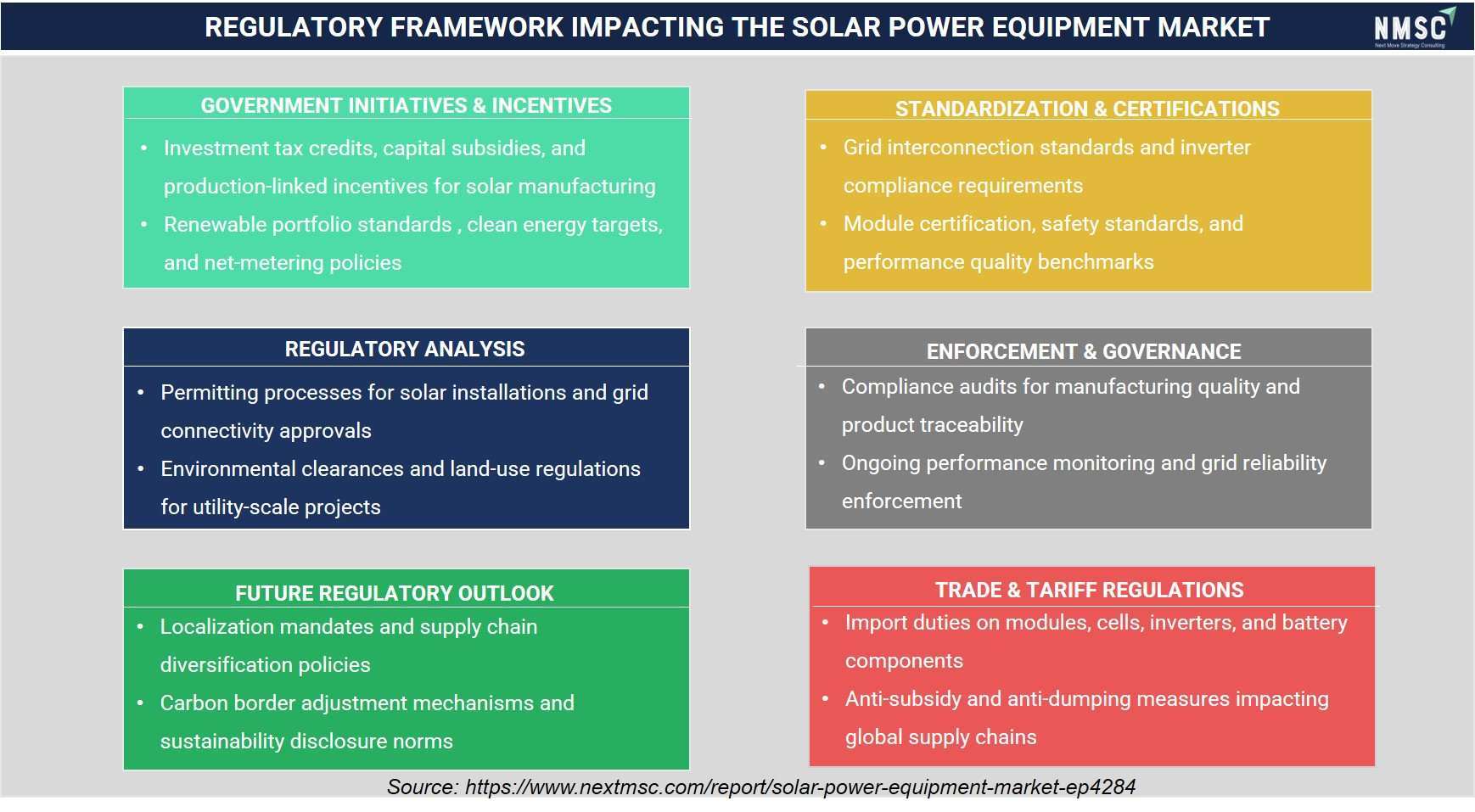
We observed that the above infographic outlines the regulatory architecture influencing the solar power equipment market demand across four core pillars, government initiatives and incentive structures, standardisation and certification requirements, permitting and environmental approval processes, and local trade and tariff regulations, collectively shaping compliance obligations, supply chain resilience, investment confidence, and sustainable market expansion.
What Are the Key Factors Influencing Investment Analysis & Opportunities in the Solar Power Equipment Industry?
Based on our analysis, we observed that investment interest in the solar power equipment market continues to be shaped by the intersection of technology evolution, policy support, and shifting risk appetites among strategic and financial investors. From our competitive assessment, we found that funding trends reflect growing confidence in integrated solutions that pair solar generation with energy storage and digital performance optimisation, as investors increasingly prioritise cash flows anchored by long-term contracts and capacity build-outs.
We also observe that valuations are being influenced by supply chain resilience and domestic manufacturing incentives, particularly in regions where policy mechanisms have reshaped cost structures and reduced import dependencies. Moreover, projects and firms that demonstrate adaptability to grid integration requirements and hybrid deployment patterns command stronger investor attention, as they are better positioned to capture future demand under evolving market regimes.
Key Benefits for Stakeholders:
Next Move Strategy Consulting (NMSC) provides a comprehensive and evidence-based analysis of the solar power equipment market trends, covering historical developments from 2020 to 2025 and offering forward-looking forecasts through 2035. Our study assesses the market at global, regional, and country levels, combining quantitative outlooks with qualitative insights into key growth drivers, adoption constraints, technology evolution, and investment dynamics across major solar power equipment segments.
Based on our analysis, we found that the solar power equipment market delivers differentiated yet complementary benefits to both investors and customers across the value chain. Investors gain exposure to long-term structural energy transition themes supported by policy incentives, localisation mandates, and grid modernisation programs, which collectively enhance revenue visibility and strategic positioning. We observe that vertically integrated manufacturers and technology-driven solution providers create value through supply chain control, innovation leadership, and recurring service models.
Based on our evaluation, we found that customers, including utilities, commercial enterprises, and residential adopters, benefit from improved energy cost predictability, enhanced resilience through hybrid and storage-ready systems, and compliance with decarbonization regulations. Policy frameworks such as renewable procurement mandates and clean energy tax incentives further strengthen the business case, enabling both capital providers and end users to align financial returns with sustainability objectives while advancing energy security and operational efficiency
|
Parameters |
Details |
|
Customization Scope |
Free customization (equivalent to up to 80 analyst-working hours) after purchase. Addition or alteration to country, regional & segment scope. |
|
Pricing and Purchase Options |
Avail customized purchase options to meet your exact research needs. |
|
Approach |
In-depth primary and secondary research; proprietary databases; rigorous quality control and validation measures. |
|
Analytical Tools |
Porter's Five Forces, SWOT, value chain, and Harvey ball analysis to assess competitive intensity, stakeholder roles, and relative impact of key factors. |
Key Market Segments
By Product Type
-
Solar Modules
-
Crystalline Silicon
-
Monocrystalline (mono-Si)
-
Multicrystalline (multi-Si)
-
-
Thin Film
-
Cadmium Telluride (CdTe)
-
Copper Indium Gallium Selenide (CIGS)
-
Amorphous Silicon (a-Si)
-
-
Emerging Technologies
-
Perovskite
-
Other
-
-
-
Inverters & Power Conversion
-
String Inverters
-
Single-Phase
-
Three-Phase
-
-
Central Inverters
-
Microinverters
-
DC Optimizers
-
Hybrid Inverters
-
Battery Inverters
-
-
Mounting & Tracking Structures
-
Fixed Tilt Systems
-
Roof-Mounted
-
Ground-Mounted
-
-
Tracking Systems
-
Single-Axis
-
Dual-Axis
-
-
-
Balance of System (BOS) Electrical Components
-
DC Side Components
-
Combiner Boxes
-
DC Cables & Connectors
-
DC Disconnects
-
Fuses & Surge Protection Devices
-
Junction Boxes
-
Monitoring Sensors
-
-
AC Side Components
-
Transformers
-
Switchgear
-
AC Combiner Panels
-
AC Cables
-
Grid-Tie Protection Relays
-
-
Other BOS Revenue
-
-
Energy Storage Systems (ESS)
-
Lithium-Ion
-
Lithium Iron Phosphate (LFP)
-
Nickel Manganese Cobalt (NMC)
-
Lithium Titanate (LTO)
-
-
Flow Batteries
-
Vanadium Redox
-
Zinc-Bromine
-
-
Lead-Acid
-
Emerging Chemistries
-
Sodium-Ion
-
Solid-State
-
-
-
Systems & Solutions
-
Pre-Engineered Kits
-
Residential Solar & Storage Kits
-
Commercial All-in-One Systems
-
Microgrid-in-a-Box
-
-
Project-Specific Hardware Bundles
-
Utility-Scale EPC Supply Packages
-
C&I Turnkey Solutions
-
-
Other Systems Revenue
-
-
Other Equipments
By Cell Architecture
-
PERC
-
TOPCon
-
Heterojunction
-
Back Contact
-
Other
-
Not Applicable (for Thin Film)
By Voltage Class
-
Low Voltage (≤ 1000 V)
-
Medium Voltage (1001 V - 35 kV)
-
High Voltage (> 35 kV)
-
Not Applicable (non-electrical equipment)
By Power Class
-
Standard Power (≤ 400 W)
-
High Power (401 W - 600 W)
-
Ultra-High Power (> 600 W)
-
Not Applicable (non-electrical equipment)
By Deployment
-
Utility-Scale (>5 MW)
-
Commercial & Industrial (10 kW - 5 MW)
-
Residential (<20 kW)
-
Off-Grid & Remote
-
Other Deployment
By Application
-
Grid-Connected Power Generation
-
Self-Consumption (behind-the-meter)
-
Backup Power
-
Off-Grid Primary Power
-
Solar-for-EV Charging
-
Other Application
By Sales Channel
-
Direct Sales
-
EPC Contractors
-
Utilities & IPPs
-
Large C&I End-Users
-
-
Distributor & Wholesale
-
Electrical Distributors
-
Solar Specialty Distributors
-
Building Material Suppliers
-
-
Retail
-
Big Box Home Improvement
-
Online Solar Retailers
-
-
OEM & Private Label
-
Other Channel
By End-User Industry
-
Investor-Owned Utilities & IPPs
-
Commercial Entities
-
Heavy Industry
-
Light Manufacturing
-
Retail & Hospitality
-
Data Centers
-
Warehouses & Distribution Centers
-
Agricultural Operations
-
-
Residential Households
-
Public Sector
-
Government
-
Schools & Universities
-
Military & Defense
-
-
Non-Profit & NGOs
-
Other End-Users
Geographical Breakdown
-
North America: U.S., Canada, and Mexico.
-
Europe: UK, Germany, France, Italy, Spain, Sweden, Denmark, Finland, the Netherlands, and the Rest of Europe.
-
Asia Pacific: China, India, Japan, South Korea, Taiwan, Indonesia, Vietnam, Australia, Philippines, Malaysia and the rest of APAC.
-
Middle East & Africa (MEA): Saudi Arabia, UAE, Egypt, Israel, Turkey, Nigeria, South Africa, and the rest of MEA.
-
Latin America: Brazil, Argentina, Chile, Colombia, and the rest of LATAM.
Conclusion & Recommendations
Based on our analysis, the solar power equipment market is transitioning from a scale-driven expansion phase to a sophistication-driven competitive cycle defined by efficiency gains, storage integration, digital intelligence, and localised manufacturing strategies. From our competitive assessment, differentiation is increasingly anchored in vertical integration, grid compatibility, and hybrid system capabilities rather than module commoditization alone. We observe that policy alignment, supply chain resilience, and technology adaptability determine which players sustain margin stability and long-term bankability. In our evaluation, the convergence of solar generation with storage and smart energy management will shape the next phase of value creation across utility-scale and distributed segments.
Looking ahead, executives prioritise innovation pipelines, strategic partnerships, and regional manufacturing positioning to remain competitive under evolving regulatory regimes. Investors should focus on firms demonstrating disciplined capital allocation, integrated solution offerings, and exposure to high-quality project pipelines. Policymakers, in our view, accelerate sustainable market expansion by maintaining regulatory clarity, supporting grid modernisation, and incentivising domestic production ecosystems. Collectively, these coordinated actions will reinforce the sector’s resilience and long-term strategic importance within the global energy transition landscape.


About the Author
 Mayurima Roy
— Mayurima Roy is Research Analyst at Next Move Strategy Consulting, where she has spent 4 years working across the firm's full industry coverage rather than a single fixed vertical. Her work centers on structured research, ongoing trend tracking, competitive assessment, and insight-led content development, translating complex market data into clear, decision-ready narratives that support informed client decision-making across diverse global industries, market sectors, and world regions every day.
Mayurima Roy
— Mayurima Roy is Research Analyst at Next Move Strategy Consulting, where she has spent 4 years working across the firm's full industry coverage rather than a single fixed vertical. Her work centers on structured research, ongoing trend tracking, competitive assessment, and insight-led content development, translating complex market data into clear, decision-ready narratives that support informed client decision-making across diverse global industries, market sectors, and world regions every day.
About the Reviewer
 Supradip Baul
— Supradip Baul is an accomplished business consultant and strategist with over a decade of rich experience in market intelligence, strategy, technology, and business transformation. His work has included rigorous qualitative and quantitative analysis across multiple industries, helping clients shape investment decisions and long-term roadmaps. Earlier in his career, he was associated with Gartner, where he contributed to industry-leading reports and market share analyses. He has worked with leading global companies and holds an MBA with a dual specialization in Marketing and Finance.
Supradip Baul
— Supradip Baul is an accomplished business consultant and strategist with over a decade of rich experience in market intelligence, strategy, technology, and business transformation. His work has included rigorous qualitative and quantitative analysis across multiple industries, helping clients shape investment decisions and long-term roadmaps. Earlier in his career, he was associated with Gartner, where he contributed to industry-leading reports and market share analyses. He has worked with leading global companies and holds an MBA with a dual specialization in Marketing and Finance.
At Next Move Strategy Consulting, we understand that insightful market research is the cornerstone of successful business decisions. That's why we employ a robust and multifaceted approach, combining various methodologies to deliver the most accurate and actionable data for our clients.

Research Landscape
We navigate the world of research with two primary approaches:
Qualitative Approach
Our qualitative research methodologies involve immersive techniques such as in-depth interviews, focus groups, and observational studies. By engaging directly with individuals and stakeholders, we uncover valuable insights that quantitative data alone may overlook.

Quantitative Research
In tandem with qualitative methodologies, NMSC leverages the power of Quantitative Research to provide a robust foundation of numerical insights. Through systematic data collection and analysis, we quantify patterns, preferences, and market trends, offering a comprehensive view of the business landscape.
Our quantitative research approach employs diverse tools, including surveys, experiments, and statistical modelling. These methodologies enable us to gather data from a large and representative sample, ensuring the statistical significance of our findings. By employing structured questionnaires and standardized data collection methods, we guarantee the reliability and validity of the information we present to our clients.
Quantitative research is particularly effective in measuring the prevalence of trends, assessing market size, and gauging the impact of various factors on consumer behavior. The numerical precision attained through this approach equips our clients with actionable insights, facilitating data-driven decision-making and strategy formulation.


Our Specialized Toolbox for Industry-Specific Market Research
We deploy a specialized arsenal of techniques tailored to meet your unique requirements. Here's a glimpse into our comprehensive toolbox:

Information Procurement
The stage entails acquiring market data or relevant information through various sources and methodologies.


Market Research Approach
We utilize both top-down and bottom-up approaches in market research analysis to achieve a comprehensive understanding of the market dynamics, leveraging the broad perspective of industry trends and macroeconomic factors alongside detailed insights from specific segments and individual companies.

Porters Five Forces Analysis
We conduct Porter's Five Forces analysis to evaluate the competitive landscape of an industry, providing us with insights into factors that affect profitability and strategic positioning.

SWOT Analysis

Forecasting
We utilize a forecasting model to predict future consumption by considering parameters like population, economics, regulations, market competition, drivers, constraints, technology, and pricing. We also employ statistical techniques such as multilinear regression, exponential smoothing, moving average, ARIMA, and Monte Carlo simulations for accurate predictions. In econometric forecasting, we analyzed short-term and long-term event impacts, attributing values based on regulatory frameworks, economic factors, and market events.





 Speak to Our Analyst