South Africa Drone Market By Component (Hardware, Software, and Services), By Platform Type (Multi-Rotor, Fixed-Wing, Hybrid VTOL, and Others), By Autonomy Level (Remotely Piloted, Assisted, Advanced, and Fully Autonomous), By Maximum Take-off Weight {Nano (<250 g), Micro (250 g–2 kg), Small (>2 kg–25 kg), and Others}, By End-User (Consumer Drone, Commercial & Industrial Drone, Government & Public Safety Drone, and Military Drone) – Analysis & Forecast, 2025–2035
Industry: Aerospace & Defense | Latest Edition: September 3, 2026 | No of Pages: 265 | No. of Tables: 140 | No. of Figures: 128 | Format: PDF | Report Code: AD5728
South Africa Drone Market Size & Forecast
|
Parameters |
Details |
|
Market Size in 2025 |
USD 226.1 million |
|
Market Size in 2026 |
USD 253.8 million |
|
Revenue Forecast in 2035 |
USD 390.3 million |
|
Market Size Growth Rate |
CAGR of 4.90% from 2026 to 2035 |
|
Market Volume in 2025 |
8 thousand units |
|
Market Volume in 2026 |
10 thousand units |
|
Volume Forecast in 2035 |
20 thousand units |
|
Market Volume Growth Rate |
CAGR of 8.49% from 2026 to 2035 |
|
Analysis Period |
2025–2035 |
|
Base Year Considered |
2025 |
|
Forecast Period |
2026–2035 |
|
Market Size Estimation |
Million (USD) |
|
Companies Profiled |
15 |
|
Market Share |
Available for 10 companies |
Industry Outlook
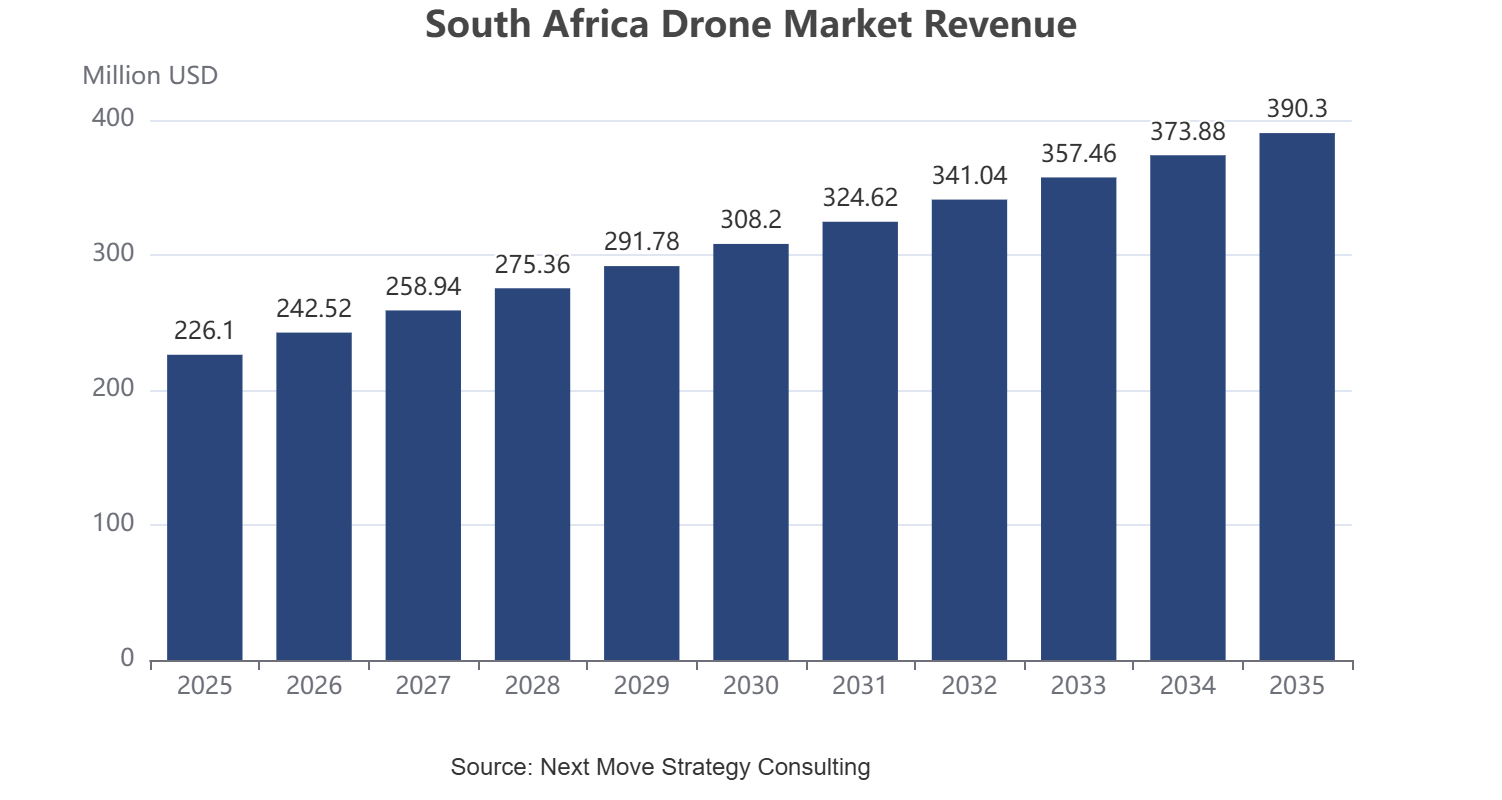
The South Africa Drone Market was valued at USD 226.1 million in 2025 and is estimated to reach USD 253.8 million in 2026. Revenue is projected to grow to USD 390.3 million by 2035, registering a CAGR of 4.90% during 2026–2035. In volume terms, the market stood at 8 thousand units in 2025, estimated at 10 thousand units in 2026, and is forecast to expand to 20 thousand units by 2035, reflecting a volume CAGR of 8.49%, driven by rising commercial and government demand across South Africa's mining, agricultural, and infrastructure sectors.
Ecosystem Analysis of the South Africa Drone Market:
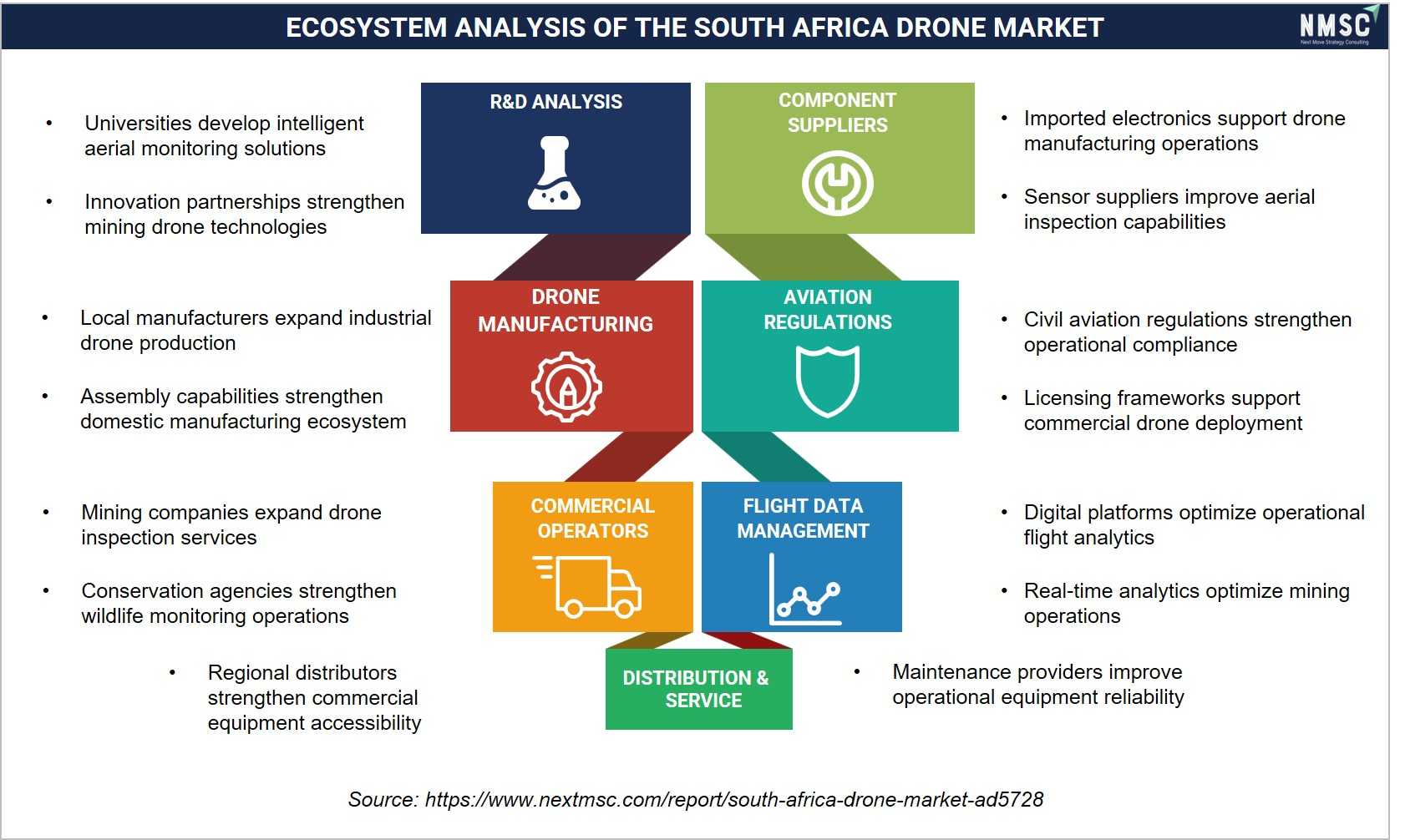
The above ecosystem analysis maps the key operational components, such as R&D analysis, component suppliers, drone manufacturing, aviation regulations, commercial operators, flight data management, and distribution and service, shaping the South Africa drone market. From our analysis, we observed that R&D analysis and component suppliers drive technological advancements, while aviation regulations ensure safety and compliance standards. Commercial operators and flight data management optimize operational efficiency, whereas distribution and service networks support market accessibility, reflecting a well-integrated ecosystem across the South Africa drone market.
What Are the Key Market Drivers, Restraints, and Opportunities Shaping the South Africa Drone Market through 2035?
Growth Catalyst & Risk Assessment Matrix
|
Drivers / Trends / Restraints |
(+/–) % Impact on CAGR Forecast |
Geographic Relevance |
Impact Timeline |
|
Large-scale mining and minerals sector driving enterprise-grade drone adoption for surveying, volumetric measurement, and site safety inspection |
+1.6% |
Major mining regions (Witwatersrand Basin, Northern Cape, Limpopo) |
Medium to long term (3–6 years) |
|
Expanding precision agriculture adoption across large-scale commercial farms driving multispectral and spraying drone deployment |
+1.4% |
Agricultural regions (Western Cape, KwaZulu-Natal, Free State, Mpumalanga) |
Medium to long term (3–6 years) |
|
Infrastructure inspection demand from utilities, rail, and port operators creating sustained enterprise drone procurement |
+1.2% |
Nationwide (Eskom corridors, Transnet networks, coastal ports) |
Medium to long term (3–5 years) |
|
Conservation and wildlife monitoring programs in national parks and marine protected areas expanding government and NGO drone use |
+0.9% |
Protected areas (Kruger, SANParks network, coastal reserves) |
Long term (4–7 years) |
|
Incomplete BVLOS regulatory framework, limited rural digital infrastructure, and currency volatility constraining commercial volume growth |
–1.1% |
Rural and peri-urban South Africa, government procurement segments |
Short to medium term (1–4 years) |
South Africa's drone market occupies a structurally distinct position within the broader African unmanned systems landscape, characterized by an established commercial adoption base in mining, precision agriculture, and wildlife conservation, alongside a developing government and public safety deployment framework. From our analysis, the market's growth trajectory reflects a balance between strong sector-specific enterprise demand and structural constraints including regulatory uncertainty, infrastructure limitations, and constrained defense procurement budgets. Progressive regulatory reform by the South African Civil Aviation Authority and growing digital infrastructure investment are expected to support measured but consistent market expansion through 2035.
Growth Drivers:
How Is South Africa's Mining and Minerals Sector Driving Enterprise Drone Adoption for Surveying and Safety Applications?
South Africa's mining and mineral extraction sector, one of the most extensive and geographically dispersed in the world, represents a structurally significant driver of commercial drone adoption for surveying, volumetric measurement, geospatial mapping, and underground inspection applications. Through NMSC's assessment, mining operators are increasingly deploying fixed-wing and hybrid VTOL platforms equipped with LiDAR and photogrammetry payloads to replace hazardous manual inspection workflows, reduce operational downtime, and improve site safety compliance. This sector-specific demand is reinforcing sustained enterprise-grade drone procurement across South Africa's major mining regions, including the Witwatersrand Basin and Northern Cape.
How Is the Growth of Precision Agriculture Driving Commercial Drone Adoption in South Africa?
South Africa's expansive agricultural sector, encompassing large-scale commercial crop cultivation, livestock management, and precision farming operations, is emerging as a consistent driver of drone adoption for crop monitoring, aerial spraying, and soil health assessment. We observed that agricultural cooperatives and commercial farm operators are progressively integrating multispectral and thermal-equipped multi-rotor and fixed-wing platforms to optimize resource utilization, reduce input costs, and improve yield prediction accuracy across diverse growing regions. Government-supported precision agriculture initiatives and the availability of internationally certified training programs are further accelerating drone integration within South Africa's commercial farming community.
How Is Demand for Infrastructure Inspection Driving Drone Procurement among Utilities and Asset Managers in South Africa?
South Africa's extensive and geographically challenging infrastructure network, encompassing electricity transmission lines, pipeline corridors, road and rail networks, and coastal port facilities, is generating consistent demand for drone-based inspection services capable of reducing manual survey costs and improving asset monitoring frequency. Through our industry assessment, utilities operators and infrastructure asset managers are deploying enterprise-grade platforms for regular inspection of Eskom transmission infrastructure, Transnet rail corridors, and municipal utilities networks, driven by the dual imperatives of cost reduction and compliance with safety and maintenance regulatory requirements. This demand is reinforcing steady enterprise drone procurement across South Africa's infrastructure management sector.
Growth Inhibitor:
How Do Regulatory Gaps, Infrastructure Limitations, and Economic Constraints Restrain Drone Market Growth in South Africa?
South Africa's drone market growth is meaningfully constrained by an evolving and at times unpredictable regulatory environment under the South African Civil Aviation Authority, where BVLOS authorization frameworks remain incomplete and operational approvals can be protracted. Compounding this, limited digital connectivity infrastructure in rural and peri-urban areas reduces the operational viability of advanced autonomous drone systems outside major metropolitan and industrial centers. From our assessment, currency volatility, fiscal constraints on government procurement, and a relatively shallow domestic manufacturing base further limit the pace of market expansion and technology upgrade cycles across both commercial and public sector segments.
Growth Opportunity:
How Does South Africa's Conservation and Environmental Monitoring Landscape Create Distinct Drone Market Opportunities?
South Africa's unique conservation and environmental monitoring landscape, encompassing nationally protected game reserves, marine protected areas, and biodiversity monitoring programs managed by SANParks and provincial conservation agencies, presents a distinctive and growing opportunity for drone deployment in wildlife tracking, anti-poaching surveillance, and environmental compliance monitoring. Our assessment identifies this conservation technology sector as an emerging application niche with strong international co-funding support and growing domestic operator capability. Additionally, expanding government investment in smart city initiatives and rural connectivity infrastructure is expected to progressively expand the addressable drone deployment landscape within South Africa's public sector through the forecast period.
How Is the South Africa Drone Market Segmented in This Report, and What Are the Key Insights from the Segmentation Analysis?
By Component Insights
How Does Component Segmentation Reflect Technology Value Distribution Across the South Africa Drone Market?
Based on component, the South Africa Drone Market is segmented into hardware, software, and services.
The market comprises an integrated ecosystem of hardware, software, and service solutions supporting drone deployment across commercial, government, and defense applications. According to our analysis, we found that hardware components provide the operational foundation through advanced airframes, sensing technologies, and communication systems. Software platforms are strengthening autonomous operations, mission planning, fleet management, and data analytics capabilities, while services such as DaaS, training, maintenance, and data processing are enabling wider adoption by improving operational efficiency, reducing ownership barriers, and supporting long-term fleet performance.
By End-User Insights
How Does End-User Segmentation Define Application Diversity Across the South Africa Drone Market?
Based on end-user, the South Africa Drone Market is segmented into consumer drones; commercial and industrial drones, government and public safety drones, and military drones,
The market reflects broad adoption across consumer, commercial, government, and defense applications, with each end-user group driving demand for specialized operational capabilities. According to our analysis, we found that commercial and industrial users are expanding drone deployment across agriculture, surveying, infrastructure inspection, logistics, and environmental monitoring, while government agencies are strengthening adoption for emergency response, public safety, and security operations. Military and consumer segments continue to evolve through mission-specific requirements, technological advancements, and increasing accessibility of drone platforms.
Key Segments
By Component
-
Hardware
-
Airframe
-
Avionics & Core Systems
-
Payloads & Sensors (Cameras, LiDAR, Multispectral, etc.)
-
Communication Systems (C2 Links)
-
-
Software
-
Flight Control & Autonomy
-
Data Processing & Analytics
-
Fleet Management
-
-
Services
-
Drone-as-a-Service (DaaS)
-
Training & Certification
-
Maintenance, Repair & Overhaul (MRO)
-
Data Processing Services
-
By Platform Type
-
Multi-Rotor
-
Fixed-Wing
-
Hybrid VTOL (Vertical Take-Off and Landing)
-
Single-Rotor (Helicopter)
-
Tethered UAV
-
Loitering Munition
-
MALE/HALE/UCAV
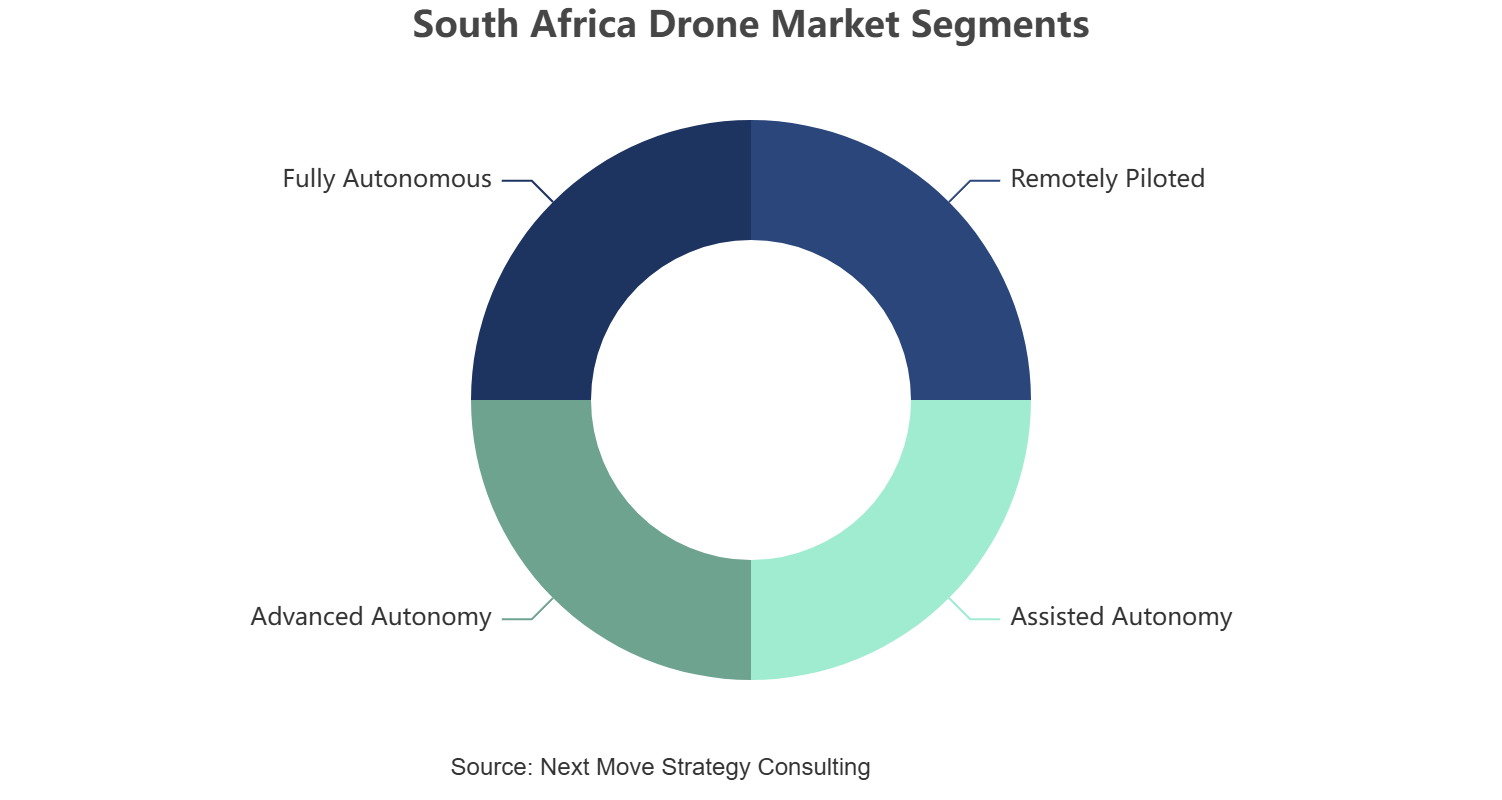
By Autonomy Level
-
Remotely Piloted
-
Assisted Autonomy
-
Advanced Autonomy
-
Fully Autonomous
By Maximum Takeoff Weight (MTOW)
-
Nano: < 250 g
-
Micro: 250 g – 2 kg
-
Small: > 2 kg – 25 kg
-
Medium: > 25 kg – 150 kg
-
Large: > 150 kg – 600 kg
-
Very Large/Tactical: > 600 kg
By Price/Performance Grade
-
Consumer Grade (< $1,000)
-
Prosumer Grade ($1,000 – $10,000)
-
Enterprise Grade ($10,000 – $100,000)
-
Military Grade (> $100,000)
By End-User
-
Consumer Drone
-
Commercial & Industrial Drone
-
Aerial Imaging & Cinematography
-
Surveying & Mapping (Geomatics)
-
Agricultural Applications (spraying, crop monitoring)
-
Infrastructure Inspection (energy, utilities, transport)
-
Logistics & Delivery (package transport)
-
Environmental & Scientific Monitoring
-
-
Government & Public Safety Drone
-
Emergency Response & Disaster Management
-
Law Enforcement & Security
-
Firefighting & Public Safety
-
Smart City Management
-
-
Military Drone
-
Intelligence, Surveillance & Reconnaissance (ISR)
-
Combat Operations
-
Electronic Warfare (EW)
-
Target Acquisition & Designation
-
Logistics & Resupply
-
Decoy & Countermeasure Systems
-
Competitive Landscape
The competitive landscape of the South Africa Drone Market is shaped by the dominance of internationally headquartered drone manufacturers and technology platforms, given the limited scale of domestic South African drone production. Competition is primarily driven by platform performance specifications, payload compatibility, regulatory certification status within the SACAA framework, and the availability of local distribution, training, and MRO service networks. Our assessment indicates that companies offering localized training and certification programs, SACAA-compliant operational support, and flexible Drone-as-a-Service contracting models are gaining competitive advantage across South Africa's commercial and government procurement channels.
Key Players of the South Africa Drone Market:
-
SZ DJI Technology Co. Ltd.
-
Draganfly Inc.
-
Flyability SA
-
Skydio Inc.
-
Hydra Technologies de Mexico S.A. de C.V.
-
AgEagle Aerial Systems Inc.
-
Alpi Aviation S.r.l.
-
NARMA Inc.
-
Quantum-Systems GmbH
-
Guangzhou XAG Co. Ltd.
-
FIXAR Aero SIA
-
AeroVironment Inc.
-
Delair SAS
-
Wingtra AG
-
TerraHaptix Limited
Key players operating in the South Africa Drone Market include SZ DJI Technology Co. Ltd., Draganfly Inc., Flyability SA, Skydio Inc., Hydra Technologies de Mexico S.A. de C.V., AgEagle Aerial Systems Inc., and others. These companies compete through platform performance differentiation, localized service and certification support, and targeted commercial partnerships with South African mining, agricultural, and government sector customers.
Porter's Five Forces Analysis of the South Africa Drone Industry:
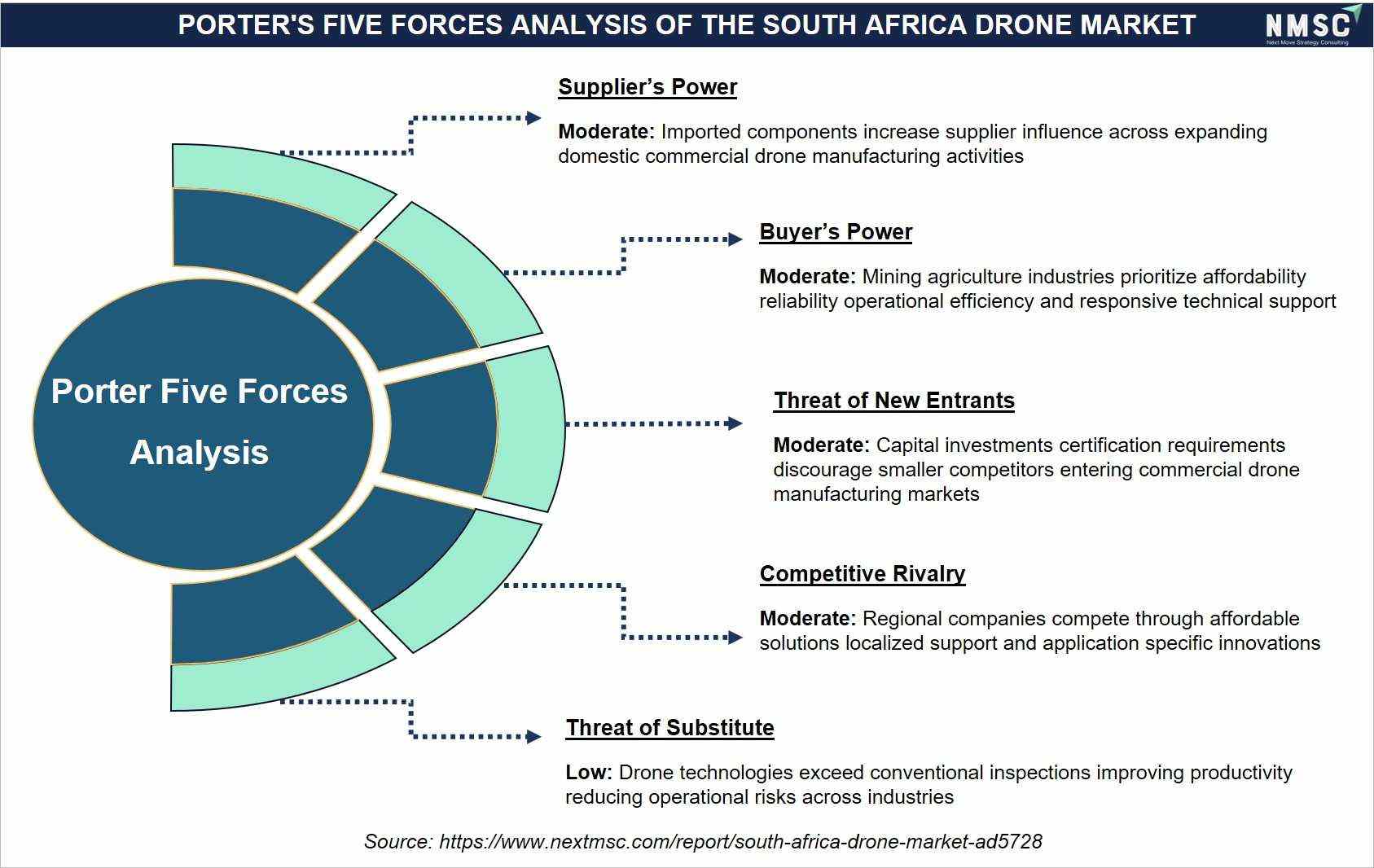
The above Porter's Five Forces analysis maps the key competitive forces, such as threat of new entrants, bargaining power of suppliers, bargaining power of buyers, threat of substitutes, and industry rivalry, shaping the South Africa drone market. From our analysis, we observed that industry rivalry remains moderate with emerging local players, while the bargaining power of suppliers is influenced by international component dependencies. The threat of new entrants is limited by regulatory requirements and certification standards, whereas the bargaining power of buyers is growing with agriculture, mining, and wildlife conservation applications driving market demand.
Key Benefits for Stakeholders
Next Move Strategy Consulting (NMSC) presents a comprehensive assessment of the South Africa Drone Market, covering revenue in USD million and volume in thousand units across the 2025–2035 period. The study provides structured insights across six segmentation dimensions, including component, platform type, autonomy level, maximum takeoff weight, price/performance grade, and end-user, equipping investors, manufacturers, and policymakers with intelligence for strategic decision-making.
Stakeholders across the South Africa drone value chain, including commercial operators, government agencies, mining companies, and agricultural enterprises, gain clarity on sector-specific demand patterns, SACAA regulatory dynamics, and competitive positioning through NMSC's analysis. The report supports decisions on market entry, product localization, service network development, and investment prioritization across South Africa's growing commercial, government, and conservation-focused drone application landscape.
|
Parameters |
Details |
|
Customization Scope |
Free customization (equivalent to up to 80 analyst-working hours) after purchase. |
|
Pricing and Purchase Options |
Avail customized purchase options to meet your exact research needs. |
|
Approach |
In-depth primary and secondary research; proprietary databases; rigorous quality control and validation measures. |
|
Analytical Tools |
Porter’s Five Forces, SWOT, value chain, and Harvey ball analysis to assess competitive intensity, stakeholder roles, and relative impact of key factors. |
Conclusion
The South Africa Drone Market is set for measured but structurally supported growth through 2035, underpinned by enterprise demand from mining, agriculture, and infrastructure sectors, expanding government and conservation applications, and the progressive development of South Africa's RPAS regulatory framework. Revenue is projected to grow from USD 253.8 million in 2026 to USD 390.3 million by 2035 at a CAGR of 4.90%, while volume is forecast to reach 20 thousand units at a CAGR of 8.49%. Competition among international OEMs and specialist service providers will intensify as localization, certification support, and DaaS models become decisive differentiators.
About the Author
 Mayurima Roy
— Mayurima Roy is Research Analyst at Next Move Strategy Consulting, where she has spent 4 years working across the firm's full industry coverage rather than a single fixed vertical. Her work centers on structured research, ongoing trend tracking, competitive assessment, and insight-led content development, translating complex market data into clear, decision-ready narratives that support informed client decision-making across diverse global industries, market sectors, and world regions every day.
Mayurima Roy
— Mayurima Roy is Research Analyst at Next Move Strategy Consulting, where she has spent 4 years working across the firm's full industry coverage rather than a single fixed vertical. Her work centers on structured research, ongoing trend tracking, competitive assessment, and insight-led content development, translating complex market data into clear, decision-ready narratives that support informed client decision-making across diverse global industries, market sectors, and world regions every day.
About the Reviewer
 Supradip Baul
— Supradip Baul is an accomplished business consultant and strategist with over a decade of rich experience in market intelligence, strategy, technology, and business transformation. His work has included rigorous qualitative and quantitative analysis across multiple industries, helping clients shape investment decisions and long-term roadmaps. Earlier in his career, he was associated with Gartner, where he contributed to industry-leading reports and market share analyses. He has worked with leading global companies and holds an MBA with a dual specialization in Marketing and Finance.
Supradip Baul
— Supradip Baul is an accomplished business consultant and strategist with over a decade of rich experience in market intelligence, strategy, technology, and business transformation. His work has included rigorous qualitative and quantitative analysis across multiple industries, helping clients shape investment decisions and long-term roadmaps. Earlier in his career, he was associated with Gartner, where he contributed to industry-leading reports and market share analyses. He has worked with leading global companies and holds an MBA with a dual specialization in Marketing and Finance.
At Next Move Strategy Consulting, we understand that insightful market research is the cornerstone of successful business decisions. That's why we employ a robust and multifaceted approach, combining various methodologies to deliver the most accurate and actionable data for our clients.

Research Landscape
We navigate the world of research with two primary approaches:
Qualitative Approach
Our qualitative research methodologies involve immersive techniques such as in-depth interviews, focus groups, and observational studies. By engaging directly with individuals and stakeholders, we uncover valuable insights that quantitative data alone may overlook.

Quantitative Research
In tandem with qualitative methodologies, NMSC leverages the power of Quantitative Research to provide a robust foundation of numerical insights. Through systematic data collection and analysis, we quantify patterns, preferences, and market trends, offering a comprehensive view of the business landscape.
Our quantitative research approach employs diverse tools, including surveys, experiments, and statistical modelling. These methodologies enable us to gather data from a large and representative sample, ensuring the statistical significance of our findings. By employing structured questionnaires and standardized data collection methods, we guarantee the reliability and validity of the information we present to our clients.
Quantitative research is particularly effective in measuring the prevalence of trends, assessing market size, and gauging the impact of various factors on consumer behavior. The numerical precision attained through this approach equips our clients with actionable insights, facilitating data-driven decision-making and strategy formulation.


Our Specialized Toolbox for Industry-Specific Market Research
We deploy a specialized arsenal of techniques tailored to meet your unique requirements. Here's a glimpse into our comprehensive toolbox:

Information Procurement
The stage entails acquiring market data or relevant information through various sources and methodologies.


Market Research Approach
We utilize both top-down and bottom-up approaches in market research analysis to achieve a comprehensive understanding of the market dynamics, leveraging the broad perspective of industry trends and macroeconomic factors alongside detailed insights from specific segments and individual companies.

Porters Five Forces Analysis
We conduct Porter's Five Forces analysis to evaluate the competitive landscape of an industry, providing us with insights into factors that affect profitability and strategic positioning.

SWOT Analysis

Forecasting
We utilize a forecasting model to predict future consumption by considering parameters like population, economics, regulations, market competition, drivers, constraints, technology, and pricing. We also employ statistical techniques such as multilinear regression, exponential smoothing, moving average, ARIMA, and Monte Carlo simulations for accurate predictions. In econometric forecasting, we analyzed short-term and long-term event impacts, attributing values based on regulatory frameworks, economic factors, and market events.





 Speak to Our Analyst