Surge Arresters Market Global Industry Analysis and Forecast (2026–2035)

Surge arresters market size was USD 2.48 Billion in 2025, projected to reach USD 5.21 Billion by 2035, growing at a CAGR of 7.7% from 2026 to 2035. Key drivers include transmission network expansion, aging grid asset replacement, and renewable energy integration, with North America leading the global market.

Download Free Sample PDF
Base Year (2025)
$2.48 Billion
Forecast (2035)
$5.21 Billion
CAGR (2026-2035)
7.7%
Top Region
North America

What Is the Surge Arresters Market Size?
The global surge arresters market reached USD 2.48 billion in 2025 and is estimated at USD 2.67 billion in 2026, forecast to reach USD 5.21 billion by 2035 at a CAGR of 7.7% between 2026 and 2035. North America leads with approximately 34% revenue share in 2025, while Medium Voltage is the dominant voltage segment, holding approximately 37% of total market revenue.

We observed that technological shifts in metal oxide varistor chemistry, silicone rubber housings, and gapless designs are reshaping product performance across voltage classes. Next Move Strategy Consulting's analysis indicates that manufacturers are scaling production of ultra-high voltage units to serve long distance transmission corridors. Material innovations improve energy absorption capacity and extend service life, which in turn reduces unplanned outages and maintenance intervals for grid operators worldwide.

Surge Arresters Market Global Industry Analysis and Forecast (2026–2035) Revenue Forecast

Values in USD Billion

2025 $2.48 Billion
2025
2026 $2.67 Billion
2026
2027 $2.88 Billion
2027
2028 $3.10 Billion
2028
2029 $3.34 Billion
2029
2030 $3.59 Billion
2030
2031 $3.87 Billion
2031
2032 $4.17 Billion
2032
2033 $4.49 Billion
2033
2034 $4.83 Billion
2034
2035 $5.21 Billion
2035

Key Takeaways

By Voltage: Medium Voltage held the largest share, expanding from USD 0.91 Billion in 2025 to USD 1.55 Billion by 2035; Ultra-High Voltage is the fastest-growing at a 9.8% CAGR from 2026–2035

By Technology: Metal-Oxide held the largest share, expanding from USD 1.17 Billion in 2025 to USD 2.23 Billion by 2035; Other Technologies is the fastest-growing at a 10.4% CAGR from 2026–2035.

By Housing: Polymer-Housed held the largest share, expanding from USD 1.14 Billion in 2025 to USD 2.08 Billion by 2035; Other Housing Types is the fastest-growing at a 9.6% CAGR from 2025–2035.

By Current Type: AC Surge Arresters held the largest share, expanding from USD 1.49 Billion in 2025 to USD 2.69 Billion by 2035; DC Surge Arresters is the fastest-growing at a 9.8% CAGR from 2026–2035.

Dominant Region: North America dominated the market with approximately 34% revenue share (USD 0.84 Billion) in 2025, anchored by mature transmission infrastructure, aging grid asset replacement, and a high concentration of leading arrester manufacturers.

Fastest-Growing Region: Asia-Pacific is expected to register the highest CAGR of 10.5% during 2026–2035, driven by rapid transmission expansion, large state grid programs, and expanding substation build-outs across high-density markets.

Dominant Country: The U.S. led the market with an estimated USD 0.64 Billion in 2025 (~76% of North America), supported by utility grid hardening programs, substation modernization, and dense manufacturer presence.

Fastest-Growing Country: India is among the fastest-growing major countries, projected to expand from USD 0.13 Billion in 2025 to USD 0.43 Billion by 2035 at a CAGR of approximately 12.7%, driven by rapid grid modernization, supportive public programs, and expanding substation rollouts.

The surge arresters market presents an absolute dollar opportunity of USD 2.54 billion between 2026 and 2035, moving from USD 2.67 billion to USD 5.21 billion. This incremental value reflects rising investment in transmission reinforcement, distribution automation, and substation expansion across developed and developing economies. Suppliers that secure long term framework agreements with national grid operators stand to capture a disproportionate share of this expansion, particularly in high voltage and polymer housed categories.

Competition in the surge arresters market is shaped by established electrical equipment manufacturers, specialized arrester suppliers, product certification requirements, and long utility qualification cycles. During our market evaluation, we noticed that original equipment manufacturers increasingly pursue joint ventures with regional fabricators to localize production and shorten lead times. Hitachi Energy Ltd, Siemens Energy AG, and GE Vernova Inc. leverage extensive high voltage testing facilities, while CHINT Electric Co., Ltd. and China XD Electric Co., Ltd. expand domestic capacity to serve large state grid programs and export markets.

Ecosystem Analysis of the Surge Arresters Market

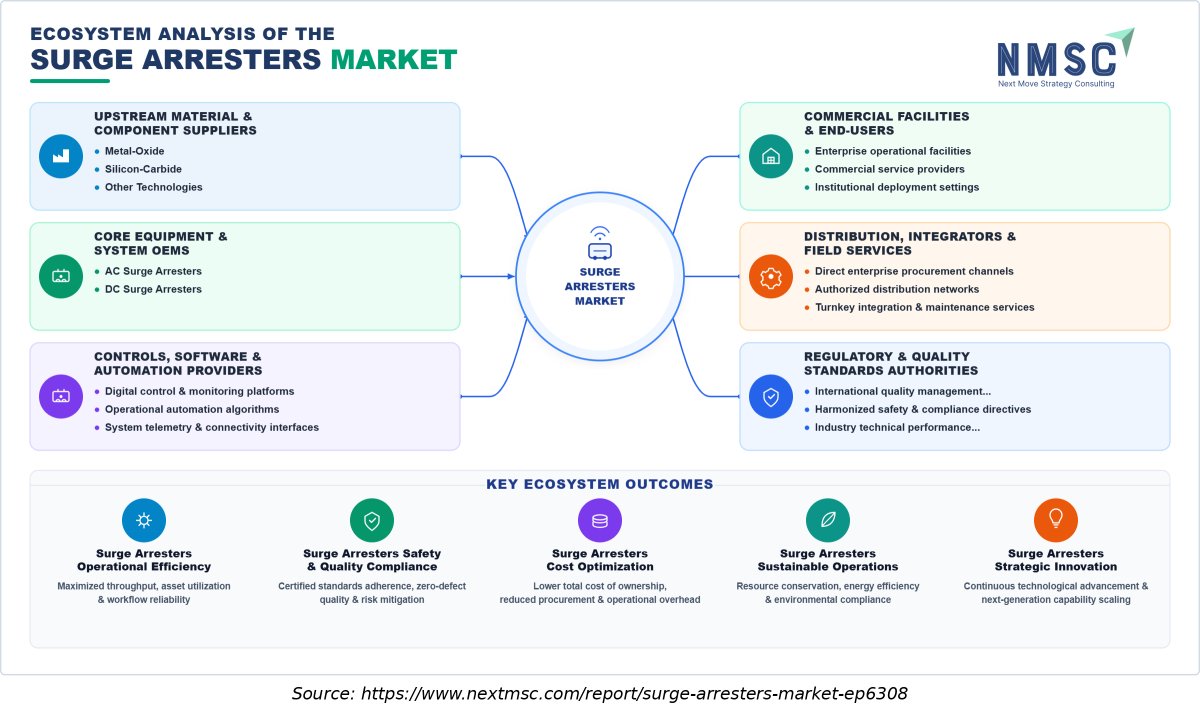
The above infographic presents the Surge arresters market ecosystem in a structured format, focusing on six core stakeholder groups: upstream material & component suppliers; core equipment & system OEMs; controls, software & automation providers; commercial facilities & end-users; distribution, integrators & field services; and regulatory & quality standards authorities. It shows how these participants support operations while contributing to operational efficiency, safety, cost optimization, sustainability, and technological innovation across diverse operating environments.

What Does the Surge Arresters Market Encompass?

The surge arresters market covers protective devices designed to divert transient overvoltages from electrical equipment to ground, preserving insulation integrity and system continuity. Product categories include station class, intermediate class, distribution class, and line surge arresters, each rated for specific system voltages and energy absorption requirements. Core technologies center on metal oxide varistor elements, which exhibit highly nonlinear resistance and conduct sharply once a threshold voltage is exceeded.

Design specifications address creepage distance, pressure relief performance, mechanical loading, and resistance to contamination in coastal and industrial environments. Material innovations include silicone rubber and ethylene propylene housings that offer hydrophobicity and reduced weight relative to traditional porcelain. Testing and performance assessment under applicable parts of the IEC 60099 series and IEEE C62.11 are important for power-system surge arresters, with requirements varying according to product type and application.

Market Drivers & Dynamics

Interactive Dataset
Transmission Network Expansion driver High Long distance lines and substations require extensive overvoltage protection for insulation coordination Immediate
Aging Grid Asset Replacement driver High Replacement of legacy porcelain units with modern polymer designs sustains recurring equipment demand Immediate
Renewable Energy Integration driver Medium Inverter based generation and collector substations introduce new transient exposure requiring protection Medium-term
Raw Material Price Volatility restraint High Fluctuations in zinc oxide, silicone compounds, and metal costs pressure manufacturing margins Immediate
Long Qualification Cycles restraint Medium Utility type testing and approval processes extend time required for new product introduction Medium-term
Substitution by Integrated Protection Systems restraint Low Gas insulated switchgear with integrated overvoltage protection may reduce standalone unit demand in select projects Long-term
Source: Next Move Strategy Consulting

Growth Drivers

What Is the Primary Growth Driver in the Surge Arresters Market?

The principal catalyst is the sustained expansion of high voltage transmission and substation infrastructure required to connect generation sources to load centers. Each new line and transformer bay demands coordinated surge protection to preserve insulation life and avoid cascading outages. Our assessment indicates that this infrastructure build cycle creates recurring volume demand that extends well beyond initial installation, supporting the overall market trajectory through 2035.

How Are Industry Standards and Directives Driving the Surge Arresters Market?

International standards including IEC 60099 series and IEEE C62.11 define type test requirements, energy handling capability, and pressure relief performance for surge arresters. Compliance with these benchmarks is a prerequisite for tendering on most utility projects, which channels procurement toward certified manufacturers. Regional grid codes in Europe and Asia further specify coordination and reliability criteria, reinforcing the importance of verified product performance across the supply base.

Growth Inhibitors

What Is Restraining the Surge Arresters Market?

Price volatility in zinc oxide, silicone compounds, and associated metals constrains margins for manufacturers operating under fixed price utility contracts. Producers must absorb input cost swings or renegotiate tenders, which can delay order conversion. Smaller fabricators with limited purchasing power face the greatest exposure, prompting consolidation pressure across the supplier landscape.

What Are the Growth Opportunities?

Can Ultra-High Voltage Corridors Capture Concentrated Deployment Value?

Long distance ultra-high voltage transmission corridors require surge arresters with elevated energy absorption and extended creepage performance. Projects in China, India, and other large territories concentrate significant unit volumes within single programs. Suppliers capable of delivering certified high rated designs with reliable test records can secure multi-year framework agreements that stabilize revenue visibility.

How Is Mid-Tier and Regional Facility Adoption Unlocking New Surge arresters market Volume?

Distribution substations, industrial plants, and renewable collector sites increasingly specify standardized surge arresters for protection of transformers and switchgear. These secondary facilities procure in smaller lot sizes but across a much broader installed base. Distributors and regional integrators that stock compact polymer housed units can serve this dispersed demand efficiently and build durable local relationships.

Can Specialized Vertical Implementations Become Distinct Premium Surge arresters’ market?

Offshore wind farms, rail electrification, and mining operations present harsh environmental and electrical conditions that demand tailored surge arrester designs. Enhanced sealing, corrosion resistant housings, and specialized voltage ratings command premium pricing relative to standard catalog units. Manufacturers that develop application specific validation data can establish differentiated positions within these niche segments.

Segmentation Analysis

2025 (USD Billion)
2035 (USD Billion)
Medium Voltage 2025: $0.91 Billion | 2035: $1.55 Billion
Medium Volta
High Voltage 2025: $0.65 Billion | 2035: $1.39 Billion
High Voltage
Extra-High Voltage 2025: $0.50 Billion | 2035: $1.20 Billion
Extra-High V
Ultra-High Voltage 2025: $0.42 Billion | 2035: $1.07 Billion
Ultra-High V
Medium Voltage $0.91 Billion $1.55 Billion 5.5%
High Voltage $0.65 Billion $1.39 Billion 7.9%
Extra-High Voltage $0.50 Billion $1.20 Billion 9.1%
Ultra-High Voltage $0.42 Billion $1.07 Billion 9.8%

Which Voltage Segment Dominates the Surge Arresters Market?

Within the Voltage spectrum, Medium Voltage commands the foremost market share, generating USD 0.91 billion (~37% share) in 2025 on the back of widespread utility standardization. In parallel, Ultra-High Voltage is positioned for rapid scale, projected to advance at a 9.8% CAGR through 2035 as transmission operators transition toward higher rated, next-generation surge arresters.

Supply Chain Analysis of the Surge Arresters Industry

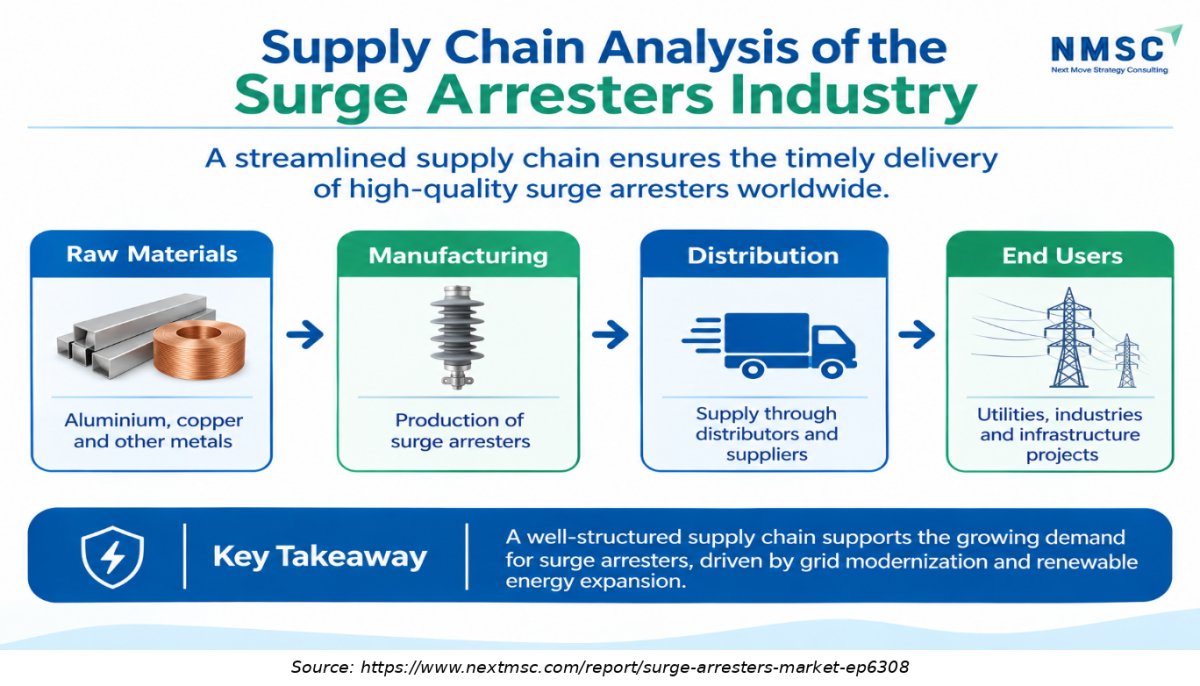
Supply Chain Analysis of the Surge Arresters Industry
The infographic illustrates the Supply Chain Structure of the Surge Arresters Industry, highlighting key stages from raw material sourcing and manufacturing to distribution and end users. It emphasizes how aluminium, copper, and other metal supplies, surge arrester production, and efficient distribution networks support product availability across utilities, industrial facilities, and infrastructure projects. It also highlights how grid modernization and renewable energy expansion are driving demand and supporting long-term market growth.

Growth Opportunities

Our analysis shows that three structural whitespace opportunities are positioned to generate disproportionate commercial returns in the Surge arresters market through 2035:

Can Ultra-High Voltage Corridors Capture Concentrated Deployment Value?

Long distance ultra-high voltage transmission corridors require surge arresters with elevated energy absorption and extended creepage performance. Projects in China, India, and other large territories concentrate significant unit volumes within single programs. Suppliers capable of delivering certified high rated designs with reliable test records can secure multi-year framework agreements that stabilize revenue visibility.

How Is Mid-Tier and Regional Facility Adoption Unlocking New Surge arresters market Volume?

Distribution substations, industrial plants, and renewable collector sites increasingly specify standardized surge arresters for protection of transformers and switchgear. These secondary facilities procure in smaller lot sizes but across a much broader installed base. Distributors and regional integrators that stock compact polymer housed units can serve this dispersed demand efficiently and build durable local relationships.

Can Specialized Vertical Implementations Become Distinct Premium Surge arresters’ market?

Offshore wind farms, rail electrification, and mining operations present harsh environmental and electrical conditions that demand tailored surge arrester designs. Enhanced sealing, corrosion resistant housings, and specialized voltage ratings command premium pricing relative to standard catalog units. Manufacturers that develop application specific validation data can establish differentiated positions within these niche segments.

Regional Outlook

2025 (USD Billion)
2035 (USD Billion)
North Americ
Europe
Asia-Pacific
Latin Americ
Middle East
Region 2025 (USD Billion) 2035 (USD Billion) CAGR (%)
North America $10.0 USD Billion $40.0 USD Billion 9.0%
Europe $17.1 USD Billion $51.1 USD Billion 27.0%
Asia-Pacific $24.2 USD Billion $62.2 USD Billion 25.0%
Latin America $31.3 USD Billion $73.3 USD Billion 23.0%
Middle East & Africa $38.4 USD Billion $84.4 USD Billion 12.0%

Regional data is locked

Unlock complete regional numbers for this market.

Unlock Full Data

Competitive Landscape

The competitive structure of the surge arresters market is moderately consolidated. Established multinational manufacturers such as Hitachi Energy Ltd, Siemens Energy AG, GE Vernova Inc., and Toshiba Energy Systems & Solutions Corporation hold significant positions across high and extra-high voltage applications. Regional specialists including CG Power and Industrial Solutions Limited, China XD Electric Co., Ltd., and CHINT Electric Co., Ltd. compete strongly in cost-sensitive and domestic procurement programs. Our assessment indicates that product certification, long qualification cycles, and installed base references continue to define entry barriers across the sector.

Dimension Description
Product Quality & Durability Surge arresters are assessed on energy absorption capacity, long-term insulation stability, and resistance to aging, with proven field durability serving as the strongest purchasing criterion for utilities.
Distribution & Channel Reach Market access depends on utility framework agreements, EPC partnerships, and regional service networks that enable timely installation, testing, and replacement of arresters across dispersed grid assets.
Design & Customization Moat Application-specific engineering for insulation coordination, housing configuration, and voltage class adaptation creates switching costs and strengthens long-term relationships with asset owners.
Material Innovation & Sustainability Advances in polymer housing materials, metal-oxide varistor formulations, and recyclable components support lower lifecycle emissions and align with utility sustainability targets for grid equipment.

How Do Companies Compete in the Surge Arresters Market?

Manufacturers in the surge arresters market differentiate primarily on electrical performance, insulation coordination accuracy, and proven reliability under fault conditions rather than on headline pricing alone. Pricing strategies vary between premium multinational offerings for critical transmission assets and competitively priced regional products for distribution-level projects. Distribution relies heavily on direct utility relationships, engineering, procurement and construction contractors, and authorized channel partners, which makes long-term service agreements and field support central to winning repeat tenders.

Which Competitive Archetypes Dominate the Surge Arresters Market?

Market participants in the surge arresters sector fall into three distinct archetypes. Global integrated equipment manufacturers such as Siemens Energy AG, Hitachi Energy Ltd, and GE Vernova Inc. combine high-voltage expertise with broad grid portfolios. Regional specialists including CG Power and Industrial Solutions Limited, CHINT Electric Co., Ltd., and China XD Electric Co., Ltd. focus on domestic and export markets with competitive cost structures. Diversified electrical companies such as Eaton Corporation PLC, Hubbell Incorporated, and Meidensha Corporation address adjacent protection and distribution segments.

What Innovation and Differentiation Strategies Are Companies Pursuing?

Sustainable advantages in the surge arresters market arise from proven field performance records, extensive type testing portfolios, and the ability to meet demanding utility specifications across varied climatic conditions. Manufacturers that maintain deep application engineering capabilities can offer tailored insulation coordination studies that reduce risk for asset owners. Such technical credibility, reinforced by long-term reliability data, tends to secure preferred supplier status and recurring replacement business over extended asset lifecycles.

What M&A and Partnership Activity Is Shaping the Market?

Mergers and acquisitions in the surge arresters market generally focus on expanding high-voltage capabilities, securing regional manufacturing footprints, and integrating complementary grid protection technologies. Larger electrical equipment groups use acquisitions to strengthen their presence in fast-growing regions and to broaden portfolios serving transmission and distribution operators. Our analysis suggests that strategic consolidation will continue as companies seek scale advantages, certification breadth, and access to emerging DC and ultra-high voltage applications.

Key Market Players

Based on research conducted by NMSC, the following companies have been identified for competitive coverage based on their participation in the surge arrester’s industry.

Hitachi Energy Ltd Siemens Energy AG Toshiba Energy Systems & Solutions Corporation GE Vernova Inc. CG Power and Industrial Solutions Limited Eaton Corporation PLC Hubbell Incorporated China XD Electric Co., Ltd. CHINT Electric Co., Ltd. Meidensha Corporation TE Connectivity PLC Ensto Oy Bonomi Eugenio S.p.A. PFISTERER Holding SE Lamco Industries Private Limited Oblum Electrical Industries Private Limited Elpro International Limited Energy Support Corporation Politek Elektromekanik ve Kimya Sanayi ve Ticaret Anonim Şirketi

Investment Opportunities

Where Are Capital Inflows Concentrating in the Surge Arresters Market?

Capital inflows in the surge arresters market are concentrating in high-voltage manufacturing capability and in research programs aimed at advanced arrester materials and designs. Our findings suggest that manufacturers are prioritizing investments that support ultra-high voltage and DC applications, which carry the strongest growth trajectories. Such allocation strengthens competitive positions while supporting the long-term expansion of the global installed base.

How Is Infrastructure Investment Shaping Market Capacity?

Infrastructure investment is shaping the surge arresters market by expanding production facilities, automated assembly lines, and regional distribution hubs. Based on research conducted by our analysts, we found that manufacturers are adding capacity closer to high-growth regions such as Asia-Pacific to reduce lead times. Investments in automated testing equipment also improve quality consistency and support the scaling of output for large utility programs.

What ESG Considerations Are Influencing Market Investment?

Environmental, social, and governance considerations are increasingly influencing investment decisions across the surge arrester ecosystem. Utilities and industrial buyers favor products that demonstrate energy efficiency, safe handling of materials, and reduced lifecycle environmental impact. Consequently, manufacturers are directing resources toward recyclable housings, responsible material sourcing, and safety compliance programs that strengthen long-term procurement eligibility.

Key Benefits for Stakeholders

How Does This Report Benefit Industry Leaders and Enterprise Operators?

Operational executives, procurement directors, and commercial leaders in the surge arresters market gain empirical benchmarks that clarify demand patterns across voltage, technology, housing, and current type segments. The report supports informed decisions on capacity planning, supplier qualification, and replacement program timing. Such insight helps enterprise operators reduce procurement risk while aligning asset protection strategies with evolving grid requirements.

How Does This Report Benefit Investors and Financial Analysts?

Investors and financial analysts can use the market trajectory from USD 2.48 billion in 2025 to USD 5.21 billion by 2035 as a valuation reference for surge arresters market participants. The projected 7.7% CAGR and the USD 2.54 billion absolute opportunity provide a quantitative basis for assessing revenue potential. Benchmarking margin profiles against segment growth rates further supports disciplined portfolio allocation decisions.

How Does This Report Benefit Equipment Manufacturers and Product Development Teams?

Equipment manufacturers and product development teams can apply the report's segment insights to shape product roadmaps for the surge arresters market. Prioritizing high-growth categories such as Ultra-High Voltage, Other Technologies, and DC Surge arresters helps direct engineering resources toward the most promising opportunities. Clear competitive benchmarks also highlight where differentiation through performance, testing credentials, and application engineering can be strengthened.

Key Market Segments Evaluated

By Voltage

  • Medium Voltage 
    • 1–12 kV
    • 12–36 kV
    • 36–52 kV
  • High Voltage 
    • 52–123 kV
    • 123–170 kV
    • 170–245 kV
  • Extra-High Voltage 
    • 245–420 kV
    • 420–800 kV
  • Ultra-High Voltage 
    • 800 kV

By Technology

  • Metal-Oxide 
    • Gapless Metal-Oxide
    • Gapped Metal-Oxide
  • Silicon-Carbide
  • Other Technologies

By Housing

  • Polymer-Housed 
    • Silicone Rubber
    • Other Polymer Materials
  • Porcelain-Housed
  • Other Housing Types

By Current Type

  • AC Surge Arresters
  • DC Surge Arresters 
    • HVDC Arresters
    • Railway DC Arresters
    • Other DC Arresters

By Application

  • Distribution Lines 
    • Overhead Distribution Lines
    • Distribution Line Terminals
  • Transmission Lines 
    • Overhead Transmission Lines
    • Transmission Line Terminals
  • Cable Systems 
    • Underground Cable Systems
    • Submarine Cable Systems
  • Substations and Switchgear 
    • AIS Substations
    • GIS Substations
    • Other Substation Configurations
  • Transformers and Reactors 
    • Power Transformers
    • Shunt Reactors
  • Generators and Rotating Machines 
    • Synchronous Generators
    • Industrial Motors
  • Railway Traction 
    • AC Traction Systems
    • DC Traction Systems
  • Industrial Power Equipment 
    • Capacitor Banks
    • Power Converters and Drives
    • Industrial Electrical Systems
  • Other Power Assets

By End User

  • Electric Utilities 
    • Transmission System Operators
    • Distribution System Operators
    • Integrated Utilities
  • Independent Power Producers 
    • Conventional Power Producers
    • Renewable Power Producers
  • Industrial Operators 
    • Process Industries
    • Discrete Manufacturing
    • Mining and Metals
    • Other Industries
  • Transportation Operators 
    • Mainline Rail Operators
    • Urban Rail Operators
    • Other Transport Infrastructure Operators
  • Commercial and Institutional Facilities 
    • Commercial Buildings
    • Data Centers
    • Public and Institutional Facilities
  • Other Infrastructure Owners

By Sales Channel

  • Direct Sales 
    • Direct Utility Contracts
    • Direct Industrial Contracts
  • Electrical Distributors 
    • General Electrical Distributors
    • Specialist Power Distributors
  • Equipment OEMs 
    • Switchgear OEMs
    • Transformer OEMs
    • Generator OEMs
  • EPC Contractors 
    • Grid and Substation EPCs
    • Industrial and Renewable Energy EPCs
  • Other Sales Channels

By Region

  • North America 
    • U.S.
    • Canada
    • Mexico.
  • Europe 
    • UK
    • Germany
    • France
    • Italy
    • Rest of Europe.
  • Asia-Pacific 
    • China
    • India
    • Japan
    • South Korea
    • Australia
    • Rest of APAC.
  • Latin America 
    • Brazil
    • Argentina
    • Colombia
    • Rest of Latin America.
  • Middle East & Africa 
    • UAE
    • Saudi Arabia
    • South Africa
    • Rest of MEA.

Conclusion & Recommendations

What Is the Long-Term Outlook for the Surge Arresters Market?

The long-term outlook for the surge arresters market is strongly positive, with revenue expanding from USD 2.67 billion in 2026 to USD 5.21 billion by 2035 at a 7.7% CAGR. Growth is underpinned by durable utility demand expansion, the structural shift toward high-performance specialized solutions, and continuous technological innovation across manufacturing and grid operations. Participants that align capacity and product development with these trends are well positioned to capture sustained value.

What Strategic Positioning Recommendations Does NMSC Offer?

Market participants should prioritize Ultra-High Voltage and DC surge arrester programs, where growth rates exceed the broader surge arresters market average. Manufacturers should strengthen application engineering and type testing portfolios to secure preferred supplier status with utilities. Distributors and OEMs can build regional service networks in Asia-Pacific to capture accelerating installation activity while sustaining competitive advantage in mature North American channels.

How Attractive Is the Surge Arresters Market for Investment?

Investment attractiveness is high, supported by the USD 2.54 billion absolute growth opportunity between 2026 and 2035 and a steady 7.7% CAGR. Demand is anchored in the mature installed base of medium voltage networks while high-growth segments add upside potential. Margin profiles remain supported by proven reliability requirements, long qualification cycles, and recurring replacement demand across utility asset lifecycles.

What Are the Key Market Shifts and Risks in the Surge Arresters Market?

Structural shifts in the surge arresters market include the migration toward polymer housings, the rising importance of metal-oxide and alternative material technologies, and the growing need for DC protection in renewable and storage projects. Primary risks involve raw material price volatility for varistor components, supply chain constraints for specialized housing materials, and the capacity needed to meet large utility procurement schedules. Manufacturers must manage these exposures through diversified sourcing and disciplined capacity planning.

What Are the Primary Growth Pathways Through 2035?

Primary growth pathways through 2035 center on Ultra-High Voltage transmission programs, DC surge arrester deployments, and advanced technology adoption within the surge arrester’s market. Capturing a disproportionate share of the USD 2.54 billion absolute growth opportunity requires targeted investment in these segments and in Asia-Pacific regional presence. Participants that combine technical credibility with responsive service models will be best placed to convert these pathways into durable revenue.

Delivered Customizations

We have successfully delivered the following deep-dive customizations:

Client Request Customization Delivered Value Adds
Historical Market Revenue & Shipment Analysis
  • Historical surge arrester market revenue and unit shipments for low, medium, high, and extra-high voltage classes, 2019 onward.
  • Shows which voltage classes have driven growth and where demand has been most cyclical, to anchor forecast assumptions.
Country-Level Trade Flow Assessment
  • Country-wise import and export analysis of surge arrester shipments under HS 8535.40, from UN Comtrade and national customs data.
  • Identifies sourcing dependencies, export hubs, and import-reliant markets to guide localization and distributor strategy.
Company-Level Voltage Portfolio Share Analysis
  • Company-level market share by voltage class, showing each manufacturer's position across low, medium, high, and extra-high voltage arresters.
  • Reveals competitor strength by voltage tier and highlights white-space segments for portfolio and bidding focus.
Grid Replacement Demand by Voltage Class
  • Installed-base age and replacement demand estimates by voltage class, built from utility asset-age disclosures, capex plans, and regulatory filings.
  • Pinpoints replacement-driven demand windows, supporting capacity planning and timing of aftermarket and tender pursuits.
Grid Expansion & Renewable Interconnection Demand Mapping
  • Demand mapping by voltage class linked to transmission and distribution expansion, renewable interconnection queues, and HVDC projects from grid operator and IEA data.
  • Shows which voltage tiers will absorb new arrester demand from renewables and grid build-out, guiding market entry and capacity investment.
Grid Reliability & Overvoltage Protection Demand Assessment
  • Assessment of protection demand by voltage class using regulator-reported outage and reliability indices (SAIDI, SAIFI) and lightning-outage statistics.
  • Links reliability performance gaps to arrester demand, helping prioritize regions and utilities with high protection-upgrade need.

FAQs

About the Author

Mayurima Roy

Mayurima Roy

Mayurima Roy is Research Analyst at Next Move Strategy Consulting, where she has spent 4 years working across the firm's full industry coverage rather than a single fixed vertical. Her work centers on structured research, ongoing trend tracking, competitive assessment, and insight-led content development, translating complex market data into clear, decision-ready narratives that support informed client decision-making across diverse global industries, market sectors, and world regions every day.

About the Reviewer

Supradip Baul

Supradip Baul

Supradip Baul is an accomplished business consultant and strategist with over a decade of rich experience in market intelligence, strategy, technology, and business transformation. His work has included rigorous qualitative and quantitative analysis across multiple industries, helping clients shape investment decisions and long-term roadmaps. Earlier in his career, he was associated with Gartner, where he contributed to industry-leading reports and market share analyses. He has worked with leading global companies and holds an MBA with a dual specialization in Marketing and Finance.

Download Free Sample

Rishabh Jogani

RISHABH JOGANI

Strategy Analyst

Accenture Japan

We are incredibly impressed with the market report on the real estate market in India provided by Next Move Strategy Consulting. The report was thorough, insightful, and well-structured, offering deep analysis and actionable recommendations. It not only captured the current trends and dynamics but also provided a forward-looking perspective that has been invaluable for our strategic planning. Their team demonstrated exceptional professionalism, attention to detail, and a profound understanding of the industry. The data-driven insights and clarity of presentation exceeded our expectations, making complex market trends easy to understand. We highly recommend Next Move Strategy Consulting to anyone looking for reliable and comprehensive market research services. Their expertise has given us the confidence to navigate the complexities of the Indian real estate market with clarity and foresight.

Kishu Kanda

KISHU KANDA

Strategy Analyst

Accenture

We purchased the AI Consumer Market Report from this company. Not only did they customize the report to meet our specific requirements, but they also showed great flexibility in accommodating our budget. The report we received fully met our expectations. Additionally, they provided prompt and thorough responses to both our pre-purchase and follow-up questions. We look forward to working with this company again in the future.

Kevin Coker

KEVIN COKER

Founder, CEO and Board Diector

Proxima Clinical Research

I have been using Next MSC reports for product positioning in a new geography for a long time. They have by far the best reports I have found and the price is reasonable too!

Gaurav Jaiswal

GAURAV JAISWAL

Founder & CEO

Yano Charge Private Limited

The EV Charging market research report provided by the NextMSC was exceptionally detailed and insightful. It offered a comprehensive analysis that proved to be a game-changer for our strategic planning. Truly a testament to the NextMSC’s expertise and thoroughness in EV market landscape & analysis.

Robert Sean Trevino

ROBERT SEAN TREVINO

Sr. Director, Head of Strategic Insights & Analytics

Foundation Medicine

I realized that it was a reliable source of information. These days, there are many people who are looking for authentic data, and this is one of the only sources that can offer them with what they need;

Custom Market Research Services

We will customize the research for you if the listed report does not fully match your requirements.

Get 30% Free Customization

Select License

This website uses cookies to ensure you get the best experience on our website. Learn more

✖