Swim Caps Market Global Industry Analysis and Forecast (2026–2035)

Swim Caps Market size was USD 863.23 Million in 2025, projected to reach USD 1094.28 Million by 2035, growing at a CAGR of 2.4% from 2026 to 2035. Key drivers include rising competitive and recreational swimming participation, the shift toward latex-free silicone materials, and institutional procurement by schools and aquatic centers, with North America leading the global market.

Download Free Sample PDF
Base Year (2025)
$863.2 Million
Forecast (2035)
$1,094.3 Million
CAGR (2026-2035)
2.4%
Top Region
North America

What Is the Swim Caps Market Size?

The global swim caps market reached USD 863.23 Million in 2025 and is estimated at USD 883.95 Million in 2026, forecast to reach USD 1094.28 Million by 2035 at a CAGR of 2.4% between 2026 and 2035. North America leads with approximately 34% revenue share in 2025, while Silicone is the dominant material, holding approximately 38% of total market revenue.

We observed that material science is redefining the category, as producers move from conventional latex toward silicone compositions that resist tearing and retain elasticity after repeated exposure to chlorine. Textile innovations, including lycra and polyester blends with improved drag reduction, are expanding the product range for competitive and training use. Operational scale also matters, since established manufacturers coordinate molding, printing, and packaging lines across multiple plants to meet seasonal demand spikes from clubs, schools, and aquatic centers. These production advances help suppliers protect margins while sustaining consistent product quality across large distribution networks.

Swim Caps Market Global Industry Analysis and Forecast (2026–2035) Revenue Forecast

Values in USD Million

2025 $863.2 Million
2025
2026 $884.0 Million
2026
2027 $905.2 Million
2027
2028 $926.9 Million
2028
2029 $949.1 Million
2029
2030 $971.9 Million
2030
2031 $995.2 Million
2031
2032 $1,019.1 Million
2032
2033 $1,043.6 Million
2033
2034 $1,068.6 Million
2034
2035 $1,094.3 Million
2035

Key Takeaways

By Material: Silicone held the largest share, expanding from USD 324.52 Million in 2025 to USD 335.52 Million by 2035; Other Materials is the fastest-growing at 5.6% CAGR from 2026–2035.

By Application: Racing held the largest share, expanding from USD 317.48 Million in 2025 to USD 323.33 Million by 2035; General-Purpose is the fastest-growing at 5.5% CAGR from 2026–2035.

By Age Group: Adults (18+) held the largest share, expanding from USD 399.79 Million in 2025 to USD 448.8 Million by 2035; Infants and Toddlers (0–2) is the fastest-growing at 5.8% CAGR from 2026–2035.

By Distribution Channel: Direct Online held the largest share, shifting from USD 293.74 Million in 2025 to USD 287.95 Million by 2035; Distributors and Wholesalers is the fastest-growing at 5.6% CAGR from 2026–2035.

Dominant Region: North America dominated the market with approximately 34% revenue share (USD 293.5 Million) in 2025, anchored by mature club and collegiate swimming infrastructure, established institutional procurement, and high concentrations of leading swimwear brands.

Fastest-Growing Region: Asia-Pacific is expected to register the highest CAGR of 5.1% during 2026–2035, driven by rapid aquatic infrastructure expansion, national swimming programs, and rising participation across high-density markets.

Dominant Country: The U.S. led the market with an estimated USD 223.06 Million in 2025 (~76% of North America), supported by extensive club and collegiate swimming networks, dense brand presence, and established institutional procurement.

Fastest-Growing Country: India is among the fastest-growing major countries, projected to expand from USD 46.61 Million in 2025 at a CAGR of approximately 6.9%, driven by growing swimming participation, supportive public programs, and expanding aquatic infrastructure rollouts.

Our findings suggest that the swim caps market will generate an absolute dollar opportunity of USD 210.33 million between 2026 and 2035, moving from USD 883.95 million to USD 1094.28 million. This incremental value arises primarily from replacement purchases, the expansion of structured swim programs, and premium upgrades toward engineered silicone caps. Manufacturers that align product development with athlete feedback on fit, comfort, and hair protection can convert this opportunity into durable share gains. The forecast implies that value capture will depend on disciplined pricing, differentiated materials, and reliable availability across both specialty and mass retail channels.

Competitive consolidation in the swim caps market is shaped by a concentrated group of global sporting goods and swimwear brands alongside specialist manufacturers. Pentland Brands Limited (Speedo), adidas AG, Decathlon SE (Nabaiji), and Arena S.p.A. compete through established sportswear and swimming product portfolios, while TYR Sport, Inc. and FINIS, Inc. focus on performance-oriented swimming equipment. Partnerships with swimming federations, club networks, and aquatic facility operators reinforce brand visibility and volume commitments. Scale in molding capacity and raw material sourcing allows leading suppliers to stabilize costs, which strengthens their ability to serve high-volume institutional and retail accounts.

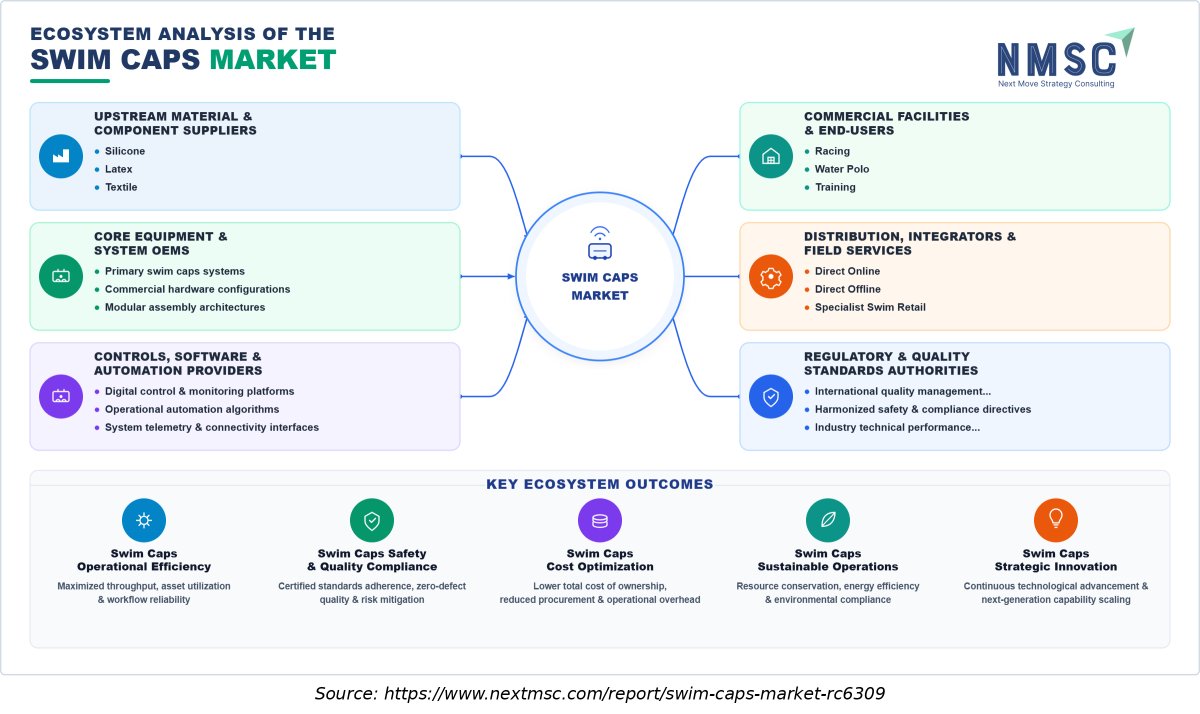
Ecosystem Analysis of the Swim Caps Industry

The above infographic presents the Swim Caps market ecosystem in a structured format, focusing on six core stakeholder groups: raw material suppliers, swim cap manufacturers, component and printing providers, quality testing and certification bodies, distributors and retailers, and institutional and individual end-users. It illustrates how these participants contribute to material innovation, manufacturing quality, product availability, distribution efficiency, and customer satisfaction across recreational and competitive swimming markets.

What Does the Swim Caps Market Encompass?

The swim caps market encompasses headwear designed primarily to contain hair and, in competitive swimming, help reduce hydrodynamic drag during aquatic training and competition. Specialized water polo caps may also incorporate ear protectors. Product types include silicone, latex, textile (including lycra and polyester blends), neoprene, and other materials, each suited to different applications ranging from recreational swimming to competitive racing. Core manufacturing technologies include material formulation, molding, edge finishing, and surface treatment, which influence fit, durability, elasticity, and hydrodynamic performance. Within this scope, competitive swimwear, recreational aquatics, and institutional training programs represent the primary demand pools served by manufacturers and distributors.
Design specifications typically address circumference tolerance, thickness, and stretch recovery, since these parameters determine comfort and retention over extended sessions. Material innovations increasingly include latex-free silicone options for consumers seeking to avoid natural-rubber latex, while maintaining elasticity and durability in chlorinated water. Material safety testing and applicable product conformity requirements support purchasing decisions among swimming federations, schools, clubs, and aquatic centers. Our assessment indicates that these specifications increasingly shape purchasing decisions across both professional and consumer segments.

Market Drivers & Dynamics

Interactive Dataset
Rising Competitive and Recreational Swimming Participation driver High Expanding club memberships and aquatic fitness programs sustain steady demand for swim caps across training and competition Immediate
Shift Toward Latex-Free Silicone Materials driver High Silicone caps address allergy concerns and offer longer durability, encouraging premium replacement purchases Immediate
Institutional Procurement by Schools and Aquatic Centers driver Medium Bulk orders from facilities create recurring volume for manufacturers offering consistent sizing and certified materials Medium-term
Price Sensitivity in Mass Retail Channels restraint High Low-cost imports compress margins for premium silicone caps, limiting pricing power for mid-tier brands Immediate
Extended Replacement Cycles of Durable Caps restraint Medium Well-maintained silicone caps last longer, which slows the frequency of repeat purchases among regular swimmers Medium-term
Raw Material Cost Volatility for Elastomers restraint Low Fluctuations in silicone and latex feedstock prices can pressure production budgets over the long term Long-term
Source: Next Move Strategy Consulting

Growth Drivers

Growth Inhibitors

Segmentation Analysis

2025 (USD Million)
2035 (USD Million)
Silicone 2025: $324.5 Million | 2035: $335.5 Million
Silicone
Latex 2025: $231.1 Million | 2035: $239.0 Million
Latex
Textile 2025: $156.1 Million | 2035: $259.7 Million
Textile
Neoprene 2025: $94.8 Million | 2035: $162.2 Million
Neoprene
Other Materials 2025: $56.7 Million | 2035: $97.9 Million
Other Materi
Silicone $324.5 Million $335.5 Million 0.3%
Latex $231.1 Million $239.0 Million 0.3%
Textile $156.1 Million $259.7 Million 5.2%
Neoprene $94.8 Million $162.2 Million 5.5%
Other Materials $56.7 Million $97.9 Million 5.6%

Which Material Segment Dominates the Market?

Silicone anchors the market, commanding roughly 38% share and USD 324.52 million in 2025 as buyers prioritize fit retention, chlorine resistance, and reusability across training and competitive programs. Latex and textile caps retain a meaningful procurement footprint, although latex share erodes as swimmers and coaches favor durable, low-maintenance alternatives. Other Materials is projected to record the highest growth rate among the listed material segments, reflecting potential demand for specialized and alternative swim cap materials.

2025 (USD Million)
2035 (USD Million)
Category A
Category B
Category C
Category D
Segment Item 2025 (USD Million) 2035 (USD Million) CAGR
Category A $10.0 USD Million $40.0 USD Million 25.0%
Category B $17.1 USD Million $51.1 USD Million 11.0%
Category C $24.2 USD Million $62.2 USD Million 25.0%
Category D $31.3 USD Million $73.3 USD Million 11.0%

Segment-wise data is locked

Unlock complete segment-wise numbers for By Application.

Unlock Full Data
2025 (USD Million)
2035 (USD Million)
Category A
Category B
Category C
Category D
Segment Item 2025 (USD Million) 2035 (USD Million) CAGR
Category A $10.0 USD Million $40.0 USD Million 27.0%
Category B $17.1 USD Million $51.1 USD Million 9.0%
Category C $24.2 USD Million $62.2 USD Million 19.0%
Category D $31.3 USD Million $73.3 USD Million 17.0%

Segment-wise data is locked

Unlock complete segment-wise numbers for By Age Group.

Unlock Full Data
2025 (USD Million)
2035 (USD Million)
Category A
Category B
Category C
Category D
Segment Item 2025 (USD Million) 2035 (USD Million) CAGR
Category A $10.0 USD Million $40.0 USD Million 14.0%
Category B $17.1 USD Million $51.1 USD Million 24.0%
Category C $24.2 USD Million $62.2 USD Million 22.0%
Category D $31.3 USD Million $73.3 USD Million 12.0%

Segment-wise data is locked

Unlock complete segment-wise numbers for By Distribution Channel.

Unlock Full Data
2025 (USD Million)
2035 (USD Million)
Category A
Category B
Category C
Category D
Segment Item 2025 (USD Million) 2035 (USD Million) CAGR
Category A $10.0 USD Million $40.0 USD Million 24.0%
Category B $17.1 USD Million $51.1 USD Million 22.0%
Category C $24.2 USD Million $62.2 USD Million 20.0%
Category D $31.3 USD Million $73.3 USD Million 22.0%

Segment-wise data is locked

Unlock complete segment-wise numbers for By Region.

Unlock Full Data

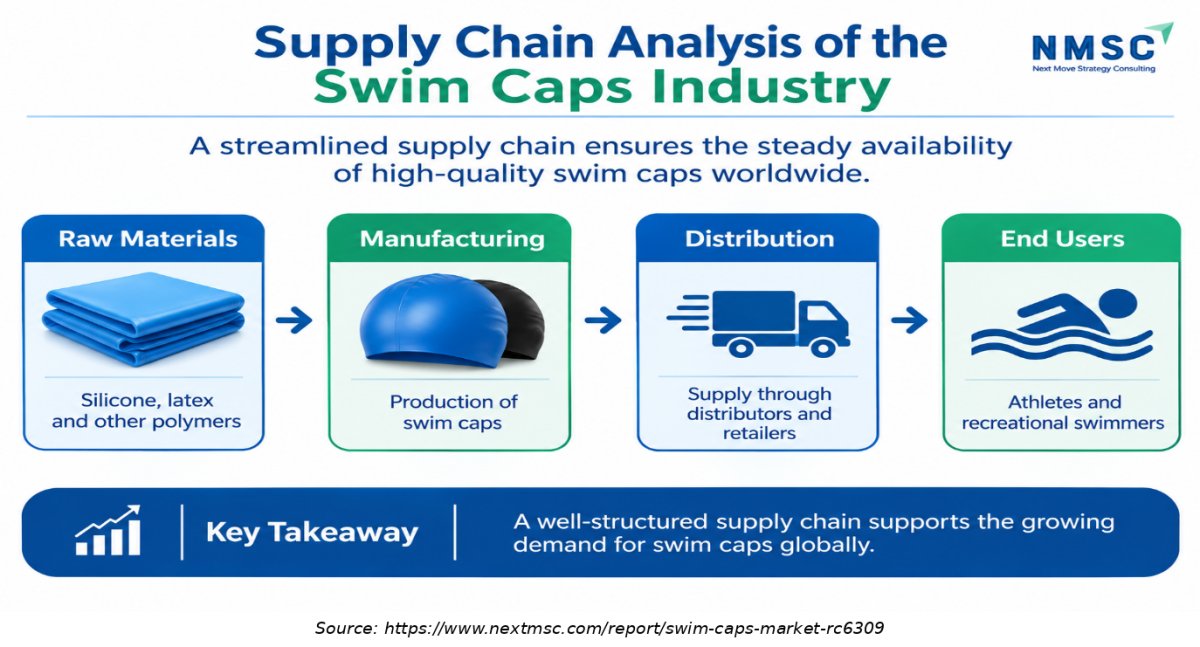
Supply Chain Analysis of the Swim Caps Industry

Supply Chain Analysis of the Swim Caps Industry
The above infographic maps the Swim Caps market supply chain across key activities, including raw material and component sourcing, material preparation and formulation, cap manufacturing and customization, quality testing and compliance verification, packaging and branding, and distribution and retail sales. It illustrates how these activities connect to ensure material availability, manufacturing consistency, product quality, supply reliability, and timely delivery to recreational and competitive swimmers.

Growth Opportunities

Our analysis shows that three structural whitespace opportunities are positioned to generate disproportionate commercial returns in the Swim Caps Market through 2035:

Can Silicone Performance Caps Capture High-Density Training Deployments?

High-density training environments such as national training centers and elite club programs require caps that withstand intensive daily use. Silicone formulations with reinforced seams and consistent elasticity meet these demands while reducing replacement frequency. Suppliers that secure supply agreements with competitive clubs and federation-affiliated programs can build predictable volume. Such partnerships also generate performance feedback that accelerates product refinement and strengthens brand credibility among serious athletes.

How Is Mid-Tier and Regional Facility Adoption Unlocking New Market Volume?

Community pools, municipal aquatic centers, and regional swim schools represent a growing base of institutional buyers outside major metropolitan hubs. These facilities typically purchase caps in bulk for lesson programs and open swim sessions, valuing consistent sizing and affordable replacement pricing. Distributors that offer flexible order quantities and reliable regional delivery can serve these accounts effectively. Expanding coverage into secondary cities therefore broadens volume without requiring extensive premium pricing.

Can Specialized Vertical Implementations Become Distinct Premium Markets?

Specialized caps designed for open-water swimming, triathlon, and cold-water recreation are emerging as distinct premium niches. These products incorporate thicker silicone for thermal retention or enhanced sighting features suited to outdoor conditions. Buyers in these segments prioritize performance attributes over price, supporting higher unit margins. Brands that develop targeted lines for these disciplines can differentiate beyond commodity competition and capture loyal athlete communities.

Regional Outlook

2025 (USD Million)
2035 (USD Million)
North Americ
Europe
Asia-Pacific
Latin Americ
Middle East
Region 2025 (USD Million) 2035 (USD Million) CAGR (%)
North America $10.0 USD Million $40.0 USD Million 9.0%
Europe $17.1 USD Million $51.1 USD Million 27.0%
Asia-Pacific $24.2 USD Million $62.2 USD Million 25.0%
Latin America $31.3 USD Million $73.3 USD Million 23.0%
Middle East & Africa $38.4 USD Million $84.4 USD Million 12.0%

Regional data is locked

Unlock complete regional numbers for this market.

Unlock Full Data

Competitive Landscape

The competitive structure of the swim caps market blends global sportswear groups with specialist swim equipment manufacturers. Pentland Brands Limited (Speedo), Arena S.p.A., TYR Sport, Inc., FINIS, Inc., Mad Wave Ltd, and HEAD Sport GmbH (Zoggs) compete on performance credibility and athlete endorsement. Diversified players such as adidas AG, Decathlon SE (Nabaiji), and Mizuno Corporation extend reach through broad retail footprints and cross-category bundling.

How Do Companies Compete in the Swim Caps Market?

Companies differentiate primarily through material science, fit engineering, and visual design, while pricing tiers separate premium competitive caps from value-oriented recreational options. Specialist brands emphasize athlete validation and racing credentials, whereas mass-market participants compete on accessibility and price. Distribution strategy varies accordingly, with specialist swim retail and direct online storefronts shaping visibility and margin capture.

Which Competitive Archetypes Dominate the Swim Caps Market?

Market participants fall into three archetypes: specialist swim equipment manufacturers focused on competitive performance caps, diversified sportswear groups leveraging broad apparel portfolios, and retail-led private or value brands serving recreational demand. Pentland Brands Limited (Speedo), Arena S.p.A., and TYR Sport, Inc. represent performance-led specialists. adidas AG, Mizuno Corporation, and Perry Ellis International, Inc. (Nike Swim) exemplify diversified sportswear participants, while Decathlon SE (Nabaiji) illustrates scale-driven value positioning.

What Innovation and Differentiation Strategies Are Companies Pursuing?

Sustainable advantages in swim caps rest on proprietary silicone formulations, verified fit consistency across head sizes, and sustained athlete endorsement that builds trust in racing environments. Brands with established design libraries and customization capabilities create switching barriers among clubs and teams. Long-standing reputations for durability under frequent chlorine exposure further reinforce customer loyalty over repeated purchase cycles.

What M&A and Partnership Activity Is Shaping the Market?

Strategic activity in the broader swimming equipment industry is primarily associated with portfolio expansion, brand development, and distribution strengthening. Specific mergers and acquisitions affecting swim cap manufacturers should be included only were supported by verifiable company announcements. Specialist brands with strong athlete networks attract strategic interest because they accelerate access to competitive segments. Strategic transactions involving swimming equipment companies may support complementary product portfolios, distribution access, and regional market expansion, although their direct impact on the swim caps market should be assessed separately.

Key Market Players

Based on research conducted by NMSC, the following 20 companies represent the validated leadership set across Swim Caps Market developers, manufacturers, and solution providers:

Pentland Brands Limited (Speedo) adidas AG Decathlon SE (Nabaiji) Arena S.p.A. TYR Sport, Inc. Mizuno Corporation Perry Ellis International, Inc. (Nike Swim) FINIS, Inc. Mad Wave Ltd HEAD Sport GmbH (Zoggs) Aqua Lung International S.A. (Aqua Sphere) Limited Fashy GmbH Produktion und Vertrieb Way Funky Company Pty Ltd. (Funkita and Funky Trunks) Miriade S.p.A. (Jaked) blueseventy LLC ZONE3 Ltd AMANZI Group Pty Ltd Spiraledge, Inc. (Sporti) Hammer Head Swim Caps, Inc. Speedo International Ltd

Recent developments point to performance-led cap updates and continued alignment with competitive swimming organisations. Speedo’s 2026 range added Fastskin cap colorways and retained IQfit head-mapping and fit-point alignment features. TYR became World Aquatics’ exclusive global supplier through 2029, while arena renewed its USA Swimming partnership through 2028, extending equipment and athlete engagement across major competitions.

Investment Opportunities

Where Are Capital Inflows Concentrating in the Swim Caps Market?

Capital allocation in swim caps increasingly targets silicone compound development and specialty material research, reflecting the dominance of silicone at USD 324.52 million in 2025. Manufacturers also direct funds toward athlete-focused design programs that sharpen fit and performance credentials. Investment interest in alternative materials supports the 5.6% CAGR projected for Other Materials through 2035.

How Is Infrastructure Investment Shaping Market Capacity?

Infrastructure investment in swim caps centers on molding capacity, automated cutting and finishing lines, and warehousing that supports rapid online order fulfillment. Expanded distributor warehousing addresses the growing role of wholesalers in aggregating bulk demand from pools and clubs. Such capacity upgrades allow producers to serve both premium competitive lines and high-volume recreational orders efficiently.

What ESG Considerations Are Influencing Market Investment?

Environmental considerations increasingly influence swim caps investment, as buyers and institutions assess material longevity and end-of-life handling. Durable silicone products offer replacement reduction benefits, while manufacturers explore lower-impact compounds within the Other Materials category. Safety compliance for children and infant products also shapes product validation spending across the ecosystem.

Key Benefits for Stakeholders

How Does This Report Benefit Industry Leaders and Enterprise Operators?

Operational executives and procurement directors gain empirical benchmarks on swim caps demand by material, application, and age cohort. Segment-level data clarifies where silicone production scale and racing-oriented assortments justify capital commitments. Forecasts through 2035 support inventory planning, supplier negotiations, and capacity sequencing across regional operations.

How Does This Report Benefit Investors and Financial Analysts?

Investors evaluating swim caps can anchor valuation models on the market expanding from USD 863.23 million in 2025 to USD 1094.28 million by 2035. Segment concentration, with Adults (18+) representing roughly 46% share, informs risk assessment around demographic exposure. Benchmarking regional leadership in North America against Asia-Pacific growth at 5.1% CAGR supports portfolio allocation decisions.

How Does This Report Benefit Product Developers and Brand Teams?

Product roadmap teams can prioritize development toward racing applications, which account for the largest revenue base, and general-purpose applications, which record the fastest growth. Insight into the 5.5% CAGR of General-Purpose demand helps target broader recreational designs. Competitive differentiation analysis clarifies where material innovation and fit engineering offer defensible advantages for swim caps portfolios.

Key Market Segments Evaluated

By Material

  • Silicone
  • Latex
  • Textile
  • Neoprene
  • Other Materials

By Application

  • Racing
  • Water Polo
  • Training
  • Recreational Swimming
  • Open-Water Swimming
  • Learn-to-Swim
  • General-Purpose

By Age Group

  • Adults (18+)
  • Children (3–17)
  • Infants and Toddlers (0–2)

By Distribution Channel

  • Direct Online
  • Direct Offline
  • Specialist Swim Retail
  • General Sports Retail
  • Mass Merchants
  • Distributors and Wholesalers
  • Institutional Buyers

By Region

  • North America 
    • U.S.
    • Canada
    • Mexico.
  • Europe 
    • UK
    • Germany
    • France
    • Italy
    • Rest of Europe.
  • Asia-Pacific 
    • China
    • India
    • Japan
    • South Korea
    • Australia
    • Rest of APAC.
  • Latin America 
    • Brazil
    • Argentina
    • Colombia
    • Rest of Latin America.
  • Middle East & Africa 
    • UAE
    • Saudi Arabia
    • South Africa
    • Rest of MEA.

Conclusion & Recommendations

What Is the Long-Term Outlook for the Swim Caps Market?

The long-term outlook for the swim caps market is steadily positive, with revenue expanding from USD 883.95 million in 2026 to USD 1094.28 million by 2035 at a 2.4% CAGR. Growth is underpinned by durable commercial demand expansion, the structural shift toward high-performance silicone products, and continuous material and fit innovation across core manufacturing workflows.

What Strategic Positioning Recommendations Does NMSC Offer?

Market participants should concentrate silicone formulation investment on racing caps while building a dedicated portfolio for general-purpose and infant cohorts. Distributors and Wholesalers warrant tailored bulk programs for pools and clubs, given their leading channel growth. Producers should also advance Other Materials development to capture the fastest-growing material subsegment within swim caps.

How Attractive Is the Swim Caps Market for Investment?

Investment attractiveness is moderate, supported by the USD 210.33 million absolute growth opportunity between 2026 and 2035. Stable demand from adult swimmers and recurring replacement cycles underpins predictable revenue streams. Margin potential is strongest for brands combining premium silicone products with direct online and specialist retail distribution.

What Are the Key Market Shifts and Risks in the Swim Caps Market?

Market structure is shifting as specialist retail channels gain share and distributors consolidate bulk purchasing. Raw material price volatility for silicone and specialty compounds presents a primary cost risk for manufacturers. Concentration of competitive demand in racing applications also exposes producers to shifts in athlete sponsorship and competitive calendars.

What Are the Primary Growth Pathways Through 2035?

The most attractive pathways involve expanding infant and toddler assortments, which record a 5.8% CAGR, alongside scaling distributor partnerships for institutional volume. Brands can also pursue hybrid material launches within Other Materials to capture accelerating demand. Targeted growth in Asia-Pacific, advancing at 5.1% CAGR, offers an additional route to capture a disproportionate share of the USD 210.33 million absolute growth opportunity in swim caps.

FAQs

About the Author

Mayurima Roy

Mayurima Roy

Mayurima Roy is Research Analyst at Next Move Strategy Consulting, where she has spent 4 years working across the firm's full industry coverage rather than a single fixed vertical. Her work centers on structured research, ongoing trend tracking, competitive assessment, and insight-led content development, translating complex market data into clear, decision-ready narratives that support informed client decision-making across diverse global industries, market sectors, and world regions every day.

About the Reviewer

Supradip Baul

Supradip Baul

Supradip Baul is an accomplished business consultant and strategist with over a decade of rich experience in market intelligence, strategy, technology, and business transformation. His work has included rigorous qualitative and quantitative analysis across multiple industries, helping clients shape investment decisions and long-term roadmaps. Earlier in his career, he was associated with Gartner, where he contributed to industry-leading reports and market share analyses. He has worked with leading global companies and holds an MBA with a dual specialization in Marketing and Finance.

Download Free Sample

Pratyush Kumar Das

PRATYUSH KUMAR DAS

Assistant Manager

Polycab India Limited

We would like to express our appreciation for the data and insights provided by nextmsc. We are very pleased with the quality and depth of the information, which has proven to be highly valuable and beneficial for our business decision-making.

Kishu Kanda

KISHU KANDA

Strategy Analyst

Accenture

We purchased the AI Consumer Market Report from this company. Not only did they customize the report to meet our specific requirements, but they also showed great flexibility in accommodating our budget. The report we received fully met our expectations. Additionally, they provided prompt and thorough responses to both our pre-purchase and follow-up questions. We look forward to working with this company again in the future.

Gaurav Jaiswal

GAURAV JAISWAL

Founder & CEO

Yano Charge Private Limited

The EV Charging market research report provided by the NextMSC was exceptionally detailed and insightful. It offered a comprehensive analysis that proved to be a game-changer for our strategic planning. Truly a testament to the NextMSC’s expertise and thoroughness in EV market landscape & analysis.

Semih Kavaklioglu

SEMIH KAVAKLIOGLU

Co-Founder & Sales Manager

Decortie

I work a lot in the marketing industry and I know that research is an essential part of any campaign. I have used Market research reports for my own products and I found them to be very informative and well-researched. The team here produces insightful reports for a good price

Melanie Samko

MELANIE SAMKO

Director of Marketing

TOSOH BIOSCIENCE, INC.

The information provided by NMSC is incredibly valuable, thank you so much for such a excellent work. I really appreciate it. I will make sure to reference all of it, in my summary document.

Custom Market Research Services

We will customize the research for you if the listed report does not fully match your requirements.

Get 30% Free Customization

Select License

This website uses cookies to ensure you get the best experience on our website. Learn more

✖