Synthetic Data for Edge AI Market Global Industry Analysis and Forecast (2026–2035)

The global Synthetic Data for Edge AI Market size was valued at USD 0.68 billion in 2025 and is estimated at USD 0.86 billion in 2026, forecast to reach USD 7.44 billion by 2035, expanding at a 27.1% CAGR from 2026 to 2035. Key drivers include rising adoption of physical AI and robotics automation and increasing data privacy regulation, with North America leading the global market.

Download Free Sample PDF
Base Year (2025)
$0.68 Billion
Forecast (2035)
$7.44 Billion
CAGR (2026-2035)
27.1%
Top Region
North America

What Is the Synthetic Data for Edge AI Market Size?

The global synthetic data for edge AI market size was valued at USD 0.68 billion in 2025 and is estimated at USD 0.86 billion in 2026, forecast to reach USD 7.44 billion by 2035, expanding at a 27.1% CAGR between 2026 and 2035. North America leads with approximately 38% share, while Autonomous Vehicles and ADAS dominate all other application segments with approximately 35% share.

We observed that growth is broad-based across every segmentation axis, with generative AI-driven rendering and multi-modal sensor data increasingly anchoring dataset strategies for perception models deployed on constrained edge hardware through 2035.

Synthetic Data for Edge AI Market Global Industry Analysis and Forecast (2026–2035) Revenue Forecast

Values in USD Billion

2025 $0.68 Billion
2025
2026 $0.86 Billion
2026
2027 $1.10 Billion
2027
2028 $1.40 Billion
2028
2029 $1.77 Billion
2029
2030 $2.26 Billion
2030
2031 $2.87 Billion
2031
2032 $3.64 Billion
2032
2033 $4.63 Billion
2033
2034 $5.89 Billion
2034
2035 $7.44 Billion
2035

Key Takeaways

By Application: Autonomous Vehicles and ADAS held the largest share of approximately 35% (USD 0.24 billion) in 2025; Robotics and Industrial Automation is the fastest-growing sub-segment at 31.0% CAGR from 2026–2035.

By Data Type: Visual/Image and Video Data held the largest share of approximately 58% (USD 0.40 billion) in 2025; Multi-Modal Data is the fastest-growing sub-segment at 32.2% CAGR from 2026–2035.

By Component: Platforms and Software Tools held the largest share of approximately 66% (USD 0.45 billion) in 2025; Services is the fastest-growing sub-segment at 28.1% CAGR from 2026–2035.

By Deployment Mode: Cloud-Based held the largest share of approximately 63% (USD 0.43 billion) in 2025; On-Premise/Edge-Native is the fastest-growing sub-segment at 27.8% CAGR from 2026–2035.

By End User: Automotive OEMs and Tier-1 Suppliers held the largest share of approximately 32% (USD 0.22 billion) in 2025; Industrial and Manufacturing Enterprises is the fastest-growing sub-segment at 29.5% CAGR from 2026–2035.

Dominant Region: North America dominated with approximately 38% revenue share (USD 0.26 billion) in 2025.

Fastest-Growing Region: Asia-Pacific is expected to register the highest CAGR of 31.3% during 2026–2035.

Dominant Country: U.S. led with approximately USD 0.20 billion in 2025.

Fastest-Growing Country: India is the fastest-growing country at approximately 36.8% CAGR from 2026–2035.

What Does the Synthetic Data for Edge AI Market Encompass?

The synthetic data for edge AI market encompasses software platforms, rendering engines, and data-as-a-service offerings that generate artificial images, video, sensor point clouds, and time-series signals used to train, validate, and continuously improve AI models deployed on edge devices with constrained compute, connectivity, and power. Our assessment indicates that the scope spans simulation-based and generative AI-based data generation techniques supplied to automotive OEMs, robotics integrators, semiconductor companies, and defense agencies across autonomous vehicles, industrial automation, surveillance, consumer electronics, and healthcare edge applications worldwide.

The category has evolved from a niche computer vision research tool into a core input for physical AI development, driven by the scarcity of labeled real-world edge-case data and the rising cost of on-vehicle and on-robot data collection. Regulatory frameworks such as the European Union's Artificial Intelligence Act and the National Institute of Standards and Technology's AI Risk Management Framework shape provenance and validation requirements for synthetic training datasets, while digital twin simulation environments increasingly inform sensor calibration and domain-randomization strategies. We observed that technology adoption is shifting toward multi-modal, physics-accurate generation pipelines that replace single-sensor synthetic imagery to improve sim-to-real transfer across the synthetic data for edge AI market.

Ecosystem Analysis of the Synthetic Data for Edge AI Market

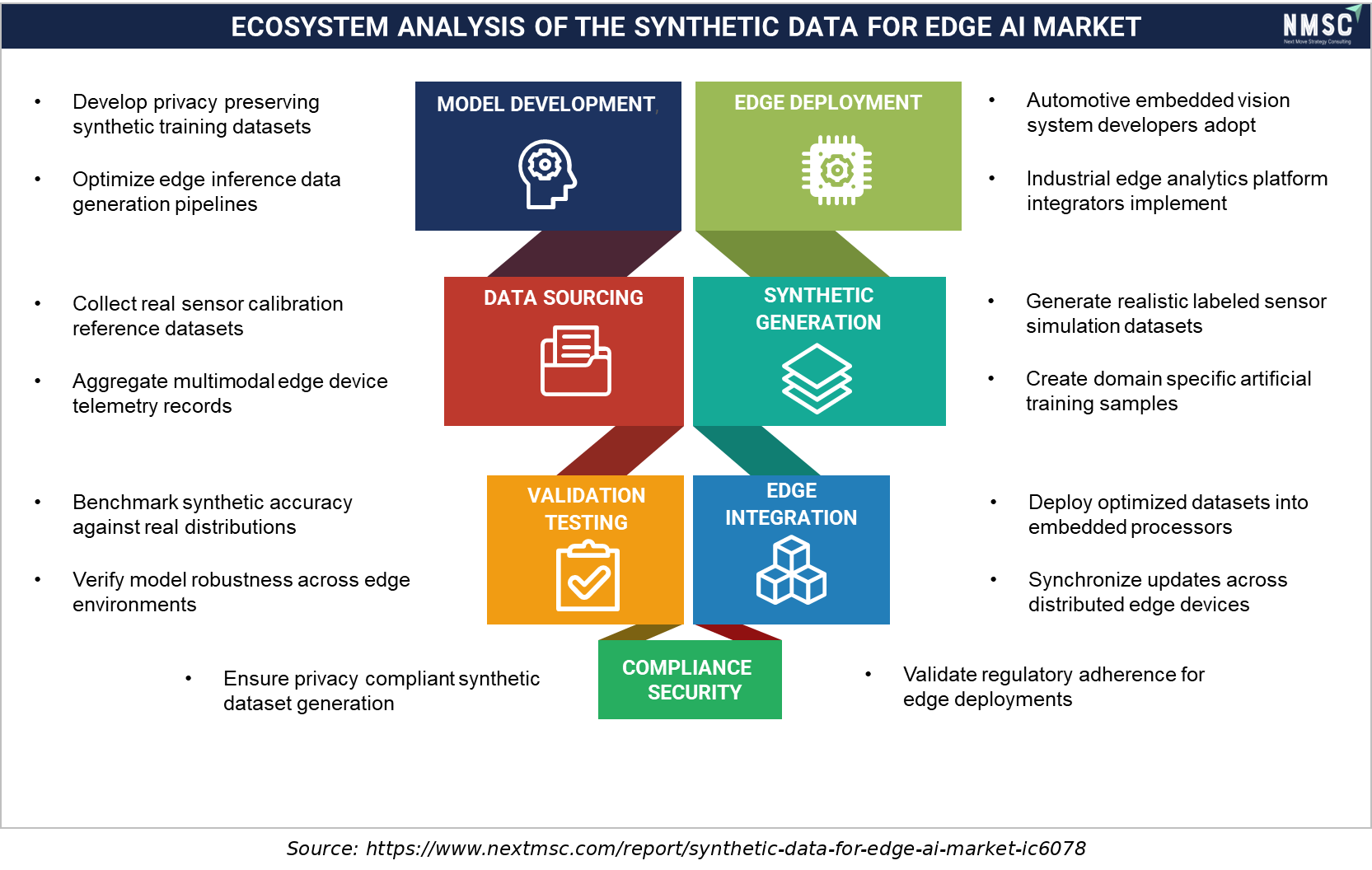
Based on research conducted by NMSC, we found that the Synthetic Data for Edge AI Market connects embedded vision developers, analytics platform integrators, data sourcing, and model development. Realistic labeled sensor simulations and privacy-preserving datasets are generated and benchmarked against real distributions. Ultimately, optimized datasets are deployed into embedded processors while ensuring privacy compliance and regulatory adherence for edge deployments across distributed systems.

Market Drivers & Dynamics

Interactive Dataset
Rising adoption of physical AI and robotics automation driver +3.2% Global 2026–2035
Scarcity and cost of labeled real-world edge-case data driver +2.6% Global 2026–2035
Expansion of autonomous vehicle and ADAS development programs driver +2.1% North America, Europe, Asia-Pacific 2026–2035
Data privacy regulation limiting real-world sensor data collection driver +1.7% Europe, North America 2026–2032
Proliferation of on-device AI chipsets in consumer and industrial hardware driver +1.4% Global 2026–2035
Government investment in defense and robotics simulation programs driver +1.1% North America, Asia-Pacific 2026–2035
Domain gap between synthetic and real-world sensor data restraint −1.3% Global 2026–2032
High computational cost of photorealistic 3D rendering restraint −0.9% Global 2026–2035
Limited standardization for synthetic data quality validation restraint −0.6% Global 2027–2035
Source: Next Move Strategy Consulting

Growth Drivers

What Is the Primary Growth Driver of the Synthetic Data for Edge AI Market?

Rising adoption of physical AI and robotics automation is the primary driver of the market. The National Institute of Standards and Technology's AI Risk Management Framework increasingly informs how manufacturers validate perception models before deployment, sustaining structured demand for repeatable, labeled synthetic scenarios. We observed that this shift, reinforced by growing industrial automation budgets, continues to anchor baseline consumption of visual and multi-modal synthetic datasets across automotive, robotics, and manufacturing end markets.

How Is Data Privacy Regulation Driving Synthetic Data for Edge AI Market Growth?

Data privacy regulation and restrictions on real-world sensor data collection are accelerating adoption of synthetic alternatives for autonomous vehicle and surveillance model training. The European Union's Artificial Intelligence Act imposes documentation and risk-assessment obligations on high-risk perception systems, pushing developers toward privacy-compliant synthetic datasets that avoid personally identifiable imagery. Our assessment indicates that this regulatory pressure, combined with tightening biometric data rules, is compressing adoption timelines for synthetic-first data strategies across Europe and North America.

Growth Inhibitors

What Is Restraining Synthetic Data for Edge AI Market Expansion?

The domain gap between synthetic and real-world sensor data restrains broader adoption, as models trained purely on synthetic imagery can underperform when deployed against unmodeled real-world noise. The U.S. National Institute of Standards and Technology continues to develop measurement frameworks for evaluating synthetic dataset fidelity and downstream model performance. We found that smaller edge AI developers face particular exposure, as limited validation budgets reduce their ability to blend synthetic and real data at the scale achieved by larger, well-capitalized platform providers.

What Are the Growth Opportunities?

How Can Synthetic Sensor-Fusion Datasets Unlock Value for Autonomous Trucking Fleets?

Synthetic sensor-fusion datasets present a whitespace opportunity for autonomous trucking fleet operators seeking to validate highway-speed perception across camera, LiDAR, and radar streams without accumulating disproportionate real-world highway miles. Suppliers that commercialize synchronized multi-sensor scenario libraries stand to capture recurring subscription revenue as freight carriers expand pilot corridors, particularly among long-haul operators pursuing driver-out validation milestones.

Where Do On-Device Validation Platforms Create New Demand Among Semiconductor Vendors?

Semiconductor vendors developing edge AI accelerators represent an underpenetrated opportunity for synthetic data providers offering hardware-in-the-loop validation suites calibrated to specific chipset architectures. Providers that develop benchmark-ready synthetic test sets for embedded inference chips can secure long-term design-partnership agreements with chipset vendors, benefiting from recurring revenue tied to successive silicon generations and expanding embedded vision product lines.

How Can Synthetic Data Licensing Models Benefit Industrial Robotics Integrators?

Industrial robotics integrators seeking to shorten commissioning timelines create an opportunity for platform providers offering subscription-based synthetic data licensing tied to specific manipulation and inspection tasks. Early movers that package pre-validated scenario libraries for common industrial tasks can differentiate with system integrators pursuing rapid, repeatable robot deployment across manufacturing and warehouse automation programs.

Segmentation Analysis

2025 (USD Billion)
2035 (USD Billion)
Autonomous Vehicles and ADAS 2025: $0.24 Billion | 2035: $2.35 Billion
Autonomous V
Robotics and Industrial Automation 2025: $0.16 Billion | 2035: $2.29 Billion
Robotics and
Smart Surveillance and Security 2025: $0.11 Billion | 2035: $1.24 Billion
Smart Survei
Consumer Electronics and Smart Devices 2025: $0.07 Billion | 2035: $0.78 Billion
Consumer Ele
Healthcare and Medical Edge Devices 2025: $0.04 Billion | 2035: $0.42 Billion
Healthcare a
Aerospace and Defense 2025: $0.04 Billion | 2035: $0.24 Billion
Aerospace an
Others 2025: $0.02 Billion | 2035: $0.12 Billion
Others
Autonomous Vehicles and ADAS $0.24 Billion $2.35 Billion 25.7%
Robotics and Industrial Automation $0.16 Billion $2.29 Billion 31.0%
Smart Surveillance and Security $0.11 Billion $1.24 Billion 27.7%
Consumer Electronics and Smart Devices $0.07 Billion $0.78 Billion 26.5%
Healthcare and Medical Edge Devices $0.04 Billion $0.42 Billion 26.1%
Aerospace and Defense $0.04 Billion $0.24 Billion 20.1%
Others $0.02 Billion $0.12 Billion 17.1%

Which Application Segment Dominates the Synthetic Data for Edge AI Market?

Autonomous Vehicles and ADAS led the market with USD 0.24 billion in 2025, supported by sustained autonomous testing programs and the near-universal reliance of perception-stack developers on synthetic scenario libraries for rare, safety-critical events. We observed that Robotics and Industrial Automation is the fastest-growing application, expanding at a 31.0% CAGR from 2026 to 2035, as manufacturers increasingly deploy synthetic data to train bin-picking, inspection, and mobile-manipulation models before physical robot commissioning.

2025 (USD Billion)
2035 (USD Billion)
Visual/Image
Sensor and P
Tabular and
Multi-Modal
Segment Item 2025 (USD Billion) 2035 (USD Billion) CAGR
Visual/Image and Video Data $10.0 USD Billion $40.0 USD Billion 20.0%
Sensor and Point Cloud Data $17.1 USD Billion $51.1 USD Billion 10.0%
Tabular and Time-Series Data $24.2 USD Billion $62.2 USD Billion 16.0%
Multi-Modal Data $31.3 USD Billion $73.3 USD Billion 22.0%

Segment-wise data is locked

Unlock complete segment-wise numbers for By Data Type.

Unlock Full Data

Which Data Type Is Most Widely Used in the Synthetic Data for Edge AI Market?

Visual/Image and Video Data remained the dominant data type across the market, reaching USD 0.40 billion in 2025 due to its broad applicability across camera-based perception systems in vehicles, robots, and security cameras. Our findings suggest that Multi-Modal Data is the fastest-growing category at a 32.2% CAGR from 2026 to 2035, reflecting developers' efforts to validate sensor-fusion perception stacks that combine camera, LiDAR, radar, and thermal streams within a single synchronized dataset.

2025 (USD Billion)
2035 (USD Billion)
Platforms an
Services
Segment Item 2025 (USD Billion) 2035 (USD Billion) CAGR
Platforms and Software Tools $10.0 USD Billion $40.0 USD Billion 27.0%
Services $17.1 USD Billion $51.1 USD Billion 17.0%

Segment-wise data is locked

Unlock complete segment-wise numbers for By Component.

Unlock Full Data

Which Component Leads Synthetic Data for Edge AI Market Demand?

Platforms and Software Tools remained the leading component within the market, valued at USD 0.45 billion in 2025 as developers increasingly license self-serve simulation and generative rendering environments. Based on research conducted by NMSC, we found that Services is the fastest-growing component, registering a 28.1% CAGR from 2026 to 2035, as enterprises without in-house simulation expertise increasingly outsource custom scenario design, sensor calibration, and dataset validation to specialized providers.

2025 (USD Billion)
2035 (USD Billion)
Cloud-Based
On-Premise/E
Segment Item 2025 (USD Billion) 2035 (USD Billion) CAGR
Cloud-Based $10.0 USD Billion $40.0 USD Billion 24.0%
On-Premise/Edge-Native $17.1 USD Billion $51.1 USD Billion 26.0%

Segment-wise data is locked

Unlock complete segment-wise numbers for By Deployment Mode.

Unlock Full Data
2025 (USD Billion)
2035 (USD Billion)
Automotive O
Technology a
Industrial a
Government a
Healthcare P
Segment Item 2025 (USD Billion) 2035 (USD Billion) CAGR
Automotive OEMs and Tier-1 Suppliers $10.0 USD Billion $40.0 USD Billion 25.0%
Technology and Semiconductor Companies $17.1 USD Billion $51.1 USD Billion 23.0%
Industrial and Manufacturing Enterprises $24.2 USD Billion $62.2 USD Billion 9.0%
Government and Defense Agencies $31.3 USD Billion $73.3 USD Billion 23.0%
Healthcare Providers $38.4 USD Billion $84.4 USD Billion 24.0%

Segment-wise data is locked

Unlock complete segment-wise numbers for By End User.

Unlock Full Data
2025 (USD Billion)
2035 (USD Billion)
Simulation a
Generative A
Hybrid Simul
Segment Item 2025 (USD Billion) 2035 (USD Billion) CAGR
Simulation and Rendering-Based $10.0 USD Billion $40.0 USD Billion 27.0%
Generative AI-Based $17.1 USD Billion $51.1 USD Billion 21.0%
Hybrid Simulation and Generative $24.2 USD Billion $62.2 USD Billion 23.0%

Segment-wise data is locked

Unlock complete segment-wise numbers for By Generation Technique.

Unlock Full Data

Growth Opportunities

Our analysis shows that three forward-looking opportunities stand out for stakeholders positioning within the synthetic data for edge AI market over the 2026–2035 forecast period.

How Can Synthetic Sensor-Fusion Datasets Unlock Value for Autonomous Trucking Fleets?

Synthetic sensor-fusion datasets present a whitespace opportunity for autonomous trucking fleet operators seeking to validate highway-speed perception across camera, LiDAR, and radar streams without accumulating disproportionate real-world highway miles. Suppliers that commercialize synchronized multi-sensor scenario libraries stand to capture recurring subscription revenue as freight carriers expand pilot corridors, particularly among long-haul operators pursuing driver-out validation milestones.

Where Do On-Device Validation Platforms Create New Demand Among Semiconductor Vendors?

Semiconductor vendors developing edge AI accelerators represent an underpenetrated opportunity for synthetic data providers offering hardware-in-the-loop validation suites calibrated to specific chipset architectures. Providers that develop benchmark-ready synthetic test sets for embedded inference chips can secure long-term design-partnership agreements with chipset vendors, benefiting from recurring revenue tied to successive silicon generations and expanding embedded vision product lines.

How Can Synthetic Data Licensing Models Benefit Industrial Robotics Integrators?

Industrial robotics integrators seeking to shorten commissioning timelines create an opportunity for platform providers offering subscription-based synthetic data licensing tied to specific manipulation and inspection tasks. Early movers that package pre-validated scenario libraries for common industrial tasks can differentiate with system integrators pursuing rapid, repeatable robot deployment across manufacturing and warehouse automation programs.

Regional Outlook

2025 (USD Billion)
2035 (USD Billion)
North Americ
Europe
Asia-Pacific
Middle East
Latin Americ
Region 2025 (USD Billion) 2035 (USD Billion) CAGR (%)
North America $10.0 USD Billion $40.0 USD Billion 9.0%
Europe $17.1 USD Billion $51.1 USD Billion 27.0%
Asia-Pacific $24.2 USD Billion $62.2 USD Billion 25.0%
Middle East & Africa $31.3 USD Billion $73.3 USD Billion 23.0%
Latin America $38.4 USD Billion $84.4 USD Billion 12.0%

Regional data is locked

Unlock complete regional numbers for this market.

Unlock Full Data

PESTEL Analysis of the Synthetic Data for Edge AI Market
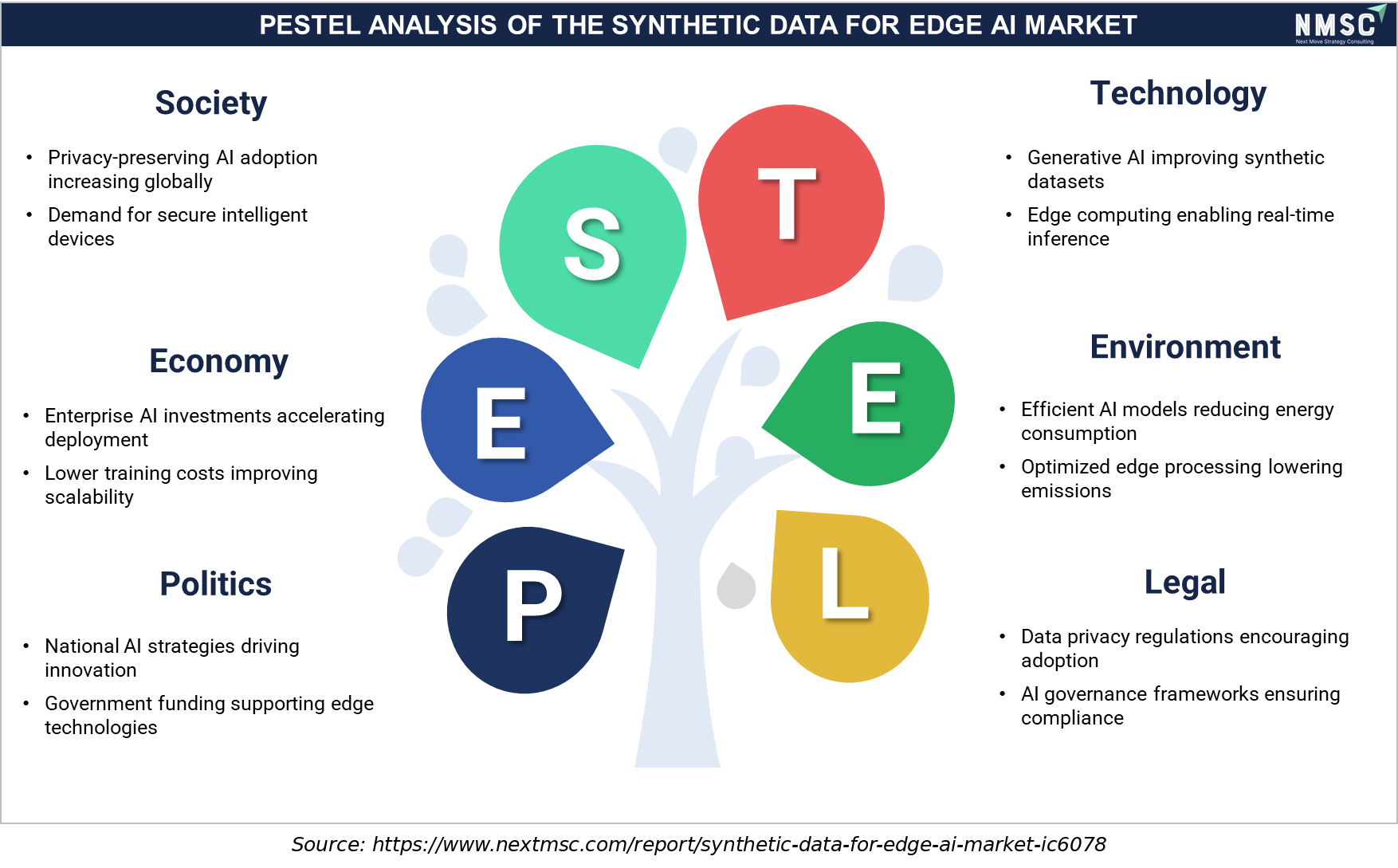
PESTEL Analysis of the Synthetic Data for Edge AI Market
NMSC's analysis indicates that enterprise AI investments, lower training costs, and demand for secure intelligent devices drive growth in the Synthetic Data for Edge AI Market. Furthermore, generative AI and edge computing accelerate real-time inference capabilities. Concurrently, government funding and national AI strategies support innovation, while data privacy regulations, AI governance frameworks, and emission-reducing efficient models dictate legal and environmental compliance worldwide.

Competitive Landscape

We observed that the synthetic data for edge AI market features a moderately fragmented competitive landscape, with a dominant full-stack platform provider competing alongside specialized simulation, sensor-modeling, and computer vision startups on realism, sensor coverage, and domain specialization.

Dimension Description
Market Structure Moderately fragmented; NVIDIA Corporation accounts for a disproportionate share of platform-level revenue through Omniverse Replicator and Isaac Sim, while numerous specialized startups serve automotive, robotics, and embedded vision niches.
Innovation Focus Generative AI-based rendering, multi-modal sensor fusion simulation, and hardware-in-the-loop validation for edge AI chipsets dominate current innovation pipelines across leading suppliers.
M&A Activity Selective consolidation through platform acquisitions, exemplified by NVIDIA's integration of Gretel's generative data engine into its Omniverse and Isaac robotics stack.

How Do Companies Compete in the Synthetic Data for Edge AI Market?

Companies compete primarily on rendering realism, sensor-modeling depth, and integration flexibility with existing machine learning pipelines across the industry. NVIDIA leverages its broad Omniverse and Isaac Sim ecosystem to serve automotive, robotics, and industrial customers at scale, while specialized providers such as Applied Intuition and Cognata compete on deep autonomous vehicle simulation fidelity for smaller, more technically demanding customer bases.

Which Competitive Archetypes Dominate the Synthetic Data for Edge AI Market?

Two archetypes dominate the market: a diversified full-stack simulation and computing platform provider offering end-to-end synthetic data and robot-learning infrastructure, and specialized point-solution vendors focused on specific sensor modalities or verticals. NVIDIA exemplifies the diversified archetype through integrated rendering-to-deployment infrastructure, while Anyverse and Neurolabs exemplify the specialized archetype serving automotive sensor simulation and retail computer vision, respectively.

How Are Companies Differentiating Through Innovation in Synthetic Data for Edge AI?

Innovation and differentiation strategy increasingly center on physics-accurate sensor simulation and hardware-in-the-loop validation. Synetic's LYNX SDK and Bifrost AI's Stardust platform both pair synthetic data generation with direct model evaluation against target deployment conditions. Our analysis shows that suppliers unable to demonstrate measurable sim-to-real transfer performance risk exclusion from automotive and defense vendor qualification processes.

What M&A and Expansion Activity Is Shaping the Synthetic Data for Edge AI Market?

Mergers, acquisitions, and platform integration continue to consolidate capabilities within the industry. NVIDIA's integration of Gretel's generative data engine into its Omniverse and Isaac robotics stack broadened its synthetic data offering for agentic and physical AI, while Synopsys' 2025 acquisition of Ansys brought AVxcelerate sensor simulation capabilities under a larger engineering software platform serving automotive perception validation.

Key Market Players

Our assessment indicates that the following 20 companies are actively shaping product innovation, dataset realism, and validation methodology within the global synthetic data for edge AI market.

NVIDIA Corporation Applied Intuition, Inc. Cognata Ltd. Parallel Domain, Inc. MathWorks, Inc. Synopsys, Inc. (Ansys AVxcelerate) dSPACE GmbH IPG Automotive GmbH Rendered.ai, Inc. Synthesis AI, Inc. SKY ENGINE AI, Inc. Bifrost AI, Inc. Duality AI, Inc. Anyverse S.L. CVEDIA Inc. Mindtech Global Ltd. Synetic, Inc. Neurolabs Ltd. Mostly AI GmbH Tonic.ai, Inc.

Latest Developments

We found that recent product and platform developments within the synthetic data for edge AI market are concentrated on generative rendering, robot-learning pipelines, and edge-hardware validation.

Date Event
May 2026 NVIDIA launched Cosmos 3, an open physical AI foundation model utilizing a mixture-of-transformers architecture for world simulation, reasoning, and synthetic data generation. NVIDIA also established the Cosmos Coalition alongside leading robotics pioneers to advance open world model development and accelerate synthetic data workflows across industries.
March 2026 NVIDIA launched the Physical AI Data Factory Blueprint, an open reference architecture that automates data processing, curation, synthetic data generation, reinforcement learning, and evaluation for vision AI agents, robotics, and autonomous vehicles, enabling scalable training-data production for physical AI systems deployed across real-world environments

Investment Opportunities

What Capital Inflows Are Targeting the Synthetic Data for Edge AI Market?

Capital inflows into the synthetic data for edge AI market are increasingly directed toward generative rendering infrastructure and robot-learning pipeline development. Venture investors continue to fund platform consolidation and Series A-stage scaling, as seen in Bifrost AI's USD 8 million funding round led by Carbide Ventures with participation from Airbus Ventures. We observed that investors favor providers demonstrating measurable sim-to-real transfer performance, viewing validated model accuracy improvement as a proxy for long-term enterprise contract retention.

How Is Infrastructure Investment Supporting Synthetic Data for Edge AI Development?

Infrastructure investment is expanding graphics processing and datacenter rendering capacity to support large-scale synthetic scene generation, particularly across North America and Asia-Pacific. Our findings suggest that platform providers are investing in cloud-based rendering farms to shorten dataset turnaround for automotive and robotics customers, supporting the throughput required for multi-modal, physics-accurate scenario generation at production scale.

What ESG Considerations Are Shaping Synthetic Data for Edge AI Investment Decisions?

Environmental, social, and governance considerations are increasingly relevant to investment decisions, with energy-efficient rendering and bias-reduction tooling as emerging criteria. The European Union's Artificial Intelligence Act continues to inform governance disclosures for high-risk perception systems trained partly on synthetic data. We found that investors increasingly favor providers with documented bias-detection and data-provenance capabilities, treating them as governance indicators alongside compute-efficiency credentials.

Key Benefits for Stakeholders

How Does This Report Benefit Enterprise and Industry Leaders?

Enterprise and industry leaders gain access to validated segmentation, competitive benchmarking, and regional demand forecasts that support sourcing and platform-selection decisions across the synthetic data for edge AI industry. Our analysis shows that detailed data-type, component, and deployment-mode breakdowns help engineering teams align dataset specifications with model qualification requirements while identifying underserved application segments for capability expansion.

How Does This Report Benefit Investors and Financial Analysts?

Investors and financial analysts benefit from consistent, single-point market size and CAGR estimates that support valuation and capital-allocation decisions across the synthetic data for edge AI supply chain. We observed that the report's regional and segment-level growth differentials help identify which platform providers and simulation specialists are best positioned to capture above-market growth in robotics and multi-modal data categories through 2035.

How Does This Report Benefit Technology Vendors and Product Teams?

Technology vendors and product teams gain insight into emerging dataset requirements, including multi-modal sensor fusion and hardware-in-the-loop validation, that are reshaping the industry. Our findings suggest that this analysis helps robot software and perception-model development teams prioritize roadmaps around sim-to-real transfer performance and edge-chipset validation increasingly required by automotive and industrial customer qualification processes.

Key Market Segments Evaluated

By Application

  • Autonomous Vehicles and ADAS
  • Robotics and Industrial Automation
  • Smart Surveillance and Security
  • Consumer Electronics and Smart Devices
  • Healthcare and Medical Edge Devices
  • Aerospace and Defense
  • Others

By Data Type

  • Visual/Image and Video Data
  • Sensor and Point Cloud Data
  • Tabular and Time-Series Data
  • Multi-Modal Data

By Component

  • Platforms and Software Tools
  • Services

By Deployment Mode

  • Cloud-Based
  • On-Premise/Edge-Native

By End User

  • Automotive OEMs and Tier-1 Suppliers
  • Technology and Semiconductor Companies
  • Industrial and Manufacturing Enterprises
  • Government and Defense Agencies
  • Healthcare Providers
  • Others

By Generation Technique

  • Simulation and Rendering-Based
  • Generative AI-Based
  • Hybrid Simulation and Generative

Conclusion & Recommendations

The long-term outlook for the synthetic data for edge AI market remains strongly positive, with revenue expected to expand from USD 0.86 billion in 2026 to USD 7.44 billion by 2035. We observed that this trajectory reflects the structural shift toward physical AI, where perception models deployed on vehicles, robots, and embedded devices increasingly depend on synthetic data to close real-world data-scarcity gaps at scale.

What Are the Strategic Positioning Recommendations for Market Participants?

Strategic positioning should prioritize multi-modal sensor coverage and demonstrable sim-to-real transfer performance over single-modality rendering breadth. Our assessment indicates that providers combining generative AI rendering with physics-accurate sensor simulation, similar to approaches adopted by NVIDIA and Anyverse, will be best positioned to capture premium contracts within automotive and defense qualification processes through 2035.

How Attractive Is the Synthetic Data for Edge AI Market for New Investment?

The synthetic data for edge AI industry presents an attractive investment case, supported by a USD 6.58 billion absolute dollar opportunity between 2026 and 2035 and above-average growth in Asia-Pacific and robotics application categories. We found that investment attractiveness is highest for platform providers combining validated dataset realism with scaled rendering infrastructure, positioning them to serve both automotive and industrial robotics segments simultaneously.

What Market Shifts and Key Risks Should Stakeholders Monitor?

Stakeholders should monitor the persistent domain gap between synthetic and real-world sensor data, rising computational costs for photorealistic rendering, and the absence of standardized synthetic data quality benchmarks as key risks. Our analysis shows that suppliers unable to demonstrate measurable downstream model performance risk losing qualification contracts to competitors with validated, benchmark-backed sim-to-real transfer credentials.

What Are the Key Growth Pathways for the Synthetic Data for Edge AI Market?

Key growth pathways include expanding multi-modal sensor-fusion dataset libraries, scaling hardware-in-the-loop validation for edge AI chipsets, and deepening penetration into industrial robotics and healthcare edge-device channels. Next Move Strategy Consulting's analysis indicates that suppliers pursuing these pathways while maintaining cloud computing cost efficiency in rendering infrastructure will be best positioned to capture the market's projected growth through 2035.

FAQs

Consolidated Source Table

Source Name / Organization URL
NVIDIA Corporation
Applied Intuition, Inc.
Cognata Ltd.
Parallel Domain, Inc.
MathWorks, Inc.
Synopsys, Inc.
dSPACE GmbH
IPG Automotive GmbH
Rendered.ai, Inc.
Synthesis AI, Inc.
Bifrost AI, Inc.
Duality AI, Inc.
Anyverse S.L.
Mindtech Global Ltd.
Synetic, Inc.
Neurolabs Ltd.
Deloitte Global
U.S. National Institute of Standards and Technology (NIST)
European Commission
European Union Artificial Intelligence Act
Saudi Data and Artificial Intelligence Authority (SDAIA)
Airbus Ventures / Businesswire (Bifrost AI funding announcement)
Methodology Note
Market size and CAGR figures presented in this report are industry-derived estimates developed by Next Move Strategy Consulting through triangulation of company disclosures, government and regulatory guidance, and a proprietary bottom-up segmentation model, as no single publicly verifiable dataset matches the synthetic data for edge AI market's exact scope, segmentation, and forecast window.

About the Author

Saista Faiyaz

Saista Faiyaz

Saista Faiyaz is Research Associate at Next Move Strategy Consulting, where she has covered consumer markets and healthcare technologies for 3 years. Her work includes primary interview review, secondary-source validation, market sizing, and structured analysis of company and industry data. She supports research by comparing evidence across sources, organizing findings into market narratives, and documenting assumptions used in analysis. Her scope includes cross-market benchmarking, and reports.

About the Reviewer

Supradip Baul

Supradip Baul

Supradip Baul is an accomplished business consultant and strategist with over a decade of rich experience in market intelligence, strategy, technology, and business transformation. His work has included rigorous qualitative and quantitative analysis across multiple industries, helping clients shape investment decisions and long-term roadmaps. Earlier in his career, he was associated with Gartner, where he contributed to industry-leading reports and market share analyses. He has worked with leading global companies and holds an MBA with a dual specialization in Marketing and Finance.

Download Free Sample

Mohit Agarwal

MOHIT AGARWAL

Chief Manager

DryChem India Pvt. Ltd.

Next Move Strategy Consulting is an amazing team of consultants. We required a market study report for our investors on top priority and the team went above and beyond our expectations to deliver the same with ample supporting data within a short time span enabling us to secure the investments and keep our project timeline maintained. Their professionalism, attention to detail, and timely delivery of actionable recommendations have left a lasting impression on our organization.

Rishabh Jogani

RISHABH JOGANI

Strategy Analyst

Accenture Japan

We are incredibly impressed with the market report on the real estate market in India provided by Next Move Strategy Consulting. The report was thorough, insightful, and well-structured, offering deep analysis and actionable recommendations. It not only captured the current trends and dynamics but also provided a forward-looking perspective that has been invaluable for our strategic planning. Their team demonstrated exceptional professionalism, attention to detail, and a profound understanding of the industry. The data-driven insights and clarity of presentation exceeded our expectations, making complex market trends easy to understand. We highly recommend Next Move Strategy Consulting to anyone looking for reliable and comprehensive market research services. Their expertise has given us the confidence to navigate the complexities of the Indian real estate market with clarity and foresight.

Gustaf Hummel Burstrom

GUSTAF HUMMEL BURSTROM

Founder

Revline Tools AB

Joseph and the team at Next Move Strategy Consulting have been excellent to work with, in supplying us with relevant market data and forecasts for our specific category. We had some special requirements and they were able to do a custom package to suit our needs. We would definitely recommend them to any other company needing market data and forecasts

Nishant Awate

NISHANT AWATE

Business Development Global Sales

Zehnder Group Deutschland GmbH

Our experience working with Next Move Strategy Consulting was positive. The team was responsive, professional, and open to incorporating our specific requirements throughout the project. The India AHU market study was comprehensive and well structured, covering market value and volume forecasts, product and application segments, and key industry trends. The inclusion of both AHU and residential MVHR market insights made the study particularly relevant for our strategic market assessment. Overall, the report provides a solid foundation for evaluating market potential, identifying priority segments, and supporting business-development decisions in India.

Henri Knyphausen

HENRI KNYPHAUSEN

Partner at Singulier [Ex-BCG]

Singulier

I recently engaged NEXTMSC.com for a commercial due diligence project within the intralogistics sector, and I am pleased to provide a reference based on my experience. In utilizing NEXTMSC.com's services, I found their report to offer valuable insights into market dynamics and key industry players. The initial report provided a solid foundation for our analysis. However, as we were investigating a smaller target in the market, and I had specific customization requests requiring additional research. These requests included detailed information on product portfolios of various players and sub-market sizes, both inclusive and exclusive of certain product categories. NEXTMSC.com demonstrated commendable responsiveness and agility in accommodating these customization requests. Within a timeframe of 1-2 weeks, they delivered a revised report that met our specific needs. Furthermore, they were receptive to my follow-up inquiries, ensuring clarity and understanding of the data provided. The final deliverable significantly contributed to our due diligence efforts. One of NEXTMSC.com's notable strengths lies in their qualitative research capabilities. However, for future engagements, I would recommend the inclusion of a quantified market model in Excel format. Such a model would offer the ability to conduct in-depth analyses and explore various market segments, including country-specific data and subcomponent breakdowns. Based on my positive experience, I would not hesitate to work with NEXTMSC.com again. Their responsiveness, willingness to accommodate customization requests, and commitment to delivering actionable insights make them a reliable partner for commercial research projects.

Custom Market Research Services

We will customize the research for you if the listed report does not fully match your requirements.

Get 30% Free Customization

Select License

This website uses cookies to ensure you get the best experience on our website. Learn more

✖