Decoy Drone Market

Decoy drone market size was USD 4.85 billion in 2025, projected to reach USD 10.35 billion by 2035 at a 7.9% CAGR from 2026 to 2035, per this market report.

Download Free Sample PDF
Base Year (2025)
$4.85 Billion
Forecast (2035)
$10.35 Billion
CAGR (2026-2035)
7.9%
Top Region
North America

What Is the Decoy Drone Market Size?

The global decoy drone market size was valued at USD 4.85 billion in 2025 and is estimated at USD 5.24 billion in 2026, forecast to reach USD 10.35 billion by 2035, expanding at a 7.9% CAGR between 2026 and 2035. North America leads with approximately 41% share, while Aerial Target Drone dominates all other decoy type categories with approximately 42% share.

We observed that growth is broadening across every segmentation axis, with electronic warfare simulation demand and expanding air defense modernization programs driving the dominant structural shifts through 2035.

Decoy Drone Market Revenue Forecast

Values in USD Billion

2025 $4.85 Billion
2025
2026 $5.23 Billion
2026
2027 $5.65 Billion
2027
2028 $6.09 Billion
2028
2029 $6.57 Billion
2029
2030 $7.09 Billion
2030
2031 $7.65 Billion
2031
2032 $8.26 Billion
2032
2033 $8.91 Billion
2033
2034 $9.61 Billion
2034
2035 $10.35 Billion
2035

Key Takeaways

By Decoy Type: Aerial Target Drone held the largest share of approximately 42% (USD 2.04 billion) in 2025; Multi-Spectral Decoy Drone is the fastest-growing sub-segment at 12.5% CAGR from 2026–2035.

By Application: Air Defense Training held the largest share of approximately 36% (USD 1.75 billion) in 2025; Naval Fleet Protection is the fastest-growing sub-segment at 10.6% CAGR from 2026–2035.

By Launch Mode: Ground-Launched held the largest share of approximately 44% (USD 2.13 billion) in 2025; Man-Portable is the fastest-growing sub-segment at 10.1% CAGR from 2026–2035.

By Propulsion Type: Jet-Propelled held the largest share of approximately 47% (USD 2.28 billion) in 2025; Other Propulsion is the fastest-growing sub-segment at 11.1% CAGR from 2026–2035.

By Range: Medium-Range held the largest share of approximately 41% (USD 1.99 billion) in 2025; Long-Range is the fastest-growing sub-segment at 10.4% CAGR from 2026–2035.

By Reusability: Recoverable Systems held the largest share of approximately 63% (USD 3.06 billion) in 2025; Expendable Systems is the fastest-growing sub-segment at 9.6% CAGR from 2026–2035.

By End User: Air Force held the largest share of approximately 46% (USD 2.23 billion) in 2025; Homeland Security and Defense Agencies is the fastest-growing sub-segment at 11.0% CAGR from 2026–2035.

Dominant Region: North America dominated with approximately 41% revenue share (USD 1.99 billion) in 2025.

Fastest-Growing Region: Latin America is expected to register the highest CAGR of 12.3% during 2026–2035.

Dominant Country: U.S. led with approximately USD 1.63 billion in 2025.

Fastest-Growing Country: Argentina is the fastest-growing country at approximately 13.0% CAGR from 2026–2035.

Market Opportunity: The decoy drone market is expected to create an absolute dollar opportunity of USD 5.11 billion between 2026 and 2035, presenting significant investment potential across electronic warfare decoy systems and expanding air defense training infrastructure.

According to NMSC analysis, defense agencies are increasingly procuring multi-spectral decoy platforms capable of simulating radar, infrared, and electronic signatures simultaneously, a shift that favors diversified defense contractors with integrated sensor-spoofing capability over single-signature target drone specialists as air forces prioritize realistic threat simulation for next-generation air defense testing through 2035.

What Does the Decoy Drone Market Encompass?

The decoy drone market encompasses unmanned aerial systems designed to simulate enemy aircraft, missiles, or other airborne threats for air defense training, missile evasion, electronic warfare simulation, and radar cross-section testing. Our assessment indicates that scope spans aerial, naval, and multi-spectral decoy platforms launched from ground, air, and ship-based systems, procured by air forces, navies, armies, and homeland security agencies worldwide. The market has evolved from single-signature radar-reflecting targets into multi-spectral platforms capable of simulating radar, infrared, and electronic signatures simultaneously, propelled by rising defense modernization budgets and the growing sophistication of air defense systems requiring realistic threat simulation.
Regulatory and procurement frameworks including the U.S. Department of Defense's acquisition guidelines and NATO's Standardization Agreements shape qualification and interoperability requirements for decoy and target drone systems used in allied military training exercises. We observed that export control regimes, including the U.S. International Traffic in Arms Regulations, continue to influence cross-border sales of advanced decoy technology. NMSC's analysis indicates that technology adoption is shifting toward reusable, multi-mission platforms, redefining procurement criteria across the decoy drone market.

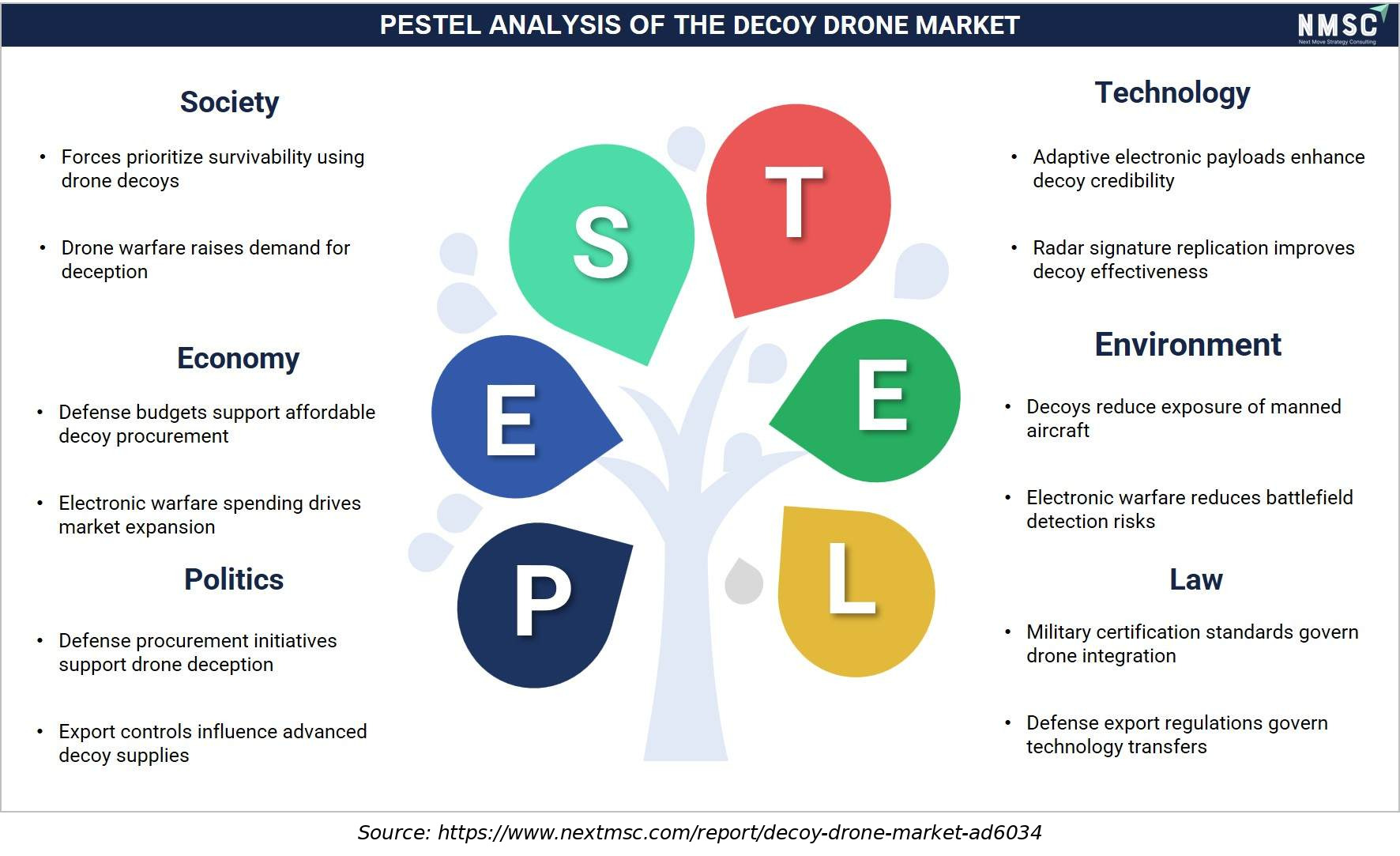
PESTEL Analysis of the Decoy Drone Market

PESTEL Analysis of the Decoy Drone Market
The decoy drone market is influenced by a range of political, economic, social, technological, environmental, and legal factors. Defense priorities, evolving security requirements, technological innovation, and public concerns all affect adoption. An evidence-based PESTEL assessment helps stakeholders understand market risks, investment drivers, regulatory pressures, and long-term opportunities across the sector.

Market Drivers & Dynamics

Interactive Dataset
Rising global defense modernization and air defense testing budgets driver +2.0% North America, Asia-Pacific 2026-2035
Growing sophistication of air defense systems requiring realistic simulation driver +1.6% Global 2026-2035
Expanding electronic warfare and multi-spectral simulation requirements driver +1.3% North America, Europe 2026-2035
Rising naval fleet modernization and anti-ship missile defense testing driver +1.0% Asia-Pacific, Middle East & Africa 2026-2035
Growing adoption of reusable, multi-mission decoy platforms driver +0.8% Global 2026-2032
Expanding defense export partnerships in emerging markets driver +0.6% Latin America, Middle East & Africa 2026-2035
High unit cost of multi-spectral and electronic warfare decoy systems restraint -0.9% Global 2026-2035
Export control restrictions limiting cross-border technology transfer restraint -0.7% Global 2026-2032
Budget constraints among smaller defense forces in emerging markets restraint -0.5% Latin America, Middle East & Africa 2028-2035
Extended procurement and qualification cycles for defense platforms restraint -0.4% North America, Europe 2026-2032
Source: Next Move Strategy Consulting

Growth Drivers

What Is the Primary Growth Driver of the Decoy Drone Market?

Rising global defense modernization and air defense testing budgets are the primary driver of the market. The U.S. Department of Defense continues to allocate substantial funding toward live-fire testing and evaluation infrastructure supporting next-generation air defense systems. We observed that this budgetary commitment, reinforced by allied nations' parallel modernization programs, continues to anchor baseline procurement of aerial target and decoy drone systems across major defense markets.

How Is Air Defense System Sophistication Driving Decoy Drone Market Growth?

Growing sophistication of air defense systems is accelerating market growth toward multi-spectral and electronic warfare-capable decoy platforms. Modern integrated air defense systems require correspondingly realistic threat simulation to validate detection and engagement effectiveness. Our assessment indicates that this technological escalation, combined with rising naval fleet modernization investment, is compressing reliance on legacy single-signature target drones relative to multi-domain simulation platforms.

Growth Inhibitors

What Is Restraining Decoy Drone Market Expansion?

High unit cost of multi-spectral and electronic warfare decoy systems restrains market expansion, particularly among smaller defense forces. The U.S. Government Accountability Office has documented rising per-unit costs associated with advanced defense testing equipment across multiple program areas. We found that smaller defense forces face particular exposure, as constrained procurement budgets limit their ability to acquire advanced multi-spectral platforms compared with larger, better-funded military organizations.

Segmentation Analysis

2025 (USD Billion)
2035 (USD Billion)
Aerial Target Drone 2025: $2.04 Billion | 2035: $3.98 Billion
Aerial Targe
Radar Decoy Drone 2025: $0.92 Billion | 2035: $1.91 Billion
Radar Decoy
Infrared Decoy Drone 2025: $0.68 Billion | 2035: $1.40 Billion
Infrared Dec
Electronic Warfare Decoy Drone 2025: $0.63 Billion | 2035: $1.60 Billion
Electronic W
Multi-Spectral Decoy Drone 2025: $0.34 Billion | 2035: $0.98 Billion
Multi-Spectr
Naval Decoy Drone 2025: $0.15 Billion | 2035: $0.31 Billion
Naval Decoy
Other Decoy Type 2025: $0.09 Billion | 2035: $0.17 Billion
Other Decoy
Aerial Target Drone $2.04 Billion $3.98 Billion 7.7%
Radar Decoy Drone $0.92 Billion $1.91 Billion 8.5%
Infrared Decoy Drone $0.68 Billion $1.40 Billion 8.4%
Electronic Warfare Decoy Drone $0.63 Billion $1.60 Billion 10.9%
Multi-Spectral Decoy Drone $0.34 Billion $0.98 Billion 12.5%
Naval Decoy Drone $0.15 Billion $0.31 Billion 8.4%
Other Decoy Type $0.09 Billion $0.17 Billion 7.3%

Which Decoy Type Segment Dominates the Decoy Drone Market?

Aerial Target Drone led the market with USD 2.04 billion in 2025, supported by sustained procurement for air defense training and weapons system evaluation across established military forces. We observed that Multi-Spectral Decoy Drone is the fastest-growing decoy type, expanding at a 12.5% CAGR from 2026 to 2035, as defense agencies prioritize platforms capable of simulating multiple threat signatures within a single training asset.

2025 (USD Billion)
2035 (USD Billion)
Air Defense
Missile Evas
Electronic W
Radar Cross-
Naval Fleet
Segment Item 2025 (USD Billion) 2035 (USD Billion) CAGR
Air Defense Training $10.0 USD Billion $40.0 USD Billion 18.0%
Missile Evasion and Countermeasures $17.1 USD Billion $51.1 USD Billion 16.0%
Electronic Warfare Simulation $24.2 USD Billion $62.2 USD Billion 22.0%
Radar Cross-Section Testing $31.3 USD Billion $73.3 USD Billion 12.0%
Naval Fleet Protection $38.4 USD Billion $84.4 USD Billion 19.0%

Segment-wise data is locked

Unlock complete segment-wise numbers for By Application.

Unlock Full Data

Which Application Leads the Decoy Drone Market?

Air Defense Training remained the dominant application, reaching USD 1.75 billion in 2025 due to sustained live-fire exercise requirements across established air forces. Based on research conducted by NMSC, we found that Naval Fleet Protection is the fastest-growing application at a 10.6% CAGR from 2026 to 2035, reflecting rising naval modernization investment and expanding anti-ship missile defense testing requirements.

2025 (USD Billion)
2035 (USD Billion)
Ground-Launc
Air-Launched
Ship-Launche
Man-Portable
Segment Item 2025 (USD Billion) 2035 (USD Billion) CAGR
Ground-Launched $10.0 USD Billion $40.0 USD Billion 19.0%
Air-Launched $17.1 USD Billion $51.1 USD Billion 17.0%
Ship-Launched $24.2 USD Billion $62.2 USD Billion 15.0%
Man-Portable $31.3 USD Billion $73.3 USD Billion 9.0%

Segment-wise data is locked

Unlock complete segment-wise numbers for By Launch Mode.

Unlock Full Data
2025 (USD Billion)
2035 (USD Billion)
Jet-Propelle
Rocket-Prope
Turboprop an
Other Propul
Segment Item 2025 (USD Billion) 2035 (USD Billion) CAGR
Jet-Propelled $10.0 USD Billion $40.0 USD Billion 12.0%
Rocket-Propelled $17.1 USD Billion $51.1 USD Billion 18.0%
Turboprop and Piston $24.2 USD Billion $62.2 USD Billion 20.0%
Other Propulsion $31.3 USD Billion $73.3 USD Billion 22.0%

Segment-wise data is locked

Unlock complete segment-wise numbers for By Propulsion Type.

Unlock Full Data
2025 (USD Billion)
2035 (USD Billion)
Short-Range
Medium-Range
Long-Range
Segment Item 2025 (USD Billion) 2035 (USD Billion) CAGR
Short-Range $10.0 USD Billion $40.0 USD Billion 19.0%
Medium-Range $17.1 USD Billion $51.1 USD Billion 9.0%
Long-Range $24.2 USD Billion $62.2 USD Billion 19.0%

Segment-wise data is locked

Unlock complete segment-wise numbers for By Range.

Unlock Full Data
2025 (USD Billion)
2035 (USD Billion)
Recoverable
Expendable S
Segment Item 2025 (USD Billion) 2035 (USD Billion) CAGR
Recoverable Systems $10.0 USD Billion $40.0 USD Billion 8.0%
Expendable Systems $17.1 USD Billion $51.1 USD Billion 18.0%

Segment-wise data is locked

Unlock complete segment-wise numbers for By Reusability.

Unlock Full Data
2025 (USD Billion)
2035 (USD Billion)
Air Force
Navy
Army
Homeland Sec
Segment Item 2025 (USD Billion) 2035 (USD Billion) CAGR
Air Force $10.0 USD Billion $40.0 USD Billion 26.0%
Navy $17.1 USD Billion $51.1 USD Billion 16.0%
Army $24.2 USD Billion $62.2 USD Billion 18.0%
Homeland Security and Defense Agencies $31.3 USD Billion $73.3 USD Billion 8.0%

Segment-wise data is locked

Unlock complete segment-wise numbers for By End User.

Unlock Full Data

Which End User Leads Decoy Drone Market Demand?

Air Force remained the leading end user within the market, valued at USD 2.23 billion in 2025 on sustained air defense training and weapons testing procurement. Our findings suggest that Homeland Security and Defense Agencies is the fastest-growing end user, registering an 11.0% CAGR from 2026 to 2035, as border security and critical infrastructure protection agencies increasingly adopt decoy systems for counter-drone and air defense testing applications.

Growth Opportunities

Our analysis shows that three forward-looking opportunities stand out for stakeholders positioning within the decoy drone market over the 2026-2035 forecast period.

How Can Multi-Spectral Platforms Unlock Growth in Advanced Air Defense Testing?

Multi-spectral decoy platforms present a whitespace opportunity for manufacturers seeking to serve air forces upgrading to next-generation integrated air defense systems. Companies that commercialize platforms simulating radar, infrared, and electronic signatures simultaneously stand to capture recurring procurement revenue as defense agencies retire legacy single-signature target drones.

Where Does Homeland Security Adoption Create New Demand?

Homeland security and critical infrastructure protection agencies represent an underpenetrated opportunity as this end-user segment grows at an 11.0% CAGR through 2035. Manufacturers that adapt military-grade decoy technology for counter-drone testing and airspace security validation can capture recurring revenue from a growing non-traditional defense customer base.

How Can Naval Decoy Systems Accelerate Fleet Modernization Demand?

Naval forces modernizing fleet defense systems create a growing opportunity for ship-launched decoy drone suppliers. Manufacturers that develop validated, sea-state-tested naval decoy platforms can secure long-term procurement contracts with navies expanding live-fire testing programs, benefiting from recurring replacement and training-cycle revenue as fleet modernization programs mature through 2035.

Regional Outlook

2025 (USD Billion)
2035 (USD Billion)
North Americ
Europe
Asia-Pacific
Middle East
Latin Americ
Region 2025 (USD Billion) 2035 (USD Billion) CAGR (%)
North America $10.0 USD Billion $40.0 USD Billion 9.0%
Europe $17.1 USD Billion $51.1 USD Billion 27.0%
Asia-Pacific $24.2 USD Billion $62.2 USD Billion 25.0%
Middle East & Africa $31.3 USD Billion $73.3 USD Billion 23.0%
Latin America $38.4 USD Billion $84.4 USD Billion 12.0%

Regional data is locked

Unlock complete regional numbers for this market.

Unlock Full Data

Competitive Landscape

We observed that the decoy drone market features a moderately consolidated competitive landscape, with established defense contractors competing alongside specialized target drone manufacturers on platform reliability, multi-spectral capability, and government contract track record. Key Takeaways

Dimension Description
Market Structure Moderately consolidated; the top companies profiled in this report collectively account for a significant share of global decoy drone market revenue, while several regional defense manufacturers serve domestic procurement programs.
Innovation Focus Multi-spectral signature simulation, electronic warfare-capable decoys, reusable recovery systems, and naval-qualified platforms dominate current innovation pipelines across leading manufacturers.
M&A Activity Selective consolidation and government partnership activity, exemplified by manufacturers securing multi-year full-rate production contracts to expand established target drone program lines.

How Do Companies Compete in the Decoy Drone Market?

Companies compete primarily on platform reliability, government contract track record, and multi-spectral simulation capability across the industry. Kratos Defense & Security Solutions, Inc. leverages its established BQM-167 and BQM-177A program lines to maintain sole-source positions on major U.S. Air Force and Navy contracts, while European manufacturers such as QinetiQ Group plc compete on NATO-qualified platform interoperability for allied training exercises.

Which Competitive Archetypes Dominate the Decoy Drone Market?

Two archetypes dominate the market: established prime contractors with sole-source, multi-year target drone production programs, and diversified defense conglomerates offering decoy systems within broader electronic warfare portfolios. Kratos Defense & Security Solutions, Inc. exemplifies the specialized prime-contractor archetype, while Lockheed Martin Corporation and Thales Group exemplify the diversified archetype integrating decoy technology within larger countermeasure portfolios.

How Are Companies Differentiating Through Innovation in Decoy Drones?

Innovation and differentiation strategy increasingly center on payload flexibility and recovery-system reliability rather than airframe performance alone. Kratos Defense & Security Solutions, Inc.'s BQM-177A platform, which carries configurable electronic countermeasure and radar augmentation payloads, illustrates how manufacturers embed mission flexibility into standardized airframes. Our analysis shows that manufacturers unable to demonstrate credible full-rate production reliability risk losing follow-on contract options to competitors with proven delivery track records.

What M&A and Expansion Activity Is Shaping the Decoy Drone Market?

Sustained multi-year production contract awards continue to shape competitive positioning within the industry rather than traditional M&A activity. Kratos Defense & Security Solutions, Inc.'s continued Full Rate Production Lot awards for the BQM-177A program, exceeding USD 175 million in cumulative contract value, illustrate how incumbent manufacturers expand revenue through contract option exercises rather than acquisitions, reinforcing high barriers to entry for new competitors.

Key Market Players

Our assessment indicates that the following 19 companies are actively shaping product innovation, government contract performance, and manufacturing capacity within the global decoy drone market.

Lockheed Martin Corporation QinetiQ Group plc Leonardo S.p.A. Israel Aerospace Industries Ltd. Elbit Systems Ltd. Saab AB Airbus SE Northrop Grumman Corporation Thales Group Griffon Aerospace, Inc. Denel SOC Ltd Rheinmetall AG Rafael Advanced Defense Systems Ltd. Chemring Group PLC Turkish Aerospace Industries, Inc. Textron Inc. The Boeing Company Terma A/S

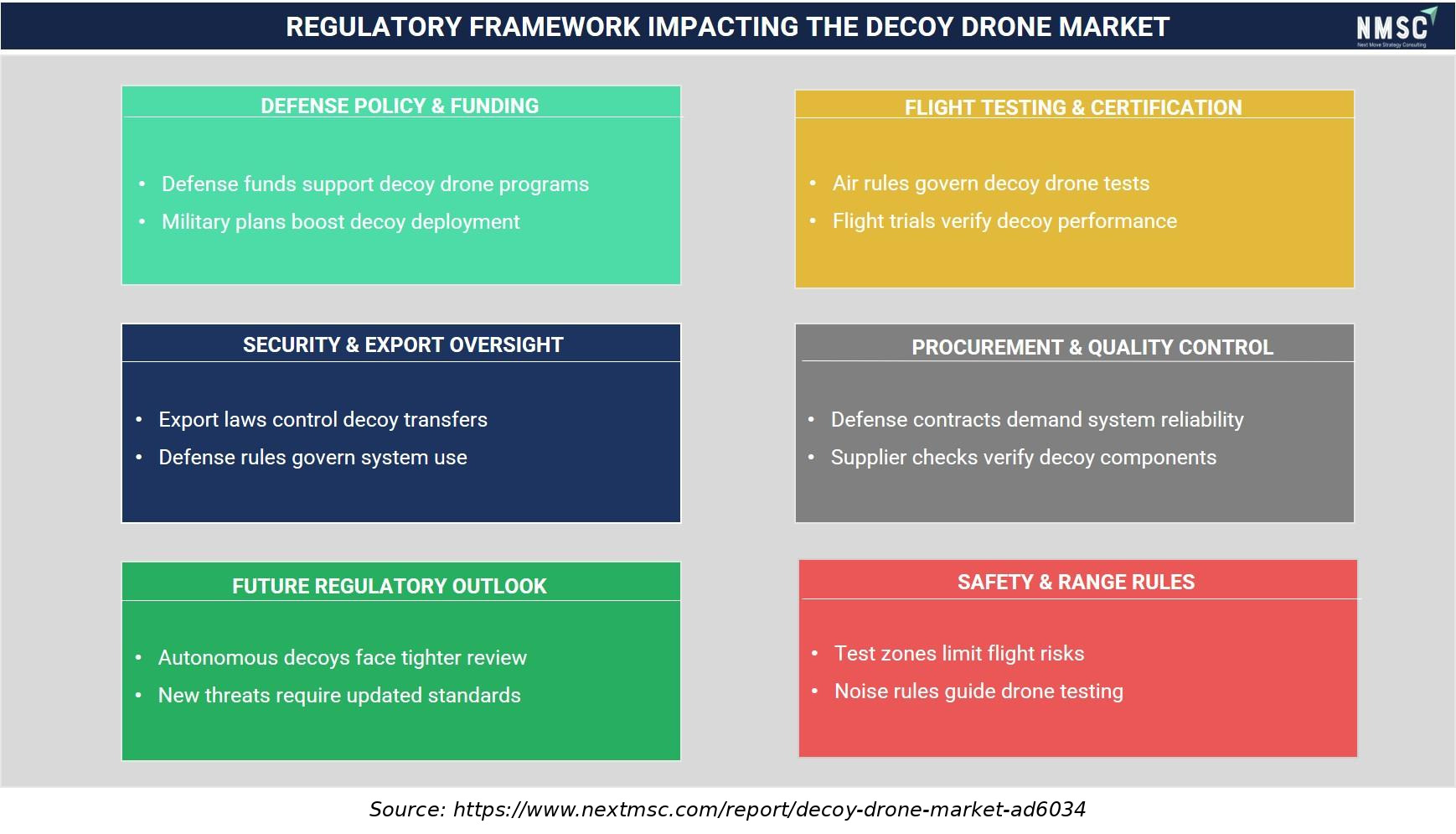
Regulatory Framework Impacting the Decoy Drone Market

Regulatory frameworks significantly influence the development, testing, and deployment of decoy drone systems. Defense funding, export controls, flight certification, procurement requirements, and safety standards can affect market access and product design. As autonomous technologies advance, manufacturers must demonstrate reliability, compliance, and responsible operational practices to meet evolving security and regulatory expectations.

Latest Developments

We found that recent contract awards within the decoy drone market are concentrated on full-rate production expansion for established aerial target platforms, reflecting sustained U.S. Navy and Air Force procurement momentum.

Date Event
September 2025 Rheinmetall unveiled MASS nova with its new 3DDS 3D Decoy Swarm at DSEI 2025. The system launches a swarm of autonomous drones that generates a three-dimensional radar signature resembling a ship and can separate independently to perform ship-like manoeuvres.
May 2025 QinetiQ announced that all Banshee aerial-target variants, including Jet 40+ and Jet 80+, were qualified for operations at NATO’s Missile Firing Installation in Crete. The certification enables European armed forces to conduct more realistic threat simulations using programmable aerial targets across missile-defence training scenarios.

Investment Opportunities

What Capital Inflows Are Targeting the Decoy Drone Market?

Capital inflows into the decoy drone market are increasingly directed toward full-rate production capacity expansion for established aerial target programs. Kratos Defense & Security Solutions, Inc.'s cumulative BQM-177A contract value exceeding USD 175 million illustrates sustained government capital commitment to proven platforms. We observed that investors favor manufacturers demonstrating multi-year contract option exercises, viewing sole-source program status as a proxy for long-term revenue durability.

How Is Infrastructure Investment Supporting Decoy Drone Delivery?

Infrastructure investment is expanding domestic manufacturing capacity to support sustained full-rate production schedules for aerial target and decoy systems. Our findings suggest that manufacturers are investing in production facility capacity across multiple U.S. locations to meet Navy and Air Force delivery timelines, supporting the scalability required as defense agencies commit to multi-year procurement programs.

What ESG Considerations Are Shaping Decoy Drone Investment Decisions?

Environmental, social, and governance considerations shape investment decisions primarily through governance criteria tied to defense contracting compliance and workforce safety standards rather than traditional environmental metrics. Manufacturers increasingly disclose domestic manufacturing employment and supply chain transparency as governance indicators. We found that investors favor manufacturers demonstrating consistent regulatory compliance and contract performance history as a governance proxy within the defense sector.

Key Benefits for Stakeholders

How Does This Report Benefit Enterprise and Industry Leaders?

Enterprise and industry leaders gain access to validated segmentation, competitive benchmarking, and regional demand forecasts that support sourcing and portfolio decisions across the decoy drone industry. Our analysis shows that detailed decoy type, application, and end-user breakdowns help procurement and program management teams align platform specifications with defense agency requirements while identifying underserved application categories for portfolio expansion.

How Does This Report Benefit Investors and Financial Analysts?

Investors and financial analysts benefit from consistent, single-point market size and CAGR estimates that support valuation and capital-allocation decisions across the decoy drone supply chain. We observed that the report's regional and segment-level growth differentials help identify which manufacturers are best positioned to capture above-market growth in multi-spectral and homeland security categories through 2035.

How Does This Report Benefit Technology Vendors and Product Teams?

Technology vendors and product teams gain insight into emerging design requirements, including multi-spectral signature simulation, reusable recovery systems, and naval-qualified platforms, that are reshaping the industry. Our findings suggest that this analysis helps product roadmap teams prioritize investment around multi-mission payload flexibility increasingly required by defense agency procurement specifications.

Key Market Segments Evaluated

By Decoy Type

  • Aerial Target Drone
  • Radar Decoy Drone
  • Infrared Decoy Drone
  • Electronic Warfare Decoy Drone
  • Multi-Spectral Decoy Drone
  • Naval Decoy Drone
  • Other Decoy Type

By Application

  • Air Defense Training
  • Missile Evasion and Countermeasures
  • Electronic Warfare Simulation
  • Radar Cross-Section Testing
  • Naval Fleet Protection
  • Other Application

By Launch Mode

  • Ground-Launched
  • Air-Launched
  • Ship-Launched
  • Man-Portable

By Propulsion Type

  • Jet-Propelled
  • Rocket-Propelled
  • Turboprop and Piston
  • Other Propulsion

By Range

  • Short-Range
  • Medium-Range
  • Long-Range

By Reusability

  • Recoverable Systems
  • Expendable Systems

By End User

  • Air Force
  • Navy
  • Army
  • Homeland Security and Defense Agencies

Conclusion & Recommendations

The long-term outlook for the market remains positive, with global revenue projected to more than double from USD 4.85 billion in 2025 to USD 10.35 billion by 2035 at a 7.9% CAGR. We observed that sustained defense modernization budgets, expanding electronic warfare simulation requirements, and rising naval fleet modernization investment will continue underpinning growth across air force, navy, and homeland security procurement categories through the forecast period.

What Strategic Positioning Should Decoy Drone Manufacturers Pursue?

Manufacturers should prioritize multi-spectral simulation capability and reusable platform architecture while pursuing multi-year production contract relationships to secure durable government revenue. Our assessment indicates that manufacturers investing early in electronic warfare-capable payloads and naval-qualified platforms will be best positioned to capture premium pricing within the decoy drone market.

How Attractive Is the Decoy Drone Market for New Investment?

The decoy drone industry presents an attractive investment case, supported by a USD 5.11 billion absolute dollar opportunity between 2026 and 2035 and above-average growth in Latin America and multi-spectral technology categories. We found that investment attractiveness is highest for manufacturers combining established government contract track records with multi-domain simulation capability, positioning them to serve both traditional military and emerging homeland security customer segments.

What Market Shifts and Key Risks Should Stakeholders Monitor?

Stakeholders should monitor high unit costs for advanced multi-spectral systems, export control restrictions, and extended procurement qualification cycles as key risks to the decoy drone market. Our analysis shows that manufacturers unable to demonstrate credible full-rate production reliability risk losing follow-on contract options to competitors with proven delivery track records, particularly within the increasingly sole-source-driven U.S. procurement environment.

What Are the Key Growth Pathways for the Decoy Drone Market?

Key growth pathways include expanding multi-spectral signature simulation capability, scaling naval decoy platform production, and deepening penetration into homeland security and critical infrastructure protection channels. NMSC's analysis indicates that manufacturers pursuing these pathways while maintaining production reliability on established aerial target programs will be best positioned to capture the decoy drone market's projected growth through 2035.

FAQs

About the Author

Mihul Sharma

Mihul Sharma

Mihul Sharma is Research Associate at Next Move Strategy Consulting, where he has covered technology, industrial, and healthcare markets for 3 years. His work applies structured business research, market analysis, and secondary-source review to assess market trends, competitive developments, and growth opportunities. He supports report development by fully synthesizing industry data, company information, and market signals into concise findings for strategy and investment-focused research teams.

About the Reviewer

Supradip Baul

Supradip Baul

Supradip Baul is an accomplished business consultant and strategist with over a decade of rich experience in market intelligence, strategy, technology, and business transformation. His work has included rigorous qualitative and quantitative analysis across multiple industries, helping clients shape investment decisions and long-term roadmaps. Earlier in his career, he was associated with Gartner, where he contributed to industry-leading reports and market share analyses. He has worked with leading global companies and holds an MBA with a dual specialization in Marketing and Finance.

Download Free Sample

Henri Knyphausen

HENRI KNYPHAUSEN

Partner at Singulier [Ex-BCG]

Singulier

I recently engaged NEXTMSC.com for a commercial due diligence project within the intralogistics sector, and I am pleased to provide a reference based on my experience. In utilizing NEXTMSC.com's services, I found their report to offer valuable insights into market dynamics and key industry players. The initial report provided a solid foundation for our analysis. However, as we were investigating a smaller target in the market, and I had specific customization requests requiring additional research. These requests included detailed information on product portfolios of various players and sub-market sizes, both inclusive and exclusive of certain product categories. NEXTMSC.com demonstrated commendable responsiveness and agility in accommodating these customization requests. Within a timeframe of 1-2 weeks, they delivered a revised report that met our specific needs. Furthermore, they were receptive to my follow-up inquiries, ensuring clarity and understanding of the data provided. The final deliverable significantly contributed to our due diligence efforts. One of NEXTMSC.com's notable strengths lies in their qualitative research capabilities. However, for future engagements, I would recommend the inclusion of a quantified market model in Excel format. Such a model would offer the ability to conduct in-depth analyses and explore various market segments, including country-specific data and subcomponent breakdowns. Based on my positive experience, I would not hesitate to work with NEXTMSC.com again. Their responsiveness, willingness to accommodate customization requests, and commitment to delivering actionable insights make them a reliable partner for commercial research projects.


Semih Kavaklioglu

SEMIH KAVAKLIOGLU

Co-Founder & Sales Manager

Decortie

I work a lot in the marketing industry and I know that research is an essential part of any campaign. I have used Market research reports for my own products and I found them to be very informative and well-researched. The team here produces insightful reports for a good price

Diana Trejo

DIANA TREJO

Assistant Manager

Sumitomo Corporation de Mexico, S.A. de C.V.

Recently, we purchased a report on the Mexico Data Center Market from Next Move Strategy Consulting. The service has been excellent, with support that is always timely and thoroughly professional. The information provided is interesting, highly useful, and delivered with clarity. I would highly recommend NextMSC for anyone seeking insightful and dependable analysis.

Melanie Samko

MELANIE SAMKO

Director of Marketing

TOSOH BIOSCIENCE, INC.

The information provided by NMSC is incredibly valuable, thank you so much for such a excellent work. I really appreciate it. I will make sure to reference all of it, in my summary document.

Amos Chang

AMOS CHANG

Strategy Consultant

Kardex Group

I have bought the intralogistics market reports from NMSC two times so far. Joseph and his team are always very helpful and flexible in responding to any customization requirements on the report. Their expertise in market reports really helps us steer the day-to-day business. I will definitely recommend and come back myself whenever there is a need.

Custom Market Research Services

We will customize the research for you if the listed report does not fully match your requirements.

Get 30% Free Customization

Select License

This website uses cookies to ensure you get the best experience on our website. Learn more

✖