How Are the Biosensors Revolutionizing Healthcare and Agriculture?
Biosensors are reshaping the ways we detect, monitor, and respond to biological and chemical changes in real time. From precision agriculture to early-stage cancer diagnostics, innovations in 2025 are expanding the scope and impact of the biosensors market.
Real-Time Plant Monitoring: A Japanese Breakthrough
Researchers at Waseda University have developed a needle-type multi-enzyme biosensor that enables real-time monitoring of sucrose levels in living plants. This device allows scientists to track sugar transport and uptake patterns that were previously impossible to observe without destructive sampling.
The biosensor integrates a multi-enzyme anode containing glucose oxidase, invertase, and mutarotase, which breaks down sucrose into glucose for electrochemical detection. It delivers high sensitivity, with a detection limit of 100 µM, a range up to 60 mM, and a fast response time of 90 seconds. Stable operation is maintained over 72 hours, and the sensor can be inserted into stems and fruits with minimal damage.
Using this sensor, the team discovered that sucrose transport in strawberry guava peaks during nighttime, aligning with natural photosynthetic redistribution cycles. In Japanese cedar, the sensor detected sucrose uptake through light-regulated stomata for the first time, revealing a previously unknown biological pathway. These findings open new possibilities for crop yield optimization, stress detection, and precise agricultural management.
Innovative Biosensors in Agriculture: Real-Time Plant Monitoring
Needle-Type Multi-Enzyme Biosensor
Developed by Waseda University, this biosensor tracks sucrose in plants in real time, revealing daily sugar transport patterns. Key features include:
Why Digital Marketing is Driving Market Transformation?
-
Enhanced Visibility: Digital channels allow biosensor companies to showcase innovations in healthcare diagnostics and precision agriculture to global audiences.
-
Data-Driven Insights: Analytics tools help track engagement, identify market trends, and refine communication strategies for maximum impact.
-
Educating End-Users: Online platforms simplify complex technologies, making sophisticated biosensor solutions easier to understand and adopt.
-
Accelerated Adoption: Targeted campaigns encourage faster acceptance of new devices among healthcare providers, farmers, and researchers.
-
Credibility and Trust: Consistent digital presence builds brand authority, demonstrating reliability in delivering innovative, high-quality biosensor solutions.
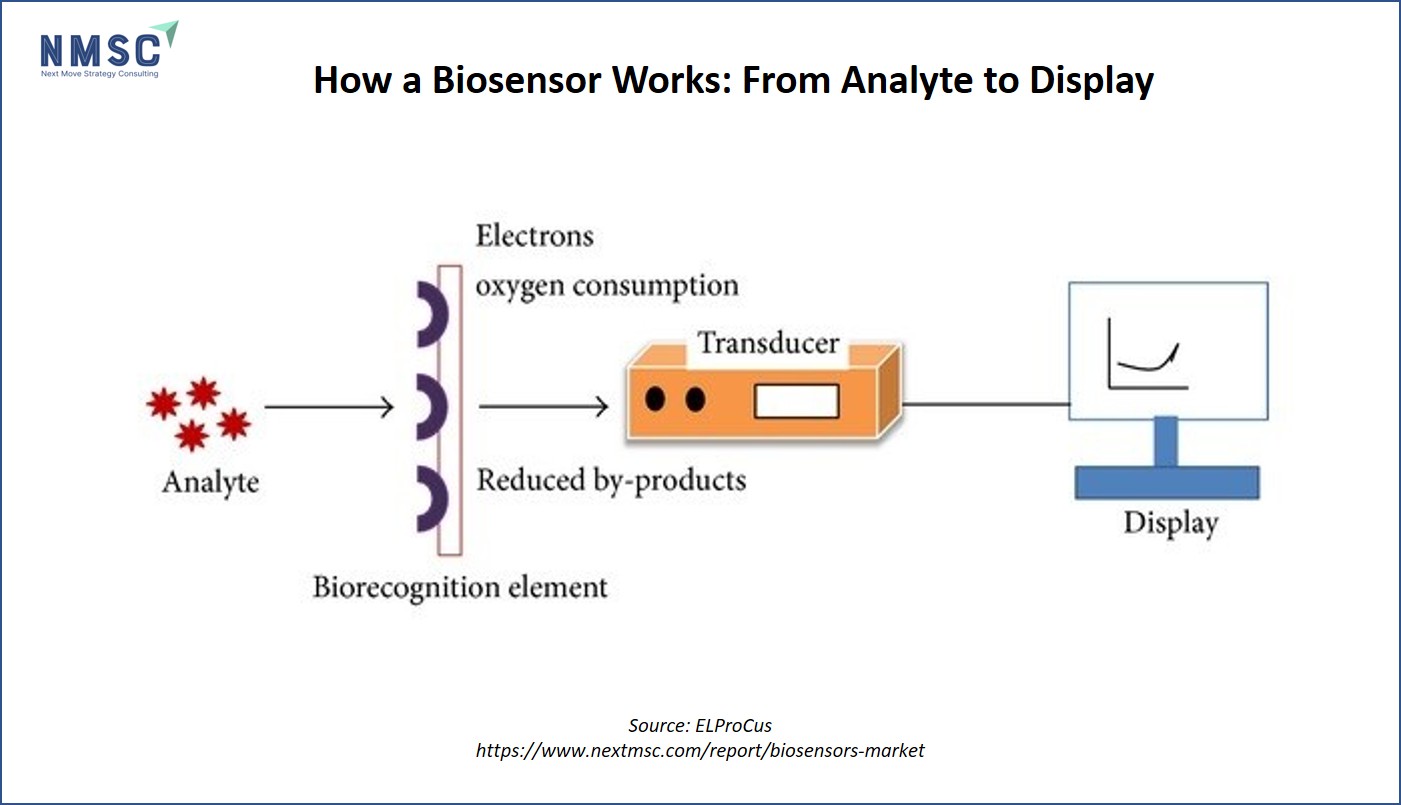
Biosensor Signal Flow: From Detection to Visualization
The process starts when the analyte the substance to be measured, such as glucose, a hormone, or a pathogen interacts with the biorecognition element. This element, often an enzyme, antibody, or receptor, selectively binds to the analyte.
During this interaction, electrons are transferred, oxygen may be consumed, and reduced by-products are formed. These chemical changes are detected by the transducer, which converts the biochemical signal into an electrical signal. The electrical signal is then sent to a display device, which visualizes the concentration or presence of the analyte in a readable format, such as a graph or numeric value.
Analyte → Biorecognition → Transducer → Display, highlighting the transformation from a chemical event to a readable output.
Affordable Breast Cancer Detection
At NIT Rourkela, researchers have created a cost-effective Tunnel Field Effect Transistor (TFET) biosensor capable of detecting breast cancer cells without expensive lab infrastructure. This label-free biosensor differentiates cancerous cells (T47D) from healthy cells (MCF-10A) by measuring dielectric properties, eliminating the need for additional reagents. Its high sensitivity, portability, and affordability allow for point-of-care testing in clinics, mobile health units, and potentially even home settings. This technology enhances early-stage diagnosis, improves survival rates, and provides access to screening for remote or underserved populations.
What Challenges Does the Market Face?
Despite strong growth potential, the biosensor market faces key hurdles:
-
Regulatory Complexity: Medical devices require stringent approvals, slowing commercialization.
-
Data Accuracy in Real-World Conditions: Environmental factors in agriculture and biological variability in healthcare can affect sensor performance.
-
Cost vs. Scalability: High-precision biosensors must balance affordability with technical sophistication.
-
Integration Barriers: Embedding sensors into existing healthcare and farming workflows requires training and infrastructure.
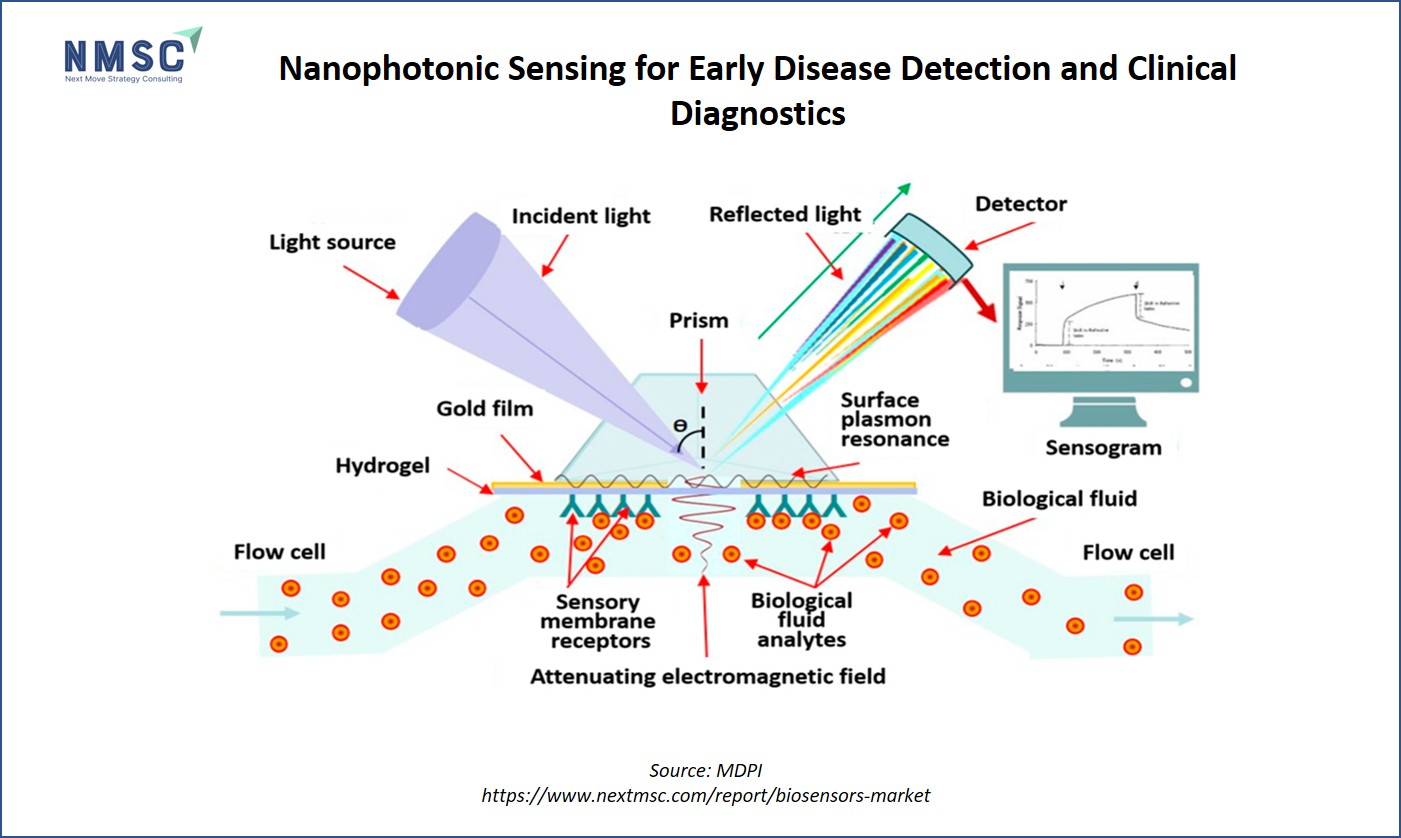
The Mechanics of Real-Time Biomolecular Interaction: An SPR Biosensor Overview
The working principle of a Surface Plasmon Resonance (SPR) Biosensor, a sophisticated optical technology used for real-time biological analysis. The process begins with a light source directing an incident beam through a prism onto a thin gold film. When the light hits the gold at a specific resonance angle, it excites electrons, creating an attenuating electromagnetic field (evanescent wave) that probes the area just below the surface. In the flow cell, a biological fluid containing analytes (like cancer biomarkers) passes over a hydrogel layer embedded with specific sensory membrane receptors. As these analytes bind to the receptors, they change the refractive index at the gold surface, causing a shift in the properties of the reflected light. This shift is captured by a detector and translated into a sensogram, a real-time graph that quantifies the molecular interaction. As highlighted by the NIT Rourkela research, this high sensitivity allows for the early and affordable detection of diseases like breast cancer by identifying minute concentrations of proteins in clinical samples.
Key Players and Strategies in the Global Biosensors Market
Major participants in the biosensors market include Abbott Laboratories, F. Hoffmann La Roche Ltd., Medtronic, Dexcom Inc., LifeScan (IP Holdings), Nova Biomedical, Universal Biosensors, Biosensors International Group Ltd., Bio Rad Laboratories Inc., Masimo, DuPont, ACON Laboratories, among others. To sustain their market leadership, these companies are employing strategies such as strategic partnerships and the introduction of innovative products across different regions.
Insights by Next Move Strategy Consulting
According to Next Move Strategy Consulting, the global biosensors market is experiencing accelerated growth due to technological advancements and rising demand across healthcare and agriculture. Healthcare applications include early diagnostics, chronic disease monitoring, and point-of-care testing, which drive the adoption of portable, cost-effective biosensors. In agriculture, precision farming, real-time crop monitoring, and climate resilience solutions are boosting demand for multi-enzyme and in vivo plant biosensors.
Research and development continues to expand sensor capabilities, enabling lab-on-chip devices, wearable biosensors, and integrated AI-IoT solutions. The market is diversifying rapidly, with cross-sector applications extending beyond human health to plant physiology and environmental monitoring.
Key Takeaways
-
Innovation is expanding: Biosensors now enable both real-time plant monitoring and affordable disease detection.
-
Accessibility matters: Low-cost, chemical-free devices increase diagnostic reach in remote areas.
-
Cross-industry opportunities: The same biosensing principles are applicable in agriculture, medical diagnostics, and environmental monitoring.
-
Future growth: Wireless, minimally invasive sensors could dominate the next phase of biosensor market expansion.
-
Strategic investment: Businesses focusing on user-friendly, accurate, and low-cost biosensors are positioned to lead.
Next Steps:
-
Invest in versatile biosensor platforms that can serve multiple industries.
-
Leverage AI and IoT integration for real-time monitoring and predictive analytics.
-
Focus on affordability and accessibility, particularly for emerging markets.
-
Monitor regulatory trends to facilitate smooth adoption in healthcare and agriculture.
-
Collaborate with research institutions to advance sensor sensitivity and durability.
About the Author
 Sanyukta Deb
— Sanyukta Deb is Digital Marketing Team Lead at Next Move Strategy Consulting, where she has led content strategy and technical SEO for the firm's B2B market research publications for over 2 years. Her editorial process translates NextMSC's primary and secondary research — spanning technology, industrial, and consumer sectors — into commercial narratives, backed by search-intent, keyword, and competitive analysis. She brings 5 years of overall experience in digital marketing and content strategy.
Sanyukta Deb
— Sanyukta Deb is Digital Marketing Team Lead at Next Move Strategy Consulting, where she has led content strategy and technical SEO for the firm's B2B market research publications for over 2 years. Her editorial process translates NextMSC's primary and secondary research — spanning technology, industrial, and consumer sectors — into commercial narratives, backed by search-intent, keyword, and competitive analysis. She brings 5 years of overall experience in digital marketing and content strategy.
About the Reviewer
 Debashree Dey
— Debashree Dey is Assistant Manager at Next Move Strategy Consulting, where she supports cross-vertical market content and communications across diverse industries for 6 years. Her professional background includes senior content writing, communications, and published manuscript authorship, with experience developing audience-focused business narratives and maintaining clear, consistent messaging. Her role supports research-led content development and editorial quality across NextMSC publications.
Debashree Dey
— Debashree Dey is Assistant Manager at Next Move Strategy Consulting, where she supports cross-vertical market content and communications across diverse industries for 6 years. Her professional background includes senior content writing, communications, and published manuscript authorship, with experience developing audience-focused business narratives and maintaining clear, consistent messaging. Her role supports research-led content development and editorial quality across NextMSC publications.















Add Comment