How Top Companies of Warehouse Robotics is Shaping the Future of Intralogistics in Russia
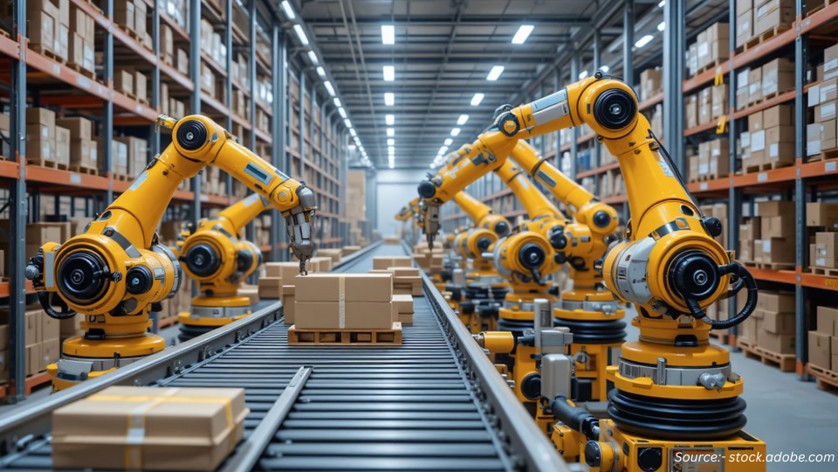
As per NMSC analysis, the Russia warehouse robotics industry is set to maintain strong growth momentum, with the market size expected to reach around USD 429.3 million by 2035, marking a solid CAGR of 6.51%. Valued at USD 208.3 million in 2025, the Russia Warehouse Robotics Market is projected to rise to USD 243.3 million by 2026. In terms of volume, the market recorded 6433 units in 2025, with forecasts indicating growth to 7712 units by 2026 and further to 14905 thousand units by 2035, reflecting a CAGR of 7.60% over the same period.
The Russia warehouse robotics market is experiencing a rapid transformation, driven by increasing digitalization, rising e-commerce demand, and the need to enhance efficiency and resilience across logistics and industrial supply chains. Once confined to pilot projects and a limited number of large facilities, warehouse robotics solutions are now being deployed more broadly across distribution centers, fulfilment hubs, manufacturing warehouses, and cross-dock operations nationwide. The growing focus on speed, accuracy, labour optimization, and operational flexibility is accelerating the adoption of autonomous mobile robots, AI-driven fleet management, real-time analytics, and digitally integrated WMS/WCS platforms. Supported by both domestic and international technology providers, these intelligent and scalable robotics solutions are improving throughput, reducing operational costs, and enabling data-driven decision-making, positioning warehouse robotics as a strategic necessity in Russia’s ongoing logistics modernization
Curious about the Russia Warehouse Robotics Market? Download Your FREE Sample Report Now
Russia Warehouse Robotics Market Overview
The Russia warehouse robotics market is undergoing a significant transformation, driven by the same forces reshaping global logistics and supply chain modernization. As warehouses respond to rising e-commerce volumes, labour constraints, and the need for greater operational resilience, robotics solutions are evolving from isolated automation tools into intelligent, connected, and scalable systems. Modern warehouse robotics deployments in Russia increasingly integrate autonomous mobile robots, AI-driven fleet orchestration, real-time data analytics, and seamless WMS/WCS connectivity. This convergence of robotics, software, and digital infrastructure enables dynamic task allocation, predictive maintenance, optimized space utilization, and faster order fulfillment. At the same time, ongoing digitalization initiatives and growing investments from domestic and select international technology providers are accelerating the deployment of advanced robotic solutions across distribution centers, manufacturing warehouses, and fulfilment hubs nationwide.
Furthermore, the warehouse robotics market in Russia is witnessing rising demand for flexible, modular, and application-specific automation solutions tailored to diverse operational environments, including retail logistics, industrial warehousing, cold storage, and omni-channel fulfilment. As operational complexity increases, warehouse operators are prioritizing systems that can integrate with digital supply chain platforms, private wireless networks, and cloud-edge architectures while supporting human–robot collaboration. The emphasis on scalability, reliability, and cost efficiency is also driving adoption of innovative business models such as Robotics-as-a-Service, enabling wider market participation. With continued advances in AI, connectivity, and digital infrastructure, warehouse robotics is becoming a core enabler of intelligent, resilient, and future-ready logistics operations, firmly positioning it at the center of Russia’s evolving warehousing and intralogistics landscape.
Key companies shaping the Russia warehouse robotics market include ABB, Fanuc Corporation, KUKA SE & Co. KGaA, RoboCV, and Ronavi Robotics LLC, all of which are contributing to the advancement of intelligent and digitally enabled warehouse automation across the country. These players are driving market evolution through the deployment of autonomous mobile robots, robotic arms, AI-powered vision systems, and advanced fleet management software that enhance efficiency, accuracy, and operational reliability in distribution centers and industrial warehouses. By emphasizing scalable automation, human robot collaboration, real-time monitoring, and seamless integration with WMS/WCS platforms, they are enabling flexible and resilient intralogistics operations. Through continued technological innovation and strategic collaborations with local partners and logistics operators, these companies are positioning themselves as key enablers of Russia’s transition toward modern, data-driven, and future-ready warehouse robotics ecosystems.
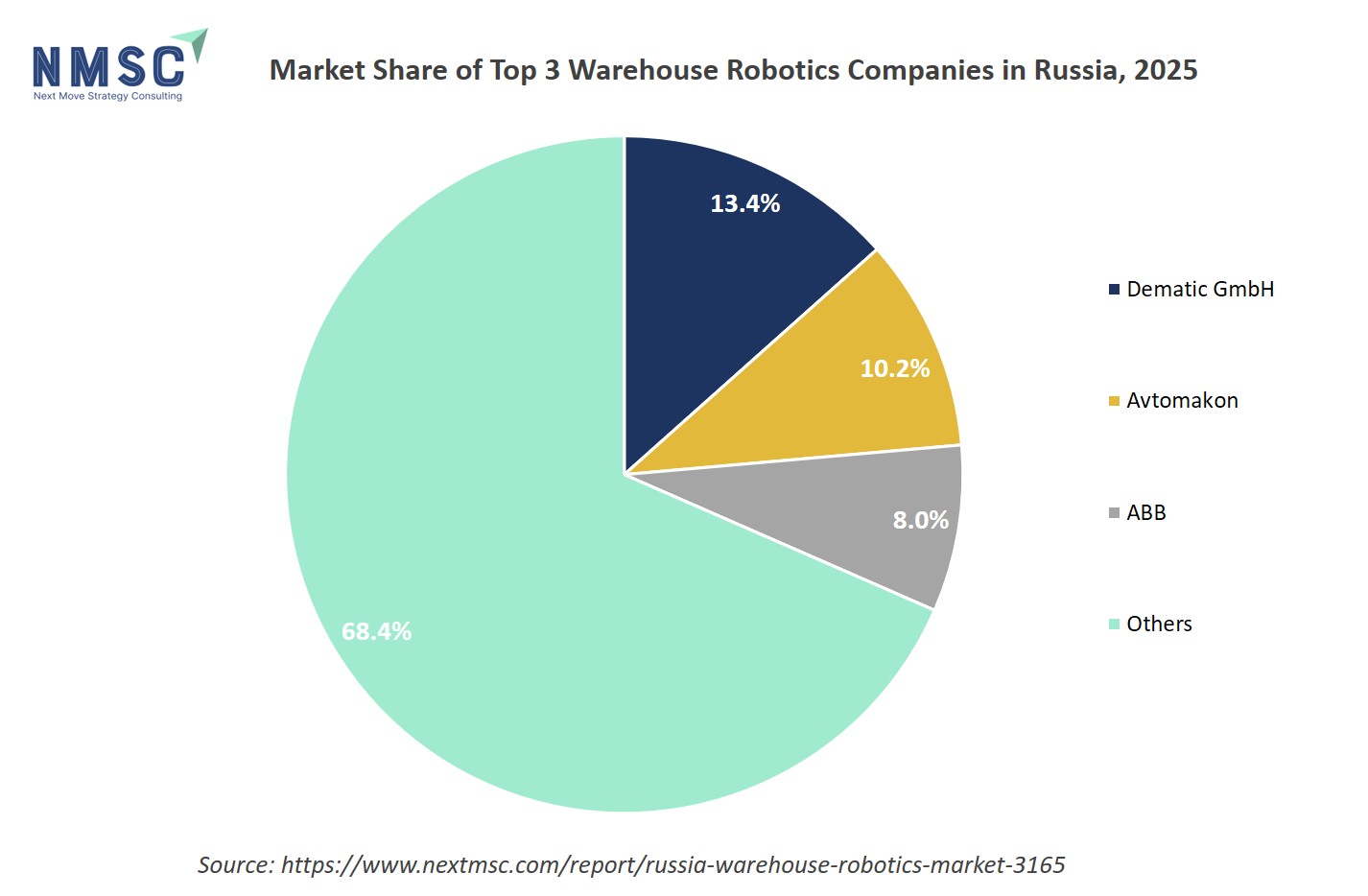
For the Latest Market Share of Top 10 Players, Order the Full Report at: Access the Full Report
HIGHLIGHTS OF ABB LTD.
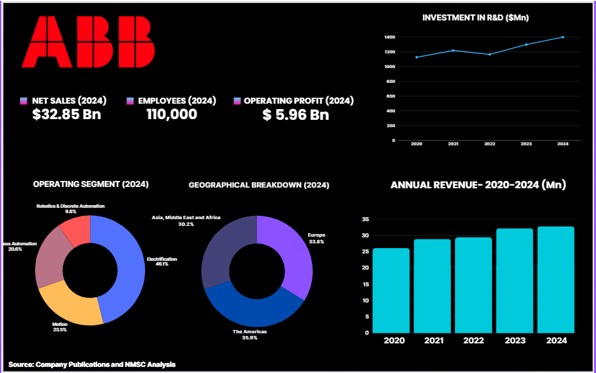
ABB Ltd., headquartered in Zurich, Switzerland, is a global leader in automation, robotics, and digital technologies, with a strong presence in the Russia warehouse robotics market. The company plays a pivotal role in advancing warehouse automation across Russia by providing industrial robots, autonomous systems, and intelligent software solutions tailored for intralogistics operations. ABB’s portfolio, which includes robotic arms, automation platforms, and digitally integrated control systems, enhances operational efficiency, reliability, and scalability for distribution centers, manufacturing warehouses, and fulfilment facilities. As Russia continues to modernize its logistics infrastructure and adopt advanced digital technologies, demand for ABB’s flexible, intelligent, and future-ready warehouse robotics solutions is increasing, reinforcing the company’s position as a key contributor to the country’s evolving warehouse automation landscape.
ABB has a notable impact on the Russia warehouse robotics market, holding an estimated 7.96% market share, which underscores its strong influence on the adoption of advanced automation across intralogistics operations. The company contributes significantly through its portfolio of industrial robots, automation systems, and digital control technologies that improve efficiency, precision, and reliability in distribution centers and manufacturing warehouses. ABB’s solutions support key warehouse functions such as material handling, palletizing, sorting, and system integration with WMS/WCS platforms, enabling higher throughput and reduced operational downtime. By combining global robotics expertise with scalable and digitally enabled automation architectures, ABB plays a critical role in helping Russian warehouses modernize operations, optimize labor utilization, and transition toward more intelligent, resilient, and future-ready logistics environments.
HIGHLIGHTS OF FANUC CORPORATION
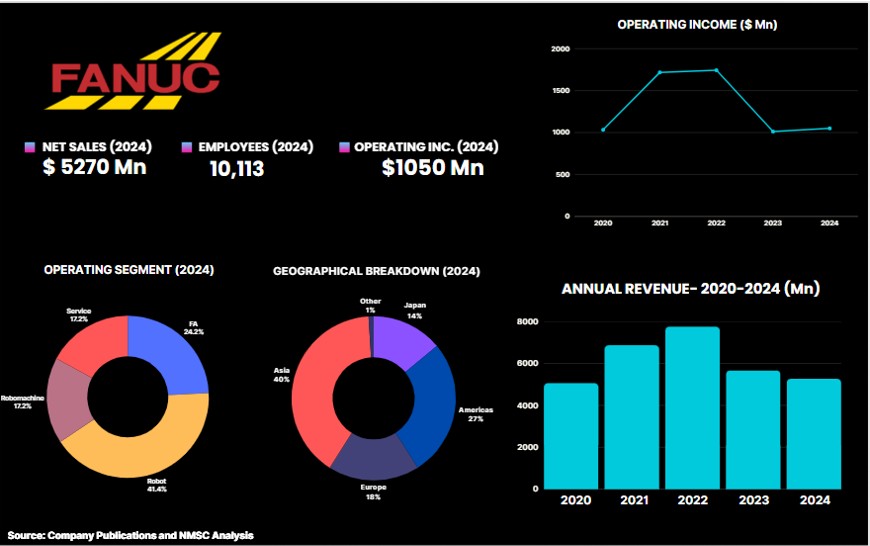
FANUC Corporation is a Japanese global leader in factory automation and industrial robotics, with a long history of developing numerical controls, servos, and advanced robotic systems applied across manufacturing and logistics industries worldwide. The company’s extensive portfolio includes industrial robots, collaborative robots, automation software, and connected technologies that enhance precision, efficiency, and reliability in automated operations. In the Russia warehouse robotics market, FANUC’s solutions support key intralogistics functions such as material handling, picking, packing, and palletizing, helping operators modernize warehouse processes and increase throughput. By integrating proven robotics hardware with digital capabilities and global service networks, FANUC enables Russian warehouses to improve operational performance, reduce manual labor dependency, and adopt scalable, future-ready automation solutions.
FANUC has a strong and sustained impact on the Russia warehouse robotics market, holding an estimated 5.63% market share, which highlights its importance as a reliable automation technology provider in intralogistics. The company contributes to market advancement by enabling high-precision, durable, and scalable robotic solutions for core warehouse operations such as picking, sorting, palletizing, and material handling. FANUC’s robotics systems are valued for their stability, long operational life, and seamless integration with warehouse control and management systems, helping Russian warehouses improve throughput, consistency, and operational efficiency. By supporting automation-driven productivity and reducing dependence on manual labor, FANUC plays a key role in accelerating the modernization and digital transformation of warehouse operations across Russia.
HIGHLIGHTS OF ROBOCV
RoboCV is a Russian robotics company and resident of the Skolkovo Innovation Center that specializes in developing autonomous robotics and smart autopilot systems for warehouse and industrial logistics. The company’s flagship solutions, such as the RoboCV X-MOTION NG system, automate the movement of warehouse vehicles like robotic tractors, stackers, and high-reach forklifts, enabling them to operate independently and efficiently within dynamic intralogistics environments while integrating with existing WMS/ERP systems. RoboCV has delivered significant projects for major Russian and international clients, including Volkswagen Group Rus, Gazpromneft-Snabzhenie, Knauf, and FM Logistics, where its autonomous systems handle repetitive material transport, pallet movement, and high-density storage operations, enhancing throughput and reducing reliance on manual labour. By combining vision-based navigation, adaptive behaviour technologies, and cloud-enabled monitoring, RoboCV’s solutions support safer, data-driven warehouse automation and contribute to the broader digital transformation of Russia’s warehousing sector.
In July 2024, RoboCV completed a warehouse robotization project at Knauf’s Krasnogorsk facility, where autonomous robotic systems were deployed to automate pallet transportation, rack handling, and stacking operations. This implementation reflects the broader evolution of the Russia warehouse robotics market, where manufacturers and logistics operators are increasingly adopting robotics to optimize high-volume, repetitive intralogistics tasks. The project underscores the market’s growing emphasis on improving operational efficiency, reducing dependence on manual labor, and enhancing consistency and safety within industrial warehouses, highlighting how robotics is becoming an integral component of modern warehouse and manufacturing operations in Russia.
HIGHLIGHTS OF KUKA SE & Co. KGaA
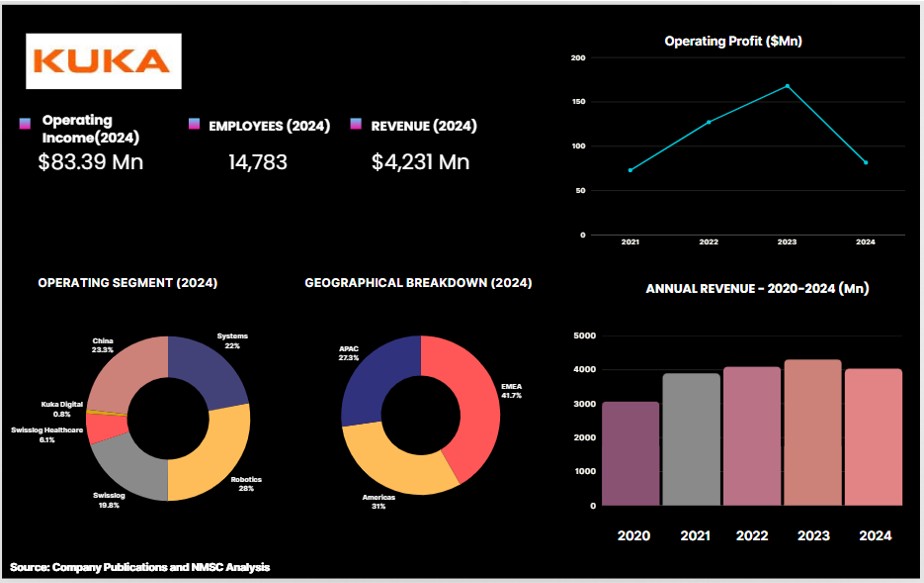
KUKA SE & Co. KGaA is a globally recognized provider of robotics, automation, and digital solutions, playing an important role in the Russia warehouse robotics market through its advanced intralogistics capabilities. The company offers intelligent automation technologies that support material handling, order fulfillment, and warehouse process optimization, enabling greater flexibility and efficiency across distribution centers and industrial warehouses. By combining robotic hardware, autonomous systems, and digitally integrated software platforms, KUKA helps warehouse operators improve throughput, reduce manual dependency, and adapt to dynamic operational requirements. Its focus on scalable, connected, and future-ready automation solutions positions KUKA as a key contributor to the modernization and digital transformation of warehouse robotics in Russia.
KUKA has a meaningful impact on the Russia warehouse robotics market, holding an estimated 3.47% market share, reflecting its role as a trusted provider of advanced automation solutions for intralogistics. The company contributes to market development by enabling flexible, software-driven warehouse automation that supports material handling, palletizing, sorting, and fulfillment oper ations. KUKA’s robotics and automation systems help Russian warehouses improve process efficiency, reduce reliance on manual labor, and adapt to changing operational demands. Through its emphasis on intelligent automation, system integration, and scalable deployment, KUKA supports the ongoing digital transformation of warehouse operations in Russia and reinforces the shift toward more resilient, efficient, and future-ready logistics environments.
HIGHLIGHTS OF RONAVI ROBOTICS LLC
Ronavi Robotics is a Russian developer and manufacturer of autonomous mobile robots (AMRs) and logistics automation systems specifically designed for warehouse and production environments. The company offers a wide range of AMRs for tasks such as heavy goods transport, rack and pallet delivery, sorting, and cross-docking, and supports flexible deployment models including Robot-as-a-Service (RaaS) to help businesses integrate automation without major upfront capital expenditure. Ronavi’s solutions are built for seamless integration with existing warehouse management systems and ERP platforms, and are engineered to streamline material movement, improve throughput, and reduce reliance on manual labor in logistics, retail, industrial, and FMCG operations across Russia. By focusing on locally adapted robotics technology and scalable automation models, Ronavi Robotics is contributing to the broader modernization of the Russia warehouse robotics market.
In September 2025, Ronavi announced the launch of its ultra-compact sorting robot, Ronavi SD, marking an important development within the Russia warehouse robotics market as demand grows for flexible and space-efficient automation. Designed for podium and parcel sorting applications, the robot supports lightweight payload handling and features QR-based navigation with modular attachments, allowing seamless integration into existing warehouse layouts. This launch reflects broader market trends in Russia’s expanding e-commerce and parcel logistics sector, where operators are increasingly seeking scalable, quickly deployable sorting solutions that enhance throughput and accuracy without requiring significant infrastructure modifications.
Summary of Russia Warehouse Robotics Market
The Russia warehouse robotics market is undergoing rapid transformation, driven by rising e-commerce activity, increasing labor constraints, and a growing focus on efficiency, speed, and supply-chain resilience. Warehouse automation, once limited to pilot projects and a small number of large facilities, is now expanding across distribution centers, fulfilment hubs, manufacturing warehouses, and industrial logistics operations nationwide. The integration of advanced technologies such as autonomous mobile robots, AI-driven fleet orchestration, machine vision, and digitally connected warehouse management systems is accelerating market growth, making warehouse robotics a critical component of Russia’s broader logistics modernization and digital transformation efforts.
Leading global and domestic players, including ABB, FANUC, KUKA, RoboCV, and Ronavi Robotics, are driving this evolution by deploying intelligent, scalable, and software-enabled robotic solutions for material handling, picking, sorting, and palletizing operations. High-impact deployments such as RoboCV’s autonomous warehouse projects and Ronavi’s modular AMR and sorting robot launches demonstrate the practical value of robotics in improving throughput, reducing manual labor, and enhancing operational reliability. Supported by increasing investment in digital infrastructure and the demand for flexible automation models, warehouse robotics is emerging as a cornerstone of Russia’s transition toward more resilient, efficient, and future-ready intralogistics systems.
About the Author
 Mayurima Roy
— Mayurima Roy is Research Analyst at Next Move Strategy Consulting, where she has spent 4 years working across the firm's full industry coverage rather than a single fixed vertical. Her work centers on structured research, ongoing trend tracking, competitive assessment, and insight-led content development, translating complex market data into clear, decision-ready narratives that support informed client decision-making across diverse global industries, market sectors, and world regions every day.
Mayurima Roy
— Mayurima Roy is Research Analyst at Next Move Strategy Consulting, where she has spent 4 years working across the firm's full industry coverage rather than a single fixed vertical. Her work centers on structured research, ongoing trend tracking, competitive assessment, and insight-led content development, translating complex market data into clear, decision-ready narratives that support informed client decision-making across diverse global industries, market sectors, and world regions every day.
About the Reviewer
 Supradip Baul
— Supradip Baul is an accomplished business consultant and strategist with over a decade of rich experience in market intelligence, strategy, technology, and business transformation. His work has included rigorous qualitative and quantitative analysis across multiple industries, helping clients shape investment decisions and long-term roadmaps. Earlier in his career, he was associated with Gartner, where he contributed to industry-leading reports and market share analyses. He has worked with leading global companies and holds an MBA with a dual specialization in Marketing and Finance.
Supradip Baul
— Supradip Baul is an accomplished business consultant and strategist with over a decade of rich experience in market intelligence, strategy, technology, and business transformation. His work has included rigorous qualitative and quantitative analysis across multiple industries, helping clients shape investment decisions and long-term roadmaps. Earlier in his career, he was associated with Gartner, where he contributed to industry-leading reports and market share analyses. He has worked with leading global companies and holds an MBA with a dual specialization in Marketing and Finance.

















Add Comment