Is Biopharmaceutical Growth Being Redefined in 2026?

The biopharmaceutical market in 2025 is moving beyond traditional research-driven narratives. Capital strategy, commercialization platforms, and regulatory digitization are emerging as decisive growth levers. Two significant developments published in late 2025 illustrate this transformation clearly: a major private equity investment into Swixx BioPharma and a strengthened digital regulatory partnership led by NNIT. Together, these developments show how expansion and compliance are becoming structurally interconnected.
Biopharmaceutical Industry Expansion Through Strategic Investment
An affiliate of SK Capital Partners agreed to invest in Swixx BioPharma to accelerate international expansion. The transaction values Swixx at more than €1.5bn ($1.76bn), according to Pharmaceutical Technology. Swixx operates as a commercialization partner for pharmaceutical companies in markets where those companies have chosen not to enter or have exited. Its geographic footprint spans Greece, Central and Eastern Europe, Eurasia, several Commonwealth of Independent States countries, Latin America, and the Middle East. The company’s mission focuses on improving access to essential medications in underserved and hard-to-reach regions. Importantly, Swixx’s co-founders Stuart Swanson and Petr Němec, along with CEO Jean-Michel Lespinasse and CFO Petr Pipal, will maintain significant ownership stakes. Existing institutional investors HBM Healthcare Investments and Mérieux Equity Partners also remain shareholders. This structure supports continuity in leadership while enabling capital-driven scaling. The €1.5bn+ valuation and projected €1.3bn+ sales in 2026 demonstrate that commercialization infrastructure has become a high-value strategic asset. The investment reflects confidence in emerging and complex markets as long-term growth drivers. Ownership continuity reinforces governance stability during expansion.
From Cell Culture to Final Fill: Biopharma Production Flow
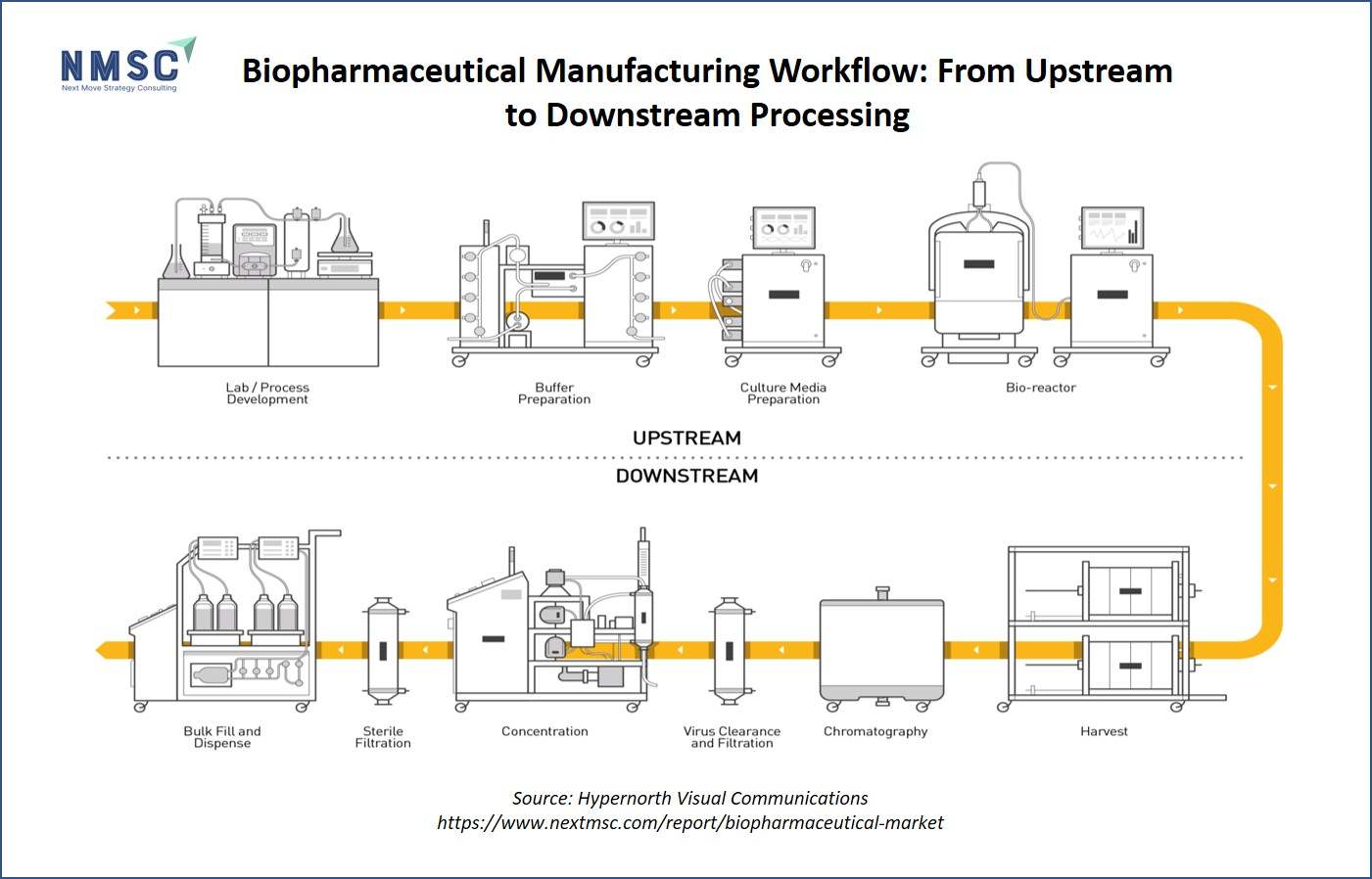
The upstream phase begins with lab and process development, where production methods are designed and optimized, followed by buffer and culture media preparation to create the ideal environment for cell growth. The process then advances to the bioreactor, where living cells produce the target biologic under carefully controlled conditions. After production, the workflow transitions to downstream processing, starting with harvest, where the biologic material is collected. It then moves through chromatography for purification, virus clearance and filtration for safety assurance, concentration to achieve the required potency, sterile filtration to ensure product purity, and finally bulk fill and dispense for packaging and distribution.
Digital Regulatory Transformation in the Biopharmaceutical Industry
A parallel transformation is unfolding in regulatory infrastructure. In 2025, NNIT announced that its European division secured a new project with a long-term strategic partner, a global biopharmaceutical company, to implement a digital solution for managing regulatory registration processes. This initiative extends a collaboration spanning more than a decade. During that time, NNIT supported high-impact programs including enterprise content modernization and transactional platform enhancements serving Human Pharma and Animal Health divisions. The regulatory registration process is a structured procedure through which pharmaceutical products gain approval across jurisdictions. Digitizing this process enhances compliance tracking, documentation accuracy, and operational transparency. According to NNIT’s leadership, the partnership emphasizes governance, innovation, and regulatory alignment as foundations for long-term success.
End-to-End Inspection and Monitoring in Sterile Biopharma Manufacturing
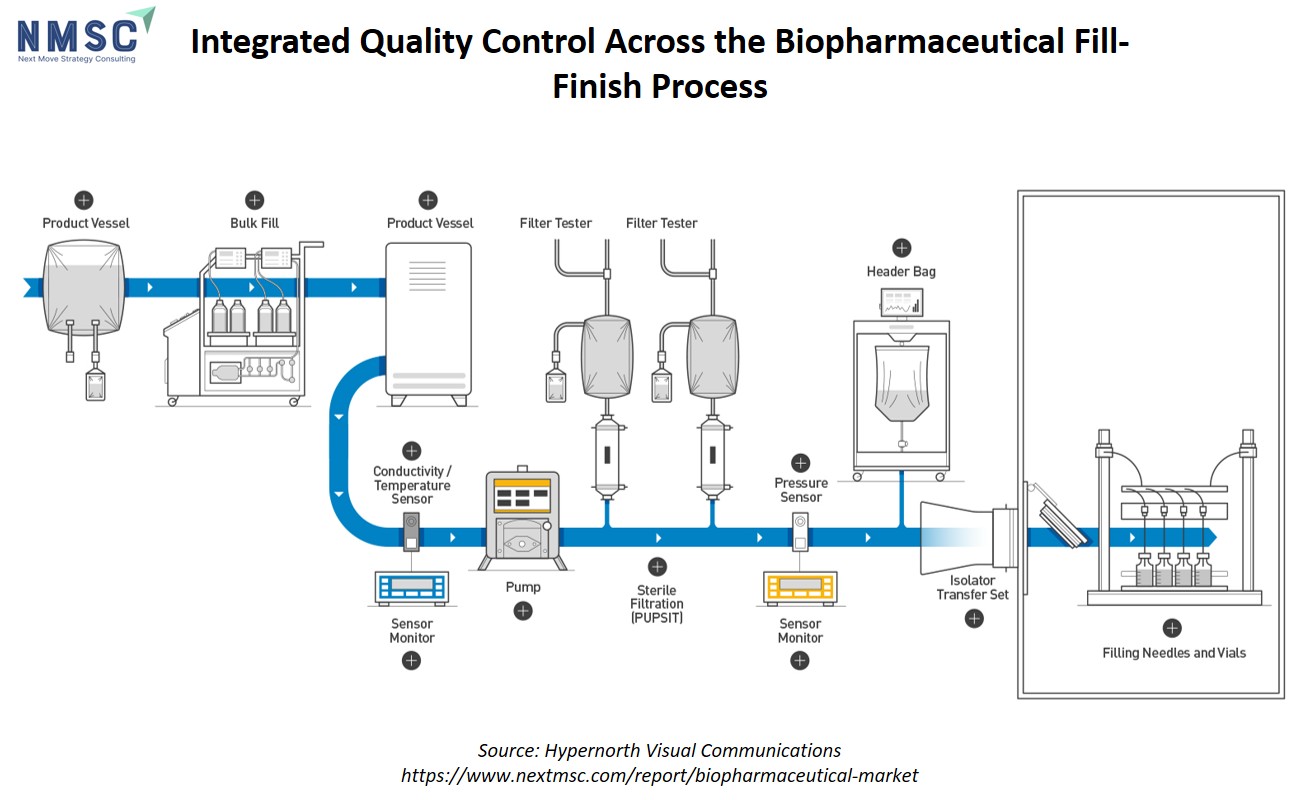
The workflow begins with the product vessel and bulk fill stage, where the biologic substance is transferred under controlled conditions. As the product moves forward, multiple checkpoints are embedded along the pipeline, including conductivity and temperature sensors, filter testers, pressure sensors, and sterile filtration systems such as PUPSIT (Pre-Use Post-Sterilization Integrity Testing). A pump regulates flow, while sensor monitors continuously track performance parameters to maintain stability and sterility. The process then advances into a header bag and isolator transfer set, which create a controlled, contamination-free environment before final filling. The final stage occurs inside an isolator system, where filling needles dispense the sterile product into vials under highly controlled aseptic conditions.
Capital Strength and Compliance Infrastructure: A Structural Shift
When examined together, the SK Capital–Swixx transaction and the NNIT regulatory project reveal a broader pattern in 2025 industry dynamics. Capital is flowing into commercialization networks, while digital systems are strengthening regulatory governance. Both initiatives prioritize scalability, operational discipline, and geographic complexity.
The valuation exceeding €1.5bn and projected 2026 sales above €1.3bn indicate that emerging-market access strategies are financially attractive. Simultaneously, the structured implementation of regulatory technology with a 2027 go-live reflects recognition that compliance modernization requires long-term investment. Investment activity and digital transformation are converging. Commercial reach and regulatory precision are becoming mutually reinforcing capabilities. Governance continuity remains a central stabilizing factor during expansion.
Leading Global Players Strengthen Market Position Through Strategic Expansion and Innovation
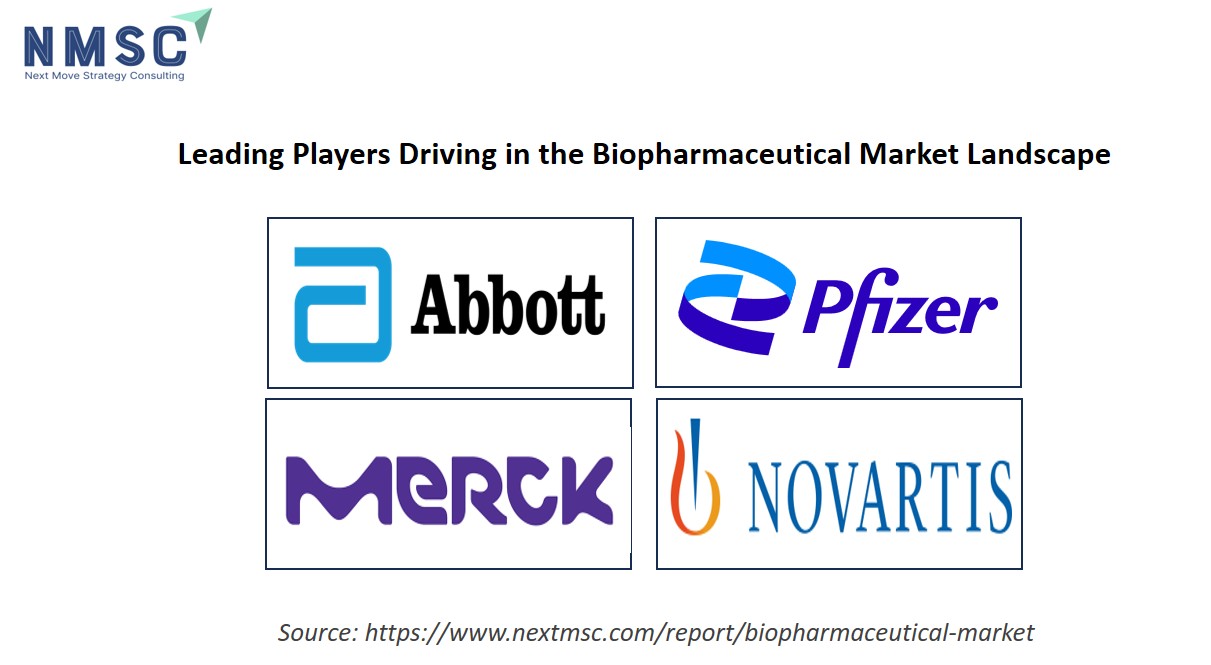
The biopharmaceutical industry features a strong presence of globally established companies including Merck KGaA, Pfizer Inc., Abbott, Amgen Inc., MJH Life Sciences, AbbVie Inc., Bristol-Myers Squibb Company, AstraZeneca, Gilead Sciences, Inc., GSK plc, F. Hoffmann-La Roche Ltd, Biogen, Bayer AG, Novartis AG, and Takeda Pharmaceutical Company Limited. These organizations are actively implementing strategic initiatives such as partnerships, joint ventures, collaborative agreements, and continuous product innovation across multiple geographic regions. Through these approaches, they aim to strengthen research capabilities, expand global reach, enhance therapeutic portfolios, and sustain competitive leadership within the evolving biopharmaceutical landscape.
Next Move Strategy Consulting’s View
From a strategic advisory perspective, the biopharmaceutical industry is shifting toward operational integration. Capital allocation decisions increasingly favor platforms that enable market access in complex geographies. At the same time, regulatory digitization programs reflect growing recognition that compliance risk must be structurally managed rather than reactively addressed. Next Move Strategy Consulting interprets these developments as indicators of a broader structural realignment. Companies that combine commercialization partnerships with robust digital governance frameworks are likely to achieve stronger scalability. Organizations that separate growth ambitions from compliance modernization may encounter execution bottlenecks. The long-term competitive advantage will likely belong to enterprises that synchronize investment strategy, operational infrastructure, and regulatory resilience.
Next Steps
-
Evaluate commercialization partnerships that expand access in underserved regions.
-
Strengthen digital regulatory registration systems before scaling geographically.
-
Align capital allocation with long-term governance and compliance frameworks.
-
Prioritize leadership continuity during ownership transitions to preserve strategic stability.
-
Integrate regulatory digitization initiatives into broader enterprise transformation roadmaps.
Conclusion
The developments of 2025 suggest that the biopharmaceutical industry is redefining growth. Strategic investments are targeting commercialization ecosystems, while digital regulatory transformation is reinforcing governance discipline. The defining question for 2026 is not whether expansion will occur. The defining question is whether organizations are structurally prepared to expand with compliance precision and operational resilience.
About the Author
 Sanyukta Deb
— Sanyukta Deb is Digital Marketing Team Lead at Next Move Strategy Consulting, where she has led content strategy and technical SEO for the firm's B2B market research publications for over 2 years. Her editorial process translates NextMSC's primary and secondary research — spanning technology, industrial, and consumer sectors — into commercial narratives, backed by search-intent, keyword, and competitive analysis. She brings 5 years of overall experience in digital marketing and content strategy.
Sanyukta Deb
— Sanyukta Deb is Digital Marketing Team Lead at Next Move Strategy Consulting, where she has led content strategy and technical SEO for the firm's B2B market research publications for over 2 years. Her editorial process translates NextMSC's primary and secondary research — spanning technology, industrial, and consumer sectors — into commercial narratives, backed by search-intent, keyword, and competitive analysis. She brings 5 years of overall experience in digital marketing and content strategy.
About the Reviewer
 Debashree Dey
— Debashree Dey is Assistant Manager at Next Move Strategy Consulting, where she supports cross-vertical market content and communications across diverse industries for 6 years. Her professional background includes senior content writing, communications, and published manuscript authorship, with experience developing audience-focused business narratives and maintaining clear, consistent messaging. Her role supports research-led content development and editorial quality across NextMSC publications.
Debashree Dey
— Debashree Dey is Assistant Manager at Next Move Strategy Consulting, where she supports cross-vertical market content and communications across diverse industries for 6 years. Her professional background includes senior content writing, communications, and published manuscript authorship, with experience developing audience-focused business narratives and maintaining clear, consistent messaging. Her role supports research-led content development and editorial quality across NextMSC publications.


















Add Comment