Who’s Shaping Explainable AI? Top 10 Global Leaders

Every time an algorithm denies a loan, flags an insurance claim, or ranks a job applicant, someone eventually asks: why? For years, many AI systems couldn't answer. That's changing fast, because regulators, customers, and boards are demanding it. The global Explainable AI Market the software, services, and frameworks that make AI decisions traceable and defensible was valued at USD 6.68 billion in 2023 and is projected to reach USD 24.58 billion by 2030, growing at a CAGR of 21.3% from 2024 to 2030.
That growth is no longer driven mainly by curiosity about how machine learning models work. It's driven by law, liability, and the reality that autonomous AI agents are now making decisions with real consequences decisions that someone, somewhere, has to be able to explain.
Global Explainable AI (XAI) Market Overview
Explainable AI, also called interpretable or transparent AI, covers the tools and methods that let a human a regulator, a customer, an auditor understand how an AI model or agent arrived at a specific output. That can mean a feature-attribution report showing which inputs drove a credit decision, a natural-language explanation attached to a diagnosis, or an audit trail showing exactly which data an autonomous agent touched before it took an action.
That forecast spans two needs: tools that add explainability to traditional machine learning models, and a newer wave built for large language models, autonomous agents, and multimodal AI, where the “black box” problem is often harder to solve.
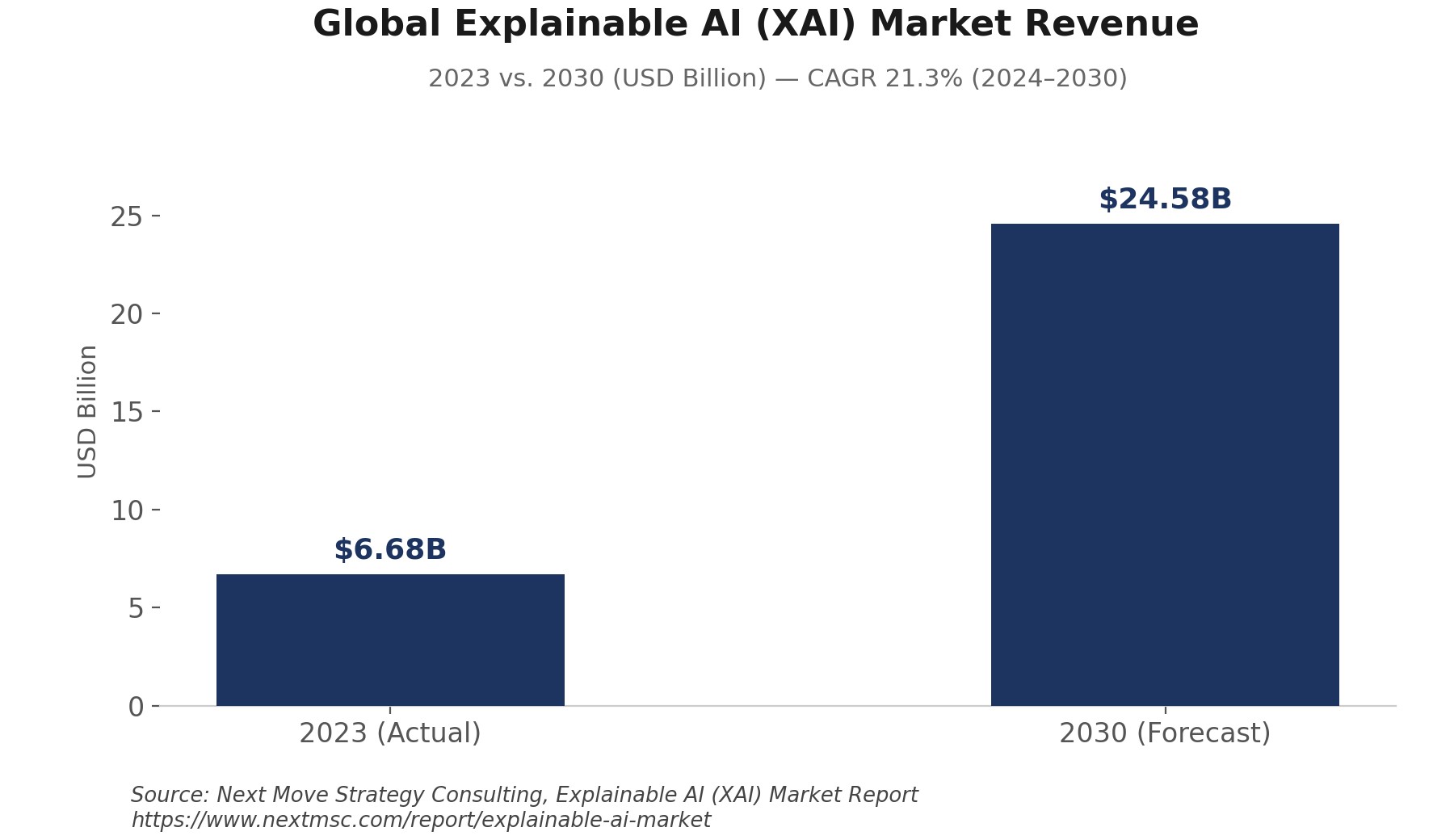
XAI is shifting from a niche technical capability to core infrastructure, roughly quadrupling in market value over the forecast period as adoption spreads beyond early movers in banking and technology.
-
Market size: USD 6.68 billion (2023) growing to a projected USD 24.58 billion (2030)
-
Growth rate: 21.3% CAGR, 2024–2030
-
Demand is broadening from BFSI and technology into healthcare, government, and manufacturing
Why AI Transparency Is No Longer Optional
The clearest catalyst this year is regulatory. The EU AI Act's transparency obligations took effect on August 2, 2026, requiring providers and deployers of certain AI systems to disclose when people are interacting with AI, label AI-generated content, and, for high-risk systems, maintain documentation that can withstand outside scrutiny. Non-compliance can carry fines running into the tens of millions of euros or a share of global annual turnover, whichever is higher, which has turned “can we explain this model's decision” from an engineering nice-to-have into a board-level compliance question.
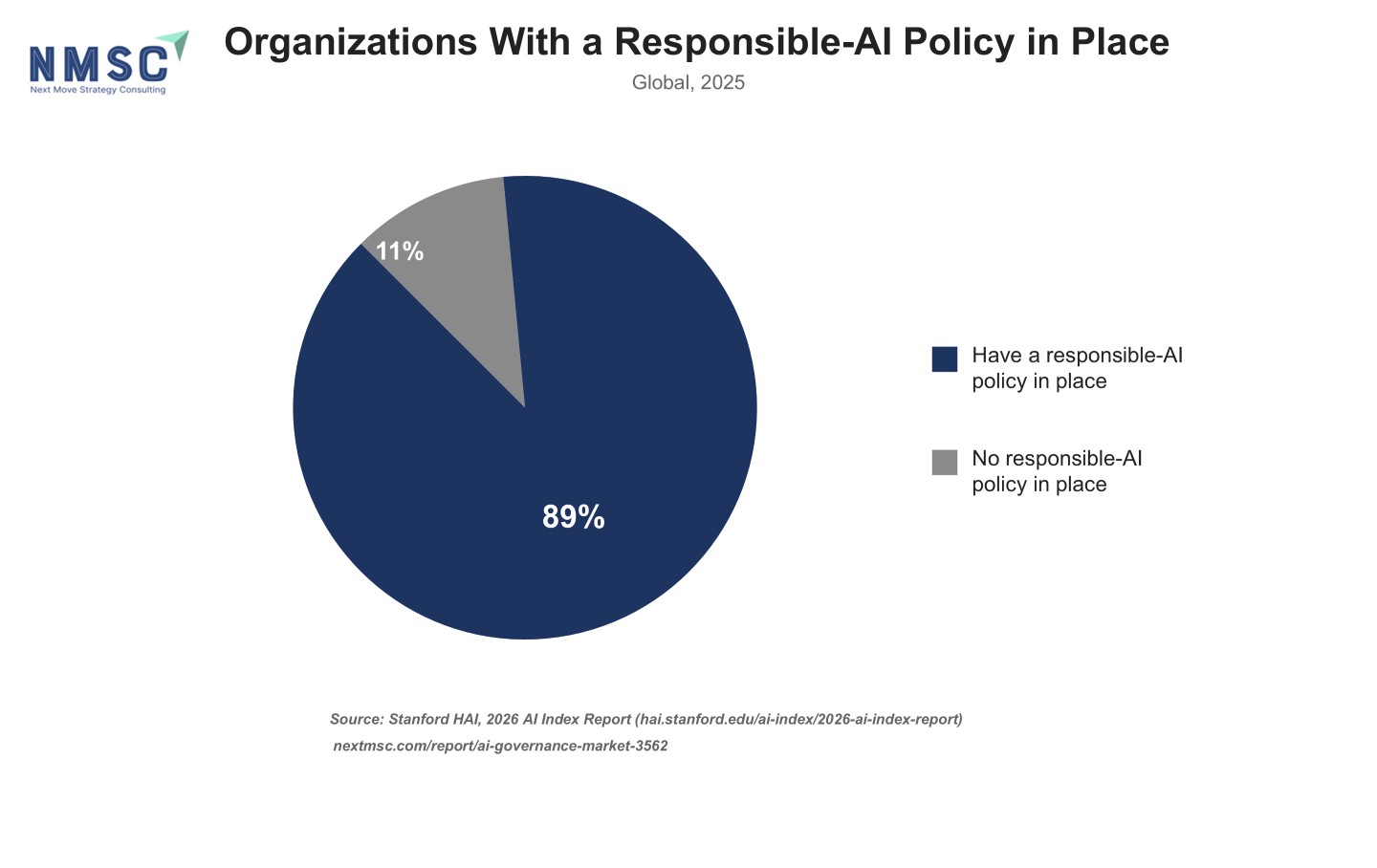
Independent research backs up the shift. Stanford HAI's 2026 AI Index Report found that the share of organizations with no responsible-AI policy in place at all fell sharply, from 24% to 11%, while AI-specific governance roles grew 17% over the same period. At the same time, the report's Foundation Model Transparency Index which scores how much leading AI developers disclose about training data, compute, and post-deployment impact tells a more complicated story.
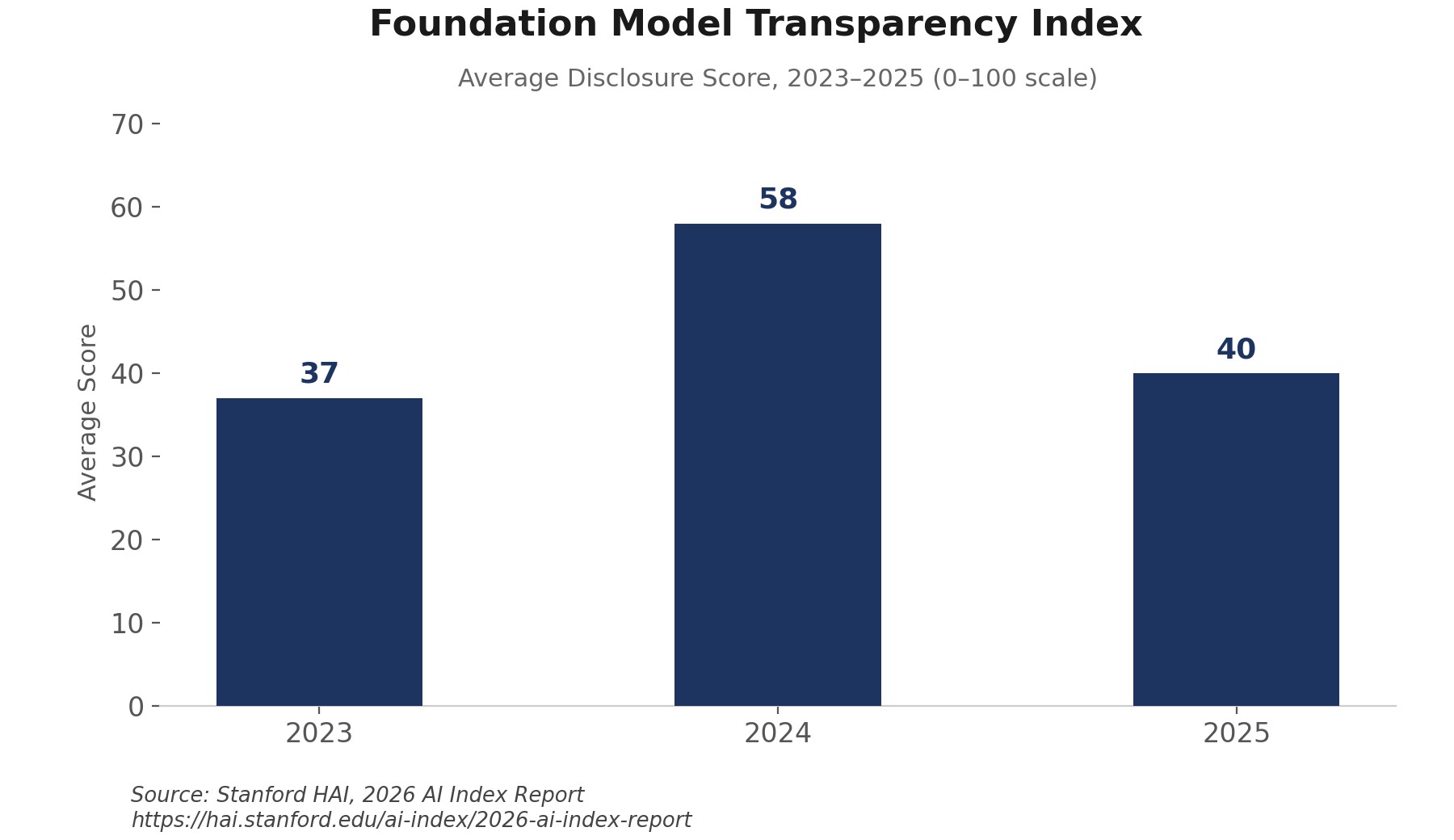
The index climbed from 37 in 2023 to 58 in 2024 as developers raced to publish model and system cards, then slipped back to 40 in 2025 a reminder that disclosure commitments can erode even as governance structures mature. McKinsey's 2026 AI Trust Maturity Survey, drawn from roughly 500 organizations, found a similar split: average responsible-AI maturity improved to 2.3 out of 4, up from 2.0 a year earlier, yet only around 30% of organizations have reached a mature level in the specific dimensions of strategy, governance, and agentic AI controls the areas most directly tied to explainability.
That growing governance layer around AI spanning policy, monitoring, and disclosure is itself becoming a distinct market. NMSC's AI Governance Market research tracks the platforms and services organizations use to enforce those policies across the AI lifecycle, a category that overlaps closely with, but is broader than, explainability tooling itself.
Responsible-AI Governance Benchmarks, 2024–2025
|
Responsible-AI Benchmark (Global) |
2024 / Prior |
2025 / Latest |
|
AI incidents logged (AI Incident Database) |
233 (2024) |
362 (2025) |
|
Organizations with no responsible-AI policy |
24% |
11% |
|
Organizations citing knowledge/training gaps as top RAI barrier |
~50% |
~59% |
|
McKinsey RAI maturity score (0–4 scale) |
2.0 (2025 survey) |
2.3 (2026 survey) |
|
Organizations with mature (level 3+) governance & agentic AI controls |
|
~30% (2026) |
Regulation and independent benchmarking are converging on the same conclusion: organizations are building governance structures faster than they are consistently delivering transparency, leaving explainability as the practical bridge between the two.
-
EU AI Act transparency obligations took effect August 2, 2026
-
Foundation Model Transparency Index: 37 (2023) → 58 (2024) → 40 (2025)
-
Only about 30% of organizations have mature governance and agentic AI controls (McKinsey, 2026)
Industry Leader Moves: How the Biggest AI Vendors Are Building Explainability In
The past six months have shown the shift from principle to product most clearly among the market's leading vendors, and the center of gravity has moved toward governing autonomous agents, not just explaining static model predictions.
Microsoft Corporation
Microsoft published its third annual Responsible AI Transparency Report on September 1, 2026, disclosing a reworked Responsible AI Standard that sets separate requirements for models, platform services, and applications, and adds threat-modeling practices specifically for agentic AI reflecting the company's view that autonomous systems introduce risks that shift as they interact with users and other systems.
Amazon Web Services Inc.
AWS has pushed governance down to the infrastructure layer. Policy controls for Amazon Bedrock AgentCore which intercept and approve every tool call an agent makes before it executes, rather than relying on the model to police itself reached general availability on March 3, 2026, with AgentCore Evaluations following on March 31, 2026 to continuously score agent quality in production.
Databricks Inc.
Databricks took a related approach with Unity AI Gateway, announced at its Data + AI Summit on June 16, 2026. The gateway extends Unity Catalog's data-governance model to agents, models, and MCP services, giving enterprises one place to enforce spend limits, routing policies, and PII guardrails, alongside unified tracing of what every agent actually did.
IBM Corporation
IBM has been building toward what it calls an “AI assurance” layer: the next generation of watsonx.governance, previewed at Think 2026, is designed to connect AI-specific risk to broader enterprise risk and compliance functions. In August 2026, IBM extended that with Enforcement Tracking for watsonx Orchestrate, which automatically pulls agent evaluation metrics into the governance system as ongoing, evidence-backed proof that agents are operating within policy a meaningfully stronger claim than simply documenting that a policy exists.
Google LLC (Alphabet Inc.)
Not every leader is doubling down on standalone explainability tooling. Google Cloud deprecated Vertex Explainable AI, its dedicated feature-attribution service, in March 2026, with access ending in March 2027 a signal that explanation capability is increasingly expected to live natively inside foundation models and agent platforms rather than as a bolt-on service.
Oracle, Salesforce, DataRobot, SAS Institute, and H2O.ai
Oracle published a June 2026 framework for “governed execution,” arguing AI safety must shift from controlling model outputs to controlling what a system can access and do at runtime. Salesforce's Agentforce 360, built around the Einstein Trust Layer's audit trail, was authorized in August 2026 to handle Controlled Unclassified Information for U.S. defense customers a real-world test of that auditability claim. DataRobot extended its AI governance beyond the public cloud in July 2026, covering on-premises, edge, and air-gapped environments. SAS Institute, named an AI governance leader by Chartis in March 2026, expanded SAS Viya's agentic AI and governance capabilities that April. H2O.ai paired its May 2026 tabH2O launch with FedRAMP High authorization, backing its governance claims with the security credential regulated U.S. agencies require.
Vendor investment has shifted from one-off explainability features toward governance infrastructure built to control and audit autonomous AI agents in production, with several leaders now treating that infrastructure as a compliance credential in its own right.
-
Microsoft, IBM, Oracle, and Databricks each published or expanded a formal AI governance framework in 2026
-
AWS and Databricks moved policy enforcement to the infrastructure/gateway layer, outside the model itself
-
Google's retirement of its standalone Vertex Explainable AI service suggests explainability is migrating into platforms rather than remaining a separate tool
Industry Adoption Patterns: Where Explainability Matters Most
Explainability demand still tracks closely with where AI decisions carry the most legal and reputational weight. U.S. Census Bureau survey data shows AI use concentrated well above the national average of 19.8% in the Information sector (39.7%) and in Finance and Insurance (33.9%), compared with only around 14% in Retail Trade a pattern consistent with the sectors that face the heaviest disclosure and fairness obligations.
AI Adoption Rate by U.S. Industry Sector (May 2026)
|
Sector |
AI Adoption Rate (U.S. businesses, as of May 3, 2026) |
|
Information |
39.7% |
|
Finance and Insurance |
33.9% |
|
National average (all sectors) |
19.8% |
|
Retail Trade |
~14% |
Banking, financial services, and insurance remain the clearest case. Lenders adopting AI for credit scoring, risk assessment, and fraud detection and prevention need to be able to show a customer, or a regulator, exactly why a loan was declined or a transaction was flagged not just that a model flagged it. Healthcare carries a related but distinct pressure: as medical devices and diagnostic tools become more connected, cybersecurity incidents involving patient data have pushed providers to demand AI systems whose decision logic can be inspected, both to build clinician trust and to support incident response after a breach.
That demand for provable, auditable AI is reshaping how organizations build systems in the first place, pushing many toward specialized AI and machine learning development services rather than treating explainability as an afterthought.
Adoption is concentrated in sectors where AI decisions are already regulated or high-stakes, and organizations increasingly treat explainability as a design requirement rather than a post-deployment fix.
-
AI adoption is roughly double the national average in Information and Finance & Insurance
-
BFSI's use cases credit scoring, fraud detection, risk assessment are the clearest drivers of XAI demand
-
Healthcare's cybersecurity exposure is pushing providers toward inspectable AI decision logic
Future Outlook
The next phase of this market looks less like “add an explanation feature” and more like “prove an autonomous system behaved as intended.” As enterprises move from single-purpose models to agentic AI that can take actions across systems, the explainability bar rises with it: an audit trail after the fact is no longer enough when an agent may have already executed a transaction, sent a message, or changed a record. Vendors' 2026 moves from AWS's pre-execution policy gateway to Databricks' unified agent tracing to IBM's evidence-backed enforcement tracking all point toward explainability being built into the control plane, not layered on top of it.
Expect the EU AI Act's August 2026 transparency provisions to be joined by more sector-specific U.S. rules on automated decision-making, and for AI governance and explainable AI vendors to keep converging, since regulators increasingly want both: a policy that AI won't do certain things, and a record proving it didn't.
Explainability is moving upstream, from a reporting layer added after deployment to a control-plane requirement that governs what autonomous AI agents are allowed to do in the first place.
-
Governance and explainability tooling are converging into a single vendor category
-
Regulatory scrutiny is expanding beyond the EU AI Act into sector-specific U.S. rules
-
Pre-execution controls, not just after-the-fact explanations, are becoming the standard for agentic AI
Conclusion
The organizations winning the trust of regulators and customers in this market are the ones that can show their work, not just claim it. With the global Explainable AI Market on track to nearly quadruple by 2030, and with AI Act enforcement, independent benchmarking, and enterprise governance programs all converging on the same demand for provable transparency, explainability has moved from a research topic to a purchasing criterion.
For a detailed breakdown of market sizing, segmentation, and competitive positioning: Download Free Sample.
About the Author
 Sanyukta Deb
— Sanyukta Deb is Digital Marketing Team Lead at Next Move Strategy Consulting, where she has led content strategy and technical SEO for the firm's B2B market research publications for over 2 years. Her editorial process translates NextMSC's primary and secondary research — spanning technology, industrial, and consumer sectors — into commercial narratives, backed by search-intent, keyword, and competitive analysis. She brings 5 years of overall experience in digital marketing and content strategy.
Sanyukta Deb
— Sanyukta Deb is Digital Marketing Team Lead at Next Move Strategy Consulting, where she has led content strategy and technical SEO for the firm's B2B market research publications for over 2 years. Her editorial process translates NextMSC's primary and secondary research — spanning technology, industrial, and consumer sectors — into commercial narratives, backed by search-intent, keyword, and competitive analysis. She brings 5 years of overall experience in digital marketing and content strategy.
About the Reviewer
 Debashree Dey
— Debashree Dey is Assistant Manager at Next Move Strategy Consulting, where she supports cross-vertical market content and communications across diverse industries for 6 years. Her professional background includes senior content writing, communications, and published manuscript authorship, with experience developing audience-focused business narratives and maintaining clear, consistent messaging. Her role supports research-led content development and editorial quality across NextMSC publications.
Debashree Dey
— Debashree Dey is Assistant Manager at Next Move Strategy Consulting, where she supports cross-vertical market content and communications across diverse industries for 6 years. Her professional background includes senior content writing, communications, and published manuscript authorship, with experience developing audience-focused business narratives and maintaining clear, consistent messaging. Her role supports research-led content development and editorial quality across NextMSC publications.


















Add Comment