Ammonia Bunkering Market Size, Share, Growth & Forecast By Fuel Type (Green Ammonia, Blue Ammonia, Grey Ammonia, and Other Low-Carbon Ammonia), By Bunkering Mode (Ship-To-Ship Bunkering, Terminal-To-Ship Bunkering, and Truck-To-Ship Bunkering), By Vessel Status (Operational Ammonia Vessels and Ammonia-Ready Vessels), and By Contract Structure (Spot Purchases, Term Agreements, and Strategic Offtake Agreements), – Global Opportunity Analysis and Industry Forecast, 2026–2035
Industry: Energy & Power | Publishing Date: June 26, 2026 | Last Updated: September 10, 2026 | No of Pages: N/A | No. of Tables: N/A | No. of Figures: N/A | Format: PDF | Report Code: EP4820
Ammonia Bunkering Market Size & Forecast
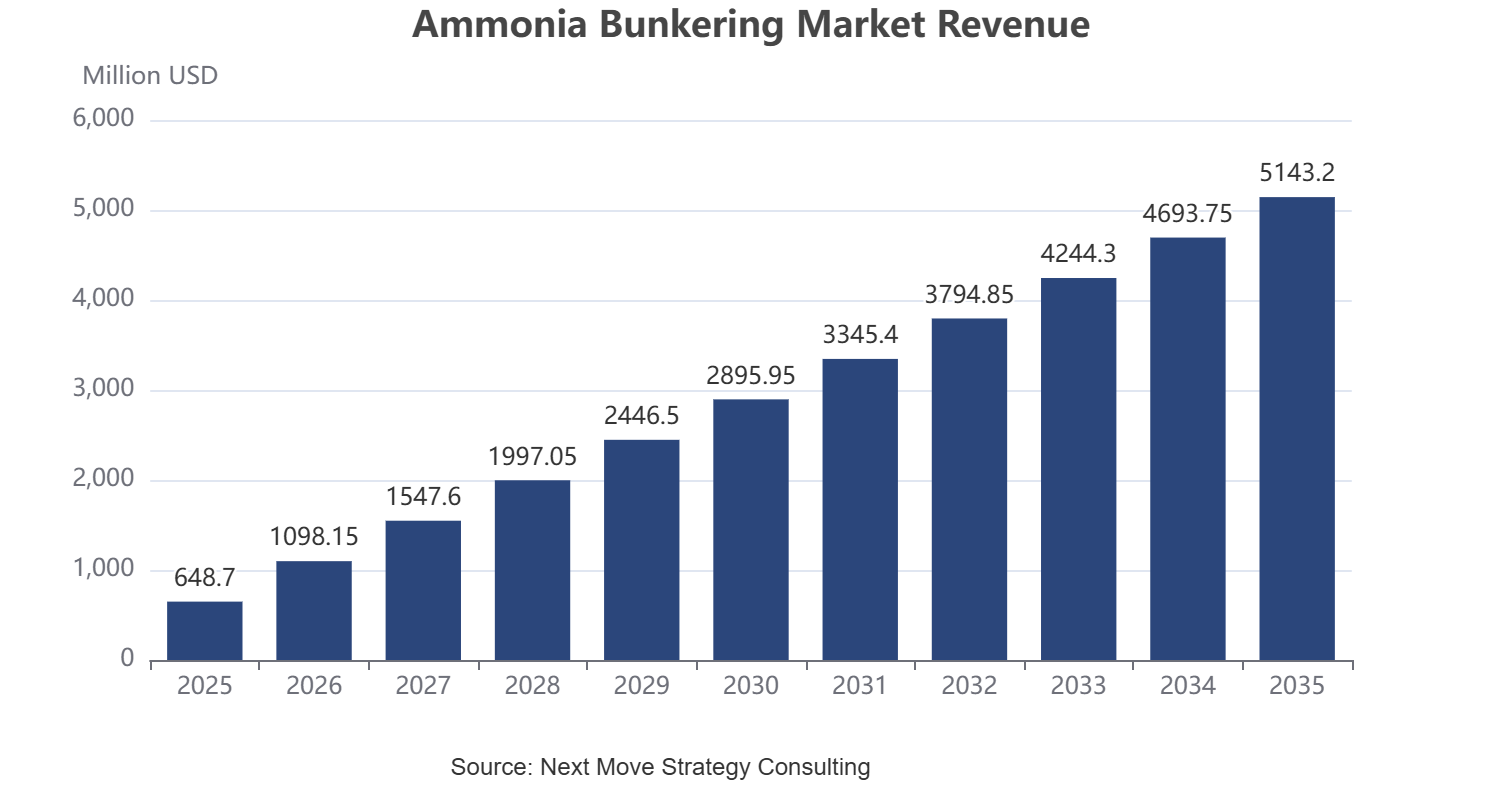
The global Ammonia Bunkering Market was valued at USD 648.7 Million in 2025 and is expected to reach USD 798.4 Million in 2026. Sustained regulatory pressure from the International Maritime Organization (IMO), the expansion of green shipping corridors, and accelerating adoption of ammonia-fueled vessels are projected to propel the Ammonia Bunkering Market to USD 5,143.2 Million by 2035, advancing at a compound annual growth rate (CAGR) of 23.1% from 2026 to 2035. Key growth catalysts include the IMO 2023 GHG Strategy targeting net-zero shipping emissions by or around 2050, rapid cost reductions in green ammonia production, and expanding port-level bunkering infrastructure at global hubs such as Singapore, Rotterdam, and Fujairah.
|
Parameters |
Details |
|
Market Size in 2025 |
USD 648.7 Million |
|
Market Size in 2026 |
USD 798.4 Million |
|
Revenue Forecast in 2035 |
USD 5,143.2 Million |
|
Growth Rate |
CAGR of 23.1% from 2026 to 2035 |
|
Analysis Period |
2025–2035 |
|
Base Year Considered |
2025 |
|
Forecast Period |
2026–2035 |
|
Market Size Estimation |
Million USD |
|
Companies Profiled |
20 |
|
Countries Covered |
36 |
|
Market Share |
Top 10 |
Ammonia Bunkering Market Overview
What Is the Ammonia Bunkering Market?
The Ammonia Bunkering Market encompasses the supply, storage, transfer, and sale of ammonia-based fuels to ships at port or at sea. As an emerging zero-carbon marine fuel, ammonia contains no carbon atoms, producing no CO₂ emissions at combustion, and offers significantly higher energy density than compressed hydrogen, making it viable for long-haul commercial shipping. The market spans infrastructure development, bunkering vessel operations, fuel quality certification, and safety management across major global port ecosystems and offshore maritime corridors.
How Has the Ammonia Bunkering Market Evolved?
The Ammonia Bunkering Market has evolved through distinct developmental phases aligned with maritime decarbonization policy. The first phase (2018–2022) focused on feasibility research, engine development by manufacturers such as MAN Energy Solutions and Wärtsilä, and conceptual bunkering safety studies in Singapore. The second phase (2023–2025) featured pilot bunkering demonstrations in Australia, China, Japan, the Netherlands, and the UK, with Rotterdam completing its first large-scale pilot ammonia transfer in 2025. The current phase centers on infrastructure investment, dual-fuel fleet ordering, and structured commercial offtake agreements between fuel producers and shipping lines.
How Do Regulations Influence the Ammonia Bunkering Market?
Regulatory developments represent the most powerful structural force shaping the Ammonia Bunkering Market. The IMO's 2023 GHG Strategy mandates at least a 20% reduction in shipping emissions by 2030 and 70% by 2040 relative to 2008 levels, with net-zero by or around 2050. The European Union's inclusion of maritime emissions in its Emissions Trading System and the FuelEU Maritime Regulation effective from 2025 are compelling European fleet operators to accelerate ammonia fuel adoption. The Clydebank Declaration, endorsed by 24 governments, targets zero-emission shipping corridors by 2030 with active pilots on Singapore–Rotterdam and Los Angeles–Shanghai lanes, creating anchored demand for ammonia bunkering infrastructure globally.
How Is Technology Adoption Expanding Across the Ammonia Bunkering Market?
Technology adoption across the Ammonia Bunkering Market is accelerating as engine manufacturers move from test benches to commercial deployment. Wärtsilä upgraded its 4-stroke Ammonia 25 engine in April 2026 to 315 kW per cylinder at 900 rpm, matching the power output of LNG-fuelled equivalents. MAN Energy Solutions and WinGD both offer commercially available two-stroke ammonia-ready engines for large container vessels and bulk carriers. Classification societies DNV and ABS have established ammonia bunkering safety frameworks, while Japan has ordered the world's first dedicated ammonia bunkering vessel for delivery in 2027, signaling the transition from pilot projects to operational commercial infrastructure.
Ecosystem Analysis of the Ammonia Bunkering Market
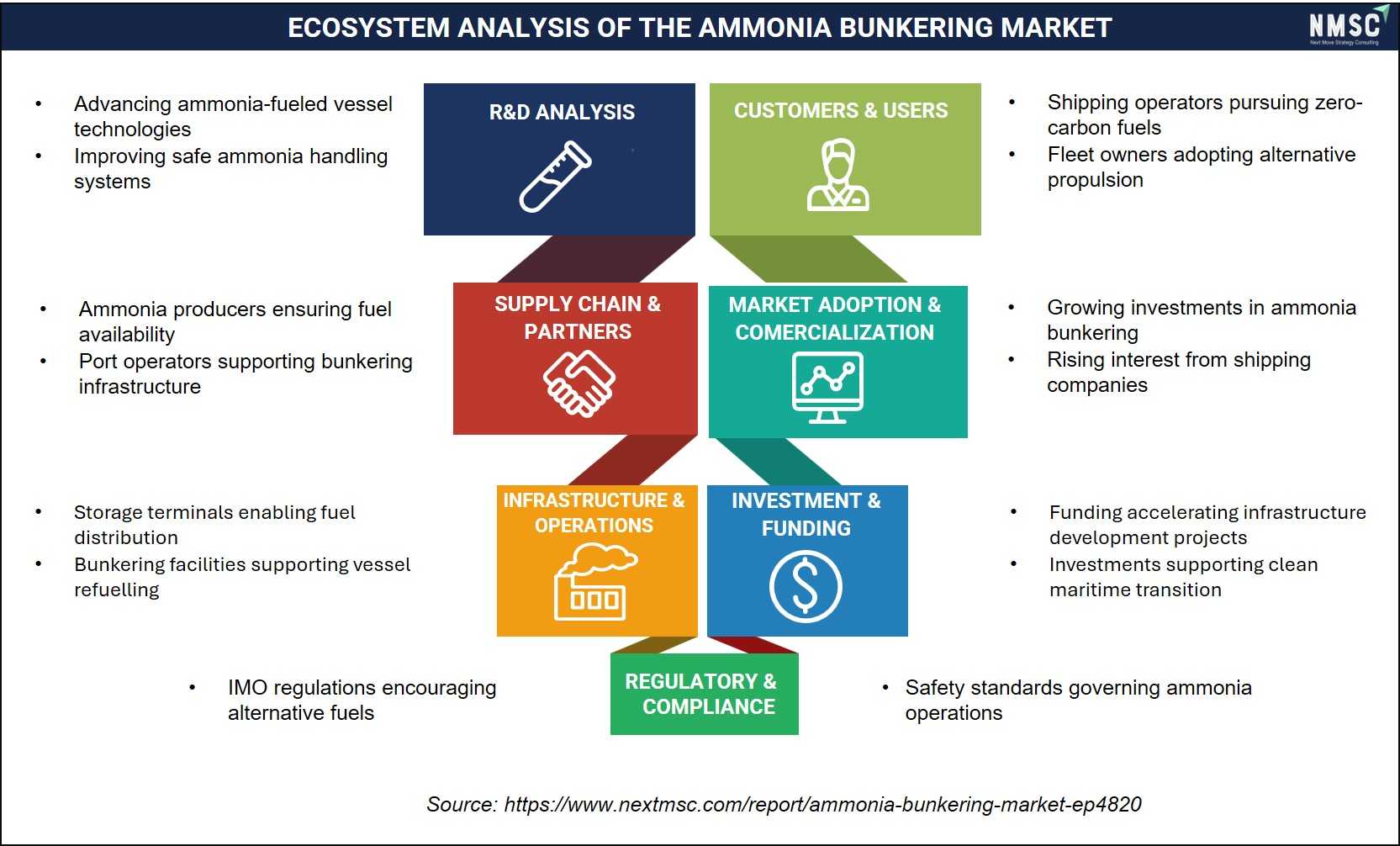
Our analysis indicates that the Ammonia Bunkering Market is supported by a rapidly evolving ecosystem comprising technology developers, ammonia producers, port authorities, shipping companies, infrastructure operators, investors, and regulatory organizations. The assessment indicates that ongoing research and development activities are advancing fuel handling technologies, safety systems, and ammonia-powered vessel capabilities. Additionally, strategic partnerships across the maritime value chain are strengthening supply networks and accelerating commercialization efforts. Investments in bunkering infrastructure, storage facilities, and port readiness programs are further supporting market development. Furthermore, evolving regulatory frameworks and compliance standards are enhancing operational confidence, supporting broader adoption of ammonia as a low-carbon marine fuel alternative.
|
Key Takeaways |
|
By ammonia type, Green Ammonia is the fastest-growing segment in the Ammonia Bunkering Market, projected to advance at a CAGR of 30.1% from 2026 to 2035, while Blue Ammonia led revenue share in 2025 at USD 324.35 Million due to lower transition costs and near-term commercial availability. |
|
By bunkering mode, Shore-to-Ship held the largest share of the Ammonia Bunkering Market at USD 324.35 Million in 2025. Ship-to-Ship bunkering is the fastest-growing mode as it enables open-sea refueling and reduces port infrastructure dependency for early-mover shipping lines. |
|
By vessel type, Bulk Carriers dominated the Ammonia Bunkering Market in 2025, accounting for the highest volume share, driven by fixed intercontinental routes and strong alignment with CMB.TECH’s 28-vessel ammonia bulker fleet program. |
|
By end-use, Commercial Shipping represented the largest segment in the Ammonia Bunkering Market with an estimated 56% share in 2025, driven by regulatory urgency to decarbonize deep-sea trade lanes. |
|
The International Energy Agency (IEA) projects ammonia could account for approximately 44–45% of global shipping fuel demand by 2050, validating the long-term structural demand outlook for the Ammonia Bunkering Market. |
|
Key players in the Ammonia Bunkering Market include Yara Clean Ammonia, Wärtsilä, MAN Energy Solutions (Everllence), WinGD, DNV, Mitsui O.S.K. Lines, NYK Line, CMB.TECH, Azane Fuel Solutions, Air Products, and Vopak. |
|
Asia-Pacific held the largest regional share in the Ammonia Bunkering Market, supported by the concentration of major shipping hubs, ammonia-ready vessel construction programs, and substantial government investment in hydrogen and ammonia infrastructure across Singapore, Japan, South Korea, and China. |
|
Asia-Pacific is also the fastest-growing region in the Ammonia Bunkering Market, driven by expanding bunkering infrastructure, increasing ammonia-fueled vessel deployment, and accelerating maritime decarbonization initiatives across the region. |
|
Singapore is the dominant country market in the Ammonia Bunkering Market, underpinned by its status as the world’s leading bunkering hub, advanced ammonia bunkering readiness, and active collaboration among fuel suppliers, shipping operators, and port authorities. |
|
Japan is the fastest-developing country market in the Ammonia Bunkering Market share, propelled by dedicated ammonia bunkering vessel investments, ammonia engine commercialization, and strong government-backed green transformation initiatives. |
Key Emerging Trends in the Ammonia Bunkering Market
How Is the Commissioning of the World's First Ammonia Bunkering Vessel Transforming the Ammonia Bunkering Market?
Japan's order for the world's first dedicated ammonia bunkering vessel, scheduled for delivery in 2027, marks a critical commercial milestone for the Ammonia Bunkering Market. This vessel will enable ship-to-ship ammonia fuel transfer at scale, reducing reliance on fixed port-based infrastructure during the market's nascent commercialization phase. Japan Engine Corporation and Mitsubishi Heavy Industries have advanced ammonia propulsion readiness, while the Japanese government's Green Innovation Fund is providing significant capital support. This vessel will serve as a proof-of-concept for replication in South Korea, Singapore, and Norway, accelerating global ammonia bunkering infrastructure development.
How Are Green Shipping Corridors Reshaping Demand Patterns in the Ammonia Bunkering Market?
Green shipping corridors are emerging as the primary demand-anchoring mechanism for the Ammonia Bunkering Market. The 24 governments endorsing the Clydebank Declaration have committed to establishing zero-emission shipping routes by 2030, with active pilot corridors on Singapore–Rotterdam and Los Angeles–Shanghai lanes. These corridors concentrate ammonia bunkering infrastructure investment along commercially dense routes, reducing the per-route capital risk and enabling fuel suppliers, port authorities, and shipping lines to co-develop supply chains under structured public-private partnerships, creating durable commercial demand signals for ammonia bunkering operators.
What Role Is Dual-Fuel Engine Technology Playing in the Ammonia Bunkering Market Expansion?
Dual-fuel ammonia engine technology is the primary enabler of near-term demand growth in the Ammonia Bunkering Market. Wärtsilä's upgraded Ammonia 25 engine (April 2026), WinGD's X-DF-A dual-fuel engines ordered by AET for Aframax tankers, and Everllence's commercially available two-stroke engine collectively represent a maturing propulsion technology ecosystem. CMB.TECH's 28-vessel ammonia bulker program, including Qingdao Beihai Shipbuilding's 210,000-ton dual-fuel bulk carrier construction commencing in October 2024, demonstrates fleet-level ammonia adoption that directly generates bunkering demand at scale across multiple trade routes.
How Is Safety Standardization Shaping Infrastructure Investment in the Ammonia Bunkering Market?
Safety protocol standardization is a foundational prerequisite for scaling the Ammonia Bunkering Market. DNV's Global Centre for Maritime Decarbonisation-led ammonia bunkering safety study in Singapore identified all bunkering risks as low or mitigable, enabling regulatory sandbox pilots. ABS granted Approval in Principle to VARD's ammonia bunkering barge in October 2024, developed by the RADIUS consortium for vessels including Høegh's Aurora Class. Norway's Directorate for Civil Protection granted safety permits to Yara Clean Ammonia and Azane to construct the world's first commercial ammonia bunker facility at Fjord Base, establishing the regulatory precedent required for broader infrastructure deployment.
What Are the Key Market Drivers, Restraints, and Opportunities That Will Shape the Ammonia Bunkering Market Industry in the Next Decade?
|
DRIVERS / TRENDS / RESTRAINTS |
(+/-) % IMPACT ON CAGR FORECAST |
GEOGRAPHIC RELEVANCE |
IMPACT TIMELINE |
|
IMO 2023 GHG Strategy & Net-Zero 2050 Mandate |
+3.8% |
Global |
2025–2035 |
|
EU ETS Maritime Inclusion & FuelEU Maritime Regulation |
+2.4% |
Europe |
2025–2035 |
|
Scale-up of Green Ammonia Production |
+2.1% |
Global (APAC, ME, Americas) |
2026–2035 |
|
Dual-Fuel Vessel Fleet Expansion |
+3.2% |
Global |
2025–2032 |
|
Green Shipping Corridor Investments |
+1.5% |
Europe, APAC, North America |
2025–2032 |
|
High Capital Cost of Bunkering Infrastructure |
-1.6% |
All Regions |
2025–2030 |
|
Ammonia Toxicity & Handling Safety Concerns |
-1.2% |
All Regions |
Ongoing |
|
Absence of Global Bunkering Safety Standards |
-0.9% |
All Regions |
2025–2028 |
|
Green Ammonia Cost Competitiveness vs. Conventional Fuels |
-0.7% |
All Regions |
2025–2030 |
|
Section 45Z U.S. Tax Credits for Low-Carbon Marine Fuels |
+1.1% |
North America |
2025–2028 |
What Are the Growth Drivers of the Ammonia Bunkering Market?
How Is the IMO's 2023 GHG Strategy Accelerating Demand Growth in the Ammonia Bunkering Market?
The IMO's 2023 Revised GHG Strategy is the single most consequential regulatory growth driver for the Ammonia Bunkering Market. By mandating at least 20% emission reduction by 2030, 70% by 2040, and net-zero by or around 2050 relative to 2008 levels, the strategy eliminates the long-term optionality of fossil marine fuels for deep-sea shipping. With the IEA projecting ammonia could represent 44–45% of global shipping fuel demand by 2050, fleet owners, shipyards, and port authorities are making investment decisions today that will anchor demand for ammonia bunkering infrastructure through the entire forecast period of 2026 to 2035.
How Is the Scale-up of Green Ammonia Production Fueling Ammonia Bunkering Market Growth?
Rapid reduction in the cost of renewable electricity and electrolyzers is making green ammonia production increasingly cost-competitive, providing a critical supply-side growth driver for the Ammonia Bunkering Market. Yara International and Air Products' partnership on the Louisiana Clean Energy Complex targeting FID in mid-2026, combined with the NEOM Green Hydrogen project in Saudi Arabia targeting commercial operations in 2027, will together supply up to 1.2 million tonnes per year of renewable ammonia. Greenko's planned facility in Kakinada, India — with 50% of Phase One output committed to Yara Clean Ammonia — further diversifies the green ammonia supply base available for marine bunkering.
How Is EU Regulatory Compliance Driving Ammonia Bunkering Market Demand in European Shipping?
The European Union's FuelEU Maritime Regulation, effective from 2025, mandates progressive reductions in the greenhouse gas intensity of energy used by ships calling at EU ports. The extension of the EU Emissions Trading System to maritime transport creates direct financial penalties for high-carbon fuel use, making the incremental cost of ammonia bunkering commercially compelling for European fleet operators. The European Commission's support scheme for Sustainable Maritime Fuel production, targeting 6.8 million tonnes of marine fuel by 2035 through 2027 funding cycles, provides additional structural demand support for ammonia bunkering market participants serving European trade lanes.
What Are the Growth Inhibitors of the Ammonia Bunkering Market?
How Do Ammonia Toxicity and Handling Safety Concerns Constrain the Ammonia Bunkering Market?
Ammonia's acute toxicity and corrosive properties represent the most technically demanding challenge for the Ammonia Bunkering Market. Ammonia is lethal at concentrations above 300 parts per million, requiring specialized personal protective equipment, sealed transfer systems, and emergency scrubbing infrastructure at bunkering points. Port operators and insurance underwriters require rigorous risk assessments, crew training programs, and real-time gas detection systems before permitting commercial bunkering operations. These requirements significantly increase the capital and operational cost of ammonia bunkering infrastructure compared to conventional marine fuel supply operations, slowing early-stage deployment and extending project permitting timelines.
How Does the Absence of Global Ammonia Bunkering Standards Limit Ammonia Bunkering Market Expansion?
The lack of a harmonized international framework for ammonia bunkering procedures, safety standards, and crew certification represents a significant structural barrier for the Ammonia Bunkering Market. While the IMO has made progress through its IGF Code amendments and MEPC deliberations, comprehensive ammonia-specific bunkering regulations remain incomplete. This regulatory gap compels individual ports and classification societies to develop bespoke safety protocols, increasing compliance complexity for multinational shipping operators and deterring early-mover investment in port infrastructure. IMO member states' 2025 decision not to adopt the new net-zero fuels framework created additional uncertainty, delaying critical deployment decisions across the ammonia supply chain.
What Are the Growth Opportunities in the Ammonia Bunkering Market?
How Does the Development of Integrated Ammonia Value Chains Create Multi-Million Dollar Opportunities in the Ammonia Bunkering Market?
The development of vertically integrated ammonia value chains — combining renewable power generation, electrolysis, ammonia synthesis, liquefaction, shipping, and bunkering terminal operations under single ownership or tightly coordinated consortia — represents the most capital-efficient pathway for scaling the Ammonia Bunkering Market. Yara and Mitsui O.S.K. Lines' partnership, spanning time charters, ship-to-ship bunkering demonstrations, and ammonia-fueled vessel development, exemplifies this integrated model. Vopak's development of global ammonia storage terminals and Golar LNG's floating ammonia transport vessels provide additional infrastructure building blocks for replicable, asset-light bunkering network models.
How Are Floating Storage and Regasification Units Creating New Bunkering Infrastructure Opportunities in the Ammonia Bunkering Market?
Floating ammonia storage and transfer units represent a capital-efficient alternative to fixed port-side bunkering infrastructure, creating significant infrastructure opportunity in the Ammonia Bunkering Market. SwitcH2's ammonia FPSO vessel project, targeting offshore ammonia production from 2028, and Louis Dreyfus Ports and Logistics' FRESH mobile ammonia terminal concept, expected to be commercial by 2025, demonstrate the commercial viability of flexible, route-agnostic bunkering solutions. These mobile infrastructure models are particularly attractive for emerging Ammonia Bunkering Market segments in developing regions where fixed terminal capital expenditure is not yet justified by current fuel demand volumes.
How Does the Asia-Pacific Shipping Hub Concentration Present a Structural Ammonia Bunkering Market Opportunity?
Asia-Pacific's concentration of the world's busiest shipping lanes and largest port ecosystems presents the most significant geographic opportunity for the market. Singapore, handling over 130,000 vessel arrivals annually, has reached Port Readiness Level 6–7 for ammonia bunkering alongside Rotterdam, positioning it as the primary early commercial bunkering hub in the region. Golden Island, NYK Line, and Yara Clean Ammonia are collaborating to promote, supply, and bunker ammonia as marine fuel in the Port of Singapore. South Korea's national hydrogen and ammonia energy strategy and China's expanding dual-fuel shipbuilding capacity further amplify Asia-Pacific's structural role as the primary demand and infrastructure center for the global Ammonia Bunkering Market.
How Is the Ammonia Bunkering Market Segmented and What Are the Key Insights from the Segmentation Analysis?
How Does Ammonia Type Segmentation Reveal the Structural Composition of the Ammonia Bunkering Market?
|
Ammonia Type Segment |
2025 (USD Million) |
2035 (USD Million) |
CAGR (%) |
|
Green Ammonia |
151.36 |
2107.99 |
30.1% |
|
Blue Ammonia |
324.35 |
1850.83 |
19.0% |
|
Grey Ammonia |
172.99 |
1184.38 |
21.2% |
Based on our analysis of maritime decarbonization trajectories and ammonia production technology maturity, we observed that the Ammonia Bunkering Market is segmented into Green Ammonia, Blue Ammonia, and Grey Ammonia. Blue Ammonia currently holds the largest revenue share in the market due to its near-term commercial availability, established production infrastructure, and lower delivered cost compared to green alternatives. Grey Ammonia continues to be used in early demonstration projects where clean certification is not yet a contractual requirement. Green Ammonia is the fastest-growing segment as renewable electricity cost reductions and electrolyzer scaling progressively close the cost gap with fossil-derived alternatives.
How Does Bunkering Mode Shape Revenue Distribution Across the Ammonia Bunkering Market?
|
Bunkering Mode Segment |
2025 (USD Million) |
2035 (USD Million) |
CAGR (%) |
|
Shore-to-Ship |
324.35 |
2213.03 |
21.2% |
|
Ship-to-Ship |
194.61 |
1749.41 |
24.6% |
|
Truck-to-Ship |
129.74 |
1180.76 |
24.7% |
On the basis of bunkering mode analysis, we observed that the Ammonia Bunkering Market is segmented into Shore-to-Ship, Ship-to-Ship, and Truck-to-Ship operations. Shore-to-Ship bunkering holds the largest current share due to its alignment with existing port terminal infrastructure and established liquid chemical transfer protocols. Truck-to-Ship is the fastest-growing bunkering mode, while Ship-to-Ship also demonstrates strong growth driven by flexible offshore refueling capabilities, as demonstrated by Yara and Mitsui O.S.K. Lines' ship-to-ship bunkering demonstrations, enabling open-water refueling flexibility for deep-sea vessels operating on transoceanic routes. Truck-to-Ship bunkering serves smaller vessel segments and emerging port locations where permanent terminal investment is not yet commercially viable.
Which Vessel Types Are Driving Purchasing Decisions in the Ammonia Bunkering Market?
|
Vessel Type Segment |
2025 (USD Million) |
2035 (USD Million) |
CAGR (%) |
|
Bulk Carriers |
194.61 |
1580.43 |
23.3% |
|
Container Ships |
162.17 |
1336.75 |
23.5% |
|
Tankers |
136.95 |
1086.11 |
23.0% |
|
Offshore Support Vessels (OSVs) |
97.31 |
741.48 |
22.5% |
|
Cruise Ships |
32.43 |
198.42 |
19.9% |
|
Other Vessel Types |
25.23 |
200.01 |
23.0% |
Based on our analysis of vessel construction trends and ammonia propulsion adoption patterns, we assessed that the market is segmented by vessel type into Bulk Carriers, Container Ships, Tankers, Offshore Support Vessels, Cruise Ships, and Other Vessel Types. Bulk Carriers dominate due to their operation on fixed intercontinental routes where dedicated bunkering points can be pre-positioned, and CMB.TECH's fleet of 28 ammonia-powered bulkers represents the largest single fleet-level commitment in the Ammonia Bunkering Market. Container Ships are the fastest-growing segment as leading operators on high-density trade lanes face the strongest regulatory pressure to demonstrate decarbonization progress under EU ETS compliance requirements.
How Do End-Use Applications Reflect Commercial Demand Dynamics in the Ammonia Bunkering Market?
|
End-Use Segment |
2025 (USD Million) |
2035 (USD Million) |
CAGR (%) |
|
Commercial Shipping |
363.99 |
2933.8 |
23.2% |
|
Offshore Operations |
162.18 |
1285.8 |
23.0% |
|
Naval & Defense |
72.08 |
594 |
23.5% |
|
Others |
50.45 |
329.6 |
20.6% |
In our analysis of maritime sector decarbonization investment, we found that the Ammonia Bunkering Market is segmented by end-use into Commercial Shipping, Offshore Operations, Naval and Defense, and Others. Commercial Shipping continues to dominate as the primary revenue segment, driven by the urgent regulatory need to decarbonize deep-sea trade lanes under the IMO's GHG Strategy. Offshore Operations represent a structurally growing segment as Offshore Support Vessels, including those used in wind energy installation and maintenance, adopt ammonia propulsion to meet sustainability requirements imposed by offshore energy project operators. Naval and Defense is an emerging segment as several NATO member navies explore ammonia-compatible vessel designs for energy security and decarbonization goals.
Regional Outlook
Geographic Performance Snapshot
|
Region |
2025 (USD Million) |
2035 (USD Million) |
CAGR (%) |
Key Driver |
|
North America |
97.3 |
771.48 |
23.0% |
Blue ammonia supply, Section 45Z credits |
|
Europe |
162.18 |
1285.8 |
23.0% |
EU ETS, FuelEU Maritime, Rotterdam hub |
|
Asia-Pacific |
259.48 |
2107.99 |
23.3% |
Singapore hub, Japan bunkering vessel, South Korea |
|
Middle East & Africa |
64.87 |
514.32 |
23.0% |
NEOM green ammonia, Fujairah bunkering hub |
|
Latin America |
64.87 |
463.61 |
21.7% |
Green corridor pilots, Brazil wind energy |
North America Ammonia Bunkering Market
North America holds a significant early-mover position in the Ammonia Bunkering Market, valued at USD 97.30 Million in 2025 and forecast to reach USD 771.48 Million by 2035 at a CAGR of 23.0%. The region benefits from substantial blue ammonia production capacity anchored in the U.S. Gulf Coast, where natural gas and carbon capture infrastructure are well established. The U.S. Treasury's Section 45Z tax credits, released in January 2025, offer production incentives for low-lifecycle-emissions transportation fuels including marine-grade ammonia, providing a structural pricing advantage for domestic ammonia fuel producers serving North American bunkering operations.
United States Ammonia Bunkering Market
The United States represents over 75% of North America's Ammonia Bunkering Market, underpinned by the Gulf Coast's concentration of chemical infrastructure, existing ammonia handling expertise, and emerging blue ammonia export terminal development. Air Products' Louisiana Clean Energy Complex, targeting FID in mid-2026, is positioned to supply large-scale low-carbon ammonia to marine bunkering operations at Gulf of Mexico ports. The Port of Los Angeles and Port of Houston are among the U.S. port authorities evaluating ammonia bunkering readiness under green shipping corridor feasibility studies aligned with the Clydebank Declaration commitments.
Canada Ammonia Bunkering Market
Canada's Ammonia Bunkering Market is at an early developmental stage, with primary activity concentrated in feasibility assessments and policy alignment. Canada's abundant wind and hydroelectric resources position the country as a potential future green ammonia producer for both domestic and export bunkering supply chains. The federal government's Clean Fuel Regulations and Net-Zero by 2050 commitment provide the regulatory framework driving initial industry exploration. Canadian ports including Vancouver and Halifax are assessing ammonia bunkering readiness as part of broader alternative fuel infrastructure planning aligned with international shipping decarbonization goals.
Mexico Ammonia Bunkering Market
Mexico's Ammonia Bunkering Market remains nascent, primarily driven by proximity to North American green shipping corridor pilots on the Los Angeles–Shanghai lane. Mexico's Pacific coast ports, particularly Manzanillo and Lázaro Cárdenas, are significant transpacific container transshipment points that could serve as secondary ammonia bunkering waypoints as corridor infrastructure matures. National energy reform dynamics and Petróleos Mexicanos' interest in diversified fuel production may support early-stage blue ammonia project development linked to PEMEX's existing refinery and gas infrastructure assets along Mexico's Gulf Coast corridor.
Europe Ammonia Bunkering Market
Europe is the most regulatory-advanced region in the Ammonia Bunkering Market, contributing USD 162.18 Million in 2025 and forecast to reach USD 1,285.80 Million by 2035 at a CAGR of 23.0%. The combined force of the EU ETS maritime extension, FuelEU Maritime Regulation, and the European Commission's sustainable maritime fuel production support scheme creates the strongest near-term commercial demand for ammonia bunkering in any region globally. Rotterdam's Port Readiness Level 6–7 status and Norway's first-of-kind commercial ammonia bunker facility approval position Europe as the global template for ammonia bunkering infrastructure development.
United Kingdom Ammonia Bunkering Market
The United Kingdom's Ammonia Bunkering Market benefits from the nation's maritime heritage, significant offshore wind capacity for green ammonia production, and the Port of Aberdeen's growing role as an offshore energy services hub. The UK's North Sea Transition Deal and Hydrogen Strategy provide policy support for blue and green ammonia production that could supply marine bunkering demand. Collaboration with Norway on the North Sea green shipping corridor is progressing, with Scottish port authorities evaluating ammonia storage and transfer infrastructure aligned with the decarbonization requirements of North Sea offshore support vessel operators.
Germany Ammonia Bunkering Market
Germany's Ammonia Bunkering Market is driven by its position as one of Europe's largest container shipping import nations and its advanced industrial decarbonization strategy. The Port of Hamburg and Port of Bremen are evaluating ammonia bunkering infrastructure as part of Germany's national hydrogen strategy, which targets 90–110 TWh of hydrogen imports annually, much of which is expected to arrive as ammonia. German shipping companies including Hapag-Lloyd are among the earliest large fleet operators exploring multi-fuel decarbonization strategies that include ammonia as a long-term fuel option for their deep-sea container services.
France Ammonia Bunkering Market
France's Ammonia Bunkering Market is developing in alignment with the France 2030 investment plan and the national hydrogen strategy targeting 6.5 GW of electrolysis capacity by 2030. The Port of Marseille-Fos, as the Mediterranean's largest port, is a strategic early-stage target for ammonia bunkering infrastructure development serving trans-Mediterranean and Suez Canal trade routes. French shipping company CMA CGM's active exploration of alternative maritime fuels and its participation in green shipping corridor initiatives creates domestic corporate demand that will catalyze market infrastructure investment at French Atlantic and Mediterranean port facilities.
Netherlands Ammonia Bunkering Market
The Netherlands hosts the most advanced ammonia bunkering ecosystem in Europe through the Port of Rotterdam's Port Readiness Level 6–7 classification and its completion of a large-scale pilot ammonia transfer in 2025. Vopak, headquartered in Rotterdam, is developing global ammonia storage terminal capacity with Rotterdam as its European anchor facility. The Netherlands' existing position as Europe's premier liquid bulk terminal nation provides a competitive infrastructure advantage for Ammonia Bunkering Market commercialization, while the Dutch government's hydrogen import terminal investment under the National Hydrogen Programme supports the supply-side infrastructure required for sustained ammonia bunkering operations.
Norway Ammonia Bunkering Market
Norway is the leading European nation in first-mover ammonia bunkering deployment within the Ammonia Bunkering Market. Yara Clean Ammonia and Azane received approval from Norway's Directorate for Civil Protection to construct the world's first commercial low-emission ammonia bunker facility at Fjord Base, primarily serving offshore supply vessels operating in the Norwegian Continental Shelf. Norway's GreenBalticCruising project investigates cruise ship ammonia bunkering feasibility across Baltic Sea routes. The Norwegian government's NOx fund and climate action support programs provide capital incentives for early market infrastructure deployment that would not be commercially viable on merchant fuel economics alone at this stage.
Spain Ammonia Bunkering Market
Spain's Ammonia Bunkering Market is in an early-growth phase, driven by the country's exceptional solar and wind resources supporting green ammonia production potential and its strategic port positions on Atlantic–Mediterranean trade routes. The Port of Algeciras, one of Europe's busiest container transshipment hubs, and the Port of Barcelona are evaluating ammonia bunkering feasibility under Spain's national hydrogen roadmap. The Spanish government's Hydrogen Valley projects in Aragon, Asturias, and Andalusia include ammonia production components that could supply bunkering operations at Iberian Peninsula ports serving Europe–Americas trade lanes.
Italy Ammonia Bunkering Market
Italy's Ammonia Bunkering Market is developing in alignment with the national hydrogen strategy and the Piano Nazionale di Ripresa e Resilienza infrastructure investments. Italian ports including Genova, Gioia Tauro, and Trieste serve major Mediterranean trade routes where decarbonization pressure from EU ETS compliance is creating demand for ammonia bunkering feasibility studies. Italy's significant renewable energy capacity expansion, particularly solar in the south, positions domestic green ammonia production as a medium-term supply source. Italian shipping operator MSC is among the global operators with the largest container fleet exposure to EU maritime emissions regulations, creating corporate demand for ammonia bunkering solutions.
Rest of Europe Ammonia Bunkering Market
The Rest of Europe segment within the market includes Denmark, Sweden, Finland, Belgium, Poland, and Greece, each contributing to the region's developing ammonia bunkering ecosystem. Denmark and Sweden are advancing ammonia bunkering readiness in the context of Baltic Sea ferry routes and North Sea offshore wind support operations. The Port of Antwerp–Bruges in Belgium is engaging in ammonia bunkering infrastructure planning as part of its alternative fuels readiness strategy. GreenBalticCruising project partners across Nordic nations are investigating ammonia bunkering feasibility for Baltic cruise routes, representing an emerging application segment within the broader European Ammonia Bunkering Market.
Asia-Pacific Ammonia Bunkering Market
Asia-Pacific is the largest and fastest-growing region in the Ammonia Bunkering Market, valued at USD 259.48 Million in 2025 and forecast to reach USD 2,107.99 Million by 2035 at a CAGR of 23.3%. The region's dominance reflects its concentration of the world's busiest shipping hubs, most active ammonia-powered vessel construction programs, and highest government investment in hydrogen and ammonia energy infrastructure. Singapore's Port Readiness Level 6–7 and Japan's dedicated bunkering vessel order collectively position Asia-Pacific as the operational epicenter of early market commercialization.
Japan Ammonia Bunkering Market
Japan is the most advanced individual country market in Asia-Pacific's Ammonia Bunkering Market and the global first-mover in dedicated bunkering vessel deployment. Japan's 2027 delivery of the world's first purpose-built ammonia bunkering vessel represents a definitive step from pilot demonstrations to commercial infrastructure. Japan Engine Corporation's commercially available ammonia marine engine and Mitsubishi Heavy Industries' ammonia-ready vessel designs support a domestic ecosystem aligned with Japan's GX (Green Transformation) strategy targeting JPY 150 trillion in green investment over ten years. NYK Line's ammonia fuel trial projects and collaboration with Yara Clean Ammonia and Golden Island at the Port of Singapore reinforce Japan's multi-route bunkering strategy.
South Korea Ammonia Bunkering Market
South Korea's Ammonia Bunkering Market is accelerating as the world's leading shipbuilding nation pivots toward ammonia-ready vessel construction. Hyundai Heavy Industries, Samsung Heavy Industries, and Daewoo Shipbuilding and Marine Engineering are collectively constructing ammonia dual-fuel vessels across multiple vessel classes. South Korea's national hydrogen and ammonia energy strategy, backed by government-led investment in the port cities of Busan and Incheon, supports bunkering infrastructure development aligned with the nation's 2050 carbon neutrality goal. AET's WinGD X-DF-A dual-fuel engine orders for Aframax tankers built in South Korea directly anchor domestic Ammonia Bunkering Market demand.
China Ammonia Bunkering Market
China's Ammonia Bunkering Market is developing at pace with the country's dual ambition as the world's largest shipbuilder and a major renewable ammonia producer. Qingdao Beihai Shipbuilding's construction of the world's first 210,000-ton ammonia dual-fuel bulk carrier for CMB.TECH, equipped with WinGD's ammonia engine, commenced in October 2024 and represents the most commercially significant single vessel order for the market to date. CIMC SOE's ammonia fuel tank supply capability and China's established ammonia port infrastructure at Qingdao, Tianjin, and Shanghai provide foundational bunkering readiness assets. China's pilot programs under the Green Shipping Initiative are building the policy framework for designated ammonia bunkering zones.
Singapore Ammonia Bunkering Market
Singapore is the operational hub of the Asia-Pacific Ammonia Bunkering Market and one of only two global ports to have achieved Port Readiness Level 6–7 for ammonia bunkering alongside Rotterdam. Singapore's Maritime Singapore decarbonization blueprint and the Maritime and Port Authority of Singapore's Alternative Fuels Roadmap provide a structured regulatory and investment framework for ammonia bunkering development. Golden Island, NYK Line, and Yara Clean Ammonia's collaboration to promote, supply, and bunker ammonia at the Port of Singapore represents the most advanced commercial ammonia bunkering arrangement globally, directly targeting IMO decarbonization goals for the world's busiest bunkering port.
Australia Ammonia Bunkering Market
Australia's Ammonia Bunkering Market benefits from the nation's vast renewable energy resources supporting world-scale green ammonia production potential and its significant role as a commodities exporter with a large bulk carrier fleet. Ammonia bunkering pilot demonstrations in Australia are among the six countries — alongside China, Japan, the Netherlands, Singapore, and the UK — where safe ammonia transfers were proven by 2025 according to DNV analysis. The Port of Darwin and Pilbara region ports are early targets for ammonia bunkering infrastructure development aligned with Australia's National Hydrogen Strategy export ambitions and the Japan-Australia Hydrogen Energy Supply Chain.
India Ammonia Bunkering Market
India's Ammonia Bunkering Market is at an early stage of development but holds significant medium-term potential given the country's National Hydrogen Mission targeting 5 million tonnes of green hydrogen production by 2030, much of which is expected to be converted to ammonia for export. Greenko's planned green ammonia facility in Kakinada with 50% of Phase One output committed to Yara Clean Ammonia represents a direct supply-chain link to the marine bunkering market. Indian port authorities at Mumbai, Visakhapatnam, and Kandla are evaluating ammonia import terminal expansions that could serve dual roles as cargo import facilities and future marine bunkering supply points as ammonia-fueled vessel adoption grows across South Asian trade routes.
Rest of Asia-Pacific Ammonia Bunkering Market
The Rest of Asia-Pacific segment within the Ammonia Bunkering Market includes Indonesia, Malaysia, Thailand, Taiwan, New Zealand, and other maritime nations. Indonesia's strategic position on the Malacca Strait, one of the world's most congested shipping lanes, creates long-term potential for ammonia bunkering hub development. Malaysia's national hydrogen roadmap includes green ammonia export targets that could supply regional bunkering operations. Taiwan's active offshore wind energy expansion is creating early demand for offshore support vessel ammonia fuel solutions at Taiwanese port facilities serving the rapidly growing Taiwan Strait renewable energy construction sector.
Middle East and Africa Ammonia Bunkering Market
The Middle East and Africa Ammonia Bunkering Market is valued at USD 64.87 Million in 2025 and forecast to reach USD 514.32 Million by 2035 at a CAGR of 23.0%. The region's dual role as a major low-cost blue ammonia producer and a critical east–west shipping route bunkering hub positions it as a strategically important supplier market. The UAE's Fujairah port is the world's third-largest bunkering hub by volume and is positioned as a strategic ammonia bunkering waypoint on east–west routes as vessel demand matures. Saudi Arabia's NEOM Green Hydrogen project, targeting commercial operations in 2027 with Air Products as sole offtaker and Yara as commercial co-developer, will supply up to 1.2 million tonnes of renewable ammonia annually.
United Arab Emirates Ammonia Bunkering Market
The UAE's Ammonia Bunkering Market is centered on Fujairah's emergence as the Middle East's primary future ammonia bunkering hub. Fujairah's established bunkering ecosystem, handling over 100 million tonnes of conventional bunker fuel annually, provides storage, logistics, and operational expertise directly transferable to ammonia bunkering as vessel demand materializes. Abu Dhabi National Oil Company's investment in blue ammonia production, combined with Masdar's renewable energy capacity expansion, positions the UAE to supply both blue and green ammonia to Fujairah bunkering operations serving Indian Ocean and Persian Gulf trade routes as the Ammonia Bunkering Market scales through the forecast period.
Saudi Arabia Ammonia Bunkering Market
Saudi Arabia's Ammonia Bunkering Market is primarily a production-side opportunity linked to the NEOM Green Hydrogen project's 1.2 million tonne per year renewable ammonia output and Saudi Aramco's established blue ammonia export program. Saudi Aramco shipped the world's first blue ammonia cargo to Japan in 2020, establishing a precedent for ammonia as an internationally traded marine energy commodity. The SABIC chemical infrastructure and Ras Al-Khair industrial city provide additional potential for ammonia production linked to marine bunkering supply chains. Saudi Arabia's Vision 2030 industrial diversification strategy supports continued investment in ammonia production capacity with export and domestic energy applications including marine bunkering.
Rest of Middle East and Africa Ammonia Bunkering Market
The Rest of Middle East and Africa Ammonia Bunkering Market segment encompasses Qatar, Kuwait, Oman, South Africa, Egypt, and other maritime nations. Qatar's LNG infrastructure expertise and port capabilities position it for potential blue ammonia bunkering development aligned with its energy transition ambitions. South Africa's Port of Durban, as Southern Africa's busiest container port, represents a long-term ammonia bunkering development opportunity as shipping decarbonization extends into Cape of Good Hope route traffic. Egypt's Suez Canal Authority, given its critical role in global east–west trade, has expressed interest in developing alternative marine fuel bunkering capabilities including ammonia to maintain competitiveness as shipping decarbonization mandates intensify through 2035.
Latin America Ammonia Bunkering Market
Latin America's Ammonia Bunkering Market is valued at USD 64.87 Million in 2025 and forecast to reach USD 463.61 Million by 2035 at a CAGR of 21.7%. Brazil's exceptional wind and solar resources support significant potential for green ammonia production at globally competitive costs, while Chile's Patagonia region is emerging as a premier green hydrogen and ammonia production location with direct maritime export access. Both nations are positioning themselves as green ammonia exporters aligned with European import demand, creating long-term supply-side linkages that support the development of domestic ammonia bunkering infrastructure at key Atlantic and Pacific ports.
Brazil Ammonia Bunkering Market
Brazil's Ammonia Bunkering Market is developing in conjunction with the country's large renewable energy base and its ambition to become a major green hydrogen and ammonia exporter under the National Hydrogen Program. The Port of Açu, one of Latin America's most modern deep-sea port complexes, is engaged in green ammonia export terminal feasibility studies that could support marine bunkering operations for vessels transiting Brazil's Atlantic coast trade lanes. Petrobras' interest in low-carbon fuel production and Vale's shipping fleet decarbonization requirements collectively create early-stage corporate demand for Ammonia Bunkering Market infrastructure development at Brazilian ports.
Rest of Latin America Ammonia Bunkering Market
The Rest of Latin America Ammonia Bunkering Market encompasses Chile, Argentina, Colombia, Peru, and other maritime nations. Chile is emerging as a leading green ammonia production location, with the Haru Oni facility and multiple other projects under development in the Patagonia and Atacama regions leveraging abundant wind and solar resources. Chilean green ammonia export capacity could supply both European import demand and Pacific trade lane vessel bunkering operations. Colombia's Caribbean ports and Argentina's Buenos Aires region are evaluating ammonia import and bunkering capabilities as the South American shipping sector begins to align with global maritime decarbonization requirements driven by IMO regulations and EU trade partner sustainability requirements.
Strategic Framework of the Ammonia Bunkering Market
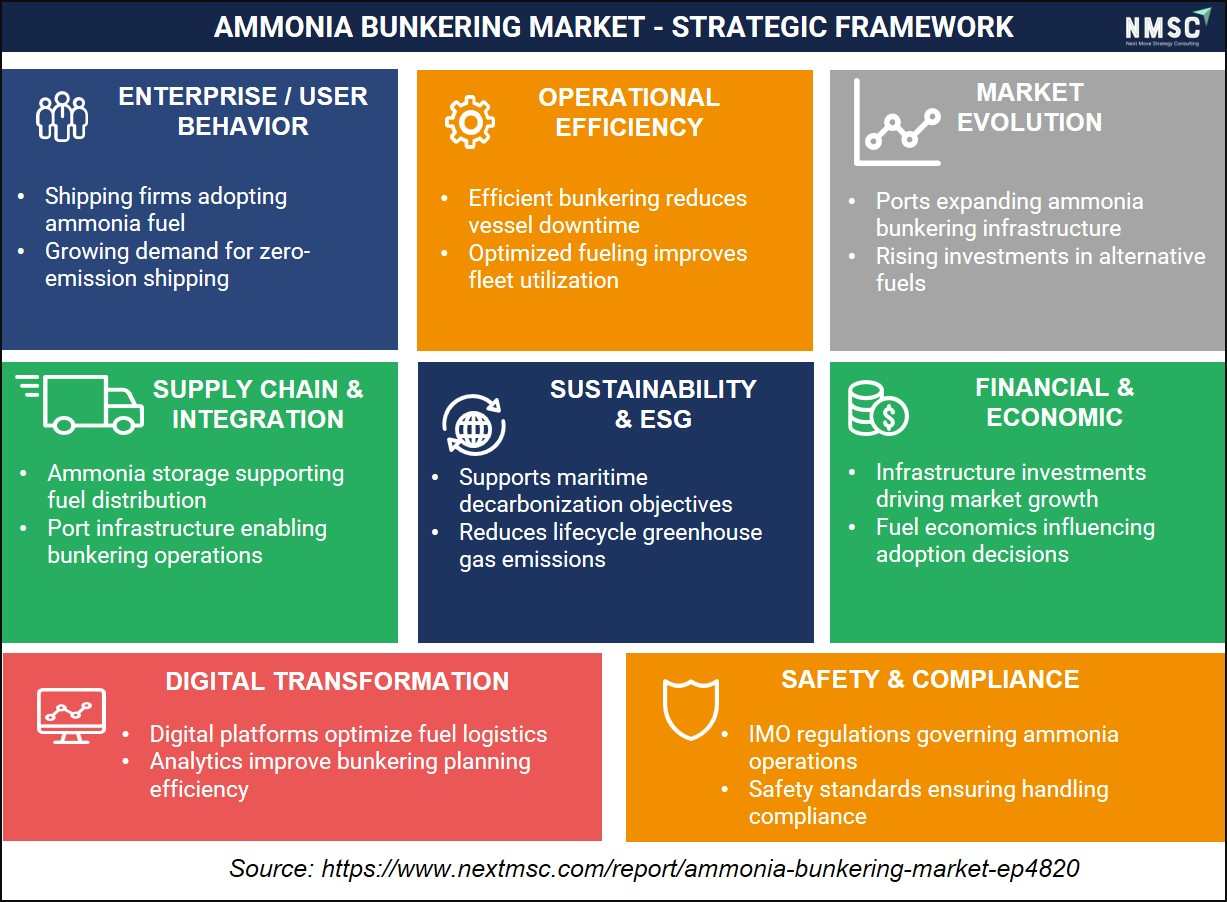
Based on NMSC's evaluation, we found that the Ammonia Bunkering market is advancing through rising demand for zero-emission shipping, infrastructure expansion, and operational improvements in fuel handling. Our assessment identifies that sustainability objectives, supportive IMO regulations, and increasing investments in bunkering networks are driving adoption. Moreover, digitalized fuel logistics, supply chain integration, and favorable decarbonization strategies continue to enhance market competitiveness and scalability.
Competitive Landscape
Competitive Dynamics and M&A Landscape
|
Key Takeaways |
Details |
|
Market Structure |
The Ammonia Bunkering Market operates through a multi-stakeholder ecosystem comprising ammonia producers, engine manufacturers, shipping companies, terminal operators, classification societies, and bunker suppliers. The market remains fragmented due to its early commercialization stage, with no single participant holding a dominant position across the value chain. |
|
Innovation Focus |
Innovation is concentrated on ammonia-capable marine engines, dual-fuel propulsion systems, bunkering safety technologies, fuel storage and containment systems, ammonia transfer infrastructure, and low-carbon ammonia production pathways that enable maritime decarbonization. |
|
M&A Activity |
Strategic partnerships, joint ventures, and consortium-led developments dominate competitive activity. Collaborations among Yara, Air Products, Mitsui O.S.K. Lines, WinGD, CMB.TECH, Azane Fuel Solutions, and infrastructure developers are accelerating commercialization of ammonia-fueled shipping and bunkering networks. |
How Do Companies Compete in the Ammonia Bunkering Market?
The Ammonia Bunkering Market is characterized by competition across multiple segments of the maritime fuel value chain. Ammonia producers compete to secure long-term fuel supply agreements and establish production capacity for low-carbon and green ammonia. Engine manufacturers focus on developing commercially viable ammonia-fueled propulsion systems that meet safety, efficiency, and emissions requirements. Shipping operators, bunker suppliers, and terminal developers compete through strategic partnerships, infrastructure investments, and first-mover projects aimed at establishing operational leadership in emerging ammonia-fueled shipping corridors. Given the market's early stage of development, collaboration often serves as a stronger competitive differentiator than direct market-share competition.
Which Kind of Companies Dominate the Ammonia Bunkering Market?
Four categories of companies currently shape the Ammonia Bunkering Market. First, ammonia producers and fuel suppliers such as Yara Clean Ammonia, Air Products, CF Industries, and Trafigura leverage production capabilities and global trading networks to support fuel availability. Second, engine and technology providers including Wärtsilä, Everllence (MAN Energy Solutions), WinGD, Mitsubishi Heavy Industries, Japan Engine Corporation, and Baker Hughes focus on propulsion and fuel system innovation. Third, shipping operators such as CMB.TECH, Mitsui O.S.K. Lines, NYK Line, and Equinor are advancing ammonia-powered vessel deployment and demonstration projects. Finally, infrastructure operators including Vopak, Azane Fuel Solutions, Golden Island, and Golar LNG are developing storage, bunkering, and transport solutions required to commercialize ammonia as a marine fuel.
Ammonia Propulsion Technologies and Integrated Infrastructure Development Drive Market Success in the Ammonia Bunkering Market
Innovation across the Ammonia Bunkering Market is concentrated on the commercialization of ammonia-capable marine engines, dual-fuel propulsion systems, ammonia storage and containment technologies, ship-to-ship bunkering solutions, and comprehensive safety frameworks. Companies are also investing in low-carbon and green ammonia production pathways to support maritime decarbonization objectives. Organizations that successfully integrate fuel production, transportation, storage, bunkering infrastructure, and vessel technology are expected to secure long-term competitive advantages as commercial adoption accelerates. Open collaboration among technology developers, shipping operators, and fuel suppliers continues to play a critical role in reducing deployment risks and accelerating market maturity.
Market Players to Opt for Strategic Partnerships and Joint Ventures to Expand Their Presence in the Ammonia Bunkering Market
Strategic partnerships and joint ventures are reshaping the competitive landscape of the Ammonia Bunkering Market. Yara and Air Products strengthened their collaboration around the NEOM Green Hydrogen project, supporting commercialization of renewable ammonia production. Yara and Mitsui O.S.K. Lines continue to collaborate on ship-to-ship bunkering demonstrations and early ammonia fuel deployment initiatives. CMB.TECH's 28-vessel ammonia-powered bulker program, supported by WinGD engine technology and CIMC SOE fuel tanks, represents one of the most significant vertically integrated vessel commitments in the industry. As commercialization advances, stakeholders are expected to pursue additional alliances, infrastructure investments, and cross-value-chain partnerships to establish ammonia fuel corridors and scale global bunkering capabilities.
Key Market Players in the Ammonia Bunkering Market
-
Yara Clean Ammonia AS
-
Wärtsilä Corporation
-
Everllence SE
-
WinGD Ltd.
-
DNV AS
-
CMB.TECH NV
-
Mitsui O.S.K. Lines, Ltd.
-
Nippon Yusen Kabushiki Kaisha
-
Azane Fuel Solutions AS
-
Air Products and Chemicals, Inc.
-
Koninklijke Vopak N.V.
-
Mitsubishi Heavy Industries, Ltd.
-
Japan Engine Corporation
-
Golden Island Pte. Ltd.
-
CF Industries Holdings, Inc.
-
Trafigura Group Pte. Ltd.
-
Equinor ASA
-
Golar LNG Limited
-
Baker Hughes Company
-
CIMC SOE Co., Ltd.
What Are the Latest Developments in the Ammonia Bunkering Industry?
|
Date |
Event |
|
May 2026 |
ITOCHU Corporation, in collaboration with Mitsui O.S.K. Lines (MOL) and CMB.TECH, secured an official two-year authorization from the Maritime and Port Authority of Singapore (MPA) to commence ship-to-ship ammonia bunkering trials, utilizing a newly ordered dedicated ammonia bunker vessel to supply dual-fuel bulkers. |
|
April 2026 |
Yara Clean Ammonia, NYK Line (via NYK Bulkship Asia), and Singapore bunker supplier Golden Island signed a land-marking non-binding term sheet to jointly develop the end-user sales, marketing, and safe supply ecosystem for low-carbon ammonia bunkering in Singapore. |
Expert Insights
 "The ammonia-fuelled ship will take a year or two to undergo trials, while fuel supply, bunkering infrastructure and safety standards have to be created. Actual sales (of ammonia engines), I would not foresee it before 2027."
— Uwe Lauber, CEO, MAN Energy Solutions
Statement made during an interview with Reuters discussing the commercialization timeline of ammonia-powered vessels and the supporting ecosystem required for ammonia as a marine fuel.
Market Interpretation
NMSC's analysis indicates that the ammonia bunkering market is currently progressing through a critical infrastructure development phase, where fuel availability, bunkering networks, and safety regulations remain key prerequisites for large-scale adoption. The statement highlights that commercialization of ammonia-fuelled vessels is closely linked to the establishment of dedicated bunkering facilities and operational standards across major ports. As engine manufacturers advance ammonia propulsion technologies, ports, fuel producers, shipowners, and regulatory bodies are increasing investments in ammonia handling and storage capabilities. This coordinated ecosystem development is expected to accelerate ammonia bunkering demand from 2027 onward as the maritime industry advances toward decarbonization targets.
Key Segment of the Ammonia Bunkering Market
By Fuel Type
-
Green Ammonia
-
Renewable Electrolysis-Based Ammonia
-
Renewable Biomass-Derived Ammonia
-
-
Blue Ammonia
-
Natural Gas with Carbon Capture and Storage
-
Other Carbon-Abated Ammonia
-
-
Grey Ammonia
-
Other Low-Carbon Ammonia
By Bunkering Mode
-
Ship-To-Ship Bunkering
-
Dedicated Ammonia Bunker Vessel
-
Multi-Fuel Bunker Vessel
-
-
Terminal-To-Ship Bunkering
-
Pipeline Transfer
-
Loading Arm Transfer
-
-
Truck-To-Ship Bunkering
-
Road Tanker Transfer
-
Containerized Tank Transfer
-
By Customer Type
-
Commercial Shipping Operators
-
Container Shipping Companies
-
Bulk Shipping Companies
-
Tanker Operators
-
Gas Carrier Operators
-
Ro-Ro Operators
-
Multipurpose Vessel Operators
-
-
Government Operators
-
Naval Operators
-
Coast Guard Operators
-
Harbor Service Operators
-
Tugboat Operators
-
Pilot Boat Operators
-
Port Service Craft Operators
-
Research Vessel Operators
-
By Vessel Status
-
Operational Ammonia Vessels
-
Dedicated Ammonia Vessels
-
Dual-Fuel Ammonia Vessels
-
-
Ammonia-Ready Vessels
-
Newbuild Ammonia-Ready Vessels
-
Retrofit-Ready Vessels
-
By Contract Structure
-
Spot Purchases
-
Term Agreements
-
Less Than 1 Year
-
1–3 Years
-
More Than 3 Years
-
-
Strategic Offtake Agreements
-
Fleet Decarbonization Programs
-
Port-Based Supply Agreements
-
Multi-Port Supply Agreements
-
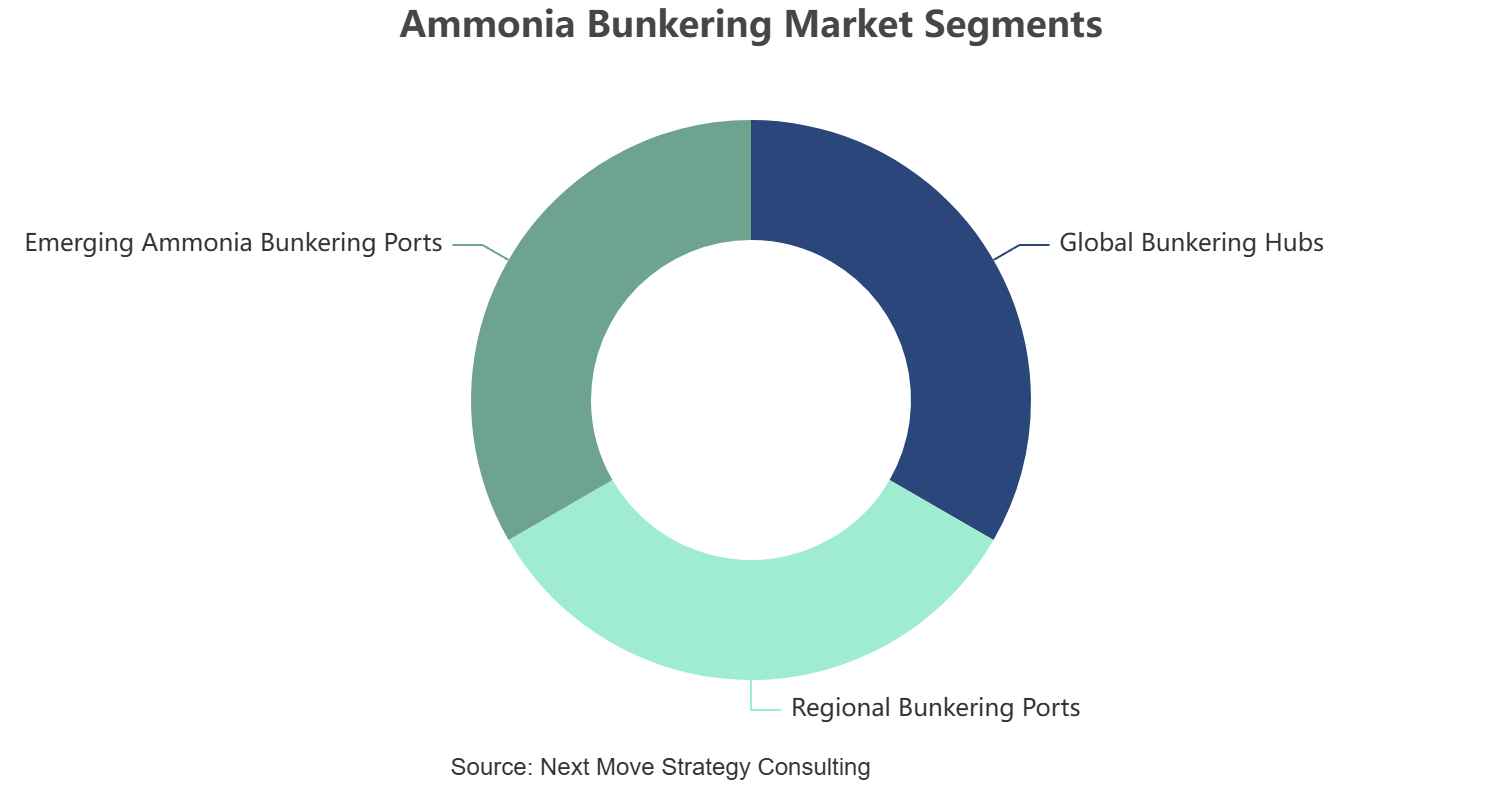
By Port Scale
-
Global Bunkering Hubs
-
Regional Bunkering Ports
-
Emerging Ammonia Bunkering Ports
By Distribution Channel
-
Direct Supplier-To-Shipowner
-
Trader-Mediated Supply
-
Marine Fuel Traders
-
Commodity Traders
-
-
Consortium And Joint Venture Supply Agreements
By End-Use Vessel Class
-
Container Vessels
-
Bulk Carriers
-
Oil Tankers
-
Chemical Tankers
-
Gas Carriers
-
Ro-Ro Vessels
-
General Cargo Vessels
-
Offshore Support Vessels
-
Tugboats And Harbor Craft
-
Naval And Government Vessels
-
Research Vessels
By Region
-
North America: U.S., Canada, and Mexico.
-
Europe: UK, Germany, France, Italy, Spain, Sweden, Denmark, Finland, the Netherlands, and the rest of Europe.
-
Asia Pacific: China, India, Japan, South Korea, Taiwan, Indonesia, Vietnam, Australia, Philippines, Malaysia and the rest of APAC.
-
Middle East & Africa (MEA): Saudi Arabia, UAE, Egypt, Israel, Turkey, Nigeria, South Africa, and the rest of MEA.
-
Latin America: Brazil, Argentina, Chile, Colombia, and the rest of LATAM.
Conclusion and Recommendations
Long-Term Outlook
The Ammonia Bunkering Market is entering its most consequential growth decade as the maritime industry transitions from fossil fuels to zero-carbon alternatives under binding IMO regulatory commitments. The market is forecast to grow from USD 798.4 Million in 2026 to USD 5,143.2 Million by 2035 at a CAGR of 23.1%, driven by accelerating ammonia-fueled fleet ordering, commercial bunkering infrastructure development at major global port hubs, and progressive cost reductions in green ammonia production. The IMO's 2023 GHG Strategy, the EU ETS maritime extension, and the Clydebank Declaration collectively ensure that regulatory demand for ammonia bunkering will intensify through 2035 and beyond, making the forecast period a foundational investment window for market participants.
Strategic Positioning Recommendations
Infrastructure investors should prioritize anchor bunkering terminal development at Singapore, Rotterdam, Fujairah, Tokyo, and Houston, where the highest concentration of ammonia-capable vessel traffic will materialize first. Fuel producers should pursue vertically integrated project structures combining renewable generation, electrolysis, synthesis, and export terminal operations to minimize production cost exposure. Engine manufacturers should accelerate commercial certification of ammonia-ready retrofit kits for the existing fleet, which represents a larger near-term revenue opportunity than newbuild installations. Classification societies and safety technology providers occupy a structurally advantaged position as mandatory intermediaries in every ammonia bunkering transaction, providing defensive revenue resilience across all market scenarios.
Investment Attractiveness
The Ammonia Bunkering Market represents an exceptionally attractive infrastructure and technology investment environment given its secular regulatory tailwinds, long-term offtake agreement structures, and the irreversibility of the IMO's decarbonization trajectory. The highest-conviction investment themes include Green Ammonia production infrastructure (30.1% CAGR through 2035), Ship-to-Ship bunkering vessel assets (24.6% CAGR), ammonia safety technology systems (23.3% CAGR), and Asia-Pacific port terminal development (23.3% CAGR). Investors should monitor Yara Clean Ammonia for potential standalone listing activity, NEOM Green Hydrogen for offtake agreement expansion, and CMB.TECH's fleet program as a direct demand-anchor bellwether for bunkering volume forecasts.
Market Shifts and Key Risks
The most significant market shift underway is the migration from isolated pilot demonstrations to structured commercial ecosystem development, anchored by Japan's 2027 bunkering vessel, Norway's Fjord Base terminal, and Singapore's Port Readiness Level advancement. Key risks include IMO framework uncertainty following the 2025 net-zero framework rejection, which delays critical deployment milestones and creates offtake uncertainty for first-mover projects. Ammonia safety incidents at bunkering facilities, if they occur during the market's early commercial phase, could trigger regulatory setbacks disproportionate to their scale, given the nascent state of public and industry confidence in ammonia as a marine fuel in the Ammonia Bunkering Market.
About the Author
 Saista Faiyaz
— Saista Faiyaz is Research Associate at Next Move Strategy Consulting, where she has covered consumer markets and healthcare technologies for 3 years. Her work includes primary interview review, secondary-source validation, market sizing, and structured analysis of company and industry data. She supports research by comparing evidence across sources, organizing findings into market narratives, and documenting assumptions used in analysis. Her scope includes cross-market benchmarking, and reports.
Saista Faiyaz
— Saista Faiyaz is Research Associate at Next Move Strategy Consulting, where she has covered consumer markets and healthcare technologies for 3 years. Her work includes primary interview review, secondary-source validation, market sizing, and structured analysis of company and industry data. She supports research by comparing evidence across sources, organizing findings into market narratives, and documenting assumptions used in analysis. Her scope includes cross-market benchmarking, and reports.
About the Reviewer
 Supradip Baul
— Supradip Baul is an accomplished business consultant and strategist with over a decade of rich experience in market intelligence, strategy, technology, and business transformation. His work has included rigorous qualitative and quantitative analysis across multiple industries, helping clients shape investment decisions and long-term roadmaps. Earlier in his career, he was associated with Gartner, where he contributed to industry-leading reports and market share analyses. He has worked with leading global companies and holds an MBA with a dual specialization in Marketing and Finance.
Supradip Baul
— Supradip Baul is an accomplished business consultant and strategist with over a decade of rich experience in market intelligence, strategy, technology, and business transformation. His work has included rigorous qualitative and quantitative analysis across multiple industries, helping clients shape investment decisions and long-term roadmaps. Earlier in his career, he was associated with Gartner, where he contributed to industry-leading reports and market share analyses. He has worked with leading global companies and holds an MBA with a dual specialization in Marketing and Finance.
At Next Move Strategy Consulting, we understand that insightful market research is the cornerstone of successful business decisions. That's why we employ a robust and multifaceted approach, combining various methodologies to deliver the most accurate and actionable data for our clients.

Research Landscape
We navigate the world of research with two primary approaches:
Qualitative Approach
Our qualitative research methodologies involve immersive techniques such as in-depth interviews, focus groups, and observational studies. By engaging directly with individuals and stakeholders, we uncover valuable insights that quantitative data alone may overlook.

Quantitative Research
In tandem with qualitative methodologies, NMSC leverages the power of Quantitative Research to provide a robust foundation of numerical insights. Through systematic data collection and analysis, we quantify patterns, preferences, and market trends, offering a comprehensive view of the business landscape.
Our quantitative research approach employs diverse tools, including surveys, experiments, and statistical modelling. These methodologies enable us to gather data from a large and representative sample, ensuring the statistical significance of our findings. By employing structured questionnaires and standardized data collection methods, we guarantee the reliability and validity of the information we present to our clients.
Quantitative research is particularly effective in measuring the prevalence of trends, assessing market size, and gauging the impact of various factors on consumer behavior. The numerical precision attained through this approach equips our clients with actionable insights, facilitating data-driven decision-making and strategy formulation.


Our Specialized Toolbox for Industry-Specific Market Research
We deploy a specialized arsenal of techniques tailored to meet your unique requirements. Here's a glimpse into our comprehensive toolbox:

Information Procurement
The stage entails acquiring market data or relevant information through various sources and methodologies.


Market Research Approach
We utilize both top-down and bottom-up approaches in market research analysis to achieve a comprehensive understanding of the market dynamics, leveraging the broad perspective of industry trends and macroeconomic factors alongside detailed insights from specific segments and individual companies.

Porters Five Forces Analysis
We conduct Porter's Five Forces analysis to evaluate the competitive landscape of an industry, providing us with insights into factors that affect profitability and strategic positioning.

SWOT Analysis

Forecasting
We utilize a forecasting model to predict future consumption by considering parameters like population, economics, regulations, market competition, drivers, constraints, technology, and pricing. We also employ statistical techniques such as multilinear regression, exponential smoothing, moving average, ARIMA, and Monte Carlo simulations for accurate predictions. In econometric forecasting, we analyzed short-term and long-term event impacts, attributing values based on regulatory frameworks, economic factors, and market events.





 Speak to Our Analyst