Why is Taste Modulation Transforming the Global Food and Beverage Landscape?

The global food and beverage industry is currently navigating a significant shift. As health-conscious behavior becomes the norm, manufacturers are tasked with a difficult paradox: reducing sugar, salt, and fat while maintaining the indulgent sensory experience consumers crave. Between April 2024 and March 2025, nearly 72% of global consumers reported cutting back on sugar to improve emotional health, sleep, and weight management.
This demand has moved beyond simple ingredient substitution. Today, the focus is on taste modulation a sophisticated science that adjusts how our taste receptors perceive flavors. From masking the bitterness of functional ingredients to replicating the "temporal profile" of sugar, taste modulators are the invisible heroes of the modern pantry.
How Does Precision Fermentation Unlock New Sweetness Frontiers?
One of the most significant breakthroughs in 2024 and 2025 involves the intersection of biotechnology and flavor. Traditional plant-based sweeteners often struggle with lingering aftertastes or metallic notes. However, the rise of precision fermentation is changing the narrative.
According to Olivier Grégoire, VP of Global Sugar Reduction at dsm-firmenich, precision fermentation allows for the sustainable production of rare stevia molecules like Rebaudioside (Reb) M and D. These specific molecules deliver a cleaner, sugar-like profile with minimal aftertaste compared to standard stevia extracts. By using biotech to "brew" these molecules, companies can offer high-purity sweeteners that are both cost-efficient and environmentally friendly, avoiding the land and water constraints of traditional agriculture.
Why Molecular Taste Science is the Key to Sugar-Like Satisfaction?
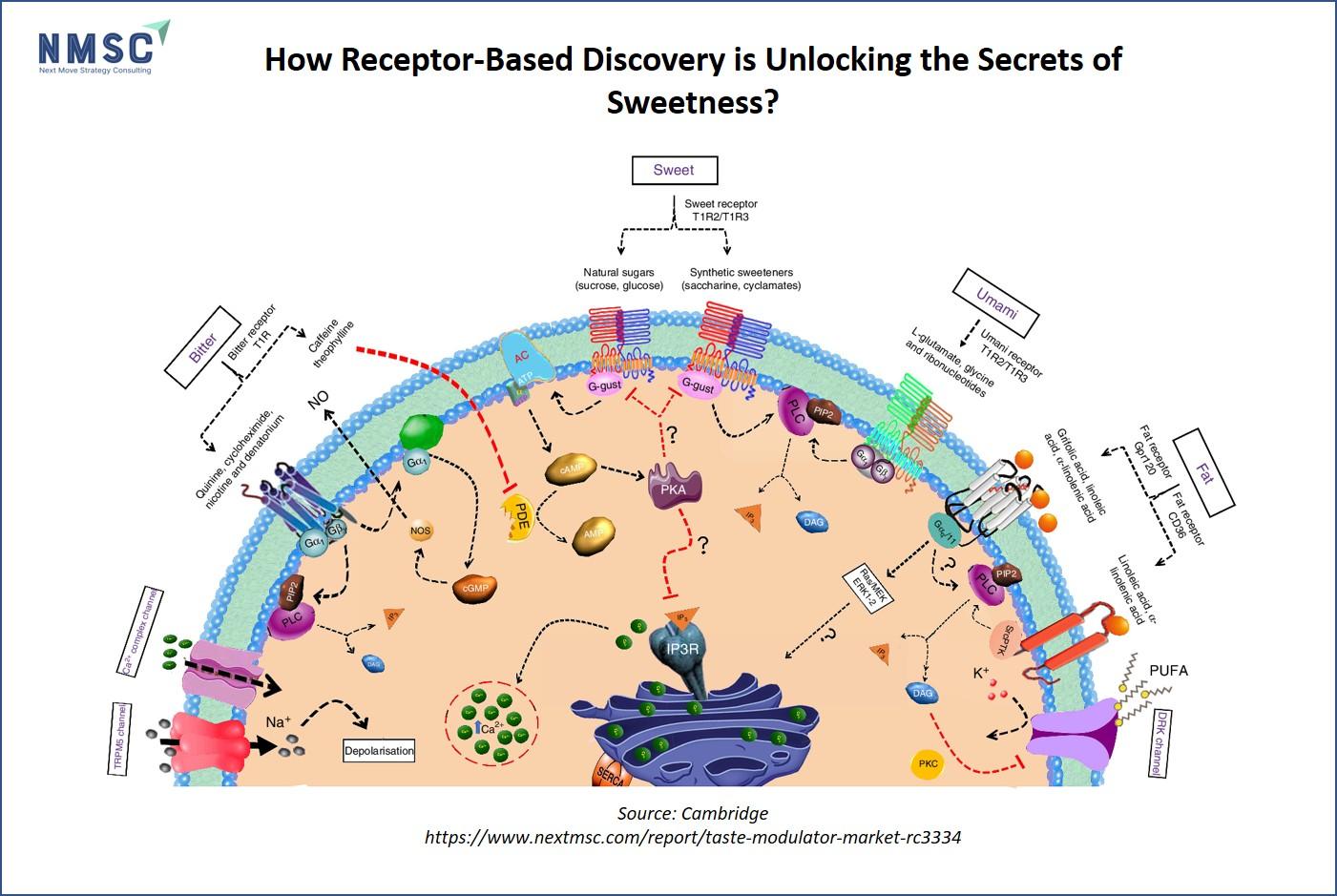
To achieve a truly "sugar-like" experience in low-sugar products, manufacturers must do more than just add a sweetener; they must replicate the entire sensory architecture shown in this cellular model. The image highlights that taste is a multi-step biological process involving signal transduction and cellular depolarization.
-
Replicating the Temporal Profile: Sugar has a specific "temporal profile" a quick onset and clean finish that is governed by how quickly receptors are activated and deactivated. Integrated solutions like TastePrint are engineered to mimic this exact biological timing.
-
Holistic Sensory Rebuilding: Because the diagram shows that multiple receptors (Sweet, Umami, Fat) contribute to the overall flavor experience, companies are moving toward fully engineered sweetness experiences. These systems combine natural sweeteners with texture optimizers and modulators to restore the "mouthfeel and vibrancy" that is often lost when sugar is removed.
-
Data-Driven Formulation: By studying the intracellular signaling pathways such as the roles of PLC, IP3R, and Calcium ions ($Ca^{2+}$). This molecular precision ensures that "better sweetness" is both palatable and commercially viable for health-conscious consumers.
How Are Companies Leading the Taste Modulation Revolution?
According to the Next Move Strategy Consulting reports that companies such as HTBA and dsm-firmenich are at the forefront of taste innovation:
-
HTBA OptiTaste Platform: Optimizes sweetness, balances flavors, and masks bitterness using natural flavonoids and upcycled ingredients.
-
dsm-firmenich TastePrint Solutions: Integrates sweeteners, flavor modulators, and texture optimizers to replicate sugar’s sensory profile in low-sugar products.
It also emphasizes that these innovations represent a shift from simple sugar replacement to multi-dimensional taste engineering, ensuring health and enjoyment coexist.
Why Biotechnology is Redefining Ingredient Sustainability?
The integration of precision fermentation into the sweetener supply chain represents a move toward "engineered sweetness." This allows brands to achieve a 1:1 sugar replacement feel that was previously considered elusive in natural formulations.
-
Precision fermentation enables the production of high-purity, rare sweeteners like Reb M.
-
This technology overcomes the agricultural and sensory limitations of traditional plant-based sweeteners.
What Technical Challenges Are Addressed by Taste Modulators?
It notes that replacing sugar is more than matching sweetness. Sugar provides structure, mouthfeel, browning, and temporal flavor perception. Alternative sweeteners often introduce off-notes or fail to mimic sugar’s clean sweetness profile.
Next Move Strategy Consulting highlights that taste modulation technologies tackle three key challenges:
-
Temporal Profile: Replicating sugar’s quick onset and short finish.
-
Off-Notes Masking: Mitigating bitterness, metallic, or licorice-like flavors.
-
Functional Replacement: Maintaining structure, moisture, and processing behavior in food products.
These solutions ensure reformulated products satisfy both sensory and functional expectations.
Can Advanced Platforms Resolve the Bitterness of Functional Foods?
As the "food as medicine" trend grows, more products are being fortified with vitamins, minerals, and proteins. Unfortunately, these functional additions often bring "off-notes" unpleasant bitter or astringent tastes. To counter this, companies like HealthTech Bio Actives (HTBA) have launched dedicated platforms such as OptiTaste.
Unveiled in mid-2025, this platform utilizes flavonoid-based technology to address specific formulation hurdles. The technology is divided into three distinct functional areas:
-
Sweetness Optimization: Minimizing added sugars while maintaining a full sweet profile.
-
Flavor Balance: Enhancing mouthfeel and fine-tuning top-notes to suit diverse preferences.
-
Advanced Masking: Suppressing the astringency and bitterness often found in caffeine-infused or vitamin-fortified products.
Why Molecular Taste Science is the Key to Sugar-Like Satisfaction?
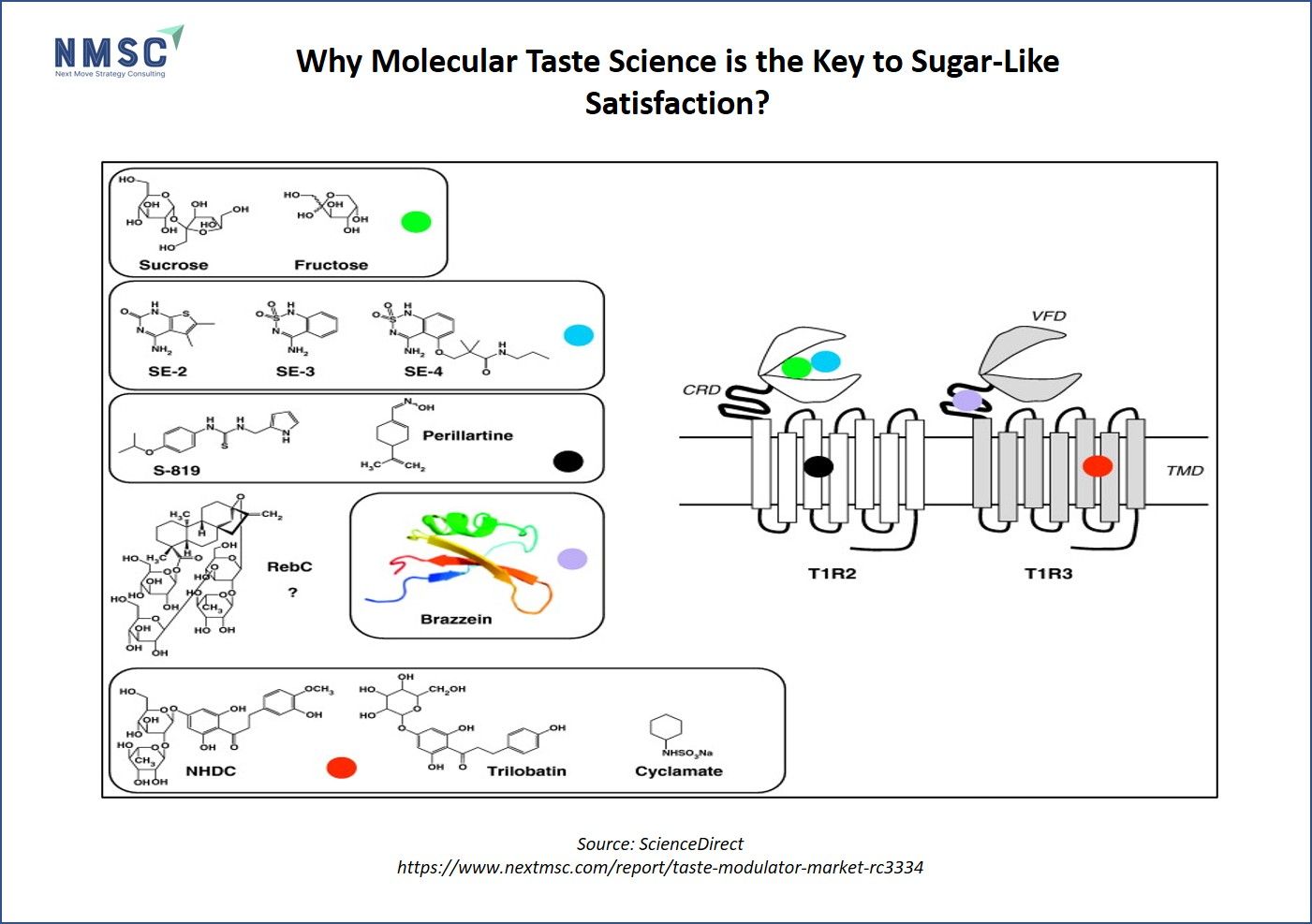
The molecular science of taste modulation, as illustrated in the provided cellular diagrams, reveals how specific receptors such as T1R2/T1R3 and T2R manage the complex biological signaling of sweetness and bitterness. By studying these pathways at a molecular level, companies can use receptor-based discovery to identify compounds that optimally activate sweet receptors while avoiding the "off-notes" such as metallic or licorice tastes often associated with high-intensity sweeteners. This scientific precision is the foundation for integrated platforms like OptiTaste and TastePrint, which do more than just substitute ingredients; they rebuild the entire "temporal profile" and sensory architecture of sugar by coordinating sweetness, flavor masking, and mouthfeel enhancement. As manufacturers invest in advanced R&D and precision fermentation to produce high-purity molecules like Reb M, they are effectively bridging the gap between health-conscious sugar reduction and the indulgent, "sugar-like" experience consumers demand.
Why Flavor Masking is Essential for the Functional Beverage Boom?
The success of functional beverages, such as energy drinks infused with Vitamin B12, depends heavily on masking technologies. Without these modulators, the consumer experience is marred by chemical aftertastes, regardless of the health benefits.
-
Modern modulation platforms use flavonoids to mask off-notes and enhance the sensory "top-notes" of a product.
-
Effective masking is essential for the commercial viability of fortified and "smart" foods.
What is the "Threefold Challenge" in Sugar Reduction?
Replacing sugar is not just about replacing sweetness; it is about replicating a complex "physical and sensory architecture." Sugar provides volume, browning, texture, and a specific "temporal profile" which refers to the quick onset, clean peak, and short finish of the taste.
Industry experts at dsm-firmenich identify three primary technical hurdles:
-
Temporal Matching: Many alternatives have a delayed onset or a lingering sweetness that feels "unnatural" to the palate.
-
Off-Note Suppression: High-intensity sweeteners can introduce unwanted licorice or metallic notes.
-
Functional Restoration: Removing sugar affects how a product behaves during baking or processing, often stripping away necessary moisture and stability.
To solve this, the industry is moving toward integrated solutions like "TastePrint." These systems do not rely on a single ingredient but instead combine sweeteners, flavor modulators, and texture optimizers to "rebuild" the full sensory curve of sugar.
Why Holistic Formulation is Superseding Simple Sugar Substitution?
A holistic approach to formulation ensures that low-sugar products do not feel like a compromise. By addressing texture and lingering tastes simultaneously, brands can navigate the rising pressure of global sugar taxes and front-of-pack labeling schemes.
-
Sugar reduction requires a multi-dimensional strategy to address taste, texture, and functionality.
-
Integrated systems like TastePrint are replacing simple ingredient substitution to achieve "sugar-like" satisfaction.
Why is Upcycling and Natural Sourcing Vital for Future Labels?
Consumer demand for "clean labels" is no longer just about what is not in the food; it is about how the ingredients are sourced. In 2025, there is a clear trend toward Upcycled Certified components. For example, HTBA’s modulation solutions leverage citrus flavonoids, aligning with ethical sourcing and sustainability trends.
This shift is a response to a more nutritionally literate consumer base. People are looking for transparency and familiar, plant-derived origins like monk fruit and stevia. Manufacturers are investing heavily HTBA recently completed a €25 million investment in R&D and a new state-of-the-art facility in Spain to ensure these natural solutions can be produced at scale.
Why the Circular Economy is Influencing Modern Taste Technology?
Sustainability is becoming a performance metric in the taste modulator market. Using side-streams from the citrus industry to create high-value flavor modulators satisfies both the "clean label" and "eco-friendly" demands of the modern market.
-
Sustainability and "clean label" requirements are driving the use of upcycled and natural origin modulators.
-
Major investments in production facilities are scaling the availability of these natural-origin solutions.
Leading Companies Shaping the Taste Modulator Industry
The taste modulator market is driven by a mix of global and specialized players delivering innovative flavor solutions. Key industry leaders include Dohler GmbH, ADM, Kerry Group plc, Firmenich International SA, Sensient Technologies Corporation, Icon Food Systems Inc., Carmi Flavor & Fragrance Co. Inc., International Flavors & Fragrances Inc., Flavorchem Corporation, Symrise, dsm-firmenich, The Flavor Factory, Inc., Synergy Taste, Corbion, and Givaudan. These companies are at the forefront of taste modulation, offering advanced solutions such as flavor masking, sweetness optimization, and clean label formulations to meet evolving consumer demands for healthier, low-sugar, and sustainable food and beverage products.
Next Steps for Manufacturers
-
Evaluate the move from single-ingredient sweeteners to integrated modulation systems to better mimic the sensory profile of sugar.
-
Incorporate masking technologies early in the R&D process for functional or fortified products to prevent consumer rejection due to bitterness.
-
Prioritize "Upcycled Certified" or natural-origin modulators to align with the growing consumer preference for sustainable and transparent labels.
-
Explore precision-fermented ingredients like Reb M to achieve cost-efficient sweetness without the metallic aftertastes of traditional stevia.
-
Utilize receptor-based discovery tools to screen for flavor compounds that optimally activate sweet receptors at a molecular level.
About the Author
 Sanyukta Deb
— Sanyukta Deb is Digital Marketing Team Lead at Next Move Strategy Consulting, where she has led content strategy and technical SEO for the firm's B2B market research publications for over 2 years. Her editorial process translates NextMSC's primary and secondary research — spanning technology, industrial, and consumer sectors — into commercial narratives, backed by search-intent, keyword, and competitive analysis. She brings 5 years of overall experience in digital marketing and content strategy.
Sanyukta Deb
— Sanyukta Deb is Digital Marketing Team Lead at Next Move Strategy Consulting, where she has led content strategy and technical SEO for the firm's B2B market research publications for over 2 years. Her editorial process translates NextMSC's primary and secondary research — spanning technology, industrial, and consumer sectors — into commercial narratives, backed by search-intent, keyword, and competitive analysis. She brings 5 years of overall experience in digital marketing and content strategy.
About the Reviewer
 Debashree Dey
— Debashree Dey is Assistant Manager at Next Move Strategy Consulting, where she supports cross-vertical market content and communications across diverse industries for 6 years. Her professional background includes senior content writing, communications, and published manuscript authorship, with experience developing audience-focused business narratives and maintaining clear, consistent messaging. Her role supports research-led content development and editorial quality across NextMSC publications.
Debashree Dey
— Debashree Dey is Assistant Manager at Next Move Strategy Consulting, where she supports cross-vertical market content and communications across diverse industries for 6 years. Her professional background includes senior content writing, communications, and published manuscript authorship, with experience developing audience-focused business narratives and maintaining clear, consistent messaging. Her role supports research-led content development and editorial quality across NextMSC publications.


















Add Comment