Divergent Technologies and Mach Industries Launch 3D-Printed Venom Strike Drone in 71 Days
Industry Insights from Next Move Strategy Consulting
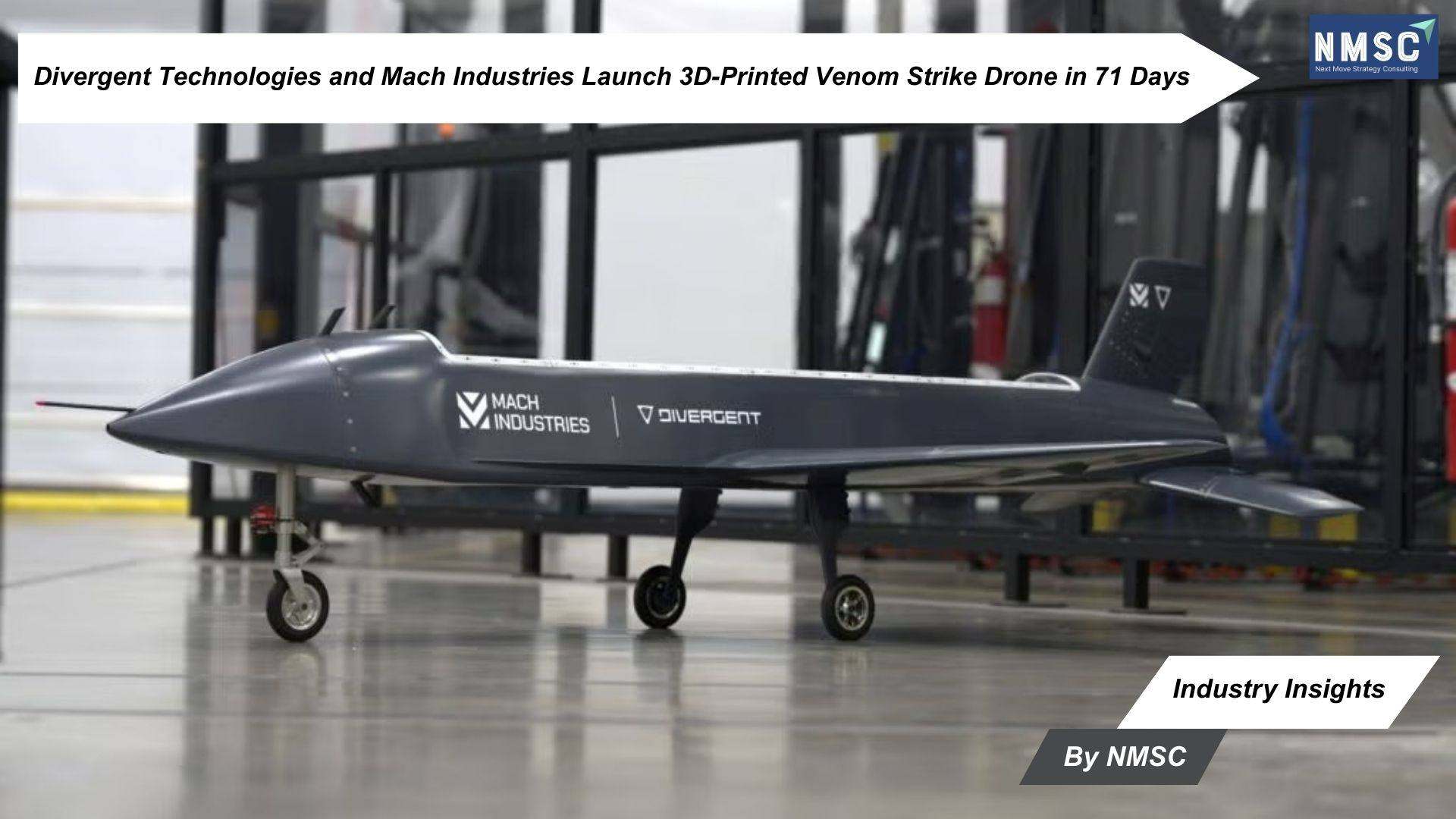
In a development that underscores the accelerating transformation of military aerospace manufacturing, Divergent Technologies has introduced the 3D-printed Venom strike drone, built and flown in just 71 days. Developed in collaboration with Mach Industries, the prototype demonstrates how digital design and additive manufacturing can dramatically compress traditional aerospace development timelines. The Venom aircraft serves as a flight demonstration platform, highlighting a production model that shifts away from tooling-intensive assembly toward software-defined manufacturing capable of rapid scaling.
From Digital Blueprint to Flight-Ready Platform
Mach Industries defined the aircraft’s baseline requirements and overall architecture, drawing upon existing avionics, simulation tools, and flight-proven control systems. The company adopted a modular, open-systems framework, enabling hardware and software development to evolve concurrently rather than sequentially. Divergent Technologies executed the structural design and production using its Adaptive Production System. Unlike conventional aerospace assembly, which often involves hundreds of discrete components joined through tooling-heavy processes, the Venom’s wings, fuselage, skins, and control surfaces were produced as monolithic additively manufactured structures. By 3D-printing large unified components rather than assembling numerous machined and fastened parts, the process reduced part count, eliminated tooling delays, and shortened the transition from digital model to physical airframe. The companies emphasised that aligning digital design, simulation, and production from the outset was central to achieving the accelerated timeline.
Enabling Scalable Drone Manufacturing
Traditional aerospace manufacturing is well suited for high-value platforms built in limited quantities, but less adaptable to systems intended for rapid, high-volume production. The additive manufacturing model underpinning Venom is designed to address that gap. Divergent Technologies states that its software-defined production system is designed to support manufacturing at scale, potentially enabling thousands of airframes annually. Because the process relies more on software-driven optimisation than fixed tooling, production lines can be reconfigured through digital updates rather than extensive physical retooling. This flexibility could enable faster variant development and upgrades without prolonged redesign phases. According to Mach Industries, the rapid development of Venom builds on its broader experience, noting that the company has taken four products from concept to flight test over the past 18 months through rapid iteration. The company argues that achieving speed to first flight must be matched by speed to scaled manufacturing to deliver operational value.
Strategic Context: Affordable Mass in Unmanned Systems
The Venom demonstration aligns with a broader US defence focus on “affordable mass” the ability to field larger numbers of lower-cost unmanned systems alongside high-end platforms. Recent conflicts have highlighted the growing operational impact of attritable drones, prompting increased emphasis on faster acquisition cycles and reduced unit costs. Although Venom remains a prototype with no disclosed details regarding operational deployment, range, or payload configuration, its significance lies in the production framework it represents. By integrating modular open systems, additive manufacturing, and parallel hardware-software development, the project presents an alternative path to traditional aerospace industrial models.
Next Move Strategy Consulting’s Viewpoint
According to Next Move Strategy Consulting’s view, the Venom strike Drone Market programme reflects a broader shift toward digitally integrated manufacturing ecosystems in defence aerospace. The firm notes that compressing development timelines while enabling scalable production could reshape procurement strategies, particularly for unmanned systems where adaptability and speed are increasingly critical. As global defence establishments prioritise rapid capability deployment, digital manufacturing platforms like Divergent’s Adaptive Production System may play a growing role in meeting operational demands without the long industrial preparation cycles characteristic of conventional aerospace production.
Redefining the Production Model for Unmanned Systems
The unveiling of the Venom strike drone signals more than a rapid prototype milestone. It illustrates how additive manufacturing and digitally driven design can converge to challenge established aerospace production norms.
While the aircraft itself remains in demonstration phase, the underlying manufacturing approach may represent a pivotal step toward faster, more flexible, and potentially scalable unmanned system development in the years ahead.
Source: Aerospace Global News
Prepared by: Next Move Strategy Consulting
About the Author
 Sanyukta Deb
— Sanyukta Deb is Digital Marketing Team Lead at Next Move Strategy Consulting, where she has led content strategy and technical SEO for the firm's B2B market research publications for over 2 years. Her editorial process translates NextMSC's primary and secondary research — spanning technology, industrial, and consumer sectors — into commercial narratives, backed by search-intent, keyword, and competitive analysis. She brings 5 years of overall experience in digital marketing and content strategy.
Sanyukta Deb
— Sanyukta Deb is Digital Marketing Team Lead at Next Move Strategy Consulting, where she has led content strategy and technical SEO for the firm's B2B market research publications for over 2 years. Her editorial process translates NextMSC's primary and secondary research — spanning technology, industrial, and consumer sectors — into commercial narratives, backed by search-intent, keyword, and competitive analysis. She brings 5 years of overall experience in digital marketing and content strategy.
About the Reviewer
 Debashree Dey
— Debashree Dey is Assistant Manager at Next Move Strategy Consulting, where she supports cross-vertical market content and communications across diverse industries for 6 years. Her professional background includes senior content writing, communications, and published manuscript authorship, with experience developing audience-focused business narratives and maintaining clear, consistent messaging. Her role supports research-led content development and editorial quality across NextMSC publications.
Debashree Dey
— Debashree Dey is Assistant Manager at Next Move Strategy Consulting, where she supports cross-vertical market content and communications across diverse industries for 6 years. Her professional background includes senior content writing, communications, and published manuscript authorship, with experience developing audience-focused business narratives and maintaining clear, consistent messaging. Her role supports research-led content development and editorial quality across NextMSC publications.

















Add Comment