IEA Urges Export Credit Support to Scale Green Hydrogen
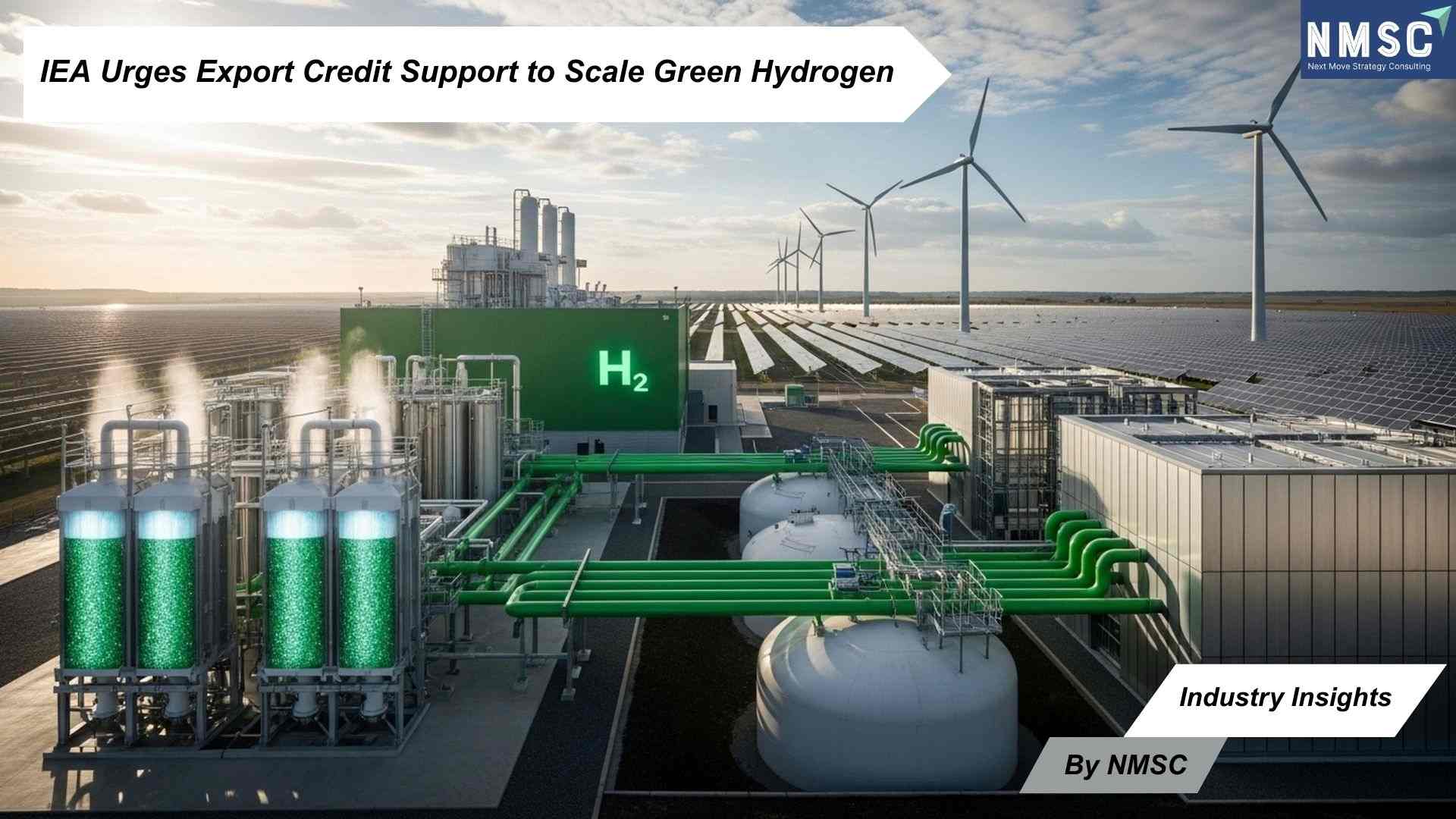
Industry Insights from Next Move Strategy Consulting
Governments are being urged to expand export credit and concessional lending for the hydrogen sector to bridge the “cost gap” between fossil fuel and low-emissions hydrogen production, according to the International Energy Agency (IEA).
Hydrogen Demand Grows, but Low-Emissions Production Lags
In a February 10 report, the IEA noted that global hydrogen demand rose by approximately 2% since 2023, largely driven by refineries, chemical production, and the iron and steel sector. Despite significant private sector investment and ambitious governmental targets, most hydrogen used in these industries continues to be produced from fossil fuels. “This has fostered a gloomier outlook among government and industry, feeding fears that the sector has stalled and concerns that hydrogen has simply gone through another ‘hype’ cycle,” the report stated. Experts have also highlighted the challenge of generating hydrogen from renewable sources, which requires vast electricity inputs and substantial infrastructure upgrades.
Progress Amid Challenges
However, the IEA emphasized that low-emissions hydrogen is advancing, albeit at a slower pace than early 2020s expectations. Last year, production reached an estimated 1 megatonne double the 2020 figure aligning its growth trajectory with other clean energy sources. Furthermore, analysis of announced projects suggests an additional 6 megatonnes could become operational by 2030. The key barrier remains cost. Low-emissions hydrogen is more expensive than conventional hydrogen derived from natural gas or coal, and investment is hindered by uncertainty over stable long-term demand. While government measures to stimulate demand have yielded mixed results, the IEA stressed that policy interventions could help overcome these challenges.
Policy Measures and Investment Support
The IEA recommended that governments provide targeted support to reduce investment risk and close the cost gap, including grants, subsidies, loan guarantees, concessional loans, export credit facilities, and public equity investments. Notably, the export credit agency sector has already shown activity in green hydrogen projects. For example, in October, Danish agency EIFO provided a £16.5 million guarantee for a £27 million Barclays loan to GeoPura, supporting a facility in Lincoln, UK. Similarly, Dutch agency Atradius DSB backed a green ammonia and hydrogen project in Morocco in 2022. Despite these advances, some projects have encountered setbacks. In 2024, H2 Green Steel (now Stegra) secured a loan backed by Euler Hermes for a Swedish steel manufacturing project incorporating green hydrogen, but the company subsequently faced financial difficulties.
Boosting Demand Through Policy Action
Beyond financing, the IEA urged governments to bolster hydrogen adoption through quotas, mandates, carbon contracts for difference, and public procurement programs in heavy industries. Global organizations, including the World Trade Organization and the International Renewable Energy Agency, have also called for reforms to facilitate rapid green hydrogen scale-up and trade in related equipment and services.
Next Move Strategy Consulting’s Viewpoint
According to Next Move Strategy Consulting’s view, the IEA’s recommendations highlight the crucial role of government-backed financial instruments and policy frameworks in enabling Green Hydrogen Market growth. While progress is being made, closing the cost gap and securing predictable long-term demand will be critical to achieving large-scale deployment and positioning hydrogen as a cornerstone of the low-emissions energy transition.
Redefining the Path for Green Hydrogen
As nations pursue decarbonization targets, the IEA’s guidance underscores the need for coordinated policy and financial support to unlock the potential of low-emissions hydrogen. With strategic interventions, the sector can move beyond early hype cycles and establish a sustainable foundation for global energy transformation.
Source: Global Trade Review
Prepared by: Next Move Strategy Consulting
About the Author
 Sanyukta Deb
— Sanyukta Deb is Digital Marketing Team Lead at Next Move Strategy Consulting, where she has led content strategy and technical SEO for the firm's B2B market research publications for over 2 years. Her editorial process translates NextMSC's primary and secondary research — spanning technology, industrial, and consumer sectors — into commercial narratives, backed by search-intent, keyword, and competitive analysis. She brings 5 years of overall experience in digital marketing and content strategy.
Sanyukta Deb
— Sanyukta Deb is Digital Marketing Team Lead at Next Move Strategy Consulting, where she has led content strategy and technical SEO for the firm's B2B market research publications for over 2 years. Her editorial process translates NextMSC's primary and secondary research — spanning technology, industrial, and consumer sectors — into commercial narratives, backed by search-intent, keyword, and competitive analysis. She brings 5 years of overall experience in digital marketing and content strategy.
About the Reviewer
 Debashree Dey
— Debashree Dey is Assistant Manager at Next Move Strategy Consulting, where she supports cross-vertical market content and communications across diverse industries for 6 years. Her professional background includes senior content writing, communications, and published manuscript authorship, with experience developing audience-focused business narratives and maintaining clear, consistent messaging. Her role supports research-led content development and editorial quality across NextMSC publications.
Debashree Dey
— Debashree Dey is Assistant Manager at Next Move Strategy Consulting, where she supports cross-vertical market content and communications across diverse industries for 6 years. Her professional background includes senior content writing, communications, and published manuscript authorship, with experience developing audience-focused business narratives and maintaining clear, consistent messaging. Her role supports research-led content development and editorial quality across NextMSC publications.
















Add Comment