Trump Considers New Tariffs on Chemicals Sector USA
Industry Insights from Next Move Strategy Consulting
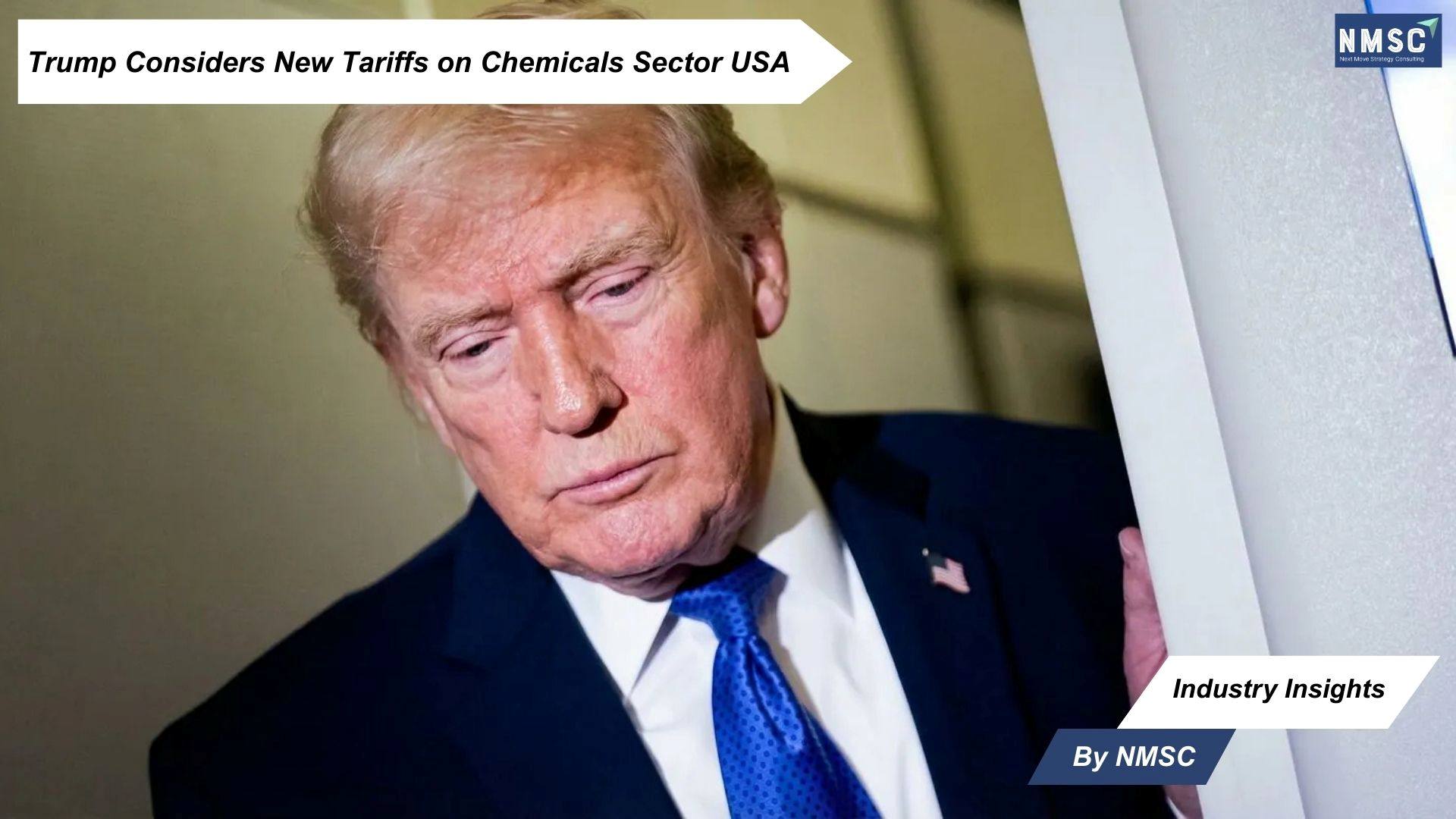
In a renewed escalation of trade policy measures, US President Donald Trump is evaluating a fresh round of national security tariffs targeting multiple industrial sectors, including industrial chemicals. The move follows a recent Supreme Court decision that ruled a significant portion of his earlier tariff actions unlawful, prompting a recalibration of strategy under alternative legal provisions. The proposed duties would affect six sectors, including large batteries, cast iron and iron fittings, plastic pipes, industrial chemicals, and equipment supporting power grids and telecommunications infrastructure. The development signals a potential shift in trade enforcement mechanisms while maintaining a strong national security narrative.
Legal Framework Behind the Proposed Measures
The new tariffs are being considered under Section 232 of the Trade Expansion Act of 1962, a provision that authorizes the president to restrict imports deemed a threat to national security. This mechanism has historically been used to justify sector-specific trade interventions. Importantly, these proposed tariffs would be separate from additional trade actions announced following last week’s court ruling. The Supreme Court had struck down tariffs previously imposed under the International Emergency Economic Powers Act, narrowing the scope of executive authority under that statute.
By leveraging Section 232, the administration appears to be pursuing a legally distinct pathway to sustain trade restrictions across strategic industries, including chemicals.
Historical Context: Prior Use of Section 232
President Trump has previously invoked Section 232 to impose tariffs on steel, aluminum, copper, and auto parts. Those measures remain in place and were not affected by the Supreme Court’s ruling.
Market response across Asia-Pacific equities has been mixed, reflecting investor caution. Traders are weighing the renewed tariff signals against broader concerns, including the potential impact of artificial intelligence advancements on software companies. The combination of trade policy uncertainty and technology disruption continues to influence global sentiment.
Escalation Through Additional Trade Authority
Further intensifying the situation, Trump stated on Truth Social that countries attempting to “play games” with the Supreme Court’s ruling would face substantially higher tariffs. Following the court’s decision invalidating tariffs under the International Emergency Economic Powers Act, the administration imposed a 15 percent global tariff under Section 122 of the Trade Act of 1974. These tariffs can remain effective for up to 150 days without congressional approval, adding another layer of short-term trade intervention.
Implications for the Chemicals Market
The inclusion of industrial chemicals within the proposed tariff list places the chemicals sector at the center of national security-driven trade scrutiny. As chemicals serve as foundational inputs across manufacturing, infrastructure, and energy systems, tariff actions in this segment may influence cost structures and supply chain decisions within multiple downstream industries.
Next Move Strategy Consulting’s View
According to Next Move Strategy Consulting, the renewed consideration of Section 232 tariffs on industrial chemicals introduces a significant inflection point for the Chemical Market. As chemicals are critical inputs across infrastructure, energy systems, manufacturing, and telecommunications equipment, trade-related cost pressures may ripple through multiple industrial value chains.
The evolving tariff framework signals heightened regulatory and geopolitical sensitivity surrounding chemical imports. In response, industry participants may increasingly prioritize supply chain realignment, domestic capacity strengthening, and strategic sourcing diversification to mitigate exposure to policy-driven volatility. Over the near term, pricing dynamics and procurement strategies are expected to reflect a more cautious and risk-adjusted operating environment within the Chemical Market.
Source: NewsBytes
Prepared by: Next Move Strategy Consulting
About the Author
 Sanyukta Deb
— Sanyukta Deb is Digital Marketing Team Lead at Next Move Strategy Consulting, where she has led content strategy and technical SEO for the firm's B2B market research publications for over 2 years. Her editorial process translates NextMSC's primary and secondary research — spanning technology, industrial, and consumer sectors — into commercial narratives, backed by search-intent, keyword, and competitive analysis. She brings 5 years of overall experience in digital marketing and content strategy.
Sanyukta Deb
— Sanyukta Deb is Digital Marketing Team Lead at Next Move Strategy Consulting, where she has led content strategy and technical SEO for the firm's B2B market research publications for over 2 years. Her editorial process translates NextMSC's primary and secondary research — spanning technology, industrial, and consumer sectors — into commercial narratives, backed by search-intent, keyword, and competitive analysis. She brings 5 years of overall experience in digital marketing and content strategy.
About the Reviewer
 Debashree Dey
— Debashree Dey is Assistant Manager at Next Move Strategy Consulting, where she supports cross-vertical market content and communications across diverse industries for 6 years. Her professional background includes senior content writing, communications, and published manuscript authorship, with experience developing audience-focused business narratives and maintaining clear, consistent messaging. Her role supports research-led content development and editorial quality across NextMSC publications.
Debashree Dey
— Debashree Dey is Assistant Manager at Next Move Strategy Consulting, where she supports cross-vertical market content and communications across diverse industries for 6 years. Her professional background includes senior content writing, communications, and published manuscript authorship, with experience developing audience-focused business narratives and maintaining clear, consistent messaging. Her role supports research-led content development and editorial quality across NextMSC publications.

















Add Comment