Advanced Driver Assistance Systems (ADAS) Market Size, Share, Growth & Forecast by Component (Hardware: Camera), By System Function (Adaptive Cruise Control, Lane Departure Warning, Lane Keep Assist, Blind Spot Detection, Parking Assist), By Vehicle Type (Passenger Car, Light Commercial Vehicle), By Automation Level (Level 0, Level 1, Level 2), By Revenue Model (Unit Sale), By Sales Channel (Original Equipment, Aftermarket Retrofit) — Global Analysis 2025–2035
Industry: Automotive & Transportation | Publishing Date: July 4, 2026 | Last Updated: September 30, 2026 | No of Pages: N/A | No. of Tables: N/A | No. of Figures: N/A | Format: PDF | Report Code: AT4947
What Is the Advanced Driver Assistance Systems (ADAS) Market Size?
The global Advanced Driver Assistance Systems (ADAS) Market was valued at USD 34.2 billion in 2025 and is expected to reach USD 38.6 billion in 2026. Sustained regulatory mandates for vehicle safety, accelerating deployment of sensor fusion architectures, and growing consumer demand for intelligent mobility are projected to propel the Advanced Driver Assistance Systems (ADAS) Market to USD 112.6 billion by 2035, advancing at a CAGR of 12.7% from 2026 to 2035. Key growth drivers include the global proliferation of mandatory ADAS fitment regulations, increasing integration of LiDAR and imaging radar, widening adoption of Level 2 and Level 2 Plus automation in passenger vehicles, and expansion of ADAS into commercial fleets and two-wheelers.
|
Parameters |
Details |
|
Market Size in 2025 |
USD 34.2 Billion |
|
Market Size in 2026 |
USD 38.6 Billion |
|
Revenue Forecast in 2035 |
USD 112.6 Billion |
|
Growth Rate |
CAGR of 12.7% from 2026 to 2035 |
|
Analysis Period |
2025–2035 |
|
Base Year Considered |
2025 |
|
Forecast Period |
2026–2035 |
|
Market Size Estimation |
Billion USD |
|
Companies Profiled |
20 |
|
Countries Covered |
33 |
|
Market Share |
Top 10 |
Advanced Driver Assistance Systems (ADAS) Market Overview
What Is the Advanced Driver Assistance Systems (ADAS) Market?
The Advanced Driver Assistance Systems (ADAS) Market encompasses hardware, software, and service components that collectively perceive the driving environment, interpret real-time data, and deliver safety or comfort interventions to the driver or vehicle systems. ADAS spans sensing hardware such as cameras, radar, LiDAR, and ultrasonic sensors, computation platforms including domain controllers and sensor fusion ECUs; and software layers covering perception, planning, localization, and human-machine interface. These systems collectively underpin the transition toward higher levels of vehicle automation, reducing road fatalities and enabling connected mobility ecosystems.
How Has the Advanced Driver Assistance Systems (ADAS) Market Evolved?
The Advanced Driver Assistance Systems (ADAS) Market has undergone three distinct technology transformation phases. The initial phase centered on discrete safety features such as anti-lock braking and electronic stability control mandated by regulators in the 1990s and 2000s. The second phase introduced sensor-integrated functions including adaptive cruise control, lane departure warning, and automatic emergency braking. NMSC's analysis indicates that the current phase is defined by centralized domain controller architectures, multi-sensor fusion, and over-the-air software update capabilities that enable continuous feature expansion post-vehicle production.
How Do Regulations Influence the Advanced Driver Assistance Systems (ADAS) Market?
Regulatory mandates have become the most powerful structural force shaping the Advanced Driver Assistance Systems (ADAS) Market. The United Nations Economic Commission for Europe Regulation 152 mandating automatic emergency braking took effect for new passenger cars in 2022, expanding to all new vehicles from 2024. The European Union's General Safety Regulation requires mandatory fitment of intelligent speed assistance, lane keeping, emergency stop signals, and driver drowsiness detection across all new vehicles sold in the EU from July 2024. These binding requirements are compelling automakers worldwide to embed ADAS components across all vehicle price segments.
How Is Technology Adoption Expanding Across the Advanced Driver Assistance Systems (ADAS) Market?
Technology adoption across the Advanced Driver Assistance Systems (ADAS) Market is accelerating as automotive OEMs transition from discrete ECU architectures to centralized zone or domain controller designs. Through our market assessment, we observed that the shift toward ADAS Domain Controllers and Sensor Fusion ECUs is enabling broader software-defined vehicle capabilities, where previously hardware-bound features can now be updated remotely. Adoption of solid-state LiDAR, high-resolution imaging radar, and AI-driven perception software is extending ADAS functionality into urban and adverse-weather driving scenarios, while V2X module integration enables infrastructure-cooperative safety features.
|
Key Takeaways |
|
By component, Hardware held the largest share of the Advanced Driver Assistance Systems (ADAS) Market at USD 24.1 billion in 2025. Within hardware, Camera remains the dominant sensing sub-segment driven by the low-cost, high-resolution capabilities of front and surround view cameras mandated across regulatory regimes worldwide. |
|
Software is the fastest-growing primary segment in the Advanced Driver Assistance Systems (ADAS) Market at a CAGR of 16.2% from 2026 to 2035, advancing from USD 5.8 billion in 2025 to USD 24.6 billion by 2035, fueled by demand for AI-native perception, sensor fusion, and over-the-air update platforms. |
|
By system function, Automatic Emergency Braking (AEB) commanded the largest functional revenue share at USD 7.2 billion in 2025, driven by mandatory regulatory fitment requirements across the European Union, United States, Japan, and South Korea spanning passenger and commercial vehicles. |
|
Driver Monitoring System (DMS) is the fastest-growing system function in the Advanced Driver Assistance Systems (ADAS) Market at a CAGR of 17.8% from 2026 to 2035, propelled by EU General Safety Regulation mandates requiring DMS in all new vehicle categories from 2024 onward. |
|
By vehicle type, Passenger Cars dominated the Advanced Driver Assistance Systems (ADAS) Market with USD 21.6 billion in 2025, reflecting the highest absolute volume of ADAS-equipped vehicles globally and the broadest regulatory mandate coverage across major automotive markets. |
|
Two-Wheelers represent the fastest-growing vehicle type segment in the Advanced Driver Assistance Systems (ADAS) Market at a CAGR of 19.4% from 2026 to 2035, driven by emerging mandates in Europe and Asia for cornering ABS, blind spot detection, and forward collision warning on powered two-wheelers. |
|
By automation level, Level 2 systems led the Advanced Driver Assistance Systems (ADAS) Market at USD 16.4 billion in 2025, representing the most commercially mature automation tier with widespread fitment across passenger car platforms from premium to entry-level segments. |
|
Level 2 Plus is the fastest-growing automation tier in the Advanced Driver Assistance Systems (ADAS) Market at a CAGR of 18.3% from 2026 to 2035, as automakers such as Mercedes-Benz, Tesla, and General Motors commercialize hands-free highway driving capabilities globally. |
|
By revenue model, Unit Sale is the dominant monetization structure in the Advanced Driver Assistance Systems (ADAS) Market at USD 27.8 billion in 2025, reflecting the hardware-centric nature of the value chain where sensors, compute platforms, and actuators are priced on per-vehicle installation basis. |
|
Subscription-based revenue models represent the fastest-growing monetization category in the Advanced Driver Assistance Systems (ADAS) Market at a CAGR of 22.6% from 2026 to 2035, as OEMs including BMW, Mercedes-Benz, and GM expand pay-per-feature software activation programs. |
|
By sales channel, Original Equipment (OE) accounted for USD 31.4 billion in 2025, representing over 90% of Advanced Driver Assistance Systems (ADAS) Market revenue, reflecting the deep integration of ADAS components into vehicle production lines at the assembly stage. |
|
North America held the largest regional share of the Advanced Driver Assistance Systems (ADAS) Market at USD 11.2 billion in 2025, projected to reach USD 34.8 billion by 2035 at a CAGR of 12.0%, anchored by NHTSA safety mandates, strong consumer preference for safety technology, and the presence of leading ADAS chipmakers including NVIDIA and Qualcomm. |
|
Asia-Pacific is the fastest-growing major region in the Advanced Driver Assistance Systems (ADAS) Market at a CAGR of 14.8% from 2026 to 2035, driven by China's new energy vehicle ADAS integration, India's BharOS vehicle safety standards rollout, and South Korea's advanced automotive electronics ecosystem. |
|
China is the single largest country market in the Advanced Driver Assistance Systems (ADAS) Market within Asia-Pacific, valued at USD 5.8 billion in 2025, representing the world's largest new vehicle market and a regulatory environment increasingly mandating ADAS fitment across electric and intelligent vehicle categories. |
|
India is the fastest-growing national market for Advanced Driver Assistance Systems (ADAS) at a CAGR of 22.4% from 2026 to 2035, propelled by Bharat New Car Assessment Programme (BNCAP) rollout from 2023 and government safety mandates requiring ABS, airbags, and ADAS-ready architectures in new passenger vehicles. |
Key Emerging Trends in the Advanced Driver Assistance Systems (ADAS) Market
How Is the Shift Toward Centralized Domain Controller Architecture Reshaping the Advanced Driver Assistance Systems (ADAS) Market?
The transition from distributed ECU architectures to centralized ADAS Domain Controllers is fundamentally restructuring the Advanced Driver Assistance Systems (ADAS) Market supply chain. Our findings suggest that automotive OEMs are consolidating sensor processing, perception, and planning functions onto high-performance SoC platforms from NVIDIA (DRIVE Thor), Qualcomm (Snapdragon Ride), and NXP. This shift reduces the per-vehicle ECU count, lowers wiring harness weight, and enables over-the-air software updates. For Tier 1 suppliers, it demands significant software capability investments and repositions value creation away from discrete hardware modules toward integrated compute-plus-software stacks.
How Is Imaging Radar Adoption Transforming Sensor Architecture in the Advanced Driver Assistance Systems (ADAS) Market?
Imaging radar is emerging as a transformative sensing technology within the Advanced Driver Assistance Systems (ADAS) Market, offering high-resolution 3D point cloud generation at a fraction of LiDAR cost and with superior all-weather performance. Based on NMSC's research, we found that automotive radar chipmakers including Infineon, NXP, and Texas Instruments are releasing 4D imaging radar chipsets that provide velocity and elevation data previously unavailable from conventional 2D radar. Continental, Valeo, and Bosch have all announced production-ready imaging radar modules for Level 2 Plus and Level 3 vehicles, indicating rapid transition from developmental to deployment phase within the ADAS sensing ecosystem.
What Role Is Solid-State LiDAR Playing in the Advanced Driver Assistance Systems (ADAS) Market Evolution?
Solid-state LiDAR is progressively replacing mechanical LiDAR in automotive ADAS applications due to its compact form factor, lower manufacturing cost, and higher vibration resistance required for production vehicle integration. Our analysis shows that companies such as Valeo's SCALA series and Innoviz have transitioned from prototype to series production, with Valeo confirming LiDAR supply agreements with global OEMs for Level 3 autonomous highway driving programs. The ability to embed solid-state LiDAR flush with vehicle body panels enables aesthetic integration that was impossible with rotating mechanical units, expanding the addressable vehicle segment beyond premium-only applications in the Advanced Driver Assistance Systems (ADAS) Market.
How Is Software-Defined Vehicle Transformation Creating New Revenue Opportunities in the Advanced Driver Assistance Systems (ADAS) Market?
The software-defined vehicle paradigm is creating an entirely new revenue layer within the Advanced Driver Assistance Systems (ADAS) Market by decoupling feature activation from hardware installation. Based on our market evaluation, we noticed that automakers including BMW, Mercedes-Benz, and General Motors now offer subscription-based ADAS feature unlocking, where hardware is pre-installed and software capabilities are activated remotely post-purchase. This model transforms the Advanced Driver Assistance Systems (ADAS) Market from a one-time per-unit hardware revenue event into a recurring software and services revenue stream, fundamentally altering the lifetime value economics of ADAS content per vehicle for both OEMs and Tier 1 suppliers.
Regulatory Framework Impacting The Adas Market
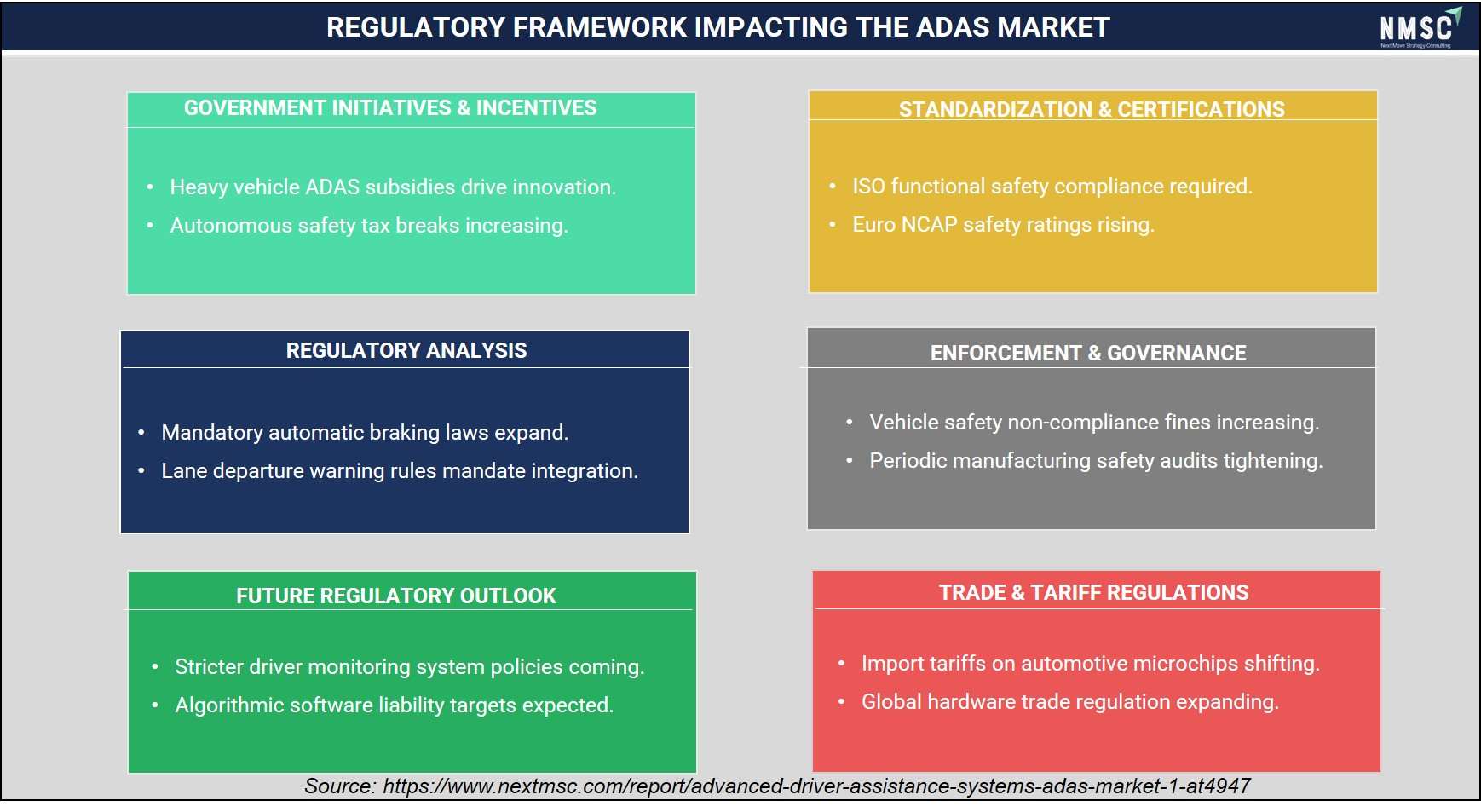
The Advanced Driver Assistance Systems (ADAS) market is significantly influenced by evolving regulatory frameworks worldwide. Governments are promoting ADAS adoption through subsidies, tax incentives, and vehicle safety initiatives, while stringent regulations mandate features such as Automatic Emergency Braking (AEB) and Lane Departure Warning (LDW). Compliance with standards including ISO functional safety requirements and Euro NCAP ratings is becoming increasingly important. Rising enforcement measures, stricter audits, and emerging regulations around driver monitoring systems, software accountability, and global trade policies are expected to further accelerate ADAS deployment and innovation across the automotive industry.
What Are the Key Market Drivers, Breakthroughs, and Investment Opportunities that Will Shape the Advanced Driver Assistance Systems (ADAS) Market Industry in the Next Decade?
|
Drivers / Trends / Restraints |
(+/-) % Impact on CAGR Forecast |
Geographic Relevance |
Impact Timeline |
|
Mandatory EU General Safety Regulation ADAS Fitment |
+2.1% |
Europe, Global OEM cascades |
2024–2030 |
|
NHTSA AEB Mandate for All New Passenger Vehicles |
+1.6% |
North America, Global |
2025–2029 |
|
China NEV ADAS Integration Acceleration |
+1.8% |
Asia-Pacific (China-led) |
2025–2035 |
|
Solid-State LiDAR Cost Reduction Curve |
Global (premiums first, mid-market by 2028) |
2026–2035 |
|
|
Software-Defined Vehicle Subscription Revenue Model |
+1.9% |
North America, Europe, South Korea |
2025–2035 |
|
High Semiconductor Content Cost Inflation |
-1.3% |
Global |
Ongoing |
|
Cybersecurity Compliance Complexity |
-0.8% |
Europe, North America |
2025–2030 |
|
Consumer Trust Gap for Higher Automation Levels |
-0.6% |
All regions |
Ongoing |
|
Two-Wheeler ADAS Expansion |
+1.2% |
Europe, Asia-Pacific |
2026–2035 |
|
V2X-Integrated Infrastructure Safety |
+0.9% |
China, Europe, North America |
2027–2035 |
|
Driver Monitoring System Regulatory Mandates |
+1.1% |
Europe, Japan, Global cascades |
2024–2030 |
|
Aftermarket ADAS Retrofit Growth |
+0.7% |
Asia-Pacific, Latin America, MEA |
2026–2035 |
What Are the Growth Drivers of the Advanced Driver Assistance Systems (ADAS) Market?
How Are Binding Global Safety Mandates Accelerating the Advanced Driver Assistance Systems (ADAS) Market?
Binding regulatory mandates represent the most powerful and durable demand driver for the Advanced Driver Assistance Systems (ADAS) Market worldwide. The European Union's General Safety Regulation, which entered into force in July 2022 and became mandatory for all new vehicle categories in July 2024, requires fitment of automatic emergency braking, intelligent speed assistance, lane keeping, emergency stop signals, driver drowsiness detection, and advanced distraction warnings. The United Nations Economic Commission for Europe (UNECE) published Regulation No. 152 mandating AEB as standard, with signatory nations binding domestic market uptake. These regulatory requirements are structurally expanding the addressable market for ADAS hardware and software across every vehicle segment.
How Is the Global Electric and New Energy Vehicle Boom Driving ADAS Market Growth?
The rapid global expansion of electric and new energy vehicles is providing a powerful secondary demand catalyst for the Advanced Driver Assistance Systems (ADAS) Market. From our research, we found that EV platforms are purpose-built for software-defined architectures, making ADAS domain controller integration structurally simpler than retrofit into legacy internal combustion engine platforms. China's Ministry of Industry and Information Technology published guidelines in 2021 and updated in 2023 requiring intelligent connected vehicle safety standards that mandate ADAS features across qualifying vehicle categories. The global EV fleet reached over 40 million vehicles in operation by 2024, each representing a significantly higher ADAS content opportunity than comparable ICE counterparts.
How Is Semiconductor Technology Advancement Unlocking New ADAS Capabilities and Market Opportunities?
Advances in automotive-grade semiconductor technology are a key enabler of Advanced Driver Assistance Systems (ADAS) Market expansion by delivering processing performance improvements that make previously infeasible AI-driven perception algorithms commercially deployable. NVIDIA's DRIVE Thor system-on-chip, released for automotive qualification in 2024, delivers 2000 TOPS (Tera Operations Per Second) of AI compute, enabling multi-sensor fusion and redundant perception required for Level 3 and Level 4 automation at production-feasible power envelopes. Qualcomm's Snapdragon Ride Gen 2 platform similarly targets integrated ADAS and infotainment on a single compute domain. Renesas, NXP, and Infineon are expanding their automotive microcontroller portfolios to address safety MCU requirements under ISO 26262 ASIL-D standards.
What Are the Growth Inhibitors of the Advanced Driver Assistance Systems (ADAS) Market?
How Is Semiconductor Cost Inflation and Supply Chain Vulnerability Constraining the Advanced Driver Assistance Systems (ADAS) Market?
Semiconductor content cost per vehicle for ADAS-equipped platforms has risen substantially, creating margin pressure for OEMs and adoption barriers for entry-level vehicle segments. The U.S. CHIPS and Science Act, signed in 2022, allocates USD 52 billion to domestic semiconductor manufacturing and research, reflecting the strategic recognition of supply chain fragility highlighted by the 2021 to 2022 global chip shortage that curtailed vehicle production worldwide. Automotive-grade semiconductors require long qualification cycles of two to four years, creating inelastic supply responses to demand surges. This structural vulnerability constrains the pace of ADAS content escalation in cost-sensitive vehicle segments across emerging markets within the Advanced Driver Assistance Systems (ADAS) Market.
How Are Cybersecurity Compliance Requirements Creating Headwinds for Advanced Driver Assistance Systems (ADAS) Market Participants?
As Advanced Driver Assistance Systems (ADAS) platforms incorporate over-the-air update capabilities, V2X connectivity, and cloud-connected features, cybersecurity compliance obligations are adding material engineering cost and program timeline risk. The United Nations Economic Commission for Europe (UNECE) WP.29 Regulation No. 155 on Cyber Security Management Systems and Regulation No. 156 on Software Update Management Systems became mandatory for all new vehicle types in Europe and Japan from July 2022 and for all new vehicles from July 2024. Compliance with these regulations requires OEMs and Tier 1 suppliers to implement systematic threat analysis, vulnerability management, and incident response programs across the entire ADAS system lifecycle.
What Are the Growth Opportunities in the Advanced Driver Assistance Systems (ADAS) Market?
How Is Two-Wheeler ADAS Adoption Creating a Structurally New Market Opportunity?
The integration of ADAS features into powered two-wheelers represents a nascent but structurally significant opportunity for the Advanced Driver Assistance Systems (ADAS) Market. The European Commission is actively developing type-approval frameworks for advanced braking and stability systems on two-wheelers, while the UN Regulation No. 78 on braking systems for motorcycles is being updated to address ABS and electronic brake distribution. The European Transport Safety Council has documented that powered two-wheelers represent approximately 1% of vehicle kilometers traveled in Europe but account for approximately 20% of road deaths, creating a powerful regulatory imperative for ADAS intervention. India's two-wheeler market, the world's largest by volume, presents enormous addressable opportunity as BNASV safety standards evolve.
How Does Aftermarket Retrofit ADAS Create an Incremental Revenue Stream in the Advanced Driver Assistance Systems (ADAS) Market?
The global installed base of vehicles without factory-fitted ADAS spans hundreds of millions of units, creating a large addressable aftermarket retrofit opportunity within the Advanced Driver Assistance Systems (ADAS) Market. Government fleet safety programs are catalyzing this demand; the U.S. Federal Motor Carrier Safety Administration mandates electronic logging devices and is advancing rulemaking on collision mitigation systems for the commercial trucking fleet. Australia's Intelligent Access Program and the National Road Safety Strategy 2021 to 2030 identify retrofitted safety technology as a priority intervention for older commercial vehicle fleets. Mobileye's aftermarket Shield+ system and similar retrofit forward-collision-warning solutions are addressing this market gap with scalable camera-based platforms.
How Is V2X-Integrated Infrastructure Cooperation Opening a New Frontier in the Advanced Driver Assistance Systems (ADAS) Market?
Vehicle-to-Everything communication integration into ADAS platforms is creating a new functional category within the Advanced Driver Assistance Systems (ADAS) Market that extends perception beyond the vehicle's own sensor range. The U.S. Department of Transportation's Connected Vehicle program and the European C-Roads Platform are funding pilot deployments of V2X infrastructure at intersections, work zones, and emergency vehicle corridors. China's Ministry of Industry and Information Technology has designated C-V2X as the mandatory standard for intelligent connected vehicles, with V2X pilot zones operational across Shanghai, Guangzhou, and Changsha. V2X-based alert systems within the ADAS functional taxonomy represent a high-growth emerging sub-segment with minimal direct competition from established sensor-based incumbents.
Swot Analysis Of The Adas Market
The SWOT analysis of the Advanced Driver Assistance Systems (ADAS) market highlights strong growth drivers and emerging challenges. The market's primary strength lies in the increasing integration of advanced safety technologies across passenger and commercial vehicles, supported by rising consumer awareness and regulatory mandates. However, high development, testing, and component manufacturing costs remain a significant weakness. Growing demand for autonomous and semi-autonomous driving technologies presents substantial opportunities for market expansion and innovation. At the same time, stringent safety regulations, certification requirements, and compliance standards pose challenges that manufacturers must address to maintain competitiveness and ensure market access.
How Is the Advanced Driver Assistance Systems (ADAS) Market Segmented in This Report, and What Are the Key Insights from the Segmentation Analysis?
How Does Component-Level Segmentation Define the Structural Architecture of the Advanced Driver Assistance Systems (ADAS) Market?
|
Component Segment |
2025 (USD Bn) |
2035 (USD Bn) |
CAGR (%) |
|
Hardware |
24.1 |
71.2 |
11.4% |
|
Software |
5.8 |
24.6 |
16.2% |
|
Services |
4.3 |
16.8 |
14.7% |
From our assessment of the Advanced Driver Assistance Systems (ADAS) Market supply chain, we observed that the component segmentation encompasses Hardware, Software, and Services as the three primary revenue tiers. Hardware dominates due to the physical sensor and compute content requirement for every ADAS-equipped vehicle, with Camera leading within hardware, driven by the regulatory mandated fitment of front cameras for AEB and lane departure functions across global markets. Radar is the second-largest hardware sub-segment, with long-range radar essential for adaptive cruise control. LiDAR is transitioning from premium to mid-segment as solid-state variants enter production. Compute and Control platforms including ADAS Domain Controllers and Sensor Fusion ECUs are growing rapidly as centralized architectures replace distributed ECU designs. Software is the fastest-growing primary segment, driven by perception, sensor fusion, and over-the-air update platform demand, while Services including validation, calibration, and data annotation support the entire ADAS development and deployment lifecycle.
Which System Functions Are Generating the Greatest Revenue in the Advanced Driver Assistance Systems (ADAS) Market?
|
System Function |
2025 (USD Bn) |
2035 (USD Bn) |
CAGR (%) |
|
Adaptive Cruise Control |
5.2 |
13.8 |
10.2% |
|
Automatic Emergency Braking |
7.2 |
19.4 |
10.4% |
|
Lane Departure Warning |
3.4 |
8.6 |
9.7% |
|
Lane Keep Assist |
3.8 |
10.2 |
10.4% |
|
Blind Spot Detection |
2.6 |
8.4 |
12.4% |
|
Parking Assist |
3.2 |
9.2 |
11.1% |
|
Driver Monitoring System |
1.8 |
9.6 |
17.8% |
|
Traffic Sign Recognition |
1.6 |
5.2 |
12.4% |
|
Night Vision |
0.8 |
3.2 |
14.9% |
|
Traffic Jam Assist |
1.4 |
6.8 |
17.0% |
|
V2X Based Alert |
0.6 |
5.4 |
24.5% |
|
Other ADAS Function |
2.6 |
13.8 |
18.2% |
Based on our analysis of the Advanced Driver Assistance Systems (ADAS) Market by system function, Automatic Emergency Braking represents the largest revenue-generating function at USD 7.2 billion in 2025, supported by binding mandates from UNECE, the EU General Safety Regulation, and NHTSA rulemaking in the United States. Adaptive Cruise Control and Lane Keep Assist are the second and third largest functions, driven by near-universal fitment in premium and upper-mid segment passenger vehicles. Driver Monitoring System is the fastest-growing function at a CAGR of 17.8%, reflecting EU mandate requirements and the critical safety role of occupant state monitoring in higher automation levels. V2X Based Alert is emerging as the highest-growth function at a CAGR of 24.5%, albeit from a small 2025 base, as C-V2X infrastructure deployment accelerates in China and pilot corridor programs expand in Europe and North America. Traffic Jam Assist and Night Vision are high-growth functions linked to Level 2 Plus and Level 3 automation program rollouts.
How Does Vehicle Type Segmentation Reveal Adoption Patterns Across the Advanced Driver Assistance Systems (ADAS) Market?
|
Vehicle Type |
2025 (USD Bn) |
2035 (USD Bn) |
CAGR (%) |
|
Passenger Car |
21.6 |
62.4 |
11.2% |
|
Light Commercial Vehicle |
5.6 |
18.4 |
12.6% |
|
Medium and Heavy Commercial Vehicle |
3.8 |
14.2 |
14.1% |
|
Two Wheeler |
1.4 |
8.8 |
19.4% |
|
Off Highway Vehicle |
1.8 |
8.8 |
17.2% |
Our analysis of the Advanced Driver Assistance Systems (ADAS) Market by vehicle type reveals that Passenger Cars dominate at USD 21.6 billion in 2025, reflecting the highest absolute ADAS fitment volume driven by regulatory mandates across Europe, North America, Japan, and China. Light Commercial Vehicles are the second-largest segment and growing faster than passenger cars, driven by fleet operator safety investment and mandated ADAS under the EU General Safety Regulation that also covers vans and light trucks. Medium and Heavy Commercial Vehicles represent an increasingly important ADAS segment at a CAGR of 14.1%, propelled by FMCSA rulemaking in the U.S. and Euro VII emissions-linked safety equipment requirements in Europe. Two-Wheelers represent the fastest-growing vehicle type at a CAGR of 19.4%, as European and Asian regulatory frameworks increasingly extend ADAS requirements to powered two-wheelers. Off Highway Vehicles including agriculture, construction, and mining platforms are adopting ADAS at 17.2% CAGR as precision agriculture and autonomous mining applications drive sensor and perception platform investment.
How Do SAE Automation Levels Define Technology Maturity Across the Advanced Driver Assistance Systems (ADAS) Market?
|
Automation Level |
2025 (USD Bn) |
2035 (USD Bn) |
CAGR (%) |
|
Level 0 |
2.4 |
4.2 |
5.8% |
|
Level 1 |
6.8 |
12.4 |
6.2% |
|
Level 2 |
16.4 |
38.6 |
9.0% |
|
Level 2 Plus |
5.4 |
28.4 |
18.3% |
|
Level 3 |
2.6 |
18.2 |
21.4% |
|
Level 4 and Above |
0.6 |
10.8 |
33.5% |
Through NMSC's assessment, we found that the Advanced Driver Assistance Systems (ADAS) Market by automation level reflects the SAE J3016 taxonomy from Level 0 driver assistance to Level 4 and above high automation. Level 2 currently represents the commercial center of gravity at USD 16.4 billion in 2025, encompassing simultaneous longitudinal and lateral control systems such as combined ACC and lane centering, which are becoming standard across a broad range of passenger vehicle trim levels globally. Level 2 Plus is the fastest-growing established automation tier at a CAGR of 18.3%, representing hands-off but eyes-on highway driving as commercialized by Tesla's Autopilot, GM's Ultra Cruise, and BMW's Personal Pilot. Level 3 is growing at 21.4% CAGR from a small base as Mercedes-Benz Drive Pilot and Honda Sensing Elite receive regulatory approval in Germany and Japan for low-speed traffic jam scenarios. Level 4 and Above commands the highest CAGR at 33.5%, driven by robotaxi fleet deployments by Waymo and Baidu Apollo, though revenue remains a small fraction of total Advanced Driver Assistance Systems (ADAS) Market through 2028.
How Are Revenue Models Evolving to Reflect the Software-Defined Shift in the Advanced Driver Assistance Systems (ADAS) Market?
|
Revenue Model |
2025 (USD Bn) |
2035 (USD Bn) |
CAGR (%) |
|
Unit Sale |
27.8 |
74.2 |
10.3% |
|
License |
2.8 |
11.6 |
15.3% |
|
Subscription |
1.4 |
10.2 |
22.6% |
|
Engineering NRE |
1.6 |
9.8 |
19.8% |
|
Royalty |
0.6 |
6.8 |
27.4% |
Based on NMSC's research, we found that the Advanced Driver Assistance Systems (ADAS) Market by revenue model reflects the structural transformation from hardware-centric to software-enabled monetization. Unit Sale remains dominant at USD 27.8 billion in 2025, representing the traditional per-vehicle hardware revenue from sensors, compute platforms, and actuators supplied through the automotive Tier 1 value chain. License revenues are growing at 15.3% CAGR as software vendors including Mobileye and Mobileye SuperVision license perception and planning software stacks to OEMs seeking to build differentiated ADAS products without fully proprietary AI development. Subscription models are the fastest-growing established revenue category at a CAGR of 22.6%, reflecting OEM-direct consumer software activation business models. Engineering NRE revenues are growing strongly at 19.8% as the growing ADAS system complexity requires deep customization engagements between OEMs and Tier 1 technology partners. Royalty-based models command the highest CAGR at 27.4%, representing IP licensing arrangements for foundational ADAS algorithms and sensor processing intellectual property.
How Do Original Equipment and Aftermarket Channels Compete for Revenue in the Advanced Driver Assistance Systems (ADAS) Market?
|
Sales Channel |
2025 (USD Bn) |
2035 (USD Bn) |
CAGR (%) |
|
Original Equipment |
31.4 |
95.8 |
11.8% |
|
Aftermarket Retrofit |
2.8 |
16.8 |
19.6% |
Our findings suggest that the Advanced Driver Assistance Systems (ADAS) Market by sales channel is heavily dominated by the Original Equipment channel at USD 31.4 billion in 2025, representing over 90% of total revenue. OE channel dominance reflects the integrated, safety-critical nature of ADAS that requires type-approval certification, deep vehicle architecture integration, and OEM-controlled supply chains. Aftermarket Retrofit is growing at a significantly higher CAGR of 19.6% from a USD 2.8 billion 2025 base, driven by fleet safety mandates from commercial vehicle regulators, government retrofit incentive programs for school buses and public transit in North America, and growing demand for camera monitoring systems and lane departure warning products in logistics and taxi fleets across Asia-Pacific and Latin America. Mobileye's aftermarket systems division and Seeing Machines' fleet DMS retrofit platforms are among the key participants addressing this growing channel.
Regional Outlook
Geographic Performance Snapshot
|
Region |
2025 (USD Bn) |
2035 (USD Bn) |
CAGR (%) |
Key Driver |
|
North America |
11.2 |
34.8 |
12.0% |
NHTSA mandates, ADAS chipmaker HQ |
|
Europe |
9.8 |
31.4 |
12.3% |
EU GSR mandates, UNECE regulations |
|
Asia-Pacific |
10.4 |
38.6 |
14.0% |
China NEV, India BNCAP, Korea OEMs |
|
Middle East & Africa |
1.4 |
4.2 |
11.6% |
Vision 2030 infrastructure, fleet safety |
|
Latin America |
1.4 |
3.6 |
9.9% |
Fleet safety mandates, urban mobility |
North America Advanced Driver Assistance Systems (ADAS) Market
North America is the most mature and technically sophisticated region in the Advanced Driver Assistance Systems (ADAS) Market, contributing USD 11.2 billion in 2025 and projected to reach USD 34.8 billion by 2035 at a CAGR of 12.0%. The region hosts the global headquarters of key ADAS semiconductor leaders including NVIDIA, Qualcomm, Texas Instruments, and onsemi, conferring a structural technology leadership position. NHTSA's AEB mandate for all new passenger cars sold in the United States was finalized in 2024, establishing mandatory fitment timelines that create durable demand across the full passenger car manufacturing supply chain. The U.S. Department of Transportation's Connected Vehicle program and Federal Highway Administration's V2X corridor pilots are extending the addressable ADAS function base beyond sensor-only architectures.
United States Advanced Driver Assistance Systems (ADAS) Market
Based on our engagements with automotive industry regulatory proceedings and OEM filing reviews, the United States represents approximately 76% of North American Advanced Driver Assistance Systems (ADAS) Market revenue in 2025. NHTSA's May 2024 final rule mandating AEB with pedestrian detection on all new light vehicles by 2029 is the most consequential domestic demand catalyst for the Advanced Driver Assistance Systems (ADAS) Market in the current decade. The National Highway Traffic Safety Administration's Standing General Order on Automatic Emergency Braking provides a compliance enforcement framework that will drive near-universal AEB adoption across all vehicle price segments. California's Department of Motor Vehicles maintains the world's most comprehensive autonomous vehicle testing and deployment regulatory framework, establishing the legal precedent for Level 3 and Level 4 ADAS commercial deployment nationally.
Canada Advanced Driver Assistance Systems (ADAS) Market
Through our analysis, Canada's Advanced Driver Assistance Systems (ADAS) Market benefits from Transport Canada's harmonized alignment with NHTSA safety regulations, ensuring that U.S. AEB and ADAS mandates cascade into the Canadian passenger vehicle market with minimal regulatory lag. Canadian federal fleet electrification targets and public transit fleet safety upgrade programs are driving commercial vehicle ADAS adoption. Ontario and Quebec represent the largest ADAS deployment markets within Canada, supported by automotive manufacturing clusters in the Windsor-Sarnia corridor that supply ADAS-equipped platforms to North American markets. Canada's participation in C-ITS pilot programs along the Highway 400 corridor is advancing V2X-integrated ADAS validation infrastructure.
Mexico Advanced Driver Assistance Systems (ADAS) Market
From our assessment, Mexico's Advanced Driver Assistance Systems (ADAS) Market is in an early but rapidly maturing growth phase, driven by the country's position as the sixth-largest vehicle producer globally with over 3.5 million units of annual production including a rapidly growing EV and hybrid segment. The nearshoring manufacturing wave from Asia has added electronics-intensive vehicle production to Mexican OEM facilities, increasing ADAS system integration opportunities. The Secretaria de Economia's automotive sector competitiveness program supports digitalization and safety feature integration across the domestic supply chain. Consumer adoption of ADAS-equipped vehicles is growing as premium and upper-mid segment sales advance alongside urbanization and road safety awareness.
Europe Advanced Driver Assistance Systems (ADAS) Market
Europe is the most intensively regulated region for Advanced Driver Assistance Systems (ADAS) adoption, generating USD 9.8 billion in 2025 and forecast to reach USD 31.4 billion by 2035 at a CAGR of 12.3%. The EU General Safety Regulation, mandatory from July 2024 for all new vehicle categories, is the defining market driver, requiring fitment of AEB, ISA, lane keeping, DMS, driver drowsiness warning, and emergency stop signals. UNECE WP.29 regulations on cybersecurity and software updates have created a compliance architecture that is progressively being adopted beyond Europe. The region is home to leading global Tier 1 ADAS suppliers including Robert Bosch GmbH, ZF Friedrichshafen, Valeo SE, Continental AG, and Aptiv, giving it a unique position as both a regulatory standard-setter and a technology production hub.
United Kingdom Advanced Driver Assistance Systems (ADAS) Market
Based on our engagements with UK automotive industry data, the United Kingdom remains closely aligned with EU vehicle safety regulations through its continuing adoption of UNECE standards post-Brexit. The UK's Automated Vehicles Act 2024 established a landmark legal framework for self-driving vehicles, creating a pathway for Level 3 and Level 4 ADAS commercial deployment. The Centre for Connected and Autonomous Vehicles (CCAV), jointly managed by the Department for Transport and DSIT, has facilitated Advanced Driver Assistance Systems (ADAS) Market development through multi-year connected and automated mobility testbed programs. The UK's Euro NCAP participation alongside the five-star safety rating system continues to incentivize voluntary adoption of advanced ADAS features above mandatory minimums across all market segments.
Germany Advanced Driver Assistance Systems (ADAS) Market
According to our evaluation, Germany is the largest individual country market for Advanced Driver Assistance Systems (ADAS) in Europe, anchored by the global headquarters of Volkswagen Group, BMW Group, Mercedes-Benz Group, and ZF Friedrichshafen alongside Bosch, Continental, and Infineon. Germany became the first country globally to legally permit Level 3 automated driving on motorways under the Autonomous Driving Act of 2021, enabling Mercedes-Benz Drive Pilot commercial operation at up to 60 km/h on approved highway sections. The Kraftfahrtbundesamt (Federal Motor Transport Authority, KBA) manages ADAS type-approval within the European framework, while the German government's automotive digitalization strategy supports ongoing R&D investment in sensor fusion and AI-driven perception.
France Advanced Driver Assistance Systems (ADAS) Market
Through our analysis, France demonstrates strong Advanced Driver Assistance Systems (ADAS) Market momentum supported by Valeo SE's global ADAS technology leadership, Stellantis' major design and engineering operations in Paris and Poissy, and the French government's Invest for the Future program for automotive electrification and connectivity. The Délégation à la Sécurité Routière has championed mandatory ADAS adoption as part of the French Road Safety National Plan 2023 to 2027, which targets a 50% reduction in road fatalities. France's comprehensive automotive safety testing infrastructure and UTAC approval facilities play a significant role in ADAS validation and homologation across the European market. Renault's commitment to ADAS integration across its EV range is driving domestic supply chain development.
Italy Advanced Driver Assistance Systems (ADAS) Market
From our assessment, Italy's Advanced Driver Assistance Systems (ADAS) Market is progressing rapidly as Stellantis' Italian manufacturing facilities integrate EU General Safety Regulation-mandated ADAS across Fiat, Alfa Romeo, and Lancia platforms. The Ministero delle Infrastrutture e dei Trasporti has published connected and automated mobility roadmaps aligned with EU mandates. Italy's National Recovery and Resilience Plan (PNRR) allocates funding to smart road infrastructure including V2X-compatible equipment at highway corridors. Magneti Marelli (now Marelli), headquartered in Italy, is an important ADAS Tier 2 electronics and sensor supplier serving European OEMs, maintaining significant domestic production and R&D capacity within the Advanced Driver Assistance Systems (ADAS) supply ecosystem.
Spain Advanced Driver Assistance Systems (ADAS) Market
Based on our market evaluation, Spain's Advanced Driver Assistance Systems (ADAS) Market is supported by a significant automotive production base with over 2.4 million vehicles produced annually, representing one of the EU's largest vehicle manufacturing economies. SEAT, wholly owned by Volkswagen Group and headquartered in Martorell, is integrating ADAS from the VW Group's centralized development programs into Spanish-produced platforms. The Dirección General de Tráfico (DGT) actively promotes ADAS adoption through road safety communication campaigns aligned with EU Vision Zero objectives. Spain's Connected Vehicle 2030 strategy and C-ITS corridor development along the Mediterranean corridor are creating V2X infrastructure foundations for next-generation ADAS features.
Sweden Advanced Driver Assistance Systems (ADAS) Market
Through our analysis, Sweden occupies a unique position in the Advanced Driver Assistance Systems (ADAS) Market as the birthplace of Volvo Cars and home to Zenseact, Volvo's ADAS software spin-off company. Sweden's Vision Zero road safety philosophy, which targets zero road fatalities, was the intellectual foundation for many global ADAS regulatory frameworks. Volvo's long-standing safety leadership has produced some of the most advanced production ADAS systems globally, including City Safety AEB, Pilot Assist lane centering, and the industry's first production pedestrian airbag. The Swedish Transport Administration (Trafikverket) operates ADAS-focused research programs and real-world driving data collection infrastructure critical to AI perception model development.
Denmark Advanced Driver Assistance Systems (ADAS) Market
According to our evaluation, Denmark's Advanced Driver Assistance Systems (ADAS) Market is driven by a combination of EU regulatory compliance for the domestic vehicle fleet and Denmark's strategic role in maritime and logistics sector ADAS adoption. The Danish Road Safety Commission's national action plan emphasizes intelligent speed assistance and lane assistance as priority safety interventions. Denmark's advanced digital infrastructure and EV adoption rate, among the highest in Scandinavia, create favorable conditions for connected ADAS feature deployment. DSV and Maersk, major logistics operators headquartered in Denmark, are exploring ADAS-equipped truck fleets as part of decarbonization and safety programs aligned with European transport policy.
Finland Advanced Driver Assistance Systems (ADAS) Market
From our assessment, Finland's Advanced Driver Assistance Systems (ADAS) Market is characterized by a focus on all-weather ADAS performance validation given the country's extreme winter conditions, including snow, ice, and low-light environments that challenge conventional camera-centric systems. Nokia's automotive connectivity division and Finnish radar technology firms including Huawei's R&D operations in Finland contribute to the ADAS sensor and connectivity innovation ecosystem. The Finnish Transport and Communications Agency (Traficom) has authorized autonomous vehicle testing in public traffic environments since 2018. Finland's role as a Nordic EV market and its participation in the Arctic Circle V2X corridor pilot programs support ADAS technology validation in conditions underrepresented in other testing geographies.
Netherlands Advanced Driver Assistance Systems (ADAS) Market
Based on our engagements with Netherlands automotive ecosystem data, the Netherlands plays a disproportionately important role in the Advanced Driver Assistance Systems (ADAS) Market as the European headquarters of NXP Semiconductors, one of the world's leading automotive ADAS microcontroller and radar chipmakers. NXP's S32 vehicle network processor family and radar chipsets are embedded across thousands of ADAS designs worldwide, making the Netherlands a global ADAS technology hub. The Rijksdienst voor het Wegverkeer (RDW) is one of UNECE's most technically active vehicle type-approval authorities and has been at the forefront of ADAS and autonomous vehicle certification framework development. ASML's lithography technology, also headquartered in the Netherlands, enables the semiconductor manufacturing processes that produce ADAS SoCs at advanced process nodes.
Rest of Europe Advanced Driver Assistance Systems (ADAS) Market
Through our analysis, the Rest of Europe Advanced Driver Assistance Systems (ADAS) Market encompasses Austria, Belgium, Czech Republic, Poland, Romania, Hungary, Portugal, and other EU and non-EU European nations progressively adopting EU GSR-aligned mandates. Poland and Czech Republic are significant vehicle production hubs for Stellantis, Volkswagen Group, and Toyota, with ADAS integration driven by parent OEM global platform strategies rather than domestic regulatory pressure alone. Austria's AVL and TU Graz are internationally recognized ADAS validation and testing technology developers. The adoption of EU General Safety Regulation across the entire European Economic Area ensures that ADAS fitment requirements cascade uniformly to vehicle fleets registered across the broader European region.
Asia-Pacific Advanced Driver Assistance Systems (ADAS) Market
Asia-Pacific is the fastest-growing major region in the Advanced Driver Assistance Systems (ADAS) Market at a CAGR of 14.0%, advancing from USD 10.4 billion in 2025 to USD 38.6 billion by 2035. China, Japan, South Korea, and India collectively define the region's growth trajectory. China's world-leading NEV adoption and intelligent connected vehicle policy ecosystem are creating the largest single-country ADAS demand pool globally. Japan and South Korea benefit from domestic OEM leadership in ADAS technology development. India's BNCAP safety rating regime is catalyzing mandatory ADAS adoption at a pace that will generate the region's highest national CAGR over the forecast period. ASEAN markets are benefiting from Japanese and Korean OEM technology transfer as global platforms are localized for emerging economy vehicle segments.
China Advanced Driver Assistance Systems (ADAS) Market
Based on our engagements with China's automotive policy documents, China is both the largest Advanced Driver Assistance Systems (ADAS) country market in Asia-Pacific and the most strategically complex, valued at USD 5.8 billion in 2025. China's Ministry of Industry and Information Technology published the Technical Requirements for the Safety of Intelligent Connected Vehicles in 2021 and has progressively tightened ADAS requirements as part of its intelligent vehicle regulatory ecosystem. China's NEV mandate requires pure electric, plug-in hybrid, and fuel cell vehicles to account for rising proportions of new vehicle sales, and NEV platforms structurally carry higher ADAS content. Domestic ADAS players including Huawei, Hesai Technology, RoboSense, and Horizon Robotics are competing directly with global Tier 1 suppliers, creating an intensely competitive domestic supply environment.
India Advanced Driver Assistance Systems (ADAS) Market
Through our analysis, India is the fastest-growing national market for Advanced Driver Assistance Systems (ADAS) at a CAGR of 22.4% from 2026 to 2035. The Bharat New Car Assessment Programme (BNCAP), launched in 2023 under the Ministry of Road Transport and Highways, has catalyzed ADAS adoption by providing consumer safety ratings that reward AEB, ESC, and lane assistance fitment. India's Automotive Industry Standard AIS-178 mandates front underrun protection and advanced braking for commercial vehicles. Maruti Suzuki, Hyundai India, Tata Motors, and Mahindra are progressively integrating ADAS features across upper-mid segment offerings in response to BNCAP ratings competition. India's massive fleet of freight trucks and buses represents a significant commercial ADAS opportunity as regulatory frameworks for commercial vehicle safety evolve.
Japan Advanced Driver Assistance Systems (ADAS) Market
According to our evaluation, Japan occupies a globally leading position in the Advanced Driver Assistance Systems (ADAS) Market through the combined market power of Toyota, Honda, Nissan, Subaru, and Mazda, and the electronics capabilities of DENSO, Aisin, and Hitachi Astemo. Japan's Ministry of Land, Infrastructure, Transport and Tourism (MLIT) issued a type-approval framework for Level 3 automated driving in 2020, enabling Honda to commercialize the world's first production Level 3 system with the Legend Hybrid EX in 2021. The Japan New Car Assessment Programme (JNCAP) provides comprehensive ADAS performance ratings that drive voluntary adoption beyond mandatory minimums across the domestic vehicle fleet. Japan's ageing population is driving specific demand for automatic brake and parking assistance systems as older driver safety becomes a policy priority.
South Korea Advanced Driver Assistance Systems (ADAS) Market
From our assessment, South Korea's Advanced Driver Assistance Systems (ADAS) Market benefits from Hyundai-Kia's global technology leadership and MOBIS's Tier 1 ADAS supply capability. Hyundai Mobis develops and supplies ADAS components including radar, camera, and ultrasonic systems for Hyundai and Kia globally and is expanding into third-party OEM supply. South Korea's Ministry of Land, Infrastructure and Transport issued autonomous vehicle safety standards updates in 2022 that support Level 2 Plus commercial operation. Samsung Electro-Mechanics and LG Electronics supply ADAS camera modules and sensor processing components to global Tier 1 suppliers. Korea's advanced semiconductor fabrication through Samsung Foundry and TSMC Korea operations supports domestic ADAS chipmaker supply chain development.
Taiwan Advanced Driver Assistance Systems (ADAS) Market
Based on our market evaluation, Taiwan plays a strategically critical role in the Advanced Driver Assistance Systems (ADAS) Market as the headquarters of TSMC, the world's leading semiconductor foundry producing NVIDIA DRIVE, Qualcomm Snapdragon Ride, and NXP ADAS chips at advanced process nodes. TSMC's 4nm and 3nm processes are enabling the next generation of ADAS SoC performance that makes advanced AI perception commercially deployable in automotive cost structures. MediaTek has also entered the ADAS semiconductor space with its Dimensity Auto platform, targeting emerging market ADAS applications. Taiwan's Automotive Research Testing Center (ARTC) provides ADAS validation and certification services for OEM and Tier 1 suppliers serving Asian markets.
Indonesia Advanced Driver Assistance Systems (ADAS) Market
Through our analysis, Indonesia represents the largest Southeast Asian vehicle market for Advanced Driver Assistance Systems (ADAS) growth potential, with annual new vehicle sales of approximately 1 million units and a government commitment to EV adoption through the National Electric Vehicle Industry Roadmap issued in 2021. Japanese OEMs including Toyota, Honda, and Mitsubishi dominate the Indonesian market and are progressively introducing ADAS-equipped variants of their global platforms. Indonesia's Ministry of Transportation has initiated discussions on mandatory ABS and ESC for passenger vehicles. The rapidly urbanizing Jakarta metropolitan area's congestion challenges and road safety imperatives are creating consumer demand for parking assist, blind spot detection, and rear collision warning systems.
Vietnam Advanced Driver Assistance Systems (ADAS) Market
From our assessment, Vietnam's Advanced Driver Assistance Systems (ADAS) Market is at an early adoption stage, driven by rapidly rising new car sales among an expanding middle class and VinFast's domestic EV platform which integrates forward collision warning, automatic emergency braking, and lane departure warning as standard features on its VF series vehicles. VinFast's global EV ambitions are compelling it to implement ADAS aligned with international standards, creating a domestic benchmark for ADAS fitment. Vietnam's two-wheeler fleet remains the world's largest per-capita, making two-wheeler ADAS a potentially significant future growth opportunity as regulatory frameworks develop. The Ministry of Transport is developing road safety regulations that may cascade ABS and stability control requirements to a broader vehicle range.
Australia Advanced Driver Assistance Systems (ADAS) Market
Based on our engagements with Australia's road safety regulatory landscape, Australia's Advanced Driver Assistance Systems (ADAS) Market benefits from the Australasian New Car Assessment Programme (ANCAP), which has long mandated a full suite of ADAS safety assists for five-star ratings and has significant consumer purchasing influence. Australia's National Road Safety Strategy 2021 to 2030 identifies ADAS technology as a key mechanism for achieving the target of a 50% reduction in road fatalities. The Heavy Vehicle National Law administered by the National Heavy Vehicle Regulator is progressively incorporating ADAS requirements for trucks and buses, creating commercial vehicle fleet upgrade demand. Australia's mining sector is one of the world's most advanced deployers of autonomous and ADAS-equipped off-highway vehicles, driving significant investment in perception and automation technology.
Philippines Advanced Driver Assistance Systems (ADAS) Market
Through our analysis, the Philippines represents an emerging Advanced Driver Assistance Systems (ADAS) Market driven by Japanese and Korean OEM market presence and a rapidly urbanizing vehicle buyer base. Toyota, Mitsubishi, and Hyundai are introducing ADAS-equipped variants of their regional platforms as urban congestion in Metro Manila drives demand for parking assist, rear camera systems, and collision mitigation features. The Land Transportation Office has begun incorporating advanced safety standards into vehicle type-approval processes. The Philippines' ambitious Build, Build, Build infrastructure program is improving road quality that enables effective ADAS sensor operation, and the electric vehicle program under Republic Act 11697 is accelerating EV platform adoption that carries higher baseline ADAS content.
Malaysia Advanced Driver Assistance Systems (ADAS) Market
According to our evaluation, Malaysia's Advanced Driver Assistance Systems (ADAS) Market is supported by the national automotive champions Proton, partly owned by Geely of China, and Perodua, a Daihatsu joint venture. Proton's Geely-sourced vehicle platforms including the X50 and X70 integrate ADAS features from Geely's China development programs, making ADAS more accessible across Malaysian consumer segments. Malaysia's Road Transport Department is developing ADAS standards aligned with UNECE frameworks. Petronas' investment in automotive digitalization and the Malaysia Automotive, Robotics and IoT Institute (MARii) are supporting ADAS supply chain localization. Penang's electronics manufacturing ecosystem includes automotive sensor and camera module suppliers that serve regional ADAS Tier 1 production programs.
Rest of Asia-Pacific Advanced Driver Assistance Systems (ADAS) Market
From our assessment, the Rest of Asia-Pacific Advanced Driver Assistance Systems (ADAS) Market encompasses Thailand, New Zealand, Bangladesh, Sri Lanka, Pakistan, and other regional markets at varying ADAS adoption stages. Thailand, as a major ASEAN vehicle production hub for Toyota, Ford, and Isuzu, is integrating ADAS into export-destined platforms aligned with global OEM safety standards. New Zealand's alignment with Australian ANCAP ratings and road safety policies creates parallel demand patterns for ADAS-equipped passenger vehicles. ASEAN harmonized vehicle regulations under the ASEAN Mutual Recognition Agreement on Type Approval are progressively incorporating ADAS safety requirements, creating a long-term demand foundation across the Southeast Asian vehicle market.
Middle East and Africa (MEA) Advanced Driver Assistance Systems (ADAS) Market
The Middle East and Africa region represents an emerging but increasingly significant Advanced Driver Assistance Systems (ADAS) Market, valued at USD 1.4 billion in 2025 and forecast to reach USD 4.2 billion by 2035 at a CAGR of 11.6%. The Gulf Cooperation Council markets, particularly Saudi Arabia and the UAE, are driving premium vehicle ADAS adoption through high per-capita incomes and a strong preference for fully-loaded vehicle configurations. Saudi Arabia's Vision 2030 transportation modernization program and the UAE's National Autonomous and Connected Vehicle Ecosystem initiative are creating regulatory and infrastructure foundations for connected ADAS technologies. South Africa and Egypt represent significant vehicle production and import markets where ADAS adoption will grow with income levels and regulatory requirements.
Saudi Arabia Advanced Driver Assistance Systems (ADAS) Market
Based on our engagements with Saudi Arabia's automotive regulatory environment, the Kingdom represents the largest Advanced Driver Assistance Systems (ADAS) Market in the GCC region. Saudi Arabia's Vision 2030 transportation pillar includes road safety as a national priority, with the General Directorate of Traffic implementing initiatives to reduce road fatalities by 50% by 2030. The Saudi Standards, Metrology and Quality Organization (SASO) is progressively aligning vehicle safety standards with international frameworks including UNECE regulations, laying the groundwork for mandatory ADAS fitment requirements. Saudi consumers demonstrate a strong preference for premium European and American vehicle brands with high ADAS content, and the country's high vehicle import volumes ensure that global ADAS fitment trends directly flow into the domestic fleet.
UAE Advanced Driver Assistance Systems (ADAS) Market
Through our analysis, the UAE's Advanced Driver Assistance Systems (ADAS) Market is distinguished by the country's National Autonomous and Connected Vehicle Ecosystem strategy, which targets 25% of all transportation in Dubai to be autonomous by 2030. The Roads and Transport Authority (RTA) of Dubai has conducted extensive autonomous vehicle pilot programs in partnership with Mobileye and local technology companies. The UAE's Emirates Authority for Standardization and Metrology (ESMA) is developing ADAS-related vehicle standards. Abu Dhabi's Masdar City and Dubai's Smart City infrastructure programs are creating V2X-compatible road environments that support connected ADAS feature deployment. The UAE's luxury vehicle market penetration ensures very high average ADAS content per vehicle compared to other MEA markets.
Egypt Advanced Driver Assistance Systems (ADAS) Market
From our assessment, Egypt's Advanced Driver Assistance Systems (ADAS) Market is driven by a growing domestic vehicle production base and rising new vehicle imports from Chinese and Korean OEMs integrating ADAS as standard features on competitive global platforms. Egypt's National Automotive Strategy prioritizes industrial localization of vehicle production and safety technology. Geely's MG and BYD-backed vehicles entering the Egyptian market carry ADAS features that are raising domestic consumer awareness and expectation. Egypt's road safety statistics, among the most challenging in the MENA region, provide a strong public policy rationale for accelerating mandatory ADAS adoption through updated vehicle type-approval requirements currently under development by the Egyptian Traffic Law framework.
Israel Advanced Driver Assistance Systems (ADAS) Market
According to our evaluation, Israel occupies a uniquely influential position in the global Advanced Driver Assistance Systems (ADAS) Market as the headquarters of Mobileye Global, the world's leading ADAS system and EyeQ SoC supplier, which was acquired by Intel in 2017 and listed as a public company in 2022. Mobileye's Jerusalem engineering campus serves as the global center of ADAS perception software and chip development. Israel's vibrant automotive technology startup ecosystem, including Innoviz Technologies (solid-state LiDAR) and Arbe Robotics (imaging radar), makes it a globally disproportionate contributor to ADAS technology innovation relative to its vehicle market size. The Israeli National Authority for Land Transport oversees emerging autonomous vehicle regulations aligned with UNECE frameworks.
Turkey Advanced Driver Assistance Systems (ADAS) Market
Based on our market evaluation, Turkey's Advanced Driver Assistance Systems (ADAS) Market benefits from one of the largest domestic vehicle production capacities in the EMEA region, with over 1.3 million units produced annually at plants operated by Ford Otosan, TOFAS-Fiat, Renault, Toyota, and the newly established TOGG domestic EV brand. TOGG's T10X and forthcoming models integrate a comprehensive ADAS suite aligned with European safety standards, setting a domestic benchmark. Turkey's alignment with EU vehicle safety directives as part of the Customs Union ensures progressive adoption of UNECE ADAS mandates across domestic market vehicles. The Turkish Road Safety Strategy 2021 to 2030 targets a 50% reduction in fatalities, creating policy impetus for accelerated ADAS adoption.
Nigeria Advanced Driver Assistance Systems (ADAS) Market
Through our analysis, Nigeria represents the largest vehicle market in Sub-Saharan Africa by population and economic scale, though the Advanced Driver Assistance Systems (ADAS) Market remains nascent with adoption concentrated in imported premium vehicles in Lagos and Abuja. The Federal Road Safety Corps has documented severe road fatality statistics that create a clear public health justification for ADAS adoption. Nigerian vehicle imports increasingly include ADAS-equipped Chinese and Korean models at accessible price points. The Nigeria Automotive Industry Development Programme aims to develop domestic assembly capacity that may progressively incorporate ADAS requirements as international OEM partners introduce their global platforms. Long-term development of the Nigerian Advanced Driver Assistance Systems (ADAS) Market will depend on regulatory framework development and infrastructure improvement.
South Africa Advanced Driver Assistance Systems (ADAS) Market
From our assessment, South Africa's Advanced Driver Assistance Systems (ADAS) Market is the most developed in Sub-Saharan Africa, supported by domestic vehicle production operations for BMW, Mercedes-Benz, Ford, Toyota, and Isuzu. South Africa's Road Traffic Act and the South African Bureau of Standards are progressively aligning with international ADAS safety requirements. Euro NCAP-rated vehicles account for a significant share of premium vehicle imports, ensuring high ADAS content among aspirational consumer segments. South Africa's C-ITS and smart transportation pilot programs in Johannesburg and Cape Town are creating early V2X infrastructure that supports connected ADAS feature development. Mining ADAS applications, including autonomous haul trucks at Anglo American and Impala Platinum operations, represent a significant commercial ADAS deployment base.
Rest of MEA Advanced Driver Assistance Systems (ADAS) Market
According to our evaluation, the Rest of the MEA Advanced Driver Assistance Systems (ADAS) Market encompasses Qatar, Kuwait, Bahrain, Oman, Morocco, Kenya, Ethiopia, and other regional markets at early adoption stages. Qatar and Kuwait benefit from GCC-aligned affluent consumer bases with high imported premium vehicle ratios carrying advanced ADAS content. Morocco's Renault and Stellantis production operations are integrating ADAS as part of European platform exports, creating domestic supply chain exposure. Kenya's growing ride-hailing and commercial fleet sector is creating demand for fleet safety monitoring ADAS solutions. The long-term MEA ADAS demand trajectory will be defined by the pace of regulatory harmonization with UNECE standards and infrastructure investment supporting connected vehicle technologies.
Latin America Advanced Driver Assistance Systems (ADAS) Market
Latin America represents an emerging Advanced Driver Assistance Systems (ADAS) Market, valued at USD 1.4 billion in 2025 and forecast to reach USD 3.6 billion by 2035 at a CAGR of 9.9%. Brazil and Mexico account for the largest shares of regional ADAS revenue. The region's vehicle market is characterized by cost-sensitivity that limits premium ADAS penetration, but rising regulatory pressure in Brazil and the introduction of ADAS-equipped Chinese electric vehicles at competitive price points are gradually expanding the addressable market. Fleet safety mandates from the Agência Nacional de Transportes Terrestres in Brazil and equivalent commercial vehicle regulators represent the most immediate growth catalyst for ADAS adoption within the regional commercial transportation sector.
Brazil Advanced Driver Assistance Systems (ADAS) Market
Based on our engagements with Brazil's automotive regulatory environment, Brazil represents approximately 42% of the Latin America Advanced Driver Assistance Systems (ADAS) Market in 2025. The National Traffic Council (CONTRAN) and DENATRAN have published progressive vehicle safety standards including mandatory ABS and ESC requirements that serve as foundational ADAS precursors. Brazil's New Car Assessment Program (Latin NCAP) provides safety ratings that reward ADAS fitment and are influencing consumer purchasing decisions among upper-income urban buyers. Fiat Chrysler's Jeep and Peugeot's manufacturing operations in Goiana and Porto Real are integrating ADAS from parent group global platforms. Brazil's emerging EV market, supported by the Mover Program, is expected to accelerate ADAS content per vehicle as electrification and digitalization converge.
Argentina Advanced Driver Assistance Systems (ADAS) Market
Through our analysis, Argentina's Advanced Driver Assistance Systems (ADAS) Market is constrained by macroeconomic volatility and currency control policies that limit new vehicle import volumes and depress premium segment sales. Toyota, Volkswagen, and Ford operate significant manufacturing facilities in Argentina producing Latin American market models that carry progressively higher ADAS content aligned with parent company global platform updates. Argentina's Secretaría de Transporte has not yet issued mandatory ADAS requirements, but the Latin NCAP safety rating program applies consumer market influence over ADAS adoption. The country's agricultural sector, one of the world's largest, creates meaningful demand for off-highway precision agriculture ADAS platforms that operate independently of consumer vehicle regulatory dynamics.
Chile Advanced Driver Assistance Systems (ADAS) Market
From our assessment, Chile's Advanced Driver Assistance Systems (ADAS) Market is the most import-dependent in the region, with Korean and Japanese OEMs supplying the bulk of passenger vehicle sales. Chilean consumer preference for fully equipped imported vehicles creates relatively high average ADAS content per new vehicle compared to regionally produced budget platforms. Chile's Ministry of Transport and Telecommunications has engaged with UNECE vehicle safety standards harmonization through its participation in APEC transport working groups. Chile's copper mining sector deploys a growing number of autonomous and ADAS-equipped haul trucks, creating a specialized off-highway ADAS market that is structurally decoupled from passenger vehicle regulatory dynamics within the broader Advanced Driver Assistance Systems (ADAS) Market.
Colombia Advanced Driver Assistance Systems (ADAS) Market
According to our evaluation, Colombia's Advanced Driver Assistance Systems (ADAS) Market is growing from a small base driven by Renault's Colombian manufacturing presence, which produces ADAS-equipped vehicles aligned with Renault's European platform safety standards, and by the growing market share of Chinese NEV brands integrating ADAS as standard. Colombia's National Road Safety Plan 2022 to 2031 sets fatality reduction targets that provide policy support for mandatory ADAS consideration. The Ministerio de Transporte's vehicle safety technical standards are progressively incorporating ABS and ESC requirements, setting the foundation for future ADAS mandates. Colombia's emerging ride-hailing and urban mobility sector is creating incremental demand for fleet management and ADAS monitoring solutions within commercial vehicle operations.
Rest of Latin America Advanced Driver Assistance Systems (ADAS) Market
From our assessment, the Rest of Latin America Advanced Driver Assistance Systems (ADAS) Market encompasses Peru, Ecuador, Bolivia, Uruguay, Paraguay, Central America, and Caribbean markets at early ADAS adoption stages. Peru and Ecuador have active Latin NCAP participation that rewards ADAS-equipped new vehicle sales, gradually shifting consumer expectations. The growing penetration of Chinese EV and ADAS-equipped vehicles across Central America through competitive pricing is introducing ADAS capabilities to markets previously served by lower-specification Japanese used vehicle imports. Long-term growth will depend on income level increases, infrastructure investment, and progressive adoption of UNECE or Latin NCAP-aligned vehicle safety requirements across national regulatory frameworks.
Competitive Landscape
Competitive Dynamics and M&A Landscape
|
Key Takeaways |
Details |
|
Market Structure |
Fragmented-to-consolidating; large Tier 1 suppliers compete with semiconductor specialists, software-native ADAS companies, and emerging Chinese players across multiple ADAS technology layers |
|
Innovation Focus |
AI-native perception software, solid-state LiDAR, 4D imaging radar, ADAS Domain Controllers, over-the-air software update platforms, and V2X integration |
|
M&A Activity |
High; notable transactions include FORVIA's acquisition of Hella, ZF's acquisition of Wabco, Hyundai Mobis' ADAS software investments, and semiconductor players targeting ADAS software stacks through licensing and acquisition |
How Do Companies Compete in the Advanced Driver Assistance Systems (ADAS) Market?
The Advanced Driver Assistance Systems (ADAS) Market competitive structure is defined by a multi-tier value chain where large Tier 1 automotive suppliers compete on system integration capability, while semiconductor specialists compete on compute performance per watt, and software-native companies compete on AI perception accuracy. NMSC's analysis indicates that market structure is evolving from a model of discrete component supply toward integrated ADAS system supply including compute-plus-perception software stacks. Competitive strategies center on securing long-term OEM platform nominations that extend five to seven years into production, creating significant switching cost advantages for incumbents. Geographic expansion into China's domestic supply chain and into the growing ADAS aftermarket segment are priority growth levers for global participants.
Which Kind of Companies Dominate the Advanced Driver Assistance Systems (ADAS) Market?
The Advanced Driver Assistance Systems (ADAS) Market is dominated by three categories of companies. First, established Tier 1 automotive suppliers including Robert Bosch, Continental, ZF, Valeo, Aptiv, and Magna International command the largest revenue shares through their deep OEM relationships, system integration expertise, and global manufacturing footprints. Second, semiconductor companies including NVIDIA, Qualcomm, NXP, Infineon, Renesas, and STMicroelectronics are increasingly capturing value through their ADAS SoC and compute platform positioning. Third, software-native ADAS companies including Mobileye are creating new value tiers by supplying end-to-end perception software stacks and licensing them to OEMs seeking to differentiate without fully proprietary AI development capabilities.
AI-Native Differentiation and Open Standards Drive Market Success in the Advanced Driver Assistance Systems (ADAS) Market
Our assessment indicates that AI-native perception differentiation is becoming the primary competitive battleground in the Advanced Driver Assistance Systems (ADAS) Market, as classical rule-based algorithms are progressively replaced by deep learning-based object detection, semantic segmentation, and behavior prediction models. Companies that own proprietary training datasets collected from billions of real-world driving miles, including Mobileye's Road Experience Management platform and Tesla's fleet learning data, hold a durable competitive moat that is difficult for new entrants to replicate. Open software standards including AUTOSAR Adaptive and ASAM OpenX are simultaneously enabling modular software supply chains that reduce barriers for software-native companies to participate in ADAS platform development without traditional automotive hardware integration expertise.
Market Players to Opt for Merger and Acquisition Strategies to Expand Their Presence in the Advanced Driver Assistance Systems (ADAS) Market
Merger and acquisition activity in the Advanced Driver Assistance Systems (ADAS) Market is intensifying as Tier 1 suppliers seek to acquire software capabilities and semiconductor companies seek to expand into ADAS software stacks. FORVIA's 2021 acquisition of Hella for EUR 6.8 billion created a combined entity with significant ADAS sensor and electronics capabilities. ZF's USD 7.4 billion acquisition of Wabco in 2020 significantly strengthened its commercial vehicle ADAS and safety system portfolio. Qualcomm's acquisition of Arriver's perception and driver assistance software from Veoneer in 2022 demonstrated semiconductor player ambitions to capture software-layer ADAS value. These transactions indicate a clear strategic consolidation trend that will continue to reshape the competitive boundaries of the Advanced Driver Assistance Systems (ADAS) Market through 2030.
Who Are the Key Market Players in the Advanced Driver Assistance Systems (ADAS) Market?
• Robert Bosch GmbH
• DENSO Corporation
• ZF Friedrichshafen AG
• AUMOVIO SE
• Magna International Inc.
• Valeo SE
• Aptiv PLC
• Hyundai Mobis Co., Ltd.
• Mobileye Global Inc.
• FORVIA SE
• AISIN CORPORATION
• Hitachi Astemo, Ltd.
• Qualcomm Incorporated
• NVIDIA Corporation
• NXP Semiconductors N.V.
• Infineon Technologies AG
• Renesas Electronics Corporation
• STMicroelectronics N.V.
• onsemi
• Texas Instruments Incorporated
What Are the Latest Developments in the Advanced Driver Assistance Systems (ADAS) Market Industry?
|
Date |
Event |
|
January 2026 |
Aptiv announced that a leading global commercial vehicle OEM selected its Gen 6 ADAS Platform. The platform integrates radar, smart cameras, AI-based perception software, and ADAS functions across 14 vehicle models and more than 30 variants. This is a direct ADAS deployment deal. |
|
January 2026 |
Mobileye announced that a major U.S.-based automaker selected its EyeQ6H-powered Surround ADAS solution for future vehicles. The system supports hands-free highway driving and will be deployed across millions of vehicles, making it a significant ADAS adoption milestone. |
What Are the Investment Opportunities in the Advanced Driver Assistance Systems (ADAS) Market?
Where Are Capital Inflows Concentrated in the Advanced Driver Assistance Systems (ADAS) Market?
Capital inflows into the Advanced Driver Assistance Systems (ADAS) Market are concentrated across three primary investment themes: AI perception software, solid-state LiDAR, and ADAS semiconductor compute platforms. The U.S. Department of Energy and National Science Foundation have funded university research programs supporting computer vision and sensor fusion foundations that underpin commercial ADAS AI development. The European Commission's Horizon Europe program has allocated funding to ADAS safety verification and connected vehicle research consortia. Private investment in ADAS technology companies has accelerated with Innoviz Technologies' NASDAQ listing and Mobileye's Intel-backed IPO demonstrating public market appetite for pure-play ADAS investment vehicles within the broader Advanced Driver Assistance Systems (ADAS) Market.
How Are Infrastructure Investments Creating ADAS Market Enablement Opportunities?
Infrastructure investments in V2X communications, smart road systems, and connected traffic management are creating parallel market enablement opportunities for Advanced Driver Assistance Systems (ADAS) technology providers. The U.S. Infrastructure Investment and Jobs Act of 2021 allocated USD 110 billion for roads and bridges, with a significant component directed toward intelligent transportation system deployment including variable message signs, connected intersection equipment, and ITS architecture upgrades that support V2X-based ADAS features. China's Ministry of Transport has published smart highway deployment plans covering over 10,000 kilometers of intelligent expressway with V2X roadside unit fitment. These infrastructure investments are directly expanding the addressable market for V2X Module ADAS components within the Advanced Driver Assistance Systems (ADAS) supply chain.
How Are ESG Considerations Influencing Investment Flows into the Advanced Driver Assistance Systems (ADAS) Market?
Environmental, social, and governance considerations are increasingly channeling institutional investment toward Advanced Driver Assistance Systems (ADAS) Market participants given the technology's direct alignment with road safety and social impact objectives. ADAS systems are demonstrably linked to road fatality reduction, which the United Nations Road Safety Trust Fund has identified as a development priority under the Sustainable Development Goal 3.6 targeting a 50% reduction in global road traffic deaths by 2030. The European Investment Bank has provided sustainability-linked financing to automotive suppliers investing in ADAS safety technology as part of its transport sector lending program. Institutional ESG frameworks increasingly score automotive OEM and supplier investments partly based on ADAS safety technology integration across their vehicle portfolios.
How Is Digital Transformation Expanding Revenue Boundaries in the Advanced Driver Assistance Systems (ADAS) Market?
Digital transformation of the automotive value chain is expanding revenue boundaries in the Advanced Driver Assistance Systems (ADAS) Market beyond the vehicle manufacturing moment into a lifetime of connected, updatable service interactions. Over-the-air software update capability, which UNECE Regulation 156 has standardized in Europe and Japan, creates a technical foundation for ongoing ADAS feature monetization post-vehicle sale. OEMs including BMW Group, GM, Mercedes-Benz, and Stellantis are actively developing business models for software-enabled ADAS feature unlocking that generate recurring revenue from the installed fleet base. This digital transformation of ADAS commercialization is attracting PE and venture investment into the software middleware, cloud computing, and data management infrastructure that enables vehicle-to-cloud ADAS data pipelines and over-the-air update platforms.
Key Benefits for Stakeholders
For Investors and Financial Analysts
Investors and financial analysts gain access to comprehensive market sizing and forecast data for the Advanced Driver Assistance Systems (ADAS) Market from 2025 to 2035, including CAGR analysis across system types, vehicle categories, regions, and countries. This intelligence supports portfolio evaluation, valuation modeling, risk assessment, and capital allocation decisions within the automotive technology ecosystem. Detailed segment-level growth analysis enables stakeholders to identify high-potential investment opportunities and emerging technology leaders across the ADAS value chain.
For Automotive OEMs
Automotive OEMs benefit from detailed insights into ADAS technology evolution, regulatory compliance requirements, safety mandate developments, and competitive positioning strategies across global markets. The report provides actionable intelligence on system architecture trends, sensor integration strategies, software-defined vehicle developments, and sourcing considerations that support product planning, platform development, and long-term technology roadmaps. OEMs can leverage these insights to enhance vehicle safety offerings while aligning with evolving consumer and regulatory expectations.
For Tier 1 and Tier 2 Suppliers
Tier 1 and Tier 2 suppliers gain a clear understanding of high-growth ADAS segments, technology transition trends, and emerging demand opportunities across vehicle categories and geographic markets. The analysis highlights evolving customer requirements, procurement priorities, and innovation areas such as advanced sensing, driver monitoring, and autonomous driving support functions. These insights assist suppliers in optimizing product portfolios, prioritizing R&D investments, and strengthening their competitive positioning within the automotive supply chain.
For Semiconductor and Software Companies
Semiconductor manufacturers, AI developers, and automotive software providers receive valuable insights into automotive compute requirements, sensor processing demands, perception software advancements, and vehicle platform architecture evolution. The report evaluates technology adoption patterns, software integration trends, and competitive dynamics across the ADAS ecosystem. This enables technology providers to identify market opportunities, align product development with OEM requirements, and strengthen participation in next-generation vehicle intelligence platforms.
For Regulators and Policy Makers
Government agencies, transportation authorities, and regulatory bodies gain a structured assessment of the impact of safety regulations, vehicle standards, and ADAS mandates on market adoption and road safety outcomes. The report provides evidence-based insights into regional regulatory frameworks, compliance timelines, and implementation challenges, supporting informed policy development and international harmonization efforts. Policymakers can use these findings to evaluate the effectiveness of safety initiatives and accelerate the adoption of advanced vehicle safety technologies.
For Private Equity and Venture Capital Firms
Private equity and venture capital firms gain visibility into emerging investment themes across the ADAS Market, including LiDAR technologies, Driver Monitoring Systems (DMS), Vehicle-to-Everything (V2X) communication, software-defined vehicle platforms, and next-generation safety solutions. Quantified growth projections and competitive benchmarking support deal sourcing, due diligence, and portfolio management decisions. The analysis also highlights innovative startups and technology disruptors positioned to benefit from increasing automation and vehicle intelligence trends.
For Fleet Operators and Commercial Vehicle Managers
Fleet operators and commercial vehicle managers receive practical insights into the economic and operational benefits of ADAS deployment, including accident reduction, regulatory compliance, driver safety enhancement, and total cost of ownership improvements. The report examines adoption trends across commercial vehicle segments and evaluates the business case for investing in advanced safety technologies. These insights support procurement planning, fleet modernization initiatives, and long-term risk management strategies.
Key Market Segments
By Component
• Hardware
○ Camera
-
Front Camera
-
Surround View Camera
-
Rear Camera
-
Driver Monitoring Camera
-
Other Camera
○ Radar
-
Short Range Radar
-
Long Range Radar
-
Imaging Radar
-
Other Radar
○ LiDAR
-
Mechanical LiDAR
-
Solid State LiDAR
○ Ultrasonic
○ Other Sensing Hardware
○ Compute and Control
-
ADAS Domain Controller
-
Sensor Fusion ECU
-
Safety MCU
-
Other Compute Hardware
○ Connectivity
-
V2X Module
-
Other Connectivity Hardware
○ Actuation
-
Brake Actuation
-
Steering Actuation
-
Park Actuation
-
Other Actuation
• Software
-
Perception Software
-
Sensor Fusion and Localization Software
-
Planning and Control Software
-
Human Machine Interface and Warning Software
-
Maps and Localization Data
-
Fleet Safety Monitoring Software
-
Other ADAS Software
• Services
-
Engineering and Integration
-
Validation and Homologation
-
Data Collection and Annotation
-
Maintenance and Over the Air Support
-
Installation and Calibration
-
Other ADAS Services
By System Function
• Adaptive Cruise Control
• Automatic Emergency Braking
• Lane Departure Warning
• Lane Keep Assist
• Blind Spot Detection
• Parking Assist
• Driver Monitoring System
• Traffic Sign Recognition
• Night Vision
• Traffic Jam Assist
• V2X Based Alert
• Other ADAS Function
By Vehicle Type
• Passenger Car
• Light Commercial Vehicle
• Medium and Heavy Commercial Vehicle
• Two Wheeler
• Off Highway Vehicle
By Automation Level
• Level 0
• Level 1
• Level 2
• Level 2 Plus
• Level 3
• Level 4 and Above
By Revenue Model
• Unit Sale
• License
• Subscription
• Engineering NRE
• Royalty
By Sales Channel
• Original Equipment
• Aftermarket Retrofit
By Region
-
North America: U.S., Canada, and Mexico.
-
Europe: UK, Germany, France, Italy, Spain, Sweden, Denmark, Finland, the Netherlands, and the rest of Europe.
-
Asia Pacific: China, India, Japan, South Korea, Taiwan, Indonesia, Vietnam, Australia, Philippines, Malaysia and the rest of APAC.
-
Middle East & Africa (MEA): Saudi Arabia, UAE, Egypt, Israel, Turkey, Nigeria, South Africa, and the rest of MEA.
-
Latin America: Brazil, Argentina, Chile, Colombia, and the rest of LATAM.
Conclusion and Recommendations
Long-Term Outlook
The Advanced Driver Assistance Systems (ADAS) Market is entering the most consequential growth phase in its history, underpinned by converging forces of binding regulatory mandates, advancing semiconductor performance, AI-native software architectures, and the global electrification transition. The market is forecast to grow from USD 38.6 billion in 2026 to USD 112.6 billion by 2035, at a CAGR of 12.7%. NMSC's analysis indicates that this trajectory reflects both the expansion of ADAS across previously unserved vehicle types including two-wheelers and commercial vehicles and the deep software monetization of existing hardware platforms through subscription and licensing revenue models that extend value capture well beyond the initial vehicle sale event.
Strategic Positioning Recommendations
Tier 1 suppliers should prioritize transitioning from component supply to integrated system supply models that bundle sensing hardware with proprietary AI perception software under unified OEM platform contracts. This shift is non-negotiable for maintaining competitive relevance as OEMs increasingly source from ADAS system integrators rather than discrete hardware vendors. Semiconductor companies should invest in automotive-grade AI SoC scaling that delivers progressive performance improvements within UNECE cybersecurity and ISO 26262 functional safety frameworks, as compute performance is a primary selection criterion for ADAS domain controller nominations. Software-native ADAS companies should leverage their AI dataset advantages to penetrate Chinese and Asian markets where perception algorithm differentiation commands premium licensing valuations.
Investment Attractiveness
The Advanced Driver Assistance Systems (ADAS) Market represents a structurally attractive long-term investment environment given its combination of regulatory demand certainty, recurring software revenue growth, and multiple high-CAGR sub-segment opportunities. The highest-conviction investment themes identified by NMSC's analysis include Driver Monitoring Systems (17.8% CAGR), Level 2 Plus automation (18.3% CAGR), V2X Based Alert functions (24.5% CAGR), Two-Wheeler ADAS (19.4% CAGR), and Subscription revenue models (22.6% CAGR). Investors should monitor Mobileye for organic growth execution on its SuperVision and Chauffeur programs, and potential consolidation plays in imaging radar, solid-state LiDAR, and ADAS safety MCU sub-segments where technology differentiation commands premium exit multiples.
Market Shifts and Key Risks
The most significant market shift underway in the Advanced Driver Assistance Systems (ADAS) Market is the migration from distributed ECU to centralized domain controller architecture, which is redirecting value creation from hardware component suppliers to compute platform and software stack providers. This shift benefits NVIDIA, Qualcomm, and ADAS software companies at the expense of discrete ECU manufacturers. Key risks include semiconductor supply chain concentration at TSMC and other foundries creating geopolitical vulnerability, cybersecurity exploit risks in connected ADAS platforms that could generate regulatory recall obligations, consumer trust barriers slowing Level 3 and Level 4 adoption beyond regulatory compliance-driven uptake, and open-source perception model development reducing software differentiation premiums.
Growth Pathways
Organizations seeking to maximize value from the Advanced Driver Assistance Systems (ADAS) Market should pursue a three-horizon strategy. In the near term from 2025 to 2027, prioritize Level 2 and Level 2 Plus content growth across passenger car platforms in Europe, North America, and China driven by EU GSR and NHTSA mandate compliance, while building over-the-air software update capability as the commercial foundation for post-sale revenue. In the mid-term from 2027 to 2031, invest in Driver Monitoring Systems, imaging radar integration, and two-wheeler ADAS product development to capture the highest CAGR sub-segments. In the long term from 2031 to 2035, position for V2X-integrated cooperative safety architectures and Level 3 mass-market expansion as digital infrastructure investments in China, Europe, and North America reach sufficient density to enable cooperative ADAS feature deployment at scale.
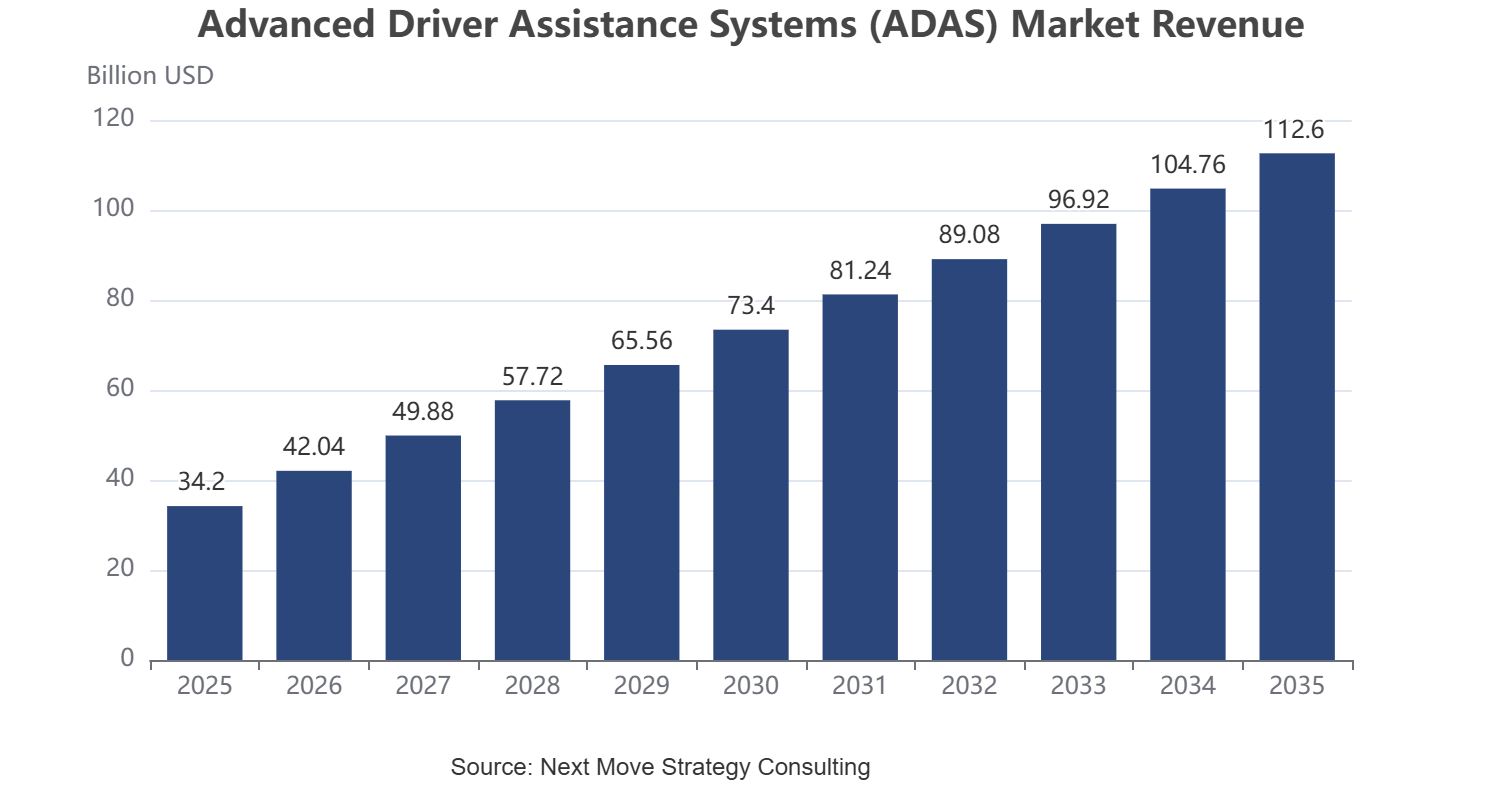
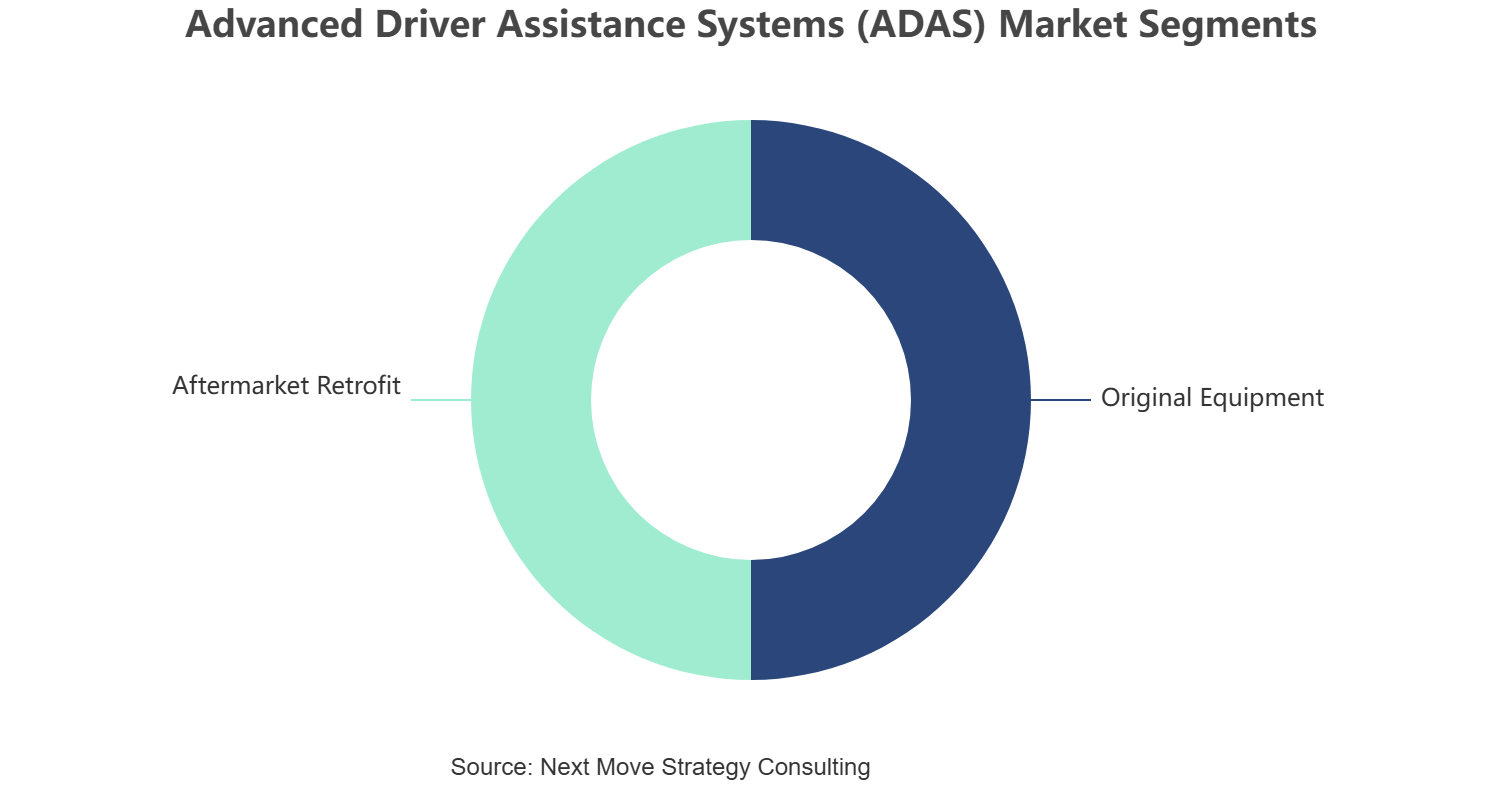
About the Author
 Liza Phukan
— Liza Phukan is Research Associate at Next Move Strategy Consulting, where she has covered emerging industries and market research across sectors for 3.5 years. Her work includes analyzing industry developments, validating market data, and developing structured business content from research findings. She uses secondary research and data-validation practices to turn complex market information into clear decision-useful market analysis for business audiences and support report development and B2B.
Liza Phukan
— Liza Phukan is Research Associate at Next Move Strategy Consulting, where she has covered emerging industries and market research across sectors for 3.5 years. Her work includes analyzing industry developments, validating market data, and developing structured business content from research findings. She uses secondary research and data-validation practices to turn complex market information into clear decision-useful market analysis for business audiences and support report development and B2B.
About the Reviewer
 Supradip Baul
— Supradip Baul is an accomplished business consultant and strategist with over a decade of rich experience in market intelligence, strategy, technology, and business transformation. His work has included rigorous qualitative and quantitative analysis across multiple industries, helping clients shape investment decisions and long-term roadmaps. Earlier in his career, he was associated with Gartner, where he contributed to industry-leading reports and market share analyses. He has worked with leading global companies and holds an MBA with a dual specialization in Marketing and Finance.
Supradip Baul
— Supradip Baul is an accomplished business consultant and strategist with over a decade of rich experience in market intelligence, strategy, technology, and business transformation. His work has included rigorous qualitative and quantitative analysis across multiple industries, helping clients shape investment decisions and long-term roadmaps. Earlier in his career, he was associated with Gartner, where he contributed to industry-leading reports and market share analyses. He has worked with leading global companies and holds an MBA with a dual specialization in Marketing and Finance.
At Next Move Strategy Consulting, we understand that insightful market research is the cornerstone of successful business decisions. That's why we employ a robust and multifaceted approach, combining various methodologies to deliver the most accurate and actionable data for our clients.

Research Landscape
We navigate the world of research with two primary approaches:
Qualitative Approach
Our qualitative research methodologies involve immersive techniques such as in-depth interviews, focus groups, and observational studies. By engaging directly with individuals and stakeholders, we uncover valuable insights that quantitative data alone may overlook.

Quantitative Research
In tandem with qualitative methodologies, NMSC leverages the power of Quantitative Research to provide a robust foundation of numerical insights. Through systematic data collection and analysis, we quantify patterns, preferences, and market trends, offering a comprehensive view of the business landscape.
Our quantitative research approach employs diverse tools, including surveys, experiments, and statistical modelling. These methodologies enable us to gather data from a large and representative sample, ensuring the statistical significance of our findings. By employing structured questionnaires and standardized data collection methods, we guarantee the reliability and validity of the information we present to our clients.
Quantitative research is particularly effective in measuring the prevalence of trends, assessing market size, and gauging the impact of various factors on consumer behavior. The numerical precision attained through this approach equips our clients with actionable insights, facilitating data-driven decision-making and strategy formulation.


Our Specialized Toolbox for Industry-Specific Market Research
We deploy a specialized arsenal of techniques tailored to meet your unique requirements. Here's a glimpse into our comprehensive toolbox:

Information Procurement
The stage entails acquiring market data or relevant information through various sources and methodologies.


Market Research Approach
We utilize both top-down and bottom-up approaches in market research analysis to achieve a comprehensive understanding of the market dynamics, leveraging the broad perspective of industry trends and macroeconomic factors alongside detailed insights from specific segments and individual companies.

Porters Five Forces Analysis
We conduct Porter's Five Forces analysis to evaluate the competitive landscape of an industry, providing us with insights into factors that affect profitability and strategic positioning.

SWOT Analysis

Forecasting
We utilize a forecasting model to predict future consumption by considering parameters like population, economics, regulations, market competition, drivers, constraints, technology, and pricing. We also employ statistical techniques such as multilinear regression, exponential smoothing, moving average, ARIMA, and Monte Carlo simulations for accurate predictions. In econometric forecasting, we analyzed short-term and long-term event impacts, attributing values based on regulatory frameworks, economic factors, and market events.





 Speak to Our Analyst