Advanced Phase Change Materials Market Size, Share, Growth & Forecast by Product Form (Bulk PCM, Encapsulated PCM {Microencapsulated PCM, Macroencapsulated PCM}, Formulated PCM {Shape Stabilized PCM, Composite PCM, Slurry PCM}), Chemistry (Organic PCM, Inorganic PCM, Eutectic Mixtures, Composite PCM), Application Function (Isothermal Control, Thermal Energy Storage, Active Cooling Support, Thermal Buffering), Temperature Range, End-User Industry, Distribution Channel — Global Analysis 2025–2035
Industry: Materials and Chemical | Lastest Edition: July 4, 2026 | No of Pages: 789 | No. of Tables: 1339 | No. of Figures: 1332 | Format: PDF | Report Code : MC10
What Is the Advanced Phase Change Materials Market Size?
The global Advanced Phase Change Materials Market was valued at USD 2.50 billion in 2025 and is expected to reach USD 3.07 billion in 2026. Propelled by escalating demand for energy-efficient thermal management solutions across construction, cold chain logistics, electric vehicles, and renewable energy storage, the market is projected to reach USD 7.73 billion by 2035, advancing at a CAGR of 10.82% from 2026 to 2035. Key growth drivers include rapid adoption of encapsulated and formulated PCMs in sustainable buildings, surging EV battery thermal regulation requirements, growing pharmaceutical cold chain investments, and expanding deployment of specialty PCM in renewable energy storage infrastructure globally.
|
Parameters |
Details |
|
Market Size in 2025 |
USD 2.50 Billion |
|
Market Size in 2026 |
USD 3.07 Billion |
|
Revenue Forecast in 2035 |
USD 7.73 Billion |
|
Growth Rate |
CAGR of 10.82% from 2026 to 2035 |
|
Analysis Period |
2025–2035 |
|
Base Year Considered |
2025 |
|
Forecast Period |
2026–2035 |
|
Market Size Estimation |
USD Billion |
|
Companies Profiled |
20 |
|
Countries Covered |
33 |
|
Market Share |
Top 10 |
Advanced Phase Change Materials Market Overview
What Is the Advanced Phase Change Materials Market?
The Advanced Phase Change Materials Market encompasses engineered substances that absorb, store, and release large amounts of latent thermal energy during phase transitions, primarily between solid and liquid states at defined temperature ranges. These materials serve diverse applications including building thermal regulation, pharmaceutical cold chain, food logistics, EV battery cooling, HVAC load shifting, and renewable energy storage. The market covers a broad chemistry spectrum—organic, inorganic, eutectic, and composite PCMs—distributed across encapsulated, formulated, and bulk product forms, serving end-user industries worldwide from construction and healthcare to electronics and energy utilities
How Has the Advanced Phase Change Materials Market Evolved?
The Advanced Phase Change Materials Market has evolved through successive phases of material innovation and application expansion. The initial phase centered on bulk paraffin-based PCM integration in building insulation. A subsequent phase introduced microencapsulation technologies enabling PCM incorporation into concrete, plaster, and textiles. NMSC's analysis indicates that the current phase reflects accelerating adoption of composite PCM and shape-stabilized PCM architectures designed for EV battery thermal regulation, data center cooling, and high-temperature industrial process storage. Formulated PCM now represents 14.01% CAGR—the fastest-growing product form—reflecting the shift from commodity to high-performance specialty PCM systems.
How Do Regulations Influence the Advanced Phase Change Materials Market?
Regulatory frameworks exert meaningful structural influence on the Advanced Phase Change Materials Market. The European Union's Energy Performance of Buildings Directive mandates near-zero energy building standards, directly incentivizing PCM integration in construction. U.S. Department of Energy building codes and Title 24 California energy standards similarly promote passive thermal storage adoption. Pharmaceutical PCM demand is regulated through the International Council for Harmonisation Q1A-Q1D guidelines governing cold chain validation for temperature-sensitive biologics. Chemical safety regulations including REACH in Europe and TSCA in the United States govern PCM formulation composition, shaping material selection across commercial and industrial applications.
How Is Technology Adoption Expanding Across the Advanced Phase Change Materials Market?
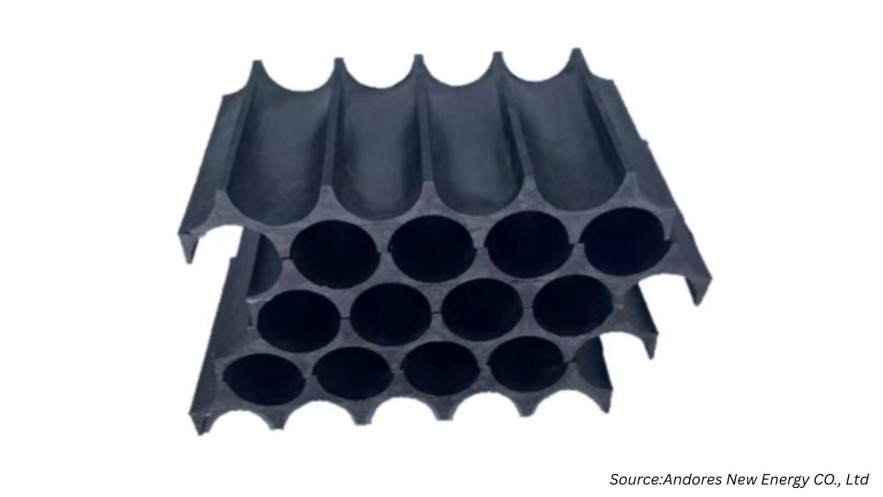
Technology adoption across the Advanced Phase Change Materials Market is accelerating through advances in microencapsulation science, composite PCM synthesis, and smart thermal management system integration. Nano-enhanced PCM formulations incorporating graphene and carbon nanotubes are improving thermal conductivity, a historically limiting factor in organic PCMs. Shape-stabilized PCM architectures eliminate leakage risk during phase transitions, enabling direct integration into structural building panels. Through our market assessment, we observed that automotive OEMs and battery manufacturers are actively qualifying engineered PCM solutions for prismatic and cylindrical cell thermal regulation systems, marking a pivotal adoption inflection in the EV segment.
Ecosystem Analysis of the Advanced Phase Change Materials Market
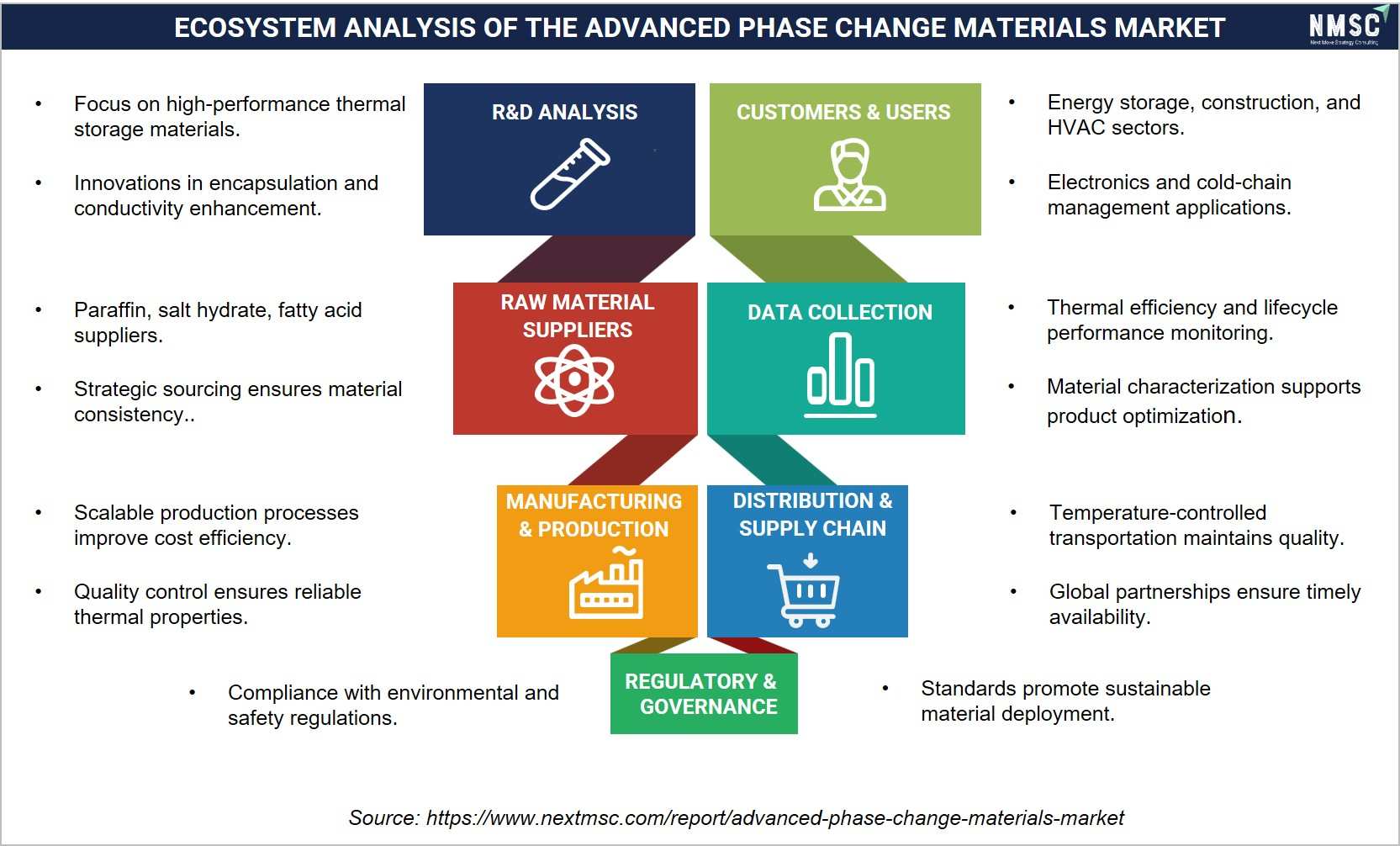
The Advanced Phase Material Market ecosystem comprises a diverse network of stakeholders involved in material innovation, production, commercialization, and end-use deployment. The ecosystem begins with R&D activities focused on developing high-performance phase change materials, followed by raw material suppliers providing essential chemical compounds and specialty materials. Manufacturers and producers convert these inputs into advanced phase materials for various applications, while distribution and supply chain partners ensure efficient market delivery. The ecosystem is further supported by data collection and market intelligence providers, end-users and customers across multiple industries, and regulatory and governance bodies that establish quality, safety, and environmental standards, collectively driving market growth and technological advancement.
Key Takeaways
|
Key Takeaways |
|
By product form, Encapsulated PCM held the largest share of the Advanced Phase Change Materials Market at USD 823.75 million in 2025, representing 32.9% of total market revenue, driven by superior handling characteristics, elimination of leakage risk, and compatibility with diverse construction and textile applications. |
|
Formulated PCM is the fastest-growing product form in the Advanced Phase Change Materials Market at a CAGR of 14.01% from 2026 to 2035, projected to grow from USD 545.27 million in 2025 to USD 2.25 billion by 2035, fueled by demand for composite and shape-stabilized architectures in EV battery and industrial thermal storage applications. |
|
By chemistry, Organic PCM held the largest chemistry share of the Advanced Phase Change Materials Market at USD 1.04 billion in 2025, underpinned by widespread paraffin and fatty acid adoption in building, cold chain, and textile applications owing to favorable melting behavior and chemical stability. |
|
Composite PCM is the fastest-growing chemistry segment in the Advanced Phase Change Materials Market at a CAGR of 14.54% from 2026 to 2035, expanding from USD 243.87 million in 2025 to USD 1.05 billion by 2035, driven by high-performance thermal management demand in EV batteries, electronics, and data center infrastructure. |
|
By application function, Isothermal Control led the Advanced Phase Change Materials Market with USD 792.82 million in 2025, reflecting strong deployment across pharmaceutical cold chain and food logistics segments requiring precise temperature maintenance. |
|
Thermal Buffering is the fastest-growing application function in the Advanced Phase Change Materials Market at a CAGR of 12.71% from 2026 to 2035, expanding from USD 355.93 million in 2025 to USD 1.30 billion by 2035, driven by fire protection, textile comfort, and thermal shielding applications. |
|
By end-user industry, Building & Construction represents the single largest end-user segment in the Advanced Phase Change Materials Market, anchored by large-scale commercial and residential passive thermal regulation adoption across North America and Europe. |
|
Automotive & Transport is the fastest-growing end-user industry in the Advanced Phase Change Materials Market, driven by EV battery thermal regulation requirements and surging demand from EV manufacturers and battery cell producers globally. |
|
Asia-Pacific dominated the Advanced Phase Change Materials Market regionally with USD 940.54 million in 2025, representing 37.6% of global revenue, supported by China's construction boom, India's pharmaceutical cold chain expansion, and Japan's advanced battery manufacturing ecosystem. |
|
Asia-Pacific is simultaneously the fastest-growing major region at a CAGR of 13.06% from 2026 to 2035, projected to reach USD 3.56 billion by 2035, reflecting broad-based adoption across construction, EV, cold chain, and energy storage end-user industries. |
|
Europe was the second-largest Advanced Phase Change Materials Market region at USD 646.24 million in 2025, supported by stringent building energy efficiency mandates under the EU Energy Performance of Buildings Directive and strong demand for PCM in pharmaceutical cold chain logistics. |
|
Middle East & Africa is the second-fastest growing Advanced Phase Change Materials Market region at a CAGR of 11.35% from 2026 to 2035, driven by expanding pharmaceutical and food cold chain infrastructure in Saudi Arabia and UAE, and growing renewable energy storage projects across the region. |
Key Emerging Trends in the Advanced Phase Change Materials Market
How Is the Integration of Nano-Enhanced PCM Formulations Transforming Thermal Performance Standards in the Advanced Phase Change Materials Market?
Nano-enhancement is fundamentally reshaping thermal conductivity benchmarks in the Advanced Phase Change Materials Market, addressing the historically low thermal conductivity of organic paraffin systems. Researchers at multiple universities have demonstrated that graphene nanoplatelet and carbon nanotube additives can increase effective thermal conductivity of paraffin PCM by 30–60% without significantly degrading latent heat capacity. From our research, we found that specialty PCM manufacturers including Rubitherm Technologies and Axiotherm GmbH are actively commercializing nano-composite formulations for high-duty-cycle electronics cooling and EV battery thermal pad applications, creating a premium product tier commanding 15–20% higher unit pricing than standard bulk PCM grades.
How Is the Proliferation of EV Battery Thermal Management Creating a Structural Shift in Demand for Engineered PCM Solutions?
Engineered PCM is emerging as a critical bill-of-materials component in electric vehicle battery thermal management systems, with adoption accelerating as automakers seek alternatives to liquid cooling loops in pack-level thermal design. NMSC's analysis indicates that manufacturers including Tesla, CATL, and BYD are evaluating composite PCM and encapsulated PCM thermal interface layers as passive buffering components to reduce active cooling system complexity and weight. The EV Battery Regulation sub-segment within Active Cooling Support is positioned as one of the highest-growth application pockets in the Advanced Phase Change Materials Market, reflecting structural alignment with global EV adoption trajectories projected to exceed 40 million annual units by 2030 according to the International Energy Agency.
How Are Renewable Energy Storage Requirements Reshaping Demand for High-Temperature PCM in the Advanced Phase Change Materials Market?
The global buildout of concentrated solar power and industrial thermal energy storage systems is driving demand for high-temperature PCM operating in the 120–300°C range and ultra-high-temperature PCM above 300°C, a segment previously serving only niche metallurgical applications. Through our market assessment, we observed that molten salt PCM systems are being integrated into industrial process storage projects in Southern Europe, North Africa, and the Middle East, enabling off-peak renewable energy capture and dispatchable heat delivery. High-performance thermal storage materials combining molten salt and metallic PCM chemistries are being evaluated for integration with utility-scale solar thermal plants, representing a multi-hundred-million-dollar growth frontier in the Advanced Phase Change Materials Market.
How Is Digital Monitoring and Sensor Integration Transforming the Lifecycle Management of PCM-Based Thermal Systems in the Advanced Phase Change Materials Market?
Digital integration is creating new value proposition dimensions for the Advanced Phase Change Materials Market as system operators deploy IoT-enabled temperature sensors and predictive analytics platforms to monitor PCM phase state, degradation, and thermal performance in real time. Based on our market evaluation, we noticed that cold chain logistics providers including Cryopak and Cold Chain Technologies are embedding PCM performance monitoring within their temperature-controlled packaging systems, enabling SLA compliance documentation for pharmaceutical shippers. This convergence of shape-stabilized PCM materials with digital monitoring infrastructure is elevating PCM from a passive commodity material to an active, data-generating thermal system component commanding premium service-based revenue models across pharmaceutical and food distribution applications.
What Are the Key Market Drivers, Breakthroughs, and Investment Opportunities that Will Shape the Advanced Phase Change Materials Industry in the Next Decade?
|
Drivers / Trends / Restraints |
(+/-) % Impact on CAGR Forecast |
Geographic Relevance |
Impact Timeline |
|
Mandatory Green Building Energy Codes Expanding PCM Deployment in Construction |
+2.3% |
Europe, North America, Asia-Pacific |
2025–2035 |
|
Surging EV Battery Thermal Management Demand for Engineered PCM |
+2.1% |
Asia-Pacific, Europe, North America |
2025–2032 |
|
Pharmaceutical Cold Chain Regulatory Mandates Driving Medical PCM Adoption |
+1.6% |
Global (led by North America, Europe) |
2025–2035 |
|
Renewable Energy Storage Buildout Creating High-Temperature PCM Demand |
+1.4% |
Middle East, Europe, Asia-Pacific |
2026–2035 |
|
Microencapsulation Technology Advances Enabling PCM Integration in Textiles |
+1.2% |
Europe, North America, Asia-Pacific |
2025–2032 |
|
High Raw Material Costs for Specialty PCM Limiting Price Competitiveness |
-1.0% |
All regions |
Ongoing |
|
Low Thermal Conductivity of Organic PCM Constraining High-Duty-Cycle Applications |
-0.8% |
Global |
Ongoing |
|
Bio-Based and Sustainable PCM Development Opening Green Building Markets |
+1.1% |
Europe, North America |
2026–2035 |
|
Data Center Peak Cooling Demand Driving Active Cooling PCM Solutions |
+0.9% |
North America, Europe, Asia-Pacific |
2025–2032 |
|
High-Temperature Industrial Process PCM for Renewable Energy Integration |
+0.8% |
Middle East, Europe |
2026–2035 |
What Are the Growth Drivers of the Advanced Phase Change Materials Market?
How Are Mandatory Green Building Energy Standards Fueling Adoption of Engineered PCM in the Advanced Phase Change Materials Market?
Mandatory building energy performance regulations across the European Union, North America, and Asia-Pacific are the most consequential structural demand driver for the Advanced Phase Change Materials Market in the construction segment. The EU's revised Energy Performance of Buildings Directive requires all new buildings to achieve near-zero energy standards by 2030, creating direct incentive for passive thermal storage integration using engineered PCM in insulation boards, ceiling panels, and facade systems. Our analysis shows that the U.S. Department of Energy's Building Technologies Office has funded multiple demonstration projects validating PCM integration in residential and commercial buildings, documenting 15–25% reductions in peak HVAC load in monitored deployments. Specialty PCM manufacturers are responding by developing construction-grade encapsulated PCM products meeting fire safety and durability requirements aligned with major building codes.
How Is the Electric Vehicle Manufacturing Surge Creating Sustained Demand for High-Performance Thermal Storage Materials in the Advanced Phase Change Materials Market?
The global electric vehicle transition is generating structural, multi-decade demand for high-performance thermal storage materials capable of regulating lithium-ion battery pack temperatures within the 15–35°C optimal operating window. According to the International Energy Agency's Global EV Outlook, global EV sales surpassed 14 million units in 2023, establishing a rapidly expanding installed base of battery systems requiring precise thermal management. Our findings suggest that composite PCM and shape-stabilized PCM architectures are being evaluated as passive thermal buffer layers in cylindrical, prismatic, and pouch cell battery modules, reducing peak thermal load on active liquid cooling systems. Battery manufacturers including CATL and Panasonic are actively characterizing PCM thermal interface materials for next-generation cell formats, positioning the EV segment as the highest-growth application in the Advanced Phase Change Materials Market through 2035.
How Are Pharmaceutical Cold Chain Compliance Requirements Driving Demand for PCM in the Advanced Phase Change Materials Market?
Stringent regulatory requirements governing the temperature-controlled distribution of biologics, vaccines, and cell therapies are driving sustained investment in pharmaceutical-grade PCM packaging solutions across the Advanced Phase Change Materials Market. The World Health Organization's guidelines for vaccine cold chain management require continuous temperature maintenance between 2°C and 8°C throughout the distribution chain, creating non-discretionary demand for PCM-based insulated shipping systems. Based on NMSC's research, we found that the global biologics market, which requires cold chain logistics at every distribution stage, exceeded USD 400 billion in global sales in 2023 according to IQVIA Institute data, creating a large and growing addressable market for isothermal control PCM solutions. Cold chain PCM providers including Cold Chain Technologies and Cryopak are qualifying next-generation slurry PCM and microencapsulated PCM products for validated pharmaceutical packaging systems meeting WHO and IATA temperature-sensitive cargo standards.
What Are the Growth Inhibitors of the Advanced Phase Change Materials Market?
How Do High Raw Material Costs and Price Volatility Constrain Adoption of Specialty PCM Across Price-Sensitive Application Segments?
Raw material cost volatility represents a meaningful structural restraint on the Advanced Phase Change Materials Market, particularly for specialty PCM formulations incorporating bio-based fatty acids, sugar alcohols, and salt hydrate precursors subject to agricultural commodity and chemical feedstock price cycles. Paraffin-based PCM pricing is linked to petroleum derivative markets, exposing manufacturers and end-users to crude oil price cycles that complicate long-term project economics for building integration and renewable storage applications. Our assessment indicates that high formulation costs for shape-stabilized PCM and nano-enhanced composite PCM relative to conventional insulation alternatives limit adoption penetration in cost-sensitive residential construction markets in emerging economies, creating a market bifurcation between premium commercial applications and price-sensitive residential and light industrial segments globally.
How Does the Low Thermal Conductivity of Organic PCM Limit Performance in High-Duty-Cycle Industrial and Electronics Cooling Applications?
The inherently low thermal conductivity of organic paraffin and fatty acid-based PCM, typically between 0.2 and 0.4 W/(m·K), creates a technical performance ceiling that limits adoption in high-power-density applications requiring rapid heat absorption and rejection cycles. Data center cooling, high-frequency electronics thermal management, and fast-charge EV battery applications demand thermal conductivity exceeding 1.0 W/(m·K), which standard organic PCMs cannot achieve without significant nano-enhancement or structural modification. Based on our market evaluation, we noticed that this performance gap has historically constrained adoption of high-performance thermal storage materials in demanding duty-cycle applications, forcing system designers to rely on conventional liquid cooling despite higher system complexity and weight. Ongoing nano-composite PCM development programs are addressing this constraint, but commercially scalable solutions at competitive price points remain limited for the most demanding high-power applications.
What Are the Growth Opportunities in the Advanced Phase Change Materials Market?
How Does the Expansion of Bio-Based PCM Development Create Sustainability-Driven Growth Opportunities in the Advanced Phase Change Materials Market?
Growing end-user demand for sustainable, non-petroleum-derived thermal management materials is creating a premium market opportunity for bio-based PCM derived from plant-derived fatty acids, vegetable esters, and sugar alcohols within the Advanced Phase Change Materials Market. The EU Green Deal's Chemical Strategy for Sustainability and U.S. Executive Order 14081 on biotechnology and biomanufacturing are creating policy tailwinds for bio-derived specialty materials across multiple industrial applications. Our analysis shows that companies including PureTemp LLC and Pluss Advanced Technologies are commercializing plant-derived bio-based PCM products targeting green building certifications including LEED and BREEAM, which award credits for bio-based material content. The bio-based PCM segment commands a 10–25% price premium over petroleum-derived equivalents in certified green building applications, supporting favorable margin profiles for early-mover specialty producers.
How Does the Rapid Growth of Data Center Infrastructure Create New Demand Opportunities for Active Cooling Support PCM in the Advanced Phase Change Materials Market?
The accelerating global buildout of hyperscale and edge data centers is generating significant demand for PCM-based peak cooling solutions capable of reducing peak thermal load on chiller and cooling tower infrastructure during high server utilization events. The U.S. Department of Energy's Lawrence Berkeley National Laboratory has documented data center energy consumption exceeding 200 terawatt-hours annually in the United States alone, with cooling representing approximately 40% of total facility energy use. Through our market assessment, we observed that data center operators are evaluating slurry PCM and composite PCM-integrated cooling panels as components of thermal energy storage systems that shift cooling load from peak electricity tariff periods to off-peak hours, generating direct operating cost savings. This application positions the Advanced Phase Change Materials Market at the intersection of digital infrastructure growth and energy efficiency imperatives, creating a high-value, technology-driven demand channel across North America, Europe, and Asia-Pacific data center markets.
How Does Expanding Renewable Energy Storage Infrastructure Represent a Long-Term Growth Frontier for High-Temperature PCM in the Advanced Phase Change Materials Market?
Utility-scale renewable energy storage buildout represents one of the most significant long-term growth opportunities for the Advanced Phase Change Materials Market, specifically for high-temperature and ultra-high-temperature PCM chemistries including molten salt, metallic, and eutectic mixtures operating above 120°C. The International Renewable Energy Agency has documented that achieving global net-zero energy targets by 2050 requires six-fold expansion of energy storage capacity, with thermal energy storage representing a cost-effective complement to electrochemical battery storage for industrial process heat and concentrated solar power applications. Based on NMSC's research, we found that companies including Sunamp Limited and Hero Future Energies are deploying PCM-based thermal energy storage systems in district heating networks and residential heat battery applications, demonstrating commercially viable use cases for PCM thermal storage in decentralized renewable energy integration. This positions inorganic and eutectic PCM chemistries as structurally aligned with multi-decade energy transition capital investment cycles globally.
How Is the Advanced Phase Change Materials Market Segmented in This Report, and What Are the Key Insights from the Segmentation Analysis?
How Do Bulk, Encapsulated, and Formulated PCM Define the Structural Composition of the Advanced Phase Change Materials Market?
|
Segments |
2025 (USD Mn) |
2035 (USD Mn) |
CAGR (%) |
|
Bulk PCM |
802.98 |
2,056.51 |
8.73% |
|
Encapsulated PCM |
823.75 |
2,768.16 |
11.76% |
|
Formulated PCM |
545.27 |
2,246.03 |
14.01% |
|
Other PCM Forms |
331.43 |
661.88 |
6.00% |
|
Total |
2,503.43 |
7,732.58 |
10.82% |
Based on our analysis of global PCM procurement and application trends, the Advanced Phase Change Materials Market by product form spans Bulk PCM, Encapsulated PCM, Formulated PCM, and Other PCM Forms. Encapsulated PCM holds the largest revenue share at USD 823.75 million in 2025, driven by microencapsulated powders and slurries that enable seamless integration into construction materials and textiles, and macroencapsulated panels and pouches serving cold chain and HVAC applications. Formulated PCM is the fastest-growing product form at a 14.01% CAGR, reflecting demand for shape-stabilized, composite, and slurry architectures in EV battery regulation and industrial process storage. Bulk PCM retains a significant position in large-scale HVAC and industrial thermal storage projects, while Other PCM Forms serve niche specialty applications.
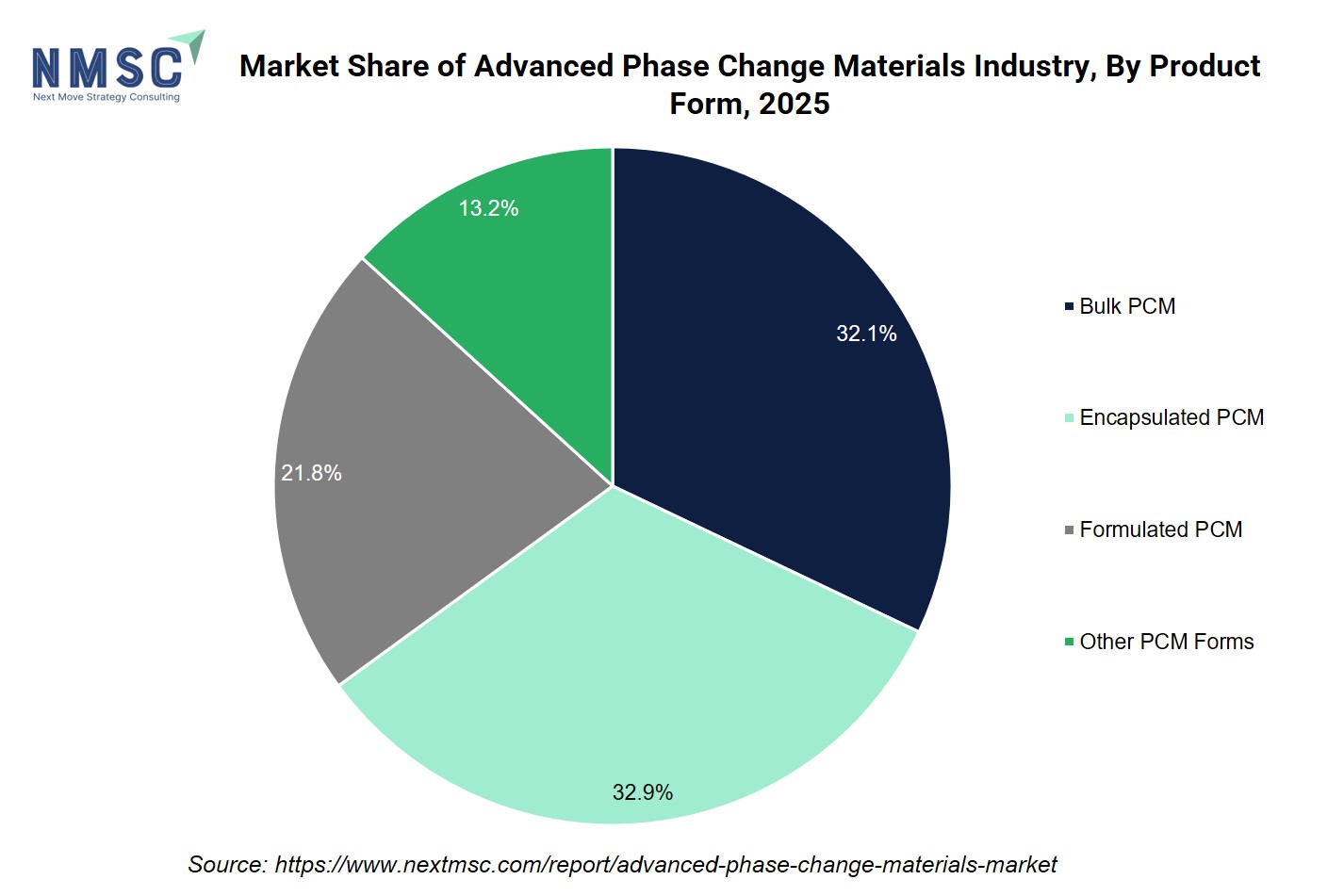
Which PCM Chemistry Categories Are Driving Innovation and Market Differentiation in the Advanced Phase Change Materials Market?
|
Segments |
2025 (USD Mn) |
2035 (USD Mn) |
CAGR (%) |
|
Organic PCM |
1,035.02 |
3,244.97 |
10.99% |
|
Inorganic PCM |
705.85 |
1,935.02 |
9.49% |
|
Eutectic Mixtures |
423.48 |
1,284.61 |
10.60% |
|
Composite PCM |
243.87 |
1,054.29 |
14.54% |
|
Other Chemistries |
95.20 |
213.70 |
7.29% |
|
Total |
2,503.43 |
7,732.58 |
10.82% |
From our research, we found that the Advanced Phase Change Materials Market chemistry segmentation spans Organic PCM, Inorganic PCM, Eutectic Mixtures, Composite PCM, and Other Chemistries. Organic PCM dominates at USD 1035.02 Million in 2025, encompassing paraffin, fatty acid, bio-based, and sugar alcohol variants that serve the largest installed base across building, cold chain, and textile applications due to favorable cycling stability and non-corrosive properties. Composite PCM is the fastest-growing chemistry at a 14.54% CAGR, driven by shape-stabilized and porous material infiltrated architectures solving thermal conductivity and leakage challenges in advanced applications. Eutectic Mixtures are expanding at 10.60% CAGR, serving temperature-precise pharmaceutical and food cold chain applications. Inorganic PCM—salt hydrate and molten salt variants—remains critical for medium-to-high-temperature industrial storage.
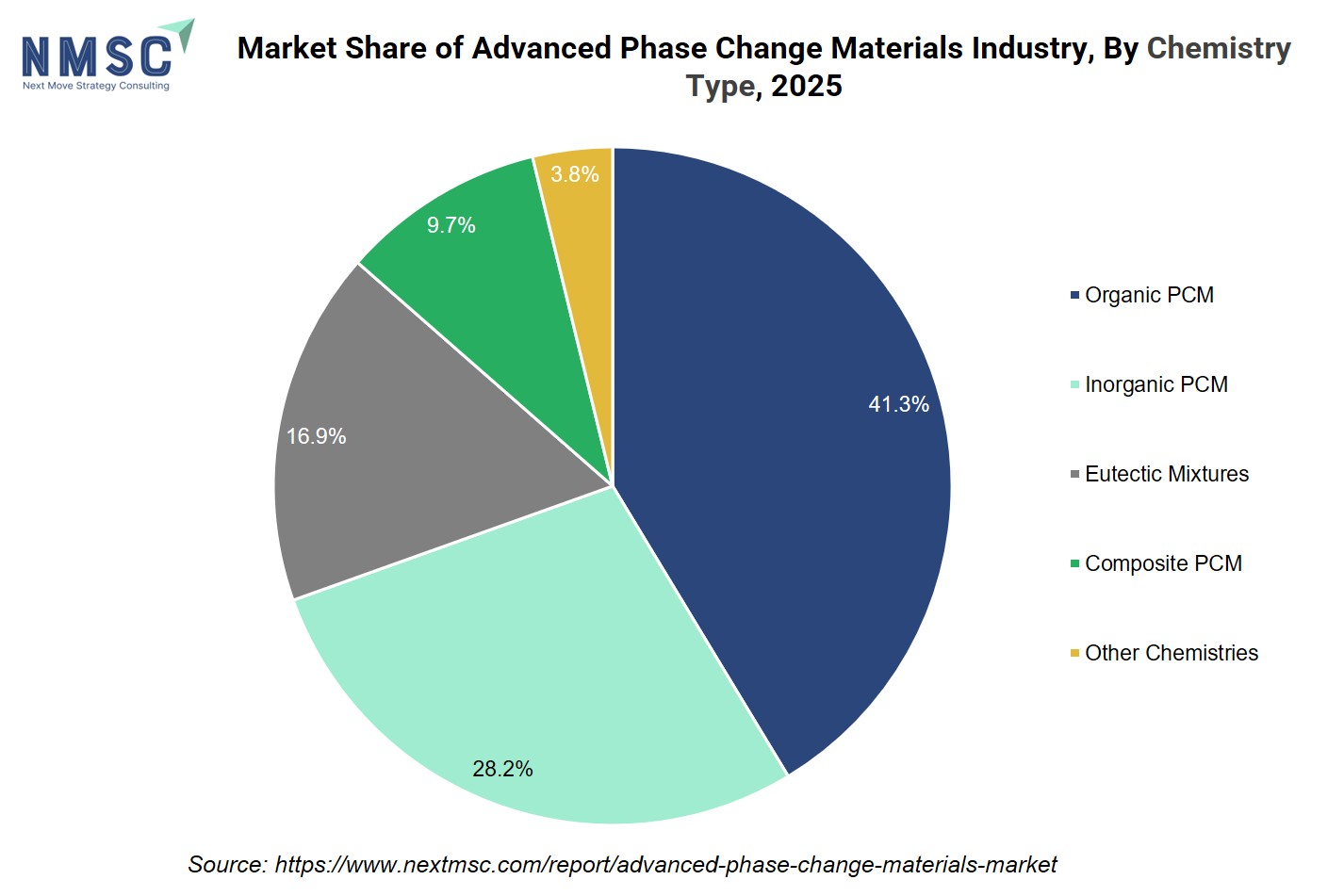
Which Application Functions Are Generating the Highest Value Concentration in the Advanced Phase Change Materials Market?
|
Segments |
2025 (USD Mn) |
2035 (USD Mn) |
CAGR (%) |
|
Isothermal Control |
792.82 |
2,228.11 |
9.77% |
|
Thermal Energy Storage |
758.38 |
2,761.35 |
12.64% |
|
Active Cooling Support |
429.51 |
1,089.37 |
8.63% |
|
Thermal Buffering |
355.93 |
1,302.85 |
12.71% |
|
Other Functions |
166.79 |
350.89 |
6.57% |
|
Total |
2,503.43 |
7,732.58 |
10.82% |
Our analysis of global PCM application demand reveals that the Advanced Phase Change Materials Market by application function encompasses Isothermal Control, Thermal Energy Storage, Active Cooling Support, Thermal Buffering, and Other Functions. Isothermal Control leads at USD 792.82 million in 2025, reflecting critical deployment in pharmaceutical cold chain shipping, medical storage devices, and food transport packaging where temperature excursions carry regulatory and product safety consequences. Thermal Buffering is the fastest-growing function at 12.71% CAGR, driven by expanding demand in fire protection, textile comfort materials, and thermal shielding for industrial equipment. Thermal Energy Storage follows at 12.64% CAGR, propelled by HVAC load shifting and renewable energy integration projects. Active Cooling Support is expanding at 8.63% CAGR, anchored by EV battery regulation and electronics cooling applications.
Regional Outlook
Geographic Performance Snapshot
|
Region |
2025 (USD Mn) |
2035 (USD Mn) |
CAGR (%) |
Key Driver |
|
North America |
595.03 |
1,468.73 |
8.34% |
LEED/Title 24 building codes, pharmaceutical cold chain expansion, EV manufacturing growth |
|
Europe |
646.24 |
1,779.58 |
9.55% |
EU Energy Performance of Buildings Directive, renewable storage investment, pharmaceutical logistics |
|
Asia-Pacific |
940.54 |
3,556.23 |
13.06% |
China construction PCM adoption, India pharma cold chain, Japan EV battery manufacturing |
|
Middle East & Africa |
204.89 |
663.80 |
11.35% |
Gulf cold chain infrastructure, renewable energy storage, pharmaceutical distribution growth |
|
Latin America |
116.73 |
264.25 |
7.38% |
Brazil pharmaceutical cold chain, food logistics, gradual green building code adoption |
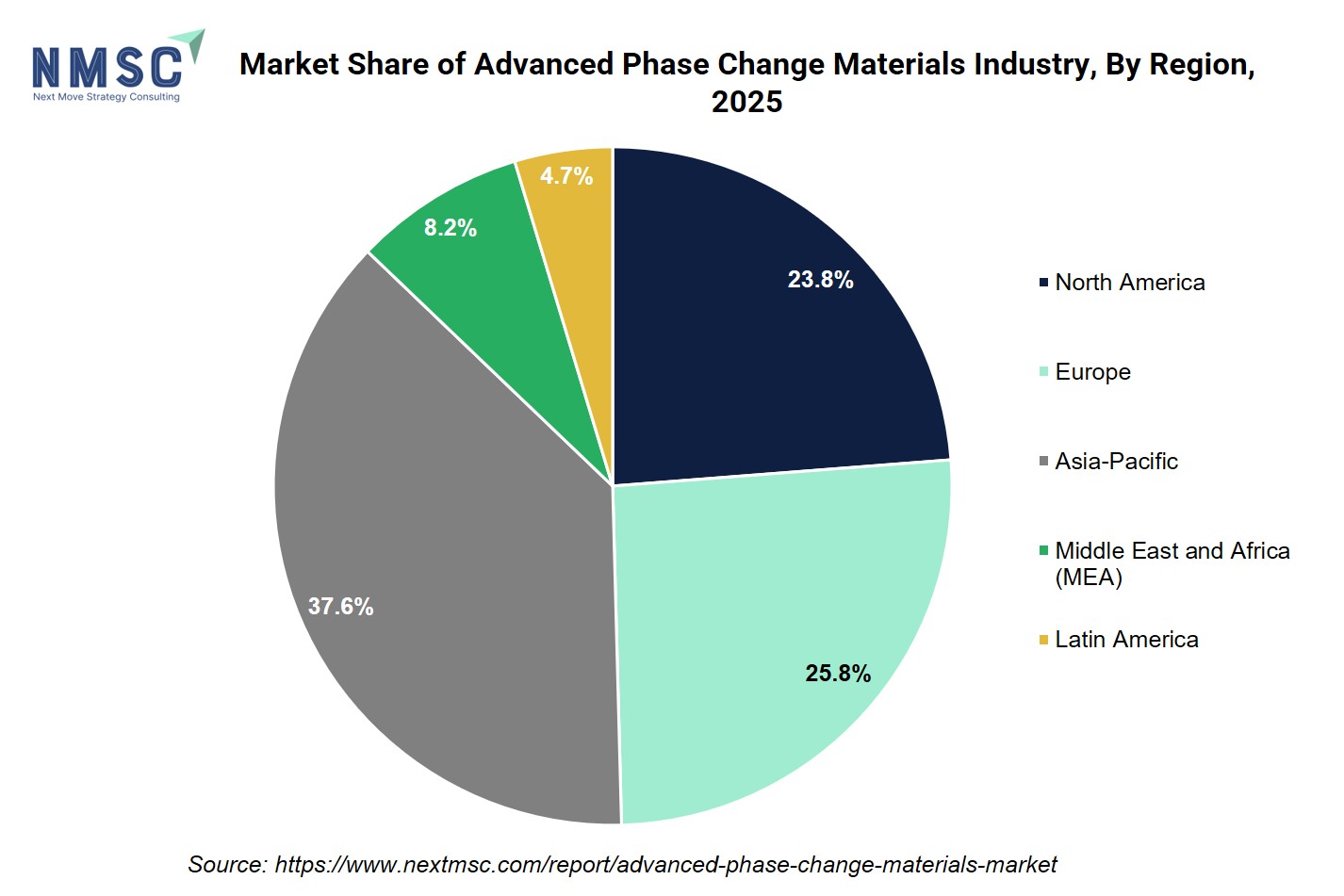
North America Advanced Phase Change Materials Market
North America contributed USD 595.03 million to the Advanced Phase Change Materials Market in 2025, forecast to reach USD 1.47 billion by 2035 at a CAGR of 8.34%. Based on our engagements with North American industry stakeholders, the region benefits from stringent building energy codes including Title 24 in California and ASHRAE 90.1 nationally, which incentivize passive PCM integration in new commercial and residential construction. Pharmaceutical cold chain growth driven by biologics and vaccine distribution expansion, along with EV manufacturing scale-up in Michigan, Tennessee, and Georgia, are creating diversified multi-sector PCM demand across the forecast period.
Europe Advanced Phase Change Materials Market
Europe is the second-largest Advanced Phase Change Materials Market region, contributing USD 646.24 million in 2025 and forecast to reach USD 1.78 billion by 2035 at a CAGR of 9.55%. Based on our engagements with European PCM market participants, the region's growth is anchored in the EU Energy Performance of Buildings Directive, which mandates near-zero energy building standards and directly incentivizes PCM integration in building envelopes. Pharmaceutical cold chain logistics for biologics distribution across the EU, and PCM integration in district heating systems in Northern and Central Europe, provide additional structural demand pillars throughout the forecast period.
Asia-Pacific Advanced Phase Change Materials Market
Asia-Pacific dominates the Advanced Phase Change Materials Market with USD 940.54 million in 2025, forecast to reach USD 3.56 billion by 2035 at a CAGR of 13.06%. Through our analysis, the region's outsized growth reflects China's large-scale green building construction PCM adoption, India's rapidly expanding pharmaceutical cold chain infrastructure, Japan's advanced EV battery manufacturing ecosystem, and South Korea's growing PCM integration in electronics cooling applications. Asia-Pacific's diverse industrial base and government-led energy efficiency mandates across multiple jurisdictions create a structural multi-decade growth environment for the Advanced Phase Change Materials Market.
Middle East & Africa Advanced Phase Change Materials Market
The Middle East & Africa Advanced Phase Change Materials Market contributed USD 204.89 million in 2025, forecast to reach USD 663.80 million by 2035 at a CAGR of 11.35%. From our assessment, Saudi Arabia and UAE are the primary demand centers, driven by pharmaceutical and food cold chain infrastructure investment aligned with their respective Vision 2030 and UAE Net Zero 2050 programs. Renewable energy storage projects across Gulf Cooperation Council nations and North Africa are creating demand for high-temperature PCM in concentrated solar power and district cooling applications, establishing the MEA region as one of the fastest-growing Advanced Phase Change Materials Market geographies.
Latin America Advanced Phase Change Materials Market
Latin America contributed USD 116.73 million to the Advanced Phase Change Materials Market in 2025, forecast to reach USD 264.25 million by 2035 at a CAGR of 7.38%. According to evaluation of the regional PCM demand landscape, Brazil dominates through pharmaceutical cold chain logistics and food beverage processing applications. Gradual adoption of green building standards across major cities and growing food export supply chain investment are expanding PCM adoption in the region. Budget constraints and limited domestic PCM manufacturing infrastructure moderate growth relative to other regions, though import availability from established North American and European suppliers supports market development.
U.S. Advanced Phase Change Materials Market
Based on our engagements with North American market stakeholders, the United States represents approximately 70% of North American Advanced Phase Change Materials Market revenue, underpinned by leadership in pharmaceutical cold chain logistics, advanced building energy codes, and a rapidly scaling EV manufacturing sector. U.S. Department of Energy programs supporting advanced building materials and the BioPreferred program promoting bio-based material procurement create favorable policy environments for PCM adoption. Leading manufacturers including Cold Chain Technologies and Phase Change Solutions are headquartered domestically, maintaining competitive intensity and technology development capacity within the national market.
Canada Advanced Phase Change Materials Market
Through our analysis, Canada participates in the Advanced Phase Change Materials Market primarily through pharmaceutical cold chain, building thermal storage, and emerging EV battery applications aligned with Canada's clean technology investment priorities. Canada's National Building Code updates incorporating energy performance requirements are gradually expanding PCM adoption in commercial construction. Government programs including Natural Resources Canada's Clean Energy for Rural and Remote Communities initiative are evaluating thermal storage solutions for Northern community energy resilience, representing a niche but growing application for cold-range PCM systems in extreme-climate building environments.
Mexico Advanced Phase Change Materials Market
From our assessment, Mexico's Advanced Phase Change Materials Market is developing through pharmaceutical manufacturing cold chain requirements and food processing logistics, particularly in the Mexico City and Monterrey industrial corridors. Mexico's growing automotive manufacturing sector, which produces both conventional and electric vehicles for North American markets, is creating emerging demand for PCM-based thermal management materials at tier-1 supplier facilities. Regulatory alignment with U.S. FDA standards for pharmaceutical distribution is driving adoption of validated cold chain PCM packaging solutions among Mexican contract pharmaceutical manufacturers serving North American export markets.
UK Advanced Phase Change Materials Market
Based on our engagements, the United Kingdom holds the largest Advanced Phase Change Materials Market in Europe, driven by strong pharmaceutical cold chain logistics requirements for National Health Service supply chains and private sector biologics distribution, mandatory green building standards under the Building Regulations Part L, and growing heat battery market development led by Sunamp Limited. The UK's Net Zero Strategy and Future Homes Standard are accelerating PCM integration in new residential developments. UK-based research institutions including UCL and University of Birmingham are advancing composite PCM and nano-enhanced PCM technology development, contributing to the UK's position as a European PCM innovation hub.
Germany Advanced Phase Change Materials Market
Through our analysis, Germany's Advanced Phase Change Materials Market is underpinned by mandatory energy renovation targets under the German Building Energy Act (GEG), the automotive industry's EV transition driving battery thermal management PCM demand, and pharmaceutical logistics requirements for biologics cold chain distribution. German engineering companies including Rubitherm Technologies GmbH and Axiotherm GmbH are globally recognized specialty PCM producers serving both domestic and export markets. Germany's Renewable Energy Sources Act investment in solar thermal storage is creating demand for medium- and high-temperature PCM applications within the domestic energy transition program.
France Advanced Phase Change Materials Market
From our assessment, France's Advanced Phase Change Materials Market benefits from the French RE2020 energy regulation mandating thermal comfort and energy performance in new buildings, creating structural demand for PCM integration in building envelopes and HVAC systems. France's pharmaceutical industry, one of the largest in Europe, generates sustained demand for cold chain PCM packaging aligned with ANSM regulatory requirements. French government investment in solar energy and industrial decarbonization under the France 2030 investment plan is creating emerging demand for high-temperature PCM in thermal energy storage systems supporting industrial process heat and renewable energy integration projects.
Italy Advanced Phase Change Materials Market
Based on our engagements, Italy's Advanced Phase Change Materials Market is driven by the Mediterranean climate context creating strong passive cooling demand in commercial and residential buildings, national energy efficiency investment incentives including the Superbonus renovation credit, and pharmaceutical cold chain requirements for Italy's substantial generic pharmaceutical manufacturing sector. Italian building materials manufacturers are integrating PCM into insulation panels and mortars aligned with national building energy efficiency incentive programs. Growing food and beverage export logistics, including temperature-controlled distribution of Italian specialty food products, creates additional demand for refrigeration-range PCM solutions.
Spain Advanced Phase Change Materials Market
Through our analysis, Spain's Advanced Phase Change Materials Market is growing through building energy efficiency renovation programs under Spain's National Energy and Climate Plan and the EU Recovery Fund, which are financing PCM integration in existing building envelope upgrades. Spain's concentrated solar power sector, the largest in Europe by installed capacity, is creating evaluation interest for high-temperature PCM thermal storage in CSP facility thermal energy management applications. Pharmaceutical distribution requirements for temperature-sensitive medication, including cold chain logistics for Spain's aging population healthcare needs, represent a stable demand driver for isothermal PCM packaging solutions.
Sweden Advanced Phase Change Materials Market
From our assessment, Sweden's Advanced Phase Change Materials Market reflects advanced adoption of PCM in district heating systems and residential energy storage applications aligned with Sweden's target of 100% renewable electricity and near-zero building energy requirements. Swedish climate conditions create strong demand for comfort-range PCM in buildings that reduce both heating and cooling loads. Climator Sweden AB, a domestic PCM producer, serves the Nordic building and logistics markets. Sweden's progressive pharmaceutical regulations and life sciences sector create demand for high-specification cold chain PCM systems for biologics and clinical trial material distribution across the Nordic region.
Denmark Advanced Phase Change Materials Market
Based on our engagements, Denmark's Advanced Phase Change Materials Market benefits from the country's ambitious district heating network, which covers over 60% of Danish households and is transitioning to solar thermal and heat pump integration where PCM thermal storage provides peak-load buffering capability. Denmark's stringent building energy codes under the Danish Building Regulations BR18 incentivize passive PCM adoption in new construction. The Danish pharmaceutical sector, led by Novo Nordisk, generates significant cold chain PCM demand for insulin and GLP-1 receptor agonist global distribution, establishing Denmark as a high-value pharmaceutical PCM application market within Northern Europe.
Finland Advanced Phase Change Materials Market
Through our analysis, Finland's Advanced Phase Change Materials Market is characterized by strong demand for cold-range PCM in pharmaceutical cold chain and food logistics operating under Arctic climate conditions. Finland's National Climate and Energy Strategy targets for building energy efficiency are driving PCM integration in new construction and renovation projects. The Finnish logistics sector's strong infrastructure for international pharmaceutical distribution creates sustained PCM packaging demand. Finland's wood-based biomaterials research ecosystem is exploring bio-based PCM development aligned with the country's circular bioeconomy strategy, positioning Finland as a potential future contributor to sustainable PCM material innovation.
Netherlands Advanced Phase Change Materials Market
From our assessment, the Netherlands is a significant Advanced Phase Change Materials Market participant due to the Port of Rotterdam's role as Europe's primary pharmaceutical and cold chain logistics hub, creating concentrated demand for high-performance PCM-based temperature-controlled shipping solutions. Dutch building energy regulations under the BENG standard are driving PCM adoption in new commercial construction. The Netherlands' position as a major European pharmaceutical distribution center for biologics and vaccines creates demand for validated cold chain PCM packaging meeting EU Good Distribution Practice requirements. Dutch specialty chemicals expertise supports domestic PCM formulation capability through established chemical manufacturing infrastructure.
Rest of Europe Advanced Phase Change Materials Market
Through our analysis, the Rest of Europe Advanced Phase Change Materials Market encompasses growing demand from Poland, Sweden's Nordic neighbors Norway and Switzerland, Austria, Belgium, Czech Republic, Romania, and other EU and non-EU nations. Poland's large-scale building renovation program under its National Recovery and Resilience Plan is creating demand for building-grade encapsulated PCM. Switzerland's pharmaceutical manufacturing sector generates high-specification cold chain PCM demand. Nordic nations including Norway are integrating PCM thermal storage in offshore energy installations and building renovation programs, contributing to steady regional demand expansion aligned with European Green Deal building renovation priorities.
China Advanced Phase Change Materials Market
Based on our engagements, China is the largest single country market in the Asia-Pacific Advanced Phase Change Materials Market, driven by the world's largest green building construction program, a dominant EV and battery manufacturing base, and rapidly expanding pharmaceutical cold chain infrastructure. China's 14th Five-Year Plan for building energy efficiency mandates green building certification for major commercial construction, creating large-scale encapsulated PCM demand. CATL, BYD, and other Chinese EV and battery manufacturers are qualifying PCM thermal interface materials for next-generation cell formats. China's domestic PCM industry is advancing rapidly through state-funded R&D programs aligned with national energy efficiency and carbon neutrality targets.
India Advanced Phase Change Materials Market
Through our analysis, India's Advanced Phase Change Materials Market is one of the fastest-growing nationally, driven by pharmaceutical cold chain expansion aligned with the Pradhan Mantri Jan Arogya Yojana healthcare program, vaccine distribution infrastructure investment, and emerging green building adoption under the Energy Conservation Building Code. Pluss Advanced Technologies Private Limited, headquartered in Gurugram, is India's leading domestic PCM producer serving pharmaceutical, cold chain, and building applications. India's food cold chain investment under the Pradhan Mantri Kisan Sampada Yojana is creating structural demand for refrigeration-range PCM in temperature-controlled food distribution warehouses and transport refrigeration systems serving the growing organized retail sector.
Japan Advanced Phase Change Materials Market
From our assessment, Japan's Advanced Phase Change Materials Market is centered on advanced EV battery thermal management, electronics cooling applications, and pharmaceutical cold chain logistics for Japan's major pharmaceutical sector. Japan's Top Runner building energy efficiency standards are driving passive PCM adoption in commercial buildings. Kaneka Corporation, a Japanese specialty materials company, is an established PCM producer serving domestic and international markets. Japan's precision manufacturing culture and high regulatory standards create demand for high-performance engineered PCM formulations meeting strict performance and purity specifications for pharmaceutical and electronics cooling applications. Japan's decarbonization targets are also driving industrial thermal energy storage PCM adoption.
South Korea Advanced Phase Change Materials Market
Based on our engagements, South Korea's Advanced Phase Change Materials Market is growing through EV battery manufacturing, electronics cooling, and building energy efficiency applications. Samsung SDI and LG Energy Solution are among the leading battery manufacturers evaluating PCM-based thermal management solutions for next-generation EV cell formats. South Korea's Green Remodeling program provides financial incentives for building energy efficiency upgrades incorporating PCM thermal storage elements. The Korean pharmaceutical sector's cold chain infrastructure investment for biologics and biopharmaceutical distribution is creating regulated demand for validated isothermal PCM packaging aligned with Ministry of Food and Drug Safety requirements.
Taiwan Advanced Phase Change Materials Market
Through our analysis, Taiwan's Advanced Phase Change Materials Market is primarily driven by the island's globally dominant semiconductor and electronics manufacturing sector, where PCM-based passive thermal management solutions are being evaluated for high-power chip packaging and data center cooling applications. Taiwan's concentrated electronics supply chain, including TSMC, ASE Technology, and major electronics OEMs, creates concentrated demand for precision-engineered PCM materials with consistent phase transition temperatures and high thermal stability. Taiwan's pharmaceutical cold chain infrastructure for domestic healthcare and export-oriented pharmaceutical manufacturing also generates steady demand for comfort-range and refrigeration-range PCM packaging solutions.
Indonesia Advanced Phase Change Materials Market
From our assessment, Indonesia's Advanced Phase Change Materials Market is developing primarily through food and pharmaceutical cold chain logistics investment, driven by the archipelago nation's distributed geography creating complex temperature-controlled distribution requirements. Indonesia's National Industrial Development Master Plan supports food processing infrastructure expansion, creating demand for PCM-based temperature-controlled warehousing and transport. Government immunization program investment in vaccine cold chain infrastructure aligned with WHO standards is creating demand for PCM-based passive cooling systems serving community health centers and district hospitals across Indonesia's 17,000-island territory. Growing international pharmaceutical distribution activity through Jakarta's logistics hub is accelerating cold chain PCM adoption.
Vietnam Advanced Phase Change Materials Market
Based on our engagements, Vietnam's Advanced Phase Change Materials Market is expanding through pharmaceutical cold chain investment aligned with the Ministry of Health's Good Storage Practice guidelines, food export logistics requiring temperature-controlled distribution, and emerging green building adoption in Ho Chi Minh City and Hanoi commercial construction. Vietnam's rapid industrial development and electronics manufacturing sector growth are creating early-stage demand for PCM-based thermal management solutions at major electronics assembly facilities. International pharmaceutical companies establishing Vietnam distribution operations are investing in PCM-based cold chain packaging to maintain supply chain integrity for temperature-sensitive biologics and vaccines.
Australia Advanced Phase Change Materials Market
Through our analysis, Australia's Advanced Phase Change Materials Market is driven by pharmaceutical cold chain requirements for the Pharmaceutical Benefits Scheme distribution network, green building adoption under the National Construction Code energy efficiency provisions, and emerging demand for high-temperature PCM in concentrated solar thermal projects in South Australia and Western Australia. The Therapeutic Goods Administration's cold chain guidelines for vaccine and biologics distribution create regulatory demand for validated PCM temperature-controlled packaging. Australia's mining and industrial processing sector represents a developing market for high-temperature PCM in process heat recovery and thermal energy storage applications.
Philippines Advanced Phase Change Materials Market
From our assessment, the Philippines Advanced Phase Change Materials Market is developing primarily through pharmaceutical cold chain expansion driven by universal healthcare program vaccine distribution requirements, food processing cold chain investment, and growing commercial construction in Manila and Cebu metropolitan areas. The Department of Health's cold chain improvement program for immunization logistics is creating demand for PCM-based passive cooling systems for remote health facility vaccine storage. The Philippines' tropical climate creates strong demand for building cooling load reduction through PCM integration in commercial building facades and roofing systems, aligned with emerging green building standards.
Malaysia Advanced Phase Change Materials Market
Based on our engagements, Malaysia's Advanced Phase Change Materials Market is advancing through pharmaceutical manufacturing and cold chain logistics requirements for the country's significant generics pharmaceutical export sector, food and beverage processing cold chain investment, and emerging EV-related PCM demand driven by government EV adoption incentives under the Low Carbon Mobility Blueprint. Malaysia's GreenRE and GBI green building certification programs are creating incremental PCM adoption in commercial building construction. The country's Halal food logistics sector requires certified temperature-controlled distribution, creating demand for food-grade PCM packaging solutions meeting Malaysian Department of Islamic Development standards.
Rest of APAC Advanced Phase Change Materials Market
Through our analysis, the Rest of Asia-Pacific Advanced Phase Change Materials Market encompasses growing demand from Thailand, Bangladesh, Pakistan, New Zealand, Sri Lanka, Cambodia, and Myanmar. Thailand's pharmaceutical manufacturing sector and food export cold chain generate consistent PCM demand. New Zealand's pharmaceutical distribution requirements for biologics under Medsafe guidelines create demand for validated cold chain PCM packaging. Bangladesh's growing ready-made garments sector is creating early-stage interest in PCM-integrated textile comfort applications. The broader APAC sub-regional market is expanding gradually as pharmaceutical cold chain standards align with international regulatory requirements across Southeast and South Asian economies.
Saudi Arabia Advanced Phase Change Materials Market
Based on our engagements, Saudi Arabia leads the Middle East & Africa Advanced Phase Change Materials Market, driven by Vision 2030 healthcare infrastructure investment expanding pharmaceutical cold chain requirements, food cold chain development for the growing retail food market, and renewable energy storage projects under the National Renewable Energy Program targeting 50% renewable electricity by 2030. Saudi Aramco and NEOM smart city projects are evaluating thermal energy storage solutions including PCM integration for district cooling. The Saudi Food and Drug Authority's cold chain requirements for pharmaceutical distribution are creating regulated demand for validated isothermal PCM packaging serving both domestic distribution and regional export pharmaceutical logistics.
UAE Advanced Phase Change Materials Market
Through our analysis, the UAE Advanced Phase Change Materials Market reflects advanced adoption of PCM-based cold chain solutions in pharmaceutical distribution through Dubai's globally connected logistics infrastructure, food cold chain investment for the UAE's large food import market, and growing building energy efficiency adoption driven by the UAE Net Zero by 2050 strategic initiative. UAE building regulations mandate sustainable building standards in government and large commercial projects, creating PCM integration opportunities. EDGE Group's sustainability-focused industrial companies are exploring advanced thermal management materials for defense and industrial applications, while pharmaceutical cold chain operators at Dubai International Airport are deploying PCM packaging for temperature-sensitive cargo transit.
Egypt Advanced Phase Change Materials Market
From our assessment, Egypt's Advanced Phase Change Materials Market is developing primarily through pharmaceutical cold chain investment driven by the Egyptian Drug Authority's Good Storage Practice requirements, food cold chain expansion for Egypt's large food processing export sector, and emerging renewable energy storage interest aligned with Egypt's Integrated Sustainable Energy Strategy. Egypt's geographic position as a pharmaceutical distribution hub for North Africa and the Middle East creates demand for reliable PCM-based temperature-controlled packaging for pharmaceutical transit operations. The Egyptian Ministry of Petroleum and Mineral Resources' renewable energy projects, including large-scale solar farms in the Eastern Desert, represent an emerging high-temperature PCM opportunity.
Israel Advanced Phase Change Materials Market
Based on our engagements, Israel's Advanced Phase Change Materials Market benefits from a highly advanced pharmaceutical and biotech sector generating demand for validated PCM cold chain packaging, concentrated solar power installations in the Negev Desert requiring thermal energy storage solutions, and sophisticated building energy management adoption. Israel's startup ecosystem is active in thermal management materials innovation, contributing nano-enhanced PCM and composite PCM development. The Israel Innovation Authority's energy storage programs support PCM thermal storage research and commercialization. Israel's pharmaceutical export sector, including Teva Pharmaceutical's global logistics operations, creates consistent high-specification PCM cold chain packaging demand.
Turkey Advanced Phase Change Materials Market
Through our analysis, Turkey's Advanced Phase Change Materials Market is growing through pharmaceutical manufacturing and cold chain logistics requirements, food processing export distribution, and building energy efficiency investment aligned with Turkey's National Energy Efficiency Action Plan. Turkey's large construction sector, which includes both domestic building programs and regional export projects in MENA and Central Asia, represents a significant addressable market for building-grade PCM materials. Turkey's solar energy buildout under the Renewable Energy Resource Zones program is creating emerging demand for thermal energy storage PCM integration. Domestic PCM manufacturing capability is developing as Turkish specialty chemical companies invest in phase change material formulation aligned with European market quality standards.
Nigeria Advanced Phase Change Materials Market
From our assessment, Nigeria's Advanced Phase Change Materials Market is primarily driven by pharmaceutical cold chain requirements for vaccine distribution under the National Primary Health Care Development Agency programs and the country's substantial pharmaceutical import distribution network. Nigeria's limited reliable electricity infrastructure makes passive PCM cooling solutions particularly valuable for maintaining pharmaceutical product integrity during distribution across regions with frequent power outages. Food cold chain development for Nigeria's growing organized retail sector represents an emerging PCM demand driver. International pharmaceutical companies and logistics operators are deploying PCM-based passive cooling packaging to ensure product quality across Nigeria's challenging distribution environment.
South Africa Advanced Phase Change Materials Market
Based on our engagements, South Africa's Advanced Phase Change Materials Market is supported by pharmaceutical cold chain requirements under the South African Health Products Regulatory Authority guidelines, food cold chain investment for the country's sophisticated retail and export food sector, and growing building energy efficiency adoption aligned with SANS 10400-XA energy use in buildings standards. South Africa's renewable energy independent power producer procurement program, one of Africa's most advanced, is creating interest in thermal energy storage solutions including PCM integration for industrial process applications. Cape Town and Johannesburg commercial real estate developers are incorporating green building features including passive thermal storage systems in premium office and retail developments.
Rest of MEA Advanced Phase Change Materials Market
Through our analysis, the Rest of MEA Advanced Phase Change Materials Market encompasses growing demand from Kuwait, Qatar, Bahrain, Jordan, Morocco, Kenya, Ethiopia, and other nations. Gulf Cooperation Council members including Kuwait and Qatar are investing in pharmaceutical distribution infrastructure and food cold chain aligned with their respective national development plans, creating PCM demand. Morocco's growing pharmaceutical manufacturing sector and renewable energy buildout under the Noor Solar Complex program create demand for both cold chain and high-temperature PCM solutions. Sub-Saharan African nations are gradually adopting PCM cold chain packaging for vaccine distribution programs supported by Gavi and WHO immunization initiatives.
Brazil Advanced Phase Change Materials Market
Based on our engagements, Brazil dominates the Latin America Advanced Phase Change Materials Market, driven by a substantial pharmaceutical manufacturing and cold chain distribution sector serving both domestic and South American export markets regulated by ANVISA guidelines. Brazil's food processing industry, including meat, soy, and citrus export supply chains, requires PCM-based temperature-controlled logistics. Brazil's growing EV market, supported by government electromobility programs, is creating early-stage demand for PCM battery thermal management solutions at domestic vehicle assembly facilities. Green building adoption in São Paulo and Rio de Janeiro commercial construction is gradually incorporating PCM thermal storage in premium commercial development projects.
Argentina Advanced Phase Change Materials Market
Through our analysis, Argentina's Advanced Phase Change Materials Market is developing through pharmaceutical cold chain requirements for Argentina's significant pharmaceutical manufacturing sector and food cold chain investment for the country's major agricultural export supply chains. ANMAT's pharmaceutical distribution regulations create demand for validated temperature-controlled packaging incorporating PCM for temperature-sensitive medicines distributed across Argentina's diverse geographic territory. Economic volatility has historically moderated capital investment in advanced building materials including PCM, though growing awareness of energy cost reduction benefits is gradually expanding PCM adoption in commercial building energy efficiency retrofits within Buenos Aires metropolitan market.
Chile Advanced Phase Change Materials Market
From our assessment, Chile's Advanced Phase Change Materials Market benefits from a relatively stable investment environment, strong pharmaceutical cold chain requirements under the Chilean Institute of Public Health regulations, and growing renewable energy integration interest creating demand for thermal energy storage PCM. Chile's advanced concentrated solar power potential in the Atacama Desert, the highest solar irradiance region in the world, creates a long-term opportunity for high-temperature PCM in solar thermal energy storage systems. Chile's mining sector is exploring PCM integration for industrial process heat recovery, representing a differentiated application opportunity within the South American market context.
Colombia Advanced Phase Change Materials Market
Based on our engagements, Colombia's Advanced Phase Change Materials Market is driven by pharmaceutical cold chain requirements aligned with INVIMA's Good Storage and Distribution Practice guidelines for the country's growing pharmaceutical sector, food cold chain investment for Colombia's significant agricultural export logistics, and gradual green building adoption in Bogotá and Medellín commercial construction. Colombia's tropical climate creates demand for building cooling load reduction solutions where PCM integration in building envelopes offers energy cost savings for commercial building operators. Growing pharmaceutical manufacturing activity and international pharma company distribution hub investment in Colombia are creating sustained demand for validated cold chain PCM packaging solutions.
Rest of LATAM Advanced Phase Change Materials Market
Through our analysis, the Rest of Latin America Advanced Phase Change Materials Market encompasses demand from Peru, Ecuador, Uruguay, Paraguay, Bolivia, Venezuela, Central America, and Caribbean nations. Peru's pharmaceutical cold chain requirements under DIGEMID guidelines and food export logistics for agricultural products generate PCM demand. Ecuador's pharmaceutical import distribution and food cold chain investment represent developing market segments. Most Central American nations primarily access PCM through U.S. and Mexican supply chains for pharmaceutical packaging applications. The overall sub-regional market remains nascent but is growing steadily as international pharmaceutical distribution standards align with WHO cold chain guidelines across the region.
Competitive Landscape
Competitive Dynamics and M&A Landscape
|
Key Takeaways |
Details |
|
Market Structure |
Moderately fragmented. The top five vendors—Croda International, DuPont de Nemours, Henkel AG, Kaneka Corporation, and Rubitherm Technologies—collectively hold an estimated 30–35% of total Advanced Phase Change Materials Market revenue. The competitive landscape includes diversified specialty chemical companies, dedicated PCM manufacturers, and emerging bio-based material producers. Regional specialists such as Climator Sweden AB and Pluss Advanced Technologies hold disproportionate strength in Northern European and South Asian sub-markets respectively. |
|
Innovation Focus |
Nano-enhanced composite PCM formulations for EV battery thermal management, bio-based PCM from plant-derived feedstocks targeting green building certifications, microencapsulation process efficiency improvements, shape-stabilized PCM for high-temperature industrial applications, and smart PCM thermal monitoring system integration with IoT-enabled cold chain platforms. |
|
M&A Activity |
Strategic partnerships and acquisitions are targeting microencapsulation technology platforms, bio-based raw material access, and regional distribution network expansion. Croda International has advanced bio-based specialty materials through acquisitions aligned with its sustainability strategy. Henkel AG integrates PCM through its adhesive and thermal interface materials business units. Cold chain PCM providers are consolidating to expand validated pharmaceutical packaging portfolios and geographic service coverage. |
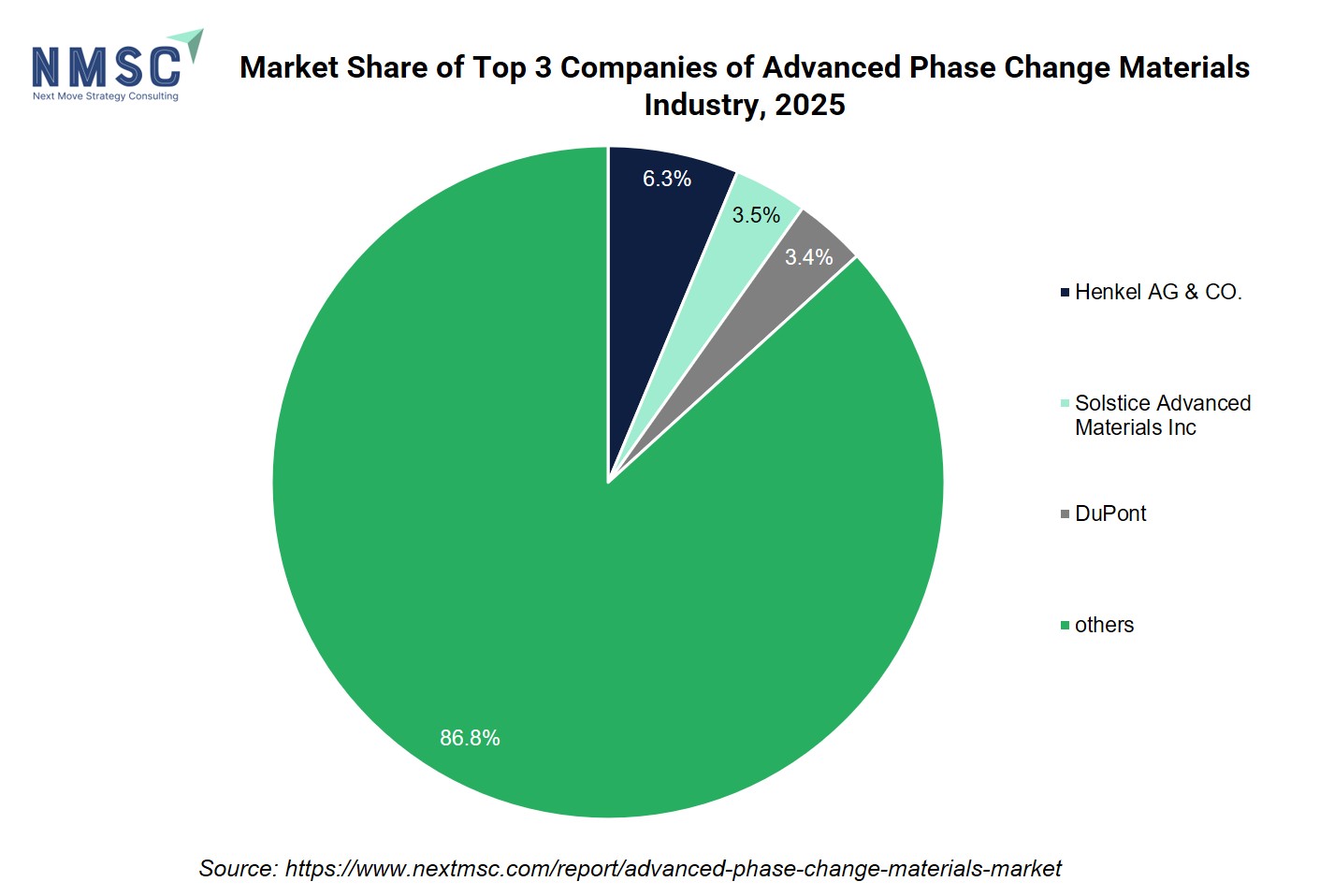
For the latest market share analysis and in-depth report on Advanced Phase Change Materials Industry insights, you can buy our latest report: Access the Report
How Do Companies Compete in the Advanced Phase Change Materials Market?
Our analysis shows that the Advanced Phase Change Materials Market competitive structure reflects a bifurcated landscape of diversified specialty chemical groups and dedicated PCM specialists. Diversified chemical companies including Croda International, DuPont, and Henkel leverage integrated manufacturing platforms, global distribution infrastructure, and application engineering capabilities to serve high-volume industrial customers with customized PCM formulations. Competitive strategies center on application-specific product development, technical service capabilities, and supply chain reliability. Innovation investment in bio-based PCM chemistry, nano-enhanced composite formulations, and microencapsulation process technology is critical for maintaining technical differentiation as application requirements become increasingly demanding across EV, pharmaceutical, and renewable energy end-users.
Which Kind of Companies Dominate the Advanced Phase Change Materials Market?
The Advanced Phase Change Materials Market is dominated by three distinct company archetypes. Diversified global specialty chemical companies including Croda International, DuPont de Nemours, and Henkel AG hold competitive advantages through integrated R&D capabilities, broad product portfolios, and global customer relationships spanning multiple end-user industries. Dedicated PCM specialists including Rubitherm Technologies, Axiotherm GmbH, Climator Sweden AB, and PCM Products Ltd compete on deep application expertise, customized formulation capabilities, and established reference installations across construction, cold chain, and energy storage applications. Emerging bio-based and advanced material companies including PureTemp LLC and Pluss Advanced Technologies are capturing premium market positions in sustainability-focused building and pharmaceutical segments.
AI-Native Differentiation and Open Standards Drive Market Success in the Advanced Phase Change Materials Market
NMSC's analysis indicates that digitally enhanced PCM system differentiation is becoming a relevant competitive dimension in cold chain and building energy management applications. Manufacturers that embed performance monitoring, predictive degradation modeling, and data-driven qualification documentation into their PCM system offerings gain competitive advantages in pharmaceutical cold chain procurement, where regulatory validation requirements create strong preference for suppliers offering integrated performance evidence. Companies developing open-standard PCM thermal specification frameworks aligned with emerging ISO and ASTM standards for PCM performance characterization gain credibility with major construction and automotive OEM procurement teams evaluating engineered PCM for high-value applications.
Market Players to Opt for Merger and Acquisition Strategies to Expand Their Presence in the Advanced Phase Change Materials Market
Our findings suggest that merger and acquisition activity will remain an active growth strategy for Advanced Phase Change Materials Market participants seeking to expand geographic market coverage, acquire microencapsulation process technology, and accelerate bio-based PCM product portfolio development. Specialty chemical groups are evaluating acquisitions of dedicated PCM producers to rapidly enter high-growth application segments including EV battery thermal management and pharmaceutical cold chain. Regional cold chain PCM providers are consolidating to build validated pharmaceutical packaging platforms with the geographic coverage and regulatory documentation capabilities required by global pharmaceutical distributor customers. Technology-driven M&A targeting nano-composite PCM formulation capabilities is expected to increase as EV and electronics cooling applications impose higher technical performance requirements on PCM suppliers.
Who Are the Key Market Players in the Advanced Phase Change Materials Market?
-
Croda International plc
-
DuPont de Nemours, Inc.
-
PureTemp LLC
-
Outlast Technologies, LLC
-
Solstice Advanced Materials Inc.
-
Cold Chain Technologies, LLC
-
Cryopak Verification Technologies, Inc.
-
PCM Products Ltd
-
Phase Change Solutions, Inc.
-
Henkel AG & Co. KGaA
-
RGEES LLC
-
Axiotherm GmbH
-
Climator Sweden AB
-
Rubitherm Technologies GmbH
-
Kaneka Corporation
-
Pluss Advanced Technologies Private Limited
-
Insolcorp, LLC
-
Roper Thermals LLC
-
Sasol Limited
-
Sunamp Limited
What Are the Latest Developments in the Advanced Phase Change Materials Industry?
|
Date |
Event |
|
Mar 2026 |
Sunamp launched Central Bank Mini, its first dedicated product for the commercial, industrial, and manufacturing sectors. The company said the system uses its Plentigrade® PCM technology to capture and redeploy waste heat for food and beverage production, advanced manufacturing, and heat-network applications. |
|
Jan 2026 |
Henkel introduced LOCTITE MS 9650, enhancing flexibility and durability for automotive bonding, supporting thermal stability and energy-efficient system designs aligned with advanced PCM-based thermal management applications. |
|
Nov 2025 |
Sunamp announced a partnership with Jiangsu Gomon New Energy Technology to establish manufacturing capacity for PCM-based heat batteries in China, supporting expansion across Asia-Pacific thermal storage markets. |
|
Sept 2025 |
Cold Chain Technologies is expanding its APAC footprint via new hubs and distributors to increase regional availability of its PCM-based thermal packaging for the growing life sciences market. |
|
Jul 2025 |
DuPont highlighted its Laird Tpcm 7000 phase change thermal interface material, designed for advanced thermal management applications in electronics and high-performance computing environments. |
|
Mar 2025 |
Pluss Advanced Technologies launched PRONGO, a phase change material-based temperature-controlled packaging solution designed for frozen foods and temperature-sensitive logistics applications. |
Porter’s Five Forces Analysis of the Advanced Phase Change Materials Market
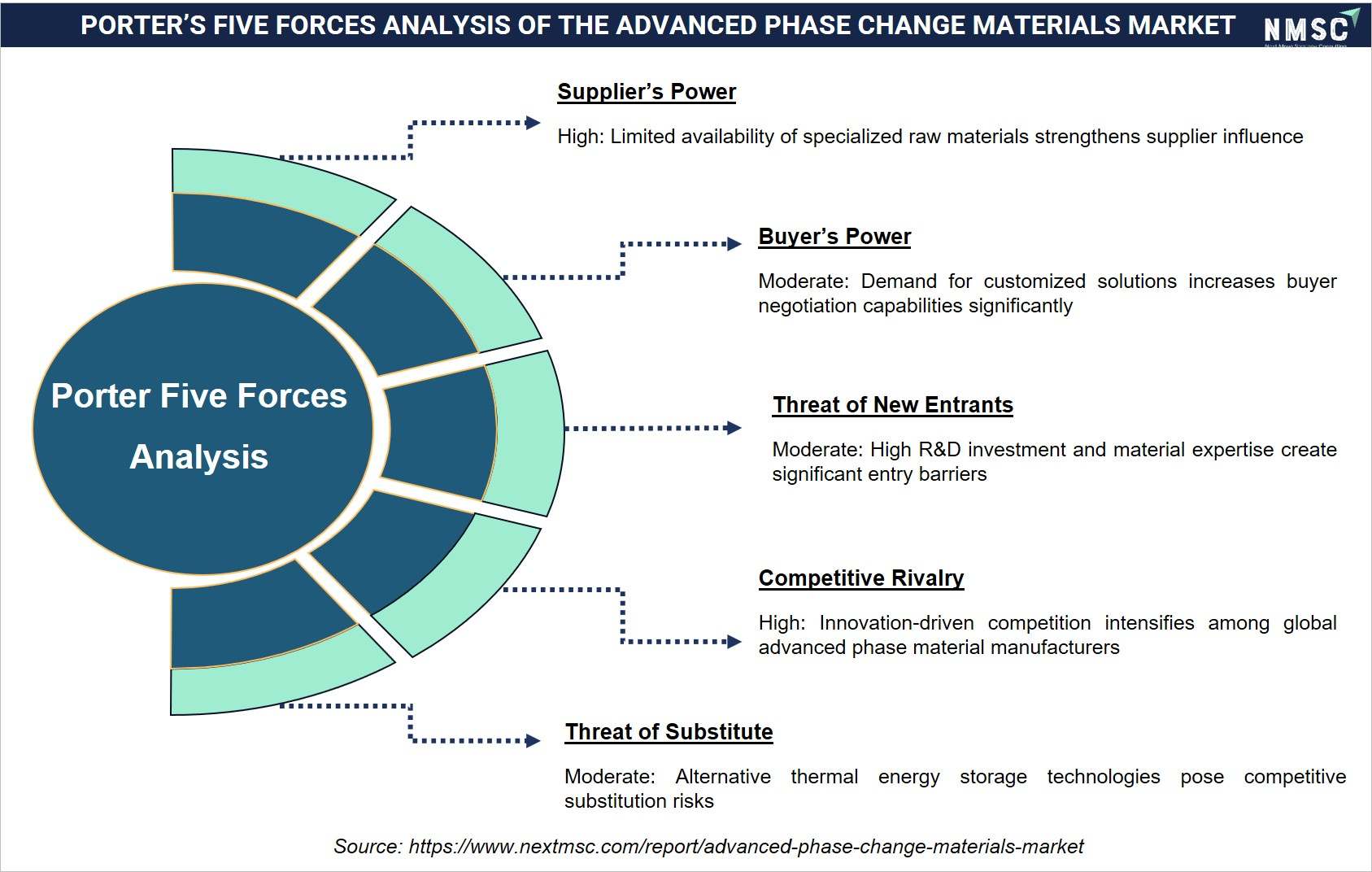
Porter’s Five Forces Analysis provides a structured framework for evaluating the competitive dynamics of the Advanced Phase Material Market. The analysis examines the bargaining power of suppliers, which is influenced by the availability of specialized raw materials and technological expertise; the bargaining power of buyers, driven by customer requirements for performance, cost efficiency, and sustainability. It also assesses the threat of new entrants, which is moderated by high R&D investments, technical know-how, and regulatory compliance requirements. The threat of substitutes is determined by the availability of alternative thermal management and energy storage materials, while competitive rivalry reflects the intensity of competition among established manufacturers and innovators. Together, these forces help stakeholders understand market attractiveness, competitive positioning, and long-term growth potential within the Advanced Phase Material Market.
What Are the Investment Opportunities in the Advanced Phase Change Materials Market?
Capital Inflows and Advanced PCM Manufacturing Investment
The Advanced Phase Change Materials Market is attracting capital inflows through both direct manufacturing investment and specialty material venture financing. Government clean energy programs in the United States, EU, and Asia-Pacific are funding PCM thermal storage demonstration projects aligned with building decarbonization and renewable energy integration goals. Based on our market evaluation, we noticed that clean energy-focused private equity funds and corporate venture arms of automotive and pharmaceutical companies are investing in next-generation PCM formulation startups developing bio-based, nano-enhanced, and composite PCM architectures for high-growth application segments. Manufacturing capacity expansion investments by established PCM producers including Rubitherm, Pluss Advanced Technologies, and Climator reflect industry confidence in sustained demand growth through the forecast period.
Infrastructure Investment in Pharmaceutical Cold Chain PCM Solutions
Pharmaceutical cold chain infrastructure investment represents one of the most capital-intensive and high-margin demand drivers for the Advanced Phase Change Materials Market. The World Health Organization estimates that approximately 25% of vaccines reach their destination having been compromised through temperature excursions in cold chain distribution, creating strong regulatory and commercial motivation for investment in higher-performance PCM-based passive cooling systems. Our assessment indicates that validated PCM qualified container programs for clinical trial material distribution, ultra-cold chain for mRNA vaccine logistics, and automated PCM conditioning infrastructure at international air cargo hubs represent high-capital-intensity deployment opportunities. Companies including Cold Chain Technologies and Cryopak are investing in qualification testing, regulatory documentation, and global distribution networks to serve multinational pharmaceutical clients with consistent validated performance.
ESG Considerations in Advanced Phase Change Materials Market Investment
Environmental, Social, and Governance considerations are increasingly relevant to investment decisions in the Advanced Phase Change Materials Market, particularly for bio-based PCM products, building thermal storage applications, and renewable energy integration projects. PCM-enabled building energy reduction directly supports carbon footprint reduction commitments of real estate investors and corporate occupiers measuring Scope 1 and 2 emissions. Bio-based PCM derived from sustainably sourced fatty acids and plant oils qualifies for bio-based material credits under LEED and BREEAM certification systems. Our findings suggest that institutional real estate investment trusts and sovereign wealth funds with net-zero building portfolio commitments represent a growing institutional buyer segment for high-performance PCM thermal storage systems in premium commercial building upgrades globally.
Digital Transformation and Smart PCM System Investment
Digital integration of PCM systems with IoT monitoring, building management platforms, and cold chain traceability systems is creating investment opportunities at the intersection of thermal materials and digital infrastructure. Advanced PCM system providers are developing proprietary monitoring platforms that document phase state, thermal performance, and operational history to support regulatory compliance documentation for pharmaceutical applications and building energy performance certification. Our analysis shows that companies that combine high-performance engineered PCM materials with digital performance monitoring capabilities can create differentiated, recurring software and service revenue streams alongside traditional materials sales, supporting higher valuation multiples and more predictable long-term revenue profiles attractive to institutional investors seeking exposure to the energy transition materials sector.
Private Equity and Venture Capital Activity in the Advanced PCM Sector
Defense and clean energy-focused private equity and venture capital investment in Advanced Phase Change Materials Market companies is expanding, reflecting recognition of PCM's enabling role across multiple high-growth sectors simultaneously. Clean energy venture funds are investing in thermal energy storage PCM startups targeting utility-scale and distributed renewable storage applications. Automotive-focused corporate venture arms are partnering with composite PCM developers to accelerate EV battery thermal management solution qualification. NMSC's analysis indicates that the most active investment themes include bio-based PCM manufacturing scale-up, nano-enhanced composite PCM for EV and electronics applications, PCM-integrated building panel systems for green building retrofit markets, and cold chain PCM packaging platforms targeting pharmaceutical and biologics distribution logistics.
Key Benefits for Stakeholders
For Building Material Manufacturers and Construction Companies
Building material manufacturers and construction companies gain a structured, data-rich assessment of Advanced Phase Change Materials Market growth trajectories, building-grade PCM product performance benchmarks, and regulatory framework analysis across 36 countries. The segmentation analysis by product form, temperature range, and end-user industry provides precise market sizing for encapsulated PCM in construction applications, enabling informed decisions on PCM integration investment, product certification priorities, and target market geography selection aligned with regional building energy code development timelines through 2035.
For Pharmaceutical and Cold Chain Logistics Operators
Pharmaceutical manufacturers and cold chain logistics operators access a detailed assessment of PCM technology developments, supplier landscape, and regulatory trend analysis relevant to ISO 21067 and WHO cold chain compliance requirements. Isothermal Control segment analysis, covering cold chain transport and medical and pharmaceutical storage sub-segments, provides evidence-based benchmarking for PCM procurement specification development. Country-level analysis across 36 nations provides regulatory and market maturity context essential for global distribution network PCM packaging standardization programs covering both established and emerging pharmaceutical market geographies.
For Advanced PCM Manufacturers and Material Scientists
Advanced PCM manufacturers and material scientists gain actionable intelligence on fastest-growing application segments, technology preference trends by end-user industry, and competitive positioning dynamics across global Advanced Phase Change Materials Market geography. Product form and chemistry segmentation analysis identifying Composite PCM at 14.54% CAGR and Formulated PCM at 14.01% CAGR provides clear investment prioritization signals for R&D portfolio allocation and production capacity expansion decisions. The competitive landscape analysis covers innovation focus areas, recent developments, and M&A activity across all 20 profiled market participants.
For Investors and Financial Analysts
Investors and financial analysts access a structured assessment of the Advanced Phase Change Materials Market's growth trajectory, competitive dynamics, M&A pipeline, and segment-level revenue forecasts through 2035. CAGR analysis by segment, region, and end-user enables precise portfolio construction and materials sector valuation modeling. Detailed company profiles of all 20 covered manufacturers, combined with latest development tracking, provide an early-signal framework for identifying acquisition targets, emerging technology leaders, and established specialty chemical companies positioned to capture disproportionate share of growing PCM procurement across EV, pharmaceutical, building, and renewable energy sectors.
PESTEL Analysis of the Advanced Phase Change Materials Market
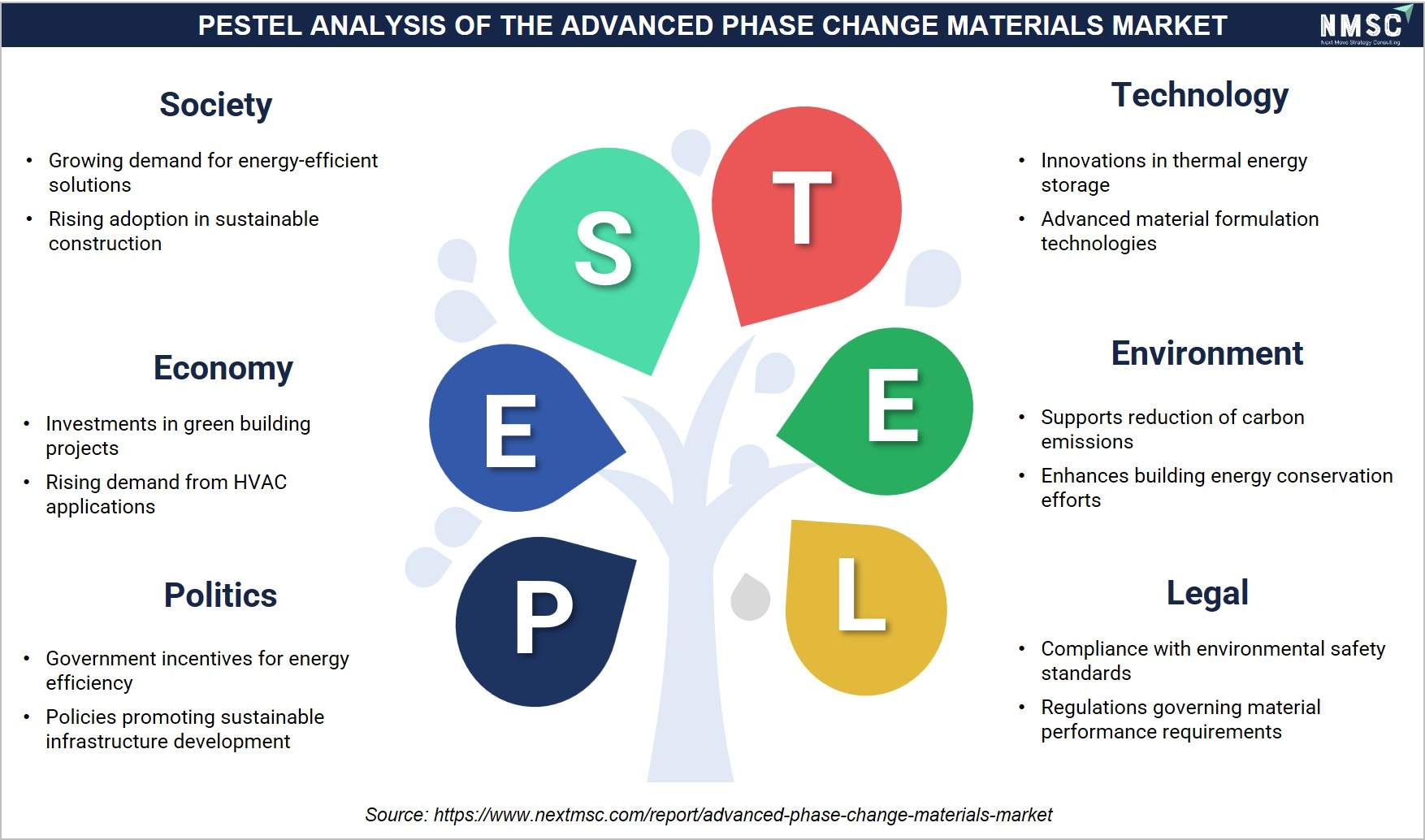
The Advanced Phase Material Market is influenced by a range of Political, Economic, Social, Technological, Environmental, and Legal (PESTEL) factors that collectively shape industry growth and adoption. Political support through energy-efficiency policies and sustainability initiatives encourages market development, while economic factors such as industrial expansion and investment in advanced materials drive demand. Growing awareness of energy conservation and thermal comfort contributes to the social adoption of advanced phase materials. Continuous innovations in material science and thermal management technologies strengthen the market from a technological perspective. Increasing focus on carbon reduction and sustainable resource utilization highlights the importance of environmental factors. Meanwhile, legal frameworks governing product safety, environmental compliance, and performance standards play a crucial role in ensuring market integrity and long-term industry growth.
Key Market Segments
By Product Form
-
Bulk PCM
-
Encapsulated PCM
-
Microencapsulated PCM
-
Powders
-
Slurries and Dispersions
-
-
Macroencapsulated PCM
-
Panels and Mats
-
Pouches and Tubes
-
-
-
Formulated PCM
-
Shape Stabilized PCM
-
Composite PCM
-
Slurry PCM
-
-
Other PCM Forms
By Chemistry
-
Organic PCM
-
Paraffin and Alkane Based
-
Fatty Acid and Ester Based
-
Sugar Alcohol Based
-
Bio Based
-
-
Inorganic PCM
-
Salt Hydrate Based
-
Molten Salt Based
-
Metallic Based
-
-
Eutectic Mixtures
-
Organic-Organic Eutectics
-
Inorganic-Inorganic Eutectics
-
Organic-Inorganic Eutectics
-
-
Composite PCM
-
Shape Stabilized
-
Porous Material Infiltrated
-
-
Other Chemistries
By Application Function
-
Isothermal Control
-
Cold Chain Transport
-
Medical & Pharma Storage
-
-
Thermal Energy Storage
-
HVAC Load Shifting
-
Industrial Process Storage
-
Renewable Storage
-
-
Active Cooling Support
-
EV Battery Regulation
-
Electronics Cooling
-
Data Center Peak Cooling
-
-
Thermal Buffering
-
Fire Protection
-
Thermal Shielding
-
Textile Comfort
-
-
Other Functions
By Temperature Range
-
Cryogenic (Below -50°C)
-
Refrigeration (-50°C to 0°C)
-
Comfort (0°C to 50°C)
-
Medium (50°C to 120°C)
-
High (120°C to 300°C)
-
Ultra-High (Above 300°C)
By Distribution Channel
-
Direct Sales
-
OEM Contracts
-
Large Project Sales
-
-
Distributors & Wholesalers
-
System Integrators & EPC
-
Retail & E-commerce
-
Other Channels
By End-User Industry
-
Building & Construction
-
Residential
-
Commercial
-
Industrial
-
-
Cold Chain & Logistics
-
3PL Providers
-
Freight & Transport
-
-
Healthcare & Life Sciences
-
Pharma Manufacturers
-
Biotech & Medical Devices
-
Hospitals & Blood Banks
-
-
Food & Beverage
-
Processors
-
Distributors
-
-
Automotive & Transport
-
EV & Battery Makers
-
Conventional Auto
-
Rail & Aerospace
-
-
Electronics & Electrical
-
Data Centers
-
Consumer Electronics
-
Telecom Infrastructure
-
-
Textile & Apparel
-
Performance Wear Brands
-
Home Textile Makers
-
Industrial Fabric Makers
-
-
Industrial Processing
-
Chemical Plants
-
General Manufacturing
-
-
Energy & Utilities
-
Renewable Developers
-
District Heating & Cooling
-
Grid Operators
-
-
Consumer & Retail
-
Direct Brands
-
Retailers & E-tailers
-
-
Other Industries
By Region
-
North America: U.S., Canada, and Mexico
-
Europe: UK, Germany, France, Italy, Spain, Sweden, Denmark, Finland, the Netherlands, and the Rest of Europe
-
Asia-Pacific: China, India, Japan, South Korea, Taiwan, Indonesia, Vietnam, Australia, Philippines, Malaysia, and the Rest of APAC
-
Middle East & Africa (MEA): Saudi Arabia, UAE, Egypt, Israel, Turkey, Nigeria, South Africa, and the Rest of MEA
-
Latin America: Brazil, Argentina, Chile, Colombia, and the Rest of LATAM
Conclusion and Recommendations
Long-Term Outlook
The Advanced Phase Change Materials Market is entering its most consequential growth decade, anchored by the convergence of building decarbonization mandates, electric vehicle adoption acceleration, pharmaceutical cold chain expansion, and renewable energy storage deployment. The market is forecast to grow from USD 3.07 billion in 2026 to USD 7.73 billion by 2035, at a CAGR of 10.82%. Our analysis shows that this growth reflects both the volumetric expansion of established applications in building and cold chain and the rapid scale-up of emerging high-value applications in EV battery thermal management, data center cooling, and high-temperature industrial thermal storage. The structural shift from commodity Bulk PCM toward Formulated and Composite PCM architectures will define competitive positioning and margin dynamics throughout the forecast period.
Strategic Positioning Recommendations
PCM manufacturers should prioritize composite PCM and shape-stabilized PCM product portfolio development, targeting the EV battery thermal management and industrial thermal storage applications commanding the highest growth rates and premium pricing. Investment in bio-based PCM chemistry aligned with EU and North American sustainability procurement requirements creates differentiated positioning in green building and pharmaceutical markets. Pharmaceutical cold chain PCM providers should pursue full regulatory validation documentation and WHO PQS qualification to capture premium market positions in global vaccine distribution logistics. Manufacturers with exposure to Asia-Pacific distribution channels are best positioned to capture the region's 13.06% CAGR growth, the highest among all geographies globally.
Investment Attractiveness
The Advanced Phase Change Materials Market represents a structurally attractive investment environment underpinned by regulatory-mandated building energy efficiency requirements, non-discretionary pharmaceutical cold chain demand, and high-growth EV and energy storage applications creating multi-sector demand diversification. The highest-conviction investment themes include Composite PCM at 14.54% CAGR, Formulated PCM at 14.01% CAGR, Thermal Buffering applications at 12.71% CAGR, Thermal Energy Storage at 12.64% CAGR, and Asia-Pacific regional exposure at 13.06% CAGR. Companies achieving technical leadership in nano-enhanced and bio-based PCM formulations are positioned to capture premium unit economics in the most rapidly expanding market segments.
Market Shifts and Key Risks
The most significant market shift underway is the transition from passive building insulation PCM applications toward active thermal management system integration in EV batteries, electronics cooling, and renewable energy storage—segments requiring materially higher performance specifications and creating structurally different competitive requirements. Key risks include petroleum feedstock price volatility affecting organic PCM cost structures, regulatory escalation on chemical composition in building materials affecting specific PCM formulation categories in the EU, and competitive pricing pressure from emerging Asian PCM producers entering established building and cold chain markets at lower price points. Nano-enhancement and bio-based PCM development programs that successfully achieve cost parity with conventional formulations represent the critical technology risk inflection point for the forecast period.
Growth Pathways
Organizations seeking to maximize value from the Advanced Phase Change Materials Market should pursue a three-horizon strategy. In the near term through 2027, prioritize EV battery thermal management PCM qualification programs, pharmaceutical cold chain PCM portfolio WHO PQS validation, and composite PCM production scale-up to capture immediate growth from high-growth application demand. In the mid-term from 2027 to 2031, invest in bio-based PCM commercial scale-up aligned with EU Green Deal sustainability procurement policies, Asia-Pacific distribution infrastructure expansion, and high-temperature PCM for industrial and renewable energy storage applications. In the long term through 2035, position for ultra-high-temperature PCM in next-generation concentrated solar power, data center PCM thermal storage integration, and smart PCM system platforms delivering data-enabled service revenue streams alongside material sales.
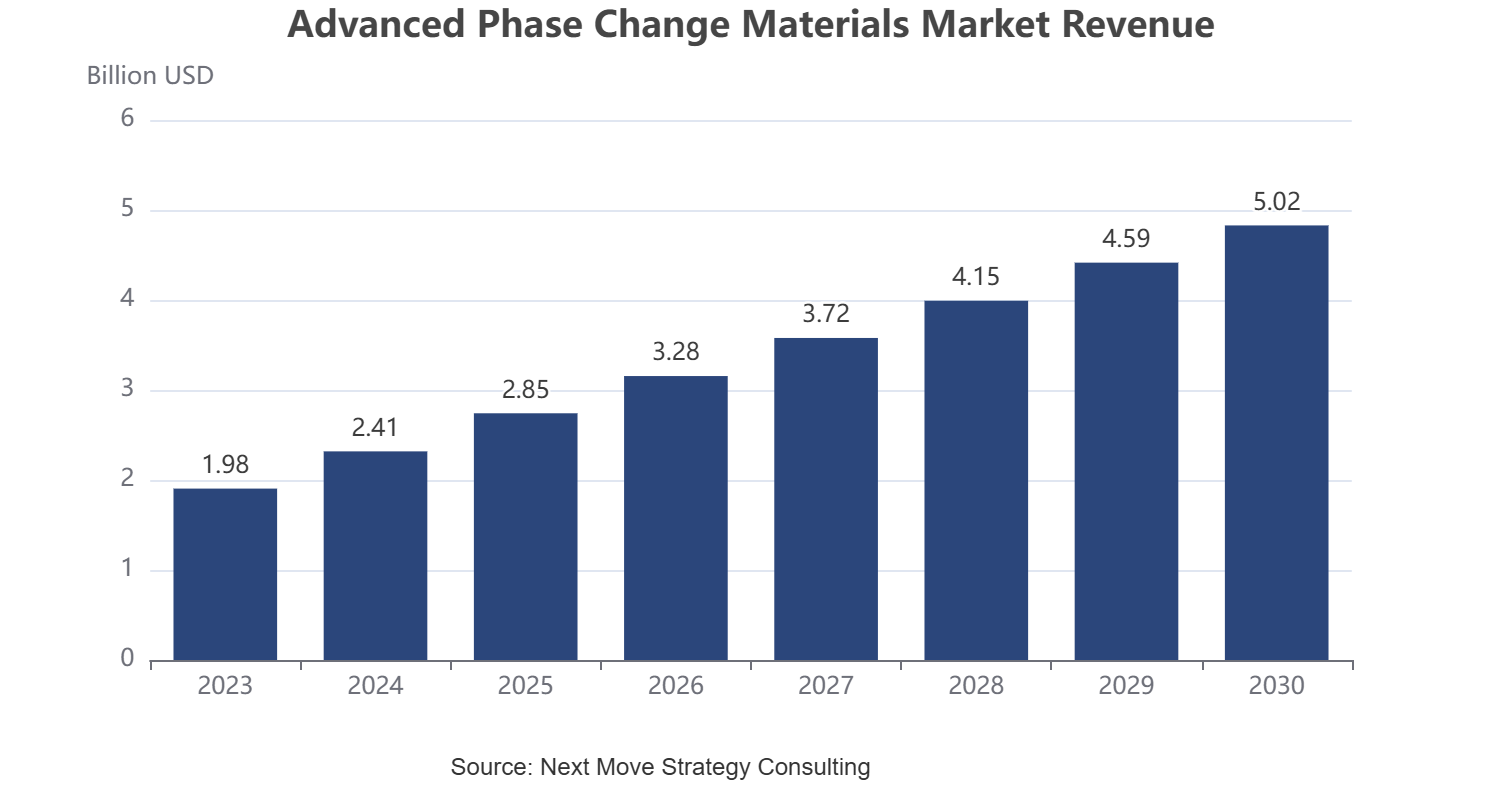
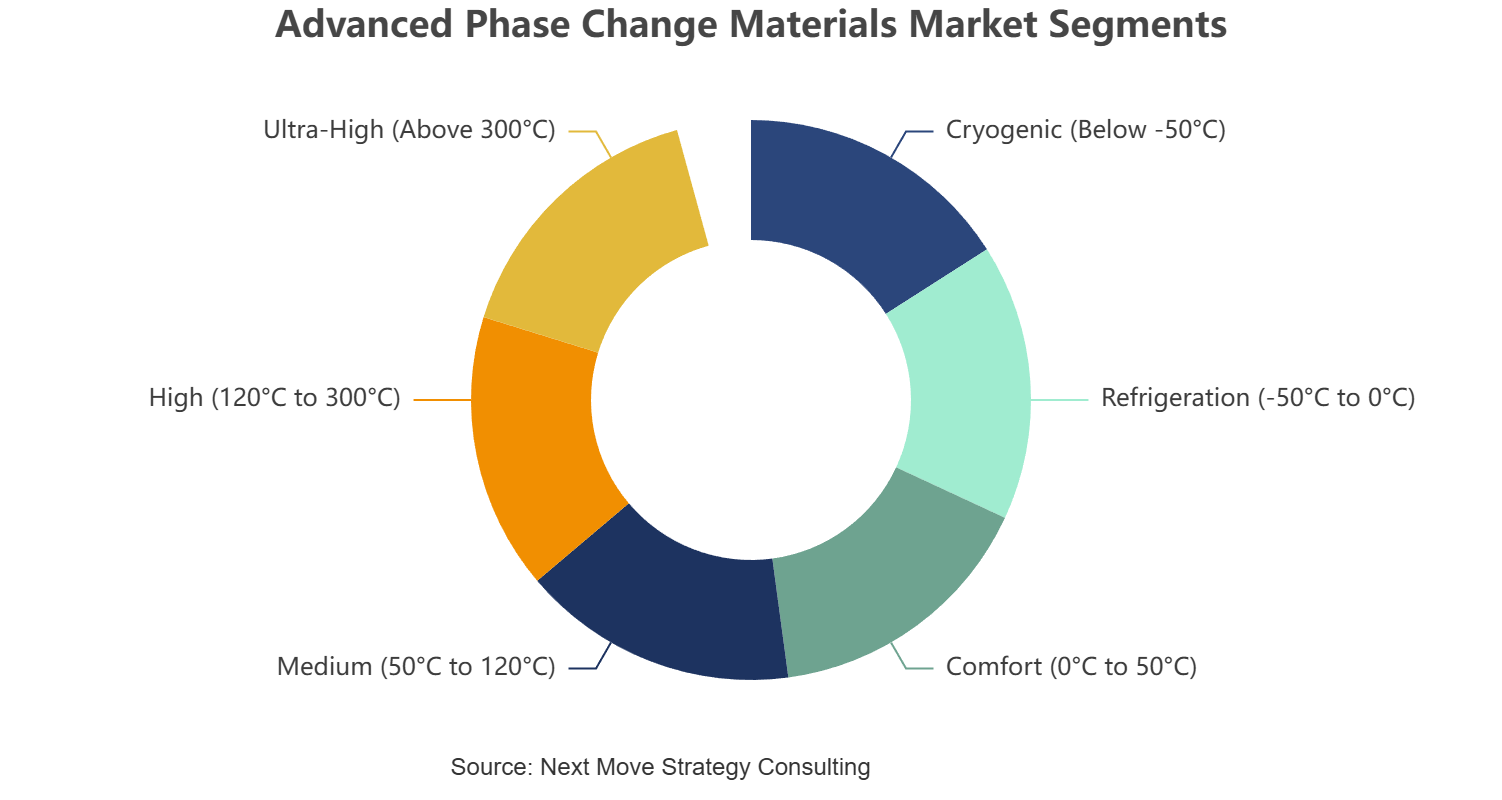
About the Author
 Mihul Sharma is a research professional with 1 year of experience in business research and market analysis. He has developed a solid foundation in research methodologies, data analysis, and market intelligence, enabling him to identify meaningful insights that support strategic business decisions. With a keen analytical mindset and a commitment to continuous learning, Mihul approaches every project with curiosity, attention to detail, and a results-oriented perspective. He is passionate about expanding his expertise, staying updated with industry trends, and contributing to impactful research initiatives. Beyond work, Mihul enjoys reading about emerging business trends, exploring new technologies, and travelling to discover different cultures and perspectives.
About the Reviewer
 Supradip Baul is an accomplished business consultant and strategist with over a decade of rich experience in market intelligence, strategy, technology, and business transformation. His work has included rigorous qualitative and quantitative analysis across multiple industries, helping clients shape investment decisions and long-term roadmaps. Earlier in his career, he was associated with Gartner, where he contributed to industry-leading reports and market share analyses. He has worked with leading global companies and holds an MBA with a dual specialization in Marketing and Finance.
At Next Move Strategy Consulting, we understand that insightful market research is the cornerstone of successful business decisions. That's why we employ a robust and multifaceted approach, combining various methodologies to deliver the most accurate and actionable data for our clients.

Research Landscape
We navigate the world of research with two primary approaches:
Qualitative Approach
Our qualitative research methodologies involve immersive techniques such as in-depth interviews, focus groups, and observational studies. By engaging directly with individuals and stakeholders, we uncover valuable insights that quantitative data alone may overlook.

Quantitative Research
In tandem with qualitative methodologies, NMSC leverages the power of Quantitative Research to provide a robust foundation of numerical insights. Through systematic data collection and analysis, we quantify patterns, preferences, and market trends, offering a comprehensive view of the business landscape.
Our quantitative research approach employs diverse tools, including surveys, experiments, and statistical modelling. These methodologies enable us to gather data from a large and representative sample, ensuring the statistical significance of our findings. By employing structured questionnaires and standardized data collection methods, we guarantee the reliability and validity of the information we present to our clients.
Quantitative research is particularly effective in measuring the prevalence of trends, assessing market size, and gauging the impact of various factors on consumer behavior. The numerical precision attained through this approach equips our clients with actionable insights, facilitating data-driven decision-making and strategy formulation.


Our Specialized Toolbox for Industry-Specific Market Research
We deploy a specialized arsenal of techniques tailored to meet your unique requirements. Here's a glimpse into our comprehensive toolbox:

Information Procurement
The stage entails acquiring market data or relevant information through various sources and methodologies.


Market Research Approach
We utilize both top-down and bottom-up approaches in market research analysis to achieve a comprehensive understanding of the market dynamics, leveraging the broad perspective of industry trends and macroeconomic factors alongside detailed insights from specific segments and individual companies.

Porters Five Forces Analysis
We conduct Porter's Five Forces analysis to evaluate the competitive landscape of an industry, providing us with insights into factors that affect profitability and strategic positioning.

SWOT Analysis

Forecasting
We utilize a forecasting model to predict future consumption by considering parameters like population, economics, regulations, market competition, drivers, constraints, technology, and pricing. We also employ statistical techniques such as multilinear regression, exponential smoothing, moving average, ARIMA, and Monte Carlo simulations for accurate predictions. In econometric forecasting, we analyzed short-term and long-term event impacts, attributing values based on regulatory frameworks, economic factors, and market events.





 Speak to Our Analyst