AI Agent Security Market Global Industry Analysis and Forecast (2026–2035)

The global AI Agent Security Market size was valued at USD 1.52 billion in 2025 and is estimated at USD 2.18 billion in 2026, forecast to reach USD 22.40 billion by 2035, expanding at a 29.5% CAGR between 2026 and 2035. North America leads with approximately 46% share, while Agent Identity and Access Security accounts for approximately 30% of the market.
Download Free Sample PDF
Base Year (2025)
$1.52 Billion
Forecast (2035)
$22.40 Billion
CAGR (2026-2035)
29.5%
Top Region
North America

What Is the AI Agent Security Market Size?
The global AI Agent Security Market was valued at USD 1.52 Billion in 2025 and is estimated at USD 2.18 Billion in 2026. It is projected to reach USD 22.40 Billion by 2035, a CAGR of 29.5% from 2026 to 2035. North America leads with about 46% market share, while agent identity and access security represents the largest solution segment with approximately 30% share.
During our market evaluation, we observed that identity controls and runtime guardrails anchor early enterprise spending, concentrating value heavily in hosted architectures and high-compliance verticals.

AI Agent Security Market Global Industry Analysis and Forecast (2026–2035) Revenue Forecast
Values in USD Billion

2025 $1.52 Billion
2025
2026 $2.18 Billion
2026
2027 $2.82 Billion
2027
2028 $3.66 Billion
2028
2029 $4.73 Billion
2029
2030 $6.13 Billion
2030
2031 $7.94 Billion
2031
2032 $10.28 Billion
2032
2033 $13.32 Billion
2033
2034 $17.24 Billion
2034
2035 $22.40 Billion
2035

Key Takeaways

Dominant Solution: Agent identity and access security (USD 0.46 Billion in 2025; USD 6.10 Billion in 2035)

Fastest-Growing Solution: Agent red teaming and assurance (31.8% CAGR, 2026–2035)

Dominant Deployment Mode: Cloud and SaaS delivered (USD 1.07 Billion in 2025; USD 17.30 Billion in 2035)

Fastest-Growing Deployment Mode: Cloud and SaaS delivered (30.5% CAGR, 2026–2035)

Dominant End Use Industry: BFSI (USD 0.38 Billion in 2025; USD 5.40 Billion in 2035)

Fastest-Growing End Use Industry: Healthcare and life sciences (30.9% CAGR, 2026–2035)

Dominant Region: North America (USD 0.70 Billion in 2025; USD 9.35 Billion in 2035)

Fastest-Growing Region: Asia-Pacific (32.1% CAGR, 2026–2035)

Dominant Country: U.S. (USD 0.62 Billion in 2025; USD 8.20 Billion in 2035)

Fastest-Growing Country: India (34.3% CAGR, 2026–2035)

Market opportunity: the market adds USD 20.22 Billion of revenue between 2026 and 2035, an entry window for vendors and investors.

According to NMSC analysis, cloud and SaaS delivered offerings account for about 72% of 2026 revenue because most agents run on hosted platforms.

What Does the AI Agent Security Market Encompass?
The AI Agent Security Market covers software and services designed to discover, authenticate, constrain, monitor, and audit autonomous AI agents. These agents independently plan tasks, execute APIs, and interact with critical enterprise systems. It spans four solution groups: agent identity and access security, runtime protection and guardrails, posture and governance management, and red teaming and assurance. General model hosting, conventional endpoint protection and basic chatbot filtering sit outside the scope, which prevents double counting with adjacent cybersecurity revenue.

Standards and rules are shaping product design. The OWASP Top 10 for Agentic Applications (published December 9, 2025) provides enterprises with a standardized risk taxonomy. Concurrently, the NIST AI Agent Standards Initiative (launched February 17, 2026) targets agent security and identity research. The EU AI Act became applicable on August 2, 2026, with high-risk compliance obligations taking effect in December 2027 and August 2028. Vendors respond by embedding automated policy enforcement, cryptographic audit trails, and runtime boundary controls into their platforms.

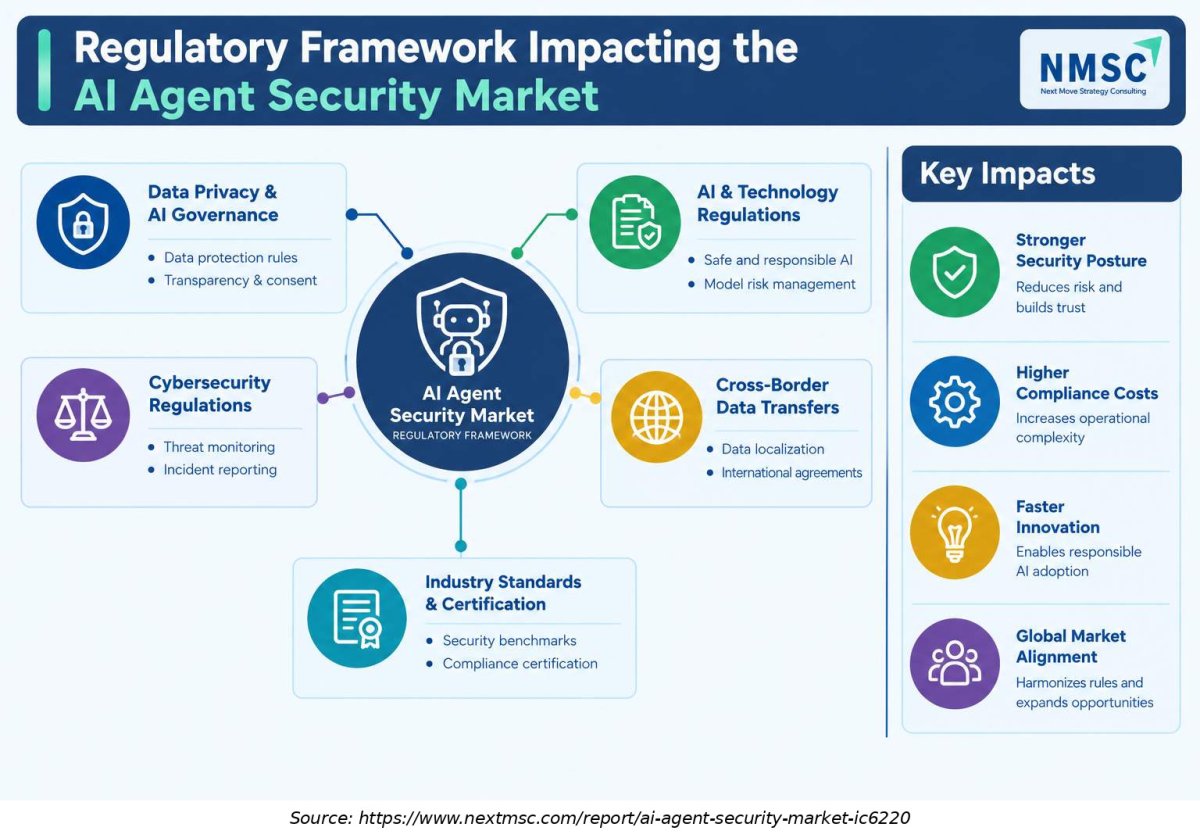
Regulatory Framework Impacting the AI Agent Security Market

Data protection laws, cybersecurity requirements, AI governance frameworks, and industry certification standards increasingly influence the AI agent security market. Regulations addressing transparency, model risk management, incident reporting, and cross-border data transfers shape vendor compliance priorities. These requirements can increase implementation costs while strengthening security, accountability, and enterprise trust, supporting the responsible adoption of AI agents across industries.

Market Drivers & Dynamics

Interactive Dataset
Agents moving from pilot to production use driver +4.4% Global 2026–2032
Growth of machine and agent identities with privileged access driver +4.1% Global, strongest in North America 2026–2035
Regulation and standards (EU AI Act, NIST, CISA guidance) driver +3.6% Europe and North America 2026–2030
MCP and tool connectivity widening the attack surface driver +2.9% Global 2026–2031
Skills gaps and unclear ownership of agent risk restraint −2.7% Global 2026–2029
Immature standards and fragmented protocols restraint −2.2% Global 2026–2030
Buyer tool sprawl and budget scrutiny restraint −1.8% North America and Europe 2026–2028
Hyperscaler bundling pressure on standalone vendors restraint -1.5% Global 2027–2033
Source: Next Move Strategy Consulting

Growth Drivers

What Is the Primary Growth Driver of the AI Agent Security Market?

Our findings suggest that enterprise adoption of AI agents is the primary growth driver of the AI agent security market. The U.S. Census Bureau reported that 19.8% of U.S. businesses used AI in the period ending 3 May 2026, rising to 37% among firms with 250 or more employees. Each production agent holds credentials, tool access and data permissions, so adoption translates directly into demand for identity, guardrail and monitoring controls.

How Is Regulation Driving Market Growth?

We observed that regulatory timelines push buyers toward documented controls. The EU AI Act became applicable on 2 August 2026, and the AI Omnibus, in force since 27 July 2026, moved high risk obligations to 2 December 2027 and 2 August 2028, which gives vendors a defined planning window. CISA, the NSA and partner agencies from Australia, Canada, New Zealand and the United Kingdom issued joint agentic AI guidance on 1 May 2026, recommending limited autonomy, strong identity management and continuous monitoring.

Growth Inhibitors

What Is Restraining the AI Agent Security Market?

During our market evaluation, we noticed that fragmented standards and crowded tooling slow purchasing decisions. NIST’s initiative is still building community protocols, so buyers lack a settled reference for agent interoperability. Identity, network, endpoint and cloud vendors all pitch overlapping agent controls, which lengthens evaluation cycles. Based on industry-derived estimations, the cumulative restraint from skills shortages, governance ambiguity, vendor tool sprawl, and hyperscaler bundling imposes an estimated 8.2% negative impact on the compound annual growth rate.

What Are the Growth Opportunities?

Where Does Agent Identity Governance Create Revenue?

Agent identity governance lets vendors sell credential vaulting, just in time access and ownership assignment to banks, insurers and public agencies that must prove who authorised each action. BFSI and government buyers benefit most because audit evidence is mandatory, and identity vendors with privileged access depth can attach agent modules to existing contracts. The identity solution segment adds USD 5.44 Billion between 2026 and 2035.

Can Hybrid and Sovereign Deployments Unlock New Demand?

Regulated buyers want agent logs, prompts and policy engines inside controlled environments, which favours hybrid architectures and private gateways. Vendors that package runtime enforcement for local data centres, endpoint fleets and edge AI devices can serve healthcare, financial and government buyers. The hybrid segment grows from USD 0.43 Billion in 2026 to USD 3.60 Billion in 2035, a gain of USD 3.17 Billion.

Will Assurance Services Become a Compliance Staple?

Red teaming and assurance can evolve from a pre launch test into a recurring compliance deliverable as the EU AI Act and sector rules require evidence. Healthcare and life sciences and Asia Pacific buyers, which grow at 30.9% and 32.1%, gain most from managed testing programs, framework mapped reports and continuous validation after each model update. The assurance segment rises from USD 0.40 Billion to USD 4.80 Billion across 2026 to 2035.

Segmentation Analysis

2025 (USD Billion)
2035 (USD Billion)
Agent identity and access security 2025: $0.46 Billion | 2035: $6.10 Billion
Agent identi
Agent runtime protection and guardrails 2025: $0.41 Billion | 2035: $6.30 Billion
Agent runtim
Agent posture and governance management 2025: $0.37 Billion | 2035: $5.20 Billion
Agent postur
Agent red teaming and assurance 2025: $0.28 Billion | 2035: $4.80 Billion
Agent red te
Agent identity and access security $0.46 Billion $6.10 Billion 28.0%
Agent runtime protection and guardrails $0.41 Billion $6.30 Billion 30.1%
Agent posture and governance management $0.37 Billion $5.20 Billion 28.9%
Agent red teaming and assurance $0.28 Billion $4.80 Billion 31.8%

Which Solution Segment Leads the AI Agent Security Market?

Our assessment indicates that agent identity and access security leads the solution market, expanding from USD 0.46 Billion in 2025 to USD 6.10 Billion by 2035 at a 28.0% CAGR, driven by mandatory enterprise credentialing and least-privilege governance. Agent red teaming and assurance is the fastest growing solution at 31.8%, since regulation and audit demands favour repeatable adversarial testing. Runtime protection and guardrails, and posture and governance management, follow at 30.1% and 28.9%, supported by gateway enforcement and inventory needs.

2025 (USD Billion)
2035 (USD Billion)
Category A
Category B
Category C
Category D
Segment Item 2025 (USD Billion) 2035 (USD Billion) CAGR
Category A $10.0 USD Billion $40.0 USD Billion 25.0%
Category B $17.1 USD Billion $51.1 USD Billion 11.0%
Category C $24.2 USD Billion $62.2 USD Billion 25.0%
Category D $31.3 USD Billion $73.3 USD Billion 11.0%

Segment-wise data is locked

Unlock complete segment-wise numbers for By Deployment Mode.

Unlock Full Data
2025 (USD Billion)
2035 (USD Billion)
Category A
Category B
Category C
Category D
Segment Item 2025 (USD Billion) 2035 (USD Billion) CAGR
Category A $10.0 USD Billion $40.0 USD Billion 27.0%
Category B $17.1 USD Billion $51.1 USD Billion 9.0%
Category C $24.2 USD Billion $62.2 USD Billion 19.0%
Category D $31.3 USD Billion $73.3 USD Billion 17.0%

Segment-wise data is locked

Unlock complete segment-wise numbers for By End Use Industry.

Unlock Full Data
2025 (USD Billion)
2035 (USD Billion)
Category A
Category B
Category C
Category D
Segment Item 2025 (USD Billion) 2035 (USD Billion) CAGR
Category A $10.0 USD Billion $40.0 USD Billion 14.0%
Category B $17.1 USD Billion $51.1 USD Billion 24.0%
Category C $24.2 USD Billion $62.2 USD Billion 22.0%
Category D $31.3 USD Billion $73.3 USD Billion 12.0%

Segment-wise data is locked

Unlock complete segment-wise numbers for By Region.

Unlock Full Data

Growth Opportunities

NMSC’s analysis indicates that three opportunities offer the clearest revenue pull through 2035.

Where Does Agent Identity Governance Create Revenue?

Agent identity governance lets vendors sell credential vaulting, just in time access and ownership assignment to banks, insurers and public agencies that must prove who authorised each action. BFSI and government buyers benefit most because audit evidence is mandatory, and identity vendors with privileged access depth can attach agent modules to existing contracts. The identity solution segment adds USD 5.44 Billion between 2026 and 2035.

Can Hybrid and Sovereign Deployments Unlock New Demand?

Regulated buyers want agent logs, prompts and policy engines inside controlled environments, which favours hybrid architectures and private gateways. Vendors that package runtime enforcement for local data centres, endpoint fleets and edge AI devices can serve healthcare, financial and government buyers. The hybrid segment grows from USD 0.43 Billion in 2026 to USD 3.60 Billion in 2035, a gain of USD 3.17 Billion.

Will Assurance Services Become a Compliance Staple?

Red teaming and assurance can evolve from a pre launch test into a recurring compliance deliverable as the EU AI Act and sector rules require evidence. Healthcare and life sciences and Asia Pacific buyers, which grow at 30.9% and 32.1%, gain most from managed testing programs, framework mapped reports and continuous validation after each model update. The assurance segment rises from USD 0.40 Billion to USD 4.80 Billion across 2026 to 2035.

Regional Outlook

2025 (USD Billion)
2035 (USD Billion)
North Americ
Europe
Asia-Pacific
Middle East
Latin Americ
Region 2025 (USD Billion) 2035 (USD Billion) CAGR (%)
North America $10.0 USD Billion $40.0 USD Billion 9.0%
Europe $17.1 USD Billion $51.1 USD Billion 27.0%
Asia-Pacific $24.2 USD Billion $62.2 USD Billion 25.0%
Middle East & Africa $31.3 USD Billion $73.3 USD Billion 23.0%
Latin America $38.4 USD Billion $84.4 USD Billion 12.0%

Regional data is locked

Unlock complete regional numbers for this market.

Unlock Full Data

Competitive Landscape

Our assessment indicates that competition is shaped by incumbent security suites, identity specialists and agent native start ups. Key Takeaways Market Structure: Moderately fragmented, with security suites and identity vendors leading and agent native specialists adding depth Innovation Focus: Agent identity, gateway based runtime enforcement, MCP visibility and continuous red teaming M&A Activity: High, with CyberArk, Wiz, SGNL, SPLX, Lakera, CalypsoAI, Invariant Labs and Virtue AI transactions announced during 2025–2026

Dimension Description
Market Structure Moderately fragmented, with security suites and identity vendors leading and agent native specialists adding depth
Innovation Focus Agent identity, gateway based runtime enforcement, MCP visibility and continuous red teaming
M&A Activity High, with CyberArk, Wiz, SGNL, SPLX, Lakera, CalypsoAI, Invariant Labs and Virtue AI transactions announced during 2025–2026

How Do Companies Compete in the AI Agent Security Market?

We found that vendors compete on platform breadth, depth of identity data and distribution reach. Suite providers such as Microsoft, Cisco and Palo Alto Networks bundle agent controls into existing enterprise agreements, while Okta and CrowdStrike lean on identity and endpoint telemetry. Pricing follows platform licences, with agent controls added as modules or consumption tiers, and geographic expansion tracks cloud marketplaces and local integrators across North America, Europe and Asia Pacific.

Which Vendor Archetypes Dominate?

Three archetypes dominate: security suites that extend network, endpoint and email estates, identity specialists that treat agents as privileged accounts, and agent native firms such as Zenity focused on runtime visibility and intent. Differentiation themes include policy enforcement outside the agent, discovery of unsanctioned agents, MCP server inventory and audit ready evidence. Suite vendors win on convenience, whereas specialists win on depth and speed of release.

How Are Firms Differentiating Through Innovation?

NMSC’s analysis indicates that innovation concentrates on four capabilities: agent discovery, identity based authorization, gateway enforcement and automated adversarial testing. Cisco added an AI bill of materials and MCP catalog, Okta organised its blueprint around where agents are, what they connect to and what they can do, and the NVIDIA Sentry watchdog moves monitoring into hardware. These moves raise switching costs by tying policies to inventories and identities.

Key Market Players

We found that the profiled vendors below show verified agent security scope and 2025–2026 activity, listed in ranked order.

Microsoft Corporation Palo Alto Networks, Inc. CrowdStrike Holdings, Inc. Cisco Systems, Inc. Google LLC Zscaler, Inc. Okta, Inc. Check Point Software Technologies Ltd. Fortinet, Inc. SentinelOne, Inc. International Business Machines Corporation Cloudflare, Inc. Proofpoint, Inc. F5, Inc. Trend Micro Incorporated Zenity Snyk Limited

Latest Developments

Our findings suggest that the past nine months brought launches, acquisitions and official guidance in quick succession.

Date Event
Sep 26 NVIDIA introduced an open platform combining OpenShell software, which establishes runtime boundaries and enforces policies, with Sentry, a hardware-backed reference design for monitoring agent behavior. The system is designed to constrain unauthorized actions and provide governance across AI software, compute infrastructure and robotics environments.
Sep 26 Proofpoint announced its Agentic Data and AI Security system, unifying data-risk analysis and AI security in one system. Three autonomous agents support detection, investigation and protection optimization, while semantic business policies and agentic insights help identify emerging risks. Availability was expected by the end of 2026.
Aug 26 Fortinet acquired Virtue AI, a provider of AI runtime protection, automated AI validation and security for autonomous systems. The acquisition is intended to extend Fortinet’s AI-Native Security Fabric with continuous validation and runtime protection across the AI lifecycle, strengthening its broader strategy for securing agentic enterprise environments.
Jun 26 SentinelOne announced plans to integrate Prompt Security with Amazon Bedrock AgentCore. The integration is designed to provide runtime guardrails for AI agents operating on AWS, extending security controls across agent-to-tool, agent-to-model and agent-to-agent communications. The announcement described an upcoming integration rather than a completed deployment.
Apr 26 Okta made its AI agent identity security offering generally available, enabling organizations to discover, register, onboard and govern agents across supported frameworks and environments. The platform provides agent identities, managed connections, least-privilege access controls and centralized administration, helping security teams manage agent permissions and revoke access when required.

SWOT Analysis

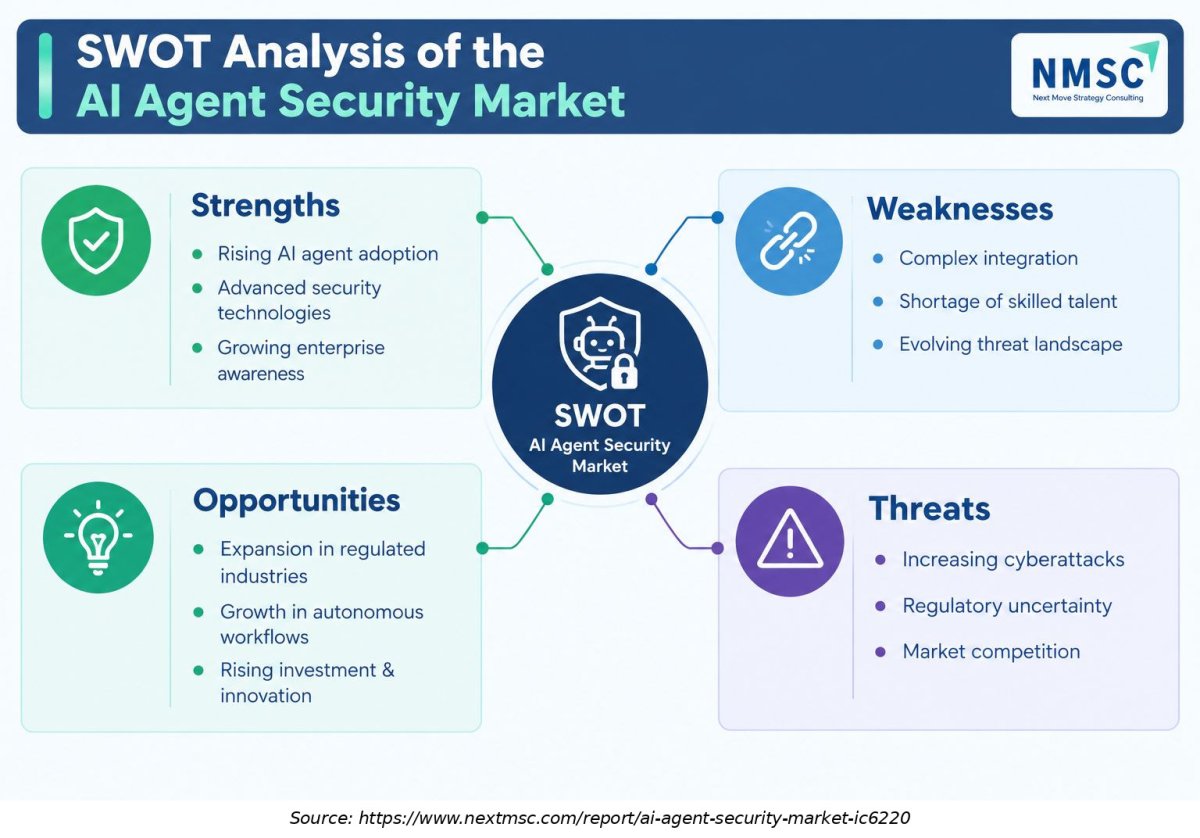
This SWOT view highlights structural strengths, strategic gaps, expansion headroom, and external risks shaping outcomes in the AI Agent Security Market Global Industry Analysis and Forecast (2026–2035).

Strengths

growing enterprise adoption of autonomous AI systems, advances in security technologies, and rising awareness of AI-related risks

Weaknesses

complex integrations, talent shortages, and evolving threats can constrain deployment

Opportunities

emerging in regulated industries and autonomous workflows

Threats

increasing cyberattacks, regulatory uncertainty, and competitive pressure require continuous innovation and robust security capabilities

Investment Opportunities

Where Is Capital Flowing in the AI Agent Security Market?

Strategic acquirers account for most visible capital deployment, and our review of 2025–2026 announcements shows eight acquisitions by profiled vendors that widen AI and agent security coverage. CyberArk, Wiz, SGNL, SPLX, Lakera, CalypsoAI, Invariant Labs and Virtue AI target identity, red teaming, guardrails and cloud posture. Investors should look for targets that own agent inventories, identity graphs or testing automation, because incumbents pay for capabilities they cannot build quickly.

How Is Infrastructure Investment Shaping Deployment?

Infrastructure spending shifts controls into gateways, networks and silicon. Amazon Bedrock AgentCore gateways will carry SentinelOne signals for allow or deny decisions, Cloudflare routes MCP traffic through its zero trust platform, and the NVIDIA Sentry reference design runs on BlueField 4 DPUs as an out of band watchdog. Investors should expect cloud delivered revenue, at USD 1.58 Billion in 2026, to keep funding most capacity expansion.

What ESG Considerations Matter for Agent Security?

Governance dominates the ESG lens, because agent actions affect privacy, fairness and accountability. CrowdStrike earned ISO/IEC 42001:2023 certification, IBM maps controls to 12 compliance frameworks including the EU AI Act, and F5 produces audit trails with regulatory templates. We found that buyers increasingly request evidence of human oversight and revocable access, which supports investment in responsible AI documentation, transparent logging and workforce training.

Key Benefits for Stakeholders

How Do Enterprise and Industry Leaders Benefit?

Enterprise security and risk leaders gain a structured view of where agent spending concentrates, with solution, deployment and industry sizes through 2035. The segment data supports build versus buy decisions, for example identity at USD 0.66 Billion in 2026 against red teaming at USD 0.40 Billion. The regional and country analysis helps align rollout sequencing with regulation, notably EU AI Act dates and national guidance.

How Do Investors and Financial Analysts Benefit?

Investors receive a reconciled forecast, with a USD 20.22 Billion opportunity between 2026 and 2035 and segment CAGRs from 26.6% to 31.8%. The acquisition pattern and vendor ranking help identify consolidation targets, while the growth matrix shows which drivers and restraints move the CAGR most. Country figures for India, South Korea and the UAE highlight high growth pockets for early stage allocation.

How Do Technology Vendors and Product Teams Benefit?

Product teams gain a view of capability gaps across identity, runtime, posture and assurance, plus the archetypes competing for each. The trend analysis indicates that gateway enforcement, MCP inventory and continuous testing set buying criteria, so roadmaps can prioritise them. Regional and partner insights guide go to market planning, particularly for hybrid deployments valued at USD 0.43 Billion in 2026.

Key Market Segments Evaluated

By Solution

  • Agent identity and access security
  • Agent runtime protection and guardrails
  • Agent posture and governance management
  • Agent red teaming and assurance

By Deployment Mode

  • Cloud and SaaS delivered
  • Hybrid
  • On premises

By End Use Industry

  • BFSI
  • IT and telecom
  • Healthcare and life sciences
  • Government and public sector
  • Retail and e-commerce
  • Manufacturing and energy

By Region

  • North America 
    • U.S.
    • Canada
    • Mexico
  • Europe 
    • UK
    • Germany
    • France
    • Italy
    • Spain
    • Sweden
    • Denmark
    • Finland
    • Netherlands
    • Rest of Europe
  • Asia-Pacific 
    • China
    • India
    • Japan
    • South Korea
    • Taiwan
    • Indonesia
    • Vietnam
    • Australia
    • Philippines
    • Malaysia
    • Rest of APAC
  • Middle East & Africa 
    • Saudi Arabia
    • UAE
    • Egypt
    • Israel
    • Turkey
    • Nigeria
    • South Africa
    • Rest of MEA
  • Latin America 
    • Brazil
    • Argentina
    • Chile
    • Colombia
    • Rest of LATAM

Conclusion & Recommendations

Our findings suggest the AI agent security market grows from USD 2.18 Billion in 2026 to USD 22.40 Billion in 2035, a 29.5% CAGR, as agents shift from pilots to core operations. Growth stays above 26% in every segment, and Asia Pacific, the Middle East and Africa, and Latin America outgrow North America. The structure should consolidate around suites and identity platforms while specialists supply testing and runtime depth.

Strategic Positioning Recommendations

Vendors should position around agent identity and gateway enforcement, which together hold USD 1.25 Billion of 2026 revenue. Suite providers ought to bundle discovery with policy, and specialists should partner with identity and cloud platforms for distribution. Buyers should assign ownership for each agent, require revocable access and test agents before release. Regional strategies should prioritise hybrid options in Europe and channel partnerships in Asia Pacific.

Investment Attractiveness

NMSC’s assessment shows red teaming and assurance offers the fastest growth at a 31.8% CAGR, while identity offers the largest base at USD 0.66 Billion in 2026. Healthcare and life sciences at 30.9% and government at 30.7% provide diversified exposure. Capital is best directed toward firms with durable data advantages, such as identity graphs and agent inventories, rather than thin wrappers around model filters.

Market Shifts and Key Risks

Key risks include shifting standards, hyperscaler bundling and false confidence from probabilistic detection. We observed that vendors themselves acknowledge detection can be probabilistic, so enforcement design matters. Regulatory delays to 2027 and 2028 may slow compliance driven spending, while a high profile agent incident could abruptly raise demand. Buyers should avoid single vendor lock in and review policy portability regularly.

Growth Pathways

Three pathways stand out: identity governance for BFSI and government, hybrid and sovereign runtime enforcement, and recurring assurance services. Asia Pacific at 32.1% offers geographic expansion, while cloud delivered products at 30.5% offer the broadest distribution. Partnerships with cloud platforms, integrators and chip makers extend reach, and bundles covering discovery, enforcement and testing raise average deal value.

FAQs

About the Author

Mihul Sharma

Mihul Sharma

Mihul Sharma is Research Associate at Next Move Strategy Consulting, where he has covered technology, industrial, and healthcare markets for 3 years. His work applies structured business research, market analysis, and secondary-source review to assess market trends, competitive developments, and growth opportunities. He supports report development by fully synthesizing industry data, company information, and market signals into concise findings for strategy and investment-focused research teams.

About the Reviewer

Supradip Baul

Supradip Baul

Supradip Baul is an accomplished business consultant and strategist with over a decade of rich experience in market intelligence, strategy, technology, and business transformation. His work has included rigorous qualitative and quantitative analysis across multiple industries, helping clients shape investment decisions and long-term roadmaps. Earlier in his career, he was associated with Gartner, where he contributed to industry-leading reports and market share analyses. He has worked with leading global companies and holds an MBA with a dual specialization in Marketing and Finance.

Download Free Sample

Kishu Kanda

KISHU KANDA

Strategy Analyst

Accenture

We purchased the AI Consumer Market Report from this company. Not only did they customize the report to meet our specific requirements, but they also showed great flexibility in accommodating our budget. The report we received fully met our expectations. Additionally, they provided prompt and thorough responses to both our pre-purchase and follow-up questions. We look forward to working with this company again in the future.

Diana Trejo

DIANA TREJO

Assistant Manager

Sumitomo Corporation de Mexico, S.A. de C.V.

Recently, we purchased a report on the Mexico Data Center Market from Next Move Strategy Consulting. The service has been excellent, with support that is always timely and thoroughly professional. The information provided is interesting, highly useful, and delivered with clarity. I would highly recommend NextMSC for anyone seeking insightful and dependable analysis.

Ross J Mckenzie

ROSS J MCKENZIE

Business Insight Manager

Staysure Group

“Next MSC have been incredibly helpful in providing detailed & robust information on our market, alongside quantifying growth by different segments. The process to procure was simple and easy, with sample reports and regular contact to ensure we had what we needed. Succinct detail on their sources & methodologies is also greatly received, allowing transparency in this respect helps build trust in the detail you pay for. Joseph in particular was fantastic, and helped ensure efficient provision of the insight pack – thank you NMSC!”.

Kevin Coker

KEVIN COKER

Founder, CEO and Board Diector

Proxima Clinical Research

I have been using Next MSC reports for product positioning in a new geography for a long time. They have by far the best reports I have found and the price is reasonable too!

Semih Kavaklioglu

SEMIH KAVAKLIOGLU

Co-Founder & Sales Manager

Decortie

I work a lot in the marketing industry and I know that research is an essential part of any campaign. I have used Market research reports for my own products and I found them to be very informative and well-researched. The team here produces insightful reports for a good price

Custom Market Research Services

We will customize the research for you if the listed report does not fully match your requirements.

Get 30% Free Customization

Select License

This website uses cookies to ensure you get the best experience on our website. Learn more

✖