Cloud Security Market By Offering (Software: Cloud Posture and Workload Security [CNAPP], Cloud Access Security [CASB], Cloud Network and Edge Security [Cloud Firewall], Cloud Identity Security, Cloud Detection and Response [Cloud SIEM], SaaS Security [SSPM, SaaS DLP]; Services: Professional Services, Managed ), By Deployment Model (Public Cloud), By Organization Size (Enterprise, Midmarket), By End User Industry (BFSI), By Sales Channel (Direct Sales) – Global Analysis and Forecast, 2025–2035
Industry: ICT & Media | Publishing Date: July 8, 2026 | Last Updated: September 30, 2026 | No of Pages: N/A | No. of Tables: N/A | No. of Figures: N/A | Format: PDF | Report Code: IC5020
Industry Outlook
The global Cloud Security Market was valued at USD 37.6 billion in 2025 and is expected to reach USD 44.3 billion by the end of 2026. The market is projected to grow substantially, reaching USD 193.5 billion by 2035, registering a CAGR of 17.8% from 2026 to 2035. NMSC's analysis indicates that accelerating enterprise cloud adoption, the proliferation of hybrid and multicloud architectures, escalating threat landscapes, and stringent global data protection regulations are the primary growth drivers shaping the Cloud Security Market across the forecast period. The market revenue is further underpinned by structural investment increases in cloud identity security, AI-powered threat detection, and zero trust enforcement as enterprises modernize their security architectures in response to expanding cloud-native attack surfaces.
Cloud Security Market Size and Forecast
|
Parameters |
Details |
|
Market Size in 2025 |
USD 37.6 Billion |
|
Market Size in 2026 |
USD 44.3 Billion |
|
Revenue Forecast in 2035 |
USD 193.5 Billion |
|
Growth Rate |
CAGR of 17.8% from 2026 to 2035 |
|
Analysis Period |
2025–2035 |
|
Base Year Considered |
2025 |
|
Forecast Period |
2026–2035 |
|
Market Size Estimation |
Billion USD |
|
Companies Profiled |
20 |
|
Countries Covered |
33 |
Cloud Security Market Overview
What Is the Cloud Security Market?
Cloud Security refers to the technologies, platforms, and services designed to protect cloud-based infrastructure, applications, workloads, data, and identities from cyber threats, unauthorized access, data breaches, and compliance risks. The Cloud Security Market encompasses a broad range of solutions including Cloud Security Posture Management (CSPM), Cloud Workload Protection Platforms (CWPP), Cloud Infrastructure Entitlement Management (CIEM), Cloud Detection and Response (CDR), identity and access management, data security, network security, and cloud-native application protection. NMSC's analysis indicates that cloud security has become a foundational component of enterprise digital transformation strategies, enabling organizations to secure increasingly complex multi-cloud and hybrid cloud environments while maintaining operational agility and regulatory compliance.
How Has the Cloud Security Market Evolved?
The Cloud Security Market has evolved through three major phases of development. The first phase, spanning approximately 2010 to 2016, focused primarily on securing cloud access through identity management, encryption, and basic perimeter protections as organizations began migrating workloads to public cloud environments. The second phase, from 2016 to 2022, was characterized by the emergence of cloud-native security solutions, security posture management platforms, and workload protection technologies designed to address the unique challenges of dynamic cloud infrastructure. Through our market assessment, we observed that the current third phase, beginning around 2023, is defined by unified Cloud-Native Application Protection Platforms (CNAPPs), AI-driven threat detection, automated security remediation, and zero trust architectures that deliver continuous visibility and protection across increasingly distributed cloud ecosystems.
How Do Regulations Influence the Cloud Security Market?
Regulatory compliance requirements represent a significant structural growth driver across the Cloud Security Market. Frameworks such as the European Union's General Data Protection Regulation (GDPR), the U.S. Federal Risk and Authorization Management Program (FedRAMP), India's Digital Personal Data Protection Act (DPDPA), the Payment Card Industry Data Security Standard (PCI DSS), and the EU NIS2 Directive require organizations to implement comprehensive cloud security controls, data protection measures, continuous monitoring capabilities, and incident reporting procedures. From our research, we found that growing regulatory scrutiny surrounding cloud-hosted data and critical digital infrastructure has accelerated investment in cloud security platforms, particularly among organizations operating in highly regulated sectors such as BFSI, healthcare, government, and telecommunications.
How Is Technology Adoption Expanding Across the Cloud Security Market?
Technology adoption across the Cloud Security Market is accelerating as enterprises modernize security architectures to support cloud-first and multi-cloud operating models. Based on NMSC's research, we found that organizations are increasingly consolidating security functions onto integrated platforms that combine posture management, workload protection, entitlement governance, threat detection, and compliance monitoring within a unified framework. AI-powered behavioral analytics, machine learning-based anomaly detection, automated threat response, and generative AI-enabled security operations are among the fastest-growing technology categories. Large enterprises and mid-market organizations alike are benefiting from cloud-delivered security solutions that reduce operational complexity, improve threat visibility, and enable faster response to evolving cyber risks across distributed cloud environments.
|
Key Takeaways |
|
By offering, the Software segment held the largest share of the Cloud Security Market at USD 28.3 billion in 2025, driven by strong adoption of Cloud-Native Application Protection Platforms (CNAPP), Cloud Security Posture Management (CSPM), identity security solutions, and security analytics platforms. Managed Services is the fastest-growing offering segment, projected to expand from USD 5.2 billion in 2025 to USD 27.7 billion by 2035 at a CAGR of 18.3%, supported by the global cybersecurity talent shortage and increasing demand for outsourced security operations. |
|
By deployment model, Public Cloud accounted for the largest revenue share at USD 18.9 billion in 2025, reflecting the growing migration of enterprise workloads to hyperscale cloud environments. Multicloud is the fastest-growing deployment model in the Cloud Security Market, expected to increase from USD 4.8 billion in 2025 to USD 28.6 billion by 2035 at a CAGR of 19.5%, as organizations prioritize flexibility, resilience, and vendor diversification strategies. |
|
By organization size, the Enterprise segment dominated the Cloud Security Market with revenue of USD 24.4 billion in 2025, supported by large-scale cloud adoption and complex regulatory compliance requirements. The Midmarket segment is the fastest-growing customer category, forecast to grow from USD 8.5 billion in 2025 to USD 46.8 billion by 2035 at a CAGR of 18.7%, driven by accelerating cloud-first digital transformation initiatives. |
|
By industry vertical, BFSI held the largest market share at USD 9.1 billion in 2025 and is projected to reach USD 48.3 billion by 2035 at a CAGR of 18.2%. The sector's leadership is driven by stringent regulatory mandates, increasing cyberattack risks, and growing investment in Zero Trust and data protection frameworks. Healthcare is the fastest-growing vertical, expanding from USD 3.2 billion in 2025 to USD 20.6 billion by 2035 at a CAGR of 20.3%, supported by healthcare digitization, telemedicine growth, and stricter patient data security requirements. |
|
By sales channel, Channel Partners generated the largest revenue contribution at USD 14.8 billion in 2025, reflecting the importance of system integrators, value-added resellers, and managed service providers in enterprise cloud security deployments. Cloud Marketplaces are the fastest-growing sales channel, projected to increase from USD 3.1 billion in 2025 to USD 19.8 billion by 2035 at a CAGR of 20.4%, as enterprises increasingly procure security solutions through AWS, Microsoft Azure, and Google Cloud marketplaces. |
|
North America remained the largest regional market, generating USD 15.8 billion in 2025 and expected to reach USD 79.6 billion by 2035 at a CAGR of 17.5%. The region benefits from the presence of leading cloud providers, mature cybersecurity spending patterns, and strong regulatory compliance requirements across critical industries. |
|
Asia-Pacific is the fastest-growing regional market in the Cloud Security Market, forecast to expand from USD 7.1 billion in 2025 to USD 43.2 billion by 2035 at a CAGR of 19.8%. Growth is fueled by accelerating cloud adoption, government-led digital transformation programs, expanding data center investments, and rising cybersecurity awareness across emerging economies. |
|
The United States represents the largest country-level market, accounting for USD 12.6 billion in 2025 and projected to reach USD 63.5 billion by 2035 at a CAGR of 17.4%. Market leadership is supported by the world's largest concentration of cloud service providers, cybersecurity vendors, and enterprise cloud spending. |
|
India is the fastest-growing national market within the Cloud Security Market, expected to grow from USD 1.1 billion in 2025 to USD 8.9 billion by 2035 at a CAGR of 23.4%. Growth is being driven by rapid cloud migration, increasing cybersecurity regulations, expansion of digital public infrastructure, and rising enterprise investment in cloud-native security technologies. |
Key Emerging Trends in the Cloud Security Market
How Is AI-Powered Threat Detection Transforming Cloud Security Operations?
Artificial intelligence and machine learning are fundamentally redefining how organizations detect and respond to cloud threats at scale. Our analysis shows that AI-driven security operations centers can analyze billions of cloud telemetry signals in real time, reducing mean time to detect cloud intrusions by significant margins compared to traditional SIEM approaches. Microsoft Sentinel and CrowdStrike Falcon are deploying large language model capabilities to synthesize threat intelligence and automate incident triage workflows across multicloud environments. This shift enables lean security teams to manage enterprise-scale cloud environments with greater detection precision, faster investigation cycles, and more consistent response quality than human-only operations can achieve.
How Is Zero Trust Architecture Reshaping Cloud Identity and Access Management?
Zero Trust Architecture is rapidly becoming the foundational security model for cloud deployments across enterprise and government organizations globally. Based on NMSC's research, we found that the principle of never trust, always verify is driving increased adoption of ZTNA, Cloud PAM, and Cloud IAM platforms that enforce continuous authentication and authorization across dynamic cloud workloads where traditional network perimeters no longer provide meaningful security boundaries. Zscaler's Zero Trust Exchange and Palo Alto Networks' Prisma Access exemplify this architectural shift, enabling enterprises to replace legacy VPN-based remote access with identity-centric, least-privilege access controls that scale natively with cloud environments and align with the NIST SP 800-207 Zero Trust Architecture framework.
Is Platform Consolidation Redefining the Competitive Landscape of the Cloud Security Market?
The Cloud Security Market is experiencing a structural shift from fragmented point-solution architectures to integrated security platforms that consolidate multiple capabilities under unified management. Through our market assessment, we observed that enterprises managing large numbers of discrete security tools are actively consolidating onto CNAPP platforms that unify CSPM, CWPP, CIEM, and CDR functions within a single interface. Wiz's rapid commercial ascent and Palo Alto Networks' Prisma Cloud expansion illustrate the market momentum behind platform consolidation. This trend is compressing the addressable market for standalone vendors while substantially rewarding players with comprehensive, API-driven platform architectures and proven integration depth with major cloud providers.
How Are Expanding Regulatory Requirements Driving Cloud Security Investment Globally?
Expanding regulatory frameworks across all major economies are directly translating into cloud security budget increases across industries and geographies simultaneously. Our findings suggest that the implementation of NIS2 in Europe, updates to HIPAA Security Rule guidance in the United States, and India's DPDPA enforcement are compelling organizations to deploy verifiable cloud security controls, complete audit trails, and enforceable data residency measures. Government and BFSI sectors are the primary beneficiaries of this regulatory-driven demand surge, with compliance-as-code and policy-as-code capabilities emerging as key procurement criteria in enterprise cloud security platform evaluations. This regulatory tailwind is expected to sustain above-market growth rates through the forecast period.
What Are the Key Market Drivers, Breakthroughs, and Investment Opportunities That Will Shape the Cloud Security Market in the Next Decade?
The Cloud Security Market growth trajectory over 2026-2035 will be shaped by a confluence of technological breakthroughs, regulatory mandates, and structural demand shifts. NMSC's analysis indicates that AI-native security platforms, zero trust adoption, and the acceleration of cloud-native application development are the most consequential forces driving market expansion. Simultaneously, talent scarcity, integration complexity, and cost management pressures represent credible restraints that may moderate growth at the margin for specific segments and geographies.
Growth Catalyst and Risk Assessment Matrix
|
Drivers / Trends / Restraints |
(+/-) % Impact on CAGR Forecast |
Geographic Relevance |
Impact Timeline |
|
Accelerating Enterprise Cloud Migration |
+1.8% |
Global |
2025-2028 (Near-Term) |
|
Zero Trust Architecture Adoption |
+1.4% |
North America, Europe |
2025-2030 (Medium-Term) |
|
AI and ML Integration in Security Platforms |
+1.6% |
Global |
2026-2035 (Long-Term) |
|
Stringent Regulatory Compliance Mandates |
+1.2% |
Europe, North America, APAC |
2025-2028 (Near-Term) |
|
Ransomware and Nation-State Threat Escalation |
+1.0% |
Global |
2025-2035 (Sustained) |
|
Multicloud Complexity and Attack Surface Expansion |
+0.9% |
Global |
2026-2030 (Medium-Term) |
|
Cybersecurity Talent Shortage |
-0.5% |
Global |
2025-2030 (Medium-Term) |
|
Budget Constraints in SMB Segment |
-0.4% |
Emerging Markets |
2025-2027 (Near-Term) |
|
Cloud Security Platform Complexity |
-0.3% |
Global |
2025-2028 (Near-Term) |
|
Managed Security Services Growth Opportunity |
+1.1% |
Global |
2026-2035 (Long-Term) |
|
API Security and SaaS Protection Expansion |
+0.9% |
North America, APAC |
2026-2030 (Medium-Term) |
|
AI Security Posture Management (AI-SPM) Emergence |
+0.7% |
North America, Europe |
2027-2035 (Long-Term) |
What Are the Growth Drivers of the Cloud Security Market?
How Is the Rapid Adoption of Cloud Services Fueling Demand for Cloud Security Solutions?
Enterprise migration to cloud environments is the most fundamental structural driver of Cloud Security Market growth. Based on NMSC’s research, we found that as organizations shift workloads to AWS, Microsoft Azure, and Google Cloud, the attack surface expands exponentially, creating durable demand for cloud-native security controls including CSPM, CWPP, and Cloud IAM. The U.S. Government’s Federal Cloud Computing Strategy mandates that federal agencies adopt cloud services with embedded security controls, directly expanding the addressable market for cloud security vendors in the public sector. Each new cloud workload deployed without corresponding security instrumentation represents an exploitable vulnerability, sustaining continuous and compounding security investment cycles across enterprise and government buyers globally.
How Are Escalating Cyber Threats Accelerating Enterprise Investment in the Cloud Security Market?
The rising frequency and sophistication of cyberattacks targeting cloud infrastructure are compelling organizations across all sectors to substantially increase cloud security investment. Our assessment indicates that ransomware groups increasingly target cloud storage, SaaS applications, and cloud-hosted backup systems due to the high business disruption potential and ransom leverage these environments provide. The U.S. Cybersecurity and Infrastructure Security Agency (CISA) has documented consistent growth in cloud-targeted intrusion campaigns by both nation-state actors and financially motivated threat groups, reinforcing enterprise urgency around CSPM, CDR, and Cloud SIEM deployments. Cyber insurance market requirements for demonstrable cloud security controls further institutionalize cloud security spending as a mandatory operational cost rather than a discretionary investment.
How Are Identity Security Gaps in Cloud Environments Creating Structural Demand in the Cloud Security Market?
Misconfigured identities and excessive cloud entitlements represent one of the most frequently exploited attack vectors in cloud environments across all industry verticals. Through NMSC’s assessment, we found that Cloud IAM misconfigurations and privilege escalation vulnerabilities are among the leading causes of cloud data breaches, creating persistent and growing demand for CIEM, Cloud PAM, and workload identity platforms. The National Institute of Standards and Technology (NIST) Special Publication 800-207 on Zero Trust Architecture specifically identifies identity verification and least-privilege access enforcement as foundational cloud security requirements, providing direct regulatory backing for CIEM and Cloud IAM procurement across government agencies and regulated industries. This creates a structural, compliance-backed demand driver for the Cloud Identity Security sub-segment through 2035.
Porter’s Five Forces Analysis of the Cloud Security Market
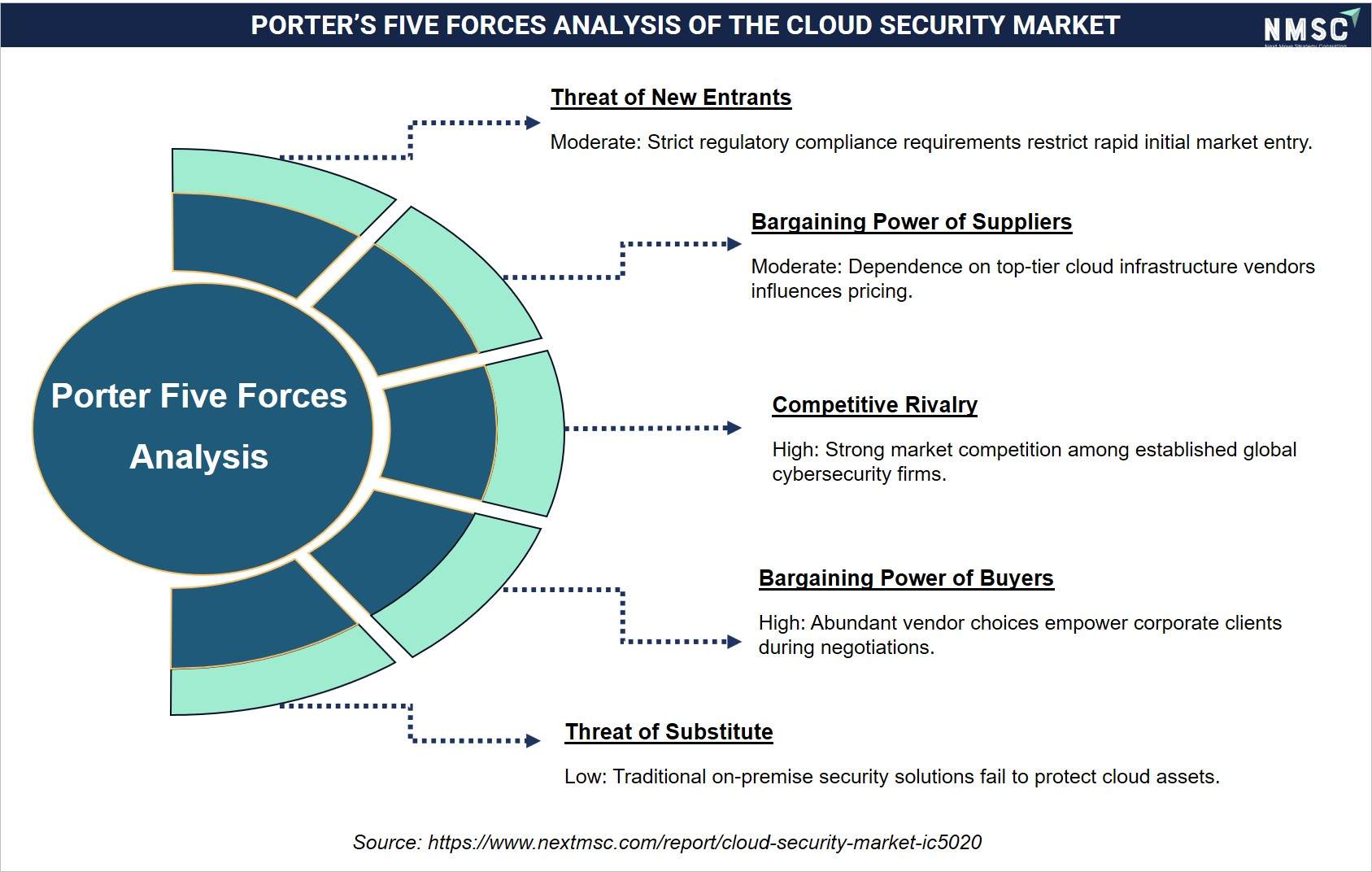
The Porter’s Five Forces analysis for the Cloud Security Market highlights the competitive dynamics shaping industry growth and profitability. Competitive rivalry remains high due to the presence of established cybersecurity vendors and continuous technological innovation. Buyer bargaining power is moderate to high as enterprises seek scalable and cost-effective solutions. Supplier power remains moderate, while the threat of new entrants is limited by high technological expertise and compliance requirements. The threat of substitutes is relatively low, as cloud security solutions are essential for protecting cloud-based infrastructure, applications, and data in an increasingly digital business environment.
What Are the Growth Inhibitors of the Cloud Security Market?
How Is the Cybersecurity Talent Shortage Constraining Cloud Security Market Expansion?
The global cybersecurity workforce gap remains a meaningful structural constraint on cloud security market growth rates. Based on our market evaluation, we noticed that organizations frequently struggle to operationalize advanced cloud security platforms without adequately trained personnel capable of interpreting threat signals, tuning detection logic, and managing complex multi-cloud security postures at scale. The International Information System Security Certification Consortium (ISC2) has documented a substantial global cybersecurity workforce deficit, with cloud security specialist roles among the hardest positions to fill across all technology disciplines. This talent scarcity drives enterprises toward managed security service providers and automated platforms, benefiting the managed services sub-segment while moderating direct software adoption velocity among mid-market organizations with limited internal security engineering capacity.
How Does Cloud Security Platform Complexity Restrain Mid-Market Adoption Within the Cloud Security Market?
The architectural complexity of modern cloud security platforms presents a meaningful barrier to adoption, particularly among mid-market and SMB organizations with limited security staff and platform integration capabilities. Our analysis shows that the proliferation of cloud security categories including CSPM, CWPP, CASB, CIEM, and CDR creates evaluation fatigue among buyers who lack the technical capacity to assess overlapping capabilities across competing vendor platforms or manage multi-vendor deployments simultaneously. This complexity restrains market growth by extending procurement decision timelines, increasing integration professional services costs, and deterring organizations from committing to comprehensive cloud security architectures without clear, demonstrable return on investment within short planning horizons.
What Are the Growth Opportunities in the Cloud Security Market?
How Is the Managed Security Services Segment Creating High-Growth Opportunities in the Cloud Security Market?
The managed cloud security services segment represents one of the most commercially attractive growth opportunities within the broader Cloud Security Market. NMSC's analysis indicates that the combination of persistent talent shortages, growing attack surface complexity, and the organizational need for continuous 24x7 threat monitoring is driving enterprises of all sizes toward outsourced cloud security operations. MSSPs and MDR providers specializing in cloud security are capturing expanding market share, supported by increased private equity investment seeking to consolidate the fragmented managed security services landscape into scaled platform businesses. This opportunity is most pronounced in mid-market and SMB segments that lack the internal capability to independently operate sophisticated cloud security platforms at production grade.
How Is API Security Emerging as a High-Priority Investment Area Within the Cloud Security Market?
The rapid proliferation of cloud-native applications and microservices architectures has elevated API security to a strategic priority within the Cloud Security Market. Based on our research, we found that APIs represent the primary integration layer connecting cloud services, SaaS applications, and third-party ecosystems, making them a high-value and increasingly targeted attack vector. The Cloud API Security sub-segment within Cloud Network and Edge Security is experiencing accelerated growth as organizations deploy API gateways, bot management controls, and behavioral API anomaly detection solutions at scale. The Open Web Application Security Project (OWASP) API Security Top 10 framework is increasingly referenced in enterprise API security procurement requirements, creating a standardized evaluation framework that benefits established vendors with compliant API security portfolios.
What Opportunities Does the SaaS Security Sub-Segment Present Within the Cloud Security Market?
The SaaS Security segment, encompassing SSPM and SaaS DLP capabilities, presents a compelling high-growth opportunity as enterprise SaaS application portfolios expand well beyond the visibility of traditional IT security controls. Our observation indicates that the average enterprise now operates a substantial portfolio of SaaS applications, many deployed by business units without security team oversight, creating significant shadow IT exposure and unmonitored data flows that represent exploitable compliance and breach risks. Vendors offering automated SaaS discovery, configuration risk assessment, and data loss prevention capabilities are experiencing accelerating demand from CISO organizations seeking to govern the full SaaS layer without impeding legitimate business productivity. This segment aligns directly with the broader enterprise shift toward CNAPP-style platform consolidation strategies.
Swot Analysis of the Cloud Security Market
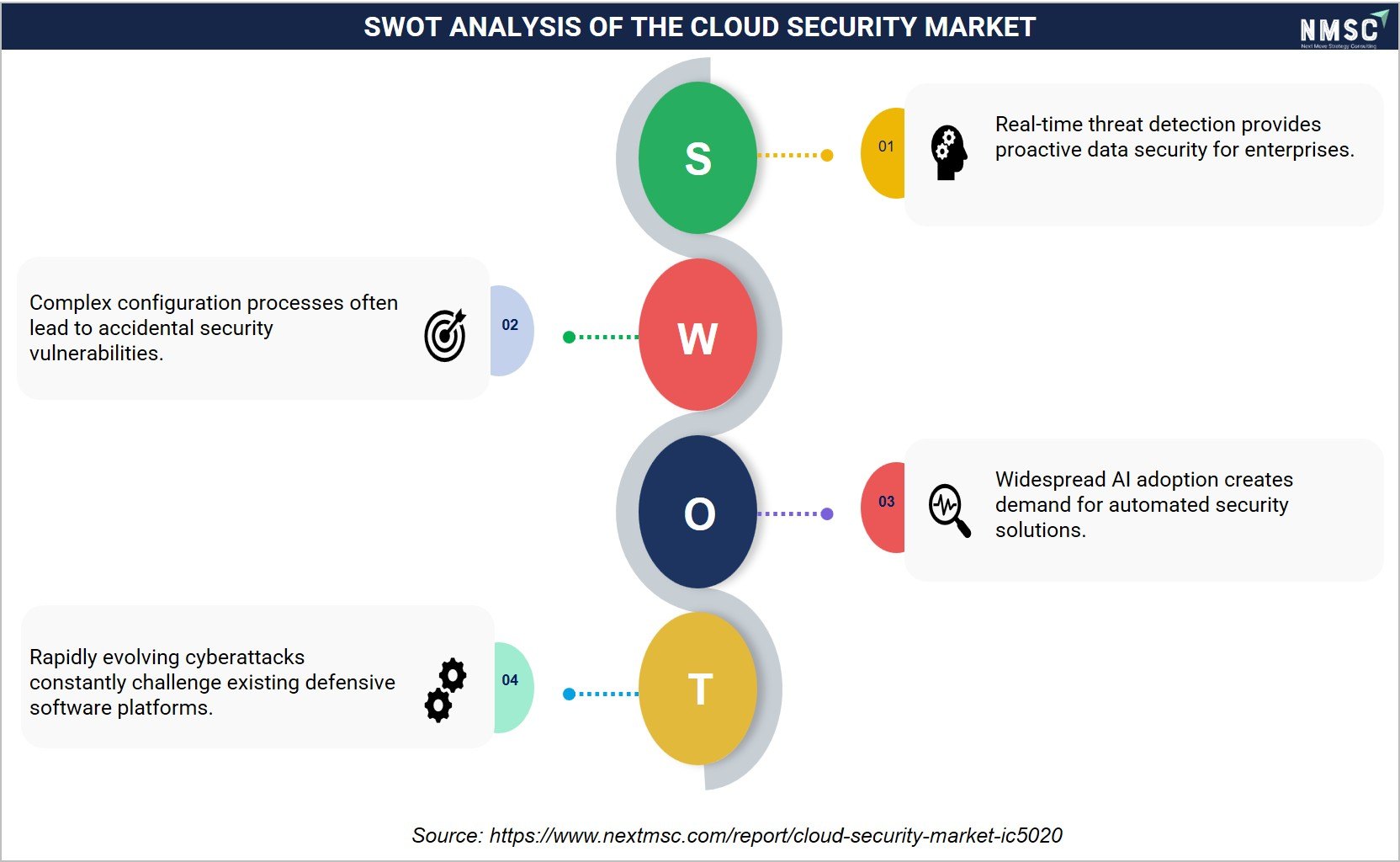
The SWOT analysis of the Cloud Security Market highlights its strong ability to provide real-time threat detection and proactive protection for enterprise data and cloud environments. However, complex configuration and deployment processes can increase the risk of security misconfigurations and vulnerabilities. The market presents significant opportunities through the growing adoption of AI, which is driving demand for automated and intelligent security solutions. At the same time, rapidly evolving cyber threats continue to challenge existing security frameworks, requiring continuous innovation and investment in advanced cloud security technologies.
How Is the Cloud Security Market Segmented in This Report, and What Are the Key Insights from the Segmentation Analysis?
How Do Software and Services Sub-Segments Define Revenue Distribution Across the Cloud Security Market?
|
Segments |
2025 (USD Billion) |
2035 (USD Billion) |
CAGR (%) |
|
Software |
28.3 |
147.2 |
18.1% |
|
Cloud Posture and Workload Security |
8.6 |
48.1 |
18.8% |
|
Cloud Access Security |
5.9 |
32.7 |
18.7% |
|
Cloud Network and Edge Security |
4.1 |
22.4 |
18.5% |
|
Cloud Data Security |
3.8 |
20.8 |
18.6% |
|
Cloud Identity Security |
3.2 |
18.6 |
19.2% |
|
Cloud Detection and Response |
2.7 |
17.3 |
20.3% |
|
SaaS Security |
2.3 |
14.6 |
20.2% |
|
Other Cloud Security Software |
1.7 |
9.7 |
19.0% |
|
Services |
9.3 |
46.3 |
17.4% |
|
Professional Services |
4.1 |
18.6 |
16.3% |
|
Managed Services |
5.2 |
27.7 |
18.3% |
The Software sub-segment dominates the Cloud Security Market by offering, capturing the majority of total revenues across the forecast period. Within Software, Cloud Posture and Workload Security holds the leading position, driven by CNAPP adoption as enterprises unify CSPM, CWPP, and CIEM capabilities on a single platform. Cloud Detection and Response and SaaS Security are the fastest-growing software sub-categories, reflecting the expansion of threats targeting cloud-native workloads and the growing unmanaged enterprise SaaS footprint. Within Services, Managed Services is outpacing Professional Services growth, as organizations with limited internal security capabilities outsource cloud security operations to MSSPs and MDR providers with specialized cloud expertise and continuous monitoring capabilities that deliver measurably superior detection outcomes versus point-in-time assessments alone.
Which Cloud Deployment Model Drives the Highest Security Spending Across the Cloud Security Market?
|
Segments |
2025 (USD Billion) |
2035 (USD Billion) |
CAGR (%) |
|
Public Cloud |
18.9 |
98.4 |
18.0% |
|
Private Cloud |
7.4 |
35.2 |
16.8% |
|
Hybrid Cloud |
5.9 |
29.6 |
17.4% |
|
Multicloud |
4.8 |
28.6 |
19.5% |
|
Other Deployment Model |
0.6 |
1.7 |
11.0% |
Public Cloud deployment commands the dominant share within the Cloud Security Market deployment segmentation, reflecting the broad enterprise migration of workloads to hyperscaler environments. From our research, we found that Public Cloud environments generate the highest security tooling expenditure due to the dynamic, auto-scaling nature of cloud workloads that require continuous posture monitoring and automated policy enforcement to maintain compliance and security integrity. Multicloud is the fastest-growing deployment model as enterprises distribute workloads across multiple providers to avoid vendor dependency and optimize cost and performance profiles. This multicloud complexity amplifies demand for unified CNAPP platforms, Cloud SIEM, and Cloud XDR capabilities that provide consistent visibility and policy enforcement across heterogeneous, multi-provider cloud infrastructure.
How Does Organization Size Influence Cloud Security Market Spending Patterns and Solution Preferences?
|
Segments |
2025 (USD Billion) |
2035 (USD Billion) |
CAGR (%) |
|
Enterprise |
24.4 |
128.6 |
18.1% |
|
Midmarket |
8.5 |
46.8 |
18.7% |
|
SMB |
4.7 |
18.1 |
14.4% |
Enterprise organizations account for the dominant share of Cloud Security Market revenue, driven by complex multi-cloud environments, extensive regulatory compliance obligations, and large cloud security teams capable of deploying and operationalizing sophisticated platforms at scale. NMSC's analysis indicates that enterprises prioritize CNAPP consolidation, enterprise-grade Cloud SIEM, and integrated identity security solutions that deliver cross-cloud visibility across large, dynamic account inventories. The Midmarket segment is growing at the fastest rate, supported by the democratization of enterprise-grade cloud security through SaaS-delivered platforms and managed security services that eliminate the internal engineering prerequisites. SMB adoption remains constrained by budget limitations, though marketplace bundling and simplified cloud security packages from hyperscalers are gradually expanding penetration in this underserved segment.
Which Industry Verticals Drive the Highest Cloud Security Market Demand, and Where Is Growth Accelerating?
|
Segments |
2025 (USD Billion) |
2035 (USD Billion) |
CAGR (%) |
|
BFSI |
9.1 |
48.3 |
18.2% |
|
Government |
5.7 |
28.4 |
17.4% |
|
Healthcare |
3.2 |
20.6 |
20.3% |
|
Manufacturing |
3.1 |
15.4 |
17.4% |
|
Retail |
3.6 |
18.2 |
17.5% |
|
IT and Telecom |
6.8 |
32.6 |
16.9% |
|
Energy and Utilities |
2.8 |
14.8 |
18.2% |
|
Other Industries |
3.3 |
15.2 |
16.5% |
BFSI holds the largest share of Cloud Security Market revenue by end-user industry, reflecting the sector's exposure to financial fraud, regulatory penalties, and reputational risk from cloud security failures. Based on our market evaluation, we noticed that BFSI organizations deploy the broadest portfolio of cloud security controls including Cloud SIEM, Cloud SOAR, Cloud PAM, and Cloud Encryption to satisfy requirements from bodies including the U.S. Federal Financial Institutions Examination Council (FFIEC), PCI DSS, and the European Banking Authority (EBA). Healthcare is the fastest-growing end-user vertical, driven by rapid migration of electronic health records, telemedicine platforms, and clinical research workloads to cloud environments, combined with intensifying regulatory scrutiny from HIPAA and increasing ransomware targeting of healthcare organizations globally. Government is the second-largest segment, with sovereign cloud security investments accelerating across North America, Europe, and Asia Pacific.
How Are Channel Partners and Marketplaces Reshaping Cloud Security Market Sales and Distribution?
|
Segments |
2025 (USD Billion) |
2035 (USD Billion) |
CAGR (%) |
|
Direct Sales |
11.6 |
58.4 |
17.5% |
|
Channel Partners |
14.8 |
76.4 |
17.9% |
|
Marketplaces |
3.1 |
19.8 |
20.4% |
|
MSSPs |
8.1 |
39.2 |
17.1% |
Channel Partners represent the dominant sales channel within the Cloud Security Market, reflecting the established role of value-added resellers, system integrators, and technology partners in distributing cloud security platforms across enterprise and midmarket segments globally. Through NMSC's assessment, we found that channel ecosystems enable vendors to scale go-to-market reach across geographies and industry verticals that direct sales teams cannot cost-effectively cover at comparable scale independently. Marketplaces are the fastest-growing sales channel, driven by enterprise procurement teams increasingly sourcing cloud security solutions directly through AWS Marketplace, Azure Marketplace, and Google Cloud Marketplace, leveraging pre-committed cloud spend and streamlined procurement workflows that reduce contracting complexity and accelerate deployment timelines. MSSPs represent a significant and growing channel, particularly for managed detection and response and managed SIEM services delivered on cloud-native platforms targeting the mid-market and enterprise segments simultaneously.
Regional Outlook
Geographic Performance Snapshot
|
Region |
2025 (USD Billion) |
2035 (USD Billion) |
CAGR (%) |
Key Driver |
|
North America |
15.8 |
79.6 |
17.5% |
Federal mandates, cloud-native enterprises |
|
Europe |
8.9 |
43.6 |
17.3% |
GDPR, NIS2, sovereign cloud programs |
|
Asia Pacific |
7.1 |
43.2 |
19.8% |
Digital transformation, data localization |
|
Middle East and Africa |
3.2 |
14.8 |
16.6% |
Vision programs, critical infrastructure protection |
|
Latin America |
2.6 |
12.3 |
16.7% |
Cloud adoption, LGPD enforcement in Brazil |
North America Cloud Security Market
North America is the largest regional market for Cloud Security, accounting for USD 15.8 billion in 2025 and projected to reach USD 79.6 billion by 2035 at a CAGR of 17.6%. The region benefits from the world's highest enterprise cloud adoption rates, a strong presence of leading cloud service providers and cybersecurity vendors, and substantial investments in digital transformation initiatives across public and private sectors. Mature regulatory frameworks, including FedRAMP, CCPA, CPRA, and federal cybersecurity mandates, continue to drive enterprise spending on cloud security solutions. Additionally, the region's advanced cloud infrastructure, growing adoption of multi-cloud environments, and increasing demand for AI-driven threat detection and zero trust architectures support its sustained leadership in the global Cloud Security Market.
United States Cloud Security Market
Through our analysis of the United States Cloud Security Market, the country commands the largest national share globally, reflecting its role as the primary headquarters for leading cloud security vendors and the world's highest concentration of cloud-native enterprises. Federal procurement programs including FedRAMP, the Department of Defense Zero Trust Strategy, and CISA's Secure Cloud Business Applications (SCuBA) project drive substantial public-sector cloud security investment. The private sector is equally active, with large enterprises deploying comprehensive cloud security platforms to satisfy SEC cybersecurity disclosure requirements and industry-specific regulations. The U.S. Cloud Security Market was valued at USD 12.6 billion in 2025 and is forecasted to reach USD 63.5 billion by 2035.
Canada Cloud Security Market
According to our evaluation, the Canada Cloud Security Market is experiencing accelerating growth driven by the adoption of cloud-first strategies across federal and provincial government agencies, the expansion of the financial services sector in public cloud environments, and the enforcement of the Personal Information Protection and Electronic Documents Act (PIPEDA). Canadian enterprises in BFSI and healthcare verticals are primary cloud security adopters, supported by proximity to U.S.-based vendors and integration into North American managed security service ecosystems. Canada's Cloud Security Market was valued at USD 1.9 billion in 2025.
Mexico Cloud Security Market
From our assessment, Mexico's Cloud Security Market is in an active development phase, supported by increasing enterprise cloud adoption in manufacturing, retail, and financial services sectors. Mexico's proximity to the United States and integration into North American supply chains is elevating cybersecurity awareness and driving demand for cloud security controls among multinational enterprises. Regulatory developments including the Federal Law on Protection of Personal Data Held by Private Parties (LFPDPPP) are strengthening compliance-driven cloud security demand across regulated industries. Mexico's Cloud Security Market was valued at USD 1.3 billion in 2025.
Europe Cloud Security Market
Europe is the second-largest regional market for Cloud Security, accounting for USD 8.9 billion in 2025 and projected to reach USD 43.6 billion by 2035 at a CAGR of 17.2%. The region benefits from one of the world's most comprehensive cybersecurity and data protection frameworks, driving sustained investment in cloud security technologies across both public and private sectors. Regulations such as GDPR, the NIS2 Directive, and the EU Cybersecurity Act are compelling organizations to strengthen cloud security controls, enhance risk management practices, and improve incident response capabilities. Strong adoption across critical industries including finance, healthcare, energy, and transportation, combined with increasing cloud migration initiatives, continues to support market growth. The UK, Germany, and France collectively account for the majority of regional revenue, underpinned by advanced digital infrastructure and growing demand for secure cloud environments.
United Kingdom Cloud Security Market
Based on our engagements across the UK market, the country maintains a leading position in European cloud security adoption, supported by the National Cyber Security Centre (NCSC) Cloud Security Guidance, the Cyber Essentials certification framework, and the Financial Conduct Authority (FCA) operational resilience requirements for financial institutions. Post-Brexit, the UK has established its own data protection framework under UK GDPR, which continues to mandate cloud security investment across all sectors handling personal data. The UK Cloud Security Market was valued at USD 1.9 billion in 2025.
Germany Cloud Security Market
From our assessment, Germany's Cloud Security Market reflects the country's industrial strength and its emphasis on data sovereignty and operational security. The Federal Office for Information Security (BSI) IT-Grundschutz framework and BSI Cloud Computing Guidelines are widely adopted by German enterprises as baseline cloud security standards. Germany's manufacturing sector is a key growth driver, as Industry 4.0 initiatives connect operational technology to cloud environments, creating new attack surfaces requiring cloud-native security monitoring. The Germany Cloud Security Market was valued at USD 1.6 billion in 2025.
France Cloud Security Market
According to our evaluation, France's cloud security demand is shaped by the national cloud sovereignty strategy, SecNumCloud certification requirements from the French cybersecurity agency (ANSSI), and the deployment of strategic public sector cloud programs. French enterprises in defense, aerospace, and government verticals are primary cloud security adopters, with strong preference for European-certified vendors satisfying sovereignty criteria. The France Cloud Security Market was valued at USD 1.1 billion in 2025 and is expected to grow steadily through the forecast period.
Italy Cloud Security Market
Through our analysis, Italy's Cloud Security Market is growing as the government's National Recovery and Resilience Plan (PNRR) drives digital transformation investments across public administration, healthcare, and manufacturing. The Italian National Cybersecurity Agency (ACN) has formalized cloud security guidelines aligned with NIS2, creating a structured regulatory demand environment. Italy's SME-dominated economy is increasing cloud adoption for operational efficiency, driving demand for cost-effective managed cloud security services. Italy's Cloud Security Market was valued at USD 0.7 billion in 2025.
Spain Cloud Security Market
Based on our engagements, Spain's Cloud Security Market is expanding as national and regional governments accelerate cloud adoption through the Spain Digital Agenda 2026, and as BFSI and retail sectors migrate workloads to cloud environments. The National Cryptology Centre (CCN) Cloud Security Guide serves as the primary public-sector cloud security procurement reference. The Spain Cloud Security Market was valued at USD 0.6 billion in 2025, with growth accelerating as NIS2 compliance requirements become enforceable across critical infrastructure operators.
Sweden Cloud Security Market
From our assessment, Sweden is one of the most digitally advanced economies in Europe, with high cloud adoption rates across public and private sectors. The Swedish Civil Contingencies Agency (MSB) provides cloud security guidance that enterprises and government agencies adopt as part of national cyber resilience programs. Sweden's Cloud Security Market was valued at USD 0.4 billion in 2025 and benefits from a strong technology ecosystem and elevated cloud security risk awareness among enterprise decision-makers.
Denmark Cloud Security Market
According to our evaluation, Denmark's Cloud Security Market is supported by the country's advanced digital government initiatives and mandatory cybersecurity requirements for public-sector cloud deployments managed through the Agency for Digitisation. Denmark's BFSI and healthcare sectors are the primary cloud security adopters. The Denmark Cloud Security Market was valued at USD 0.3 billion in 2025, with steady growth projected through 2035 aligned with NIS2 transposition timelines.
Finland Cloud Security Market
Based on our engagements, Finland's Cloud Security Market is driven by robust national cybersecurity infrastructure and strong government investment in cloud security for critical infrastructure protection. Finland's technology sector and defense-adjacent industries are key cloud security buyers. The Finland Cloud Security Market was valued at USD 0.3 billion in 2025 and is expected to grow steadily in line with Nordic digital economy trends and NIS2 enforcement.
Netherlands Cloud Security Market
Through NMSC's assessment, we found that the Netherlands is a critical European cloud hub due to its role as home to major data center campuses and the Amsterdam Internet Exchange (AMS-IX), one of the world's largest internet exchanges. Dutch financial services firms, logistics operators, and government agencies are substantial cloud security buyers. The Netherlands Cloud Security Market was valued at USD 0.7 billion in 2025, driven by GDPR enforcement, BFSI regulatory requirements, and the cloud-heavy operational model of Dutch multinationals.
Rest of Europe Cloud Security Market
From our assessment, the rest of European markets including Belgium, Poland, Austria, Portugal, Switzerland, and Central and Eastern European nations are experiencing accelerating cloud security adoption aligned with NIS2 transposition into national law and growing enterprise cloud footprints. These markets collectively contributed USD 1.3 billion in 2025 and are expected to grow substantially through 2035 as regulatory enforcement intensifies and enterprise cloud adoption deepens across the region.
Asia Pacific Cloud Security Market
Asia Pacific is the fastest-growing region in the global Cloud Security Market, accounting for USD 7.1 billion in 2025 and projected to reach USD 43.2 billion by 2035 at a CAGR of 19.8%. The region is benefiting from rapid enterprise cloud adoption, accelerating digital transformation initiatives, and increasing investments in cloud infrastructure across both developed and emerging economies. Growing data privacy, cybersecurity, and data localization regulations are encouraging organizations to strengthen cloud security capabilities and compliance frameworks. China, India, Japan, South Korea, and Australia represent the region's key markets, collectively contributing the majority of regional revenue. Rising adoption of multi-cloud environments, expanding internet penetration, and increasing cyber threat activity continue to drive demand for advanced cloud security solutions, supporting the region's position as the highest-growth market globally.
China Cloud Security Market
Through our analysis, China's Cloud Security Market operates under a unique regulatory and competitive environment shaped by the Cybersecurity Law (CSL), Data Security Law (DSL), and Personal Information Protection Law (PIPL), which mandate data residency and cloud security controls for organizations operating in China. Domestic vendors including Alibaba Cloud Security, Tencent Security, and Huawei Cloud Security hold significant market share, supported by government preference for domestically developed solutions in regulated industries. The China Cloud Security Market was valued at USD 2.1 billion in 2025.
India Cloud Security Market
Based on our engagements, India's Cloud Security Market is the fastest-growing nationally within the global Cloud Security Market, supported by the country's massive cloud adoption acceleration, the Digital Personal Data Protection Act (DPDPA) enforcement, and the Reserve Bank of India (RBI) cloud security guidelines for financial institutions. India's IT and telecom sector, BFSI industry, and government digital transformation programs are primary demand drivers. The India Cloud Security Market was valued at USD 1.1 billion in 2025 and is projected to grow at a CAGR of 23.4% through 2035, reaching USD 8.9 billion.
Japan Cloud Security Market
According to our evaluation, Japan's Cloud Security Market is shaped by the Digital Agency's government cloud procurement standards and the Ministry of Economy, Trade and Industry (METI) cloud security guidelines. Japan's financial sector, automotive industry, and defense-adjacent manufacturing are primary cloud security adopters. Cultural emphasis on data protection and vendor certification drives demand for compliant, certified cloud security platforms. Japan's Cloud Security Market was valued at USD 1.1 billion in 2025.
South Korea Cloud Security Market
From our assessment, South Korea's Cloud Security Market benefits from one of the world's highest broadband and cloud penetration rates, combined with the Korea Internet and Security Agency (KISA) cloud security certification framework (K-ISMS-P) that mandates security controls for cloud service providers and enterprise cloud users alike. The BFSI sector and semiconductor manufacturing industry are primary cloud security buyers. South Korea's Cloud Security Market was valued at USD 0.8 billion in 2025.
Taiwan Cloud Security Market
Based on our engagements, Taiwan's Cloud Security Market is driven by the country's advanced semiconductor and electronics manufacturing sectors, which are increasingly deploying cloud environments to support Industry 4.0 and supply chain digitization initiatives. Taiwan's government has formalized cloud security standards through the National Institute of Cyber Security (NICS), with growing enforcement of cloud risk assessment requirements for critical industries. Taiwan's Cloud Security Market was valued at USD 0.4 billion in 2025.
Indonesia Cloud Security Market
Through NMSC's assessment, we found that Indonesia's Cloud Security Market is expanding rapidly as one of Southeast Asia's largest digital economies transitions enterprise workloads to cloud environments. The Personal Data Protection Law (UU PDP) enacted in 2022 is creating compliance-driven cloud security demand across BFSI, healthcare, and government sectors in the country. Indonesia's Cloud Security Market was valued at USD 0.3 billion in 2025 and is projected to grow at an above-regional-average rate through 2035 as regulatory enforcement matures.
Vietnam Cloud Security Market
According to our evaluation, Vietnam's Cloud Security Market is developing rapidly within the context of the country's Cybersecurity Law and National Digital Transformation Program, which mandate secure cloud adoption for government services and critical sector operators. The growing IT outsourcing industry and expanding fintech ecosystem are driving cloud security investment from both domestic and international enterprises. Vietnam's Cloud Security Market was valued at USD 0.2 billion in 2025 with significant growth potential through 2035.
Australia Cloud Security Market
Based on our research, we found that Australia's Cloud Security Market is one of the most mature in Asia Pacific, driven by the Australian Cyber Security Centre (ACSC) Cloud Security Guidance, the Essential Eight Maturity Model endorsed by the Australian Government, and mandatory data breach notification requirements under the Privacy Act. Financial services, healthcare, and government are the primary cloud security adopters. Australia's Cloud Security Market was valued at USD 0.7 billion in 2025.
Philippines Cloud Security Market
From our assessment, the Philippines Cloud Security Market is growing as the country's business process outsourcing sector, banking industry, and government agencies increase cloud adoption. The National Privacy Commission enforces the Data Privacy Act (DPA) 2012, driving compliance-related cloud security investment. The Philippines Cloud Security Market was valued at USD 0.2 billion in 2025, with accelerating growth expected as cloud infrastructure investment intensifies through 2035.
Malaysia Cloud Security Market
Through our analysis, Malaysia's Cloud Security Market benefits from the government's MyDIGITAL initiative promoting cloud adoption across public services and the Personal Data Protection Act (PDPA) mandating data security controls. Malaysia is establishing itself as a regional cloud hub with hyperscaler data center investments from AWS, Microsoft Azure, and Google Cloud. Malaysia's Cloud Security Market was valued at USD 0.2 billion in 2025 and is projected to grow at an above-regional-average rate through 2035.
Rest of Asia Pacific Cloud Security Market
Based on our engagements, the Rest of Asia Pacific markets including Singapore, Thailand, Bangladesh, Sri Lanka, and New Zealand are experiencing varying levels of cloud security market maturity. Singapore stands out as a high-maturity market driven by the Monetary Authority of Singapore (MAS) Technology Risk Management Guidelines and its role as a regional financial hub. The collective Rest of APAC Cloud Security Market was valued at approximately USD 0.2 billion in 2025.
Middle East and Africa Cloud Security Market
The Middle East & Africa Cloud Security Market accounted for USD 3.2 billion in 2025 and is projected to reach USD 14.8 billion by 2035, growing at a CAGR of 16.6%. The region is witnessing strong growth driven by accelerating digital transformation initiatives, increasing investments in cloud infrastructure, and rising cybersecurity requirements across critical industries. Government-led programs focused on digital economy development and national cybersecurity strategies are encouraging organizations to strengthen cloud security capabilities and adopt advanced protection solutions. Saudi Arabia, the UAE, Israel, and South Africa are the key markets contributing to regional growth. Additionally, the expansion of cloud data centers by global hyperscalers, growing cloud adoption among enterprises, and increasing awareness of cyber risks continue to support demand for cloud security solutions across the region.
Saudi Arabia Cloud Security Market
According to our evaluation, Saudi Arabia's Cloud Security Market is being shaped by Vision 2030 digital transformation initiatives, the National Cybersecurity Authority (NCA) Essential Cybersecurity Controls (ECC), and the Cloud Computing Regulatory Framework requiring security compliance for cloud services used by government entities and regulated industries. BFSI, energy, and government are the dominant cloud security buyer verticals. Saudi Arabia's Cloud Security Market was valued at USD 0.8 billion in 2025.
UAE Cloud Security Market
Based on our engagements, the UAE Cloud Security Market benefits from the country's position as a regional digital hub, with Dubai and Abu Dhabi hosting significant financial services, logistics, and government cloud deployments. The UAE Cybersecurity Council's National Cybersecurity Strategy and the Dubai Electronic Security Centre (DESC) cloud security standards drive enterprise cloud security compliance investment across the emirate. UAE's Cloud Security Market was valued at USD 0.7 billion in 2025.
Egypt Cloud Security Market
Through NMSC's assessment, we found that Egypt's Cloud Security Market is developing as the country invests in digital government services and banking sector modernization. Egypt's National Telecommunications Regulatory Authority (NTRA) provides cloud security guidelines, and the Central Bank of Egypt (CBE) issues cybersecurity circulars mandating cloud security controls for financial institutions operating in the country. Egypt's Cloud Security Market was valued at USD 0.3 billion in 2025.
Israel Cloud Security Market
From our assessment, Israel's Cloud Security Market is uniquely positioned given the country's global leadership in cybersecurity innovation. Israeli-founded cloud security companies including Check Point Software Technologies and Wiz contribute to both the supply side and market awareness within the Cloud Security Market. The Israeli National Cyber Directorate (INCD) provides cloud security guidance for government and critical infrastructure sectors. Israel's Cloud Security Market was valued at USD 0.4 billion in 2025.
Turkey Cloud Security Market
Based on our research, we found that Turkey's Cloud Security Market is growing as the country's information and communications technology sector modernizes, supported by the Personal Data Protection Authority (KVKK) data security requirements and the banking regulator BDDK's cloud computing guidelines for financial institutions. Turkey's Cloud Security Market was valued at USD 0.3 billion in 2025 and is expected to grow through 2035 as cloud adoption deepens across regulated sectors.
Nigeria Cloud Security Market
According to our evaluation, Nigeria's Cloud Security Market is in an early development stage, with growth driven by the financial services sector's adoption of cloud platforms and the Nigeria Data Protection Regulation (NDPR) enforcement by the National Information Technology Development Agency (NITDA). Nigeria's Cloud Security Market was valued at USD 0.2 billion in 2025, with significant growth potential as internet penetration and enterprise cloud adoption accelerate across the country.
South Africa Cloud Security Market
Through our analysis, South Africa is the most mature Cloud Security Market in sub-Saharan Africa, driven by the BFSI sector, telecommunications companies, and government agencies adopting cloud environments under the Protection of Personal Information Act (POPIA) compliance obligations. The South African Reserve Bank (SARB) publishes cloud risk management guidance for banks operating in the country. South Africa's Cloud Security Market was valued at USD 0.3 billion in 2025.
Rest of Middle East and Africa Cloud Security Market
Based on our engagements, the Rest of MEA markets including Kuwait, Qatar, Bahrain, Oman, Kenya, Morocco, and Ethiopia are experiencing early-to-mid-stage cloud security market development. GCC countries are benefiting from national digital economy programs, while East and West African markets are driven by fintech expansion and mobile-first cloud adoption. Rest of MEA Cloud Security Market revenues were estimated at USD 0.2 billion in 2025.
Latin America Cloud Security Market
Latin America accounted for USD 2.6 billion in the Cloud Security Market in 2025 and is projected to reach USD 12.3 billion by 2035, growing at a CAGR of 16.7%. The region is experiencing steady market expansion as enterprises and government organizations increasingly adopt cloud technologies to support digital transformation initiatives. Growing awareness of cybersecurity risks, rising cloud migration activities, and the need to secure sensitive business and customer data are driving demand for cloud security solutions. Regulatory frameworks such as Brazil's LGPD, Argentina's Personal Data Protection Law, and Colombia's Law 1581 are further encouraging organizations to strengthen security controls and compliance capabilities. Brazil, Mexico, Argentina, and Colombia represent the key regional markets, supported by increasing investments in digital infrastructure and cloud-based business operations.
Brazil Cloud Security Market
Based on our engagements, Brazil is the dominant Cloud Security Market in Latin America, driven by enforcement of the LGPD by the National Data Protection Authority (ANPD), strong enterprise cloud adoption in BFSI and retail sectors, and the Brazilian government's cloud-first transformation program. Brazil's Cloud Security Market was valued at USD 1.3 billion in 2025 and represents the majority of the Latin American regional total, with growth forecasted to accelerate through 2035 as LGPD enforcement matures and cloud adoption deepens.
Argentina Cloud Security Market
Through NMSC's assessment, we found that Argentina's Cloud Security Market is developing steadily despite macroeconomic volatility, supported by a technology-literate workforce and growing fintech and software development industries that require cloud security controls for client data protection. The Personal Data Protection Law (Law 25.326) and emerging AI and data governance regulations are driving compliance-oriented cloud security spending. Argentina's Cloud Security Market was valued at USD 0.4 billion in 2025.
Chile Cloud Security Market
According to our evaluation, Chile's Cloud Security Market benefits from the country's position as one of Latin America's most stable and digitally advanced economies. Chile's Financial Market Commission (CMF) has issued cloud security guidelines for regulated financial institutions, and the national cybersecurity framework is aligned with NIST standards. Chile's Cloud Security Market was valued at USD 0.3 billion in 2025, with steady growth projected through 2035.
Colombia Cloud Security Market
From our assessment, Colombia's Cloud Security Market is growing as the country's technology sector expands and enterprises in BFSI, retail, and government adopt cloud platforms for operational efficiency. The Superintendencia de Industria y Comercio (SIC) enforces Law 1581 on data protection, creating compliance-driven cloud security demand across regulated sectors. Colombia's Cloud Security Market was valued at USD 0.3 billion in 2025.
Rest of Latin America Cloud Security Market
Based on our research, we found that the Rest of Latin America markets including Peru, Ecuador, and Central American nations are in the early adoption phase of enterprise cloud security, supported by growing fintech ecosystems, expanding regulatory attention to data protection, and increasing enterprise cloud infrastructure investment from regional and multinational organizations. Rest of Latin America Cloud Security Market was valued at USD 0.3 billion in 2025.
Competitive Landscape
Competitive Dynamics and M&A Landscape
|
Key Takeaways |
Details |
|
Market Structure |
Fragmented-to-consolidating; dominated by large platform vendors including Microsoft, Palo Alto Networks, and CrowdStrike alongside specialized cloud-native innovators such as Wiz, Netskope, and Orca Security; active vendor consolidation via M&A across the platform layer. |
|
Innovation Focus |
AI-native threat detection and response, CNAPP platform convergence, zero trust enforcement at scale, cloud-native SOC automation, generative AI for threat intelligence synthesis, and AI Security Posture Management (AI-SPM) for AI workload protection. |
|
M&A Activity |
Elevated M&A activity from 2022 through 2025, including Cisco's acquisition of Splunk, Google's integration of Mandiant into Google Security Operations, CrowdStrike's acquisition of Bionic.ai for ASPM capabilities, and Palo Alto Networks' continued CNAPP platform expansion through targeted acquisitions. |
How Do Companies Compete in the Cloud Security Market?
The Cloud Security Market is characterized by a dynamic competitive landscape in which large platform vendors compete against focused innovators across multiple security capability layers simultaneously. NMSC's analysis indicates that the market structure is transitioning from fragmentation toward consolidation, with leading vendors including Microsoft, Palo Alto Networks, CrowdStrike, and Zscaler capturing an increasing proportion of enterprise cloud security budgets through platform-led sales motions that bundle multiple security capabilities under unified pricing and management frameworks, reducing per-capability unit economics for buyers while increasing total platform contract values.
Which Kind of Companies Dominate the Cloud Security Market?
The Cloud Security Market is dominated by three distinct vendor categories. The first category includes large, diversified cybersecurity platform vendors such as Microsoft, Palo Alto Networks, CrowdStrike, and Fortinet that offer comprehensive cloud security portfolios integrated with broader endpoint, network, and identity security capabilities within unified platforms. The second category comprises cloud-native security specialists such as Zscaler, Netskope, and Wiz that were purpose-built for cloud environments and compete on the depth of cloud-native functionality, architectural simplicity, and speed of innovation within their core capability domains. The third category includes traditional IT security vendors including IBM, Broadcom, and Trend Micro that have extended legacy on-premises security platforms to cloud environments through product modernization programs and targeted acquisition strategies.
AI-Native Differentiation and Open Standards Drive Market Success in the Cloud Security Market
Our findings suggest that vendors achieving the greatest commercial momentum in the Cloud Security Market share two common strategic attributes: AI-native product architectures and commitment to open standards and interoperability. AI-native platforms that embed machine learning across detection, investigation, and response workflows demonstrate measurably faster threat detection and lower analyst workload compared to rule-based legacy alternatives. Simultaneously, vendors adopting open data standards such as the Open Cybersecurity Schema Framework (OCSF) and supporting API-based integrations are winning procurement decisions from enterprises seeking to avoid proprietary lock-in while consolidating their cloud security tooling investments onto fewer, higher-value platform relationships.
Market Players to Opt for Merger and Acquisition Strategies to Expand Their Presence in the Cloud Security Market
The Cloud Security Market is experiencing an elevated phase of merger and acquisition activity as established vendors seek to accelerate capability expansion and gain access to new customer segments and geographies. Based on our market evaluation, we noticed that acquisition activity is concentrated in three strategic areas: AI-powered threat intelligence, cloud data security posture management, and identity security capabilities that complement existing CNAPP platforms. CrowdStrike's acquisition of Bionic.ai expanded its CNAPP capabilities with application security posture management. Cisco's acquisition of Splunk in 2024 created a combined cloud security and observability platform with substantial cross-selling potential across Cisco's enterprise customer base globally. Google's integration of Mandiant into Google Security Operations strengthened cloud threat intelligence and incident response capabilities across Google Cloud's enterprise customer base.
Who Are the Key Market Players in the Cloud Security Market?
-
Microsoft Corporation
-
Palo Alto Networks, Inc.
-
CrowdStrike Holdings, Inc.
-
Zscaler, Inc.
-
Fortinet, Inc.
-
Cisco Systems, Inc.
-
Check Point Software Technologies Ltd.
-
Cloudflare, Inc.
-
Akamai Technologies, Inc.
-
International Business Machines Corporation
-
Broadcom Inc.
-
Netskope, Inc.
-
Proofpoint, Inc.
-
Trend Micro Incorporated
-
Wiz, Inc.
-
SentinelOne, Inc.
-
Tenable Holdings, Inc.
-
Qualys, Inc.
-
Rapid7, Inc.
-
Orca Security Ltd.
What Are the Latest Developments in the Cloud Security Market Industry?
|
Date |
Event |
|
Jul 2025 |
Palo Alto Networks announced its agreement to acquire CyberArk for approximately USD 25 billion. The acquisition combines cloud security, identity security, privileged access management, and AI-era cyber protection into a unified platform, strengthening Palo Alto’s cloud security leadership. |
|
Apr 2025 |
CrowdStrike unveiled new Falcon Cloud Security innovations, including AI Model Scanning and Shadow AI Detection, designed to secure cloud workloads, SaaS applications, AI models, cloud data, and hybrid cloud environments. The launch expands CrowdStrike’s cloud-native security portfolio. |
Expert Insights
 “We started Wiz because we believed security shouldn't slow innovation down it should enable it. Cloud fundamentally changed how the world builds software, but security was still fragmented, reactive, and built for a different era. The opportunity we saw early on was to reset that model entirely: give organizations clarity and confidence by default, so they could move fast in the cloud without fear, complexity, or trade-offs.”
— Assaf Rappaport, CEO and Co-Founder, Wiz
Statement reflecting on the core strategic vision of Wiz, highlighted during a 2026 market retrospective on the evolution and consolidation of enterprise cloud security.
Market Interpretation
This quote captures the primary operational driver of the modern cloud security market: aligning security operations with the agility of cloud-native development. Historically, disjointed security tooling created friction, resulting in complex and reactive postures. The market is now aggressively consolidating around unified, graph-based platforms that provide immediate context across multi-cloud environments. This transition enables developers and IT teams to proactively secure their infrastructure without bottlenecking product innovation.
What Are the Investment Opportunities in the Cloud Security Market?
Capital Inflows and Venture Activity
The Cloud Security Market continues to attract strong private equity, venture capital, and institutional investment as cybersecurity remains a top enterprise spending priority. We observed increasing funding activity across cloud-native security, Zero Trust architecture, Cloud Security Posture Management (CSPM), Cloud-Native Application Protection Platforms (CNAPP), and AI-driven threat detection solutions. Major cybersecurity vendors and emerging startups continue to secure substantial investment rounds, reflecting investor confidence in long-term demand. According to industry analyses from venture capital associations and cybersecurity investment reports, cybersecurity remains among the most active technology investment categories, supported by rising cloud adoption, expanding attack surfaces, and growing regulatory requirements.
Infrastructure Investment
Infrastructure investment is a major growth catalyst for the Cloud Security Market as hyperscale cloud providers continue expanding secure cloud environments globally. Microsoft, Amazon Web Services (AWS), and Google Cloud are investing billions of dollars annually in cloud infrastructure, security operations centers, threat intelligence platforms, and secure-by-design cloud services. We found that government-backed cybersecurity initiatives, including the U.S. National Cybersecurity Strategy, the European Union Cybersecurity Strategy, and national digital resilience programs across Asia-Pacific, are directing significant funding toward cloud security modernization. These investments create opportunities for cloud security vendors offering identity security, workload protection, encryption, and security monitoring capabilities.
ESG and Cyber Resilience Investment
Environmental, Social, and Governance (ESG) considerations are becoming increasingly important in cloud security investment decisions. Organizations are prioritizing cloud security solutions that enhance data privacy, support responsible AI governance, and strengthen cyber resilience frameworks. Investors increasingly view cybersecurity as a governance and risk-management imperative due to the financial and reputational impact of cyber incidents. We further assessed that cloud security providers maintaining recognized certifications, transparent vulnerability disclosure programs, privacy-compliant architectures, and strong governance frameworks are likely to attract ESG-focused institutional capital seeking lower technology risk exposure and sustainable long-term returns.
Digital Transformation Enablement
Cloud security serves as a foundational layer for enterprise digital transformation initiatives, making it a structurally attractive investment category. As organizations migrate mission-critical applications, workloads, and data assets to public, private, and hybrid cloud environments, security spending becomes a non-discretionary component of transformation budgets. We observed that modernization initiatives across healthcare, banking, government, manufacturing, and retail sectors increasingly incorporate cloud security platforms for compliance management, identity governance, data protection, and continuous monitoring. Multi-year digital transformation programs create recurring revenue opportunities for cloud security vendors through subscription-based SaaS models and managed security services contracts.
Private Equity and Strategic M&A Activity
Private equity firms and strategic acquirers remain highly active within the Cloud Security Market, targeting companies with recurring revenue models, strong customer retention rates, and differentiated cloud-native security capabilities. We identified increasing consolidation across managed security service providers (MSSPs), managed detection and response (MDR) firms, identity security providers, and cloud security software vendors. Strategic acquisitions are being driven by demand for integrated security platforms that combine cloud workload protection, threat intelligence, compliance automation, and AI-powered security operations. Investors should closely monitor emerging segments such as AI Security Posture Management (AI-SPM), cloud-native application security, confidential computing, and quantum-resistant encryption technologies, which are expected to become attractive acquisition targets between 2026 and 2035 within the Cloud Security Market.
Key Benefits for Stakeholders
For Enterprise Buyers
Enterprise buyers gain comprehensive insights into the Cloud Security Market, including market sizing, deployment model trends, technology adoption patterns, and vendor landscape assessments across public, private, and hybrid cloud environments. This intelligence supports cloud security strategy development, vendor evaluation, procurement planning, and long-term cybersecurity investment decisions. Our analysis of emerging technologies such as Zero Trust Security, Cloud Security Posture Management (CSPM), Cloud-Native Application Protection Platforms (CNAPP), and AI-driven threat detection enables organizations to align security architectures with evolving business and compliance requirements.
For Investors and Financial Analysts
Investors and financial analysts receive a structured evaluation of the Cloud Security Market's growth outlook, competitive intensity, investment landscape, and revenue opportunities through 2035. Segment-level forecasts across solutions, services, deployment models, organization sizes, and industry verticals support valuation modeling and portfolio strategy development. In addition, competitive benchmarking, funding activity analysis, and M&A trend assessment provide valuable insights for identifying emerging market leaders, acquisition candidates, and high-growth investment opportunities within the global cloud security ecosystem.
For Cloud Security Vendors and Technology Providers
Cloud security vendors and technology providers gain actionable intelligence regarding market opportunities, customer purchasing behavior, competitive positioning, and rapidly expanding solution categories. Our analysis highlights high-growth areas including identity and access management, cloud workload protection, data security, security analytics, and managed cloud security services. Regional market assessments further assist vendors in identifying expansion opportunities, optimizing go-to-market strategies, strengthening channel partnerships, and prioritizing product innovation investments to enhance competitive differentiation.
For Government and Regulatory Bodies
Government agencies and regulatory authorities benefit from detailed analysis of how evolving cybersecurity regulations, data protection mandates, and national cyber resilience initiatives are shaping the Cloud Security Market. The report provides insights into the impact of frameworks such as GDPR, NIS2, CCPA, India's Digital Personal Data Protection Act (DPDPA), and sector-specific compliance requirements on cloud security adoption. These findings support evidence-based policymaking, cybersecurity strategy development, critical infrastructure protection planning, and national cloud security investment initiatives.
For System Integrators and Managed Security Service Providers
System integrators, consulting firms, and Managed Security Service Providers (MSSPs) gain a comprehensive understanding of customer demand patterns, technology adoption trends, and competitive dynamics within the Cloud Security Market. The report identifies growth opportunities across industry verticals, regional markets, and service categories, enabling providers to refine service portfolios, develop strategic partnerships, and strengthen cloud security consulting and implementation capabilities. Insights into outsourcing trends and managed security adoption further support long-term business expansion and market penetration strategies.
For Chief Information Security Officers (CISOs) and Security Teams
CISOs and enterprise security teams gain valuable intelligence on emerging cyber threats, cloud security best practices, technology innovation trends, and vendor capabilities. The report supports informed decision-making related to cloud security architecture modernization, risk management frameworks, regulatory compliance initiatives, and multicloud security governance. Detailed market insights help security leaders benchmark security investments, evaluate solution providers, and establish resilient cloud security programs capable of addressing increasingly sophisticated threat landscapes.
Key Market Segments
By Offering
-
Software
-
Cloud Posture and Workload Security
-
CNAPP
-
CSPM
-
CWPP
-
CIEM
-
KSPM
-
Cloud Vulnerability Management
-
Other Cloud Posture and Workload Security
-
-
Cloud Access Security
-
CASB
-
SSE
-
ZTNA
-
SWG
-
Cloud Browser Isolation
-
Other Cloud Access Security
-
-
Cloud Network and Edge Security
-
Cloud Firewall
-
WAAP
-
Cloud API Security
-
DDoS Protection
-
Cloud Microsegmentation
-
Secure DNS
-
Other Cloud Network and Edge Security
-
-
Cloud Data Security
-
DSPM
-
Cloud DLP
-
Cloud Encryption and Key Management
-
Cloud Tokenization
-
Cloud Secrets Management
-
Other Cloud Data Security
-
-
Cloud Identity Security
-
Cloud IAM
-
Cloud SSO
-
Cloud MFA
-
Cloud PAM
-
Cloud CIEM
-
Workload Identity and Entitlements
-
Other Cloud Identity Security
-
-
Cloud Detection and Response
-
Cloud SIEM
-
Cloud SOAR
-
Cloud XDR
-
CDR
-
Other Cloud Detection and Response
-
-
SaaS Security
-
SSPM
-
SaaS DLP
-
Other SaaS Security
-
-
Other Cloud Security Software
-
-
Services
-
Professional Services
-
Managed Services
-
By Deployment Model
-
Public Cloud
-
Private Cloud
-
Hybrid Cloud
-
Multicloud
-
Other Deployment Model
By Organization Size
-
Enterprise
-
Midmarket
-
SMB
By End User Industry
-
BFSI
-
Government
-
Healthcare
-
Manufacturing
-
Retail
-
IT and Telecom
-
Energy and Utilities
-
Other Industries
By Sales Channel
-
Direct Sales
-
Channel Partners
-
Marketplaces
-
MSSPs
By Region
-
North America: U.S., Canada, and Mexico.
-
Europe: UK, Germany, France, Italy, Spain, Sweden, Denmark, Finland, the Netherlands, and the rest of Europe.
-
Asia Pacific: China, India, Japan, South Korea, Taiwan, Indonesia, Vietnam, Australia, Philippines, Malaysia and the rest of APAC.
-
Middle East & Africa (MEA): Saudi Arabia, UAE, Egypt, Israel, Turkey, Nigeria, South Africa, and the rest of MEA.
-
Latin America: Brazil, Argentina, Chile, Colombia, and the rest of LATAM.
Conclusion and Recommendations
Long-Term Outlook
The Cloud Security Market is entering a transformative growth phase, supported by accelerating cloud adoption, increasingly stringent regulatory requirements, and the growing sophistication of cyber threats targeting cloud environments. The market is projected to expand from USD 44.5 billion in 2026 to USD 193.5 billion by 2035, registering a CAGR of 17.8% during the forecast period. We further analysed that this growth reflects the rising complexity of multi-cloud and hybrid-cloud infrastructures, increasing enterprise reliance on cloud-native applications, and the growing need for continuous security monitoring, identity protection, and automated threat detection across distributed digital ecosystems.
Strategic Positioning Recommendations
Cloud security vendors should prioritize platform-centric strategies built around unified Cloud-Native Application Protection Platforms (CNAPP), AI-powered threat detection, Zero Trust Architecture, and cloud identity security capabilities. Organizations that deliver integrated governance, posture management, workload protection, and threat response through a single platform will be better positioned to benefit from enterprise vendor consolidation trends. Additionally, investment in compliance automation, cloud-native security analytics, and regional certification programs will be essential for securing government and highly regulated industry contracts across emerging markets.
Investment Attractiveness
The Cloud Security Market presents a highly attractive investment opportunity due to its strong recurring SaaS revenue models, mission-critical nature, and long-term alignment with global digital transformation initiatives. We assessed that the most compelling investment themes include AI-powered cloud security solutions, cloud identity and access management, managed cloud security services, and Cloud Security Posture Management (CSPM) platforms. Asia Pacific and Middle East markets offer particularly strong growth potential, supported by accelerating cloud adoption, expanding regulatory frameworks, and comparatively lower current security penetration rates. Private equity investors may also find attractive consolidation opportunities within managed security service providers and specialized cloud security firms.
Market Shifts and Key Risks
The most significant market shift anticipated through 2035 is the evolution of cloud security from fragmented point solutions toward unified CloudSecOps platforms that combine security, observability, governance, and compliance management capabilities. Another major development will be the emergence of AI Security Posture Management (AI-SPM) as a dedicated security category focused on protecting AI training, deployment, and inference environments. Key risks for the Cloud Security Market include macroeconomic pressures that may constrain enterprise technology spending, geopolitical fragmentation affecting cloud infrastructure deployment and cross-border data transfers, and the potential acceleration of quantum computing advancements that could require large-scale cryptographic modernization efforts across enterprise cloud environments.
Growth Pathways
Organizations seeking to maximize opportunities within the Cloud Security Market should adopt a phased growth strategy. In the near term (2025–2027), prioritize Zero Trust implementation, cloud identity governance, and Cloud Security Posture Management deployment to strengthen foundational security capabilities. In the mid-term (2027–2031), expand investments in AI-driven threat detection, automated incident response, and unified CNAPP platforms to improve operational efficiency and reduce security complexity. In the long term (2031–2035), position for AI governance compliance, CloudSecOps convergence, and quantum-resilient security architectures as cloud ecosystems become increasingly interconnected, autonomous, and AI-driven.
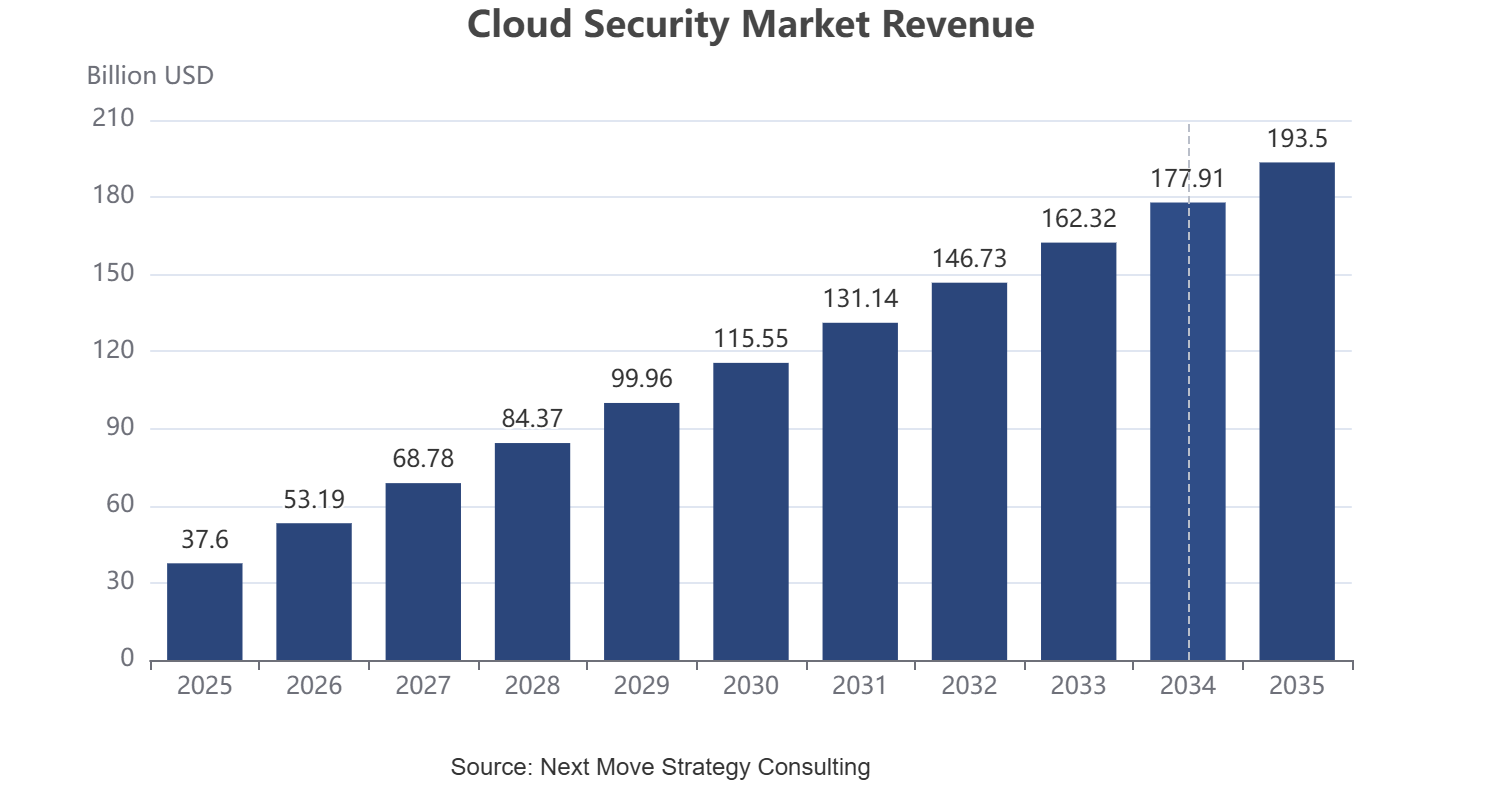
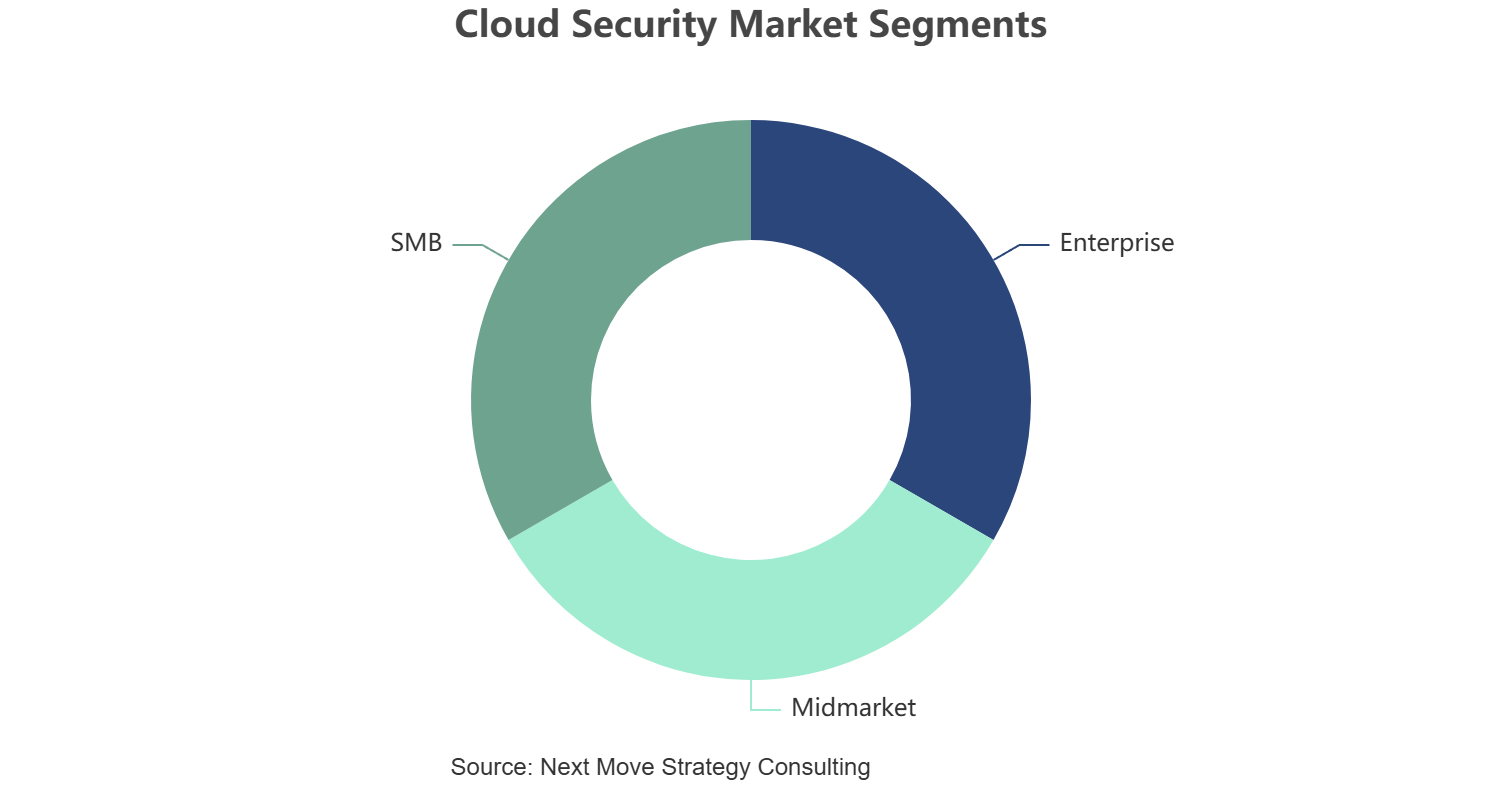
About the Author
 Liza Phukan
— Liza Phukan is Research Associate at Next Move Strategy Consulting, where she has covered emerging industries and market research across sectors for 3.5 years. Her work includes analyzing industry developments, validating market data, and developing structured business content from research findings. She uses secondary research and data-validation practices to turn complex market information into clear decision-useful market analysis for business audiences and support report development and B2B.
Liza Phukan
— Liza Phukan is Research Associate at Next Move Strategy Consulting, where she has covered emerging industries and market research across sectors for 3.5 years. Her work includes analyzing industry developments, validating market data, and developing structured business content from research findings. She uses secondary research and data-validation practices to turn complex market information into clear decision-useful market analysis for business audiences and support report development and B2B.
About the Reviewer
 Supradip Baul
— Supradip Baul is an accomplished business consultant and strategist with over a decade of rich experience in market intelligence, strategy, technology, and business transformation. His work has included rigorous qualitative and quantitative analysis across multiple industries, helping clients shape investment decisions and long-term roadmaps. Earlier in his career, he was associated with Gartner, where he contributed to industry-leading reports and market share analyses. He has worked with leading global companies and holds an MBA with a dual specialization in Marketing and Finance.
Supradip Baul
— Supradip Baul is an accomplished business consultant and strategist with over a decade of rich experience in market intelligence, strategy, technology, and business transformation. His work has included rigorous qualitative and quantitative analysis across multiple industries, helping clients shape investment decisions and long-term roadmaps. Earlier in his career, he was associated with Gartner, where he contributed to industry-leading reports and market share analyses. He has worked with leading global companies and holds an MBA with a dual specialization in Marketing and Finance.
At Next Move Strategy Consulting, we understand that insightful market research is the cornerstone of successful business decisions. That's why we employ a robust and multifaceted approach, combining various methodologies to deliver the most accurate and actionable data for our clients.

Research Landscape
We navigate the world of research with two primary approaches:
Qualitative Approach
Our qualitative research methodologies involve immersive techniques such as in-depth interviews, focus groups, and observational studies. By engaging directly with individuals and stakeholders, we uncover valuable insights that quantitative data alone may overlook.

Quantitative Research
In tandem with qualitative methodologies, NMSC leverages the power of Quantitative Research to provide a robust foundation of numerical insights. Through systematic data collection and analysis, we quantify patterns, preferences, and market trends, offering a comprehensive view of the business landscape.
Our quantitative research approach employs diverse tools, including surveys, experiments, and statistical modelling. These methodologies enable us to gather data from a large and representative sample, ensuring the statistical significance of our findings. By employing structured questionnaires and standardized data collection methods, we guarantee the reliability and validity of the information we present to our clients.
Quantitative research is particularly effective in measuring the prevalence of trends, assessing market size, and gauging the impact of various factors on consumer behavior. The numerical precision attained through this approach equips our clients with actionable insights, facilitating data-driven decision-making and strategy formulation.


Our Specialized Toolbox for Industry-Specific Market Research
We deploy a specialized arsenal of techniques tailored to meet your unique requirements. Here's a glimpse into our comprehensive toolbox:

Information Procurement
The stage entails acquiring market data or relevant information through various sources and methodologies.


Market Research Approach
We utilize both top-down and bottom-up approaches in market research analysis to achieve a comprehensive understanding of the market dynamics, leveraging the broad perspective of industry trends and macroeconomic factors alongside detailed insights from specific segments and individual companies.

Porters Five Forces Analysis
We conduct Porter's Five Forces analysis to evaluate the competitive landscape of an industry, providing us with insights into factors that affect profitability and strategic positioning.

SWOT Analysis

Forecasting
We utilize a forecasting model to predict future consumption by considering parameters like population, economics, regulations, market competition, drivers, constraints, technology, and pricing. We also employ statistical techniques such as multilinear regression, exponential smoothing, moving average, ARIMA, and Monte Carlo simulations for accurate predictions. In econometric forecasting, we analyzed short-term and long-term event impacts, attributing values based on regulatory frameworks, economic factors, and market events.





 Speak to Our Analyst