Democratization Market Size, Share, Trends and Growth Analysis, By Platform Type (Low-Code Development Platforms, No-Code Development Platforms, AI/ML Democratization Platforms, Citizen Data Science and Analytics Platforms, Robotic Process Automation Platforms, and Other Democratization Platforms), By Application, By End-Use Industry, By Deployment Mode, By Organization Size, and Region — Global Industry Report and Forecast, 2026–2035, at a CAGR of 31.0%
Industry: ICT & Media | Publishing Date: August 6, 2026 | Last Updated: August 6, 2026 | No of Pages: N/A | No. of Tables: N/A | No. of Figures: N/A | Format: PDF | Report Code: IC5597
What Is the Democratization Market Size?
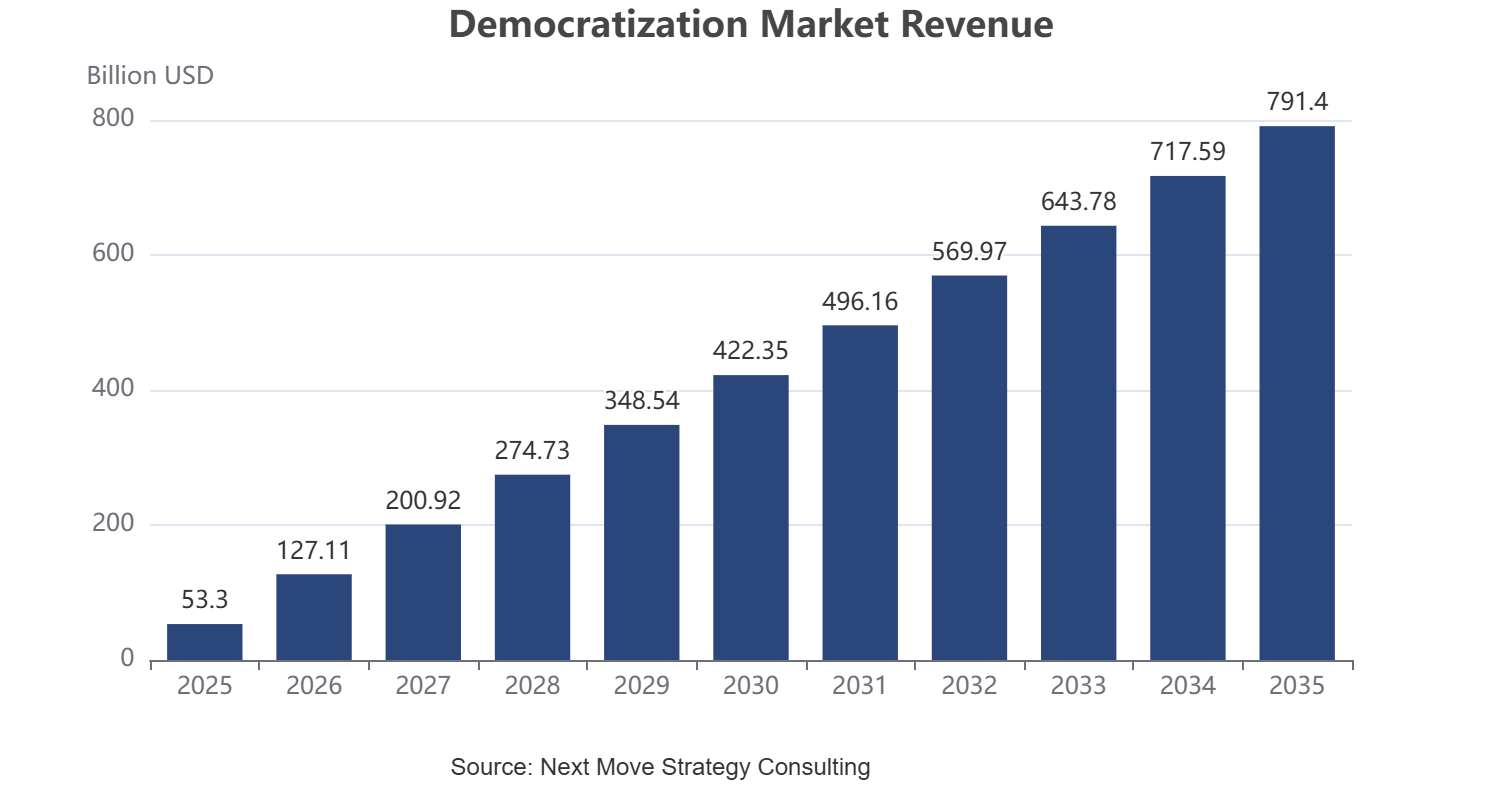
The global democratization market size was valued at USD 53.3 billion in 2025 and is estimated at USD 69.8 billion in 2026, forecast to reach USD 791.4 billion by 2035, expanding at a 31.0% CAGR between 2026 and 2035. North America leads with approximately 46% share, while low-code development platforms dominate all other platform types with approximately 30% share.
We observed that growth is broad-based across every segmentation axis, with AI and machine learning democratization tools and healthcare-linked adoption driving the dominant structural shifts through 2035.
|
Key Takeaways |
|
By Platform Type: Low-Code Development Platforms held the largest share of approximately 30% (USD 15.99 billion) in 2025; AI/ML Democratization Platforms is the fastest-growing sub-segment at 38.9% CAGR from 2026–2035. |
|
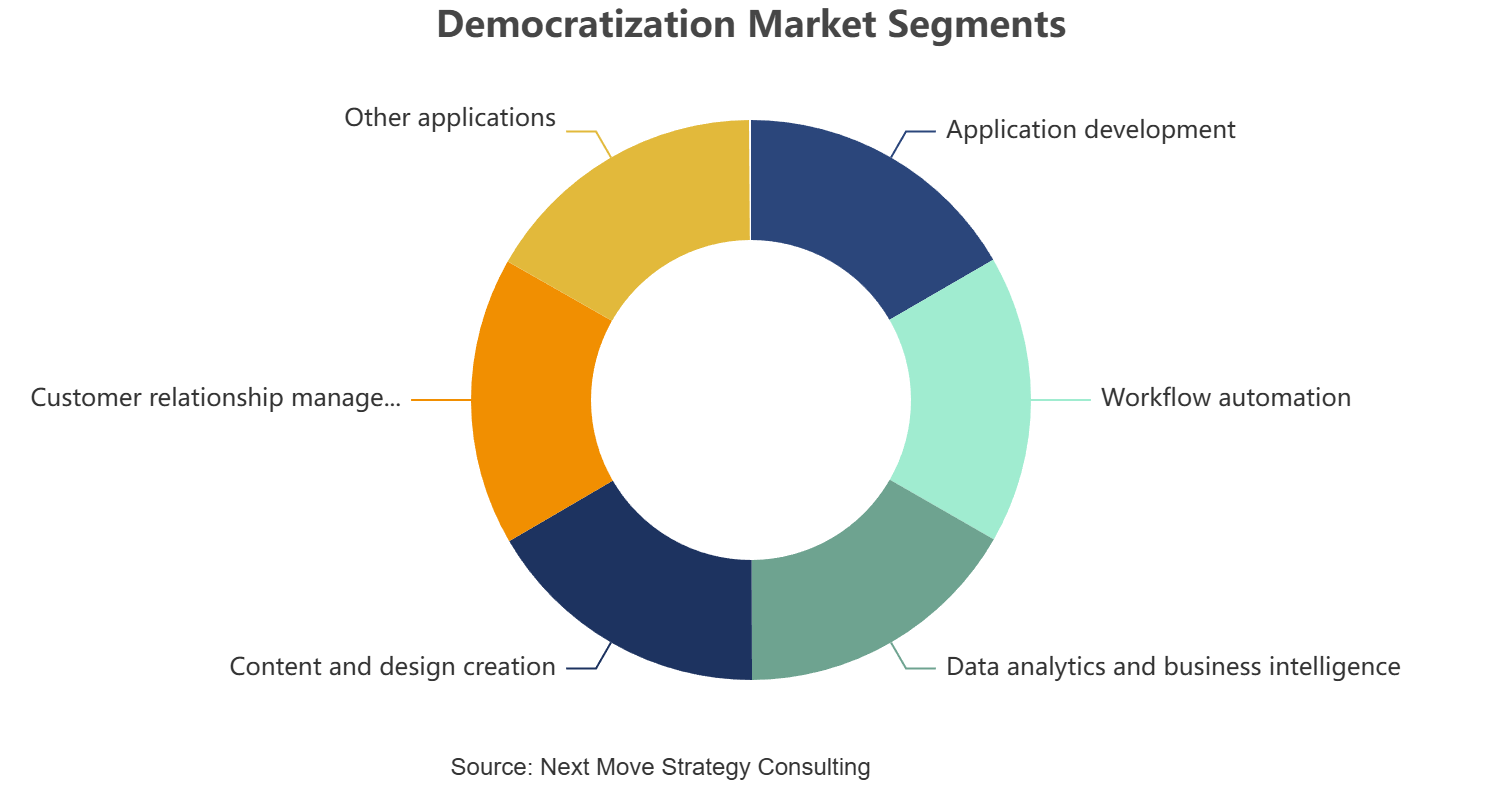
By Application: Application Development held the largest share of approximately 32% (USD 17.06 billion) in 2025; Content and Design Creation is the fastest-growing sub-segment at 40.1% CAGR from 2026–2035. |
|
By End-Use Industry: IT and Telecommunications held the largest share of approximately 22% (USD 11.73 billion) in 2025; Healthcare and Life Sciences is the fastest-growing sub-segment at 39.8% CAGR from 2026–2035. |
|
By Deployment Mode: Cloud held the largest share of approximately 68% (USD 36.24 billion) in 2025; Hybrid is the fastest-growing sub-segment at 41.4% CAGR from 2026–2035. |
|
By Organization Size: Large Enterprises held the largest share of approximately 58% (USD 30.91 billion) in 2025; Small and Medium Enterprises is the fastest-growing sub-segment at 34.1% CAGR from 2026–2035. |
|
Dominant Region: North America dominated with approximately 46% revenue share (USD 24.51 billion) in 2025. |
|
Fastest-Growing Region: Asia-Pacific is expected to register the highest CAGR of 38.0% during 2026–2035. |
|
Dominant Country: U.S. led with approximately USD 20.83 billion in 2025. |
|
Fastest-Growing Country: India is the fastest-growing country at approximately 45.7% CAGR from 2026–2035. |
Market Opportunity: The democratization market is expected to create an absolute dollar opportunity of USD 721.6 billion between 2026 and 2035, presenting significant investment potential across AI-powered development, workflow automation, and citizen data science platforms.
According to Next Move Strategy Consulting analysis, vendors are increasingly converging low-code development, generative AI, and autonomous agent orchestration into single unified platforms, a shift that favors diversified enterprise software groups over single-capability point solutions as citizen developer adoption scales through 2035.
What Does the Democratization Market Encompass?
The democratization market encompasses platforms and technologies that extend advanced software development, artificial intelligence, and data analytics capabilities to non-specialist business users through visual, low-code, and natural-language interfaces. Our assessment indicates that the scope spans low-code and no-code development platforms, AI and machine learning democratization tools, citizen data science and analytics platforms, and robotic process automation software deployed across cloud, on-premises, and hybrid environments serving large enterprises and small and medium enterprises alike. The category has evolved from basic drag-and-drop application builders into generative AI-powered agent-building environments capable of translating natural-language prompts into functional software.
Regulatory frameworks such as data governance and AI transparency requirements under the European Union's Artificial Intelligence Act shape how vendors design citizen-accessible AI tools with appropriate guardrails. We observed that technology adoption is shifting toward natural-language, agentic interfaces that allow business users to build autonomous workflows without traditional coding skills. Next Move Strategy Consulting's analysis indicates that this structural shift, combined with persistent developer shortages, is redefining procurement priorities across the democratization market.
|
Parameters |
Details |
|
Market Size in 2025 |
USD 53.3 Billion |
|
Market Size in 2026 |
USD 69.8 Billion |
|
Revenue Forecast in 2035 |
USD 791.4 Billion |
|
Growth Rate |
CAGR of 31.0% from 2026 to 2035 |
|
Analysis Period |
2025–2035 |
|
Base Year Considered |
2025 |
|
Forecast Period |
2026–2035 |
|
Market Size Estimation |
USD Billion |
|
Companies Profiled |
20 |
|
Countries Covered |
33 |
|
Market Share |
Available for Top 10 Companies |
Key Emerging Trends
Based on research conducted by Next Move Strategy Consulting, we found that four structural trends are reshaping platform design, adoption, and stakeholder engagement across the democratization industry.
How Is Agentic AI Transforming Citizen Development?
Agentic AI platforms are transforming citizen development by allowing business users to build autonomous, multi-step workflows through natural-language prompts rather than visual drag-and-drop interfaces. We observed that Salesforce's October 2025 general availability of Agentforce 360 introduced a low-code AI agent builder alongside Agentforce Builder, enabling both developers and natural-language builders to craft, test, and refine autonomous agents in a single workspace. Enterprises are adopting these platforms to compress agent development cycles previously requiring dedicated engineering resources.
Why Is Vibe Coding Reshaping Application Development?
Vibe coding, the practice of generating functional code from plain-language prompts, is rapidly democratizing application development beyond traditional citizen developer audiences. Our findings suggest that Salesforce's April 2026 launch of Agentforce Vibes, a browser-based integrated development environment built on Visual Studio Code, illustrates this shift by letting both professional developers and business users generate agents and applications through conversational prompts. This trend is elevating demand for governance and reliability controls addressing AI-generated code quality.
How Is Platform Consolidation Accelerating Through Acquisition?
Vendors are acquiring specialized agentic AI capabilities to accelerate unified platform development rather than building every capability internally. We found that Salesforce's 2026 agreements to acquire Qualified, an agentic AI marketing solutions provider, and Cimulate, an AI-powered product discovery specialist, illustrate this acquisition-driven consolidation strategy. This trend is broadening platform capability breadth as vendors integrate marketing, commerce, and service automation into single citizen-accessible environments.
What Role Does Enterprise Governance Play in Citizen AI Adoption?
Enterprise governance and reliability controls are becoming central to citizen AI tool design as organizations confront quality and hallucination risks from AI-generated workflows. Our analysis shows that Salesforce's Agent Script scripting language, introduced with Agentforce 360, combines natural-language flexibility with deterministic, auditable control logic for enterprise deployment. This trend is elevating demand for governed, enterprise-grade democratization platforms over ungoverned consumer-facing AI builders.
Consumer Behavior Analysis Of The Democratization Market
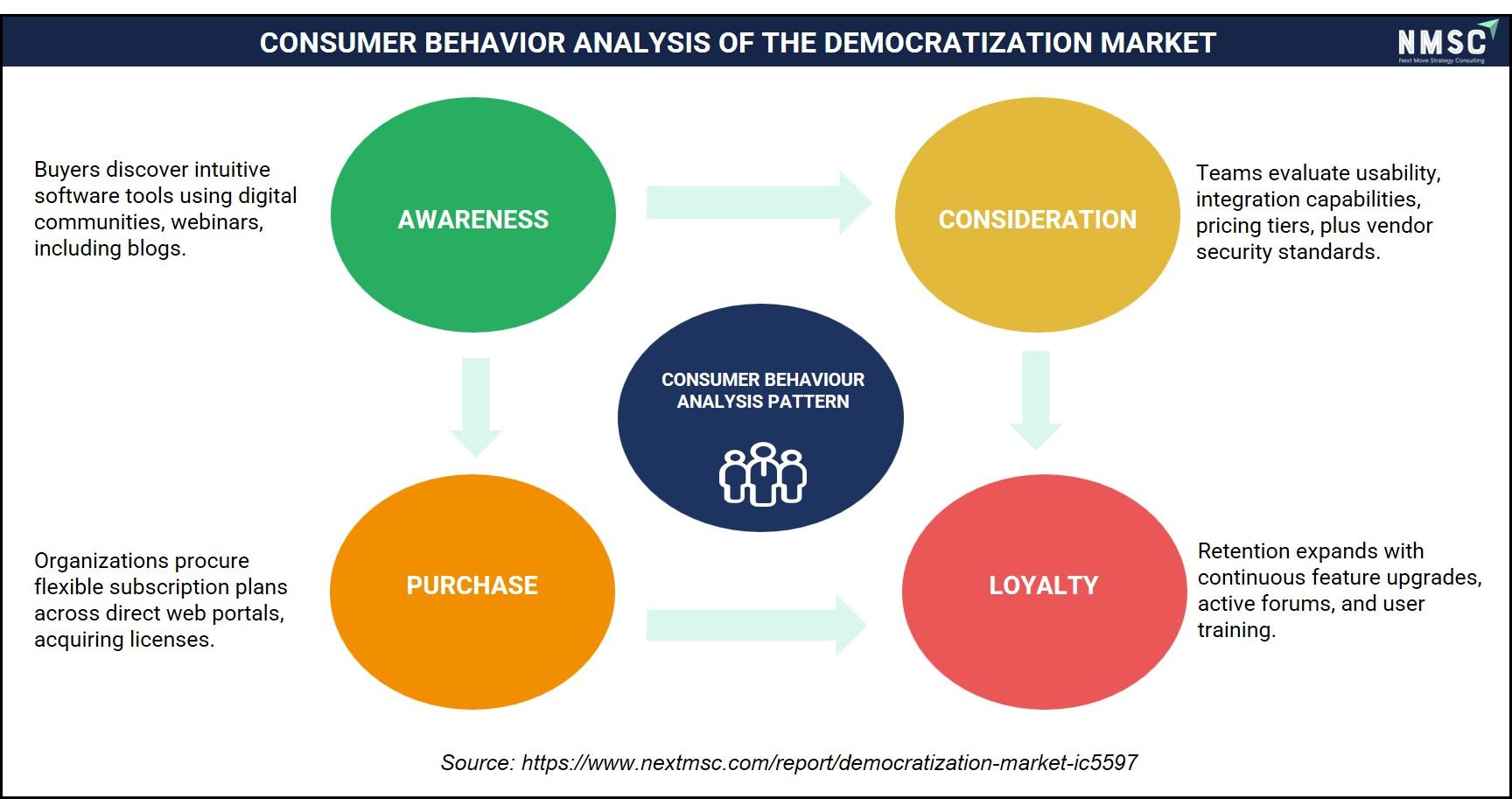
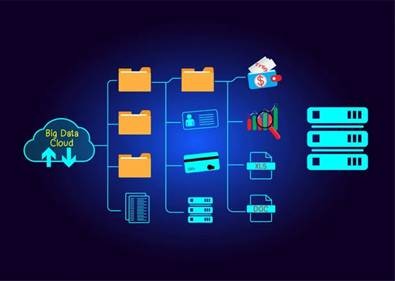
The image illustrates the consumer behavior journey in the Democratization Market, highlighting four key stages: awareness, consideration, purchase, and loyalty. Organizations discover intuitive software through digital channels, evaluate usability, integration, pricing, and security, procure subscription-based solutions via direct platforms, and remain loyal through continuous product enhancements, community engagement, and user training. This cycle reflects how accessibility, ease of adoption, and ongoing innovation drive customer acquisition and retention.
Growth Drivers and Restraints
Growth Catalyst and Risk Assessment Matrix
|
Factors |
Type |
(+/−) % Impact on CAGR |
Geographic Relevance |
Impact Timeline |
|
Persistent global software developer shortage |
Driver |
+7.5% |
Global |
2026–2035 |
|
Rapid generative AI and agentic platform adoption |
Driver |
+6.5% |
North America, Asia-Pacific |
2026–2035 |
|
Rising citizen developer initiatives within enterprises |
Driver |
+5.0% |
Global |
2026–2035 |
|
Vendor platform consolidation and acquisition activity |
Driver |
+3.5% |
North America, Europe |
2026–2032 |
|
Expanding cloud infrastructure and API accessibility |
Driver |
+2.5% |
Global |
2026–2035 |
|
Growing Asia-Pacific digital transformation investment |
Driver |
+2.0% |
Asia-Pacific |
2026–2035 |
|
AI governance and data privacy compliance complexity |
Restraint |
−2.5% |
North America, Europe |
2026–2030 |
|
Shadow IT and application sprawl risk |
Restraint |
−1.5% |
Global |
2026–2032 |
|
AI-generated code reliability and hallucination concerns |
Restraint |
−1.0% |
Global |
2026–2030 |
What Is the Primary Growth Driver of the Democratization Market?
Persistent global software developer shortage is the primary driver of the market. Industry-wide labor data referenced in enterprise technology adoption studies indicates that developer talent scarcity continues to outpace enterprise application demand, pushing organizations toward citizen-accessible tools. We observed that this shortage, reinforced by expanding business technologist roles outside traditional IT departments, continues to anchor baseline investment in low-code and no-code platforms across developed and emerging economies alike.
How Is Generative AI Adoption Driving Market Growth?
Rapid generative AI and agentic platform adoption is accelerating market growth toward natural-language, prompt-based development environments. Enterprise AI adoption studies referenced in industry disclosures show adoption rates climbing sharply among chief information officers pursuing autonomous agent strategies. Our assessment indicates that this adoption surge, combined with acquisition-driven capability consolidation such as Salesforce's Agentforce expansion, is compressing the time required for business users to deploy production-grade AI-powered applications.
What Is Restraining Democratization Market Expansion?
AI governance and data privacy compliance complexity restrains adoption among regulated enterprises concerned about ungoverned citizen-built applications. The European Union's Artificial Intelligence Act continues to inform transparency and risk-classification requirements for AI-powered development tools. We found that shadow IT and application sprawl risk further complicate governance, though enterprise-grade platforms with built-in deterministic controls are gradually addressing these adoption barriers.
Segmentation Analysis
Segment Sizing: By Platform Type
|
Segment |
2025 (USD) |
2035 (USD) |
CAGR% (2026–2035) |
|
Low-Code Development Platforms |
USD 15.99 Billion |
USD 158.28 Billion |
25.2% |
|
No-Code Development Platforms |
USD 11.73 Billion |
USD 142.45 Billion |
28.1% |
|
AI/ML Democratization Platforms |
USD 10.66 Billion |
USD 269.08 Billion |
38.9% |
|
Citizen Data Science and Analytics Platforms |
USD 7.46 Billion |
USD 126.62 Billion |
32.9% |
|
Robotic Process Automation Platforms |
USD 5.33 Billion |
USD 63.31 Billion |
27.8% |
|
Other Democratization Platforms |
USD 2.13 Billion |
USD 31.66 Billion |
31.0% |
|
Total |
USD 53.30 Billion |
USD 791.40 Billion |
31.0% |
Which Platform Type Segment Dominates the Democratization Market?
Low-Code Development Platforms led the market with USD 15.99 billion in 2025, supported by their established position across enterprise application development and workflow digitization projects. We observed that AI/ML Democratization Platforms is the fastest-growing platform type, expanding at a 38.9% CAGR from 2026 to 2035, as generative AI and agentic tools increasingly allow non-technical users to build and deploy AI-powered applications without machine learning expertise.
Segment Sizing: By Application
|
Segment |
2025 (USD) |
2035 (USD) |
CAGR% (2026–2035) |
|
Application Development |
USD 17.06 Billion |
USD 189.94 Billion |
26.8% |
|
Workflow Automation |
USD 11.73 Billion |
USD 150.37 Billion |
28.8% |
|
Data Analytics and Business Intelligence |
USD 9.59 Billion |
USD 142.45 Billion |
31.0% |
|
Content and Design Creation |
USD 6.40 Billion |
USD 174.11 Billion |
40.1% |
|
Customer Relationship Management |
USD 5.33 Billion |
USD 87.05 Billion |
32.4% |
|
Other Applications |
USD 3.19 Billion |
USD 47.48 Billion |
31.0% |
|
Total |
USD 53.30 Billion |
USD 791.40 Billion |
31.0% |
Which Application Segment Leads Market Demand?
Application Development remained the leading application within the market, valued at USD 17.06 billion in 2025 on sustained demand for citizen-built internal tools and customer-facing applications. Our findings suggest that Content and Design Creation is the fastest-growing application, registering a 40.1% CAGR from 2026 to 2035, as generative AI tools increasingly allow marketing and creative teams to produce visual and written content without specialized design or copywriting expertise.
Segment Sizing: By End-Use Industry
|
Segment |
2025 (USD) |
2035 (USD) |
CAGR% (2026–2035) |
|
IT and Telecommunications |
USD 11.73 Billion |
USD 142.45 Billion |
28.1% |
|
BFSI |
USD 9.59 Billion |
USD 126.62 Billion |
29.3% |
|
Retail and E-commerce |
USD 8.00 Billion |
USD 110.80 Billion |
30.0% |
|
Manufacturing |
USD 6.93 Billion |
USD 94.97 Billion |
29.8% |
|
Government and Public Sector |
USD 6.40 Billion |
USD 87.05 Billion |
29.7% |
|
Healthcare and Life Sciences |
USD 5.33 Billion |
USD 142.45 Billion |
39.8% |
|
Media and Creative Services |
USD 3.73 Billion |
USD 63.31 Billion |
32.9% |
|
Other Industries |
USD 1.59 Billion |
USD 23.75 Billion |
31.1% |
|
Total |
USD 53.30 Billion |
USD 791.40 Billion |
31.0% |
Which End-Use Industry Segment Leads the Democratization Market?
IT and Telecommunications remained the leading end-use industry, valued at USD 11.73 billion in 2025 on sustained demand for citizen-built internal applications and workflow automation across technology organizations. Based on research conducted by Next Move Strategy Consulting, we found that Healthcare and Life Sciences is the fastest-growing end-use industry at a 39.8% CAGR from 2026 to 2035, driven by clinical and administrative teams adopting AI-powered analytics and workflow tools without dedicated data science staff.
Growth Opportunities
Our analysis shows that three forward-looking opportunities stand out for stakeholders positioning within the democratization market over the 2026–2035 forecast period.
How Can Agentic AI Builders Unlock Value for Non-Technical Teams?
Agentic AI builders that translate natural-language prompts into autonomous, multi-step workflows present a whitespace opportunity for vendors seeking to serve marketing, sales, and operations teams. Suppliers that scale governed, natural-language agent-building capability stand to capture recurring subscription revenue as business users increasingly bypass traditional development cycles.
Where Does Healthcare Democratization Create New Demand?
Clinical and administrative healthcare teams seeking AI-powered analytics without dedicated data science staff represent an underpenetrated opportunity for healthcare-focused democratization vendors. Providers that secure clinical-workflow integration partnerships can capture recurring compliance-linked revenue tied to patient-data analytics and administrative automation requirements.
How Can Asia-Pacific Digital Transformation Benefit Regional Vendors?
Asia-Pacific enterprises pursuing rapid digital transformation create an opportunity for vendors localizing citizen development platforms for regional languages and business workflows. Early movers that adapt natural-language interfaces for China, India, and Japan can differentiate ahead of multinational competitors scaling distribution across the region's expanding citizen developer base.
Pestel Analysis Of The Democratization Market
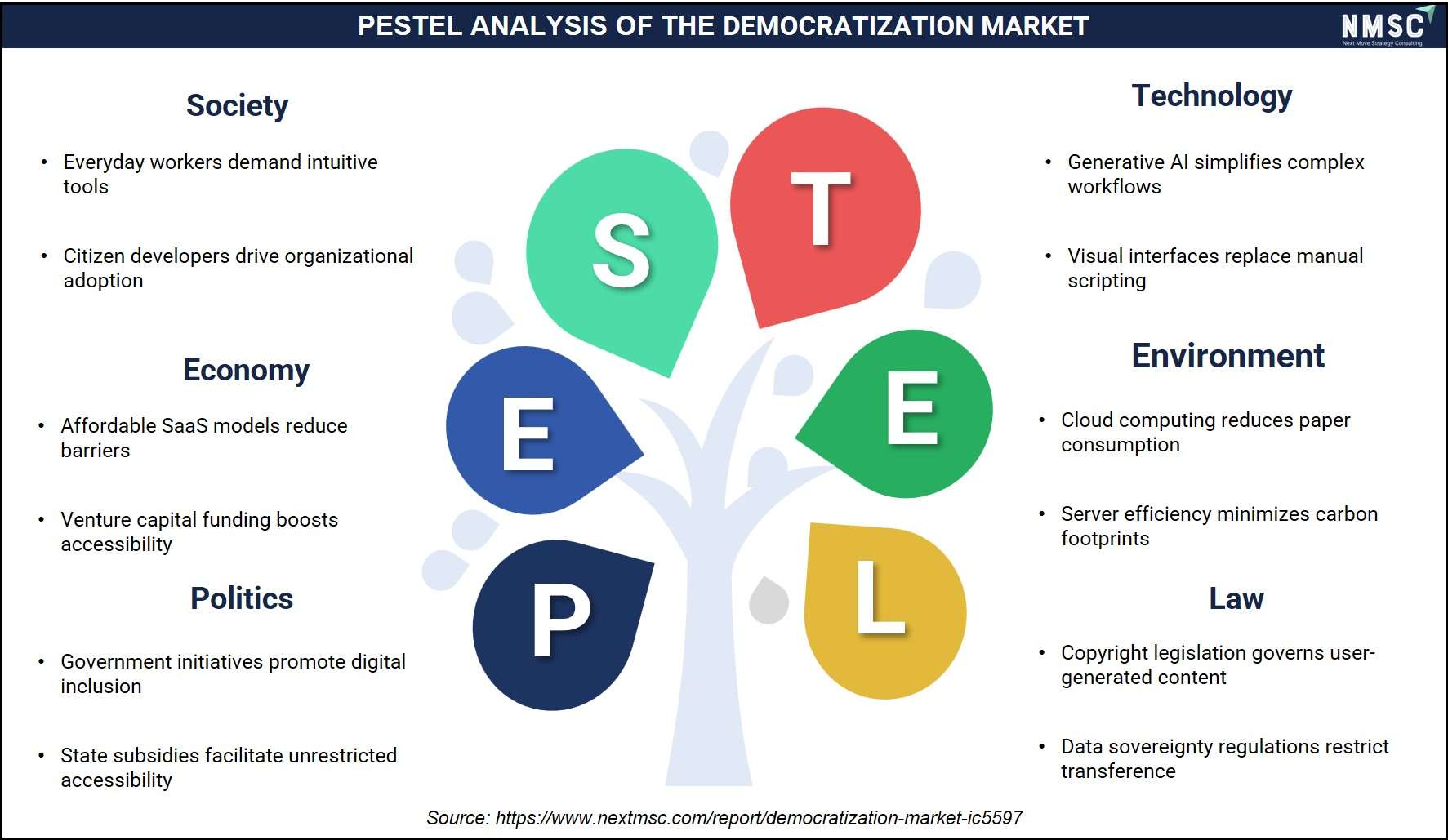
The image presents a PESTEL analysis of the Market, highlighting the key external factors influencing market growth. Political regulations, economic conditions, social demand for accessible technologies, technological advancements, environmental sustainability initiatives, and evolving legal frameworks collectively shape the adoption of democratized digital solutions. These factors drive innovation, improve accessibility, and influence strategic decisions across organizations and industries worldwide.
Regional Outlook
|
Region |
2025 (USD) |
2035 (USD) |
CAGR% (2026–2035) |
Key Driver |
|
North America |
USD 24.51 Billion |
USD 284.90 Billion |
27.4% |
Mature enterprise adoption and vendor consolidation |
|
Europe |
USD 12.79 Billion |
USD 166.20 Billion |
29.0% |
AI Act compliance and enterprise governance investment |
|
Asia-Pacific |
USD 10.66 Billion |
USD 253.25 Billion |
38.0% |
Rapid digital transformation and developer shortage pressure |
|
Middle East & Africa |
USD 2.67 Billion |
USD 47.48 Billion |
33.6% |
Growing government digital transformation investment |
|
Latin America |
USD 2.67 Billion |
USD 39.57 Billion |
30.9% |
Expanding enterprise cloud adoption |
|
Total |
USD 53.30 Billion |
USD 791.40 Billion |
31.0% |
— |
North America Democratization Market Outlook
North America leads market with an established base of enterprise low-code adoption and vendor platform consolidation across the U.S. and Canada. We observed that AI governance frameworks and sustained acquisition activity, including Salesforce's Agentforce-linked acquisitions, sustain demand for unified citizen development platforms. Technology adoption remains advanced, with agentic AI and vibe coding tools driving innovation among the region's leading vendors.
Europe Democratization Market Outlook
Europe's market reflects a mature but regulation-intensive landscape shaped by the European Union's Artificial Intelligence Act and national data governance requirements. Our findings suggest that UK, German, and French enterprises are accelerating adoption of governed, enterprise-grade citizen development platforms to satisfy transparency and risk-classification mandates. Technology adoption favors low-code platforms with built-in compliance controls, supported by regional vendors investing in certified governance capability.
Asia-Pacific Democratization Market Outlook
Asia-Pacific is the fastest-growing market region, propelled by rapid digital transformation investment in China and India and acute developer shortage pressure across the region. We found that regulatory frameworks remain less harmonized than in Europe, giving vendors flexibility to scale AI/ML democratization platforms rapidly. Technology adoption is accelerating as regional vendors, including several China-based providers, expand capacity to serve domestic enterprise and government demand.
Middle East & Africa Democratization Market Outlook
The market in Middle East & Africa is expanding as Gulf Cooperation Council economies invest in government digital transformation programs. Our analysis shows that Saudi Arabia and the UAE are attracting platform investment tied to national digitalization strategies. Regulatory influence remains moderate, while technology adoption is gradually shifting toward cloud-delivered citizen development platforms as regional governments align with global digital transformation expectations.
Latin America Democratization Market Outlook
Latin America's market is supported by expanding enterprise cloud adoption in Brazil and Argentina. We observed that regulatory frameworks are less stringent than in North America or Europe, though multinational enterprises are introducing dedicated citizen development programs. Technology adoption remains centered on low-code and no-code platforms, with competitive intensity increasing as regional enterprises partner with global vendors to expand deployment.
U.S. Democratization Market
Based on our estimates, the U.S. market was valued at approximately USD 20.83 billion in 2025 and is projected to reach USD 240.00 billion by 2035, growing at a 27.3% CAGR. Demand is anchored by mature enterprise adoption and sustained vendor consolidation activity. Technology penetration favors agentic AI and vibe coding platforms, and competitive intensity remains high among established vendors serving national enterprise customers.
Canada Democratization Market
The market in Canada reached roughly USD 2.70 billion in 2025 and is forecast to hit USD 32.00 billion by 2035 at a 27.7% CAGR. Demand structure mirrors U.S. enterprise adoption patterns, while national data governance guidance shapes procurement standards. Technology penetration is rising as national enterprises expand citizen development adoption, with competitive intensity moderate given reliance on cross-border vendors serving both markets.
UK Democratization Market
As per our estimate, the UK market stood at about USD 3.20 billion in 2025, advancing toward USD 42.00 billion by 2035 at a 29.2% CAGR. Demand is driven by established financial services and public-sector citizen development investment navigating national AI governance guidance. Regulatory influence is significant, technology penetration favors governed low-code platforms, and competitive intensity remains steady among domestic and global vendors serving UK enterprises.
Germany Democratization Market
According to our analysis, Germany's market was valued near USD 3.70 billion in 2025 and is set to reach USD 48.00 billion by 2035, expanding at a 29.0% CAGR. Demand structure benefits from Germany's strong domestic manufacturing and industrial automation base. Germany's national AI governance framework drives regulatory influence, while technology penetration favors low-code and robotic process automation platforms among leading enterprises.
France Democratization Market
Based on our estimates, France's market reached approximately USD 2.30 billion in 2025, projected to climb to USD 29.00 billion by 2035 at a 28.6% CAGR. Demand is supported by France's prominent public-sector and financial services base, which shapes governed citizen development adoption. Regulatory influence from European Union AI legislation is notable, and competitive intensity remains high given the concentration of specialized vendors serving French enterprises.
China Democratization Market
The market in China stood at roughly USD 2.80 billion in 2025 and is forecast to reach USD 75.00 billion by 2035, registering a 39.8% CAGR. Demand is fueled by expanding domestic digital transformation investment alongside a growing base of regional technology vendors. Regulatory influence is increasing gradually, technology penetration is accelerating through AI/ML democratization platforms, and competitive intensity remains elevated among numerous China-based providers.
India Democratization Market
As per our estimate, India's market was valued at about USD 1.60 billion in 2025, projected to reach USD 62.00 billion by 2035 at a 45.7% CAGR, the fastest among covered countries. Demand structure reflects acute developer shortage pressure and expanding enterprise digital transformation investment across major metropolitan markets. Regulatory influence is developing, technology penetration favors cloud-delivered platforms, and competitive intensity is increasing as domestic and global vendors scale capacity.
Japan Democratization Market
According to our analysis, Japan's market reached close to USD 2.20 billion in 2025 and is expected to hit USD 38.00 billion by 2035, growing at a 33.2% CAGR. Demand is supported by Japan's precision-oriented enterprise technology heritage, led by domestic and global vendors serving manufacturing and financial services customers. Regulatory influence is well established, technology penetration is advanced, and competitive intensity remains high among long-standing enterprise vendors.
South Korea Democratization Market
Based on our estimates, South Korea's market stood at approximately USD 1.40 billion in 2025, forecast to reach USD 32.00 billion by 2035 at a 37.4% CAGR. Demand structure benefits from the country's globally influential electronics and telecommunications manufacturing base. Technology penetration is high, with domestic enterprises adopting advanced citizen development platforms, and competitive intensity remains pronounced amid rapid technology innovation cycles.
Australia Democratization Market
The market in Australia reached about USD 1.10 billion in 2025 and is projected to reach USD 24.00 billion by 2035, expanding at a 36.7% CAGR. Demand is supported by a well-established enterprise cloud sector and growing preference for AI-powered citizen development platforms. Regulatory influence stems from Australia's national AI governance guidance, while technology penetration favors cloud deployment amid moderate competitive intensity.
UAE Democratization Market
As per our estimate, the UAE market was valued near USD 0.65 billion in 2025, projected to reach USD 13.00 billion by 2035 at a 35.4% CAGR. Demand structure is shaped by the UAE's role as a regional digital transformation and government innovation hub. Regulatory influence remains moderate, technology penetration is improving through cloud-delivered platforms, and competitive intensity is rising as vendors expand portfolios to serve Gulf markets.
Saudi Arabia Democratization Market
According to our analysis, Saudi Arabia's market reached roughly USD 0.85 billion in 2025 and is expected to hit USD 16.00 billion by 2035, growing at a 34.5% CAGR. Demand is driven by Vision 2030-linked digital government investment and expanding enterprise cloud adoption. Regulatory influence is developing under national digital transformation guidelines, and technology penetration is advancing as vendors scale citizen development offerings.
South Africa Democratization Market
Based on our estimates, South Africa's market stood at about USD 0.35 billion in 2025, forecast to reach USD 7.00 billion by 2035 at a 35.4% CAGR. Demand structure reflects a developing enterprise technology base contending with limited domestic vendor capacity. Regulatory influence remains moderate, technology penetration is gradually improving, and competitive intensity is limited given reliance on imported citizen development platforms from Europe and North America.
Brazil Democratization Market
The market in Brazil reached approximately USD 1.40 billion in 2025 and is projected to reach USD 22.00 billion by 2035, registering a 31.8% CAGR. Demand is underpinned by Brazil's expanding enterprise and financial services technology investment and growing manufacturing sector digitalization. Regulatory influence stems from national data protection policy, technology penetration favors low-code platform adoption, and competitive intensity remains moderate among regional vendors.
Argentina Democratization Market
As per our estimate, Argentina's market was valued near USD 0.45 billion in 2025, projected to reach USD 7.00 billion by 2035 at a 31.6% CAGR. Demand structure is supported by steady enterprise technology investment despite macroeconomic volatility. Regulatory influence remains limited, technology penetration is modest, and competitive intensity is centered on a small number of regional vendors serving domestic enterprise customers.
Competitive Landscape
We observed that the democratization market features a moderately consolidated competitive landscape, with diversified enterprise software groups competing alongside specialized citizen development and AI platform vendors on capability breadth and acquisition-driven consolidation.
|
Dimension |
Details |
|
Market Structure |
Moderately consolidated; diversified enterprise software groups such as Microsoft Corporation and Salesforce, Inc. compete alongside specialized citizen development vendors such as Appian Corporation and Webflow, Inc. for platform-specific deployments. |
|
Innovation Focus |
Agentic AI builders, vibe coding environments, and unified governance and orchestration layers dominate current innovation pipelines across leading vendors. |
|
M&A Activity |
Active consolidation, exemplified by Salesforce's 2026 agreements to acquire Qualified, an agentic AI marketing specialist, and Cimulate, an AI-powered product discovery provider. |
How Do Companies Compete in the Democratization Market?
Companies compete primarily on natural-language interface sophistication, governance capability, and ecosystem integration depth across the industry. Diversified vendors such as Microsoft Corporation and Salesforce, Inc. leverage broad cloud infrastructure and existing enterprise relationships to embed democratization capability across their product suites, while specialized vendors such as Airtable, Inc. and Bubble Group, Inc. compete on ease of use and rapid time-to-value for prosumer and small-team customers.
Which Competitive Archetypes Dominate the Democratization Market?
Two archetypes dominate the market: diversified enterprise software groups offering integrated low-code, AI, and automation portfolios, and specialized platform vendors focused on prosumer and citizen-developer accessibility. Salesforce, Inc. exemplifies the diversified archetype through its expanding Agentforce ecosystem, while Webflow, Inc. exemplifies the specialized archetype through its dedicated no-code design and website-building platform.
How Are Companies Differentiating Through Innovation in Democratization?
Innovation and differentiation strategy increasingly center on unifying natural-language development, governance, and orchestration into single platforms. Salesforce's Agentforce 360 launch and its subsequent Agentforce Vibes browser-based development environment both illustrate this shift toward consolidated, AI-native citizen development experiences. Our analysis shows that vendors unable to demonstrate credible agentic AI capability risk losing enterprise contracts to more integrated competitors.
What M&A and Expansion Activity Is Shaping the Democratization Market?
Mergers and acquisitions continue to consolidate capability within the industry. Salesforce's definitive agreements to acquire Qualified and Cimulate, both announced in 2026 and expected to close in the first quarter of Salesforce's fiscal year 2027, illustrate how platform vendors are acquiring specialized agentic AI capability to accelerate unified marketing, commerce, and service automation offerings.
Key Market Players
Our assessment indicates that the following 20 companies are actively shaping product innovation, acquisition strategy, and platform expansion within the global democratization market.
-
Microsoft Corporation
-
Salesforce, Inc.
-
Alphabet Inc.
-
Amazon.com, Inc.
-
International Business Machines Corporation
-
ServiceNow, Inc.
-
Appian Corporation
-
OutSystems, S.A.
-
Mendix N.V. (subsidiary of Siemens AG)
-
Zoho Corporation Pvt. Ltd.
-
DataRobot, Inc.
-
UiPath Inc.
-
Airtable, Inc.
-
Webflow, Inc.
-
Bubble Group, Inc.
-
Notion Labs, Inc.
-
Canva Pty Ltd
-
Zapier, Inc.
Latest Developments
We found that recent platform launches and acquisitions within the democratization market are concentrated on agentic AI and unified governance capability, reflecting the industry's transition toward AI-native citizen development.
|
Date |
Event |
|
August 2024 |
Microsoft published "Fast track development with AI and low-code," highlighting how AI and Microsoft Power Platform enable citizen developers and non-technical users to build business applications using natural language. The announcement focuses on democratizing software development by expanding low-code AI capabilities across enterprises. |
|
January 2024 |
AWS and Siemens announced the integration of Amazon Bedrock into the Mendix low-code platform, enabling developers and business users to build generative AI applications with minimal coding. This partnership directly supports AI democratization by making generative AI development accessible through low-code tools. |
Investment Opportunities
What Capital Inflows Are Targeting the Democratization Market?
Capital inflows into the democratization market are increasingly directed toward agentic AI capability acquisition and unified platform consolidation. Salesforce's 2026 agreements to acquire Qualified and Cimulate illustrate this trend toward strategic capability acquisition over organic development. We observed that investors favor vendors demonstrating validated enterprise customer scale, such as Salesforce's reported 12,000 Agentforce customers, as a proxy for long-term platform adoption momentum.
How Is Infrastructure Investment Supporting Democratization Platform Expansion?
Infrastructure investment is expanding cloud-delivered platform capacity across North America, Europe, and Asia-Pacific to serve rising citizen developer demand. Our findings suggest that vendors are investing in natural-language and agentic AI infrastructure, exemplified by Salesforce's Agentforce Vibes browser-based development environment, to compress the distance between business intent and functional software, supporting the accessibility required for enterprise-wide citizen development adoption.
What ESG Considerations Are Shaping Democratization Investment Decisions?
Environmental, social, and governance considerations increasingly factor into democratization investment decisions, with workforce upskilling and AI governance transparency as key criteria. The European Union's Artificial Intelligence Act continues to inform risk-classification disclosures for AI-powered development tools. We found that investors increasingly favor vendors with transparent AI governance and reliability controls, treating deterministic, auditable agent behavior as a governance indicator alongside technical capability.
Key Benefits for Stakeholders
How Does This Report Benefit Enterprise and Industry Leaders?
Enterprise and industry leaders gain access to validated segmentation, competitive benchmarking, and regional demand forecasts that support technology-investment and vendor-selection decisions across the democratization industry. Our analysis shows that detailed platform type, application, and end-use industry breakdowns help technology and procurement teams align specifications with agentic AI and governance requirements while identifying underserved categories for portfolio expansion.
How Does This Report Benefit Investors and Financial Analysts?
Investors and financial analysts benefit from consistent, single-point market size and CAGR estimates that support valuation and capital-allocation decisions across the democratization supply chain. We observed that the report's regional and segment-level growth differentials help identify which vendors are best positioned to capture above-market growth in Asia-Pacific and AI/ML democratization categories through 2035.
How Does This Report Benefit Technology Vendors and Product Teams?
Technology vendors and product teams gain insight into emerging platform requirements, including agentic AI builders, governed natural-language interfaces, and unified orchestration layers, that are reshaping the industry. Our findings suggest that this analysis helps R&D teams prioritize development roadmaps around governance and reliability capabilities increasingly required by enterprise procurement processes.
Key Market Segments
By Platform Type
-
Low-code development platforms
-
No-code development platforms
-
AI/ML democratization platforms
-
Citizen data science and analytics platforms
-
Robotic process automation platforms
-
Other democratization platforms
By Application
-
Application development
-
Workflow automation
-
Data analytics and business intelligence
-
Content and design creation
-
Customer relationship management
-
Other applications
By End-Use Industry
-
IT and telecommunications
-
BFSI
-
Retail and e-commerce
-
Manufacturing
-
Government and public sector
-
Healthcare and life sciences
-
Media and creative services
-
Other industries
By Deployment Mode
-
Cloud
-
On-premises
-
Hybrid
By Organization Size
-
Large enterprises
-
Small and medium enterprises
By Region
-
North America: U.S., Canada, Mexico
-
Europe: UK, Germany, France, Italy, Spain, Sweden, Denmark, Finland, Netherlands, Rest of Europe
-
Asia-Pacific: China, India, Japan, South Korea, Taiwan, Indonesia, Vietnam, Australia, Philippines```html , Malaysia, Rest of APAC
-
Middle East & Africa: Saudi Arabia, UAE, Egypt, Israel, Turkey, Nigeria, South Africa, Rest of MEA
-
Latin America: Brazil, Argentina, Chile, Colombia, Rest of LATAM
Conclusion and Recommendations
What Is the Long-Term Outlook for the Democratization Market?
The long-term outlook for the market remains highly favorable, with global revenue projected to expand from USD 53.3 billion in 2025 to USD 791.4 billion by 2035 at a 31.0% CAGR. We observed that sustained developer shortages, generative AI adoption, and vendor platform consolidation will continue underpinning demand across platform types through the forecast period.
What Strategic Positioning Should Democratization Vendors Pursue?
Vendors should prioritize agentic AI builders and governed natural-language interfaces while pursuing strategic acquisitions to close capability gaps. Our assessment indicates that vendors investing early in AI/ML democratization and healthcare-focused platforms, alongside enterprise governance controls, will be best positioned to capture premium pricing within the market.
How Attractive Is the Democratization Market for New Investment?
The democratization industry presents a highly attractive investment case, supported by a USD 721.6 billion absolute dollar opportunity between 2026 and 2035 and above-average growth in Asia-Pacific and content creation categories. We found that investment attractiveness is highest for vendors combining validated enterprise customer scale with proven agentic AI and governance capability.
What Market Shifts and Key Risks Should Stakeholders Monitor?
Stakeholders should monitor AI governance compliance complexity, shadow IT risk, and AI-generated code reliability concerns as key risks to the democratization market. Our analysis shows that vendors unable to adapt to enterprise governance expectations risk losing contracts to competitors with stronger deterministic control capability, particularly within Europe's increasingly regulation-driven procurement environment.
What Are the Key Growth Pathways for the Democratization Market?
Key growth pathways include expanding AI/ML democratization capabilities, scaling agentic AI and vibe coding platforms, and deepening penetration into Asia-Pacific and healthcare end-use channels. Next Move Strategy Consulting's analysis indicates that vendors pursuing these pathways while maintaining cost competitiveness in core low-code categories will be best positioned to capture the democratization market's projected growth through 2035.
About the Author
 Liza Phukan
— Liza Phukan is Research Associate at Next Move Strategy Consulting, where she has covered emerging industries and market research across sectors for 3.5 years. Her work includes analyzing industry developments, validating market data, and developing structured business content from research findings. She uses secondary research and data-validation practices to turn complex market information into clear decision-useful market analysis for business audiences and support report development and B2B.
Liza Phukan
— Liza Phukan is Research Associate at Next Move Strategy Consulting, where she has covered emerging industries and market research across sectors for 3.5 years. Her work includes analyzing industry developments, validating market data, and developing structured business content from research findings. She uses secondary research and data-validation practices to turn complex market information into clear decision-useful market analysis for business audiences and support report development and B2B.
About the Reviewer
 Supradip Baul
— Supradip Baul is an accomplished business consultant and strategist with over a decade of rich experience in market intelligence, strategy, technology, and business transformation. His work has included rigorous qualitative and quantitative analysis across multiple industries, helping clients shape investment decisions and long-term roadmaps. Earlier in his career, he was associated with Gartner, where he contributed to industry-leading reports and market share analyses. He has worked with leading global companies and holds an MBA with a dual specialization in Marketing and Finance.
Supradip Baul
— Supradip Baul is an accomplished business consultant and strategist with over a decade of rich experience in market intelligence, strategy, technology, and business transformation. His work has included rigorous qualitative and quantitative analysis across multiple industries, helping clients shape investment decisions and long-term roadmaps. Earlier in his career, he was associated with Gartner, where he contributed to industry-leading reports and market share analyses. He has worked with leading global companies and holds an MBA with a dual specialization in Marketing and Finance.
At Next Move Strategy Consulting, we understand that insightful market research is the cornerstone of successful business decisions. That's why we employ a robust and multifaceted approach, combining various methodologies to deliver the most accurate and actionable data for our clients.

Research Landscape
We navigate the world of research with two primary approaches:
Qualitative Approach
Our qualitative research methodologies involve immersive techniques such as in-depth interviews, focus groups, and observational studies. By engaging directly with individuals and stakeholders, we uncover valuable insights that quantitative data alone may overlook.

Quantitative Research
In tandem with qualitative methodologies, NMSC leverages the power of Quantitative Research to provide a robust foundation of numerical insights. Through systematic data collection and analysis, we quantify patterns, preferences, and market trends, offering a comprehensive view of the business landscape.
Our quantitative research approach employs diverse tools, including surveys, experiments, and statistical modelling. These methodologies enable us to gather data from a large and representative sample, ensuring the statistical significance of our findings. By employing structured questionnaires and standardized data collection methods, we guarantee the reliability and validity of the information we present to our clients.
Quantitative research is particularly effective in measuring the prevalence of trends, assessing market size, and gauging the impact of various factors on consumer behavior. The numerical precision attained through this approach equips our clients with actionable insights, facilitating data-driven decision-making and strategy formulation.


Our Specialized Toolbox for Industry-Specific Market Research
We deploy a specialized arsenal of techniques tailored to meet your unique requirements. Here's a glimpse into our comprehensive toolbox:

Information Procurement
The stage entails acquiring market data or relevant information through various sources and methodologies.


Market Research Approach
We utilize both top-down and bottom-up approaches in market research analysis to achieve a comprehensive understanding of the market dynamics, leveraging the broad perspective of industry trends and macroeconomic factors alongside detailed insights from specific segments and individual companies.

Porters Five Forces Analysis
We conduct Porter's Five Forces analysis to evaluate the competitive landscape of an industry, providing us with insights into factors that affect profitability and strategic positioning.

SWOT Analysis

Forecasting
We utilize a forecasting model to predict future consumption by considering parameters like population, economics, regulations, market competition, drivers, constraints, technology, and pricing. We also employ statistical techniques such as multilinear regression, exponential smoothing, moving average, ARIMA, and Monte Carlo simulations for accurate predictions. In econometric forecasting, we analyzed short-term and long-term event impacts, attributing values based on regulatory frameworks, economic factors, and market events.





 Speak to Our Analyst