AI Gesture Recognition Market Size, Share, Growth and Forecast By Solution Type (Software, Hardware, Integrated Modules, and Service), By Sensing Technology (Optical Vision Sensing, Radar Sensing, Electric Field Sensing), By Interaction Mode (Hand Gestures, Body Gestures, Multimodal Gestures), By Application Type (Consumer Interface, Others), By Buyer Type, and By End User Industry (Consumer Electronics, Automotive, Healthcare, Retail and Hospitality) — Global Analysis 2025 to 2035
Industry: ICT & Media | Publishing Date: July 4, 2026 | Last Updated: September 30, 2026 | No of Pages: N/A | No. of Tables: N/A | No. of Figures: N/A | Format: PDF | Report Code: IC4952
What Is the AI Gesture Recognition Market Size?
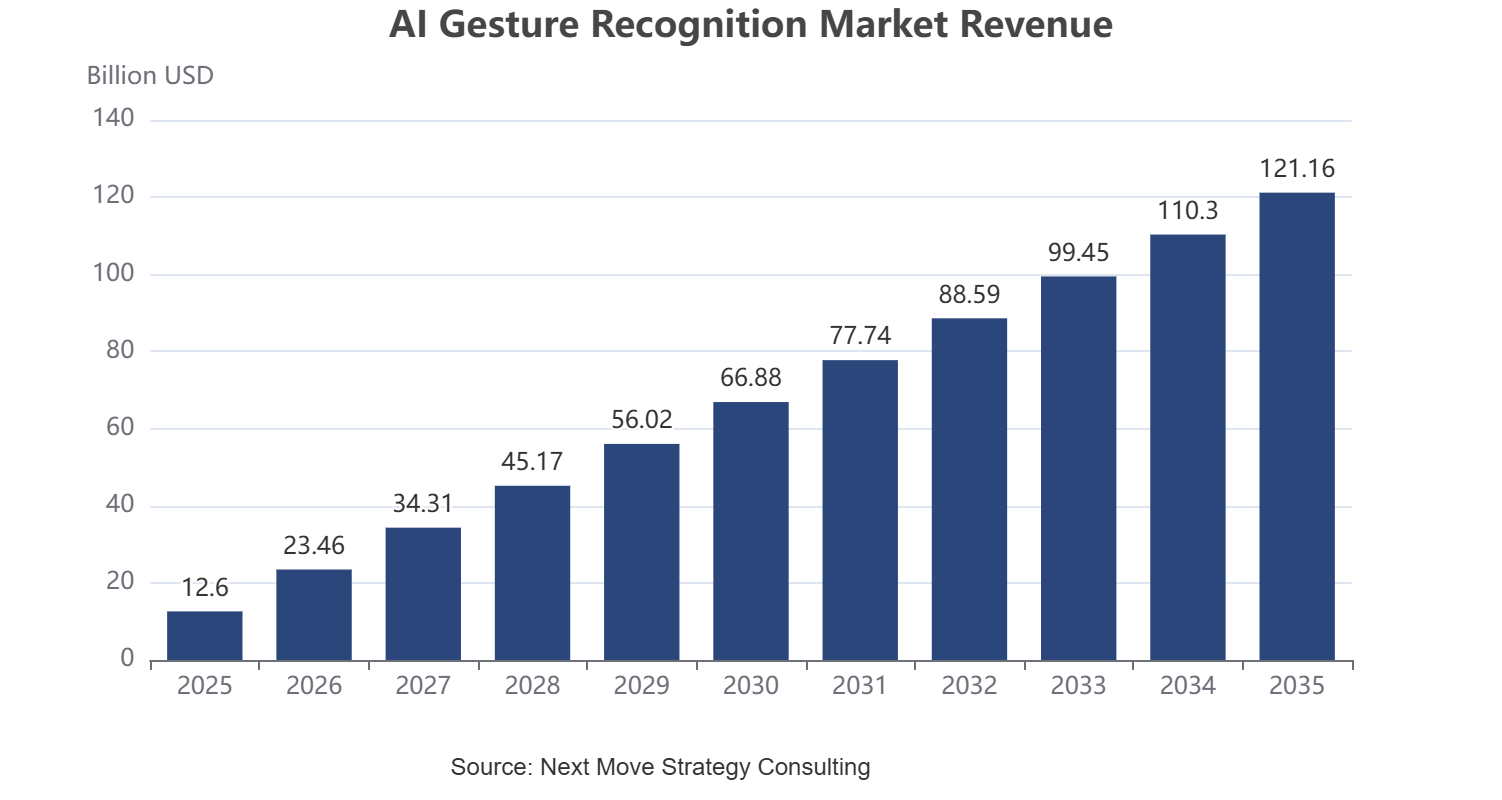
The global AI Gesture Recognition Market was valued at USD 12.6 billion in 2025 and is expected to reach USD 15.8 billion in 2026. Rising touchless interface adoption, expanding in-cabin automotive controls, and AI model efficiency gains are projected to drive the AI Gesture Recognition Market to USD 121.16 billion by 2035, advancing at a CAGR of 25.4% from 2026 to 2035. Key growth drivers include accelerating extended reality device shipments, growing demand for hygienic touchless interfaces in healthcare and public spaces, increasing integration of radar and time-of-flight sensors in consumer electronics, and rising automotive OEM investment in gesture-based in-cabin control systems.
|
Parameters |
Details |
|
Market Size in 2025 |
USD 12.6 Billion |
|
Market Size in 2026 |
USD 15.8 Billion |
|
Revenue Forecast in 2035 |
USD 121.16 Billion |
|
Growth Rate |
CAGR of 25.4% from 2026 to 2035 |
|
Analysis Period |
2025–2035 |
|
Base Year Considered |
2025 |
|
Forecast Period |
2026–2035 |
|
Market Size Estimation |
USD Billion |
|
Companies Profiled |
20 |
|
Countries Covered |
33 |
|
Market Share |
Top 10 |
AI Gesture Recognition Market Overview
What Is the AI Gesture Recognition Market?
The AI Gesture Recognition Market covers software, hardware, integrated modules, and services that allow devices to interpret hand, body, and multimodal gestures using optical, radar, electric field, wearable, and acoustic sensing technologies. This market report spans consumer electronics, automotive in-cabin systems, healthcare control, industrial interfaces, and extended reality applications, supported by software development kits, runtime engines, gesture analytics platforms, and specialized sensor hardware that together enable touchless, intuitive human-machine interaction across a widening range of commercial and industrial use cases.
How Has the AI Gesture Recognition Market Evolved Over Time?
The AI Gesture Recognition Market has progressed through three structural phases. The first phase relied on basic optical cameras paired with rule-based computer vision algorithms for simple hand tracking. The second phase introduced depth sensing and time-of-flight sensors that improved accuracy in varied lighting. NMSC's analysis indicates that the current third phase is defined by AI native gesture models, sensor fusion architectures, and edge inference chips that deliver low-latency, privacy-preserving gesture recognition across automotive, consumer, and industrial deployments.
How Does Regulation Influence the AI Gesture Recognition Market?
Regulatory frameworks are shaping the AI Gesture Recognition Market, particularly around biometric data handling and automotive safety certification. The EU General Data Protection Regulation and the EU AI Act impose transparency and risk classification requirements on camera-based gesture systems that process facial or body data. The U.S. National Highway Traffic Safety Administration's vehicle safety standards influence in-cabin gesture control certification. These frameworks compel vendors to adopt privacy-preserving sensing technologies such as radar and electric field sensing that avoid raw image capture.
How Is Technology Adoption Expanding Across the AI Gesture Recognition Market?
Technology adoption across the AI Gesture Recognition Market is accelerating as edge AI chips enable on-device gesture inference without cloud connectivity. Based on our market evaluation, we noticed that automotive OEMs are integrating millimeter wave radar and time of flight sensors directly into cabin control modules, while consumer electronics brands are embedding gesture sensing software development kits into smartphones, laptops, and extended reality headsets. This expansion is broadening the AI Gesture Recognition Market beyond early extended reality niches into mainstream consumer and automotive product lines.
|
Key Takeaway |
|
By solution type, Software dominates the AI Gesture Recognition Market at USD 4.4 billion in 2025, forecast to reach USD 44.5 billion by 2035 at a CAGR of 29.3%. Software Development Kits and Gesture Analytics Software are the leading sub-segments, reflecting strong developer ecosystem investment across consumer electronics and automotive platforms. |
|
Hardware is the fastest expanding solution type by absolute value addition, advancing from USD 3.6 billion in 2025 to USD 35.5 billion by 2035 at a CAGR of 29.0%, with Time of Flight Sensors and Radar Sensors driving the strongest sub-segment momentum within automotive and consumer device integration. |
|
By sensing technology, Optical Vision Sensing leads the AI Gesture Recognition Market at USD 5.2 billion in 2025, supported by Visible Light RGB Cameras and Depth and Time of Flight Sensors that remain the most cost-effective sensing approach for consumer electronics manufacturers. |
|
Sensor Fusion is the fastest-growing sensing technology category at a CAGR of 32.8% from 2026 to 2035, as automotive and extended reality OEMs combine radar, optical, and acoustic inputs to improve gesture recognition accuracy under variable lighting and occlusion conditions. |
|
By interaction mode, Hand Gestures dominate the AI Gesture Recognition Market at USD 7.8 billion in 2025, forecast to reach USD 68.5 billion by 2035, led by Dynamic Motions and Finger Gestures that are widely deployed across smartphones, laptops, and extended reality controllers. |
|
Multimodal Gestures represent the fastest-growing interaction mode at a CAGR of 35.1% from 2026 to 2035, as automotive in cabin systems and industrial control interfaces increasingly combine hand and body gesture inputs with voice and gaze tracking for more robust human machine interaction. |
|
By application type, In Cabin Control is the largest single application at USD 2.4 billion in 2025, while Consumer Interface remains a leading application by absolute revenue contribution as smartphone and laptop OEMs embed gesture sensing software development kits. |
|
XR Interaction is the fastest-growing application type at a CAGR of 30.2% from 2026 to 2035, propelled by rising extended reality headset shipments from Meta Platforms, Apple, and Sony that require precise hand tracking for spatial computing interfaces. |
|
North America leads the AI Gesture Recognition Market at USD 4.6 billion in 2025, forecast to reach USD 42.8 billion by 2035 at a CAGR of 28.1%, while Asia-Pacific is the fastest-growing region at a CAGR of 30.5%, driven by China and India's expanding consumer electronics and automotive manufacturing base. |
|
The United States is the largest individual country market within the AI Gesture Recognition Market at approximately USD 3.65 billion in 2025, while India is the fastest-growing country market in Asia-Pacific at a CAGR of 33.7% through 2035. |
Key Emerging Trends in the AI Gesture Recognition Market
How Is Edge AI Inference Reshaping the AI Gesture Recognition Market?
Edge AI inference chips are transforming the AI Gesture Recognition Market by enabling real-time gesture detection without continuous cloud connectivity. Our findings suggest that on-device neural processing units from Qualcomm and Microchip Technology allow smartphones and automotive cabins to interpret hand gestures within milliseconds while preserving user privacy. Apple's on-device Neural Engine and Qualcomm's Hexagon processor exemplify this shift toward local gesture processing, reducing latency for extended reality applications and addressing data residency concerns in regulated automotive AI and healthcare deployments.
How Is Radar Sensing Reshaping Touchless Interaction in the AI Gesture Recognition Market?
Radar-based sensing is reshaping the AI Gesture Recognition Market by offering privacy-preserving gesture detection that does not capture raw camera imagery. Through our market assessment, we observed that Google's Soli radar technology and Infineon's millimeter wave radar sensors enable subtle finger gesture detection through fabric and at varying distances, expanding gesture recognition into smart home devices and automotive cabins where camera-based systems face privacy or lighting limitations, creating new product categories beyond traditional optical sensing approaches.
How Is Extended Reality Adoption Driving Demand in the AI Gesture Recognition Market?
Extended reality device proliferation is a primary demand catalyst within the AI Gesture Recognition Market. From our research, we found that Meta Platforms' Quest headsets and Apple's Vision Pro rely on multi-camera hand tracking systems that interpret fine-grained finger movements for spatial computing interfaces. As enterprise training, industrial design, and consumer entertainment applications adopt extended reality devices, demand for high-precision depth sensing modules and gesture analytics software is accelerating across both hardware and software solution categories.
How Is In Cabin Gesture Control Becoming Standard in the AI Gesture Recognition Market?
In-cabin gesture control is becoming a standard automotive feature within the AI Gesture Recognition Market as OEMs seek to reduce driver distraction from touchscreen interfaces. NMSC's analysis indicates that automotive Tier 1 suppliers are integrating time-of-flight and radar sensors directly into dashboard and steering wheel assemblies, allowing drivers to adjust climate control, infotainment volume, and navigation through simple hand motions. This trend is expanding gesture recognition demand across mid-market vehicle segments beyond luxury automotive platforms.
What Are the Key Market Drivers, Breakthroughs, and Investment Opportunities That Will Shape the AI Gesture Recognition Market in the Next Decade?
|
Drivers / Trends / Restraints |
(+/-) % Impact on CAGR Forecast |
Geographic Relevance |
Impact Timeline |
|
Extended Reality Device Proliferation |
+3.1% |
North America, Asia-Pacific |
2025–2032 |
|
In Cabin Automotive Gesture Adoption |
+2.6% |
North America, Europe, Asia-Pacific |
2025–2030 |
|
Edge AI Chip Cost Reduction |
+2.2% |
Global |
2025–2030 |
|
Touchless Public Interface Demand |
+1.4% |
Asia-Pacific, Europe |
2025–2028 |
|
Radar and Electric Field Sensor Maturity |
+1.8% |
North America, Europe, Asia-Pacific |
2026–2032 |
|
Healthcare Touchless Control Adoption |
+1.1% |
North America, Europe |
2026–2033 |
|
Sensor Hardware Cost and Supply Chain |
-1.2% |
Global |
Ongoing |
|
Gesture Recognition Accuracy in Low Light |
-0.9% |
Global |
Ongoing |
|
Data Privacy Compliance Complexity |
-0.7% |
Europe, North America |
Ongoing |
|
Open Standards and SDK Fragmentation |
-0.6% |
Global |
2025–2029 |
What Are the Growth Drivers of the AI Gesture Recognition Market?
How Is Extended Reality Device Growth Driving the AI Gesture Recognition Market?
Extended reality device shipment growth is a primary demand driver for the AI Gesture Recognition Market. Spatial computing headsets require precise hand and finger gesture tracking to enable natural user interfaces without physical controllers. The U.S. Federal Communications Commission's spectrum allocation decisions for short-range sensing technologies support radar and depth sensor deployment in consumer devices. As enterprise training, design visualisation, and consumer entertainment use cases scale, demand for accurate, low-latency gesture recognition software and depth sensing hardware continues to expand the market report's addressable revenue base across multiple device categories.
How Is Automotive In-Cabin Integration Fueling AI Gesture Recognition Market Growth?
Automotive OEM integration of gesture control into vehicle cabins is fueling sustained AI Gesture Recognition Market growth and demand. The U.S. National Highway Traffic Safety Administration has highlighted driver distraction from touchscreen interfaces as a safety concern, creating regulatory tailwinds for gesture-based controls that allow drivers to maintain eye contact with the road. Tier 1 suppliers are embedding time-of-flight and radar sensors into dashboard assemblies across mid-market and luxury vehicle segments, expanding gesture recognition penetration well beyond early premium vehicle adoption.
How Are Edge AI Chip Advancements Supporting AI Gesture Recognition Market Trends?
Advancements in edge AI inference chips are supporting favourable AI Gesture Recognition Market trends by reducing the computational cost of real-time gesture processing. The U.S. National Institute of Standards and Technology has published benchmarking frameworks for edge AI model efficiency that semiconductor companies reference when designing low-power neural processing units. Microchip Technology and Qualcomm have expanded dedicated gesture processing capabilities within their microcontroller and system-on-chip product lines, lowering the bill of materials cost for gesture-enabled consumer devices and accelerating broader adoption across price-sensitive product categories.
What Are the Growth Inhibitors of the AI Gesture Recognition Market?
How Does Sensor Hardware Cost Constrain AI Gesture Recognition Market Expansion?
The cost of precision sensor hardware remains a constraint on broader AI Gesture Recognition Market expansion, particularly for radar and time-of-flight components used in premium gesture applications. The U.S. Bureau of Labor Statistics has documented semiconductor component price volatility tied to global supply chain disruptions affecting microcontroller and sensor availability. This cost pressure limits gesture recognition adoption in budget consumer electronics and entry-level vehicle segments, where manufacturers must balance feature differentiation against unit economics and overall device price positioning.
How Does Gesture Recognition Accuracy in Variable Lighting Limit AI Gesture Recognition Market Confidence?
Gesture recognition accuracy degradation under variable lighting and occlusion conditions remains a persistent inhibitor to broader AI Gesture Recognition Market confidence. Optical vision systems relying solely on RGB cameras struggle with low-light or backlit environments, producing inconsistent gesture detection that frustrates end users. Our assessment indicates that this technical limitation has driven enterprises and OEMs toward sensor fusion architectures combining radar, infrared, and optical inputs, though this adds component cost and integration complexity to gesture system design, slowing adoption in cost-constrained product segments.
What Are the Growth Opportunities in the AI Gesture Recognition Market?
How Does Healthcare Touchless Control Create an Opportunity in the AI Gesture Recognition Market?
Healthcare facility adoption of touchless gesture control represents a significant opportunity within the AI Gesture Recognition Market, driven by infection control priorities in operating rooms and clinical settings. The U.S. Centers for Disease Control and Prevention's hand hygiene guidelines for healthcare settings support touchless interface adoption as a complementary infection prevention measure. Gesture-controlled medical imaging review systems and operating room equipment allow clinicians to interact with displays without breaking sterile protocol, creating a specialised but high-value demand category for gesture recognition vendors targeting healthcare control applications.
How Does Public Interface Modernisation Create a Strategic Opportunity in the AI Gesture Recognition Market?
Public sector modernisation of self-service kiosks and public interfaces is creating a strategic opportunity within the AI Gesture Recognition Market. Government agencies upgrading airport check-in systems, transit ticketing, and public information displays are evaluating touchless gesture interfaces to improve hygiene and accessibility. Based on NMSC's research, we found that public agencies in Asia-Pacific and Europe are piloting gesture-controlled kiosks as part of broader smart city and digital infrastructure investment programs, creating new public sector buyer demand beyond traditional consumer and automotive end markets.
How Does Industrial Control Automation Generate New Demand for the AI Gesture Recognition Market?
Industrial automation programs requiring hands-free equipment control are generating new demand within the AI Gesture Recognition Market. Manufacturing facilities adopting gesture-controlled robotic arms and quality inspection systems allow operators wearing protective gloves to interact with machinery without removing safety equipment. Through NMSC's assessment, we found that industrial system integrators are increasingly specifying gesture recognition modules alongside existing human-machine interface panels, creating incremental hardware and software demand within manufacturing and industrial end-use environments across both developed and emerging manufacturing economies.
Porter’s Five Forces Analysis of the AI Gesture Recognition Market
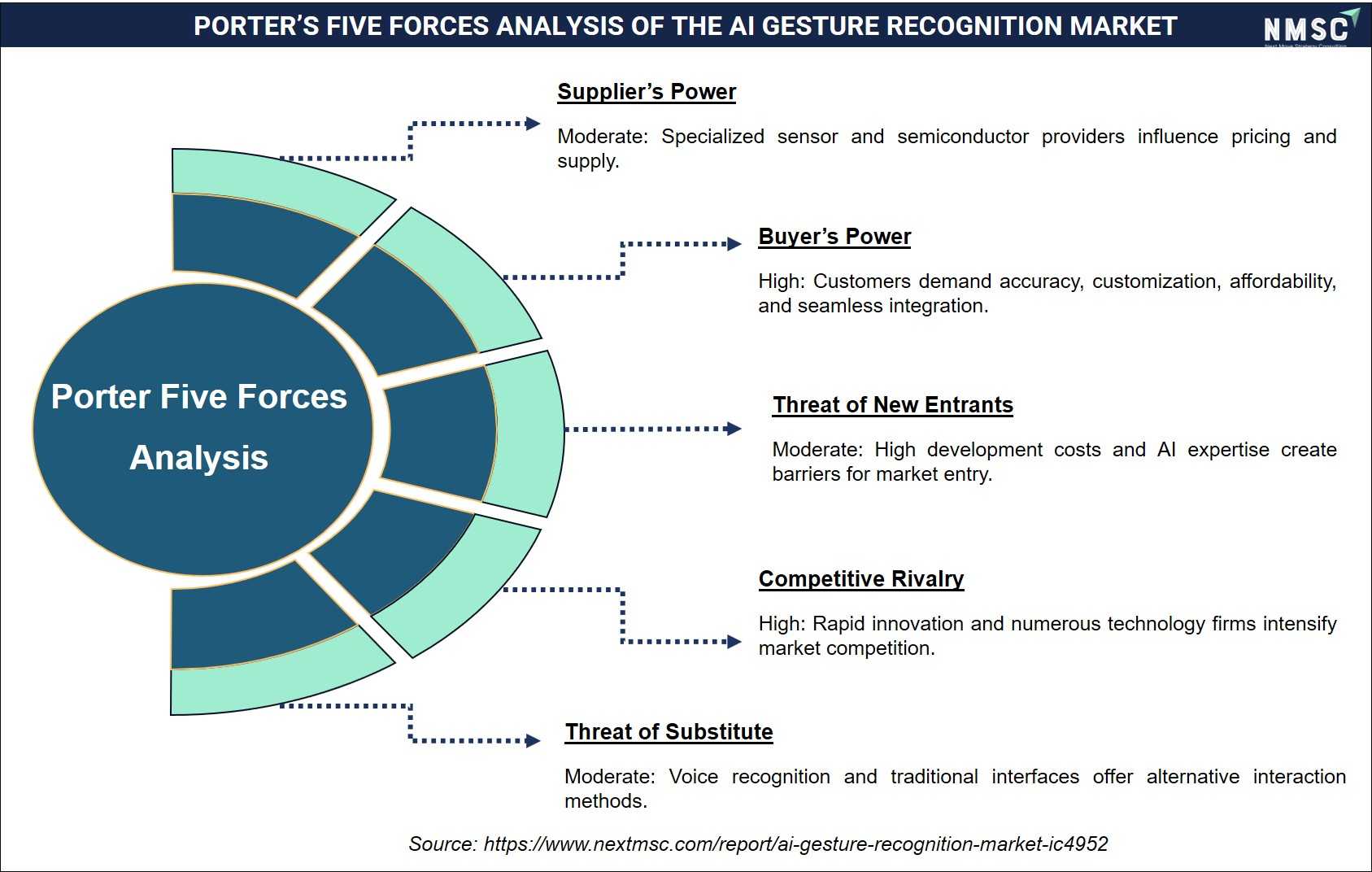
The above infographic illustrates a Porter’s Five Forces analysis of the AI Gesture Recognition Market, highlighting the competitive and structural factors influencing industry development. It assesses competitive rivalry, supplier and buyer bargaining power, threats from substitutes, and barriers to entry. The framework emphasizes the importance of sensor technologies, AI algorithms, and ecosystem partnerships, while reflecting rising demand for touchless interfaces and increasing competition among technology providers.
How Is the AI Gesture Recognition Market Segmented in This Report, and What Are the Key Insights from the Segmentation Analysis?
How Do Software, Hardware, Integrated Modules, and Service Sub-Segments Define the AI Gesture Recognition Market?
|
Solution Type |
2025 (USD Bn) |
2035 (USD Bn) |
CAGR (%) |
|
Software |
4.4 |
44.5 |
29.3% |
|
Hardware |
3.6 |
35.5 |
29.0% |
|
Integrated Modules |
3.3 |
30.5 |
28.0% |
|
Service |
1.3 |
10.66 |
26.3% |
Based on our analysis of solution type adoption, the AI Gesture Recognition Market report is structured into Software, Hardware, Integrated Modules, and Service categories. Software leads at USD 4.4 billion in 2025, with Software Development Kits and Gesture Analytics Software dominating due to strong developer ecosystem demand across consumer electronics and automotive platforms. Hardware, comprising Image Sensors, Time of Flight Sensors, and Radar Sensors, follows closely as OEMs embed dedicated sensing components. Integrated Modules combining Camera, Depth Sensing, and Sensor Fusion capabilities are emerging as the fastest adopted category among Tier 1 automotive suppliers seeking turnkey gesture solutions.
How Do Optical, Radar, Electric Field, Wearable, and Acoustic Sensing Technologies Compare in the AI Gesture Recognition Market?
|
Sensing Technology |
2025 (USD Bn) |
2035 (USD Bn) |
CAGR (%) |
|
Optical Vision Sensing |
5.2 |
42.5 |
26.3% |
|
Radar Sensing |
2.6 |
28.6 |
30.5% |
|
Electric Field Sensing |
1.1 |
8.9 |
26.2% |
|
Wearable Sensing |
1.6 |
17.8 |
30.7% |
|
Acoustic Sensing |
0.9 |
7.96 |
27.4% |
|
Sensor Fusion |
1.2 |
15.4 |
32.8% |
Through our analysis of sensing technology adoption trends, Optical Vision Sensing leads the AI Gesture Recognition Market at USD 5.2 billion in 2025, with Visible Light RGB Cameras and Depth and Time of Flight Sensors remaining the most cost-effective and widely deployed approach across consumer devices. Radar Sensing, led by Millimeter Wave Radar, is gaining share in automotive and privacy-sensitive applications due to its ability to detect gestures without capturing imagery. Sensor Fusion is the fastest-growing technology category at a CAGR of 32.8%, as OEMs combine multiple sensing modalities to improve accuracy under variable real-world conditions.
How Do Hand, Body, and Multimodal Gesture Interaction Modes Differ in the AI Gesture Recognition Market?
|
Interaction Mode |
2025 (USD Bn) |
2035 (USD Bn) |
CAGR (%) |
|
Hand Gestures |
7.8 |
68.5 |
27.3% |
|
Body Gestures |
3.3 |
30.2 |
27.9% |
|
Multimodal Gestures |
1.5 |
22.46 |
35.1% |
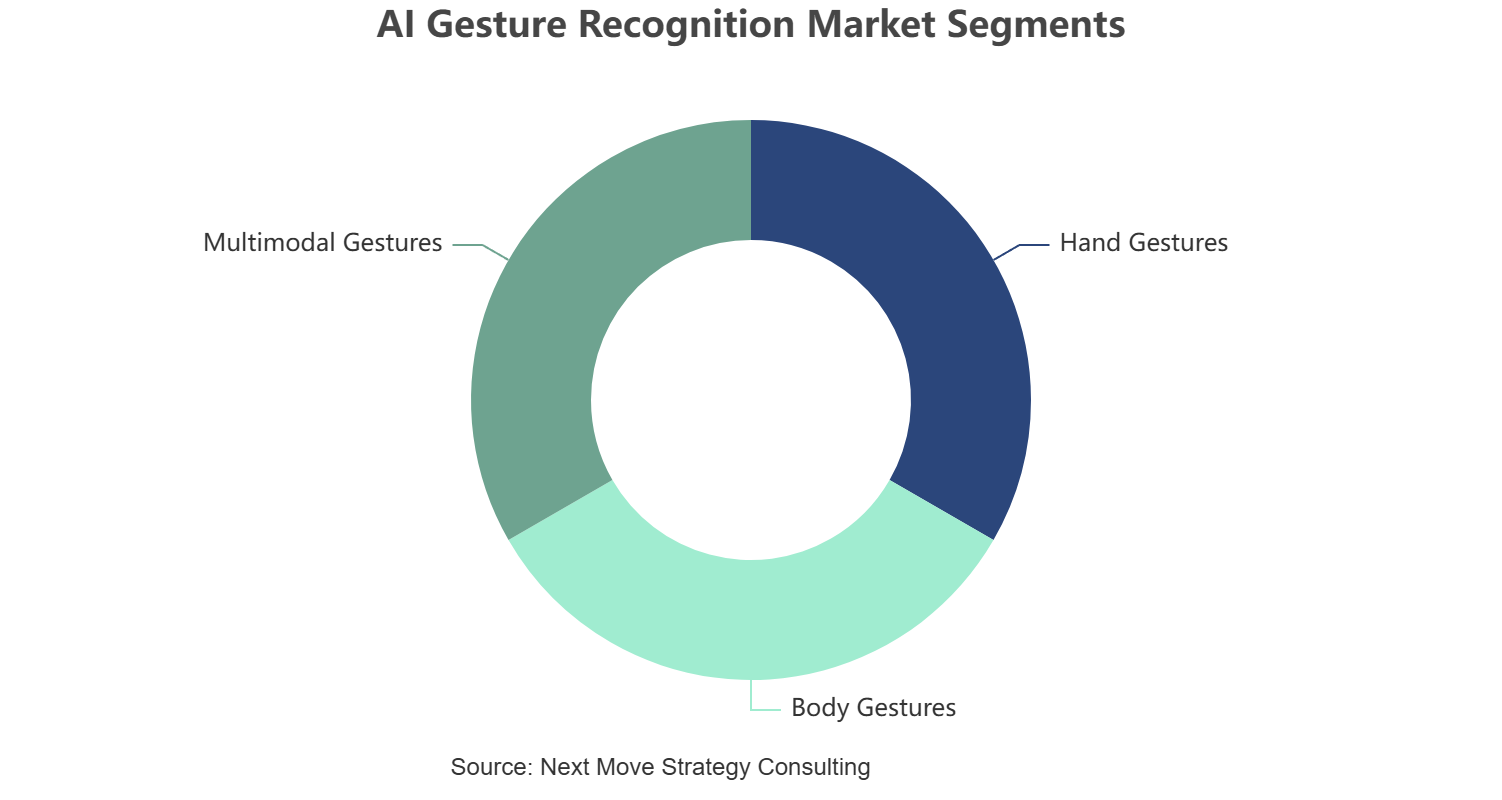
Our analysis of interaction mode adoption confirms that Hand Gestures dominate the AI Gesture Recognition Market at USD 7.8 billion in 2025, with Dynamic Motions and Finger Gestures driving the largest revenue contribution across smartphones, laptops, and extended reality controllers. Body Gestures, covering Arm Motions and Posture Changes, serve fitness, gaming, and industrial monitoring applications. Multimodal Gestures, which combine hand and body inputs with complementary voice or gaze signals, represent the fastest-growing interaction mode at a CAGR of 35.1%, reflecting automotive and industrial demand for more robust, context-aware human-machine interfaces.
Which Application Types Are Generating the Most Demand in the AI Gesture Recognition Market?
|
Application Type |
2025 (USD Bn) |
2035 (USD Bn) |
CAGR (%) |
|
Consumer Interface |
3.8 |
29.8 |
25.7% |
|
XR Interaction |
2.1 |
22.6 |
30.2% |
|
In Cabin Control |
2.4 |
24.2 |
29.3% |
|
Public Interface |
1.2 |
11.5 |
28.5% |
|
Industrial Control |
1.1 |
11.2 |
29.4% |
|
Healthcare Control |
0.9 |
9.6 |
30.1% |
|
Security and Access |
0.6 |
6.86 |
31.1% |
|
Analytics and Monitoring |
0.5 |
5.4 |
30.3% |
From our research, we found that Consumer Interface applications generate the largest revenue contribution within the AI Gesture Recognition Market at USD 3.8 billion in 2025, reflecting widespread smartphone and laptop gesture sensing integration. In-Cabin Control follows closely as automotive OEMs expand gesture-based dashboard interactions. XR Interaction is the fastest-growing application at a CAGR of 30.2%, driven by extended reality headset adoption from Meta Platforms, Apple, and Sony. Healthcare Control and Security and Access applications, while smaller in absolute revenue, are recording above-average growth rates as specialized touchless use cases scale.
How Does Buyer Type Influence Procurement Patterns in the AI Gesture Recognition Market?
|
Buyer Type |
2025 (USD Bn) |
2035 (USD Bn) |
CAGR (%) |
|
Original Equipment Manufacturers |
4.6 |
44.2 |
28.6% |
|
Tier 1 Suppliers |
3.1 |
29.6 |
28.5% |
|
System Integrators |
2.0 |
18.9 |
28.3% |
|
Enterprise Operators |
1.4 |
14.0 |
29.2% |
|
Application Developers |
1.0 |
9.46 |
28.4% |
|
Public Agencies |
0.5 |
5.0 |
29.2% |
Based on our market evaluation, Original Equipment Manufacturers represent the largest buyer category within the AI Gesture Recognition Market at USD 4.6 billion in 2025, as consumer electronics and automotive brands directly integrate gesture sensing into their product lines. Tier 1 Suppliers follow as automotive component manufacturers embed gesture modules into vehicle subsystems before delivery to OEMs. System Integrators and Enterprise Operators are expanding their gesture recognition procurement for industrial and commercial deployments, while Public Agencies, though the smallest buyer category, show steady growth tied to smart city and public infrastructure modernization programs.
Which End User Industries Are Driving Demand in the AI Gesture Recognition Market?
|
End User Industry |
2025 (USD Bn) |
2035 (USD Bn) |
CAGR (%) |
|
Consumer Electronics |
4.9 |
38.6 |
25.8% |
|
Automotive |
3.2 |
33.5 |
29.8% |
|
Healthcare |
1.5 |
16.8 |
30.8% |
|
Retail and Hospitality |
1.1 |
11.6 |
29.9% |
|
Industrial |
0.9 |
9.8 |
30.4% |
|
Aerospace and Defense |
0.5 |
5.4 |
30.3% |
|
Enterprise and Education |
0.3 |
3.36 |
30.8% |
|
Public Sector |
0.2 |
2.1 |
29.9% |
Our analysis of end-user industry adoption confirms that Consumer Electronics is the dominant end-use vertical in the AI Gesture Recognition Market at USD 4.9 billion in 2025, supported by gesture sensing integration across smartphones, laptops, and smart home devices. Automotive follows as the second-largest vertical, driven by in cabin gesture control expansion across global vehicle platforms. Healthcare is recording the fastest growth at a CAGR of 30.8%, propelled by touchless infection control adoption in clinical environments, while Industrial, Aerospace and Defense, and Enterprise and Education verticals are scaling from smaller bases with above-market growth rates.
Regional Outlook
Geographic Performance Snapshot
|
Region |
2025 (USD Bn) |
2035 (USD Bn) |
CAGR (%) |
Key Driver |
|
North America |
4.6 |
42.8 |
28.1% |
Extended reality and automotive gesture adoption |
|
Europe |
3.2 |
27.6 |
27.0% |
Automotive OEM gesture integration, GDPR compliant sensing |
|
Asia-Pacific |
3.5 |
38.5 |
30.5% |
Consumer electronics manufacturing, automotive expansion |
|
Middle East and Africa |
0.8 |
7.5 |
28.2% |
Smart city public interface investment |
|
Latin America |
0.5 |
4.76 |
28.5% |
Automotive and consumer electronics growth |
North America AI Gesture Recognition Market
North America leads the AI Gesture Recognition Market, contributing USD 4.6 billion in 2025 and forecast to reach USD 42.8 billion by 2035 at a CAGR of 28.1%. The region hosts the global headquarters of Apple, Meta Platforms, Microsoft, Google, and Qualcomm, anchoring both extended reality device innovation and gesture sensing chip development. The U.S. National Institute of Standards and Technology's AI guidance frameworks support enterprise confidence in gesture recognition deployment across regulated automotive and healthcare applications throughout the forecast period.
U.S. AI Gesture Recognition Market
Based on our engagements, the United States represents the single largest country within the AI Gesture Recognition Market at approximately USD 3.65 billion in 2025. The U.S. benefits from the headquarters presence of Apple, Meta Platforms, Microsoft, Google, and Qualcomm, creating concentrated innovation in gesture sensing software development kits and edge AI chips. The U.S. National Highway Traffic Safety Administration's distraction reduction guidance supports automotive gesture control adoption, while extended reality headset shipments continue to anchor consumer-facing demand across the domestic market.
Canada AI Gesture Recognition Market
Through our analysis, Canada contributes a meaningful share of North American AI Gesture Recognition Market revenue, supported by a growing automotive parts manufacturing base and a technology sector concentrated in Toronto and Vancouver. Canadian automotive suppliers are integrating gesture sensing components for export to U.S. assembly plants. The Canadian Radio-television and Telecommunications Commission's spectrum policies support radar-based sensing technology deployment, while academic research institutions contribute to gesture recognition algorithm development within the broader North American innovation ecosystem.
Mexico AI Gesture Recognition Market
From our assessment, Mexico is an emerging manufacturing hub within the North American AI Gesture Recognition Market, driven by its substantial automotive assembly and electronics manufacturing base. Mexican manufacturing facilities supply gesture sensing hardware components to North American automotive OEMs as part of regional supply chain nearshoring trends. The Mexican government's digital economy initiatives support broader technology sector growth, while proximity to the U.S. market continues to position Mexico as a cost-competitive assembly location for gesture sensing hardware and integrated modules.
Europe AI Gesture Recognition Market
Europe is the second-largest region in the AI Gesture Recognition Market, contributing USD 3.2 billion in 2025 and forecast to reach USD 27.6 billion by 2035 at a CAGR of 27.0%. The region's automotive manufacturing strength in Germany and France drives substantial in cabin gesture control demand, while GDPR compliance requirements favour privacy preserving radar and electric field sensing technologies over camera based optical systems. Infineon Technologies and STMicroelectronics anchor regional sensor hardware innovation across the European gesture recognition ecosystem.
UK AI Gesture Recognition Market
According to our evaluation, the United Kingdom holds a leading position within the European AI Gesture Recognition Market, supported by a strong fintech and consumer technology sector based in London. UK based developers contribute meaningfully to gesture recognition software innovation, while the Information Commissioner's Office's data protection guidance shapes camera-based sensing deployment requirements. Financial services and retail sectors are early adopters of touchless public interface technology, supporting demand for gesture recognition software and integrated sensing modules across the UK.
Germany AI Gesture Recognition Market
Based on our market evaluation, Germany is the largest individual European market for the AI Gesture Recognition Market, anchored by its dominant automotive manufacturing sector. German automotive OEMs including premium vehicle manufacturers are early adopters of in cabin gesture control systems. Infineon Technologies, headquartered in Germany, is a leading global supplier of radar and time of flight sensors used in automotive gesture applications. The German Federal Office for Information Security's data protection guidance supports privacy preserving sensing technology adoption across regulated industries.
France AI Gesture Recognition Market
Through our analysis, France represents a significant European market for the AI Gesture Recognition Market, supported by its automotive manufacturing base and a growing technology startup ecosystem in Paris. French automotive suppliers are integrating gesture sensing into vehicle infotainment systems, while the country's national AI strategy supports broader machine learning research relevant to gesture recognition algorithm development. The CNIL's active enforcement of GDPR provisions shapes camera-based sensing deployment requirements across French commercial and automotive applications.
Italy AI Gesture Recognition Market
From our assessment, Italy is a growing market within the AI Gesture Recognition Market, supported by its automotive component manufacturing sector and a strong industrial design tradition. Italian automotive suppliers contribute to European in cabin gesture control supply chains, while the country's manufacturing base supports industrial gesture control adoption for hands-free equipment operation. Italy's Garante data protection authority enforces GDPR compliance requirements that influence camera-based gesture sensing deployment across commercial and industrial applications.
Spain AI Gesture Recognition Market
Based on our evaluation, Spain demonstrates steady growth within the AI Gesture Recognition Market, driven by its automotive assembly sector and expanding retail technology adoption. Spanish automotive plants integrate gesture sensing hardware as part of broader European vehicle platforms. The Agencia Espanola de Proteccion de Datos enforces GDPR compliance requirements affecting camera-based sensing systems. Retail and hospitality sectors in Spain are piloting touchless public interface kiosks, supporting incremental gesture recognition software and hardware demand across the country.
Sweden AI Gesture Recognition Market
Sweden represents a technologically advanced market within the AI Gesture Recognition Market, supported by a highly digitized consumer base and strong telecommunications infrastructure. Swedish automotive manufacturers are early adopters of gesture-based safety features, while the country's robust technology startup ecosystem contributes to gesture recognition software innovation. The Swedish Authority for Privacy Protection enforces GDPR compliance requirements that support adoption of privacy preserving radar and electric field sensing technologies across Swedish commercial and automotive deployments.
Denmark AI Gesture Recognition Market
Through our analysis, Denmark shows consistent adoption within the AI Gesture Recognition Market, supported by a digitally mature enterprise base and strong public sector technology investment. Danish healthcare facilities are early adopters of touchless gesture control for clinical environments, aligning with the country's broader digital health strategy. The Danish Data Protection Agency provides active regulatory oversight that shapes gesture sensing technology procurement requirements across healthcare, public sector, and enterprise deployments within the Danish market.
Finland AI Gesture Recognition Market
Finland's AI Gesture Recognition Market reflects the country's strong telecommunications and technology heritage, with Nokia's historical engineering base contributing to sensor and wireless technology talent availability. Finnish enterprises are exploring gesture recognition for industrial automation and public sector digital services. The Finnish government's data governance initiatives support privacy preserving sensing technology adoption, while the country's compact but technologically sophisticated market continues to incrementally adopt gesture recognition across enterprise and public sector applications.
Netherlands AI Gesture Recognition Market
From our assessment, the Netherlands is a notable European hub within the AI Gesture Recognition Market, supported by strong logistics, retail, and technology sectors based in Amsterdam. Dutch retail and hospitality businesses are piloting touchless interface kiosks for customer service applications. The Dutch Data Protection Authority's GDPR enforcement decisions influence camera-based gesture sensing deployment standards. The Netherlands' position as a European logistics hub also supports industrial gesture control adoption within warehouse and distribution center automation.
Rest of Europe AI Gesture Recognition Market
Rest of Europe, comprising Poland, Belgium, Switzerland, Austria, Portugal, Czech Republic, and other nations, collectively represents a meaningful share of the European AI Gesture Recognition Market. Poland and Czech Republic benefit from automotive component manufacturing investment supplying broader European supply chains. Switzerland hosts precision sensor manufacturing capabilities relevant to gesture hardware production. Belgium, as the seat of EU institutions, represents a regulatory and policy influence center shaping gesture recognition data protection standards across the wider European market.
Asia-Pacific AI Gesture Recognition Market
Asia-Pacific is the fastest-growing region in the AI Gesture Recognition Market, advancing from USD 3.5 billion in 2025 to USD 38.5 billion by 2035 at a CAGR of 30.5%. The region's dominant consumer electronics and automotive manufacturing base, anchored by China, South Korea, Japan, and Taiwan, drives substantial gesture sensing hardware production. Samsung Electronics and Sony Group Corporation maintain significant regional research and manufacturing presence supporting both domestic consumption and global gesture recognition hardware export through the forecast period.
China AI Gesture Recognition Market
Based on our engagements, China is the largest single market within Asia-Pacific for the AI Gesture Recognition Market, driven by its massive consumer electronics manufacturing base and expanding domestic automotive industry. Chinese smartphone manufacturers are integrating gesture sensing software development kits into flagship devices. The Ministry of Industry and Information Technology's industrial policy supports domestic semiconductor and sensor manufacturing capability development, while China's large electric vehicle manufacturing sector creates substantial in cabin gesture control hardware demand.
India AI Gesture Recognition Market
Through our analysis, India is the fastest-growing country market within Asia-Pacific for the AI Gesture Recognition Market at a CAGR of 33.7%. India's expanding smartphone manufacturing base under the government's Production Linked Incentive scheme is driving domestic gesture sensing component assembly. The Ministry of Electronics and Information Technology's digital economy initiatives support broader technology sector growth. India's growing automotive manufacturing sector and expanding consumer electronics market continue to scale gesture recognition adoption from a comparatively smaller base.
Japan AI Gesture Recognition Market
From our assessment, Japan is the second-largest Asia-Pacific market for the AI Gesture Recognition Market, supported by Sony Group Corporation's consumer electronics and gaming hardware leadership alongside a mature automotive manufacturing sector. Japanese automotive OEMs are early adopters of in cabin gesture control technology. The Personal Information Protection Commission's data governance framework shapes camera-based sensing deployment requirements. Japan's precision sensor manufacturing capabilities also support component supply for regional and global gesture recognition hardware production.
South Korea AI Gesture Recognition Market
According to our evaluation, South Korea demonstrates strong adoption within the AI Gesture Recognition Market, anchored by Samsung Electronics' global consumer electronics leadership and extensive semiconductor manufacturing capability. South Korean smartphone and television manufacturers are integrating gesture sensing across premium product lines. The Personal Information Protection Act, enforced by the PIPC, governs camera-based sensing data handling. South Korea's advanced semiconductor fabrication infrastructure also supports gesture sensing chip production for both domestic and export markets.
Taiwan AI Gesture Recognition Market
Taiwan's AI Gesture Recognition Market is concentrated in semiconductor manufacturing and electronics component supply, given the island's globally significant chip fabrication capacity. Taiwanese foundries manufacture sensor chips and microcontrollers used across global gesture recognition hardware supply chains. The government's digital economy initiatives support continued semiconductor sector investment. Taiwan's electronics manufacturing ecosystem positions it as a critical upstream supplier for gesture sensing hardware components destined for global consumer electronics and automotive brands.
Indonesia AI Gesture Recognition Market
Indonesia is an emerging market within the AI Gesture Recognition Market, supported by its large consumer electronics market and growing domestic smartphone assembly sector. Indonesian government digital economy policies are encouraging local electronics manufacturing investment. The country's expanding middle class consumer base supports incremental adoption of gesture-enabled smartphones and smart home devices, while regional automotive assembly operations are beginning to evaluate gesture control features for locally produced vehicle models within the broader Southeast Asian supply chain.
Vietnam AI Gesture Recognition Market
Vietnam is a growing electronics manufacturing hub within the AI Gesture Recognition Market, benefiting from supply chain diversification as global electronics brands expand assembly operations within the country. Vietnamese factories assemble consumer electronics components that incorporate gesture sensing modules destined for export markets. The government's National Digital Transformation Program supports broader technology sector development. Vietnam's growing role in global electronics supply chains positions it as an increasingly important manufacturing location for gesture sensing hardware components.
Australia AI Gesture Recognition Market
Through our analysis, Australia represents a mature consumer market within the AI Gesture Recognition Market, characterized by strong smartphone and extended reality device adoption rates. The Australian Competition and Consumer Commission's consumer protection framework shapes data handling requirements for camera-based gesture systems. Australian healthcare facilities are evaluating touchless control technology for clinical settings. The country's compact but affluent consumer base supports premium gesture-enabled device adoption across consumer electronics and emerging extended reality product categories.
Philippines AI Gesture Recognition Market
From our assessment, Philippines is a developing market within the AI Gesture Recognition Market, supported by a growing business process outsourcing sector and expanding smartphone penetration. Philippine consumers are increasingly adopting gesture-enabled mobile devices as smartphone affordability improves. The National Privacy Commission's data protection enforcement shapes camera-based sensing deployment requirements. The country's young, digitally engaged population base supports gradual gesture recognition technology adoption across consumer electronics applications.
Malaysia AI Gesture Recognition Market
According to our evaluation, Malaysia is a growing market within the AI Gesture Recognition Market, supported by its established electronics manufacturing sector and Kuala Lumpur's position as a regional technology hub. Malaysian electronics manufacturers contribute to regional gesture sensing component supply chains. The government's MyDigital strategy targets continued digital economy expansion. Malaysian automotive assembly operations are beginning to evaluate gesture control integration for locally assembled vehicle models within the broader Southeast Asian automotive supply chain.
Rest of Asia-Pacific AI Gesture Recognition Market
Rest of Asia-Pacific, comprising Thailand, Singapore, Bangladesh, Sri Lanka, Pakistan, New Zealand, and smaller Pacific Island nations, collectively represents a growing share of regional AI Gesture Recognition Market revenue. Singapore functions as a regional technology and electronics trading hub supporting gesture sensing component distribution. Thailand's automotive assembly sector is evaluating gesture control features for regional vehicle production. New Zealand's compact consumer electronics market continues steady adoption alongside the broader trans-Tasman digital technology economy.
Middle East and Africa AI Gesture Recognition Market
The Middle East and Africa region is advancing within the AI Gesture Recognition Market from USD 0.8 billion in 2025 to USD 7.5 billion by 2035 at a CAGR of 28.2%. Smart city development programs in Saudi Arabia and the UAE are the primary growth catalysts, supplemented by Israel's technology sector strength and South Africa's regional electronics distribution role. Public sector investment in touchless public interface kiosks for transportation and government services is creating structural demand across the region.
Saudi Arabia AI Gesture Recognition Market
Based on our engagements, Saudi Arabia is the largest AI Gesture Recognition Market within the Middle East and Africa region, driven by Vision 2030's smart city development programs, particularly the NEOM project, which incorporates touchless and gesture controlled public interfaces into its planned infrastructure. The Saudi Authority for Data and Artificial Intelligence's national AI strategy supports broader technology adoption. Saudi public agencies are piloting gesture controlled kiosks for government service delivery, creating sustained public sector demand for gesture recognition technology.
UAE AI Gesture Recognition Market
Through our analysis, UAE is the second-largest AI Gesture Recognition Market in the region, powered by Dubai and Abu Dhabi's smart city and tourism infrastructure investment. The UAE National AI Strategy 2031 supports broader artificial intelligence technology adoption across public and private sectors. UAE airports and retail destinations are early adopters of touchless gesture-controlled interfaces for passenger experience enhancement. Financial services and hospitality sectors create additional gesture recognition demand across the Emirates' technology-forward business environment.
Egypt AI Gesture Recognition Market
From our assessment, Egypt is an emerging market within the AI Gesture Recognition Market, supported by a large population base and the government's Egypt Vision 2030 digital transformation agenda. Egyptian public agencies are beginning to evaluate touchless interface technology for government service delivery modernization. The National Telecommunication Regulatory Authority's data protection framework shapes camera-based sensing deployment requirements. Egypt's growing smartphone penetration supports gradual gesture recognition technology adoption across consumer electronics applications within the domestic market.
Israel AI Gesture Recognition Market
According to our evaluation, Israel occupies a distinctive position within the AI Gesture Recognition Market as a significant technology innovation hub, hosting numerous sensor and computer vision startups. Israeli technology companies contribute meaningfully to gesture recognition algorithm and radar sensing innovation. The Israeli Privacy Protection Authority governs data processing requirements for camera-based systems. Israel's defense technology sector also drives demand for advanced gesture and motion sensing capabilities within specialized security and surveillance applications.
Turkey AI Gesture Recognition Market
Through our analysis, Turkey is a mid-sized and growing AI Gesture Recognition Market within the region, characterized by an expanding automotive manufacturing sector and growing consumer electronics demand. Turkey's Personal Data Protection Authority enforces data governance requirements affecting camera-based sensing deployment. Turkish automotive component manufacturers are beginning to integrate gesture sensing capabilities for regional vehicle production. Istanbul's growing technology startup ecosystem further supports gesture recognition software development and local market adoption.
Nigeria AI Gesture Recognition Market
Based on our engagements, Nigeria is the largest AI Gesture Recognition Market within Sub-Saharan Africa, powered by its large population and growing smartphone penetration rate. The Nigeria Data Protection Commission enforces governance requirements under the Nigeria Data Protection Act 2023 affecting camera-based sensing systems. Nigerian consumers are increasingly adopting gesture-enabled mobile devices as smartphone affordability improves across the domestic market, while the country's growing technology startup ecosystem in Lagos supports incremental gesture recognition software development.
South Africa AI Gesture Recognition Market
From our assessment, South Africa is the most mature AI Gesture Recognition Market within Sub-Saharan Africa, supported by Johannesburg's role as the continent's commercial and financial hub. The Information Regulator enforces the Protection of Personal Information Act, which governs camera-based sensing data handling requirements. South African retail and financial services sectors are piloting touchless interface technology for customer service applications. The country's relatively developed electronics distribution infrastructure supports broader regional gesture recognition hardware availability.
Rest of MEA AI Gesture Recognition Market
Rest of MEA, comprising Kuwait, Qatar, Bahrain, Oman, Jordan, Kenya, Ethiopia, Tanzania, Ghana, and other emerging markets, collectively represents an early-growth portion of the regional AI Gesture Recognition Market. GCC nations including Qatar and Kuwait are investing in smart city infrastructure that incorporates touchless public interface technology. Kenya's growing technology ecosystem positions it as an emerging Sub-Saharan Africa adoption market. Ethiopia and Tanzania remain at early stages of consumer electronics market development that will underpin future gesture recognition demand.
Latin America AI Gesture Recognition Market
Latin America is advancing within the AI Gesture Recognition Market from USD 0.5 billion in 2025 to USD 4.76 billion by 2035 at a CAGR of 28.5%. Brazil and Mexico are the primary growth engines, supported by expanding automotive assembly operations and growing consumer electronics demand. Regional government digital transformation programs are creating incremental demand for touchless public interface technology across transportation and government service delivery applications throughout the forecast period.
Brazil AI Gesture Recognition Market
Based on our market evaluation, Brazil is the largest AI Gesture Recognition Market in Latin America, driven by its substantial automotive manufacturing sector and the region's largest consumer electronics market. Brazilian automotive assembly plants are evaluating gesture control integration for regionally produced vehicle models. The Lei Geral de Protecao de Dados, enforced by the ANPD, governs camera-based sensing data handling requirements. Brazil's growing smartphone penetration continues to support gesture recognition software adoption across consumer electronics applications.
Argentina AI Gesture Recognition Market
Through our analysis, Argentina demonstrates growing adoption within the AI Gesture Recognition Market, supported by a technically capable workforce and an active technology startup ecosystem based in Buenos Aires. Argentina's automotive component manufacturing sector contributes to regional supply chains for gesture sensing hardware. The Argentine Personal Data Protection Law, undergoing modernization toward international standards, shapes data governance requirements. Growing smartphone adoption continues to support incremental gesture recognition technology penetration across the domestic consumer market.
Chile AI Gesture Recognition Market
From our assessment, Chile demonstrates relatively high market maturity within Latin America for the AI Gesture Recognition Market, supported by Santiago's role as a regional financial and commercial hub. Chile's Data Protection Law is being modernized to align with international standards, shaping data governance requirements for camera-based sensing systems. Chilean retail and financial services sectors are exploring touchless interface technology for customer service applications, supporting incremental gesture recognition software adoption across the domestic market.
Colombia AI Gesture Recognition Market
According to our evaluation, Colombia is an emerging market within the AI Gesture Recognition Market, supported by Bogota's growing role as a regional technology hub. Colombia's Ley 1581 on personal data protection and Superintendencia de Industria y Comercio enforcement shape camera based sensing data governance requirements. Colombian consumer electronics retailers are introducing gesture-enabled device categories as smartphone penetration continues to expand. The country's growing technology startup ecosystem also supports gradual gesture recognition software development.
Rest of Latin America AI Gesture Recognition Market
Rest of Latin America, comprising Peru, Ecuador, Uruguay, Panama, Costa Rica, and smaller Central American and Caribbean markets, collectively contributes a growing portion of regional AI Gesture Recognition Market revenue. Peru's expanding consumer electronics retail sector is introducing gesture-enabled devices to domestic consumers. Uruguay benefits from one of Latin America's most digitally advanced government infrastructures, supporting early public sector touchless interface pilots. Costa Rica's electronics assembly sector contributes incrementally to regional gesture sensing hardware supply chains.
Competitive Landscape
Competitive Dynamics and M&A Landscape in the AI Gesture Recognition Market
|
Key Takeaways |
Details |
|
Market Structure |
The AI Gesture Recognition trends features a concentrated top tier of consumer technology giants alongside a fragmented second tier of specialized sensor and software vendors competing on sensing accuracy and integration depth. |
|
Innovation Focus |
Leading companies are investing in edge AI inference chips, sensor fusion architectures, and privacy-preserving radar sensing to differentiate gesture recognition accuracy and latency performance. |
|
M&A Activity |
Semiconductor companies and consumer technology platforms are acquiring specialized gesture sensing startups to internalise sensor fusion algorithms and accelerate proprietary hardware integration timelines. |
How Do Companies Compete in the AI Gesture Recognition Market?
Competition within the AI Gesture Recognition Market spans consumer technology giants, semiconductor sensor manufacturers, and specialised gesture software vendors. Market structure features Apple, Samsung Electronics, Meta Platforms, and Microsoft competing through vertically integrated hardware and software ecosystems, while Infineon Technologies, STMicroelectronics, and NXP Semiconductors compete on sensor component performance and cost. Competitive strategies center on edge AI chip efficiency, sensor fusion accuracy, and software development kit ease of integration. Innovation focus areas include radar sensing miniaturisation, low-power neural processing, and multimodal gesture algorithms. Geographic expansion strategies prioritize automotive Tier 1 supplier partnerships in Europe and Asia-Pacific, while pricing strategies range from premium vertically integrated device bundling to component-level competitive pricing among standalone sensor suppliers.
Which Kind of Companies Dominate the AI Gesture Recognition Market?
Vertically integrated consumer technology companies with proprietary chip design capabilities currently dominate the AI Gesture Recognition Market, given their ability to optimize gesture sensing software and hardware performance within a single product ecosystem. Apple's custom silicon and Samsung Electronics' semiconductor manufacturing scale exemplify this advantage. Specialised sensor manufacturers including Infineon Technologies and STMicroelectronics maintain strong positions by supplying component-level radar and time-of-flight sensors to multiple OEM customers across automotive and consumer electronics applications, creating a dual-track competitive structure across the market.
AI-Native Differentiation and Open Standards Drive Market Success in the AI Gesture Recognition Market
Companies that embed AI-native gesture processing directly within edge silicon, rather than relying on cloud-dependent processing, are achieving stronger market positioning within the AI Gesture Recognition Market. Qualcomm's dedicated AI processing units and Apple's on-device Neural Engine illustrate this approach. Simultaneously, support for open sensing standards and cross-platform software development kits is becoming a differentiator for vendors targeting third-party application developers, as open standards reduce integration friction for enterprise and industrial customers building custom gesture-enabled applications.
Market Players to opt for Merger and Acquisition Strategies to Expand Their Presence in the AI Gesture Recognition Market
Strategic acquisition activity is accelerating within the AI Gesture Recognition Market as established semiconductor and consumer technology companies seek to internalise specialised gesture sensing capabilities. Larger technology platforms have historically acquired computer vision and sensor fusion startups to accelerate proprietary algorithm development rather than building comparable capabilities organically. This trend is expected to continue as semiconductor companies seek to expand their gesture sensing portfolio breadth and consumer technology firms aim to secure differentiated hardware capabilities ahead of competitors in the extended reality and automotive gesture control segments.
Who Are the Key Market Players in the AI Gesture Recognition Market?
-
Apple Inc.
-
Samsung Electronics Co., Ltd.
-
Meta Platforms, Inc.
-
Microsoft Corporation
-
Google LLC
-
Qualcomm Technologies, Inc.
-
Sony Group Corporation
-
RealSense, Inc.
-
Infineon Technologies AG
-
STMicroelectronics N.V.
-
NXP Semiconductors N.V.
-
Microchip Technology Incorporated
-
Synaptics Incorporated
-
Ultraleap Ltd.
-
Elliptic Laboratories ASA
-
eyeSight Technologies Ltd.
-
ams OSRAM AG
-
Vayyar Imaging Ltd.
-
Lattice Semiconductor Corporation
-
TDK Corporation
What Are the Latest Developments in the AI Gesture Recognition Industry?
|
Date |
Event |
|
August 2025 |
Elliptic Laboratories ASA announced a multi-year licensing agreement with a major laptop customer. The platform includes AI Virtual Gesture Sensor technology and reinforces the growing integration of software-defined gesture recognition capabilities into PCs, supporting touchless interaction and contextual user experiences. |
|
March 2025 |
Elliptic Labs announced that vivo's V50 and V50e smartphones launched with its AI Virtual Smart Sensor Platform. The deployment demonstrates increasing adoption of AI-based gesture and proximity sensing technologies in consumer electronics, enhancing touchless interaction and device intelligence. |
Consumer Behaviour Analysis of the AI Gesture Recognition Market
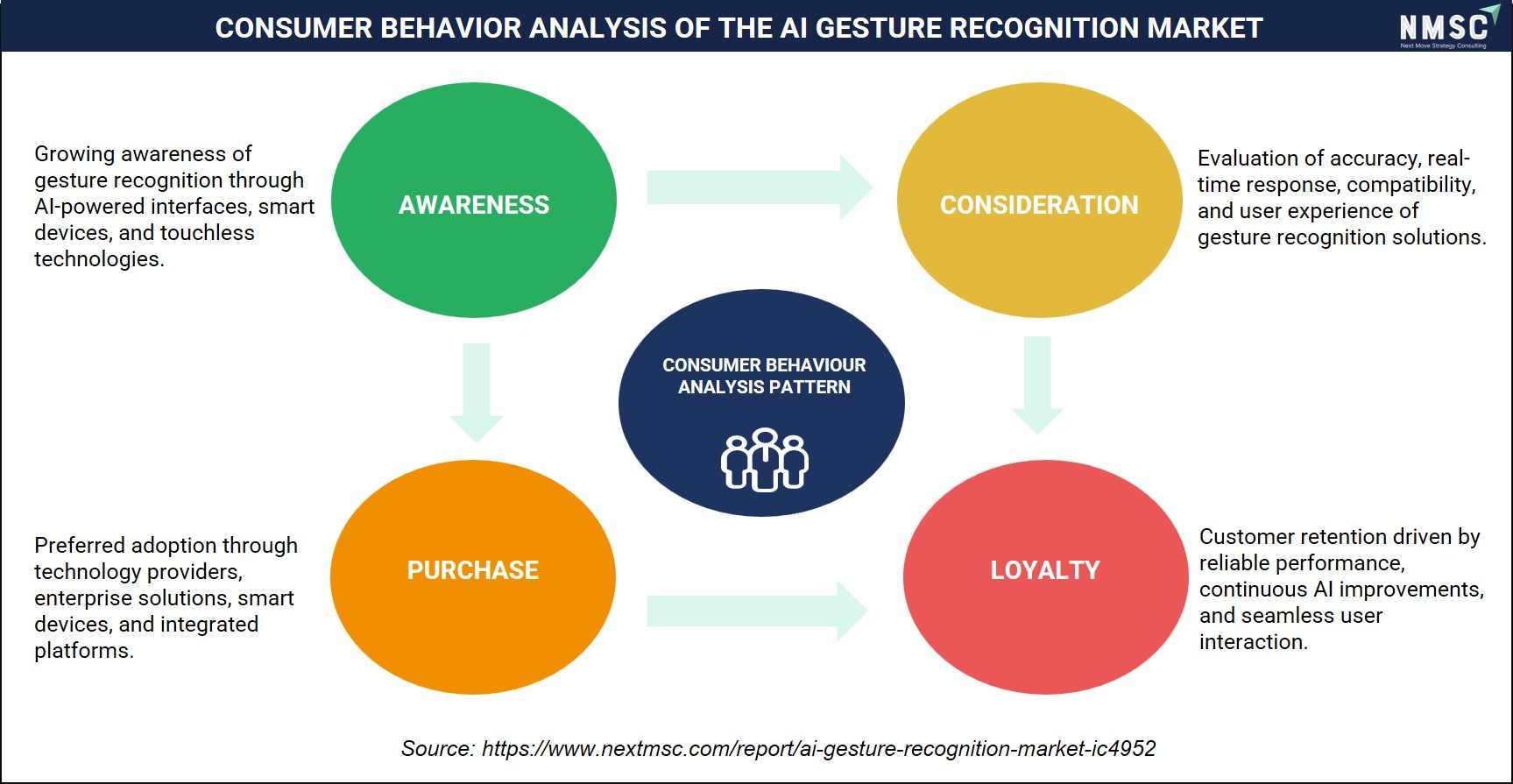
The above framework maps the consumer journey across awareness, consideration, purchase, and loyalty within the Gesture Recognition Market. We observed that awareness flows through AI-powered interfaces, smart devices, and touchless technologies, while consideration hinges on accuracy, real-time response, compatibility, and user experience. Adoption occurs through technology providers, enterprise solutions, and integrated platforms, with loyalty ultimately driven by reliable performance, continuous AI improvements, and seamless user interaction.
What Are the Investment Opportunities in AI Gesture Recognition Market?
Capital Inflows and Infrastructure Investment in the AI Gesture Recognition Market
The AI Gesture Recognition Market is attracting growing capital inflows from semiconductor companies and consumer technology platforms investing in dedicated gesture sensing chip fabrication capacity. Infineon Technologies and STMicroelectronics have expanded radar and time-of-flight sensor production lines to meet automotive and consumer electronics demand. The U.S. National Science Foundation has funded academic research programs in human-computer interaction and sensor technology that contribute foundational research supporting commercial gesture recognition product development across the broader innovation ecosystem.
ESG Considerations in the AI Gesture Recognition Market
Environmental and accessibility considerations are emerging within the AI Gesture Recognition Market investment thesis, particularly as touchless interfaces support accessibility for users with mobility limitations. The U.S. Department of Justice's Americans with Disabilities Act accessibility guidance supports adoption of alternative input methods, including gesture control for public-facing kiosks and interfaces. Energy-efficient edge AI chip design also reduces device power consumption compared to cloud-dependent gesture processing, aligning gesture recognition hardware development with broader semiconductor industry energy efficiency objectives and sustainability reporting requirements.
Digital Transformation as an Investment Driver in the AI Gesture Recognition Market
Digital transformation programs across automotive, healthcare, and public sector verticals are a primary demand-side investment driver in the AI Gesture Recognition Market. Automotive OEMs investing in next-generation cabin experience platforms are allocating capital toward gesture control integration as a competitive differentiator. Healthcare facilities modernising clinical environments are evaluating touchless interface technology as part of broader infection control infrastructure investment. These multi-year transformation programs across distinct end-use verticals are creating sustained demand for gesture recognition software, hardware, and integration services.
PE and VC Activity in the AI Gesture Recognition Market
Venture capital activity in the AI Gesture Recognition Market remains concentrated in specialized sensor fusion and gesture software startups addressing specific vertical applications including healthcare control and industrial automation. The National Venture Capital Association has documented sustained venture investment in sensor technology and human-computer interaction startups as part of broader deep technology investment trends. Strategic acquirers including established semiconductor and consumer technology companies continue to represent the primary exit pathway for specialized gesture recognition startups seeking to scale commercial deployment.
Key Benefits for Stakeholders
For Technology Vendors
Technology vendors gain access to a comprehensive and vendor-neutral assessment of the AI Gesture Recognition Market trends, including detailed segmentation by solution type, sensing technology, and application category. The analysis enables vendors to identify product positioning gaps, uncover cross-sell opportunities, and refine go-to-market strategies across consumer electronics, automotive, and industrial automation applications. Competitive landscape intelligence further supports roadmap prioritization and market expansion decisions.
For Investors (Private Equity and Venture Capital Firms)
Investors benefit from structured market sizing, CAGR forecasts, and segment-level growth projections that facilitate investment thesis development and portfolio allocation decisions. The report highlights the fastest-growing applications and technologies within the gesture recognition ecosystem while providing competitive landscape assessments and M&A activity insights relevant to hardware and software providers operating in the market.
For Automotive OEMs and Tier 1 Suppliers
Automotive OEMs and Tier 1 suppliers gain actionable intelligence on sensing technology capabilities, competitive positioning, and regional regulatory trends influencing the adoption of gesture-based interfaces. These insights support component sourcing strategies and in-cabin system design decisions for both conventional and electric vehicle platforms, enabling manufacturers to align user experience innovations with evolving safety and connectivity requirements.
For System Integrators
System integrators obtain detailed analysis of end-use industries and buyer categories, allowing them to prioritize partnership development and allocate integration resources toward high-growth opportunities. The report identifies the application segments experiencing the strongest adoption, enabling service providers to align implementation capabilities with evolving customer requirements across industrial, automotive, healthcare, and consumer markets.
For Healthcare Organizations and Public Sector Buyers
Healthcare institutions and public sector organizations gain access to application-specific market sizing and regional adoption benchmarks that support procurement decisions for touchless interface technologies. The analysis provides insights into emerging use cases within clinical environments and public services, helping decision-makers evaluate technologies that enhance hygiene, accessibility, and operational efficiency.
For Academic Researchers and Research Institutions
Academic researchers and research institutions benefit from a comprehensive analytical framework covering market sizing methodologies, segmentation structures, and regional dynamics within the AI Gesture Recognition Market. The report serves as a valuable reference for studies related to gesture recognition technologies, human-computer interaction, computer vision, and the broader evolution of touchless user interfaces.
AI Gesture Recognition Market Key Segments
By Solution Type
-
Software
-
Software Development Kits
-
Runtime Engines
-
Cloud Application Programming Interfaces
-
Gesture Analytics Software
-
-
Hardware
-
Image Sensors
-
Time of Flight Sensors
-
Radar Sensors
-
Electric Field Sensors
-
Microcontrollers
-
-
Integrated Modules
-
Camera Modules
-
Depth Sensing Modules
-
Radar Modules
-
Ultrasonic Modules
-
Sensor Fusion Modules
-
-
Service
-
Custom Algorithm Training
-
Dataset Synthesis
-
System Integration
-
Technical Support
-
By Sensing Technology
-
Optical Vision Sensing
-
Visible Light RGB Cameras
-
Infrared Cameras
-
Depth and Time of Flight Sensors
-
Structured Light Imaging
-
-
Radar Sensing
-
Millimeter Wave Radar
-
Ultra-Wideband Radar
-
-
Electric Field Sensing
-
Quasi-static Electric Field
-
-
Wearable Sensing
-
Inertial Measurement Units
-
Electromyography Bands
-
-
Acoustic Sensing
-
Ultrasonic Sensing
-
Acoustic Ranging Arrays
-
-
Sensor Fusion
By Interaction Mode
-
Hand Gestures
-
Static Poses
-
Dynamic Motions
-
Finger Gestures
-
-
Body Gestures
-
Arm Motions
-
Posture Changes
-
-
Multimodal Gestures
By Application Type
-
Consumer Interface
-
XR Interaction
-
In Cabin Control
-
Public Interface
-
Industrial Control
-
Healthcare Control
-
Security and Access
-
Analytics and Monitoring
By Buyer Type
-
Original Equipment Manufacturers
-
Tier 1 Suppliers
-
System Integrators
-
Enterprise Operators
-
Application Developers
-
Public Agencies
By End User Industry
-
Consumer Electronics
-
Automotive
-
Healthcare
-
Retail and Hospitality
-
Industrial
-
Aerospace and Defense
-
Enterprise and Education
-
Public Sector
By Region
-
North America: U.S., Canada, and Mexico.
-
Europe: UK, Germany, France, Italy, Spain, Sweden, Denmark, Finland, the Netherlands, and the rest of Europe.
-
Asia Pacific: China, India, Japan, South Korea, Taiwan, Indonesia, Vietnam, Australia, Philippines, Malaysia and the rest of APAC.
-
Middle East & Africa (MEA): Saudi Arabia, UAE, Egypt, Israel, Turkey, Nigeria, South Africa, and the rest of MEA.
-
Latin America: Brazil, Argentina, Chile, Colombia, and the rest of LATAM.
Conclusion and Recommendations
Long-Term Outlook for the AI Gesture Recognition Market
The AI Gesture Recognition Market is positioned for sustained expansion through 2035, driven by extended reality device proliferation, automotive in-cabin integration, and edge AI chip cost reduction. The market is forecast to grow from USD 15.8 billion in 2026 to USD 121.16 billion by 2035 at a CAGR of 25.4%. NMSC's analysis indicates that this growth reflects gesture recognition's transition from a novelty consumer feature to a standard interface expectation across automotive, healthcare, and enterprise product categories.
Strategic Positioning Recommendations
Vendors should prioritize sensor fusion architectures that combine radar, optical, and acoustic sensing to achieve real-world reliability beyond controlled demo conditions. Investment in privacy-preserving sensing technologies, particularly radar and electric field sensing, is a non-negotiable strategic requirement for vendors targeting European markets subject to GDPR and the EU AI Act. Automotive Tier 1 suppliers should prioritize partnerships with sensor hardware manufacturers to accelerate in-cabin gesture control integration timelines ahead of competitive vehicle platform launches.
Investment Attractiveness of the AI Gesture Recognition Market
The AI Gesture Recognition Market represents an attractive investment environment given its CAGR of 25.4% through 2035 and diversified demand drivers spanning consumer electronics, automotive, and healthcare verticals. Our assessment identifies Multimodal Gestures at a CAGR of 35.1%, Sensor Fusion at 32.8%, and Healthcare end-use adoption at 30.8% as the highest-conviction investment themes, all advancing well above the overall market growth rate and reflecting durable secular demand for more reliable, context-aware gesture interfaces.
Market Shifts and Key Risks
The most significant market shift underway is the transition from single-sensor optical systems toward multi-sensor fusion architectures that deliver reliable performance across varied real-world conditions. This shift favours vendors with integrated hardware and software capabilities over component-only suppliers. Key risks include sensor hardware cost volatility tied to semiconductor supply chains, data privacy compliance complexity in camera-based systems, and accuracy limitations in low light or occlusion scenarios that could slow adoption in safety-critical automotive and healthcare applications.
Growth Pathways for the AI Gesture Recognition Market
Organizations seeking to maximize value from the AI Gesture Recognition Market should pursue a three-horizon strategy. In the near term through 2028, the priority is sensor fusion integration and edge AI chip optimization to improve gesture detection reliability across consumer and automotive products. In the mid-term from 2028 to 2032, expansion into healthcare and industrial control applications will diversify revenue beyond consumer electronics. From 2032 to 2035, multimodal interfaces combining gesture, voice, and gaze tracking will define next-generation human-machine interaction standards.
About the Author
 Mayurima Roy
— Mayurima Roy is Research Analyst at Next Move Strategy Consulting, where she has spent 4 years working across the firm's full industry coverage rather than a single fixed vertical. Her work centers on structured research, ongoing trend tracking, competitive assessment, and insight-led content development, translating complex market data into clear, decision-ready narratives that support informed client decision-making across diverse global industries, market sectors, and world regions every day.
Mayurima Roy
— Mayurima Roy is Research Analyst at Next Move Strategy Consulting, where she has spent 4 years working across the firm's full industry coverage rather than a single fixed vertical. Her work centers on structured research, ongoing trend tracking, competitive assessment, and insight-led content development, translating complex market data into clear, decision-ready narratives that support informed client decision-making across diverse global industries, market sectors, and world regions every day.
About the Reviewer
 Supradip Baul
— Supradip Baul is an accomplished business consultant and strategist with over a decade of rich experience in market intelligence, strategy, technology, and business transformation. His work has included rigorous qualitative and quantitative analysis across multiple industries, helping clients shape investment decisions and long-term roadmaps. Earlier in his career, he was associated with Gartner, where he contributed to industry-leading reports and market share analyses. He has worked with leading global companies and holds an MBA with a dual specialization in Marketing and Finance.
Supradip Baul
— Supradip Baul is an accomplished business consultant and strategist with over a decade of rich experience in market intelligence, strategy, technology, and business transformation. His work has included rigorous qualitative and quantitative analysis across multiple industries, helping clients shape investment decisions and long-term roadmaps. Earlier in his career, he was associated with Gartner, where he contributed to industry-leading reports and market share analyses. He has worked with leading global companies and holds an MBA with a dual specialization in Marketing and Finance.
At Next Move Strategy Consulting, we understand that insightful market research is the cornerstone of successful business decisions. That's why we employ a robust and multifaceted approach, combining various methodologies to deliver the most accurate and actionable data for our clients.

Research Landscape
We navigate the world of research with two primary approaches:
Qualitative Approach
Our qualitative research methodologies involve immersive techniques such as in-depth interviews, focus groups, and observational studies. By engaging directly with individuals and stakeholders, we uncover valuable insights that quantitative data alone may overlook.

Quantitative Research
In tandem with qualitative methodologies, NMSC leverages the power of Quantitative Research to provide a robust foundation of numerical insights. Through systematic data collection and analysis, we quantify patterns, preferences, and market trends, offering a comprehensive view of the business landscape.
Our quantitative research approach employs diverse tools, including surveys, experiments, and statistical modelling. These methodologies enable us to gather data from a large and representative sample, ensuring the statistical significance of our findings. By employing structured questionnaires and standardized data collection methods, we guarantee the reliability and validity of the information we present to our clients.
Quantitative research is particularly effective in measuring the prevalence of trends, assessing market size, and gauging the impact of various factors on consumer behavior. The numerical precision attained through this approach equips our clients with actionable insights, facilitating data-driven decision-making and strategy formulation.


Our Specialized Toolbox for Industry-Specific Market Research
We deploy a specialized arsenal of techniques tailored to meet your unique requirements. Here's a glimpse into our comprehensive toolbox:

Information Procurement
The stage entails acquiring market data or relevant information through various sources and methodologies.


Market Research Approach
We utilize both top-down and bottom-up approaches in market research analysis to achieve a comprehensive understanding of the market dynamics, leveraging the broad perspective of industry trends and macroeconomic factors alongside detailed insights from specific segments and individual companies.

Porters Five Forces Analysis
We conduct Porter's Five Forces analysis to evaluate the competitive landscape of an industry, providing us with insights into factors that affect profitability and strategic positioning.

SWOT Analysis

Forecasting
We utilize a forecasting model to predict future consumption by considering parameters like population, economics, regulations, market competition, drivers, constraints, technology, and pricing. We also employ statistical techniques such as multilinear regression, exponential smoothing, moving average, ARIMA, and Monte Carlo simulations for accurate predictions. In econometric forecasting, we analyzed short-term and long-term event impacts, attributing values based on regulatory frameworks, economic factors, and market events.





 Speak to Our Analyst