API-Centric SaaS Market Size, Share, Growth & Forecast by Type (API Management, API Security, API Integration and Automation, Communications APIs, Payments and Financial APIs, Identity and Access APIs, AI Model APIs, Developer Platform, Data and Platform APIs, Other API-Centric SaaS), Revenue Stream (Subscription, Usage Based, Transaction Based, Hybrid), Sales Channel (Direct Enterprise, Self-Serve, Partner Led, Marketplace),— Global Analysis 2026–2035
Industry: ICT & Media | Publishing Date: July 4, 2026 | Last Updated: September 30, 2026 | No of Pages: N/A | No. of Tables: N/A | No. of Figures: N/A | Format: PDF | Report Code: IC4934
What Is the API-Centric SaaS Market Size?
The global API-Centric SaaS Market was valued at USD 42.8 billion in 2025 and is expected to reach USD 51.7 billion in 2026. Accelerating digital transformation, the proliferation of cloud-native applications, and enterprise adoption of modular software architectures are projected to propel the market to USD 285.6 billion by 2035, advancing at a CAGR of 20.9% from 2026 to 2035. Key growth drivers include the rapid adoption of microservices and headless architectures, the explosive growth of AI-powered APIs, enterprise demand for real-time communications and payment services, and the expanding ecosystem of developer-centric platform tooling.
|
Parameters |
Details |
|
Market Size in 2025 |
USD 42.8 Billion |
|
Market Size in 2026 |
USD 51.7 Billion |
|
Revenue Forecast in 2035 |
USD 285.6 Billion |
|
Growth Rate |
CAGR of 20.9% from 2026 to 2035 |
|
Analysis Period |
2025–2035 |
|
Base Year Considered |
2025 |
|
Forecast Period |
2026–2035 |
|
Market Size Estimation |
USD Billion |
|
Companies Profiled |
20 |
|
Countries Covered |
33 |
|
Market Share |
Top 10 |
API-Centric SaaS Market Overview
What Is the API-Centric SaaS Market?
API-Centric SaaS is a cloud-delivered software model in which the core product is exposed and consumed primarily through application programming interfaces, enabling programmatic integration across diverse digital ecosystems. Unlike traditional SaaS products designed primarily for end-user graphical interfaces, API-Centric SaaS platforms allow developers, enterprise architects, and platform engineers to embed capabilities — spanning communications, payments, identity, AI model inference, and data access — directly into applications and workflows via standardized REST, GraphQL, gRPC, or event-driven APIs.
How Has the API-Centric SaaS Market Evolved?
The API-Centric SaaS Market has progressed through three distinct evolutionary phases. The first phase, spanning approximately 2005 to 2015, was defined by the emergence of standalone API gateways and basic developer portals as connective tissue between monolithic enterprise systems. The second phase, from 2015 to 2022, saw the rise of full-lifecycle API management platforms, iPaaS automation, and the first generation of programmable communications and payments APIs. NMSC's analysis indicates that the current phase is characterized by AI-native API platforms, real-time event-driven architectures, and API ecosystems supporting large language model inference and autonomous agent deployments.
How Do Regulations Influence the API-Centric SaaS Market?
Regulatory developments play a structurally important role in shaping the API-Centric SaaS Market. Open banking mandates such as PSD2 in Europe and the Consumer Financial Protection Bureau's open banking rule in the United States are compelling financial institutions to expose standardized payment and account data APIs, directly expanding the total addressable market for financial and identity APIs. The EU's AI Act introduces compliance requirements for AI model APIs used in high-risk applications. Additionally, GDPR, CCPA, and emerging data localization mandates across Asia and the Middle East are driving investment in API security, consent management, and identity verification capabilities.
How Is Technology Adoption Expanding Across the API-Centric SaaS Market?
Technology adoption across the API-Centric SaaS Market is accelerating as enterprises transition from monolithic to composable architectures. Our findings suggest that organizations are increasingly adopting API-first design principles, where product capabilities are built as APIs before being wrapped in user interfaces. Usage-based and consumption-based pricing models have significantly lowered the barrier to adoption for developers and startups, enabling self-serve discovery and trial. Enterprise platform engineering teams are consolidating internal API governance under dedicated developer portals and API management planes, while AI model APIs from providers including OpenAI and Anthropic are becoming embedded dependencies within enterprise software supply chains.
|
Key Takeaways |
|
By type, API Management held the largest revenue share in the API-Centric SaaS Market at USD 9.8 billion in 2025 and is projected to reach USD 62.4 billion by 2035, supported by growing enterprise demand for API gateway management, lifecycle governance, developer portals, analytics, and monetization capabilities. AI Model APIs are the fastest-growing type segment, expanding at a CAGR of 29.6%, driven by increasing adoption of generative AI, multimodal AI services, agentic workflows, and API-based access to foundation models. |
|
By revenue stream, the Subscription model generated the largest market revenue at USD 17.4 billion in 2025 and is forecast to reach USD 104.2 billion by 2035, reflecting strong enterprise preference for predictable recurring pricing structures. Usage-Based pricing is the fastest-growing revenue stream with a CAGR of 22.3%, fueled by AI API consumption, communications APIs, and cloud-native services priced according to transaction and usage volumes. |
|
By sales channel, Direct Enterprise remained the dominant sales channel with USD 19.8 billion in revenue in 2025, supported by complex enterprise deployments requiring customized implementation, governance, and security support. Self-Serve is the fastest-growing channel at a CAGR of 22.5%, driven by developer-led adoption, transparent pricing models, and product-led growth strategies. |
|
By buyer, Developer buyers accounted for the largest revenue contribution at USD 15.6 billion in 2025, reflecting the developer-first purchasing model adopted by leading API-Centric SaaS vendors. Platform Engineering represents the fastest-growing buyer segment with a CAGR of 23.4%, supported by increasing enterprise investments in internal developer platforms, API governance, and platform engineering initiatives. |
|
By deployment, Public Cloud dominated the market with revenues of USD 29.8 billion in 2025, benefiting from scalability, global availability, and seamless integration with hyperscale cloud ecosystems. Hybrid Deployment is expected to witness the fastest growth at a CAGR of 22.5%, driven by data residency requirements, security considerations, and the need to manage APIs across both cloud and on-premise environments. |
|
By end market, Technology and Software represented the largest industry segment with USD 13.2 billion in revenue in 2025, as software-native organizations remain the largest adopters of API-first architectures and cloud-native development models. BFSI is the fastest-growing end market at a CAGR of 23.6%, supported by open banking initiatives, digital payments infrastructure, embedded finance, and digital identity adoption. |
|
North America held the largest regional share in the API-Centric SaaS Market at USD 18.6 billion in 2025, projected to reach USD 118.4 billion by 2035 at a CAGR of 22.6%, supported by the presence of hyperscale's, strong AI adoption, mature cloud infrastructure, and significant enterprise technology spending. |
|
Asia-Pacific is the fastest-growing regional market with a CAGR of 23.8%, driven by rapid cloud adoption, expanding digital payments ecosystems, increasing API monetization initiatives, and government-led digital transformation programs across major economies. |
|
The United States dominated the API-Centric SaaS Market in 2025, driven by the strong presence of cloud hyperscalers, leading SaaS vendors, advanced API management ecosystems, and widespread enterprise adoption of AI, automation, and microservices architectures. The country's mature digital infrastructure, high software spending, and growing demand for composable and interoperable business applications continue to strengthen its leadership position in the market. |
|
India is projected to be the fastest-growing country in the API-Centric SaaS Market during the forecast period, supported by rapid cloud adoption, a thriving startup ecosystem, expanding digital payment infrastructure, and increasing enterprise digital transformation initiatives. Government-backed digitization programs, growing API monetization strategies, and rising demand for scalable SaaS solutions across BFSI, retail, healthcare, and technology sectors are accelerating market growth throughout the country. |
Key Emerging Trends in the API-Centric SaaS Market
How Is the Rise of AI Model APIs Transforming the API-Centric SaaS Landscape?
AI model APIs represent the most structurally disruptive trend in the API-Centric SaaS Market. From our research, we found that providers including OpenAI, Anthropic, Google DeepMind, and Meta AI are commercializing large language models, image generation models, speech APIs, and multimodal inference capabilities via RESTful and streaming API interfaces. Enterprises are embedding these capabilities directly into internal tools, customer-facing applications, and automated workflows. The emergence of AI agent APIs — where models can invoke tools, plan multi-step tasks, and operate autonomously — is creating an entirely new sub-category of API consumption that transcends traditional request-response paradigms.
How Is the Shift to Event-Driven Architectures Reshaping API Integration in the API-Centric SaaS Market?
Through our market assessment, we observed that enterprises are transitioning from synchronous REST-based integrations toward event-driven architectures powered by streaming APIs, webhooks, and message queue services. Platforms such as Confluent, AWS EventBridge, and Solace enable real-time event streaming between microservices and third-party SaaS applications. This architectural shift is expanding for event integration services within the API Integration and Automation segment of the API-Centric SaaS Market demand. Financial services firms, e-commerce platforms, and logistics providers represent the highest-adoption segments, requiring sub-second event propagation for fraud detection, inventory management, and dynamic pricing systems.
What Role Is Developer Experience Playing in Driving Competitive Differentiation Across the API-Centric SaaS Market?
Developer experience has become the primary competitive battleground in the API-Centric SaaS Market. Based on our market evaluation, we noticed that vendors investing in comprehensive developer portals, interactive API documentation, client SDK generation, sandbox environments, and transparent API versioning are achieving higher developer adoption velocity and lower time-to-first-integration metrics. Postman's API platform, with its extensive user base of API developers, demonstrates the commercial value of developer-first tooling. Organizations that prioritize DX investment are capturing superior net revenue retention rates and benefiting from bottom-up product-led growth motions driven by individual developers advocating for platform adoption within enterprises.
How Is API Security Becoming a Board-Level Priority Across the API-Centric SaaS Market?
Our assessment indicates that API security has elevated from a technical concern to a strategic enterprise risk management priority, fundamentally reshaping investment patterns in the API-Centric SaaS Market. The proliferation of API endpoints across microservices architectures, third-party integrations, and mobile applications has dramatically expanded attack surfaces. The Open Web Application Security Project (OWASP) API Security Top 10, first published in 2019 and updated in 2023, codified the most critical API vulnerabilities, driving enterprise adoption of threat detection, rate limiting, schema validation, and bot management solutions. High-profile data breaches traced to exposed or misconfigured APIs have further elevated board-level scrutiny.
Ecosystem Analysis of the API-Centric SaaS Market
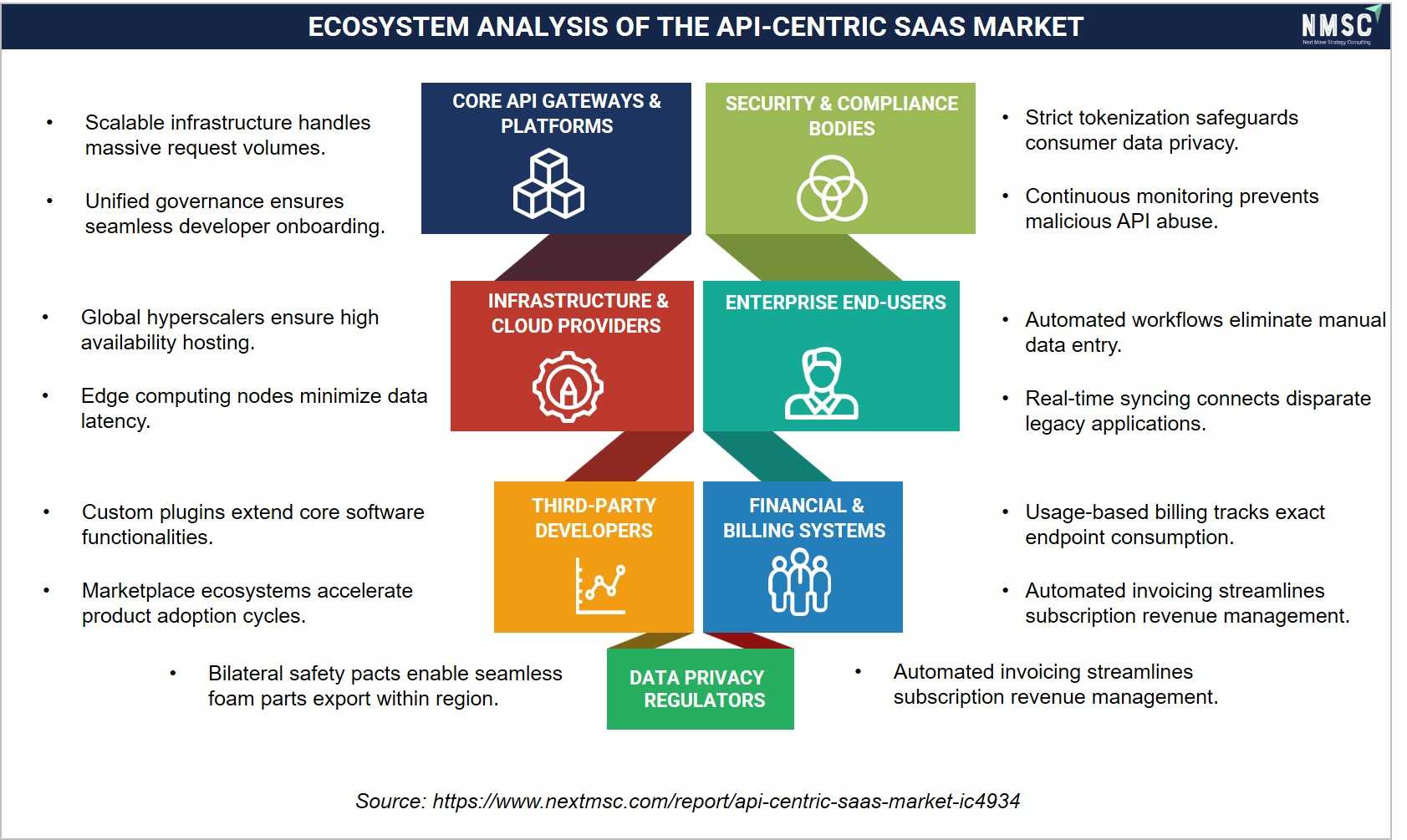
The ecosystem analysis of the API-Centric SaaS market highlights the interconnected network of technology providers, developers, enterprises, and regulatory stakeholders that enable API-driven software delivery. Core API gateway platforms and cloud infrastructure providers form the technological foundation, ensuring scalability, connectivity, and performance. Third-party developers enhance platform functionality through integrations and ecosystem expansion, while enterprise end users drive adoption across diverse business applications. Financial and billing systems support subscription management and monetization models, strengthening recurring revenue streams. Additionally, security, compliance, and data privacy regulators play a critical role in ensuring secure data exchange, regulatory adherence, and customer trust, fostering sustainable market growth.
What Are the Key Market Drivers, Breakthroughs, and Investment Opportunities that Will Shape the API-Centric SaaS Market in the Next Decade?
|
Drivers / Trends / Restraints |
(+/-) % Impact on CAGR Forecast |
Geographic Relevance |
Impact Timeline |
|
Surging AI Model API Adoption |
+3.2% |
Global (led by North America, Europe) |
2025–2032 |
|
Open Banking & PSD2 Mandates |
+2.1% |
Europe, North America, Asia-Pacific |
2025–2030 |
|
Microservices & Cloud-Native Architectures |
+1.9% |
Global (all regions) |
2025–2035 |
|
Developer-Led Growth and Self-Serve Adoption |
+1.6% |
North America, Europe, APAC |
2025–2030 |
|
Real-Time Communications API Expansion |
+1.4% |
Global |
2025–2033 |
|
API Security Threat Escalation (Driver) |
+1.1% |
Global |
Ongoing |
|
Regulatory Fragmentation and Compliance Costs |
-1.4% |
Europe, APAC, North America |
Ongoing |
|
API Key Management and Developer Onboarding Friction |
-0.8% |
SMB, Mid-market globally |
2025–2028 |
|
Vendor Lock-In Concerns in API Management |
-0.6% |
Enterprise globally |
Ongoing |
|
AI Agent API Ecosystem Expansion |
+2.6% |
Global |
2026–2035 |
|
Embedded Finance and API Monetization |
+1.8% |
North America, Europe, LATAM |
2025–2032 |
What Are the Growth Drivers of the API-Centric SaaS Market?
How Is the Explosion of AI Model APIs Creating Structural Demand Across the API-Centric SaaS Market?
The commercialization of large language models, multimodal inference, and AI agent capabilities through standardized API interfaces is the most powerful growth catalyst in the API-Centric SaaS Market. From our research, we found that OpenAI's API platform reported over 2 million active developers as of mid-2024, with API revenue growing at triple-digit rates year over year. Enterprises are embedding AI model APIs into customer service automation, content generation, code assistance, and document processing workflows. According to the National Science Foundation, federal AI research investment has grown substantially, signaling sustained institutional commitment to the underlying model development powering this API economy.
How Are Open Banking Mandates Accelerating Growth in Financial and Payments APIs Within the API-Centric SaaS Market?
Open banking regulations are generating structurally mandated demand for financial API services across the API-Centric SaaS Market. In the European Union, the PSD2 directive requires all banks to expose standardized payment initiation and account information APIs to licensed third parties, creating a multi-billion-dollar market for payment acceptance, account verification, and financial data access services. The Consumer Financial Protection Bureau's open banking rule in the United States, finalized under Section 1033 of the Dodd-Frank Act, extends similar API-based financial data portability requirements to American institutions. Based on NMSC's research, we found that these regulatory frameworks are directly driving adoption of Payments APIs, Financial Data Access services, and identity verification capabilities.
How Is the Enterprise Migration to Microservices Architectures Driving API Management Adoption in the API-Centric SaaS Market?
The enterprise migration from monolithic application architectures to microservices and cloud-native designs is creating an exponential increase in the number of APIs requiring management, security, and governance. Our analysis shows that each microservices decomposition initiative generates dozens to hundreds of new API endpoints requiring discovery, versioning, authentication, rate limiting, and observability tooling. The Cloud Native Computing Foundation's survey of cloud-native adoption, conducted with input from thousands of organizations globally, consistently reports microservices as among the most widely adopted cloud-native technologies. This structural trend directly expands demand for API Gateway, API Lifecycle Management, and Developer Portal services within the API-Centric SaaS Market.
What Are the Growth Inhibitors of the API-Centric SaaS Market?
How Does Regulatory Fragmentation Constrain API-Centric SaaS Market Expansion Across Jurisdictions?
Regulatory fragmentation presents a significant structural constraint on the API-Centric SaaS Market, particularly for cross-border API deployments in financial services, healthcare, and communications verticals. Different data residency requirements, API disclosure mandates, and certification standards across the EU, United States, India, China, and Southeast Asia force API-Centric SaaS vendors to build and maintain jurisdiction-specific compliance programs. The EU's Digital Markets Act imposes mandatory API interoperability obligations on designated gatekeepers, while the AI Act introduces conformity requirements for AI model APIs in high-risk applications. Through NMSC's assessment, we found that these overlapping obligations increase product development costs and slow international expansion timelines.
How Does Developer Onboarding Friction and API Key Management Complexity Limit API-Centric SaaS Market Penetration?
Despite the rise of developer-first platforms, onboarding friction remains a meaningful inhibitor within the API-Centric SaaS Market, particularly for complex multi-API integrations targeting enterprise buyers. Inconsistent API authentication standards, lack of unified API key management across multi-vendor stacks, and insufficient API documentation quality collectively extend time-to-integration and increase developer dropout rates. The U.S. National Institute of Standards and Technology has published guidelines on digital identity and API authentication standards, yet enterprise adoption of consistent authentication frameworks across heterogeneous API ecosystems remains incomplete. These frictions contribute to higher customer acquisition costs and slower platform monetization for emerging API-Centric SaaS vendors.
What Are the Growth Opportunities in the API-Centric SaaS Market?
How Does the Emergence of AI Agent Ecosystems Create a Multi-Billion-Dollar Opportunity in the API-Centric SaaS Market?
AI agent architectures, where AI systems autonomously call external APIs to retrieve data, trigger transactions, and orchestrate multi-step workflows, represent a transformational expansion of the API-Centric SaaS total addressable market. Our analysis shows that every tool-enabled AI agent requires structured API access to communications, payments, identity, data, and productivity services, effectively multiplying per-application API consumption volumes. The emerging MCP protocol and similar agent communication standards, along with orchestration frameworks such as LangChain and AutoGen, are establishing standardized patterns for agent-to-API interaction. Organizations that position their API platforms as agent-ready with structured tool schemas and OAuth-secured access are capturing early-mover advantages.
How Is the Embedded Finance Trend Creating Structural Opportunity for Payments and Financial APIs in the API-Centric SaaS Market?
Embedded finance — the integration of financial services directly within non-financial software applications — is generating durable demand for Payments and Financial APIs across the API-Centric SaaS Market. Platforms embedding payment acceptance, payouts, issuing, account verification, and financial data access APIs include vertical SaaS providers in logistics, healthcare, real estate, and retail. The U.S. Federal Reserve's FedNow real-time payments infrastructure, launched in July 2023, is expanding the developer API surface for real-time payment initiation, creating new embedded finance use cases. Based on our market evaluation, we noticed that API-first fintech platforms including Stripe, Adyen, Plaid, and Checkout.com are the primary beneficiaries of this structural opportunity.
How Does the Expansion of Developer Self-Serve Channels Create Go-to-Market Opportunities in the API-Centric SaaS Market?
The shift toward product-led growth and developer self-serve channels is creating scalable, capital-efficient go-to-market opportunities for API-Centric SaaS vendors. Our findings suggest that organizations that enable developers to discover, trial, and productionize API capabilities without requiring sales-assisted procurement are achieving significantly higher top-of-funnel conversion rates and lower customer acquisition costs. AWS Marketplace, Azure Marketplace, and cloud-native API marketplaces are becoming primary channels for API-Centric SaaS discovery and procurement. The U.S. General Services Administration's marketplace-based procurement frameworks are also extending developer-self-serve models into the U.S. federal government technology sector, creating a large public sector opportunity.
How Is the API-Centric SaaS Market Segmented in This Report, and What Are the Key Insights from the Segmentation Analysis?
How Does the Type Segmentation Reveal the Structural Composition of the API-Centric SaaS Market?
|
Type Segment |
2025 (USD Bn) |
2035 (USD Bn) |
CAGR (%) |
|
API Management |
9.8 |
62.4 |
20.3% |
|
API Security |
4.6 |
41.8 |
24.2% |
|
API Integration & Automation |
7.2 |
52.6 |
21.9% |
|
Communications APIs |
6.4 |
41.2 |
20.4% |
|
Payments & Financial APIs |
8.1 |
56.8 |
21.4% |
|
Identity & Access APIs |
3.2 |
24.6 |
22.6% |
|
AI Model APIs |
2.4 |
32.4 |
29.6% |
|
Developer Platform |
1.6 |
11.4 |
21.6% |
|
Data & Platform APIs |
1.1 |
8.4 |
22.5% |
|
Other API-Centric SaaS |
0.4 |
1.8 |
16.2% |
Based on NMSC's research, we found that the API-Centric SaaS Market is segmented by type into API Management, API Security, API Integration and Automation, Communications APIs, Payments and Financial APIs, Identity and Access APIs, AI Model APIs, Developer Platform, Data and Platform APIs, and Other API-Centric SaaS. API Management retains the largest revenue share, driven by enterprise demand for gateway, lifecycle management, developer portal, analytics and monetization, and discovery capabilities that govern increasing API traffic volumes. API Security is the fastest-growing segment, reflecting rising threat detection, schema validation, and rate limiting investments as API attack surfaces expand with microservices adoption. AI Model APIs — spanning text generation, image generation, speech, multimodal, and agent capabilities — represent the highest CAGR at 29.6% from 2026 to 2035, positioning them as the next structural growth engine for the Market throughout the forecast period.
How Do Revenue Stream Models Reflect the Commercial Evolution of the API-Centric SaaS Market?
|
Revenue Stream |
2025 (USD Bn) |
2035 (USD Bn) |
CAGR (%) |
|
Subscription |
17.4 |
104.2 |
19.5% |
|
Usage Based |
12.8 |
96.4 |
22.3% |
|
Transaction Based |
7.6 |
54.8 |
21.7% |
|
Hybrid |
5.0 |
30.2 |
19.6% |
Through our market assessment, we observed that the API-Centric SaaS Market is organized by revenue stream into Subscription, Usage Based, Transaction Based, and Hybrid models. The Subscription segment continues to dominate due to predictable recurring revenue structures preferred by enterprise API management, developer platform, and identity vendors. Usage-Based pricing is the fastest-growing stream at a CAGR of 22.3%, driven by AI model API consumption models, communications APIs priced per message and per minute, and cloud-native API services tied to transactional volumes. Transaction-Based models are prominent in Payments and Financial APIs, reflecting the per-transaction commercial structure of payment acceptance, payouts, and account verification services. Hybrid models combining base subscription fees with usage overage are gaining adoption among enterprise buyers seeking budget predictability alongside consumption flexibility.
How Are Sales Channels Reshaping Go-to-Market Strategies in the API-Centric SaaS Market?
|
Sales Channel |
2025 (USD Bn) |
2035 (USD Bn) |
CAGR (%) |
|
Direct Enterprise |
19.8 |
116.4 |
19.4% |
|
Self Serve |
10.6 |
82.4 |
22.5% |
|
Partner Led |
7.4 |
52.6 |
21.7% |
|
Marketplace |
5.0 |
34.2 |
21.1% |
Our analysis shows that the API-Centric SaaS Market is segmented by sales channel into Direct Enterprise, Self-Serve, Partner Led, and Marketplace channels. Direct Enterprise channels remain dominant for complex API management, security, and integration platform deployments requiring customized deployment support, security assessments, and executive-level account management. Self-Serve is the fastest-growing channel at a CAGR of 22.5%, powered by developer-centric API trial environments, transparent usage-based pricing, and product-led growth motions where individual developers become enterprise advocates. Partner Led channels are significant for iPaaS and B2B integration deployments where systems integrators and consulting partners drive enterprise adoption. Marketplace channels are expanding as AWS Marketplace, Azure Marketplace, and Google Cloud Marketplace enable frictionless API service procurement through committed cloud spend.
Which Buyer Segments Are Driving Purchasing Decisions in the API-Centric SaaS Market?
|
Buyer Segment |
2025 (USD Bn) |
2035 (USD Bn) |
CAGR (%) |
|
Developer |
15.6 |
96.4 |
19.9% |
|
Platform Engineering |
7.2 |
56.8 |
23.4% |
|
Security |
6.8 |
52.6 |
22.7% |
|
Integration |
5.4 |
36.4 |
21.0% |
|
Product |
4.2 |
26.2 |
20.2% |
|
Finance |
2.4 |
10.6 |
16.1% |
|
Operations |
1.2 |
6.6 |
18.6% |
Based on our market evaluation, we noticed that the API-Centric SaaS Market is segmented by buyer into Developer, Platform Engineering, Security, Integration, Product, Finance, and Operations personas. Developer buyers represent the largest revenue contributor, reflecting the developer-first commercial model of leading API-Centric SaaS vendors. Platform Engineering is the fastest-growing buyer segment at a CAGR of 23.4% as organizations formalize internal developer experience teams responsible for API governance, internal developer portals, and platform infrastructure. Security buyers are a high-growth segment driven by the expanding API threat landscape and regulatory requirements for API security controls. Finance and Operations buyers represent emerging personas as embedded payments APIs and workflow automation APIs extend the API-Centric SaaS consumption base beyond purely technical buyers.
How Does Deployment Mode Shape Revenue Distribution Across the API-Centric SaaS Market?
|
Deployment Mode |
2025 (USD Bn) |
2035 (USD Bn) |
CAGR (%) |
|
Public Cloud |
29.8 |
196.4 |
21.1% |
|
Hybrid |
7.4 |
56.8 |
22.5% |
|
Private Cloud |
4.2 |
26.6 |
20.3% |
|
On Premise |
1.4 |
5.8 |
15.3% |
In our observation, the API-Centric SaaS Market is segmented by deployment into Public Cloud, Hybrid, Private Cloud, and On-Premise modes. Public Cloud dominates due to its elastic scalability, global availability, and native integration with hyperscaler services that API-Centric SaaS platforms depend upon. Hybrid Deployment is the fastest-growing mode at a CAGR of 22.3%, driven by financial services, healthcare, and government organizations that require API management and gateway capabilities spanning both public cloud and on-premise environments to comply with data residency and security requirements. Private Cloud deployment retains relevance among sovereign financial institutions and government agencies requiring complete infrastructure control. On Premise deployments are declining in share but persist in highly regulated industries.
Which End Markets Generate the Most Value in the API-Centric SaaS Market?
|
End Market |
2025 (USD Bn) |
2035 (USD Bn) |
CAGR (%) |
|
Technology and Software |
13.2 |
82.4 |
20.0% |
|
BFSI |
7.9 |
63.4 |
23.6% |
|
Retail and E-Commerce |
6.2 |
42.8 |
21.3% |
|
Telecom and Media |
32.6 |
19.6% |
|
|
Healthcare and Life Sciences |
4.2 |
34.6 |
23.4% |
|
Public Sector |
2.8 |
14.8 |
18.2% |
|
Logistics and Travel |
2.2 |
11.4 |
17.8% |
|
Other |
0.9 |
3.6 |
14.8% |
From our assessment, the API-Centric SaaS Market end market segmentation encompasses Technology and Software, BFSI, Retail and E-Commerce, Telecom and Media, Healthcare and Life Sciences, Public Sector, Logistics and Travel, and other industries. Technology and Software is the dominant end market, as software-native organizations are inherently API-first and represent both the largest consumers and builders of API-Centric SaaS capabilities. BFSI is the fastest-growing end market at a CAGR of 23.6%, driven by open banking mandates, real-time payments infrastructure, and digital identity requirements. Healthcare and Life Sciences is the second-fastest-growing at 23.4% CAGR, propelled by interoperability mandates including the U.S. 21st Century Cures Act and HL7 FHIR-based healthcare API standards driving investment in identity, data, and communications APIs.
Regional Outlook
Geographic Performance Snapshot
|
Region |
2025 (USD Bn) |
2035 (USD Bn) |
CAGR (%) |
Key Driver |
|
North America |
18.6 |
118.4 |
22.6% |
Hyperscaler HQ, AI API adoption, BFSI demand |
|
Europe |
10.2 |
62.8 |
19.8% |
PSD2/Open Banking, GDPR-driven API security |
|
Asia-Pacific |
9.4 |
68.6 |
23.8% |
Digital payments, India Stack, cloud-first APAC |
|
Middle East & Africa |
2.4 |
18.6 |
22.8% |
Vision 2030, digital transformation |
|
Latin America |
2.2 |
17.2 |
22.9% |
Fintech API expansion, open banking |
North America API-Centric SaaS Market
North America is the global epicentre of the API-Centric SaaS Market, contributing USD 18.6 billion in 2025 and forecast to reach USD 118.4 billion by 2035 at a CAGR of 22.6%. The region benefits from the headquarters of the world's leading API-Centric SaaS vendors, including Stripe, Twilio, Cloudflare, Okta, Postman, and Plaid, alongside the three major hyperscale's that provide the infrastructure foundation for cloud-native API delivery. Enterprise API management adoption is among the most mature globally, driven by financial services, technology, healthcare, and retail sectors with high API traffic volumes and stringent governance requirements.
U.S. API-Centric SaaS Market
Based on our engagements, the United States represents over 78% of North American API-Centric SaaS Market revenue, making it the world's single largest national market. The U.S. benefits from the highest concentration of API-first technology companies, the most mature developer ecosystem globally, and regulatory catalysts including the CFPB's open banking rule under Section 1033 of the Dodd-Frank Act, which is accelerating financial API adoption. The Federal Civilian Executive Branch's zero-trust architecture mandates are driving U.S. government investment in identity and access APIs. Healthcare API demand is expanding under the 21st Century Cures Act's information-blocking prohibitions and FHIR-based interoperability requirements.
Canada API-Centric SaaS Market
Through our analysis, Canada represents approximately 14% of North American API-Centric SaaS revenue, with strong adoption concentrated in BFSI, telecommunications, and public sector end markets. Canadian financial institutions are navigating an active open banking implementation process, with the Department of Finance Canada advancing its consumer-directed finance framework. The federal government's Digital Ambition strategy is expanding public sector demand for identity, communications, and integration APIs. Canadian enterprises demonstrate preference for sovereign cloud-deployed API management solutions to address cross-border data flow concerns, particularly for API traffic containing personal financial and health information subject to PIPEDA requirements.
Mexico API-Centric SaaS Market
From our assessment, Mexico is the fastest-growing market within North America in the API-Centric SaaS landscape, advancing at a CAGR of 28.4%. Mexico's vibrant fintech ecosystem, accelerated by the Ley Fintech open banking framework administered by the Comisión Nacional Bancaria y de Valores (CNBV), is a primary driver of Payments and Financial API adoption. The growing manufacturing sector's Industry 4.0 transition and nearshoring wave are generating demand for B2B integration and workflow orchestration APIs. Communications APIs are expanding rapidly, supporting the growth of digital-native financial services and customer engagement platforms targeting Mexico's large mobile-first consumer population.
Europe API-Centric SaaS Market
Europe is the second-largest region in the API-Centric SaaS Market, contributing USD 10.2 billion in 2025 and forecast to reach USD 62.8 billion by 2035 at a CAGR of 19.8%. Europe's regulatory environment, characterized by PSD2 open banking mandates, GDPR data protection requirements, the EU AI Act, and the Digital Markets Act's API interoperability obligations, simultaneously drive API demand and shapes architectural requirements. PSD2 has created a structurally mandated market for payment initiation, account information, and financial data APIs, benefiting vendors including Stripe, Adyen, and Checkout.com operating across European financial markets.
U.K. API-Centric SaaS Market
Based on our engagements, the United Kingdom is Europe's largest individual country market for API-Centric SaaS, representing approximately 24% of European revenue in 2025. The UK's Financial Conduct Authority and the Open Banking Implementation Entity (OBIE) have mandated one of the most advanced open banking API ecosystems globally, with over 7 million active open banking users as of 2024 reported by the Open Banking Limited entity. Post-Brexit, the UK maintains GDPR-equivalent standards through UK GDPR while developing an independent AI regulation framework that may create differentiated API compliance requirements. London's fintech cluster is the most concentrated API-Centric SaaS innovation hub in Europe.
Germany API-Centric SaaS Market
According to evaluation, Germany is the second-largest European market in the API-Centric SaaS landscape, driven by its world-class manufacturing sector's rapid adoption of industrial IoT integration APIs, supply chain B2B integration services, and Industry 4.0 platform connectivity. German enterprises are among the most stringent API security buyers globally, reflecting BSIG Act requirements and Federal Office for Information Security (BSI) cloud security guidelines. SAP SE, headquartered in Walldorf, is a dominant player in enterprise API integration and workflow orchestration, with its Business Technology Platform providing extensive iPaaS and event integration capabilities to its large installed base.
France API-Centric SaaS Market
Through our analysis, France is the third-largest European API-Centric SaaS market, distinguished by strong government-led digital transformation investment and national AI sovereignty initiatives. The France 2030 program allocates significant funding to cloud infrastructure and API platform development. The CNIL's active GDPR enforcement posture drives enterprise investment in API security and consent management solutions. French telecommunications operators including Orange and SFR are significant consumers of Communications APIs for programmable voice, messaging, and verification services. The French government's API.gouv.fr initiative has established API-first design principles as a standard for public sector digital service delivery.
Italy API-Centric SaaS Market
From our assessment, Italy is a growing European market for API-Centric SaaS, with notable adoption in financial services, public administration, and manufacturing sectors. The Piano Nazionale di Ripresa e Resilienza (PNRR) has directed investment toward public sector API integration and digital identity infrastructure. Italy's Polo Strategico Nazionale sovereign cloud program is creating demand for hybrid API management deployments serving government and regulated industry workloads. Italian financial institutions are implementing PSD2 compliance API exposures while simultaneously investing in Payments API consumption for digital payments modernization.
Spain API-Centric SaaS Market
Based on our market evaluation, we noticed that Spain demonstrates growing momentum in the API-Centric SaaS Market, driven by a dynamic financial sector, retail expansion, and public digital transformation under Agenda España Digital 2026. Spanish banks including BBVA, Santander, and CaixaBank are among Europe's most API-forward financial institutions, with extensive open banking and embedded finance API programs. The Agencia Española de Protección de Datos (AEPD) enforces GDPR, driving investment in identity and consent management APIs. Spain's AWS, Google Cloud, and Azure local cloud regions support enterprise data residency requirements for API traffic containing personal data.
Sweden API-Centric SaaS Market
Through our analysis, Sweden is a high-maturity API-Centric SaaS market within the Nordic region, benefiting from one of Europe's highest technology adoption rates and a deeply digital-native financial sector. The Swedish Financial Supervisory Authority (Finansinspektionen) oversees PSD2 implementation, supporting a dynamic open banking API ecosystem. Swedish fintech companies including Klarna and Trustly have built global API-first payment and banking services from a Swedish innovation base. The Swedish Internet Infrastructure Foundation and DIGG (Agency for Digital Government) promote API-first standards in public sector digital services, creating additional government end-market demand.
Denmark API-Centric SaaS Market
According to evaluation, Denmark has established itself as a leading adopter of API-Centric SaaS solutions in the Nordic region, driven by strong digital governance, advanced open banking infrastructure, and a sophisticated financial technology sector. The Danish Financial Supervisory Authority (Finanstilsynet) has implemented PSD2, with the Danish finance hub supporting a growing ecosystem of open banking API consumers. Denmark's Digital Strategy and the Agency for Digitalisation's API standards for government services reflect strong institutional commitment to API-first public sector service delivery. High enterprise cloud adoption and a developed startup ecosystem contribute to Denmark's above-average API-Centric SaaS penetration rate.
Finland API-Centric SaaS Market
From our assessment, Finland demonstrates a mature and stable API-Centric SaaS adoption profile, anchored by telecommunications, banking, and public sector end markets. The Finnish Financial Supervisory Authority (Finanssivalvonta) administers PSD2 compliance, supporting the open banking API ecosystem. Finland's Digital and Population Data Services Agency (DVV) is a significant consumer of identity and authentication APIs for national digital identity infrastructure. Nokia's presence in telecommunications technology shapes demand for communications APIs and network-layer programmability services. Finland's advanced e-government infrastructure, recognized as among the most digitally developed globally by the UN E-Government Survey, drives public sector API adoption.
Netherlands API-Centric SaaS Market
Based on our engagements, the Netherlands is a strategically important API-Centric SaaS market, serving as a European digital hub due to Amsterdam's role as a major internet exchange point and financial centre. The Autoriteit Financiële Markten (AFM) and De Nederlandsche Bank (DNB) oversee PSD2 and open banking implementation. ABN AMRO, ING, and Rabobank are among Europe's most progressive open banking API providers, offering developer portals and API products to third-party fintech developers. The Dutch government's API strategy, formalized in the Forum Standaardisatie's API design rules, establishes API-first standards for government digital services, creating sustained public sector API investment.
Rest of Europe API-Centric SaaS Market
The Rest of Europe, encompassing Poland, Belgium, Switzerland, Austria, Portugal, Czech Republic, Ireland, Romania, and other nations, collectively represents a growing and diverse segment of the API-Centric SaaS Market. Switzerland and Ireland host significant financial services concentrations, driving advanced payments and financial API adoption. Poland is among the fastest-growing markets in Central and Eastern Europe, propelled by a dynamic fintech sector and strong technology services industry. Belgium's role as the seat of EU institutions creates concentrated demand for API security and compliance solutions. The Nordics collectively contribute a high-value, digitally mature segment with above-average per-capita API consumption.
Asia-Pacific API-Centric SaaS Market
Asia-Pacific is the fastest-growing major region in the API-Centric SaaS Market at a CAGR of 23.8%, advancing from USD 9.4 billion in 2025 to USD 68.6 billion by 2035. The region's growth is underpinned by India's India Stack digital public infrastructure, China's industrial internet and super-app API ecosystems, Japan's enterprise digital transformation programs, and Southeast Asia's rapidly expanding fintech and e-commerce sectors. Regulatory catalysts including the Reserve Bank of India's open banking frameworks, the Monetary Authority of Singapore's open banking API standards, and Australia's Consumer Data Right are driving financial API adoption across the region's largest economies.
China API-Centric SaaS Market
Based on our engagements, China represents the largest individual API-Centric SaaS market in Asia-Pacific, with a distinctive ecosystem dominated by domestic platform providers. Alibaba Cloud, Tencent Cloud, Huawei Cloud, and Baidu AI Cloud provide API management and AI model API capabilities to China's vast enterprise and developer communities. The Cyberspace Administration of China's regulations governing cross-border data flows, generative AI services, and algorithm transparency shape the domestic market's compliance requirements. Industrial internet APIs supporting manufacturing, logistics, and supply chain digitization represent the largest domestic use case category, reflecting China's policy priorities around Industry 4.0 and Made in China 2025 objectives.
India API-Centric SaaS Market
Through our analysis, India is the fastest-growing national market in Asia-Pacific for API-Centric SaaS at a CAGR of 27.4%, advancing from USD 1.8 billion in 2025 to USD 18.2 billion by 2035. India Stack — comprising the Aadhaar biometric identity API, UPI real-time payments API, DigiLocker document API, and Account Aggregator financial data framework overseen by the Reserve Bank of India — has created one of the world's most advanced public digital API infrastructures. The Digital Personal Data Protection Act (DPDPA) administered by the Ministry of Electronics and Information Technology is driving enterprise investment in consent management and identity APIs. India's large and rapidly growing developer community provides strong organic demand for developer platform and API tooling services.
Japan API-Centric SaaS Market
According to evaluation, Japan is a high-value API-Centric SaaS market undergoing significant structural transformation, driven by the government's digital reform agenda and enterprise IT modernization programs. The Financial Services Agency (FSA) oversees open banking implementation, with Japanese megabanks including MUFG, SMFG, and Mizuho operating API portals for fintech developers. The Digital Agency, established in 2021 to centralize government digital transformation, is a significant driver of identity and authentication API adoption. Japan's advanced manufacturing sector is generating demand for B2B integration and workflow orchestration APIs to support supply chain digitization and connected factory initiatives under the Society 5.0 policy framework.
South Korea API-Centric SaaS Market
From our assessment, South Korea is an advanced API-Centric SaaS market benefiting from the world's fastest internet infrastructure, a highly digitized financial sector, and a regulatory environment supportive of open banking and fintech innovation. The Financial Services Commission (FSC) oversees MyData open banking regulations, enabling licensed third parties to access financial data APIs with consumer consent. Korean chaebols including Samsung, Hyundai, and LG are major enterprise consumers of B2B integration, communications, and AI model APIs for their global operations. The Ministry of Science and ICT's Digital New Deal strategy is driving public sector API platform investment and supporting the AI model API ecosystem.
Taiwan API-Centric SaaS Market
Based on our engagements, Taiwan is a growing API-Centric SaaS market with concentrated demand from its globally significant semiconductor and electronics manufacturing industries. The Financial Supervisory Commission (FSC) has advanced open banking regulations across three phases, with the third phase enabling full open banking API ecosystems for licensed fintech operators. TSMC, MediaTek, and major Taiwanese electronics manufacturers are significant consumers of B2B integration and workflow orchestration APIs for global supply chain management. Taiwan's high-density technology manufacturing base is generating demand for IoT data APIs and streaming APIs to support smart manufacturing and connected device management.
Indonesia API-Centric SaaS Market
Through our analysis, Indonesia is among the highest-growth API-Centric SaaS markets in Southeast Asia, propelled by its large and rapidly expanding digital economy. Bank Indonesia's open banking API framework and the PJSP (Penyelenggara Jasa Sistem Pembayaran) licensing regime for payment service providers are driving Payments API adoption. Kominfo's Personal Data Protection Law (PDP Law) enacted in 2022 is compelling enterprise investment in identity, consent management, and API security solutions. Indonesia's super-app ecosystem, led by GoTo and Grab, generates significant Communications and Payments API consumption, while the country's large unbanked population is driving demand for financial inclusion-focused API-Centric SaaS services.
Vietnam API-Centric SaaS Market
From our assessment, Vietnam is an emerging and fast-growing API-Centric SaaS market, supported by a young digital-native population, rapid e-commerce expansion, and a government-mandated cashless payments initiative. The State Bank of Vietnam's open banking framework is advancing real-time payment API infrastructure. Vietnam's rapidly growing fintech sector, including VNPay and MoMo, depends heavily on Payments and Communications API services. The Ministry of Information and Communications' National Digital Transformation Program, targeting 50% of GDP from the digital economy by 2025, is driving public sector API integration investment. Vietnam's cost-competitive technology talent base is supporting expanding developer API platform adoption.
Australia API-Centric SaaS Market
Based on our engagements, Australia is the most mature API-Centric SaaS market in Oceania and a regional benchmark for open banking API implementation. The Australian Competition and Consumer Commission (ACCC) administers the Consumer Data Right (CDR), which mandates standardized data sharing APIs across banking, energy, and telecommunications sectors. The Australian Prudential Regulation Authority (APRA) oversees financial institutions' API security and technology risk requirements. The Australian Government's Digital Economy Strategy is driving public sector API integration and identity verification investment. Australian financial institutions including Commonwealth Bank, ANZ, Westpac, and NAB are advanced open banking API providers serving a growing fintech developer ecosystem.
Philippines API-Centric SaaS Market
Through our analysis, the Philippines is a high-growth API-Centric SaaS market driven by its large digital payments adoption wave and BPO industry's evolving API integration requirements. Bangko Sentral ng Pilipinas (BSP) has advanced digital payment and open finance frameworks, driving Payments and Financial API demand. GCash and Maya (formerly PayMaya) have built API-first digital financial services platforms serving tens of millions of Filipinos, generating significant Communications and Payments API consumption. The National Privacy Commission enforces the Data Privacy Act of 2012, shaping enterprise investment in identity, consent, and API security capabilities across the Philippine enterprise market.
Malaysia API-Centric SaaS Market
According to evaluation, Malaysia is a mature and digitally progressive API-Centric SaaS market in Southeast Asia, supported by Bank Negara Malaysia's open banking API framework and the MyData open finance initiative. The Securities Commission and Bank Negara's Financial Technology Regulatory Sandbox have fostered fintech API innovation. Telecoms including Telekom Malaysia and Maxis are major consumers of Communications APIs for programmable messaging, voice, and verification services. Malaysia's National Digital Economy Blueprint and the Ministry of Digital's initiatives are driving public sector API integration investment. Enterprise demand from BFSI, retail, and logistics sectors underpins Malaysia's strong API platform growth trajectory.
Rest of APAC API-Centric SaaS Market
The Rest of Asia-Pacific, encompassing Singapore, Thailand, New Zealand, Bangladesh, Sri Lanka, Pakistan, and other nations, represents a growing and increasingly sophisticated component of the API-Centric SaaS Market. Singapore, although a small market by population, is a strategic API-Centric SaaS hub, hosting regional offices of leading vendors and serving as a regulatory sandbox pioneer under the Monetary Authority of Singapore's financial API frameworks. Thailand's Bank of Thailand has advanced open banking API standards. New Zealand's Consumer Data Right framework aligns with Australia's CDR model, creating a trans-Tasman API ecosystem. Singapore's PDPA and related regulations shape regional API security standards.
Middle East and Africa API-Centric SaaS Market
The Middle East and Africa (MEA) region contributed USD 2.4 billion to the API-Centric SaaS Market in 2025 and is projected to reach USD 18.6 billion by 2035 at a CAGR of 22.8%. The region's growth is driven by Saudi Arabia's Vision 2030 digital transformation initiative, the UAE's Smart Government programs, and rapid fintech API adoption across Egypt, Nigeria, and South Africa. Governments across the GCC are mandating open banking and digital identity API infrastructure, while Africa's mobile-first digital economy is generating substantial demand for Communications and Payments APIs serving the continent's large unbanked population.
Saudi Arabia API-Centric SaaS Market
Based on our engagements, Saudi Arabia is the largest API-Centric SaaS market in the MEA region, driven by Vision 2030 digital economy objectives and the Saudi Central Bank's (SAMA) open banking framework. SAMA's Open Banking Lab has standardized API specifications for payment initiation, account information, and financial data access services across Saudi banking institutions. The Saudi Authority for Data and Artificial Intelligence (SDAIA) administers the Personal Data Protection Law, driving enterprise investment in identity, consent management, and API security solutions. Saudi Arabia's USD 500 billion NEOM smart city program is generating demand for IoT data APIs and integration platform services at scale.
UAE API-Centric SaaS Market
Through our analysis, the UAE is the second-largest and most innovation-forward API-Centric SaaS market in MEA. The Central Bank of the UAE (CBUAE) has launched its Open Finance framework, mandating API-based financial data sharing across licensed institutions. Dubai's DIFC and Abu Dhabi's ADGM financial free zones host concentrations of fintech companies driving Payments, Identity, and Communications API consumption. The UAE's AI strategy and national data policy, overseen by the UAE AI Office and the UAE Data Office, are driving AI model API adoption in government services and enterprise applications. The UAE's high smartphone penetration and tech-forward consumer base amplify Communications API demand.
Egypt API-Centric SaaS Market
From our assessment, Egypt is an emerging and high-potential API-Centric SaaS market in North Africa, propelled by the Central Bank of Egypt's digital payments modernization initiative and the government's Egypt Vision 2030 digital economy targets. InstaPay, Egypt's real-time payments infrastructure, is expanding developer access to Payments APIs. The Egypt Information Technology Industry Development Agency (ITIDA) supports a growing technology services sector that consumes integration and automation APIs. Egypt's large and young population, combined with increasing smartphone penetration, is driving Communications API demand for messaging, voice, and verification services supporting digital banking and e-commerce growth.
Israel API-Centric SaaS Market
Based on our market evaluation, Israel is a highly mature and innovation-intensive API-Centric SaaS market, distinguished by its world-class cybersecurity industry and a dense concentration of technology startups. The Bank of Israel's open banking framework governs financial API exposure across Israeli banks. Israel's cybersecurity sector, including API security companies, contributes significantly to both domestic adoption and global export of API security solutions. The Israel Innovation Authority supports API platform startups through R&D grants. Israeli enterprises and defense-adjacent organizations are significant consumers of advanced API security, identity, and authentication services, reflecting the country's elevated cybersecurity investment levels.
Turkey API-Centric SaaS Market
Through our analysis, Turkey is a growing API-Centric SaaS market with strong fintech activity and a large digital consumer base. The Banking Regulation and Supervision Agency (BDDK) oversees open banking API implementation under the Banking Law. Turkey's vibrant fintech sector, including Iyzico (owned by PayU) and Param, drives Payments API adoption. The Personal Data Protection Authority (KVKK) enforces data protection rules shaping API security and identity management investment. Turkey's large population and high mobile internet penetration drive Communications API demand for OTP verification, messaging, and voice services used across e-commerce, fintech, and digital services platforms.
Nigeria API-Centric SaaS Market
According to evaluation, Nigeria is the largest API-Centric SaaS market in Sub-Saharan Africa, driven by Africa's most dynamic fintech ecosystem and the Central Bank of Nigeria's open banking regulatory framework. The CBN's Open Banking Nigeria guidelines, published in 2021, have catalyzed API-based financial data sharing and payment initiation services. Flutterwave, Paystack, and Interswitch are leading API-first fintech platforms driving Payments and Communications API adoption across Nigeria's large unbanked population. The Nigeria Data Protection Commission enforces the Nigeria Data Protection Act (NDPA), shaping enterprise API security and identity management investment. Nigeria's large developer community is an active consumer of developer platform and tooling services.
South Africa API-Centric SaaS Market
From our assessment, South Africa is the most mature API-Centric SaaS market in Sub-Saharan Africa, anchored by its well-developed financial sector and the Protection of Personal Information Act (POPIA) administered by the Information Regulator. The South African Reserve Bank's (SARB) open banking project is advancing standardized financial API frameworks. Major South African banks including Standard Bank, FirstRand, and Absa are active participants in API-based financial services delivery. South Africa's telecommunications sector, led by MTN and Vodacom, drives Communications API consumption. The country's National Development Plan emphasizes digital economy infrastructure, supporting sustained API-Centric SaaS investment across BFSI, telecommunications, and public sector end markets.
Rest of MEA API-Centric SaaS Market
The Rest of MEA, encompassing Kuwait, Qatar, Bahrain, Oman, Jordan, Morocco, Kenya, Ghana, Ethiopia, and other nations, represents a growing segment of the API-Centric SaaS Market. GCC countries outside Saudi Arabia and UAE are advancing Vision-inspired open banking and digital government API programs. Kenya's M-Pesa API ecosystem, operated by Safaricom, remains one of the world's most widely used mobile payments API platforms, processing billions of transactions annually. Morocco is emerging as a North Africa technology services hub. Ghana's Mobile Money Interoperability system demonstrates West Africa's programmatic payments API adoption. Regional growth is increasingly supported by expanding cloud infrastructure investment across the continent.
Latin America API-Centric SaaS Market
Latin America is among the fastest-growing regions in the API-Centric SaaS Market at a CAGR of 22.9%, advancing from USD 2.2 billion in 2025 to USD 17.2 billion by 2035. Brazil and Mexico collectively account for approximately 68% of regional revenue. The region's growth is powered by open banking regulations in Brazil and Mexico, the rapid expansion of digital payments and embedded finance, and the emergence of major API-first fintech platforms including Nubank, MercadoPago, and Clip. Growing developer communities, increasing hyperscaler data center investment, and evolving data protection legislation across major economies are structural growth enablers.
Brazil API-Centric SaaS Market
Based on our engagements, Brazil is the largest API-Centric SaaS market in Latin America, accounting for approximately 40% of regional revenue in 2025. The Banco Central do Brasil's Open Finance framework, one of the most comprehensive open banking implementations globally, mandates API-based data sharing and payment initiation across all licensed financial institutions operating in Brazil. The Lei Geral de Proteção de Dados (LGPD), enforced by the ANPD, drives enterprise investment in consent management, identity, and API security solutions. Brazil's Pix real-time payments infrastructure, which processes billions of transactions monthly, is the foundation for an expanding Payments API ecosystem serving fintech developers and enterprise platforms.
Argentina API-Centric SaaS Market
Through our analysis, Argentina is the second-largest API-Centric SaaS market in Latin America, supported by a significant technology talent base and a growing enterprise software sector. Argentina's Personal Data Protection Law and its modernization aligned with GDPR standards shape enterprise API security and identity investment. Buenos Aires hosts a growing concentration of technology startups and regional centers for global API-Centric SaaS vendors. Argentine financial institutions are increasing adoption of Payments and Identity APIs. Economic volatility has paradoxically accelerated digital adoption, as businesses seek API-enabled automation and efficiency improvements to manage cost pressures across operations and customer service functions.
Chile API-Centric SaaS Market
From our assessment, Chile is a stable and growing API-Centric SaaS market, benefiting from Latin America's highest cloud penetration rate per capita and a proactive open banking regulatory environment. Chile's Data Protection Law approved in 2024 aligns with GDPR standards, compelling enterprise investment in identity and consent management APIs. The Comisión para el Mercado Financiero (CMF) oversees open banking implementation frameworks. Google Cloud and Microsoft Azure operate Chilean cloud regions. Chilean financial institutions including Banco de Chile and BancoEstado are advancing API-based digital banking services, while Chile's growing fintech sector is an active consumer of Payments and Communications API platforms.
Colombia API-Centric SaaS Market
According to evaluation, Colombia is among the fastest-growing API-Centric SaaS markets in Latin America, supported by Bogotá's emergence as a regional technology hub and a dynamic fintech sector. Colombia's Statutory Law 1581 on Personal Data Protection and regulation by the Superintendencia de Industria y Comercio (SIC) establish the compliance baseline for enterprise API data handling. Bancolombia and Davivienda are advancing digital banking API programs. AWS and Google Cloud operate Colombian cloud regions, providing low-latency infrastructure for API-Centric SaaS delivery. Colombia's growing developer community and government-backed innovation programs are supporting expanding adoption of developer platform and tooling services.
Rest of LATAM API-Centric SaaS Market
The Rest of Latin America, including Peru, Ecuador, Uruguay, Bolivia, Paraguay, Costa Rica, Panama, and Caribbean nations, represents a smaller but steadily growing component of the API-Centric SaaS Market. Uruguay's advanced data protection framework and technology export industry support above-average enterprise API platform adoption. Costa Rica serves as a nearshore technology services hub for North American enterprises, generating professional services-related API integration demand. Peru and Ecuador are in early-stage cloud adoption growth phases, with expanding fintech activity driving initial Payments and Communications API investment. Panama's regional logistics and financial hub status creates demand for trade finance, payments, and supply chain integration API services.
Strategic Framework of the API-Centric SaaS Market
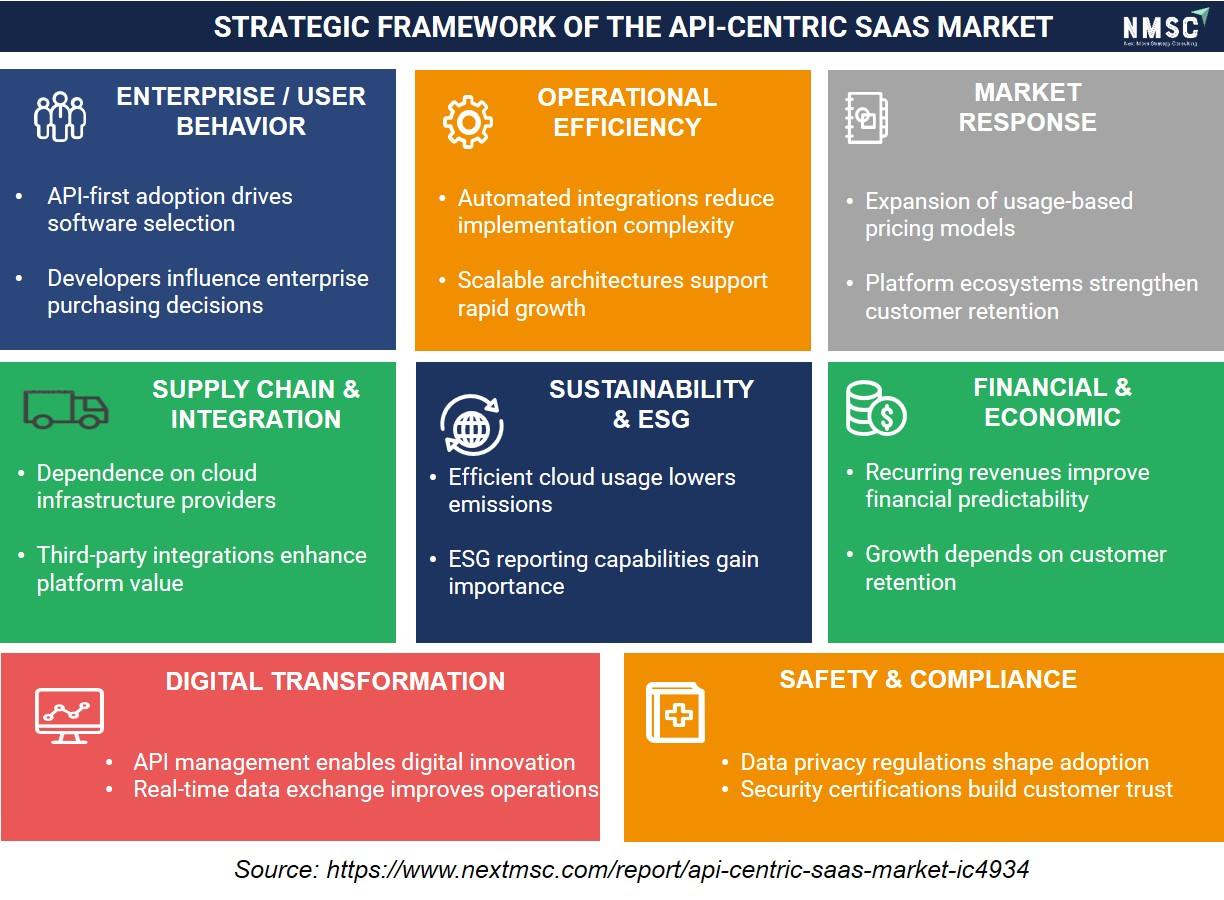
The strategic framework of the API-Centric SaaS market is driven by growing demand for API-first architectures that enable seamless connectivity, automation, and digital innovation. Enterprises increasingly prioritize solutions that simplify integrations and support scalable, cloud-based operations, while developers play a key role in influencing software adoption decisions. Operational efficiency is enhanced through automated workflows and real-time data exchange, improving business agility and customer experiences. The market also benefits from recurring revenue models and expanding platform ecosystems that strengthen customer retention. Meanwhile, compliance with data privacy regulations and security standards remains essential, as organizations seek to build trust and ensure secure API-driven interactions.
Competitive Landscape
Competitive Dynamics and M&A Landscape
|
Key Takeaways |
Details |
|
Market Structure |
The API-Centric SaaS Market features multi-tiered competition among hyperscalers (Microsoft, Amazon, Alphabet), full-stack platform vendors (Salesforce, SAP, IBM), specialized API-native providers (Cloudflare, Kong, Axway), and vertical API specialists (Stripe, Twilio, Okta, Plaid), each competing on distinct capability depth and developer experience. |
|
Innovation Focus |
Innovation in the API-Centric SaaS Market centers on AI model API capabilities (LLM inference, multimodal, agent orchestration), real-time event-driven integration architectures, developer experience tooling (automated documentation, SDK generation), API security (WAAP, bot detection, schema enforcement), and embedded finance API ecosystems. |
|
M&A Activity |
Cloudflare's acquisition strategy targeting API security and edge computing capabilities, Boomi's continued expansion under Francisco Partners backing, and Workato's enterprise automation acquisitions reflect active consolidation. Sinch's acquisitions of MessageBird and Mailgun have positioned it as a multi-channel Communications API leader. Kong's open-source community strategy combined with enterprise commercial offerings drives organic-plus-inorganic growth in API management. |
How Do Companies Compete in the API-Centric SaaS Market?
The API-Centric SaaS Market is characterized by multi-tiered competition among hyperscalers, specialized API-native platform vendors, and domain-specific API service providers. Microsoft, Amazon, and Alphabet compete on breadth of integrated API management services, global data center reach, and bundled AI model API capabilities within comprehensive cloud platforms. Specialized API-native vendors including Kong, Axway, Cloudflare, and Postman differentiate on depth of API governance capability, multi-cloud neutrality, developer experience quality, and open-standard compatibility. Domain specialists including Stripe, Adyen, Twilio, Sinch, Okta, and Plaid compete on breadth of coverage, developer trust, reliability SLAs, and ecosystem partnerships within their respective verticals.
Which Kind of Companies Dominate the API-Centric SaaS Market?
Three distinct company categories dominate the API-Centric SaaS Market. First, global hyperscalers — Microsoft Azure (API Management, Azure AI Services), Amazon Web Services (API Gateway, Bedrock, Pinpoint), and Alphabet's Google Cloud (Apigee, Cloud Endpoints, Vertex AI) — leverage comprehensive cloud infrastructure and bundled AI capabilities. Second, specialized API platform vendors including Salesforce, IBM, SAP, Cloudflare, Kong, Axway, Boomi, Workato, and Postman provide purpose-built API lifecycle, integration, and developer tooling. Third, vertical API specialists including Stripe, Adyen, Checkout.com, Twilio, Sinch, Okta, OpenAI, and Plaid dominate individual API category verticals with deeply engineered, developer-first capabilities commanding high market share within their specialized domains.
AI-Native Differentiation and Open Standards Drive Market Success in the API-Centric SaaS Market
Innovation focus across the API-Centric SaaS Market is concentrated in AI-native API capabilities — including LLM inference APIs, multimodal model APIs, and autonomous agent tool-calling architectures — alongside event-driven integration platforms, API security automation using ML-based anomaly detection, and developer experience tooling that generates client code, documentation, and test suites automatically. Vendors embedding AI within API governance platforms are capturing premium pricing and accelerating land-and-expand revenue motions. Open standard adoption, including OpenAPI Specification 3.x, AsyncAPI for event-driven APIs, and OAuth 2.0/OIDC for identity, differentiates platforms offering multi-cloud portability and avoiding proprietary lock-in for enterprise API consumers.
Market Players to Opt for Merger and Acquisition Strategies to Expand Their Presence in the API-Centric SaaS Market
Mergers and acquisitions are reshaping the competitive map of the API-Centric SaaS Market as vendors seek to expand capabilities across the API lifecycle. Sinch AB's acquisitions of MessageBird, Mailgun, and other communications API providers reflect a strategy to build a comprehensive multi-channel Communications API platform spanning messaging, voice, email, video, and verification. Cloudflare's security-adjacent API acquisitions strengthen its developer-oriented global edge platform. Private equity firms including Francisco Partners, Vista Equity, and Thoma Bravo have been active investors in enterprise API management and integration platform assets. Consolidation in AI model API infrastructure, iPaaS automation, and embedded finance API platforms is expected to accelerate from 2025 to 2028.
Who Are the Key Market Players in the API-Centric SaaS Market?
-
Microsoft Corporation
-
Amazon.com, Inc.
-
Alphabet Inc.
-
Salesforce, Inc.
-
Stripe, Inc.
-
Adyen N.V.
-
Twilio Inc.
-
IBM Corporation
-
SAP SE
-
Cloudflare, Inc.
-
Okta, Inc.
-
Sinch AB (publ)
-
OpenAI OpCo, LLC
-
Checkout Ltd
-
Plaid Inc.
-
Postman, Inc.
-
Boomi, Inc.
-
Workato, Inc.
-
Kong Inc.
-
Axway Software
What Are the Latest Developments in the API-Centric SaaS Industry?
|
Date |
Event |
|
Jul 2026 |
Microsoft and APIBoost announced a partnership integrating APIBoost capabilities with Azure API Management to simplify API consumption and governance across enterprises. |
|
Mar 2026 |
Microsoft made Copilot-powered API policy authoring generally available in Azure API Management, strengthening AI-assisted API lifecycle management. |
|
May 2025 |
Salesforce agreed to acquire Informatica for approximately $8 billion, strengthening data integration, API connectivity, and Agentforce AI capabilities alongside MuleSoft. |
|
Jan 2025 |
AWS continued expanding API-driven AI and application development capabilities through API Gateway and Bedrock integrations supporting enterprise AI workloads. |
Expert Insights

"We think that AI is an additional use case for APIs. APIs are driven by use cases: mobile, microservices — AI just happens to be the latest one. When we look at AI, we’re really looking at APIs all over the place.”
— Marco Palladino, Co-Founder & CTO, Kong
Statement made during a TechCrunch interview discussing the growing role of APIs in enabling AI applications and multi-LLM environments.
Market Interpretation
The comment highlights a fundamental growth driver within the API-Centric SaaS Market: the expansion of API usage beyond traditional application integration into AI-powered ecosystems. As enterprises deploy generative AI, AI agents, and intelligent automation solutions, APIs are becoming the primary mechanism for connecting models, enterprise data, cloud services, and business workflows. This trend is accelerating demand for API management platforms, API gateways, security solutions, and integration-focused SaaS offerings, reinforcing APIs as critical infrastructure for next-generation digital transformation initiatives.
What Are the Investment Opportunities in the API-Centric SaaS Market?
Capital Inflows and Venture Activity
The API-Centric SaaS Market continues to attract substantial venture and institutional capital, reflecting investor confidence in the structural long-term growth of API-driven software monetization. OpenAI's multi-billion-dollar funding rounds from Microsoft and strategic investors validate the commercial trajectory of AI model API services. Stripe's valuation trajectory, Adyen's sustained public market performance, and Cloudflare's consistent revenue growth demonstrate public and private market confidence in API-Centric SaaS business models. The National Venture Capital Association has reported that API infrastructure, developer tooling, and embedded fintech have been among the most active venture investment categories in technology, reinforcing sustained capital allocation into the API-Centric SaaS ecosystem across the forecast period.
Infrastructure Investment
Data center and cloud infrastructure investment by hyperscalers provides the foundational capacity enabling API-Centric SaaS market growth. Our analysis shows that Microsoft's USD 80 billion data center investment commitment for FY2025, directed primarily at Azure and AI infrastructure, directly expands capacity for API management, Azure API Management services, and Azure AI model API delivery globally. Alphabet's USD 75 billion 2025 capital expenditure commitment encompasses Google Cloud infrastructure supporting Apigee API management and Vertex AI model API services. Amazon Web Services' continued infrastructure investment supports API Gateway, Bedrock AI model APIs, and the hyperscaler's comprehensive API platform capabilities serving enterprise developers worldwide.
ESG and Sustainable Infrastructure
Environmental, Social, and Governance considerations are increasingly influencing API-Centric SaaS investment decisions, particularly among institutional investors subject to ESG-aligned mandates. Data center energy consumption, a significant operational expense for API-Centric SaaS platforms, is subject to regulatory scrutiny under the EU's Energy Efficiency Directive and the U.S. Department of Energy's data center energy efficiency programs. Hyperscalers including Microsoft, with its carbon negativity commitment by 2030, and Google, maintaining carbon neutrality since 2007, are advancing renewable energy infrastructure supporting API platform delivery. API-Centric SaaS vendors operating serverless and edge computing architectures offer inherent energy efficiency advantages over traditional dedicated infrastructure deployments.
Digital Transformation Enablement
API-Centric SaaS platforms are foundational enablers of enterprise digital transformation programs, making them structurally integral to multi-year IT investment cycles across every industry vertical. Enterprises undergoing ERP modernizations, CRM integrations, healthcare interoperability mandates, and manufacturing digitization require API integration, identity, and communications layers to connect modernized systems with legacy infrastructure. The NIST Digital Transformation Framework and the European Commission's Industry 5.0 initiative explicitly reference API-based interoperability as a prerequisite for next-generation digital competitiveness. Through NMSC's assessment, we found that these structural dependencies create durable, multi-year demand tied directly to broader enterprise technology refresh cycles across global end markets.
Private Equity and Strategic Mergers and Acquisitions
Private equity firms are deploying significant capital into the API-Centric SaaS ecosystem, targeting specialized platform vendors, vertical API specialists, and embedded finance infrastructure providers. Francisco Partners, Vista Equity Partners, and Thoma Bravo have historically been active in enterprise integration platform and API management software acquisitions. Strategic M&A is accelerating as full-stack platform vendors seek to acquire AI model API capabilities, embedded finance infrastructure, and API security tooling. Our assessment indicates that investors should monitor consolidation activity around API security vendors, iPaaS automation platforms, Communications API consolidators, and AI agent orchestration infrastructure as structurally attractive targets in the 2025 to 2028 timeframe.
Key Benefits for Stakeholders
For Enterprise Buyers
Enterprise buyers gain comprehensive, vendor-neutral insights into the API-Centric SaaS Market, including quantitative sizing across all type segments, revenue streams, deployment modes, buyer personas, and end market verticals. This intelligence supports API strategy planning, vendor evaluation, build-versus-buy decisions for API management and security infrastructure, and multi-year technology investment roadmaps. NMSC's competitive landscape analysis enables procurement teams to benchmark vendor capabilities, evaluate pricing models, and assess strategic fit for enterprise-scale API governance, integration automation, and communications API deployments.
For Investors and Financial Analysts
Investors and financial analysts access a structured, data-rich assessment of the API-Centric SaaS Market's growth trajectory, competitive dynamics, M&A pipeline, and segment-level revenue forecasts through 2035. The CAGR analysis by type, revenue stream, sales channel, buyer, deployment, and end market enables precise portfolio construction and valuation modeling. Detailed profiling of all 20 covered companies, combined with latest development tracking and regional market sizing, provides an early-signal framework for identifying acquisition targets, emerging leaders, and at-risk incumbents across the global API-Centric SaaS landscape.
For API-Centric SaaS Vendors and Platform Providers
API-Centric SaaS vendors and platform providers gain actionable intelligence on white-space opportunities, competitive positioning gaps, and fastest-growing subsegments within the API-Centric SaaS Market. Type analysis reveals emerging high-growth areas including AI Model APIs and API Security. Regional outlook sections identify geographic expansion priorities with regulatory and market maturity context. The buyer segment and sales channel analysis enables vendors to refine go-to-market strategies, optimize channel mix across direct enterprise, self-serve, and marketplace routes, and align product investment with the highest-priority buyer personas and end market verticals.
For Government and Regulatory Bodies
Government agencies and regulatory bodies gain structured analysis of how open banking mandates, data protection regulations, AI governance frameworks, and digital public infrastructure programs are influencing the API-Centric SaaS Market's structure and growth trajectory. Country-level insights provide policymakers with evidence-based perspectives on how regulatory design choices in financial API, identity API, and data API domains affect digital economy competitiveness and enterprise platform adoption. The regional outlook provides direct relevance for national API economy strategy development and digital public infrastructure investment planning.
Key Market Segments
By Type
-
API Management
-
Gateway
-
Lifecycle Management
-
Developer Portal
-
Analytics and Monetization
-
-
API Security
-
Discovery
-
Schema Validation
-
Threat Detection
-
Rate Limiting
-
-
API Integration and Automation
-
iPaaS
-
B2B Integration
-
Workflow Orchestration
-
Event Integration
-
-
Communications APIs
-
Messaging
-
Voice
-
Email
-
Video
-
Verification
-
-
Payments and Financial APIs
-
Payment Acceptance
-
Payouts
-
Issuing
-
Account Verification
-
Financial Data Access
-
-
Identity and Access APIs
-
Authentication
-
Authorization
-
User Management
-
Consent Management
-
-
AI Model APIs
-
Text Generation
-
Image Generation
-
Speech
-
Multimodal
-
Agents
-
-
Developer Platform
-
API Design
-
Testing
-
Mocking
-
Documentation
-
-
Data and Platform APIs
-
Database APIs
-
Search APIs
-
Location APIs
-
Content APIs
-
Streaming APIs
-
-
Other API-Centric SaaS
By Revenue Stream
-
Subscription
-
Usage Based
-
Transaction Based
-
Hybrid
By Sales Channel
-
Direct Enterprise
-
Self Serve
-
Partner Led
-
Marketplace
By Buyer
-
Developer
-
Platform Engineering
-
Security
-
Integration
-
Product
-
Finance
-
Operations
By Deployment
-
Public Cloud
-
Hybrid
-
Private Cloud
-
On Premise
By End Market
-
Technology and Software
-
BFSI
-
Retail and E-Commerce
-
Telecom and Media
-
Healthcare and Life Sciences
-
Public Sector
-
Logistics and Travel
-
Other
By Region
-
North America: U.S., Canada, and Mexico.
-
Europe: UK, Germany, France, Italy, Spain, Sweden, Denmark, Finland, the Netherlands, and the rest of Europe.
-
Asia Pacific: China, India, Japan, South Korea, Taiwan, Indonesia, Vietnam, Australia, Philippines, Malaysia and the rest of APAC.
-
Middle East & Africa (MEA): Saudi Arabia, UAE, Egypt, Israel, Turkey, Nigeria, South Africa, and the rest of MEA.
-
Latin America: Brazil, Argentina, Chile, Colombia, and the rest of LATAM.
Conclusion and Recommendations
Long-Term Outlook
The API-Centric SaaS Market is entering the most consequential growth decade in its history, driven by AI model API commercialization, open banking mandate expansion, microservices architecture standardization, and the emergence of autonomous AI agent ecosystems that multiply API consumption volumes per application. The market is forecast to grow from USD 51.7 billion in 2026 to USD 285.6 billion by 2035, at a CAGR of 20.9%. Our further analysis indicates that this growth reflects both the structural expansion of enterprise API volumes and the increasing willingness of organizations to procure specialized API-Centric SaaS capabilities rather than building bespoke in-house API infrastructure.
Strategic Positioning Recommendations
API platform vendors should prioritize AI-native differentiation through integrated AI model API capabilities, agent-ready tool schemas, and AI-powered API governance automation. Organizations that embed AI within developer-first API platforms will capture premium pricing and superior net revenue retention economics. Embedded finance integration, enabling non-financial platforms to embed Payments, Identity, and Financial Data APIs, represents a structurally growing revenue opportunity. Vendors without comprehensive API security coverage will face structural disadvantage in regulated-market enterprise procurement processes across financial services, healthcare, and government end markets throughout the forecast period.
Investment Attractiveness
The API-Centric SaaS Market represents an exceptionally attractive investment environment given durable multi-decade secular growth drivers, recurring usage-based and subscription revenue models, and a structural shift toward API-first software architectures across every industry vertical. Our assessment identifies the highest-conviction investment themes as AI Model APIs (29.6% CAGR), API Security (24.2% CAGR), Platform Engineering buyer segment (23.4% CAGR), BFSI end market (23.6% CAGR), and Healthcare and Life Sciences end market (23.4% CAGR). Investors should monitor potential IPO activity from major private API-Centric SaaS platforms and consolidation plays in API security, iPaaS automation, and AI agent infrastructure sub-segments.
Market Shifts and Key Risks
The most significant market shift underway is the migration from discrete, category-specific API management or integration tool procurement toward unified API platform purchasing encompassing management, security, analytics, and developer experience in a single vendor relationship. This shift benefits comprehensive platform vendors and hyperscalers at the expense of point-solution providers. Key risks for the API-Centric SaaS Market include AI model API commoditization compressing margins for inference API providers, data privacy regulatory escalation constraining cross-border API data flows, open-source API gateway alternatives pressuring commercial licensing economics, and macroeconomic pressures slowing enterprise technology budgets beyond the near term.
Growth Pathways
Organizations seeking to maximize value from the API-Centric SaaS Market should pursue a three-horizon investment strategy. In the near term from 2025 to 2027, prioritize API management platform consolidation, API security posture improvement, and developer experience investment to establish the governed API foundation required for AI and embedded finance integration. In the mid-term from 2027 to 2031, invest in AI agent API readiness, embedded finance API monetization programs, and regional API compliance readiness across Asia-Pacific and MEA. In the long term from 2031 to 2035, position for API fabric interoperability across multi-cloud, edge, and sovereign environments as API-driven software architectures reach universal enterprise adoption.
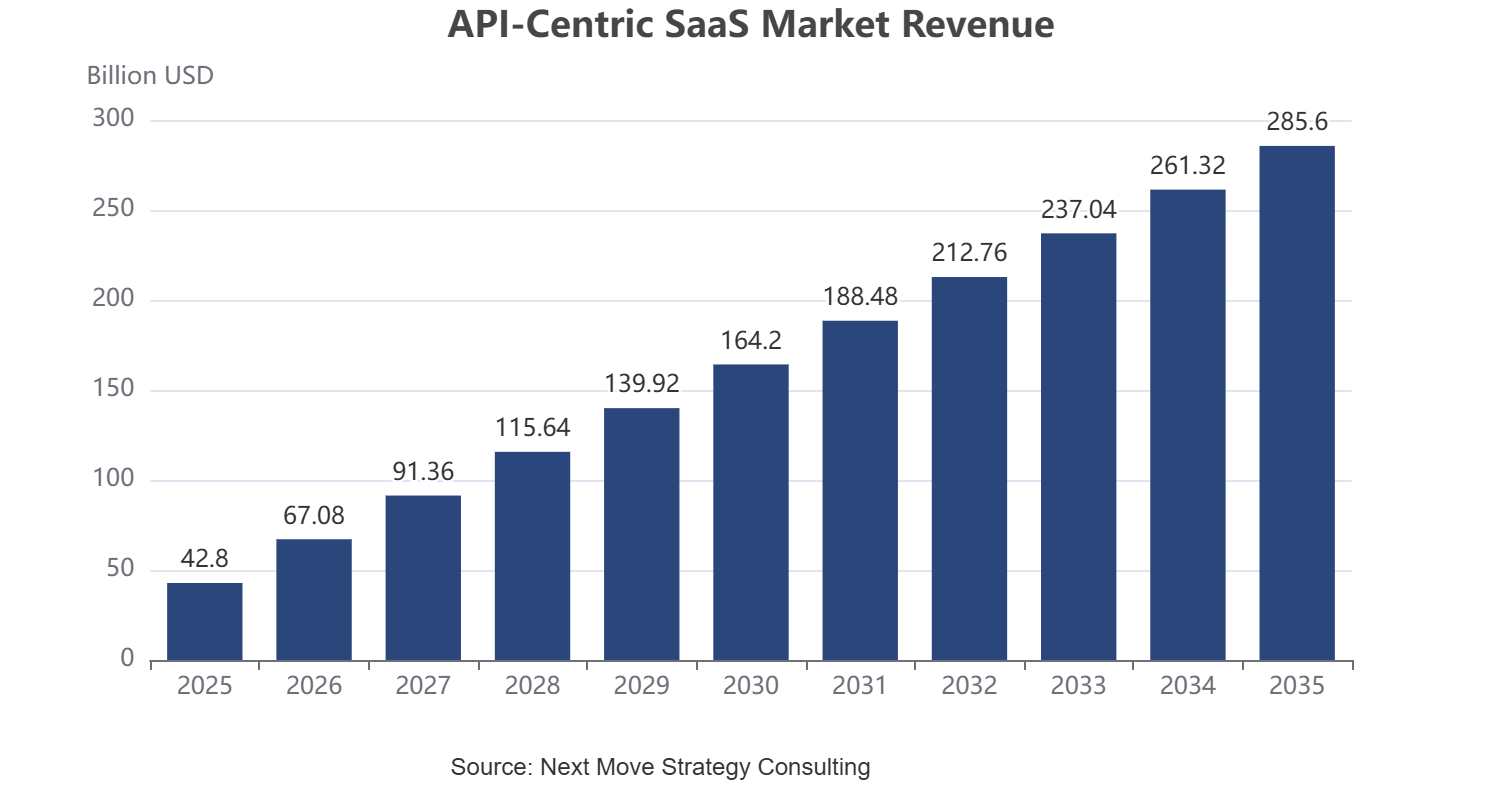
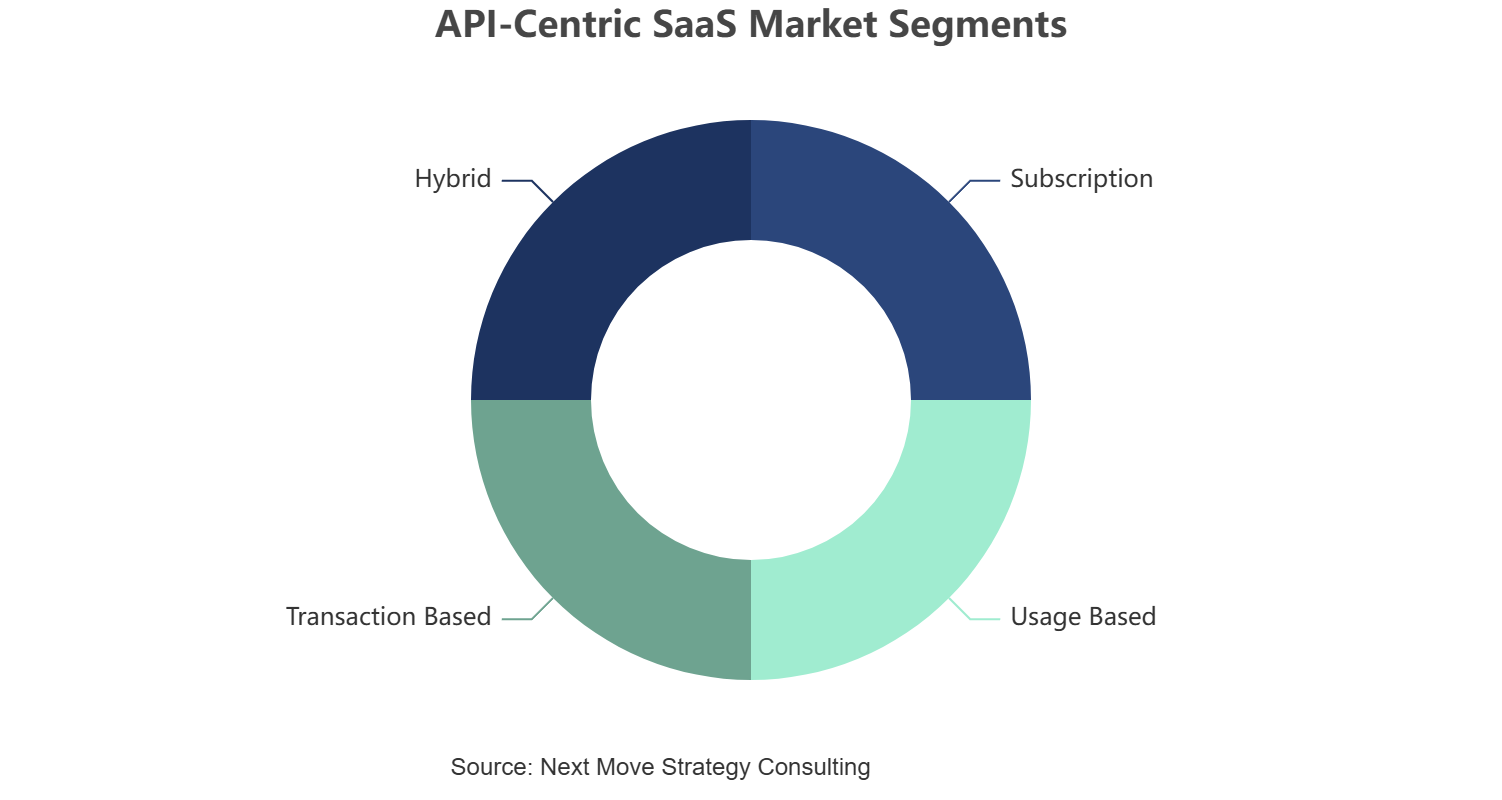
About the Author
 Mihul Sharma
— Mihul Sharma is Research Associate at Next Move Strategy Consulting, where he has covered technology, industrial, and healthcare markets for 3 years. His work applies structured business research, market analysis, and secondary-source review to assess market trends, competitive developments, and growth opportunities. He supports report development by fully synthesizing industry data, company information, and market signals into concise findings for strategy and investment-focused research teams.
Mihul Sharma
— Mihul Sharma is Research Associate at Next Move Strategy Consulting, where he has covered technology, industrial, and healthcare markets for 3 years. His work applies structured business research, market analysis, and secondary-source review to assess market trends, competitive developments, and growth opportunities. He supports report development by fully synthesizing industry data, company information, and market signals into concise findings for strategy and investment-focused research teams.
About the Reviewer
 Supradip Baul
— Supradip Baul is an accomplished business consultant and strategist with over a decade of rich experience in market intelligence, strategy, technology, and business transformation. His work has included rigorous qualitative and quantitative analysis across multiple industries, helping clients shape investment decisions and long-term roadmaps. Earlier in his career, he was associated with Gartner, where he contributed to industry-leading reports and market share analyses. He has worked with leading global companies and holds an MBA with a dual specialization in Marketing and Finance.
Supradip Baul
— Supradip Baul is an accomplished business consultant and strategist with over a decade of rich experience in market intelligence, strategy, technology, and business transformation. His work has included rigorous qualitative and quantitative analysis across multiple industries, helping clients shape investment decisions and long-term roadmaps. Earlier in his career, he was associated with Gartner, where he contributed to industry-leading reports and market share analyses. He has worked with leading global companies and holds an MBA with a dual specialization in Marketing and Finance.
At Next Move Strategy Consulting, we understand that insightful market research is the cornerstone of successful business decisions. That's why we employ a robust and multifaceted approach, combining various methodologies to deliver the most accurate and actionable data for our clients.

Research Landscape
We navigate the world of research with two primary approaches:
Qualitative Approach
Our qualitative research methodologies involve immersive techniques such as in-depth interviews, focus groups, and observational studies. By engaging directly with individuals and stakeholders, we uncover valuable insights that quantitative data alone may overlook.

Quantitative Research
In tandem with qualitative methodologies, NMSC leverages the power of Quantitative Research to provide a robust foundation of numerical insights. Through systematic data collection and analysis, we quantify patterns, preferences, and market trends, offering a comprehensive view of the business landscape.
Our quantitative research approach employs diverse tools, including surveys, experiments, and statistical modelling. These methodologies enable us to gather data from a large and representative sample, ensuring the statistical significance of our findings. By employing structured questionnaires and standardized data collection methods, we guarantee the reliability and validity of the information we present to our clients.
Quantitative research is particularly effective in measuring the prevalence of trends, assessing market size, and gauging the impact of various factors on consumer behavior. The numerical precision attained through this approach equips our clients with actionable insights, facilitating data-driven decision-making and strategy formulation.


Our Specialized Toolbox for Industry-Specific Market Research
We deploy a specialized arsenal of techniques tailored to meet your unique requirements. Here's a glimpse into our comprehensive toolbox:

Information Procurement
The stage entails acquiring market data or relevant information through various sources and methodologies.


Market Research Approach
We utilize both top-down and bottom-up approaches in market research analysis to achieve a comprehensive understanding of the market dynamics, leveraging the broad perspective of industry trends and macroeconomic factors alongside detailed insights from specific segments and individual companies.

Porters Five Forces Analysis
We conduct Porter's Five Forces analysis to evaluate the competitive landscape of an industry, providing us with insights into factors that affect profitability and strategic positioning.

SWOT Analysis

Forecasting
We utilize a forecasting model to predict future consumption by considering parameters like population, economics, regulations, market competition, drivers, constraints, technology, and pricing. We also employ statistical techniques such as multilinear regression, exponential smoothing, moving average, ARIMA, and Monte Carlo simulations for accurate predictions. In econometric forecasting, we analyzed short-term and long-term event impacts, attributing values based on regulatory frameworks, economic factors, and market events.





 Speak to Our Analyst