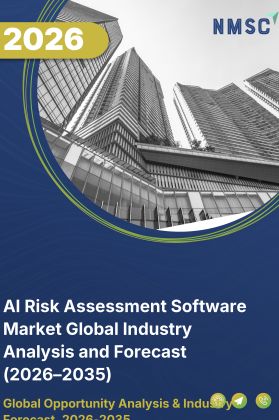
AI Risk Assessment Software Market Global Industry Analysis and Forecast (2026–2035)

Compliance duties under the EU AI Act and NIST aligned programmes, together with agentic AI rollouts, lift revenue from USD 1.12 Billion in 2025 to USD 8.20 Billion in 2035, a 21.6% CAGR over 2026–2035, with North America in the lead.

Download Free Sample PDF
Base Year (2025)
$1.12 Billion
Forecast (2035)
$8.20 Billion
CAGR (2026-2035)
21.6%
Top Region
North America

What Is the AI Risk Assessment Software Market Size?

The global AI Risk Assessment Software Market was valued at USD 1.12 Billion in 2025 and is estimated at USD 1.41 Billion in 2026. It is forecast to reach USD 8.20 Billion by 2035, expanding at a 21.6% CAGR from 2026 to 2035. North America led with a 44.6% share, while AI governance and compliance platforms held 55.4%.

Our assessment indicates that segment leadership and growth leadership now sit in different parts of the market.

AI Risk Assessment Software Market Global Industry Analysis and Forecast (2026–2035) Revenue Forecast

Values in USD Billion

2025 $1.12 Billion
2025
2026 $1.41 Billion
2026
2027 $1.71 Billion
2027
2028 $2.08 Billion
2028
2029 $2.54 Billion
2029
2030 $3.08 Billion
2030
2031 $3.75 Billion
2031
2032 $4.56 Billion
2032
2033 $5.54 Billion
2033
2034 $6.74 Billion
2034
2035 $8.20 Billion
2035

Key Takeaways

By Solution type: AI governance and compliance platforms held the largest share, expanding from USD 0.62 Billion in 2025 to USD 4.12 Billion by 2035 at a 20.5% CAGR; AI testing and red teaming is the fastest growing at 23.3% CAGR from 2026–2035.

By AI system type: Traditional machine learning models held the largest share, moving from USD 0.58 Billion in 2025 to USD 2.05 Billion by 2035; Agentic AI systems are the fastest growing at 35.4% CAGR from 2026–2035.

By End user industry: BFSI held the largest share, rising from USD 0.34 Billion in 2025 to USD 2.20 Billion by 2035; Government and public sector is the fastest growing at 24.3% CAGR from 2026–2035.

Dominant Region: North America, growing from USD 0.50 Billion in 2025 to USD 3.10 Billion by 2035.

Fastest-Growing Region: Asia-Pacific, at 25.3% CAGR from 2026–2035, rising from USD 0.19 Billion in 2025 to USD 1.90 Billion by 2035.

Dominant Country: U.S., growing from USD 0.447 Billion in 2025 to USD 2.790 Billion by 2035.

Fastest-Growing Country: India, at 28.5% CAGR from 2026–2035, rising from USD 0.030 Billion in 2025 to USD 0.400 Billion by 2035.

The AI Risk Assessment Software Market offers an absolute opportunity of USD 6.79 Billion between 2026 and 2035, which tells investors that spend is moving from pilot assessments to programme wide tooling.

According to NMSC analysis, buyers now treat evidence quality, meaning logged tests and mapped controls, as the deciding feature once two platforms look equal on paper.

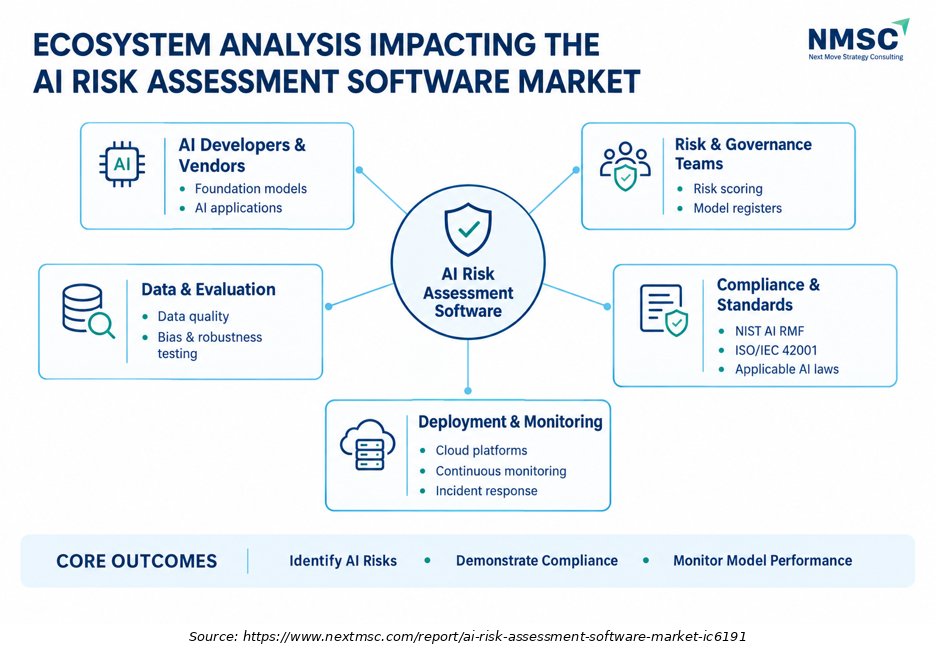
Ecosystem Analysis of the AI Risk Assessment Software Market

The infographic highlights the key stakeholders shaping the AI Risk Assessment Software market, including AI model and cloud providers, governance and testing software vendors, system integrators, and enterprise risk, security, and compliance teams. Their collaboration supports AI inventories, risk assessments, red teaming, continuous monitoring, and auditable governance across the AI lifecycle

What Does the AI Risk Assessment Software Market Encompass?

The AI Risk Assessment Software Market covers software that identifies, scores, tests and monitors the risks of machine learning, generative AI and agentic systems across their lifecycle. Core modules include AI inventories, risk and impact assessments, control libraries, model testing, red teaming and runtime monitoring. Our analysis shows that buyers connect these modules into one evidence chain that links a use case to a tested control and an auditable record, extending responsible AI programmes into measurable practice.

The regulatory environment is the main structural force. The EU AI Act sets duties for high-risk systems, and Regulation (EU) 2026/1744 moved those dates to 2 December 2027 and 2 August 2028. The NIST AI Risk Management Framework and ISO/IEC 42001 give buyers a common vocabulary. We observed that vendors now map every assessment question to these texts, which turns AI governance from a policy document into a repeatable workflow.

Market Drivers & Dynamics

Interactive Dataset
EU AI Act obligations for high-risk systems driver +4.2% Europe, Global 2026–2029
Rapid enterprise adoption of generative AI driver +5.1% North America, Asia-Pacific 2026–2032
Agentic AI deployments that need runtime controls driver +3.6% Global 2027–2033
Rising AI incident volume and board accountability driver +2.4% North America, Europe 2026–2030
Buyer demand for ISO/IEC 42001 and NIST aligned evidence driver +1.9% Global 2026–2031
Deferral of high-risk deadlines to 2027 and 2028 restraint −2.3% Europe 2026–2028
Shortage of AI assurance and audit skills restraint −1.8% Global 2026–2030
Fragmented standards and overlapping tool categories restraint −1.5% Global 2026–2032
Source: Next Move Strategy Consulting

Growth Drivers

What Is the Primary Growth Driver of the AI Risk Assessment Software Market?

Enterprise AI use is spreading fast enough that unmanaged risk has become a board topic. Eurostat reports that 20.0% of EU enterprises with 10 or more employees used AI in 2025, up from 13.5% in 2024. The U.S. Census Bureau found 37% of firms with at least 250 employees using AI by May 2026. More deployed systems mean more assessments per year, which lifts enterprise AI risk tooling demand.

How Is Regulatory Pressure Driving AI Risk Assessment Software Market Growth?

Our findings suggest that regulation shapes purchasing even where deadlines move. Stanford's 2026 AI Index reports that GDPR influences responsible AI decisions at 60% of surveyed organizations and the EU AI Act at 43%. Risk and compliance teams now hold primary responsibility for AI governance at 19% of organizations, up from 13%. That shift moves budgets toward governance, risk and compliance tooling that produces audit evidence.

Growth Inhibitors

What Is Restraining the AI Risk Assessment Software Market?

The largest drag is timing. The EU delayed stand-alone high-risk obligations to 2 December 2027, so some buyers postpone spending until enforcement is closer. The Joint Research Centre names a lack of relevant expertise as the main bottleneck to AI adoption in EU strategic sectors, and NIST states that AI RMF 1.0 is being revised. Together these factors slow procurement and lengthen implementation cycles.

What Are the Growth Opportunities?

How Can Vendors Capture Demand for Agent Governance?

Enterprises are deploying software agents faster than they can list them. Vendors that discover agents, score their permissions and enforce limits at runtime can sell to security and compliance teams together. The beneficiary segment is Agentic AI systems, projected to reach USD 3.05 Billion by 2035, and the mechanism is a per agent or per action pricing model that grows with each new AI agents deployment.

Where Does Third Party AI Risk Create White Space?

Most companies consume AI through suppliers, yet few assess the models inside purchased software. A questionnaire and testing service for vendor supplied AI would attach to existing supplier reviews. The beneficiary is AI governance and compliance platforms, which can extend current third party risk management workflows to supplier models and bill by supplier tier.

Can Sector Specific Assessment Libraries Open Regulated Verticals?

Healthcare, insurance and public bodies need controls written in their own regulatory language. Prebuilt libraries that map clinical safety, claims fairness or public duty rules to test cases shorten rollout from months to weeks. The beneficiary is Healthcare and life sciences at 23.8% CAGR and Government and public sector at 24.3%, where buyers pay for domain content as well as software.

Segmentation Analysis

2025 (USD Billion)
2035 (USD Billion)
AI governance and compliance platforms 2025: $0.62 Billion | 2035: $4.12 Billion
AI governanc
AI testing and red teaming 2025: $0.27 Billion | 2035: $2.31 Billion
AI testing a
AI monitoring and observability tools 2025: $0.23 Billion | 2035: $1.77 Billion
AI monitorin
AI governance and compliance platforms $0.62 Billion $4.12 Billion 20.5%
AI testing and red teaming $0.27 Billion $2.31 Billion 23.3%
AI monitoring and observability tools $0.23 Billion $1.77 Billion 22.3%

Which Solution Type Leads the AI Risk Assessment Software Market and Which Grows Fastest?

AI governance and compliance platforms led with USD 0.62 Billion in 2025 because they hold the inventory, workflow and audit record that other tools feed. AI testing and red teaming grow fastest at 23.3% from 2026 to 2035 as agent behaviour needs adversarial checks. Teams generate test inputs with synthetic data, and testers report results into the governance record.

2025 (USD Billion)
2035 (USD Billion)
Category A
Category B
Category C
Category D
Segment Item 2025 (USD Billion) 2035 (USD Billion) CAGR
Category A $10.0 USD Billion $40.0 USD Billion 25.0%
Category B $17.1 USD Billion $51.1 USD Billion 11.0%
Category C $24.2 USD Billion $62.2 USD Billion 25.0%
Category D $31.3 USD Billion $73.3 USD Billion 11.0%

Segment-wise data is locked

Unlock complete segment-wise numbers for By AI system type.

Unlock Full Data
2025 (USD Billion)
2035 (USD Billion)
Category A
Category B
Category C
Category D
Segment Item 2025 (USD Billion) 2035 (USD Billion) CAGR
Category A $10.0 USD Billion $40.0 USD Billion 27.0%
Category B $17.1 USD Billion $51.1 USD Billion 9.0%
Category C $24.2 USD Billion $62.2 USD Billion 19.0%
Category D $31.3 USD Billion $73.3 USD Billion 17.0%

Segment-wise data is locked

Unlock complete segment-wise numbers for By End user industry.

Unlock Full Data

Growth Opportunities

Based on research conducted by NMSC, we found that three opportunities carry the largest revenue upside through 2035.

How Can Vendors Capture Demand for Agent Governance?

Enterprises are deploying software agents faster than they can list them. Vendors that discover agents, score their permissions and enforce limits at runtime can sell to security and compliance teams together. The beneficiary segment is Agentic AI systems, projected to reach USD 3.05 Billion by 2035, and the mechanism is a per agent or per action pricing model that grows with each new AI agents deployment.

Where Does Third Party AI Risk Create White Space?

Most companies consume AI through suppliers, yet few assess the models inside purchased software. A questionnaire and testing service for vendor supplied AI would attach to existing supplier reviews. The beneficiary is AI governance and compliance platforms, which can extend current third party risk management workflows to supplier models and bill by supplier tier.

Can Sector Specific Assessment Libraries Open Regulated Verticals?

Healthcare, insurance and public bodies need controls written in their own regulatory language. Prebuilt libraries that map clinical safety, claims fairness or public duty rules to test cases shorten rollout from months to weeks. The beneficiary is Healthcare and life sciences at 23.8% CAGR and Government and public sector at 24.3%, where buyers pay for domain content as well as software.

Regional Outlook

2025 (USD Billion)
2035 (USD Billion)
North Americ
Europe
Asia-Pacific
Middle East
Latin Americ
Region 2025 (USD Billion) 2035 (USD Billion) CAGR (%)
North America $10.0 USD Billion $40.0 USD Billion 9.0%
Europe $17.1 USD Billion $51.1 USD Billion 27.0%
Asia-Pacific $24.2 USD Billion $62.2 USD Billion 25.0%
Middle East & Africa $31.3 USD Billion $73.3 USD Billion 23.0%
Latin America $38.4 USD Billion $84.4 USD Billion 12.0%

Regional data is locked

Unlock complete regional numbers for this market.

Unlock Full Data

Supply Chain Structure of the AI Risk Assessment Software Market
Supply Chain Structure of the AI Risk Assessment Software Market
The infographic illustrates the AI Risk Assessment Software value chain, connecting AI infrastructure and model providers, assessment software developers, implementation partners, and enterprise buyers. Integrations link model access, testing results, risk controls, and monitoring evidence, enabling organizations to manage AI risk throughout deployment and operation

Competitive Landscape

We found that the competitive field is fragmented across four vendor types that rarely meet in the same deal.

How Do Companies Compete in the Market?

Competition turns on breadth of integration, depth of control libraries and proof of evidence. Platform vendors bundle governance with data, workflow or cloud products and price it as an add on. Startups sell depth, such as red teaming or observability, and win on time to first assessment. Regional pricing tiers and partner led delivery shape geographic expansion.

Which Vendor Archetypes Dominate the Industry?

Four archetypes lead. Enterprise platforms such as IBM, Microsoft and ServiceNow differentiate through installed base. Privacy and GRC suites such as One Trust and Archer differentiate through regulatory mapping. Security vendors such as Palo Alto Networks and Check Point differentiate through testing and runtime defence. Specialists such as Credo AI and Fiddler AI differentiate through depth and speed.

What Innovation and Differentiation Strategies Are Companies Using?

Vendors are adding AI agents of their own. Credo AI made its governance assistant generally available on 13 May 2026 to draft questionnaire answers and propose controls. SAS announced AI Navigator for inventories on 28 April 2026. Others publish evaluation engines and policy libraries, and several offer free or low-priced starter editions to win mid-sized buyers.

Key Market Players

Our analysis shows that the following 18 companies, ranked by breadth of verified AI risk assessment capability, shape the market.

International Business Machines Corporation Microsoft Corporation ServiceNow, Inc. SAS Institute Inc. OneTrust LLC Cisco Systems, Inc. Palo Alto Networks, Inc. Check Point Software Technologies Ltd. Collibra NV Dataiku Archer Technologies LLC Credo AI Holistic AI Fiddler AI ModelOp Trustible Saidot Monitaur

Latest Developments

NMSC's analysis indicates that product launches, deals and rule changes since April 2025 point in one direction.

Date Event
April 2025 IBM added a Model Risk Evaluation Engine to watsonx. governance to compare foundation model risk metrics.
July 2025 Palo Alto Networks completed its acquisition of Protect AI and moved the technology into Prisma AIRS.
September 2025 Check Point announced the acquisition of Lakera to add AI red teaming and AI agent security.
April 2026 SAS announced SAS AI Navigator, a SaaS platform to inventory and govern AI use cases.

Expert Insights

Lauren Kornutick

Lauren Kornutick

Director Analyst | Gartner

"Traditional GRC tools are simply not equipped to handle the unique risks of AI, from real-time decision automation to the threat of bias and misuse."

Analyst Interpretation

Kornutick made this statement in a Q&A published by Gartner on February 17, 2026, discussing the limitations of traditional governance, risk, and compliance tools in managing AI-specific risks and the growing need for specialized AI governance platforms

Investment Opportunities

Where Is Capital Flowing in the Market?

Capital is concentrating in platforms that control runtime enforcement. Fiddler AI raised a USD 0.03 Billion Series C in January 2026 and reports total funding of USD 0.10 Billion with revenue growth above 4x over 18 months. Strategic buyers have paid for Protect AI, Lakera and trail ML. Investors should favour firms with recurring platform revenue and proven integrations.

Which Infrastructure Investments Support Growth?

Vendors are building connectors to cloud AI services, data platforms and agent protocols. ServiceNow added 30 integrations for AI discovery, and One Trust connects to major cloud and data platforms. Sovereign hosting, evidence ledgers and secure model gateways are the next build areas. Infrastructure spending raises switching costs, which supports long customer lifetimes.

How Do ESG Considerations Influence Investment?

Governance is the G in ESG, and boards want proof that AI is fair, safe and accountable. Assessment software supplies that proof through logged tests and mapped controls. Standards such as ISO/IEC 42001 give investors a way to check vendor claims. Funds that screen for AI incidents, which reached a record 362 reports in 2025, will see this software as risk reduction.

Key Benefits for Stakeholders

How Does the Report Help Enterprise and Industry Leaders?

Enterprise leaders get a clear map of solution types, AI system types and industries so they can match tooling to their risk profile. The forecast by segment shows where budgets will grow and when. The competitive review explains which vendor archetype fits a bank, a hospital or a ministry, and supports build versus buy choices.

How Does the Report Help Investors and Financial Analysts?

Investors receive segment sizes, CAGR figures from 2026 to 2035 and the USD 6.79 Billion opportunity, along with a review of deal activity. The drivers and restraints matrix quantifies each factor's effect on growth. Regional and country figures show where adoption leads or lags, which helps in valuing platform vendors and targets.

How Does the Report Help Technology Vendors and Product Teams?

Vendors can see which capabilities buyers value, from runtime enforcement to agent discovery, and which segments grow fastest. The regional analysis highlights regulatory differences that affect product roadmaps and partner choices. Product teams can use the opportunity analysis to prioritise sector libraries, supplier risk modules, pricing models and the partner integrations that shorten sales cycles.

Key Market Segments Evaluated

By Solution type

  • AI governance and compliance platforms
  • AI testing and red teaming
  • AI monitoring and observability tools

By AI system type

  • Traditional machine learning models
  • Generative AI and LLMs
  • Agentic AI systems

By End user industry

  • BFSI
  • IT and telecom
  • Healthcare and life sciences
  • Government and public sector
  • Retail and consumer goods
  • Manufacturing and energy

By Region

  • North America 
    • U.S.
    • Canada
    • Mexico
  • Europe 
    • UK
    • Germany
    • France
    • Italy
    • Spain
    • Sweden
    • Denmark
    • Finland
    • Netherlands
    • Rest of Europe
  • Asia-Pacific 
    • China
    • India
    • Japan
    • South Korea
    • Taiwan
    • Indonesia
    • Vietnam
    • Australia
    • Philippines
    • Malaysia
    • Rest of APAC
  • Middle East & Africa 
    • Saudi Arabia
    • UAE
    • Egypt
    • Israel
    • Turkey
    • Nigeria
    • South Africa
    • Rest of MEA
  • Latin America 
    • Brazil
    • Argentina
    • Chile
    • Colombia
    • Rest of LATAM

Conclusion & Recommendations

Revenue should climb from USD 1.41 Billion in 2026 to USD 8.20 Billion in 2035, and the mix will shift toward generative and agentic systems. Assessment will become a standing control in every AI release process. Our analysis shows that the market ends the decade as core infrastructure for enterprise AI, with spending tied to the number of systems in production.

What Strategic Positioning Recommendations Does NMSC Offer?

Vendors should position around evidence: logged tests, mapped controls and runtime proof. Platform vendors should add testing depth through partnerships or acquisitions. Specialists should integrate with the major governance platforms rather than compete on breadth. Buyers should insist on open connectors and exportable records so that assessments survive a change of vendor.

What Is the Investment Attractiveness of the AI Risk Assessment Software Market?

Attractiveness is high. Growth of 21.6% a year outpaces most enterprise software, demand is tied to rules and incidents rather than discretionary budgets, and acquirers are active. Concentration risk is moderate because no vendor holds a dominant share. The best risk adjusted entries are runtime enforcement, agent governance and sector libraries in regulated industries.

What Are the Market Shifts and Key Risks in the AI Risk Assessment Software Market?

Three shifts matter. Assessment is moving from periodic to continuous, security and compliance budgets are merging, and agents are replacing models as the unit of risk. The main risks are further delays to regulation, a shortage of skilled assessors and tool sprawl. Vendors that automate assessment and map to several standards at once reduce exposure to each.

What Are the Primary Growth Pathways Through 2035?

Growth will come from agent governance, supplier AI risk, sector libraries and expansion in Asia-Pacific, the fastest region at 25.3%. Government and healthcare buyers add new seats as rules mature. Bundled offers from cloud and security platforms widen reach among mid sized firms, and continuous monitoring turns one time projects into subscriptions.

FAQs

Sources & References

1.

ServiceNow Newsroom

newsroom.servicenow.com
2.

One Trust Newsroom

onetrust.com
3.

Palo Alto Networks Investor Relations

investors.paloaltonetworks.com/node/19421/pdf
4.

Check Point Software Technologies Press Releases

checkpoint.com
5.

IBM Announcements

ibm.com
6.

Fiddler AI Press Releases

fiddler.ai
7.

SAS Press Releases

sas.com
8.

Credo AI Company Blog

credo.ai
9.

Collibra Newsroom

collibra.com
10.

Archer Press Releases

archerirm.com
11.

Cisco AI Defense: AI Model and Application Validation

cisco.com
12.

Microsoft Learn: Purview Compliance Manager Assessments

learn.microsoft.com
13.

UK Government: Portfolio of AI Assurance Techniques

gov.uk
14.

Council of the European Union

consilium.europa.eu
15.

EUR-Lex: Regulation (EU) 2026/1744

eur-lex.europa.eu
16.

NIST AI Risk Management Framework

nist.gov
17.

Eurostat: Enterprises Using AI Technologies

ec.europa.eu
18.

U.S. Census Bureau: AI Use by Businesses

census.gov
19.

Stanford HAI: 2026 AI Index, Responsible AI

hai.stanford.edu
20.

European Commission Joint Research Centre

joint-research-centre.ec.europa.eu
21.

ISO/IEC 42001 AI Management Systems

iso.org/standard/42001
22.

OECD.AI Incidents Monitor

oecd.ai/en/incidents

About the Author

Mayurima Roy

Mayurima Roy

Mayurima Roy is Research Analyst at Next Move Strategy Consulting, where she has spent 4 years working across the firm's full industry coverage rather than a single fixed vertical. Her work centers on structured research, ongoing trend tracking, competitive assessment, and insight-led content development, translating complex market data into clear, decision-ready narratives that support informed client decision-making across diverse global industries, market sectors, and world regions every day.

About the Reviewer

Supradip Baul

Supradip Baul

Supradip Baul is an accomplished business consultant and strategist with over a decade of rich experience in market intelligence, strategy, technology, and business transformation. His work has included rigorous qualitative and quantitative analysis across multiple industries, helping clients shape investment decisions and long-term roadmaps. Earlier in his career, he was associated with Gartner, where he contributed to industry-leading reports and market share analyses. He has worked with leading global companies and holds an MBA with a dual specialization in Marketing and Finance.

Download Free Sample

Rishabh Jogani

RISHABH JOGANI

Strategy Analyst

Accenture Japan

We are incredibly impressed with the market report on the real estate market in India provided by Next Move Strategy Consulting. The report was thorough, insightful, and well-structured, offering deep analysis and actionable recommendations. It not only captured the current trends and dynamics but also provided a forward-looking perspective that has been invaluable for our strategic planning. Their team demonstrated exceptional professionalism, attention to detail, and a profound understanding of the industry. The data-driven insights and clarity of presentation exceeded our expectations, making complex market trends easy to understand. We highly recommend Next Move Strategy Consulting to anyone looking for reliable and comprehensive market research services. Their expertise has given us the confidence to navigate the complexities of the Indian real estate market with clarity and foresight.

Kishu Kanda

KISHU KANDA

Strategy Analyst

Accenture

We purchased the AI Consumer Market Report from this company. Not only did they customize the report to meet our specific requirements, but they also showed great flexibility in accommodating our budget. The report we received fully met our expectations. Additionally, they provided prompt and thorough responses to both our pre-purchase and follow-up questions. We look forward to working with this company again in the future.

Semih Kavaklioglu

SEMIH KAVAKLIOGLU

Co-Founder & Sales Manager

Decortie

I work a lot in the marketing industry and I know that research is an essential part of any campaign. I have used Market research reports for my own products and I found them to be very informative and well-researched. The team here produces insightful reports for a good price

Gaurav Jaiswal

GAURAV JAISWAL

Founder & CEO

Yano Charge Private Limited

The EV Charging market research report provided by the NextMSC was exceptionally detailed and insightful. It offered a comprehensive analysis that proved to be a game-changer for our strategic planning. Truly a testament to the NextMSC’s expertise and thoroughness in EV market landscape & analysis.

Henri Knyphausen

HENRI KNYPHAUSEN

Partner at Singulier [Ex-BCG]

Singulier

I recently engaged NEXTMSC.com for a commercial due diligence project within the intralogistics sector, and I am pleased to provide a reference based on my experience. In utilizing NEXTMSC.com's services, I found their report to offer valuable insights into market dynamics and key industry players. The initial report provided a solid foundation for our analysis. However, as we were investigating a smaller target in the market, and I had specific customization requests requiring additional research. These requests included detailed information on product portfolios of various players and sub-market sizes, both inclusive and exclusive of certain product categories. NEXTMSC.com demonstrated commendable responsiveness and agility in accommodating these customization requests. Within a timeframe of 1-2 weeks, they delivered a revised report that met our specific needs. Furthermore, they were receptive to my follow-up inquiries, ensuring clarity and understanding of the data provided. The final deliverable significantly contributed to our due diligence efforts. One of NEXTMSC.com's notable strengths lies in their qualitative research capabilities. However, for future engagements, I would recommend the inclusion of a quantified market model in Excel format. Such a model would offer the ability to conduct in-depth analyses and explore various market segments, including country-specific data and subcomponent breakdowns. Based on my positive experience, I would not hesitate to work with NEXTMSC.com again. Their responsiveness, willingness to accommodate customization requests, and commitment to delivering actionable insights make them a reliable partner for commercial research projects.

Custom Market Research Services

We will customize the research for you if the listed report does not fully match your requirements.

Get 30% Free Customization

Select License

This website uses cookies to ensure you get the best experience on our website. Learn more

✖