
AI Tax Preparation Market Size, Share, Trends and Growth Analysis, By Component (Consumer Tax Preparation Software, Professional Tax Preparation Software, Tax Workflow and Practice Management Software, Enterprise Tax Management Software, AI Tax Intelligence Software, and AI-Enabled Tax Preparation Services), By Buyer Type, By Deployment Model(Cloud, Desktop, Mobile, and Others), By Revenue Model, and Region — Global Industry Report and Forecast, 2026–2035
Industry: ICT & Media | Publishing Date: July 22, 2026 | Last Updated: September 30, 2026 | No of Pages: N/A | No. of Tables: N/A | No. of Figures: N/A | Format: PDF | Report Code: IC5322
What Is the AI Tax Preparation Market Size?
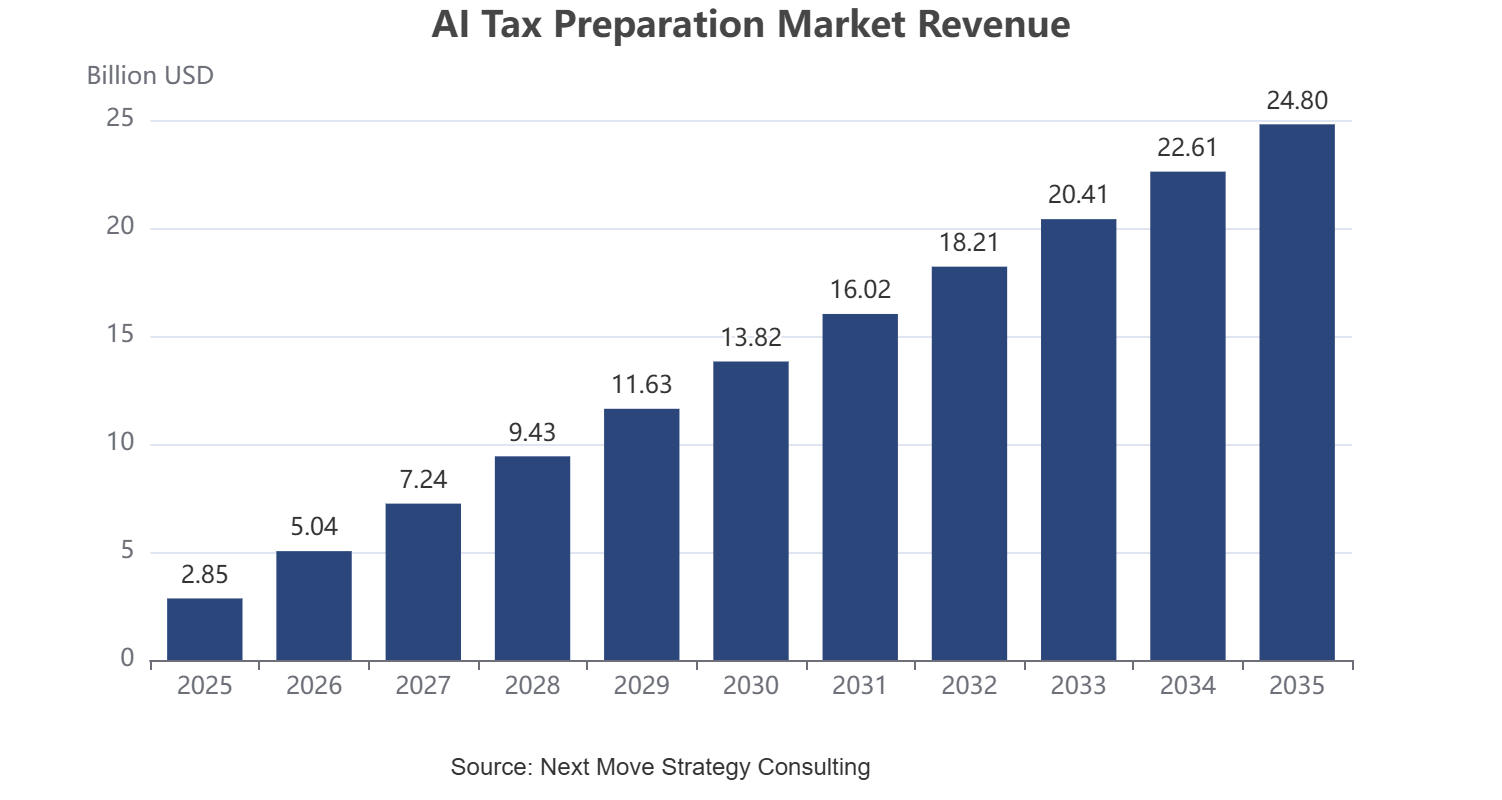
The global AI tax preparation market size was valued at USD 2.85 billion in 2025 and is estimated at USD 3.62 billion in 2026, forecast to reach USD 24.80 billion by 2035, expanding at a 23.8% CAGR between 2026 and 2035. North America leads with approximately 34% share, while Consumer Tax Preparation Software dominates all other components with approximately 30% share.
We observed that growth is broad based across every segmentation axis, with AI Tax Intelligence Software and cloud-native deployment driving the dominant structural shifts through 2035 as filers and firms replace rule-based software with adaptive, learning-based systems.
|
Key Takeaways |
|
By Component: Consumer Tax Preparation Software held the largest share of approximately 30% (USD 0.85 Billion) in 2025; AI Tax Intelligence Software is the fastest-growing sub-segment at 36.1% CAGR from 2026-2035. |
|
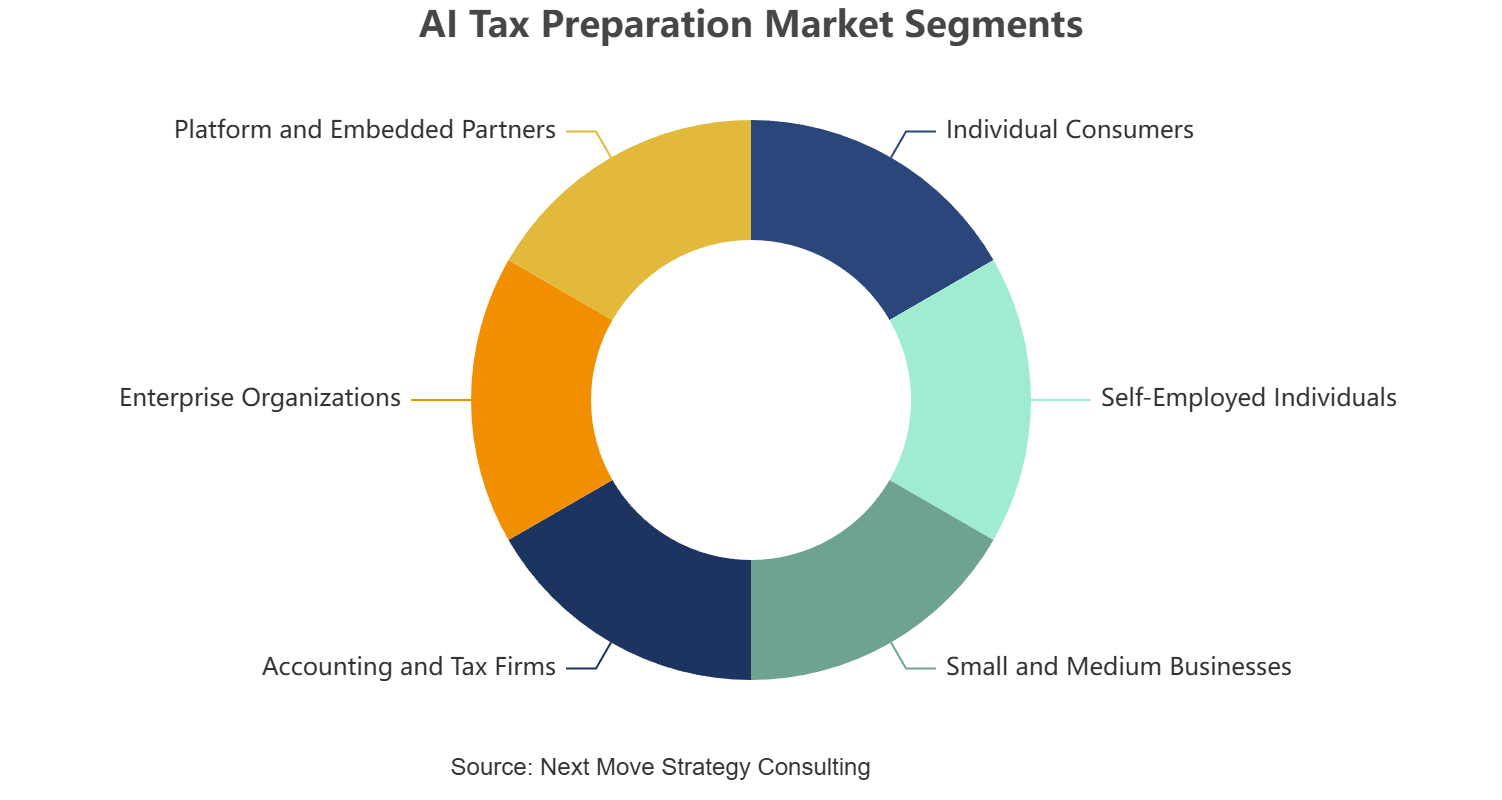
By Buyer Type: Individual Consumers held the largest share of approximately 25% (USD 0.72 Billion) in 2025; Platform and Embedded Partners is the fastest-growing sub-segment at 36.6% CAGR from 2026-2035. |
|
By Deployment Model: Cloud Deployment held the largest share of approximately 61% (USD 1.75 Billion) in 2025; API and Embedded Deployment is the fastest-growing sub-segment at 33.4% CAGR from 2026-2035. |
|
By Revenue Model: Subscription revenue held the largest share of approximately 34% (USD 0.97 Billion) in 2025; Usage-Based revenue is the fastest-growing sub-segment at 32.9% CAGR from 2026-2035. |
|
Dominant Region: North America dominated with approximately 34% revenue share (USD 0.97 Billion) in 2025. |
|
Fastest-Growing Region: Asia-Pacific is expected to register the highest CAGR of 30.9% during 2026-2035. |
|
Dominant Country: The U.S. led with approximately USD 820 million in 2025. |
|
Fastest-Growing Country: India is the fastest-growing country at approximately 34.5% CAGR from 2026-2035. |
Market Opportunity: The AI tax preparation market is expected to create an absolute dollar opportunity of USD 21.18 billion between 2026 and 2035, presenting significant investment potential across the consumer filing, professional practice, and enterprise tax compliance value chain.
According to Next Move Strategy Consulting analysis, accounting and tax firms are increasingly consolidating around AI-enabled practice management platforms to offset staff shortages, a shift that favors vendors offering integrated document processing, e-filing automation, and client collaboration tools over point solutions as compliance complexity intensifies through 2035.
What Does the AI Tax Preparation Market Encompass?
The AI tax preparation market encompasses software and services that apply machine learning, natural language processing, and optical character recognition to prepare, review, and file tax returns for individuals, businesses, and enterprises. Our assessment indicates that the scope spans consumer filing applications, professional preparation suites, practice management tools, enterprise tax engines, AI tax intelligence platforms, and AI-enabled preparation services delivered to salaried individuals, self-employed filers, accounting firms, and multinational corporations across cloud, desktop, mobile, and embedded deployment models.
Regulatory frameworks such as the U.S. Internal Revenue Service's e-file authentication requirements and the European Commission's VAT in the Digital Age initiative shape data validation and cross-border reporting features, while HM Revenue & Customs' Making Tax Digital program increasingly influences cloud and API-based architecture adoption. We observed that technology adoption is shifting toward generative AI copilots that draft client memos and flag deduction opportunities in real time. Next Move Strategy Consulting's analysis indicates that this structural shift, combined with rising e-filing mandates, is redefining vendor selection criteria across the AI tax preparation market.
|
Parameters |
Details |
|
Market Size in 2025 |
USD 2.85 Billion |
|
Market Size in 2026 |
USD 3.62 Billion |
|
Revenue Forecast in 2035 |
USD 24.80 Billion |
|
Growth Rate |
CAGR of 23.8% from 2026 to 2035 |
|
Analysis Period |
2025–2035 |
|
Base Year Considered |
2025 |
|
Forecast Period |
2026–2035 |
|
Market Size Estimation |
Revenue (USD Billion) |
|
Companies Profiled |
20 |
|
Countries Covered |
33 |
|
Market Share |
Available for Top 10 Companies |
Key Emerging Trends in the AI Tax Preparation Market
Based on research conducted by Next Move Strategy Consulting, we found that four structural trends are reshaping product development, client engagement, and regulatory alignment across the industry.
How Is Generative AI Transforming Tax Advisory Drafting?
Generative AI is transforming advisory workflows by drafting client memos, tax position summaries, and notice responses that preparers previously wrote manually. We observed that Intuit's Intuit Assist, embedded across TurboTax and QuickBooks in the 2026 filing season, generates plain-language explanations of deduction eligibility for individual filers. Professional tax firms are adopting similar copilots to compress review cycles, while accounting platforms are retooling document templates to accommodate AI-drafted first passes across return preparation and correspondence.
Why Are Conversational Tax Assistants Gaining Adoption Among Filers?
Conversational tax assistants are gaining adoption as consumers and small businesses seek instant, contextual guidance without scheduling a preparer consultation. We observed that H&R Block's AI Tax Assist chatbot handles routine filing questions across its online and assisted channels, building on broader agentic AI capability that can independently complete multi-step tasks. Self-employed filers and gig workers are adopting these tools to clarify deduction rules in real time, while enterprise buyers are piloting internal tax copilots to reduce first-line query volume directed at compliance teams.
How Is Automated Document Extraction Reshaping Practice Efficiency?
Automated data extraction using optical character recognition is reshaping how firms ingest W-2s, 1099s, and receipts, cutting manual entry time across practice management platforms. We observed that Thomson Reuters integrated AI-based document classification into its professional tax workflow suite to accelerate intake during peak filing season. Accounting and tax firms are prioritizing these capabilities to reallocate staff toward advisory work, while software vendors are bundling extraction accuracy guarantees into enterprise licensing agreements.
What Role Does AI Play in Cross-Border and Indirect Tax Compliance?
AI-driven indirect tax engines are reshaping how multinational enterprises manage sales tax, VAT, and GST obligations across jurisdictions with frequently changing rates and rules. We observed that Avalara's AI-enabled rate determination engine automatically updates jurisdictional tax rules for enterprise customers. Multinational enterprises and platform partners are integrating these engines directly into billing systems, while regulatory bodies' digital reporting mandates are accelerating enterprise investment in real-time compliance automation.
Regulatory Framework Impacting the AI Tax Preparation Market
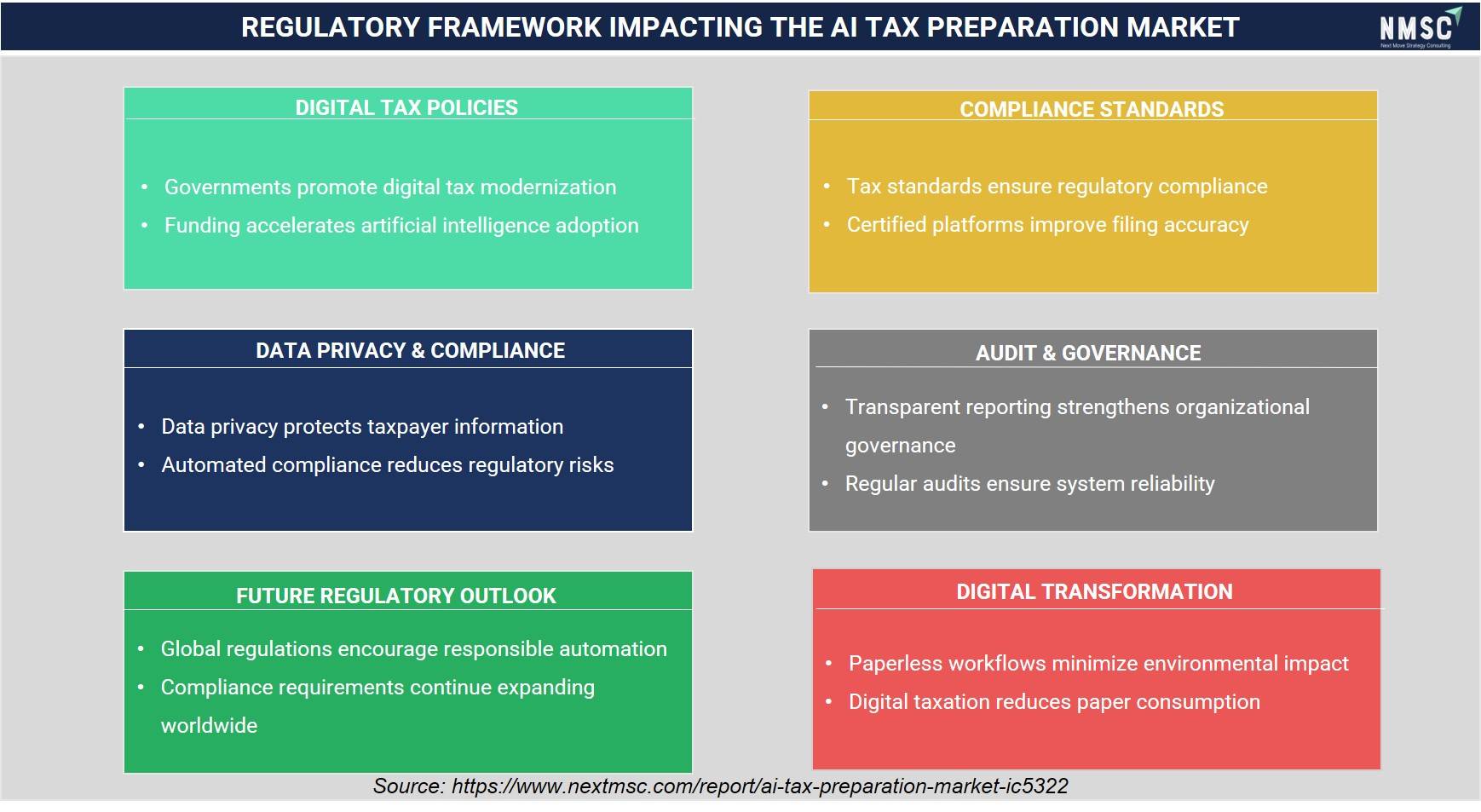
Based on our regulatory assessment, we observed that digital tax modernization initiatives and government funding programs accelerate the adoption of AI-powered tax preparation solutions across businesses and accounting firms. Furthermore, our analysis indicates that compliance standards, certification requirements, data privacy regulations, and automated governance frameworks strengthen filing accuracy, protect taxpayer information, and reduce regulatory risks. Moreover, expanding global compliance requirements and paperless digital taxation initiatives encourage responsible AI adoption while supporting sustainable and efficient tax administration practices.
Growth Drivers and Restraints
Growth Catalyst & Risk Assessment Matrix
|
Factors |
Type |
(+/-) % Impact on CAGR |
Geographic Relevance |
Impact Timeline |
|
Rising e-filing mandates from tax authorities |
Driver |
+4.2% |
Global |
2026–2035 |
|
Growing preparer staff shortages at accounting firms |
Driver |
+3.6% |
North America, Europe |
2026–2032 |
|
Adoption of generative AI copilots for advisory drafting |
Driver |
+5.1% |
Global |
2026–2035 |
|
Expansion of gig economy and self-employed filer base |
Driver |
+2.8% |
North America, Asia-Pacific |
2026–2035 |
|
Embedded tax engines within payroll and banking platforms |
Driver |
+3.3% |
Global |
2027–2035 |
|
Rising cryptocurrency and digital asset transaction volume |
Driver |
+2.4% |
North America, Asia-Pacific |
2026–2033 |
|
Data privacy and cross-border data residency restrictions |
Restraint |
-2.1% |
Europe, Middle East & Africa |
2026–2032 |
|
Filer distrust of fully automated deduction recommendations |
Restraint |
-1.6% |
Global |
2026–2030 |
|
High integration costs for legacy accounting infrastructure |
Restraint |
-1.9% |
Latin America, Middle East & Africa |
2026–2031 |
What Is the Primary Growth Driver of the AI Tax Preparation Market?
Rising e-filing mandates issued by tax authorities are the primary growth driver, compelling both individual filers and enterprises to adopt compliant digital preparation tools. The Internal Revenue Service reported that more than 90% of individual returns were filed electronically in recent filing seasons, reinforcing demand for e-filing-ready software. Our findings suggest that jurisdictions extending mandatory digital reporting to small businesses will further expand the addressable base for AI-enabled preparation platforms.
How Is the Accounting Staff Shortage Driving Market Growth?
A persistent shortage of qualified tax preparers is driving accounting and tax firms toward AI-enabled workflow and document processing software to sustain client volume. We observed that firms are deploying automated data extraction and validation tools to offset reduced headcount during peak season. Our analysis shows that practice management software revenue is expanding fastest among mid-sized accounting firms, which face the most acute staffing constraints relative to client demand growth.
What Is Restraining Growth in the AI Tax Preparation Market?
Data privacy regulations and cross-border data residency restrictions are restraining enterprise adoption, particularly where tax data must remain within national infrastructure. The European Commission's data governance framework requires enterprises to validate hosting arrangements before deploying cloud-based tax engines. Our assessment indicates that vendors offering region-specific hosting and private cloud options are better positioned to overcome this restraint than providers reliant solely on centralized public cloud infrastructure.
Segmentation Analysis
Segment Sizing: By Component
|
Segment |
2025 (USD Billion) |
2035 (USD Billion) |
CAGR% (2026-2035) |
|
Consumer Tax Preparation Software |
0.85 |
5.10 |
22.0% |
|
Professional Tax Preparation Software |
0.68 |
5.60 |
26.4% |
|
Tax Workflow and Practice Management Software |
0.42 |
3.40 |
26.2% |
|
Enterprise Tax Management Software |
0.48 |
4.35 |
27.7% |
|
AI Tax Intelligence Software |
0.24 |
3.85 |
36.1% |
|
AI-Enabled Tax Preparation Services |
0.18 |
2.50 |
34.0% |
|
Total |
2.85 |
24.80 |
23.8% |
Which Component Dominates the AI Tax Preparation Market?
Consumer Tax Preparation Software dominates the component landscape, valued at USD 0.85 billion in 2025 on the strength of mass-market individual filing volume. We found that AI Tax Intelligence Software is the fastest-growing component at a 36.1% CAGR, driven by demand for deduction optimization and fraud detection engines. Our analysis shows that vendors bundling intelligence layers atop traditional filing software are capturing disproportionate share of incremental spending through 2035.
Segment Sizing: By Buyer Type
|
Segment |
2025 (USD Billion) |
2035 (USD Billion) |
CAGR% (2026-2035) |
|
Individual Consumers |
0.72 |
4.35 |
22.1% |
|
Self-Employed Individuals |
0.46 |
3.95 |
27.0% |
|
Small and Medium Businesses |
0.55 |
5.05 |
27.9% |
|
Accounting and Tax Firms |
0.58 |
4.90 |
26.8% |
|
Enterprise Organizations |
0.38 |
3.90 |
29.5% |
|
Platform and Embedded Partners |
0.16 |
2.65 |
36.6% |
|
Total |
2.85 |
24.80 |
23.8% |
Which Buyer Type Leads AI Tax Preparation Market Demand?
Individual Consumers lead buyer-type demand at USD 0.72 billion in 2025, reflecting the scale of mass-market annual filing volume across salaried and retired populations. We found that Platform and Embedded Partners represent the fastest-growing buyer type at a 36.6% CAGR as payroll and banking platforms embed tax computation directly into their products. Our assessment indicates that accounting and tax firms are increasing per-seat software spend to offset preparer capacity constraints.
Segment Sizing: By Deployment Model
|
Segment |
2025 (USD Billion) |
2035 (USD Billion) |
CAGR% (2026-2035) |
|
Cloud Deployment |
1.75 |
15.90 |
27.8% |
|
Desktop Deployment |
0.42 |
1.55 |
15.6% |
|
Mobile Deployment |
0.38 |
3.35 |
27.4% |
|
API and Embedded Deployment |
0.30 |
4.00 |
33.4% |
|
Total |
2.85 |
24.80 |
23.8% |
Why Does Cloud Deployment Dominate the AI Tax Preparation Market?
Cloud deployment dominates with USD 1.75 billion in 2025 revenue, reflecting preparer and enterprise preference for continuously updated regulatory rule engines over static desktop installations and broader enterprise migration toward cloud computing infrastructure. We found that API and Embedded Deployment is the fastest-growing model at a 33.4% CAGR as software platforms outside the tax category embed compliant filing engines directly into their user experience. Our analysis shows that desktop deployment is declining in relative share but persists among privacy-sensitive enterprise users.
Growth Opportunities
Our findings suggest that three forward-looking whitespace opportunities stand out for stakeholders positioning ahead of 2035 demand across the AI tax preparation value chain.
How Can Embedded Tax Engines Unlock New Revenue for Platform Partners?
Embedding compliant tax computation directly into payroll, banking, and accounting software platforms creates a monetizable feature layer for platform and embedded partners. This mechanism lets non-tax software vendors capture usage-based fees while reducing filer drop-off caused by third-party redirects, benefiting Platform and Embedded Partners most directly.
Can AI-Driven Audit Representation Expand Tax Resolution Software Demand?
AI systems that draft audit response documentation and track notice deadlines create a scalable resolution service layer for accounting and tax firms. This mechanism converts reactive, hourly-billed audit work into a repeatable software-assisted process, benefiting mid-sized and large accounting firms seeking to expand advisory margins.
Will Digital Asset Tax Filing Become a Standalone Growth Category?
Rising cryptocurrency and non-fungible token transaction volume creates demand for specialized digital asset tax filing modules that reconcile exchange data automatically. This mechanism benefits self-employed and high-net-worth individual filers who otherwise face manual cost-basis reconciliation across multiple exchanges and wallets.
Regional Outlook
|
Region |
2025 (USD Billion) |
2035 (USD Billion) |
CAGR% (2026-2035) |
Key Driver |
|
North America |
0.97 |
7.65 |
25.8% |
E-filing mandates and preparer shortages |
|
Europe |
0.68 |
5.55 |
26.3% |
VAT digital reporting mandates |
|
Asia-Pacific |
0.79 |
8.90 |
30.9% |
Rising digital filing penetration |
|
Middle East & Africa |
0.24 |
1.65 |
23.9% |
VAT and GST modernization |
|
Latin America |
0.17 |
1.05 |
22.4% |
Electronic invoicing expansion |
|
Total |
2.85 |
24.80 |
23.8% |
- |
North America AI Tax Preparation Market
North America's market is mature, anchored by widespread e-filing infrastructure and a concentrated base of established software vendors. Key drivers include Internal Revenue Service digital reporting requirements and acute preparer staffing shortages. Regulatory influence from the IRS's Modernized e-File system shapes vendor certification standards, while technology adoption favors generative AI copilots. The region's strategic outlook remains focused on premium AI intelligence features rather than base-filing volume growth.
Europe AI Tax Preparation Market
Europe's market is expanding steadily as national tax authorities implement digital reporting obligations under coordinated European Union frameworks. Key drivers include VAT in the Digital Age requirements and cross-border enterprise compliance needs. Regulatory influence from national revenue authorities shapes data residency requirements, while technology adoption favors hybrid cloud architectures. The region's strategic outlook favors vendors offering multi-jurisdiction compliance automation across fragmented national tax codes.
Asia-Pacific AI Tax Preparation Market
Asia-Pacific is the fastest-growing region, driven by rising digital filing penetration and expanding small business formalization across emerging economies. Key drivers include government digitization initiatives and growing self-employed and gig-worker populations. Regulatory influence from national tax administrations shapes mobile-first filing requirements, while technology adoption favors mobile deployment models. The region's strategic outlook rewards vendors offering low-cost, localized language support across diverse national tax systems.
Middle East & Africa AI Tax Preparation Market
The Middle East & Africa market is in an early growth stage as VAT and GST regimes mature across Gulf and African economies. Key drivers include ongoing VAT modernization programs and expanding enterprise compliance obligations. Regulatory influence from national tax authorities shapes e-invoicing integration requirements, while technology adoption favors cloud-based enterprise engines. The region's strategic outlook favors vendors partnering with regional systems integrators to navigate fragmented regulatory environments.
Latin America AI Tax Preparation Market
Latin America's market is expanding as electronic invoicing mandates extend deeper into small business and self-employed segments. Key drivers include national tax administration digitization programs and rising smartphone-based filing access. Regulatory influence from revenue authorities shapes real-time transaction reporting requirements, while technology adoption favors mobile and API-based deployment. The region's strategic outlook favors vendors integrating directly with mandatory electronic invoicing infrastructure.
U.S. AI Tax Preparation Market
Based on our estimates, the U.S. accounted for approximately USD 0.82 billion in 2025 and is projected to reach USD 6.35 billion by 2035, at a CAGR of approximately 25.5%. Demand structure is concentrated among individual consumers and mid-sized accounting firms, with high adoption of cloud-based filing software. Regulatory influence from the Internal Revenue Service shapes e-file certification, while technology penetration is highest among generative AI copilots. Competitive intensity is elevated, and the strategic outlook favors incumbents expanding AI intelligence features.
Canada AI Tax Preparation Market
The market in Canada was valued at approximately USD 0.11 billion in 2025 and is projected to reach USD 0.82 billion by 2035, growing at a CAGR of approximately 25.1%. Demand structure centers on individual filers and small businesses navigating provincial and federal tax layers. Regulatory influence from the Canada Revenue Agency shapes NETFILE certification standards, while technology adoption favors mobile filing applications. Competitive intensity is moderate, and the strategic outlook favors bilingual, cross-provincial compliance tools.
UK AI Tax Preparation Market
As per our estimate, the UK market was valued at approximately USD 0.19 billion in 2025 and is forecast to reach USD 1.58 billion by 2035, at a CAGR of approximately 26.4%. Demand structure is driven heavily by small business compliance under Making Tax Digital rules. Regulatory influence from HM Revenue & Customs shapes mandatory digital record-keeping, while technology adoption favors API-integrated accounting software. Competitive intensity is high, and the strategic outlook favors vendors embedded within accounting software ecosystems.
Germany AI Tax Preparation Market
According to our analysis, Germany's market was valued at approximately USD 0.15 billion in 2025 and is projected to reach USD 1.24 billion by 2035, at a CAGR of approximately 26.2%. Demand structure is concentrated among enterprise organizations managing complex VAT and corporate tax obligations. Regulatory influence from national and European Union tax frameworks shapes reporting formats, while technology penetration favors enterprise tax management software. Competitive intensity is moderate, and the strategic outlook favors vendors with strong local compliance expertise.
France AI Tax Preparation Market
Based on our estimates, France's market was valued at approximately USD 0.12 billion in 2025 and is projected to reach USD 0.97 billion by 2035, at a CAGR of approximately 26.0%. Demand structure is shaped by mandatory e-invoicing rollout across business segments. Regulatory influence from French tax authorities shapes structured invoice data requirements, while technology adoption favors cloud and API deployment. Competitive intensity is moderate, and the strategic outlook favors vendors integrating directly with national e-invoicing platforms.
China AI Tax Preparation Market
The market in China was valued at approximately USD 0.24 billion in 2025 and is projected to reach USD 3.10 billion by 2035, growing at a CAGR of approximately 32.9%. Demand structure is driven by rapid enterprise digitization and expanding small business formalization. Regulatory influence from national tax administration shapes golden tax system integration, while technology adoption favors mobile and cloud platforms. Competitive intensity is rising, and the strategic outlook favors vendors with deep local regulatory integration.
India AI Tax Preparation Market
As per our estimate, India's market was valued at approximately USD 0.18 billion in 2025 and is projected to reach USD 2.75 billion by 2035, at a CAGR of approximately 34.5%. Demand structure is dominated by self-employed individuals and small businesses adapting to Goods and Services Tax compliance. Regulatory influence from national tax authorities shapes e-invoicing and return filing formats, while technology adoption favors mobile-first applications. Competitive intensity is intensifying, and the strategic outlook favors low-cost, vernacular-language platforms.
Japan AI Tax Preparation Market
According to our analysis, Japan's market was valued at approximately USD 0.14 billion in 2025 and is projected to reach USD 1.35 billion by 2035, at a CAGR of approximately 28.6%. Demand structure centers on enterprise organizations and accounting firms navigating consumption tax invoicing rules. Regulatory influence from the National Tax Agency shapes qualified invoice system compliance, while technology adoption favors cloud-based enterprise engines. Competitive intensity is moderate, and the strategic outlook favors vendors with strong enterprise integration capability.
South Korea AI Tax Preparation Market
Based on our estimates, South Korea's market was valued at approximately USD 0.09 billion in 2025 and is projected to reach USD 0.98 billion by 2035, at a CAGR of approximately 30.1%. Demand structure is shaped by enterprise adoption of electronic tax invoicing systems. Regulatory influence from the National Tax Service shapes mandatory e-tax invoice standards, while technology adoption favors API-integrated platforms. Competitive intensity is moderate, and the strategic outlook favors vendors partnering with domestic enterprise software providers.
Australia AI Tax Preparation Market
The market in Australia was valued at approximately USD 0.08 billion in 2025 and is projected to reach USD 0.71 billion by 2035, growing at a CAGR of approximately 27.2%. Demand structure is concentrated among individual consumers and small businesses filing through myTax-adjacent channels. Regulatory influence from the Australian Taxation Office shapes single-touch payroll integration, while technology adoption favors cloud and mobile platforms. Competitive intensity is moderate, and the strategic outlook favors vendors with strong payroll platform partnerships.
UAE AI Tax Preparation Market
As per our estimate, the UAE market was valued at approximately USD 0.05 billion in 2025 and is projected to reach USD 0.38 billion by 2035, at a CAGR of approximately 25.8%. Demand structure is driven by enterprise organizations adapting to corporate tax and VAT obligations. Regulatory influence from the Federal Tax Authority shapes e-invoicing rollout, while technology adoption favors cloud-based enterprise engines. Competitive intensity is moderate, and the strategic outlook favors vendors with Gulf regional compliance expertise.
Saudi Arabia AI Tax Preparation Market
According to our analysis, Saudi Arabia's market was valued at approximately USD 0.06 billion in 2025 and is projected to reach USD 0.44 billion by 2035, at a CAGR of approximately 25.2%. Demand structure is shaped by mandatory e-invoicing under the Zakat, Tax and Customs Authority's Fatoora program. Regulatory influence from national tax authorities shapes phased e-invoicing integration, while technology adoption favors enterprise cloud platforms. Competitive intensity is moderate, and the strategic outlook favors vendors certified under national e-invoicing standards.
South Africa AI Tax Preparation Market
Based on our estimates, South Africa's market was valued at approximately USD 0.04 billion in 2025 and is projected to reach USD 0.27 billion by 2035, at a CAGR of approximately 23.5%. Demand structure centers on small and medium businesses adapting to eFiling modernization. Regulatory influence from the South African Revenue Service shapes digital filing requirements, while technology adoption favors cloud deployment. Competitive intensity is low to moderate, and the strategic outlook favors vendors offering affordable small-business tiers.
Brazil AI Tax Preparation Market
The market in Brazil was valued at approximately USD 0.07 billion in 2025 and is projected to reach USD 0.47 billion by 2035, growing at a CAGR of approximately 23.6%. Demand structure is shaped by mandatory electronic invoicing across business segments. Regulatory influence from national tax authorities shapes structured fiscal document standards, while technology adoption favors API and cloud deployment. Competitive intensity is moderate, and the strategic outlook favors vendors integrating with mandatory fiscal document systems.
Argentina AI Tax Preparation Market
As per our estimate, Argentina's market was valued at approximately USD 0.03 billion in 2025 and is projected to reach USD 0.19 billion by 2035, at a CAGR of approximately 22.8%. Demand structure is concentrated among small businesses and self-employed filers adapting to electronic invoicing mandates. Regulatory influence from national tax authorities shapes real-time reporting requirements, while technology adoption favors mobile and cloud platforms. Competitive intensity is low, and the strategic outlook favors vendors offering cost-efficient compliance automation.
Consumer Behavior Analysis of the AI Tax Preparation Market
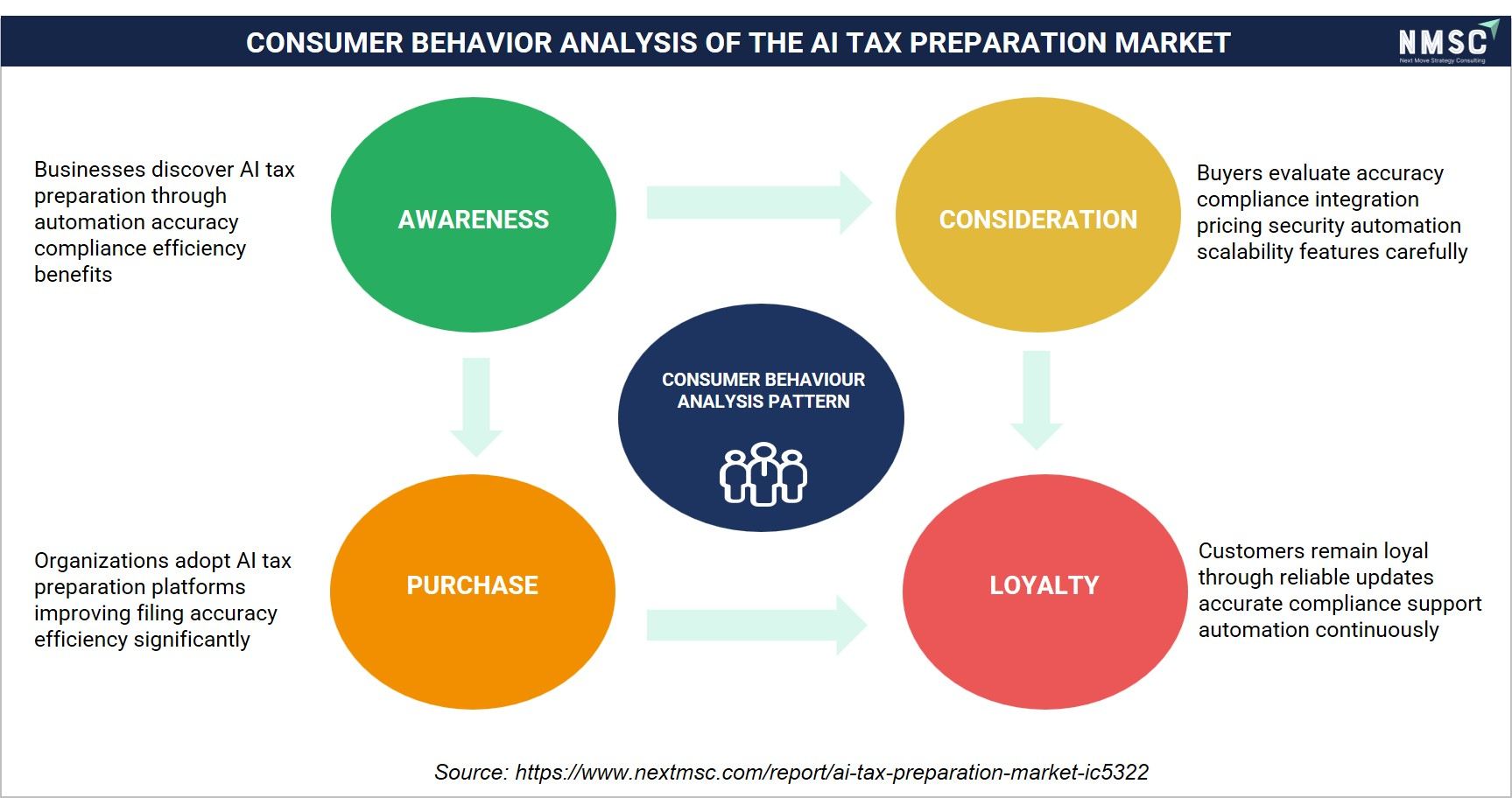
Based on our consumer behavior assessment, we observed that businesses and tax professionals become aware of AI tax preparation solutions through automation benefits, improved filing accuracy, and enhanced compliance capabilities before evaluating accuracy, regulatory compliance, integration, pricing, security, automation, and scalability. Furthermore, our analysis indicates that organizations increasingly adopt AI tax preparation platforms to improve filing efficiency and reduce manual effort, while reliable software updates, continuous compliance support, high filing accuracy, and automation capabilities strengthen long-term customer loyalty and platform retention.
Competitive Landscape
Our analysis shows that the competitive landscape spans large diversified software vendors, specialized AI-native entrants, and traditional service providers integrating AI capability into existing preparation workflows across the industry.
|
Dimension |
Detail |
|
Market Structure |
Moderately consolidated, with the top five vendors holding a majority of professional and consumer software revenue |
|
Innovation Focus |
Generative AI copilots, automated document extraction, and embedded tax intelligence |
|
M&A Activity |
Elevated, driven by incumbent acquisition of AI-native tax intelligence and workflow startups |
How Do Companies Compete in the AI Tax Preparation Market?
Companies compete primarily on filing accuracy, AI-driven deduction identification, and breadth of e-filing jurisdiction coverage. Established vendors leverage decades of accumulated tax rule libraries, while newer entrants compete on user experience and conversational interfaces. Our findings suggest that pricing competition is most intense in the consumer segment, while professional and enterprise segments compete on integration depth and compliance guarantee strength.
Which Competitive Archetypes Dominate the AI Tax Preparation Market?
Two archetypes dominate: diversified incumbents such as Intuit and Thomson Reuters that bundle AI features across broad software suites, and AI-native specialists such as FlyFin and TaxGPT that differentiate on conversational, automation-first experiences. We found that diversified incumbents win on trust and jurisdiction coverage, while AI-native specialists win on speed of feature iteration among self-employed and freelance filer segments.
What Innovation and Differentiation Strategies Are Vendors Pursuing?
Vendors are pursuing differentiation through proprietary large language model fine-tuning on tax code corpora, real-time regulatory update automation, and expanded audit representation capabilities. Our assessment indicates that vendors investing in explainable AI outputs, which show filers the reasoning behind a deduction recommendation, are building stronger trust and retention among cautious first-time AI tax software adopters.
What M&A Activity Is Shaping the Competitive Landscape?
M&A activity is elevated as diversified vendors acquire AI-native workflow and document processing startups to accelerate feature roadmaps rather than build internally. Our analysis shows that practice management and document extraction specialists are attractive acquisition targets for enterprise tax platform vendors seeking to expand into accounting firm workflows through inorganic geographic and capability expansion.
Key Market Players
Our assessment indicates that the following 20 companies represent the leading vendors shaping product innovation, jurisdiction coverage, and AI capability across the AI tax preparation market.
-
H&R Block, Inc.
-
Thomson Reuters Corporation
-
Wolters Kluwer N.V.
-
Avalara, Inc.
-
Vertex Inc.
-
Taxwell, LLC
-
Jackson Hewitt Inc.
-
Liberty Tax Service Inc.
-
Defmacro Software Private Limited
-
TaxHawk, Inc.
-
TaxDome LLC
-
Canopy Tax, Inc.
-
Workflex Solutions LLC
-
FlyFin AI, Inc.
-
Blue J Legal Inc.
-
TaxGPT Inc.
-
Instead Inc.
-
Koinly Limited
Latest Developments
Based on research conducted by Next Move Strategy Consulting, we found that vendors have accelerated AI feature rollouts ahead of recent filing seasons, prioritizing generative assistance and automated compliance checks.
|
Date |
Event |
|
February 2026 |
H&R Block integrated advanced generative AI into its "AI Tax Assist" tool across both DIY online and desktop platforms. Designed to help taxpayers navigate a complex 2026 legislative landscape, the tool provides 24/7 instant answers and is supported by human expertise from The Tax Institute. |
|
November 2025 |
Intuit scaled its AI-driven consumer platform, integrating Credit Karma data into TurboTax to automate tax categorization. By using agentic AI, the platform aims to provide year-round financial outcomes, including personalized recommendations for debt management and investing following the tax-filing process. |
|
November 2025 |
Thomson Reuters introduced ONESOURCE+, an "Intelligent Compliance Network" that leverages "CoCounsel," its agentic AI, to connect tax, trade, legal, and risk workflows. This platform is designed to transform disconnected compliance tasks into coordinated, outcome-driven operations for global enterprises. |
Expert Insights
 "The tax return is going to become a lot more commoditised, really allowing professionals to become more of an adviser to their clients. AI lets professionals shift from data wrangling to being true advisers."
— John McGowan, Founder & CEO, HubSync
Statement made during the AICPA & CIMA podcast discussing the growing role of artificial intelligence in tax preparation, where McGowan explained how AI-driven automation is transforming tax workflows by reducing manual tasks and enabling professionals to focus on higher-value advisory services.
Market Interpretation
The statement underscores the transformative role of AI in the tax preparation market by automating routine activities such as data entry, document processing, and compliance tasks. As AI handles repetitive workflows, tax professionals can dedicate more time to strategic advisory, tax planning, and personalized client engagement. Consequently, the growing adoption of AI-powered tax preparation solutions is accelerating the shift toward more efficient, advisory-centric tax services while enhancing productivity and client value.
Investment Opportunities
Where Are Capital Inflows Concentrated in the AI Tax Preparation Market?
Capital inflows are concentrated in AI-native tax intelligence and conversational assistant startups that raised growth funding to expand jurisdiction coverage. Our findings suggest that investors favor companies demonstrating measurable accuracy improvements over rule-based incumbents, particularly those serving the underserved self-employed and digital asset filer segments.
How Significant Is Infrastructure Investment in This Market?
Infrastructure investment is significant among enterprise vendors building compliant cloud hosting and real-time regulatory update pipelines across multiple jurisdictions. Our analysis shows that vendors investing in redundant, region-specific data infrastructure are better positioned to win enterprise contracts requiring strict data residency guarantees.
What ESG Considerations Are Relevant to This Market?
Environmental, Social, and Governance considerations center on data privacy governance, algorithmic fairness in deduction recommendations, and financial inclusion through affordable filing access for low-income taxpayers. Our assessment indicates that vendors publishing transparent AI governance frameworks are increasingly favored by enterprise and government procurement processes.
Key Benefits for Stakeholders
How Does This Report Benefit Industry Leaders?
Industry leaders benefit from detailed segmentation, competitive benchmarking, and regional demand data that inform product roadmap and go-to-market prioritization decisions. This report's forecasts and strategic insights help executives allocate engineering resources toward the fastest-growing components and deployment models identified across the analysis.
How Does This Report Benefit Investors and Financial Analysts?
Investors and financial analysts benefit from validated market sizing, CAGR projections, and competitive landscape analysis that support valuation and due diligence work. The report's data on regional growth differentials and segment-level opportunity sizing helps analysts identify where capital deployment offers the strongest risk-adjusted return potential.
How Does This Report Benefit Technology Vendors and Product Teams?
Technology vendors and product teams benefit from granular segmentation across component, buyer type, and deployment model that clarifies where feature investment will generate the greatest addressable demand. The report's regional regulatory analysis helps product teams prioritize jurisdiction-specific compliance features ahead of competitors.
Key Market Segments
By Component
-
Consumer Tax Preparation Software
-
Standard Individual Filing
-
Federal Income Tax
-
State and Local Tax
-
Amended Return
-
-
Self-Employed Filing
-
Freelancer
-
Sole Proprietor
-
Gig Worker
-
-
Investment Tax Filing
-
Capital Gains
-
Dividend and Interest
-
Foreign Asset Reporting
-
-
Digital Asset Tax Filing
-
Cryptocurrency
-
Non-Fungible Token
-
Decentralized Finance
-
-
Specialized Consumer
-
Expatriate
-
Nonresident
-
Multi-State
-
-
-
Professional Tax Preparation Software
-
Individual Return Preparation
-
Form 1040
-
High Net Worth Return
-
Multi-Jurisdiction Return
-
-
Business Return
-
Corporate
-
Partnership
-
Trust and Estate
-
-
Tax Resolution Software
-
Audit Representation
-
Notice Resolution
-
Installment Agreement Management
-
-
Compliance Automation
-
E-Filing Automation
-
Validation and Error Checking
-
Regulatory Update Automation
-
-
-
Tax Workflow and Practice Management Software
-
Practice Operations
-
Scheduling
-
Staff Management
-
Capacity Planning
-
-
Client Collaboration
-
Client Portal
-
Secure Messaging
-
Secure Document Exchange
-
-
Document Processing
-
Optical Character Recognition
-
Automated Data Extraction
-
Classification and Tagging
-
-
Filing Delivery
-
Return Assembly
-
Electronic Signature
-
Client Delivery
-
-
-
Enterprise Tax Management Software
-
Corporate Income Tax Management
-
Domestic Tax Compliance
-
International Tax Compliance
-
Transfer Pricing Support
-
-
Indirect Tax Management
-
Sales Tax Automation
-
Value Added Tax Automation
-
Goods and Services Tax Automation
-
-
Tax Provision Management
-
Deferred Tax Accounting
-
Financial Tax Reporting
-
Regulatory Reporting
-
-
Enterprise Tax Analytics
-
Risk Monitoring
-
Scenario Modeling
-
Audit Trail Analytics
-
-
-
AI Tax Intelligence Software
-
Tax Research Automation
-
Tax Code Search
-
Regulatory Interpretation
-
Case Law Analysis
-
-
AI Review and Validation
-
Error Detection
-
Deduction Optimization
-
Fraud Detection
-
-
AI Content Generation
-
Client Memo Drafting
-
Tax Position Drafting
-
Advisory Recommendation
-
-
Conversational Tax Assistants
-
Consumer Tax Chatbots
-
Professional Tax Copilots
-
Enterprise Tax Agents
-
-
-
AI-Enabled Tax Preparation Services
-
Digital Assisted Filing
-
Guided Filing
-
Hybrid Human Review
-
Remote Filing Assistance
-
-
CPA-Assisted Filing
-
Individual Certified Public Accountant
-
Business Certified Public Accountant
-
Premium Advisory
-
-
Tax Outsourcing Services
-
Return Preparation Outsourcing
-
Offshore Preparation
-
Managed Compliance
-
-
Tax Advisory Services
-
Tax Planning
-
Compliance Advisory
-
Audit Support
-
-
By Buyer Type
-
Individual Consumers
-
Salaried Individuals
-
Retirees
-
High Net Worth Individuals
-
-
Self-Employed Individuals
-
Freelancers
-
Gig Workers
-
Sole Proprietors
-
-
Small and Medium Businesses
-
Micro Businesses
-
Small Businesses
-
Mid-Sized Businesses
-
-
Accounting and Tax Firms
-
Solo Practices
-
Small Tax Firms
-
Mid-Sized Accounting Firms
-
Large Accounting Firms
-
-
Enterprise Organizations
-
Domestic Enterprises
-
Multinational Enterprises
-
Financial Institutions
-
-
Platform and Embedded Partners
-
Payroll Platforms
-
Banking Platforms
-
Accounting Software Platforms
-
By Deployment Model
-
Cloud Deployment
-
Public Cloud
-
Private Cloud
-
Hybrid Cloud
-
-
Desktop Deployment
-
Standalone Desktop
-
Network Desktop
-
-
Mobile Deployment
-
Native Mobile Applications
-
Mobile Web Applications
-
-
API and Embedded Deployment
-
Embedded Tax Engines
-
Third-Party Application Programming Interface Integration
-
White-Label Integration
-
By Revenue Model
-
Subscription
-
Monthly Subscription
-
Annual Subscription
-
-
Per Return
-
Individual Return Fees
-
Business Return Fees
-
-
Usage-Based
-
Transaction Fees
-
Application Programming Interface Usage Fees
-
-
License
-
Per Seat Licensing
-
Enterprise Licensing
-
-
Service
-
Preparation Fees
-
Advisory Fees
-
Outsourcing Fees
-
By Region
-
North America: U.S., Canada, Mexico
-
Europe: UK, Germany, France, Italy, Spain, Sweden, Denmark, Finland, Netherlands, Rest of Europe
-
Asia-Pacific: China, India, Japan, South Korea, Taiwan, Indonesia, Vietnam, Australia, Philippines, Malaysia, Rest of APAC
-
Middle East & Africa: Saudi Arabia, UAE, Egypt, Israel, Turkey, Nigeria, South Africa, Rest of MEA
-
Latin America: Brazil, Argentina, Chile, Colombia, Rest of LATAM
Conclusion and Recommendations
What Is the Long-Term Outlook for the AI Tax Preparation Market?
The long-term outlook remains strongly positive, with the market projected to expand from USD 3.62 billion in 2026 to USD 24.80 billion by 2035 at a 23.8% CAGR. Our findings suggest that sustained e-filing mandates and preparer staffing constraints will continue to underpin demand well beyond the current forecast window, particularly across enterprise and accounting firm buyer segments.
What Strategic Positioning Should Vendors Pursue?
Vendors should prioritize embedding AI intelligence layers atop existing filing infrastructure while pursuing partnerships with payroll and banking platforms to capture embedded distribution. Our assessment indicates that vendors combining jurisdiction breadth with conversational AI interfaces will be best positioned to capture premium pricing within the AI tax preparation market.
How Attractive Is the AI Tax Preparation Market for New Investment?
The AI tax preparation industry presents an attractive investment case, supported by a USD 21.18 billion absolute dollar opportunity between 2026 and 2035 and above-average growth in Asia-Pacific and AI Tax Intelligence Software. We found that investment attractiveness is highest for vendors combining proprietary tax-code trained models with scaled distribution across consumer and enterprise channels.
What Market Shifts and Key Risks Should Stakeholders Monitor?
Stakeholders should monitor data privacy regulation tightening, filer distrust of fully automated recommendations, and competitive pressure from free government-provided filing tools as key risks. Our analysis shows that vendors unable to demonstrate explainable, auditable AI outputs risk losing share to competitors offering greater transparency, particularly within Europe's increasingly regulated data environment.
What Are the Key Growth Pathways for the AI Tax Preparation Market?
Key growth pathways include expanding embedded tax engines within adjacent platforms, scaling AI-driven audit representation services, and deepening penetration into digital asset and cross-border filing categories. Next Move Strategy Consulting's analysis indicates that vendors pursuing these pathways while maintaining accuracy and compliance trust will be best positioned to capture the market's projected growth through 2035.
About the Author
 Saista Faiyaz
— Saista Faiyaz is Research Associate at Next Move Strategy Consulting, where she has covered consumer markets and healthcare technologies for 3 years. Her work includes primary interview review, secondary-source validation, market sizing, and structured analysis of company and industry data. She supports research by comparing evidence across sources, organizing findings into market narratives, and documenting assumptions used in analysis. Her scope includes cross-market benchmarking, and reports.
Saista Faiyaz
— Saista Faiyaz is Research Associate at Next Move Strategy Consulting, where she has covered consumer markets and healthcare technologies for 3 years. Her work includes primary interview review, secondary-source validation, market sizing, and structured analysis of company and industry data. She supports research by comparing evidence across sources, organizing findings into market narratives, and documenting assumptions used in analysis. Her scope includes cross-market benchmarking, and reports.
About the Reviewer
 Supradip Baul
— Supradip Baul is an accomplished business consultant and strategist with over a decade of rich experience in market intelligence, strategy, technology, and business transformation. His work has included rigorous qualitative and quantitative analysis across multiple industries, helping clients shape investment decisions and long-term roadmaps. Earlier in his career, he was associated with Gartner, where he contributed to industry-leading reports and market share analyses. He has worked with leading global companies and holds an MBA with a dual specialization in Marketing and Finance.
Supradip Baul
— Supradip Baul is an accomplished business consultant and strategist with over a decade of rich experience in market intelligence, strategy, technology, and business transformation. His work has included rigorous qualitative and quantitative analysis across multiple industries, helping clients shape investment decisions and long-term roadmaps. Earlier in his career, he was associated with Gartner, where he contributed to industry-leading reports and market share analyses. He has worked with leading global companies and holds an MBA with a dual specialization in Marketing and Finance.
At Next Move Strategy Consulting, we understand that insightful market research is the cornerstone of successful business decisions. That's why we employ a robust and multifaceted approach, combining various methodologies to deliver the most accurate and actionable data for our clients.

Research Landscape
We navigate the world of research with two primary approaches:
Qualitative Approach
Our qualitative research methodologies involve immersive techniques such as in-depth interviews, focus groups, and observational studies. By engaging directly with individuals and stakeholders, we uncover valuable insights that quantitative data alone may overlook.

Quantitative Research
In tandem with qualitative methodologies, NMSC leverages the power of Quantitative Research to provide a robust foundation of numerical insights. Through systematic data collection and analysis, we quantify patterns, preferences, and market trends, offering a comprehensive view of the business landscape.
Our quantitative research approach employs diverse tools, including surveys, experiments, and statistical modelling. These methodologies enable us to gather data from a large and representative sample, ensuring the statistical significance of our findings. By employing structured questionnaires and standardized data collection methods, we guarantee the reliability and validity of the information we present to our clients.
Quantitative research is particularly effective in measuring the prevalence of trends, assessing market size, and gauging the impact of various factors on consumer behavior. The numerical precision attained through this approach equips our clients with actionable insights, facilitating data-driven decision-making and strategy formulation.


Our Specialized Toolbox for Industry-Specific Market Research
We deploy a specialized arsenal of techniques tailored to meet your unique requirements. Here's a glimpse into our comprehensive toolbox:

Information Procurement
The stage entails acquiring market data or relevant information through various sources and methodologies.


Market Research Approach
We utilize both top-down and bottom-up approaches in market research analysis to achieve a comprehensive understanding of the market dynamics, leveraging the broad perspective of industry trends and macroeconomic factors alongside detailed insights from specific segments and individual companies.

Porters Five Forces Analysis
We conduct Porter's Five Forces analysis to evaluate the competitive landscape of an industry, providing us with insights into factors that affect profitability and strategic positioning.

SWOT Analysis

Forecasting
We utilize a forecasting model to predict future consumption by considering parameters like population, economics, regulations, market competition, drivers, constraints, technology, and pricing. We also employ statistical techniques such as multilinear regression, exponential smoothing, moving average, ARIMA, and Monte Carlo simulations for accurate predictions. In econometric forecasting, we analyzed short-term and long-term event impacts, attributing values based on regulatory frameworks, economic factors, and market events.





 Speak to Our Analyst