AI Chip Market Global Industry Analysis and Forecast (2026–2035)

The global AI Chip Market size was valued at USD 207.30 billion in 2025 and is projected to reach USD 1,137.82 billion by 2035, expanding at a 15.95% CAGR from 2026 to 2035. North America leads the market, while custom silicon, rising AI inference demand, and sovereign AI buildouts drive market growth.

Download Free Sample PDF
Base Year (2025)
$207.30 Billion
Forecast (2035)
$1,137.82 Billion
CAGR (2026-2035)
16.0%
Top Region
North America

What Is the AI Chip Market Size?

The global AI Chip Market reached USD 207.30 Billion in 2025 and is estimated at USD 300.36 Billion in 2026, forecast to reach USD 1,137.82 Billion by 2035 at a CAGR of 15.95% between 2026 and 2035. North America leads with approximately 46% share in 2025, while GPUs hold approximately 62% of total revenue.
NMSC's analysis indicates that GPUs, inference workloads and cloud deployments anchor revenue, while custom ASICs and edge silicon expand fastest.

AI Chip Market Global Industry Analysis and Forecast (2026–2035) Revenue Forecast

Values in USD Billion

2025 $207.30 Billion
2025
2026 $300.36 Billion
2026
2027 $348.27 Billion
2027
2028 $403.82 Billion
2028
2029 $468.22 Billion
2029
2030 $542.91 Billion
2030
2031 $629.50 Billion
2031
2032 $729.91 Billion
2032
2033 $846.33 Billion
2033
2034 $981.31 Billion
2034
2035 $1,137.82 Billion
2035

Key Takeaways

By Chip Type: GPU held the largest share, expanding from USD 128.53 Billion in 2025 to USD 489.26 Billion by 2035; ASIC is the fastest growing at 20.31% CAGR from 2026–2035.

By Function: Training held the largest share, expanding from USD 114.02 Billion in 2025 to USD 341.35 Billion by 2035; Inference is the fastest growing at 20.37% CAGR from 2026–2035.

By Deployment: Cloud and data center held the largest share, expanding from USD 182.42 Billion in 2025 to USD 910.26 Billion by 2035; Edge is the fastest growing at 21.63% CAGR from 2026–2035.

Dominant Region: North America dominated with approximately 46% revenue share in 2025, equal to USD 95.36 Billion, supported by hyperscaler capital spending and the headquarters of leading chip designers.

Fastest-Growing Region: Middle East & Africa is expected to register the highest CAGR of 19.38% during 2026–2035, driven by sovereign AI programs in the Gulf.

Dominant Country: The U.S. led the market with an estimated USD 85.82 Billion in 2025, reflecting the concentration of cloud and AI lab demand.

Fastest-Growing Country: India is projected to expand from USD 2.36 Billion in 2025 to USD 29.36 Billion by 2035 at a CAGR of 24.83% over 2026–2035, as national compute programs and cloud regions scale.

The AI Chip Market presents an absolute investment opportunity of approximately USD 837.46 Billion between 2026 and 2035, calculated as the difference between the 2035 forecast of USD 1,137.82 Billion and the 2026 base of USD 300.36 Billion. This makes custom ASIC programs, inference accelerators and rack scale platforms the most capital efficient categories for semiconductor investors and cloud operators.

According to NMSC analysis, the migration from merchant GPUs toward hyperscaler designed ASICs is the most structurally significant shift in the market, because Google, Amazon, Microsoft and Meta now field their own accelerators while still buying merchant parts. Broadcom reported AI semiconductor revenue of USD 16.7 Billion in its fiscal third quarter of 2026, up 221% year over year, which shows how quickly custom silicon revenue is scaling.

What Does the AI Chip Market Encompass?

The AI Chip Market covers processors designed or optimized to run machine learning workloads, including graphics processing units, application specific integrated circuits, central processing units with AI acceleration and field programmable gate arrays. It spans training and inference in cloud data centers and at the edge. Revenue is measured at the chip level, which excludes memory modules sold separately, networking equipment and server assembly. The World Semiconductor Trade Statistics organization projects logic chip sales of USD 411.37 Billion in 2026, which frames the processor opportunity.
The regulatory environment is shaped primarily by United States export controls. In January 2026 the Bureau of Industry and Security revised its license review policy for advanced computing commodities, moving certain high performance chips bound for China to case by case review. Structural evolution is equally visible, because rack scale systems, annual product cadences and multiyear capacity agreements now define how buyers procure accelerators across cloud and sovereign programs.

Ecosystem Analysis of the AI Chip Market

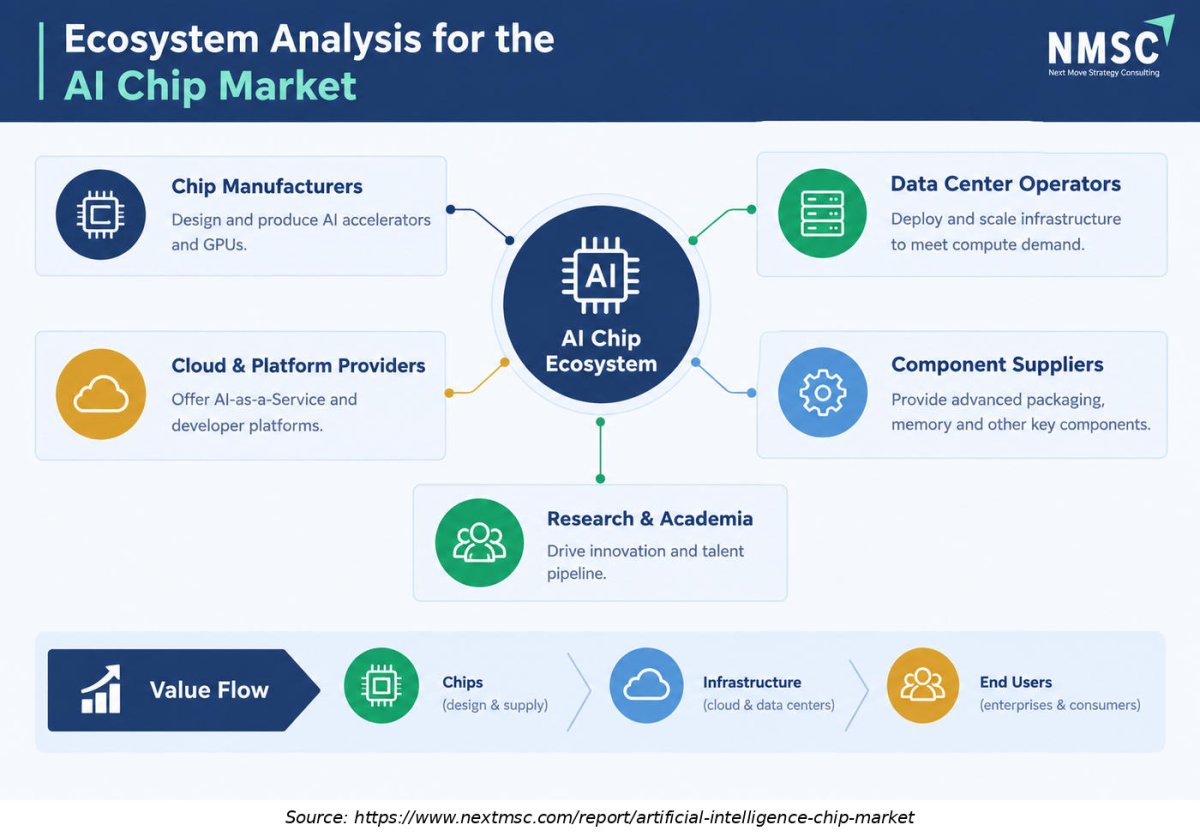
The infographic illustrates the AI Chip Market ecosystem, connecting chip manufacturers, cloud and platform providers, data center operators, component suppliers, and research institutions. It highlights the value flow from chip design and supply to infrastructure deployment and end-user applications, demonstrating how collaboration across the value chain supports AI computing capacity and market development.

Market Drivers & Dynamics

Interactive Dataset
Hyperscaler custom silicon programs (TPU, Trainium, Maia, MTIA) driver +3.2% North America, Asia Pacific 2026–2030
Shift of AI workloads from training to inference driver +2.6% Global 2026–2035
Rack scale systems and sovereign AI buildouts driver +2.1% Middle East & Africa, North America 2026–2032
Domestic accelerator substitution in China driver +1.4% China 2026–2030
Edge AI adoption in PCs, devices and embedded systems driver +1.2% Global 2027–2035
Export controls and licensing friction restraint −1.6% China, global supply chain 2026–2029
Data center power availability restraint −1.8% North America, Europe 2026–2033
Memory and advanced packaging supply constraints restraint −1.3% Asia Pacific, global 2026–2028
Source: Next Move Strategy Consulting

Growth Drivers

What Is the Primary Growth Driver of the AI Chip Market?

Cloud and AI lab capital spending is the primary driver. NVIDIA reported fiscal second quarter 2027 Data Center revenue of USD 89.0 Billion, up 117% year over year. Total revenue for the following quarter was guided at USD 108.0 Billion. AMD's Data Center segment grew 107% to USD 6.7 Billion in the second quarter of 2026, and Anthropic agreed to deploy up to 2GW of Instinct MI450 GPUs. Our assessment indicates that gigawatt scale commitments give vendors multiyear revenue visibility.

How Is Data Center Buildout Driving Market Growth?

The International Energy Agency estimates that data center electricity consumption reached about 415 TWh in 2024, roughly 1.5% of global electricity use, and could more than double to about 945 TWh by 2030. The agency calls AI the most important driver of that growth. Our analysis shows that every added gigawatt of capacity requires accelerators with higher performance per watt, which favors newer designs such as Ironwood, rated by Google at twice the performance per watt of Trillium.

Growth Inhibitors

What Is Restraining the AI Chip Market?

Export policy, memory supply and power availability constrain shipments. The Bureau of Industry and Security moved certain H200 class and MI325X class chips to case by case review for China in January 2026, adding certification and testing obligations for exporters. Samsung Electronics reported in July 2026 that memory supply remains limited despite higher production, and the IEA notes that the largest AI facilities under construction will use as much electricity as 2 million households. We observed that these frictions delay deployments more than they reduce demand.

What Are the Growth Opportunities?

How Can Inference Focused Silicon Create New Revenue Pools?

Operators measure success by cost per token, which rewards chips tuned for serving rather than training. Cerebras and AWS have described a disaggregated approach that pairs Trainium3 for prefill with Cerebras CS-3 systems for decode, and Qualcomm has built its AI200 rack around inference. Inference ASICs and accelerators are the main beneficiaries, with the inference segment projected to reach USD 796.47 Billion by 2035.

Where Will Sovereign AI Programs Create Demand?

Governments and national champions are building domestic compute capacity. Qualcomm and HUMAIN announced an AI infrastructure deployment in Saudi Arabia in October 2025, and AMD lists HUMAIN among the customers deploying Helios racks. Middle East & Africa is the fastest growing region at 19.38% CAGR, and cloud and data center accelerators sold into national programs are the segment that benefits most.

Which Edge Applications Offer Untapped Potential?

Embedded and device silicon is the least saturated opportunity. AMD launched Ryzen AI Halo, Ryzen AI Embedded X100 and Versal Gen 2 in 2026, targeting PCs, industrial equipment and embedded systems. Rising demand for local edge AI inference will lift edge shipments, and the edge segment, valued at USD 39.05 Billion in 2026, is the main beneficiary of that shift.

Segmentation Analysis

2025 (USD Billion)
2035 (USD Billion)
GPU 2025: $128.53 Billion | 2035: $489.26 Billion
GPU
ASIC 2025: $49.75 Billion | 2035: $523.40 Billion
ASIC
CPU 2025: $16.58 Billion | 2035: $79.65 Billion
CPU
FPGA 2025: $12.44 Billion | 2035: $45.51 Billion
FPGA
GPU $128.53 Billion $489.26 Billion 13.53%
ASIC $49.75 Billion $523.40 Billion 20.31%
CPU $16.58 Billion $79.65 Billion 12.76%
FPGA $12.44 Billion $45.51 Billion 10.84%

Which Chip Type Leads the AI Chip Market and Which Grows Fastest?

GPUs dominate with USD 128.53 Billion in 2025, about 62% of revenue, because NVIDIA and AMD supply the merchant accelerators that cloud operators buy at scale. ASICs represent the fastest growing segment at a 20.31% CAGR from 2026 to 2035, expanding from USD 49.75 Billion in 2025 (USD 99.12 Billion in 2026) to USD 523.40 Billion by 2035 as Broadcom, Marvell, and hyperscaler teams ship custom parts. CPUs and FPGAs grow more slowly, supported by AMD EPYC and Versal products. We found that ASIC revenue overtakes GPU revenue by 2035.

2025 (USD Billion)
2035 (USD Billion)
Training
Inference
Segment Item 2025 (USD Billion) 2035 (USD Billion) CAGR
Training $10.0 USD Billion $40.0 USD Billion 25.0%
Inference $17.1 USD Billion $51.1 USD Billion 11.0%

Segment-wise data is locked

Unlock complete segment-wise numbers for By Function.

Unlock Full Data
2025 (USD Billion)
2035 (USD Billion)
Cloud and da
Edge
Segment Item 2025 (USD Billion) 2035 (USD Billion) CAGR
Cloud and data center $10.0 USD Billion $40.0 USD Billion 27.0%
Edge $17.1 USD Billion $51.1 USD Billion 9.0%

Segment-wise data is locked

Unlock complete segment-wise numbers for By Deployment.

Unlock Full Data
2025 (USD Billion)
2035 (USD Billion)
North Americ
Canada
Mexico
Europe: UK
Germany
Segment Item 2025 (USD Billion) 2035 (USD Billion) CAGR
North America: U.S. $10.0 USD Billion $40.0 USD Billion 14.0%
Canada $17.1 USD Billion $51.1 USD Billion 24.0%
Mexico $24.2 USD Billion $62.2 USD Billion 22.0%
Europe: UK $31.3 USD Billion $73.3 USD Billion 12.0%
Germany $38.4 USD Billion $84.4 USD Billion 27.0%

Segment-wise data is locked

Unlock complete segment-wise numbers for By Region.

Unlock Full Data

Growth Opportunities

Our analysis shows that three opportunity pools offer the clearest revenue upside through 2035.

How Can Inference Focused Silicon Create New Revenue Pools?

Operators measure success by cost per token, which rewards chips tuned for serving rather than training. Cerebras and AWS have described a disaggregated approach that pairs Trainium3 for prefill with Cerebras CS-3 systems for decode, and Qualcomm has built its AI200 rack around inference. Inference ASICs and accelerators are the main beneficiaries, with the inference segment projected to reach USD 796.47 Billion by 2035.

Where Will Sovereign AI Programs Create Demand?

Governments and national champions are building domestic compute capacity. Qualcomm and HUMAIN announced an AI infrastructure deployment in Saudi Arabia in October 2025, and AMD lists HUMAIN among the customers deploying Helios racks. Middle East & Africa is the fastest growing region at 19.38% CAGR, and cloud and data center accelerators sold into national programs are the segment that benefits most.

Which Edge Applications Offer Untapped Potential?

Embedded and device silicon is the least saturated opportunity. AMD launched Ryzen AI Halo, Ryzen AI Embedded X100 and Versal Gen 2 in 2026, targeting PCs, industrial equipment and embedded systems. Rising demand for local edge AI inference will lift edge shipments, and the edge segment, valued at USD 39.05 Billion in 2026, is the main beneficiary of that shift.

Regional Outlook

2025 (USD Billion)
2035 (USD Billion)
North Americ
Europe
Asia-Pacific
Middle East
Latin Americ
Region 2025 (USD Billion) 2035 (USD Billion) CAGR (%)
North America $10.0 USD Billion $40.0 USD Billion 9.0%
Europe $17.1 USD Billion $51.1 USD Billion 27.0%
Asia-Pacific $24.2 USD Billion $62.2 USD Billion 25.0%
Middle East & Africa $31.3 USD Billion $73.3 USD Billion 23.0%
Latin America $38.4 USD Billion $84.4 USD Billion 12.0%

Regional data is locked

Unlock complete regional numbers for this market.

Unlock Full Data

Competitive Landscape

Our findings suggest that competition centers on system level performance per watt, software ecosystems and access to scarce memory and packaging capacity.

Dimension Description
Market Structure Concentrated among NVIDIA, Broadcom and AMD, with hyperscaler designers and Chinese domestic suppliers gaining share
Innovation Focus Inference efficiency, rack scale integration and annual product cadences
M&A Activity Selective, with partnerships, listings and spin offs more common than large acquisitions

How Do Companies Compete in the AI Chip Market?

Competition combines performance, price, software and supply security. NVIDIA guided a gross margin of 74.0% for its fiscal third quarter of 2027, which reflects pricing power built on its software and system stack. AWS says Trainium3 customers report cost reductions of up to 50%, and Huawei reports that external developers now make up 61% of CANN developers. Geographic expansion follows sovereign programs and cloud region launches.

Which Competitor Archetypes Dominate?

Four archetypes dominate. Merchant platform vendors, led by NVIDIA, AMD, Intel and Qualcomm, sell chips and systems to many buyers. Custom silicon enablers, Broadcom and Marvell, design accelerators for hyperscalers. Captive designers, including Alphabet, Amazon, Microsoft, Meta, Alibaba and Baidu, build for their own workloads. National and specialist suppliers such as Huawei, Cambricon and Cerebras differentiate through domestic supply or wafer scale architecture.

How Are Leaders Differentiating Through Innovation?

Product cadence is accelerating. Huawei and Qualcomm have committed to annual releases, and Meta says it can ship a new MTIA generation every six months or less. NVIDIA has Vera Rubin in full production, AMD launched the MI400 series, and Microsoft and Amazon moved to 3nm designs with Maia 200 and Trainium3. Differentiation increasingly rests on memory bandwidth, interconnect scale and software support.

What Is the Role of M&A and Strategic Partnerships?

Capital moves through partnerships and listings more than acquisitions. AMD acquired MEXT in 2026 to add AI driven memory optimization, and Meta and Broadcom committed to more than 1GW of custom silicon. Cerebras raised USD 6.4 Billion in gross IPO proceeds and signed a multiyear agreement with OpenAI valued above USD 20 Billion, while Baidu has proposed a separate listing of Kunlunxin. Our assessment indicates that supply and capacity agreements will remain the dominant deal form.

Key Market Players

NMSC's analysis indicates that the following companies, ranked by verifiable AI chip revenue and operational scale, define the competitive landscape.

NVIDIA Corporation Broadcom Inc. Advanced Micro Devices, Inc. Alphabet Inc. Amazon.com, Inc. Huawei Technologies Co., Ltd. Marvell Technology, Inc. Intel Corporation Microsoft Corporation Qualcomm Incorporated Meta Platforms, Inc. Alibaba Group Holding Limited Cambricon Technologies Corporation Limited Baidu, Inc. Cerebras Systems Inc.

Latest Developments

During our market evaluation, we noticed that the most recent announcements concentrate on custom silicon, rack scale systems and sovereign deployments.

Date Event
Sep 2026 Huawei reported that its Atlas 950 SuperPoD had entered large-scale commercial use and announced that the Ascend 960DT chip was scheduled for availability in Q1 2027
Jul 2026 AMD launched its Instinct MI400 Series GPUs and Helios rack-scale AI solutions, expanding its high-performance computing portfolio for large-scale AI training and inference.
Jun 2026 Qualcomm unveiled its Dragonwing data center portfolio, including the AI300 inference accelerator, and outlined an annual release cadence for its AI accelerator roadmap.
May 2026 Alibaba's T-Head launched the Zhenwu M890 AI chip and reported cumulative shipments exceeding 560,000 Zhenwu chips, strengthening its presence in China's domestic AI semiconductor ecosystem.

Investment Opportunities

Where Are Capital Inflows Concentrating?

Capital is flowing to chip designers, capacity agreements and public listings. Cerebras closed a USD 1 Billion Series H in February 2026 and USD 6.4 Billion in gross IPO proceeds, and AMD agreed with Anthropic to supply up to 2GW of MI450 GPUs. We observed that investors favor vendors with signed multiyear capacity, since those contracts reduce revenue uncertainty relative to spot demand.

Which Infrastructure Investments Matter Most?

Cluster scale networking and rack integration require sustained spending. AWS describes UltraClusters of up to 1 million Trainium chips, and Huawei describes an agentic SuperCluster architecture reaching 512,000 NPUs. NVIDIA's USD 108.0 Billion revenue outlook for its next quarter shows how much infrastructure is being ordered. Investors should watch advanced packaging, memory supply and interconnect suppliers as adjacent bottlenecks.

How Do ESG Considerations Shape Investment?

Energy use is the central ESG variable. The IEA projects data center electricity demand of about 945 TWh in 2030, so performance per watt influences procurement. Google rates Ironwood at twice the performance per watt of Trillium, and Huawei says its Hi ONE optical engines cut power by more than 550 kW in an Atlas 960E SuperPoD configuration. Our analysis shows that efficiency claims increasingly feature in vendor selection.

PESTEL Analysis of the AI Chip Market

PESTEL Analysis of the AI Chip Market
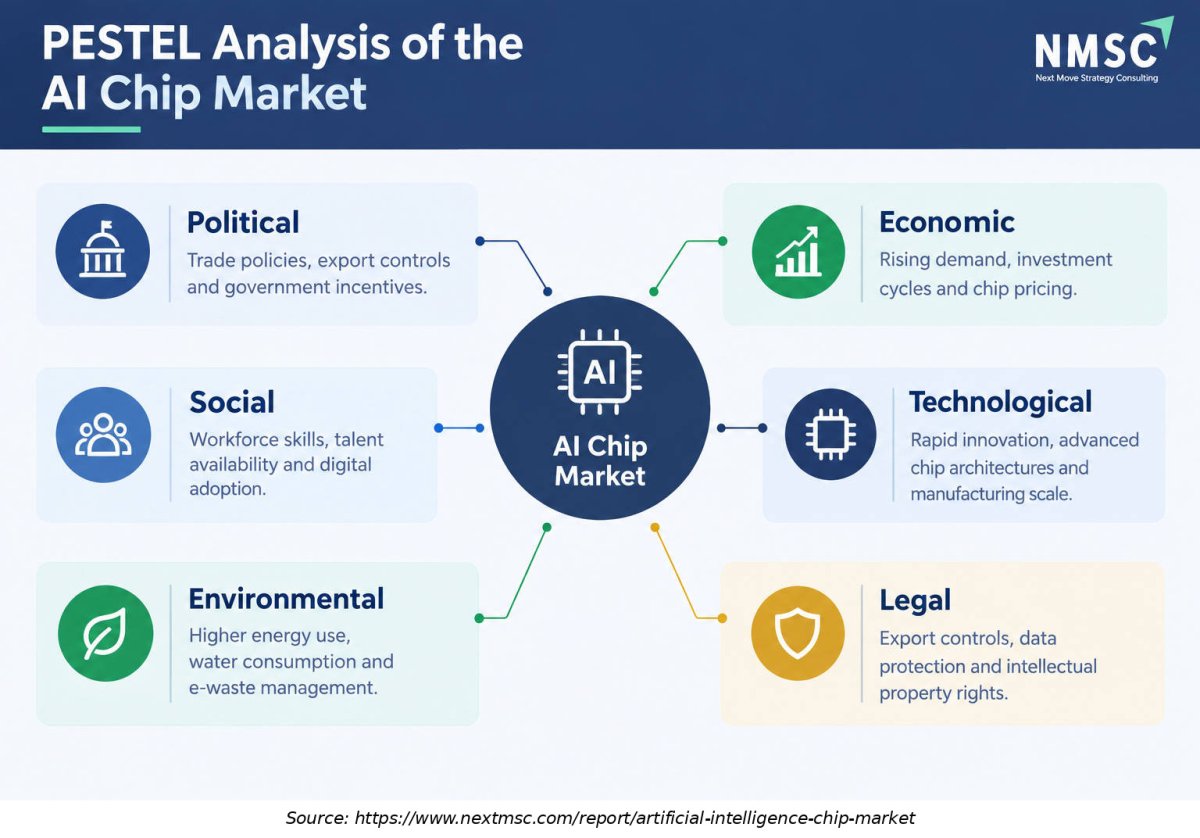
The infographic examines the political, economic, social, technological, environmental, and legal factors influencing the AI Chip Market. It highlights the impact of export controls, investment trends, workforce availability, chip innovation, energy and water consumption, and intellectual property regulations, providing a structured overview of the external forces shaping industry competitiveness and long-term growth.

Key Benefits for Stakeholders

What Do Enterprise and Industry Leaders Gain?

Enterprises and cloud operators gain a segmented view of where to place workloads. The report sizes training at USD 150.18 Billion and inference at USD 150.18 Billion in 2026, and shows inference reaching USD 796.47 Billion by 2035. Our findings suggest that buyers can use these splits to time purchases between merchant GPUs and custom ASICs.

What Do Investors and Financial Analysts Gain?

Investors receive reconciled forecasts that sum to USD 1,137.82 Billion in 2035, with segment and regional CAGRs calculated consistently from 2026. The analysis identifies ASICs at 20.31% CAGR and Middle East & Africa at 19.38% CAGR as the fastest growing areas. We found that these figures help separate cyclical demand from structural shifts in the supplier base.

What Do Technology Vendors and Product Teams Gain?

Vendors and product teams gain a view of competitor roadmaps, including annual cadences at Huawei and Qualcomm, MTIA generations at Meta and 3nm designs at Microsoft and Amazon. The competitive analysis maps archetypes and differentiation themes, which helps teams prioritize memory bandwidth, interconnect and software investments. NMSC's analysis indicates that edge and inference products offer the widest unserved demand.

Key Market Segments Evaluated

By Chip Type

  • GPU
  • ASIC
  • CPU
  • FPGA

By Function

  • Training
  • Inference

By Deployment

  • Cloud and data center
  • Edge

By Region

  • North America 
    • U.S.
    • Canada
    • Mexico
  • Europe 
    • UK
    • Germany
    • France
    • Italy
    • Spain
    • Sweden
    • Denmark
    • Finland
    • Netherlands
    • Rest of Europe
  • Asia-Pacific 
    • China
    • India
    • Japan
    • South Korea
    • Taiwan
    • Indonesia
    • Vietnam
    • Australia
    • Philippines
    • Malaysia
    • Rest of APAC
  • Middle East & Africa 
    • Saudi Arabia
    • UAE
    • Egypt
    • Israel
    • Turkey
    • Nigeria
    • South Africa
    • Rest of MEA
  • Latin America 
    • Brazil
    • Argentina
    • Chile
    • Colombia
    • Rest of LATAM

Conclusion & Recommendations

The market is forecast to grow from USD 207.30 Billion in 2025 to USD 1,137.82 Billion by 2035, a 15.95% CAGR over 2026 to 2035. Our analysis shows growth shifting from training clusters to inference fleets and from merchant GPUs toward custom ASICs, with Asia Pacific overtaking North America by the end of the period. Annual product cadences and gigawatt scale commitments support the trajectory.

What Strategic Positioning Recommendations Does NMSC Offer?

NMSC recommends that chip vendors pair silicon with networking, software and rack integration, since buyers now purchase systems. Hyperscalers should keep a portfolio of merchant and custom parts to manage supply risk. Smaller vendors should target inference, edge and sovereign niches where cost per token and local supply matter more than peak training performance.

What Is the Investment Attractiveness of the AI Chip Market?

Attractiveness is high but concentrated. The USD 837.46 Billion opportunity between 2026 and 2035 favors vendors with signed capacity agreements, such as AMD with Anthropic and Cerebras with OpenAI. We observed that custom ASIC enablers and inference specialists offer the strongest growth, while merchant GPU leaders offer scale and margin. Valuation discipline matters because demand depends on a limited set of large buyers.

What Are the Market Shifts and Key Risks for the AI Chip Market?

Key shifts include the rise of inference, the spread of rack scale systems and the growth of domestic suppliers in China. Key risks include export policy changes, memory and packaging shortages, and grid constraints on new data centers. Customer concentration is a further risk, because a few cloud and AI lab buyers account for most orders. Our assessment indicates that supply and power, not demand, are the likeliest limits to growth.

What Are the Primary Growth Pathways Through 2035?

Three pathways stand out. Custom ASICs grow from USD 99.12 Billion in 2026 to USD 523.40 Billion by 2035, inference grows at 20.37% CAGR, and edge deployments grow at 21.63% CAGR. Sovereign programs in the Gulf and India add regional upside. We found that vendors aligned with at least two pathways are best placed to outgrow the market.

FAQs

Sources & References

1.

NVIDIA Newsroom: Fiscal Q2 2027 Financial Results

nvidianews.nvidia.com
2.

AMD Investor Relations: Second Quarter 2026 Financial Results

ir.amd.com
3.

Broadcom Form 8-K, Exhibit 99.1 (SEC)

sec.gov
4.

Marvell Investor Relations: Second Quarter Fiscal 2027 Results

investor.marvell.com
5.

Google Cloud Blog: Ironwood TPU

blog.google
6.

Amazon: Trainium3 UltraServers Now Available

aboutamazon.com
7.

Microsoft Source: Introducing Maia 200

news.microsoft.com
8.

Meta: Expanding Meta's Custom Silicon

about.fb.com
9.

Meta: Partnership with Broadcom on Custom AI Silicon

about.fb.com
10.

Huawei: Huawei Connect 2026 Keynote

huawei.com
11.

Alibaba Group: Zhenwu M890 AI Chip Announcement

alibabagroup.com
12.

Baidu Investor Relations: Fourth Quarter and Fiscal Year 2025 Results

ir.baidu.com
13.

Cerebras Investor Relations: First Quarter 2026 Results

investors.cerebras.ai
14.

Qualcomm: Dragonfly Data Center Roadmap

qualcomm.com
15.

Qualcomm: HUMAIN and Qualcomm Saudi Arabia Deployment

qualcomm.com
16.

Intel Newsroom

intel.com
17.

Samsung Electronics: Second Quarter 2026 Results

news.samsung.com
18.

International Energy Agency: Energy and AI

iea.org
19.

World Semiconductor Trade Statistics: Spring 2026 Forecast

wsts.org
20.

U.S. Federal Register: Revision to License Review Policy for Advanced Computing Commodities

federalregister.gov

About the Author

Mihul Sharma

Mihul Sharma

Mihul Sharma is Research Associate at Next Move Strategy Consulting, where he has covered technology, industrial, and healthcare markets for 3 years. His work applies structured business research, market analysis, and secondary-source review to assess market trends, competitive developments, and growth opportunities. He supports report development by fully synthesizing industry data, company information, and market signals into concise findings for strategy and investment-focused research teams.

About the Reviewer

Supradip Baul

Supradip Baul

Supradip Baul is an accomplished business consultant and strategist with over a decade of rich experience in market intelligence, strategy, technology, and business transformation. His work has included rigorous qualitative and quantitative analysis across multiple industries, helping clients shape investment decisions and long-term roadmaps. Earlier in his career, he was associated with Gartner, where he contributed to industry-leading reports and market share analyses. He has worked with leading global companies and holds an MBA with a dual specialization in Marketing and Finance.

Robert Sean Trevino

ROBERT SEAN TREVINO

Sr. Director, Head of Strategic Insights & Analytics

Foundation Medicine

I realized that it was a reliable source of information. These days, there are many people who are looking for authentic data, and this is one of the only sources that can offer them with what they need;

Kevin Coker

KEVIN COKER

Founder, CEO and Board Diector

Proxima Clinical Research

I have been using Next MSC reports for product positioning in a new geography for a long time. They have by far the best reports I have found and the price is reasonable too!

Gaurav Jaiswal

GAURAV JAISWAL

Founder & CEO

Yano Charge Private Limited

The EV Charging market research report provided by the NextMSC was exceptionally detailed and insightful. It offered a comprehensive analysis that proved to be a game-changer for our strategic planning. Truly a testament to the NextMSC’s expertise and thoroughness in EV market landscape & analysis.

Gustaf Hummel Burstrom

GUSTAF HUMMEL BURSTROM

Founder

Revline Tools AB

Joseph and the team at Next Move Strategy Consulting have been excellent to work with, in supplying us with relevant market data and forecasts for our specific category. We had some special requirements and they were able to do a custom package to suit our needs. We would definitely recommend them to any other company needing market data and forecasts

Ross J Mckenzie

ROSS J MCKENZIE

Business Insight Manager

Staysure Group

“Next MSC have been incredibly helpful in providing detailed & robust information on our market, alongside quantifying growth by different segments. The process to procure was simple and easy, with sample reports and regular contact to ensure we had what we needed. Succinct detail on their sources & methodologies is also greatly received, allowing transparency in this respect helps build trust in the detail you pay for. Joseph in particular was fantastic, and helped ensure efficient provision of the insight pack – thank you NMSC!”.

Custom Market Research Services

We will customize the research for you if the listed report does not fully match your requirements.

Get 30% Free Customization

Select License

This website uses cookies to ensure you get the best experience on our website. Learn more

✖