Autonomous Navigation AI Market What Is the Autonomous Navigation AI Market Size?

Analysis of the global autonomous navigation AI market, covering market size, growth drivers, restraints, opportunities, segmentation, regional outlook, competitive landscape, and key players.

Download Free Sample PDF
Base Year (2025)
$3.4 Billion
Forecast (2035)
$28.6 Billion
CAGR (2026-2035)
23.7%
Top Region
North America

Market Size & Forecast - Autonomous Navigation AI Market

Global Revenue Forecast

Values in USD Billion

2025 $3.4 Billion
2025
2026 $4.2 Billion
2026
2027 $5.2 Billion
2027
2028 $6.4 Billion
2028
2029 $8.0 Billion
2029
2030 $9.8 Billion
2030
2031 $12.2 Billion
2031
2032 $15.1 Billion
2032
2033 $18.6 Billion
2033
2034 $23.1 Billion
2034
2035 $28.6 Billion
2035

Market Overview - Autonomous Navigation AI Market

The global autonomous navigation AI market, encompassing software, hardware, and services for ground vehicles, aerial systems, marine vessels, spacecraft, and weapon systems, was valued at USD 3.41 billion in 2025. It is projected to reach USD 28.61 billion by 2035, exhibiting a robust Compound Annual Growth Rate (CAGR) of 23.7% from 2026 to 2035. This market enables systems to perceive environments, localize position, plan paths, and execute motion control without continuous human intervention, spanning SAE Levels 1 through 5.

Structurally, the market has evolved from rule-based advanced driver-assistance systems (ADAS) towards end-to-end neural network stacks, capable of reasoning through complex and rare driving scenarios. This shift is exemplified by innovations like NVIDIA's Alpamayo model family. Regulatory frameworks, such as the U.S. NHTSA's Automated Vehicle Framework and SAE International's J3016 taxonomy, continue to shape commercial deployment pathways, with technology adoption most advanced in commercial robotaxi and long-haul trucking applications in North America.

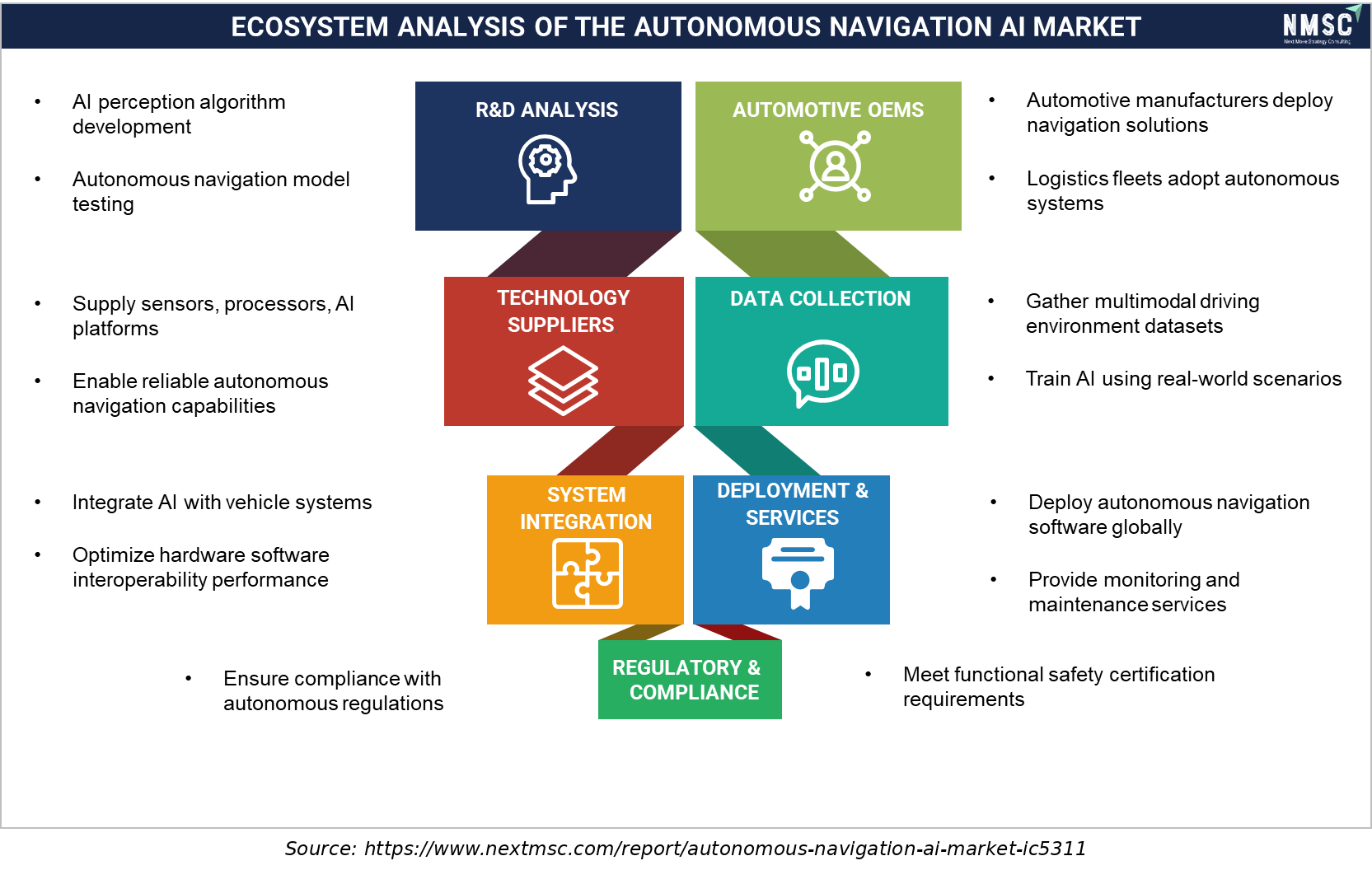
An ecosystem analysis reveals a complex interplay of R&D, technology suppliers, system integration, data collection, deployment, and regulatory compliance. AI perception algorithms and autonomous models are developed and tested, supported by sensors, processors, and AI platforms. Multimodal driving data is crucial for training AI models, while functional safety certifications ensure responsible deployment. Automotive OEMs and logistics fleets are key adopters, relying on deployment services and monitoring for system reliability. The market presents a significant absolute dollar opportunity of approximately USD 24.39 billion between 2026 and 2035, favoring vendors scaling software-defined perception and planning stacks.

Key Takeaways

The global autonomous navigation AI market is projected to grow from USD 3.41 billion in 2025 to USD 28.61 billion by 2035, at a CAGR of 23.7%.

North America held the largest revenue share in 2025, approximately 38%, driven by commercial robotaxi and long-haul trucking applications.

The Ground platform segment dominated the market with roughly 62% share in 2025, valued at USD 2.11 billion.

Software commands the largest component share at approximately 48% in 2025 (USD 1.64 billion) and is the fastest-growing component segment at a 24.7% CAGR.

Assisted Navigation (SAE Levels 1 and 2) leads autonomy-level segmentation with 40% share in 2025 (USD 1.36 billion).

Fully Autonomous Navigation is the fastest-growing autonomy-level segment, with a CAGR of 35.3%.

Weapon Systems and Space platforms are the fastest-growing segments by platform, both at a 27.3% CAGR.

The Middle East & Africa region is the fastest-growing globally, projected at a 26.8% CAGR.

End-to-end neural network architectures are transforming autonomy stacks, enabling unified, learned reasoning models for complex scenarios.

Level 4 robotaxi services are accelerating commercial validation and improving training-data quality for perception and planning models.

Hybrid edge-cloud compute architectures are becoming the default deployment model, balancing latency and continuous learning needs.

Fragmented regulation and high sensor/compute costs at higher autonomy levels remain key restraints to market growth.

Ecosystem Analysis of the Autonomous Navigation AI Market

The Autonomous Navigation AI Market ecosystem is built on coordinated value chains across technology developers, component manufacturers, software integrators, investors, and end users to scale commercial adoption.

R&D Analysis

  • AI perception algorithm development
  • Autonomous navigation model testing

Automotive OEMs

  • Automotive manufacturers deploy navigation solutions
  • Logistics fleets adopt autonomous systems

Technology Suppliers

  • Supply sensors, processors, AI platforms
  • Enable reliable autonomous navigation capabilities

Data Collection

  • Gather multimodal driving environment datasets
  • Train AI using real-world scenarios

System Integration

  • Integrate AI with vehicle systems
  • Optimize hardware software interoperability performance

Deployment & Services

  • Deploy autonomous navigation software globally
  • Provide monitoring and maintenance services

Regulatory & Compliance

  • Ensure compliance with autonomous regulations
  • Meet functional safety certification requirements

SWOT Analysis - Autonomous Navigation AI Market

This SWOT view highlights structural strengths, strategic gaps, expansion headroom, and external risks shaping outcomes in the Autonomous Navigation AI Market.

Strengths

Strong market growth driven by commercial Level 4 robotaxi and autonomous freight scaling; increasing defense budgets for uncrewed systems; advancements in end-to-end neural networks and physical AI; supportive regulatory frameworks in key regions like the U.S.; significant investment in AI compute infrastructure.

Weaknesses

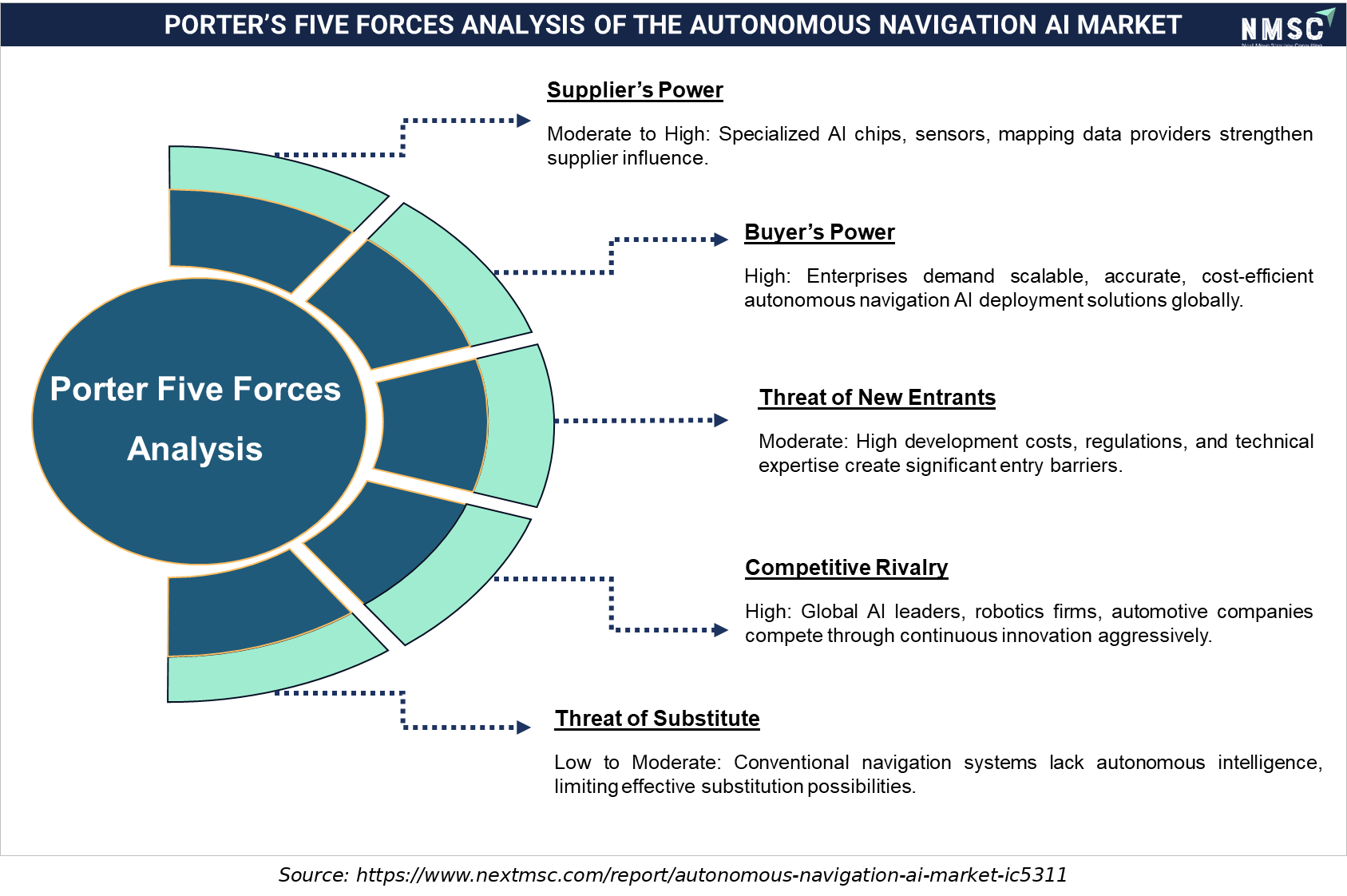
Fragmented regulation across states and countries hindering uniform commercial deployment; high sensor and compute bill-of-materials costs for Level 4 and Level 5 autonomy, constraining adoption for cost-sensitive operators; reliance on specialized AI chips and mapping data providers leading to moderate to high supplier power.

Opportunities

Absolute dollar opportunity of USD 24.39 billion between 2026 and 2035; potential for vendors to capture value from reusable foundation models through licensing; cross-sector hardware reuse (automotive to defense/industrial) accelerating development cycles; expanding warehouse and last-mile automation driving autonomous mobile robot fleet scaling; rapid growth in emerging regions like Middle East & Africa and India.

Threats

Regulatory uncertainty and potential for withdrawal of national frameworks (e.g., NHTSA's AV STEP); public-trust risks following high-profile safety incidents; intense competitive rivalry among global AI leaders, robotics firms, and automotive companies; high development costs and regulatory requirements posing barriers to new entrants; potential for conventional navigation systems to limit effective substitution, though currently low to moderate.

Market Drivers & Dynamics - Autonomous Navigation AI Market

Interactive Dataset
Commercial Level 4 Robotaxi and Autonomous Freight Scaling driver Driver Global, particularly North America
Rising Defense Budgets for Uncrewed and Autonomous Systems driver Driver NATO member states, Asia-Pacific
NHTSA's Supportive Automated Vehicle Exemption Program driver Driver U.S.
Dual-Use AI Computing Platforms driver Driver Global
Fragmented Regulation Across States and Countries restraint Restraint Global
High Sensor and Compute Bill-of-Materials Costs restraint Restraint Global
Reusable Foundation Models for Autonomy Software Licensing opportunity Opportunity Global
Cross-Sector Hardware Reuse (Commercial Automotive to Defense/Industrial) opportunity Opportunity Global
Autonomous Mobile Robot Fleet Scaling in Logistics opportunity Opportunity Global
Source: Next Move Strategy Consulting

What Is the Primary Growth Driver of the Autonomous Navigation AI Market?

Commercial Level 4 Robotaxi and Autonomous Freight Scaling

The scaling of commercial Level 4 robotaxi and autonomous freight services is the single largest driver of market revenue. Validated deployment mileage directly funds further model training and compute investment. Regulatory clarity, such as NHTSA's Automated Vehicle Exemption Program, is accelerating capital commitments from automotive OEMs and dedicated autonomy developers.

Rising Defense Budgets for Uncrewed and Autonomous Systems

Increasing defense budgets allocated to uncrewed and autonomous systems are significantly driving the Weapon Systems and Defense Air Systems segments, which are projected to grow at a 27.3% CAGR. Government agencies across civilian and defense domains are actively removing barriers to autonomous system deployment, with dual-use AI computing platforms increasingly shared between commercial automotive and defense navigation programs.

What Is Restraining Autonomous Navigation AI Market Growth?

Fragmented Regulation Across States and Countries

Fragmented regulation across different states and countries hinders uniform commercial deployment. NHTSA's withdrawal of its proposed AV STEP national framework in favor of narrower rulemaking on specific safety standards reflects this challenge, creating inconsistencies that restrain widespread adoption.

High Sensor and Compute Bill-of-Materials Costs

The high bill-of-materials costs for sensors and compute at Level 4 and Level 5 autonomy levels constrain adoption, particularly among cost-sensitive commercial fleet operators. These pressures disproportionately affect smaller autonomy developers who lack the financial scale of automotive OEM-backed competitors.

Growth Opportunities

Capturing Value from Reusable Foundation Models

Open, reusable reasoning models, such as NVIDIA's Alpamayo family, create a mechanism for smaller automakers and Tier 1 suppliers to license production-grade autonomy software instead of building proprietary stacks. This licensing-driven democratization of Level 2+ and Level 4 capabilities benefits mid-tier automotive OEMs and software-defined vehicle platform vendors.

Accelerating Defense Development through Cross-Sector Hardware Reuse

Compute architectures originally engineered for commercial automotive autonomy, including edge AI modules capable of over 1,000 INT8 TOPS, enable defense contractors to accelerate uncrewed ground and aerial system development without duplicating silicon R&D. Defense electronics integrators and dual-use AI computing vendors are primary beneficiaries of this cross-sector hardware reuse opportunity.

Benefits from Autonomous Mobile Robot Fleet Scaling in Logistics

The expansion of warehouse and last-mile automation creates an opportunity for logistics operators to achieve labor-cost savings through autonomous mobile robot fleets coordinated by centralized fleet-management software. Third-party logistics providers and warehouse automation integrators are well-positioned to capitalize on this as e-commerce volume drives fulfillment-center throughput requirements.

Segmentation Analysis - Autonomous Navigation AI Market

Which Platform Dominates the Autonomous Navigation AI Market?

2025 (USD Billion)
2035 (USD Billion)
Ground 2025: $2.1 Billion | 2035: $16.2 Billion
Ground
Weapon Systems 2025: $0.4 Billion | 2035: $4.8 Billion
Weapon Syste
Space 2025: $0.3 Billion | 2035: $3.7 Billion
Space
Air 2025: $0.2 Billion | 2035: $1.9 Billion
Air
Marine 2025: $0.2 Billion | 2035: $1.9 Billion
Marine
Ground $2.1 Billion $16.2 Billion 25.2%
Weapon Systems $0.4 Billion $4.8 Billion 25.2%
Space $0.3 Billion $3.7 Billion 25.2%
Air $0.2 Billion $1.9 Billion 25.2%
Marine $0.2 Billion $1.9 Billion 25.2%

Ground Platform Dominance

The Ground platform dominates the autonomous navigation AI market, holding approximately 62% share in 2025 with a value of USD 2.11 billion. This reflects the extensive deployment of autonomous technologies in passenger vehicles, commercial trucking, and mobile robots compared to other platforms.

Fastest-Growing Platforms

Weapon Systems and Space platforms are identified as the fastest-growing segments, both projected at a 27.3% CAGR from 2026 to 2035. This growth is primarily fueled by expanding defense budgets for applications like loitering munitions and autonomous spacecraft navigation among NATO member states and major space agencies.

Which Component Segment Is Growing Fastest?

2025 (USD Billion)
2035 (USD Billion)
Software 2025: $1.6 Billion | 2035: $14.6 Billion
Software
Hardware 2025: $1.0 Billion | 2035: $8.1 Billion
Hardware
Services 2025: $0.7 Billion | 2035: $5.9 Billion
Services
Software $1.6 Billion $14.6 Billion 23.8%
Hardware $1.0 Billion $8.1 Billion 23.8%
Services $0.7 Billion $5.9 Billion 23.8%

Software Dominance and Growth

Software holds the largest component share, accounting for approximately 48% of the market in 2025, valued at USD 1.64 billion. This dominance stems from perception, path planning, and decision-making algorithms being the primary source of competitive differentiation. Software is also the fastest-growing component segment, with a CAGR of 24.7% from 2026 to 2035, as vendors increasingly license reusable software stacks across multiple hardware platforms.

Which Autonomy Level Segment Leads the Market?

2025 (USD Billion)
2035 (USD Billion)
Assisted Navigation 2025: $1.4 Billion | 2035: $9.5 Billion
Assisted Nav
Fully Autonomous Navigation 2025: $0.5 Billion | 2035: $8.6 Billion
Fully Autono
Semi-Autonomous Navigation 2025: $0.8 Billion | 2035: $5.6 Billion
Semi-Autonom
Highly Autonomous Navigation 2025: $0.7 Billion | 2035: $4.9 Billion
Highly Auton
Assisted Navigation $1.4 Billion $9.5 Billion 21.5%
Fully Autonomous Navigation $0.5 Billion $8.6 Billion 21.5%
Semi-Autonomous Navigation $0.8 Billion $5.6 Billion 21.5%
Highly Autonomous Navigation $0.7 Billion $4.9 Billion 21.5%

Assisted Navigation Market Leadership

Assisted Navigation, encompassing SAE Levels 1 and 2 driver-assistance systems, leads the autonomy-level segmentation with approximately 40% share in 2025, valued at USD 1.36 billion. This reflects its continued widespread adoption across the global passenger vehicle fleet.

Fully Autonomous Navigation as Fastest Growing

Fully Autonomous Navigation (SAE Level 5) is the fastest-growing segment, projected at a 35.3% CAGR. This growth is propelled by significant milestones such as Waymo surpassing 20 million lifetime autonomous rides by December 2025 and the continued expansion of Level 4 fleets by robotaxi operators in North America and China.

Which End-User Segment is Driving Growth?

2025 (USD Billion)
2035 (USD Billion)
Automotive 2025: $1.4 Billion | 2035: $11.1 Billion
Automotive
Logistics 2025: $0.7 Billion | 2035: $5.5 Billion
Logistics
Defense 2025: $0.5 Billion | 2035: $5.0 Billion
Defense
Manufacturing 2025: $0.3 Billion | 2035: $2.8 Billion
Manufacturin
Others 2025: $0.5 Billion | 2035: $4.2 Billion
Others
Automotive $1.4 Billion $11.1 Billion 23.7%
Logistics $0.7 Billion $5.5 Billion 23.7%
Defense $0.5 Billion $5.0 Billion 23.7%
Manufacturing $0.3 Billion $2.8 Billion 23.7%
Others $0.5 Billion $4.2 Billion 23.7%

Automotive and Logistics Lead Adoption

The Automotive and Logistics sectors represent significant end-user segments, with substantial adoption of autonomous navigation AI for passenger vehicles, commercial trucking, and warehouse automation. These sectors are key drivers of market demand, leveraging autonomy for efficiency and safety improvements.

Defense Sector's Accelerated Growth

The Defense end-user segment is experiencing accelerated growth, with a projected CAGR of 26.0%. This is driven by increasing defense budgets allocated to uncrewed and autonomous systems, including ground vehicles, aerial systems, and weapon platforms, across various NATO member states and other regions.

Regional Outlook - Autonomous Navigation AI Market

North America $1.3 Billion $10.0 Billion 22.6%
Europe $0.7 Billion $5.3 Billion 22.4%
Asia-Pacific $1.1 Billion $10.9 Billion 25.8%
Middle East & Africa $0.2 Billion $1.5 Billion 22.3%
Latin America $0.1 Billion $0.9 Billion 24.6%

Competitive Landscape - Autonomous Navigation AI Market

How Do Companies Compete in the Autonomous Navigation AI Market?

Companies primarily compete on the strength of their model reasoning capability, the extent of their real-world deployment mileage, compute efficiency, and their safety-validation track record accumulated across millions of autonomous miles. NVIDIA and Mobileye emphasize compute platform breadth and OEM partnership depth, while Waymo and Aurora focus on validated deployment scale. Defense-focused entrants like Anduril Industries and Shield AI compete on uncrewed system integration expertise.

Which Competitive Archetypes Dominate the Autonomous Navigation AI Market?

Two main archetypes dominate the market: horizontal AI compute and software platform providers, who license reusable autonomy stacks across multiple OEMs, and vertically integrated full-stack operators, who run proprietary fleets. NVIDIA exemplifies the horizontal platform archetype with its DRIVE Hyperion ecosystem, while Waymo represents the vertically integrated operator archetype through its self-operated robotaxi fleet and proprietary sensor-to-software stack.

How Are Companies Differentiating Through Innovation?

Innovation and differentiation increasingly revolve around reasoning-capable, end-to-end neural network models that can explain driving decisions, moving beyond black-box outputs. NVIDIA's Alpamayo open model family and Kodiak AI's deployment of DRIVE AGX Thor edge compute in driverless Class 8 trucking illustrate how manufacturers are embedding proprietary reasoning capability directly into commercially deployed hardware to build platform lock-in and enhance trust.


What M&A and Expansion Activity Is Shaping the Autonomous Navigation AI Market?

Expansion activity in the autonomous navigation AI market is primarily concentrated in platform partnerships and geographic scaling, rather than large-format acquisitions. Examples include NVIDIA's partnership with Uber to scale a 100,000-vehicle autonomous fleet and the integration of Stellantis, Lucid, and Mercedes-Benz into the DRIVE AGX Hyperion 10 ecosystem. This trend shows compute platform vendors embedding themselves across multiple OEM programs simultaneously, rather than pursuing vertical consolidation.

Key Market Players

NVIDIA Corporation Mobileye Global Inc. Waymo LLC Tesla, Inc. Baidu, Inc. Aurora Innovation, Inc. Pony AI Inc. WeRide Inc. Momenta Wayve Technologies Ltd. Applied Intuition, Inc. Kodiak Robotics, Inc. Nuro, Inc. Shield AI, Inc. Anduril Industries, Inc. Hexagon AB Thales S.A. Rheinmetall AG Saab AB

Conclusion & Recommendations - Autonomous Navigation AI Market

Vendors should prioritize developing reusable, licensable software stacks and dual-use hardware platforms capable of serving both commercial and defense customers. Maintaining validated safety-deployment track records is crucial for market acceptance and regulatory approval.

Invest in End-to-End Reasoning Models and Hybrid Architectures

Developers should invest early in end-to-end reasoning models and edge-cloud hybrid architectures. This strategic positioning will enable them to capture premium platform-licensing revenue and retain access to policy-supported commercial deployment channels, driving Level 4 and Level 5 commercialization.

Monitor Regulatory Fragmentation and Cost Pressures

Stakeholders must closely monitor regulatory fragmentation, particularly following NHTSA's withdrawal of the proposed AV STEP national framework. High sensor and compute bill-of-materials costs at Level 4 and Level 5, along with public-trust risks from safety incidents, are key challenges that require proactive management and transparent safety data.

Expand into Industrial and Logistics Autonomous Mobile Robot Deployment

Key growth pathways include deepening penetration into industrial and logistics autonomous mobile robot deployment. Scaling reusable end-to-end reasoning models across multiple OEM and fleet-operator partnerships, and expanding dual-use defense-commercial compute platforms, will be critical for capturing projected market growth through 2035.

Expert Insights - Autonomous Navigation AI Market

Jensen Huang

Jensen Huang

CEO | NVIDIA

"Alpamayo is the moment cars begin to safely reason, not just drive. Only NVIDIA makes available open models, simulation, real-world data and agent skills so the entire global robotaxi ecosystem can develop level 4 capabilities that understand edge cases, explain decisions, earn trust and scale safely to millions of vehicles."

Analyst Interpretation

This statement highlights the critical evolution of AI-powered autonomous navigation from simple trajectory generation to systems capable of reasoning about complex environments and making informed decisions. It underscores the industry's shift towards AI systems that can interpret road conditions, evaluate actions, and navigate safely through unpredictable real-world scenarios, fostering trust and enabling large-scale Level 4 deployment.

About the Author

Author

Tushmi Dutta is a focused researcher specializing in detailed analysis and insight-driven research across diverse business landscapes. She supports strategic initiatives through structured data interpretation, thorough validation, and clear communication of findings that aid informed decision-making. With a strong interest in writing, she enjoys presenting research insights in an engaging and accessible manner. Beyond work, she enjoys traveling, reading, painting, and continuously learning new skills that contribute to her creative and professional growth.

About the Reviewer

Reviewer

Supradip Baul is an accomplished business consultant and strategist with over a decade of rich experience in market intelligence, strategy, technology, and business transformation. His work has included rigorous qualitative and quantitative analysis across multiple industries, helping clients shape investment decisions and long-term roadmaps. Earlier in his career, he was associated with Gartner, where he contributed to industry-leading reports and market share analyses. He has worked with leading global companies and holds an MBA with a dual specialization in Marketing and Finance.

Download Free Sample

FAQs - Autonomous Navigation AI Market

Kevin Coker

KEVIN COKER

Founder, CEO and Board Diector

Proxima Clinical Research

I have been using Next MSC reports for product positioning in a new geography for a long time. They have by far the best reports I have found and the price is reasonable too!

Ross J Mckenzie

ROSS J MCKENZIE

Business Insight Manager

Staysure Group

“Next MSC have been incredibly helpful in providing detailed & robust information on our market, alongside quantifying growth by different segments. The process to procure was simple and easy, with sample reports and regular contact to ensure we had what we needed. Succinct detail on their sources & methodologies is also greatly received, allowing transparency in this respect helps build trust in the detail you pay for. Joseph in particular was fantastic, and helped ensure efficient provision of the insight pack – thank you NMSC!”.

Diana Trejo

DIANA TREJO

Assistant Manager

Sumitomo Corporation de Mexico, S.A. de C.V.

Recently, we purchased a report on the Mexico Data Center Market from Next Move Strategy Consulting. The service has been excellent, with support that is always timely and thoroughly professional. The information provided is interesting, highly useful, and delivered with clarity. I would highly recommend NextMSC for anyone seeking insightful and dependable analysis.

Kishu Kanda

KISHU KANDA

Strategy Analyst

Accenture

We purchased the AI Consumer Market Report from this company. Not only did they customize the report to meet our specific requirements, but they also showed great flexibility in accommodating our budget. The report we received fully met our expectations. Additionally, they provided prompt and thorough responses to both our pre-purchase and follow-up questions. We look forward to working with this company again in the future.

Henri Knyphausen

HENRI KNYPHAUSEN

Partner at Singulier [Ex-BCG]

Singulier

I recently engaged NEXTMSC.com for a commercial due diligence project within the intralogistics sector, and I am pleased to provide a reference based on my experience. In utilizing NEXTMSC.com's services, I found their report to offer valuable insights into market dynamics and key industry players. The initial report provided a solid foundation for our analysis. However, as we were investigating a smaller target in the market, and I had specific customization requests requiring additional research. These requests included detailed information on product portfolios of various players and sub-market sizes, both inclusive and exclusive of certain product categories. NEXTMSC.com demonstrated commendable responsiveness and agility in accommodating these customization requests. Within a timeframe of 1-2 weeks, they delivered a revised report that met our specific needs. Furthermore, they were receptive to my follow-up inquiries, ensuring clarity and understanding of the data provided. The final deliverable significantly contributed to our due diligence efforts. One of NEXTMSC.com's notable strengths lies in their qualitative research capabilities. However, for future engagements, I would recommend the inclusion of a quantified market model in Excel format. Such a model would offer the ability to conduct in-depth analyses and explore various market segments, including country-specific data and subcomponent breakdowns. Based on my positive experience, I would not hesitate to work with NEXTMSC.com again. Their responsiveness, willingness to accommodate customization requests, and commitment to delivering actionable insights make them a reliable partner for commercial research projects.

Custom Market Research Services - Autonomous Navigation AI Market

We will customize the research for you if the listed report does not fully match your requirements.

Get 30% Free Customization

Select License

This website uses cookies to ensure you get the best experience on our website. Learn more