AI Autonomous Navigation Market Size, Share & Forecast By Platform (Land, Air, Marine, and Other Platforms), By Solution (Hardware Software and Services), By Autonomy Level (Assisted, Supervised Autonomy, and others), By Buyer Type (OEM, Tier 1 Supplier, Fleet Operator, Government and Defense, System Integrator, and Others), By Sales Channel (Direct, Tier 1 Channel, Distributor, System Integrator Channel, and Online and Over-the-Air), and By End-Use Industry — Global Analysis 2025–2035
Industry: ICT & Media | Publishing Date: July 4, 2026 | Last Updated: September 30, 2026 | No of Pages: N/A | No. of Tables: N/A | No. of Figures: N/A | Format: PDF | Report Code: IC4941
AI Autonomous Navigation Market
What Is the AI Autonomous Navigation Market Size?
The global AI Autonomous Navigation Market was valued at USD 5.2 billion in 2025 and is projected to reach USD 6.2 billion in 2026. Accelerating adoption of autonomous systems across automotive, defense, logistics, and UAV sectors is expected to propel the market to USD 33.8 billion by 2035, advancing at a CAGR of 20.6% from 2026 to 2035. Key growth drivers include the widespread deployment of AI-powered sensor fusion algorithms, rising defense budgets globally, rapid commercialization of delivery drones, and the maturation of GNSS and LiDAR technology ecosystems.
|
Parameters |
Details |
|
Market Size in 2025 |
USD 5.2 Billion |
|
Market Size in 2026 |
USD 6.2 Billion |
|
Revenue Forecast in 2035 |
USD 33.8 Billion |
|
Growth Rate |
CAGR of 20.6% from 2026 to 2035 |
|
Analysis Period |
2025–2035 |
|
Base Year Considered |
2025 |
|
Forecast Period |
2026–2035 |
|
Market Size Estimation |
Billion USD |
|
Companies Profiled |
20 |
|
Countries Covered |
38 |
|
Market Share |
Top 10 |
AI Autonomous Navigation Market Overview
What Is the AI Autonomous Navigation Market?
The AI Autonomous Navigation Market encompasses the full technology ecosystem enabling vehicles, aerial systems, maritime platforms, and space assets to perceive their environment, determine their position, plan optimal routes, and execute movement with minimal or no human intervention. The market includes hardware such as GNSS receivers, inertial measurement units, LiDAR, radar, and camera arrays, along with software layers covering sensor fusion, simultaneous localization and mapping (SLAM), path planning, and AI-driven decision-making engines. Applications span passenger vehicles, commercial drones, autonomous underwater vehicles, agricultural robots, and guided munitions.
How Has the AI Autonomous Navigation Market Evolved?
The AI Autonomous Navigation Market has undergone transformative structural evolution across three distinct technology phases. The first phase focused on rule-based GPS-assisted guidance systems deployed in aviation and maritime sectors during the early 2000s. The second phase, driven by deep learning breakthroughs in the 2010s, introduced real-time perception and multi-sensor fusion, enabling rudimentary automotive ADAS deployments. NMSC's analysis indicates that the current phase is characterized by AI-native navigation stacks that integrate transformer-based perception models, edge computing platforms, and cloud-synchronized HD mapping into unified real-time autonomy systems applicable across all mobility verticals.
How Do Regulations Influence the AI Autonomous Navigation Market?
Regulatory frameworks are a defining structural force shaping investment patterns and go-to-market strategies across the AI Autonomous Navigation Market. The United Nations Economic Commission for Europe (UNECE) WP.29 regulation introduced binding international standards for Automated Lane Keeping Systems (ALKS) covering Level 3 autonomy. The U.S. Department of Transportation's Automated Vehicles Comprehensive Plan established federal guidelines for testing and deployment of autonomous vehicles on public roads. In Europe, the General Safety Regulation (EU) 2019/2144 mandated ADAS features including emergency braking and lane departure warning across all new vehicles from 2022, directly stimulating demand for AI navigation hardware and software components.
How Is Technology Adoption Expanding Across the AI Autonomous Navigation Market?
Technology adoption across the AI Autonomous Navigation Market is accelerating as the cost of key sensor components declines sharply and AI compute platforms achieve higher efficiency. Solid-state LiDAR average selling prices have declined by over 70% since 2020, enabling broader deployment across commercial vehicle and drone platforms. Through NMSC's assessment, we found that edge AI processors from NVIDIA, Qualcomm, and Mobileye now deliver the compute density required to run full navigation stacks on embedded platforms consuming under 10 watts. Simultaneously, over-the-air software update capabilities are enabling fleet operators to continuously improve navigation performance post-deployment, compressing the technology adoption lifecycle.
|
Key Takeaways |
|
By Platform, the Land segment dominated the AI Autonomous Navigation Market with USD 2.6 billion in 2025, driven by large-scale deployments in passenger vehicles, commercial trucks, and warehouse autonomous mobile robots across North America and Asia-Pacific. |
|
The Munitions segment is the fastest-growing platform in the AI Autonomous Navigation Market, projected to advance at a CAGR of approximately 25.0% from 2026 to 2035, reflecting surging global defense budgets and rapid deployment of loitering munitions and precision-guided systems. |
|
By Solution, Hardware dominated the AI Autonomous Navigation Market at USD 2.8 billion in 2025, with positioning sensors and perception sensors collectively representing the largest hardware sub-categories due to rising vehicle and drone sensor requirements. |
|
The Software segment is the fastest-growing solution type in the AI Autonomous Navigation Market, advancing at a CAGR of approximately 24.5% from 2026 to 2035, as AI-native navigation stacks, HD mapping, and fleet orchestration platforms gain rapid enterprise traction. |
|
By Autonomy Level, the Assisted segment held the largest market share at USD 1.6 billion in 2025, underpinned by regulatory mandates for ADAS across passenger vehicles and commercial aircraft globally. |
|
The Full Autonomy segment is the fastest-growing autonomy level in the AI Autonomous Navigation Market at an estimated CAGR of 30.1% from 2026 to 2035, propelled by advancing robotaxi deployments, fully autonomous warehouse robots, and long-range autonomous UAV programs. |
|
By Buyer Type, OEMs represented the dominant buyer category in the AI Autonomous Navigation Market at USD 1.8 billion in 2025, as automotive manufacturers accelerate integration of AI navigation stacks into next-generation vehicle architectures. |
|
Government and Defense buyers are the fastest-growing buyer type in the AI Autonomous Navigation Market at an estimated CAGR of 26.0%, driven by surging procurement of autonomous defense platforms, surveillance drones, and autonomous ground vehicles across NATO and Asia-Pacific defense programs. |
|
By Sales Channel, Direct sales dominated the AI Autonomous Navigation Market at USD 2.2 billion in 2025, reflecting the highly technical, application-specific nature of navigation system procurement across automotive OEMs, defense agencies, and large fleet operators. |
|
The Online and Over-the-Air (OTA) channel is the fastest-growing sales channel in the AI Autonomous Navigation Market at an estimated CAGR of 28.5% from 2026 to 2035, as software-defined navigation stacks enable continuous remote deployment and feature updates for vehicle and drone fleets. |
|
By End-Use Industry, the Automotive sector led the AI Autonomous Navigation Market at USD 1.5 billion in 2025, supported by widespread ADAS mandates, rising consumer demand for driver-assistance features, and OEM investment in Level 3 and Level 4 platform development. |
|
The Defense and Aerospace sector is the fastest-growing end-use industry in the AI Autonomous Navigation Market at an estimated CAGR of 22.0% from 2026 to 2035, driven by rapid proliferation of autonomous combat drones, unmanned ground vehicles, and precision-guided munitions worldwide. |
|
North America dominated the AI Autonomous Navigation Market at USD 2.0 billion in 2025 and is projected to reach USD 11.8 billion by 2035, supported by the presence of leading autonomous systems developers, robust defense spending, and a mature ADAS regulatory environment. |
|
Asia-Pacific is the fastest-growing region in the AI Autonomous Navigation Market at a CAGR of 22.9% from 2026 to 2035, propelled by China's intelligent vehicle mandates, India's rising drone infrastructure, and South Korea's and Japan's autonomous robotics ecosystems. |
|
The United States is the single largest country market in the AI Autonomous Navigation Market, underpinned by the presence of Waymo, NVIDIA, Mobileye, and major defense prime contractors, alongside the most advanced federal testing and commercialization framework for autonomous systems globally. |
|
Saudi Arabia is the largest country market in the Middle East and Africa AI Autonomous Navigation Market, driven by Vision 2030 initiatives, NEOM's autonomous mobility projects, and rising investments in defense modernization and AI-enabled transportation systems. |
Key Emerging Trends in the AI Autonomous Navigation Market
How Is AI-Native Sensor Fusion Reshaping the Capability Architecture of the AI Autonomous Navigation Market?
AI-native sensor fusion is fundamentally transforming navigation system architectures by replacing sequential processing pipelines with unified deep learning models that simultaneously process LiDAR point clouds, radar returns, camera frames, and IMU data. Our findings suggest that leading automotive Tier 1 suppliers, including Bosch and Continental, have transitioned to transformer-based perception architectures capable of processing heterogeneous sensor inputs in under 20 milliseconds. This shift dramatically improves object detection accuracy in adverse weather conditions and low-visibility environments, enabling more reliable navigation across a broader operational design domain for autonomous vehicles and aerial systems.
How Is the Rise of Neuromorphic Computing Influencing Navigation Efficiency in the AI Autonomous Navigation Market?
Neuromorphic computing platforms are emerging as a transformative trend in the AI Autonomous Navigation Market by enabling event-driven, ultra-low-power processing of navigation-relevant data streams. Intel's Loihi 2 and academic neuromorphic architectures are being evaluated for navigation tasks that require continuous, low-latency sensor processing in energy-constrained environments such as small drones and underwater vehicles. Through our market assessment, we observed that this technology trend is particularly impactful for military UAV programs where onboard compute power and thermal management are critical constraints limiting deployment endurance.
How Is Simultaneous Localization and Mapping (SLAM) Technology Evolving Within the AI Autonomous Navigation Market?
SLAM technology is undergoing a generational leap driven by the integration of AI and deep learning methods. Classical feature-based SLAM algorithms are being augmented with neural radiance field (NeRF) representations and semantic scene understanding, enabling navigation systems to build photorealistic 3D maps and localize within them with centimeter-level precision. Based on NMSC's research, we found that companies such as Trimble and Hexagon are deploying AI-enhanced SLAM solutions in construction and mining environments where GPS signals are unreliable, enabling autonomous earthmoving equipment to operate in structured subterranean environments with high precision.
How Is the Proliferation of 5G Connectivity Enhancing Cloud-Assisted Navigation in the AI Autonomous Navigation Market?
5G networks are enabling a hybrid navigation architecture in which onboard AI processing is complemented by cloud-hosted high-definition map updates, cooperative perception data from V2X infrastructure, and real-time traffic intelligence. Our analysis shows that Qualcomm's C-V2X chipsets, integrated with AI navigation software stacks, enable vehicles to receive centimeter-accurate differential GNSS corrections and hazard alerts from roadside units with sub-10-millisecond latency. This architecture reduces the onboard compute burden while enabling vehicles to collectively improve navigation safety, creating a new market opportunity for connectivity-integrated AI Autonomous Navigation Market solutions across smart city deployments.
PESTEL Analysis of the AI Autonomous Navigation Market
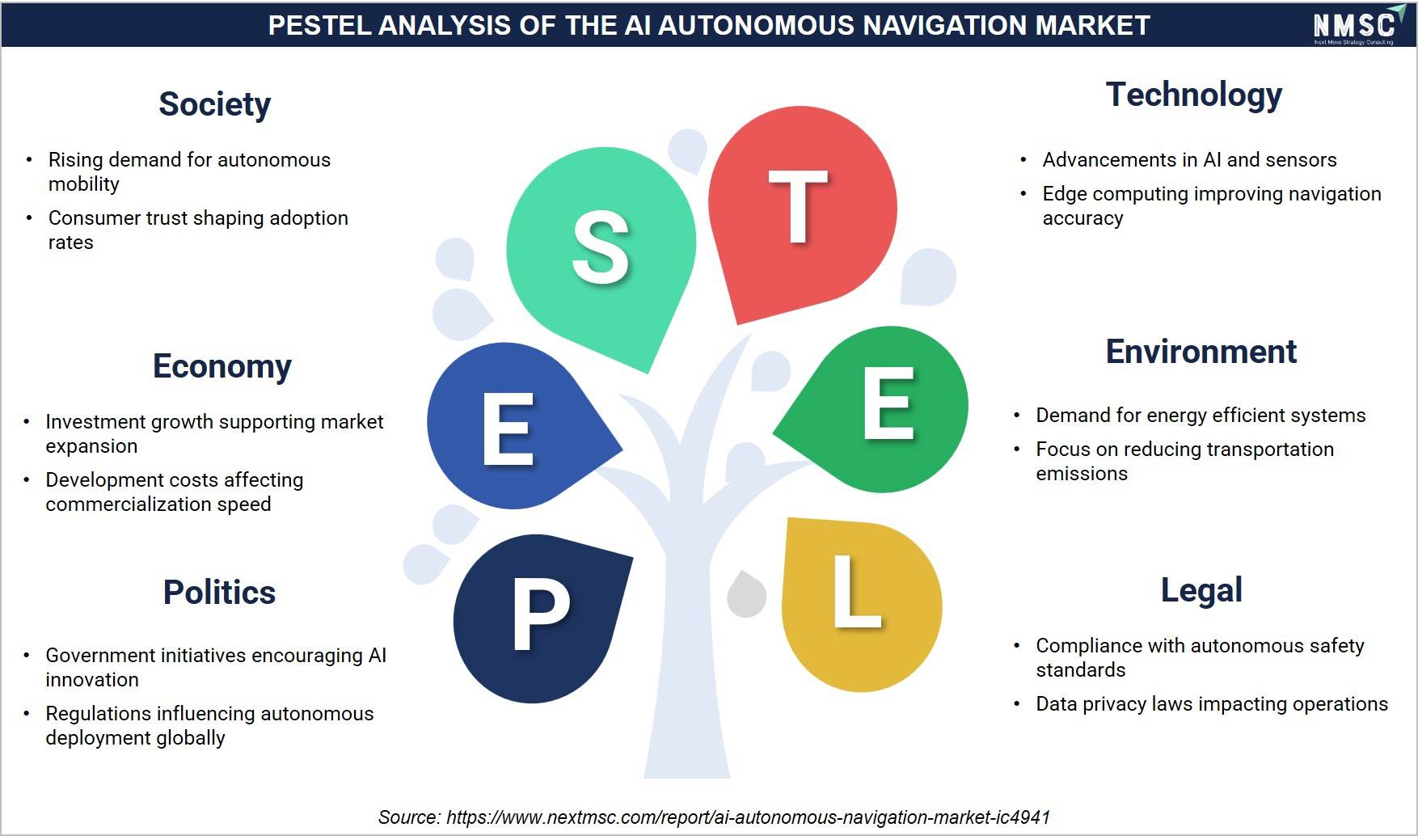
Based on our analysis, we found that the AI Autonomous Navigation Market is influenced by evolving political regulations, technological advancements, economic investments, environmental sustainability initiatives, legal compliance requirements, and growing societal acceptance of autonomous systems. Furthermore, rapid progress in AI, sensor technologies, and connectivity accelerates commercialization. We observed that supportive regulatory frameworks and increasing digital infrastructure investments continue strengthening long-term market growth.
What Are the Key Market Drivers, Breakthroughs, and Investment Opportunities that Will Shape the AI Autonomous Navigation Industry in the Next Decade?
|
Drivers / Trends / Restraints |
(+/-) % Impact on CAGR Forecast |
Geographic Relevance |
Impact Timeline |
|
Rapid Autonomous Vehicle Commercialization |
+2.4% |
Global (North America, APAC lead) |
2025–2032 |
|
Surging Defense UAV and UGV Programs |
+2.2% |
North America, Europe, MEA |
2025–2035 |
|
Proliferation of AMR and AGV in Logistics |
+1.9% |
APAC, North America, Europe |
2025–2030 |
|
AI and ML Integration in Navigation Stacks |
+1.7% |
Global |
2025–2035 |
|
Expansion of Autonomous Marine Systems |
+1.3% |
Europe, North America, APAC |
2026–2035 |
|
Rising Demand for Precision Agriculture Drones |
+1.2% |
APAC, North America, LATAM |
2026–2035 |
|
OTA Navigation Software Update Models |
+1.0% |
North America, Europe |
2025–2032 |
|
High V&V and Safety Certification Costs |
-1.5% |
Global SMB and Mid-market |
2025–2030 |
|
Cybersecurity Vulnerabilities in Navigation Systems |
-1.1% |
Europe, North America, APAC |
Ongoing |
|
Geopolitical Restrictions on Dual-Use Technology |
-0.9% |
MEA, APAC, Europe |
2025–2035 |
What Are the Growth Drivers of the AI Autonomous Navigation Market?
How Is the Global Push for Vehicle Automation Driving Sustained Demand in the AI Autonomous Navigation Market?
Government safety mandates and consumer demand for advanced driver assistance systems are among the most powerful structural drivers of the AI Autonomous Navigation Market. The European General Safety Regulation (EU 2019/2144), which became fully applicable in July 2024, mandates autonomous emergency braking, intelligent speed assistance, and lane departure warning systems across all new passenger and commercial vehicles sold in the EU. This single regulation has accelerated procurement of AI-based perception and navigation components across Tier 1 suppliers and OEMs. From our research, we found that the U.S. National Highway Traffic Safety Administration (NHTSA) reported that vehicles equipped with forward collision warning systems reduce rear-end collision rates by approximately 23%, reinforcing the safety case that drives regulatory expansion globally.
How Are Rising Global Defense Budgets Catalyzing Growth in the AI Autonomous Navigation Market?
Global defense spending is directly fueling investment in military autonomous navigation systems across air, land, sea, and space domains. According to the Stockholm International Peace Research Institute (SIPRI), global military expenditure reached USD 2.44 trillion in 2023, with autonomous and unmanned systems representing one of the fastest-growing procurement categories. The U.S. Department of Defense Replicator Initiative, announced in 2023, specifically targets mass procurement of autonomous attritable UAV platforms that require sophisticated AI navigation capabilities. Our assessment indicates that NATO member states are collectively increasing allocations for autonomous ground vehicle and maritime UUV programs, creating a durable multi-decade demand driver for high-precision military navigation systems.
How Is the Growth of E-Commerce and Warehouse Automation Expanding the AI Autonomous Navigation Market?
The explosive growth of e-commerce fulfillment and warehouse automation is creating substantial sustained demand for AI navigation solutions across AMR, AGV, and delivery drone platforms. The U.S. Bureau of Labor Statistics reports that e-commerce employment in warehouse and fulfillment operations has grown significantly, but labor constraints are compelling operators to accelerate robot deployment. Based on our market evaluation, we noticed that companies such as Amazon Robotics and Ocado deploy fleets of thousands of autonomous mobile robots whose navigation systems must achieve sub-centimeter positioning accuracy across dynamic warehouse environments. This sector represents a high-volume, recurring-upgrade demand channel that is expanding the total addressable market for AI Autonomous Navigation Market solutions.
What Are the Growth Inhibitors of the AI Autonomous Navigation Market?
How Do Safety Validation and Certification Costs Constrain Adoption Across the AI Autonomous Navigation Market?
The cost and duration of safety validation and regulatory certification represent the most significant structural barrier to faster commercialization within the AI Autonomous Navigation Market. Automotive functional safety standard ISO 26262 and the aviation DO-178C software certification standard require extensive hardware-in-the-loop testing, failure mode and effects analysis, and formal verification procedures that can add millions of dollars and 18 to 36 months to a navigation system's development cycle. NMSC's analysis indicates that these certification barriers disproportionately affect SMB navigation software vendors and new market entrants who lack the established compliance infrastructure of Tier 1 automotive suppliers, limiting competitive dynamics and slowing innovation pace in safety-critical navigation applications.
How Do Cybersecurity Vulnerabilities in AI Navigation Systems Inhibit Market Confidence and Adoption?
AI-powered navigation systems present a significantly expanded cybersecurity attack surface compared to conventional rule-based systems, as adversarial machine learning attacks can cause AI perception models to misclassify objects or fail to detect obstacles under specifically crafted conditions. The U.S. Cybersecurity and Infrastructure Security Agency (CISA) has identified connected autonomous vehicles as critical infrastructure requiring dedicated cybersecurity frameworks. Through our analysis, we found that spoofing attacks on GNSS signals, which are well-documented in academic literature published by IEEE, represent a particularly challenging threat to navigation reliability in high-stakes applications including precision agriculture, port logistics, and unmanned maritime vessels. These vulnerabilities create procurement hesitancy among risk-sensitive enterprise buyers globally.
What Are the Growth Opportunities in the AI Autonomous Navigation Market?
How Does the Expanding Global Drone Delivery Infrastructure Create a Multi-Billion-Dollar Opportunity for the AI Autonomous Navigation Market?
Regulatory approvals for beyond-visual-line-of-sight (BVLOS) drone operations are unlocking a structurally significant commercial opportunity for AI navigation solution providers. The U.S. Federal Aviation Administration (FAA) granted first commercial BVLOS waivers in 2023 and is actively developing the regulatory framework for urban air mobility operations under the Advanced Air Mobility program. NMSC's analysis indicates that the FAA's drone registry had over 855,000 registered drones as of 2024, and commercial operator registrations are growing at double-digit rates annually. Each BVLOS drone requires advanced AI navigation capabilities including terrain following, obstacle avoidance, and precision landing, making drone fleet expansion a direct and scalable demand multiplier for the AI Autonomous Navigation Market.
How Does the Digitization of Mining and Construction Create Structural Demand in the AI Autonomous Navigation Market?
The global mining and construction sectors are undergoing rapid autonomous transformation that is creating substantial new demand for AI navigation systems in GPS-denied and GPS-degraded environments. Rio Tinto's Mine of the Future program and BHP's autonomous haulage system, disclosed in their respective annual reports, have deployed over 400 fully autonomous mining trucks operating without safety drivers, each requiring precision AI navigation systems. Our assessment indicates that the International Council on Mining and Metals (ICMM) has identified autonomous haulage as a key safety and productivity lever, and member companies are collectively accelerating deployment timelines, creating a robust procurement pipeline for ruggedized AI navigation solutions optimized for underground and open-pit mining environments.
How Does the Emergence of Autonomous Maritime Systems Present a Structural Growth Opportunity in the AI Autonomous Navigation Market?
The autonomous maritime sector represents a nascent but high-growth opportunity within the AI Autonomous Navigation Market, driven by international shipping's search for operational cost reduction and safety improvements. The International Maritime Organization (IMO) Maritime Autonomous Surface Ships (MASS) regulatory framework, currently under development through a roadmap approved in 2023, is establishing the global legal and technical baseline for autonomous vessel deployment. Our findings suggest that leading maritime nations including Norway, Denmark, Japan, and Singapore are piloting autonomous ferry and cargo vessel programs that will require sophisticated multi-sensor AI navigation stacks capable of meeting IMO COLREGS compliance requirements, creating a well-defined commercial pathway for marine AI navigation vendors.
How Is the AI Autonomous Navigation Market Segmented in This Report, and What Are the Key Insights from the Segmentation Analysis?
Which Platform Category Is Driving the Largest Revenue Share in the AI Autonomous Navigation Market?
|
Platform Segment |
2025 (USD Bn) |
2035 (USD Bn) |
CAGR (%) |
|
Land |
2.60 |
14.20 |
18.6% |
|
Air |
1.20 |
8.40 |
22.1% |
|
Marine |
0.40 |
2.90 |
21.6% |
|
Space |
0.20 |
2.10 |
26.8% |
|
Munitions |
0.50 |
4.80 |
25.0% |
|
Other Platforms |
0.30 |
1.40 |
17.7% |
|
Total |
5.20 |
33.80 |
20.6% |
Based on our analysis, the AI Autonomous Navigation Market by platform is segmented into Land, Air, Marine, Space, Munitions, and Other Platforms. The Land segment commands the largest share at USD 2.6 billion in 2025, driven by high-volume ADAS deployments across passenger vehicles, commercial trucks, and warehouse AMR and AGV fleets. Road sub-segments covering passenger and commercial vehicles collectively represent the dominant Land category, while off-highway platforms including AMR and AGV are the fastest-growing Land sub-segments. The Air segment, encompassing UAVs and autonomous aircraft, is the second-largest platform category, benefiting from surging commercial drone adoption and advanced air mobility programs. The Munitions segment, though smaller in revenue, is the fastest-growing platform in the AI Autonomous Navigation Market, reflecting escalating global defense procurement of loitering munitions, guided missiles, and autonomous torpedoes, particularly across NATO member states and Asia-Pacific defense forces.
How Does the Solution Segmentation Reveal Value Distribution Across the AI Autonomous Navigation Market?
|
Solution Segment |
2025 (USD Bn) |
2035 (USD Bn) |
CAGR (%) |
|
Hardware |
2.80 |
14.40 |
17.8% |
|
Software |
1.80 |
14.60 |
24.5% |
|
Services |
0.60 |
4.80 |
23.1% |
|
Total |
5.20 |
33.80 |
20.6% |
Our analysis of the AI Autonomous Navigation Market by solution reveals distinct growth trajectories across Hardware, Software, and Services categories. The Hardware segment currently dominates at USD 2.8 billion in 2025, driven by the physical sensor infrastructure required at every navigation layer, including GNSS and INS positioning sensors, LiDAR, radar, camera, and ultrasonic perception sensors, as well as compute and processing units. Within hardware, LiDAR sensors represent the fastest-growing sub-category as solid-state LiDAR technology reduces costs while improving performance. The Software segment, valued at USD 1.8 billion in 2025, is projected to surpass hardware revenue share by 2031 as AI navigation stacks, HD mapping platforms, and fleet management software command recurring subscription pricing. Services, encompassing integration, calibration, testing, maintenance, and data annotation, represent the smallest segment today but are expanding as complex multi-vehicle deployments require sustained vendor support.
How Do Autonomy Levels Define Market Maturity and Future Growth Potential in the AI Autonomous Navigation Market?
|
Autonomy Level |
2025 (USD Bn) |
2035 (USD Bn) |
CAGR (%) |
|
Assisted |
1.60 |
5.40 |
13.1% |
|
Supervised Autonomy |
1.40 |
6.80 |
17.1% |
|
Conditional Autonomy |
1.00 |
7.20 |
21.8% |
|
High Autonomy |
0.70 |
7.40 |
26.2% |
|
Full Autonomy |
0.50 |
7.00 |
30.1% |
|
Total |
5.20 |
33.80 |
20.6% |
Through NMSC's assessment, we found that the AI Autonomous Navigation Market by autonomy level is segmented into Assisted, Supervised Autonomy, Conditional Autonomy, High Autonomy, and Full Autonomy. The Assisted segment currently dominates at USD 1.6 billion in 2025, reflecting the large installed base of ADAS-equipped vehicles operating at SAE Level 1 and Level 2 automation. However, the growth trajectory reverses decisively toward higher autonomy levels, with Full Autonomy representing the fastest-growing segment at an estimated CAGR of 30.1%, reflecting the compound impact of robotaxi expansion, warehouse full automation programs, and fully autonomous military platforms. Conditional and High Autonomy segments are also growing rapidly as automotive OEMs commercialize SAE Level 3 highway autopilot functions and autonomous agricultural and mining systems achieve higher operational independence.
Which Buyer Categories Are Shaping Procurement Dynamics in the AI Autonomous Navigation Market?
|
Buyer Type |
2025 (USD Bn) |
2035 (USD Bn) |
CAGR (%) |
|
OEM |
1.80 |
9.40 |
18.1% |
|
Tier 1 Supplier |
1.00 |
5.20 |
17.9% |
|
Fleet Operator |
0.70 |
5.60 |
23.1% |
|
Government and Defense |
0.90 |
8.40 |
26.0% |
|
System Integrator |
0.50 |
3.80 |
22.7% |
|
Others |
0.30 |
1.40 |
17.7% |
|
Total |
5.20 |
33.80 |
20.6% |
Based on NMSC's research, we found that the AI Autonomous Navigation Market by buyer type is segmented into OEMs, Tier 1 Suppliers, Fleet Operators, Government and Defense agencies, System Integrators, and Others. OEMs represent the dominant buyer category at USD 1.8 billion in 2025, as automotive manufacturers, UAV producers, and maritime vessel OEMs directly procure and integrate AI navigation systems into platform designs. Tier 1 Suppliers purchase navigation components and software to embed into modular systems supplied to OEMs. Fleet Operators are an increasingly important buyer category as commercial drone operators, robotaxi services, and logistics companies procure navigation systems for installed fleets. Government and Defense agencies are the fastest-growing buyer type, reflecting surging military procurement of autonomous navigation solutions across land, air, sea, and space domains globally.
How Are Sales Channel Dynamics Evolving Across the AI Autonomous Navigation Market?
|
Sales Channel |
2025 (USD Bn) |
2035 (USD Bn) |
CAGR (%) |
|
Direct |
2.20 |
11.20 |
17.6% |
|
Tier 1 Channel |
1.20 |
6.80 |
18.9% |
|
Distributor |
0.60 |
4.20 |
21.6% |
|
System Integrator Channel |
0.80 |
6.40 |
23.2% |
|
Online and Over-the-Air (OTA) |
0.40 |
5.20 |
28.5% |
|
Total |
5.20 |
33.80 |
20.6% |
In our observation, the AI Autonomous Navigation Market by sales channel is segmented into Direct, Tier 1 Channel, Distributor, System Integrator Channel, and Online and OTA channels. The Direct sales channel dominates at USD 2.2 billion in 2025, reflecting the technical complexity and high-stakes nature of AI navigation system procurement, which demands dedicated engineering, validation, and customization support that only direct relationships can reliably provide. The System Integrator Channel is growing rapidly as complex multi-vehicle and multi-domain autonomous deployments require specialized integration expertise. Most notably, the Online and OTA channel is the fastest-growing sales channel at an estimated CAGR of 28.5%, driven by the shift toward software-defined navigation systems where feature improvements, sensor calibration updates, and AI model refreshes can be delivered remotely to installed fleets without physical intervention.
Which End-Use Industries Are Generating the Highest Demand in the AI Autonomous Navigation Market?
|
End-Use Industry |
2025 (USD Bn) |
2035 (USD Bn) |
CAGR (%) |
|
Automotive |
1.50 |
8.40 |
18.4% |
|
Logistics and Warehousing |
0.80 |
5.40 |
21.1% |
|
Defense and Aerospace |
1.00 |
7.20 |
22.0% |
|
Agriculture |
0.30 |
2.40 |
23.0% |
|
Mining and Construction |
0.20 |
1.60 |
23.0% |
|
Marine |
0.20 |
1.40 |
21.6% |
|
Public Safety and Inspection |
0.30 |
2.60 |
24.1% |
|
Industrial Automation |
0.60 |
4.40 |
22.0% |
|
Others |
0.30 |
0.40 |
3.2% |
|
Total |
5.20 |
33.80 |
20.6% |
Our assessment indicates that the AI Autonomous Navigation Market by end-use industry is segmented into Automotive, Logistics and Warehousing, Defense and Aerospace, Agriculture, Mining and Construction, Marine, Public Safety and Inspection, Industrial Automation, and Others. The Automotive sector leads at USD 1.5 billion in 2025, driven by regulatory ADAS mandates, OEM Level 3 commercialization programs, and consumer adoption of driver assistance features across passenger vehicle segments globally. Defense and Aerospace is the second-largest end-use segment, reflecting high-unit-value autonomous navigation procurements across drone, missile, and autonomous vehicle programs. Public Safety & Inspection is the fastest-growing commercial end-use segment as AMR and AGV deployments accelerate across fulfillment centers globally. Agriculture and Mining represent structurally growing segments as precision farming and autonomous haulage programs expand across North America, Australia, and Asia-Pacific.
Regional Outlook
Geographic Performance Snapshot
|
Region |
2025 (USD Bn) |
2035 (USD Bn) |
CAGR (%) |
Key Driver |
|
North America |
2.00 |
11.80 |
19.4% |
Defense spending, AV commercialization, ADAS mandates |
|
Europe |
1.10 |
6.80 |
20.2% |
EU GSR mandates, autonomous maritime, defense UAV programs |
|
Asia-Pacific |
1.40 |
10.80 |
22.9% |
China EV autonomy, India drone growth, Japan and South Korea robotics |
|
Middle East & Africa |
0.30 |
2.10 |
20.2% |
Defense modernization, smart city autonomy programs |
|
Latin America |
0.40 |
2.30 |
18.5% |
Precision agriculture, logistics automation, mining haulage |
North America AI Autonomous Navigation Market
North America is the global leader in the AI Autonomous Navigation Market, contributing USD 2.0 billion in 2025 and projected to reach USD 11.8 billion by 2035 at a CAGR of 19.4%. The region benefits from the world's most concentrated ecosystem of autonomous vehicle developers, defense prime contractors, and AI semiconductor companies. Robust federal defense spending on autonomous systems, mature ADAS regulatory frameworks established by NHTSA and FAA, and the commercialization of robotaxi services in major U.S. cities collectively underpin the region's market leadership. Active programs from DARPA and U.S. Army Research Laboratory further stimulate demand for advanced navigation solutions.
U.S. AI Autonomous Navigation Market
Based on our engagements with industry stakeholders, we found that the United States accounts for approximately 80% of North American AI Autonomous Navigation Market revenue in 2025. The U.S. benefits from unmatched concentration of technology leaders including Waymo, NVIDIA, Mobileye, and Qualcomm, alongside defense prime contractors RTX, L3Harris, and Northrop Grumman with active autonomous navigation programs. NHTSA's Federal Motor Vehicle Safety Standards are being updated to accommodate Level 3 and above autonomous vehicles, while the FAA's Advanced Air Mobility framework is creating regulatory clarity for urban air mobility navigation deployments. U.S. Army's Robotic Combat Vehicle program represents a multi-billion-dollar pipeline for military autonomous navigation systems.
Canada AI Autonomous Navigation Market
Through our analysis, Canada represents approximately 12% of North American AI Autonomous Navigation Market revenue, driven by mining sector autonomous haulage programs and growing urban mobility initiatives. Autonomous mining truck deployments in Alberta oil sands operations by operators including Syncrude and CNRL are creating structured demand for precision navigation systems. Transport Canada's Automated and Connected Vehicles program provides a regulatory framework for AV testing and eventual deployment. Canada's agricultural sector is also expanding precision GPS and drone navigation adoption across Western Canadian grain farming operations, creating a diversified demand base within the AI Autonomous Navigation Market.
Mexico AI Autonomous Navigation Market
From our assessment, Mexico is an emerging AI Autonomous Navigation Market within North America, primarily driven by its large automotive manufacturing sector. Mexico hosts major OEM assembly plants for Volkswagen, General Motors, Ford, and Stellantis, creating demand for ADAS navigation components used in vehicles produced for North American and European markets. The Mexican government's National Smart Mobility Strategy is stimulating early urban autonomous vehicle pilot programs in Mexico City and Monterrey. Mexico's growing aerospace manufacturing presence, particularly in Chihuahua and Baja California, is also driving adoption of precision navigation components for aerospace applications.
Europe AI Autonomous Navigation Industry
Europe is the second-largest region in the AI Autonomous Navigation Market, contributing USD 1.1 billion in 2025 and projected to reach USD 6.8 billion by 2035 at a CAGR of 20.2%. The EU General Safety Regulation and autonomous vehicle legislation across major European markets are structural demand drivers, compelling every OEM selling vehicles in Europe to embed AI navigation capabilities. European defense modernization programs, including NATO's autonomous systems roadmap and national procurement by Germany, France, and the UK, represent a growing segment. The autonomous maritime sector centered on Scandinavian shipping represents a distinctive European market opportunity.
U.K. AI Autonomous Navigation Industry
Based on our engagements, the United Kingdom is among Europe's most proactive markets for AI Autonomous Navigation Market adoption. The Automated Vehicles Act 2024, receiving Royal Assent in May 2024, established the legal framework for self-driving vehicle deployment on UK roads, creating a first-mover regulatory environment. UK-based programs including the CCAV-funded DRIVEN autonomous vehicle trial and Zenzic's Connected Places program are generating early deployment experience and supply chain demand. The UK Ministry of Defence's investment in autonomous unmanned systems under the Defence and Security Industrial Strategy is also a significant demand driver.
Germany AI Autonomous Navigation Industry
According to evaluation, Germany represents the largest single automotive market for AI navigation components in Europe, driven by the global headquarters of BMW, Mercedes-Benz, Volkswagen, Bosch, and Continental. Germany's amendment to the Vienna Convention permitting Level 4 autonomous driving on designated motorway sections in 2022 created regulatory precedent. The Federal Motor Transport Authority (KBA) has established certification pathways for automated driving functions. Robert Bosch's proprietary navigation stack and Continental's HPC2 domain controller represent significant German AI navigation investments serving global OEM customers throughout the forecast period.
France AI Autonomous Navigation Industry
Through our analysis, we noticed that France is a growing market within the European AI Autonomous Navigation Market, distinguished by Renault Group's and Stellantis's ADAS development programs and the advanced research ecosystem at INRIA and IFPen. The French LOM Law of 2019 established an experimental framework for autonomous vehicle testing, since expanded through subsequent mobility legislation. France's naval defense sector, centered on Naval Group and Thales, is actively developing autonomous underwater vehicle navigation systems. The French aerospace and defense sector, including Safran's inertial navigation systems business, represents a high-value indigenous navigation technology capability.
Italy AI Autonomous Navigation Industry
From our assessment, Italy presents growing AI Autonomous Navigation Market adoption primarily within the industrial automation, maritime, and defense sectors. Leonardo S.p.A.'s autonomous UAV programs for the Italian Air Force and export customers represent a significant defense navigation demand center. Fincantieri's autonomous vessel research program is exploring AI navigation for patrol vessels and commercial ferries. Italy's manufacturing sector, particularly in robotics and industrial automation, is adopting AI navigation solutions for autonomous material handling and precision manufacturing. The Italian Space Agency (ASI) participates in European navigation satellite programs, creating research and development demand.
Spain AI Autonomous Navigation Industry
Based on our market evaluation, Spain demonstrates growing momentum in the AI Autonomous Navigation Market, driven by the automotive sector centered on Seat/Cupra R&D, Navantia's autonomous naval vessel programs, and expanding smart logistics initiatives. The Spanish government's Digital Spain 2026 strategy has prioritized autonomous and connected mobility as a strategic investment area. Spain's agricultural sector, particularly in the Mediterranean region for fruit and vegetable cultivation, is adopting autonomous tractor and spraying drone technologies requiring precision AI navigation capabilities. Indra Sistemas represents a key domestic defense autonomous navigation system provider.
Sweden AI Autonomous Navigation Industry
Through our market assessment, we observed that Sweden is a globally significant center of autonomous vehicle and maritime navigation development, home to Volvo Cars, Volvo Group, Scania, and Northvolt. Volvo Group's Vera autonomous electric transport vehicle program represents one of Europe's most advanced commercial autonomous navigation deployments. Scania is actively testing fully autonomous long-haul trucks in controlled environments. Chalmers University of Technology maintains one of Europe's leading autonomous systems research centers. Sweden's icy and challenging driving conditions make it a preferred location for adverse-weather autonomous navigation validation, attracting global OEM testing programs.
Denmark AI Autonomous Navigation Industry
Based on our engagements, Denmark is a leading market for autonomous maritime navigation within the AI Autonomous Navigation Market. The Danish Maritime Authority has been among the first regulatory bodies globally to establish frameworks for autonomous vessel operations in national waters. Maersk's offshore autonomous vessel programs and the Ro-Ro autonomous ferry operated by Scandlines represent early commercial deployments. Denmark's Copenhagen-based smart city initiatives include autonomous public transport pilots. The country's wind energy sector, specifically offshore wind farm survey and maintenance operations, is also creating demand for autonomous marine navigation solutions.
Finland AI Autonomous Navigation Industry
According to evaluation, Finland demonstrates strong AI Autonomous Navigation Market activity driven by its technology sector, arctic mobility innovation, and defense modernization. Nokia's network infrastructure is being leveraged for V2X autonomous navigation connectivity trials. VTT Technical Research Centre of Finland is a key national research partner for autonomous vehicle and drone navigation development. Finland's challenging winter conditions make it a globally recognized test environment for cold-weather autonomous navigation performance validation. The Finnish Defence Forces' modernization program includes investment in autonomous navigation for border surveillance and reconnaissance UAV platforms.
Netherlands AI Autonomous Navigation Industry
From our assessment, the Netherlands is a strategically important node in the European AI Autonomous Navigation Market, characterized by the Port of Rotterdam's autonomous container terminal logistics, smart highway initiatives by Rijkswaterstaat, and strong technology investment by NXP Semiconductors in automotive radar and V2X navigation solutions. NXP's RoadLink and Dolphin processor families are widely deployed in automotive navigation systems globally. The Netherlands Vehicle Authority (RDW) provides regulatory oversight for autonomous vehicle approvals. The Netherlands' dense logistics infrastructure makes it a high-priority deployment market for autonomous AGV and last-mile delivery drone navigation systems.
Rest of Europe AI Autonomous Navigation Industry
Based on our market evaluation, we noticed that the Rest of Europe, encompassing Poland, Belgium, Switzerland, Austria, Portugal, Czech Republic, Norway, and other European nations, collectively represents a growing segment of the AI Autonomous Navigation Market. Norway's advanced offshore energy sector is driving autonomous underwater vehicle navigation adoption for subsea inspection. Switzerland's precision engineering and pharmaceutical logistics sectors are adopting autonomous mobile robot navigation platforms. Poland and Czech Republic are emerging as important automotive manufacturing locations where ADAS navigation component integration is expanding. Belgium's smart highway project, co-funded by the EU, includes Level 4 autonomous truck platoon navigation trials.
Asia-Pacific AI Autonomous Navigation Industry
Asia-Pacific is the fastest-growing major region in the AI Autonomous Navigation Market, advancing from USD 1.4 billion in 2025 to an estimated USD 10.8 billion by 2035 at a CAGR of 22.9%. The region's growth is propelled by China's national intelligent vehicle strategy, India's rapidly expanding drone ecosystem, South Korea's and Japan's advanced robotics and automotive sectors, and Australia's world-leading mining autonomous haulage deployments. Diverse regulatory frameworks across the region are converging toward greater permissiveness for autonomous vehicle and drone operations, expanding the addressable deployment environment throughout the forecast period.
China AI Autonomous Navigation Industry
Based on our engagements, China is the largest single market in Asia-Pacific for the AI Autonomous Navigation Market, driven by the Ministry of Industry and Information Technology's (MIIT) Technology Roadmap for Smart and Connected Vehicles targeting L3 and above autonomy commercialization by 2025. China's national standard GB/T 40429-2021 defines SAE-equivalent autonomy levels, providing regulatory clarity for OEM navigation system development. Baidu Apollo's robotaxi program holds hundreds of commercial licenses across multiple Chinese cities. Domestic AI navigation players including Mobileye's partnerships with local OEMs and homegrown vendors such as Horizon Robotics and DeepRoute.ai are creating a highly competitive AI autonomous navigation ecosystem.
India AI Autonomous Navigation Industry
Through our analysis, India is the fastest-growing national market within the Asia-Pacific AI Autonomous Navigation Market, advancing at an estimated CAGR of approximately 27.0%. The Indian Space Research Organisation (ISRO) Chandrayaan-3 mission's Pragyan rover demonstrated advanced AI navigation capabilities in resource-constrained environments, elevating India's autonomous navigation research profile. India's Ministry of Civil Aviation's drone regulations, established under the Drones Rules 2021 and subsequent amendments, have created structured commercial drone operating frameworks. India's precision agriculture sector, involving over 140 million hectares of cultivated land, represents a massive underserved opportunity for autonomous AI navigation platform deployment.
Japan AI Autonomous Navigation Industry
According to evaluation, Japan is the second-largest Asia-Pacific market for the AI Autonomous Navigation Market, supported by Toyota Research Institute's foundational autonomous navigation research, Honda's automated driving technology, and Yaskawa Electric's industrial robot navigation platforms. Japan's revised Road Traffic Act permitting Level 3 autonomous driving on expressways since April 2023 represents a regulatory milestone. The Japan Aerospace Exploration Agency (JAXA) is advancing autonomous navigation for lunar exploration missions. Japan's Society 5.0 vision and digital transformation policy under the Cabinet Office are providing structural support for autonomous navigation deployment across manufacturing, agriculture, and mobility sectors.
South Korea AI Autonomous Navigation Industry
From our assessment, South Korea demonstrates high AI Autonomous Navigation Market maturity driven by Hyundai Motor Group's Boston Dynamics robotics acquisition, Samsung's automotive semiconductor investments, and the Korean government's future mobility initiative. The Autonomous Vehicle Act enacted in 2020 established the licensing framework for Level 3 autonomous vehicle deployment. Korea's defense sector is actively investing in autonomous navigation for unmanned ground vehicles and surveillance drones through the Agency for Defense Development (ADD). South Korea's dense 5G network coverage provides ideal connectivity infrastructure for V2X-assisted autonomous navigation deployments across urban environments.
Taiwan AI Autonomous Navigation Industry
Based on our market evaluation, we noticed that Taiwan occupies a critical position in the global AI Autonomous Navigation Market supply chain as a leading manufacturer of AI navigation chips, radar semiconductors, and automotive SoCs through TSMC, MediaTek, and associated fabless companies. Taiwan's chip manufacturing capabilities underpin a significant share of global AI navigation hardware production. Locally, Taiwan is developing autonomous bus programs in partnership with municipalities, and the Industrial Technology Research Institute (ITRI) is conducting advanced autonomous navigation research. MediaTek's automotive AI chipset programs represent a growing segment of Taiwan's direct AI navigation market participation.
Indonesia AI Autonomous Navigation Industry
Through our analysis, Indonesia is among the fastest-growing AI Autonomous Navigation Market countries in Southeast Asia, driven by its large agricultural sector's adoption of precision farming drones, growing logistics automation in its expanding e-commerce market, and government investment in smart infrastructure. Gojek and Tokopedia's logistics networks are exploring autonomous last-mile delivery. Indonesia's National AI Strategy under Bappenas prioritizes autonomous transport and smart agriculture as key AI deployment domains. The country's archipelago geography, encompassing over 17,000 islands, is creating unique demand for autonomous maritime navigation systems to support inter-island freight and passenger services.
Vietnam AI Autonomous Navigation Industry
Based on our engagements, Vietnam is an emerging AI Autonomous Navigation Market driven by rapid manufacturing sector expansion and growing digital economy investment. Vietnam's electronics and precision manufacturing sector, hosting facilities for Samsung, Intel, and LG, is adopting autonomous material handling systems requiring AI navigation. VinFast, Vietnam's electric vehicle manufacturer, is developing ADAS capabilities for its domestic and export vehicle programs. Vietnam's Ministry of Transport is developing a framework for drone operations supporting agriculture and infrastructure inspection. Vietnam's growing fintech and logistics sector is evaluating autonomous indoor navigation for warehouse automation in Ho Chi Minh City and Hanoi logistics hubs.
Australia AI Autonomous Navigation Industry
According to evaluation, Australia is the most advanced AI Autonomous Navigation Market in Oceania, driven primarily by world-leading autonomous haulage deployments in the iron ore, coal, and gold mining sectors. BHP's autonomous haul truck fleet in the Pilbara region, comprising over 200 vehicles as disclosed in their annual reports, operates across some of the most demanding autonomous navigation environments globally. Rio Tinto's Mine of the Future program has demonstrated fully autonomous drill, blast, and haul operations. Australia's Civil Aviation Safety Authority (CASA) has established a progressive drone regulatory framework enabling BVLOS agricultural drone operations, creating structured commercial demand.
Philippines AI Autonomous Navigation Industry
From our assessment, the Philippines is a developing AI Autonomous Navigation Market with growing adoption driven by agricultural drone applications and smart city initiatives. The Civil Aviation Authority of the Philippines (CAAP) established the Philippine Civil Aviation Regulations (PCAR) Part 5 governing drone operations, creating a regulatory baseline for commercial autonomous navigation. The Philippines' archipelago geography and frequent natural disaster exposure are creating demand for autonomous search and rescue drone navigation capabilities. Manila and Cebu's smart city programs include autonomous vehicle pilot initiatives. The country's growing e-commerce sector is beginning to evaluate autonomous indoor navigation for warehouse operations.
Malaysia AI Autonomous Navigation Industry
Based on our market evaluation, Malaysia is a mid-tier and growing AI Autonomous Navigation Market, characterized by government-led smart transportation initiatives and a growing automotive manufacturing sector. The Malaysian Aviation Commission (MAVCOM) and Department of Civil Aviation have established drone regulatory frameworks supporting commercial operations. Malaysia's MyDigital strategy includes autonomous and connected mobility as a priority investment area. Proton and Perodua are exploring ADAS navigation integration under national automotive policy. Malaysia's position as a regional logistics hub centered on Port Klang is creating demand for autonomous AGV navigation in port terminal operations.
Rest of Asia-Pacific AI Autonomous Navigation Industry
Based on our engagements, the Rest of Asia-Pacific, comprising Thailand, Singapore, Bangladesh, Sri Lanka, New Zealand, and other nations, collectively represents a growing segment of the regional AI Autonomous Navigation Market. Singapore's Land Transport Authority has established one of the world's most progressive autonomous vehicle regulatory frameworks, with active Level 4 bus and pod trials. Thailand's Eastern Economic Corridor policy promotes autonomous vehicle integration in manufacturing zones. New Zealand's agricultural sector is adopting precision drone navigation for orcharding and viticulture. Bangladesh and Sri Lanka represent early-stage markets with growing interest in agricultural drone navigation solutions.
Middle East and Africa AI Autonomous Navigation Industry
The Middle East and Africa region is contributing USD 0.3 billion in 2025 and is projected to reach USD 2.1 billion by 2035 at a CAGR of 20.2% in the AI Autonomous Navigation Market. Vision-driven national transformation programs in Saudi Arabia and the UAE are the primary commercial growth engines, supplemented by Israel's world-class defense technology export ecosystem, Turkey's military UAV industry, and South Africa's mining sector autonomous haulage adoption. The region's defense spending levels, particularly across GCC nations, are driving substantial procurement of guided autonomous navigation systems for military platforms.
Saudi Arabia AI Autonomous Navigation Industry
Based on our engagements, Saudi Arabia is the largest AI Autonomous Navigation Market in the MEA region, driven by Vision 2030's ambitious Smart Cities and autonomous transportation programs. NEOM's linear city project includes fully autonomous transit systems as a core mobility infrastructure component. Saudi ARAMCO's digital oilfield programs are deploying autonomous inspection drones and robots requiring precision AI navigation. The Saudi Authority for Data and Artificial Intelligence (SDAIA) is providing policy and investment frameworks supporting autonomous systems deployment. Saudi Arabia's defense sector is investing heavily in autonomous navigation for surveillance drones and unmanned ground vehicle programs.
UAE AI Autonomous Navigation Industry
Through our analysis, the UAE is the second-largest AI Autonomous Navigation Market in MEA, powered by Dubai's Autonomous Transportation Strategy targeting 25% of all trips in Dubai to be autonomous by 2030. The Roads and Transport Authority (RTA) has conducted Level 4 autonomous vehicle trials and deployed autonomous pods in tourist zones. The Abu Dhabi Autonomous Racing League (A2RL) is accelerating autonomous racing vehicle navigation development. UAE's defense procurement through IDEX and NAVDEX trade shows reflects active military autonomous navigation system purchases. The UAE's advanced air mobility framework, among the most progressive globally, is enabling commercial UAV deployment.
Egypt AI Autonomous Navigation Industry
From our assessment, Egypt is an emerging AI Autonomous Navigation Market in Africa and the broader MEA region. Egypt's Vision 2030 digital transformation agenda is driving early adoption of autonomous systems across infrastructure inspection, agricultural drone operations, and smart city mobility. The Egyptian military's modernization program includes adoption of guided autonomous navigation technologies. Egypt's agricultural sector, covering the Nile Delta and Valley, is beginning to adopt autonomous precision irrigation drones. Cairo's New Administrative Capital project includes smart transportation infrastructure that may incorporate autonomous navigation systems in planned transit solutions.
Israel AI Autonomous Navigation Industry
According to evaluation, Israel occupies a unique and disproportionately significant position within the AI Autonomous Navigation Market as the origin country of Mobileye, whose EyeQ autonomous driving SoCs are deployed in over 100 million vehicles globally. Israel's defense technology sector, anchored by companies including Elbit Systems, Rafael Advanced Defense Systems, and IAI, produces world-class autonomous navigation systems for loitering munitions, combat UAVs, and autonomous ground vehicles that are exported globally. The Israel Innovation Authority actively funds autonomous navigation R&D programs. Israel's dense startup ecosystem produces significant autonomous navigation technology innovation output relative to its size.
Turkey AI Autonomous Navigation Industry
Based on our market evaluation, Turkey is a growing AI Autonomous Navigation Market within MEA, distinguished by its internationally recognized military autonomous drone technology sector. Baykar's Bayraktar TB2 and Akinci drones, equipped with advanced autonomous navigation and targeting systems, have achieved significant international commercial success, as documented in defense ministry export announcements. ROKETSAN and Aselsan are developing guided autonomous navigation systems for national and export defense programs. Turkey's automotive manufacturing sector, hosting Ford, Fiat, and Hyundai production facilities, is creating demand for ADAS navigation components integrated into vehicles produced in Turkey for European markets.
Nigeria AI Autonomous Navigation Industry
Through our analysis, Nigeria is Sub-Saharan Africa's largest AI Autonomous Navigation Market, driven by agricultural drone adoption, urban logistics innovation, and oil sector inspection automation. Nigeria's National Information Technology Development Agency (NITDA) is promoting drone technology adoption under the National Digital Economy Policy. Nigeria's agricultural sector, representing approximately 25% of GDP, is beginning to adopt autonomous precision farming drones for crop monitoring and spraying. Lagos-based logistics startups are evaluating autonomous delivery solutions. Nigeria's oil and gas sector, operated by major international companies and NNPCL, is deploying autonomous inspection drones for pipeline and facility monitoring.
South Africa AI Autonomous Navigation Market
From our assessment, South Africa is the most mature AI Autonomous Navigation Market in Sub-Saharan Africa, driven by the mining sector's advanced autonomous haulage technology adoption and a growing defense electronics sector. South African mining companies including AngloGold Ashanti and Sibanye Stillwater are evaluating and deploying autonomous navigation systems for underground mining environments. The South African Civil Aviation Authority (SACAA) has established drone regulations enabling commercial BVLOS operations in approved areas. Denel's defense electronics division represents indigenous autonomous navigation capability for military applications. South Africa's automotive sector, with BMW, Toyota, and Ford assembly plants, creates automotive navigation component demand.
Rest of MEA AI Autonomous Navigation Market
Based on our engagements, the Rest of MEA, encompassing Kuwait, Qatar, Bahrain, Oman, Jordan, Morocco, Kenya, Ghana, Ethiopia, and other nations, collectively represents a growing segment of the AI Autonomous Navigation Market. Qatar's smart city investments ahead of and following FIFA 2022 include autonomous navigation pilots for airport and metro connectivity. Kuwait and Oman are investing in autonomous oilfield inspection drone programs. Kenya and Ghana are among Africa's most active markets for agricultural drone adoption, with government programs subsidizing precision farming drone navigation for smallholder farmers. Morocco's growing automotive manufacturing sector is creating demand for ADAS navigation component integration.
Latin America AI Autonomous Navigation Market
Latin America is contributing USD 0.4 billion in 2025 and is projected to reach USD 2.3 billion by 2035 at a CAGR of 18.5% in the AI Autonomous Navigation Market. Brazil and Mexico collectively account for approximately 65% of regional revenue. Precision agriculture, autonomous mining haulage, and logistics automation represent the dominant demand drivers across the region. Growing digital economy investment by hyperscalers establishing data centers and logistics infrastructure across major Latin American economies is creating an expanding base for autonomous navigation system deployment. Defense modernization programs, particularly in Brazil and Chile, are also contributing to military autonomous navigation demand.
Brazil AI Autonomous Navigation Market
Based on our engagements, Brazil is the largest AI Autonomous Navigation Market in Latin America, accounting for approximately 38% of regional revenue in 2025. Brazil's vast agricultural sector, the world's largest producer of soybeans, sugar, and beef, is rapidly adopting precision agricultural drone navigation for crop monitoring and input application. The National Civil Aviation Agency (ANAC) and DECEA's drone regulatory framework is creating structured operational conditions for commercial AI navigation deployments. Vale's autonomous mining programs in the Amazon region are deploying precision navigation systems for haulage and drilling equipment. Brazil's automotive sector, with major plants from GM, Volkswagen, and Stellantis, generates ADAS navigation component demand.
Argentina AI Autonomous Navigation Market
Through our analysis, Argentina is the second-largest AI Autonomous Navigation Market in Latin America, driven by its world-class agricultural technology sector and a significant aerospace and defense industry. Argentina's Pampas region, one of the world's most productive agricultural zones, is adopting autonomous precision farming systems at an accelerating rate. INVAP, Argentina's state-owned technology company, develops satellite navigation and aerospace systems with AI navigation applications. Argentina's defense sector is investing in domestic autonomous drone development programs. The country's growing technology startup ecosystem in Buenos Aires is producing AI navigation software companies serving regional and global markets.
Chile AI Autonomous Navigation Market
From our assessment, Chile represents a growing AI Autonomous Navigation Market with particularly strong momentum in the mining sector, which is the economic backbone of the Chilean economy. Chile's copper and lithium mining operations represent a multi-billion-dollar sector where autonomous haulage, drilling, and inspection navigation systems are being deployed by operators including Codelco and BHP Escondida. The Chilean Aviation Directorate (DGAC) has established drone regulations enabling commercial operations. Chile's agricultural sector, particularly in viticulture and fruit exports, is adopting autonomous precision farming navigation. The government's National AI Policy published in 2021 includes autonomous systems as a priority development area.
Colombia AI Autonomous Navigation Market
Based on our market evaluation, Colombia is among the fastest-growing AI Autonomous Navigation Market countries in Latin America. The Colombian Civil Aeronautics Authority (Aerocivil) has issued drone regulations enabling commercial operations across multiple risk categories. Colombia's agricultural sector, particularly coffee, banana, and palm oil production, is beginning to adopt autonomous drone navigation for crop monitoring and precision application. Bogota's smart city initiatives include autonomous mobility pilots. The oil and gas sector, operated by Ecopetrol and international majors, is deploying autonomous inspection drones for pipeline monitoring across Colombia's challenging geographic terrain.
Rest of LATAM AI Autonomous Navigation Market
Based on our engagements, the Rest of Latin America, including Peru, Ecuador, Uruguay, Bolivia, Paraguay, Costa Rica, Panama, and Caribbean nations, collectively represents a smaller but growing component of the AI Autonomous Navigation Market. Peru's significant mining sector, producing copper and gold, is evaluating autonomous haulage navigation systems. Uruguay's highly digitized agricultural sector is an early adopter of precision drone navigation for soybean and wheat cultivation. Costa Rica and Panama serve as regional logistics hubs where warehouse AMR navigation adoption is growing. Ecuador's flower and banana export agricultural sector represents an emerging market for precision drone navigation applications.
Supply Chain Structure of the AI Autonomous Navigation Market
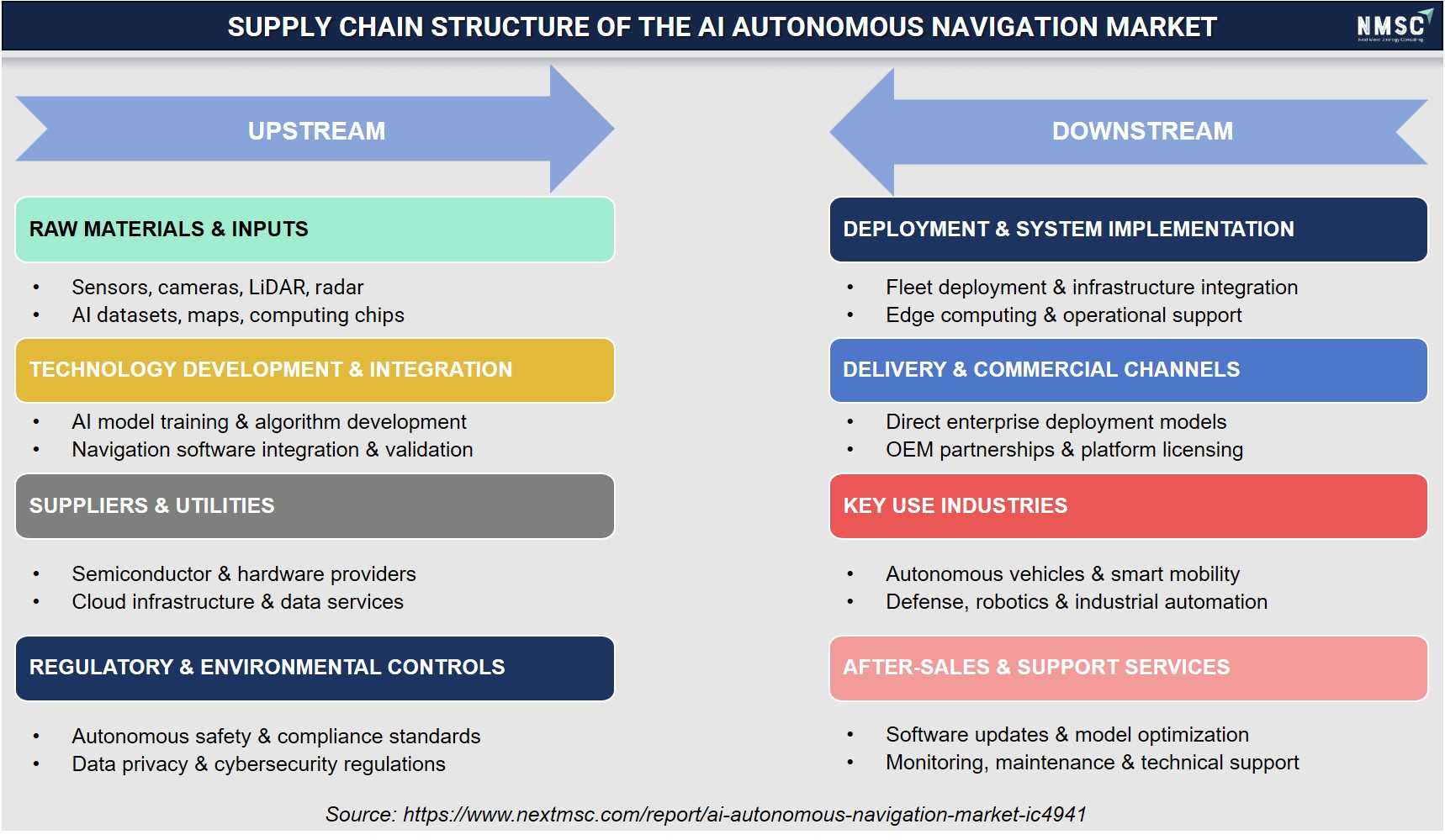
Our assessment indicates that the AI Autonomous Navigation Market relies on a robust supply chain spanning sensor manufacturers, semiconductor providers, AI software developers, cloud infrastructure vendors, and system integrators. Moreover, OEM partnerships, deployment services, and continuous software support ensure reliable commercialization. We found that strong collaboration across upstream and downstream participants enhances innovation, operational efficiency, and scalable adoption across industries.
Competitive Landscape
Competitive Dynamics and M&A Landscape
|
Key Takeaways |
Details |
|
Market Structure |
The AI Autonomous Navigation Market features multi-tiered competition among defense prime contractors (RTX, L3Harris, Thales), automotive Tier 1 and Tier 2 suppliers (Continental, Bosch, Aptiv, Mobileye), and AI-native platform companies (NVIDIA, Qualcomm, Hexagon), each competing on distinct performance, certification, and integration value propositions. |
|
Innovation Focus |
Innovation in the AI Autonomous Navigation Market is concentrated in AI-native sensor fusion architectures, solid-state LiDAR cost reduction, edge AI processing for navigation stacks, HD mapping and SLAM software, and over-the-air navigation software deployment capabilities enabling continuous post-deployment performance improvement. |
|
M&A Activity |
M&A activity in the AI Autonomous Navigation Market reflects consolidation around full-stack navigation capability. Intel's divestiture of Mobileye through IPO in 2022 marked a reshaping of the competitive landscape. Qualcomm's acquisition of Veoneer's ADAS division, Continental's acquisition of Elektrobit for software-defined vehicle platforms, and multiple defense-sector autonomous navigation acquisitions highlight active consolidation. |
How Do Companies Compete in the AI Autonomous Navigation Market?
The AI Autonomous Navigation Market is characterized by multi-tiered competition across defense primes, automotive Tier 1 suppliers, AI semiconductor companies, and specialist navigation software vendors. Defense prime contractors compete on system-level integration, certification heritage, and strategic partnership with government procurement agencies. Automotive Tier 1 suppliers differentiate on domain expertise, OEM qualification programs, and manufacturing scale required to serve high-volume vehicle programs. AI semiconductor companies compete on compute density, power efficiency, and software ecosystem richness. Geographic expansion strategies center on establishing local engineering presence to navigate country-specific certification requirements, while pricing strategies range from platform licensing for software to unit-price competition for commoditizing perception hardware components.
Which Kind of Companies Dominate the AI Autonomous Navigation Market?
Three categories of companies collectively dominate the AI Autonomous Navigation Market. First, global defense and aerospace conglomerates including RTX Corporation, Honeywell, Safran, Thales, and L3Harris leverage decades of inertial navigation and guided systems expertise to serve military and aviation customers with safety-critical AI navigation platforms. Second, automotive-focused AI navigation leaders including Mobileye, Continental, Bosch, Aptiv, and Qualcomm develop AI perception and navigation stacks that are integrated into passenger and commercial vehicles at OEM level globally. Third, AI compute platform leaders including NVIDIA, which provides the DRIVE AGX and Orin computing platforms powering autonomous navigation stacks across automotive, robotics, and drone applications.
AI-Native Differentiation and Open Standards Drive Market Success in the AI Autonomous Navigation Market
Innovation focus across the AI Autonomous Navigation Market is concentrated in AI-native sensor fusion models that process multi-modal sensor inputs through end-to-end neural networks, reducing the engineering complexity of classical modular navigation pipelines. Open standards adoption, including ROS 2 (Robot Operating System) supported by the Open Robotics Foundation, is differentiating navigation software platforms by enabling interoperability across heterogeneous sensor configurations and compute architectures. Vendors that successfully achieve cross-domain certification across automotive ISO 26262, aviation DO-178C, and defense MIL-STD-882E standards are capturing premium pricing and broader addressable markets than single-domain specialists.
Market Players to Opt for Merger and Acquisition Strategies to Expand Their Presence in the AI Autonomous Navigation Market
Mergers and acquisitions are actively reshaping the competitive structure of the AI Autonomous Navigation Market as companies seek full-stack navigation capability and cross-domain addressability. Qualcomm's acquisition of Veoneer's ADAS division, completed in 2022, consolidated its automotive navigation SoC and perception software position. Continental AG's acquisition of Elektrobit strengthened its software-defined navigation platform capability. RTX Corporation and Honeywell continue to acquire inertial navigation and guidance technology companies to maintain defense navigation leadership. Our assessment indicates that further consolidation is expected in the 2025–2028 timeframe around HD mapping software vendors, agricultural autonomous navigation specialists, and drone AI navigation platform companies.
Who Are the Key Market Players in the AI Autonomous Navigation Market?
-
RTX Corporation
-
Honeywell International Inc.
-
Mobileye Global Inc.
-
Tesla, Inc.
-
Robert Bosch GmbH
-
Safran SA
-
Waymo LLC
-
SZ DJI Technology Co., Ltd.
-
Thales S.A.
-
Aptiv PLC
-
L3Harris Technologies, Inc.
-
Hexagon AB
-
Qualcomm Incorporated
-
Garmin Ltd.
-
ABB Ltd
-
Trimble Inc.
-
Teledyne Technologies Incorporated
-
OMRON Corporation
What Are the Latest Developments in the AI Autonomous Navigation Industry?
|
Date |
Event |
|
June 2026 |
Mobileye announced a strategic pivot toward becoming a vertically integrated robotaxi operator. Rather than just supplying technology, Mobileye plans to launch a fully owned and operated autonomous ride-hailing service in 2027, utilizing its existing Mobileye Drive platform and Moovit mobility data |
|
May 2026 |
NVIDIA expanded its DRIVE Hyperion platform through collaborations with Foxconn and Uber to accelerate the deployment of Level 4-ready robotaxi fleets, providing a standardized AI compute, safety, and software architecture for autonomous navigation. |
|
February 2026 |
Waymo secured USD 16 billion in funding to accelerate the expansion of its commercial robotaxi operations and autonomous driving technology. The investment supports fleet growth, deployment into new markets, and continued advancement of autonomous navigation capabilities. |
Expert Insights
 “AI-enabled mobile robots can transform sectors like discrete manufacturing, logistics and laboratories. Robots equipped with ABB's new Visual Simultaneous Localization and Mapping (Visual SLAM) technology, for example, have advanced mapping and navigation skills, granting new levels of autonomy, while greatly reducing the infrastructure needed by previous generations of guided robots.”
— Marc Segura, President, ABB Robotics Division
Statement made during ABB's discussion on emerging frontiers in robotics and artificial intelligence, highlighting how AI-powered Visual Simultaneous Localization and Mapping (Visual SLAM) technology is advancing autonomous navigation capabilities across industrial and commercial mobile robot applications.
Market Interpretation
The statement highlights the growing adoption of AI-powered navigation technologies within the AI Autonomous Navigation Market, where advanced perception, mapping, and localization capabilities are enabling autonomous mobile robots to operate efficiently in dynamic and unstructured environments. AI-driven Visual Simultaneous Localization and Mapping (Visual SLAM) is reducing dependence on fixed navigation infrastructure while enhancing real-time obstacle detection, route optimization, and autonomous decision-making. As industries increasingly deploy autonomous robots across manufacturing, logistics, warehousing, laboratories, and other industrial environments, demand for intelligent navigation platforms that improve operational flexibility, scalability, and productivity continues to expand.
What Are the Investment Opportunities in the AI Autonomous Navigation Market?
Capital Inflows and Venture Activity
The AI Autonomous Navigation Market is experiencing robust capital inflows from venture capital, strategic corporate investors, and government innovation programs. Waymo has raised multiple funding rounds with cumulative investment exceeding USD 11 billion as disclosed in Alphabet investor communications, underscoring the long-term conviction of institutional investors in autonomous navigation commercialization. Defense technology investors including In-Q-Tel, the U.S. intelligence community's venture arm, are actively funding early-stage AI navigation companies focused on GPS-denied military applications. NMSC's analysis indicates that the software layer of AI navigation, encompassing SLAM, path planning, and fleet orchestration, is attracting disproportionately high venture interest relative to hardware components, reflecting the superior recurring revenue characteristics of software licensing models.
Infrastructure Investment
Infrastructure investment is emerging as a critical enabler of the AI Autonomous Navigation Market, as vehicle-to-infrastructure (V2X) connectivity, high-definition road mapping programs, and precise differential GPS correction networks constitute foundational infrastructure for high-performance autonomous navigation. The U.S. Infrastructure Investment and Jobs Act of 2021 allocated USD 65 million specifically for ATMS and connected vehicle infrastructure, creating a government-funded deployment pathway for navigation-supportive infrastructure. Similarly, the European Commission's Intelligent Transport Systems Directive revision mandates deployment of digital road data and V2X infrastructure across the Trans-European Transport Network, directly benefiting AI navigation system vendors that offer V2X-integrated solutions.
ESG and Sustainable Autonomous Mobility
Environmental, Social, and Governance considerations are increasingly influencing investment allocation toward AI Autonomous Navigation Market technologies. Autonomous electric vehicle platforms equipped with AI navigation systems demonstrate measurably superior energy efficiency through AI-optimized acceleration and braking profiles, contributing to scope 1 emissions reduction commitments for logistics fleet operators. The International Energy Agency (IEA) has identified autonomous driving capability as one of the enabling technologies for achieving optimal vehicle energy efficiency, reinforcing the ESG investment case. Institutional investors with net-zero portfolio commitments are viewing autonomous navigation-enabled electrification as a dual-impact investment aligning both technology growth and carbon reduction objectives.
Digital Transformation Enablement
Digital transformation programs across the logistics and agriculture sectors are generating measurable return on investment from AI navigation system deployments that is attracting sustained capital flows. Our assessment indicates that autonomous mobile robot navigation deployments in warehouse environments generate documented labor productivity improvements, with operators reporting throughput improvements of 200% to 400% relative to manual picking operations. In precision agriculture, autonomous drone navigation enables crop scouting at costs significantly below manual inspection, with the Food and Agriculture Organization of the United Nations (FAO) documenting that precision agriculture technologies reduce pesticide use by 15% to 20%, creating cost and ESG benefits that accelerate return on autonomous navigation system investment.
Private Equity and Strategic M&A Activity
Private equity and venture capital activity in the AI Autonomous Navigation Market reflects a maturing investment thesis transitioning from early-stage exploration to growth-stage scaling. PE firms including Thoma Bravo and Francisco Partners have historically invested in navigation software platforms, while growth equity investors are funding autonomous maritime and agricultural navigation specialists. NMSC's analysis indicates that the expected convergence of HD mapping vendors, sensor fusion software companies, and fleet management platform providers is creating consolidation opportunities that PE acquirers are positioned to capture. Cross-sector synergy transactions, combining automotive ADAS navigation capabilities with defense autonomous navigation expertise, represent an emerging deal theme as AI navigation technology requirements converge across civil and military domains.
Key Benefits for Stakeholders
This AI Autonomous Navigation Market research report delivers actionable intelligence for technology developers, OEMs, investors, enterprise users, government organizations, and regulatory authorities involved in the development, deployment, procurement, and governance of AI-powered autonomous navigation solutions across platform, solution, autonomy level, industry, and regional segments.
For Technology Developers and Solution Providers
Technology developers and solution providers gain detailed insights into platform-wise, solution-wise, and autonomy-level market performance, enabling the identification of high-growth innovation areas and emerging application opportunities. The report supports product roadmap planning, R&D prioritization, technology commercialization strategies, and partnership development by highlighting evolving customer requirements, competitive positioning, and regional demand patterns across the AI Autonomous Navigation Market.
For OEMs and Tier 1 Suppliers
Automotive, aerospace, defense, marine, and industrial OEMs, together with Tier 1 suppliers, receive comprehensive market intelligence covering regional demand, competitive dynamics, and technology adoption trends. The report supports strategic sourcing decisions, supplier ecosystem development, product integration planning, and long-term technology roadmap alignment while enabling organizations to evaluate growth opportunities across multiple autonomous navigation applications and end-use industries.
For Investors and Financial Analysts
Investors and financial analysts gain a structured assessment of the AI Autonomous Navigation Market through comprehensive market sizing, segment-wise revenue forecasts, CAGR analysis, competitive benchmarking, and strategic development tracking through 2035. Detailed company profiles and analysis of technology adoption trends support investment thesis development, portfolio evaluation, acquisition target identification, and long-term capital allocation decisions across the autonomous mobility ecosystem.
For Fleet Operators and Enterprise Buyers
Fleet operators and enterprise buyers across logistics, agriculture, mining, construction, mobility, and industrial sectors gain valuable insights into technology adoption trends, deployment strategies, regulatory readiness, and vendor capabilities. The report supports procurement planning, total cost of ownership evaluation, technology selection, and digital transformation initiatives by providing comparative analysis of leading navigation platforms and solution providers.
For Government and Regulatory Bodies
Government agencies, defense organizations, transportation authorities, and regulatory bodies receive comprehensive analysis of regional adoption patterns, evolving safety standards, autonomy-level maturity, and regulatory developments shaping the AI Autonomous Navigation Market. Country-level insights support evidence-based policymaking, national autonomous mobility strategies, industrial competitiveness initiatives, and the development of regulatory frameworks that facilitate safe and scalable deployment of autonomous navigation technologies.
Key Market Segments
By Platform
-
Land
-
Road
-
Passenger Vehicles
-
Commercial Vehicles
-
-
Off-Highway
-
AMR
-
AGV
-
UGV
-
Mining and Construction Equipment
-
-
-
Air
-
UAV
-
Autonomous Aircraft
-
-
Marine
-
Surface Vessels
-
Underwater Vehicles
-
-
Space
-
Orbital Spacecraft
-
Planetary Rovers
-
-
Munitions
-
Guided Missiles
-
Loitering Munitions
-
Torpedoes
-
-
Other Platforms
By Solution
-
Hardware
-
Positioning Sensors
-
GNSS
-
INS
-
IMU
-
-
Perception Sensors
-
LiDAR
-
Radar
-
Camera
-
Ultrasonic
-
Barometer
-
Other
-
-
Compute and Processing Units
-
Other Hardware
-
-
Software
-
Perception and Sensor Fusion
-
Localization and Mapping
-
Path Planning and Control
-
Decision Making and Prediction
-
Fleet Management and Orchestration
-
HD Mapping
-
Development and Simulation Tools
-
Other Software
-
-
Services
-
Integration and Deployment
-
Calibration and Testing
-
Maintenance and Support
-
Data and Annotation Services
-
By Autonomy Level
-
Assisted
-
Supervised Autonomy
-
Conditional Autonomy
-
High Autonomy
-
Full Autonomy
By Buyer Type
-
OEM
-
Tier 1 Supplier
-
Fleet Operator
-
Government and Defense
-
System Integrator
-
Others
By Sales Channel
-
Direct
-
Tier 1 Channel
-
Distributor
-
System Integrator Channel
-
Online and Over-the-Air
By End-Use Industry
-
Automotive
-
Logistics and Warehousing
-
Defense and Aerospace
-
Agriculture
-
Mining and Construction
-
Marine
-
Public Safety and Inspection
-
Industrial Automation
-
Others
By Region
-
North America: U.S., Canada, and Mexico
-
Europe: UK, Germany, France, Italy, Spain, Sweden, Denmark, Finland, Netherlands, and the Rest of Europe
-
Asia-Pacific: China, India, Japan, South Korea, Taiwan, Indonesia, Vietnam, Australia, Philippines, Malaysia, and the Rest of APAC
-
Middle East & Africa (MEA): Saudi Arabia, UAE, Egypt, Israel, Turkey, Nigeria, South Africa, and the Rest of MEA
-
Latin America: Brazil, Argentina, Chile, Colombia, and the Rest of LATAM
Conclusion and Recommendations
Long-Term Outlook
The AI Autonomous Navigation Market is entering the most consequential growth decade in its history, driven by convergent forces including AI capability maturation, declining sensor costs, regulatory frameworks creating deployment clarity, and global defense modernization programs. The market is forecast to grow from USD 6.2 billion in 2026 to USD 33.8 billion by 2035 at a CAGR of 20.6%, reflecting not only the expanding volume of autonomous platforms being deployed but also the increasing software and services intensity of next-generation navigation systems. Our analysis indicates that the transition from hardware-dominant revenue to software-led recurring revenue models represents the most consequential structural shift underway within the market.
Strategic Positioning Recommendations
Platform vendors and navigation technology developers should prioritize AI-native sensor fusion differentiation, embedding end-to-end deep learning architectures that outperform classical modular pipelines across a broader operational design domain. Cross-domain certification investment is non-negotiable for companies seeking to address both commercial and defense procurement channels, as dual-use navigation capability commands premium positioning across both markets. Investment in OTA software delivery infrastructure is emerging as a critical strategic asset, enabling vendors to generate recurring software revenue from installed hardware fleets and continuously improve navigation performance throughout the product lifecycle, shifting the revenue model from one-time component sales to recurring software subscription dynamics.
Investment Attractiveness
The AI Autonomous Navigation Market represents an exceptionally attractive long-term investment environment given durable secular demand drivers across multiple end-use verticals, software-led recurring revenue model transition, and a structural supply-demand imbalance in certified autonomous navigation expertise. NMSC's assessment indicates that the highest-conviction investment themes include Full Autonomy navigation platforms (CAGR approximately 30.1%), Government and Defense buyer segment solutions (CAGR approximately 26.0%), OTA navigation software platforms (CAGR approximately 28.5%), and APAC region expansion (CAGR 22.9%). Investors should monitor consolidation activity in agricultural autonomous navigation, autonomous maritime navigation, and HD mapping software sub-segments, where fragmented competitive landscapes and proven commercial models create attractive acquisition opportunities.
Market Shifts and Key Risks
The most significant market shift underway is the migration from discrete navigation sensor procurement to AI navigation stack platform purchasing, where OEMs and defense agencies procure integrated software-hardware solutions from full-stack providers rather than assembling point components. This shift benefits full-stack platform providers including NVIDIA, Mobileye, and Qualcomm at the expense of standalone sensor vendors. Key risks for the AI Autonomous Navigation Market include cybersecurity attack vectors targeting AI navigation models, geopolitical restrictions on dual-use navigation technology exports, regulatory timeline uncertainty for higher autonomy level approvals, and the potential for open-source AI navigation software to commoditize certain software navigation stack categories.
Growth Pathways
Organizations seeking to maximize value from the AI Autonomous Navigation Market should pursue a three-horizon strategy aligned with the market's autonomy level maturity curve. In the near term from 2025 to 2027, priority investments should focus on hardware positioning for ADAS mandates, software stack development for SAE Level 2 to 3 commercial vehicle autonomy, and OTA capability establishment. In the mid-term from 2027 to 2031, organizations should focus on Full Autonomy platform development for logistics, agriculture, and defense, HD mapping network expansion in Asia-Pacific, and cross-domain certification for civil and military dual-use navigation capabilities. In the long term from 2031 to 2035, success will require positioning across space and advanced maritime navigation domains as these segments accelerate toward commercialization.
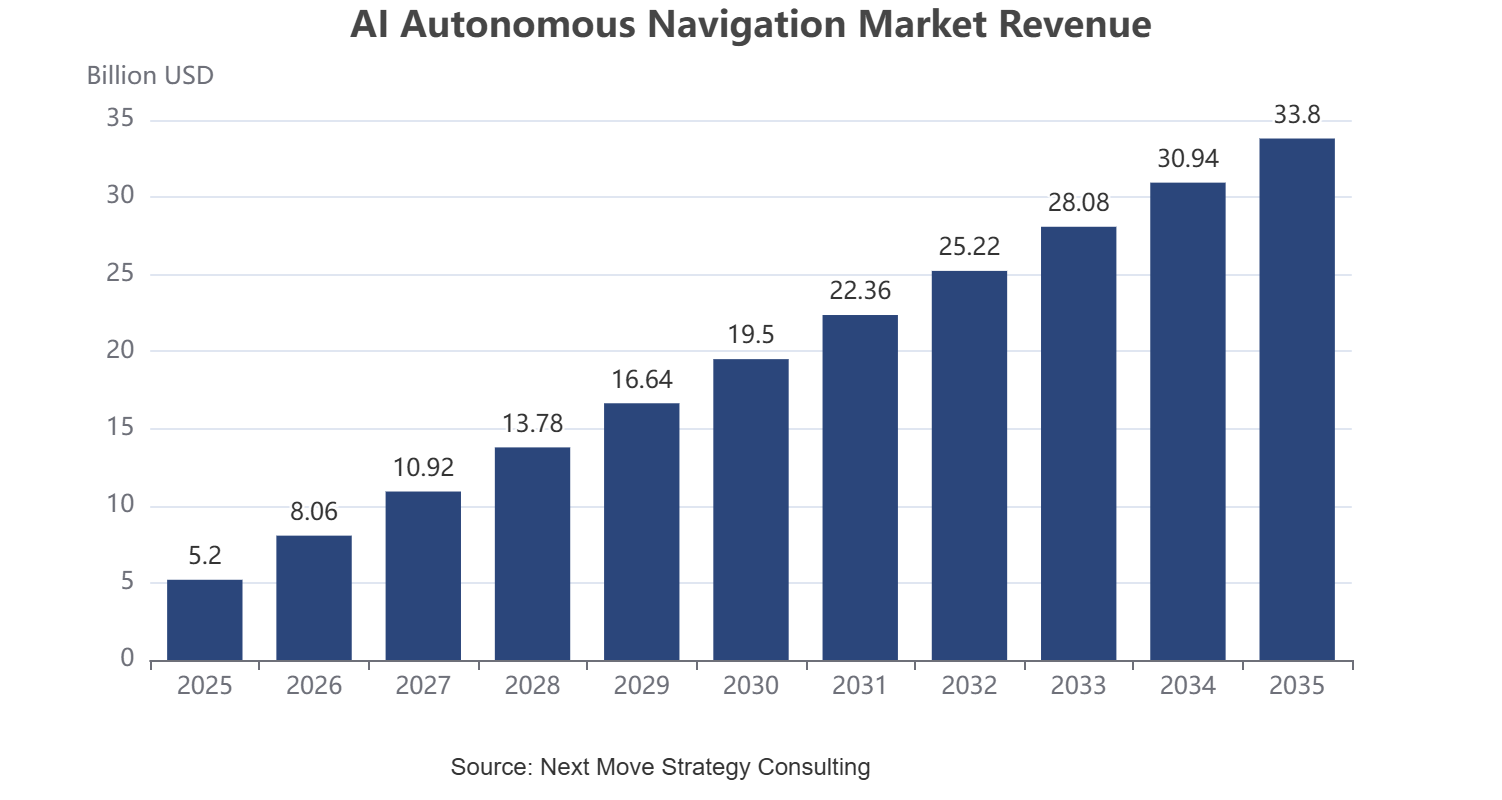
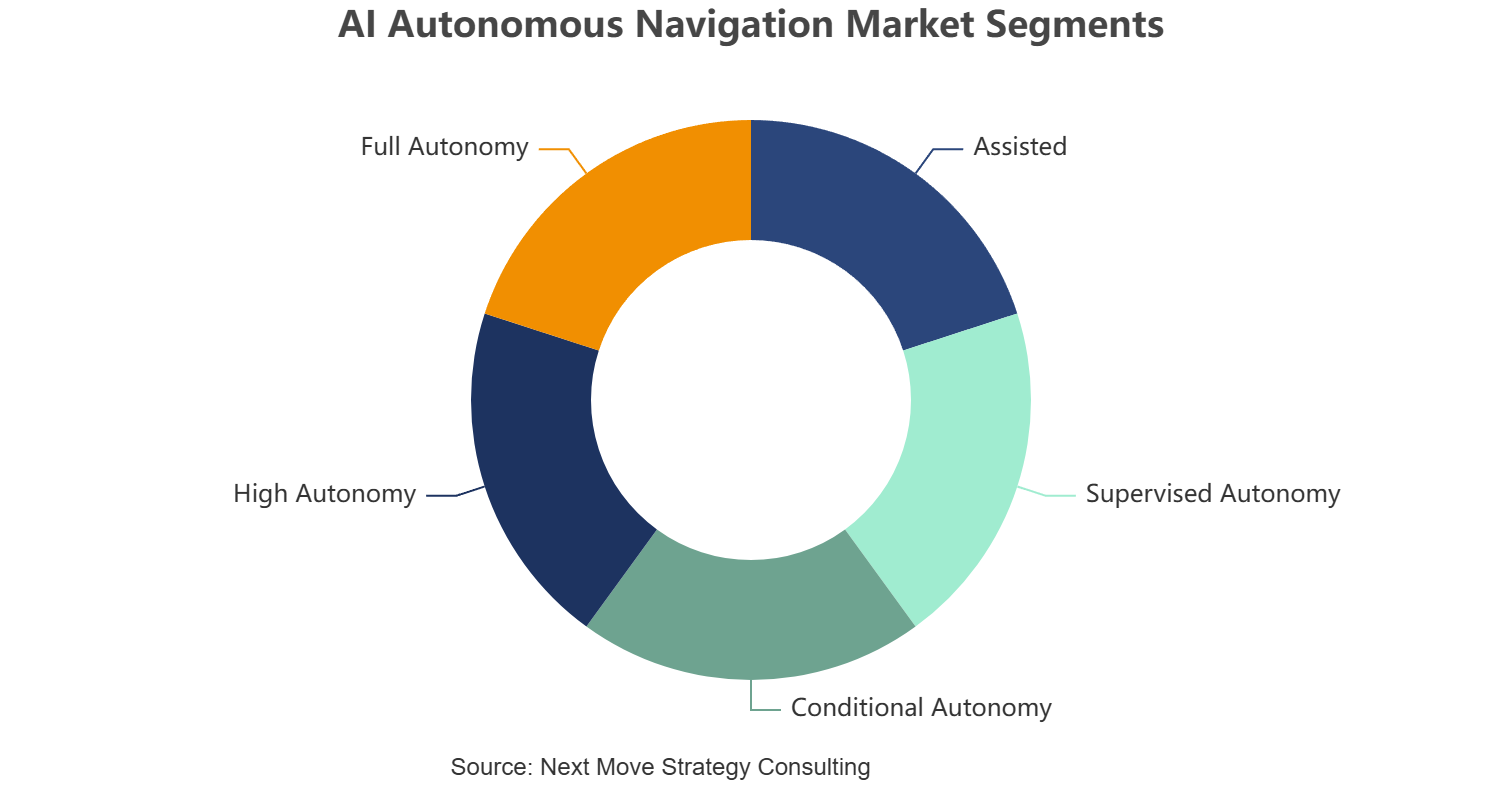
About the Author
 Saista Faiyaz
— Saista Faiyaz is Research Associate at Next Move Strategy Consulting, where she has covered consumer markets and healthcare technologies for 3 years. Her work includes primary interview review, secondary-source validation, market sizing, and structured analysis of company and industry data. She supports research by comparing evidence across sources, organizing findings into market narratives, and documenting assumptions used in analysis. Her scope includes cross-market benchmarking, and reports.
Saista Faiyaz
— Saista Faiyaz is Research Associate at Next Move Strategy Consulting, where she has covered consumer markets and healthcare technologies for 3 years. Her work includes primary interview review, secondary-source validation, market sizing, and structured analysis of company and industry data. She supports research by comparing evidence across sources, organizing findings into market narratives, and documenting assumptions used in analysis. Her scope includes cross-market benchmarking, and reports.
About the Reviewer
 Supradip Baul
— Supradip Baul is an accomplished business consultant and strategist with over a decade of rich experience in market intelligence, strategy, technology, and business transformation. His work has included rigorous qualitative and quantitative analysis across multiple industries, helping clients shape investment decisions and long-term roadmaps. Earlier in his career, he was associated with Gartner, where he contributed to industry-leading reports and market share analyses. He has worked with leading global companies and holds an MBA with a dual specialization in Marketing and Finance.
Supradip Baul
— Supradip Baul is an accomplished business consultant and strategist with over a decade of rich experience in market intelligence, strategy, technology, and business transformation. His work has included rigorous qualitative and quantitative analysis across multiple industries, helping clients shape investment decisions and long-term roadmaps. Earlier in his career, he was associated with Gartner, where he contributed to industry-leading reports and market share analyses. He has worked with leading global companies and holds an MBA with a dual specialization in Marketing and Finance.
At Next Move Strategy Consulting, we understand that insightful market research is the cornerstone of successful business decisions. That's why we employ a robust and multifaceted approach, combining various methodologies to deliver the most accurate and actionable data for our clients.

Research Landscape
We navigate the world of research with two primary approaches:
Qualitative Approach
Our qualitative research methodologies involve immersive techniques such as in-depth interviews, focus groups, and observational studies. By engaging directly with individuals and stakeholders, we uncover valuable insights that quantitative data alone may overlook.

Quantitative Research
In tandem with qualitative methodologies, NMSC leverages the power of Quantitative Research to provide a robust foundation of numerical insights. Through systematic data collection and analysis, we quantify patterns, preferences, and market trends, offering a comprehensive view of the business landscape.
Our quantitative research approach employs diverse tools, including surveys, experiments, and statistical modelling. These methodologies enable us to gather data from a large and representative sample, ensuring the statistical significance of our findings. By employing structured questionnaires and standardized data collection methods, we guarantee the reliability and validity of the information we present to our clients.
Quantitative research is particularly effective in measuring the prevalence of trends, assessing market size, and gauging the impact of various factors on consumer behavior. The numerical precision attained through this approach equips our clients with actionable insights, facilitating data-driven decision-making and strategy formulation.


Our Specialized Toolbox for Industry-Specific Market Research
We deploy a specialized arsenal of techniques tailored to meet your unique requirements. Here's a glimpse into our comprehensive toolbox:

Information Procurement
The stage entails acquiring market data or relevant information through various sources and methodologies.


Market Research Approach
We utilize both top-down and bottom-up approaches in market research analysis to achieve a comprehensive understanding of the market dynamics, leveraging the broad perspective of industry trends and macroeconomic factors alongside detailed insights from specific segments and individual companies.

Porters Five Forces Analysis
We conduct Porter's Five Forces analysis to evaluate the competitive landscape of an industry, providing us with insights into factors that affect profitability and strategic positioning.

SWOT Analysis

Forecasting
We utilize a forecasting model to predict future consumption by considering parameters like population, economics, regulations, market competition, drivers, constraints, technology, and pricing. We also employ statistical techniques such as multilinear regression, exponential smoothing, moving average, ARIMA, and Monte Carlo simulations for accurate predictions. In econometric forecasting, we analyzed short-term and long-term event impacts, attributing values based on regulatory frameworks, economic factors, and market events.





 Speak to Our Analyst