Autonomous Retail Market Size, Share, Growth & Forecast by Solution Type (Cashierless Checkout Systems, Autonomous Self-Checkout Systems, Unattended Retail Systems, Store Intelligence Systems, Autonomous Retail Platform Software and Services), Revenue Stream, Deployment Model, End User, Store Format (Small Format, Medium Format and Large Format), and Sales Channel — Global Analysis & Forecast 2025–2035
Industry: ICT & Media | Publishing Date: July 4, 2026 | Last Updated: September 30, 2026 | No of Pages: N/A | No. of Tables: N/A | No. of Figures: N/A | Format: PDF | Report Code: IC4947
What Is the Autonomous Retail Market Size?
Based on our research findings, the global Autonomous Retail Market was valued at USD 8.6 billion in 2025 and is expected to reach USD 10.2 billion in 2026. Sustained technology adoption, rising labor costs, and accelerating demand for frictionless shopping experiences are projected to propel the market to USD 56.8 billion by 2035, advancing at a CAGR of 21.0% from 2026 to 2035. Key growth catalysts include widespread deployment of computer vision and AI-powered checkout systems, expanding unattended retail infrastructure, rising retailer investment in store intelligence platforms, and growing consumer acceptance of autonomous shopping environments across grocery, convenience, and specialty retail formats.
|
Parameters |
Details |
|
Market Size in 2025 |
USD 8.6 Billion |
|
Market Size in 2026 |
USD 10.2 Billion |
|
Revenue Forecast in 2035 |
USD 56.8 Billion |
|
Growth Rate |
CAGR of 21.0% from 2026 to 2035 |
|
Analysis Period |
2025–2035 |
|
Base Year Considered |
2025 |
|
Forecast Period |
2026–2035 |
|
Market Size Estimation |
Billion USD |
|
Companies Profiled |
20 |
|
Countries Covered |
38 |
|
Market Share |
Top 10 |
Autonomous Retail Market Overview
What Is the Autonomous Retail Market?
The Autonomous Retail Market encompasses a broad spectrum of technology-enabled solutions that remove or minimize the need for human-assisted transactions within physical retail environments. These solutions include cashierless checkout systems powered by computer vision, RFID, and sensor fusion; autonomous self-checkout kiosks driven by AI item recognition; smart vending machines; micro markets; fully autonomous store formats; and integrated store intelligence platforms spanning electronic shelf labels, inventory visibility, shelf monitoring, loss prevention, and advanced retail analytics. The market serves multiple end-user verticals ranging from grocery and convenience stores to healthcare, education, and workplace retail settings.
How Has the Autonomous Retail Market Evolved?
The Autonomous Retail Market has progressed through distinct technology maturation phases. The first phase was characterized by the introduction of barcode-based self-checkout kiosks that required partial customer participation and attendant oversight. The second phase introduced RFID-enabled smart carts and scan-and-go mobile applications, reducing friction at the point of sale. NMSC's analysis indicates that the current phase represents a fundamental architectural shift toward fully frictionless environments, with AI-driven computer vision, edge computing, and multi-sensor fusion enabling stores to identify items, track shopper journeys, and process payments entirely without cashier interaction.
How Do Regulations Influence the Autonomous Retail Market?
Regulatory considerations are becoming increasingly prominent in shaping the Autonomous Retail Market structure. Consumer privacy regulations, including the European Union General Data Protection Regulation, the California Consumer Privacy Act, and analogous data protection laws across Asia-Pacific and Latin America, directly govern how computer vision systems can collect and process biometric and behavioral data in retail spaces. Additionally, labor regulations across multiple markets are influencing the pace of cashierless store adoption, as policymakers balance automation-driven efficiency gains against workforce displacement concerns. Compliance requirements are compelling vendors to design privacy-preserving architectures with on-device processing capabilities.
How Is Technology Adoption Expanding Across the Autonomous Retail Market?
Technology adoption across the Autonomous Retail Market is accelerating as hardware costs decline, AI model accuracy improves, and retailers seek operational efficiency at scale. Our assessment indicates that edge AI processors, miniaturized vision sensors, and high-accuracy RFID tags have reached cost inflection points that make deployment economically viable across small and medium retail formats. Cloud-connected store management platforms are enabling centralized fleet oversight, real-time inventory synchronization, and remote diagnostics across distributed autonomous retail deployments, further reducing total cost of ownership and supporting broader commercial rollout by both established retailers and technology-first autonomous store operators.
|
Key Takeaways |
|
By solution type, Unattended Retail Systems held the largest share of the Autonomous Retail Market at USD 2.4 billion in 2025, driven by widespread adoption of smart vending machines, autonomous stores, and micro market platforms across workplaces, hospitality venues, and transportation hubs. Cashierless Checkout Systems are the fastest-growing solution segment, projected to expand from USD 2.1 billion in 2025 to USD 14.8 billion by 2035 at a CAGR of 21.5%, fueled by enterprise-scale deployment of AI-powered computer vision, sensor fusion, and RFID-enabled checkout technologies. |
|
By revenue stream, Hardware accounted for USD 3.2 billion in 2025, representing the largest revenue share in the Autonomous Retail Market, supported by investments in vision cameras, RFID infrastructure, electronic shelf labels, smart carts, and autonomous checkout equipment. Software Subscription is the fastest-growing revenue stream at a CAGR of 22.3% from 2026 to 2035, as vendors increasingly transition toward SaaS-based autonomous retail platforms offering recurring revenue through store management, analytics, and AI model lifecycle services. |
|
By deployment model, New Store Deployment commanded the largest share at USD 4.8 billion in 2025, reflecting the growing construction of greenfield autonomous convenience stores, modular retail formats, and micro market environments designed around cashierless technologies. New Store Deployment is also the fastest-growing deployment model at a CAGR of 21.0% from 2026 to 2035, supported by expanding investment in autonomous retail infrastructure across airports, workplaces, campuses, and smart city developments. |
|
By end user, Grocery generated USD 2.8 billion in 2025, representing the largest share of the Autonomous Retail Market, driven by extensive investments in cashierless checkout, electronic shelf labels, AI-enabled inventory visibility, and autonomous store technologies. Education Retail is the fastest-growing end-user segment at a CAGR of 25.9% from 2026 to 2035, supported by rapid deployment of autonomous micro markets and unattended retail formats across universities and educational campuses. |
|
By store format, Medium Format Stores accounted for USD 3.4 billion in 2025, supported by extensive deployment of self-checkout modernization, AI-powered loss prevention, and electronic shelf label systems across supermarkets and specialty retail outlets. Small Format Stores are the fastest-growing store format in the Autonomous Retail Market at a CAGR of 21.9% from 2026 to 2035, driven by growing adoption of autonomous convenience stores and grab-and-go retail concepts in urban locations and transit hubs. |
|
By sales channel, Direct Sales generated USD 3.6 billion in 2025, representing the largest revenue contribution in the Autonomous Retail Market as leading vendors prioritized enterprise partnerships with major grocery chains, convenience retailers, and sports venue operators. OEM Partnerships are projected to register the fastest growth at a CAGR of 21.6% from 2026 to 2035, supported by the integration of autonomous checkout, AI vision, and loss prevention capabilities into next-generation retail hardware platforms. |
|
North America held the largest regional share at USD 3.4 billion in 2025 and is projected to reach USD 21.2 billion by 2035 at a CAGR of 20.1%, supported by Amazon's autonomous retail ecosystem, high retailer technology investments, mature AI infrastructure, and large-scale commercial deployment of cashierless checkout technologies. |
|
Middle East and Africa is the fastest-growing region in the Autonomous Retail Market at a CAGR of 23.8%, driven by Vision 2030 initiatives, expanding smart retail infrastructure across Saudi Arabia and the UAE, and increasing investment in autonomous retail formats throughout emerging consumer markets. |
|
The United States dominated the Autonomous Retail Market in 2025, accounting for the largest share of global revenue. Its leadership is supported by the presence of leading autonomous retail technology providers, widespread deployment of Amazon Go and Just Walk Out technologies, significant enterprise retail technology spending, and advanced AI, cloud, and payment infrastructure enabling large-scale commercialization of cashierless shopping environments. |
|
Saudi Arabia is projected to be the fastest-growing country in the Autonomous Retail Market during the forecast period. Growth is driven by Vision 2030 initiatives, expanding smart retail infrastructure, increasing investments in autonomous checkout technologies, rapid modernization of the retail sector, and supportive government programs promoting AI-enabled commercial ecosystems and digital transformation across the Kingdom. |
Key Emerging Trends in the Autonomous Retail Market
How Is Computer Vision at the Edge Reshaping the Autonomous Retail Market?
Edge-deployed computer vision is fundamentally transforming the Autonomous Retail Market by enabling real-time item recognition, shopper tracking, and frictionless payment without cloud round-trips. Our analysis shows that modern AI inference chips allow overhead camera arrays to process hundreds of simultaneous shopper-item interactions at sub-50-millisecond latency. Amazon's Just Walk Out technology, licensed to third-party retailers, exemplifies this trend, enabling turnkey cashierless store deployment without requiring retailers to build proprietary computer vision stacks. This shift reduces bandwidth dependency, strengthens data privacy compliance by keeping biometric processing on-device, and substantially lowers the total infrastructure cost per store deployment.
How Is the Convergence of RFID and Computer Vision Creating New Opportunities in the Autonomous Retail Market?
The convergence of RFID and computer vision technologies within hybrid sensor fusion checkout architectures represents a pivotal trend in the Autonomous Retail Market. Through our market assessment, we observed that pure-play computer vision systems face accuracy challenges with reflective packaging and occlusion, while RFID alone requires item-level tagging investments that are impractical for fresh produce categories. Hybrid systems combining RFID gate detection at store exits with vision-based item recognition on shelves address these limitations, enabling high-accuracy autonomous checkout across a broader product taxonomy. Zebra Technologies and Avery Dennison have both invested in hybrid RFID-vision integration frameworks as a result.
How Is the Micro Market and Autonomous Store Format Redefining Unattended Retail?
Micro market and autonomous store formats are redefining unattended retail within the broader Autonomous Retail Market. NMSC's analysis indicates that operators including 365 Retail Markets and Cantaloupe are deploying open-format micro markets across corporate campuses, hospitals, and transportation hubs, offering a curated assortment with self-service kiosk checkout. Simultaneously, containerized and modular autonomous store formats from operators including AiFi are enabling rapid deployment in non-traditional retail locations such as military bases, theme parks, and remote construction sites. These formats are expanding the total addressable market for autonomous retail beyond conventional grocery and convenience store settings.
How Is AI-Driven Loss Prevention Becoming a Core Value Driver in the Autonomous Retail Market?
AI-driven loss prevention is emerging as one of the most commercially compelling value propositions within the Autonomous Retail Market. From our research, we found that retail shrink attributable to theft, administrative error, and vendor fraud imposes substantial cost burdens on global retailers, creating strong return-on-investment rationale for AI-powered in-store monitoring systems. Companies such as Everseen have developed vision AI platforms that identify point-of-sale transaction anomalies and self-checkout bypass behaviors in real time, enabling retailers to recoup losses significantly exceeding the technology investment. This dual benefit of operational efficiency and shrink reduction is accelerating autonomous retail adoption beyond the checkout use case alone.
Consumer Behavior Analysis of the Autonomous Retail Market
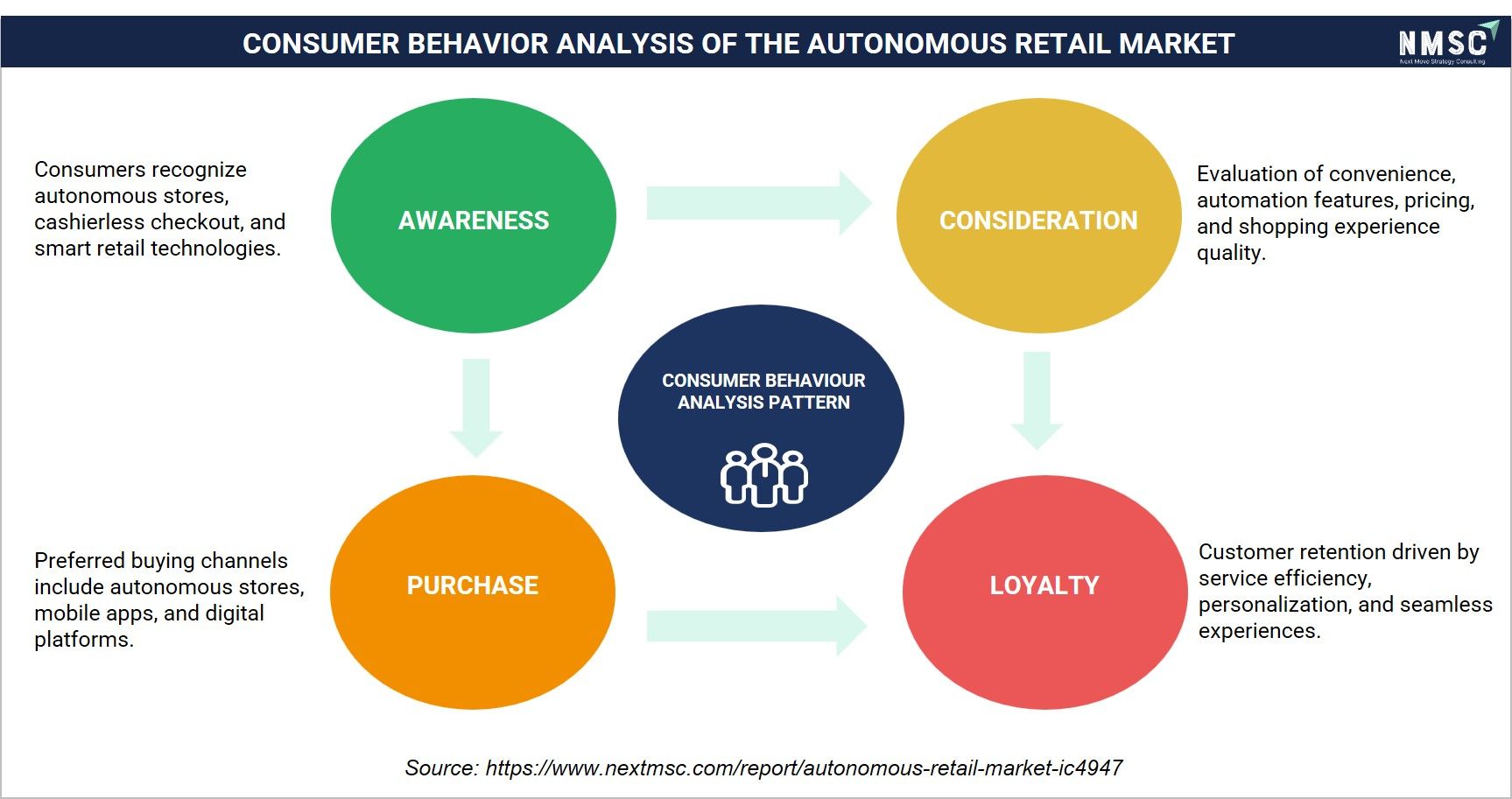
The consumer behavior analysis illustrates the purchasing journey shaping the Autonomous Retail Market. Based on our assessment, we found thatgrowing awareness of cashierless stores, AI-enabled shopping, and frictionless payment experiences is strengthening customer adoption. Moreover, consumers increasingly evaluate convenience, automation capabilities, pricing, and shopping experience before purchase, while seamless digital engagement and personalized services continue to foster long-term customer loyalty.
What Are the Key Market Drivers, Breakthroughs, and Investment Opportunities That Will Shape the Autonomous Retail Industry in the Next Decade?
|
Drivers / Trends / Restraints |
(+/-) % Impact on CAGR Forecast |
Geographic Relevance |
Impact Timeline |
|
Rising Labor Costs and Store Staffing Pressures |
+3.2% |
Global (led by North America, Europe) |
2025–2035 |
|
Rapid Deployment of Computer Vision AI |
+2.8% |
North America, Europe, APAC |
2025–2030 |
|
Proliferation of Smart Vending and Micro Markets |
+2.1% |
North America, APAC, MEA |
2025–2033 |
|
Electronic Shelf Label and Store Intelligence Adoption |
+1.8% |
Europe, North America, APAC |
2025–2032 |
|
Consumer Demand for Frictionless Shopping |
+1.6% |
Global |
2025–2035 |
|
Expansion of Autonomous Retail in Non-Grocery Verticals |
+1.4% |
Global |
2026–2035 |
|
Data Privacy Regulations Limiting Vision Data Use |
-1.4% |
Europe, APAC, North America |
Ongoing |
|
High CapEx for Greenfield Autonomous Store Deployment |
-1.1% |
SMB Retailers Globally |
2025–2029 |
|
Consumer Trust and Adoption Barriers |
-0.8% |
All Regions |
Ongoing |
|
Sensor Fusion and AI Model Accuracy Improvements |
+1.9% |
Global |
2026–2032 |
What Are the Growth Drivers of the Autonomous Retail Market?
How Is the Escalation of Retail Labor Costs Driving Investment in the Autonomous Retail Market?
Escalating retail labor costs represent the most structurally significant demand driver for the Autonomous Retail Market. Based on NMSC's research, we found that minimum wage legislation in the United States has resulted in a series of state-level increases that have materially raised store operating costs for large grocery and convenience retailers. The U.S. Bureau of Labor Statistics reports that retail trade employment costs have risen consistently, compelling operators to evaluate automation as a path to sustainable cost structures. Autonomous checkout and unattended store formats enable retailers to redeploy labor toward higher-value customer service activities while reducing per-transaction costs at scale across multi-store networks.
How Is Consumer Adoption of Self-Service and Frictionless Commerce Accelerating the Autonomous Retail Market?
Shifting consumer behavior toward self-service and frictionless commerce is creating a durable demand signal for the Autonomous Retail Market. Our assessment indicates that mobile payment adoption, contactless transaction preferences accelerated by the COVID-19 pandemic, and rising consumer comfort with AI-mediated retail experiences have substantially lowered behavioral barriers to autonomous checkout adoption. The Federal Reserve's annual consumer payments study consistently highlights accelerating shifts toward digital and contactless payment modalities, which directly complement the payment infrastructure embedded in cashierless and autonomous checkout deployments. This consumer behavioral evolution is reducing the need for change management investment during autonomous retail technology rollouts.
How Is the Growth of Non-Traditional Retail Venues Expanding the Autonomous Retail Market?
The expansion of autonomous retail technology into non-traditional venues including sports stadiums, airports, hospitals, military installations, and university campuses is materially broadening the total addressable market. Through NMSC's assessment, we found that captive audience environments with high transaction velocity and constrained staffing capacity represent ideal deployment conditions for autonomous self-checkout and unattended retail systems. The Transportation Security Administration's airport modernization initiatives in the United States and analogous airport infrastructure programs across Europe and Asia-Pacific are creating structured procurement pathways for autonomous retail operators targeting travel retail channels. These venue types represent faster-growing sub-segments relative to traditional grocery.
What Are the Growth Inhibitors of the Autonomous Retail Market?
How Do Data Privacy Regulations Constrain Computer Vision Deployment in the Autonomous Retail Market?
Data privacy regulation represents a significant structural constraint on the adoption of computer vision-based autonomous checkout systems across multiple geographies within the Autonomous Retail Market. The European Union's General Data Protection Regulation prohibits the collection and processing of biometric data without explicit informed consent, which creates legal complexity for overhead shopper tracking systems that monitor individuals throughout their store visit. Several EU national data protection authorities have issued guidance specifically addressing retail video surveillance and AI-based shopper monitoring, imposing consent requirements and data minimization obligations that increase compliance costs and restrict deployment architectures. Vendors operating in Europe must invest substantially in on-device processing and data anonymization to maintain regulatory compliance.
How Does the High Capital Expenditure Requirement Limit Autonomous Retail Market Adoption Among Smaller Retailers?
The substantial capital expenditure associated with deploying cashierless checkout or fully autonomous store infrastructure remains a meaningful barrier for small and independent retail operators within the Autonomous Retail Market. NMSC's analysis indicates that greenfield autonomous store buildouts require significant upfront investment in overhead camera systems, server infrastructure, network connectivity, and custom store fixtures, in addition to software integration and system calibration costs. The U.S. Small Business Administration has documented that access to capital for technology modernization remains a persistent challenge for independent grocery and convenience retailers. This financial barrier concentrates near-term adoption among large enterprise retailers, limiting the speed of market expansion among the long tail of global retail operators.
What Are the Growth Opportunities in the Autonomous Retail Market?
How Does the Expansion of Just Walk Out Technology Licensing Create a Multi-Billion Dollar Opportunity in the Autonomous Retail Market?
The emergence of technology licensing as a commercial model for autonomous checkout represents a transformative opportunity within the Autonomous Retail Market. Amazon's decision to license its Just Walk Out technology to third-party retailers, stadiums, and airport operators signals a platform-based approach that decouples autonomous checkout from proprietary store ownership. Our analysis shows that this licensing model enables technology providers to generate recurring revenue streams from software, maintenance, and transaction fees without bearing the capital risk of store ownership. Retailers gaining access to enterprise-grade computer vision checkout infrastructure without proprietary R&D investment represents a compelling value proposition that is accelerating deployment velocity across multiple venue categories globally.
How Is the Adoption of Electronic Shelf Labels Creating Structural Platform Expansion Opportunities in the Autonomous Retail Market?
Electronic shelf label adoption is creating a significant platform expansion opportunity within the Autonomous Retail Market by providing a high-frequency connectivity layer between store shelves and central retail management systems. From our assessment, we observed that ESL deployments, led by VusionGroup and Hanshow Technology, generate recurring software and service revenue while enabling real-time dynamic pricing, planogram compliance monitoring, and inventory visibility capabilities. The European Commission's Single Market program has encouraged digital retail infrastructure investment across EU member states, indirectly supporting ESL adoption. ESL platforms provide the foundational data infrastructure upon which advanced shelf monitoring, automated replenishment, and loss prevention capabilities can be built.
How Does the Growth of Autonomous Retail in Emerging Markets Represent a Structural Long-Term Opportunity?
Emerging markets across Asia-Pacific, the Middle East, and Latin America represent a structurally significant long-term growth opportunity for the Autonomous Retail Market. Our findings suggest that rapid modern trade expansion in India, Southeast Asia, and the Gulf Cooperation Council states is creating demand for cost-efficient autonomous checkout solutions that enable new store formats to operate profitably with minimal staffing. The Saudi Vision 2030 program and the UAE's National Retail Strategy explicitly support technology-driven retail modernization, creating government-aligned procurement environments for autonomous retail technology vendors. These markets offer greenfield deployment opportunities unconstrained by legacy checkout infrastructure, enabling direct adoption of next-generation autonomous retail architectures.
How Is the Autonomous Retail Market Segmented in This Report, and What Are the Key Insights from the Segmentation Analysis?
How Does Solution Type Segmentation Reveal the Structural Composition of the Autonomous Retail Market?
|
Solution Type Segment |
2025 (USD Bn) |
2035 (USD Bn) |
CAGR (%) |
|
Cashierless Checkout Systems |
2.1 |
14.8 |
21.5% |
|
Autonomous Self-Checkout Systems |
1.8 |
12.6 |
21.5% |
|
Unattended Retail Systems |
2.4 |
14.2 |
19.6% |
|
Store Intelligence Systems |
1.5 |
9.8 |
20.6% |
|
Autonomous Retail Platform Software and Services |
0.8 |
5.4 |
21.0% |
Based on NMSC's research, the Autonomous Retail Market is segmented by solution type into Cashierless Checkout Systems, Autonomous Self-Checkout Systems, Unattended Retail Systems, Store Intelligence Systems, and Autonomous Retail Platform Software and Services. Unattended Retail Systems currently holds the largest share at USD 2.4 billion in 2025, driven by the high commercial maturity of smart vending machines and micro market platforms. Cashierless Checkout Systems registers the fastest growth at 21.5% CAGR, reflecting accelerating retailer investment in overhead computer vision, sensor fusion, and RFID gate checkout architectures. Store Intelligence Systems is expanding steadily as retailers invest in ESL, inventory visibility, and AI-powered loss prevention solutions to improve operational margins.
How Do Revenue Stream Dynamics Shape the Commercial Trajectory of the Autonomous Retail Market?
|
Revenue Stream |
2025 (USD Bn) |
2035 (USD Bn) |
CAGR (%) |
|
Hardware |
3.2 |
18.6 |
19.4% |
|
Software License |
1.2 |
7.4 |
20.0% |
|
Software Subscription |
1.8 |
13.8 |
22.3% |
|
Transaction Fees |
1.0 |
8.6 |
23.9% |
|
Professional Services |
1.4 |
8.4 |
19.7% |
Our market analysis indicates that the Autonomous Retail Market is segmented by revenue stream into Hardware, Software License, Software Subscription, Transaction Fees, and Professional Services. Hardware dominates at USD 3.2 billion in 2025, reflecting significant capital investment in computer vision cameras, RFID infrastructure, ESL displays, and smart cart systems across both new and retrofit store deployments. Software Subscription is the fastest-growing revenue stream at a CAGR of 22.3%, as platform vendors shift to recurring SaaS models for checkout orchestration, store management, and AI model lifecycle services. Transaction Fee revenue is also growing rapidly at 23.9% CAGR, as autonomous store operators monetize per-transaction throughput on cashierless retail platforms.
How Does Deployment Model Selection Influence Technology Adoption Patterns in the Autonomous Retail Market?
|
Deployment Model |
2025 (USD Bn) |
2035 (USD Bn) |
CAGR (%) |
|
New Store Deployment |
4.8 |
32.6 |
21.0% |
|
Existing Store Retrofit |
3.8 |
24.2 |
20.4% |
Through our market evaluation, we noticed that the Autonomous Retail Market is segmented into New Store Deployment and Existing Store Retrofit models. New Store Deployment leads at USD 4.8 billion in 2025, as greenfield autonomous convenience stores, modular micro markets, and container-format autonomous stores are designed from inception around cashierless architecture, enabling seamless sensor integration and optimized store layouts. Existing Store Retrofit represents USD 3.8 billion in 2025 and is expanding as large grocery and convenience chains integrate autonomous checkout and ESL systems into legacy store formats, supported by declining hardware costs and improved interoperability between autonomous retail platforms and existing POS infrastructure.
Which End-User Verticals Are Generating the Most Value in the Autonomous Retail Market?
|
End User Segment |
2025 (USD Bn) |
2035 (USD Bn) |
CAGR (%) |
|
Grocery |
2.8 |
16.4 |
19.5% |
|
Convenience Retail |
1.6 |
10.8 |
21.0% |
|
Specialty Retail |
0.8 |
5.6 |
21.5% |
|
Food Service |
0.6 |
4.8 |
23.1% |
|
Travel Retail |
0.5 |
3.4 |
21.1% |
|
Sports and Entertainment Venues |
0.4 |
3.6 |
24.6% |
|
Healthcare Retail |
0.4 |
3.2 |
23.1% |
|
Education Retail |
0.3 |
3.0 |
25.9% |
|
Workplace Retail |
0.6 |
5.0 |
23.5% |
|
Other Retail |
0.6 |
1.0 |
5.2% |
Our analysis of end-user adoption trends confirms that the Autonomous Retail Market is segmented across Grocery, Convenience Retail, Specialty Retail, Food Service, Travel Retail, Sports and Entertainment Venues, Healthcare Retail, Education Retail, Workplace Retail, and Other Retail. Grocery holds the dominant position at USD 2.8 billion in 2025, driven by large-scale deployment of cashierless checkout, ESL, and AI inventory management systems across hypermarket and supermarket formats. Education Retail is the fastest-growing end-user segment at a CAGR of 25.9%, as campus operators rapidly expand autonomous micro market and unattended store installations to serve students around the clock. Sports and Entertainment Venues and Workplace Retail also register strong growth driven by high-velocity transaction environments and staffing efficiency requirements.
How Does Store Format Influence Autonomous Retail Technology Selection and Deployment Strategy?
|
Store Format |
2025 (USD Bn) |
2035 (USD Bn) |
CAGR (%) |
|
Small Format |
2.8 |
20.6 |
21.9% |
|
Medium Format |
3.4 |
21.4 |
20.2% |
|
Large Format |
2.4 |
14.8 |
20.0% |
Based on our market evaluation, the Autonomous Retail Market is segmented by store format into Small, Medium, and Large Format stores. Medium Format stores represent the highest revenue contribution at USD 3.4 billion in 2025, as supermarkets, mid-size convenience chains, and specialty retail operators invest heavily in self-checkout modernization, electronic shelf label systems, and AI-powered shrink prevention. Small Format stores register the fastest growth at a CAGR of 21.9%, reflecting robust investment in autonomous grab-and-go formats across corporate campuses, transit hubs, and urban convenience locations. Large Format stores represent a substantial but slower-growing segment due to the complexity and cost of deploying cashierless checkout at hypermarket scale.
How Are Sales Channel Strategies Reshaping Go-to-Market Approaches in the Autonomous Retail Market?
|
Sales Channel |
2025 (USD Bn) |
2035 (USD Bn) |
CAGR (%) |
|
Direct Sales |
3.6 |
22.6 |
20.2% |
|
Systems Integrators |
2.2 |
14.8 |
21.0% |
|
Channel Partners |
1.6 |
10.8 |
21.0% |
|
OEM Partnerships |
1.2 |
8.6 |
21.6% |
NMSC's analysis indicates that the Autonomous Retail Market is segmented by sales channel into Direct Sales, Systems Integrators, Channel Partners, and OEM Partnerships. Direct Sales leads at USD 3.6 billion in 2025, as autonomous retail technology vendors prioritize strategic enterprise relationships with large grocery chains and convenience store networks, providing customized deployment services and managed service contracts. Systems Integrators represent USD 2.2 billion in 2025, playing a critical role in connecting autonomous retail platforms with existing POS, ERP, and inventory management systems in legacy retail environments. OEM Partners
OEM Partnerships register the fastest CAGR of 21.6%, as hardware manufacturers embed autonomous checkout software directly into next-generation terminal platforms.
Regional Outlook
Geographic Performance Snapshot
|
Region |
2025 (USD Bn) |
2035 (USD Bn) |
CAGR (%) |
Key Driver |
|
North America |
3.4 |
21.2 |
20.1% |
Amazon ecosystem, high retailer tech budgets |
|
Europe |
1.8 |
11.4 |
20.3% |
ESL leadership, GDPR-compliant vision systems |
|
Asia-Pacific |
2.1 |
14.6 |
21.4% |
Modern trade expansion, scan-and-go adoption |
|
Middle East & Africa |
0.5 |
4.2 |
23.8% |
Vision 2030, smart retail infrastructure |
|
Latin America |
0.8 |
5.4 |
21.0% |
Modern trade growth, convenience retail expansion |
North America Autonomous Retail Market
North America is the global epicenter of the Autonomous Retail Market, accounting for USD 3.4 billion in 2025 and forecast to reach USD 21.2 billion by 2035 at a CAGR of 20.1%. The region benefits from Amazon's pioneering deployment of cashierless checkout infrastructure through Amazon Go and Just Walk Out technology, the highest concentration of autonomous retail technology vendors, and enterprise retailers with substantial technology investment budgets. Regulatory frameworks such as the California Consumer Privacy Act are compelling vendors to develop privacy-preserving computer vision architectures, while federal minimum wage legislation is sustaining the labor cost rationale for autonomous checkout investment across the forecast period.
U.S. Autonomous Retail Market
Based on our analysis, the United States represents approximately 76% of North American Autonomous Retail Market revenue in 2025, positioning it as the world's single largest national market for autonomous retail technology. The U.S. benefits from the headquarters and commercial deployment base of Amazon, NCR Voyix, Diebold Nixdorf, AiFi, Zippin, and Mashgin, alongside the largest installed base of self-checkout terminals among global retail operators. Federal procurement programs administered by the General Services Administration are beginning to incorporate autonomous retail solutions for on-base commissaries and federal facility retail environments. Consumer acceptance of cashierless checkout is supported by widespread contactless payment infrastructure nationwide.
Canada Autonomous Retail Market
Through our assessment, Canada represents approximately 15% of North American Autonomous Retail Market revenue. Canadian grocery chains including Loblaw Companies and Empire Company are investing in self-checkout modernization and electronic shelf label systems across their extensive national store networks. Government digital economy strategies and federal innovation programs are supporting retail technology adoption. Privacy legislation under Canada's Personal Information Protection and Electronic Documents Act governs the deployment of facial recognition and AI-powered shopper tracking systems, with national discussions ongoing regarding the scope of biometric data protections applicable to autonomous retail environments operating across provincial jurisdictions.
Mexico Autonomous Retail Market
According to our evaluation, Mexico is an emerging market within the North America Autonomous Retail Market, exhibiting strong growth potential driven by rapid modern trade expansion across major metropolitan areas. International retail chains including Walmart de Mexico, OXXO-parent FEMSA, and Amazon's growing Mexican marketplace operations are the primary early adopters of autonomous checkout and store intelligence technologies. Mexico's Federal Law on the Protection of Personal Data Held by Private Parties governs data collection in retail environments. Falling hardware costs and growing availability of Spanish-language autonomous checkout interfaces are progressively lowering adoption barriers across the Mexican retail landscape.
Europe Autonomous Retail Market
Europe is the second-largest region in the Autonomous Retail Market, contributing USD 1.8 billion in 2025 and forecast to reach USD 11.4 billion by 2035 at a CAGR of 20.3%. Europe leads global adoption of electronic shelf label technology, with VusionGroup and Hanshow commanding strong market positions across Western European grocery chains. The GDPR and EU AI Act impose stringent constraints on computer vision-based shopper monitoring, compelling autonomous retail vendors to develop on-device processing and privacy-by-design architectures as a prerequisite for European market access. Scan-and-go mobile checkout has achieved meaningful consumer adoption across Nordic and UK grocery formats.
U.K. Autonomous Retail Market
Based on our engagements with retail technology stakeholders, the United Kingdom represents the largest individual European market for the Autonomous Retail Market, accounting for approximately 21% of European revenue in 2025. Major UK grocery operators including Tesco, Sainsbury's, and Marks and Spencer have deployed self-checkout, scan-and-go, and electronic shelf label systems at scale, establishing a high baseline for autonomous retail adoption. Amazon Fresh stores utilizing Just Walk Out technology have operated in London since 2021, providing a commercially validated cashierless grocery model within the UK market. UK GDPR-aligned frameworks govern computer vision deployment in retail, with the Information Commissioner's Office providing specific guidance on AI-based retail surveillance.
Germany Autonomous Retail Market
From our assessment, Germany is the second-largest European market in the Autonomous Retail Market, driven by its large grocery retail sector and strong tradition of technology-led operational efficiency. REWE Group, EDEKA, and Metro have each invested in electronic shelf label systems and self-checkout modernization across their store networks. The Federal Data Protection Act (BDSG) and specific guidance from the Federal Commissioner for Data Protection impose strict requirements on biometric and behavioral data collection in retail settings, creating compliance complexity for computer vision-based cashierless checkout deployments. German autonomous retail adoption is consequently more concentrated in ESL, inventory management, and scan-and-go solutions than in overhead vision tracking systems.
France Autonomous Retail Market
Through our analysis, France represents the third-largest European market in the Autonomous Retail Market, with Carrefour and Auchan among the early adopters of electronic shelf label platforms and self-service checkout modernization. AiFi has deployed autonomous store technology within French transit environments, and VusionGroup's Paris headquarters positions it as a strategic partner for major French grocery operators pursuing ESL rollouts. The Commission Nationale de l'Informatique et des Libertés provides specific regulatory guidance on CCTV and AI-based retail monitoring, defining compliance requirements that autonomous retail vendors must address in their product architectures prior to French market deployment.
Italy Autonomous Retail Market
According to our evaluation, Italy is developing as a growth market within the European Autonomous Retail Market, with major grocery operators including Coop Italia and Esselunga investing in self-checkout systems and digital store management platforms. The Italian Data Protection Authority (Garante) has issued guidelines on AI and biometric data use in public spaces and commercial environments, providing regulatory clarity that influences autonomous retail deployment strategy. Italian retailers exhibit strong interest in inventory visibility and planogram compliance solutions that improve shelf availability without requiring extensive customer-facing technology modifications, representing an entry-point adoption path for autonomous retail platform vendors.
Spain Autonomous Retail Market
Based on our market evaluation, Spain is expanding its presence in the Autonomous Retail Market, supported by Mercadona's significant technology investment and El Corte Inglés's ongoing self-checkout modernization programs. Mercadona has piloted autonomous checkout technology across selected format locations, establishing proof-of-concept deployments that are informing broader national rollout decisions. Spain's Organic Law on Data Protection and Digital Rights provides the framework governing AI-powered retail data collection, and autonomous retail vendors seeking Spanish market entry must align their product architectures with both national legislation and applicable EU AI Act obligations.
Sweden Autonomous Retail Market
Through our assessment, Sweden is among the most advanced Autonomous Retail Markets within the Nordic region, with ICA Gruppen and Coop Sweden deploying scan-and-go technology across numerous locations and investing in autonomous checkout solutions aligned with high consumer technology adoption rates. Sweden's mature mobile payment infrastructure and high smartphone penetration support the proliferation of scan-and-go checkout modalities. The Swedish Authority for Privacy Protection oversees GDPR compliance for retail data collection activities, and Swedish retailers have been proactive in adopting privacy-respecting checkout technologies that comply with evolving EU AI Act requirements.
Denmark Autonomous Retail Market
From our analysis, Denmark is a high-adoption Autonomous Retail Market within Scandinavia, characterized by advanced scan-and-go deployments by Salling Group, Denmark's largest retail group. Denmark's strong digital infrastructure, high consumer trust in technology-driven services, and established contactless payment ecosystem provide an enabling environment for autonomous checkout adoption. The Danish Data Protection Agency (Datatilsynet) provides specific guidance on video surveillance and AI-based monitoring in retail settings. Denmark also hosts early-stage deployments of autonomous micro market formats in corporate office environments, supported by national digital transformation initiatives.
Finland Autonomous Retail Market
According to our evaluation, Finland represents an early-adopter market within the Autonomous Retail Market, with K Group and S Group, the country's two dominant grocery operators, investing in self-checkout expansion and scan-and-go technology. Finland's high smartphone penetration and consumer readiness for digital payment modalities support autonomous checkout adoption. The Office of the Data Protection Ombudsman governs GDPR implementation in Finland, and Finnish grocery operators have prioritized privacy-compliant autonomous checkout implementations. Finland also exhibits growing interest in autonomous micro market deployments across healthcare facilities and educational campuses.
Netherlands Autonomous Retail Market
Based on our engagements, the Netherlands is an active market within the European Autonomous Retail Market, with Albert Heijn, operated by Ahold Delhaize, being among the most technically advanced grocery retailers in the region. Albert Heijn's extensive self-checkout infrastructure, tap-to-go payment system, and mobile scan-and-go application provide a strong foundational platform for transitioning toward more advanced autonomous checkout capabilities. The Dutch Data Protection Authority (Autoriteit Persoonsgegevens) enforces strict GDPR compliance standards. The Netherlands also serves as a European hub for autonomous retail technology distribution, given its strategic logistics and commercial infrastructure.
Rest of Europe Autonomous Retail Market
From our assessment, the Rest of Europe segment within the Autonomous Retail Industry includes markets such as Poland, Belgium, Portugal, Austria, Switzerland, and other European nations that are in varying stages of autonomous retail technology adoption. Central and Eastern European grocery retailers are increasingly investing in self-checkout and electronic shelf label systems as modern trade penetration deepens. Swiss premium grocery retailers are exploring computer vision checkout pilots, while Belgian and Portuguese operators are actively deploying scan-and-go and ESL technologies. Regulatory environments across these markets largely mirror GDPR frameworks, with national data protection authorities providing market-specific implementation guidance.
Asia-Pacific Autonomous Retail Market
Asia-Pacific is the third-largest region in the Autonomous Retail Industry, contributing USD 2.1 billion in 2025 and forecast to reach USD 14.6 billion by 2035 at a CAGR of 21.4%. The region benefits from rapid modern trade expansion in India and Southeast Asia, China's advanced AI retail infrastructure, and Japan's mature self-checkout ecosystem. Mobile-first consumer behavior and high smartphone penetration across the region provide a strong enabling environment for scan-and-go and app-based autonomous checkout adoption. Government digital economy programs across China, India, South Korea, and Singapore are actively supporting retail technology modernization initiatives.
China Autonomous Retail Market
Based on our analysis, China is the largest national Autonomous Retail Industry in Asia-Pacific, valued at approximately USD 0.6 billion in 2025, with Alibaba's Hema stores, JD.com's unmanned supermarkets, and Cloudpick Technology's autonomous store deployments representing the most advanced commercial implementations. China's extensive AI ecosystem, competitive sensor hardware supply chain, and high consumer acceptance of mobile-first retail formats support rapid autonomous retail expansion. Government initiatives under the Digital China strategy promote smart retail infrastructure investment. Regulatory developments under China's Personal Information Protection Law govern biometric data collection, influencing the architectural design of computer vision checkout systems deployed domestically.
India Autonomous Retail Market
Through our market assessment, India is the fastest-growing major national market for the Autonomous Retail Industry in Asia-Pacific, propelled by rapid modern trade expansion, rising disposable incomes, and government-backed digital retail infrastructure programs. Reliance Retail, Amazon India, and domestic technology startups are piloting autonomous checkout and smart store technologies across metro retail formats. India's digital payment infrastructure, including the Unified Payments Interface, provides a highly capable payment backbone for cashierless retail implementations. The Digital Personal Data Protection Act, enacted in 2023, establishes the regulatory framework governing consumer data in autonomous retail environments, influencing the design requirements for computer vision and behavioral tracking systems.
Japan Autonomous Retail Market
According to our evaluation, Japan has one of the most mature Autonomous Retail Markets in Asia-Pacific, supported by widespread consumer acceptance of self-service retail formats, vending machine infrastructure, and high technology adoption rates. Major Japanese retailers including AEON, Seven-Eleven Japan, and Lawson have invested in self-checkout, scan-and-go, and electronic shelf label technologies across extensive national store networks. Toshiba Tec and Fujitsu are leading domestic autonomous retail technology suppliers with deep enterprise retail client relationships. Japan's labor shortage driven by demographic aging is providing the strongest structural labor cost rationale for autonomous checkout and unattended retail deployment among all major Asia-Pacific economies.
South Korea Autonomous Retail Market
From our analysis, South Korea is a technically advanced Autonomous Retail Industry, with major convenience chains including GS25, CU, and 7-Eleven Korea deploying self-checkout and AI-assisted store management systems across tens of thousands of locations. South Korea's high mobile payment adoption, 5G connectivity infrastructure, and consumer comfort with technology-driven retail experiences provide a highly enabling environment for autonomous checkout expansion. The Personal Information Protection Act governs biometric and behavioral data collection in Korean retail settings. Korean autonomous retail technology startups are also gaining commercial traction, supported by government AI industry development programs.
Taiwan Autonomous Retail Market
Based on our assessment, Taiwan exhibits growing adoption of autonomous retail technology, particularly within convenience retail, where 7-Eleven Taiwan and FamilyMart Taiwan operate two of the highest-density convenience store networks globally. Self-checkout and scan-and-go solutions are expanding across Taiwanese convenience formats, supported by high consumer familiarity with digital retail interactions. Taiwan's semiconductor and electronics manufacturing ecosystem provides downstream advantages for autonomous retail hardware procurement. The Personal Data Protection Act regulates consumer data collection in retail environments, with the Personal Data Protection Commission overseeing compliance for AI-enabled retail technology deployments.
Indonesia Autonomous Retail Market
Through our assessment, Indonesia is an emerging growth market within the Asia-Pacific Autonomous Retail Industry, driven by rapid modern trade expansion led by Alfamart and Indomaret, which collectively operate the largest convenience store networks in Southeast Asia. Rising smartphone penetration and growing mobile payment adoption across Indonesian urban centers are enabling scan-and-go checkout pilots. The Personal Data Protection Law, enacted in 2022, provides the foundational regulatory framework for consumer data management in retail technology deployments. Government programs supporting Indonesia's digital economy transformation are indirectly accelerating retail technology investment across modern trade operators.
Vietnam Autonomous Retail Market
According to our evaluation, Vietnam represents an early-stage but rapidly developing Autonomous Retail Industry, supported by strong GDP growth, rapid modern trade expansion, and increasing investment by international retail operators. Vincommerce, operated by Masan Group, and Circle K Vietnam are among the retail operators actively modernizing checkout and store management infrastructure. Vietnam's young and digitally native consumer population exhibits high mobile payment adoption rates, supporting scan-and-go checkout viability. The government's national digital transformation program through 2025 explicitly includes smart retail infrastructure as a priority area, creating a policy-aligned environment for autonomous retail technology investment.
Australia Autonomous Retail Market
Based on our engagements, Australia is one of the most mature Autonomous Retail Markets within the Asia-Pacific region, with Woolworths Group and Coles Group representing the two dominant grocery retailers that have invested heavily in self-checkout infrastructure and store intelligence platforms. Scan-and-go technology has achieved meaningful consumer adoption across Australian supermarket formats. The Australian Privacy Act and the Privacy Principles governing biometric data collection in commercial environments provide regulatory clarity for autonomous retail vendors. Australia is also an early adopter of autonomous micro market formats in corporate workplace and healthcare settings, supported by high labor costs and consumer technology readiness.
Philippines Autonomous Retail Market
From our assessment, the Philippines represents an emerging market within the Asia-Pacific Autonomous Retail Industry, driven by rapid urbanization, growing middle-class consumer spending, and increasing modern trade penetration led by SM Retail, Robinsons Retail, and international grocery operators. The Philippines' Data Privacy Act of 2012, implemented by the National Privacy Commission, governs data collection in retail environments, including AI-powered checkout and customer monitoring systems. Growing mobile payment adoption through GCash and Maya is creating a viable payment infrastructure for cashierless and scan-and-go checkout implementations across urban Philippine retail formats.
Malaysia Autonomous Retail Market
According to our evaluation, Malaysia is developing as a growth market within the Autonomous Retail Industry in Southeast Asia, driven by rapid modern trade expansion, high consumer technology adoption, and increasing retailer investment in store digitization. Operators including Aeon Malaysia, Lotus's, and 7-Eleven Malaysia are deploying self-checkout and store management technology upgrades. The Personal Data Protection Act 2010 governs consumer data in retail environments. Malaysia's National Fourth Industrial Revolution Policy supports smart retail as a priority application of AI and IoT technology, creating a government-aligned policy environment for autonomous retail technology adoption across the Malaysian market.
Rest of Asia-Pacific Autonomous Retail Market
From our analysis, the Rest of Asia-Pacific segment within the Autonomous Retail Industry includes Singapore, Thailand, Bangladesh, Sri Lanka, New Zealand, and other markets across the region. Singapore's Smart Nation initiative has supported pilot deployments of autonomous checkout technology in local supermarkets and convenience formats, while Thai grocery operators are investing in self-checkout modernization programs. New Zealand grocery retailers are tracking Australian autonomous retail developments with growing interest in cross-Tasman technology rollouts. These markets collectively represent a meaningful long-term growth opportunity as modern trade infrastructure expands and consumer digital payment adoption deepens across the Asia-Pacific frontier.
Middle East and Africa Autonomous Retail Market
Middle East and Africa is the fastest-growing region in the Autonomous Retail Industry, contributing USD 0.5 billion in 2025 and forecast to reach USD 4.2 billion by 2035 at a CAGR of 23.8%. The Gulf Cooperation Council states, particularly Saudi Arabia and the UAE, are driving regional growth through Vision 2030-aligned smart retail investments, aggressive modern trade expansion, and government programs explicitly promoting digital retail infrastructure. Autonomous vending and micro market formats are expanding across the Gulf's extensive hospitality, airport, and commercial real estate sectors. Africa represents an earlier-stage but high-potential growth frontier as modern trade penetration accelerates across major Sub-Saharan markets.
Saudi Arabia Autonomous Retail Market
Based on our analysis, Saudi Arabia is the largest and fastest-growing individual Autonomous Retail Industry within the Middle East, valued at approximately USD 0.12 billion in 2025 and expected to reach approximately USD 1.0 billion by 2035. Vision 2030's retail sector transformation goals explicitly support technology-driven modern retail development, creating a government-aligned investment environment. Panda Retail Company, Carrefour Saudi Arabia, and international retailers entering the Saudi market through franchise models are actively investing in self-checkout and store intelligence platforms. The Saudi Data and Artificial Intelligence Authority (SDAIA) governs data protection in commercial AI deployments, providing regulatory clarity for autonomous retail technology vendors.
UAE Autonomous Retail Market
Through our assessment, the UAE is the second-largest Autonomous Retail Industry in the Middle East and Africa region, valued at approximately USD 0.14 billion in 2025. Dubai's ambition to establish itself as a global smart retail hub has driven early deployments of autonomous checkout technology across premium grocery, travel retail, and hospitality formats. Amazon's regional presence and the UAE's extensive international retailer ecosystem create a high-exposure environment for autonomous retail technology adoption. The UAE Federal Personal Data Protection Law governs consumer data in retail environments. Dubai Expo legacy investments in digital infrastructure continue to benefit retail technology deployment across the emirate.
Egypt Autonomous Retail Market
According to our evaluation, Egypt represents an emerging growth market within the Middle East and Africa Autonomous Retail Industry, driven by a large consumer population, rapid urbanization, and growing modern trade investment by Carrefour Egypt, Spinneys, and domestic grocery chains. Egypt's digitization agenda under its Vision 2030 equivalent and the Central Bank's financial inclusion programs are driving mobile payment adoption, which supports scan-and-go and cashierless checkout viability. Regulatory frameworks governing consumer data protection in Egypt are evolving, with the Personal Data Protection Law providing initial guidance for retail AI deployments.
Israel Autonomous Retail Market
Based on our market assessment, Israel is a high-technology early-adopter market within the Autonomous Retail Industry, benefiting from a dense startup ecosystem with several globally recognized autonomous retail technology developers. Trigo Vision, headquartered in Tel Aviv, represents Israel's leading contribution to global cashierless checkout technology, with commercial deployments in European and U.S. grocery chains. Israeli grocery operators including Shufersal and Rami Levy are actively piloting autonomous checkout solutions. The Privacy Protection Authority governs data protection in commercial AI applications, providing regulatory oversight for computer vision-based retail technology deployments across Israeli retail formats.
Turkey Autonomous Retail Market
From our assessment, Turkey is developing as an autonomous retail technology adoption market, driven by a large modern trade sector led by BIM, A101, Migros, and Carrefour Turkey, which collectively operate thousands of stores across the country. Self-checkout systems are being deployed across Turkey's hypermarket and supermarket formats. The Personal Data Protection Law (KVKK) governs biometric and behavioral data collection in retail environments. Turkey's young and digitally active consumer population and high smartphone penetration provide enabling conditions for scan-and-go checkout adoption as mobile payment infrastructure matures across the Turkish market.
Nigeria Autonomous Retail Market
According to our evaluation, Nigeria represents an early-stage market within the Autonomous Retail Industry in Sub-Saharan Africa, characterized by rapid urbanization and growing modern trade investment. Shoprite Nigeria, Spar Nigeria, and growing domestic supermarket chains are beginning to explore self-checkout technology as store formats modernize. Nigeria's Data Protection Regulation (NDPR), administered by the National Information Technology Development Agency, provides the foundational framework for retail AI data governance. The expansion of mobile payment platforms including PalmPay and Opay is gradually enabling the payment infrastructure required for advanced autonomous checkout implementations across Nigerian retail formats.
South Africa Autonomous Retail Market
Based on our engagements, South Africa is the most technically advanced Autonomous Retail Industry in Sub-Saharan Africa, with major grocery retailers including Shoprite Checkers, Pick n Pay, and Woolworths Food investing in self-checkout systems and scan-and-go technology. South Africa's well-developed modern trade infrastructure, high consumer technology adoption in urban centers, and established card payment ecosystem provide a strong enabling environment for autonomous checkout expansion. The Protection of Personal Information Act (POPIA) governs data collection in retail environments, with the Information Regulator providing oversight of AI-based retail data processing activities.
Rest of Middle East and Africa Autonomous Retail Market
Through our assessment, the Rest of Middle East and Africa segment within the Autonomous Retail Industry includes Kuwait, Qatar, Bahrain, Oman, Morocco, Kenya, Ghana, and other markets. The Gulf sub-markets of Kuwait, Qatar, and Bahrain are experiencing rapid autonomous vending and smart retail investment aligned with national economic diversification programs. Moroccan retailers are investing in self-checkout systems as French-style hypermarket formats expand. East African markets, particularly Kenya, represent early-stage growth opportunities where mobile payment infrastructure led by M-Pesa provides a strong foundation for cashierless checkout adoption as modern trade penetration increases.
Latin America Autonomous Retail Market
Latin America contributed USD 0.8 billion to the Autonomous Retail Industry in 2025 and is forecast to reach USD 5.4 billion by 2035 at a CAGR of 21.0%. Brazil dominates regional revenue, driven by Grupo Pão de Açúcar, Carrefour Brasil, and Assaí Atacadista's large-scale grocery operations and growing technology investment. Rapid mobile payment adoption through Pix in Brazil and Mercado Pago across the region is creating the transactional infrastructure required for autonomous checkout implementations. Rising retail labor costs in major Latin American economies are strengthening the economic case for autonomous retail deployment across the region's modern trade operators.
Brazil Autonomous Retail Market
Based on our analysis, Brazil is the dominant Autonomous Retail Industry in Latin America, representing approximately 48% of regional revenue in 2025. Major grocery operators including Grupo Pão de Açúcar, Carrefour Brasil, and Assaí are investing in self-checkout infrastructure and store intelligence systems across their hypermarket and supermarket formats. Brazil's Pix instant payment system, operated by the Banco Central do Brasil, has achieved widespread consumer adoption and provides an ideal payment backbone for cashierless and scan-and-go retail implementations. The Lei Geral de Proteção de Dados (LGPD) governs biometric and behavioral data collection in commercial retail environments, requiring privacy-compliant AI deployment architectures.
Argentina Autonomous Retail Market
Through our assessment, Argentina is the second-largest Autonomous Retail Industry in Latin America, with COTO, Día%, and Carrefour Argentina investing in self-checkout and store management modernization. Argentina's volatile macroeconomic environment creates both challenges and incentives for autonomous retail adoption, as retailers seek to reduce labor cost exposure through technology-driven operational efficiency. The Agencia de Acceso a la Información Pública governs personal data protection under Argentina's personal data law, providing regulatory oversight for AI-based retail data collection. Growing consumer mobile payment adoption is gradually enabling the payment infrastructure required for advanced autonomous checkout implementations.
Chile Autonomous Retail Market
According to our evaluation, Chile is one of the most technically mature Autonomous Retail Markets in Latin America, driven by Walmart Chile, Cencosud, and SMU Group, which collectively operate a large and technology-progressive modern trade network. Self-checkout deployment is more advanced in Chile than in most Latin American peers, reflecting the country's high consumer technology adoption rates and well-developed card payment infrastructure. Chile's Law on the Protection of Personal Data, updated under recent legislative reform, governs retail AI data collection. Chile's stable macroeconomic environment and high per-capita income support technology investment decisions across major grocery and specialty retail operators.
Colombia Autonomous Retail Market
Based on our market assessment, Colombia is a growing Autonomous Retail Industry in Latin America, supported by Grupo Éxito's large-scale grocery operations, the expansion of D1 and Ara discount formats, and growing investment by international convenience operators. Colombia's evolving digital payment landscape, including the expansion of PSE and Nequi mobile wallets, is enabling the payment infrastructure required for cashierless checkout implementations. The Superintendencia de Industria y Comercio oversees personal data protection under Statutory Law 1581, providing the regulatory framework governing AI-based consumer data collection in Colombian retail environments. Urban population concentration in Bogotá and Medellín creates high-density deployment opportunities for autonomous retail formats.
Rest of Latin America Autonomous Retail Market
Through our analysis, the Rest of Latin America segment within the Autonomous Retail Industry includes Peru, Ecuador, Uruguay, Paraguay, Bolivia, Central America, and the Caribbean. Peru's modern trade expansion led by Cencosud Peru and Tottus is creating early-stage demand for self-checkout and store intelligence systems. Uruguay's high per-capita income and well-developed card payment infrastructure position it as a potential early adopter of autonomous checkout technology within the Southern Cone. Central American and Caribbean markets are in early-stage modern trade development, representing a longer-term opportunity for autonomous retail technology vendors pursuing regional expansion strategies across the full Latin American market.
Supply Chain Structure of the Autonomous Retail Market
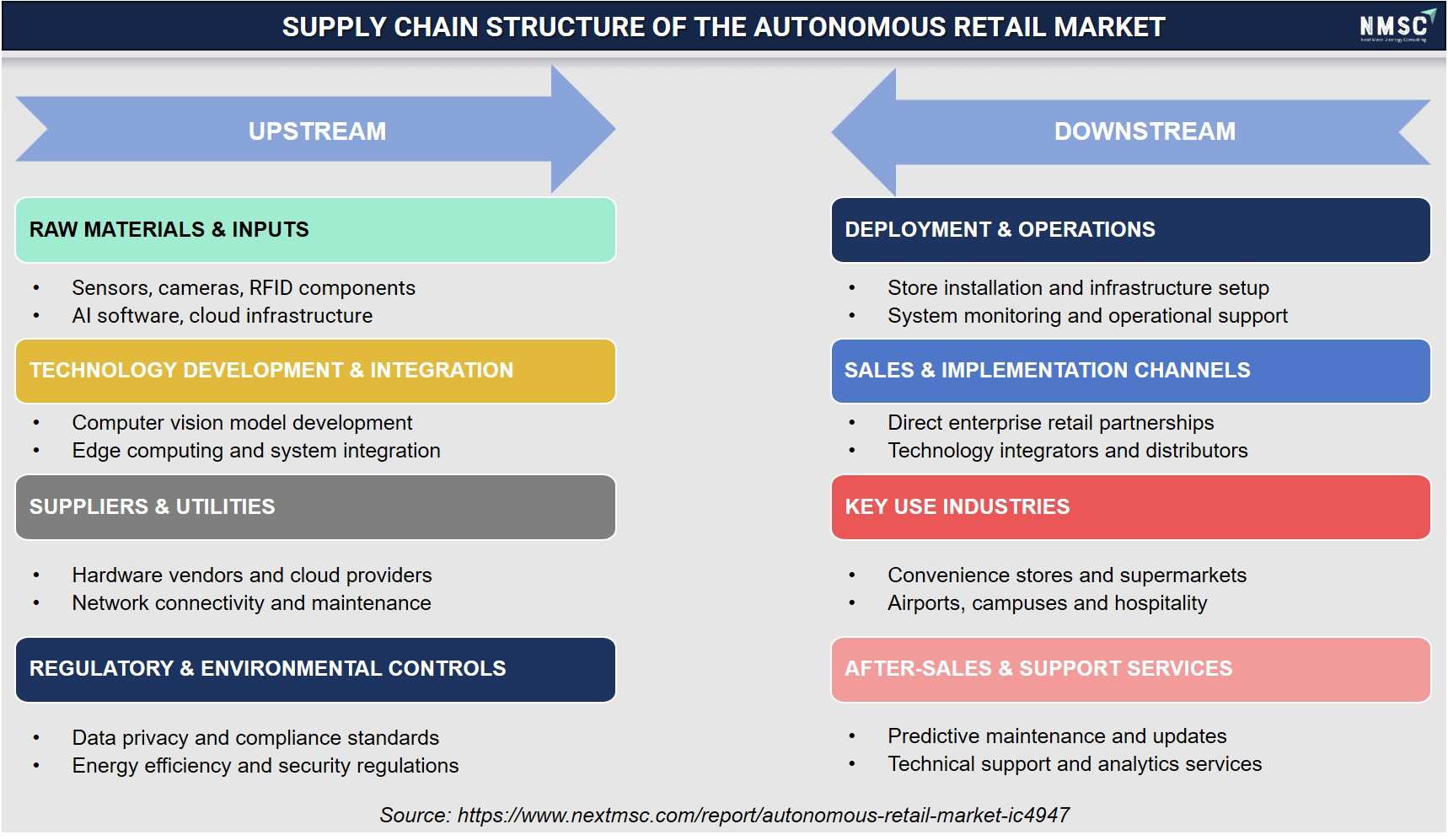
The supply chain structure highlights the interconnected ecosystem supporting the Autonomous Retail Market. We identified that advanced sensors, AI software, cloud infrastructure, and system integration form the foundation of autonomous retail deployments. Furthermore, collaboration among technology providers, retailers, system integrators, and service partners, supported by regulatory compliance and after-sales support, is enabling efficient implementation and scalable market expansion across diverse retail environments.
Competitive Landscape
Competitive Dynamics and M&A Landscape
|
Key Takeaways |
Details |
|
Market Structure |
The Autonomous Retail Market is moderately fragmented, featuring a combination of large technology conglomerates (Amazon, NCR Voyix, Zebra Technologies, Fujitsu, Toshiba Tec), specialized autonomous retail startups (AiFi, Trigo, Zippin, Mashgin), and ESL and hardware specialists (VusionGroup, Hanshow, Avery Dennison). No single vendor commands a majority market share across all solution categories. |
|
Innovation Focus |
R&D investment is concentrated in computer vision model accuracy improvement, multi-modal sensor fusion architectures, edge AI inference optimization, privacy-preserving biometric processing, and AI-powered loss prevention. Several vendors are pursuing open-standards AI model platforms to reduce retailer lock-in concerns and accelerate enterprise adoption. |
|
M&A Activity |
The Autonomous Retail Market has experienced increasing M&A activity as large technology vendors seek to acquire proven computer vision capabilities, established retail customer bases, and patented checkout technologies developed by venture-backed autonomous retail startups. Strategic acquirers are particularly focused on companies with deployed customer references and recurring revenue streams. |
How Do Companies Compete in the Autonomous Retail Market?
The Autonomous Retail Market exhibits a multi-dimensional competitive dynamic in which vendors differentiate across technology accuracy, deployment speed, integration depth, and total cost of ownership. Our analysis shows that the market structure ranges from large enterprise technology conglomerates with broad solution portfolios to specialized AI-native startups focused on specific use cases such as cashierless checkout or loss prevention. Competitive strategies include technology licensing (Amazon Just Walk Out), vertical integration across hardware and software, and open-platform API approaches that enable integration with existing retail infrastructure. Geographic expansion through partnerships with regional systems integrators is a key go-to-market lever for global vendors entering emerging markets in Asia-Pacific, the Middle East, and Latin America.
Which Kind of Companies Dominate the Autonomous Retail Market?
The Autonomous Retail Market is dominated by three distinct company archetypes. First, established retail technology conglomerates including NCR Voyix, Diebold Nixdorf, Fujitsu, and Toshiba Tec leverage deep retail customer relationships and proven POS infrastructure to add autonomous checkout capabilities to existing solution portfolios. Second, technology platform companies including Amazon and Zebra Technologies bring AI, cloud, and hardware manufacturing capabilities to create vertically integrated autonomous retail platforms with broad commercial reach. Third, AI-native startups including AiFi, Trigo Vision, Zippin, and Mashgin compete on computer vision accuracy, deployment simplicity, and innovative commercial models such as store-as-a-service and revenue-share pricing arrangements.
AI-Native Differentiation and Open Standards Drive Market Success in the Autonomous Retail Market
NMSC's analysis indicates that AI-native differentiation is becoming the primary competitive moat within the Autonomous Retail Market, as retailers increasingly evaluate checkout solution providers on the accuracy, speed, and explainability of their underlying AI models. Vendors that have developed proprietary training datasets compiled from diverse retail environments, packaging formats, and lighting conditions hold a meaningful competitive advantage. Simultaneously, open-standards interoperability is emerging as a critical enterprise procurement criterion, with retailers requiring that autonomous checkout and store intelligence platforms integrate seamlessly with existing ERP, WMS, and CRM systems through standardized APIs rather than proprietary integration frameworks that create vendor lock-in.
Market Players to Opt for Merger and Acquisition Strategies to Expand Their Presence in the Autonomous Retail Market
Merger and acquisition activity is expected to intensify within the Autonomous Retail Market as the technology matures and larger vendors seek to acquire proven AI capabilities and established customer bases. From our assessment, the most likely acquisition targets are AI-native cashierless checkout vendors with deployed commercial references across multiple retail formats, ESL software platform companies with large recurring revenue bases, and loss prevention AI specialists that can be integrated into broader store intelligence portfolios. Large technology vendors including Zebra Technologies and NCR Voyix have established track records of acquiring complementary retail technology companies and integrating them into their broader platform architectures, suggesting continued inorganic growth strategies through the forecast period.
Who Are the Key Market Players in the Autonomous Retail Market?
-
Amazon.com, Inc.
-
NCR Voyix Corporation
-
Zebra Technologies Corporation
-
VusionGroup S.A.
-
Fujitsu Limited
-
Toshiba Tec Corporation
-
GLORY LTD.
-
Hanshow Technology Co., Ltd.
-
Nayax Ltd.
-
Cantaloupe, Inc.
-
365 Retail Markets, LLC
-
StrongPoint ASA
-
Everseen Limited
-
AiFi Inc.
-
Trigo Vision Ltd.
-
Zippin Inc.
-
Mashgin, Inc.
-
Cloudpick Technology Co., Ltd.
What Are the Latest Developments in the Autonomous Retail Industry?
|
Date |
Event |
|
May 2026 |
The Cantaloupe, Inc. company completed its acquisition by 365 Retail Markets, LLC on May 8, 2026. This merger significantly consolidates the self-service and automated retail market, combining Cantaloupe’s digital payment infrastructure with 365’s smart store technologies. |
|
January 2026 |
Everseen Debuted "Everact" at NRF 2026, an agentic AI platform that allows retail teams to use natural language to query store data, retrieve video evidence, and receive recommended actions for operational issues like loss prevention. |
|
January 2026 |
Fujitsu Limited announced a new autonomous AI platform designed for generative AI lifecycle management. The platform features lightweight models and low-code/no-code frameworks for developers to build specialized AI agents for retail operations, with an official global launch scheduled for July 2026. |
Expert Insights
 “Our collaboration with Verizon and the Atlanta Hawks and State Farm Arena showcases how autonomous retail and seamless entry solutions can transform stadium environments. By leveraging cutting-edge technology with spatial intelligence, we are enabling faster, frictionless transactions that redefine convenience for fans while optimizing venue operations.”
— Steve Carlin, CEO, AiFi
Statement made during the launch of the Hawks Express cashierless checkout store at State Farm Arena, highlighting how AI-powered autonomous retail and spatial intelligence technologies are transforming retail operations and enhancing customer experiences in high-traffic venues.
Market Interpretation
The statement highlights the growing adoption of autonomous retail technologies that enable frictionless shopping experiences while improving operational efficiency. Retailers are increasingly deploying AI-powered computer vision, spatial intelligence, and autonomous checkout solutions to eliminate traditional checkout processes, reduce waiting times, and optimize store operations. As demand for seamless, contactless shopping experiences continues to increase across sports venues, convenience stores, airports, and other high-footfall retail environments, investments in autonomous retail platforms are expected to accelerate, supporting broader market growth.
What Are the Investment Opportunities in the Autonomous Retail Market?
Capital Inflows and Venture Activity
The Autonomous Retail Market continues to attract strong venture capital and strategic corporate investment as retailers accelerate the adoption of cashierless and AI-powered shopping technologies. AI-native autonomous retail companies, including AiFi, Trigo Vision, Zippin, and Mashgin, have secured significant funding to commercialize computer vision and smart store solutions. We noticed that strategic investments from major retailers and technology partners are reducing commercialization risks while creating expansion-stage opportunities for growth investors targeting scalable autonomous retail platforms.
Infrastructure Investment
Investment in digital retail infrastructure is emerging as a key driver of the Autonomous Retail Market as retailers modernize stores with AI-enabled cameras, sensors, edge computing, cloud platforms, and smart payment systems. We found that enterprise retailers are increasingly investing in integrated autonomous retail ecosystems rather than standalone hardware deployments. These investments expand recurring software and managed service revenues while strengthening long-term platform adoption across convenience stores, supermarkets, airports, campuses, and other retail environments.
ESG and Sustainable Retail Operations
Environmental, Social, and Governance (ESG) priorities are increasingly influencing investment decisions across the Autonomous Retail Market. AI-powered inventory management, automated shelf monitoring, and real-time demand forecasting help retailers reduce food waste, optimize energy consumption, and improve operational efficiency. We further analysed that institutional investors increasingly favor autonomous retail platforms supporting sustainability initiatives while enabling workforce redeployment toward higher-value customer engagement and store management functions.
Digital Transformation Enablement
Autonomous retail technologies have become an integral component of enterprise digital transformation strategies as retailers modernize customer engagement and store operations. AI-driven computer vision, cloud analytics, digital payment platforms, and real-time inventory intelligence enable frictionless shopping experiences while improving operational visibility and decision-making. We assessed that growing investments in smart retail infrastructure and omnichannel commerce are creating durable, long-term opportunities for autonomous retail solution providers across global markets.
Private Equity and Strategic M&A Activity
Private equity firms and strategic investors are expanding their presence in the Autonomous Retail Market as leading technology providers transition from pilot deployments to commercial-scale operations. Growth capital is increasingly targeting computer vision developers, AI checkout solution providers, electronic shelf label platforms, and retail analytics companies. We noticed that consolidation across retail technology vendors is creating attractive acquisition opportunities as established retailers and technology companies strengthen their autonomous retail capabilities through strategic mergers and acquisitions.
Key Benefits for Stakeholders
For Retailers and Store Operators
Retailers and store operators gain a comprehensive analysis of the Autonomous Retail Market's technology landscape, enabling informed capital allocation decisions across cashierless checkout, self-checkout modernization, unattended retail, and store intelligence investments. The segmentation analysis across solution type, deployment model, end-user vertical, and store format provides granular market sizing data to support business case development for autonomous retail rollouts. Competitive landscape analysis identifies leading technology vendors and their respective commercial strengths, enabling procurement teams to conduct structured vendor evaluations. CAGR and revenue forecast data through 2035 supports long-range capital planning and digital transformation roadmap development.
For Autonomous Retail Technology Vendors
Autonomous retail technology vendors gain actionable intelligence on white-space opportunities, competitive positioning gaps, and fastest-growing market segments within the Autonomous Retail Market. Solution type segmentation reveals that Cashierless Checkout Systems and Education Retail represent the highest-growth investment priorities, while revenue stream analysis highlights Software Subscription and Transaction Fees as the most strategically valuable revenue model transitions. Regional analysis identifies the Middle East and Africa as the fastest-growing geography requiring targeted commercial investment, while North America remains the largest revenue pool. Competitive landscape assessment enables vendors to identify differentiation strategies relative to both established enterprise technology vendors and AI-native startup competitors.
For Investors and Financial Analysts
Investors and financial analysts access a structured, data-rich assessment of the Autonomous Retail Market's growth trajectory, competitive dynamics, M&A pipeline, and segment-level revenue forecasts through 2035. CAGR analysis by segment, region, and end-user vertical enables precise portfolio construction and valuation modeling. Detailed coverage of all 20 profiled vendors, combined with latest development tracking, provides an early-signal framework for identifying acquisition targets, emerging leaders, and at-risk incumbents within the global autonomous retail technology landscape. The forecast from USD 8.6 billion in 2025 to USD 56.8 billion by 2035 at a 21.0% CAGR defines a compelling investment universe for growth-focused technology investors.
For Government and Regulatory Bodies
Government agencies and regulatory bodies gain a structured analysis of how consumer data privacy regulations, labor market policies, and digital infrastructure investment programs are influencing the Autonomous Retail Market's development trajectory. Country-level insights provide policymakers with evidence-based perspectives on how regulatory design choices affect retail technology investment attraction and consumer economic welfare. Regional outlook sections offer direct relevance to national retail modernization strategy development, particularly for governments in the Middle East, Southeast Asia, and Latin America that are actively using policy instruments to accelerate digital retail infrastructure development within their national economic competitiveness frameworks.
Key Market Segments
By Solution Type
-
Cashierless Checkout Systems
-
Computer Vision Checkout Systems
-
Overhead Vision Systems
-
Shelf Vision Systems
-
Hybrid Vision Systems
-
-
RFID Checkout Systems
-
RFID Gate Systems
-
RFID Store Systems
-
-
Sensor Fusion Checkout Systems
-
Vision and Weight Sensor Systems
-
Vision and RFID Sensor Systems
-
-
Smart Cart Systems
-
Vision-Based Smart Carts
-
Sensor-Based Smart Carts
-
-
-
Autonomous Self-Checkout Systems
-
AI Self-Checkout Kiosks
-
Item Recognition Kiosks
-
Basket Recognition Kiosks
-
-
Scan and Go Systems
-
Mobile Scan and Go
-
Handheld Scan and Go
-
-
Hybrid Self-Checkout Systems
-
Assisted Self-Checkout
-
Autonomous Self-Checkout
-
-
-
Unattended Retail Systems
-
Smart Vending Machines
-
Ambient Product Vending
-
Refrigerated Product Vending
-
Specialty Product Vending
-
-
Micro Market Platforms
-
Workplace Micro Markets
-
Campus Micro Markets
-
Hospitality Micro Markets
-
-
Autonomous Stores
-
Container Stores
-
Modular Stores
-
Permanent Autonomous Stores
-
-
-
Store Intelligence Systems
-
Electronic Shelf Label Systems
-
ESL Hardware
-
ESL Software
-
ESL Services
-
-
Inventory Visibility Systems
-
RFID Inventory Systems
-
Vision Inventory Systems
-
-
Shelf Monitoring Systems
-
Stock Availability Monitoring
-
Planogram Compliance Monitoring
-
-
Loss Prevention Systems
-
Checkout Loss Prevention
-
In-Store Loss Prevention
-
-
Retail Analytics Systems
-
Shopper Analytics
-
Operational Analytics
-
-
Other Store Intelligence Systems
-
-
Autonomous Retail Platform Software and Services
-
Store Operations Platforms
-
Device Management Platforms
-
Store Management Platforms
-
-
Autonomous Checkout Platforms
-
Transaction Management Platforms
-
Checkout Orchestration Platforms
-
-
Computer Vision Platforms
-
Vision Processing Engines
-
AI Model Management Platforms
-
-
Professional Services
-
Deployment Services
-
Integration Services
-
Managed Services
-
-
Other Autonomous Retail Platform Software and Services
-
By Revenue Stream
-
Hardware
-
Software License
-
Software Subscription
-
Transaction Fees
-
Professional Services
By Deployment Model
-
New Store Deployment
-
Existing Store Retrofit
By Store Format
-
Small Format
-
Medium Format
-
Large Format
By Sales Channel
-
Direct Sales
-
Systems Integrators
-
Channel Partners
-
OEM Partnerships
By End User
-
Grocery
-
Convenience Retail
-
Specialty Retail
-
Food Service
-
Travel Retail
-
Sports and Entertainment Venues
-
Healthcare Retail
-
Education Retail
-
Workplace Retail
-
Other Retail
By Region
-
North America: U.S., Canada, and Mexico.
-
Europe: UK, Germany, France, Italy, Spain, Sweden, Denmark, Finland, the Netherlands, and the rest of Europe.
-
Asia-Pacific: China, India, Japan, South Korea, Taiwan, Indonesia, Vietnam, Australia, Philippines, Malaysia, and the rest of APAC.
-
Middle East & Africa (MEA): Saudi Arabia, UAE, Egypt, Israel, Turkey, Nigeria, South Africa, and the rest of MEA.
-
Latin America: Brazil, Argentina, Chile, Colombia, and the rest of LATAM.
Conclusion and Recommendations
Long-Term Outlook
The Autonomous Retail Market is entering its most consequential growth decade, driven by structural labor cost pressures, technology cost deflation in AI hardware, and accelerating consumer preference for frictionless shopping experiences. The market is forecast to grow from USD 10.2 billion in 2026 to USD 56.8 billion by 2035, at a CAGR of 21.0%. Our analysis further indicates that this growth reflects both the deepening penetration of autonomous checkout within grocery and convenience retail, and the significant expansion of the market into new venue categories including education, healthcare, workplace, and sports and entertainment retail environments across all major global geographies.
Strategic Positioning Recommendations
Platform vendors should prioritize interoperable, open-API autonomous retail architectures that integrate with existing retail infrastructure rather than requiring full store rebuilds. AI-native differentiation through proprietary computer vision training datasets, proven accuracy benchmarks, and privacy-preserving on-device processing will be the most durable competitive moat within the Autonomous Retail Market. Vendors targeting European and Asian markets must invest in GDPR-compliant and local data protection law-aligned product architectures as a prerequisite for enterprise procurement qualification. Software Subscription and Transaction Fee revenue models should be prioritized over hardware-only sales to capture the higher lifetime value associated with platform-based autonomous retail deployments.
Investment Attractiveness
The Autonomous Retail Market represents a highly attractive investment environment, given durable multi-decade secular drivers, expanding total addressable market across multiple venue categories, and a clear trajectory from technology maturation to commercial scale. NMSC's assessment identifies the highest-conviction investment themes as Education Retail adoption (25.9% CAGR), Sports and Entertainment Venue deployment (24.6% CAGR), Transaction Fee revenue stream growth (23.9% CAGR), and Middle East and Africa regional expansion (23.8% CAGR). Investors should monitor AI-native checkout startups with deployed enterprise references for strategic acquisition activity by established retail technology conglomerates seeking to accelerate autonomous retail capabilities.
Market Shifts and Key Risks
The most significant market shift underway within the Autonomous Retail Market is the transition from attendance-optional self-checkout to fully frictionless, zero-interaction cashierless environments enabled by computer vision and sensor fusion. This transition benefits AI-native vendors and technology licensors such as Amazon at the expense of traditional checkout terminal manufacturers. Key risks include consumer privacy regulatory escalation constraining computer vision deployment across European and Asian markets, high capital expenditure requirements limiting adoption among small and mid-size retailers, workforce displacement concerns prompting legislative intervention in certain jurisdictions, and AI model accuracy failures in complex product recognition scenarios undermining consumer trust in cashierless checkout implementations.
Growth Pathways
Organizations seeking to maximize value from the Autonomous Retail Market should pursue a phased investment strategy. In the near term through 2027, priority should be placed on electronic shelf label deployment and scan-and-go checkout modernization to establish the digital store data infrastructure required for advanced autonomous retail. In the mid-term through 2031, investment in AI-powered loss prevention, sensor fusion checkout, and autonomous micro market expansion will capture the fastest-growing revenue segments. In the long term through 2035, positioning for fully autonomous store formats across multiple venue categories and geographic markets will establish durable leadership in the most structurally valuable segments of the global autonomous retail technology landscape.
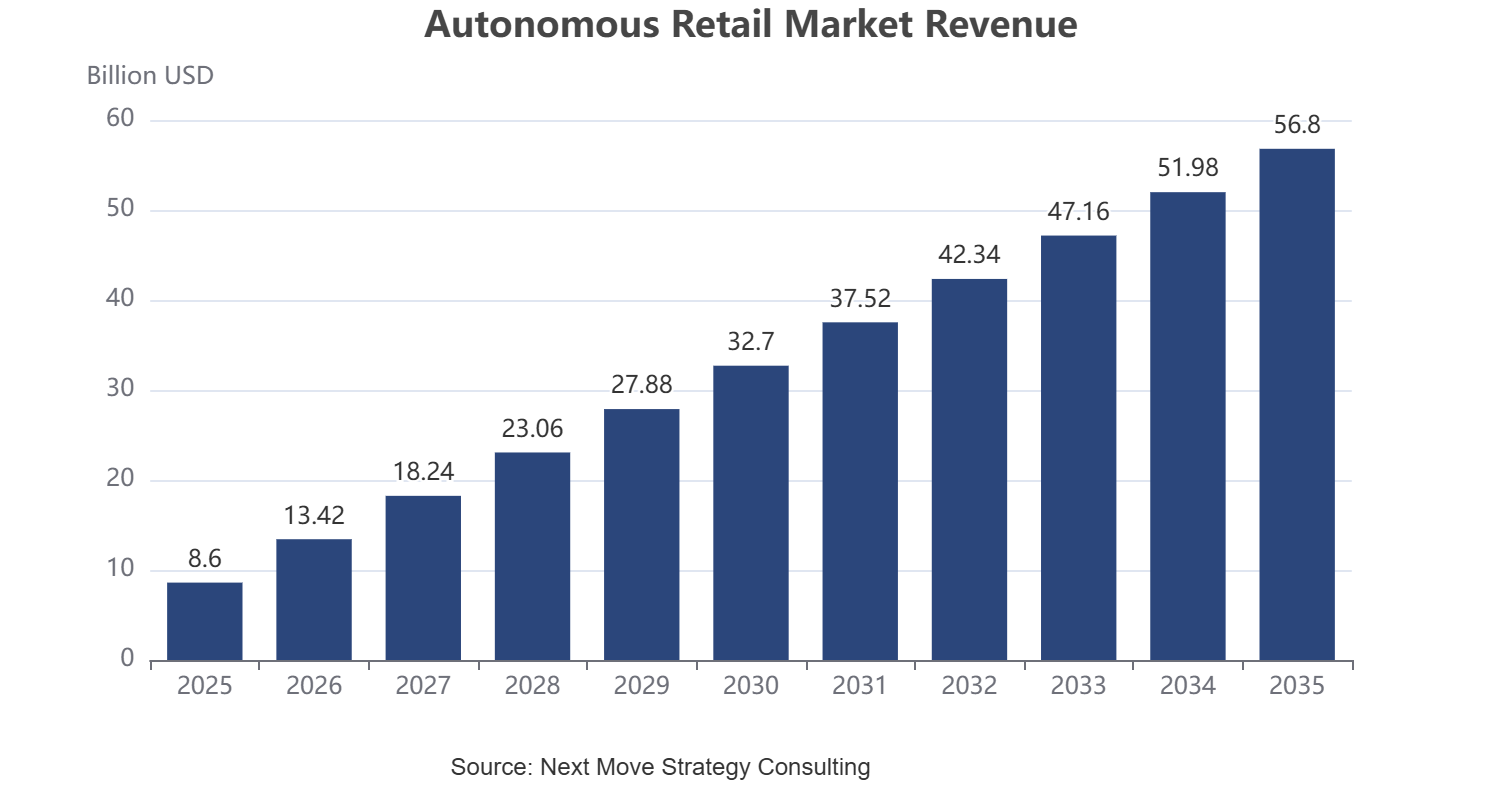
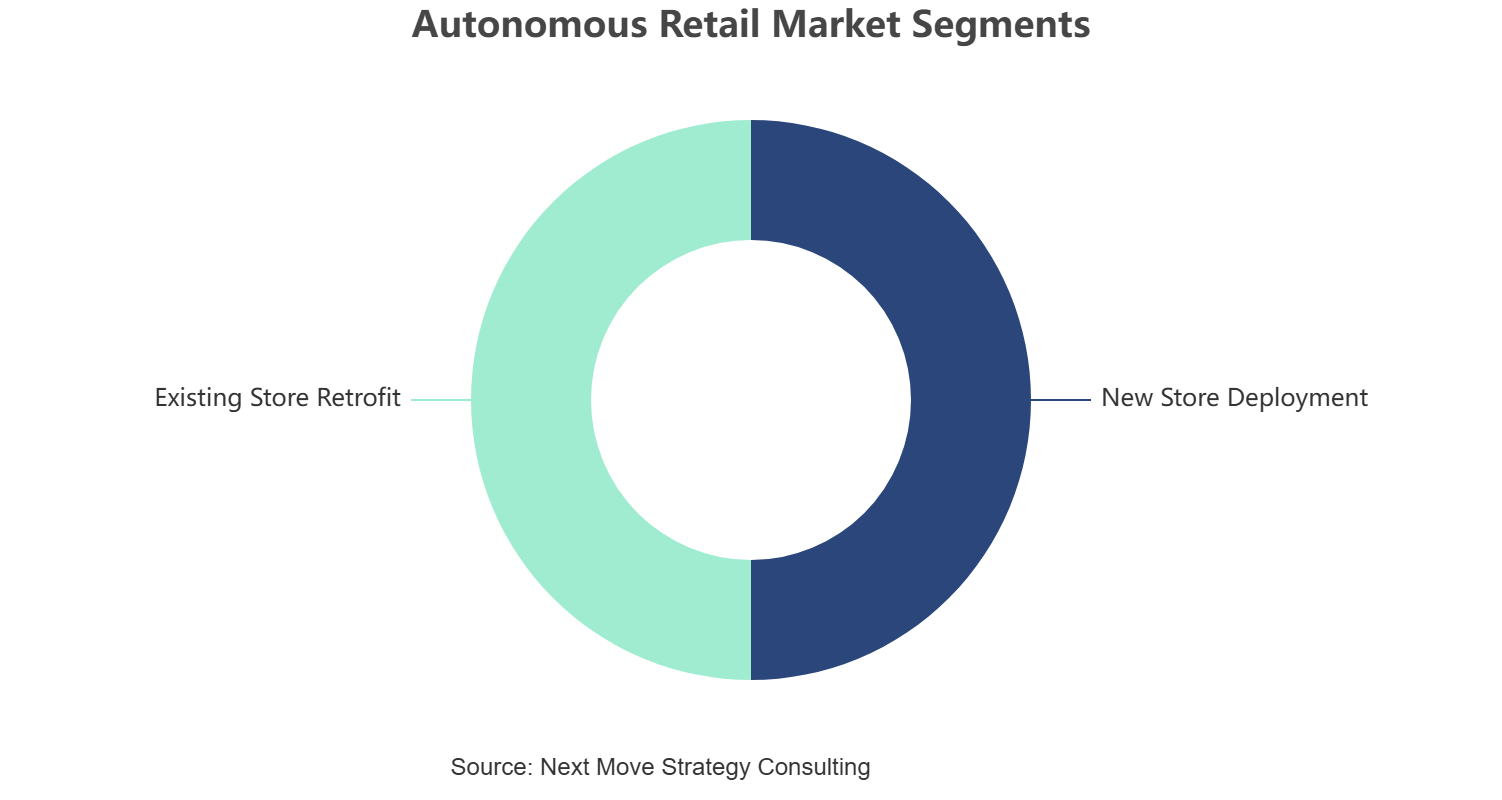
About the Author
 Saista Faiyaz
— Saista Faiyaz is Research Associate at Next Move Strategy Consulting, where she has covered consumer markets and healthcare technologies for 3 years. Her work includes primary interview review, secondary-source validation, market sizing, and structured analysis of company and industry data. She supports research by comparing evidence across sources, organizing findings into market narratives, and documenting assumptions used in analysis. Her scope includes cross-market benchmarking, and reports.
Saista Faiyaz
— Saista Faiyaz is Research Associate at Next Move Strategy Consulting, where she has covered consumer markets and healthcare technologies for 3 years. Her work includes primary interview review, secondary-source validation, market sizing, and structured analysis of company and industry data. She supports research by comparing evidence across sources, organizing findings into market narratives, and documenting assumptions used in analysis. Her scope includes cross-market benchmarking, and reports.
About the Reviewer
 Supradip Baul
— Supradip Baul is an accomplished business consultant and strategist with over a decade of rich experience in market intelligence, strategy, technology, and business transformation. His work has included rigorous qualitative and quantitative analysis across multiple industries, helping clients shape investment decisions and long-term roadmaps. Earlier in his career, he was associated with Gartner, where he contributed to industry-leading reports and market share analyses. He has worked with leading global companies and holds an MBA with a dual specialization in Marketing and Finance.
Supradip Baul
— Supradip Baul is an accomplished business consultant and strategist with over a decade of rich experience in market intelligence, strategy, technology, and business transformation. His work has included rigorous qualitative and quantitative analysis across multiple industries, helping clients shape investment decisions and long-term roadmaps. Earlier in his career, he was associated with Gartner, where he contributed to industry-leading reports and market share analyses. He has worked with leading global companies and holds an MBA with a dual specialization in Marketing and Finance.
At Next Move Strategy Consulting, we understand that insightful market research is the cornerstone of successful business decisions. That's why we employ a robust and multifaceted approach, combining various methodologies to deliver the most accurate and actionable data for our clients.

Research Landscape
We navigate the world of research with two primary approaches:
Qualitative Approach
Our qualitative research methodologies involve immersive techniques such as in-depth interviews, focus groups, and observational studies. By engaging directly with individuals and stakeholders, we uncover valuable insights that quantitative data alone may overlook.

Quantitative Research
In tandem with qualitative methodologies, NMSC leverages the power of Quantitative Research to provide a robust foundation of numerical insights. Through systematic data collection and analysis, we quantify patterns, preferences, and market trends, offering a comprehensive view of the business landscape.
Our quantitative research approach employs diverse tools, including surveys, experiments, and statistical modelling. These methodologies enable us to gather data from a large and representative sample, ensuring the statistical significance of our findings. By employing structured questionnaires and standardized data collection methods, we guarantee the reliability and validity of the information we present to our clients.
Quantitative research is particularly effective in measuring the prevalence of trends, assessing market size, and gauging the impact of various factors on consumer behavior. The numerical precision attained through this approach equips our clients with actionable insights, facilitating data-driven decision-making and strategy formulation.


Our Specialized Toolbox for Industry-Specific Market Research
We deploy a specialized arsenal of techniques tailored to meet your unique requirements. Here's a glimpse into our comprehensive toolbox:

Information Procurement
The stage entails acquiring market data or relevant information through various sources and methodologies.


Market Research Approach
We utilize both top-down and bottom-up approaches in market research analysis to achieve a comprehensive understanding of the market dynamics, leveraging the broad perspective of industry trends and macroeconomic factors alongside detailed insights from specific segments and individual companies.

Porters Five Forces Analysis
We conduct Porter's Five Forces analysis to evaluate the competitive landscape of an industry, providing us with insights into factors that affect profitability and strategic positioning.

SWOT Analysis

Forecasting
We utilize a forecasting model to predict future consumption by considering parameters like population, economics, regulations, market competition, drivers, constraints, technology, and pricing. We also employ statistical techniques such as multilinear regression, exponential smoothing, moving average, ARIMA, and Monte Carlo simulations for accurate predictions. In econometric forecasting, we analyzed short-term and long-term event impacts, attributing values based on regulatory frameworks, economic factors, and market events.





 Speak to Our Analyst