Backup and Disaster Recovery Market Global Industry Analysis and Forecast (2026–2035)

Rising ransomware exposure, tighter resilience rules and cloud-delivered recovery are lifting the Backup and Disaster Recovery Market from USD 15.60 Billion in 2025 to USD 46.60 Billion by 2035 at an 11.5% CAGR over 2026 to 2035, led by North America

Download Free Sample PDF
Base Year (2025)
$15.60 Billion
Forecast (2035)
$46.60 Billion
CAGR (2026-2035)
11.5%
Top Region
North America

What Is the Backup and Disaster Recovery Market Size?

The global Backup and Disaster Recovery Market was valued at USD 15.60 Billion in 2025 and is estimated at USD 17.45 Billion in 2026. It is forecast to reach USD 46.60 Billion by 2035, growing at a CAGR of 11.5% from 2026 to 2035. North America leads with approximately 39% share, while backup and recovery software holds approximately 44%.

We observed that buyers now fund recovery speed and proof of data integrity ahead of raw backup capacity.

Backup and Disaster Recovery Market Global Industry Analysis and Forecast (2026–2035) Revenue Forecast

Values in USD Billion

2025 $15.60 Billion
2025
2026 $17.45 Billion
2026
2027 $19.46 Billion
2027
2028 $21.69 Billion
2028
2029 $24.19 Billion
2029
2030 $26.97 Billion
2030
2031 $30.07 Billion
2031
2032 $33.53 Billion
2032
2033 $37.39 Billion
2033
2034 $41.69 Billion
2034
2035 $46.60 Billion
2035

Key Takeaways

By Offering: Backup and recovery software held the largest share, expanding from USD 6.80 Billion in 2025 to USD 16.40 Billion by 2035; Cloud backup and recovery services is the fastest growing at 16.1% CAGR from 2026–2035.

By Deployment Mode: On-premises held the largest share, expanding from USD 7.00 Billion in 2025 to USD 10.60 Billion by 2035; Public cloud is the fastest growing at 16.3% CAGR from 2026–2035.

By End User Industry: BFSI held the largest share, expanding from USD 3.90 Billion in 2025 to USD 10.40 Billion by 2035; Manufacturing and energy is the fastest growing at 13.9% CAGR from 2026–2035.

Dominant Region: North America dominated with approximately 39% share in 2025, equal to USD 6.08 Billion, anchored by ransomware exposure and large enterprise installed bases.

Fastest-Growing Region: Asia-Pacific is expected to register the highest CAGR of 14.1% during 2026–2035, driven by digital banking and public cloud expansion.

Dominant Country: The U.S. led the market with an estimated USD 5.12 Billion in 2025, supported by the deepest base of regulated and security conscious buyers.

Fastest-Growing Country: India is among the fastest growing major markets at 18.2% CAGR during 2026–2035, supported by data protection rules and cloud first adoption.

Between 2026 and 2035, the market is projected to add USD 29.15 Billion, representing a major investment opportunity concentrated in cloud-delivered recovery services.

According to NMSC analysis, tested recovery runbooks and clean room restores are becoming larger budget lines than incremental backup storage.

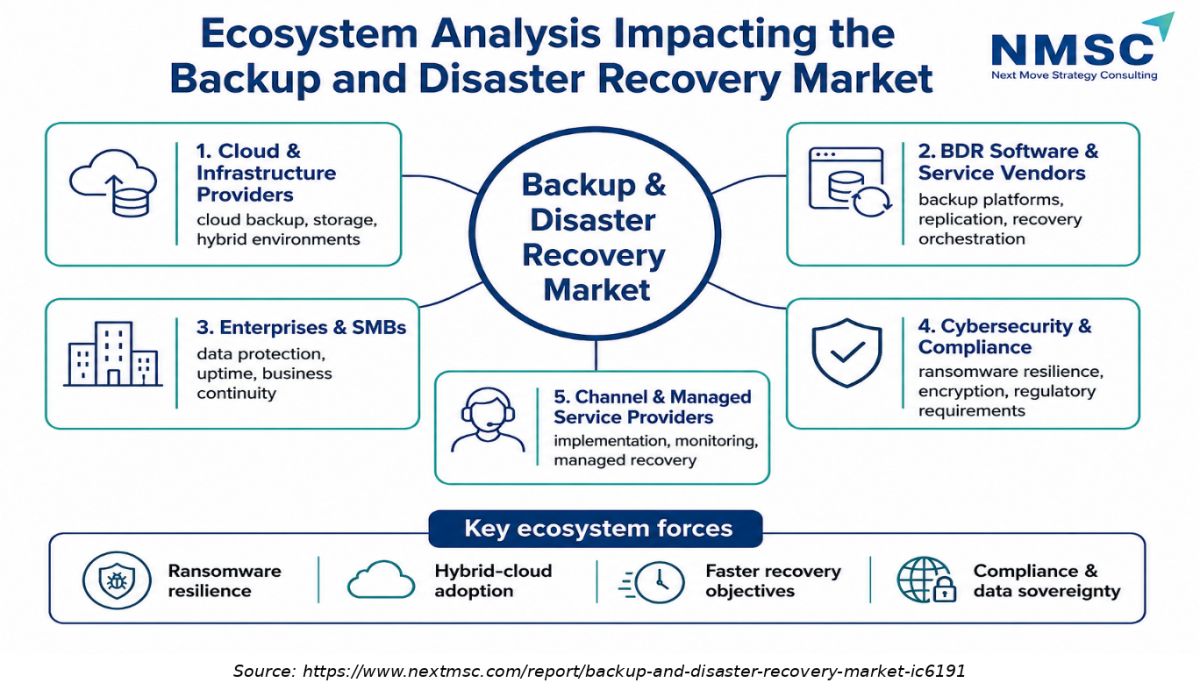
Ecosystem Analysis Impacting the Backup and Disaster Recovery Market

The infographic highlights the key stakeholders shaping the Backup and Disaster Recovery Market, including cloud infrastructure providers, software vendors, enterprises, cybersecurity and compliance providers, and managed service partners. It illustrates how ransomware resilience, hybrid-cloud adoption, faster recovery objectives, and data sovereignty requirements influence market growth and drive demand for reliable, secure, and scalable data protection solutions.

What Does the Backup and Disaster Recovery Market Encompass?

The Backup and Disaster Recovery Market covers the software, appliances, cloud services and professional services that copy, protect and restore enterprise data and applications after loss, corruption, cyberattack or site failure. The market report scope spans backup and recovery software, backup and disaster recovery as a service, backup appliances and hardware, and professional and managed services. Primary storage arrays without protection functions fall outside the definition, which keeps the analysis free of overlap with the wider storage industry.

Structural evolution is moving the industry from scheduled copies toward continuous cyber recovery with verified clean restore points. Regulation reinforces this shift, since the EU Digital Operational Resilience Act has applied since 17 January 2025 and requires financial entities to keep tested backup policies and segregated restoration systems. Technology adoption now centres on immutable storage, anomaly detection on backup data and orchestrated recovery into cloud regions, which together raise the value of each protected workload.

Market Drivers & Dynamics

Interactive Dataset
Rising ransomware and extortion exposure driver +2.1% Global, led by North America 2026–2035
Operational resilience regulation such as DORA driver +1.6% Europe, North America 2026–2030
Shift to cloud-delivered recovery services driver +1.9% Global 2026–2035
Data growth from AI workloads driver +1.2% Global 2026–2035
Hybrid and multicloud estate complexity driver +0.8% Global 2026–2032
Tool sprawl and licensing complexity restraint −1.1% Global 2026–2030
Shortage of recovery engineering skills restraint −0.9% Global, acute in Asia-Pacific and MEA 2026–2033
Cloud egress and storage cost pressure restraint −0.8% Global 2026–2030
Source: Next Move Strategy Consulting

Growth Drivers

What Is the Primary Growth Driver of the Backup and Disaster Recovery Market?

Ransomware pressure is the primary growth driver. U.S. law enforcement complaint records show ransomware complaints rising to 3,611 in 2025 from 3,156 in 2024, a 14.4% increase, alongside 63 newly identified variants. Reported losses understate the true cost because they exclude downtime and recovery spend. Boards respond by funding immutable copies, isolated recovery environments and rehearsed restores, which makes cyber recovery the most reliable source of incremental demand in the Backup and Disaster Recovery Market.

How Is DORA Driving the Backup and Disaster Recovery Market Growth?

Regulation converts resilience from a preference into an obligation. DORA has applied to EU financial entities since 17 January 2025, and its backup provisions require documented policies, periodic restoration testing and restoration systems segregated from production. Because banks must also oversee critical ICT providers, they favor vendors that supply evidence, audit support, and clear exit plans. BFSI is therefore the largest end user segment at 25% of 2025 revenue, and similar supervisory expectations are spreading across other jurisdictions.

Growth Inhibitors

What Is Restraining the Backup and Disaster Recovery Market?

Tool sprawl, licensing complexity and pricing pressure restrain growth. Industry-derived estimates suggest that large enterprises run several overlapping protection tools, which delays consolidation and inflates operating costs. Commoditization is visible in endpoint backup, where Backblaze reported Computer Backup ARR of USD 0.06 Billion, flat year on year, with net revenue retention of 94% in the second quarter of 2026. Skills gaps in recovery engineering and cloud egress charges add further friction, trimming the forecast CAGR by an estimated 2.8 percentage points.

What Are the Growth Opportunities?

How Can Cyber Recovery Vaults Open a New Revenue Pool?

Isolated recovery vaults let vendors sell a premium tier above routine backup. The mechanism pairs immutable storage, clean room restore testing and malware scanning of backup copies, and the beneficiary segment is backup and recovery software and appliances in regulated industries. Buyers pay for assurance that a clean copy exists, which supports higher attach rates and multiyear subscriptions. Dell positions Power Protect Cyber Recovery for this purpose.

Where Do Mid-Market and MSP Channels Create Whitespace?

Managed service providers serve organizations that lack in house recovery skills. The mechanism is a per workload subscription sold through partner channels, and the beneficiary segment is backup and disaster recovery as a service in small and mid-sized firms. N-able builds its data protection growth on this channel, and Druva reported a 300% jump in MSP customers in 2023. Packaged recovery with defined recovery times turns a cost line into a managed contract.

Can Protecting AI and Identity Data Become a New Segment?

Identity directories and AI training data are now recovery critical assets. The mechanism is extending protection policies to identity providers, vector stores and model pipelines, and the beneficiary is platform vendors with strong metadata and access controls. Veeam added governance capability through Securiti AI, and Rubrik targets risk and recovery for AI transformations. Enterprises adopting AI at scale will need to restore trusted data quickly after errors or attacks.

Segmentation Analysis

2025 (USD Billion)
2035 (USD Billion)
Backup and recovery software 2025: $6.80 Billion | 2035: $16.40 Billion
Backup and r
Cloud backup and recovery services 2025: $3.90 Billion | 2035: $17.60 Billion
Cloud backup
Backup appliances and hardware 2025: $2.80 Billion | 2035: $6.20 Billion
Backup appli
Professional and managed services 2025: $2.10 Billion | 2035: $6.40 Billion
Professional
Backup and recovery software $6.80 Billion $16.40 Billion 9.1%
Cloud backup and recovery services $3.90 Billion $17.60 Billion 16.1%
Backup appliances and hardware $2.80 Billion $6.20 Billion 8.4%
Professional and managed services $2.10 Billion $6.40 Billion 11.8%

Which Offering Dominates the Backup and Disaster Recovery Market?

Backup and Disaster Recovery Market software dominates with 44% of 2025 revenue, anchored by the installed bases of Veeam, Cohesity and Commvault. Cloud backup and recovery services are the fastest growing offering at 16.1% CAGR, led by backup as a service for SaaS and endpoint data, with Commvault SaaS revenue up 52% and N-able reporting data protection ARR above USD 0.20 Billion. Appliances grow slowest at 8.4% as workloads migrate to cloud targets.

2025 (USD Billion)
2035 (USD Billion)
On-premises
Public cloud
Hybrid cloud
Segment Item 2025 (USD Billion) 2035 (USD Billion) CAGR
On-premises $10.0 USD Billion $40.0 USD Billion 25.0%
Public cloud $17.1 USD Billion $51.1 USD Billion 11.0%
Hybrid cloud $24.2 USD Billion $62.2 USD Billion 25.0%

Segment-wise data is locked

Unlock complete segment-wise numbers for By Deployment Mode.

Unlock Full Data

Which Deployment Mode Is Growing Fastest?

On-premises deployment remains the largest mode at 45% of 2025 revenue because regulated enterprises retain control of primary recovery copies. Growth is slowest there, at 4.2% CAGR, as new workloads originate in the cloud. Public cloud is the fastest growing mode at 16.3% CAGR, helped by cloud computing adoption and managed recovery services, while hybrid cloud expands at 13.7% as customers keep local restore speed and add an offsite cloud copy. Vendors increasingly sell a single control plane across all three modes.

2025 (USD Billion)
2035 (USD Billion)
BFSI
IT and telec
Healthcare a
Government a
Retail and e
Segment Item 2025 (USD Billion) 2035 (USD Billion) CAGR
BFSI $10.0 USD Billion $40.0 USD Billion 27.0%
IT and telecom $17.1 USD Billion $51.1 USD Billion 9.0%
Healthcare and life sciences $24.2 USD Billion $62.2 USD Billion 19.0%
Government and public sector $31.3 USD Billion $73.3 USD Billion 17.0%
Retail and e-commerce $38.4 USD Billion $84.4 USD Billion 18.0%

Segment-wise data is locked

Unlock complete segment-wise numbers for By End User Industry.

Unlock Full Data

Which End User Industry Leads Demand?

BFSI leads with 25% of 2025 revenue because supervisors require tested recovery and institutions carry the highest downtime cost. Healthcare and life sciences grow at 12.4% CAGR as hospitals face frequent ransomware pressure and strict record retention rules. Manufacturing and energy are the fastest-growing end-user industries at 13.9% CAGR, reflecting the spread of connected plant systems and the need to restore operational data after attacks. Government and public sector spending grows at 10.4% with rising sovereign cloud requirements.

2025 (USD Billion)
2035 (USD Billion)
North Americ
U.S.
Canada
Mexico
Europe
Segment Item 2025 (USD Billion) 2035 (USD Billion) CAGR
North America $10.0 USD Billion $40.0 USD Billion 14.0%
U.S. $17.1 USD Billion $51.1 USD Billion 24.0%
Canada $24.2 USD Billion $62.2 USD Billion 22.0%
Mexico $31.3 USD Billion $73.3 USD Billion 12.0%
Europe $38.4 USD Billion $84.4 USD Billion 27.0%

Segment-wise data is locked

Unlock complete segment-wise numbers for By Region.

Unlock Full Data

Growth Opportunities

NMSC's analysis indicates that three opportunity pools offer the strongest return on incremental investment.

How Can Cyber Recovery Vaults Open a New Revenue Pool?

Isolated recovery vaults let vendors sell a premium tier above routine backup. The mechanism pairs immutable storage, clean room restore testing and malware scanning of backup copies, and the beneficiary segment is backup and recovery software and appliances in regulated industries. Buyers pay for assurance that a clean copy exists, which supports higher attach rates and multiyear subscriptions. Dell positions Power Protect Cyber Recovery for this purpose.

Where Do Mid-Market and MSP Channels Create Whitespace?

Managed service providers serve organizations that lack in house recovery skills. The mechanism is a per workload subscription sold through partner channels, and the beneficiary segment is backup and disaster recovery as a service in small and mid-sized firms. N-able builds its data protection growth on this channel, and Druva reported a 300% jump in MSP customers in 2023. Packaged recovery with defined recovery times turns a cost line into a managed contract.

Can Protecting AI and Identity Data Become a New Segment?

Identity directories and AI training data are now recovery critical assets. The mechanism is extending protection policies to identity providers, vector stores and model pipelines, and the beneficiary is platform vendors with strong metadata and access controls. Veeam added governance capability through Securiti AI, and Rubrik targets risk and recovery for AI transformations. Enterprises adopting AI at scale will need to restore trusted data quickly after errors or attacks.

Regional Outlook

2025 (USD Billion)
2035 (USD Billion)
North Americ
Europe
Asia-Pacific
Middle East
Latin Americ
Region 2025 (USD Billion) 2035 (USD Billion) CAGR (%)
North America $10.0 USD Billion $40.0 USD Billion 9.0%
Europe $17.1 USD Billion $51.1 USD Billion 27.0%
Asia-Pacific $24.2 USD Billion $62.2 USD Billion 25.0%
Middle East & Africa $31.3 USD Billion $73.3 USD Billion 23.0%
Latin America $38.4 USD Billion $84.4 USD Billion 12.0%

Regional data is locked

Unlock complete regional numbers for this market.

Unlock Full Data

Competitive Landscape

Based on research conducted by NMSC, we found that competition has shifted from backup features toward recovery assurance and security integration.

How Do Companies Compete in the Backup and Disaster Recovery Market?

Vendors compete on recovery speed, security features, workload coverage and commercial flexibility. Software platforms from Veeam, Commvault, Cohesity and Rubrik sell through partners and increasingly through subscription and SaaS models. Dell competes through purpose-built appliances and cyber recovery software, while Druva and N-able compete with fully managed cloud services. Pricing is shifting toward consumption and workload-based subscriptions, and geographic expansion is pursued through managed service providers and regional cloud partners.

Which Competitor Archetypes Dominate?

Three archetypes dominate. Scale leaders such as Veeam differentiate on installed base reach and ecosystem breadth, and platform consolidators such as Cohesity and Commvault differentiate on breadth across data security and recovery. Security led challengers such as Rubrik differentiate on cyber recovery, while managed delivery specialists such as Druva and N-able differentiate on simplicity and partner delivery. Dell differentiates on integrated appliances and cyber vaults, so recovery proof, operating ease and channel economics define the main themes.

How Do Leading Companies Differentiate Through Innovation?

Innovation centers on proving clean recovery, extending protection to SaaS and identity data, and automating response. Commvault is growing SaaS revenue while expanding its Cloud platform, Veeam adds data posture and governance after acquiring Securiti AI, and Rubrik builds around risk and recovery for AI transformations. Backblaze competes on low-cost object storage used as a backup target. Vendors also invest in AI-drivenin cybersecurity features that detect anomalies in backup data before restore.

What Is the Level of M&A Activity?

Deal activity is high and shapes share. Cohesity combined with the data protection business of Veritas, forming a group with pro forma fiscal 2023 revenue above USD 1.60 Billion and ARR of USD 1.30 Billion. Veeam closed its USD 1.73 Billion Securiti AI deal in December 2025. We expect further deals as vendors seek data security, identity and AI governance capabilities that extend recovery platforms beyond copy and restore.

Key Market Players

Our assessment indicates that the following eight companies lead the market, listed in ranked order by verifiable scale and offering breadth.

Veeam Software Cohesity, Inc. Commvault Systems, Inc. Rubrik, Inc. Dell Technologies Inc. Druva Inc. N-able, Inc. Backblaze, Inc.

Latest Developments

We found that recent corporate and industry events confirm the pace of consolidation and the rising weight of cyber recovery.

Date Event
December 2025 Veeam completed its acquisition of Securiti AI for USD 1.725 billion, expanding its broader data-resilience capabilities into data security posture management, privacy and AI governance.
August 2026 N-able, Inc. reported second-quarter 2026 total ARR of USD 0.54 Billion, up 6.0% year over year, with data protection leading net new ARR expansion.

Expert Insights

Anand Eswaran

Anand Eswaran

CEO | Veeam

"“The old model of ‘protect and hope’ is just done. The new model is data resilience as a living defensive system, where backup, recovery, security, privacy, and compliance all work together as one intelligence system.”"

Analyst Interpretation

The insight highlights a fundamental shift from conventional backup toward continuous data resilience, where backup and recovery are integrated with security, privacy, and compliance. Increasing ransomware and cyber threats are therefore driving organizations to adopt more comprehensive disaster recovery architectures rather than relying solely on periodic backups.

Investment Opportunities

Where Is Capital Flowing in the Backup and Disaster Recovery Market?

Capital is flowing toward platforms with security and recovery depth. Veeam committed USD 1.73 Billion to acquire Securiti AI, Cohesity combined with the data protection business of Veritas, and public vendors such as Rubrik and Commvault are funding growth from strong subscription ARR. We see the strongest return in cloud-delivered recovery, cyber vault tiers and managed service platforms, where recurring revenue and net retention support valuations.

How Does Infrastructure Investment Shape Demand?

Infrastructure spending on cloud regions, secondary sites and edge locations creates protected workloads and recovery targets. As enterprises add datacentercolocation capacity for secondary sites, demand rises for replication software, immutable storage and orchestration. Appliance vendors benefit where local restore speed matters, while public cloud providers capture offsite copies. Backblaze reported B2 Cloud Storage ARR of USD 0.11 Billion, up 39%, showing strong demand for low-cost object storage that backup tools can target.

What ESG Considerations Affect Investment?

ESG considerations center on the energy use of protected data, responsible retention and operational resilience for critical services. Deduplication, tiering and deletion of obsolete copies reduce storage footprint and emissions, and buyers increasingly ask vendors for efficiency data. Governance matters because failed recovery at hospitals, banks and utilities harms the public. We believe vendors that document efficiency, support lawful retention limits and evidence recovery for critical services will find investors more receptive.

Key Benefits for Stakeholders

How Does This Report Help Enterprise and Industry Leaders?

Enterprise leaders gain a segmented view of offerings, deployment modes and industries, with 2025 base values, 2026 estimates and 2035 forecasts. The analysis helps benchmark recovery spending, choose between software, appliance and service delivery, and justify budgets using regional growth rates. It also clarifies how regulation, cybersecurity insurance underwriting and vendor consolidation affect procurement timing, so leaders can negotiate multiyear commitments with a realistic view of price and capability trends.

What Value Does It Offer Investors and Financial Analysts?

Investors receive reconciled market values by segment and region; growth rates measured from 2026 to 2035 and a profile of ranked vendors. The data identifies where growth concentrates, notably cloud-delivered recovery at 16.1% CAGR and Asia-Pacific at 14.1%. Analysts can compare vendor positioning, consolidation trends and subscription mix against market growth to test valuation assumptions and screen acquisition targets in data security and managed recovery.

How Do Technology Vendors and Product Teams Benefit?

Vendors and product teams can align roadmaps with the fastest growing segments, such as public cloud and managed services, and with verticals including manufacturing and energy. The report highlights feature priorities in cyber recovery, immutable storage and AI assisted operations, and it shows where partner channels create whitespace. Product teams can use the regional and country analysis to prioritize data residency, localization and compliance features for launch planning.

Key Market Segments Evaluated

By Offering

  • Backup and recovery software
  • Cloud backup and recovery services
  • Backup appliances and hardware
  • Professional and managed services

By Deployment Mode

  • On-premises
  • Public cloud
  • Hybrid cloud

By End User Industry

  • BFSI
  • IT and telecom
  • Healthcare and life sciences
  • Government and public sector
  • Retail and e-commerce
  • Manufacturing and energy

By Region

  • North America 
    • U.S.
    • Canada
    • Mexico
  • Europe 
    • UK
    • Germany
    • France
    • Italy
    • Spain
    • Sweden
    • Denmark
    • Finland
    • Netherlands
    • Rest of Europe
  • Asia-Pacific 
    • China
    • India
    • Japan
    • South Korea
    • Taiwan
    • Indonesia
    • Vietnam
    • Australia
    • Philippines
    • Malaysia
    • Rest of APAC
  • Middle East & Africa 
    • Saudi Arabia
    • UAE
    • Egypt
    • Israel
    • Turkey
    • Nigeria
    • South Africa
    • Rest of MEA
  • Latin America 
    • Brazil
    • Argentina
    • Chile
    • Colombia
    • Rest of LATAM

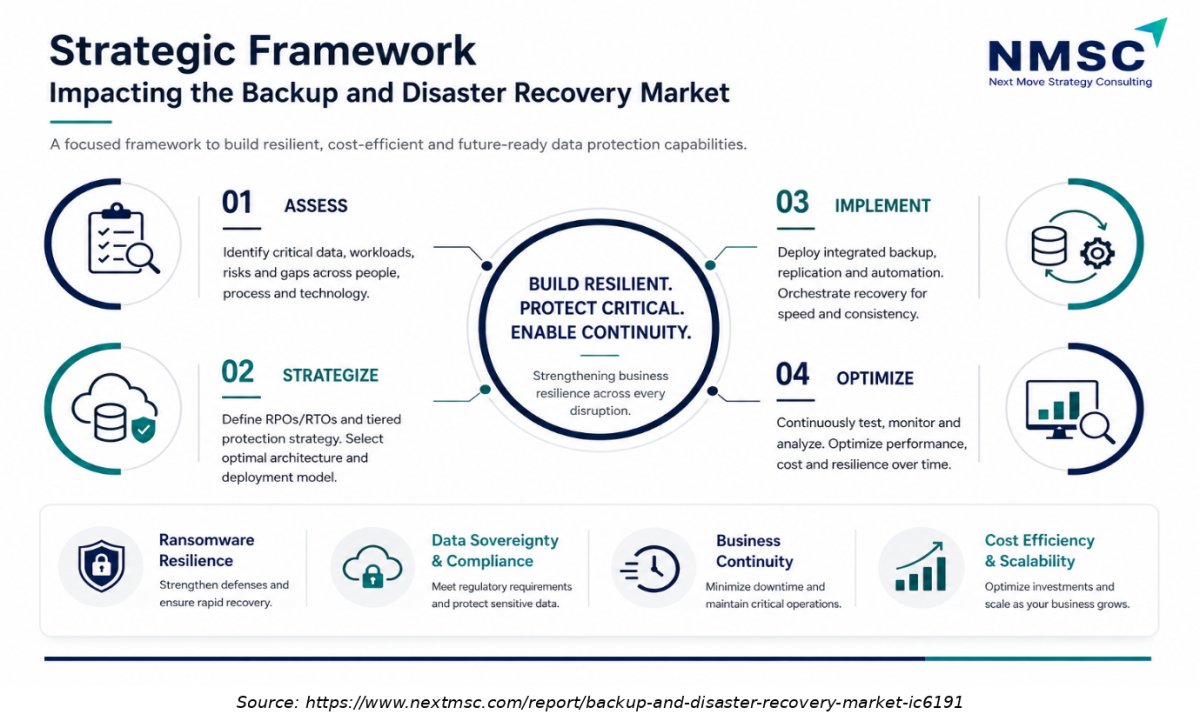
Strategic Framework Impacting the Backup and Disaster Recovery Market

Strategic Framework Impacting the Backup and Disaster Recovery Market
The infographic illustrates the strategic framework shaping the Backup and Disaster Recovery Market by connecting risk assessment, resilient protection strategies, automated recovery, and continuous optimization. It highlights how ransomware resilience, regulatory compliance, data sovereignty, business continuity, and cost efficiency influence strategic decisions, helping organizations strengthen data protection, minimize downtime, and ensure reliable recovery across evolving IT environments.
Conclusion & Recommendations

The long-term outlook is positive, with the market rising from USD 17.45 Billion in 2026 to USD 46.60 Billion in 2035. Growth is supported by persistent ransomware pressure, regulatory obligations and the migration of protected workloads to cloud environments. Cloud-delivered offerings should overtake several traditional categories by the end of the forecast period, while on-premises spending grows slowly. The competitive landscape will stay active as vendors broaden into security and AI governance.

What Strategic Positioning Recommendations Does NMSC Offer?

NMSC recommends that vendors lead with proven recovery outcomes, not storage features, and that they package cyber vaults, orchestration and testing in simple subscriptions. Enterprises should consolidate overlapping tools, require recovery evidence from suppliers and align recovery tiers with business criticality. Managed service providers should build data protection practices around workload-based pricing. All parties should plan for hybrid estates, since on-premises, public cloud and hybrid modes will coexist through 2035.

How Strong Is the Investment Attractiveness of This Market?

Investment attractiveness is high because revenue is recurring, switching costs are meaningful and demand is tied to mandatory resilience obligations. Our estimate of an 11.5% CAGR sits within the range expected for a growth stage market, and the segment mix shows stronger returns in cloud-delivered services. Attractiveness is tempered by price competition in endpoint backup and by consolidation among buyers, so selectivity on vendor quality and channel strength remains essential.

What Are the Market Shifts and Key Risks Through 2035?

Key shifts include the move from on-premises to cloud delivery, the fusion of backup and data security, and the extension of protection to SaaS, identity and AI data. Risks include tool sprawl that slows consolidation, pricing pressure in commoditized segments, shortages of recovery engineers and the possibility that attackers target backup systems directly. Vendors and buyers should treat backup infrastructure as a security asset and test recovery under realistic attack scenarios.

What Are the Primary Growth Pathways Through 2035?

Growth pathways include cyber recovery tiers, managed recovery for small and mid-sized firms, protection of AI and identity data, and expansion in Asia-Pacific, the Middle East and Latin America. Public cloud and hybrid modes, together with services, add the most absolute revenue through 2035. Regional growth is led by Asia-Pacific at 14.1% CAGR, and India leads countries at 18.2%. Vendors that combine product depth with partner reach should capture a disproportionate share.

FAQs

Sources & References

1.

Commvault Systems, Inc., Fourth Quarter and Fiscal 2026 results (SEC Form 8-K)

sec.gov
2.

Rubrik, Inc., Fourth Quarter and Fiscal Year 2026 results (SEC Form 8-K)

sec.gov
3.

Rubrik, Inc., Annual Report on Form 10-K for fiscal year ended 31 January 2026

sec.gov
4.

Veeam Software, press release on completion of the Securiti AI acquisition

veeam.com
5.

Veeam Software, Business Wire release, 11 December 2025

businesswire.com
6.

Cohesity, Inc., Cohesity and Veritas Data Protection Business to Combine

cohesity.com
7.

Druva Inc., press release on SaaS ARR milestone

druva.com
8.

N-able, Inc., Second Quarter 2026 results (Business Wire)

secure.businesswire.com
9.

Backblaze, Inc., Second Quarter 2026 results (SEC Form 8-K, Exhibit 99.1)

sec.gov
10.

Dell Technologies, Achieving Cyber Resilience with Dell Power Protect

dell.com
11.

Federal Bureau of Investigation, Internet Crime Complaint Center, 2025 Internet Crime Report

ic3.gov
12.

European Union, Regulation (EU) 2022/2554 (Digital Operational Resilience Act), EUR-Lex

eur-lex.europa.eu

About the Author

Mayurima Roy

Mayurima Roy

Mayurima Roy is Research Analyst at Next Move Strategy Consulting, where she has spent 4 years working across the firm's full industry coverage rather than a single fixed vertical. Her work centers on structured research, ongoing trend tracking, competitive assessment, and insight-led content development, translating complex market data into clear, decision-ready narratives that support informed client decision-making across diverse global industries, market sectors, and world regions every day.

About the Reviewer

Supradip Baul

Supradip Baul

Supradip Baul is an accomplished business consultant and strategist with over a decade of rich experience in market intelligence, strategy, technology, and business transformation. His work has included rigorous qualitative and quantitative analysis across multiple industries, helping clients shape investment decisions and long-term roadmaps. Earlier in his career, he was associated with Gartner, where he contributed to industry-leading reports and market share analyses. He has worked with leading global companies and holds an MBA with a dual specialization in Marketing and Finance.

Download Free Sample

Rishabh Jogani

RISHABH JOGANI

Strategy Analyst

Accenture Japan

We are incredibly impressed with the market report on the real estate market in India provided by Next Move Strategy Consulting. The report was thorough, insightful, and well-structured, offering deep analysis and actionable recommendations. It not only captured the current trends and dynamics but also provided a forward-looking perspective that has been invaluable for our strategic planning. Their team demonstrated exceptional professionalism, attention to detail, and a profound understanding of the industry. The data-driven insights and clarity of presentation exceeded our expectations, making complex market trends easy to understand. We highly recommend Next Move Strategy Consulting to anyone looking for reliable and comprehensive market research services. Their expertise has given us the confidence to navigate the complexities of the Indian real estate market with clarity and foresight.

Pratyush Kumar Das

PRATYUSH KUMAR DAS

Assistant Manager

Polycab India Limited

We would like to express our appreciation for the data and insights provided by nextmsc. We are very pleased with the quality and depth of the information, which has proven to be highly valuable and beneficial for our business decision-making.

Henri Knyphausen

HENRI KNYPHAUSEN

Partner at Singulier [Ex-BCG]

Singulier

I recently engaged NEXTMSC.com for a commercial due diligence project within the intralogistics sector, and I am pleased to provide a reference based on my experience. In utilizing NEXTMSC.com's services, I found their report to offer valuable insights into market dynamics and key industry players. The initial report provided a solid foundation for our analysis. However, as we were investigating a smaller target in the market, and I had specific customization requests requiring additional research. These requests included detailed information on product portfolios of various players and sub-market sizes, both inclusive and exclusive of certain product categories. NEXTMSC.com demonstrated commendable responsiveness and agility in accommodating these customization requests. Within a timeframe of 1-2 weeks, they delivered a revised report that met our specific needs. Furthermore, they were receptive to my follow-up inquiries, ensuring clarity and understanding of the data provided. The final deliverable significantly contributed to our due diligence efforts. One of NEXTMSC.com's notable strengths lies in their qualitative research capabilities. However, for future engagements, I would recommend the inclusion of a quantified market model in Excel format. Such a model would offer the ability to conduct in-depth analyses and explore various market segments, including country-specific data and subcomponent breakdowns. Based on my positive experience, I would not hesitate to work with NEXTMSC.com again. Their responsiveness, willingness to accommodate customization requests, and commitment to delivering actionable insights make them a reliable partner for commercial research projects.

Kevin Coker

KEVIN COKER

Founder, CEO and Board Diector

Proxima Clinical Research

I have been using Next MSC reports for product positioning in a new geography for a long time. They have by far the best reports I have found and the price is reasonable too!

Nishant Awate

NISHANT AWATE

Business Development Global Sales

Zehnder Group Deutschland GmbH

Our experience working with Next Move Strategy Consulting was positive. The team was responsive, professional, and open to incorporating our specific requirements throughout the project. The India AHU market study was comprehensive and well structured, covering market value and volume forecasts, product and application segments, and key industry trends. The inclusion of both AHU and residential MVHR market insights made the study particularly relevant for our strategic market assessment. Overall, the report provides a solid foundation for evaluating market potential, identifying priority segments, and supporting business-development decisions in India.

Custom Market Research Services

We will customize the research for you if the listed report does not fully match your requirements.

Get 30% Free Customization

Select License

This website uses cookies to ensure you get the best experience on our website. Learn more

✖