AI in Disaster Risk Market By Offering (Hardware: Sensors, Edge Devices, Alert Systems, Satellites; Software: Risk Intelligence, Early Warning, Geospatial Analytics, Incident Management, Catastrophe Modeling; Services: Implementation, Managed Services, Advisory, Support), By Hazard (Flood, Wildfire, Drought, Multi Hazard), By Deployment Mode (SaaS, Data Feed, Private Cloud, Project Based, Hybrid), By End User (Government, Insurance, NGOs, Academia) – Global Analysis & Forecast, 2025–2035
Industry: ICT & Media | Publishing Date: July 4, 2026 | Last Updated: September 30, 2026 | No of Pages: N/A | No. of Tables: N/A | No. of Figures: N/A | Format: PDF | Report Code: IC4945
What Is the AI in Disaster Risk Market Size?
The global AI in Disaster Risk Market was valued at USD 9.85 billion in 2025 and is estimated to reach USD 12.67 billion by the end of 2026. The market is projected to expand to USD 121.86 billion by 2035, growing at a CAGR of 28.6% from 2026 to 2035. The Market revenue is driven by escalating frequency of climate-related natural hazards, rapid integration of machine learning into early warning and catastrophe modeling platforms, growing government mandates under frameworks such as the Sendai Framework for Disaster Risk Reduction 2015 to 2030, and expanding adoption by the global insurance sector seeking AI-driven parametric risk modeling capabilities.
|
Parameters |
Details |
|
Market Size in 2025 |
USD 9.85 billion |
|
Market Size in 2026 |
USD 12.67 billion |
|
Revenue Forecast in 2035 |
USD 121.86 billion |
|
Growth Rate |
CAGR of 28.6% from 2026 to 2035 |
|
Analysis Period |
2025–2035 |
|
Base Year Considered |
2025 |
|
Forecast Period |
2026–2035 |
|
Market Size Estimation |
USD Billion |
|
Companies Profiled |
20 |
|
Countries Covered |
33 |
|
Market Share |
Available for Top 10 Companies |
AI in Disaster Risk Market Overview
What Is the AI in Disaster Risk Industry?
The AI in Disaster Risk Market encompasses the deployment of artificial intelligence, machine learning, computer vision, geospatial analytics, predictive modeling, and Earth observation technologies across the disaster risk management lifecycle, including hazard preparedness, early warning, emergency response, post-disaster recovery, and risk financing mechanisms such as parametric insurance. NMSC's analysis indicates that the market has evolved into a data-intensive ecosystem where AI integrates satellite imagery, IoT sensor networks, weather intelligence, and cloud-native computing to deliver real-time risk assessment, predictive analytics, and decision support for governments, humanitarian agencies, insurers, and critical infrastructure operators.
How Has the AI in Disaster Risk Market Evolved?
The AI in Disaster Risk Market has progressed through multiple phases of technological development. Initial deployments focused on rule-based hazard monitoring and historical risk mapping using conventional geographic information systems (GIS). The subsequent phase introduced machine learning algorithms capable of improving weather forecasting, flood modeling, and seismic analysis through large-scale data processing. Based on research conducted by NMSC, we found that the current phase is characterized by the convergence of generative AI, computer vision, commercial satellite constellations, IoT-enabled sensing infrastructure, and cloud computing platforms that enable continuous monitoring and high-resolution, multi-hazard risk prediction across geographically diverse regions.
How Do Regulations Influence the AI in Disaster Risk Market?
Regulatory and policy frameworks play a significant role in shaping the AI in Disaster Risk Market. The Sendai Framework for Disaster Risk Reduction 2015–2030 establishes global targets for reducing disaster-related mortality, infrastructure damage, and economic losses, encouraging governments to adopt AI-enabled disaster risk assessment and early warning technologies. In addition, the European Union Civil Protection Mechanism and the Critical Entities Resilience Directive strengthen requirements for technology-driven disaster preparedness and critical infrastructure resilience. Growing emphasis on climate adaptation policies, national disaster management strategies, and responsible AI governance is further supporting the adoption of AI-based disaster risk solutions across both developed and emerging economies.
How Is Technology Adoption Expanding Across the AI in Disaster Risk Industry?
Technology adoption across the AI in Disaster Risk Market is accelerating as governments, insurers, emergency management agencies, and infrastructure operators increasingly deploy cloud-based AI platforms for predictive analytics and real-time situational awareness. Our findings suggest that Software-as-a-Service (SaaS) platforms currently dominate new deployments due to their scalability and integration capabilities, while edge AI systems embedded within early warning sensors are expanding rapidly in connectivity-constrained regions. The growing integration of AI with commercial Earth observation technologies, including synthetic aperture radar (SAR), multispectral satellite imagery, drone-based monitoring, and digital twin platforms, is significantly improving flood forecasting, wildfire detection, landslide monitoring, earthquake damage assessment, and climate resilience planning.
|
Key Takeaways |
|
By Offering, Software dominated the AI in Disaster Risk Market with USD 5.42 billion and a 55% share in 2025, driven by strong demand for catastrophe modeling and risk intelligence platforms. Software is also the fastest-growing offering, projected to expand at a CAGR of 35.8% from 2026 to 2035. |
|
By Hazard, Flood accounted for the largest market share with USD 1.97 billion in 2025, reflecting widespread deployment of AI-based flood prediction and monitoring systems. Multi Hazard is expected to register the fastest growth at a CAGR of 38.9% through 2035. |
|
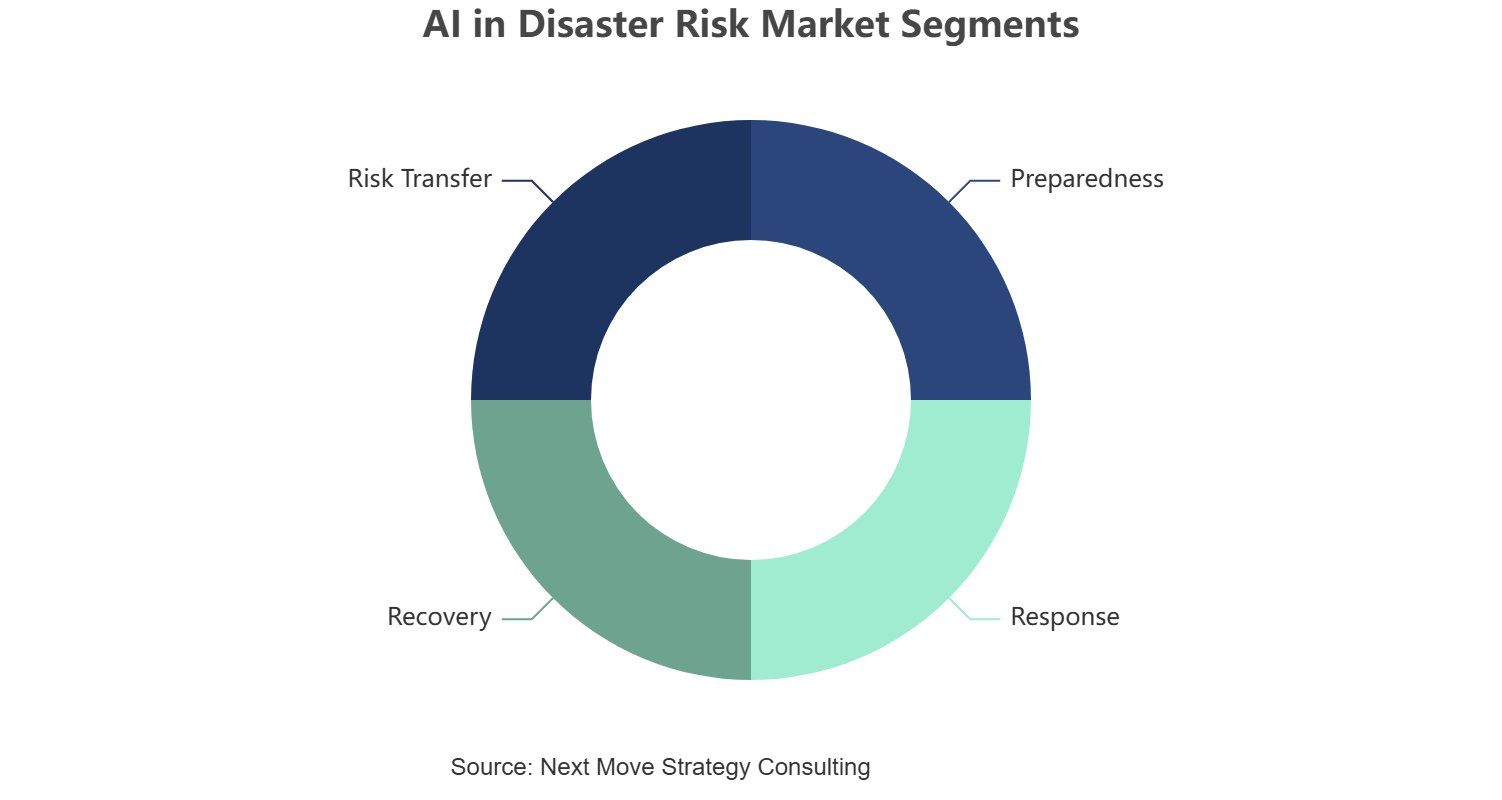
By Phase, Preparedness led the market with USD 3.45 billion in 2025, supported by investments in predictive analytics and disaster planning. The segment is also projected to grow the fastest at a CAGR of 33.4% from 2026 to 2035. |
|
By Deployment Mode, SaaS held the largest share with USD 3.94 billion and 40% of market revenue in 2025, owing to its scalability and cloud-based accessibility. Hybrid deployment is forecast to be the fastest-growing segment at a CAGR of 36.5% through 2035. |
|
By End User, the government dominated the market with USD 3.45 billion and a 35% share in 2025, driven by public investments in disaster preparedness and emergency response. Enterprise is expected to witness the fastest growth at a CAGR of 35.0% from 2026 to 2035. |
|
North America was the largest regional market with USD 4.14 billion and a 42% share in 2025, supported by advanced disaster management infrastructure and high AI adoption. Asia Pacific is projected to be the fastest-growing region at a CAGR of 36.0% through 2035. |
|
The United States remained the largest country market in 2025, driven by strong government funding and a mature catastrophe modeling ecosystem. China and India are expected to be the fastest-growing country markets through 2035, supported by expanding digital resilience initiatives and AI investments. |
Key Emerging Trends in the AI in Disaster Risk Market
How Is Generative AI Transforming Catastrophe Scenario Modeling in the AI in Disaster Risk Industry?
Generative AI is fundamentally reshaping catastrophe scenario modeling within the market by enabling probabilistic synthesis of thousands of physically plausible hazard scenarios beyond historical event records. NMSC's assessment indicates that insurers and reinsurers using generative AI-augmented catastrophe models are achieving materially improved tail-risk quantification for perils including tropical cyclones and convective storms. Swiss Re and Verisk Analytics have both advanced AI-integrated probabilistic modeling capabilities, with generative approaches enabling faster scenario generation and superior portfolio stress testing for complex multi-hazard exposures.
How Are Commercial SAR Satellites Reshaping Real-Time Disaster Response Intelligence?
The proliferation of commercial synthetic aperture radar satellite constellations from providers including ICEYE and Planet Labs is creating transformative new capabilities for real-time flood mapping and post-disaster damage assessment within the AI in Disaster Risk Market. Through our market assessment, we observed that AI-powered SAR image analysis platforms can now produce flood inundation maps within 30-90 minutes of satellite overpass, enabling meaningful operational use during active disaster response. FEMA and several European civil protection agencies have integrated commercial SAR-derived AI assessments into active emergency response workflows.
How Is AI-Driven Physical Climate Risk Disclosure Driving Enterprise Adoption of Disaster Risk Platforms?
Corporate climate risk disclosure mandates are emerging as a powerful non-traditional demand driver for AI in Disaster Risk Market beyond its core government and insurance customer base. From our research, we found that the Task Force on Climate Related Financial Disclosures framework and emerging mandatory disclosure regimes in the U.S., EU, and UK are compelling enterprises to quantify and report AI-assessed physical climate risk across their asset portfolios and supply chains. Platforms from companies including Verisk, Moody's, and One Concern are specifically targeting this rapidly growing enterprise climate risk analytics demand.
How Is Edge AI Integration with IoT Sensor Networks Advancing Community-Level Early Warning in the AI in Disaster Risk Industry?
Edge AI deployment within ground-level IoT sensor networks is advancing the last-mile delivery of disaster early warnings in the AI in Disaster Risk Market, particularly for flood, landslide, and tsunami hazards in areas with limited connectivity. NMSC's analysis indicates that edge-enabled AI devices can process seismic and hydrological sensor data locally in sub-second timeframes, enabling autonomous alert triggering without network dependency. The United Nations Development Programme's last-mile early warning programs and several national meteorological agencies are piloting these architectures at community scale across Asia and Africa.
PESTEL Analysis of the AI in Disaster Risk Industry
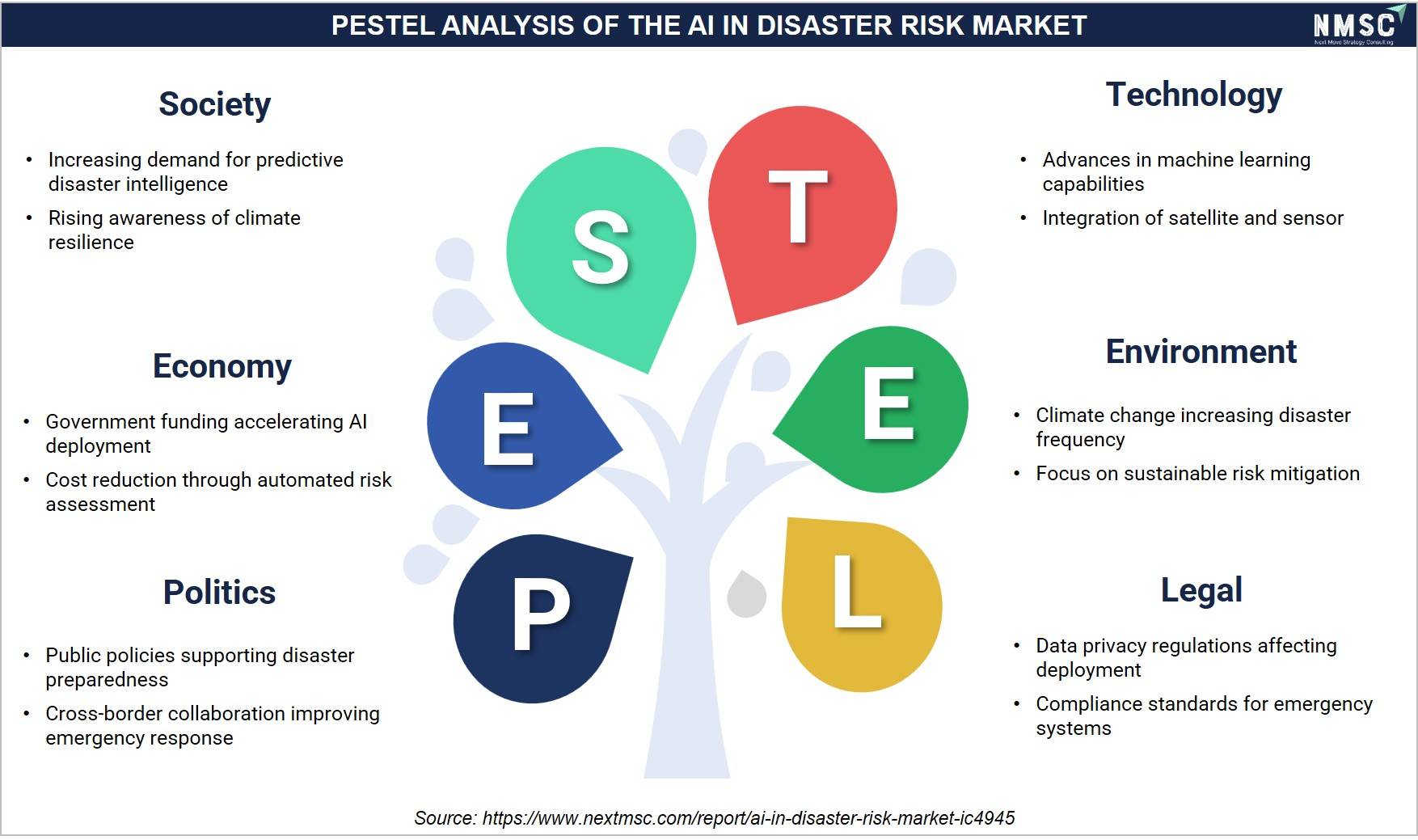
The above infographic presents a PESTEL analysis of the AI in disaster risk market, covering political, economic, social, technological, environmental, and legal dimensions. Public policies and government funding are strengthening disaster preparedness and cost efficiencies, while growing public demand and climate awareness are shaping social acceptance. At the same time, machine learning and satellite integration are enabling advanced forecasting, all within a legal framework of data privacy and compliance standards. Looking ahead, we observed that these interconnected factors collectively shape the market's evolution across the sector.
What Are the Key Market Drivers, Breakthroughs, and Investment Opportunities That Will Shape the AI in Disaster Risk Industry in the Next Decade?
The AI in Disaster Risk Market is propelled by a unique combination of macro-level climate dynamics, policy frameworks, and technology convergences that collectively create compounding demand acceleration. Based on research conducted by NMSC, we found that three primary catalysts, namely escalating disaster frequency and economic losses, international policy commitments under the Sendai Framework, and the maturation of commercial satellite and IoT data ecosystems, are expected to contribute a combined positive CAGR uplift of approximately 12 percentage points. These drivers are partially offset by data standardization barriers and skilled workforce constraints, producing a net CAGR of 28.6% over the 2026 to 2035 forecast period.
|
Drivers / Trends / Restraints |
(+/-) % Impact on CAGR Forecast |
Geographic Relevance |
Impact Timeline |
|
Escalating Disaster Frequency & Economic Losses |
+5.2% |
Global |
2025–2035 |
|
Sendai Framework & Government Policy Mandates |
+3.8% |
Global, Led by Asia Pacific & Europe |
2025–2035 |
|
Commercial Satellite & IoT Data Proliferation |
+3.1% |
Global |
2026–2035 |
|
Corporate Physical Climate Risk Disclosure |
+2.4% |
North America, Europe |
2026–2035 |
|
AI/ML Technology Maturity & Cloud Scalability |
+2.0% |
Global |
2025–2035 |
|
Data Standardization & Interoperability Gaps |
-1.8% |
MEA, Latin America, Southeast Asia |
2025–2030 |
|
Skilled AI Workforce Shortage in DRM Sector |
-1.2% |
Global |
2025–2032 |
|
AI Governance & Liability Uncertainty |
-0.9% |
Europe, North America |
2026–2030 |
|
Flexible SaaS Pricing & Freemium Models |
+0.8% |
Global |
2027–2035 |
|
Multi-Hazard AI Platform Development |
+0.7% |
Asia Pacific, MEA, Latin America |
2028–2035 |
What Are the Growth Drivers of the AI in Disaster Risk Market?
How Is the Rising Frequency and Economic Cost of Climate Disasters Driving Demand for AI in Disaster Risk Solutions?
Escalating natural hazard frequency and economic losses represent the most fundamental structural demand driver for the AI in Disaster Risk Market. The United Nations Office for Disaster Risk Reduction documented that between 2000 and 2019, climate and geophysical disasters caused USD 2.97 trillion in total global economic losses. The World Meteorological Organization's State of the Global Climate 2024 report confirmed that extreme weather events set multiple records in 2023 and 2024, including the warmest year on record, driving acute government and private sector investment in AI-powered risk prediction, early warning, and loss estimation capabilities to manage escalating exposure.
How Do the Sendai Framework Targets and International Policy Mandates Accelerate AI in Disaster Risk Industry Growth?
The Sendai Framework for Disaster Risk Reduction 2015 to 2030, endorsed by 187 UN member states, establishes seven global targets, including a substantial reduction in disaster-related economic losses and significant increases in multi-hazard early warning system access by 2030. UNDRR's monitoring of Sendai Framework progress creates institutional demand for AI-enabled risk assessment and monitoring platforms among signatory governments. The UN Early Warnings for All initiative, launched in 2022, specifically targets universal early warning system coverage by 2027, committing USD 3.1 billion toward AI-compatible sensor, communication, and analytics infrastructure development globally.
How Does the Proliferation of Commercial Earth Observation Data Drive Growth in the AI in Disaster Risk Industry?
The rapid expansion of commercial satellite constellations, including Planet Labs' Dove optical fleet and ICEYE's SAR microsatellite constellation, is creating an unprecedented volume of near-real-time Earth observation data that directly fuels AI model development and deployment within the AI in Disaster Risk Market. NASA's open data policy covering Landsat, MODIS, and Sentinel satellite archives provides freely accessible training data for AI-based hazard classification models. USGS National Geospatial Program publicly releases 3DEP high-resolution elevation data that serves as foundational terrain input for AI-powered flood and landslide risk models.
What Are the Growth Inhibitors of the AI in Disaster Risk Industry?
How Do Data Standardization Gaps and Interoperability Challenges Constrain Market Penetration?
The absence of universal data standards for hazard footprint formats, exposure databases, and vulnerability functions creates significant interoperability barriers that constrain seamless AI deployment across organizational boundaries in the AI in Disaster Risk Market. Our findings suggest that national meteorological agencies, civil protection authorities, and the insurance sector frequently maintain incompatible data formats and classification taxonomies that prevent AI platforms from ingesting multi-source data without costly preprocessing. The Open Geospatial Consortium is actively developing disaster risk data standards, but adoption timelines are extended, particularly among legacy government systems in lower-income nations.
How Does the Shortage of AI Expertise Within Disaster Risk Management Organizations Limit Adoption?
The intersection of specialized AI engineering skills with deep domain expertise in disaster risk management represents a talent bottleneck that constrains the pace of AI in Disaster Risk Market adoption, particularly within government agencies and NGOs. NMSC's analysis indicates that national disaster management authorities in emerging economies frequently lack the technical capacity to configure, validate, and operationalize AI risk models without sustained vendor support. The World Meteorological Organization's HydroHub and other capacity-building initiatives address this gap, but workforce development timelines in this specialized domain are measured in years rather than months.
What Are the Growth Opportunities in the AI in Disaster Risk Industry?
How Are Parametric Insurance and AI-Driven Risk Transfer Products Creating New Market Opportunities?
Parametric insurance products, which pay predetermined amounts triggered by objectively measurable hazard parameters such as wind speed, rainfall accumulation, or seismic intensity, represent a high-growth opportunity segment for the market. The World Bank's Disaster Risk Financing and Insurance Program has documented growing issuance of parametric sovereign risk transfer instruments covering Caribbean, African, and Pacific nations, all of which require AI-powered index construction and trigger monitoring. Swiss Re's Insurance Linked Strategy and similar reinsurance market developments are creating substantial new demand for AI-calibrated parametric models that price and monitor catastrophe triggers with actuarial precision.
How Does the UN Early Warnings for All Initiative Open New Market Development Opportunities in Emerging Economies?
The UN Secretary-General's Early Warnings for All initiative, targeting universal multi-hazard early warning system access by 2027, is creating a structured opportunity for market expansion into previously underserved geographies. The initiative commits USD 3.1 billion toward end-to-end early warning system development across developing nations, explicitly incorporating AI-based hazard detection and impact forecasting components. Through our analysis, technology vendors positioned to deliver cost-effective, connectivity-resilient AI early warning solutions for low-income country deployment will access substantial grant and concessional financing-backed procurement opportunities over the 2025 to 2030 period.
How Is AI Integration with Urban Digital Twins Creating Expansion Opportunities in the Disaster Risk Market?
The growing deployment of urban digital twins by smart city authorities globally is creating a strategic adjacency opportunity for the AI in Disaster Risk Market, as real-time city simulation platforms are increasingly incorporating AI-driven hazard scenario overlays for infrastructure resilience planning. Based on our market evaluation, municipalities in Singapore, Dubai, and multiple European capitals have integrated AI-based flood, earthquake, and extreme heat scenario modeling into their digital twin platforms. This integration trend creates demand for urban-scale AI risk intelligence APIs that vendors can deliver as modular subscription services within existing smart city infrastructure contracts.
How Is the AI in Disaster Risk Market Segmented in This Report, and What Are the Key Insights from the Segmentation Analysis?
Which Offering Category Generates the Highest Revenue in the AI in Disaster Risk Industry?
|
Offering |
2025 (USD Billion) |
2035 (USD Billion) |
CAGR 2026–2035 (%) |
|
Hardware |
2.46 |
24.37 |
29.1 |
|
Software |
5.42 |
85.30 |
35.8 |
|
Services |
1.97 |
12.19 |
22.5 |
The offering segment of the market is structured across hardware, software, and services, with software commanding the dominant share at USD 5.42 billion in 2025 and the highest CAGR at 35.8% through 2035. Within software, catastrophe modeling and risk intelligence sub-segments drive the majority of insurance and government revenue, while early warning and geospatial analytics platforms are the fastest-growing sub-segments. Hardware, encompassing sensors, edge devices, alert systems, and satellites, contributes USD 2.46 billion in 2025. Services, covering implementation, managed services, and advisory, grow at 22.5% CAGR as the installed base expands.
Which Hazard Type Commands the Largest Share of the AI in Disaster Risk Industry?
|
Hazard Type |
2025 (USD Billion) |
2035 (USD Billion) |
CAGR 2026–2035 (%) |
|
Flood |
1.97 |
21.93 |
30.9 |
|
Wildfire |
1.48 |
18.28 |
32.4 |
|
Storm |
1.77 |
20.72 |
31.5 |
|
Earthquake |
1.18 |
12.19 |
29.8 |
|
Landslide |
0.79 |
8.53 |
30.5 |
|
Drought |
0.99 |
9.75 |
29.3 |
|
Multi Hazard |
1.18 |
21.93 |
38.9 |
|
Other Hazards |
0.49 |
8.53 |
37.9 |
The hazard type segmentation of the market reflects the full spectrum of natural and climate hazards addressed by AI systems. Flood dominates at USD 1.97 billion in 2025, reflecting the global maturity of AI-based inundation modeling. Storm and wildfire follow closely, driven by insurance sector demand for rapid damage estimation. The Multi Hazard segment, encompassing compound event modeling and national multi-peril risk platforms, is the fastest growing at 38.9% CAGR, reflecting growing government demand for integrated national risk atlases. Earthquake and drought segments are advancing as AI-based seismic assessment and agricultural drought monitoring gain institutional traction.
How Does the Disaster Management Phase Influence Technology Demand in the AI in Disaster Risk Industry?
|
Phase |
2025 (USD Billion) |
2035 (USD Billion) |
CAGR 2026–2035 (%) |
|
Preparedness |
3.45 |
46.31 |
33.4 |
|
Response |
2.96 |
34.12 |
31.5 |
|
Recovery |
1.97 |
24.37 |
32.6 |
|
Risk Transfer |
1.47 |
17.06 |
31.3 |
The phase-based segmentation of the market reveals that preparedness commands the largest share at USD 3.45 billion in 2025 and grows at the highest CAGR of 33.4%, driven by government investment in proactive AI-based hazard scenario modeling and national risk assessment platforms. Response phase applications, including AI-driven damage mapping and resource allocation, account for USD 2.96 billion. Recovery phase AI tools for debris estimation and reconstruction planning are growing at 32.6% CAGR. The Risk Transfer segment, covering AI-driven parametric insurance and catastrophe bond trigger monitoring, is the smallest but strategically critical at USD 1.47 billion in 2025.
Which Deployment Mode Dominates the AI in Disaster Risk Industry?
|
Deployment Mode |
2025 (USD Billion) |
2035 (USD Billion) |
CAGR 2026–2035 (%) |
|
SaaS |
3.94 |
60.93 |
35.6 |
|
Data Feed |
1.48 |
14.62 |
29.0 |
|
Private Cloud |
1.97 |
18.28 |
28.5 |
|
Project Based |
1.48 |
12.19 |
26.5 |
|
Hybrid |
0.98 |
15.84 |
36.5 |
SaaS dominates the deployment mode segment of the market at USD 3.94 billion in 2025, growing at 35.6% CAGR, driven by government, insurance, and NGO preference for subscription-based platforms that minimize capital expenditure and enable rapid scaling. Data Feed services, providing real-time hazard intelligence streams to third-party applications, account for USD 1.48 billion. Private Cloud deployments serve security-conscious government clients at USD 1.97 billion. The Hybrid deployment mode is the fastest growing at 36.5% CAGR, reflecting demand for architectures that combine cloud analytics with on-premise sensitive data sovereignty requirements.
Which End User Segment Generates the Highest Revenue in the AI in Disaster Risk Industry?
|
End User |
2025 (USD Billion) |
2035 (USD Billion) |
CAGR 2026–2035 (%) |
|
Government |
3.45 |
38.99 |
31.2 |
|
Insurance |
1.97 |
26.81 |
33.8 |
|
Utilities |
1.48 |
18.28 |
32.4 |
|
Enterprise |
1.48 |
21.93 |
35.0 |
|
NGOs |
0.49 |
4.87 |
29.3 |
|
Academia |
0.49 |
4.87 |
29.3 |
|
Other End Users |
0.49 |
6.11 |
32.5 |
Government end users lead the market at USD 3.45 billion in 2025, driven by national meteorological agencies, civil protection authorities, and military disaster response units. Insurance, including primary carriers, reinsurers, and insurtech platforms, is the second-largest segment at USD 1.97 billion and grows at 33.8% CAGR. Enterprise is the fastest-growing end user at 35.0% CAGR, propelled by climate risk disclosure mandates. Utilities at USD 1.48 billion adopt AI for critical infrastructure resilience. NGOs and academia contribute through humanitarian response applications and research-grade risk modeling platforms, respectively.
Regional Outlook
Geographic Performance Snapshot
|
Region |
2025 (USD Billion) |
2035 (USD Billion) |
CAGR 2026–2035 (%) |
Maturity Level |
|
North America |
4.14 |
46.31 |
31.1 |
Advanced disaster monitoring and federal AI investments |
|
Europe |
2.46 |
26.81 |
30.8 |
Climate resilience policies and AI-powered early warning systems |
|
Asia Pacific |
2.17 |
34.12 |
36.0 |
High disaster exposure and government resilience programs |
|
Middle East & Africa (MEA) |
0.59 |
8.53 |
34.7 |
Climate adaptation initiatives and smart city development |
|
Latin America |
0.49 |
6.09 |
32.5 |
Disaster preparedness programs and geospatial AI adoption |
North America AI in Disaster Risk Market
Based on our engagements across the North American market, the region leads the AI in Disaster Risk Market at USD 4.14 billion in 2025, projected to reach USD 46.31 billion by 2035 at a CAGR of 31.1%. FEMA's National Risk Index, NOAA's AI-integrated weather prediction systems, and the U.S. insurance sector's deep catastrophe modeling ecosystem create a uniquely mature demand environment. Canada's National Adaptation Strategy and Mexico's national disaster risk finance programs add further regional demand breadth.
U.S. AI in Disaster Risk Industry
Through our analysis, the United States is the largest individual country market in the global AI in Disaster Risk Market, accounting for approximately USD 3.44 billion in 2025 and reflecting the world's most developed catastrophe modeling ecosystem, operated by platforms including Verisk Analytics and Moody's RMS. FEMA's National Risk Index integrates multi-hazard AI assessment for all U.S. counties, while NOAA's Artificial Intelligence Strategic Plan drives agency-wide adoption of machine learning for weather and climate hazard prediction. The U.S. insurance sector's long-established AIR and RMS model reliance creates structural recurring demand for next-generation AI risk platforms.
Canada AI in Disaster Risk Industry
Based on our market evaluation, Canada exhibits advanced adoption of AI in disaster risk across wildfire monitoring, flood mapping, and climate adaptation planning. Natural Resources Canada's National Flood Hazard Identification Program and Public Safety Canada's disaster risk management investments drive government AI procurement. The National Adaptation Strategy, published in 2023, commits significant federal funding to climate resilience technology. Competitive intensity is moderate, with U.S. and domestic vendors serving federal and provincial government clients through established procurement frameworks.
Mexico AI in Disaster Risk Industry
From our assessment, Mexico's AI in Disaster Risk Market is at an emerging-advancing stage, driven by the country's significant multi-hazard exposure, including earthquakes, hurricanes, and floods. The National Civil Protection System and CENAPRED's disaster risk monitoring mandate create institutional demand for AI-enabled early warning and impact modeling tools. World Bank-supported disaster risk finance programs in Mexico are accelerating parametric insurance and AI risk model development. Competitive intensity is growing as international vendors localize platforms for Mexico's specific hazard environment.
Europe AI in Disaster Risk Market
According to our evaluation of the European market, Europe represents the second largest regional share of the AI in Disaster Risk Market at USD 2.46 billion in 2025, projected to reach USD 26.81 billion by 2035 at a CAGR of 30.8%. The EU Copernicus Emergency Management Service, the EU Civil Protection Mechanism, and the Critical Entities Resilience Directive create a structured government demand environment. Europe's advanced reinsurance sector, centered in Switzerland and Germany, is a major driver of AI catastrophe modeling investment, and the EU AI Act's regulatory framework is shaping responsible AI deployment in risk systems.
United Kingdom AI in Disaster Risk Industry
Based on our engagements, the United Kingdom maintains an advanced AI in Disaster Risk Market, supported by the Environment Agency's National Flood Risk Assessment, the Cabinet Office Emergency Planning guidance, and the UK Met Office's AI-integrated weather forecasting. The Lloyd's of London insurance market's global reach creates strong domestic demand for AI catastrophe modeling innovation. Post-Brexit regulatory divergence from the EU AI Act creates differentiated compliance considerations for vendors serving both UK and EU clients, adding strategic complexity to market entry.
Germany AI in Disaster Risk Industry
Through our analysis, Germany exhibits high AI in Disaster Risk Market adoption driven by the German Weather Service's AI-enhanced early warning systems and the Federal Office of Civil Protection and Disaster Assistance's digital resilience investments. Germany's significant reinsurance sector, anchored by Munich Re, drives substantial catastrophe modeling technology procurement. The EU AI Act's primary regulatory jurisdiction in Germany ensures that AI risk platforms are designed with transparency and accountability requirements central to their architecture.
France AI in Disaster Risk Industry
From our assessment, France's AI in Disaster Risk Market is driven by Météo-France's AI-integrated weather prediction investment, the Ministry of Ecological Transition's climate adaptation programs, and the Caisse Centrale de Réassurance's government reinsurance mandate. France's significant exposure to flood, storm, and earthquake hazards creates persistent demand for AI-based risk modeling. The French Civil Security Directorate is actively deploying AI tools for emergency resource optimization, increasing government software procurement within the disaster risk analytics market.
Italy AI in Disaster Risk Industry
Based on our market evaluation, Italy's AI in Disaster Risk Market reflects the country's acute multi-hazard exposure, including seismic, volcanic, flood, and landslide risks. The National Civil Protection Department's investment in AI-enhanced hazard monitoring and Italy's participation in the EU Copernicus Emergency Management Service activations drive institutional AI procurement. The Italian Space Agency's collaboration with commercial SAR providers for post-disaster damage mapping is advancing technology adoption, and Italian universities contribute world-class geophysical AI research supporting market development.
Spain AI in Disaster Risk Industry
Through our analysis, Spain's AI in Disaster Risk Market is growing, driven by State Meteorological Agency AEMET's AI weather integration and the Directorate General of Civil Protection's national risk assessment investments. Spain's exposure to wildfire, drought, and flash flood hazards is intensifying AI demand. The EU CAP agricultural risk programs and Spain's National Adaptation Plan to Climate Change create policy-backed demand for AI-driven agricultural and infrastructure risk assessment tools. Competitive intensity is increasing as European and U.S. vendors expand regional presence.
Sweden AI in Disaster Risk Industry
Based on our engagements, Sweden exhibits advanced adoption of AI in disaster risk, particularly for forest fire monitoring, flood early warning, and critical infrastructure resilience. The Swedish Civil Contingencies Agency drives national digital resilience investment, and Sweden's advanced satellite and remote sensing research capacity supports domestic AI model development. Sweden's public sector innovation culture and strong digital infrastructure enable rapid AI platform deployment, and the country serves as a regional reference market for Nordic disaster risk technology.
Denmark AI in Disaster Risk Industry
According to our evaluation, Denmark's AI in Disaster Risk Market is advancing with focus on coastal flood risk, storm surge prediction, and climate adaptation planning. The Danish Meteorological Institute's AI integration and the government's National Climate Adaptation Plan create structured institutional demand. Denmark's renewable energy infrastructure creates utility sector demand for AI-based extreme weather resilience tools. The country's small but innovation-intensive market serves as a testbed for AI-based climate adaptation solutions with EU-wide applicability.
Finland AI in Disaster Risk Industry
From our assessment, Finland's AI in Disaster Risk Market is developing with focus on winter weather risk, forest fire monitoring, and critical infrastructure protection. The Finnish Meteorological Institute's AI research and the National Emergency Supply Agency's digital preparedness investments drive government procurement. Finland's advanced technology ecosystem and leadership in edge computing innovation support domestic AI disaster risk platform development. The Nordic Council's joint resilience programs create additional regional market demand linkages.
Netherlands AI in Disaster Risk Industry
Based on our engagements, the Netherlands demonstrates exceptionally high engagement with AI in disaster risk, driven by the country's existential flood management imperative and world-leading hydraulic engineering heritage. Deltares, the Netherlands' independent research institute, leads internationally in AI-integrated flood modeling and real-time inundation forecasting. The Dutch government's Delta Programme creates sustained institutional demand for AI water management and flood risk tools. The Netherlands serves as a global reference market for AI-enhanced flood risk intelligence.
Rest of Europe AI in Disaster Risk Industry
Through NMSC's assessment, the Rest of Europe segment, encompassing Poland, Austria, Switzerland, Norway, and Southeastern European states, represents a growing market for AI disaster risk solutions. Switzerland's reinsurance cluster anchored by Swiss Re and Zurich drives catastrophe modeling AI investment. Eastern European nations are increasing AI disaster risk adoption through EU structural funding, while Norway's offshore energy and Arctic climate exposure create specialized AI risk analytics demand.
Asia Pacific AI in Disaster Risk Market
From our assessment, Asia Pacific represents the fastest-growing region in the AI in Disaster Risk Market at a CAGR of 36.0%, growing from USD 2.17 billion in 2025 to USD 34.12 billion by 2035. The region's exceptional multi-hazard exposure, combined with China's Digital China initiative, India's National Disaster Management Authority technology modernization, Japan's resilience investment legacy, and Australia's wildfire and flood risk urgency, creates a convergent demand environment that will make Asia Pacific the largest regional AI in Disaster Risk Market by the early 2030s.
China AI in Disaster Risk Industry
Based on our market evaluation, China is the largest and fastest-growing individual country market in the Asia Pacific for AI in disaster risk. China's National Emergency Management System, China Meteorological Administration AI integration, and the National Remote Sensing Centre's disaster monitoring programs create substantial government AI procurement. China's Digital China Initiative and dual-use military-civil fusion programs accelerate domestic AI disaster risk technology development. Chinese tech companies, including Alibaba Cloud and Huawei, are deploying AI disaster risk analytics platforms domestically and across Belt and Road Initiative partner nations.
India AI in Disaster Risk Industry
Through our analysis, India's AI in Disaster Risk Market is advancing rapidly, driven by the National Disaster Management Authority's National Disaster Risk Management Plan and the India Meteorological Department's AI-integrated cyclone and flood prediction systems. India's significant exposure to monsoon floods, cyclones, and earthquakes creates structural demand for AI risk prediction. ISRO's Earth observation data availability supports AI model development. The World Bank and Asian Development Bank are funding disaster risk technology investments in India that benefit AI platform deployment across government and utility sectors.
Japan AI in Disaster Risk Industry
According to our evaluation, Japan is one of the most advanced AI in Disaster Risk Markets globally relative to its economic scale, reflecting the country's multi-century history of seismic and typhoon risk management. The Japan Meteorological Agency's AI weather prediction investment and Cabinet Office disaster risk reduction programs drive government procurement. Japan's construction and utility sectors are advanced adopters of AI-based seismic risk and infrastructure resilience tools. Japan hosts leading domestic AI disaster technology providers as well as U.S. and European vendor subsidiaries targeting the Asia Pacific market.
South Korea AI in Disaster Risk Industry
Based on our engagements, South Korea exhibits strong AI in Disaster Risk Market adoption driven by the Ministry of Interior and Safety's national disaster management digital transformation and Korea Meteorological Administration AI initiatives. South Korea's Smart City development programs integrate AI-based disaster risk monitoring across urban infrastructure. The country's advanced semiconductor and AI ecosystem supports domestic AI disaster risk innovation. The government's investment in AI-based typhoon, flood, and industrial disaster risk tools is creating expanding procurement demand from both national and local government authorities.
Taiwan AI in Disaster Risk Industry
From our assessment, Taiwan's AI in Disaster Risk Market is driven by the country's significant typhoon, earthquake, and flood exposure combined with a mature technology ecosystem. The Central Weather Bureau's AI forecasting enhancement and the National Science and Technology Council's disaster research programs support institutional adoption. Taiwan's critical semiconductor manufacturing infrastructure creates enterprise-level demand for AI-based natural disaster risk assessment tools protecting high-value manufacturing assets. Competitive intensity is moderate, with domestic technology firms competing alongside U.S. and Japanese vendors.
Indonesia AI in Disaster Risk Industry
Through NMSC's assessment, Indonesia's AI in Disaster Risk Market is at an advancing stage, reflecting the country's extraordinary multi-hazard exposure, including earthquakes, tsunamis, volcanic eruptions, and floods. The National Disaster Management Authority BNPB's technology modernization investments and BMKG's AI-integrated early warning systems create growing government procurement. World Bank and UN-supported disaster risk programs in Indonesia are funding AI early warning and risk assessment platform deployment. Competitive intensity is increasing as international vendors partner with local technology integrators for market access.
Vietnam AI in Disaster Risk Industry
Based on our market evaluation, Vietnam's AI in Disaster Risk Market is emerging, driven by the country's severe flood, typhoon, and landslide exposure. The Ministry of Natural Resources and Environment's climate adaptation investment and the Vietnam Disaster Management Authority's technology programs create initial government procurement demand. International Development Bank programs are co-financing AI early warning system upgrades in Vietnam. The market is in early adoption, with growth accelerating as commercial satellite data availability improves and government digital capacity strengthens over the forecast period.
Australia AI in Disaster Risk Industry
According to our evaluation, Australia represents an advanced and rapidly expanding AI in Disaster Risk Market, driven by escalating bushfire, flood, and cyclone risk that reached a national crisis point during the 2019 to 2020 Black Summer fires and subsequent La Niña flood events. The National Recovery and Resilience Agency's investments, Bureau of Meteorology AI integration, and Geoscience Australia's AI-enhanced hazard mapping create robust government demand. Australia's insurance sector is a major driver of catastrophe modeling AI adoption, and the country's advanced research institutions contribute globally significant AI disaster risk technology.
Philippines AI in Disaster Risk Industry
From our assessment, the Philippines represents one of the highest-priority emerging opportunities in the Asia Pacific AI in Disaster Risk Market, given the country's extreme typhoon, flood, and earthquake exposure. PAGASA's weather prediction modernization and the National Disaster Risk Reduction and Management Council's technology investments are driving AI procurement. International development organizations, including the World Bank and ADB, are co-financing AI early warning and risk assessment system upgrades. Market growth will accelerate as cloud connectivity expands and government digital capacity increases.
Malaysia AI in Disaster Risk Industry
Based on our engagements, Malaysia's AI in Disaster Risk Market is growing, driven by the Department of Irrigation and Drainage's AI-integrated flood monitoring systems and the National Disaster Management Agency's technology modernization programs. Malaysia's significant flood exposure, particularly in Peninsular Malaysia and Sabah, creates persistent government demand for AI inundation prediction tools. The government's MyDigital initiative supports broader public sector AI adoption that benefits disaster risk applications. Competitive intensity is moderate with international vendors competing through established local technology partners.
Rest of Asia Pacific AI in Disaster Risk Industry
Through our analysis, the Rest of the Asia Pacific, encompassing New Zealand, Bangladesh, Sri Lanka, Thailand, and Myanmar, represents a varied set of AI disaster risk market development conditions. New Zealand's Geological and Nuclear Sciences GNS Research contributes internationally recognized seismic AI capability. Bangladesh and Sri Lanka are receiving significant international development investment in cyclone and flood AI early warning systems. Thailand's Industrial Estate Authority is investing in AI flood risk tools following the 2011 mega-floods that disrupted global supply chains.
Middle East & Africa AI in Disaster Risk Market
Based on our engagements across MEA, the region accounts for USD 0.59 billion of the AI in Disaster Risk Market in 2025, projected to expand to USD 8.53 billion by 2035 at a CAGR of 34.7%. Growth is driven by GCC governments investing in AI drought and heat wave risk management under Vision 2030 frameworks, Israel's globally recognized AI emergency management technology ecosystem, and African development bank investments in early warning infrastructure across Sub-Saharan nations with high disaster exposure.
Saudi Arabia AI in Disaster Risk Industry
Based on our market evaluation, Saudi Arabia is the largest AI in Disaster Risk Market in the GCC, driven by the Vision 2030 Smart Cities initiative and the National Centre for Meteorology's AI weather prediction investment. Saudi Arabia's exposure to drought, extreme heat, and flash floods creates structural government demand for AI-based risk monitoring. NEOM and other megaproject development programs are integrating AI disaster risk tools for critical infrastructure resilience planning. International technology vendors are establishing regional presences to serve the Saudi government and utility procurement.
UAE AI in Disaster Risk Industry
Through our analysis, the UAE exhibits advanced AI in Disaster Risk Market adoption driven by the National Emergency Crisis and Disasters Management Authority and the UAE National Centre of Meteorology's AI integration. Dubai's smart city infrastructure incorporates AI-based extreme weather and flooding risk monitoring. The UAE serves as a regional technology hub, with global AI disaster risk vendors establishing Middle East headquarters in Dubai and Abu Dhabi. ESA and international disaster risk programs have designated the UAE as a regional capacity-building center.
Egypt AI in Disaster Risk Industry
From our assessment, Egypt's AI in Disaster Risk Market is emerging, driven by the country's exposure to Nile flooding, Mediterranean coastal risks, and agricultural drought. The Egyptian Meteorological Authority's modernization programs and Egypt's National Disaster Risk Management Strategy are creating initial institutional demand for AI risk tools. International development programs co-financed by the World Bank and the African Development Bank are supporting AI early warning investments in Egypt. Market development will accelerate as rural digital connectivity expands.
Israel AI in Disaster Risk Industry
According to our evaluation, Israel demonstrates disproportionately high AI in Disaster Risk Market activity relative to its geographic size, reflecting the country's world-class technology sector and acute security-driven emergency management AI investment. The Israel Innovation Authority supports extensive AI disaster and emergency response technology development. Israeli AI companies have developed internationally deployed wildfire prediction, earthquake early warning, and crisis communication platforms. Israel's technology export ecosystem positions it as a significant net exporter of AI disaster risk intellectual property globally.
Turkey AI in Disaster Risk Industry
Based on our engagements, Turkey's AI in Disaster Risk Market is advancing rapidly following the February 2023 Kahramanmaras earthquake sequence, which demonstrated the critical limitations of existing risk assessment and response infrastructure. AFAD's national disaster risk management modernization program is driving significant AI platform procurement. Turkey's significant seismic, flood, and wildfire exposure creates multi-hazard demand. International donors and the European Commission's pre-accession programs are co-funding AI disaster risk capacity building in Turkey.
Nigeria AI in Disaster Risk Industry
From our assessment, Nigeria's AI in Disaster Risk Market is at an early stage, driven by growing flood, drought, and conflict displacement risk. The National Emergency Management Agency and the Nigeria Meteorological Agency are beginning AI early warning integration supported by the World Bank West Africa Regional programs. Limited rural digital infrastructure and skilled workforce constraints are significant adoption barriers. Nigerian universities and research institutions are developing AI disaster risk capabilities, and the market is expected to accelerate post-2028 as connectivity and institutional capacity improve.
South Africa AI in Disaster Risk Industry
Based on our market evaluation, South Africa is the most advanced AI in Disaster Risk Market on the African continent, driven by the South African Weather Service's AI forecasting investment and the National Disaster Management Centre's technology programs. South Africa's exposure to drought, wildfire, and flood events creates sustained demand. The country's established financial services sector drives insurance sector AI risk analytics adoption. South Africa serves as a regional technology hub for Sub-Saharan African AI disaster risk market development, with international vendors using Cape Town and Johannesburg as continental base operations.
Rest of Middle East & Africa AI in Disaster Risk Industry
Through NMSC's assessment, the Rest of MEA, encompassing Morocco, Kenya, Ethiopia, Ghana, and GCC states including Qatar and Kuwait, represents a diverse set of emerging AI disaster risk opportunities. The African Union's Sendai Framework implementation programs and regional development bank disaster resilience investments are creating structured AI procurement pipelines. Morocco's advanced technology ecosystem and Kenya's thriving tech sector are producing domestic AI disaster risk innovation alongside international vendor activity.
Latin America AI in Disaster Risk Market
Through NMSC's assessment, the Latin American AI in Disaster Risk Market was valued at USD 0.49 billion in 2025, expected to reach USD 6.09 billion by 2035 at a CAGR of 32.5%. Brazil and Colombia represent the most developed country markets, driven by Amazon deforestation monitoring, flood risk, and landslide exposure. World Bank and Inter-American Development Bank programs are funding AI early warning and disaster risk finance instrument development across the region. Growing climate event frequency and urban vulnerability are intensifying government AI procurement.
Brazil AI in Disaster Risk Industry
Based on our engagements, Brazil is the largest AI in Disaster Risk Market in Latin America, driven by CEMADEN's national landslide and flash flood early warning system, INPE's Amazon deforestation and wildfire monitoring programs, and the National Civil Defense System's technology modernization. Brazil's BNDES agricultural risk financing programs are creating AI drought and flood risk tool demand. The government's Plano Nacional de Adaptação à Mudança do Clima creates sustained institutional demand. Major international AI vendors serve Brazil through São Paulo-based operations and local technology partnerships.
Argentina AI in Disaster Risk Industry
Through our analysis, Argentina's AI in Disaster Risk Market is developing, driven by the National Meteorological Service's AI weather integration and the country's significant flood, drought, and storm exposure. The Secretariat of Civil Protection and National Security is advancing AI tools for emergency coordination. Argentina's agricultural sector, the world's third largest soy exporter, creates substantial enterprise demand for AI drought and extreme weather risk modeling. Economic volatility has historically constrained technology import cycles, but structural climate exposure is creating persistent investment incentives.
Chile AI in Disaster Risk Industry
According to our evaluation, Chile exhibits advanced AI in Disaster Risk Market adoption driven by the country's extreme seismic and volcanic exposure and the National Seismological Center's AI earthquake monitoring investment. The National Emergency Office ONEMI's digital transformation program and Chile's sophisticated mining sector create dual government and enterprise demand for AI risk platforms. Chile's stable macroeconomic environment and advanced broadband infrastructure support premium AI platform procurement. The country is a regional reference market for earthquake and tsunami AI early warning technology.
Colombia AI in Disaster Risk Industry
From our assessment, Colombia's AI in Disaster Risk Market is advancing, driven by the country's significant volcanic, earthquake, landslide, and flood exposure. UNGRD's national disaster risk management technology investment and IDEAM's hydrometeorological AI integration create government procurement demand. Colombia's coffee and oil sectors drive enterprise AI risk analytics adoption for asset protection planning. World Bank and IDB-supported disaster risk programs are funding AI capacity building. Competitive intensity is growing with international vendors establishing regional presence through local partner networks.
Rest of Latin America AI in Disaster Risk Industry
Based on our market evaluation, the Rest of LATAM, encompassing Peru, Ecuador, Venezuela, Paraguay, and Central American nations, represents early-stage AI disaster risk market territory. Peru's seismic and El Niño flood exposure and Ecuador's volcanic and earthquake risk create structural demand. Central American nations are receiving USAID and World Bank AI disaster risk capacity building support through regional resilience programs. Connectivity improvements and growing climate event frequency are creating improving conditions for AI risk platform deployment across this sub-region through the forecast period.
Competitive Landscape
Competitive Dynamics & M&A Landscape
|
Key Takeaways |
Details |
|
Market Structure |
Highly fragmented with 20 profiled players across pure-play AI disaster risk specialists, cloud hyperscalers, reinsurance analytics firms, and satellite intelligence providers; Verisk Analytics and Moody's Corporation collectively command the largest share of catastrophe modeling revenue; cloud hyperscalers including AWS, Microsoft Azure, and Google Cloud compete as platform infrastructure providers enabling third-party AI disaster risk application ecosystems |
|
Innovation Focus |
Generative AI for catastrophe scenario synthesis, SAR satellite AI imagery analysis, real-time multi-hazard compound event modeling, parametric risk index construction, digital twin disaster simulation, edge AI for last-mile early warning, and natural language AI for emergency communication and situational awareness generation |
|
M&A Activity |
Accelerating consolidation from 2023 to 2025, with cloud and enterprise software majors acquiring AI geospatial analytics specialists; reinsurance majors acquiring AI risk intelligence startups; satellite imagery providers partnering with catastrophe modelers; significant PE investment in AI climate risk disclosure analytics platforms serving enterprise physical climate risk mandates |
How Do Companies Compete in the AI in Disaster Risk Market?
The competitive landscape of the market is highly fragmented across five distinct competitor archetypes: legacy catastrophe modeling platforms such as Verisk Analytics and Moody's RMS, cloud hyperscalers including AWS, Microsoft, and Google competing as infrastructure and AI tooling providers, Earth observation companies such as Planet Labs, ICEYE, and BlackSky providing raw satellite intelligence, specialized AI disaster risk platforms such as One Concern and Tomorrow.io, and enterprise software majors including IBM, Oracle, and Palantir competing through data integration and emergency management workflow platforms. NMSC's analysis indicates that differentiation increasingly hinges on AI model accuracy, data asset proprietary depth, and ability to deliver end-to-end risk intelligence workflows rather than point solutions.
Which Kind of Companies Dominate the AI in Disaster Risk Market?
Specialized catastrophe modeling analytics firms, cloud-native AI platform providers, and commercial Earth observation companies collectively represent the dominant competitive tiers in the market. Verisk Analytics, Moody's Corporation, and Swiss Re command the catastrophe modeling tier through decades of actuarially validated probabilistic risk datasets. Hyperscalers AWS, Microsoft Azure, and Google Cloud dominate the platform infrastructure tier, enabling third-party AI disaster risk application deployment at scale. ICEYE, Planet Labs, and BlackSky anchor the Earth observation data supply tier that increasingly underpins all AI risk intelligence products in the market.
AI-Native Differentiation and Open Standards Drive Market Success in the AI in Disaster Risk Market
AI-native architectures that integrate real-time satellite and IoT sensor data streams with probabilistic deep learning models are emerging as the primary competitive differentiator in the market. Based on NMSC's research, we found that platforms offering open API frameworks, enabling interoperability with government emergency management systems, reinsurance portfolio tools, and enterprise risk management platforms, command premium pricing and superior client retention rates. Open data standards adoption, particularly OGC-compliant hazard data formats and UN-SPIDER-recommended disaster risk data protocols, is becoming a de facto requirement for government procurement qualification globally.
Market Players to Opt for Merger and Acquisition Strategies to Expand Their Presence in the AI in Disaster Risk Market
The AI in Disaster Risk Market is experiencing an M&A wave as established enterprise software, reinsurance analytics, and cloud computing majors seek to acquire specialized AI disaster risk capabilities, including geospatial AI processing, parametric risk index construction, and real-time satellite image analysis. NMSC's assessment indicates that the period from 2023 to 2025 saw multiple acqui-hire and technology asset transactions targeting AI hazard prediction startups. Companies that successfully combine proprietary AI model libraries with comprehensive historical hazard databases and cloud-scalable delivery architectures will achieve the most defensible competitive positions in the high-growth market over the forecast period.
Who Are the Key Market Players in the AI in Disaster Risk Market?
-
Verisk Analytics, Inc.
-
Moody's Corporation
-
Environmental Systems Research Institute, Inc. (Esri)
-
International Business Machines Corporation (IBM)
-
Microsoft Corporation
-
Google LLC
-
Amazon Web Services, Inc.
-
Oracle Corporation
-
Hexagon AB
-
Palantir Technologies Inc.
-
Swiss Re Ltd
-
Motorola Solutions, Inc.
-
NEC Corporation
-
Fujitsu Limited
-
Planet Labs PBC
-
ICEYE Oy
-
BlackSky Technology Inc.
-
Everbridge, Inc.
-
The Tomorrow Companies Inc. (Tomorrow.io)
-
One Concern, Inc.
What Are the Latest Developments in the AI in Disaster Risk Industry?
|
Date |
Event |
|
October 2025 |
Google introduced major updates to Google Earth AI, including Gemini-powered geospatial reasoning that combines satellite imagery, weather forecasts, and population data to predict flood and storm impacts. The enhancement strengthens AI-driven disaster preparedness, early warning, and emergency planning for governments and enterprises. |
Expert Insights
 “AI is an unbelievable opportunity to address some of the world’s most pressing challenges in health care, manufacturing, climate change and more. But it’s important to reap these benefits while minimizing the environmental impact. That means making more sustainable choices about how models are built, trained, and used, where processing occurs, what infrastructure is used, and how open and collaborative we are along the way.”
— Christina Shim, IBM’s Global Head of Sustainability Software and an AI Ethics Board Member
Statement made during IBM's discussion on responsible AI and sustainability, emphasizing the importance of leveraging AI to address climate-related challenges.
Market Interpretation
The comment underscores AI's expanding role in addressing climate-related risks through sustainable and responsible deployment of advanced analytics and intelligent decision-making systems. It highlights the growing emphasis on energy-efficient AI infrastructure and environmentally responsible model development, reinforcing the adoption of AI-driven solutions for climate resilience, disaster risk assessment, and sustainable resource management across governments and enterprises.
SWOT Analysis of the AI in Disaster Risk Market
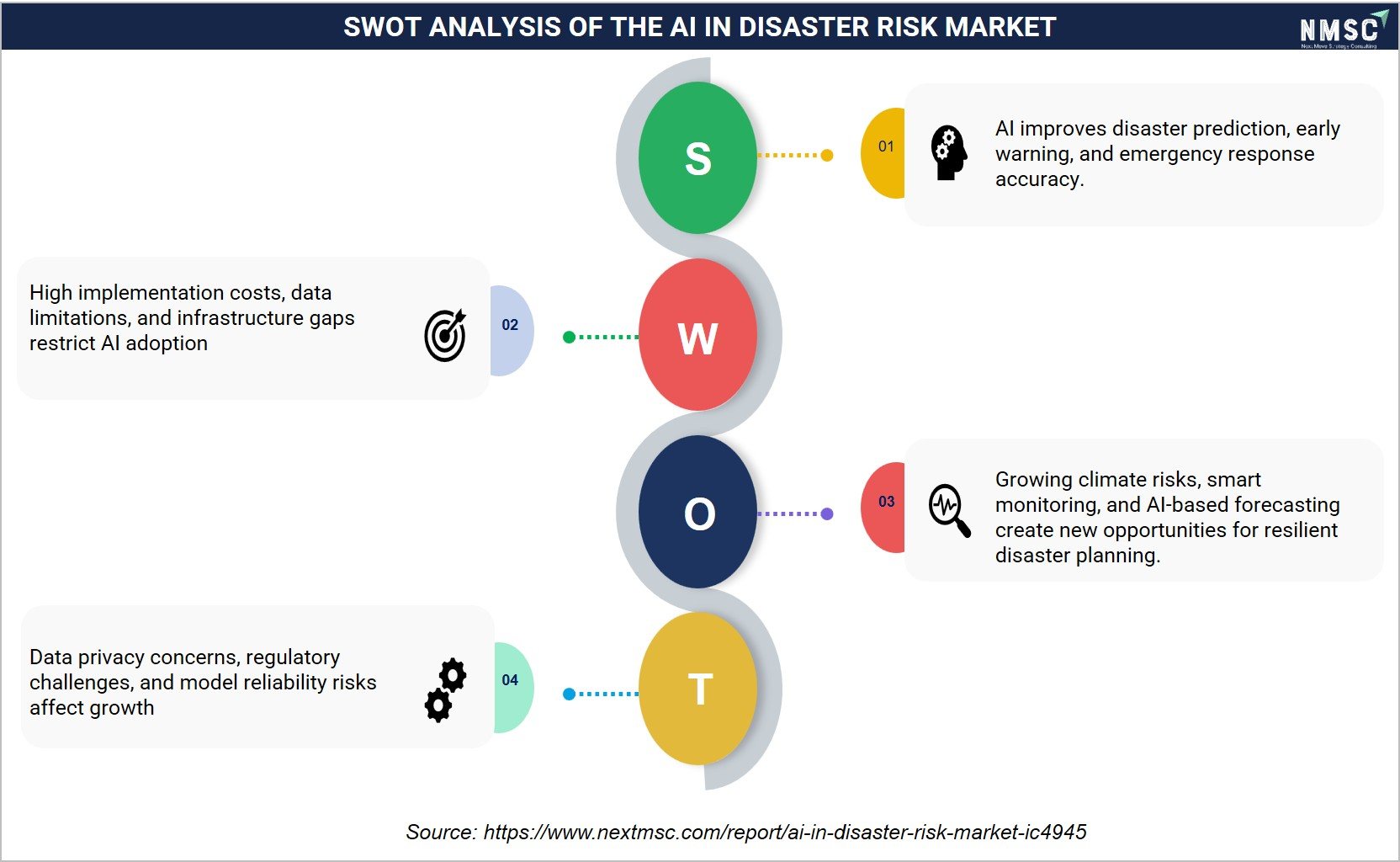
The above infographic presents a SWOT analysis of the AI in disaster risk industry, where AI's ability to improve prediction, early warning, and emergency response stands out as a key strength. However, this potential is constrained by high implementation costs, limited data availability, and infrastructure gaps, which collectively hinder broader adoption. At the same time, growing climate risks and advances in smart monitoring are opening new opportunities for AI-driven disaster planning. That said, we noticed that persistent concerns around data privacy, regulatory uncertainty, and model reliability continue to pose significant challenges to long-term market growth and stability.
What Are the Investment Opportunities in the AI in Disaster Risk Market?
Capital Inflows and Venture Activity
Capital inflows into the AI in Disaster Risk Industry are accelerating across multiple investment categories. Institutional investors applying climate-aligned portfolio strategies are directing capital toward AI disaster risk intelligence platforms as both a climate adaptation investment and a direct commercial opportunity. NMSC's analysis shows that the global AI disaster risk technology sector attracted growing venture funding between 2023 and 2025, supported by recession-resistant government demand, expanding enterprise climate risk compliance requirements, and scalable data network effects that strengthen long-term investment potential.
Infrastructure Investment
Infrastructure investment opportunities in the AI in Disaster Risk Market include commercial satellite constellation expansion, IoT sensor network deployment for urban flood and seismic monitoring, and cloud data center capacity supporting AI model training and inference workloads. The UN Early Warnings for All initiative's USD 3.1 billion commitment has created a structured public financing pipeline for AI-enabled early warning infrastructure. From our assessment, private infrastructure funds are increasingly pursuing co-investment opportunities alongside development finance institutions to expand resilience-focused digital infrastructure across climate-vulnerable regions.
ESG Considerations
ESG considerations are increasingly influencing institutional capital allocation within the AI in Disaster Risk Industry , as AI-powered disaster risk platforms contribute directly to disaster resilience, climate adaptation, and sustainable development objectives. Solutions capable of reducing disaster-related mortality, economic losses, and infrastructure damage align with leading impact investment frameworks such as IRIS+ and Global Impact Investing Network (GIIN) metrics. NMSC's findings indicate that institutional investors operating under Article 9 EU SFDR mandates are progressively incorporating AI disaster resilience technologies into climate adaptation and sustainable infrastructure investment portfolios.
Digital Transformation Enablement
Digital transformation across government agencies and the insurance sector represents one of the largest long-term investment opportunities in the AI in Disaster Risk Market. National meteorological agencies, civil protection authorities, emergency management organizations, and insurance carriers are allocating multi-year budgets toward AI-enabled forecasting, risk assessment, and disaster response platforms. Increasingly, governments classify AI disaster risk technologies as critical national digital infrastructure, creating stable procurement pipelines and long-term revenue visibility for technology providers.
Private Equity and Strategic M&A Activity
Private equity and venture capital activity in the AI in Disaster Risk Industry reflects growing confidence in the sector's long-term expansion. Based on NMSC's research, AI climate risk analytics companies, parametric risk platform providers, and commercial satellite intelligence firms attracted some of the largest funding rounds between 2023 and 2025. Strategic investors and private equity firms are also pursuing integrated platform strategies by combining AI software providers, sensor technology companies, geospatial intelligence firms, and managed service providers to build end-to-end disaster risk management ecosystems capable of generating premium long-term enterprise value.
Key Benefits for Stakeholders
For Government and Civil Protection Agencies
Government agencies, emergency management authorities, and civil protection organizations gain access to a comprehensive assessment of the market, including market sizing, revenue forecasts, and segmentation across offering types, hazard categories, disaster management phases, deployment models, and end users. Country-level analysis across 33 geographies, combined with policy alignment covering the Sendai Framework, EU Critical Entities Resilience Directive, and national adaptation strategies, supports evidence-based technology procurement, budget planning, resilience policy development, and international cooperation initiatives.
For the Insurance and Reinsurance Sector
Insurance companies, reinsurers, and catastrophe risk specialists benefit from detailed market intelligence covering AI-powered catastrophe modeling, parametric insurance solutions, risk intelligence platforms, and predictive analytics technologies. Competitive benchmarking of leading market participants, combined with insights into emerging technologies such as generative AI, synthetic aperture radar (SAR) satellite integration, and multi-hazard risk modeling, enables informed technology investments, vendor selection, underwriting modernization, and actuarial capability enhancement.
For Technology Vendors and Platform Providers
AI solution providers, software developers, cloud platform vendors, and disaster risk technology companies gain actionable insights into market opportunities through detailed segmentation by offering, hazard type, disaster management phase, deployment model, and end-user industry. Regional opportunity assessments, competitive landscape analysis, procurement trends, and segment-level CAGR forecasts support product roadmap development, go-to-market strategy refinement, international expansion planning, investor engagement, and identification of high-growth application areas through 2035.
For Investors and Financial Stakeholders
Investors, private equity firms, venture capital funds, and financial institutions receive a data-driven evaluation of the AI in Disaster Risk Market, including revenue forecasts through 2035, segment-level growth analysis, and competitive dynamics across software, hardware, and services. The report maps investment opportunities throughout the market value chain while assessing ESG alignment with the Sendai Framework, Sustainable Development Goal (SDG) 13, and climate adaptation initiatives, enabling informed portfolio construction, valuation analysis, capital allocation, and long-term investment strategy development.
Key Market Segments
By Offering
-
Hardware
-
Sensors
-
Edge Devices
-
Alert Systems
-
Satellites
-
Other Hardware
-
-
Software
-
Risk Intelligence
-
Early Warning
-
Geospatial Analytics
-
Incident Management
-
Catastrophe Modeling
-
Other Software
-
-
Services
-
Implementation
-
Managed Services
-
Advisory
-
Support
-
Other Services
-
By Hazard
-
Flood
-
Wildfire
-
Storm
-
Earthquake
-
Landslide
-
Drought
-
Multi Hazard
-
Other Hazards
By Phase
-
Preparedness
-
Response
-
Recovery
-
Risk Transfer
By Deployment Mode
-
SaaS
-
Data Feed
-
Private Cloud
-
Project Based
-
Hybrid
By End User
-
Government
-
Insurance
-
Utilities
-
Enterprise
-
NGOs
-
Academia
-
Other End Users
By Region
-
North America: U.S., Canada, and Mexico.
-
Europe: UK, Germany, France, Italy, Spain, Sweden, Denmark, Finland, the Netherlands, and the rest of Europe.
-
Asia Pacific: China, India, Japan, South Korea, Taiwan, Indonesia, Vietnam, Australia, Philippines, Malaysia and the rest of APAC.
-
Middle East & Africa (MEA): Saudi Arabia, UAE, Egypt, Israel, Turkey, Nigeria, South Africa, and the rest of MEA.
-
Latin America: Brazil, Argentina, Chile, Colombia, and the rest of LATAM.
Conclusion & Recommendations
Long-Term Outlook
The AI in Disaster Risk Market is entering a decade of exceptional structural growth, driven by the convergence of climate change adaptation priorities, rapid advances in artificial intelligence, expanding Earth observation infrastructure, and increasing government investment in disaster resilience. The market is forecast to grow from USD 9.85 billion in 2025 to USD 121.86 billion by 2035 at a CAGR of 28.6%. NMSC's analysis indicates that this growth reflects not only expanding adoption of AI-powered disaster management platforms but also increasing software value per deployment, as predictive analytics, computer vision, digital twins, and multi-hazard intelligence platforms become integral to government, insurance, infrastructure, and enterprise risk management strategies.
Strategic Positioning Recommendations
AI disaster risk solution providers should prioritize the development of scalable, interoperable SaaS platforms capable of supporting the full disaster risk management lifecycle, from preparedness and early warning to emergency response and post-disaster recovery. Vendors should strengthen proprietary hazard datasets, geospatial AI capabilities, and explainable AI models to improve forecasting accuracy and regulatory acceptance. Strategic partnerships with satellite operators, cloud service providers, meteorological agencies, development banks, and emergency management organizations will be critical for expanding market reach. Companies should also invest in flexible deployment models, including sovereign cloud and hybrid architectures, to address growing data sovereignty and national security requirements across government customers.
Investment Attractiveness
The AI in Disaster Risk Market represents a highly attractive investment opportunity, supported by accelerating climate adaptation spending, expanding digital government initiatives, and increasing enterprise demand for physical climate risk intelligence. NMSC's assessment indicates that the highest-conviction investment themes include AI-powered catastrophe modeling platforms, early warning systems, geospatial analytics software, climate risk intelligence solutions, and disaster management SaaS platforms serving government and insurance sectors. Investment opportunities are particularly strong in software-centric business models, where recurring subscription revenues, high gross margins, and scalable cloud deployments create superior long-term value compared with hardware-intensive or project-based implementations.
Market Shifts and Key Risks
The most significant market shift underway is the transition from reactive disaster response systems toward predictive, AI-driven disaster risk management platforms capable of delivering real-time, multi-hazard intelligence. Key risks for the market include evolving AI governance regulations, particularly requirements governing high-risk AI applications in critical infrastructure and emergency management, which may increase compliance costs and lengthen public-sector procurement cycles. Additional risks include fragmented data sovereignty regulations, inconsistent availability of high-quality hazard datasets across regions, cybersecurity threats targeting critical emergency management infrastructure, and geopolitical disruptions affecting satellite data access and cross-border information sharing.
Growth Pathways
Organizations seeking to maximize value from the market should pursue a three-horizon strategy. In the near term, from 2025 to 2027, prioritize participation in national early warning modernization programs, expand AI-enabled disaster preparedness platforms, and establish strategic partnerships with governments, humanitarian organizations, and cloud infrastructure providers. In the mid-term from 2027 to 2031, invest in digital twin technologies, climate risk analytics, multi-hazard AI platforms, and enterprise physical climate risk solutions aligned with evolving disclosure regulations. In the long term, from 2031 to 2035, position for autonomous AI-driven disaster resilience ecosystems that integrate real-time satellite observations, IoT sensor networks, edge AI, and predictive decision-support capabilities, enabling fully connected disaster risk management across governments, critical infrastructure, and private enterprises.
About the Author
 Mayurima Roy
— Mayurima Roy is Research Analyst at Next Move Strategy Consulting, where she has spent 4 years working across the firm's full industry coverage rather than a single fixed vertical. Her work centers on structured research, ongoing trend tracking, competitive assessment, and insight-led content development, translating complex market data into clear, decision-ready narratives that support informed client decision-making across diverse global industries, market sectors, and world regions every day.
Mayurima Roy
— Mayurima Roy is Research Analyst at Next Move Strategy Consulting, where she has spent 4 years working across the firm's full industry coverage rather than a single fixed vertical. Her work centers on structured research, ongoing trend tracking, competitive assessment, and insight-led content development, translating complex market data into clear, decision-ready narratives that support informed client decision-making across diverse global industries, market sectors, and world regions every day.
About the Reviewer
 Supradip Baul
— Supradip Baul is an accomplished business consultant and strategist with over a decade of rich experience in market intelligence, strategy, technology, and business transformation. His work has included rigorous qualitative and quantitative analysis across multiple industries, helping clients shape investment decisions and long-term roadmaps. Earlier in his career, he was associated with Gartner, where he contributed to industry-leading reports and market share analyses. He has worked with leading global companies and holds an MBA with a dual specialization in Marketing and Finance.
Supradip Baul
— Supradip Baul is an accomplished business consultant and strategist with over a decade of rich experience in market intelligence, strategy, technology, and business transformation. His work has included rigorous qualitative and quantitative analysis across multiple industries, helping clients shape investment decisions and long-term roadmaps. Earlier in his career, he was associated with Gartner, where he contributed to industry-leading reports and market share analyses. He has worked with leading global companies and holds an MBA with a dual specialization in Marketing and Finance.
At Next Move Strategy Consulting, we understand that insightful market research is the cornerstone of successful business decisions. That's why we employ a robust and multifaceted approach, combining various methodologies to deliver the most accurate and actionable data for our clients.

Research Landscape
We navigate the world of research with two primary approaches:
Qualitative Approach
Our qualitative research methodologies involve immersive techniques such as in-depth interviews, focus groups, and observational studies. By engaging directly with individuals and stakeholders, we uncover valuable insights that quantitative data alone may overlook.

Quantitative Research
In tandem with qualitative methodologies, NMSC leverages the power of Quantitative Research to provide a robust foundation of numerical insights. Through systematic data collection and analysis, we quantify patterns, preferences, and market trends, offering a comprehensive view of the business landscape.
Our quantitative research approach employs diverse tools, including surveys, experiments, and statistical modelling. These methodologies enable us to gather data from a large and representative sample, ensuring the statistical significance of our findings. By employing structured questionnaires and standardized data collection methods, we guarantee the reliability and validity of the information we present to our clients.
Quantitative research is particularly effective in measuring the prevalence of trends, assessing market size, and gauging the impact of various factors on consumer behavior. The numerical precision attained through this approach equips our clients with actionable insights, facilitating data-driven decision-making and strategy formulation.


Our Specialized Toolbox for Industry-Specific Market Research
We deploy a specialized arsenal of techniques tailored to meet your unique requirements. Here's a glimpse into our comprehensive toolbox:

Information Procurement
The stage entails acquiring market data or relevant information through various sources and methodologies.


Market Research Approach
We utilize both top-down and bottom-up approaches in market research analysis to achieve a comprehensive understanding of the market dynamics, leveraging the broad perspective of industry trends and macroeconomic factors alongside detailed insights from specific segments and individual companies.

Porters Five Forces Analysis
We conduct Porter's Five Forces analysis to evaluate the competitive landscape of an industry, providing us with insights into factors that affect profitability and strategic positioning.

SWOT Analysis

Forecasting
We utilize a forecasting model to predict future consumption by considering parameters like population, economics, regulations, market competition, drivers, constraints, technology, and pricing. We also employ statistical techniques such as multilinear regression, exponential smoothing, moving average, ARIMA, and Monte Carlo simulations for accurate predictions. In econometric forecasting, we analyzed short-term and long-term event impacts, attributing values based on regulatory frameworks, economic factors, and market events.





 Speak to Our Analyst