Strategic Orchestrators Market Global Industry Analysis and Forecast (2026–2035)

The global Strategic Orchestrators Market size was valued at USD 14.20 billion in 2025 and is estimated at USD 16.80 billion in 2026, forecast to reach USD 83.49 billion by 2035, expanding at a 19.5% CAGR from 2026 to 2035. Key drivers include enterprise adoption of AI agents requiring cross-department coordination and growing AI governance requirements, with North America leading the global market.

Download Free Sample PDF
Base Year (2025)
$14.20 Billion
Forecast (2035)
$83.49 Billion
CAGR (2026-2035)
19.5%
Top Region
North America

What Is the Strategic Orchestrators Market Size?

The global strategic orchestrators market size was valued at USD 14.20 billion in 2025 and is estimated at USD 16.80 billion in 2026, forecast to reach USD 83.49 billion by 2035, expanding at a 19.5% CAGR between 2026 and 2035. North America leads with approximately 38% share, while workflow orchestration platforms dominate all other product types with approximately 34% share.

We observed that growth is broad-based across every segmentation axis, with AI agent orchestration and hybrid deployment architectures driving the dominant structural shifts through 2035.

Strategic Orchestrators Market Global Industry Analysis and Forecast (2026–2035) Revenue Forecast

Values in USD Billion

2025 $14.20 Billion
2025
2026 $16.97 Billion
2026
2027 $20.28 Billion
2027
2028 $24.23 Billion
2028
2029 $28.96 Billion
2029
2030 $34.60 Billion
2030
2031 $41.35 Billion
2031
2032 $49.42 Billion
2032
2033 $59.05 Billion
2033
2034 $70.57 Billion
2034
2035 $83.49 Billion
2035

Key Takeaways

By Type: Workflow Orchestration Platforms held the largest share of approximately 34% (USD 4.83 billion) in 2025; AI Agent Orchestration Platforms is the fastest-growing sub-segment at 23.0% CAGR from 2026–2035.

By Deployment Mode: Cloud held the largest share of approximately 61% (USD 8.66 billion) in 2025; Hybrid is the fastest-growing sub-segment at 20.9% CAGR from 2026–2035.

By End-Use Industry: Banking, Financial Services and Insurance held the largest share of approximately 24% (USD 3.41 billion) in 2025; Healthcare and Life Sciences is the fastest-growing sub-segment at 22.5% CAGR from 2026–2035.

Dominant Region: North America dominated with approximately 38% revenue share (USD 5.40 billion) in 2025.

Fastest-Growing Region: Asia-Pacific is expected to register the highest CAGR of 21.3% during 2026–2035.

Dominant Country: U.S. led with approximately USD 4.32 billion in 2025.

Fastest-Growing Country: India is the fastest-growing country at approximately 25.5% CAGR from 2026–2035.

What Does the Strategic Orchestrators Market Encompass?

The strategic orchestrators market encompasses software platforms and services that coordinate, sequence, and govern complex workflows across AI agents, robotic process automation bots, application programming interfaces, and human employees within enterprise environments. Our assessment indicates that the scope spans workflow orchestration engines, AI agent orchestration layers, business process orchestration suites, and integration platforms deployed by enterprises across banking, healthcare, retail, manufacturing, and government functions. The category has evolved from siloed automation and business process management tooling into a unified orchestration layer, driven by the proliferation of AI agents that require cross-system coordination, governance, and auditability.
Regulatory frameworks such as the European Union's Artificial Intelligence Act and guidance from the U.S. National Institute of Standards and Technology's AI Risk Management Framework increasingly shape governance, observability, and audit-trail requirements for orchestrated AI agents, while data residency rules across the European Economic Area and Asia-Pacific influence deployment architecture choices. We observed that technology adoption is shifting toward multi-agent, multi-model orchestration that spans hyperscaler ecosystems rather than single-vendor stacks. NMSC's analysis indicates that this structural shift, combined with rising enterprise demand for auditable AI governance, is redefining vendor selection criteria across the strategic orchestrators market.

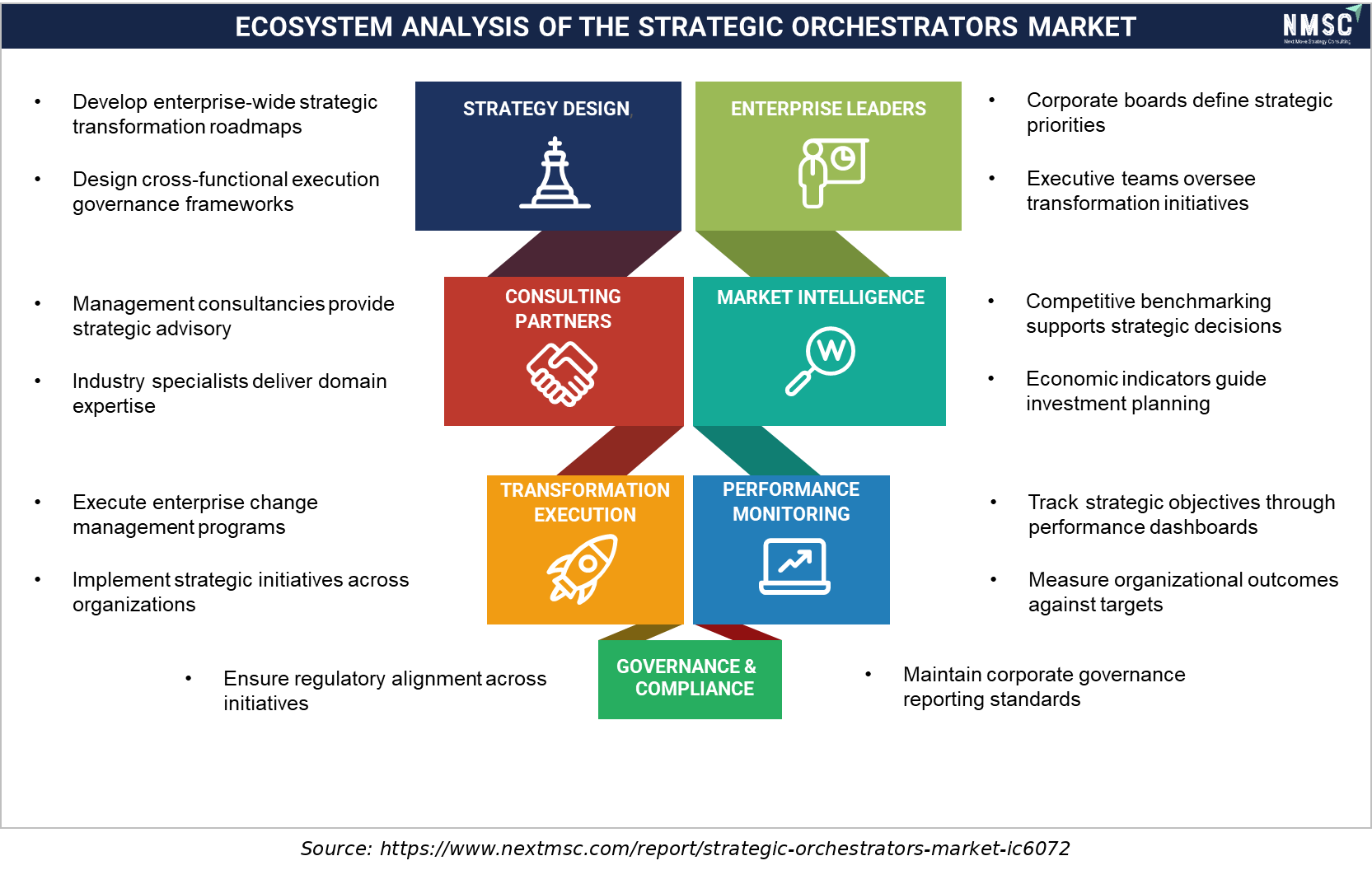
Ecosystem Analysis

Market Drivers & Dynamics

Interactive Dataset
Enterprise AI agent proliferation requiring cross-system coordination driver +4.8% Global 2026–2032
Rising enterprise process automation and process-mining adoption driver +3.6% North America, Europe 2026–2033
Expansion of low-code and no-code orchestration tooling driver +2.9% Global 2026–2031
Regulatory push for AI governance and auditability driver +2.1% Europe 2026–2030
Hyperscaler investment in agentic AI infrastructure driver +3.3% North America, Asia-Pacific 2026–2034
Data privacy constraints and legacy system fragmentation restraint −2.4% Global 2026–2030
Shortage of skilled orchestration and AI engineering talent restraint −1.8% North America, Europe 2026–2029
High implementation and change-management costs for small and mid-size enterprises restraint −1.5% Global 2026–2028
Vendor lock-in and interoperability gaps across multi-agent ecosystems restraint −1.2% Global 2026–2031
Source: Next Move Strategy Consulting

Growth Drivers

What Is the Primary Growth Driver for the Strategic Orchestrators Market?

Enterprise adoption of AI agents that must coordinate across departments is the primary growth driver, as organizations require a governing layer to sequence, monitor, and audit autonomous agent activity. The U.S. Bureau of Labor Statistics recorded continued expansion in computer systems design and related services employment through 2025, reflecting sustained enterprise IT investment that underpins orchestration platform budgets. During our market evaluation, we noticed that this driver is reinforced by hyperscalers embedding orchestration primitives directly into cloud infrastructure.

How Is AI Governance Regulation Driving Market Growth?

The European Union's Artificial Intelligence Act is increasing demand for AI governance, documentation, monitoring, and risk-management capabilities, supporting the adoption of orchestration platforms that provide relevant governance and audit functions.. We found that compliance-driven procurement is accelerating adoption among regulated industries such as banking and healthcare, where the National Institute of Standards and Technology's AI Risk Management Framework is increasingly referenced in vendor selection criteria.

Growth Inhibitors

What Is Restraining Strategic Orchestrators Market Growth?
Data privacy constraints and fragmented legacy IT environments restrain market growth, as enterprises must reconcile orchestration platforms with decades-old systems that lack modern application programming interfaces. Our assessment indicates that integration complexity extends implementation timelines and inflates total cost of ownership, particularly for organizations operating across multiple regulatory jurisdictions with differing data residency requirements under frameworks such as the European Commission's data protection rules.

What Are the Growth Opportunities?

Can Vertical-Specific Agent Catalogs Unlock New Revenue for Platform Vendors?

Pre-validated, industry-specific agent catalogs allow platform vendors to shorten enterprise deployment cycles and capture premium pricing from banking, healthcare, and insurance buyers seeking production-ready automation rather than custom development. We found that vendors bundling compliance-ready agents with orchestration infrastructure stand to benefit most, as regulated-industry buyers consistently prioritize speed to production over custom-build flexibility when selecting long-term platform partners.

Will Mid-Market Enterprises Become the Next Orchestration Growth Segment?

Mid-market enterprises, historically underserved by complex enterprise orchestration suites built for large IT organizations, represent an underpenetrated opportunity as low-code orchestration tooling steadily lowers implementation barriers. Integration and API orchestration vendors that simplify deployment stand to benefit most from this segment's growing willingness to adopt orchestrated automation without dedicated AI engineering teams or large upfront implementation budgets.

Can Systems Integrators Capture Value from Orchestration Implementation Services?

Rising orchestration complexity is expanding demand for implementation, integration, and change-management services alongside core software licensing, particularly as multi-agent deployments touch multiple business functions simultaneously. Systems integrators and platform vendors offering managed orchestration services stand to benefit as enterprises increasingly seek to offload governance and multi-agent coordination overhead rather than building and maintaining that capability internally.

Segmentation Analysis

2025 (USD Billion)
2035 (USD Billion)
Workflow Orchestration Platforms 2025: $4.83 Billion | 2035: $24.21 Billion
Workflow Orc
AI Agent Orchestration Platforms 2025: $3.83 Billion | 2035: $29.22 Billion
AI Agent Orc
Business Process Orchestration Suites 2025: $2.70 Billion | 2035: $13.36 Billion
Business Pro
Integration and API Orchestration Platforms 2025: $1.99 Billion | 2035: $12.11 Billion
Integration
Others 2025: $0.85 Billion | 2035: $4.59 Billion
Others
Workflow Orchestration Platforms $4.83 Billion $24.21 Billion 17.4%
AI Agent Orchestration Platforms $3.83 Billion $29.22 Billion 23.0%
Business Process Orchestration Suites $2.70 Billion $13.36 Billion 17.2%
Integration and API Orchestration Platforms $1.99 Billion $12.11 Billion 20.0%
Others $0.85 Billion $4.59 Billion 18.4%

Which Type Segment Dominates the Strategic Orchestrators Market?

Type segmentation spans workflow orchestration platforms, AI agent orchestration platforms, business process orchestration suites, integration and API orchestration platforms, and other adjacent orchestration tools. Workflow Orchestration Platforms dominated with a 34% share in 2025, reflecting incumbent adoption of process-sequencing engines across IT and operations teams. AI Agent Orchestration Platforms is the fastest-growing sub-segment at a 23.0% CAGR from 2026–2035, driven by enterprise deployment of autonomous agent fleets that require dedicated coordination and governance infrastructure distinct from legacy workflow tooling.

2025 (USD Billion)
2035 (USD Billion)
Cloud
On-Premise
Hybrid
Segment Item 2025 (USD Billion) 2035 (USD Billion) CAGR
Cloud $10.0 USD Billion $40.0 USD Billion 9.0%
On-Premise $17.1 USD Billion $51.1 USD Billion 23.0%
Hybrid $24.2 USD Billion $62.2 USD Billion 9.0%

Segment-wise data is locked

Unlock complete segment-wise numbers for By Deployment Mode.

Unlock Full Data

Which Deployment Mode Leads the Strategic Orchestrators Market?

Deployment mode segmentation covers cloud, on-premise, and hybrid architectures. Cloud deployment held the largest share at approximately 61% in 2025, supported by hyperscaler-native orchestration services that reduce infrastructure overhead for enterprise buyers. Hybrid deployment is the fastest-growing sub-segment at a 20.9% CAGR from 2026–2035, as regulated industries retain sensitive orchestration logic on-premise while extending agent coordination to cloud-hosted models, a pattern reinforced by data residency requirements across Europe and Asia-Pacific.

2025 (USD Billion)
2035 (USD Billion)
Banking
Financial Se
IT and Telec
Healthcare a
Retail and E
Segment Item 2025 (USD Billion) 2035 (USD Billion) CAGR
Banking $10.0 USD Billion $40.0 USD Billion 20.0%
Financial Services and Insurance $17.1 USD Billion $51.1 USD Billion 18.0%
IT and Telecommunications $24.2 USD Billion $62.2 USD Billion 12.0%
Healthcare and Life Sciences $31.3 USD Billion $73.3 USD Billion 22.0%
Retail and E-Commerce $38.4 USD Billion $84.4 USD Billion 25.0%

Segment-wise data is locked

Unlock complete segment-wise numbers for By End-Use Industry.

Unlock Full Data

Which End-Use Industry Is the Fastest-Growing in the Strategic Orchestrators Market?

End-use industry segmentation spans banking, financial services and insurance, IT and telecommunications, healthcare and life sciences, retail and e-commerce, manufacturing, government and public sector, and other verticals. Banking, Financial Services and Insurance held the largest share at approximately 24% in 2025, reflecting early adoption of orchestrated automation for lending, claims, and fraud workflows. Healthcare and Life Sciences is the fastest-growing vertical at a 22.5% CAGR from 2026–2035, as providers deploy orchestrated AI agents for prior authorization, care coordination, and revenue-cycle management under tightening documentation and audit requirements.

Growth Opportunities

Beyond the core growth drivers, NMSC's analysis indicates three forward-looking whitespace opportunities where orchestration vendors can capture disproportionate share through 2035.

Can Vertical-Specific Agent Catalogs Unlock New Revenue for Platform Vendors?

Pre-validated, industry-specific agent catalogs allow platform vendors to shorten enterprise deployment cycles and capture premium pricing from banking, healthcare, and insurance buyers seeking production-ready automation rather than custom development. We found that vendors bundling compliance-ready agents with orchestration infrastructure stand to benefit most, as regulated-industry buyers consistently prioritize speed to production over custom-build flexibility when selecting long-term platform partners.

Will Mid-Market Enterprises Become the Next Orchestration Growth Segment?

Mid-market enterprises, historically underserved by complex enterprise orchestration suites built for large IT organizations, represent an underpenetrated opportunity as low-code orchestration tooling steadily lowers implementation barriers. Integration and API orchestration vendors that simplify deployment stand to benefit most from this segment's growing willingness to adopt orchestrated automation without dedicated AI engineering teams or large upfront implementation budgets.

Can Systems Integrators Capture Value from Orchestration Implementation Services?

Rising orchestration complexity is expanding demand for implementation, integration, and change-management services alongside core software licensing, particularly as multi-agent deployments touch multiple business functions simultaneously. Systems integrators and platform vendors offering managed orchestration services stand to benefit as enterprises increasingly seek to offload governance and multi-agent coordination overhead rather than building and maintaining that capability internally.

Regional Outlook

2025 (USD Billion)
2035 (USD Billion)
North Americ
Europe
Asia-Pacific
Middle East
Latin Americ
Region 2025 (USD Billion) 2035 (USD Billion) CAGR (%)
North America $10.0 USD Billion $40.0 USD Billion 9.0%
Europe $17.1 USD Billion $51.1 USD Billion 27.0%
Asia-Pacific $24.2 USD Billion $62.2 USD Billion 25.0%
Middle East & Africa $31.3 USD Billion $73.3 USD Billion 23.0%
Latin America $38.4 USD Billion $84.4 USD Billion 12.0%

Regional data is locked

Unlock complete regional numbers for this market.

Unlock Full Data

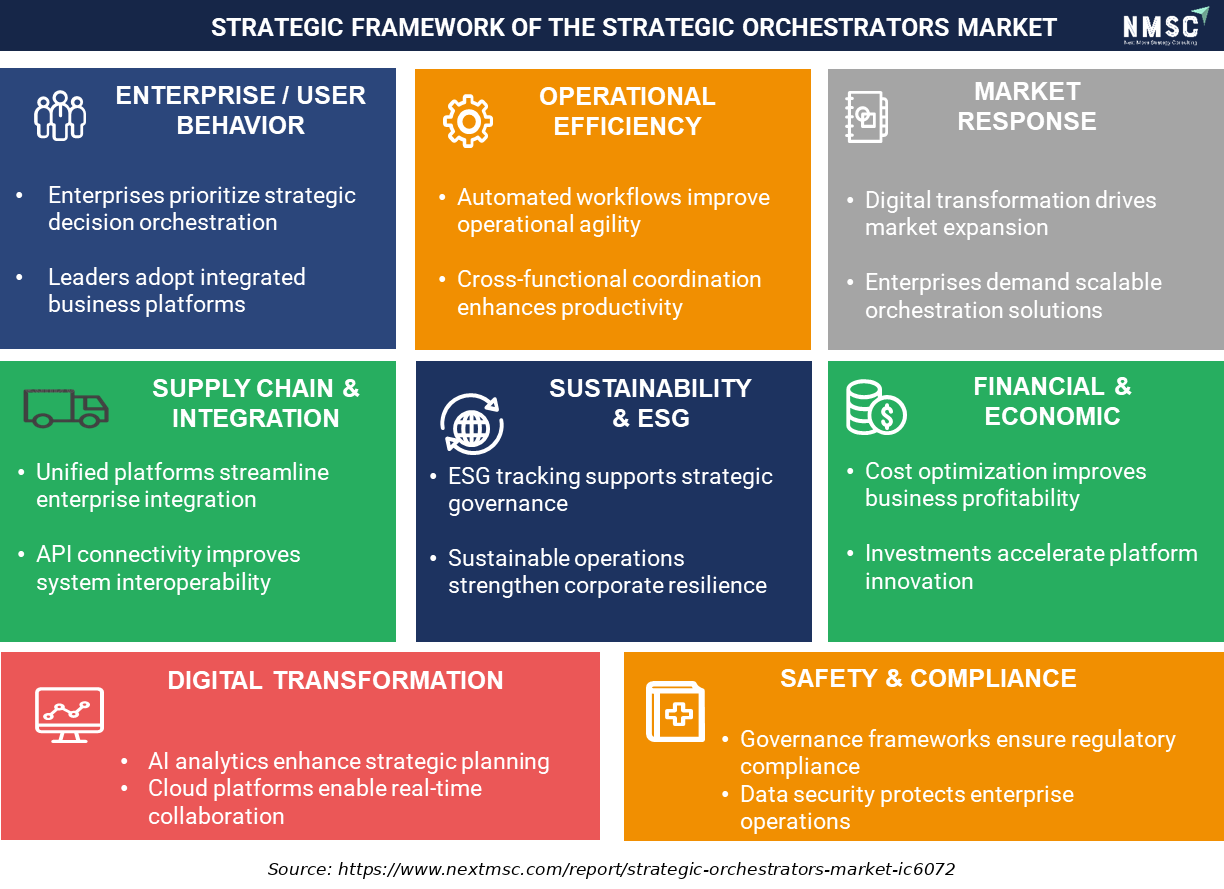
Strategic Framework of the Strategic Orchestrators Market
Competitive Landscape

We observed that the strategic orchestrators market is moderately consolidated among large enterprise software vendors that have extended existing platforms into orchestration, alongside specialist automation vendors defending category leadership through rapid agentic feature releases.

Dimension Description
Category Assessment
Market Structure Moderately consolidated; large enterprise software vendors, hyperscalers, and automation specialists compete alongside emerging orchestration providers.
Innovation Focus Multi-agent coordination, cross-model interoperability via open protocols, and embedded governance and observability tooling.
M&A Activity Elevated; platform vendors are acquiring identity, security, and observability specialists to embed governance directly into orchestration layers.

How Do Companies Compete in the Strategic Orchestrators Market?

Vendors compete primarily on breadth of pre-built connectors, depth of governance and observability tooling, and the ability to orchestrate agents built on competing foundation models without forcing customers into a single ecosystem. Our analysis shows that platform vendors with existing enterprise footprints, such as customer relationship management or IT service management incumbents, leverage installed-base distribution advantages over automation-native challengers competing primarily on technical depth.

Which Competitive Archetypes Dominate the Strategic Orchestrators Market?

Three archetypes dominate: platform incumbents extending existing enterprise software into orchestration, automation-native specialists that evolved from robotic process automation into agentic orchestration, and hyperscaler-embedded orchestration services bundled with cloud infrastructure. We found that installed-base distribution, developer ecosystem depth, and native governance tooling are the specific differentiation themes separating leaders from challengers in each archetype.

What Innovation and Differentiation Strategies Define Market Leaders?

Leading vendors differentiate through native support for open interoperability protocols, embedded observability dashboards, and vertical-specific agent catalogs that collectively reduce enterprise deployment timelines from months to weeks. Our assessment indicates that vendors investing earliest in cross-platform agent observability are best positioned to win multi-year enterprise contracts, as buyers increasingly avoid single-vendor lock-in when standardizing on an orchestration layer.

How Active Is M&A in the Strategic Orchestrators Market?

M&A activity is elevated as platform vendors acquire identity governance, asset visibility, and security specialists to embed compliance directly into orchestration layers rather than relying on third-party integrations. This pattern reflects a broader strategic shift toward owning the full governance stack around orchestrated AI agents, reducing enterprise dependence on point-solution security vendors.

Key Market Players

Based on research conducted by NMSC, the following 20 companies represent the leading providers of strategic orchestration platforms and services globally, ranked by estimated market-specific revenue and scale of operations.

ServiceNow, Inc. Microsoft Corporation Salesforce, Inc. International Business Machines Corporation SAP SE Oracle Corporation UiPath Inc. Automation Anywhere, Inc. Celonis SE Appian Corporation Pegasystems Inc. Amazon.com, Inc. Alphabet Inc. Databricks, Inc. Workato, Inc. Boomi, LP SS&C Technologies Holdings, Inc. Camunda Services GmbH Zapier Inc. n8n GmbH

Latest Developments

During our market evaluation, we noticed a wave of product and platform announcements through 2025 and into 2026 as vendors raced to extend orchestration capabilities to autonomous AI agents.

Date Event
July 2026 Microsoft released Agent Framework’s orchestration patterns to version 1.0, stabilizing sequential, concurrent, group-chat, handoff, and Magentic multi-agent coordination across Python and .NET. The release provides production-ready orchestration primitives for coordinating specialized agents and workflows, strengthening Microsoft’s enterprise agent orchestration capabilities.
June 2026 UiPath introduced Maestro Case, an AI-native case management capability within UiPath Maestro that orchestrates AI agents, robots, people, applications, and data across dynamic, exception-heavy processes. The launch extends governed orchestration into long-running case management, improving visibility, control, and execution across complex enterprise operations.
May 2026 Camunda announced ProcessOS, a new intelligence layer for its agentic orchestration platform designed to discover, re-engineer, and continuously improve enterprise processes. The launch strengthens Camunda’s platform by adding AI-driven process intelligence to orchestration, supporting organizations in redesigning operations around coordinated human and agent work.
May 2026 SAP announced embedded partnerships with n8n and Vercel within its new Joule Studio environment. This integration enables developers to visually orchestrate multi-agent systems and streamline end-to-end business process workflows directly grounded in SAP Business AI Platform while maintaining strict enterprise-grade security and governance controls.

Expert Insights

Sagi Eliyahu

CEO and Co-Founder | Tonkean

"True orchestration, in a nutshell, is enterprise-grade orchestration, which is orchestration that connects every individual component of your organisation, and that’s capable of helping you automate complex work seamlessly across all those components – across every team, tool, system and data source."

Analyst Interpretation

The comment highlights the growing shift toward enterprise-wide orchestration that connects teams, tools, systems, and data sources to automate complex business processes. As organizations increasingly seek to overcome fragmented workflows and coordinate diverse technology environments, demand is rising for orchestration solutions that integrate multiple enterprise components and enable seamless automation. This supports the expansion of the Strategic Orchestrators Market, particularly across enterprise workflow coordination, automation, system integration, and AI-enabled orchestration capabilities.

Investment Opportunities

Where Are Capital Inflows Concentrating in the Strategic Orchestrators Market?

Capital inflows are concentrating in vendors building cross-model orchestration and governance tooling, reflecting investor confidence in platforms positioned as the control layer above competing AI agent ecosystems. We found that public-market valuations for automation-native vendors have re-rated around agentic orchestration announcements, signaling investor recognition of the category's structural growth potential through 2035.

How Is Infrastructure Investment Shaping the Market?

Hyperscaler capital expenditure on AI-optimized data center infrastructure directly underwrites orchestration platform scalability, as agent coordination workloads require substantial compute and low-latency networking. Our assessment indicates that regions with concentrated hyperscaler infrastructure investment, including North America and parts of Asia-Pacific, will continue attracting disproportionate orchestration platform revenue relative to infrastructure-constrained markets.

What Environmental, Social, and Governance (ESG) Considerations Affect Strategic Orchestrators Market Investment?
Environmental considerations center on the energy intensity of AI agent workloads underlying orchestration platforms, prompting vendors to disclose data center efficiency metrics. Governance considerations are increasingly central given orchestration platforms' role in AI accountability, with vendors publishing responsible-AI frameworks to satisfy institutional investor due diligence. Social considerations include workforce transition support, an area vendors are addressing through reskilling partnerships tied to agentic workforce management rollouts.

Key Benefits for Stakeholders

How Does This Report Benefit Enterprise Technology Leaders?

Enterprise technology leaders gain a consolidated view of segment-level growth rates, vendor competitive positioning, and regional adoption patterns needed to prioritize orchestration platform investment. Our analysis, forecasts, and vendor benchmarking support build versus buy decisions and help technology leaders sequence orchestration rollouts against the market's projected 19.5% CAGR through 2035.

How Does This Report Benefit Investors and Financial Analysts?

Investors and financial analysts gain quantified segment, regional, and country-level revenue forecasts alongside competitive landscape analysis needed to evaluate public and private orchestration vendors. The report's data-backed opportunity sizing of USD 66.69 billion between 2026 and 2035 supports valuation and capital allocation decisions across the sector.

How Does This Report Benefit Technology Vendors and Product Teams?

Technology vendors and product teams gain visibility into fastest-growing segments, underserved regional markets, and emerging buyer requirements around governance and interoperability. This strategic insight supports product roadmap prioritization and go-to-market sequencing across the segments and regions identified as highest-growth through 2035.

Key Market Segments Evaluated

By Type

  • Workflow Orchestration Platforms
  • AI Agent Orchestration Platforms
  • Business Process Orchestration Suites
  • Integration and API Orchestration Platforms
  • Others

By Deployment Mode

  • Cloud
  • On-Premise
  • Hybrid

By End-Use Industry

  • Banking, Financial Services and Insurance
  • IT and Telecommunications
  • Healthcare and Life Sciences
  • Retail and E-Commerce
  • Manufacturing
  • Government and Public Sector
  • Others

Conclusion & Recommendations

The long-term outlook remains strongly positive, with the market projected to expand from USD 16.80 billion in 2026 to USD 83.49 billion by 2035 at a 19.5% CAGR. NMSC's analysis indicates that growth will remain broad-based across regions and segments, with AI agent orchestration platforms progressively capturing share from legacy workflow tooling as enterprise agent deployments scale.

What Strategic Positioning Should Vendors Pursue?

Vendors should prioritize open interoperability with competing foundation models and clouds over closed-ecosystem strategies, given enterprise buyers' demonstrated resistance to vendor lock-in. Our assessment indicates that platform vendors combining native governance tooling with vertical-specific agent catalogs are best positioned to defend premium pricing as the market matures through 2035.

How Attractive Is the Strategic Orchestrators Market for New Investment?
The strategic orchestrators industry presents an attractive investment case, supported by a USD 66.69 billion absolute dollar opportunity between 2026 and 2035 and above-average growth in Asia-Pacific and AI agent orchestration categories. We found that investment attractiveness is highest for vendors combining governance credentials with cross-platform interoperability, positioning them to serve both regulated and less-regulated enterprise segments simultaneously.

What Market Shifts and Key Risks Should Stakeholders Monitor?

Stakeholders should monitor talent shortages in AI orchestration engineering, tightening AI governance regulation, and integration complexity with fragmented legacy systems as key risks to the strategic orchestrators market. Our analysis shows that vendors unable to demonstrate interoperability and auditable governance risk losing enterprise contracts to competitors with certified compliance credentials, particularly within Europe's increasingly regulated AI environment.

What Are the Key Growth Pathways for the Strategic Orchestrators Market?

Key growth pathways include expanding vertical-specific agent catalogs, scaling hybrid deployment architectures for regulated industries, and deepening penetration into mid-market enterprises through low-code orchestration tooling. NMSC's analysis indicates that vendors pursuing these pathways while maintaining interoperability across competing AI ecosystems will be best positioned to capture the strategic orchestrators market's projected growth through 2035.

FAQs

About the Author

Saista Faiyaz

Saista Faiyaz

Saista Faiyaz is Research Associate at Next Move Strategy Consulting, where she has covered consumer markets and healthcare technologies for 3 years. Her work includes primary interview review, secondary-source validation, market sizing, and structured analysis of company and industry data. She supports research by comparing evidence across sources, organizing findings into market narratives, and documenting assumptions used in analysis. Her scope includes cross-market benchmarking, and reports.

About the Reviewer

Supradip Baul

Supradip Baul

Supradip Baul is an accomplished business consultant and strategist with over a decade of rich experience in market intelligence, strategy, technology, and business transformation. His work has included rigorous qualitative and quantitative analysis across multiple industries, helping clients shape investment decisions and long-term roadmaps. Earlier in his career, he was associated with Gartner, where he contributed to industry-leading reports and market share analyses. He has worked with leading global companies and holds an MBA with a dual specialization in Marketing and Finance.

Download Free Sample

Henri Knyphausen

HENRI KNYPHAUSEN

Partner at Singulier [Ex-BCG]

Singulier

I recently engaged NEXTMSC.com for a commercial due diligence project within the intralogistics sector, and I am pleased to provide a reference based on my experience. In utilizing NEXTMSC.com's services, I found their report to offer valuable insights into market dynamics and key industry players. The initial report provided a solid foundation for our analysis. However, as we were investigating a smaller target in the market, and I had specific customization requests requiring additional research. These requests included detailed information on product portfolios of various players and sub-market sizes, both inclusive and exclusive of certain product categories. NEXTMSC.com demonstrated commendable responsiveness and agility in accommodating these customization requests. Within a timeframe of 1-2 weeks, they delivered a revised report that met our specific needs. Furthermore, they were receptive to my follow-up inquiries, ensuring clarity and understanding of the data provided. The final deliverable significantly contributed to our due diligence efforts. One of NEXTMSC.com's notable strengths lies in their qualitative research capabilities. However, for future engagements, I would recommend the inclusion of a quantified market model in Excel format. Such a model would offer the ability to conduct in-depth analyses and explore various market segments, including country-specific data and subcomponent breakdowns. Based on my positive experience, I would not hesitate to work with NEXTMSC.com again. Their responsiveness, willingness to accommodate customization requests, and commitment to delivering actionable insights make them a reliable partner for commercial research projects.

Mohit Agarwal

MOHIT AGARWAL

Chief Manager

DryChem India Pvt. Ltd.

Next Move Strategy Consulting is an amazing team of consultants. We required a market study report for our investors on top priority and the team went above and beyond our expectations to deliver the same with ample supporting data within a short time span enabling us to secure the investments and keep our project timeline maintained. Their professionalism, attention to detail, and timely delivery of actionable recommendations have left a lasting impression on our organization.

Kishu Kanda

KISHU KANDA

Strategy Analyst

Accenture

We purchased the AI Consumer Market Report from this company. Not only did they customize the report to meet our specific requirements, but they also showed great flexibility in accommodating our budget. The report we received fully met our expectations. Additionally, they provided prompt and thorough responses to both our pre-purchase and follow-up questions. We look forward to working with this company again in the future.

Gustaf Hummel Burstrom

GUSTAF HUMMEL BURSTROM

Founder

Revline Tools AB

Joseph and the team at Next Move Strategy Consulting have been excellent to work with, in supplying us with relevant market data and forecasts for our specific category. We had some special requirements and they were able to do a custom package to suit our needs. We would definitely recommend them to any other company needing market data and forecasts

Gaurav Jaiswal

GAURAV JAISWAL

Founder & CEO

Yano Charge Private Limited

The EV Charging market research report provided by the NextMSC was exceptionally detailed and insightful. It offered a comprehensive analysis that proved to be a game-changer for our strategic planning. Truly a testament to the NextMSC’s expertise and thoroughness in EV market landscape & analysis.

Custom Market Research Services

We will customize the research for you if the listed report does not fully match your requirements.

Get 30% Free Customization

Select License

This website uses cookies to ensure you get the best experience on our website. Learn more

✖