AI Disaster Prediction Market Size, Share, Trends and Growth Analysis, By Offering (SaaS Platform, Data Subscription, API Access, Managed Service, and Professional Service), By Technology (Machine Learning Models, Ensemble Models, and Other Technologies), By Deployment Mode (Cloud, Private Cloud, and Others), By Sales Channel (Direct, Partner, Marketplace, and OEM), By End Use Industry (Government, Insurance, Energy, and Other End Use Industries)— Global Industry Report and Forecast, 2026–2035
Industry: ICT & Media | Publishing Date: July 14, 2026 | Last Updated: September 30, 2026 | No of Pages: N/A | No. of Tables: N/A | No. of Figures: N/A | Format: PDF | Report Code: IC5143
What Is the AI Disaster Prediction Market Size?
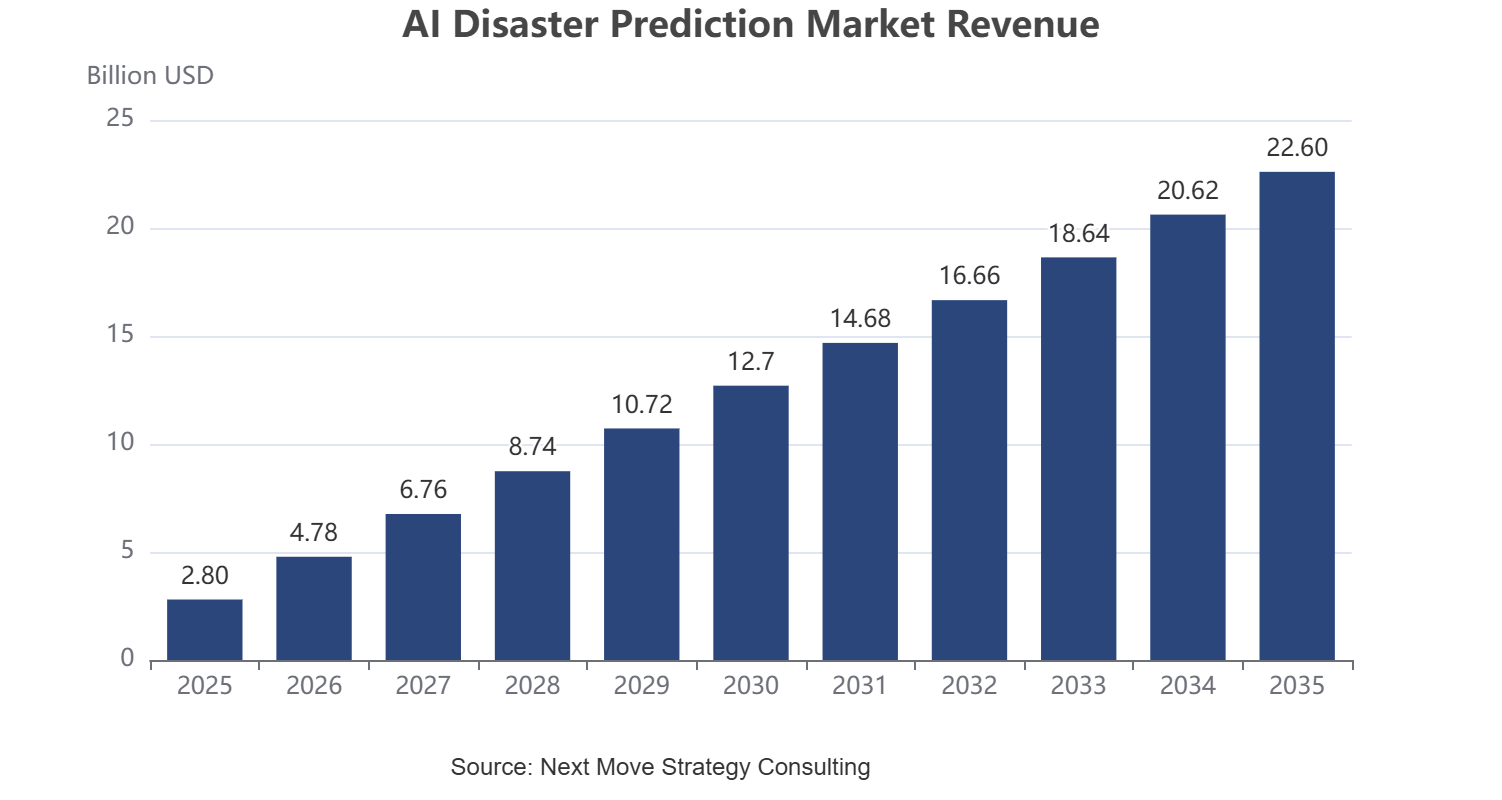
The global AI Disaster Prediction Market size was valued at USD 2.80 Billion in 2025 and is estimated at USD 3.40 Billion in 2026, forecast to reach USD 22.60 Billion by 2035, expanding at a 23.4% CAGR between 2026 and 2035. North America leads with approximately 36% share, while under offering, SaaS Platform dominates with approximately 34% share.
We observed that growth is broad-based across every segmentation axis, with insurance risk modeling and government early-warning mandates driving the dominant structural shifts through 2035.
|
Key Takeaways |
|
By Offering: SaaS Platform held the largest share of approximately 34% (USD 0.95 Billion) in 2025; API Access is the fastest-growing sub-segment at 26.8% CAGR from 2026–2035 |
|
By Technology: Machine Learning Models held the largest share of approximately 31% (USD 0.87 Billion) in 2025; Digital Twin is the fastest-growing sub-segment at 27.5% CAGR from 2026–2035 |
|
By Deployment Mode: Cloud held the largest share of approximately 46% (USD 1.29 Billion) in 2025; Hybrid is the fastest-growing sub-segment at 24.6% CAGR from 2026–2035 |
|
By Sales Channel: Direct held the largest share of approximately 42% (USD 1.18 Billion) in 2025; Marketplace is the fastest-growing sub-segment at 26.5% CAGR from 2026–2035 |
|
By End Use Industry: Government held the largest share of approximately 29% (USD 0.81 Billion) in 2025; Insurance is the fastest-growing sub-segment at 25.5% CAGR from 2026–2035 |
|
Dominant Region: North America dominated with approximately 36% revenue share (USD 1.01 Billion) in 2025 |
|
Fastest-Growing Region: Asia-Pacific is expected to register the highest CAGR of 26.5% during 2026–2035 |
|
Dominant Country: U.S. led with approximately USD 0.79 Billion in 2025 |
|
Fastest-Growing Country: India is the fastest-growing country at approximately 28.5% CAGR from 2026–2035 |
Between 2026 and 2035, the AI Disaster Prediction Market is set to generate an absolute dollar opportunity of USD 19.20 Billion, positioning insurance-grade risk scoring and government early-warning platforms as a compelling area for capital allocation.
According to Next Move Strategy Consulting analysis, sustained investment in geospatial AI and digital twin architectures is reshaping procurement criteria for government and insurance buyers, as model transparency and validated accuracy scores increasingly determine vendor shortlisting across catastrophe risk and early-warning categories.
What does the AI Disaster Prediction Market Encompass?
The AI Disaster Prediction Market encompasses software platforms, data subscriptions, APIs, managed services, and professional services that apply machine learning, geospatial AI, and digital twin modeling to forecast natural and climate-driven hazards before they materialize. Our assessment indicates that the scope spans forecast dashboards, risk score platforms, early warning systems, and hazard data feeds supplied to government agencies, insurers, utilities, and logistics operators seeking to anticipate floods, wildfires, storms, and seismic events with quantified confidence intervals.
Regulatory frameworks such as the U.S. Federal Emergency Management Agency's risk rating standards and the European Union's Civil Protection Mechanism shape data validation and model transparency requirements, while national meteorological agency data-sharing mandates increasingly influence platform interoperability. We observed that technology adoption is shifting toward ensemble and digital twin architectures that combine satellite, sensor, and historical loss data to improve predictive accuracy. Next Move Strategy Consulting's analysis indicates that this structural shift, combined with insurer demand for parametric risk pricing, is redefining sourcing criteria across the AI Disaster Prediction Market.
|
Parameters |
Details |
|
Market Size in 2025 |
USD 2.80 Billion |
|
Market Size in 2026 |
USD 3.40 Billion |
|
Revenue Forecast in 2035 |
USD 22.60 Billion |
|
Growth Rate |
CAGR of 23.4% from 2026 to 2035 |
|
Analysis Period |
2025–2035 |
|
Base Year Considered |
2025 |
|
Forecast Period |
2026–2035 |
|
Market Size Estimation |
Revenue (USD Billion) |
|
Companies Profiled |
20 |
|
Countries Covered |
33 |
|
Market Share |
Available for Top 10 Companies |
Key Emerging Trends
We found that four structural trends are redefining how the AI Disaster Prediction Market is designed, procured, and deployed across public and private buyers.
How Is Digital Twin Modeling Transforming Disaster Simulation?
Digital twin platforms now replicate entire watersheds, coastal zones, and grid infrastructure to simulate cascading disaster scenarios before they occur. This transformation shifts buyers from static hazard maps toward continuously updated simulations that ingest live sensor feeds. Utilities and municipal planners increasingly adopt this format for infrastructure stress-testing. Hexagon's digital reality platforms illustrate how twin-based simulation is becoming a procurement standard for large-scale civil infrastructure resilience planning.
How Is Adoption of Geospatial AI Expanding Across Government Agencies?
Government agencies are integrating geospatial AI into national early-warning infrastructure at an accelerating pace, driven by mandates to reduce disaster response latency. This adoption impacts procurement cycles, favoring vendors with proven satellite-data integration. Esri's partnerships with national mapping agencies demonstrate how geospatial AI is moving from pilot programs into standing operational infrastructure for hazard monitoring and public alerting systems.
How Is Insurance Sector Demand Reshaping Risk Score Platforms?
Insurers are pushing risk score platform vendors toward parametric, event-triggered pricing models that require granular, auditable predictions. This stakeholder shift affects model design, requiring explainability layers alongside raw forecasts. Verisk's catastrophe modeling tools show how insurance-grade validation is becoming a baseline requirement for any vendor selling into underwriting workflows within the AI Disaster Prediction Market.
How Is Sensor Fusion Improving Early Warning Accuracy?
Sensor fusion techniques combining satellite imagery, IoT ground sensors, and weather radar are reducing false-positive rates in early warning systems. This transformation impacts response coordination, as agencies gain higher-confidence lead times before disaster onset. Spire Global's satellite-sensor data integration illustrates how fusion architectures are becoming central to next-generation early warning platform design across flood and storm-prone geographies.
Ecosystem Analysis of the AI Disaster Prediction Market
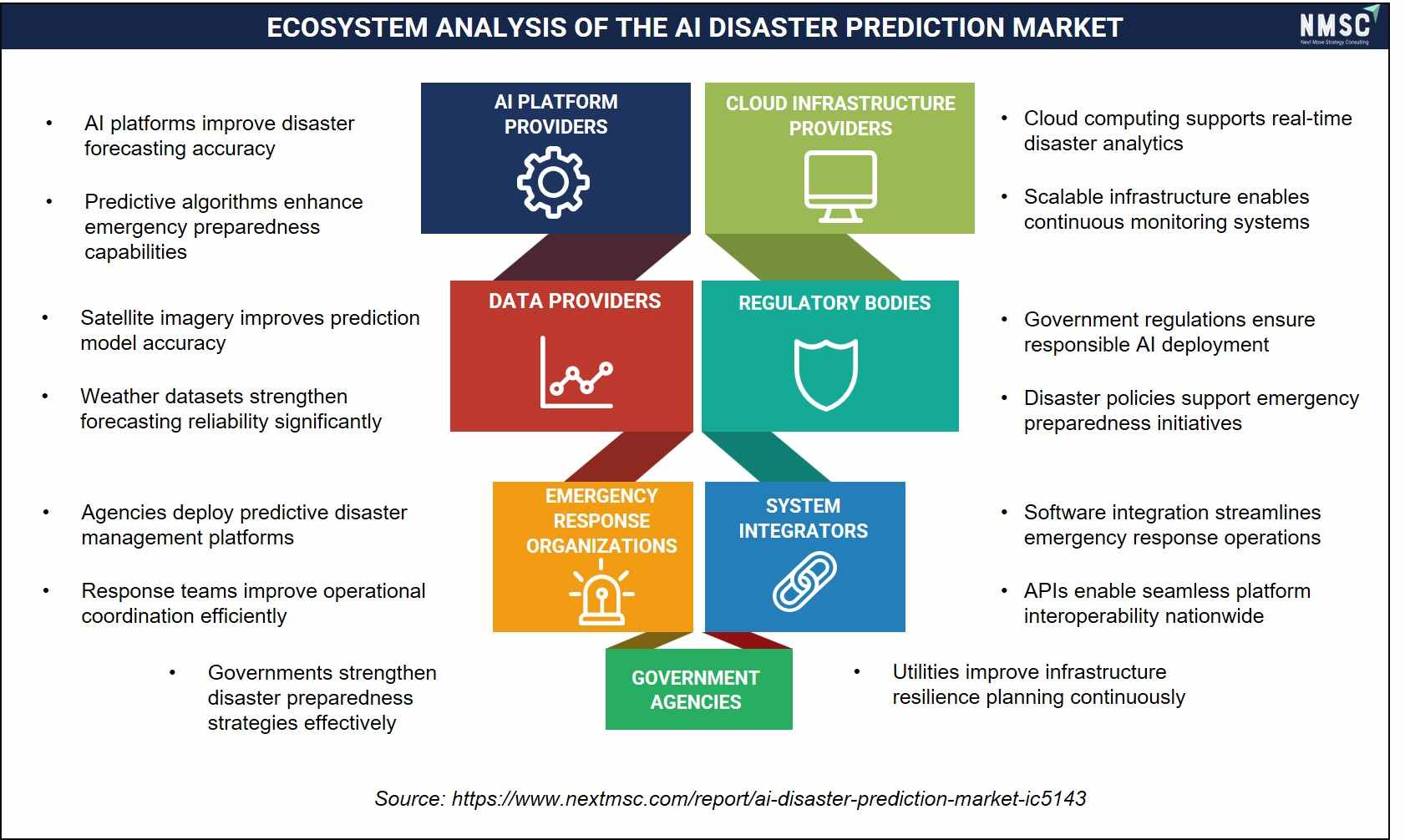
The ecosystem of the AI Disaster Prediction Market connects AI platform providers, cloud infrastructure providers, and data providers that supply satellite imagery, weather, geospatial, and sensor information for predictive modeling. Regulatory bodies establish governance standards, while system integrators deploy AI solutions within emergency management infrastructure. Emergency response organizations utilize predictive insights for disaster preparedness and response planning, and government agencies coordinate implementation, funding, and public safety initiatives. Collaboration among these stakeholders enables accurate forecasting, faster decision-making, and more resilient disaster management systems.
Growth Drivers & Restraints
Growth Catalyst & Risk Assessment Matrix
|
Factors |
Type |
(+/−) % Impact on CAGR |
Geographic Relevance |
Impact Timeline |
|
Rising frequency of climate-driven disasters |
Driver |
+3.8% |
Global |
2026–2035 |
|
Government early-warning mandates |
Driver |
+3.1% |
North America, Europe, APAC |
2026–2035 |
|
Insurer demand for parametric risk pricing |
Driver |
+2.6% |
North America, Europe |
2026–2032 |
|
Satellite and sensor data cost decline |
Driver |
+2.2% |
Global |
2026–2035 |
|
Cloud infrastructure expansion |
Driver |
+1.9% |
Global |
2026–2030 |
|
Growing geospatial AI talent availability |
Driver |
+1.4% |
North America, APAC |
2027–2035 |
|
Data quality and gap inconsistencies |
Restraint |
−1.8% |
MEA, Latin America |
2026–2030 |
|
High implementation cost for legacy agencies |
Restraint |
−1.5% |
Global |
2026–2029 |
|
Regulatory fragmentation across jurisdictions |
Restraint |
−1.1% |
Europe, APAC |
2026–2032 |
What is the primary growth driver?
The primary growth driver is the escalating frequency of climate-driven disasters, which is pushing governments and insurers toward predictive infrastructure. The U.S. National Oceanic and Atmospheric Administration recorded a sustained rise in billion-dollar weather disaster events over the past decade, reinforcing budgetary pressure toward early-warning investment. We observed that this trend alone contributes an estimated +3.8% impact on the market's 2026–2035 CAGR, concentrated most heavily in North America and Asia-Pacific.
How is government early-warning investment driving the market growth?
Government early-warning investment is driving market growth as national agencies formalize AI-based hazard monitoring into standing budget lines rather than pilot programs. The United Nations Office for Disaster Risk Reduction has promoted early-warning-for-all coverage targets among member states, reinforcing sustained procurement demand. Our findings suggest that government-funded deployments now anchor a growing share of Managed Service and Professional Service revenue within the AI Disaster Prediction Market.
What is restraining the AI Disaster Prediction Market growth?
Data quality and gap inconsistencies across developing regions restrain market growth, as AI prediction accuracy depends on consistent historical and sensor data that remains sparse across parts of the Middle East, Africa, and Latin America. This restraint is estimated to reduce the 2026–2035 CAGR by approximately 1.8 percentage points in affected geographies. Our analysis shows that vendors addressing this gap through low-cost sensor networks are positioned to capture disproportionate share in underserved markets.
Segmentation Analysis
Segment Sizing: By Offering
|
Segment |
2025 (USD) |
2035 (USD) |
CAGR% (2026–2035) |
|
SaaS Platform |
USD 0.95 Billion |
USD 8.29 Billion |
24.5% |
|
Data Subscription |
USD 0.62 Billion |
USD 4.19 Billion |
21% |
|
API Access |
USD 0.45 Billion |
USD 4.62 Billion |
26.8% |
|
Managed Service |
USD 0.48 Billion |
USD 3.48 Billion |
22% |
|
Professional Service |
USD 0.30 Billion |
USD 2.02 Billion |
20.5% |
|
Total |
USD 2.80 Billion |
USD 22.60 Billion |
23.4% |
Which offering dominates the AI Disaster Prediction Market?
SaaS Platform dominates the offering axis with USD 0.95 Billion in 2025, reflecting buyer preference for subscription-based forecast dashboards and risk score platforms over custom-built systems. Our findings suggest that API Access is the fastest-growing sub-segment at 26.8% CAGR from 2026 to 2035, as insurers and logistics operators increasingly embed forecast and alert APIs directly into existing claims and routing software rather than adopting standalone platforms.
Segment Sizing: By Technology
|
Segment |
2025 (USD) |
2035 (USD) |
CAGR% (2026–2035) |
|
Machine Learning Models |
USD 0.87 Billion |
USD 6.48 Billion |
22.5% |
|
Ensemble Models |
USD 0.42 Billion |
USD 3.25 Billion |
23% |
|
Digital Twin |
USD 0.34 Billion |
USD 3.64 Billion |
27.5% |
|
Geospatial AI |
USD 0.50 Billion |
USD 4.11 Billion |
23.8% |
|
Computer Vision |
USD 0.31 Billion |
USD 2.62 Billion |
24.2% |
|
Sensor Fusion |
USD 0.25 Billion |
USD 1.91 Billion |
22.8% |
|
Other Technologies |
USD 0.11 Billion |
USD 0.59 Billion |
18% |
|
Total |
USD 2.80 Billion |
USD 22.60 Billion |
23.4% |
Which technology leads AI Disaster Prediction adoption?
Machine Learning Models lead the technology axis with USD 0.87 Billion in 2025, underpinning the majority of forecast and risk-scoring engines currently in production. We observed that Digital Twin is the fastest-growing sub-segment at 27.5% CAGR from 2026 to 2035, driven by utility and municipal demand for infrastructure-level hazard simulation that traditional statistical models cannot replicate at comparable resolution.
Segment Sizing: By End Use Industry
|
Segment |
2025 (USD) |
2035 (USD) |
CAGR% (2026–2035) |
|
Government |
USD 0.81 Billion |
USD 6.00 Billion |
22% |
|
Insurance |
USD 0.56 Billion |
USD 5.35 Billion |
25.5% |
|
Energy and Utilities |
USD 0.39 Billion |
USD 3.16 Billion |
23.2% |
|
Transport and Logistics |
USD 0.31 Billion |
USD 2.44 Billion |
22.8% |
|
Agriculture |
USD 0.25 Billion |
USD 2.14 Billion |
24% |
|
Built Environment |
USD 0.22 Billion |
USD 1.83 Billion |
23.6% |
|
Telecom |
USD 0.14 Billion |
USD 1.00 Billion |
21.5% |
|
Retail |
USD 0.07 Billion |
USD 0.45 Billion |
20% |
|
Other End Use Industries |
USD 0.05 Billion |
USD 0.23 Billion |
19% |
|
Total |
USD 2.80 Billion |
USD 22.60 Billion |
23.4% |
Which end use industry drives the largest share?
Government held the largest end use share at USD 0.81 Billion in 2025, reflecting sustained public-sector investment in national early-warning infrastructure. Our analysis shows that Insurance is the fastest-growing sub-segment at 25.5% CAGR from 2026 to 2035, as underwriters accelerate adoption of AI-based catastrophe modeling to support parametric and event-triggered policy structures across property and agricultural lines.
Growth Opportunities
Three forward-looking opportunities stand out as whitespace areas for vendors positioning ahead of 2035 demand curves.
How Can Parametric Insurance Integration Unlock New Revenue?
Vendors that embed forecast APIs directly into parametric insurance triggers can capture recurring, usage-based revenue from underwriters seeking automated, low-dispute payout mechanisms. This mechanism benefits Insurance end users and API Access offering providers, positioning early integrators to lock in multi-year underwriting partnerships.
How Can Municipal Digital Twin Adoption Expand Market Reach?
Expanding digital twin platforms into mid-sized municipal governments, beyond current national-agency concentration, opens a large underserved buyer segment. This mechanism benefits Government end users and Digital Twin technology providers, as smaller agencies increasingly seek scaled-down infrastructure resilience simulation within constrained budgets.
How Can Sensor Data Marketplaces Create New Distribution Channels?
Building marketplace-based distribution for hazard layer and observation datasets allows smaller sensor operators to monetize data through established forecast platforms. This mechanism benefits Data Subscription offering providers and the Marketplace sales channel, accelerating data diversity available to downstream forecasting models.
Regional Outlook
|
Region |
2025 (USD) |
2035 (USD) |
CAGR% (2026–2035) |
Key Driver |
|
North America |
USD 1.01 Billion |
USD 7.22 Billion |
22% |
Early-warning and insurance modernization |
|
Europe |
USD 0.73 Billion |
USD 5.45 Billion |
22.6% |
Early-warning and insurance modernization |
|
Asia-Pacific |
USD 0.67 Billion |
USD 6.63 Billion |
26.5% |
Early-warning and insurance modernization |
|
Middle East & Africa |
USD 0.22 Billion |
USD 1.93 Billion |
24.8% |
Early-warning and insurance modernization |
|
Latin America |
USD 0.17 Billion |
USD 1.37 Billion |
23.5% |
Early-warning and insurance modernization |
|
Total |
USD 2.80 Billion |
USD 22.60 Billion |
23.4% |
|
North America AI Disaster Prediction Market
North America leads the AI Disaster Prediction Market with mature adoption anchored in federal and state-level early-warning programs. Key drivers include FEMA risk rating modernization and insurer demand for wildfire and flood scoring. Regulatory influence remains moderate, with data-sharing standards accelerating rather than constraining deployment. Technology adoption is advanced, with Machine Learning Models and Geospatial AI in widespread operational use. Strategic outlook favors vendors with proven government contracting track records.
Europe AI Disaster Prediction Market
Europe shows steady maturity, supported by the EU Civil Protection Mechanism and national meteorological agency modernization programs. Key drivers include cross-border flood and wildfire coordination requirements. Regulatory influence is significant, with data governance and model transparency rules shaping vendor selection. Technology adoption favors Ensemble Models and Digital Twin platforms for infrastructure resilience. Strategic outlook favors vendors demonstrating GDPR-compliant data architectures.
Asia-Pacific AI Disaster Prediction Market
Asia-Pacific is the fastest-growing region, driven by monsoon, typhoon, and seismic exposure across densely populated economies. Key drivers include national disaster management agency digitization and insurance penetration growth. Regulatory influence varies by country, with China and India advancing government-led early-warning mandates. Technology adoption is accelerating around Geospatial AI and Sensor Fusion. Strategic outlook favors vendors with localized data partnerships.
Middle East & Africa AI Disaster Prediction Market
Middle East & Africa remains an emerging region, with growth concentrated in Gulf states investing in climate resilience infrastructure. Key drivers include national vision programs prioritizing smart infrastructure and disaster preparedness. Regulatory influence is developing, with data availability gaps constraining model accuracy in parts of Africa. Technology adoption favors Cloud deployment given limited legacy infrastructure. Strategic outlook favors vendors offering managed service models.
Latin America AI Disaster Prediction Market
Latin America shows emerging adoption, led by Brazil's flood and landslide monitoring investments. Key drivers include agricultural risk management and urban flood exposure. Regulatory influence remains limited relative to other regions, though national meteorological agencies are expanding data partnerships. Technology adoption favors Machine Learning Models delivered via Cloud platforms. Strategic outlook favors vendors partnering with regional agricultural insurers.
U.S. AI Disaster Prediction Market
Based on our engagements, the AI Disaster Prediction industry in U.S. was valued at approximately USD 0.79 Billion in 2025 and is projected to reach USD 5.54 Billion by 2035, growing at approximately 21.5% CAGR from 2026 to 2035. Demand structure centers on federal disaster relief modernization and dominant insurer adoption of AI catastrophe scoring. Adoption levels remain concentrated among large agencies and insurers, though technology penetration is broadening. Regulatory influence, competitive intensity, and strategic outlook all favor vendors that can demonstrate localized validation and data partnerships specific to U.S.
Canada AI Disaster Prediction Market
Through our analysis, the AI Disaster Prediction industry in Canada was valued at approximately USD 0.15 Billion in 2025 and is projected to reach USD 1.17 Billion by 2035, growing at approximately 23% CAGR from 2026 to 2035. Demand structure centers on wildfire monitoring investment and provincial early-warning system upgrades. Adoption levels remain concentrated among large agencies and insurers, though technology penetration is broadening. Regulatory influence, competitive intensity, and strategic outlook all favor vendors that can demonstrate localized validation and data partnerships specific to Canada.
UK AI Disaster Prediction Market
From our assessment, the AI Disaster Prediction industry in UK was valued at approximately USD 0.17 Billion in 2025 and is projected to reach USD 1.24 Billion by 2035, growing at approximately 22.2% CAGR from 2026 to 2035. Demand structure centers on Environment Agency flood forecasting modernization and insurer parametric product growth. Adoption levels remain concentrated among large agencies and insurers, though technology penetration is broadening. Regulatory influence, competitive intensity, and strategic outlook all favor vendors that can demonstrate localized validation and data partnerships specific to UK.
Germany AI Disaster Prediction Market
According to evaluation, the AI Disaster Prediction industry in Germany was valued at approximately USD 0.15 Billion in 2025 and is projected to reach USD 1.08 Billion by 2035, growing at approximately 22% CAGR from 2026 to 2035. Demand structure centers on flood resilience investment following recent river basin events and industrial risk modeling demand. Adoption levels remain concentrated among large agencies and insurers, though technology penetration is broadening. Regulatory influence, competitive intensity, and strategic outlook all favor vendors that can demonstrate localized validation and data partnerships specific to Germany.
France AI Disaster Prediction Market
Based on our engagements, the AI Disaster Prediction industry in France was valued at approximately USD 0.11 Billion in 2025 and is projected to reach USD 0.84 Billion by 2035, growing at approximately 22.8% CAGR from 2026 to 2035. Demand structure centers on wildfire and coastal storm monitoring expansion under national civil protection programs. Adoption levels remain concentrated among large agencies and insurers, though technology penetration is broadening. Regulatory influence, competitive intensity, and strategic outlook all favor vendors that can demonstrate localized validation and data partnerships specific to France.
China AI Disaster Prediction Market
Through our analysis, the AI Disaster Prediction industry in China was valued at approximately USD 0.19 Billion in 2025 and is projected to reach USD 1.94 Billion by 2035, growing at approximately 25.8% CAGR from 2026 to 2035. Demand structure centers on large-scale government early-warning digitization and rapid satellite constellation expansion. Adoption levels remain concentrated among large agencies and insurers, though technology penetration is broadening. Regulatory influence, competitive intensity, and strategic outlook all favor vendors that can demonstrate localized validation and data partnerships specific to China.
India AI Disaster Prediction Market
From our assessment, the AI Disaster Prediction industry in India was valued at approximately USD 0.12 Billion in 2025 and is projected to reach USD 1.48 Billion by 2035, growing at approximately 28.5% CAGR from 2026 to 2035. Demand structure centers on monsoon flood forecasting modernization and expanding agricultural insurance penetration. Adoption levels remain concentrated among large agencies and insurers, though technology penetration is broadening. Regulatory influence, competitive intensity, and strategic outlook all favor vendors that can demonstrate localized validation and data partnerships specific to India.
Japan AI Disaster Prediction Market
According to evaluation, the AI Disaster Prediction industry in Japan was valued at approximately USD 0.11 Billion in 2025 and is projected to reach USD 0.95 Billion by 2035, growing at approximately 23.5% CAGR from 2026 to 2035. Demand structure centers on seismic and typhoon early-warning infrastructure upgrades supported by national resilience budgets. Adoption levels remain concentrated among large agencies and insurers, though technology penetration is broadening. Regulatory influence, competitive intensity, and strategic outlook all favor vendors that can demonstrate localized validation and data partnerships specific to Japan.
South Korea AI Disaster Prediction Market
Based on our engagements, the AI Disaster Prediction industry in South Korea was valued at approximately USD 0.07 Billion in 2025 and is projected to reach USD 0.65 Billion by 2035, growing at approximately 24.6% CAGR from 2026 to 2035. Demand structure centers on smart city flood monitoring adoption and government-backed sensor network expansion. Adoption levels remain concentrated among large agencies and insurers, though technology penetration is broadening. Regulatory influence, competitive intensity, and strategic outlook all favor vendors that can demonstrate localized validation and data partnerships specific to South Korea.
Australia AI Disaster Prediction Market
Through our analysis, the AI Disaster Prediction industry in Australia was valued at approximately USD 0.05 Billion in 2025 and is projected to reach USD 0.42 Billion by 2035, growing at approximately 23% CAGR from 2026 to 2035. Demand structure centers on bushfire prediction investment and insurer-led catastrophe modeling adoption. Adoption levels remain concentrated among large agencies and insurers, though technology penetration is broadening. Regulatory influence, competitive intensity, and strategic outlook all favor vendors that can demonstrate localized validation and data partnerships specific to Australia.
UAE AI Disaster Prediction Market
From our assessment, the AI Disaster Prediction industry in UAE was valued at approximately USD 0.05 Billion in 2025 and is projected to reach USD 0.45 Billion by 2035, growing at approximately 25.5% CAGR from 2026 to 2035. Demand structure centers on smart infrastructure investment under national vision programs and flash-flood monitoring expansion. Adoption levels remain concentrated among large agencies and insurers, though technology penetration is broadening. Regulatory influence, competitive intensity, and strategic outlook all favor vendors that can demonstrate localized validation and data partnerships specific to UAE.
Saudi Arabia AI Disaster Prediction Market
According to evaluation, the AI Disaster Prediction industry in Saudi Arabia was valued at approximately USD 0.04 Billion in 2025 and is projected to reach USD 0.38 Billion by 2035, growing at approximately 26.2% CAGR from 2026 to 2035. Demand structure centers on Vision 2030-aligned smart city resilience programs and flash-flood early-warning investment. Adoption levels remain concentrated among large agencies and insurers, though technology penetration is broadening. Regulatory influence, competitive intensity, and strategic outlook all favor vendors that can demonstrate localized validation and data partnerships specific to Saudi Arabia.
South Africa AI Disaster Prediction Market
Based on our engagements, the AI Disaster Prediction industry in South Africa was valued at approximately USD 0.03 Billion in 2025 and is projected to reach USD 0.22 Billion by 2035, growing at approximately 22.8% CAGR from 2026 to 2035. Demand structure centers on drought and flood monitoring expansion supported by regional meteorological agency modernization. Adoption levels remain concentrated among large agencies and insurers, though technology penetration is broadening. Regulatory influence, competitive intensity, and strategic outlook all favor vendors that can demonstrate localized validation and data partnerships specific to South Africa.
Brazil AI Disaster Prediction Market
Through our analysis, the AI Disaster Prediction industry in Brazil was valued at approximately USD 0.06 Billion in 2025 and is projected to reach USD 0.54 Billion by 2035, growing at approximately 23.8% CAGR from 2026 to 2035. Demand structure centers on landslide and flood monitoring investment across major urban centers. Adoption levels remain concentrated among large agencies and insurers, though technology penetration is broadening. Regulatory influence, competitive intensity, and strategic outlook all favor vendors that can demonstrate localized validation and data partnerships specific to Brazil.
Argentina AI Disaster Prediction Market
From our assessment, the AI Disaster Prediction industry in Argentina was valued at approximately USD 0.02 Billion in 2025 and is projected to reach USD 0.16 Billion by 2035, growing at approximately 22.5% CAGR from 2026 to 2035. Demand structure centers on agricultural drought risk modeling adoption supported by expanding insurer partnerships. Adoption levels remain concentrated among large agencies and insurers, though technology penetration is broadening. Regulatory influence, competitive intensity, and strategic outlook all favor vendors that can demonstrate localized validation and data partnerships specific to Argentina.
PESTEL Analysis of the AI Disaster Prediction Market
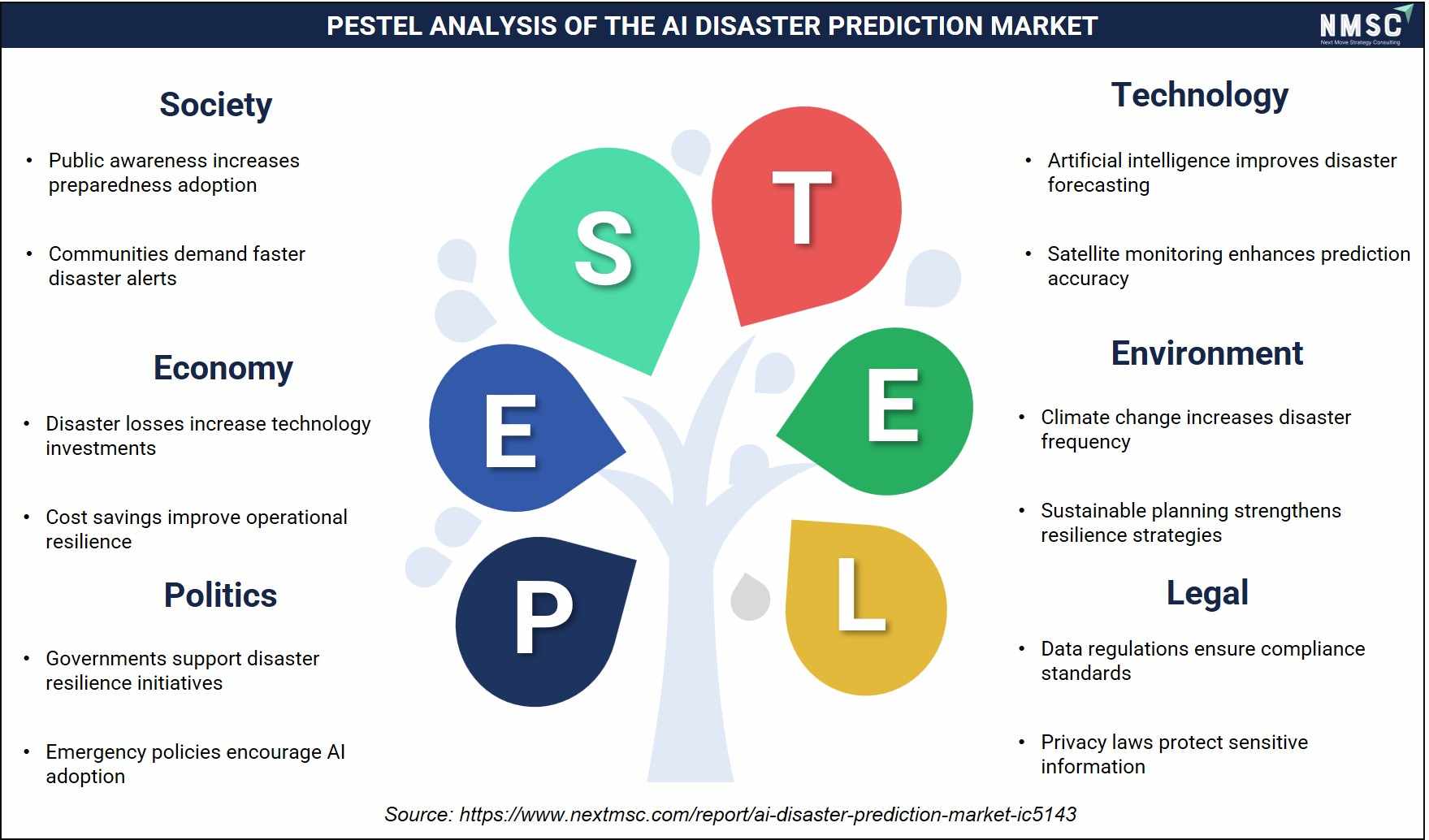
The PESTEL analysis of the AI Disaster Prediction industry highlights strong political and regulatory support for disaster preparedness, climate resilience, and public safety initiatives. Economic factors encourage investments in predictive technologies that reduce disaster-related losses, while social awareness strengthens demand for early warning systems. Technological advancements in AI, satellite imaging, IoT, and cloud computing improve forecasting capabilities. Environmental concerns increase the need for proactive disaster management, and legal frameworks governing data sharing, cybersecurity, and emergency response influence solution deployment worldwide.
Competitive Landscape
We observed that the AI Disaster Prediction Market remains moderately fragmented, with technology-heavy incumbents, specialized climate-risk analytics firms, and satellite data providers competing across overlapping but distinct value-chain positions.
|
Dimension |
Assessment |
|
Market Structure |
Moderately fragmented, with large technology platforms and specialized risk-analytics firms competing alongside satellite data providers |
|
Innovation Focus |
Digital twin simulation, ensemble forecasting accuracy, and explainable risk scoring for regulated insurance use |
|
M&A Activity |
Selective acquisitions of satellite and sensor data firms by larger analytics and technology platforms |
How do companies compete in the AI Disaster Prediction Market?
Companies compete primarily on forecast accuracy, data breadth, and integration depth with downstream insurance, government, and utility workflows. Next Move Strategy Consulting's analysis indicates that vendors differentiate through proprietary sensor networks, validated model performance, and long-term government contracting relationships rather than price alone, given the high accuracy stakes involved in disaster forecasting.
Which competitive archetypes dominate the market?
Three archetypes dominate: diversified technology platforms such as Alphabet, IBM, and NVIDIA supplying underlying AI infrastructure; specialized risk-analytics firms such as Verisk, Moody's, and Aon serving insurance underwriting directly; and satellite-data-native firms such as Planet Labs and Spire Global supplying the observational layer that both other archetypes depend on for model accuracy.
What innovation and differentiation strategies are companies pursuing?
Companies are pursuing differentiation through explainable AI layers that satisfy regulatory and insurance audit requirements, alongside proprietary sensor fusion pipelines. Our findings suggest that firms investing in digital twin capabilities, such as Hexagon and Esri, are positioning for premium government infrastructure contracts where simulation fidelity outweighs price sensitivity.
What M&A activity is shaping the competitive landscape?
M&A activity concentrates on larger analytics and technology firms acquiring smaller satellite and sensor data specialists to secure proprietary observational inputs. This consolidation trend reflects the strategic value of exclusive data access in a market where forecast accuracy directly determines client retention across insurance and government segments.
Key Market Players
Next Move Strategy Consulting's analysis indicates that the following companies represent the validated competitive set actively shaping the AI Disaster Prediction Market through platform, data, and modeling capabilities.
-
NVIDIA
-
Moody's
-
Verisk
-
Aon
-
Esri
-
Hexagon
-
Trimble
-
Planet Labs
-
Spire Global
-
DTN
-
AccuWeather
-
Weathernews
-
Tomorrow.io
-
Fathom
-
Floodbase
-
One Concern
-
Jupiter Intelligence
-
Climavision
Latest Developments
We found that recent developments across the competitive set reflect accelerating investment in satellite data partnerships and government-facing early-warning deployments.
|
Date |
Event |
|
January 2026 |
NVIDIA launched the Earth-2 family of open models, centered on the new Atlas architecture. Atlas outperforms previous-generation models like GenCast in medium-range forecasting (up to 15 days). The suite also introduces HealDA (Global Data Assimilation), which generates atmospheric initial conditions in seconds—a task that previously consumed nearly half of the supercomputing cycles in traditional meteorological systems. |
|
March 2026 |
Google Research announced a major update to FloodHub, now providing urban flash flood predictions with up to 24-hour advance notice. Leveraging a novel methodology based on global news data and satellite imagery, the system now covers over 2 billion people across 150+ countries. This milestone addresses the "warning gap" in the Global South, where rapid-onset flash floods—responsible for 85% of flood-related fatalities—were previously difficult to predict at scale. |
|
August 2025 |
Tomorrow.io Launches Gale Agentic AI: Tomorrow.io launched Gale, an agentic AI capability within its Resilience Platform that automates weather-driven operational decisions using real-time intelligence. The launch strengthens AI-powered disaster forecasting, preparedness, and response capabilities across the AI Disaster Prediction Market |
Expert Insights
 “AI is already helping to predict early weather warnings, such as floods and storms, with much greater accuracy, and if deployed at scale, it could protect hundreds of millions of people,”
— Martin Krause, Director, Climate Division, United Nations Environment Programme (UNEP)
Statement made during discussions following the AI Impact Summit in Delhi, highlighting the role of AI in climate and disaster risk management.
Market Interpretation
The statement underscores the transformative role of artificial intelligence in enhancing early warning systems and disaster prediction capabilities, particularly for extreme weather events such as floods and storms. The significant improvement in forecasting accuracy, combined with the scalability of AI solutions, is enabling governments and global organizations to strengthen disaster preparedness frameworks. As climate-related risks intensify globally, the adoption of AI-driven predictive analytics is accelerating, supporting timely interventions, minimizing potential damage, and improving resilience across vulnerable regions.
Investment Opportunities
Where Are Capital Inflows Concentrating?
Capital inflows are concentrating in geospatial AI and digital twin technology providers, reflecting investor confidence in infrastructure-grade simulation capabilities. Our assessment indicates that Series B and later-stage funding rounds increasingly target firms with proven government or insurance contract pipelines rather than early-stage research ventures.
What Infrastructure Investment Is Required for Scale?
Scaling requires sustained investment in satellite constellation capacity, ground sensor networks, and cloud compute for model training. We observed that vendors lacking proprietary data infrastructure face rising dependency costs on third-party satellite providers such as Planet Labs and Spire Global, affecting long-term margin structures.
What ESG Considerations Influence Investment Decisions?
ESG considerations favor AI disaster prediction as a climate-adaptation technology, supporting favorable capital access under sustainability-linked financing frameworks. Our analysis shows that investors increasingly evaluate model transparency and equitable data coverage across low-income regions as part of ESG due diligence for this category.
Key Benefits for Stakeholders
How Does This Report Benefit Government and Industry Leaders?
This report equips government and industry leaders with validated segmentation, regional demand data, and competitive benchmarking to guide procurement and infrastructure investment decisions. Next Move Strategy Consulting's analysis indicates that leaders can use the offering and technology breakdowns to align budget allocation with proven adoption patterns across comparable geographies.
How Does This Report Benefit Investors and Financial Analysts?
This report benefits investors and financial analysts through quantified market sizing, CAGR forecasts, and company-level competitive positioning that support capital allocation decisions. Our findings suggest that the regional and segment-level growth data enable more precise identification of high-growth investment opportunities within the AI Disaster Prediction Market.
How Does This Report Benefit Technology Vendors and Product Teams?
This report benefits technology vendors and product teams by clarifying which offering, technology, and deployment combinations are gaining share fastest, informing roadmap prioritization. Our assessment indicates that product teams can use the segmentation insights to align feature investment with the fastest-growing sub-segments identified across offering and technology axes.
Key Market Segments
By Offering
-
SaaS Platform
-
Forecast Dashboard
-
Risk Score Platform
-
Early Warning Platform
-
Digital Twin Platform
-
-
Data Subscription
-
Forecast Feed
-
Hazard Layer
-
Exposure Dataset
-
Observation Dataset
-
-
API Access
-
Forecast API
-
Alert API
-
Risk Score API
-
-
Managed Service
-
Managed Monitoring
-
Managed Forecasting
-
Managed Alerts
-
-
Professional Service
-
Implementation
-
Integration
-
Custom Model Build
-
Advisory
-
By Technology
-
Machine Learning Models
-
Ensemble Models
-
Digital Twin
-
Geospatial AI
-
Computer Vision
-
Sensor Fusion
-
Other Technologies
By Deployment Mode
-
Cloud
-
Private Cloud
-
On-Premises
-
Hybrid
By Sales Channel
-
Direct
-
Partner
-
Marketplace
-
OEM
By End Use Industry
-
Government
-
Insurance
-
Energy and Utilities
-
Transport and Logistics
-
Agriculture
-
Built Environment
-
Telecom
-
Retail
-
Other End Use Industries
By Region
-
North America: U.S., Canada, Mexico
-
Europe: UK, Germany, France, Italy, Spain, Sweden, Denmark, Finland, Netherlands, Rest of Europe
-
Asia-Pacific: China, India, Japan, South Korea, Taiwan, Indonesia, Vietnam, Australia, Philippines, Malaysia, Rest of APAC
-
Middle East & Africa: Saudi Arabia, UAE, Egypt, Israel, Turkey, Nigeria, South Africa, Rest of MEA
-
Latin America: Brazil, Argentina, Chile, Colombia, Rest of LATAM
Conclusion & Recommendations
What Is the Long-Term Outlook?
The long-term outlook remains strongly positive, with the AI Disaster Prediction Market projected to grow from USD 3.40 Billion in 2026 to USD 22.60 Billion by 2035 at a 23.4% CAGR. Sustained climate volatility and government early-warning mandates underpin durable demand. Next Move Strategy Consulting's analysis indicates that this growth trajectory remains resilient even under conservative sensor-data-availability assumptions across emerging regions.
What Are the Strategic Positioning Recommendations?
Vendors should prioritize explainable, insurance-grade model validation alongside government contracting relationships to capture the dominant Government and Insurance end-use segments. Our assessment indicates that firms combining proprietary data infrastructure with API-first distribution are best positioned to capture share across both mature and emerging regional markets.
How Attractive Is This Market for Investment?
Investment attractiveness remains high, supported by a 23.4% forecast CAGR and an absolute dollar opportunity of USD 19.20 Billion between 2026 and 2035. Our findings suggest that digital twin and geospatial AI technology providers offer the strongest risk-adjusted growth profile given accelerating government infrastructure investment.
What Market Shifts and Key Risks Should Stakeholders Monitor?
Stakeholders should monitor data quality gaps across the Middle East, Africa, and Latin America, which restrain accuracy and adoption pace in those regions. We observed that regulatory fragmentation across jurisdictions also poses execution risk for vendors scaling multi-country deployments without localized compliance strategies.
What Are the Key Growth Pathways?
Key growth pathways include parametric insurance API integration, municipal-level digital twin expansion, and sensor data marketplace development. Next Move Strategy Consulting's analysis indicates that vendors pursuing these three pathways simultaneously are best positioned to capture disproportionate share of the projected 2026–2035 opportunity.
About the Author
 Saista Faiyaz
— Saista Faiyaz is Research Associate at Next Move Strategy Consulting, where she has covered consumer markets and healthcare technologies for 3 years. Her work includes primary interview review, secondary-source validation, market sizing, and structured analysis of company and industry data. She supports research by comparing evidence across sources, organizing findings into market narratives, and documenting assumptions used in analysis. Her scope includes cross-market benchmarking, and reports.
Saista Faiyaz
— Saista Faiyaz is Research Associate at Next Move Strategy Consulting, where she has covered consumer markets and healthcare technologies for 3 years. Her work includes primary interview review, secondary-source validation, market sizing, and structured analysis of company and industry data. She supports research by comparing evidence across sources, organizing findings into market narratives, and documenting assumptions used in analysis. Her scope includes cross-market benchmarking, and reports.
About the Reviewer
 Supradip Baul
— Supradip Baul is an accomplished business consultant and strategist with over a decade of rich experience in market intelligence, strategy, technology, and business transformation. His work has included rigorous qualitative and quantitative analysis across multiple industries, helping clients shape investment decisions and long-term roadmaps. Earlier in his career, he was associated with Gartner, where he contributed to industry-leading reports and market share analyses. He has worked with leading global companies and holds an MBA with a dual specialization in Marketing and Finance.
Supradip Baul
— Supradip Baul is an accomplished business consultant and strategist with over a decade of rich experience in market intelligence, strategy, technology, and business transformation. His work has included rigorous qualitative and quantitative analysis across multiple industries, helping clients shape investment decisions and long-term roadmaps. Earlier in his career, he was associated with Gartner, where he contributed to industry-leading reports and market share analyses. He has worked with leading global companies and holds an MBA with a dual specialization in Marketing and Finance.
At Next Move Strategy Consulting, we understand that insightful market research is the cornerstone of successful business decisions. That's why we employ a robust and multifaceted approach, combining various methodologies to deliver the most accurate and actionable data for our clients.

Research Landscape
We navigate the world of research with two primary approaches:
Qualitative Approach
Our qualitative research methodologies involve immersive techniques such as in-depth interviews, focus groups, and observational studies. By engaging directly with individuals and stakeholders, we uncover valuable insights that quantitative data alone may overlook.

Quantitative Research
In tandem with qualitative methodologies, NMSC leverages the power of Quantitative Research to provide a robust foundation of numerical insights. Through systematic data collection and analysis, we quantify patterns, preferences, and market trends, offering a comprehensive view of the business landscape.
Our quantitative research approach employs diverse tools, including surveys, experiments, and statistical modelling. These methodologies enable us to gather data from a large and representative sample, ensuring the statistical significance of our findings. By employing structured questionnaires and standardized data collection methods, we guarantee the reliability and validity of the information we present to our clients.
Quantitative research is particularly effective in measuring the prevalence of trends, assessing market size, and gauging the impact of various factors on consumer behavior. The numerical precision attained through this approach equips our clients with actionable insights, facilitating data-driven decision-making and strategy formulation.


Our Specialized Toolbox for Industry-Specific Market Research
We deploy a specialized arsenal of techniques tailored to meet your unique requirements. Here's a glimpse into our comprehensive toolbox:

Information Procurement
The stage entails acquiring market data or relevant information through various sources and methodologies.


Market Research Approach
We utilize both top-down and bottom-up approaches in market research analysis to achieve a comprehensive understanding of the market dynamics, leveraging the broad perspective of industry trends and macroeconomic factors alongside detailed insights from specific segments and individual companies.

Porters Five Forces Analysis
We conduct Porter's Five Forces analysis to evaluate the competitive landscape of an industry, providing us with insights into factors that affect profitability and strategic positioning.

SWOT Analysis

Forecasting
We utilize a forecasting model to predict future consumption by considering parameters like population, economics, regulations, market competition, drivers, constraints, technology, and pricing. We also employ statistical techniques such as multilinear regression, exponential smoothing, moving average, ARIMA, and Monte Carlo simulations for accurate predictions. In econometric forecasting, we analyzed short-term and long-term event impacts, attributing values based on regulatory frameworks, economic factors, and market events.





 Speak to Our Analyst