Blind Assistive Technology Market By Product (Devices, Software, Services, and Accessories & Consumables), By Buyer (Individual Consumers, Educational Institutions, Healthcare Providers, Government Agencies, Corporations & Enterprises, and Non-Profit Organizations), and By Distribution Channel (Retail Sales, Institutional & Government Tenders, and Resellers & Integrators) – Global Opportunity Analysis and Industry Forecast, 2025–2030
Industry: Healthcare | Publishing Date: June 9, 2026 | Last Updated: October 16, 2026 | No of Pages: N/A | No. of Tables: N/A | No. of Figures: N/A | Format: PDF | Report Code: HC3858
Industry Outlook
The global Blind Assistive Technology Market size was valued at USD 6.33 billion in 2024, and is expected to be valued at USD 7.13 billion by the end of 2025. The industry is projected to grow, hitting USD 12.95 billion by 2030, with a CAGR of 12.67% between 2025 and 2030.
The market is witnessing significant transformation, driven by increasing health awareness, changing dietary preferences, and growing demand for nutrient-rich and plant-based food ingredients. Rising urbanization, disposable incomes, and consumer inclination toward natural and functional foods are fueling global market growth. Blind Assistive Technologies are gaining traction as a versatile ingredient across bakery, confectionery, snacks, and dairy alternatives due to their gluten-free, low-fat, and high-fiber properties. Expansion of modern retail networks, online grocery platforms, and sustainable sourcing practices further enhance market penetration. Additionally, advancements in processing technologies, packaging innovations, and value-added assistive tech for the blind products, such as flours, purees, and ready-to-eat snacks, are reshaping consumer choices, improving product shelf life, and strengthening brand positioning globally.
What Are the Key Trends in Market?
What are the Major Technological Trends Shaping the Market?
Technological innovation is playing a transformative role in the blind assistive technology market expansion. Advancements in AI, machine learning, and computer vision are driving the development of smart navigation systems, wearable assistive devices, and sensor-based mobility tools that improve user independence and safety. Integration of IoT and cloud-based platforms enables real-time data sharing and personalized assistance, while voice recognition and haptic feedback technologies are enhancing user-device interaction. Furthermore, the introduction of lightweight materials, compact batteries, and ergonomic designs is improving device comfort and usability. Continuous R&D in smart glasses, ultrasonic sensors, and smartphone-based assistance apps is redefining accessibility and expanding adoption among visually impaired users globally.
How is Demographic Change Influencing the Market?
Demographic shifts and societal trends are significantly impacting the Market. The aging population in developed regions such as Japan, Europe, and North America is driving demand for vision-assistive devices due to increased cases of age-related visual impairments like macular degeneration and glaucoma. Simultaneously, growing awareness of disability inclusion and accessibility rights is influencing public and private investments in assistive technologies. In emerging economies, rising disposable incomes and healthcare accessibility are expanding market potential. Moreover, younger generations of visually impaired individuals are showing strong adoption of digitally enabled, AI-driven, and wearable assistive solutions, creating opportunities for innovation and personalization.
What Role does Government Support Play in Driving Industry Growth?
Government initiatives are instrumental in promoting growth in the Market. Many countries are implementing disability inclusion policies, providing financial assistance, subsidies, and tax incentives for assistive device manufacturers and users. Programs by organizations such as the World Health Organization (WHO) and national agencies focus on inclusive education, rehabilitation, and digital accessibility. In addition, public procurement of assistive devices for schools, hospitals, and community centers enhances adoption. Governments in regions like Europe, North America, and Asia-Pacific are also funding R&D for AI-enabled mobility aids and smart wearables, fostering innovation and accessibility on a global scale.
How is Consumer Preference Changing in the Market?
Consumer preferences in the Market are evolving toward smart, connected, and user-friendly devices that offer greater autonomy and integration into daily life. Users are increasingly seeking multifunctional devices that combine navigation, obstacle detection, and communication features. There is growing demand for aesthetic, lightweight, and discreet designs that blend seamlessly with personal lifestyles. Moreover, consumers are prioritizing voice-enabled interfaces, mobile app compatibility, and cloud connectivity for real-time updates and customization. The shift toward affordable, portable, and rechargeable assistive devices is also expanding market accessibility, driving both innovation and mass-market adoption.
What Are the Key Market Drivers, Breakthroughs, And Investment Opportunities That Will Shape the Blind Assistive Technology Industry in Next Decade?
The market is experiencing robust growth driven by rising disposable incomes, increasing healthcare expenditure, and rapid advancements in AI and sensor-based devices. Higher income levels and government-supported healthcare investments are enhancing accessibility to advanced assistive tools such as smart canes, AI-powered navigation aids, and wearable vision devices. Technological innovations integrating AI, IoT, and computer vision are improving user independence, safety, and personalized assistance. However, high device costs and limited affordability in low-income regions remain key restraints. Despite these challenges, growing emphasis on digital accessibility, smart healthcare infrastructure, and inclusive mobility solutions is creating strong opportunities for innovation and global market expansion.
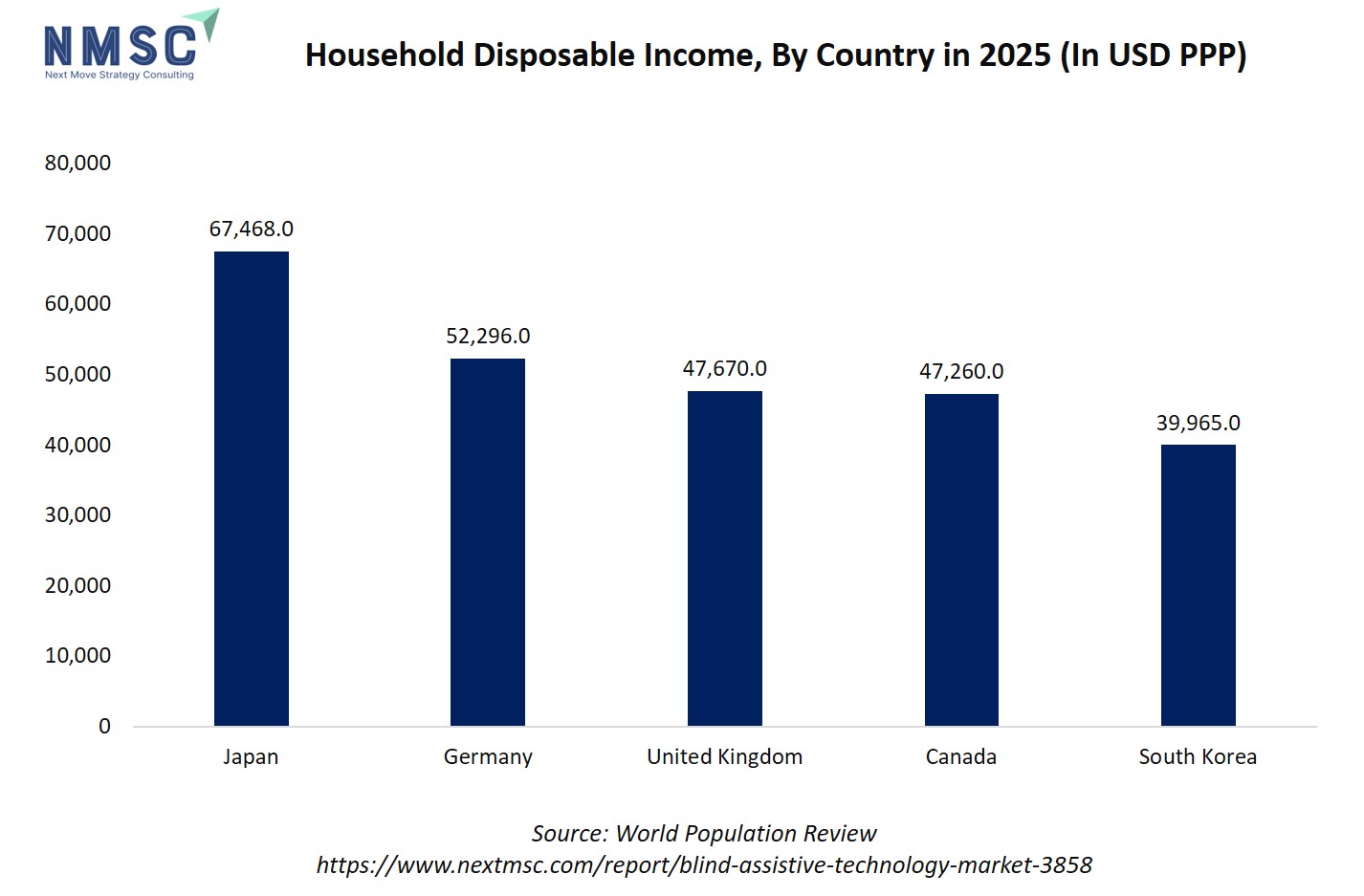
Rising household disposable incomes, measured in USD PPP, are a key driver for the blind assistive technology market revenue, as higher purchasing power enables consumers and healthcare systems to invest in advanced assistive solutions. In high-income countries such as Japan (USD 67,468 PPP), Germany (USD 52,296 PPP), the UK (USD 47,670 PPP), Canada (USD 47,260 PPP), and South Korea (USD 39,965 PPP), individuals afford premium, AI-powered, and sensor-based assistive devices that enhance mobility, communication, and independence for the visually impaired. Additionally, greater disposable income allows for increased healthcare spending and adoption of innovative technologies within rehabilitation and assistive care centers. Manufacturers are responding to this trend by developing smart, user-friendly, and ergonomically designed assistive tools, targeting both personal and institutional buyers. Thus, rising income levels globally are not only improving accessibility but also driving demand for technologically advanced and high-performance vision impairment assistive devices products.
Growth Drivers:
How is Rising Disposable Income and Healthcare Expenditure Driving the Market Demand?
Rising disposable income and healthcare expenditure are key drivers of the Market. As income levels increase globally, particularly in emerging economies, individuals and families are more capable of investing in advanced healthcare and assistive solutions. This financial empowerment allows visually impaired individuals to access high-quality assistive devices such as smart canes, wearable navigation aids, and AI-powered reading tools that were previously unaffordable.
Additionally, growing healthcare expenditure by both governments and private sectors is improving the availability and affordability of assistive technologies. Many countries are expanding reimbursement policies, healthcare coverage, and disability support programs, making these products more accessible to the visually impaired population. Together, these factors are fostering greater adoption of blind assistive technologies, driving innovation, and supporting market expansion across both developed and developing regions.
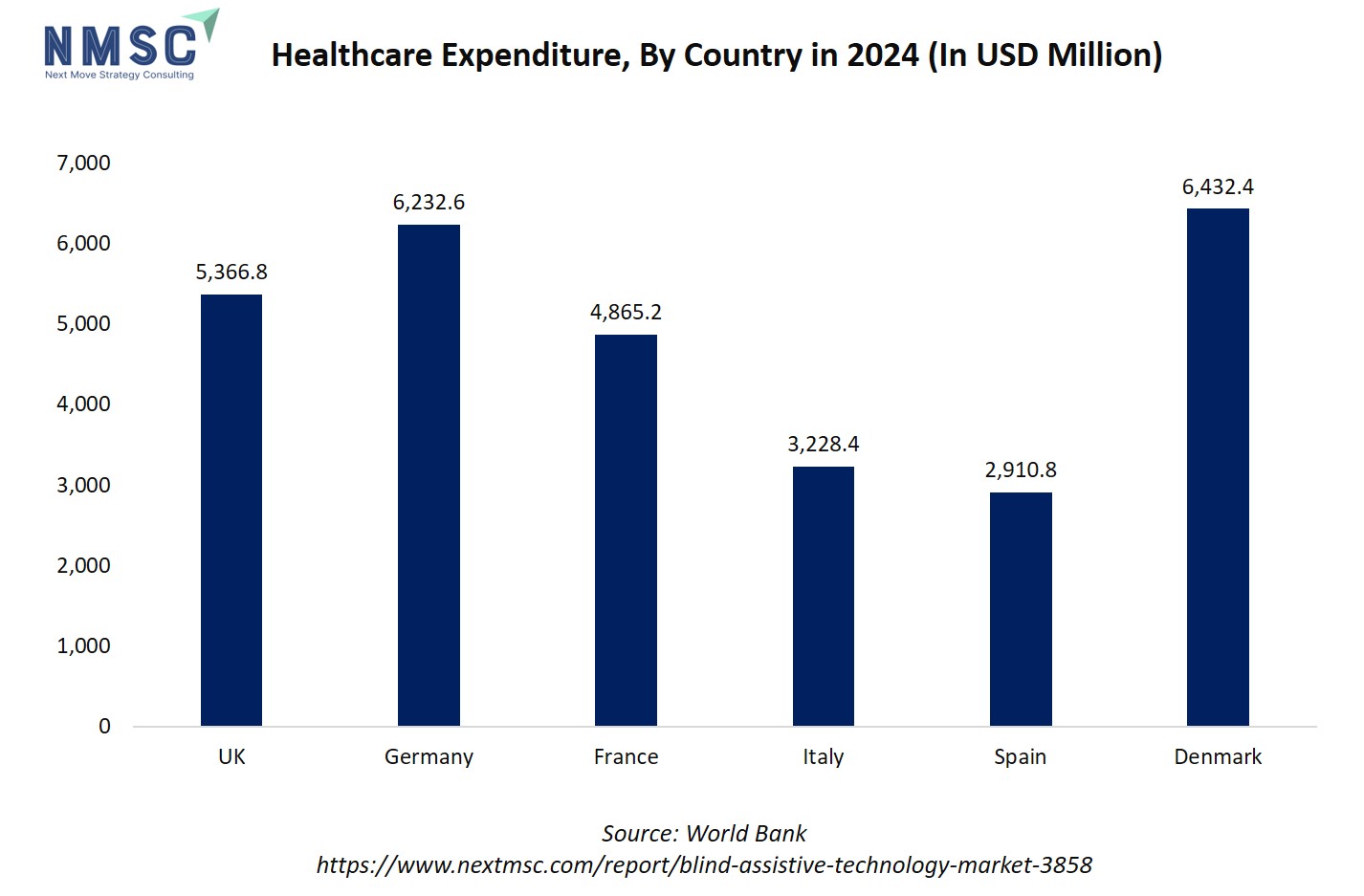
The bar chart titled Healthcare Expenditure, By Country in 2024 (In USD Million) illustrates healthcare spending across six European countries, the UK, Germany, France, Italy, Spain, and Denmark. According to the data, Denmark (USD 6,432.4 million) and Germany (USD 6,232.6 million) report the highest healthcare expenditures, followed by the UK (USD 5,366.8 million) and France (USD 4,865.2 million). Meanwhile, Italy (USD 3,228.4 million) and Spain (USD 2,910.8 million) record comparatively lower spending levels.
In relation to the blind assistive technology market, higher healthcare expenditure in countries like Denmark, Germany, and the UK indicates stronger institutional support for assistive technologies, better accessibility programs, and higher adoption of advanced solutions such as AI-powered mobility aids and smart reading devices. These nations are more likely to invest in inclusive healthcare infrastructure and government-funded initiatives supporting visually impaired individuals. Conversely, lower expenditure in Southern European countries suggests slower adoption due to budget constraints, though growing awareness and government programs are expected to drive future market growth in these regions.
Is Technological Advancements in AI and Sensor-Based Devices Accelerating the Market Growth?
Technological advancements in AI and sensor-based devices are a major driver of the Market. The integration of artificial intelligence (AI), computer vision, and advanced sensors has revolutionized how visually impaired individuals interact with their surroundings. Smart assistive devices equipped with LiDAR, ultrasonic sensors, and image recognition technologies enable users to detect obstacles, identify objects, and navigate complex environments with greater safety and independence.
AI-powered applications, such as real-time voice guidance, text-to-speech conversion, and facial recognition, further enhance user experience and accessibility. Continuous improvements in miniaturization, battery efficiency, and wireless connectivity are making these devices more compact, reliable, and user-friendly. As innovation accelerates, the convergence of AI, IoT, and wearable technologies is expected to expand the range and capabilities of blind assistive products, driving demand and shaping the future of inclusive mobility and digital accessibility.
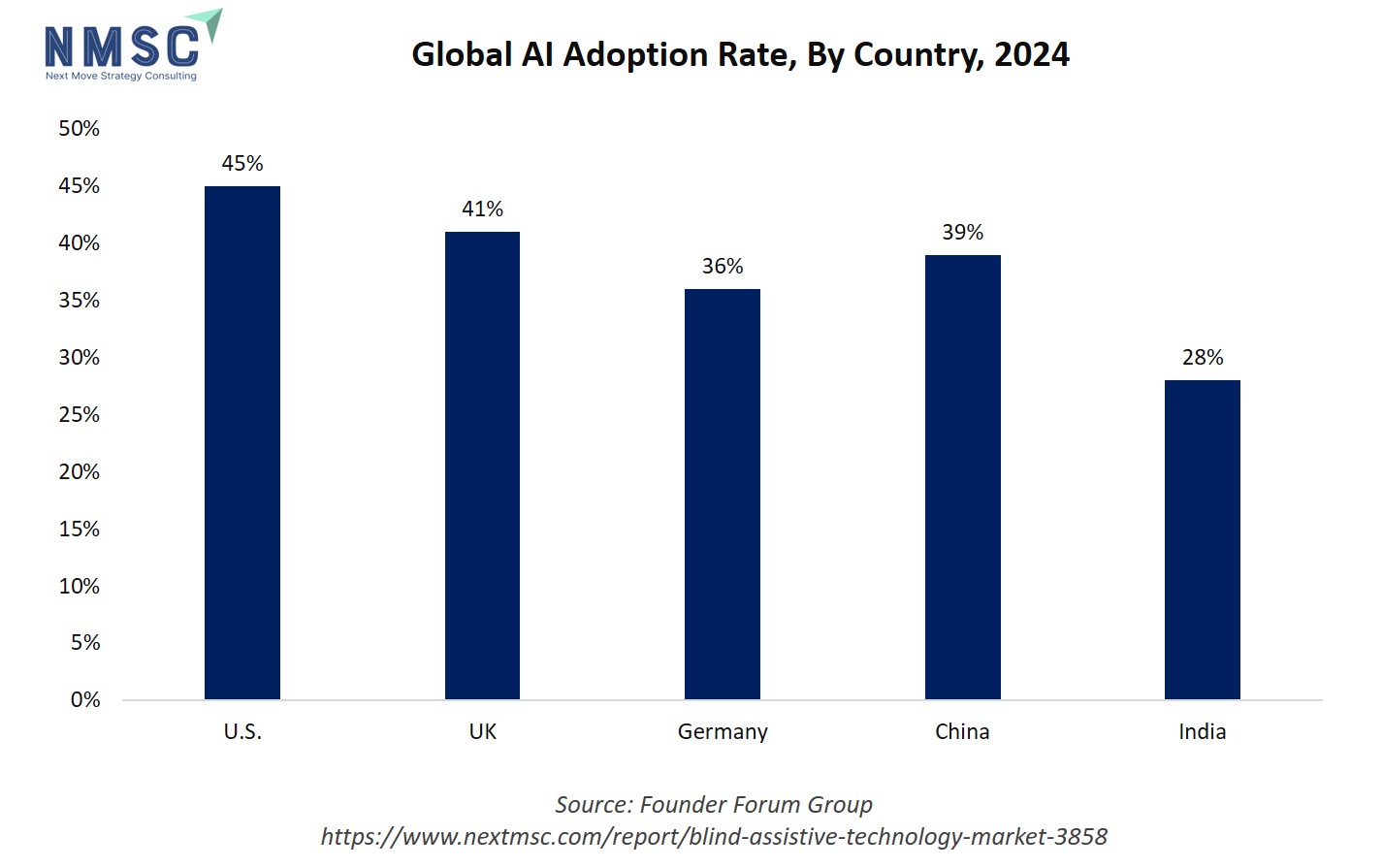
The chart titled “Global AI Adoption Rate, By Country, 2024” shows that the U.S. (45%) leads in AI adoption, followed by the UK (41%), China (39%), Germany (36%), and India (28%). This high level of AI integration in developed economies is a major enabler for the blind assistive technology market, as it accelerates the creation of intelligent assistive solutions such as AI-driven reading aids, navigation devices, and voice-guided systems. In countries like the U.S. and the UK, where AI infrastructure and innovation ecosystems are strong, companies are able to develop advanced products that enhance autonomy, accessibility, and quality of life for visually impaired users.
Meanwhile, nations such as China and India, with rising AI capabilities, are increasingly leveraging the technology to produce cost-effective and scalable assistive devices suited for large populations. These developments are helping bridge accessibility gaps in emerging markets. Overall, AI adoption serves as a critical growth driver for the blind assistive technology market demand by enabling smarter, more personalized, and efficient devices that support education, mobility, and independent living for visually impaired individuals.
Growth Inhibitors:
How does High Cost and Limited Accessibility Restraints the Growth of the Market?
One of the major restraints in the blind assistive technology market is the high cost of advanced assistive devices, which limits accessibility for many users, particularly in low- and middle-income regions. Technologies incorporating AI, LiDAR, or smart sensors come with substantial development and production costs, making the final products expensive for end users. Additionally, limited insurance coverage and lack of government subsidies in some countries further restrict affordability. This cost barrier hinders widespread adoption, especially among elderly or economically disadvantaged visually impaired individuals, slowing market growth.
How Is Integration of AI And IoT for Personalized Assistance Creating Opportunity for the Market?
A key opportunity lies in the integration of Artificial Intelligence (AI) and Internet of Things (IoT) to develop smart, connected assistive solutions. These technologies enable real-time navigation assistance, health monitoring, and personalized feedback, improving user independence and safety. The growing use of cloud-based platforms and mobile connectivity allows devices to learn user preferences and adapt to specific environments. Moreover, collaborations between tech companies, healthcare providers, and research institutions are driving innovation in affordable, multifunctional assistive tools. This trend opens new avenues for product differentiation, mass adoption, and expansion into emerging markets.
How Blind Assistive Technology Market Is Segmented in This Report, And What Are the Key Insights from the Segmentation Analysis?
By Product Category Insights
Which Product Category is Expected to Drive the Blind Assistive Technology Market in 2025?
On the basis of product category, the market is segmented into Reading & Information Access, Mobility & Orientation, Low Vision Aids, and Others. The Reading & Information Access segment is expected to drive the blind assistive technology market growth in 2025, owing to the growing adoption of AI-powered reading devices, Braille displays, and screen readers that enable visually impaired individuals to access digital and printed content independently. Rising digital literacy, expansion of e-learning platforms, and government initiatives supporting inclusive education are further accelerating the demand for such technologies.
Meanwhile, the Mobility & Orientation segment, comprising smart canes, wearable navigation aids, and GPS-integrated tools, is also witnessing significant growth, driven by advancements in sensor-based and IoT-enabled solutions that enhance user safety and autonomy. The Low Vision Aids segment, including magnifiers and electronic vision enhancement systems, is expanding steadily among elderly users with partial vision loss. The Others category, which includes communication and daily living assistance tools, is gaining traction with increasing innovation in personalized, connected, and multifunctional assistive devices.
By User Vision Status Insights
Which User Vision Status Is Expected to Drive the Blind Assistive Technology Market in 2025?
On the basis of user vision status, the market is segmented into Totally Blind Users and Low Vision Users. The Totally Blind Users segment is expected to dominate the blind assistive technology market share in 2025, driven by increasing demand for AI-powered navigation systems, voice-controlled devices, and Braille-based reading tools. The growing availability of smart canes, obstacle detection wearables, and real-time voice guidance applications is enhancing independence and mobility for users with total vision loss. Supportive government programs, accessibility initiatives, and advancements in AI and IoT integration are further expanding adoption in this segment.
By Distribution Channel Insights
How is the Online Retail Segment Driving the Blind Assistive Technology Market in 2025?
On the basis of distribution channel, the market is segmented into Online Retail, Offline Retail, Direct Sales / Institutional Procurement, and Government Programmes / Subsidised Supply. The Online Retail segment is expected to experience strong growth in 2025 due to the rising adoption of e-commerce platforms, brand-owned websites, and digital marketplaces offering assistive technologies. Online channels provide convenient access, wider product variety, and competitive pricing, making them highly preferred among consumers. Enhanced accessibility tools, virtual product demonstrations, and AI-based recommendation systems are further supporting online sales, particularly in developed markets where digital adoption is high.
By End Use Industry Insights
How are Educational Institutions Driving the Blind Assistive Technology Market in 2025?
On the basis of end use industry, the market is segmented into Educational Institutions, Enterprises & Social Organisations, Healthcare & Hospitals, and Others. The Educational Institutions segment is expected to hold a significant share in 2025, driven by the rising integration of assistive learning tools and inclusive education programs for visually impaired students. Schools and universities are increasingly adopting Braille readers, screen magnifiers, audio learning systems, and AI-based reading devices to support accessibility in classrooms. Government mandates promoting inclusive education and collaborations with assistive tech providers are further strengthening adoption across academic environments globally.
Regional Outlook
The market is geographically studied across North America, Europe, Asia Pacific, and the Middle East & Africa, and each region is further studied across countries.
Blind Assistive Technology Market in North America
The North American market is driven by rising healthcare awareness, technological innovation, and growing adoption of smart assistive solutions for the visually impaired. Increasing disposable incomes and favourable government policies supporting disability inclusion are further accelerating market growth. Expanding distribution through medical equipment suppliers, online platforms, and healthcare institutions is enhancing accessibility. The rising demand for AI-based navigation aids, smart glasses, and wearable assistive devices reflects consumers’ growing preference for technologically advanced, reliable, and user-friendly solutions.
Blind Assistive Technology Market in the United States
In the U.S., the market is primarily driven by high investment in healthcare technology, growing awareness of assistive solutions, and strong government initiatives promoting accessibility. Consumers and institutions are increasingly adopting AI-powered devices, smart canes, and vision-assist wearables to enhance mobility and independence for visually impaired individuals. The presence of leading manufacturers and expanding reimbursement coverage are further supporting product innovation and market penetration.
Blind Assistive Technology Market in Canada
In Canada, market growth is supported by rising healthcare expenditure, improved accessibility initiatives, and advancements in AI and IoT-based assistive technologies. Consumers are increasingly adopting connected assistive devices for daily navigation, education, and workplace applications. The country’s focus on inclusive healthcare systems and government-backed support programs for visually impaired individuals continue to strengthen market expansion.
Blind Assistive Technology Market in Europe
The European market is witnessing strong growth due to rising awareness of digital accessibility, an aging population, and supportive regulatory frameworks for assistive technologies. Consumers and healthcare providers are adopting AI and sensor-based assistive devices designed for enhanced independence and mobility. Expansion of telehealth services, smart healthcare infrastructure, and funding for innovation are contributing to sustained market growth across the region.
Blind Assistive Technology Market in the United Kingdom
In the U.K., the market is driven by high adoption of AI-integrated assistive devices, government-led accessibility programs, and increasing healthcare investments. Urban populations are embracing wearable navigation aids, smart canes, and vision-assist devices that improve mobility and quality of life. Growing collaborations between tech developers, healthcare providers, and advocacy organizations are fostering innovation and awareness.
Blind Assistive Technology Market in Germany
Germany’s market growth is fueled by technological advancements, strong healthcare infrastructure, and emphasis on accessibility and inclusion. Consumers are increasingly adopting sensor-based assistive technologies and AI-powered mobility solutions. The country’s focus on innovation, government support for digital healthcare, and collaborations with research institutions are strengthening its position as a key market in Europe.
Blind Assistive Technology Market in France
In France, rising healthcare expenditure and awareness of visual impairment challenges are driving demand for advanced assistive solutions. The adoption of smart wearables, AI-enabled mobility aids, and connected devices is growing rapidly. Public initiatives supporting inclusive design and enhanced accessibility standards further promote innovation and consumer trust in the market.
Blind Assistive Technology Market in Spain
Spain’s market is expanding due to increasing healthcare modernization, higher disposable incomes, and growing adoption of smart assistive tools. Urban populations are embracing innovative AI-based devices and mobile applications that support navigation, reading, and communication. Government-backed disability inclusion programs and advancements in connected healthcare are supporting continued growth.
Blind Assistive Technology Market in Italy
Italy’s market is driven by increasing awareness of assistive technologies, aging demographics, and healthcare digitization. Consumers are adopting user-friendly, AI-powered, and IoT-connected assistive devices designed to improve independence and quality of life. Expansion of healthcare funding and partnerships with global assistive technology developers are fostering innovation and market expansion.
Blind Assistive Technology Market in the Nordics
The Nordic market is characterized by strong healthcare systems, high digital literacy, and a strong focus on inclusivity. Consumers and institutions are early adopters of AI- and sensor-based assistive technologies. Government initiatives supporting universal design, accessibility standards, and sustainable innovation continue to make the region a hub for advanced blind assistive technology solutions.
Blind Assistive Technology Market in Asia Pacific
The Asia Pacific market is experiencing strong growth driven by rapid urbanization, increasing healthcare awareness, and rising disposable incomes. Countries such as India, China, Japan, South Korea, and Australia are witnessing heightened demand for technologically advanced, AI-enabled, and multifunctional assistive devices for the visually impaired. Expansion of healthcare infrastructure, government support programs, and accessibility initiatives are accelerating adoption. Furthermore, growing availability through e-commerce platforms and medical distribution networks, along with a focus on affordability and innovation, is fostering widespread market development across the region.
Blind Assistive Technology Market in China
China’s market is expanding rapidly due to increased government investment in assistive technology and growing healthcare modernization. Rising disposable incomes and awareness of accessibility needs are fueling adoption of smart canes, wearable devices, and AI-driven vision aids. The presence of domestic tech innovators and e-commerce platforms such as Alibaba and JD.com enhances accessibility and affordability. Additionally, China’s push toward digital health transformation and smart city initiatives is boosting opportunities for localized and connected assistive solutions.
Blind Assistive Technology Market in Japan
Japan’s market is driven by its aging population, advanced technology ecosystem, and strong emphasis on inclusive healthcare. Consumers and institutions are adopting AI-powered wearable navigation aids, smart glasses, and voice-guided assistance systems. The country’s focus on robotics and IoT integration supports continuous innovation in user-friendly and compact devices. Accessibility through established retail, healthcare institutions, and online platforms further enhances adoption, positioning Japan as a leader in next-generation assistive solutions.
Blind Assistive Technology Market in India
India’s market is growing rapidly due to rising healthcare awareness, urbanization, and government-led disability inclusion programs. With a large visually impaired population and expanding access to affordable technology, demand for smart canes, reading aids, and wearable navigation systems is increasing. Growth in domestic startups, healthcare digitization, and e-commerce accessibility further supports innovation. Collaborations between NGOs, healthcare institutions, and global technology providers are helping bridge affordability gaps and accelerate market expansion.
Blind Assistive Technology Market in South Korea
South Korea’s market is driven by rapid adoption of AI, IoT, and robotics technologies in healthcare. Rising disposable incomes and tech-savvy consumers are fueling demand for intelligent assistive solutions such as smart eyewear, real-time navigation aids, and connected mobility systems. Government initiatives promoting digital accessibility and assistive technology innovation are further stimulating market growth. Enhanced retail and e-commerce distribution networks are improving access to both premium and affordable assistive products.
Blind Assistive Technology Market in Taiwan
Taiwan’s market growth is supported by strong healthcare infrastructure, high digital literacy, and a proactive approach to accessibility innovation. Consumers increasingly favor smart assistive devices that combine portability, AI-driven features, and multifunctional usability. Startups and research institutions are driving innovation in IoT-connected devices and wearable assistive technologies. Supportive policies, along with the availability of products through online and healthcare retail channels, continue to strengthen Taiwan’s market position.
Blind Assistive Technology Market in Indonesia
Indonesia’s market is expanding due to rapid urbanization, a growing middle class, and increasing awareness of assistive technologies. Demand for affordable, portable, and easy-to-use devices such as smart canes, mobile-based vision aids, and navigation applications is rising. Government initiatives promoting inclusivity and accessibility, along with digital transformation in healthcare, are accelerating adoption. E-commerce and telehealth platforms are key enablers of market reach in both urban and semi-urban regions.
Blind Assistive Technology Market in Australia
Australia’s market is characterized by strong healthcare support systems and a focus on accessibility and inclusivity. Rising disposable incomes and awareness of assistive technology are driving demand for AI-integrated navigation devices, wearable mobility aids, and smart home solutions for the visually impaired. Expansion of online retail channels, medical device distribution, and assistive technology funding programs are improving accessibility. Sustainability and ethical innovation also influence product design and development, reinforcing steady market growth.
Blind Assistive Technology Market in Latin America
The Latin American market is growing due to rising healthcare investment, urbanization, and government initiatives supporting accessibility. Countries such as Brazil, Mexico, and Argentina are witnessing increasing demand for affordable, locally adapted assistive technologies. Expanding e-commerce platforms and healthcare infrastructure are improving product reach. Collaborative programs between public institutions, NGOs, and tech startups are helping enhance awareness, affordability, and innovation in assistive solutions across the region.
Blind Assistive Technology Market in the Middle East & Africa
In the Middle East and Africa, market growth is supported by improving healthcare access, rising urbanization, and government efforts to promote inclusion. Increasing adoption of smart mobility aids, AI-based reading tools, and digital accessibility platforms is driving demand. Expanding healthcare infrastructure and education initiatives are improving awareness and product adoption. Regional collaborations and international partnerships are also encouraging innovation, localization, and affordability of blind assistive technologies across both developed and emerging markets.
Competitive Landscape
Which Companies Dominate the Market and How do they Compete?
The global blind assistive technology industry is dominated by established manufacturers and regional specialists such as Cambium Learning Group, American Thermoform Corporation, LVI Low Vision International AB, Access Ingenuity, HumanWare Group, VFO, Freedom Scientific, HIMS Inc., OrCam Technologies, and KGS Corporation. These companies compete by offering a comprehensive range of assistive technologies, including Braille embossers, screen readers, portable magnifiers, smart canes, wearable AI devices, and electronic Braille displays, catering to both educational and independent living applications.
Market leaders differentiate themselves through continuous technological innovation, particularly in AI integration, IoT connectivity, and sensor-based navigation systems. Companies like OrCam Technologies and HumanWare focus on advanced wearable solutions and AI-driven devices, while Freedom Scientific and VFO lead in digital accessibility software such as screen readers and magnification tools. Regional specialists such as American Thermoform and LVI Low Vision International emphasize customized and affordable assistive solutions. Competitive strategies include product diversification, partnerships with educational and healthcare institutions, and expansion of digital and distribution networks. Companies that combine innovation, accessibility, affordability, and user-centric design are strengthening their market position and driving growth in the global blind assistive technology market.
Market Dominated by Blind Assistive Technology Market Giants and Specialists
The blind assistive technology industry is characterized by the presence of both global technology leaders and specialized regional innovators. Major multinational companies dominate through strong R&D capabilities, global distribution networks, and diversified portfolios that include smart canes, wearable navigation aids, and AI-powered visual assistance systems. These established players focus on scale, reliability, and integration with healthcare ecosystems. Meanwhile, smaller or niche firms are driving innovation through personalized, cost-effective, and user-specific assistive solutions tailored to local accessibility needs. This dual structure offers users the flexibility to choose between globally trusted brands and specialized technologies designed for unique functional or affordability requirements.
Innovation and Adaptability Drive Market Success
Technological innovation and adaptability remain the cornerstone of success in the blind assistive technology industry. Leading companies are investing heavily in AI, IoT, and sensor-based solutions to enhance device accuracy, user comfort, and connectivity. Innovations such as smart glasses with real-time object detection, wearable haptic devices, and voice-guided navigation tools are redefining user independence and accessibility. Additionally, manufacturers are emphasizing ergonomic design, affordability, and data integration for seamless user experiences. Companies that rapidly adapt to evolving user preferences and accessibility standards are strengthening their market position and fostering long-term brand loyalty.
Market Players to Opt for Merger & Acquisition Strategies to Expand their Presence
Mergers and acquisitions are becoming a strategic priority for leading electronic braille systems companies seeking to broaden their technological capabilities and global footprint. Key players are acquiring startups specializing in AI vision systems, smart wearables, and accessibility software to diversify their portfolios and accelerate innovation. These collaborations also enable the integration of advanced features like machine learning and real-time cloud connectivity. Through M&A activity, companies are enhancing scalability, entering emerging markets, and offering more affordable and versatile assistive solutions — ultimately positioning themselves as leaders in inclusive technology and digital accessibility worldwide.
List of Key Blind Assistive Technology Companies
-
Vispero
-
HumanWare Group
-
OrCam Technologies Ltd.
-
American Thermoform Corporation
-
SELVAS Healthcare, Inc.
-
Eschenbach Optik GmbH
-
LVI Low Vision International AB
-
Dolphin Computer Access Ltd.
-
Cambium Learning Group, Inc.
-
Index Braille AB
-
ViewPlus Technologies, Inc.
-
Dot Inc.
-
Zoomax Technology Co., Limited
-
Gentex Corporation
-
Envision Technologies B.V.
-
Matapo a.s.
-
IrisVision, Inc.
-
American Printing House for the Blind
-
.lumen
-
KGS Corporation
What Are the Latest Key Industry Developments?
-
September 2025 - HumanWare Group reported a collaboration or prototype work linking its assistive-vision tech with mainstream smart-glasses from Ray Ban Meta, potentially lowering cost and improving accessibility.
-
October 2024 - OrCam Technologies unveiled enhanced AI features for its MyEye device at CES, improving object/text recognition for visually impaired users.
-
July 2024 - OrCam Technologies announced layoffs, halted development of its visual-aid devices and pivoted focus to hearing-aid products.
What Are the Key Factors Influencing Investment Analysis & Opportunities in the Blind Assistive Technology market?
The blind assistive technology market is gaining strong investor interest, driven by rapid technological advancements and growing global emphasis on accessibility and inclusion. Key investment factors include the rising prevalence of visual impairments, increasing healthcare expenditure, and growing adoption of AI- and sensor-based assistive devices. Companies that focus on innovation in smart wearables, IoT-enabled navigation systems, and AI-driven vision assistance tools present significant growth opportunities. Additionally, supportive government initiatives, disability inclusion programs, and reimbursement policies are enhancing market viability. Strategic mergers, partnerships, and R&D collaborations with tech and healthcare firms further strengthen market expansion prospects. Investors are expected to prioritize firms that demonstrate technological innovation, cost efficiency, and scalable accessibility solutions, aligning with global trends in digital health and assistive technology.
Key Benefits for Stakeholders:
Next Move Strategy Consulting (NMSC) delivers an in-depth evaluation of the blind assistive technology market trends, analyzing historical performance from 2020 to 2024 and providing reliable forecasts through 2030. The report covers regional and country-level assessments, offering quantitative insights into market size, adoption rates, device shipments, technological advancements, user demographics, and emerging opportunities across all major assistive technology categories. This comprehensive study highlights critical growth drivers, regulatory frameworks, accessibility mandates, innovation trends, ecosystem partnerships, and investment activities shaping the sector.
The global blind assistive technology industry provides significant value to a wide range of stakeholders by supporting essential domains such as healthcare, education, mobility, workplace accessibility, and digital inclusion. Investors benefit from expanding demand, driven by rising awareness, supportive government policies, and rapid advancements in AI-powered accessibility solutions. Customers, including individuals with visual impairments, rehabilitation centers, schools, hospitals, and accessibility service providers, gain access to innovative tools such as screen readers, Braille displays, mobility aids, smart wearables, navigation systems, and AI vision devices that enhance independence, safety, and quality of life. Manufacturers, technology developers, and solution providers benefit from growing adoption, continuous innovation opportunities in AI, IoT, computer vision, tactile interfaces, cloud-based accessibility platforms, and increasing collaboration with governments and NGOs. The market also offers strong potential for companies to expand their product portfolios, improve affordability, localize solutions, and strengthen global distribution networks as demand for inclusive technologies accelerates worldwide.
Report Scope
|
Parameters |
Details |
|
Market Size in 2025 |
USD 7.13 Billion |
|
Revenue Forecast in 2030 |
USD 12.95 Billion |
|
Growth Rate |
CAGR of 12.67% from 2025 to 2030 |
|
Analysis Period |
2024–2030 |
|
Base Year Considered |
2024 |
|
Forecast Period |
2025–2030 |
|
Market Size Estimation |
Billion (USD) |
|
Growth Factors |
|
|
Companies Profiled |
15 |
|
Countries Covered |
28 |
|
Market Share |
Available for 10 companies |
|
Customization Scope |
Free customization (equivalent to up to 80 analyst-working hours) after purchase. Addition or alteration to country, regional & segment scope. |
|
Pricing and Purchase Options |
Avail customized purchase options to meet your exact research needs. |
|
Approach |
In-depth primary and secondary research; proprietary databases; rigorous quality control and validation measures. |
|
Analytical Tools |
Porter's Five Forces, SWOT, value chain, and Harvey ball analysis to assess competitive intensity, stakeholder roles, and relative impact of key factors. |
Key Market Segments
By Product
-
Devices
-
Reading Devices
-
Wearable Readers
-
Handheld OCR Scanners
-
Stationary Reading Machines
-
-
Braille Hardware
-
Refreshable Braille Displays
-
Braille Notetakers
-
Braille Embossers and Printers
-
-
Mobility and Navigation Hardware
-
Smart Canes
-
Electronic Travel Aids
-
Handheld GPS Devices
-
-
Low Vision Hardware
-
Optical Magnifiers
-
Electronic Video Magnifiers
-
-
Daily Living Aids
-
Talking Products
-
Identification Tools
-
Writing and Signature Guides
-
-
Communication Devices
-
Dedicated Voice Output Devices
-
Speech Generating Devices (AAC)
-
-
Implantable Devices
-
-
Software
-
Screen Reading Software
-
Screen Magnification Software
-
OCR and Scanning Software
-
Text-to-Speech Software
-
Navigation Software
-
OS Accessibility Licenses
-
-
Services
-
Remote Assistance Services
-
Content and Subscription Services
-
Training and Consulting Services
-
Support and Maintenance Services
-
Installation and Integration Services
-
-
Accessories and Consumables
-
Power and Connectivity
-
Replacement Parts
-
Protective Gear and Mounts
-
Consumable Supplies
-
By Buyer
-
Individual Consumers
-
Educational Institutions
-
Healthcare Providers
-
Government Agencies
-
Corporations and Enterprises
-
Non-Profit Organizations
By Distribution Channel
-
Retail Sales
-
Online
-
Offline
-
-
Institutional and Government Tenders
-
Resellers and Integrators
Geographical Breakdown
-
North America: U.S., Canada, and Mexico.
-
Europe: U.K., Germany, France, Italy, Spain, Sweden, Denmark, Finland, Netherlands, and rest of Europe.
-
Asia Pacific: China, India, Japan, South Korea, Taiwan, Indonesia, Vietnam, Australia, Philippines, Malaysia, and rest of APAC.
-
Middle East & Africa (MENA): Saudi Arabia, UAE, Egypt, Israel, Turkey, Nigeria, South Africa, and rest of MENA.
-
Latin America: Brazil, Argentina, Chile, Colombia, and rest of LATAM
Conclusion & Recommendations
The blind assistive technology market is poised for sustained growth, supported by rising global awareness of accessibility needs, expanding visually impaired populations, rapid technological innovation, and strong policy momentum promoting inclusive digital ecosystems. NMSC’s analytical framework equips stakeholders, industry leaders, investors, and policymakers with actionable insights to navigate this rapidly evolving landscape with confidence. The sector’s long-term outlook remains highly positive, driven by advancements in AI-powered vision technologies, tactile interfaces, smart mobility solutions, and accessible communication tools, alongside strengthening regulatory mandates for equal access across public, digital, and physical environments. Strategic takeaways highlight the importance of continuous innovation, interoperability, user-centric design, and compliance with global accessibility standards. Companies that integrate AI and computer vision into product lines, enhance device affordability, strengthen distribution channels, and collaborate with healthcare and education ecosystems will secure a competitive edge. The market also presents significant potential in emerging segments such as AI-based navigation systems, wearable assistive devices, real-time text-to-speech technologies, cloud accessibility platforms, and multimodal smart assistance tools, offering new revenue opportunities and improving quality of life for visually impaired users worldwide.
For executives and investors, capitalizing on these trends requires identifying high-growth technology categories, prioritizing R&D investments in intelligent assistive solutions, and forming strategic partnerships with rehabilitation centers, NGOs, tech innovators, and government accessibility programs. Expanding presence in regions with strong regulatory frameworks, robust healthcare systems, and increasing adoption of digital accessibility solutions will enhance long-term returns. Additionally, emphasizing sustainability, data security, user privacy, and international compliance standards strengthens stakeholder trust and aligns companies with evolving expectations from governments, institutions, and end users. Together, these strategies position market participants to maximize value creation, accelerate accessibility innovation, and capture strong opportunities in the blind assistive technology market.


About the Author
 Tushmi Dutta
— Tushmi Dutta is a focused researcher specializing in detailed analysis and insight-driven research across diverse business landscapes. She supports strategic initiatives through structured data interpretation, thorough validation, and clear communication of findings that aid informed decision-making. With a strong interest in writing, she enjoys presenting research insights in an engaging and accessible manner. Beyond work, she enjoys traveling, reading, painting, and continuously learning new skills that contribute to her creative and professional growth.
Tushmi Dutta
— Tushmi Dutta is a focused researcher specializing in detailed analysis and insight-driven research across diverse business landscapes. She supports strategic initiatives through structured data interpretation, thorough validation, and clear communication of findings that aid informed decision-making. With a strong interest in writing, she enjoys presenting research insights in an engaging and accessible manner. Beyond work, she enjoys traveling, reading, painting, and continuously learning new skills that contribute to her creative and professional growth.
About the Reviewer
 Supradip Baul
— Supradip Baul is an accomplished business consultant and strategist with over a decade of rich experience in market intelligence, strategy, technology, and business transformation. His work has included rigorous qualitative and quantitative analysis across multiple industries, helping clients shape investment decisions and long-term roadmaps. Earlier in his career, he was associated with Gartner, where he contributed to industry-leading reports and market share analyses. He has worked with leading global companies and holds an MBA with a dual specialization in Marketing and Finance.
Supradip Baul
— Supradip Baul is an accomplished business consultant and strategist with over a decade of rich experience in market intelligence, strategy, technology, and business transformation. His work has included rigorous qualitative and quantitative analysis across multiple industries, helping clients shape investment decisions and long-term roadmaps. Earlier in his career, he was associated with Gartner, where he contributed to industry-leading reports and market share analyses. He has worked with leading global companies and holds an MBA with a dual specialization in Marketing and Finance.
At Next Move Strategy Consulting, we understand that insightful market research is the cornerstone of successful business decisions. That's why we employ a robust and multifaceted approach, combining various methodologies to deliver the most accurate and actionable data for our clients.

Research Landscape
We navigate the world of research with two primary approaches:
Qualitative Approach
Our qualitative research methodologies involve immersive techniques such as in-depth interviews, focus groups, and observational studies. By engaging directly with individuals and stakeholders, we uncover valuable insights that quantitative data alone may overlook.

Quantitative Research
In tandem with qualitative methodologies, NMSC leverages the power of Quantitative Research to provide a robust foundation of numerical insights. Through systematic data collection and analysis, we quantify patterns, preferences, and market trends, offering a comprehensive view of the business landscape.
Our quantitative research approach employs diverse tools, including surveys, experiments, and statistical modelling. These methodologies enable us to gather data from a large and representative sample, ensuring the statistical significance of our findings. By employing structured questionnaires and standardized data collection methods, we guarantee the reliability and validity of the information we present to our clients.
Quantitative research is particularly effective in measuring the prevalence of trends, assessing market size, and gauging the impact of various factors on consumer behavior. The numerical precision attained through this approach equips our clients with actionable insights, facilitating data-driven decision-making and strategy formulation.


Our Specialized Toolbox for Industry-Specific Market Research
We deploy a specialized arsenal of techniques tailored to meet your unique requirements. Here's a glimpse into our comprehensive toolbox:

Information Procurement
The stage entails acquiring market data or relevant information through various sources and methodologies.


Market Research Approach
We utilize both top-down and bottom-up approaches in market research analysis to achieve a comprehensive understanding of the market dynamics, leveraging the broad perspective of industry trends and macroeconomic factors alongside detailed insights from specific segments and individual companies.

Porters Five Forces Analysis
We conduct Porter's Five Forces analysis to evaluate the competitive landscape of an industry, providing us with insights into factors that affect profitability and strategic positioning.

SWOT Analysis

Forecasting
We utilize a forecasting model to predict future consumption by considering parameters like population, economics, regulations, market competition, drivers, constraints, technology, and pricing. We also employ statistical techniques such as multilinear regression, exponential smoothing, moving average, ARIMA, and Monte Carlo simulations for accurate predictions. In econometric forecasting, we analyzed short-term and long-term event impacts, attributing values based on regulatory frameworks, economic factors, and market events.





 Speak to Our Analyst