China Aerospace Foam Market By Foam Chemistry (Polyurethane, Polyolefin, PMI, Polyimide, PVC, PET, and Others), By Product Form (Block, Sheet, Roll, Molded Part, Machined Part, Kit, and Other Form), By Application (Structural Core, Seating and Comfort, Cabin Insulation, Acoustic Damping, Sealing and Gasketing, and Others), By Aircraft Platform (Commercial, Military, Business, and Space), By Sales Channel (OEM Installation and Aftermarket) – Analysis & Forecast, 2025-2035
Industry: Materials and Chemical | Latest Edition: August 5, 2026 | No of Pages: 175 | No. of Tables: 65 | No. of Figures: 60 | Format: PDF | Report Code: MC5576
China Aerospace Foam Market Size & Forecast
|
Parameters |
Details |
|
Market Size in 2026 |
USD 922 million |
|
Revenue Forecast in 2035 |
USD 1809.6 million |
|
Growth Rate |
CAGR of 7.78% from 2026 to 2035 |
|
Analysis Period |
2025–2035 |
|
Base Year Considered |
2025 |
|
Forecast Period |
2026–2035 |
|
Market Size Estimation |
Million (USD) |
|
Companies Profiled |
15 |
|
Market Share |
Available for 10 companies |
Industry Outlook
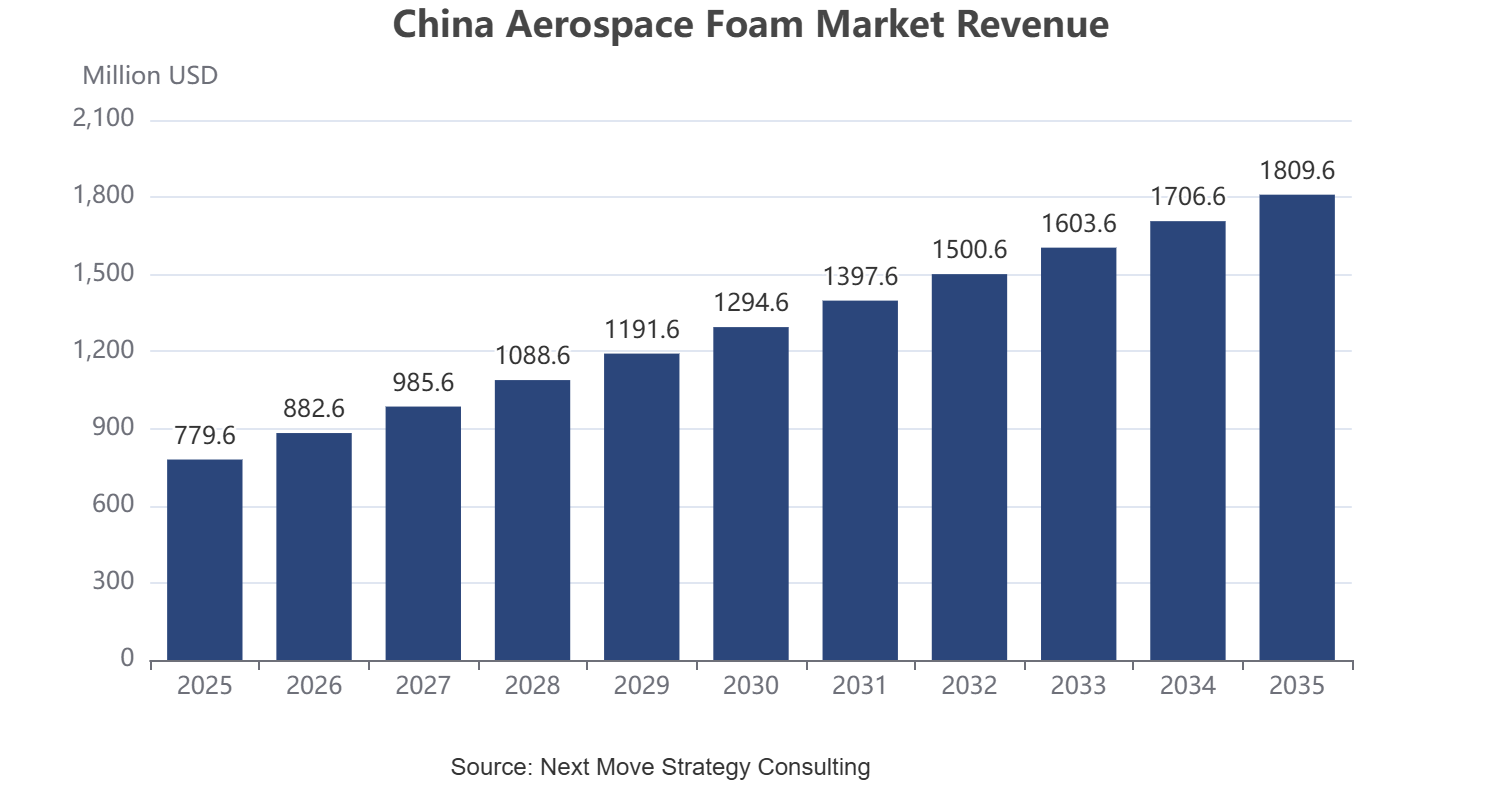
The China Aerospace Foam Market size was valued at USD 779.6 million in 2025, and is expected to be valued at USD 922 million by the end of 2026. The industry is projected to grow, hitting USD 1809.6 million by 2035, with a CAGR of 7.78% between 2026 and 2035.
Ecosystem Analysis of the China Aerospace Foam Market:
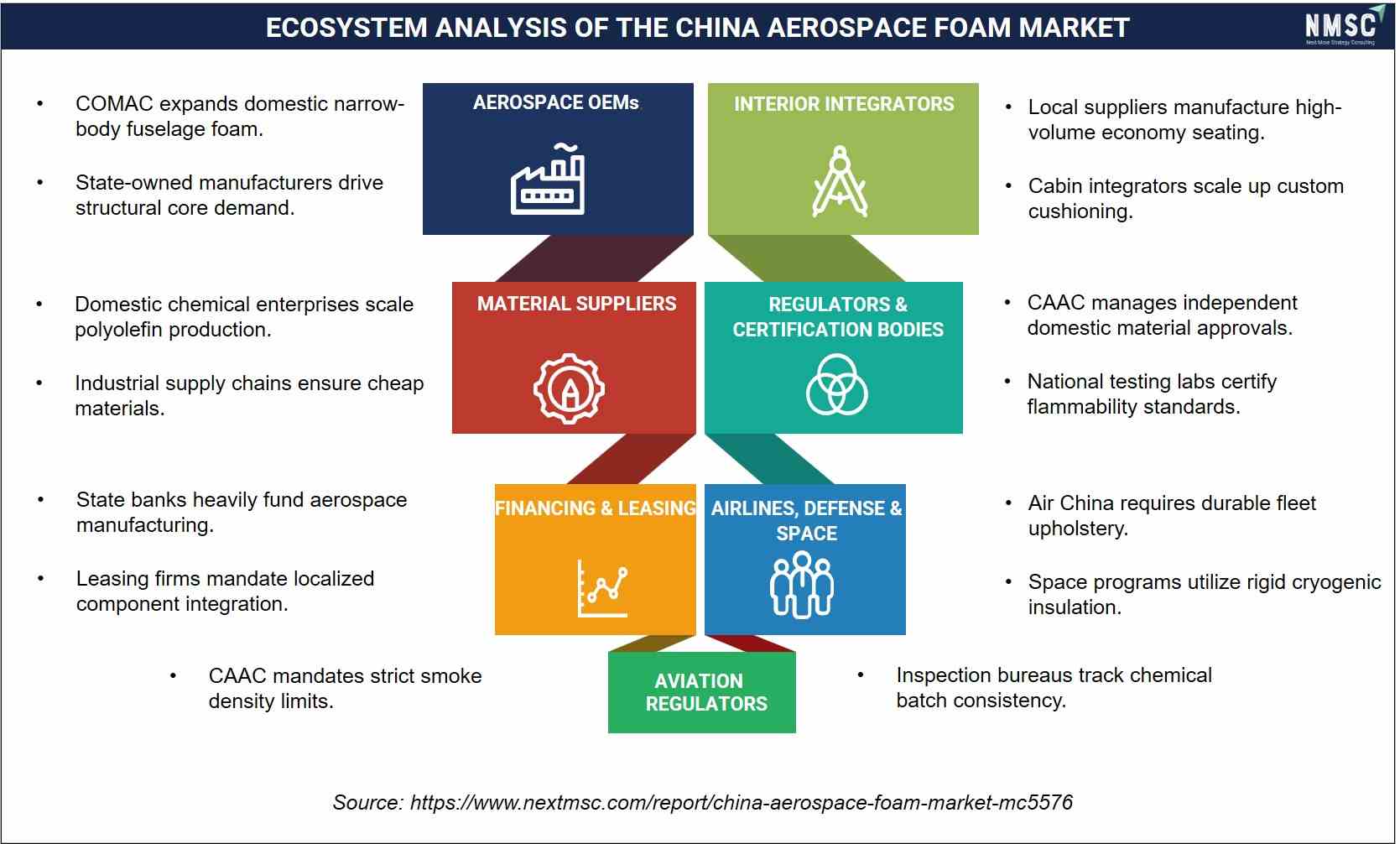
The infographic presents a structured ecosystem analysis of the China aerospace foam market, highlighting how interconnected stakeholders influence industry performance across the country's rapidly expanding aviation sector. Aerospace OEMs and cabin integrators remain central to demand creation, particularly through domestic aircraft programs such as the COMAC C919, where aircraft design requirements are translated into specialized material specifications. These requirements are fulfilled by suppliers providing lightweight, insulating, and safety-compliant aerospace foam solutions. Regulators and certification bodies enforce CAAC airworthiness and material qualification standards, while financing and leasing entities support fleet procurement and capital access. Airlines, defense, and space organizations continue to drive end-use demand under China's centralized aerospace framework. Overall, our analysis indicates that regulatory control, state-backed aviation expansion, and integrated supply chain coordination collectively shape China's aerospace foam ecosystem.
What are the Key Market Drivers, Breakthroughs, and Investment Opportunities that will Shape the China Aerospace Foam Industry in the Next Decade?
Growth Catalyst & Risk Assessment Matrix
|
Drivers / Trends / Restraints |
(+/–) % Impact on CAGR Forecast |
Geographic Relevance |
Impact Timeline |
|
Strong domestic aircraft production driving large-scale aerospace foam consumption |
+4.62% |
Shanghai, Xi'an, Tianjin aerospace manufacturing hubs |
Long term (4–8 years) |
|
Government-driven aerospace expansion strengthening localized material demand |
+4.38% |
National aerospace industrial ecosystem |
Long term (4–8 years) |
|
Lightweight aircraft engineering increasing adoption of advanced foam materials |
+4.05% |
COMAC-linked engineering and production clusters |
Medium to Long term (3–6 years) |
|
Indigenous aviation programs improving domestic foam supplier integration |
+3.88% |
Commercial and defense aviation corridors across China |
Medium to Long term (3–7 years) |
|
Technology transfer restrictions limiting access to advanced aerospace material systems |
-4.16% |
China-wide aerospace technology ecosystem |
Short to Medium term (1–5 years) |
The China aerospace foam market is expanding within a rapidly developing aerospace ecosystem supported by strong domestic aircraft production, government-driven aerospace expansion, technology transfer restrictions, and growing indigenous aviation programs. China continues to strengthen domestic aerospace manufacturing capabilities through large-scale industrial investment and localization strategies aimed at reducing external dependence. However, restrictions on advanced technology transfer continue to influence material innovation and integration within high-end aerospace applications. Despite these limitations, the country is steadily advancing its indigenous aerospace ecosystem through production scaling, supply chain localization, and next-generation aircraft development. Overall, the market reflects a high-growth and state-supported aerospace structure driven by domestic manufacturing expansion and long-term aviation self-reliance objectives.
Growth Driver:
How is Strong Domestic Aircraft Production Strengthening the China Aerospace Foam Market?
Strong domestic aircraft production remains a foundational driver for the China aerospace foam market as expanding commercial and defense aviation programs continue increasing demand for certified aerospace materials. Aerospace foams are extensively integrated into aircraft seating systems, cabin insulation structures, acoustic control assemblies, and lightweight interior components where durability and operational efficiency are critical. The scaling of domestic aircraft manufacturing is creating sustained procurement demand for aerospace-grade foam materials across production and assembly cycles. We found that increasing localisation of aircraft manufacturing activities is also strengthening regional sourcing requirements for advanced interior materials, thereby reinforcing long-term consumption of aerospace foams within the domestic supply chain. As production capacity continues expanding, demand for lightweight and performance-driven foam solutions is expected to strengthen further across China's aerospace manufacturing ecosystem.
How is Government-Driven Aerospace Expansion Accelerating Aerospace Foam Demand in China?
Based on our research, we observed that government-driven aerospace expansion is significantly reinforcing aerospace foam demand in China through long-term industrial policies, strategic aviation investments, and domestic aerospace capability development initiatives. State-backed support is accelerating aircraft manufacturing capacity expansion, infrastructure development, and aerospace technology advancement across both commercial and defense aviation sectors. Aerospace foams benefit directly from this expansion due to their extensive application in insulation systems, cabin interiors, vibration management structures, and lightweight assemblies. Further, policy-led localization initiatives are also encouraging stronger integration between domestic material suppliers and aircraft manufacturers, improving internal supply chain depth for aerospace-grade materials. Additionally, sustained public investment in aerospace modernization programs is strengthening long-term visibility for aerospace material procurement across multiple aviation platforms.
How is Increasing Focus on Lightweight Aircraft Engineering Supporting Foam Adoption?
Increasing focus on lightweight aircraft engineering is emerging as an important incremental driver for aerospace foam demand in China as manufacturers prioritize fuel efficiency, operational optimization, and advanced aircraft performance. Aerospace foams are increasingly replacing heavier traditional materials across seating systems, insulation structures, and cabin interior applications due to their favorable strength-to-weight characteristics. This transition is becoming particularly important within next-generation domestic aircraft platforms where weight reduction and efficiency improvement remain key engineering priorities. Through NMSC's assessment, we noticed that advanced polymer-based foam technologies are also gaining importance as manufacturers seek improved fire resistance, acoustic control, and durability performance within evolving aircraft architectures. As China continues advancing domestic aerospace engineering capabilities, lightweight material integration is expected to become an increasingly significant demand catalyst for aerospace foam solutions.
Growth Inhibitor:
How are Technology Transfer Restrictions Constraining the China Aerospace Foam Market?
Technology transfer restrictions remain a structural restraint for the China aerospace foam market because limitations on access to advanced aerospace technologies and proprietary material systems continue influencing domestic capability development. Restrictions related to high-end aerospace engineering, specialized material formulations, and advanced manufacturing technologies can slow the pace of innovation and increase dependence on localized substitutes. These constraints particularly affect the development of highly specialized aerospace foam solutions requiring advanced certification and performance characteristics. In addition, restricted access to certain foreign technologies can complicate integration into globally standardized aerospace supply chains and delay commercialization of next-generation material systems. While China continues to strengthen its domestic aerospace innovation capacity, technology access limitations remain an important challenge for accelerating high-end aerospace material advancement.
Growth Opportunity:
How is Growth of Indigenous Aviation Programs Creating New Opportunities in China?
NMSC analysis indicates that the growth of indigenous aviation programs represents a major long-term opportunity for the China aerospace foam market as the country intensifies efforts to build self-reliant commercial and defense aviation capabilities. Domestic aircraft platforms require extensive integration of aerospace foams across seating systems, insulation assemblies, acoustic management applications, and lightweight structural interiors. We also found that indigenous aviation development is increasingly prioritizing localized sourcing ecosystems, creating significant opportunities for domestic aerospace material manufacturers to integrate into long-term production programs. Early-stage platform development also enables material suppliers to participate more directly in qualification and specification processes, strengthening future procurement visibility. As indigenous aircraft programs continue scaling across commercial and military aviation segments, demand for advanced aerospace foam solutions is expected to expand substantially within China's domestic aerospace ecosystem.
How is the China Aerospace Foam Industry segmented in this report, and what are the key insights from the segmentation analysis?
By Foam Chemistry Insights
What is Driving Foam Chemistry Adoption in the China Aerospace Foam Market?
Based on foam chemistry, the China Aerospace Foam Market is segmented into polyurethane foam, polyolefin foam, PMI foam, polyimide foam, PVC foam, PET foam, melamine foam, silicone foam, elastomeric foam, metal foam and other specialty foam.
Our segment evaluation indicates that foam chemistry adoption is closely linked to the country's expanding domestic aircraft manufacturing capabilities, defense aviation investments, and long-term aerospace self-reliance initiatives. Polyurethane and polyolefin foams account for a substantial share of utilization due to their versatility across cabin interiors, insulation systems, and lightweight structural applications, where cost efficiency and scalable production remain important. Alongside this, PMI and polyimide foams are gaining stronger traction in high-performance structural and thermal environments that require enhanced fire resistance, mechanical stability, and lightweight properties for advanced aircraft platforms. PVC and PET foams continue to support cabin lightweighting strategies, while melamine, silicone, and other specialty foams address acoustic insulation, vibration control, and defense-oriented engineering requirements. Overall, China's rapidly evolving aerospace manufacturing ecosystem continues to accelerate demand for diversified and higher-performance foam chemistries across both commercial and military aviation segments.
By Application Insights
What is Driving Application Diversification in the China Aerospace Foam Market?
Based on application, the China Aerospace Foam Market is segmented into structural core, seating and comfort, cabin insulation, acoustic damping, sealing and gasketing, thermal management, dielectric and RF, protection, and other applications.
Application demand is being shaped by the country's rapidly expanding aircraft manufacturing ecosystem, rising domestic aviation demand, and increasing investment in advanced aerospace technologies. Structural core applications account for a major share of foam utilization, supported by strong emphasis on lightweight aircraft construction, fuel efficiency, and structural optimization across commercial and defense platforms. At the same time, cabin insulation and acoustic damping applications continue to gain importance as manufacturers focus on improving thermal performance, vibration reduction, and passenger comfort in next-generation aircraft. Seating and comfort applications are also expanding alongside growing fleet modernization and cabin upgrade activities. Other applications, including sealing, thermal management, dielectric, and protection systems, play a more specialized role in supporting avionics integration, operational reliability, and equipment safety. Overall, China's aerospace sector continues to reinforce broad-based adoption of application-specific foam materials aligned with large-scale aviation expansion and technological advancement.
Competitive Landscape
The China aerospace foam market reflects a rapidly expanding and strategically significant competitive landscape, driven by the country's accelerating aircraft manufacturing ambitions, defense aviation modernisation, and increasing localisation of aerospace supply chains. Market demand is being reinforced by rising production of commercial aircraft, growing utilization of lightweight and thermally efficient materials, and sustained investment in indigenous aerospace technologies. We found that competitive intensity is shaped by stringent certification requirements, ongoing material innovation, and the need to align with China's broader objectives around domestic aerospace capability development, supply chain security, and advanced manufacturing self-sufficiency.
Strategic Developments:
-
April 2026 - At Asia's largest plastics showcase, CHINAPLAS 2026 in Shanghai, Evonik's Greater China division officially launched a targeted campaign for its ROHACELL polymethacrylimide (PMI) rigid structural foam. Driven by China's 15th Five-Year Plan targeting the rapid growth of the low-altitude economy, Evonik is positioning its Shanghai-managed ultra-lightweight foam lines directly into the domestic manufacturing of critical structural components for eVTOL aircraft and drones.
Key Players of the China Aerospace Foam Market:
-
Evonik Specialty Chemicals (Shanghai) Co., Ltd.
-
DuPont China Holding Co., Ltd.
-
Hexcel Composites (Tianjin) Co., Ltd.
-
Boyd (Wuxi) Thermal Solutions Co., Ltd.
-
Saint-Gobain (China) Investment Co., Ltd.
-
Rogers (Shanghai) Technology Co., Ltd.
-
Zotefoams T-FIT Material Technology (Kunshan) Co., Ltd.
-
Hybo Technology (China) Co., Ltd.
-
3A Composites (China) Ltd.
-
Hunan Rifeng Composite Co., Ltd.
-
Diab Composite Materials (Kunshan) Co., Ltd.
-
Hutchinson (Suzhou) Co., Ltd.
-
Armacell (Guangzhou) Insulation Co., Ltd.
Competitive participation includes Evonik Specialty Chemicals (Shanghai) Co., Ltd., DuPont China Holding Co., Ltd., Hexcel Composites (Tianjin) Co., Ltd., Boyd (Wuxi) Thermal Solutions Co., Ltd., Saint-Gobain (China) Investment Co., Ltd., and Rogers (Shanghai) Technology Co., Ltd., all of which operate through localized manufacturing, aerospace-grade material platforms, and application-specific engineering capabilities. Market differentiation increasingly depends on the ability to support domestic aircraft programs with high-performance foam solutions tailored for insulation, acoustic management, and structural lightweighting applications. Strategic focus is also shifting toward regional production expansion, deeper OEM collaboration, and development of next-generation material systems aligned with China's long-term aerospace industrial upgrading and aviation efficiency objectives.
Supply Chain Analysis of the China Aerospace Foam Market:
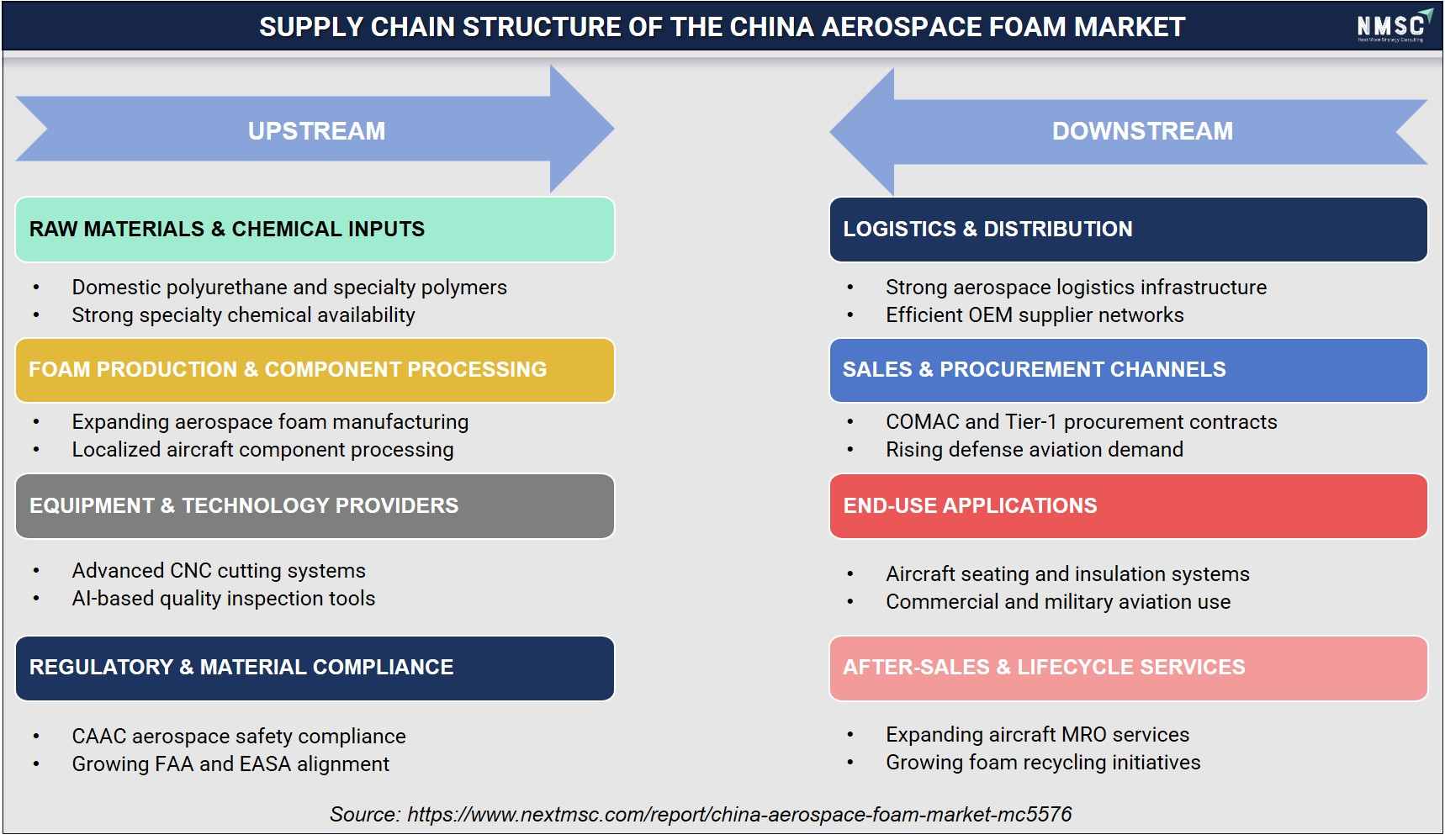
The infographic presents a supply chain structure analysis of the China aerospace foam market, highlighting the upstream and downstream activities shaping industry operations. Upstream activities include strong domestic availability of specialty polymers and polyurethane materials, expanding foam manufacturing capabilities, advanced processing technologies, and CAAC-led regulatory compliance with increasing alignment to FAA and EASA standards. However, in the downstream, the market benefits from robust aerospace logistics networks, procurement demand led by COMAC and defense aviation programs, along with growing applications in seating, insulation, and aircraft interiors. Expanding MRO services and recycling initiatives further strengthen lifecycle support. Overall, our analysis indicates that localisation, technological advancement, and integrated aerospace infrastructure collectively drive China's vertically connected aerospace foam supply chain.
Key Segments
By Foam Chemistry
-
Polyurethane Foam
-
Flexible Polyurethane
-
Rigid Polyurethane
-
Integral Skin Polyurethane
-
-
Polyolefin Foam
-
Polyethylene Foam
-
Polypropylene Foam
-
-
PMI Foam
-
Polyimide Foam
-
PVC Foam
-
PET Foam
-
Melamine Foam
-
Silicone Foam
-
Elastomeric Foam
-
Metal Foam
-
Aluminum Foam
-
Copper Foam
-
Other Metal Foam
-
-
Other Specialty Foam
By Product Form
-
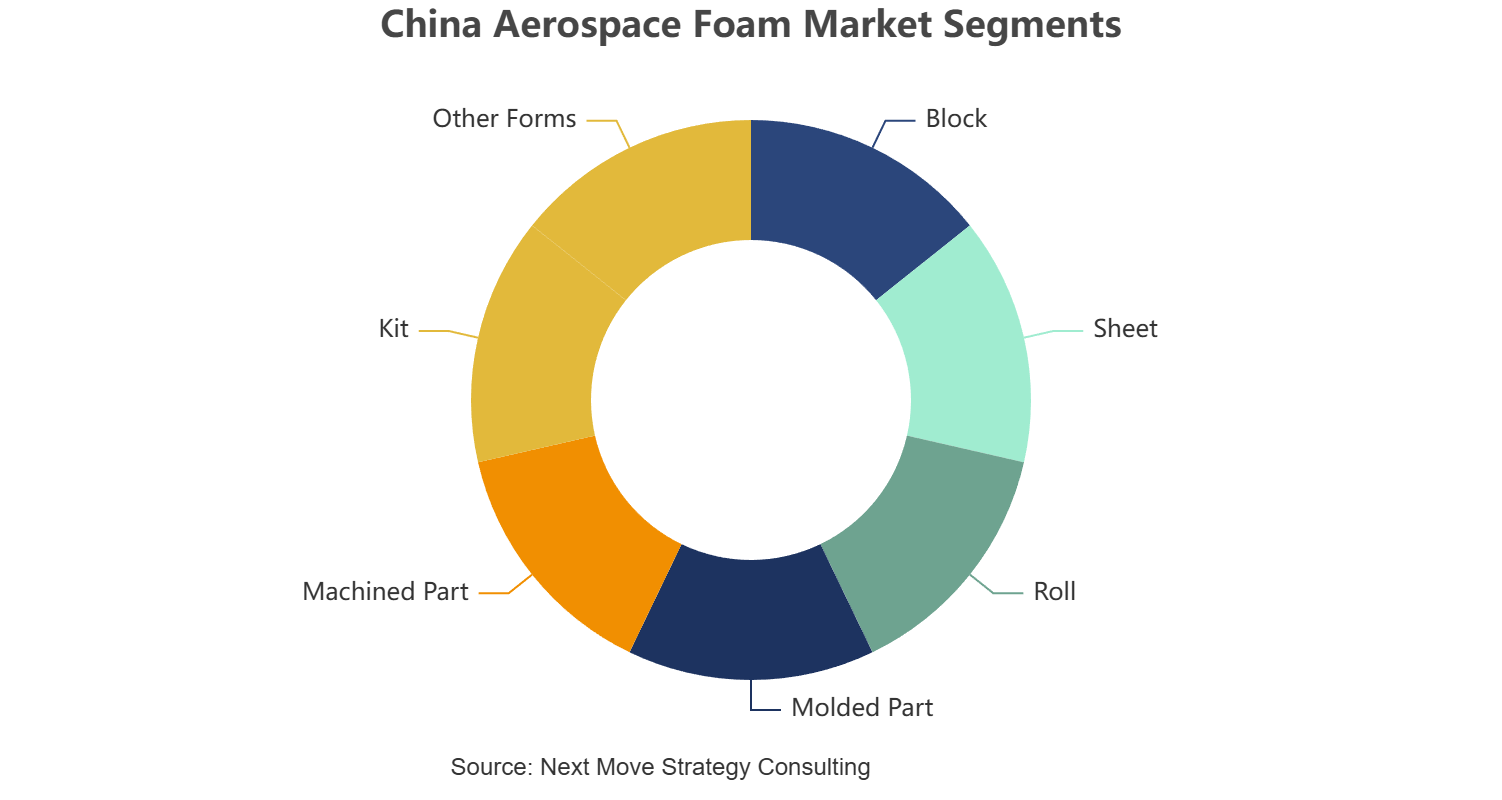
Block
-
Sheet
-
Roll
-
Molded Part
-
Machined Part
-
Kit
-
Other Forms
By Application
-
Structural Core
-
Seating and Comfort
-
Cabin Insulation
-
Acoustic Damping
-
Sealing and Gasketing
-
Thermal Management
-
Dielectric and RF
-
Protection
-
Other Application
By Aircraft Platform
-
Commercial Aviation
-
Narrow-Body Aircraft
-
Wide-Body Aircraft
-
Regional Jets
-
-
Military Aviation
-
Fixed-Wing
-
Rotary-Wing
-
-
Business Aviation
-
Space
-
Launch Vehicles
-
Satellites
-
Space Habitats & Modules
-
By Sales Channel
-
OEM Installation
-
Aftermarket
Key Benefits for Stakeholders:
Next Move Strategy Consulting (NMSC) presents a comprehensive analysis of the China Aerospace Foam Market, covering historical trends from 2020 through 2025 and offering detailed forecasts through 2035. Our study examines the market at regional and country levels, providing quantitative projections and insights into key growth drivers, challenges, and investment opportunities across all major aerospace foam segments.
China's aerospace foam market is being shaped by the rapid expansion of domestic aircraft manufacturing, rising defense aviation capabilities, and strong state-backed aerospace development initiatives that continue to accelerate industrial scale and long-term market visibility. Demand for advanced foam materials is increasing alongside the country's focus on indigenous aircraft programs, cabin modernisation, and lightweight structural engineering aimed at improving operational efficiency and reducing external technology dependence. From an investment standpoint, the market benefits from expanding aerospace supply chain localization, growing material innovation capabilities, and sustained government support for high-value manufacturing. Within this evolving ecosystem, OEMs, airlines, and aerospace suppliers increasingly adopt aerospace foam solutions to improve thermal insulation, acoustic performance, passenger comfort, and aircraft weight optimization. At the same time, we noticed that strengthening domestic certification systems and closer alignment with international aviation standards are reinforcing material reliability and supporting broader adoption of advanced aerospace technologies across China's aviation sector.
|
Parameters |
Details |
|
Customization Scope |
Free customization (equivalent to up to 80 analyst-working hours) after purchase. |
|
Pricing and Purchase Options |
Avail customized purchase options to meet your exact research needs. |
|
Approach |
In-depth primary and secondary research; proprietary databases; rigorous quality control and validation measures. |
|
Analytical Tools |
Porter's Five Forces, SWOT, value chain, and Harvey ball analysis to assess competitive intensity, stakeholder roles, and relative impact of key factors. |
About the Author
 Mayurima Roy
— Mayurima Roy is Research Analyst at Next Move Strategy Consulting, where she has spent 4 years working across the firm's full industry coverage rather than a single fixed vertical. Her work centers on structured research, ongoing trend tracking, competitive assessment, and insight-led content development, translating complex market data into clear, decision-ready narratives that support informed client decision-making across diverse global industries, market sectors, and world regions every day.
Mayurima Roy
— Mayurima Roy is Research Analyst at Next Move Strategy Consulting, where she has spent 4 years working across the firm's full industry coverage rather than a single fixed vertical. Her work centers on structured research, ongoing trend tracking, competitive assessment, and insight-led content development, translating complex market data into clear, decision-ready narratives that support informed client decision-making across diverse global industries, market sectors, and world regions every day.
About the Reviewer
 Supradip Baul
— Supradip Baul is an accomplished business consultant and strategist with over a decade of rich experience in market intelligence, strategy, technology, and business transformation. His work has included rigorous qualitative and quantitative analysis across multiple industries, helping clients shape investment decisions and long-term roadmaps. Earlier in his career, he was associated with Gartner, where he contributed to industry-leading reports and market share analyses. He has worked with leading global companies and holds an MBA with a dual specialization in Marketing and Finance.
Supradip Baul
— Supradip Baul is an accomplished business consultant and strategist with over a decade of rich experience in market intelligence, strategy, technology, and business transformation. His work has included rigorous qualitative and quantitative analysis across multiple industries, helping clients shape investment decisions and long-term roadmaps. Earlier in his career, he was associated with Gartner, where he contributed to industry-leading reports and market share analyses. He has worked with leading global companies and holds an MBA with a dual specialization in Marketing and Finance.
At Next Move Strategy Consulting, we understand that insightful market research is the cornerstone of successful business decisions. That's why we employ a robust and multifaceted approach, combining various methodologies to deliver the most accurate and actionable data for our clients.

Research Landscape
We navigate the world of research with two primary approaches:
Qualitative Approach
Our qualitative research methodologies involve immersive techniques such as in-depth interviews, focus groups, and observational studies. By engaging directly with individuals and stakeholders, we uncover valuable insights that quantitative data alone may overlook.

Quantitative Research
In tandem with qualitative methodologies, NMSC leverages the power of Quantitative Research to provide a robust foundation of numerical insights. Through systematic data collection and analysis, we quantify patterns, preferences, and market trends, offering a comprehensive view of the business landscape.
Our quantitative research approach employs diverse tools, including surveys, experiments, and statistical modelling. These methodologies enable us to gather data from a large and representative sample, ensuring the statistical significance of our findings. By employing structured questionnaires and standardized data collection methods, we guarantee the reliability and validity of the information we present to our clients.
Quantitative research is particularly effective in measuring the prevalence of trends, assessing market size, and gauging the impact of various factors on consumer behavior. The numerical precision attained through this approach equips our clients with actionable insights, facilitating data-driven decision-making and strategy formulation.


Our Specialized Toolbox for Industry-Specific Market Research
We deploy a specialized arsenal of techniques tailored to meet your unique requirements. Here's a glimpse into our comprehensive toolbox:

Information Procurement
The stage entails acquiring market data or relevant information through various sources and methodologies.


Market Research Approach
We utilize both top-down and bottom-up approaches in market research analysis to achieve a comprehensive understanding of the market dynamics, leveraging the broad perspective of industry trends and macroeconomic factors alongside detailed insights from specific segments and individual companies.

Porters Five Forces Analysis
We conduct Porter's Five Forces analysis to evaluate the competitive landscape of an industry, providing us with insights into factors that affect profitability and strategic positioning.

SWOT Analysis

Forecasting
We utilize a forecasting model to predict future consumption by considering parameters like population, economics, regulations, market competition, drivers, constraints, technology, and pricing. We also employ statistical techniques such as multilinear regression, exponential smoothing, moving average, ARIMA, and Monte Carlo simulations for accurate predictions. In econometric forecasting, we analyzed short-term and long-term event impacts, attributing values based on regulatory frameworks, economic factors, and market events.





 Speak to Our Analyst