Data Center Automation Software Market

The global Data Center Automation Software Market size was valued at USD 24.73 billion in 2025 and is estimated at USD 34.52 billion in 2026, forecast to reach USD 122.65 billion by 2035, expanding at a 14.99% CAGR between 2026 and 2035 (reconciled to 15.13% under period curve modeling). North America leads with approximately 36% share, while Orchestration and Workflow Automation dominate all other segments with approximately 34% share.

Download Free Sample PDF
Base Year (2025)
$24.73 Billion
Forecast (2035)
$122.65 Billion
CAGR (2026-2035)
15.1%
Top Region
North America

What Is the Data Center Automation Software Market Size?

The global Data Center Automation Software Market was valued at USD 24.73 Billion in 2025 and is estimated at USD 34.52 Billion in 2026. It is forecast to reach USD 122.65 Billion by 2035, growing at a CAGR of 15.13% from 2026 to 2035. North America leads with roughly 36% share, while orchestration and workflow automation holds about 34%.

Our assessment indicates that three segmentation axes and five regions explain most of the growth variance in this market, as summarized below.

Data Center Automation Software Market Revenue Forecast

Values in USD Billion

2025 $24.73 Billion
2025
2026 $34.52 Billion
2026
2027 $39.74 Billion
2027
2028 $45.76 Billion
2028
2029 $52.68 Billion
2029
2030 $60.65 Billion
2030
2031 $69.83 Billion
2031
2032 $80.39 Billion
2032
2033 $92.55 Billion
2033
2034 $106.56 Billion
2034
2035 $122.65 Billion
2035

Key Takeaways

By Solution Type: Orchestration and workflow automation held the largest share, expanding from USD 8.66 Billion in 2025 to USD 40.48 Billion by 2035; Network automation is the fastest growing at 17.29% CAGR from 2026–2035.

By Deployment Mode: On premises held the largest share, expanding from USD 12.86 Billion in 2025 to USD 41.70 Billion by 2035; Cloud is the fastest growing at 18.44% CAGR from 2026–2035.

By Data Center Type: Enterprise data centers held the largest share, expanding from USD 10.13 Billion in 2025 to USD 33.12 Billion by 2035; Edge data centers is the fastest growing at 21.84% CAGR from 2026–2035.

Dominant Region: North America held the largest share, rising from USD 9.15 Billion in 2025 to USD 38.02 Billion by 2035 as enterprises standardize operations.

Fastest Growing Region: Latin America is the fastest growing region at 17.45% CAGR from 2026–2035, ahead of Middle East & Africa and APAC.

Dominant Country: The U.S. leads, expanding from USD 7.32 Billion in 2025 to USD 28.90 Billion by 2035.

Fastest Growing Country: India is the fastest growing country at 22.31% CAGR from 2026–2035, supported by new hyperscale and colocation capacity.

The Data Center Automation Software Market is projected to expand by approximately USD 88.13 billion between 2026 and 2035, creating potential growth opportunities for vendors of network automation, cloud-delivered platforms and related solutions.

According to NMSC analysis, the step up from USD 24.73 Billion in 2025 to USD 34.52 Billion in 2026 reflects AI cluster build outs and platform consolidation, while later years rely on steady subscription expansion across edge and hybrid sites. We observed that vendors with strong network portfolios capture a disproportionate share of that incremental spending, because AI fabrics need intent based configuration and automated validation from the first day of operation.

What does the Data Center Automation Software Market Encompass?

This study defines the Data Center Automation Software Market as commercial software that automates provisioning, configuration, orchestration, workload placement, network fabric management and infrastructure monitoring across enterprise, colocation, hyperscale and edge facilities. It includes platform licences, subscriptions and bundled support. It excludes server, storage and networking hardware, standalone cooling and power equipment, and general purpose cloud compute. Revenue is measured in USD Billion, with 2025 as the base year, 2026 as the estimate year and 2035 as the forecast horizon.
Platforms cover orchestration, configuration, network fabric control and infrastructure monitoring, linking asset records to change workflows. Spending is shifting from one off tooling toward subscription platforms that support private cloud, colocation and edge sites under one operating model, so the Data Center Automation Software Market tracks recurring software revenue rather than hardware sales.

Market Drivers & Dynamics

Interactive Dataset
AI workload growth and rack density driver +3.2% Global, led by North America and APAC 2026–2035
Hybrid and private cloud standardization driver +2.4% North America, Europe 2026–2032
Operator labor shortage and cost control driver +1.9% Global 2026–2030
Edge site proliferation driver +1.6% APAC, Europe 2027–2035
Integration complexity across legacy estates restraint −2.1% Europe, Middle East & Africa 2026–2030
Licensing and vendor consolidation pressure restraint −1.3% North America, Europe 2026–2029
Data sovereignty and security constraints restraint −0.9% Europe, Middle East & Africa 2026–2033
Source: Next Move Strategy Consulting

Growth Drivers

What Is the Primary Growth Driver in the Data Center Automation Software Market?

AI driven load is the dominant force. The International Energy Agency projects that global data centre electricity demand will more than double to around 945 TWh by 2030, with AI optimised facilities more than quadrupling their demand. Growth at that pace cannot be operated manually, so AI optimized datacenterinfrastructure depends on automated provisioning, power aware scheduling and continuous fault handling. This sustains demand across the Data Center Automation Software Market through 2035.

How Is Hybrid Cloud Standardization Supporting Demand?

Enterprises are consolidating fragmented virtualization estates onto a single private cloud operating model. Broadcom announced general availability of VMware Cloud Foundation 9.0 in June 2025, positioning it as a unified platform for modern private cloud with built in automation. Standardization raises attach rates for lifecycle and policy tooling, and supports cloud computing spending on portable operations. Hybrid deployments grow at 17.89% CAGR from 2026 to 2035, while cloud delivered platforms reach 18.44%.

Growth Inhibitors

What Is Restraining the Data Center Automation Software Market?

Integration complexity remains a key restraint, as brownfield data centers often require custom connectors to integrate legacy servers, building management systems, and older management consoles. Licensing changes following vendor consolidation and data sovereignty requirements further extend procurement and implementation timelines, especially in regulated sectors. Standardized IT service management governance frameworks help mitigate these delays, though lengthy procurement cycles continue to moderate enterprise adoption speed.

What Are the Growth Opportunities?

Can Sovereign and Private AI Clouds Unlock Premium Automation Demand?

Governments and regulated enterprises are building private AI capacity that must run inside national borders. These sites need automated GPU cluster provisioning, tenant isolation and audit trails from day one. Operators of every hyperscale datacenter program and sovereign cloud will procure orchestration with policy controls, and hyperscale facilities grow from USD 8.98 Billion in 2026 to USD 40.47 Billion in 2035.

Does Energy Aware Automation Create a New Revenue Pool?

Power availability now limits site expansion, so software that shifts workloads by grid carbon intensity or cooling headroom earns budget. Vendors can price this as an outcome based module tied to energy savings. Integration with datacenterpower solutions and cooling controllers is the differentiator, because it lets operators defend capacity requests to utilities and regulators with measured data.

Can Colocation Operators Productize Automation as a Managed Service?

Tenants of a colocation facility increasingly expect self service portals, remote hands workflows and programmatic cross connects. Operators that expose automation through APIs convert operations cost into a recurring service. Colocation data centers grow from USD 9.32 Billion in 2026 to USD 30.66 Billion in 2035, giving providers a large base on which to deploy platform subscriptions.

Segmentation Analysis

2025 (USD Billion)
2035 (USD Billion)
Orchestration and workflow automation 2025: $8.66 Billion | 2035: $40.48 Billion
Orchestratio
Configuration and provisioning automation 2025: $7.17 Billion | 2035: $30.66 Billion
Configuratio
Network automation 2025: $5.19 Billion | 2035: $31.89 Billion
Network auto
Infrastructure monitoring and DCIM 2025: $3.71 Billion | 2035: $19.62 Billion
Infrastructu
Orchestration and workflow automation $8.66 Billion $40.48 Billion 14.74%
Configuration and provisioning automation $7.17 Billion $30.66 Billion 13.68%
Network automation $5.19 Billion $31.89 Billion 17.29%
Infrastructure monitoring and DCIM $3.71 Billion $19.62 Billion 15.13%

Which Solution Type Leads the Data Center Automation Software Market?

Orchestration and workflow automation led with USD 8.66 Billion in 2025 because every operator needs a control layer that sequences provisioning, approvals and rollbacks. Network automation is the fastest growing solution type at 17.29% CAGR from 2026 to 2035, as AI fabrics demand intent based configuration and automated validation. Configuration and provisioning automation remains a large base at USD 9.67 Billion in 2026, while monitoring and DCIM advances steadily as sites adopt telemetry driven capacity planning.

2025 (USD Billion)
2035 (USD Billion)
Category A
Category B
Category C
Category D
Segment Item 2025 (USD Billion) 2035 (USD Billion) CAGR
Category A $10.0 USD Billion $40.0 USD Billion 25.0%
Category B $17.1 USD Billion $51.1 USD Billion 11.0%
Category C $24.2 USD Billion $62.2 USD Billion 25.0%
Category D $31.3 USD Billion $73.3 USD Billion 11.0%

Segment-wise data is locked

Unlock complete segment-wise numbers for By Deployment Mode.

Unlock Full Data
2025 (USD Billion)
2035 (USD Billion)
Category A
Category B
Category C
Category D
Segment Item 2025 (USD Billion) 2035 (USD Billion) CAGR
Category A $10.0 USD Billion $40.0 USD Billion 27.0%
Category B $17.1 USD Billion $51.1 USD Billion 9.0%
Category C $24.2 USD Billion $62.2 USD Billion 19.0%
Category D $31.3 USD Billion $73.3 USD Billion 17.0%

Segment-wise data is locked

Unlock complete segment-wise numbers for By Data Center Type.

Unlock Full Data

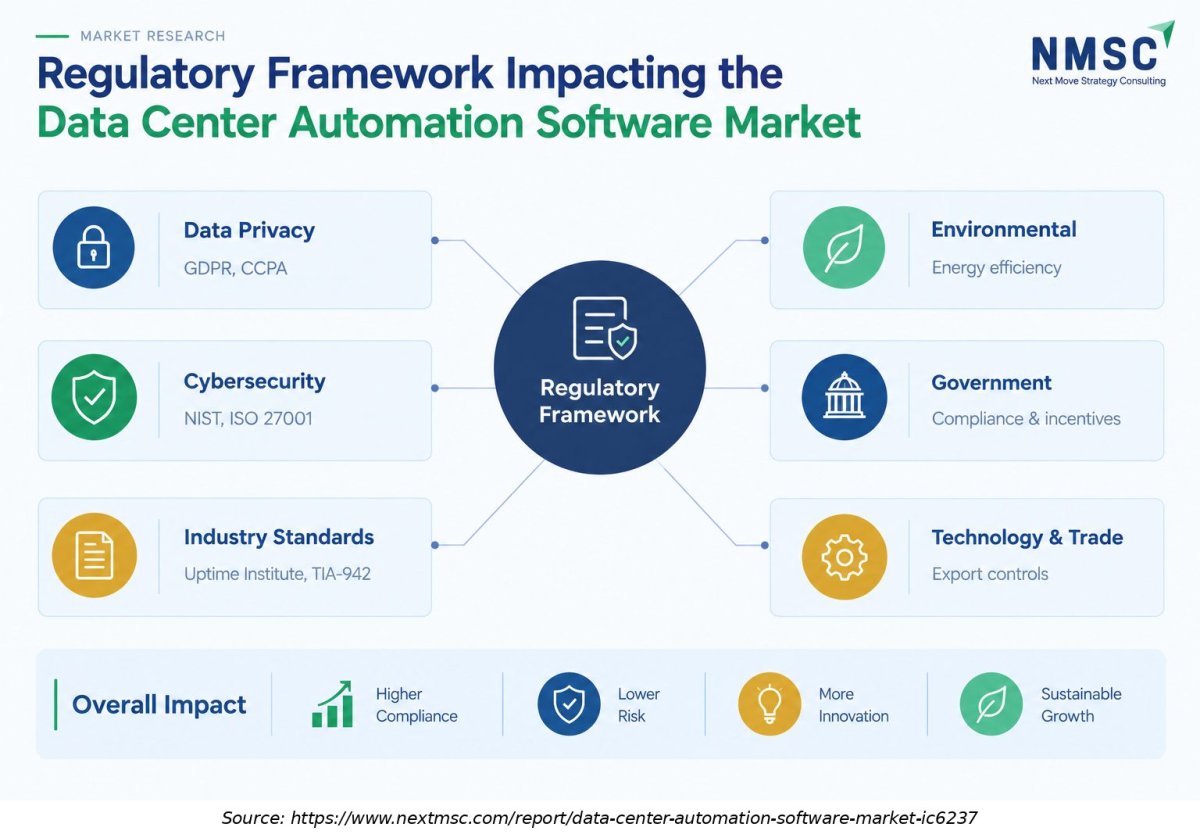
Regulatory Framework Impacting the Data Center Automation Software Market

The data center automation software market is influenced by data privacy regulations, cybersecurity standards, environmental requirements, and industry-specific compliance frameworks. Regulations such as GDPR and CCPA shape data protection practices, while standards like ISO 27001 support information security management. Energy efficiency requirements and technology export controls also influence software deployment, encouraging vendors to prioritize compliance, operational resilience, and sustainable data center management.

Growth Opportunities

Three opportunity pools stand out for vendors and investors over the forecast horizon.

Can Sovereign and Private AI Clouds Unlock Premium Automation Demand?

Governments and regulated enterprises are building private AI capacity that must run inside national borders. These sites need automated GPU cluster provisioning, tenant isolation and audit trails from day one. Operators of every hyperscale datacenter program and sovereign cloud will procure orchestration with policy controls, and hyperscale facilities grow from USD 8.98 Billion in 2026 to USD 40.47 Billion in 2035.

Does Energy Aware Automation Create a New Revenue Pool?

Power availability now limits site expansion, so software that shifts workloads by grid carbon intensity or cooling headroom earns budget. Vendors can price this as an outcome based module tied to energy savings. Integration with datacenterpower solutions and cooling controllers is the differentiator, because it lets operators defend capacity requests to utilities and regulators with measured data.

Can Colocation Operators Productize Automation as a Managed Service?

Tenants of a colocation facility increasingly expect self service portals, remote hands workflows and programmatic cross connects. Operators that expose automation through APIs convert operations cost into a recurring service. Colocation data centers grow from USD 9.32 Billion in 2026 to USD 30.66 Billion in 2035, giving providers a large base on which to deploy platform subscriptions.

Regional Outlook

2025 (USD Billion)
2035 (USD Billion)
North Americ
Asia-Pacific
Europe
Middle East
Latin Americ
Region 2025 (USD Billion) 2035 (USD Billion) CAGR (%)
North America $10.0 USD Billion $40.0 USD Billion 9.0%
Asia-Pacific $17.1 USD Billion $51.1 USD Billion 27.0%
Europe $24.2 USD Billion $62.2 USD Billion 25.0%
Middle East & Africa $31.3 USD Billion $73.3 USD Billion 23.0%
Latin America $38.4 USD Billion $84.4 USD Billion 12.0%

Regional data is locked

Unlock complete regional numbers for this market.

Unlock Full Data

Competitive Landscape

The Data Center Automation Software Market is moderately concentrated at the platform layer and fragmented in specialist tooling. Large infrastructure vendors compete with software platform providers, facility technology companies and open source commercial distributions. Our analysis shows that integration breadth, AI assistance and hybrid operating depth separate leaders from specialists, and buyers increasingly weigh vendor stability after recent acquisitions.

Dimension Description
Market Structure Moderately concentrated, led by infrastructure and cloud platform vendors with fragmented specialist tooling.
Innovation Focus Agentic operations, infrastructure as code, intent based network automation and energy aware scheduling.
M&A Activity Active consolidation, including IBM with HashiCorp and HPE with Juniper Networks in 2025.

How Do Companies Compete in the Data Center Automation Software Market?

Vendors compete on breadth of integration, depth of AI assistance, and the credibility of their roadmap for hybrid operations. Hardware makers such as Dell Technologies and Hewlett Packard Enterprise bundle management software with servers and fabrics, while ServiceNow competes through workflow and discovery data. Cisco and Broadcom rely on installed networking and virtualization bases to cross sell automation modules.

Which Competitive Archetypes Dominate the Data Center Automation Software Market?

Three archetypes stand out. Full stack platform vendors, including IBM, Broadcom and Cisco, sell orchestration across compute, network and cloud. Infrastructure bundlers, such as Dell Technologies, HPE and Nutanix, attach automation to hardware or hyperconverged systems. Facility specialists, including Schneider Electric and Carrier through Nlyte, focus on DCIM, power and capacity planning, and increasingly connect to IT orchestration.

What Innovation and Differentiation Strategies Are Companies Pursuing?

Differentiation now centers on AI assisted operations and unified control planes. Cisco described its approach in 2024 by stating that it is “committed to making the deployment and operation of AI infrastructure simpler”. Broadcom emphasizes a single private cloud platform in VMware Cloud Foundation 9.0, while IBM combines Red Hat Ansible and HashiCorp Terraform inside one hybrid cloud strategy, and network fabric automation is a visible battleground.

What M&A and Partnership Activity Is Shaping the Market?

Consolidation is accelerating. IBM closed the HashiCorp deal in February 2025, and Hewlett Packard Enterprise completed its Juniper Networks acquisition in July 2025 to pair AI native networking with its infrastructure management portfolio. Partnerships with NVIDIA, such as Cisco's Secure AI Factory update in March 2026, align automation roadmaps with GPU cluster deployment and give buyers validated reference designs.

Key Market Players

We found nine companies with verifiable offerings, ranked by portfolio breadth.

Cisco Systems, Inc. Broadcom Inc. International Business Machines Corporation Hewlett Packard Enterprise Company Dell Technologies Inc. Schneider Electric SE ServiceNow, Inc. Nutanix, Inc. Carrier Global Corporation

Latest Developments

During our market evaluation, we noticed that consolidation and AI infrastructure launches dominated official announcements between 2025 and 2026.

Date Event
March 2026 Cisco described expansions to Secure AI Factory with NVIDIA to support agentic AI deployments across data centers, sovereign clouds and enterprise environments. Updates include next-generation 102.4 Tbps networking options, NVIDIA Spectrum-6 support, integrated security, observability and AgenticOps, helping customers operate distributed AI workloads with consistent controls.
February 2026 Cisco introduced Silicon One G300, a 102.4 Tbps switching chip designed for gigawatt-scale AI clusters, alongside G300-powered N9000 and 8000 systems, advanced optics and Nexus One management upgrades. The portfolio targets AI training, inference and agentic workloads, with liquid-cooled configurations designed to improve infrastructure efficiency.

Investment Opportunities

Where Are Capital Inflows Concentrating in the Data Center Automation Software Market?

Capital is flowing toward platform consolidation and AI operations within the Data Center Automation Software Market. IBM paid an enterprise value of USD 6.4 Billion for HashiCorp, and HPE completed its Juniper Networks acquisition in 2025, showing that strategic buyers will pay for control of provisioning and network automation assets. Smaller specialists in observability, energy aware scheduling and edge orchestration remain likely targets for the same acquirers.

How Is Infrastructure Investment Shaping Market Capacity?

Facility spending creates the installed base that software must manage. Investment in liquid cooling and high density power raises operating complexity, which favors tools that coordinate IT and facility telemetry. As capacity expands across hyperscale, colocation and edge sites, automation licences scale with rack counts and cluster sizes, giving software vendors recurring revenue linked to physical build outs.

What ESG Considerations Are Influencing Market Investment?

Energy is the central ESG issue. The IEA expects data centre electricity demand to reach around 945 TWh by 2030, so investors scrutinize efficiency and carbon reporting. Automation that raises utilization and shifts load to cleaner hours supports a green datacenter strategy, and it provides auditable metrics that lenders and regulators increasingly request.

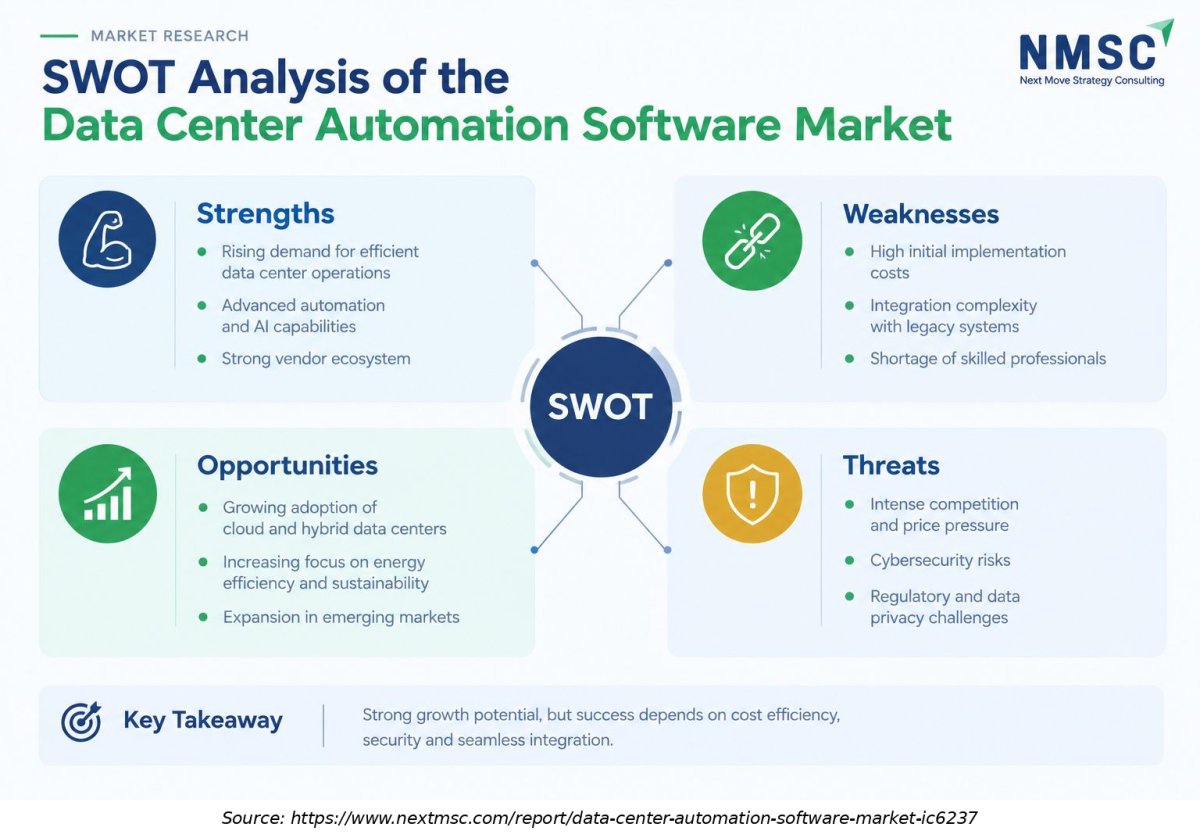
SWOT Analysis

This SWOT view highlights structural strengths, strategic gaps, expansion headroom, and external risks shaping outcomes in the Data Center Automation Software Market.

Strengths

growing demand for operational efficiency, advanced AI capabilities, and cloud infrastructure adoption

Weaknesses

high implementation costs, integration complexity, and skills shortages

Opportunities

hybrid cloud expansion and energy-efficient operations

Threats

cybersecurity threats, regulatory challenges, and competitive pricing pressures

Key Benefits for Stakeholders

How Does This Report Benefit Industry Leaders and Data Center Operators?

Operators gain a sized view of solution, deployment and facility segments within the Data Center Automation Software Market, which supports platform selection and budget phasing. The regional and country analysis shows where capacity is growing fastest, helping teams prioritize rollouts, staffing and vendor negotiations for their own sites, and it supplies benchmarks for justifying automation budgets internally.

How Does This Report Benefit Investors and Financial Analysts?

Investors receive a reconciled forecast from USD 34.52 Billion in 2026 to USD 122.65 Billion in 2035, with segment growth rates that identify where recurring revenue expands fastest. The competitive review highlights consolidation patterns and the valuation context set by recent acquisitions in automation and networking, which helps analysts compare entry points across segments and regions.

How Does This Report Benefit Technology Vendors and Platform Teams?

Vendors can benchmark positioning against competing archetypes, identify gaps in network, edge and energy aware features, and prioritize partnerships. Platform teams gain a view of integration expectations and buyer priorities that can shape roadmaps over the next decade, including where cloud delivery should replace licensed installs and where bundled hardware software remains the stronger route to market.

Key Market Segments Evaluated

By Solution Type

  • Orchestration and workflow automation
  • Configuration and provisioning automation
  • Network automation
  • Infrastructure monitoring and DCIM

By Deployment Mode

  • On premises
  • Cloud
  • Hybrid

By Data Center Type

  • Enterprise data centers
  • Colocation data centers
  • Hyperscale data centers
  • Edge data centers

By Region

  • North America 
    • U.S.
    • Canada
    • Mexico
  • Europe 
    • UK
    • Germany
    • France
    • Italy
    • Spain
    • Sweden
    • Denmark
    • Finland
    • Netherlands
    • Rest of Europe
  • Asia-Pacific 
    • China
    • India
    • Japan
    • South Korea
    • Taiwan
    • Indonesia
    • Vietnam
    • Australia
    • Philippines
    • Malaysia
    • Rest of APAC
  • Middle East & Africa 
    • Saudi Arabia
    • UAE
    • Egypt
    • Israel
    • Turkey
    • Nigeria
    • South Africa
    • Rest of MEA
  • Latin America 
    • Brazil
    • Argentina
    • Chile
    • Colombia
    • Rest of LATAM

Conclusion & Recommendations

The outlook is one of sustained expansion, with revenue rising from USD 34.52 Billion in 2026 to USD 122.65 Billion in 2035. Growth shifts from solution breadth toward operating model depth, as cloud delivered and hybrid platforms overtake on premises licences and edge sites become the fastest growing facility type. Asia Pacific closes the gap with North America and passes it by 2035, which will reorder vendor priorities.

What Strategic Positioning Recommendations Does NMSC Offer?

We recommend that platform vendors invest first in network automation and agentic operations, where growth is highest, and secure integrations with facility power and cooling telemetry. Hardware bundlers should open their management stacks to third party orchestrators. Operators should standardize on one policy driven pipeline and negotiate multiyear terms before further consolidation reshapes licence structures.

What Is the Investment Attractiveness of the Market?

Attractiveness is high because revenue is recurring, linked to rack and cluster counts, and supported by an absolute opportunity of about USD 88.13 Billion through 2035. Strategic acquirers have set valuation markers with the HashiCorp and Juniper transactions. The strongest entry points are edge orchestration, energy aware scheduling and managed automation for colocation, where growth rates exceed the global average.

What Are the Market Shifts and Key Risks?

Three shifts matter most: the move from scripts to agentic operations, the rise of cloud delivered control planes, and the pull of sovereign AI capacity. Risks include integration cost across legacy estates, pricing changes after vendor consolidation, power constraints that delay site openings, and security exposure when a single control plane manages thousands of devices.

What Are the Primary Growth Pathways Through 2035?

Growth pathways run through three channels. Cloud delivery, at 18.44% CAGR from 2026 to 2035, extends reach to mid sized operators. Network automation, at 17.29%, follows AI fabric builds. Edge facilities, at 21.84%, add distributed demand, and India, at 22.31%, offers the fastest country level scaling for vendors able to localize delivery.

FAQs

About the Author

Mihul Sharma

Mihul Sharma

Mihul Sharma is Research Associate at Next Move Strategy Consulting, where he has covered technology, industrial, and healthcare markets for 3 years. His work applies structured business research, market analysis, and secondary-source review to assess market trends, competitive developments, and growth opportunities. He supports report development by fully synthesizing industry data, company information, and market signals into concise findings for strategy and investment-focused research teams.

About the Reviewer

Supradip Baul

Supradip Baul

Supradip Baul is an accomplished business consultant and strategist with over a decade of rich experience in market intelligence, strategy, technology, and business transformation. His work has included rigorous qualitative and quantitative analysis across multiple industries, helping clients shape investment decisions and long-term roadmaps. Earlier in his career, he was associated with Gartner, where he contributed to industry-leading reports and market share analyses. He has worked with leading global companies and holds an MBA with a dual specialization in Marketing and Finance.

Download Free Sample

Kishu Kanda

KISHU KANDA

Strategy Analyst

Accenture

We purchased the AI Consumer Market Report from this company. Not only did they customize the report to meet our specific requirements, but they also showed great flexibility in accommodating our budget. The report we received fully met our expectations. Additionally, they provided prompt and thorough responses to both our pre-purchase and follow-up questions. We look forward to working with this company again in the future.

Pratyush Kumar Das

PRATYUSH KUMAR DAS

Assistant Manager

Polycab India Limited

We would like to express our appreciation for the data and insights provided by nextmsc. We are very pleased with the quality and depth of the information, which has proven to be highly valuable and beneficial for our business decision-making.

Henri Knyphausen

HENRI KNYPHAUSEN

Partner at Singulier [Ex-BCG]

Singulier

I recently engaged NEXTMSC.com for a commercial due diligence project within the intralogistics sector, and I am pleased to provide a reference based on my experience. In utilizing NEXTMSC.com's services, I found their report to offer valuable insights into market dynamics and key industry players. The initial report provided a solid foundation for our analysis. However, as we were investigating a smaller target in the market, and I had specific customization requests requiring additional research. These requests included detailed information on product portfolios of various players and sub-market sizes, both inclusive and exclusive of certain product categories. NEXTMSC.com demonstrated commendable responsiveness and agility in accommodating these customization requests. Within a timeframe of 1-2 weeks, they delivered a revised report that met our specific needs. Furthermore, they were receptive to my follow-up inquiries, ensuring clarity and understanding of the data provided. The final deliverable significantly contributed to our due diligence efforts. One of NEXTMSC.com's notable strengths lies in their qualitative research capabilities. However, for future engagements, I would recommend the inclusion of a quantified market model in Excel format. Such a model would offer the ability to conduct in-depth analyses and explore various market segments, including country-specific data and subcomponent breakdowns. Based on my positive experience, I would not hesitate to work with NEXTMSC.com again. Their responsiveness, willingness to accommodate customization requests, and commitment to delivering actionable insights make them a reliable partner for commercial research projects.

Kevin Coker

KEVIN COKER

Founder, CEO and Board Diector

Proxima Clinical Research

I have been using Next MSC reports for product positioning in a new geography for a long time. They have by far the best reports I have found and the price is reasonable too!

Diana Trejo

DIANA TREJO

Assistant Manager

Sumitomo Corporation de Mexico, S.A. de C.V.

Recently, we purchased a report on the Mexico Data Center Market from Next Move Strategy Consulting. The service has been excellent, with support that is always timely and thoroughly professional. The information provided is interesting, highly useful, and delivered with clarity. I would highly recommend NextMSC for anyone seeking insightful and dependable analysis.

Custom Market Research Services

We will customize the research for you if the listed report does not fully match your requirements.

Get 30% Free Customization

Select License

This website uses cookies to ensure you get the best experience on our website. Learn more

✖