Compost & Manure Market Global Industry Analysis and Forecast (2026–2035)

Compost & Manure Market size was USD 12.52 Billion in 2025, projected to reach USD 27.41 Billion by 2035, growing at a CAGR of 8.15% from 2026 to 2035. Key drivers include mandatory organic waste diversion, expanding food waste processing capacity, and rising demand for soil health inputs, with North America leading the market.

Download Free Sample PDF
Base Year (2025)
$12.52 Billion
Forecast (2035)
$27.41 Billion
CAGR (2026-2035)
8.2%
Top Region
North America

What Is the Compost & Manure Market Size?

The global Compost & Manure Market reached USD 12.52 Billion in 2025 and is estimated at USD 13.54 Billion in 2026. It is projected to reach USD 27.41 Billion by 2035, growing at a CAGR of 8.15% from 2026 to 2035. North America leads with approximately a 34% share, while Compost is the dominant product type with approximately a 58% share.

We observed that mandatory organic waste diversion, rather than fertilizer pricing alone, is setting the pace of capacity additions across both product types.

Compost & Manure Market Global Industry Analysis and Forecast (2026–2035) Revenue Forecast

Values in USD Billion

2025 $12.52 Billion
2025
2026 $13.54 Billion
2026
2027 $14.64 Billion
2027
2028 $15.84 Billion
2028
2029 $17.13 Billion
2029
2030 $18.52 Billion
2030
2031 $20.03 Billion
2031
2032 $21.67 Billion
2032
2033 $23.43 Billion
2033
2034 $25.34 Billion
2034
2035 $27.41 Billion
2035

Key Takeaways

By Product Type: Compost held the largest share, expanding from USD 7.24 Billion in 2025 to USD 16.40 Billion by 2035; Processed Manure is the fastest-growing at 9.51% CAGR from 2026–2035.

By Source Material: Animal Manure held the largest share, expanding from USD 5.54 Billion in 2025 to USD 11.57 Billion by 2035; Food Waste is the fastest-growing at 10.92% CAGR from 2026–2035.

By Product Form: Bulk held the largest share, expanding from USD 8.56 Billion in 2025 to USD 17.67 Billion by 2035; Packaged is the fastest-growing at 9.43% CAGR from 2026–2035.

By Sales Channel: Direct Sales held the largest share, expanding from USD 5.17 Billion in 2025 to USD 10.41 Billion by 2035; Retail is the fastest-growing at 10.02% CAGR from 2026–2035.

By End User: Agriculture held the largest share, expanding from USD 5.81 Billion in 2025 to USD 11.82 Billion by 2035; Land Restoration is the fastest-growing at 10.50% CAGR from 2026–2035.

Dominant Region: North America held approximately a 34% share in 2025 at USD 4.29 Billion, on course to reach USD 8.65 Billion by 2035.

Fastest-Growing Region: Asia-Pacific advances at 9.74% CAGR from 2026–2035, with revenue rising from USD 3.33 Billion in 2025 to USD 8.45 Billion by 2035.

Dominant Country: The U.S. recorded about USD 3.44 Billion in 2025, heading to USD 6.82 Billion by 2035.

Fastest-Growing Country: India grows at 12.31% CAGR from 2026–2035, climbing from USD 0.46 Billion in 2025 to USD 1.45 Billion by 2035.

The market presents an absolute opportunity of approximately USD 13.87 Billion between 2026 and 2035, rewarding investors who secure feedstock contracts early.

According to NMSC analysis, mandated diversion of food and yard waste is the largest single source of new compost supply through 2035.

Ecosystem Analysis of the Compost & Manure Industry

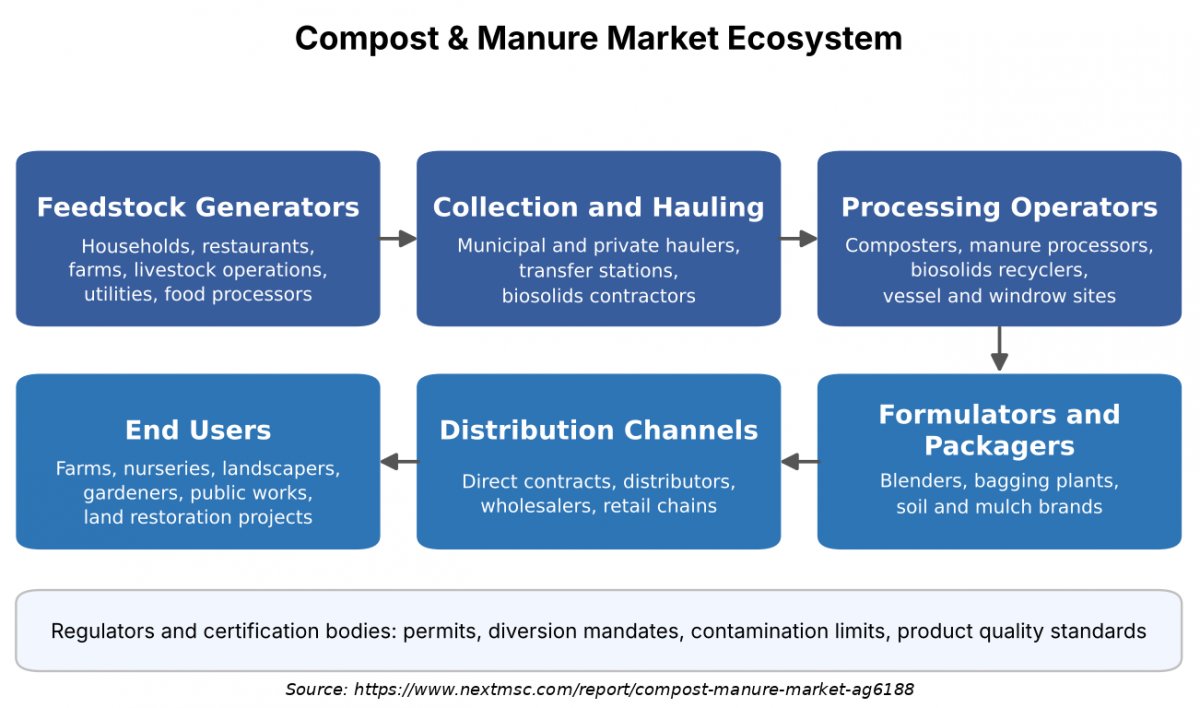
The infographic illustrates the Compost & Manure Market ecosystem across six primary participant groups: feedstock generators, collection/hauling firms, processors, packagers, distribution channels, and end users. Regulators and certification bodies sit across all six groups, because permits, contamination limits, and product quality standards decide which material can enter commerce.

What does the Compost & Manure Market Encompass?

The Compost & Manure Market covers finished compost and manure products made from organic residues, sold in bulk or in bags to farms, landscapers, municipalities, retailers and home gardeners. Compost is the stabilized product of controlled aerobic decomposition, while manure covers raw animal excreta and processed manure that has been dried, composted, pelletized, or otherwise treated. Feedstocks range from yard trimmings and food scraps to biosolids and mushroom residues.
Regulation shapes the scope more than any other force. The European Union has required separate collection of biowaste since 31 December 2023, and California requires cities and counties to procure recovered organic products at 0.08 tons per resident each year. Operators are adopting aerated static piles, enclosed vessels, and depackaging equipment to control odor and contamination, which widens the volume of material that qualifies as compost.

Market Drivers & Dynamics

Interactive Dataset
Mandated organics diversion and food waste separation rules driver +2.6% North America, Europe 2026–2035
Public procurement targets for compost and mulch driver +1.4% North America 2026–2031
Soil health and organic farming demand driver +1.2% Global 2026–2035
Government support for organic manure and compost driver +0.9% Asia-Pacific 2026–2032
Engineered composting and depackaging capacity additions driver +0.8% North America, Europe 2026–2033
PFAS scrutiny of biosolids land application restraint −0.9% North America, Europe 2026–2033
Nutrient application ceilings on livestock manure restraint −0.7% Europe 2026–2035
Contamination in food waste streams and permitting delays restraint −0.6% Global 2026–2032
Source: Next Move Strategy Consulting

Growth Drivers

What Is the Primary Growth Driver in the Compost & Manure Market?

Mandated organics diversion is the primary growth driver. Directive (EU) 2025/1892 entered into force on 16 October 2025 under the revised EU Waste Framework Directive. It mandates binding 2030 food waste reduction targets of 10% in processing and 30% per capita in retail and households. In the United States, only 2.6 million tons of food waste were composted in 2018, equal to 4.1% of wasted food, which shows how much feedstock remains uncaptured.

How Is Soil Health Demand Driving Market Growth?

Based on our analysis, we observed that farmers and public agencies increasingly utilize compost and manure as high-value soil health inputs rather than disposal outputs. U.S. certified organic cropland reached 3.631 million acres across 17,445 farms in 2021, with sales of USD 11.2 billion, and organic systems depend on these inputs. India pays market development assistance of Rs 1,500 per tonne on fermented, liquid, and phosphate-rich organic manure, which supports adoption among smallholders.

Growth Inhibitors

What Is Restraining the Compost & Manure Market?

Contamination and nutrient limits are the main restraints. EPA published a draft risk assessment on PFOA and PFOS in biosolids on 14 January 2025, finding that risks may exceed acceptable thresholds in some scenarios, which clouds land application of biosolids. In the Netherlands, 2025 livestock manure phosphate production exceeded its national ceiling of 135 million kg, restricting how much manure farms can apply.

Segmentation Analysis

2025 (USD Billion)
2035 (USD Billion)
Compost 2025: $7.24 Billion | 2035: $16.40 Billion
Compost
Manure 2025: $5.28 Billion | 2035: $11.01 Billion
Manure
Raw Manure 2025: $2.95 Billion | 2035: $5.21 Billion
Raw Manure
Processed Manure 2025: $2.33 Billion | 2035: $5.80 Billion
Processed Ma
Compost $7.24 Billion $16.40 Billion 8.53%
Manure $5.28 Billion $11.01 Billion 7.61%
Raw Manure $2.95 Billion $5.21 Billion 5.82%
Processed Manure $2.33 Billion $5.80 Billion 9.51%

Which Product Type Leads the Compost & Manure Market?

Compost leads with USD 7.24 Billion in 2025 and is expected to reach USD 16.40 Billion by 2035, because municipal diversion programs keep supplying it with predictable volume. Manure grows more slowly at 7.61%, held back by Raw Manure at 5.82%, since nutrient application limits cap farm spreading. Processed Manure is the faster segment at 9.51%, as drying and pelletizing make the product transportable to buyers beyond the livestock region.

2025 (USD Billion)
2035 (USD Billion)
Category A
Category B
Category C
Category D
Segment Item 2025 (USD Billion) 2035 (USD Billion) CAGR
Category A $10.0 USD Billion $40.0 USD Billion 25.0%
Category B $17.1 USD Billion $51.1 USD Billion 27.0%
Category C $24.2 USD Billion $62.2 USD Billion 9.0%
Category D $31.3 USD Billion $73.3 USD Billion 19.0%

Segment-wise data is locked

Unlock complete segment-wise numbers for By Source Material.

Unlock Full Data
2025 (USD Billion)
2035 (USD Billion)
Category A
Category B
Category C
Category D
Segment Item 2025 (USD Billion) 2035 (USD Billion) CAGR
Category A $10.0 USD Billion $40.0 USD Billion 9.0%
Category B $17.1 USD Billion $51.1 USD Billion 11.0%
Category C $24.2 USD Billion $62.2 USD Billion 21.0%
Category D $31.3 USD Billion $73.3 USD Billion 15.0%

Segment-wise data is locked

Unlock complete segment-wise numbers for By Product Form.

Unlock Full Data
2025 (USD Billion)
2035 (USD Billion)
Category A
Category B
Category C
Category D
Segment Item 2025 (USD Billion) 2035 (USD Billion) CAGR
Category A $10.0 USD Billion $40.0 USD Billion 24.0%
Category B $17.1 USD Billion $51.1 USD Billion 10.0%
Category C $24.2 USD Billion $62.2 USD Billion 8.0%
Category D $31.3 USD Billion $73.3 USD Billion 14.0%

Segment-wise data is locked

Unlock complete segment-wise numbers for By Sales Channel.

Unlock Full Data
2025 (USD Billion)
2035 (USD Billion)
Category A
Category B
Category C
Category D
Segment Item 2025 (USD Billion) 2035 (USD Billion) CAGR
Category A $10.0 USD Billion $40.0 USD Billion 26.0%
Category B $17.1 USD Billion $51.1 USD Billion 16.0%
Category C $24.2 USD Billion $62.2 USD Billion 18.0%
Category D $31.3 USD Billion $73.3 USD Billion 8.0%

Segment-wise data is locked

Unlock complete segment-wise numbers for By End User.

Unlock Full Data

Supply Chain Analysis of the Compost & Manure Industry

Supply Chain Analysis of the Compost & Manure Industry
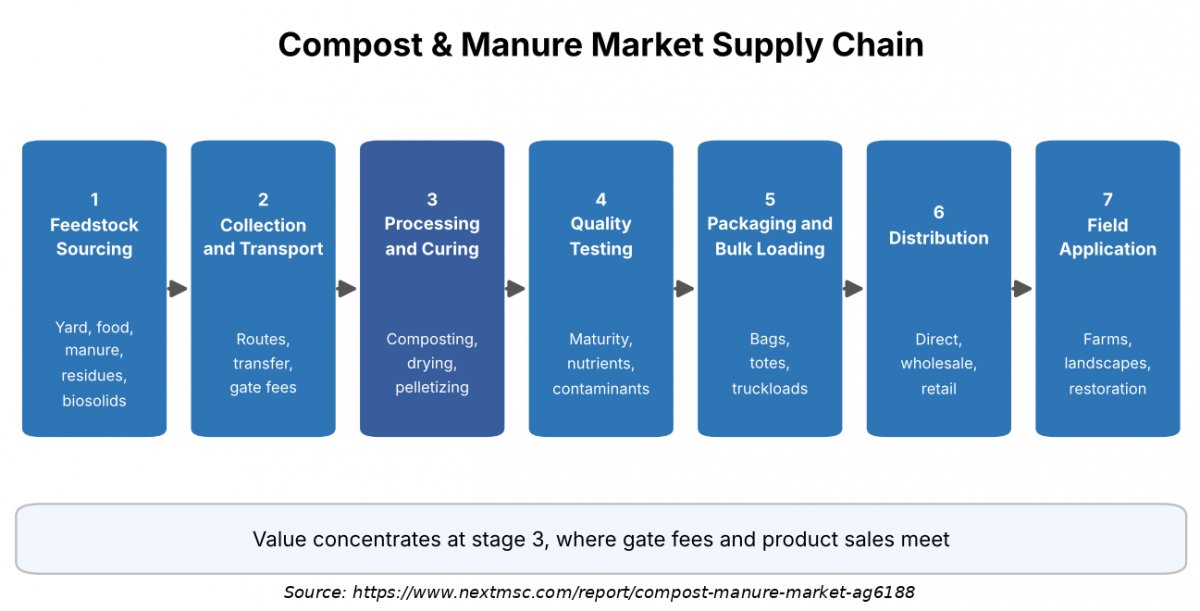
The above infographic maps the Compost & Manure Market supply chain across feedstock sourcing, collection and transport, processing and curing, quality testing, packaging and bulk loading, distribution, and field application. Value concentrates at the processing stage, where operators earn gate fees on incoming material and product revenue on outgoing compost, so site permits and tipping fee contracts shape profitability more than finished product pricing.

Growth Opportunities

Our analysis shows that three structural opportunities are positioned to generate outsized revenue gains through 2035.

Can Food Waste-Based Compost Capture the Largest Feedstock Gap?

Food scraps are the largest uncaptured feedstock in the Compost & Manure Market because only 4.1% of wasted food was composted in the United States in 2018. Processors that secure separate collection contracts and depackaging capacity can grow Food Waste volume from USD 1.35 Billion in 2026 to USD 3.43 Billion by 2035, with industrial composters and municipal haulers as the main beneficiaries.

Does Packaged Retail Compost Offer a Premium Margin Opportunity?

Retail revenue rises from USD 2.98 Billion in 2026 to USD 7.04 Billion by 2035, and Home Gardening grows at 9.38%. Branded bagged compost with labeled nutrient analysis commands higher realized prices per ton than bulk loads, so consumer brands such as The Scotts Miracle-Gro Company and regional bagging operators gain the most.

Can Land Restoration and Public Works Demand Anchor Bulk Volumes?

Land Restoration grows at 10.50% and Municipal and Public Works at 8.56%, creating contracted bulk demand for roadside, mine site, and park projects. Large composters with regional logistics reach, such as Republic Services, Recology and Agromin, can convert public procurement into multiyear supply agreements, while smaller processors can win local park and roadside contracts.

Regional Outlook

2025 (USD Billion)
2035 (USD Billion)
North Americ
Europe
Asia-Pacific
Middle East
Latin Americ
Region 2025 (USD Billion) 2035 (USD Billion) CAGR (%)
North America $10.0 USD Billion $40.0 USD Billion 9.0%
Europe $17.1 USD Billion $51.1 USD Billion 27.0%
Asia-Pacific $24.2 USD Billion $62.2 USD Billion 25.0%
Middle East & Africa $31.3 USD Billion $73.3 USD Billion 23.0%
Latin America $38.4 USD Billion $84.4 USD Billion 12.0%

Regional data is locked

Unlock complete regional numbers for this market.

Unlock Full Data

Competitive Landscape

Our assessment indicates that the industry is moderately fragmented, with national waste majors competing against regional composters and specialist biosolids firms.

Dimension Description
Market Structure Moderately fragmented, with integrated waste majors holding the largest permitted capacity and regional composters and biosolids specialists serving local markets
Innovation Focus Covered and engineered processing, depackaging, larger permitted sites, and packaged product ranges
M&A Activity Infrastructure investor acquisitions, platform roll-ups of regional composters and asset swaps between biosolids specialists

How Do Companies Compete in the Compost & Manure Market?

Companies in the Compost & Manure Market compete on permitted capacity, collection route density, contamination control and product quality. Republic Services reported processing more than 1.1 million tons of food and yard waste in 2025 and a California network producing about 20,000 tons of compost per month. Agromin operates 21 processing and composting facilities in California and sells more than 300 soil products, which shows how breadth of product range supports pricing.

Which Competitive Archetypes Dominate the Compost & Manure Market?

Three archetypes dominate: integrated waste management majors such as Waste Management, Inc., Republic Services, Inc., Veolia Environnement S.A. and REMONDIS SE & Co. KG, which pair collection with processing; specialist organics recyclers such as Agromin Corporation and A1 Organics LLC, which differentiate on product range; and biosolids specialists such as Synagro Technologies, Inc. and Denali Water Solutions LLC, which serve utilities under long contracts.

What Innovation and Differentiation Strategies Are Companies Pursuing?

We observed that leading operators are investing in covered processing, depackaging, and capacity expansion rather than product novelty. Recology expanded its Aumsville facility by 25,000 tons of annual organics acceptance in 2025, and Synagro invested about USD 50 million in two biosolids composting facilities in 2024 with combined output near 78,000 tons per year. Veolia opened a Zaragoza plant that converts sewage sludge and rural residues into agricultural compost.

What M&A and Partnership Activity Is Shaping the Market?

Our findings suggest that consolidation is moving from waste majors toward infrastructure investors and platform builders. Macquarie Asset Management and BCI completed the acquisition of Renewi in June 2025, Circular Services bought Atlas Organics in November 2025, and Synagro and Denali exchanged assets in August 2024. In Colorado, three composting firms combined under the Compost Colorado brand, a pattern that favors local density.

Key Market Players

Based on research conducted by NMSC, the following 20 companies represent the validated leadership set across the Compost & Manure Market.

Waste Management, Inc. Recology Inc. Veolia Environnement S.A. Agromin Corporation REMONDIS SE & Co. KG Denali Water Solutions LLC Renewi plc Paprec Group S.A.S. SUEZ S.A. Republic Services, Inc. GFL Environmental Inc. Cleanaway Waste Management Limited Biffa Waste Services Limited CLP Circular Services, Inc. Synagro Technologies, Inc. Casella Waste Systems, Inc. McGill Environmental Systems of NC, Inc. A1 Organics LLC FCC Environment Limited The Scotts Miracle-Gro Company

Latest Developments

During our market evaluation, we noticed that 2025–2026 activity centers on new processing capacity, ownership changes, and rules on contaminants.

Date Event
August 2026 Agromin and Limoneira cleared land for a 70-acre composting center in Santa Paula, California, with capacity of about 295,000 tons per year and operations expected in the second half of 2027.
June 2026 Republic Services started construction of the San Bernardino Sustainability Park, designed for more than 300,000 tons of yard and food waste per year, scalable to 600,000 tons, with opening expected in late 2026.
February 2026 Agromin reported processing more than 1.25 million tons of organic waste in 2025, up 250,000 tons from 2024, across 21 California facilities.

Expert Insights

Priyanka Singh

Priyanka Singh

Programme Lead | CEEW

"Cities need reliable waste data, contracts that reward quality rather than just quantity, assured source-segregated feedstock, and credible offtake markets for compost, fermented organic manure and bio-CNG."

Analyst Interpretation

The statement highlights the importance of developing reliable demand channels for commercially produced compost and organic manure. Consistent feedstock quality, effective processing and established offtake arrangements can help producers improve operational efficiency and market access. As municipalities and waste-processing companies expand organic waste recovery, partnerships with agricultural input distributors and farming communities can strengthen the commercialization of compost and manure. Consequently, we conclude that these developments will accelerate private investment in processing infrastructure and drive overall market expansion.

Investment Opportunities

Where Are Capital Inflows Concentrating in the Compost & Manure Market?

Capital in the Compost & Manure Market is flowing to platform consolidation and regional operators with permitted capacity. Laurel Mountain Capital announced a debt and equity investment in Colorado hauler 5280 Waste Solutions in April 2025, and Macquarie Asset Management and BCI acquired Renewi in June 2025. These transactions show infrastructure and private equity investors valuing contracted feedstock and processing permits.

How Is Infrastructure Investment Shaping Market Capacity?

Infrastructure spending is concentrated in large engineered sites. Republic Services is building a 140 acre site in San Bernardino County with 60 acres for compost operations, and Agromin and Limoneira plan a 70 acre center in Santa Paula with about 295,000 tons of annual capacity. Because permits are slow to obtain, early movers capture contracted feedstock and hold a durable advantage over later entrants.

What ESG Considerations Are Influencing Market Investment?

Environmental, Social, and Governance considerations focus on methane avoidance, soil carbon, contaminant control and circular economy benefits. Recology reported that composting and recycling avoided 1.7 million metric tons of greenhouse gas emissions in its 2025 sustainability update, and UN data show 1.05 billion tonnes of food were wasted in 2022. Investors also screen for PFAS exposure in biosolids and for odor management at urban sites.

Key Benefits for Stakeholders

How Does This Report Benefit Organics Processors and Waste Operators?

Operators gain a reconciled view of demand by product type, source material, product form and channel, which helps them match facility design to the most profitable output. Segment data on Food Waste at 10.92% and Packaged at 9.43% guide feedstock contracting and bagging investment, while regional tables support site selection.

How Does This Report Benefit Investors and Financial Analysts?

Investors and financial analysts gain a Compost & Manure Market base of USD 12.52 Billion in 2025, growing to USD 27.41 Billion by 2035, with segment, region and country figures that reconcile to the global total. The report identifies where consolidation is occurring, which end users anchor contracts and which risks, such as PFAS rules and nutrient ceilings, could alter returns.
How Does This Report Benefit Farmers, Landscapers and Public Buyers?

Agricultural, landscaping and municipal buyers gain visibility into supply trends, product forms and sales channels that influence price and availability. Procurement officers can compare how regions treat compost quality and organics mandates, and land managers can identify which end uses are expanding fastest, such as Land Restoration and Home Gardening.

Key Market Segments Evaluated

By Product Type

  • Compost
  • Manure 
    • Raw Manure
    • Processed Manure

By Source Material

  • Green and Yard Waste
  • Food Waste
  • Animal Manure
  • Agricultural Residues
  • Forestry and Wood Residues
  • Biosolids
  • Mushroom Residues
  • Mixed Organic Materials
  • Other Organic Materials

By Product Form

  • Bulk
  • Packaged

By Sales Channel

  • Direct Sales
  • Distributor and Wholesale
  • Retail

By End User

  • Agriculture
  • Horticulture
  • Landscaping and Turf
  • Home Gardening
  • Land Restoration
  • Municipal and Public Works
  • Commercial and Industrial Land Management

By Region

  • North America 
    • U.S.
    • Canada
    • Mexico
  • Europe 
    • UK
    • Germany
    • France
    • Italy
    • Spain
    • Sweden
    • Denmark
    • Finland
    • Netherlands
    • Rest of Europe
  • Asia-Pacific 
    • China
    • India
    • Japan
    • South Korea
    • Taiwan
    • Indonesia
    • Vietnam
    • Australia
    • Philippines
    • Malaysia
    • Rest of APAC
  • Middle East & Africa 
    • Saudi Arabia
    • UAE
    • Egypt
    • Israel
    • Turkey
    • Nigeria
    • South Africa
    • Rest of MEA
  • Latin America 
    • Brazil
    • Argentina
    • Chile
    • Colombia
    • Rest of LATAM

Conclusion & Recommendations

The outlook for the Compost & Manure Market is strongly positive, with revenue expanding from USD 12.52 Billion in 2025 to USD 27.41 Billion by 2035. Growth rests on mandated diversion, soil health demand and new processing capacity, and North America and Europe keep the largest base while Asia-Pacific adds the most momentum at 9.74%. The forecast assumes no sudden reversal in diversion policy.
What Strategic Positioning Recommendations Does NMSC Offer?

Operators should secure feedstock contracts and permits first, then invest in covered processing and contamination control. Integrated waste companies should build product brands and retail relationships, while specialist composters should lock in multiyear public and agricultural offtake. Biosolids handlers should prepare for PFAS limits by testing product consistently and diversifying outlets beyond land application. Every operator should report diversion tonnage and contamination rates transparently, because municipal buyers increasingly award contracts on measured performance.

What Is the Investment Attractiveness of the Compost & Manure Market?

Attractiveness is high, supported by an absolute opportunity of USD 13.87 Billion between 2026 and 2035 and visible transaction activity. Returns are strongest where operators hold permitted capacity close to dense feedstock sources and contracted buyers. Capital intensity and long permitting periods favor patient investors who can hold assets through the ramp up phase.

What Are the Market Shifts and Key Risks in the Compost & Manure Market?

Key shifts include the move from yard waste to food waste feedstock, from open windrows to engineered systems and from bulk to packaged sales. Principal risks are PFAS regulation of biosolids, nutrient application ceilings such as those in the Netherlands, contamination in food waste streams and delays in permitting new sites.

What Are the Primary Growth Pathways Through 2035?

Growth pathways include food waste recovery at 10.92%, retail packaged product at 10.02%, land restoration contracts at 10.50% and processed manure at 9.51%. Regional expansion in Asia-Pacific and Latin America adds volume, and consolidation among regional operators improves utilization and pricing. Together these pathways explain why the market roughly doubles between 2026 and 2035.

FAQs

Sources & References

1.

U.S. Environmental Protection Agency, Draft Risk Assessment for PFOA and PFOS in Biosolids (January 14, 2025)

19january2025snapshot.epa.gov
2.

U.S. Environmental Protection Agency, National Overview: Facts and Figures on Materials, Wastes and Recycling (data year 2018)

epa.gov
3.

CalRecycle, SB 1383 Recovered Organic Waste Product Procurement

calrecycle.ca.gov
4.

European Parliament Legislative Observatory, Directive (EU) 2025/1892 summary

oeil.europarl.europa.eu
5.

European Compost Network, Factsheet on the Waste Framework Directive

compostnetwork.info
6.

United Nations, UNEP Food Waste Index Report 2024 coverage (UN News)

news.un.org/en/node/1148036
7.

Lok Sabha Secretariat, Unstarred Question No. 1160 (July 30, 2024)

eparlib.nic.in
8.

USDA National Agricultural Statistics Service, Organic Survey briefing (December 15, 2022)

data.nass.usda.gov
9.

Statistics Netherlands (CBS), Livestock manure nitrogen and phosphate production 2025

cbs.nl
10.

Macquarie Asset Management, Completion of acquisition of Renewi (June 6, 2025)

macquarie.com
11.

Energy Capital Partners, Completion of acquisition of Biffa (January 2023)

ecpgp.com
12.

Republic Services Investor Relations, San Bernardino Sustainability Park (June 18, 2026)

investor.republicservices.com/node/30401
13.

Recology, 2025 Sustainability Update (June 24, 2025)

recology.com
14.

Synagro Technologies, Synagro and Denali asset transfer agreement (August 22, 2024)

synagro.com
15.

Veolia, Completion of the sale of the new Suez (February 1, 2022)

veolia.com
16.

Invest in Spain, Veolia Zaragoza composting and biomass plant (2026)

investinspain.org
17.

GlobeNewswire, OC Waste & Recycling partners with Agromin (January 13, 2026)

globenewswire.com
18.

Fertilizer Daily, Agromin composts 1.25 million tons of organic waste in 2025 (February 20, 2026)

fertilizerdaily.com
19.

Fertilizer Daily, Agromin and Limoneira advance 70 acre composting center (August 13, 2026)

fertilizerdaily.com
20.

Waste Dive, Circular Services acquires Atlas Organics (November 6, 2025)

wastedive.com
21.

Waste Dive, Synagro opens composting facilities in New Jersey and South Carolina (June 28, 2024)

wastedive.com
22.

BioCycle, Colorado composting services expand through investment and consolidation (January 20, 2026)

biocycle.net
23.

Organic Grower, Republic Services compost production in California (June 18, 2026)

organicgrower.info

About the Author

Mayurima Roy

Mayurima Roy

Mayurima Roy is Research Analyst at Next Move Strategy Consulting, where she has spent 4 years working across the firm's full industry coverage rather than a single fixed vertical. Her work centers on structured research, ongoing trend tracking, competitive assessment, and insight-led content development, translating complex market data into clear, decision-ready narratives that support informed client decision-making across diverse global industries, market sectors, and world regions every day.

About the Reviewer

Supradip Baul

Supradip Baul

Supradip Baul is an accomplished business consultant and strategist with over a decade of rich experience in market intelligence, strategy, technology, and business transformation. His work has included rigorous qualitative and quantitative analysis across multiple industries, helping clients shape investment decisions and long-term roadmaps. Earlier in his career, he was associated with Gartner, where he contributed to industry-leading reports and market share analyses. He has worked with leading global companies and holds an MBA with a dual specialization in Marketing and Finance.

Download Free Sample

Gaurav Jaiswal

GAURAV JAISWAL

Founder & CEO

Yano Charge Private Limited

The EV Charging market research report provided by the NextMSC was exceptionally detailed and insightful. It offered a comprehensive analysis that proved to be a game-changer for our strategic planning. Truly a testament to the NextMSC’s expertise and thoroughness in EV market landscape & analysis.

Mohit Agarwal

MOHIT AGARWAL

Chief Manager

DryChem India Pvt. Ltd.

Next Move Strategy Consulting is an amazing team of consultants. We required a market study report for our investors on top priority and the team went above and beyond our expectations to deliver the same with ample supporting data within a short time span enabling us to secure the investments and keep our project timeline maintained. Their professionalism, attention to detail, and timely delivery of actionable recommendations have left a lasting impression on our organization.

Semih Kavaklioglu

SEMIH KAVAKLIOGLU

Co-Founder & Sales Manager

Decortie

I work a lot in the marketing industry and I know that research is an essential part of any campaign. I have used Market research reports for my own products and I found them to be very informative and well-researched. The team here produces insightful reports for a good price

Robert Sean Trevino

ROBERT SEAN TREVINO

Sr. Director, Head of Strategic Insights & Analytics

Foundation Medicine

I realized that it was a reliable source of information. These days, there are many people who are looking for authentic data, and this is one of the only sources that can offer them with what they need;

Rishabh Jogani

RISHABH JOGANI

Strategy Analyst

Accenture Japan

We are incredibly impressed with the market report on the real estate market in India provided by Next Move Strategy Consulting. The report was thorough, insightful, and well-structured, offering deep analysis and actionable recommendations. It not only captured the current trends and dynamics but also provided a forward-looking perspective that has been invaluable for our strategic planning. Their team demonstrated exceptional professionalism, attention to detail, and a profound understanding of the industry. The data-driven insights and clarity of presentation exceeded our expectations, making complex market trends easy to understand. We highly recommend Next Move Strategy Consulting to anyone looking for reliable and comprehensive market research services. Their expertise has given us the confidence to navigate the complexities of the Indian real estate market with clarity and foresight.

Custom Market Research Services

We will customize the research for you if the listed report does not fully match your requirements.

Get 30% Free Customization

Select License

This website uses cookies to ensure you get the best experience on our website. Learn more

✖