Compost and Top Soil Market Global Industry Analysis and Forecast (2026–2035)

The global Compost and Top Soil Market size was valued at USD 9.72 billion in 2025 and is estimated at USD 11.16 billion in 2026, forecast to reach USD 19.38 billion by 2035, expanding at a 7.14% CAGR between 2026 and 2035. North America leads with approximately 36% share, while Compost dominates all other product types with approximately 47% share.
Download Free Sample PDF
Base Year (2025)
$9.72 Billion
Forecast (2035)
$19.38 Billion
CAGR (2026-2035)
7.1%
Top Region
North America

What Is the Compost and Top Soil Market Size?
The global compost and top soil market size was valued at USD 9.72 billion in 2025 and is estimated at USD 11.16 billion in 2026, forecast to reach USD 19.38 billion by 2035, expanding at a 7.14% CAGR between 2026 and 2035. North America leads with approximately 36% share, while compost dominates all other product types with approximately 47% share.

We observed that growth is broad-based across every segmentation axis, with food and organic waste-derived compost and online retail distribution driving the dominant structural shifts through 2035.

Compost and Top Soil Market Global Industry Analysis and Forecast (2026–2035) Revenue Forecast
Values in USD Billion

2025 $9.72 Billion
2025
2026 $11.16 Billion
2026
2027 $11.96 Billion
2027
2028 $12.81 Billion
2028
2029 $13.73 Billion
2029
2030 $14.71 Billion
2030
2031 $15.76 Billion
2031
2032 $16.88 Billion
2032
2033 $18.09 Billion
2033
2034 $19.38 Billion
2034
2035 $19.38 Billion
2035

Key Takeaways

By Product Type: Compost held the largest share of approximately 47% (USD 4.57 Billion) in 2025; Growing Media Blends is the fastest-growing sub-segment at 8.1% CAGR from 2026–2035.

By Source Material: Yard and Green Waste held the largest share of approximately 44% (USD 4.28 Billion) in 2025; Food and Organic Waste is the fastest-growing sub-segment at 9.1% CAGR from 2026–2035.

By Application: Agriculture held the largest share of approximately 29% (USD 2.82 Billion) in 2025; Erosion Control and Land Reclamation is the fastest-growing sub-segment at 8.6% CAGR from 2026–2035.

By Distribution Channel: Direct Sales (Bulk) held the largest share of approximately 41% (USD 3.98 Billion) in 2025; Online Retail is the fastest-growing sub-segment at 12.1% CAGR from 2026–2035.

Dominant Region: North America dominated with approximately 36% revenue share (USD 3.50 billion) in 2025.

Fastest-Growing Region: Asia-Pacific is expected to register the highest CAGR of 9.1% during 2026–2035.

Dominant Country: U.S. led with approximately USD 2.87 billion in 2025.

Fastest-Growing Country: India is the fastest-growing country at approximately 12.1% CAGR from 2026–2035.

Market Opportunity: The compost and top soil market is expected to create an absolute dollar opportunity of USD 8.22 billion between 2026 and 2035, presenting significant investment potential across the organic waste diversion and soil amendment value chain.

According to Next Move Strategy Consulting analysis, manufacturers are increasingly reformulating bagged topsoil and garden soil products around peat-free, compost-based organic matter to meet both regulatory phase-out requirements and consumer demand for OMRI-listed organic gardening inputs, a shift that favors producers with diversified organic feedstock sourcing over peat-dependent legacy formulations through 2035.

What Does the Compost and Top Soil Market Encompass?
The compost and top soil market encompasses organic soil amendments, engineered topsoil blends, and growing media produced from yard waste, food waste, biosolids, and other organic feedstocks for agricultural, landscaping, horticultural, and residential gardening applications. Our assessment indicates that the scope spans bulk and bagged compost, topsoil, and growing media blends supplied through direct sales, retail garden centers, and landscaping contractor channels, distinct from organic fertilizers and standalone chemical soil additives that fall outside this market's defined scope.

SUPPLY CHAIN STRUCTURE OF THE COMPOST AND TOP SOIL MARKET

SUPPLY CHAIN STRUCTURE OF THE COMPOST AND TOP SOIL MARKET
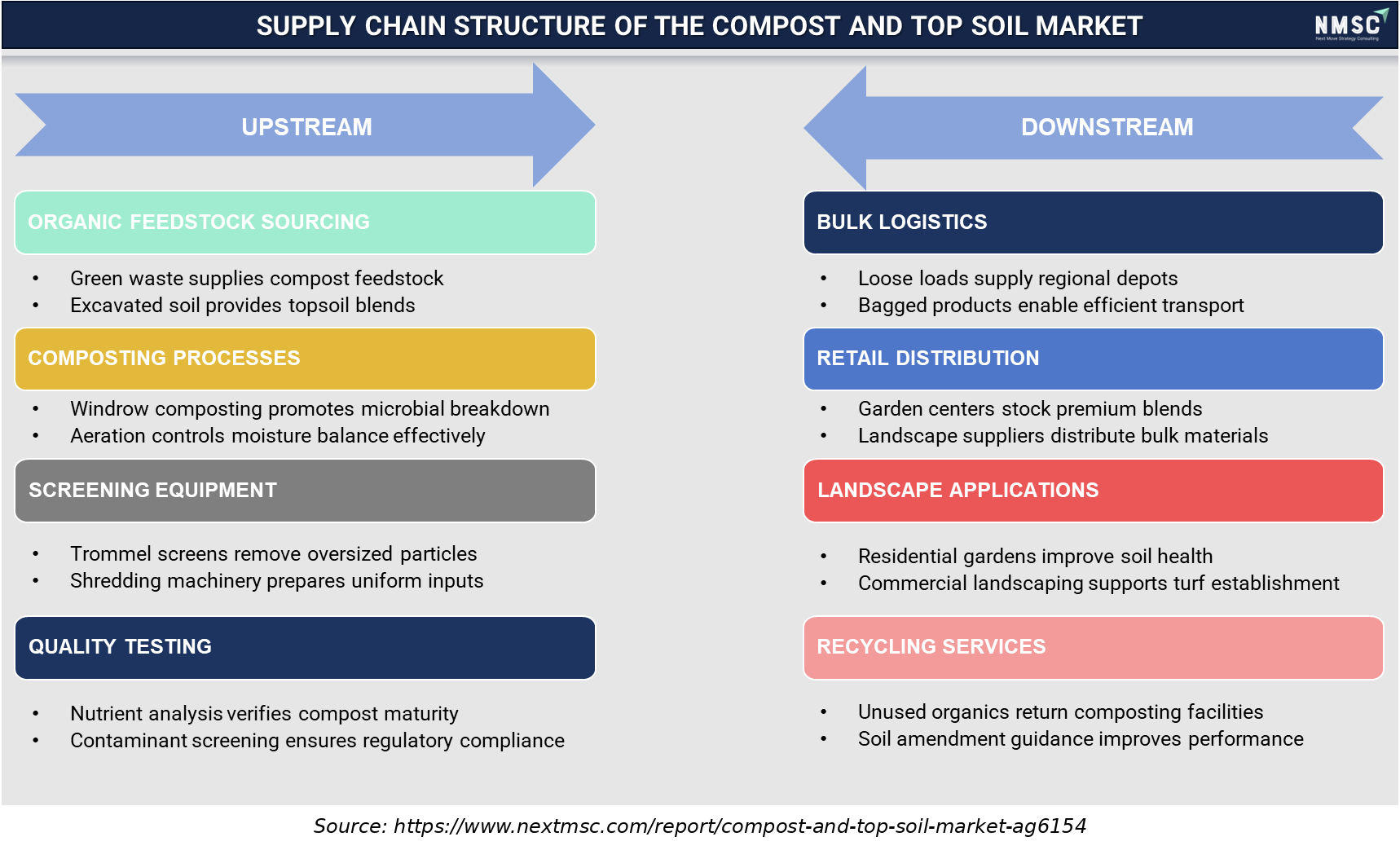
The supply chain of the compost and top soil market begins with sourcing organic feedstock and excavated soil, followed by composting, screening, and quality testing to ensure nutrient content and regulatory compliance. Processed materials are then transported through bulk logistics and distributed via garden centers and landscape suppliers. The end-use includes residential and commercial landscaping, while recycling services return organic waste to composting facilities, supporting a circular and sustainable soil management ecosystem.

Market Drivers & Dynamics

Interactive Dataset
Expanding municipal organic waste diversion and composting infrastructure driver +1.9% North America, Europe 2026–2035
Rising consumer demand for organic and peat-free gardening products driver +1.6% Europe, North America 2026–2035
Growing urban gardening and outdoor living space investment driver +1.2% Global 2026–2032
Expanding commercial landscaping and turf maintenance activity driver +1.0% Global 2026–2035
Rising agricultural adoption of compost-based soil health programmes driver +0.8% Asia-Pacific, Latin America 2026–2035
Government soil health and organic waste diversion policy support driver +0.6% Global 2026–2035
EU peat phase-out compliance costs for growing media manufacturers restraint −0.9% Europe 2026–2032
Seasonal and weather-dependent demand volatility restraint −0.6% Global 2026–2035
Transportation cost sensitivity for bulk, low-value soil products restraint −0.4% Global 2028–2035
Source: Next Move Strategy Consulting

Growth Drivers

What Is the Primary Growth Driver of the Compost and Top Soil Market?

Expanding municipal organic waste diversion and composting infrastructure is the primary driver of the market. U.S. Environmental Protection Agency data continues to track rising municipal solid waste diversion rates as cities expand curbside organics collection programmes. We observed that this infrastructure expansion, reinforced by state and municipal organic waste disposal bans in several jurisdictions, continues to anchor baseline feedstock supply and demand for compost products across developed economies.

How Is Consumer Demand for Organic Products Driving Compost and Top Soil Market Growth?
Rising consumer demand for organic and peat-free gardening products is accelerating market growth toward certified, sustainably sourced soil amendments. UK government policy documentation continues to reference the planned phase-out of peat in amateur horticulture as part of national environmental strategy. Our assessment indicates that this regulatory and consumer alignment, combined with expanding OMRI-certified product lines, is compressing adoption timelines for peat-free growing media across Europe and North America.

Growth Inhibitors

What Is Restraining Compost and Top Soil Market Expansion?
EU peat phase-out compliance costs restrain margin stability among growing media manufacturers required to reformulate products around alternative substrates. European environmental policy documentation continues to require phased amateur peat use reduction through 2030, creating reformulation and sourcing costs for affected manufacturers. We found that manufacturers investing early in coir, wood fiber, and compost-based alternatives are beginning to offset this restraint, though full transition across the industry remains gradual.

Segmentation Analysis

2025 (USD Billion)
2035 (USD Billion)
Compost 2025: $4.57 Billion | 2035: $9.43 Billion
Compost
Top Soil 2025: $3.50 Billion | 2035: $6.13 Billion
Top Soil
Growing Media Blends 2025: $1.65 Billion | 2035: $3.82 Billion
Growing Medi
Compost $4.57 Billion $9.43 Billion 6.7%
Top Soil $3.50 Billion $6.13 Billion 4.8%
Growing Media Blends $1.65 Billion $3.82 Billion 8.1%

Which Product Type Segment Dominates the Compost and Top Soil Market?

Compost led the market with USD 4.57 billion in 2025, supported by its dual role as both a standalone soil amendment and a key ingredient in blended garden soil and growing media products. We observed that Growing Media Blends is the fastest-growing product type, expanding at an 8.1% CAGR from 2026 to 2035, as manufacturers increasingly formulate engineered, application-specific blends combining compost, topsoil, and peat-free additives for container and raised-bed gardening.

2025 (USD Billion)
2035 (USD Billion)
Yard and Gre
Food and Org
Biosolids an
Other Feedst
Segment Item 2025 (USD Billion) 2035 (USD Billion) CAGR
Yard and Green Waste $10.0 USD Billion $40.0 USD Billion 12.0%
Food and Organic Waste $17.1 USD Billion $51.1 USD Billion 14.0%
Biosolids and Manure $24.2 USD Billion $62.2 USD Billion 8.0%
Other Feedstocks $31.3 USD Billion $73.3 USD Billion 10.0%

Segment-wise data is locked

Unlock complete segment-wise numbers for By Source Material.

Unlock Full Data
2025 (USD Billion)
2035 (USD Billion)
Agriculture
Landscaping
Horticulture
Residential
Erosion Cont
Segment Item 2025 (USD Billion) 2035 (USD Billion) CAGR
Agriculture $10.0 USD Billion $40.0 USD Billion 15.0%
Landscaping and Turf $17.1 USD Billion $51.1 USD Billion 21.0%
Horticulture and Nursery $24.2 USD Billion $62.2 USD Billion 11.0%
Residential Gardening $31.3 USD Billion $73.3 USD Billion 21.0%
Erosion Control and Land Reclamation $38.4 USD Billion $84.4 USD Billion 14.0%

Segment-wise data is locked

Unlock complete segment-wise numbers for By Application.

Unlock Full Data

Which Application Segment Leads Compost and Top Soil Market Demand?
Agriculture remained the leading application, valued at USD 2.82 billion in 2025 as farmers increasingly adopt compost-based soil health programmes to reduce synthetic fertilizer dependency. Based on research conducted by Next Move Strategy Consulting, we found that Erosion Control and Land Reclamation is the fastest-growing application at an 8.6% CAGR from 2026 to 2035, reflecting expanding infrastructure and land restoration project investment requiring engineered soil amendments.

2025 (USD Billion)
2035 (USD Billion)
Direct Sales
Retail and G
Landscaping
Online Retai
Segment Item 2025 (USD Billion) 2035 (USD Billion) CAGR
Direct Sales (Bulk) $10.0 USD Billion $40.0 USD Billion 8.0%
Retail and Garden Centers $17.1 USD Billion $51.1 USD Billion 10.0%
Landscaping Contractors $24.2 USD Billion $62.2 USD Billion 20.0%
Online Retail $31.3 USD Billion $73.3 USD Billion 10.0%

Segment-wise data is locked

Unlock complete segment-wise numbers for By Distribution Channel.

Unlock Full Data

Which Distribution Channel Leads Compost and Top Soil Adoption?

Direct Sales (Bulk) remained the dominant distribution channel, reaching USD 3.99 billion in 2025 due to its cost efficiency for large-volume agricultural, landscaping, and municipal buyers. Our findings suggest that Online Retail is the fastest-growing distribution channel at a 12.1% CAGR from 2026 to 2035, reflecting rising residential gardening consumer preference for home-delivered bagged compost and topsoil products.

2025 (USD Billion)
2035 (USD Billion)
North Americ
Canada
Mexico
Europe: UK
Germany
Segment Item 2025 (USD Billion) 2035 (USD Billion) CAGR
North America: U.S. $10.0 USD Billion $40.0 USD Billion 25.0%
Canada $17.1 USD Billion $51.1 USD Billion 19.0%
Mexico $24.2 USD Billion $62.2 USD Billion 17.0%
Europe: UK $31.3 USD Billion $73.3 USD Billion 15.0%
Germany $38.4 USD Billion $84.4 USD Billion 16.0%

Segment-wise data is locked

Unlock complete segment-wise numbers for By Region.

Unlock Full Data

Growth Opportunities

Our analysis shows that three forward-looking opportunities stand out for stakeholders positioning within the compost and top soil market over the 2026–2035 forecast period.

How Can Biofertilizer-Enriched Compost Unlock Value for Agricultural Buyers?

Biofertilizer-enriched compost presents a whitespace opportunity for manufacturers targeting agricultural buyers seeking to combine soil structure improvement with microbial nutrient enhancement. Suppliers that integrate biofertilizer technology into compost formulations stand to capture premium pricing as farmers pursuing soil health programmes seek combined amendment and biological input products rather than sourcing each separately.

Where Does Municipal Organics Processing Create New Demand?

Municipalities expanding curbside organics collection represent an underpenetrated opportunity for compost producers seeking stable, low-cost feedstock supply agreements. Suppliers that establish processing partnerships with municipal waste authorities can secure long-term feedstock access while producing certified compost for landscaping and agricultural resale, benefiting from expanding organic waste diversion mandates across major metropolitan markets.

How Can Certified Organic Product Lines Benefit Retail-Focused Manufacturers?

Retail-focused manufacturers seeking premium shelf positioning create an opportunity through expanded OMRI-certified and peat-free product lines. Early movers that scale documented organic certification across bagged compost and topsoil products can differentiate with retail garden center and online retail buyers pursuing verified sustainability credentials for residential gardening and small-scale horticultural applications.

CONSUMER BEHAVIOR ANALYSIS OF THE COMPOST AND TOP SOIL MARKET

CONSUMER BEHAVIOR ANALYSIS OF THE COMPOST AND TOP SOIL MARKET

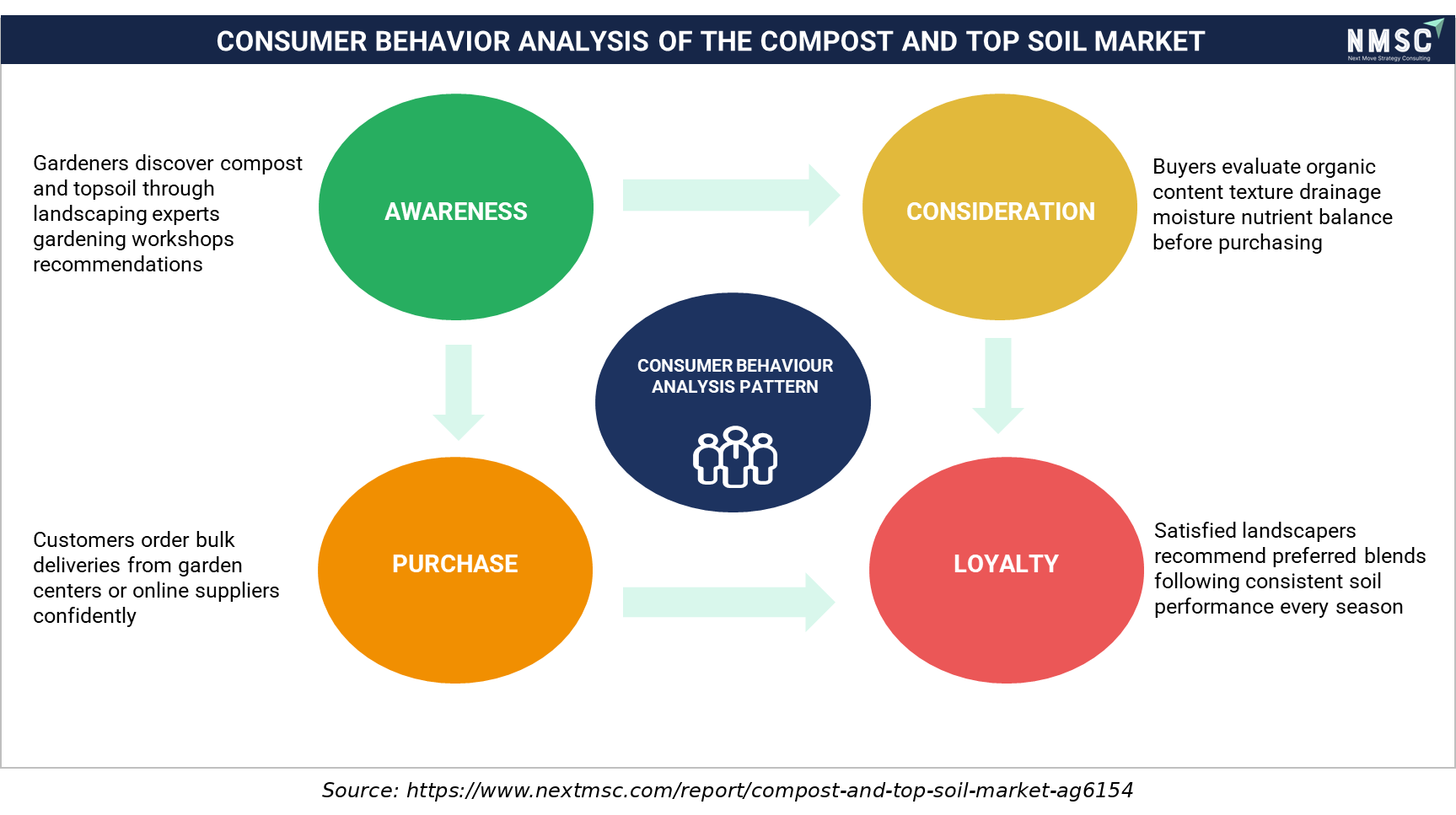
Consumer behavior in the compost and top soil market follows a four-stage journey: awareness, consideration, purchase, and loyalty. Buyers first learn about products through gardening experts, workshops, landscaping professionals, and recommendations. During evaluation, they compare organic content, texture, drainage, moisture retention, and nutrient balance. Purchases are made through garden centers or online suppliers, while consistent product quality and soil performance encourage repeat purchases and positive word-of-mouth recommendations.

Regional Outlook

2025 (USD Billion)
2035 (USD Billion)
North Americ
Europe
Asia-Pacific
Middle East
Latin Americ
Region 2025 (USD Billion) 2035 (USD Billion) CAGR (%)
North America $10.0 USD Billion $40.0 USD Billion 9.0%
Europe $17.1 USD Billion $51.1 USD Billion 27.0%
Asia-Pacific $24.2 USD Billion $62.2 USD Billion 25.0%
Middle East & Africa $31.3 USD Billion $73.3 USD Billion 23.0%
Latin America $38.4 USD Billion $84.4 USD Billion 12.0%

Regional data is locked

Unlock complete regional numbers for this market.

Unlock Full Data

Competitive Landscape

We observed that the compost and top soil market remains moderately fragmented among diversified consumer garden product companies and regional waste management-affiliated compost producers competing for retail and municipal contract accounts.

Dimension Description
Market Structure Moderately fragmented, led by diversified garden product companies and regional compost producers
Innovation Focus Peat-free reformulation, OMRI organic certification, and municipal organics processing capacity
M&A Activity Moderate, concentrated in regional composting facility acquisitions and waste management integration

How Do Companies Compete in the Compost and Top Soil Market?

Companies compete primarily on feedstock sourcing scale, organic certification breadth, and retail distribution reach across the industry. Diversified garden product companies such as The Scotts Miracle-Gro Company and Central Garden & Pet Company leverage broad retail relationships to distribute branded bagged compost and topsoil, while waste management-affiliated producers such as WM and Republic Services, Inc. compete on bulk composting capacity tied to municipal organics collection contracts.

Which Competitive Archetypes Dominate the Compost and Top Soil Market?

Two archetypes dominate the market: diversified consumer garden product companies offering branded, retail-distributed compost and soil products, and waste management-affiliated producers converting municipal organic waste into bulk compost. The Scotts Miracle-Gro Company and Kellogg Garden Products exemplify the consumer brand archetype through OMRI-certified retail product lines, while WM and Republic Services, Inc. exemplify the waste management archetype through large-scale organics processing infrastructure.

How Are Companies Differentiating Through Innovation in Compost and Top Soil?

Innovation and differentiation strategy increasingly center on peat-free formulation and documented organic certification. The Scotts Miracle-Gro Company's Miracle-Gro Organic Garden Soil, combining organic compost with upcycled green waste and OMRI listing, exemplifies how manufacturers are reformulating flagship product lines around sustainability credentials. Our analysis shows that producers unable to demonstrate peat-free or certified organic formulations risk losing shelf space to competitors with validated sustainability positioning.

What M&A and Expansion Activity Is Shaping the Compost and Top Soil Market?

Composting facility expansion and organics processing capacity investment continue to shape competitive positioning within the industry. Waste management companies including WM and Republic Services, Inc. continue to expand organics processing infrastructure to convert growing municipal organic waste diversion volumes into commercial compost products, illustrating how feedstock supply expansion is becoming a strategic capacity investment priority across the sector.

Key Market Players

Our assessment indicates that the following 15 companies are actively shaping product innovation, feedstock sourcing, and commercial strategy within the global compost and top soil market.

The Scotts Miracle-Gro Company Central Garden & Pet Company Kellogg Garden Products Sun Gro Horticulture Distribution, Inc. Michigan Peat Company Premier Tech Ltd. Klasmann-Deilmann GmbH WM (Waste Management, Inc.) Republic Services, Inc. Recology Inc. A1 Organics, Inc. Atlas Organics, Inc. Vital Earth Resources Coast of Maine Organic Products, Inc. Purple Cow Organics

Latest Developments

We found that recent activity within the compost and top soil market is concentrated on organic product reformulation and peat-free certification expansion, reflecting the industry's response to regulatory and consumer sustainability demand.

Date Event
April 2024 ScottsMiracle-Gro launched Miracle-Gro Organic Raised Bed & Garden Soil, an organic, peat-free soil blend formulated with upcycled green waste and locally crafted near retail locations. The product is designed for both raised-bed and in-ground gardening, simplifying product selection for home gardeners while supporting the company’s sustainability efforts.

Expert Insights

Peter Burks

CEO | Garden Centre Association

"The Garden Centre Association is determined to provide our customers with the best advice on how to use these new peat-free composts successfully. It is so important for all gardeners to have confidence in the products that are now available to them to ensure they continue having a great time growing plants in their homes and gardens."

Analyst Interpretation

This statement highlights the accelerating transition from peat-based compost to sustainable peat-free growing media, a major structural trend shaping the global compost and topsoil market. Increasing environmental regulations, retailer education, and consumer demand for sustainable gardening products are driving manufacturers to invest in composts produced from green waste, bark, wood fibre, composted organics, and other renewable materials. The shift is expected to stimulate innovation and expand demand for eco-friendly soil amendments across residential and commercial horticulture.

Investment Opportunities

What Capital Inflows Are Targeting the Compost and Top Soil Market?

Capital inflows into the compost and top soil market are increasingly directed toward peat-free substrate production and municipal organics processing capacity. European growing media manufacturers continue to invest in coir, wood fiber, and compost-based alternative substrate capacity ahead of regulatory phase-out deadlines. We observed that investors favor producers demonstrating diversified, certified organic feedstock sourcing, viewing regulatory compliance readiness as a proxy for long-term market access.

How Is Infrastructure Investment Supporting Compost and Top Soil Market Growth?

Infrastructure investment is expanding municipal organics processing capacity to convert growing curbside food and yard waste collection volumes into commercial compost feedstock. Our findings suggest that waste management companies' continued organics processing capacity expansion illustrates how feedstock supply chain investment is becoming central to meeting rising compost demand from agricultural, landscaping, and residential gardening buyers.

What ESG Considerations Are Shaping Compost and Top Soil Investment Decisions?

Environmental, social, and governance considerations are central to investment decisions across the industry, with organic waste diversion and peat-free sourcing as key criteria. U.S. Environmental Protection Agency organics diversion data and European peat phase-out policy continue to inform sustainability disclosures. We found that investors increasingly favor producers with validated organic certification and diverted feedstock sourcing, treating documented sustainability performance as a governance indicator alongside supply chain traceability.

Key Benefits for Stakeholders

How Does This Report Benefit Enterprise and Industry Leaders?

Enterprise and industry leaders gain access to validated segmentation, competitive benchmarking, and regional demand forecasts that support sourcing and product development decisions across the compost and top soil industry. Our analysis shows that detailed product type, source material, and application breakdowns help procurement teams align feedstock investment with certification and demand requirements while identifying underserved segments for expansion.

How Does This Report Benefit Investors and Financial Analysts?

Investors and financial analysts benefit from consistent, single-point market size and CAGR estimates that support valuation and capital-allocation decisions across the compost and top soil market supply chain. We observed that the report's regional and segment-level growth differentials help identify which manufacturers and waste management-affiliated producers are best positioned to capture above-market growth in growing media blends and online retail categories through 2035.

How Does This Report Benefit Technology Vendors and Product Teams?

Technology vendors and product teams gain insight into emerging design requirements, including peat-free substrate formulation, organic certification, and municipal organics processing integration, that are reshaping the industry. Our findings suggest that this analysis helps R&D teams prioritize development roadmaps around certified sustainability credentials and diversified feedstock sourcing that are increasingly required by retail and municipal procurement processes.

Key Market Segments Evaluated

By Product Type

  • Compost
  • Top Soil
  • Growing Media Blends

By Source Material

  • Yard and Green Waste
  • Food and Organic Waste
  • Biosolids and Manure
  • Other Feedstocks

By Application

  • Agriculture
  • Landscaping and Turf
  • Horticulture and Nursery
  • Residential Gardening
  • Erosion Control and Land Reclamation
  • Other Applications

By Distribution Channel

  • Direct Sales (Bulk)
  • Retail and Garden Centers
  • Landscaping Contractors
  • Online Retail

By Region

  • North America 
    • U.S.
    • Canada
    • Mexico
  • Europe 
    • UK
    • Germany
    • France
    • Italy
    • Spain
    • Sweden
    • Denmark
    • Finland
    • Netherlands
    • Rest of Europe
  • Asia-Pacific 
    • China
    • India
    • Japan
    • South Korea
    • Taiwan
    • Indonesia
    • Vietnam
    • Australia
    • Philippines
    • Malaysia
    • Rest of APAC
  • Middle East & Africa 
    • Saudi Arabia
    • UAE
    • Egypt
    • Israel
    • Turkey
    • Nigeria
    • South Africa
    • Rest of MEA
  • Latin America 
    • Brazil
    • Argentina
    • Chile
    • Colombia
    • Rest of LATAM

Conclusion & Recommendations

The long-term outlook for the market remains positive, with global revenue projected to roughly double from USD 9.72 billion in 2025 to USD 19.38 billion by 2035 at a 7.14% CAGR. We observed that sustained organic waste diversion expansion, growing consumer demand for peat-free products, and rising agricultural soil health investment will continue underpinning demand across agriculture, landscaping, and residential gardening applications through the forecast period.

What Strategic Positioning Should Compost and Top Soil Suppliers Pursue?

Suppliers should prioritize peat-free reformulation and OMRI organic certification while pursuing diversified feedstock sourcing to secure long-term retail and municipal contracts. Our assessment indicates that producers investing early in growing media blend innovation and online retail distribution will be best positioned to capture premium pricing within the compost and top soil market.

How Attractive Is the Compost and Top Soil Market for New Investment?

The compost and top soil industry presents an attractive investment case, supported by a USD 8.22 billion absolute dollar opportunity between 2026 and 2035 and above-average growth in Asia-Pacific and growing media blend categories. We found that investment attractiveness is highest for producers combining certified organic product portfolios with scaled municipal feedstock partnerships, positioning them to serve both retail consumer and bulk institutional buyer segments simultaneously.

What Market Shifts and Key Risks Should Stakeholders Monitor?

Stakeholders should monitor peat phase-out compliance costs, seasonal demand volatility, and transportation cost sensitivity for bulk products as key risks to the compost and top soil market. Our analysis shows that manufacturers unable to secure diversified, certified feedstock supply risk losing retail shelf space to competitors with validated peat-free and organic credentials, particularly within Europe's increasingly regulation-driven procurement environment.

What Are the Key Growth Pathways for the Compost and Top Soil Market?

Key growth pathways include expanding peat-free growing media innovation, scaling municipal organics processing partnerships, and deepening penetration into erosion control and land reclamation applications. Next Move Strategy Consulting's analysis indicates that suppliers pursuing these pathways while maintaining certified organic credentials will be best positioned to capture the compost and top soil market's projected growth through 2035.

FAQs

About the Author

Liza Phukan

Liza Phukan

Liza Phukan is Research Associate at Next Move Strategy Consulting, where she has covered emerging industries and market research across sectors for 3.5 years. Her work includes analyzing industry developments, validating market data, and developing structured business content from research findings. She uses secondary research and data-validation practices to turn complex market information into clear decision-useful market analysis for business audiences and support report development and B2B.

About the Reviewer

Supradip Baul

Supradip Baul

Supradip Baul is an accomplished business consultant and strategist with over a decade of rich experience in market intelligence, strategy, technology, and business transformation. His work has included rigorous qualitative and quantitative analysis across multiple industries, helping clients shape investment decisions and long-term roadmaps. Earlier in his career, he was associated with Gartner, where he contributed to industry-leading reports and market share analyses. He has worked with leading global companies and holds an MBA with a dual specialization in Marketing and Finance.

Download Free Sample

Pratyush Kumar Das

PRATYUSH KUMAR DAS

Assistant Manager

Polycab India Limited

We would like to express our appreciation for the data and insights provided by nextmsc. We are very pleased with the quality and depth of the information, which has proven to be highly valuable and beneficial for our business decision-making.

Amos Chang

AMOS CHANG

Strategy Consultant

Kardex Group

I have bought the intralogistics market reports from NMSC two times so far. Joseph and his team are always very helpful and flexible in responding to any customization requirements on the report. Their expertise in market reports really helps us steer the day-to-day business. I will definitely recommend and come back myself whenever there is a need.

Semih Kavaklioglu

SEMIH KAVAKLIOGLU

Co-Founder & Sales Manager

Decortie

I work a lot in the marketing industry and I know that research is an essential part of any campaign. I have used Market research reports for my own products and I found them to be very informative and well-researched. The team here produces insightful reports for a good price

Ross J Mckenzie

ROSS J MCKENZIE

Business Insight Manager

Staysure Group

“Next MSC have been incredibly helpful in providing detailed & robust information on our market, alongside quantifying growth by different segments. The process to procure was simple and easy, with sample reports and regular contact to ensure we had what we needed. Succinct detail on their sources & methodologies is also greatly received, allowing transparency in this respect helps build trust in the detail you pay for. Joseph in particular was fantastic, and helped ensure efficient provision of the insight pack – thank you NMSC!”.

Melanie Samko

MELANIE SAMKO

Director of Marketing

TOSOH BIOSCIENCE, INC.

The information provided by NMSC is incredibly valuable, thank you so much for such a excellent work. I really appreciate it. I will make sure to reference all of it, in my summary document.

Custom Market Research Services

We will customize the research for you if the listed report does not fully match your requirements.

Get 30% Free Customization

Select License

This website uses cookies to ensure you get the best experience on our website. Learn more

✖