Data Center UPS Market Global Industry Analysis and Forecast (2026–2035)

Data Center UPS Market size was USD 18.36 billion in 2026, projected to reach USD 52.90 billion by 2035, growing at a CAGR of 12.48% from 2026 to 2035. Key drivers include AI-driven data center expansion, rising reliability requirements, and lithium-ion battery adoption, with North America leading the market.
Download Free Sample PDF
Base Year (2025)
$14.52 Billion
Forecast (2035)
$52.90 Billion
CAGR (2026-2035)
12.5%
Top Region
North America

What Is the Data Center UPS Market Size?

The global Data Center UPS Market was valued at USD 14.52 Billion in 2025 and is estimated at USD 18.36 Billion in 2026, forecast to reach USD 52.90 Billion by 2035 at a CAGR of 12.48% from 2026–2035. North America leads with approximately 36% share in 2025, while Static UPS dominates with approximately 92% of revenue.

Our analysis shows that hyperscale demand and large capacity systems are setting the pace for the market.

Data Center UPS Market Global Industry Analysis and Forecast (2026–2035) Revenue Forecast

Values in USD Billion

2025 $14.52 Billion
2025
2026 $18.36 Billion
2026
2027 $20.65 Billion
2027
2028 $23.23 Billion
2028
2029 $26.13 Billion
2029
2030 $29.39 Billion
2030
2031 $33.06 Billion
2031
2032 $37.18 Billion
2032
2033 $41.82 Billion
2033
2034 $47.04 Billion
2034
2035 $52.90 Billion
2035

Key Takeaways

By UPS Type: Static UPS held the largest share, expanding from USD 13.40 Billion in 2025 to USD 47.70 Billion by 2035; Rotary UPS is the fastest growing at 15.4% CAGR from 2026–2035.

By Capacity: 501–1,000 kVA held the largest share, expanding from USD 4.65 Billion in 2025 to USD 16.50 Billion by 2035; Above 1,000 kVA is the fastest growing at 15.7% CAGR from 2026–2035.

By Data Center Type: Hyperscale and cloud held the largest share, expanding from USD 4.94 Billion in 2025 to USD 21.10 Billion by 2035, and is also the fastest growing at 14.0% CAGR from 2026–2035.

Dominant Region: North America held approximately 36% share, rising from USD 5.23 Billion in 2025 to USD 17.80 Billion by 2035.

Fastest-Growing Region: Middle East & Africa at 16.1% CAGR from 2026–2035, expanding from USD 0.95 Billion in 2025 to USD 5.00 Billion by 2035.

Dominant Country: The U.S. led national demand at USD 4.55 Billion in 2025, rising to USD 15.45 Billion by 2035.

Fastest-Growing Country: Saudi Arabia at 17.8% CAGR from 2026–2035, expanding from USD 0.22 Billion in 2025 to USD 1.40 Billion by 2035.

The market presents an absolute opportunity of USD 34.54 Billion between 2026 and 2035, a clear signal for capacity and technology investors.

According to NMSC analysis, the sharpest structural change is the move from small enterprise rooms toward multi megawatt blocks that serve AI campuses. Capacity above 1,000 kVA grows at 15.3%, well ahead of the 9.4% recorded for systems up to 100 kVA, which means vendors with large, modular, lithium ion ready platforms capture the largest share of incremental revenue.

What Does the Data Center UPS Market Encompass?

The Data Center UPS Market covers uninterruptible power supply systems that condition incoming power and bridge utility interruptions until generators or alternate feeds take over in colocation, hyperscale, enterprise and edge facilities. The scope includes static double conversion systems, line interactive units sized for data halls and rotary flywheel systems, together with the battery strings, static switches and monitoring software sold with them. Revenue is measured at the point of equipment sale and excludes standalone generators, switchgear and cooling.

Structurally, the market is moving from rack level and room level units toward modular blocks of 500 kVA and above that match AI campus loads. The IEC 62040 series defines UPS performance and test methods, and the EU data center rating scheme now influences specifications alongside reliability targets. During our market evaluation, we noticed that NFPA has flagged new fire hazards from lithium-ion backup in AI data centers, which raises the importance of battery room design.

Ecosystem Analysis of the Data Center UPS Market

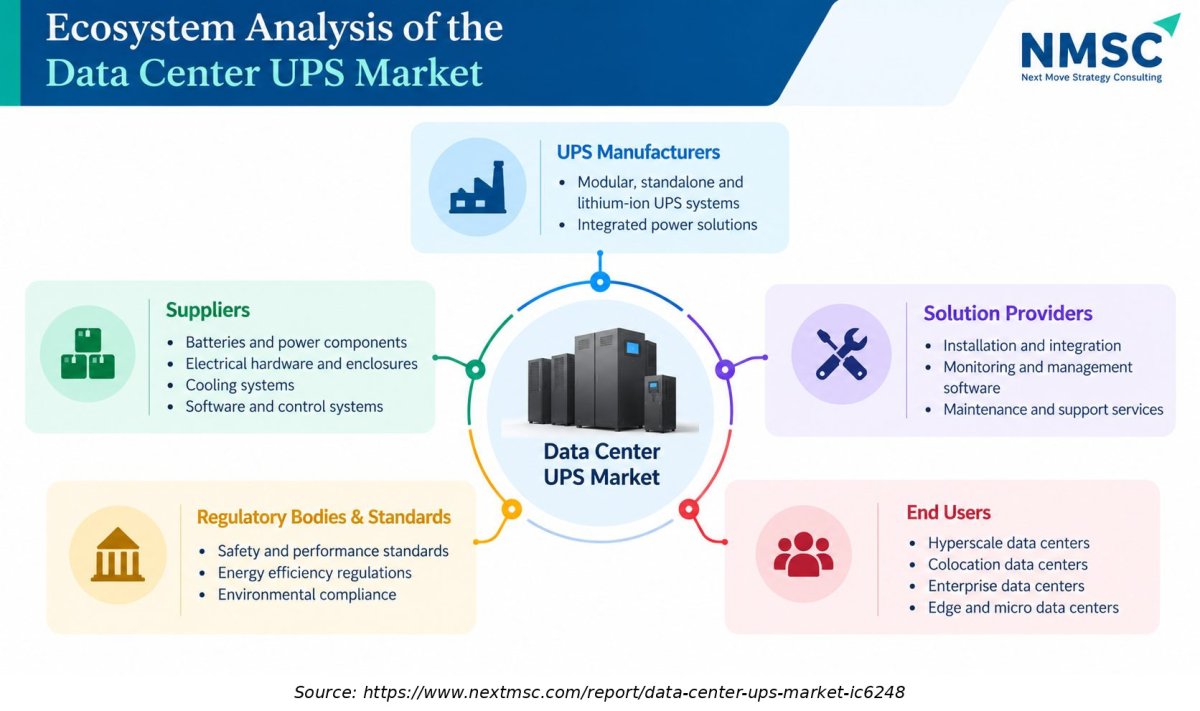
The data center UPS market ecosystem comprises component suppliers, UPS manufacturers, solution providers, and data center operators. Key components include batteries, power semiconductors, transformers, and control systems. Service providers support installation, monitoring, and maintenance, while regulatory bodies, investors, and research institutions contribute to product safety, energy efficiency, technological innovation, and reliable power backup.

Market Drivers & Dynamics

Interactive Dataset
AI and hyperscale capacity buildout driver +3.4% Global, led by U.S. and China 2026–2035
Rising cost of downtime and reliability targets driver +1.6% Global 2026–2035
Lithium ion and modular UPS adoption driver +1.2% North America, Europe, Asia-Pacific 2026–2032
Efficiency and reporting regulation driver +0.8% Europe, Asia-Pacific 2026–2030
Grid interconnection delays restraint −1.3% North America, Europe 2026–2031
Transformer and switchgear lead times restraint −1.0% Global 2026–2028
Lithium ion fire code and permitting reviews restraint −0.9% North America, Europe 2026–2030
Shift toward 800 VDC power architectures restraint −0.7% Global hyperscale 2027–2035
Source: Next Move Strategy Consulting

Growth Drivers

What Is the Primary Growth Driver in the Data Center UPS Market?

AI driven data center expansion is the primary structural driver of the Data Center UPS Market. The IEA estimates that global data center electricity use reached about 415 TWh in 2024 and could rise to about 945 TWh by 2030, with the United States adding about 240 TWh and China about 175 TWh. Each added megawatt of critical load needs UPS capacity, and AI racks raise both power density and the cost of downtime, which favors larger modular systems with lithium-ion storage.

How Are Reliability Requirements and Efficiency Rules Driving Data Center UPS Market Growth?

Power protection remains a licence to operate for every data center, so reliability targets keep UPS in each design. Regulation adds a second push, because Delegated Regulation 2024/1364 created a common EU rating scheme for data centers with reporting to a European database. Operators must now evidence efficiency, which supports high efficiency operating modes and lithium-ion systems with lower losses. India's datacenter capacity grew from about 375 MW in 2020 to about 1,500 MW in 2025, according to the Press Information Bureau.

Growth Inhibitors

What Is Restraining the Data Center UPS Market?

Grid access and equipment lead times are the main restraints. Berkeley Lab reports a median of 61 months from interconnection request to operation for generation and storage projects built in 2025, against 36 months in 2015. The U.S. Department of Energy notes that large power transformer lead times are commonly quoted at about 36 months. Delayed energization postpones UPS commissioning, while component shortages and lithium-ion fire code reviews add further schedule risk.

What Are the Growth Opportunities?

Can Grid Interactive UPS and Battery Storage Integration Create a New Revenue Layer?

Operators facing long grid queues increasingly want backup batteries that also support the grid. The IEA notes that regulators could encourage backup power generation or storage assets more flexibly, which opens revenue from frequency services and peak shaving. Vendors with lithium ion UPS, power conversion and energy management software are best placed, and hyperscale and colocation operators are the first beneficiaries.

Does Replacement of Aging Lead Acid UPS Fleets Offer a Dependable Demand Stream?

Within the Data Center UPS Market, many enterprise rooms still run valve regulated lead acid strings and older transformer based UPS. Replacing them with modular lithium ion systems reduces footprint and maintenance, while efficiency reporting under European and German rules strengthens the business case. Enterprise and colocation sites in North America and Europe benefit first, and service contracts convert one time replacements into recurring revenue.

Can Edge and Emerging Market Data Centers Scale Faster Than Core Markets?

Edge deployments for edge AI inference and low latency services need compact UPS units in the up to 100 kVA class, while Gulf campuses need very large blocks. G42 announced a 5 GW UAE US AI campus, and HUMAIN and NVIDIA announced up to 500 MW of AI factories in Saudi Arabia. Vendors with local service networks stand to benefit.

Segmentation Analysis

2025 (USD Billion)
2035 (USD Billion)
Static UPS
Rotary UPS
Segment Item 2025 (USD Billion) 2035 (USD Billion) CAGR
Static UPS $10.0 USD Billion $40.0 USD Billion 13.0%
Rotary UPS $17.1 USD Billion $51.1 USD Billion 19.0%

Segment-wise data not detailed in this view

Unlock complete segment-wise numbers for By UPS Type.

Unlock Full Data
2025 (USD Billion)
2035 (USD Billion)
Up to 100 kV
101–500 kVA
501–1
000 kVA
Above 1
Segment Item 2025 (USD Billion) 2035 (USD Billion) CAGR
Up to 100 kVA $10.0 USD Billion $40.0 USD Billion 17.0%
101–500 kVA $17.1 USD Billion $51.1 USD Billion 15.0%
501–1 $24.2 USD Billion $62.2 USD Billion 17.0%
000 kVA $31.3 USD Billion $73.3 USD Billion 15.0%
Above 1 $38.4 USD Billion $84.4 USD Billion 16.0%

Segment-wise data is locked

Unlock complete segment-wise numbers for By Capacity.

Unlock Full Data

Segment Sizing: By Capacity

2025 (USD Billion)
2035 (USD Billion)
Hyperscale a
Colocation
Enterprise
Edge
Segment Item 2025 (USD Billion) 2035 (USD Billion) CAGR
Hyperscale and cloud $10.0 USD Billion $40.0 USD Billion 13.0%
Colocation $17.1 USD Billion $51.1 USD Billion 27.0%
Enterprise $24.2 USD Billion $62.2 USD Billion 25.0%
Edge $31.3 USD Billion $73.3 USD Billion 11.0%

Segment-wise data is locked

Unlock complete segment-wise numbers for By Data Center Type.

Unlock Full Data
2025 (USD Billion)
2035 (USD Billion)
North Americ
Canada
Mexico
Europe: UK
Germany
Segment Item 2025 (USD Billion) 2035 (USD Billion) CAGR
North America: U.S. $10.0 USD Billion $40.0 USD Billion 25.0%
Canada $17.1 USD Billion $51.1 USD Billion 19.0%
Mexico $24.2 USD Billion $62.2 USD Billion 17.0%
Europe: UK $31.3 USD Billion $73.3 USD Billion 15.0%
Germany $38.4 USD Billion $84.4 USD Billion 16.0%

Segment-wise data is locked

Unlock complete segment-wise numbers for By Region.

Unlock Full Data

Growth Opportunities

Our findings suggest that three whitespace areas will capture a disproportionate share of incremental revenue.

Can Grid Interactive UPS and Battery Storage Integration Create a New Revenue Layer?

Operators facing long grid queues increasingly want backup batteries that also support the grid. The IEA notes that regulators could encourage backup power generation or storage assets more flexibly, which opens revenue from frequency services and peak shaving. Vendors with lithium ion UPS, power conversion and energy management software are best placed, and hyperscale and colocation operators are the first beneficiaries.

Does Replacement of Aging Lead Acid UPS Fleets Offer a Dependable Demand Stream?

Within the Data Center UPS Market, many enterprise rooms still run valve regulated lead acid strings and older transformer based UPS. Replacing them with modular lithium ion systems reduces footprint and maintenance, while efficiency reporting under European and German rules strengthens the business case. Enterprise and colocation sites in North America and Europe benefit first, and service contracts convert one time replacements into recurring revenue.

Can Edge and Emerging Market Data Centers Scale Faster Than Core Markets?

Edge deployments for edge AI inference and low latency services need compact UPS units in the up to 100 kVA class, while Gulf campuses need very large blocks. G42 announced a 5 GW UAE US AI campus, and HUMAIN and NVIDIA announced up to 500 MW of AI factories in Saudi Arabia. Vendors with local service networks stand to benefit.

Porter’s Five Forces Analysis of the Data Center UPS Market
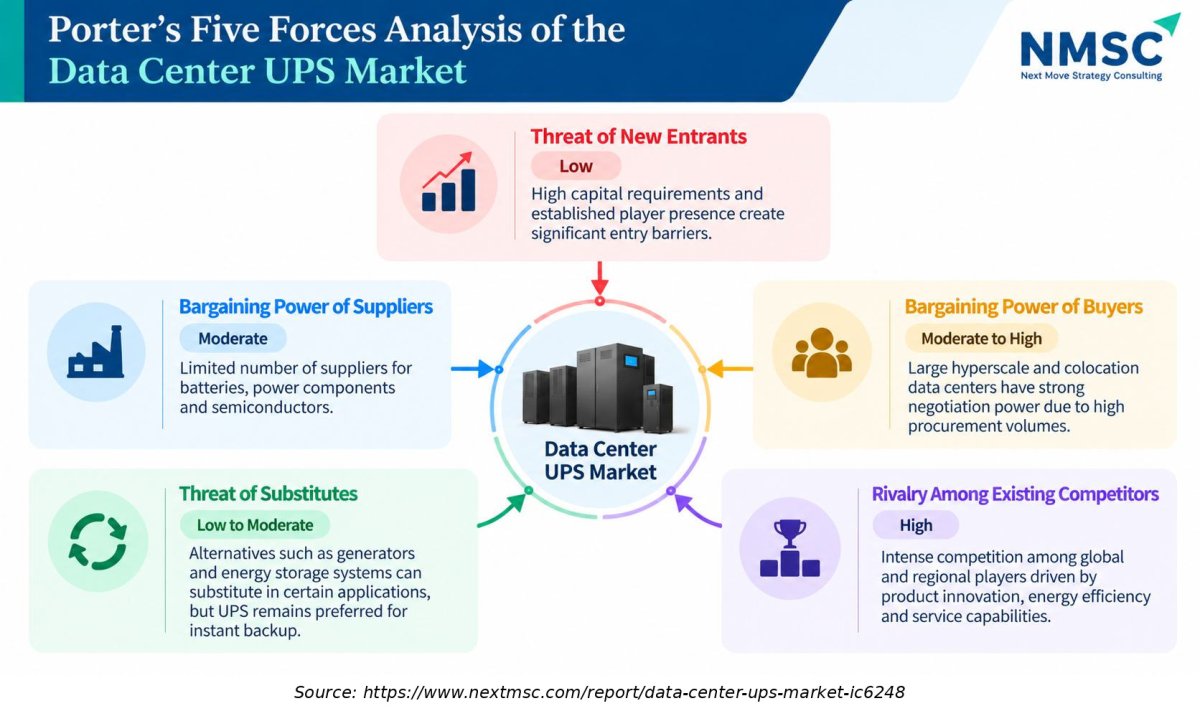
The data center UPS market faces high competitive rivalry, while substantial capital requirements limit new entrants. Supplier power remains moderate due to specialised components and battery technologies, whereas large hyperscale and colocation operators exert considerable buyer power. Alternative backup solutions, including generators and energy storage systems, create substitution pressure, although UPS systems remain essential for uninterrupted power protection in critical data center operations.

Regional Outlook

2025 (USD Billion)
2035 (USD Billion)
North Americ
Europe
Asia-Pacific
Middle East
Latin Americ
Region 2025 (USD Billion) 2035 (USD Billion) CAGR (%)
North America $10.0 USD Billion $40.0 USD Billion 9.0%
Europe $17.1 USD Billion $51.1 USD Billion 27.0%
Asia-Pacific $24.2 USD Billion $62.2 USD Billion 25.0%
Middle East & Africa $31.3 USD Billion $73.3 USD Billion 23.0%
Latin America $38.4 USD Billion $84.4 USD Billion 12.0%

Regional data is locked

Unlock complete regional numbers for this market.

Unlock Full Data

Competitive Landscape

Our analysis shows that competition spans global power majors, Asian platform vendors and specialist engineers.

Dimension Description
Market Structure Tiered, with global power majors leading large accounts while Asian platform vendors and European and Japanese specialists compete by capacity band.
Innovation Focus Lithium ion integration, medium voltage UPS, prefabricated power blocks and 800 VDC readiness.
M&A Activity Acquisitions target prefabricated power, thermal and onsite power capabilities, including Eaton's Fibrebond, Vertiv's UtilityInnovation Group and Legrand's Girtz deals.

How Do Companies Compete in the Data Center UPS Market?

Vendors compete on price per kVA, efficiency at partial load, delivery lead times, service coverage and the ability to integrate UPS into prefabricated blocks. Vertiv reported fiscal 2025 net sales of USD 10.23 Billion and a year end backlog of USD 15.0 Billion, which shows how strongly delivery capacity shapes outcomes. Geographic expansion follows hyperscale campuses, and pricing is increasingly bundled with service contracts and lithium ion battery warranties.

Which Competitive Archetypes Dominate the Data Center UPS Market?

Three archetypes stand out. Global power majors such as Vertiv, Schneider Electric, Eaton and ABB differentiate through full stack portfolios, and Schneider Electric reports data centers and networks at about 30% of its end market exposure. Asian platform vendors such as Huawei, Delta, Kehua and Kstar differentiate through modular lithium ion systems and cost. Specialists such as Socomec, Riello, Piller and Centiel differentiate through modular availability and rotary designs.

What Innovation and Differentiation Strategies Are Companies Pursuing?

Vendors are raising voltage levels and efficiency to cut conversion losses, as ABB's HiPerGuard shows with direct 34.5 kV grid connection. ABB also introduced its MegaFlex UL 415V UPS in June 2025 for large scale data centers, and Schneider Electric's Galaxy VXL targets high density AI loads. Software, remote monitoring and DC readiness for 800 VDC architectures are the next differentiators.

What M&A and Partnership Activity Is Shaping the Market?

Eaton completed its USD 1.4 Billion acquisition of Fibrebond on 1 April 2025 to add prefabricated power enclosures. Vertiv agreed on 2 September 2026 to acquire UtilityInnovation Group for about USD 1.45 Billion upfront, plus up to USD 1.15 Billion tied to earnings targets. Legrand acquired Girtz Industries on 10 June 2026, and Schneider Electric completed a 75% stake in Motivair in February 2025, so consolidation targets adjacent power and cooling capability.

Key Market Players

NMSC's analysis indicates that these 18 companies hold the strongest positions in the market, listed in ranked order.

Vertiv Holdings Co Schneider Electric SE Eaton Corporation plc Huawei Technologies Co., Ltd. Delta Electronics, Inc. Legrand SA ABB Ltd Mitsubishi Electric Corporation Fuji Electric Co., Ltd. Toshiba Corporation Shenzhen Kehua Data Co., Ltd. Socomec Group Shenzhen Kstar Science & Technology Co., Ltd. Riello Elettronica Group Piller Group GmbH Rolls-Royce Holdings plc (dynamic UPS niche) Centiel Cyber Power Systems, Inc.

Latest Developments

We observed that 2025 and 2026 announcements cluster around AI scale power blocks, 800 VDC readiness and acquisitions.

Date Event
April 2026 ABB launches the HiPerGuard 34.5 kV medium voltage UPS for direct grid connection of AI data centers, with 98% efficiency and parallel capacity up to 25 MW.
September 2026 Schneider Electric introduces 2 to 2.5 MW prefabricated power modules and skids built on Galaxy VXL UPS technology, made in Barcelona.

Investment Opportunities

Where Are Capital Inflows Concentrating in the Data Center UPS Market?

Capital is flowing toward hyperscale campuses and the power vendors that serve them. Alphabet reported about USD 80.6 Billion of property and equipment purchases in the first half of 2026, and Amazon's trailing figure exceeded USD 170 Billion. Vendor mergers add to the flow, with Vertiv's agreed UtilityInnovation Group deal and Eaton's Fibrebond purchase. We found that investors favor firms with lithium ion, medium voltage and prefabricated offerings, because these address the fastest growing capacity bands.

How Is Infrastructure Investment Shaping Market Capacity?

Manufacturers are adding capacity close to demand. Eaton plans a new Fibrebond plant in North Little Rock, Arkansas with more than 1,200 jobs, and Schneider Electric builds its prefabricated modules in Barcelona for Europe before North America later in 2026. Grid delays, however, mean that UPS vendors increasingly partner on onsite power, so infrastructure spending extends beyond UPS to switchgear, microgrid controls and storage.

What ESG Considerations Are Influencing Data Center UPS Market Investment?

Efficiency and battery stewardship now influence purchasing. EU reporting under Delegated Regulation 2024/1364 exposes energy performance, and Regulation (EU) 2023/1542 sets phased battery requirements through 2031. USGS data show that lead acid batteries account for 67% of U.S. lead use and that secondary lead supplies about 70% of consumption, which supports recycling credentials. Lithium ion systems, in contrast, face scrutiny on fire safety and supply chains.

Key Benefits for Stakeholders

How Does This Report Benefit Data Center Operators and Enterprise Leaders?

Operators gain a clear view of how the Data Center UPS Market is shifting across UPS types, capacity bands and battery choices are gaining share, with sizing and growth rates to 2035. The analysis of Static UPS and Rotary UPS, and of bands from up to 100 kVA to above 1,000 kVA, supports procurement and replacement planning. Regional and country outlooks help leaders time capacity additions against grid, regulation and vendor lead times.

How Does This Report Benefit Investors and Financial Analysts?

Investors receive reconciled forecasts of the Data Center UPS Market that show where incremental revenue sits, including the USD 34.54 Billion opportunity between 2026 and 2035. Segment and region growth rates identify faster growing pockets such as Above 1,000 kVA systems, hyperscale buyers and Middle East and Africa demand. The competitive and developments sections track acquisitions and capacity investments, which helps analysts assess vendor positioning and valuation drivers.

How Does This Report Benefit Technology Vendors and Product Teams?

Vendors can benchmark portfolios against segment growth in the Data Center UPS Market, technology shifts and competitor moves. The report links lithium ion adoption, medium voltage designs, prefabrication and 800 VDC readiness to measurable demand, which guides roadmap and pricing decisions. Country level insights show where local assembly, service coverage and partnerships will matter most for winning large orders.

Key Market Segments Evaluated

By UPS Type

  • Static UPS
  • Rotary UPS

By Capacity

  • Up to 100 kVA
  • 101–500 kVA
  • 501–1,000 kVA
  • Above 1,000 kVA

By Data Center Type

  • Hyperscale and cloud
  • Colocation
  • Enterprise
  • Edge

By Region

  • North America 
    • U.S.
    • Canada
    • Mexico
  • Europe 
    • UK
    • Germany
    • France
    • Italy
    • Spain
    • Sweden
    • Denmark
    • Finland
    • Netherlands
    • Rest of Europe
  • Asia-Pacific 
    • China
    • India
    • Japan
    • South Korea
    • Taiwan
    • Indonesia
    • Vietnam
    • Australia
    • Philippines
    • Malaysia
    • Rest of APAC
  • Middle East & Africa 
    • Saudi Arabia
    • UAE
    • Egypt
    • Israel
    • Turkey
    • Nigeria
    • South Africa
    • Rest of MEA
  • Latin America 
    • Brazil
    • Argentina
    • Chile
    • Colombia
    • Rest of LATAM

Conclusion & Recommendations

Revenue is on course to more than double from USD 18.36 Billion in 2026 to USD 52.90 Billion in 2035, a CAGR of 12.48%. AI workloads, hyperscale campuses and rising reliability expectations anchor demand, while lithium ion, medium voltage and prefabricated designs lift value per project. We found that growth is broad based across regions, with Middle East and Africa and Asia-Pacific growing faster than North America and Europe.

What Strategic Positioning Recommendations Does NMSC Offer?

Vendors in the Data Center UPS Market should prioritize platforms above 500 kVA, lithium ion integration and service contracts, because these capture the fastest growing demand. Building local assembly and service presence in the Gulf, India and Southeast Asia improves win rates. Operators should standardize on modular blocks, plan replacement of older lead acid fleets and specify DC readiness where AI racks exceed conventional densities.

What Defines Investment Attractiveness in the Data Center UPS Market?

Attractiveness is highest for vendors exposed to hyperscale and colocation demand, because these groups grow at 14.0% and 12.4% respectively. Service revenue adds stability, and acquisitions in prefabricated and onsite power show where strategic value is migrating. Pricing power is supported by long lead times for competing power equipment, although customer concentration among a few hyperscalers remains a valuation consideration.

What Are the Market Shifts and Key Risks Ahead?

The main shifts are 800 VDC architectures, grid interactive storage and larger block sizes. Key risks include grid connection delays, transformer and switchgear lead times, and lithium ion fire code reviews. Strong supply chain management of batteries and power semiconductors will separate resilient vendors from exposed ones, and a slower AI build cycle would soften demand for the largest systems.

What Are the Primary Growth Pathways Through 2035?

Four pathways stand out: hyperscale and cloud campuses buying multi megawatt blocks, Gulf and Indian sovereign AI projects, enterprise replacement of aging UPS fleets, and edge sites that need compact units. Each pathway rewards vendors with modular platforms, lithium ion expertise and regional service capability, and together they underpin the forecast.

FAQs

Sources & References

1.

International Energy Agency, Energy and AI: Energy Demand from AI

iea.org
2.

International Energy Agency, Energy and AI: Executive Summary

iea.org
3.

Lawrence Berkeley National Laboratory, 2024 United States Data Center Energy Usage Report

escholarship.org/uc/item/32d6m0d1
4.

Lawrence Berkeley National Laboratory, United States Data Center Energy Usage Report: 2025 Update

eta.lbl.gov
5.

U.S. Department of Energy, Report on Electricity Demand from Data Centers

energy.gov
6.

Lawrence Berkeley National Laboratory, Queued Up 2026 Edition

emp.lbl.gov
7.

North American Electric Reliability Corporation, 2025 Long-Term Reliability Assessment

nerc.com
8.

U.S. Department of Energy, Large Power Transformer Resilience Report

energy.gov
9.

Federal Energy Regulatory Commission, Docket RM26-4-000 Large Load Interconnection

ferc.gov/rm26-4
10.

U.S. Geological Survey, Mineral Commodity Summaries 2026: Lead

pubs.usgs.gov
11.

European Commission, Delegated Regulation (EU) 2024/1364

eur-lex.europa.eu
12.

European Commission, EU rating scheme for data centers

energy.ec.europa.eu
13.

European Union, Regulation (EU) 2023/1542 on batteries

eur-lex.europa.eu
14.

Press Information Bureau, Government of India, Data Centres Parliamentary Reply (13 March 2026)

pib.gov.in
15.

International Electrotechnical Commission, IEC 62040-3:2021

webstore.iec.ch
16.

National Fire Protection Association, Lithium-Ion Batteries and Data Center Safety

nfpa.org
17.

Open Compute Project, Standardizing the Transition to LVDC

opencompute.org
18.

NVIDIA, 800 V HVDC Architecture for AI Factories

developer.nvidia.com
19.

G42, UAE US 5GW AI Campus

g42.ai
20.

NVIDIA Newsroom, HUMAIN and NVIDIA Strategic Partnership

nvidianews.nvidia.com
21.

Amazon.com, Inc., Form 8-K Exhibit 99.1 (Q2 2026)

sec.gov
22.

Alphabet Inc., Form 10-Q (June 30, 2026)

sec.gov
23.

Vertiv Holdings Co, Fourth Quarter 2025 Results

investors.vertiv.com
24.

Schneider Electric, FY 2025 Results Presentation

se.com
25.

ABB Ltd, HiPerGuard 34.5 kV UPS Announcement

new.abb.com
26.

Schneider Electric, Prefabricated Power Modules Announcement

se.com
27.

Schneider Electric, Completion of Motivair Acquisition

se.com
28.

Eaton Corporation plc, Fibrebond Acquisition Completion

businesswire.com
29.

Eaton Corporation plc, North Little Rock Facility Announcement

eaton.com
30.

Eaton Corporation plc, 800 VDC Architecture Announcement

eaton.com
31.

Vertiv Holdings Co, UtilityInnovation Group Announcement

investors.vertiv.com
32.

Vertiv Holdings Co, NVIDIA 800 VDC Readiness Announcement

investors.vertiv.com
33.

ABB Ltd, ABB and NVIDIA 800 VDC Collaboration

new.abb.com
34.

ABB Ltd, MegaFlex UL 415V UPS Launch

new.abb.com
35.

Legrand SA, Girtz Industries Acquisition

legrand.com
36.

Vertiv, Data Center and Facility Three Phase UPS Products

vertiv.com
37.

Mitsubishi Electric Critical Power, Data Center UPS

mitsubishicritical.com

About the Author

Liza Phukan

Liza Phukan

Liza Phukan is Research Associate at Next Move Strategy Consulting, where she has covered emerging industries and market research across sectors for 3.5 years. Her work includes analyzing industry developments, validating market data, and developing structured business content from research findings. She uses secondary research and data-validation practices to turn complex market information into clear decision-useful market analysis for business audiences and support report development and B2B.

About the Reviewer

Supradip Baul

Supradip Baul

Supradip Baul is an accomplished business consultant and strategist with over a decade of rich experience in market intelligence, strategy, technology, and business transformation. His work has included rigorous qualitative and quantitative analysis across multiple industries, helping clients shape investment decisions and long-term roadmaps. Earlier in his career, he was associated with Gartner, where he contributed to industry-leading reports and market share analyses. He has worked with leading global companies and holds an MBA with a dual specialization in Marketing and Finance.

Download Free Sample

Diana Trejo

DIANA TREJO

Assistant Manager

Sumitomo Corporation de Mexico, S.A. de C.V.

Recently, we purchased a report on the Mexico Data Center Market from Next Move Strategy Consulting. The service has been excellent, with support that is always timely and thoroughly professional. The information provided is interesting, highly useful, and delivered with clarity. I would highly recommend NextMSC for anyone seeking insightful and dependable analysis.

Rishabh Jogani

RISHABH JOGANI

Strategy Analyst

Accenture Japan

We are incredibly impressed with the market report on the real estate market in India provided by Next Move Strategy Consulting. The report was thorough, insightful, and well-structured, offering deep analysis and actionable recommendations. It not only captured the current trends and dynamics but also provided a forward-looking perspective that has been invaluable for our strategic planning. Their team demonstrated exceptional professionalism, attention to detail, and a profound understanding of the industry. The data-driven insights and clarity of presentation exceeded our expectations, making complex market trends easy to understand. We highly recommend Next Move Strategy Consulting to anyone looking for reliable and comprehensive market research services. Their expertise has given us the confidence to navigate the complexities of the Indian real estate market with clarity and foresight.

Gaurav Jaiswal

GAURAV JAISWAL

Founder & CEO

Yano Charge Private Limited

The EV Charging market research report provided by the NextMSC was exceptionally detailed and insightful. It offered a comprehensive analysis that proved to be a game-changer for our strategic planning. Truly a testament to the NextMSC’s expertise and thoroughness in EV market landscape & analysis.

Mohit Agarwal

MOHIT AGARWAL

Chief Manager

DryChem India Pvt. Ltd.

Next Move Strategy Consulting is an amazing team of consultants. We required a market study report for our investors on top priority and the team went above and beyond our expectations to deliver the same with ample supporting data within a short time span enabling us to secure the investments and keep our project timeline maintained. Their professionalism, attention to detail, and timely delivery of actionable recommendations have left a lasting impression on our organization.

Kishu Kanda

KISHU KANDA

Strategy Analyst

Accenture

We purchased the AI Consumer Market Report from this company. Not only did they customize the report to meet our specific requirements, but they also showed great flexibility in accommodating our budget. The report we received fully met our expectations. Additionally, they provided prompt and thorough responses to both our pre-purchase and follow-up questions. We look forward to working with this company again in the future.

Custom Market Research Services

We will customize the research for you if the listed report does not fully match your requirements.

Get 30% Free Customization

Select License

This website uses cookies to ensure you get the best experience on our website. Learn more

✖