Data Quality Market Size, Share, Growth & Forecast by Offering (Software, Data Services, Professional Services, Managed Services), Function (Profiling, Cleansing, Validation, Matching, Deduplication, Monitoring, Enrichment, Stewardship), Deployment (Cloud, Hybrid, On-Premises), Pricing (Subscription, Usage-Based, Perpetual, Project Fee, Retainer), Buyer (Data Engineering, Data Governance, Analytics, Compliance), Channel, and Industry — Global Analysis 2025–2035
Industry: ICT & Media | Publishing Date: June 13, 2026 | Last Updated: September 30, 2026 | No of Pages: N/A | No. of Tables: N/A | No. of Figures: N/A | Format: PDF | Report Code: IC4657
What Is the Data Quality Market Size?
The global Data Quality Market size was valued at USD 4.8 billion in 2025 and is expected to reach USD 5.5 billion in 2026. Sustained enterprise digitization, the rapid proliferation of AI and ML workloads requiring clean training data, and mounting regulatory compliance demands are projected to propel the market to USD 18.6 billion by 2035, advancing at a CAGR of 14.5% from 2026 to 2035. Key growth drivers include the explosion of multi-source data environments, mandatory data governance frameworks such as GDPR and CCPA, the rise of cloud-native data platforms, and expanding enterprise investment in master data management, data profiling, and automated cleansing capabilities to sustain AI model accuracy across global enterprise operations.
|
Parameters |
Details |
|
Market Size in 2025 |
USD 4.8 Billion |
|
Market Size in 2026 |
USD 5.5 Billion |
|
Revenue Forecast in 2035 |
USD 18.6 Billion |
|
Growth Rate |
CAGR of 14.5% from 2026 to 2035 |
|
Analysis Period |
2025–2035 |
|
Base Year Considered |
2025 |
|
Forecast Period |
2026–2035 |
|
Market Size Estimation |
USD Billion |
|
Companies Profiled |
20 |
|
Countries Covered |
33 |
|
Market Share |
Top 10 |
Data Quality Market Overview
What Is the Data Quality Market?
The data quality market comprises software platforms, data services, professional services, and managed services that help organizations discover, profile, cleanse, standardize, validate, match, deduplicate, enrich, monitor, and govern enterprise data across structured, semi-structured, and unstructured environments. Unlike broader data management solutions, we found that data quality platforms focus on improving the accuracy, consistency, completeness, and reliability of data through advanced validation rules, AI-driven anomaly detection, and intelligent matching capabilities. The market supports analytics, artificial intelligence, regulatory compliance, operational decision-making, and enterprise-wide data governance initiatives.
How Has the Data Quality Market Evolved?
The data quality market has evolved through several technology-driven transformation phases. The first phase focused on standalone on-premises solutions designed for address verification, record cleansing, and basic data validation. The second phase integrated data quality capabilities within broader data integration, master data management (MDM), and enterprise information management platforms. We analysed that the current phase is characterized by AI-native data quality frameworks that incorporate automated rule generation, intelligent data observability, real-time monitoring, and streaming data validation capabilities. These advancements are expanding adoption across data engineering teams, analytics departments, compliance functions, and business users operating in cloud-first environments.
How Do Regulations Influence the Data Quality Market?
Regulatory frameworks have become a major structural factor shaping the data quality market. Regulations such as the European Union’s GDPR, the California Consumer Privacy Act (CCPA), HIPAA, the Sarbanes-Oxley Act, and Basel III/IV banking requirements place increasing emphasis on data accuracy, integrity, transparency, and auditability. These compliance obligations are driving demand for governed data management processes, continuous quality monitoring, metadata management, and automated remediation capabilities. Organizations are increasingly investing in data quality solutions to reduce compliance risks, improve reporting accuracy, and strengthen enterprise governance frameworks.
How Is Technology Adoption Expanding Across the Data Quality Market?
Technology adoption across the data quality market is accelerating as enterprises implement cloud-native, data-driven, and AI-enabled operating models. Machine learning-powered anomaly detection, automated schema discovery, fuzzy matching algorithms, and natural language-based rule creation are reducing the complexity of data quality management for business and technical users alike. Cloud-based deployment models and consumption-driven pricing structures are lowering adoption barriers for mid-sized organizations, while large enterprises are increasingly deploying real-time data observability, automated governance, and continuous quality assurance solutions to improve data trustworthiness across distributed and multi-cloud data ecosystems.
Key Takeaways
|
Key Takeaway |
|
By offering, Software dominated the Data Quality Market at USD 2.88 billion in 2025. Cloud SaaS is the fastest-growing sub-segment at a CAGR of 16.2% from 2026 to 2035, as enterprises migrate from perpetual on-premises licenses to subscription-based, cloud-native data quality platforms. |
|
Managed Services, valued at USD 0.24 billion in 2025, is the fastest-growing offering category at a CAGR of 17.5%, reaching USD 1.18 billion by 2035, as organizations outsource continuous data cleansing, monitoring, and stewardship operations to specialist providers. |
|
By function, Cleansing and Standardization led the Data Quality Market at USD 1.05 billion in 2025, forecast to reach USD 3.85 billion by 2035. Stewardship and Rule Management is the fastest-growing at a CAGR of 16.2%, driven by automated policy enforcement and business user-facing rule authoring investment. |
|
Monitoring is the second-fastest growing functional segment at a CAGR of 16.1%, driven by enterprise demand for continuous, pipeline-embedded data quality observability for real-time AI and analytics workloads within the Data Quality Market. |
|
By deployment, Cloud led the Data Quality Market at USD 2.50 billion in 2025, projected to reach USD 10.2 billion by 2035 at the highest CAGR of 15.0%. On-premises retains USD 0.88 billion in 2025 but is the slowest-growing mode at a CAGR of 13.0%. |
|
By pricing, Subscription pricing dominated at USD 2.18 billion in 2025. Usage-based pricing is the fastest-growing model in the Data Quality Market at a CAGR of 16.0%, as cloud-native vendors align cost to data volumes and API call frequencies. |
|
By data domain, Customer data quality led at USD 1.52 billion in 2025, forecast to reach USD 5.85 billion by 2035 at a CAGR of 14.5%. Operational data is the fastest-growing domain at a CAGR of 16.1%, driven by IoT data stream validation and manufacturing process data governance. |
|
By buyer, Data Engineering held USD 1.02 billion in 2025. The Compliance buyer segment is the fastest-growing at a CAGR of 15.2%, as Chief Compliance Officers and Data Protection Officers procure dedicated data accuracy and auditability tools within the Data Quality Market. |
|
By channel, Direct sales led at USD 2.18 billion in 2025. Cloud Marketplace is the fastest-growing distribution channel at a CAGR of 18.6%, as enterprise buyers leverage AWS, Azure, and Google Cloud committed spend pools for procurement. |
|
By industry, BFSI dominated the Data Quality Market at USD 1.12 billion in 2025, projected to reach USD 4.45 billion by 2035 at a CAGR of 14.8%. Healthcare is the fastest-growing vertical at a CAGR of 16.1%, advancing from USD 0.46 billion in 2025 to USD 2.05 billion by 2035. |
|
The United States dominated the Data Quality Market at USD 2.16 billion in 2025, forecast to reach USD 8.20 billion by 2035 at a CAGR of 14.2%, anchored by strong enterprise demand for data governance, analytics, AI, and cloud-based data management solutions. |
|
India is the fastest-growing national market in the Data Quality Market at a CAGR of 17.8%, driven by accelerating digital transformation, expanding AI and analytics adoption, increasing cloud-first enterprise strategies, and growing investments in data governance and compliance frameworks. |
|
MEA is the fastest-growing region in the Data Quality Market at a CAGR of 16.2%. India is the fastest-growing national market in Asia-Pacific at a CAGR of 17.8%, driven by the Digital Personal Data Protection Act and cloud-first enterprise adoption. |
|
North America dominated the Data Quality Market at USD 2.16 billion in 2025, forecast to reach USD 8.20 billion by 2035 at a CAGR of 14.2%, anchored by the highest concentration of data-intensive enterprises and a mature regulatory and cloud platform environment. |
Key Emerging Trends in the Data Quality Market
How Is Artificial Intelligence Reshaping Automated Data Cleansing in the Data Quality Market?
AI-driven automation is fundamentally transforming data cleansing workflows within the data quality market by replacing manually authored rule sets with self-learning models capable of detecting anomalies, inferring corrections, and proposing standardization rules from data patterns. For example, Informatica's CLAIRE AI engine applies machine learning to suggest matching keys, classify data domains, and auto-remediate common data errors across customer and product records without requiring explicit rule authorship. This transformation reduces the skilled labour burden on data stewardship teams, accelerates time-to-quality for new data sources, and extends AI-assisted capabilities to business users who lack SQL expertise, broadening the addressable buyer base in the market.
How Is Real-Time Pipeline-Embedded Validation Emerging as a New Standard in the Data Quality Market?
The shift from batch-oriented data quality processes to real-time, pipeline-embedded validation represents one of the most consequential structural trends reshaping the Data Quality Market. As enterprises migrate to event-driven architectures with Apache Kafka, AWS Kinesis, and Azure Event Hubs, data quality validation must operate at millisecond latency within the ingestion pipeline rather than in post-load remediation cycles. Vendors such as Ataccama, Great Expectations, and Talend now offer streaming-native data quality frameworks that insert validation checkpoints directly into pipeline code, enabling real-time rejection, quarantine, or correction of non-conforming records before they contaminate downstream analytics, AI features, or operational systems.
How Is the Integration of Data Quality Within Data Mesh Architectures Creating New Patterns in the Data Quality Market Demand?
The emergence of data mesh architectures, which distribute data ownership and quality responsibility to domain-specific product teams, is creating new demand for decentralized, API-driven quality tooling within the market. Under a data mesh model, each domain team is accountable for the quality and fitness of the data products they publish, requiring lightweight, developer-friendly data quality SDKs rather than centralised enterprise platforms. This shift is accelerating adoption of open-source quality frameworks and cloud-native embedded modules that integrate with dbt, Apache Spark, and Databricks workflows, opening a developer-oriented market segment within the broader data quality market ecosystem.
How Are Cross-Domain Data Quality Standards Emerging as a Competitive Differentiator in the Data Quality Market?
Organizations are increasingly recognizing that siloed, domain-specific data quality programs fail to address the cross-domain consistency failures that create the most significant analytical and operational errors. For example, mismatched customer identifiers between CRM and ERP systems create reconciliation failures that no single-domain quality tool can resolve. This insight is driving investment in unified, cross-domain orchestration platforms applying consistent identity resolution, reference data alignment, and hierarchical relationship management across customer, product, supplier, and financial domains simultaneously, a capability where MDM-integrated vendors such as Collibra, Syniti, and SAP hold competitive differentiation within the data quality market.
What Are the Key Market Drivers, Breakthroughs, and Investment Opportunities that Will Shape the Data Quality Industry in the Next Decade?
|
Drivers / Trends / Restraints |
(+/-) % Impact on CAGR |
Geographic Relevance |
Impact Timeline |
|
AI/ML Training Data Quality Imperative |
+2.1% |
Global (led by NA, APAC) |
2025–2030 |
|
Regulatory Data Accuracy Mandates (GDPR, CCPA) |
+1.8% |
Europe, NA, APAC |
Ongoing |
|
Cloud-Native Data Platform Adoption |
+1.5% |
NA, Europe, APAC |
2025–2028 |
|
Real-Time Streaming Data Validation Demand |
+1.2% |
NA, APAC, Europe |
2025–2030 |
|
MDM and Data Governance Program Expansion |
+1.0% |
Global |
2026–2035 |
|
Digital Public Infrastructure in Emerging Markets |
+0.8% |
APAC, MEA, LATAM |
2026–2035 |
|
High Implementation Cost and Complexity |
-1.1% |
SMB, Mid-market globally |
2025–2028 |
|
Fragmented Vendor Landscape / Interoperability Gaps |
-0.8% |
All regions |
Ongoing |
|
Open-Source Data Quality Tools Competition |
-0.6% |
NA, Europe |
2025–2032 |
|
Cloud Marketplace Distribution Channel Growth |
+1.3% |
NA, Europe |
2025–2032 |
|
Healthcare Interoperability Mandates (ONC FHIR) |
+0.9% |
NA, Europe |
2025–2035 |
|
ESG Data Quality Requirements (CSRD, SEC) |
+0.7% |
Europe, NA |
2026–2035 |
What Are the Growth Drivers of the Data Quality Market?
How Is the Global Surge in AI and Machine Learning Workloads Driving the Data Quality Market?
The most powerful growth catalyst in the market is enterprise-wide adoption of AI and machine learning workflows that are acutely sensitive to input data accuracy, completeness, and consistency. AI model performance degrades measurably with poor-quality training data, creating an inescapable commercial linkage between AI investment and data quality investment. The U.S. National Institute of Standards and Technology (NIST) AI Risk Management Framework explicitly identifies data quality as a foundational risk dimension for AI systems, requiring organizations to document data provenance and accuracy as part of responsible AI deployment. This regulatory framing elevates data quality to an enterprise risk management priority, driving C-suite-level budget allocation across North America and Europe within the data quality market.
How Are Regulatory Data Accuracy Mandates Accelerating Investment in the Data Quality Market?
Regulatory frameworks across financial services, healthcare, and privacy law collectively constitute one of the most durable structural demand drivers in the data quality market. GDPR Article establishes data accuracy as a core data protection principle, requiring controllers to take every reasonable step to ensure inaccurate personal data is corrected without delay. The Basel Committee on Banking Supervision's BCBS 239 standards on risk data aggregation requires banks to maintain comprehensive, accurate, and timely risk data, compelling major global banks to implement enterprise data quality governance programs. In the United States, HIPAA and the 21st Century Cures Act's information blocking provisions create enforceable data accuracy obligations across the healthcare sector.
How Is the Proliferation of Cloud-Native Data Platforms Expanding the Data Quality Market?
The broad enterprise migration to cloud-native data platforms, including Databricks Lakehouse, Snowflake Data Cloud, and Microsoft Fabric, is organically expanding the data quality market by embedding quality management directly within the cloud data stack. Cloud marketplaces operated by AWS, Microsoft Azure, and Google Cloud have emerged as high-velocity distribution channels for data quality software, enabling procurement against existing cloud spend commitments. The U.S. General Services Administration's FedRAMP authorisation program extends cloud marketplace procurement to federal agencies, creating a structured pathway for data quality vendors to access the substantial U.S. federal data management budget and expanding the channel reach of the market.
What Are the Growth Inhibitors of the Data Quality Market?
How Does Implementation Complexity and Total Cost of Ownership Constrain Data Quality Market Growth?
Despite broad recognition of data quality's business value, the high total cost of enterprise data quality program implementation represents a significant constraint on data quality market growth velocity among SMB and mid-market buyers. Deploying an enterprise data quality platform requires data profiling, rule design, integration with upstream source systems, change management, and ongoing stewardship governance, a multi-phase program spanning twelve to thirty-six months. The U.S. Government Accountability Office has documented comparable challenges in federal agency data quality initiatives, noting that workforce skills deficits and legacy system complexity are the primary cost escalators in government data quality modernisation programs, extending sales cycles and limiting near-term market penetration.
How Does the Fragmented Vendor Landscape Create Interoperability Challenges That Inhibit the Data Quality Market?
The data quality market remains structurally fragmented, with specialized vendors excelling in specific domains, address validation (Melissa, Precisely), identity matching (Experian, Dun and Bradstreet), enterprise profiling (Informatica, IBM), and governance stewardship (Collibra, Ataccama), but lacking unified interoperability across functions. Organizations deploying best-of-breed solutions face significant integration overhead, duplicated rule management, and inconsistent quality metrics across platforms. This fragmentation creates procurement complexity and often forces organizations to select a single integrated vendor even when point solutions offer superior capabilities for specific use cases, artificially constraining competitive dynamics within the market and delaying purchasing decisions.
What Are the Growth Opportunities in the Data Quality Market?
How Does the Healthcare Interoperability Mandate Create a Structural Data Quality Market Opportunity?
The U.S. healthcare sector's transition to FHIR-based interoperability, mandated under the 21st Century Cures Act and the Office of the National Coordinator for Health IT's Interoperability and Information Blocking Final Rule, is creating a structurally significant opportunity within the Data Quality Market. Exchanging clinical data across disparate EHR systems requires standardized patient identity matching, medication data normalisation, and diagnostic code validation, all core data quality functions. Healthcare providers, payers, and health IT vendors investing in FHIR API compliance require embedded data quality tooling for patient identity resolution, terminology validation, and data completeness scoring, generating durable compliance-driven investment within the market.
How Does the Global Expansion of ESG Reporting Frameworks Create a New Demand Vector in the Data Quality Market?
The mandatory adoption of ESG reporting standards, including the EU's Corporate Sustainability Reporting Directive and the SEC's climate disclosure rules, is creating an entirely new demand category within the data quality market. ESG reporting requires organizations to collect, validate, and report sustainability metrics including Scope 1, 2, and 3 greenhouse gas emissions across complex global supply chains. The European Financial Reporting Advisory Group has documented data accuracy and completeness as primary challenges in CSRD implementation, creating direct commercial demand for data profiling, validation, and lineage capabilities that existing data quality platforms are well-positioned to address throughout the forecast period.
How Is the Emergence of AI Training Data Certification Creating New Revenue Streams in the Data Quality Market?
The rapid growth of commercial data marketplaces, including AWS Data Exchange, Snowflake Marketplace, and Azure Marketplace, is creating a new demand layer within the data quality market as data providers must guarantee the accuracy, completeness, and provenance of datasets they commercialize. Enterprise buyers increasingly require quality certificates, data lineage documentation, and SLA-backed accuracy guarantees as purchase conditions. The NIST AI Risk Management Framework's requirement for documented data provenance in AI training datasets elevates data quality certification as a commercial differentiator for organizations selling or licensing training datasets, creating a premium market segment for certified data quality services within the ecosystem.
Strategic Framework Analysis of the Data Quality Market
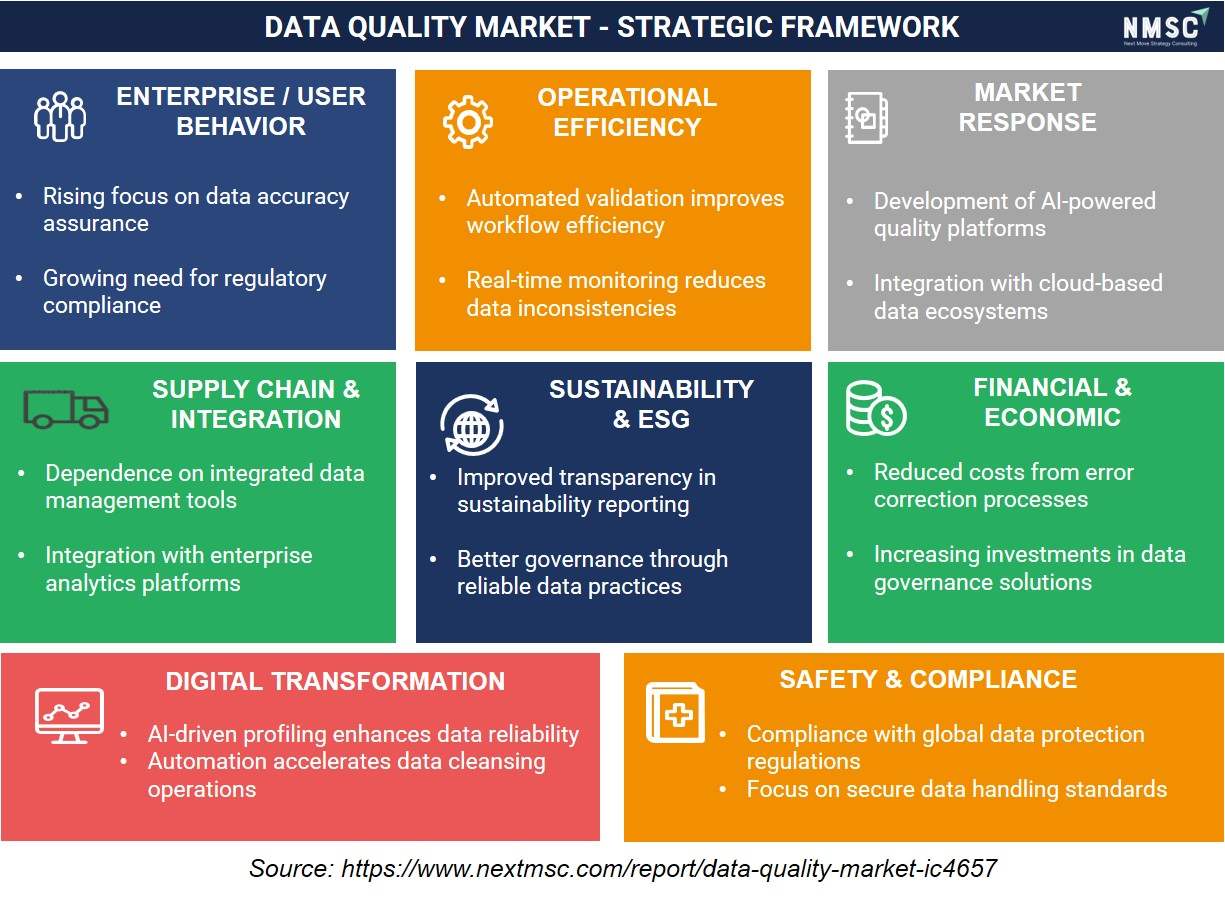
The above infographic outlines key drivers across eight dimensions. It highlights enterprise demand for data accuracy and compliance, operational efficiency through automated validation and real-time monitoring, and market response via AI-powered platforms. It also covers supply chain integration with analytics ecosystems, sustainability benefits for ESG reporting, financial savings from reduced error correction, digital transformation through AI-driven profiling, and strong emphasis on safety and regulatory compliance.
How Is the Data Quality Market Segmented in This Report, and What Are the Key Insights from the Segmentation Analysis?
How Does Deployment Mode Shape Revenue Distribution Across the Data Quality Market?
|
Deployment Segment |
2025 (USD Bn) |
2035 (USD Bn) |
CAGR (%) |
|
Cloud |
2.50 |
10.20 |
15.0% |
|
Hybrid |
1.42 |
5.40 |
14.3% |
|
On-Premises |
0.88 |
3.00 |
13.0% |
Cloud deployment commands USD 2.50 billion in 2025 and represents the highest-growth deployment mode in the market at a CAGR of 15.0%, driven by enterprise adoption of cloud-native data platforms where quality tooling is procured and deployed as cloud-native services. Hybrid deployment, valued at USD 1.42 billion in 2025, remains significant for regulated industries such as banking, insurance, and healthcare that must maintain on-premises data processing for sensitive records while leveraging cloud for scalable enrichment and reference data services. On-premises deployment, while growing at the slowest rate of 13.0% CAGR, retains a substantial installed base among large enterprises with legacy investments in IBM, Informatica PowerCenter, and SAP on-premises platforms, supporting a durable upgrade and migration services revenue stream within the data quality market.
How Do Pricing Models Reflect the Commercial Evolution of the Data Quality Market?
|
Pricing Model |
2025 (USD Bn) |
2035 (USD Bn) |
CAGR (%) |
|
Subscription |
2.18 |
8.40 |
14.5% |
|
Usage-Based |
1.02 |
4.50 |
16.0% |
|
Perpetual |
0.82 |
2.40 |
11.3% |
|
Project Fee |
0.54 |
2.18 |
15.0% |
|
Retainer |
0.24 |
1.12 |
16.6% |
Subscription pricing is the dominant commercial model in the data quality market at USD 2.18 billion in 2025, as vendors have migrated from perpetual license models to annual recurring revenue frameworks aligned with cloud SaaS delivery. Usage-based pricing is the fastest-growing model at a CAGR of 16.0%, particularly prevalent in Data Services where cost is metered per record processed or API call executed for address validation, email verification, and identity resolution. Perpetual licensing retains relevance for highly regulated organizations seeking deterministic, audit-friendly cost structures. Retainer-based pricing is growing at 16.6% CAGR, reflecting expansion of managed services arrangements where providers deliver continuous quality monitoring under fixed monthly fee structures within the market.
Which Data Domains Are Generating the Greatest Investment in the Data Quality Market?
|
Data Domain |
2025 (USD Bn) |
2035 (USD Bn) |
CAGR (%) |
|
Customer |
1.52 |
5.85 |
14.5% |
|
Product |
0.72 |
2.75 |
14.4% |
|
Supplier |
0.42 |
1.65 |
14.7% |
|
Financial |
0.62 |
2.35 |
14.3% |
|
Location |
0.46 |
1.85 |
15.0% |
|
Reference |
0.38 |
1.40 |
13.9% |
|
Operational |
0.44 |
1.95 |
16.1% |
|
Other |
0.24 |
0.80 |
12.8% |
Customer data quality is the dominant domain investment in the market at USD 1.52 billion in 2025, reflecting decades of enterprise recognition that inaccurate, duplicate, or incomplete customer records erode revenue, increase marketing waste, and create compliance exposure across GDPR, CCPA, and financial crime regulations. Product data quality, valued at USD 0.72 billion, is critical for e-commerce, manufacturing, and supply chain organizations managing large product catalogs. Operational data is the fastest-growing domain at a CAGR of 16.1%, encompassing manufacturing process data, IoT sensor streams, and logistics event data requiring real-time validation. Location data quality is gaining momentum at a CAGR of 15.0%, driven by geospatial accuracy requirements in logistics, retail, and financial services applications within the data quality market.
Which Buyer Personas Are Driving Purchasing Decisions in the Data Quality Market?
|
Buyer Segment |
2025 (USD Bn) |
2035 (USD Bn) |
CAGR (%) |
|
Data Engineering |
1.02 |
3.85 |
14.2% |
|
Data Governance |
0.88 |
3.45 |
14.6% |
|
Analytics |
0.82 |
3.10 |
14.2% |
|
Business Operations |
0.72 |
2.75 |
14.4% |
|
Compliance |
0.68 |
2.80 |
15.2% |
|
IT Operations |
0.68 |
2.65 |
14.6% |
Data Engineering teams represent the largest buyer segment in the data quality market at USD 1.02 billion in 2025, procuring pipeline-embedded validation frameworks, profiling libraries, and monitoring dashboards that integrate with existing data orchestration and transformation toolchains. Data Governance buyers, including Chief Data Officers, Data Governance Managers, and Data Stewards, invest heavily in enterprise stewardship platforms, rule management environments, and quality KPI reporting tools. The Compliance buyer segment is the fastest-growing at a CAGR of 15.2%, as Chief Compliance Officers and Data Protection Officers procure dedicated data accuracy and auditability tools to satisfy regulatory examination requirements. Analytics buyers procure data quality tools primarily to improve the reliability of data inputs powering dashboards, reports, and AI models within the market.
How Are Distribution Channels Reshaping Go-to-Market Strategies in the Data Quality Market?
|
Channel Segment |
2025 (USD Bn) |
2035 (USD Bn) |
CAGR (%) |
|
Direct |
2.18 |
7.95 |
13.8% |
|
Partner |
1.42 |
5.60 |
14.7% |
|
Marketplace |
0.74 |
3.45 |
18.6% |
|
OEM |
0.46 |
1.60 |
13.3% |
Direct sales remain the primary revenue channel in the data quality market at USD 2.18 billion in 2025, driven by enterprise account teams at platform vendors such as Informatica, IBM, SAP, and Oracle managing multi-million-dollar data quality program engagements. Partner channels, including systems integrators such as Accenture, Deloitte, and Capgemini, contribute USD 1.42 billion in 2025 at a CAGR of 14.7%, as these firms embed data quality tools within broader ERP migration, cloud transformation, and MDM implementation projects. Cloud Marketplace is the fastest-growing channel at a CAGR of 18.6%, reflecting enterprise procurement shifts toward committed cloud spend utilization. OEM channels, where data quality capabilities are embedded within ISV applications, represent USD 0.46 billion in 2025 within the market.
Regional Outlook
Geographic Performance Snapshot
|
Region |
2025 (USD Bn) |
2035 (USD Bn) |
CAGR (%) |
Key Driver |
|
North America |
2.16 |
8.20 |
14.2% |
AI/ML adoption, CCPA/HIPAA/SOX compliance, FedRAMP cloud |
|
Europe |
1.18 |
4.40 |
14.1% |
GDPR enforcement, CSRD, BCBS 239, EU AI Act |
|
Asia-Pacific |
0.88 |
3.60 |
15.2% |
DPDPA India, APPI Japan, cloud-first enterprise adoption |
|
Middle East and Africa |
0.28 |
1.25 |
16.2% |
Vision 2030, NDMO standards, fintech digitization |
|
Latin America |
0.30 |
1.15 |
14.4% |
LGPD Brazil, fintech expansion, cloud migration |
North America Data Quality Market
North America is the largest regional market in the global data quality market, contributing USD 2.16 billion in 2025 and forecast to reach USD 8.20 billion by 2035 at a CAGR of 14.2%. The region benefits from the highest concentration of enterprise technology buyers, the global headquarters of leading data quality vendors including Informatica, Precisely, and Melissa, and a mature regulatory environment spanning CCPA, HIPAA, SOX, and BCBS 239. Strong enterprise AI investment, the deepest data engineering and governance talent pool globally, and the U.S. government's Federal Data Strategy collectively sustain North America's market leadership throughout the forecast period.
United States Data Quality Market
Based on our analysis, the United States represents approximately 83% of North American data quality market revenue at an estimated USD 1.79 billion in 2025, constituting the world's single largest national market. The U.S. benefits from the highest concentration of Fortune 500 enterprise data quality buyers, the global headquarters of key vendors including Informatica, Precisely, SAS, and Microsoft, and the most active FedRAMP-authorized cloud marketplace ecosystem globally. The U.S. Federal Data Strategy and OMB Circular A-130 create sustained public sector demand. Financial services data quality investment is the largest demand driver, underpinned by BCBS 239, BSA/AML requirements, and SEC EDGAR data accuracy mandates.
Canada Data Quality Market
Through our analysis, Canada represents approximately 10% of the North American data quality market, with the financial services sector and federal government as the primary demand drivers. Canadian banks and insurance firms operate under OSFI Guideline B-10 and B-13, which impose data governance and quality standards on federally regulated financial institutions. The Government of Canada's Digital Ambition strategy and Treasury Board Policy on Service and Digital create institutional demand for data quality tooling across federal departments. Canada's PIPEDA and Quebec's Law 25 impose data accuracy obligations generating ongoing investment in customer data quality management within the Canadian market.
Mexico Data Quality Market
From our assessment, Mexico is a fast-growing data quality market within North America, driven by banking sector digitization, the nearshoring manufacturing expansion attracting global supply chain data quality programs, and a growing fintech ecosystem requiring customer identity validation and address verification. The Ley Federal de Protección de Datos Personales en Posesión de los Particulares requires data accuracy as a core data protection principle, compelling regulated organizations to invest in systematic data quality management. Mexico's CNBV imposes financial data integrity requirements on licensed banking institutions, creating regulatory-driven demand for data validation and cleansing platforms within the Mexican market.
Europe Data Quality Market
Europe is the second-largest region in the market, contributing USD 1.18 billion in 2025 and forecast to reach USD 4.40 billion by 2035 at a CAGR of 14.1%. Europe's regulatory landscape, led by GDPR, the EU Data Act, the AI Act, the CSRD, and DORA, creates among the most demanding and compliance-driven data quality investment environments globally. Germany, the UK, and France constitute the three largest national markets, collectively representing approximately 60% of European data quality market revenue in 2025. The convergence of AI governance, ESG reporting compliance, and financial data integrity regulations is creating multi-layer demand for data quality tooling across European enterprises.
United Kingdom Data Quality Market
Based on our engagements, the United Kingdom is Europe's largest individual data quality market, representing approximately 22% of European revenue in 2025. Post-Brexit, the UK maintains GDPR-equivalent standards through the UK GDPR, while the FCA's Consumer Duty regulation and Operational Resilience requirements create additional data accuracy obligations for financial services firms. The UK government's National Data Strategy and Open Banking mandates are generating demand for customer financial data quality, identity validation, and address verification capabilities across the UK banking and fintech ecosystem within the market.
Germany Data Quality Market
According to our evaluation, Germany is the second-largest European data quality market, driven by its world-class manufacturing sector, rigorous data protection culture, and the global headquarters of SAP. The Bundesdatenschutzgesetz supplements GDPR with additional national requirements, and BaFin's MaRisk and BAIT standards mandate data quality governance for regulated financial institutions. Germany's Industrie 4.0 initiatives generate significant manufacturing data quality investment, particularly for bill-of-materials accuracy, supplier master data governance, and IoT data validation within production environments across the German segment of the market.
France Data Quality Market
Through our analysis, France is the third-largest European data quality market, distinguished by strong public sector digital transformation and national AI strategy investment. The CNIL is among Europe's most active GDPR enforcement authorities, generating compliance-driven demand for customer data accuracy tools. The France 2030 investment plan allocates significant funding to enterprise data infrastructure and AI governance, creating institutional demand for data quality tooling. French insurance and banking organizations operating under Solvency II and CRR III frameworks require rigorous data quality management for regulatory reporting within the French market.
Italy Data Quality Market
From our assessment, Italy is a mid-tier European data quality market with growing adoption across financial services, manufacturing, and public administration driven by GDPR enforcement from the Garante and PNRR digital transformation investments. Italy's Polo Strategico Nazionale sovereign cloud creates institutional demand for data quality services embedded within government digital transformation programs. The Bank of Italy's supervisory expectations on internal data governance for Significant Institutions, aligned with ECB SREP guidance, create financial sector demand for validated data quality management programs within the Italian market.
Spain Data Quality Market
Based on our engagements, Spain demonstrates growing momentum in the data quality market, driven by a dynamic financial services sector, retail e-commerce expansion, and public sector digital transformation under Agenda España Digital 2026. The AEPD actively enforces GDPR, with Spain recording a high volume of regulatory sanctions creating compliance-driven demand. Spanish banks operating under ECB and Bank of Spain supervisory requirements invest in customer data quality programs for CRS/FATCA reporting, KYC compliance, and BCBS 239 obligations within the Spanish segment of the market.
Sweden Data Quality Market
According to our evaluation, Sweden is a high-per-capita data quality market consumer, supported by a highly digitized enterprise base, a government committed to data-driven public services, and globally competitive life sciences and financial services industries. The Swedish authority IMY supervises GDPR compliance with a high standard of rigour, compelling organizations to maintain systematic data quality management programs. Sweden's life sciences sector, anchored by AstraZeneca and numerous biotech firms, invests in clinical data validation and pharmacovigilance data quality tools, contributing to Sweden's above-average per-capita market investment within Northern Europe.
Denmark Data Quality Market
Through our analysis, Denmark is among the most digitally advanced economies within the European data quality market, consistently ranking at the top of the EU's Digital Economy and Society Index. Denmark's financial services, healthcare, and public sector organizations are sophisticated market buyers, investing in MDM, address validation, and data governance platforms within cloud-first enterprise architectures. The Danish Datatilsynet actively enforces GDPR, maintaining compliance-driven demand for customer data accuracy. Denmark's concentration of life sciences and pharmaceutical firms creates demand for clinical data quality and regulatory submission data validation within the Danish national market.
Finland Data Quality Market
Based on our engagements, Finland is a mature and highly digitized data quality market within the Nordic region, characterized by strong public sector data sharing programs and advanced enterprise cloud adoption. Finland's national digital identity infrastructure operated by the Finnish Digital and Population Data Services Agency underpins a sophisticated citizen data ecosystem requiring high-accuracy data quality management. Finnish enterprises in manufacturing, including Nokia and Kone, and financial services invest in supplier data quality, product master data management, and customer data accuracy programs within the Finnish market.
Netherlands Data Quality Market
From our assessment, the Netherlands is a significant European market, driven by its role as a logistics hub, a major financial services centre, and the European headquarters of numerous multinational corporations. The Dutch Data Protection Authority (Autoriteit Persoonsgegevens) has issued some of Europe's highest GDPR fines, creating strong compliance-driven demand for customer data accuracy management. Rotterdam's status as Europe's largest port generates sustained logistics data quality investment in shipment tracking accuracy, customs documentation validation, and supplier master data governance within the Dutch data quality market.
Rest of Europe Data Quality Market
Through our analysis, the Rest of Europe segment, encompassing Poland, Belgium, Austria, Switzerland, Portugal, the Czech Republic, Hungary, Romania, and other European nations, collectively represents a growing portion of the European data quality market, advancing at a CAGR of 14.5% from 2026 to 2035. Poland and the Czech Republic are leading growth markets, driven by increasing enterprise technology adoption, active GDPR supervisory authorities, and growing financial services sectors requiring BCBS 239-compliant data quality programs. Switzerland maintains data protection standards through the revised Federal Act on Data Protection and hosts major banking institutions investing in data quality for FINMA regulatory reporting requirements.
Asia-Pacific Data Quality Market
Asia-Pacific is the third-largest and fastest-growing major region in the data quality market, contributing USD 0.88 billion in 2025 and forecast to reach USD 3.60 billion by 2035 at a CAGR of 15.2%. The region's growth is propelled by India's Digital Personal Data Protection Act implementation, China's industrial data governance investments, Japan's APPI amendments, and Southeast Asia's rapid fintech and e-commerce digitization. Cloud-first enterprise strategies across Australia, Singapore, and India are accelerating adoption of cloud-native data quality platforms, while manufacturing-intensive economies including China, Japan, South Korea, and Taiwan are investing in supply chain and product data quality programs.
China Data Quality Market
Based on our analysis, China is the largest single data quality market in Asia-Pacific by revenue, driven by the world's largest manufacturing ecosystem, the most active e-commerce sector globally, and expanding regulatory data governance requirements under the Personal Information Protection Law (PIPL) and the Data Security Law. China's PIPL Article 51 requires organizations to adopt measures ensuring the accuracy and timely updating of personal data, creating formal compliance demand for customer data quality management. Industrial internet data quality, ensuring the accuracy of manufacturing process data, equipment performance streams, and supply chain event records, is the largest non-consumer investment area within the Chinese market.
India Data Quality Market
Through our analysis, India is the fastest-growing national data quality market in Asia-Pacific, advancing at a CAGR of 17.8% from 2026 to 2035, driven by the Digital Personal Data Protection Act (DPDPA), the India Stack digital public infrastructure, and the Account Aggregator framework overseen by the Reserve Bank of India. The DPDPA imposes data accuracy obligations on data fiduciaries, compelling organizations processing personal data of Indian residents to implement systematic data quality management programs. India's rapidly expanding fintech, banking, and e-commerce sectors generate large-volume demand for customer identity validation, address verification, and mobile phone validation services within the Indian market.
Japan Data Quality Market
According to our evaluation, Japan is a mature market characterized by deep enterprise investment in data governance frameworks aligned with the amended Act on the Protection of Personal Information (APPI), which imposes data accuracy obligations on personal information handling businesses. Japan's manufacturing sector, operating globally through Toyota, Honda, Panasonic, and Sony, requires robust supply chain data quality, product master data management, and IoT manufacturing data validation. The Financial Services Agency supervisory guidelines on data governance create BFSI-specific compliance demand for data quality management programs within the Japanese data quality market.
South Korea Data Quality Market
From our assessment, South Korea is a technologically sophisticated data quality market driven by globally leading semiconductor and electronics industries, combined with a strong regulatory environment under the Personal Information Protection Act (PIPA). The Personal Information Protection Commission enforces PIPA data accuracy obligations and conducts active compliance inspections of financial institutions and major e-commerce platforms. Samsung, SK Hynix, and Hyundai represent major enterprise buyers in South Korea, investing in supply chain data governance, product master data quality, and customer data management programs at global scale within the market.
Taiwan Data Quality Market
Based on our engagements, Taiwan's data quality market is driven primarily by its global semiconductor industry, led by TSMC, MediaTek, and ASE Group, which requires extremely high-accuracy process data, supply chain documentation, and intellectual property master data management across complex global operations. The Personal Data Protection Act imposes data accuracy obligations on Taiwanese businesses, creating compliance-driven investment in customer data quality management. Taiwan's Competent Authority's guidelines on cybersecurity and data protection for financial institutions create additional demand for financial data quality and customer identity management within the Taiwanese market.
Indonesia Data Quality Market
Through our analysis, Indonesia is one of the fastest-growing emerging data quality markets in Asia-Pacific, driven by the world's fourth-largest population, a rapidly expanding digital economy, and the Personal Data Protection Law enacted in 2022 under Kominfo. Indonesia's large and growing fintech sector, including GoTo Financial, Bank Jago, and Grab Financial, requires customer identity validation, mobile number verification, and address standardization at massive transaction volumes. Bank Indonesia and OJK supervision requirements for financial data integrity create regulatory demand for data quality programs among licensed Indonesian financial institutions within the market.
Vietnam Data Quality Market
From our assessment, Vietnam is an emerging and fast-growing data quality market within Southeast Asia, driven by manufacturing FDI expansion, a rapidly growing middle class, and the Cybersecurity Law and Decree 13/2023 on Personal Data Protection imposing data accuracy obligations. Vietnam's expanding electronics manufacturing sector, hosting major Samsung, Intel, and LG facilities, requires supplier data quality, production data validation, and customs documentation accuracy programs. Vietnam's growing digital banking sector, supported by the State Bank of Vietnam's digital banking framework, generates demand for customer identity validation and address verification services within the Vietnamese market.
Australia Data Quality Market
Based on our engagements, Australia is a mature and sophisticated data quality market, driven by highly regulated financial services, healthcare, and government sectors, combined with strong enterprise cloud adoption and the Consumer Data Right framework overseen by the Australian Competition and Consumer Commission. The Australian Privacy Act and its 2023 reforms impose data accuracy obligations on Australian Privacy Principle entities, creating compliance-driven demand for customer data quality management. The CDR's requirement for accurate, consented data sharing across banking, energy, and telecommunications sectors generates demand for validated data quality frameworks within the Australian market.
Philippines Data Quality Market
According to our evaluation, the Philippines is a growing data quality market within Southeast Asia, supported by the Data Privacy Act of 2012 enforced by the National Privacy Commission and a rapidly expanding BPO sector that manages customer data quality for global enterprise clients. The Philippines' BPO industry creates unique demand dynamics within the local market, blending domestic enterprise investment with internationally sourced service demand. Growing financial inclusion programs under the Bangko Sentral ng Pilipinas digital banking framework require customer identity verification and address validation capabilities at national scale within the Philippine market.
Malaysia Data Quality Market
Through our analysis, Malaysia is a strategically positioned data quality market in ASEAN, driven by its role as a regional digital hub, the Personal Data Protection Act 2010 and its 2024 amendments imposing data accuracy obligations, and expanding financial services and shared services sector investments. Bank Negara Malaysia's Risk Management in Technology policy document imposes data governance and data quality standards on financial institutions, creating regulatory demand for enterprise data quality programs. Malaysia's growing e-commerce sector and MyDIGITAL initiatives generate demand for customer data validation, address standardization, and identity resolution capabilities within the Malaysian market.
Rest of Asia-Pacific Data Quality Market
From our assessment, the Rest of Asia-Pacific segment, encompassing Singapore, Thailand, New Zealand, Sri Lanka, Bangladesh, and other APAC markets, collectively contributes a meaningful and growing share of the regional data quality market, advancing at a CAGR of 14.8% from 2026 to 2035. Singapore punches above its weight as APAC's leading financial data governance market, driven by the Monetary Authority of Singapore's Technology Risk Management guidelines mandating data accuracy and quality governance for financial institutions. Thailand and New Zealand are emerging as growing markets, driven by PDPA compliance requirements and expanding enterprise cloud adoption respectively.
Middle East and Africa Data Quality Market
The Middle East and Africa region is the fastest-growing major region in the data quality market, contributing USD 0.28 billion in 2025 and forecast to reach USD 1.25 billion by 2035 at a CAGR of 16.2%. Growth is driven by Saudi Arabia's Vision 2030 digital transformation program, the UAE National Data Management Office regulations, and expanding enterprise cloud adoption across GCC economies. Africa's growing fintech ecosystems in Nigeria, South Africa, and Kenya generate increasing demand for customer identity validation, address standardization, and anti-money laundering data quality capabilities within the MEA market.
Saudi Arabia Data Quality Market
Based on our engagements, Saudi Arabia is the largest data quality market in the Middle East, driven by Vision 2030, the Saudi Authority for Data and Artificial Intelligence national data governance framework, and large-scale digital transformation programs across ARAMCO, SABIC, and the financial services sector. The National Data Management Office under SDAIA has issued comprehensive data governance standards including data quality requirements for government entities, creating public sector demand for data profiling, validation, and cleansing platforms. Saudi Arabia's fintech expansion under SAMA licensing and Open Banking initiatives generates customer data quality investment across regulated financial institutions within the Saudi market.
UAE Data Quality Market
Through our analysis, the UAE is the second-largest data quality market in the Middle East, driven by Dubai's status as a global business hub, Abu Dhabi Department of Government Enablement data quality standards, and expanding financial services, logistics, and retail sectors. The UAE Federal Law No. 45 of 2021 on Personal Data Protection imposes data accuracy obligations, creating compliance-driven demand for customer data quality management. The DIFC Data Protection Law and ADGM Data Protection Regulations impose additional data governance requirements on financial services firms, sustaining BFSI sector demand within the UAE market.
Egypt Data Quality Market
From our assessment, Egypt is a growing data quality market within North Africa, driven by the government's Egypt Vision 2030 digital transformation agenda, Central Bank of Egypt financial inclusion initiatives, and expanding e-commerce and fintech sectors requiring customer data validation. Egypt's Personal Data Protection Law No. 151 of 2020 and its executive regulations impose data accuracy obligations on personal data controllers, creating regulatory demand for customer data quality programs. Egypt's large financial sector, including state-owned banks undergoing digital transformation, constitutes the primary enterprise demand driver for data quality services within the Egyptian market.
Israel Data Quality Market
Based on our engagements, Israel is a sophisticated and technology-advanced market within the MEA region, driven by a world-class technology sector, an active venture capital ecosystem, and strong data governance requirements under the Privacy Protection Law. Israel's technology companies, including enterprise software, cybersecurity, and fintech firms, are significant market buyers, requiring high-accuracy customer data, identity resolution, and contact data validation for global sales and marketing operations. The Bank of Israel's cyber and data governance directives create BFSI-specific demand within the Israeli segment of the market.
Turkey Data Quality Market
According to our evaluation, Turkey is a mid-tier data quality market in the MEA region, driven by a large domestic economy, a highly active retail banking sector, and the Personal Data Protection Law enforced by the Turkish Personal Data Protection Authority. Turkey's banking sector, operating under BDDK data governance requirements, is the primary driver of enterprise data quality investment, particularly for customer master data management, KYC data accuracy, and risk reporting data quality. Turkey's e-commerce and retail sectors, with significant customer database scale, generate demand for address validation, contact data quality, and customer deduplication services within the Turkish market.
Nigeria Data Quality Market
Through our analysis, Nigeria is the largest data quality market in Sub-Saharan Africa, driven by the continent's largest economy, the Nigeria Data Protection Act 2023 enforced by the Nigeria Data Protection Commission, and the Central Bank of Nigeria's financial inclusion and Bank Verification Number programs requiring high-accuracy customer identity data. Nigeria's rapidly expanding fintech ecosystem, including Flutterwave, Paystack, and Moniepoint, requires customer identity validation, mobile number verification, and anti-money laundering data quality capabilities at high transaction volumes within the Nigerian market.
South Africa Data Quality Market
From our assessment, South Africa is the most mature data quality market in Africa, characterized by a sophisticated financial sector, the Protection of Personal Information Act enforced by the Information Regulator, and large enterprises with established data governance programs. South Africa's banks, ABSA, Standard Bank, FirstRand, and Nedbank, operate under POPIA data accuracy obligations and SARB prudential data governance requirements, creating BFSI sector demand for enterprise data quality platforms. South Africa's large retail and telecommunications sectors generate customer data quality investment for address validation, contact verification, and deduplication within the market.
Rest of MEA Data Quality Market
According to our evaluation, the Rest of MEA, encompassing Kuwait, Qatar, Bahrain, Oman, Jordan, Kenya, Ethiopia, Tanzania, and other markets, is an early but rapidly growing component of the MEA data quality market, advancing at a CAGR of 17.5% from 2026 to 2035. GCC countries including Kuwait, Qatar, and Bahrain are investing in data quality as part of national data strategy and smart government programs aligned with regional digital transformation mandates from the Gulf Cooperation Council. East African markets including Kenya and Tanzania are emerging market consumers, driven by mobile money ecosystem data quality requirements and central bank digital financial infrastructure programs.
Latin America Data Quality Market
Latin America contributes USD 0.30 billion to the global data quality market in 2025 and is forecast to reach USD 1.15 billion by 2035 at a CAGR of 14.4%. Brazil dominates regional revenue, anchored by the LGPD enforced by the ANPD, while Argentina, Chile, and Colombia demonstrate fast-growing adoption. The region's fintech revolution, expanding e-commerce ecosystems, and mandatory consumer data protection legislation are collectively driving enterprise investment in customer data quality across all major Latin American economies within the market.
Brazil Data Quality Market
Based on our engagements, Brazil is the dominant data quality market in Latin America, representing approximately 48% of regional revenue in 2025, driven by the LGPD's data accuracy obligations under Article 6, the largest fintech and banking sector in Latin America, and a highly active e-commerce economy. The ANPD enforces LGPD with growing regulatory activity, compelling organizations to invest in systematic customer data quality management programs. Brazil's Banco Central do Brasil Open Finance framework creates demand for financial data quality, customer identity verification, and account data accuracy across participating financial institutions within the Brazilian market.
Argentina Data Quality Market
Through our analysis, Argentina is a growing data quality market within Latin America, driven by a large consumer base, an active fintech sector, and the Personal Data Protection Law under Habeas Data protections managed by the Agencia de Acceso a la Información Pública. Argentina's AAIP enforces data accuracy obligations, requiring organizations to maintain up-to-date and accurate personal data records, generating compliance-driven demand for customer data quality solutions. Argentina's economic complexity creates specific demand for financial data quality in cross-border transaction management, trade finance documentation accuracy, and tax data integrity within the Argentine market.
Chile Data Quality Market
From our assessment, Chile is a mature and growing data quality market within Latin America, supported by one of the region's most developed economies, a newly enacted Personal Data Protection law (Law No. 21.719 enacted in December 2024), and a sophisticated financial sector. Chile's new data protection framework introduces data accuracy obligations modelled on GDPR principles, creating a fresh wave of compliance-driven investment in customer data quality management across Chilean enterprises. Chile's financial services sector, including BancoEstado, Banco de Chile, and Santander Chile, constitutes the primary BFSI demand driver for data quality investment within the Chilean market.
Colombia Data Quality Market
Based on our engagements, Colombia is an important and growing data quality market within Latin America, driven by Statutory Law 1581 of 2012 enforced by the Superintendencia de Industria y Comercio, a growing digital banking sector, and expanding e-commerce and logistics industries. Colombia's SIC enforces data accuracy as a core habeas data right, compelling organizations to maintain systematic quality management programs. Colombia's fintech ecosystem and the Superintendencia Financiera de Colombia's open banking roadmap are creating demand for customer data quality, identity validation, and account data accuracy capabilities within the Colombian market.
Rest of Latin America Data Quality Market
Through our analysis, the Rest of Latin America, encompassing Peru, Ecuador, Uruguay, Costa Rica, Panama, and other LATAM markets, constitutes a meaningful and growing portion of the regional data quality market, advancing at a CAGR of 15.2% from 2026 to 2035. Peru and Ecuador are emerging markets, driven by expanding financial inclusion programs and banking sector digitization under national central bank initiatives. Uruguay has one of Latin America's most advanced data protection frameworks, with Law 18.331 imposing data accuracy obligations that generate structured compliance-driven demand for data quality management investment within the broader Latin American market.
Regulatory Framework Impacting the Data Quality Market
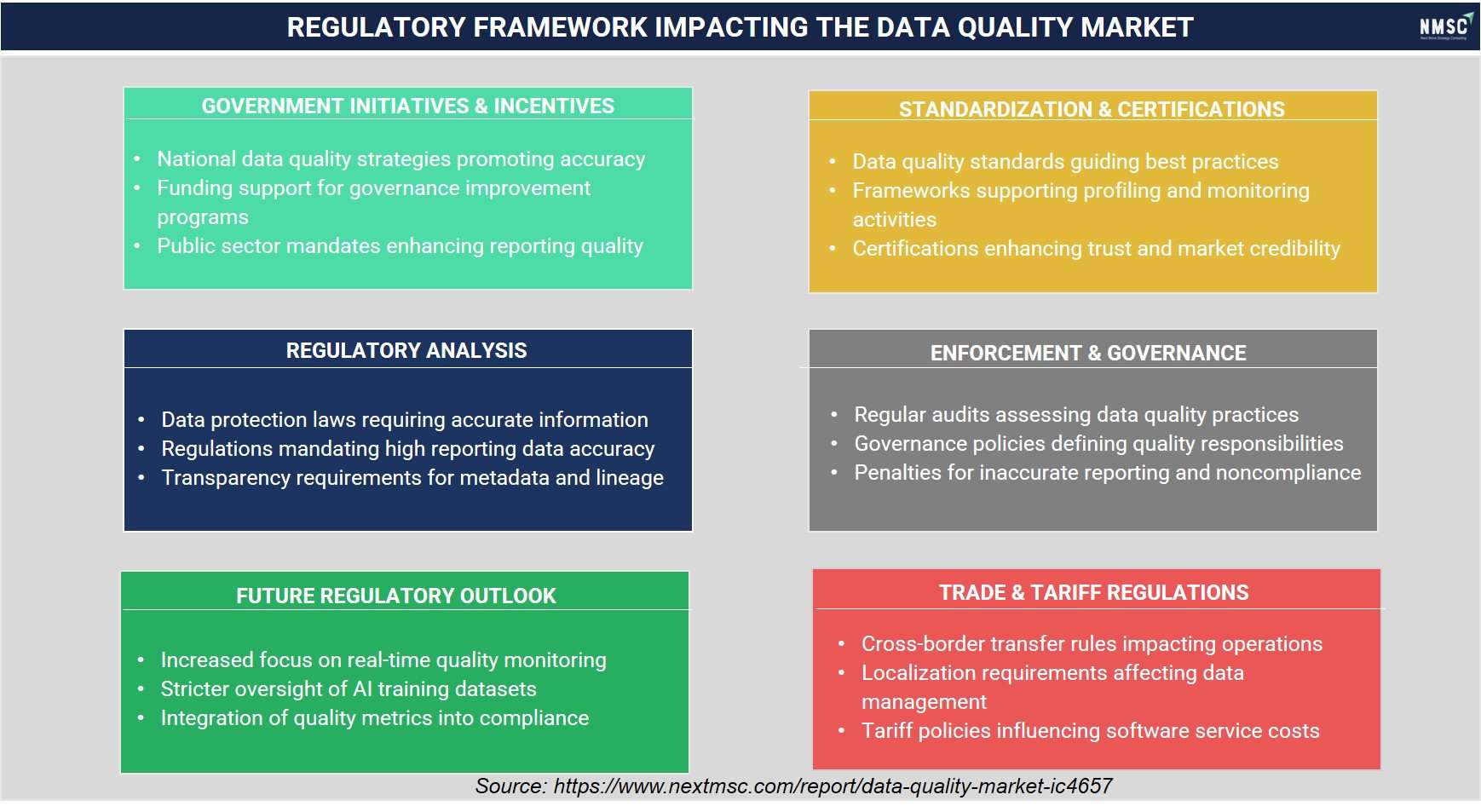
The above infographic outlines the regulatory framework impacting the data quality market, covering government initiatives and funding for accuracy mandates, data protection laws requiring reliable reporting, and future trends like real-time monitoring and AI dataset oversight. It also highlights standardization and certifications, enforcement through audits and penalties, and cross-border data transfer rules affecting software costs and compliance.
Competitive Landscape
Competitive Dynamics & M&A Landscape
|
Key Takeaways |
Details |
|
Market Structure |
The Data Quality Market features strong competition among enterprise software providers, cloud platform vendors, and specialized data quality and governance companies. Competition is centered on AI-driven data governance, metadata intelligence, master data management, automated cleansing, and trusted data delivery. Large vendors leverage integrated enterprise ecosystems, while niche players focus on data observability, compliance automation, and industry-specific quality management capabilities. |
|
Innovation Focus |
Innovation in the Data Quality Market is driven by AI-powered data profiling, automated validation, metadata intelligence, observability, and governance automation capabilities. Vendors are expanding intelligent data quality frameworks, AI-assisted remediation, and cloud-native governance platforms to improve trusted data accessibility, compliance readiness, and enterprise-wide analytics reliability across hybrid and multi-cloud environments. |
|
M&A Activity |
M&A activity in the Data Quality Market is focused on strengthening AI-ready governance, metadata management, master data capabilities, and cloud integration ecosystems. Vendors are pursuing acquisitions and strategic partnerships to improve interoperability, governance automation, and enterprise-scale trusted data management. Industry consolidation is additionally supporting expansion into regulated industries and AI-driven analytics environments requiring high-quality and compliant enterprise data. |
How Do Companies Compete in the Data Quality Market?
The competitive structure of the data quality market is led by enterprise software providers and specialized governance vendors competing through AI-driven automation, metadata intelligence, and trusted data management capabilities. Companies such as Informatica, IBM, Oracle, SAP, and Microsoft continue strengthening enterprise data governance ecosystems through cloud-native integration, master data management, and AI-assisted quality automation. Competition increasingly focuses on improving data accuracy, governance consistency, compliance readiness, and interoperability across hybrid and multi-cloud enterprise environments. Vendors are additionally prioritizing scalable observability, automated remediation, and intelligent profiling capabilities to support AI-ready enterprise analytics and digital transformation initiatives.
Which Kind of Companies Dominate the Data Quality Market?
The market is simultaneously dominated by global enterprise software vendors and specialized data quality providers targeting governance-intensive and compliance-sensitive environments. Large-scale companies such as IBM, Oracle, SAP, and Microsoft leverage existing enterprise infrastructure, database ecosystems, and cloud relationships to secure long-term modernization projects. At the same time, niche specialists including Collibra, Ataccama, Precisely, Tamr, Syniti, and Data Ladder compete through advanced profiling, metadata management, observability, and AI-powered quality automation capabilities. Our assessment indicates that companies with strong governance expertise and scalable cloud integration frameworks are gaining competitive advantage as enterprises prioritize trusted and compliant data ecosystems.
AI-Native Differentiation and Open Standards Drive Market Success in the Data Quality Market
Innovation cycles in the data quality market are increasingly shaped by AI-powered governance, metadata intelligence, automated cleansing, and real-time observability capabilities. Vendors are embedding intelligent remediation, anomaly detection, and AI-assisted stewardship tools into enterprise data management environments to improve operational efficiency and analytics reliability. Our analysis indicates that adaptability now depends on enabling scalable governance automation, regulatory compliance, and AI-ready trusted data architectures rather than traditional standalone cleansing solutions alone. Companies such as Informatica, Precisely, Experian, and Collibra are strengthening intelligent quality management capabilities to support enterprise-wide analytics modernization and regulatory-driven digital transformation initiatives.
Market Players to Opt for Merger and Acquisition Strategies to Expand Their Presence in the Data Quality Market
Acquisitions and strategic ecosystem expansion remain important growth strategies across the data quality market as vendors pursue AI-driven governance modernization and enterprise data integration expansion. Industry consolidation reflects increasing enterprise demand for unified metadata management, master data governance, observability, and compliance automation within centralized platforms. Strategic partnerships are additionally helping vendors improve interoperability across hybrid-cloud environments and regulated industries including financial services, healthcare, and telecommunications. Our research indicates that market participants are increasingly prioritizing scalable and interoperable trusted data ecosystems capable of supporting AI deployment, governance resilience, and enterprise-wide analytics transformation.
Who Are the Key Market Players in the Data Quality Market?
-
Microsoft Corporation
-
International Business Machines Corporation
-
Oracle Corporation
-
SAP SE
-
Informatica Inc.
-
Experian plc
-
Dun & Bradstreet Holdings, Inc.
-
SAS Institute Inc.
-
QlikTech International AB
-
Precisely Holdings, LLC
-
Pitney Bowes Inc.
-
Collibra NV
-
Alteryx, Inc.
-
Ataccama Corporation
-
Syniti LLC
-
Melissa Data Corporation
-
Tamr, Inc.
-
Boomi, LP
-
CDQ AG
-
Data Ladder LLC
What Are the Latest Developments in the Data Quality Market Industry?
Expert Insights

“Data-driven decision making stands out as a top goal for 76% of companies surveyed, but 67% report that they don’t fully trust the data their organization is using. And the percentage of people reporting their organization has a comprehensive data strategy actually dropped from 53% to 46% in the past year.”
- Josh Rogers, Precisely CEO
Statement published in research findings discussed during enterprise data integrity and governance analysis focused on organizational trust in data, analytics reliability, and AI readiness.
Market Interpretation
The statement highlights the growing challenge of maintaining trusted and governed enterprise data within increasingly complex digital ecosystems. Our analysis indicates that organizations are prioritizing data quality, observability, metadata intelligence, and governance automation to improve decision-making confidence and AI readiness. The declining percentage of enterprises with comprehensive data strategies reflects broader market difficulties associated with fragmented data environments, regulatory complexity, and inconsistent governance frameworks. This trend is accelerating enterprise investment in scalable data quality platforms capable of improving data accuracy, compliance readiness, and analytics reliability across hybrid and multi-cloud infrastructures.
What Are the Investment Opportunities in the Data Quality Market?
Capital Inflows and Private Equity Activity in the Data Quality Market
The data quality market has attracted sustained private equity and growth capital investment, reflecting investor recognition of the recurring revenue characteristics and multi-decade secular growth drivers within the enterprise data management software category. Private equity firms including Thoma Bravo, Clearlake Capital, and Vista Equity Partners have made significant investments in data quality and governance platform vendors, seeking to consolidate the fragmented landscape around integrated platform plays. The National Venture Capital Association reports that enterprise data management software, including data quality, has consistently ranked among the top-five software investment categories by deal volume in North America, driven by the structural tailwinds of AI governance, regulatory compliance, and cloud migration demand.
Infrastructure Investment and Digital Transformation Alignment in the Data Quality Market
Significant investment opportunity exists in the data quality market from enterprises digitizing legacy IT infrastructure, as data quality management is a critical enabler of every major digital transformation program, including ERP cloud migration, CRM modernization, and AI platform deployment. Cloud hyperscaler investment in embedded data quality capabilities, Microsoft Fabric quality monitoring, AWS Glue DataBrew, and Google Cloud Dataplex quality rules, is creating co-investment opportunities for specialized vendors that extend hyperscaler-native tooling with deeper domain-specific capabilities. The U.S. Infrastructure Investment and Jobs Act's investment in government IT modernization creates public sector opportunities for FedRAMP-authorized data quality platform vendors within the federal government channel.
ESG and Sustainability Data Quality Investment Opportunities in the Data Quality Market
ESG-aligned investment in the data quality market centers on two themes: the enablement of accurate ESG reporting, including Scope 1, 2, and 3 greenhouse gas emissions data quality, and supply chain sustainability data validation, and the sustainable operational profile of cloud-native platforms relative to energy-intensive on-premises deployments. The EU Corporate Sustainability Reporting Directive and EFRAG's European Sustainability Reporting Standards create mandatory, auditable ESG data quality requirements for approximately 50,000 companies across the EU, constituting a structurally large new demand segment within the market. Investors with ESG mandates should prioritize data quality vendors whose cloud SaaS delivery model reduces enterprise data center energy consumption relative to on-premises alternatives.
Digital Transformation and AI Governance Investment Opportunities in the Data Quality Market
The convergence of AI adoption and mandatory AI governance frameworks is creating the most durable long-term investment theme in the market. The EU AI Act's risk-based framework classifies high-risk AI systems as requiring documented, high-quality, and representative training datasets, a compliance obligation creating non-discretionary investment demand for data quality tools across European AI developers. The NIST AI Risk Management Framework Playbook similarly identifies data quality as a foundational AI risk mitigation measure, widely adopted by U.S. enterprises as a standard AI governance framework. Investors should focus on data quality vendors demonstrating direct integration with AI governance workflows, MLOps pipelines, and LLM training data curation processes, representing the highest-value future positioning within the data quality market.
Key Benefits for Stakeholders
For Enterprise Technology Buyers
Enterprise technology buyers gain comprehensive, vendor-neutral insights into the data quality market, including quantitative sizing across software, services, deployment models, organization sizes, and industry verticals. This intelligence supports data governance planning, vendor evaluation, and long-term investments in data quality, master data management, and analytics initiatives. Our competitive landscape analysis enables procurement teams to benchmark solution capabilities, assess platform differentiation, and make informed technology selection decisions with greater confidence.
For Investors and Financial Analysts
Investors and financial analysts gain access to a structured assessment of the data quality market’s growth outlook, competitive environment, M&A activity, and segment-level revenue forecasts through 2035. CAGR analysis by segment, region, and end user supports investment evaluation and market opportunity assessment. Detailed profiles of leading vendors, combined with tracking of recent product launches, partnerships, and acquisitions, provide valuable insights for identifying emerging growth leaders and competitive shifts within the global data quality ecosystem.
For Data Quality Vendors and Solution Providers
Data quality vendors and solution providers gain actionable intelligence on emerging growth opportunities, competitive positioning, and high-potential market segments within the data quality market. Segment analysis highlights demand trends across cloud-native deployments, AI-powered data quality, data observability, and governance-driven solutions. Regional assessments identify expansion opportunities based on digital transformation maturity and regulatory developments. The analysis also supports go-to-market optimization, partner strategy development, and identification of cross-selling opportunities across data management and analytics portfolios.
For Government and Regulatory Bodies
Government agencies and regulatory bodies gain a structured understanding of how data governance and privacy regulations, including GDPR, CCPA, India’s DPDP Act, HIPAA, and sector-specific compliance frameworks, are influencing the data quality market’s evolution. Country-level insights provide evidence-based perspectives on the relationship between regulatory requirements, enterprise data governance adoption, and digital economy development. The analysis supports policymaking related to data integrity, compliance modernization, and trusted data infrastructure initiatives.
Data Quality Market Key Segments
By Offering
-
Software
-
Standalone platform
-
Cloud SaaS
-
Self-hosted
-
-
Embedded module
-
Data integration module
-
Data governance module
-
Master data management module
-
Analytics module
-
Business application module
-
-
-
Data services
-
Validation
-
Address
-
Email
-
Phone
-
Identity
-
Business entity
-
-
Enrichment
-
Contact
-
Firmographic
-
Geospatial
-
Demographic
-
-
Reference data
-
Postal
-
Business registry
-
Location
-
Compliance
-
-
-
Professional services
-
Advisory
-
Implementation
-
Migration
-
Training
-
Support
-
-
Managed services
-
Managed cleansing
-
Managed monitoring
-
Managed stewardship
-
By Function
-
Profiling
-
Discovery
-
Cleansing
-
Standardization
-
Parsing
-
Validation
-
Matching
-
Deduplication
-
Monitoring
-
Enrichment
-
Stewardship
-
Rule management
-
Reporting
By Deployment
-
Cloud
-
Hybrid
-
On premises
-
By Pricing
-
Subscription
-
Usage based
-
Perpetual
-
Project fee
-
Retainer
By Data Domain
-
Customer
-
Product
-
Supplier
-
Financial
-
Location
-
Reference
-
Operational
-
Other
By Buyer
-
Data engineering
-
Data governance
-
Analytics
-
Business operations
-
Compliance
-
IT operations
-
By Channel
-
Direct
-
Partner
-
Marketplace
-
OEM
By Industry
-
BFSI
-
Healthcare
-
Life sciences
-
Retail
-
Ecommerce
-
Manufacturing
-
Automotive
-
Government
-
Public sector
-
Telecom
-
Media
-
Technology
-
Energy
-
Utilities
-
Transportation
-
Logistics
-
Education
-
Travel
By Region
-
North America: U.S., Canada, and Mexico.
-
Europe: UK, Germany, France, Italy, Spain, Sweden, Denmark, Finland, the Netherlands, and the rest of Europe.
-
Asia Pacific: China, India, Japan, South Korea, Taiwan, Indonesia, Vietnam, Australia, Philippines, Malaysia and the rest of APAC.
-
Middle East & Africa (MEA): Saudi Arabia, UAE, Egypt, Israel, Turkey, Nigeria, South Africa, and the rest of MEA.
-
Latin America: Brazil, Argentina, Chile, Colombia, and the rest of LATAM.
Conclusion and Recommendations
Long-Term Outlook
The data quality market is entering the most consequential growth phase in its history, driven by the twin mega-forces of AI adoption and regulatory data governance mandates that together elevate data quality from an IT hygiene function to a board-level enterprise risk and competitive strategy priority. The market is forecast to grow from USD 5.5 billion in 2026 to USD 18.6 billion by 2035 at a CAGR of 14.5%. This trajectory reflects a structural, multi-decade expansion of enterprise data volumes, increasing AI model dependency on high-quality training and inference data, and an expanding global regulatory framework requiring auditable, accurate, and governed data across financial services, healthcare, and consumer-facing industries worldwide.
Strategic Positioning Recommendations
Data quality platform vendors should prioritize three strategic investment areas. First, AI-native capability integration, including automated rule suggestion, ML-based anomaly detection, and LLM training data curation features that align with NIST AI RMF and EU AI Act data governance requirements. Second, cloud marketplace distribution, building on AWS, Azure, and Google Cloud marketplace listings to access enterprise committed cloud spend and accelerate procurement velocity. Third, vertical specialization in healthcare and financial services, the two highest-growth and highest-compliance industry verticals in the data quality market, where compliance-driven investment is the most durable and defensible commercial dynamic throughout the forecast period.
Investment Attractiveness
The data quality market represents a structurally attractive investment environment characterized by recurring revenue models, high switching costs inherent in enterprise data quality programs, and durable secular demand drivers including AI governance, regulatory compliance, and digital transformation. The highest-conviction investment themes include Managed Services (17.5% CAGR), Cloud Marketplace distribution (18.6% CAGR), Monitoring functional capability (16.1% CAGR), Healthcare vertical (16.1% CAGR), and the MEA regional market (16.2% CAGR). Private equity investors should monitor consolidation opportunities in address validation, identity resolution, and AI-native monitoring sub-segments where platform roll-up strategies can create defensible integrated offerings at attractive entry multiples.
Market Shifts and Key Risks
The most significant market shift underway is the migration from standalone, functional data quality tools toward integrated data governance platforms that subsume quality management within broader data catalog, MDM, and lineage capabilities. This shift benefits full-platform vendors such as Informatica, Collibra, and SAP at the expense of narrowly positioned point solutions. Key risks for the data quality market include: open-source frameworks including Great Expectations, Apache Griffin, and dbt tests competing with commercial platforms at zero license cost; AI automation potentially reducing manual labor that historically justified software investment; vendor consolidation creating procurement uncertainty for customers of acquired platforms; and macroeconomic pressure compressing enterprise software budgets among mid-market buyers.
Growth Pathways
Organizations seeking to maximize value from the data quality market should pursue a three-horizon investment strategy. In the near term (2025–2027), establish a governed data quality baseline by deploying profiling, monitoring, and cleansing capabilities within the production data pipeline and creating a data stewardship operating model with measurable quality KPIs. In the mid-term (2027–2031), invest in AI-native quality automation, cross-domain orchestration, and marketplace-based data enrichment services to elevate quality from reactive remediation to proactive, self-healing asset management. In the long term (2031–2035), position for AI governance compliance by building certified, auditable programs satisfying EU AI Act and NIST AI RMF requirements, enabling premium AI model deployment across regulated industries within the market.


About the Author
 Mayurima Roy
— Mayurima Roy is Research Analyst at Next Move Strategy Consulting, where she has spent 4 years working across the firm's full industry coverage rather than a single fixed vertical. Her work centers on structured research, ongoing trend tracking, competitive assessment, and insight-led content development, translating complex market data into clear, decision-ready narratives that support informed client decision-making across diverse global industries, market sectors, and world regions every day.
Mayurima Roy
— Mayurima Roy is Research Analyst at Next Move Strategy Consulting, where she has spent 4 years working across the firm's full industry coverage rather than a single fixed vertical. Her work centers on structured research, ongoing trend tracking, competitive assessment, and insight-led content development, translating complex market data into clear, decision-ready narratives that support informed client decision-making across diverse global industries, market sectors, and world regions every day.
About the Reviewer
 Supradip Baul
— Supradip Baul is an accomplished business consultant and strategist with over a decade of rich experience in market intelligence, strategy, technology, and business transformation. His work has included rigorous qualitative and quantitative analysis across multiple industries, helping clients shape investment decisions and long-term roadmaps. Earlier in his career, he was associated with Gartner, where he contributed to industry-leading reports and market share analyses. He has worked with leading global companies and holds an MBA with a dual specialization in Marketing and Finance.
Supradip Baul
— Supradip Baul is an accomplished business consultant and strategist with over a decade of rich experience in market intelligence, strategy, technology, and business transformation. His work has included rigorous qualitative and quantitative analysis across multiple industries, helping clients shape investment decisions and long-term roadmaps. Earlier in his career, he was associated with Gartner, where he contributed to industry-leading reports and market share analyses. He has worked with leading global companies and holds an MBA with a dual specialization in Marketing and Finance.
At Next Move Strategy Consulting, we understand that insightful market research is the cornerstone of successful business decisions. That's why we employ a robust and multifaceted approach, combining various methodologies to deliver the most accurate and actionable data for our clients.

Research Landscape
We navigate the world of research with two primary approaches:
Qualitative Approach
Our qualitative research methodologies involve immersive techniques such as in-depth interviews, focus groups, and observational studies. By engaging directly with individuals and stakeholders, we uncover valuable insights that quantitative data alone may overlook.

Quantitative Research
In tandem with qualitative methodologies, NMSC leverages the power of Quantitative Research to provide a robust foundation of numerical insights. Through systematic data collection and analysis, we quantify patterns, preferences, and market trends, offering a comprehensive view of the business landscape.
Our quantitative research approach employs diverse tools, including surveys, experiments, and statistical modelling. These methodologies enable us to gather data from a large and representative sample, ensuring the statistical significance of our findings. By employing structured questionnaires and standardized data collection methods, we guarantee the reliability and validity of the information we present to our clients.
Quantitative research is particularly effective in measuring the prevalence of trends, assessing market size, and gauging the impact of various factors on consumer behavior. The numerical precision attained through this approach equips our clients with actionable insights, facilitating data-driven decision-making and strategy formulation.


Our Specialized Toolbox for Industry-Specific Market Research
We deploy a specialized arsenal of techniques tailored to meet your unique requirements. Here's a glimpse into our comprehensive toolbox:

Information Procurement
The stage entails acquiring market data or relevant information through various sources and methodologies.


Market Research Approach
We utilize both top-down and bottom-up approaches in market research analysis to achieve a comprehensive understanding of the market dynamics, leveraging the broad perspective of industry trends and macroeconomic factors alongside detailed insights from specific segments and individual companies.

Porters Five Forces Analysis
We conduct Porter's Five Forces analysis to evaluate the competitive landscape of an industry, providing us with insights into factors that affect profitability and strategic positioning.

SWOT Analysis

Forecasting
We utilize a forecasting model to predict future consumption by considering parameters like population, economics, regulations, market competition, drivers, constraints, technology, and pricing. We also employ statistical techniques such as multilinear regression, exponential smoothing, moving average, ARIMA, and Monte Carlo simulations for accurate predictions. In econometric forecasting, we analyzed short-term and long-term event impacts, attributing values based on regulatory frameworks, economic factors, and market events.





 Speak to Our Analyst