Decoy Flares Market Global Industry Analysis and Forecast (2026–2035)

Decoy Flares Market size was USD 1.18 Billion in 2025, projected to reach USD 2.34 Billion by 2035, growing at a CAGR of 7.0% from 2026 to 2035. Key drivers include rising airborne platform modernization programs, expanding infrared threat environments, and accelerating adoption of spectral and programmable flare technology, with North America leading the market.

Download Free Sample PDF
Base Year (2025)
$1.18 Billion
Forecast (2035)
$2.34 Billion
CAGR (2026-2035)
7.0%
Top Region
North America

What Is the Decoy Flares Market Size?

The global Decoy Flares Market size reached USD 1.18 Billion in 2025 and is estimated at USD 1.27 Billion in 2026, forecast to reach USD 2.34 Billion by 2035 at approximately 7.0% CAGR between 2026 and 2035. North America holds an approximate 38% share, while Expendable Decoy Flares dominate the product type segment at approximately 61% share in 2025.

Decoy Flares Market Global Industry Analysis and Forecast (2026–2035) Revenue Forecast

Values in USD Billion

2025 $1.18 Billion
2025
2026 $1.26 Billion
2026
2027 $1.35 Billion
2027
2028 $1.45 Billion
2028
2029 $1.55 Billion
2029
2030 $1.66 Billion
2030
2031 $1.77 Billion
2031
2032 $1.89 Billion
2032
2033 $2.03 Billion
2033
2034 $2.17 Billion
2034
2035 $2.34 Billion
2035

Key Takeaways

By Product Type: Expendable Decoy Flares held the largest share, expanding from USD 0.72 Billion in 2025 to USD 1.36 Billion by 2035; Spectral Flares is the fastest-growing sub-segment at 8.84% CAGR based on the stated 2025 and 2035 values.

By Platform: Airborne held the largest share, expanding from USD 0.64 Billion in 2025 to USD 1.27 Billion by 2035; Other Platforms is the fastest-growing sub-segment at 8.84% CAGR based on the stated 2025 and 2035 values.

By End User: Military and Law Enforcement held the largest share, expanding from USD 1.03 Billion in 2025 to USD 2.01 Billion by 2035; Homeland Security is the fastest-growing sub-segment at 8.20% CAGR based on the stated 2025 and 2035 values.

By Deployment Mode: Automated held the largest share, expanding from USD 0.72 Billion in 2025 to USD 1.57 Billion by 2035; Automated is also the fastest-growing sub-segment at 8.10% CAGR from 2026–2035.

Dominant Region: North America dominated with approximately 38% revenue share in 2025.

Fastest-Growing Region: Asia-Pacific is expected to register the highest CAGR of approximately 9.35% based on the stated regional market values.

Dominant Country: The U.S. led the market, anchored by sustained Pentagon procurement and concentrated defense prime contractor presence.

Fastest-Growing Country: India is the fastest-growing country among the covered markets based on the stated country-level estimates.

The market expands by approximately USD 1.07 Billion between 2026 and 2035, calculated as the difference between the 2035 forecast of USD 2.34 Billion and the 2026 base of USD 1.27 Billion, with spectral and programmable countermeasure platforms positioned as important growth categories for defense electronics manufacturers and allied-nation procurement agencies.

According to NMSC analysis, the convergence of rising man-portable air-defense system proliferation with expanding fixed-wing and rotary-wing fleet modernization cycles is structurally broadening the decoy flares addressable population across both legacy retrofit and new-build platform programs, sustaining mid-single-digit volume growth even as unit prices for advanced spectral variants compress through economies of scale in multi-year procurement contracts.

What Does the Decoy Flares Market Encompass?

The Decoy Flares Market covers expendable infrared and spectral countermeasure flares, selected naval infrared decoy systems, and programmable pyrotechnic dispensing solutions integrated across airborne, naval, ground-based, and other qualified platforms for military, law enforcement, and homeland security end users. The market spans pyrophoric flare cartridges, multi-spectral payloads, flare dispensing systems, and associated programmable sequencing electronics sold through direct government procurement channels, foreign military sales, and licensed production agreements. We observed that the market has evolved from single-band magnesium-Teflon-Viton formulations toward broadband spectral flares capable of addressing advanced imaging infrared seeker threats.

Regulatory frameworks governing decoy flare production and export are shaped by U.S. International Traffic in Arms Regulations, applicable national export-control requirements, Wassenaar-related controls, and military qualification and safety requirements. Technology adoption trends toward reprogrammable dispensing controllers and programmable release sequencing are expanding functionality per platform beyond legacy fixed-sequence dispenser configurations, and requirements for low-observable platform compatibility are driving investment in reduced-smoke and reduced-flame-signature variants.

Market Drivers & Dynamics

Interactive Dataset
Rising airborne platform modernization and fleet expansion programs driver +2.3% North America, Europe, Asia-Pacific 2026–2035
Expanding MANPADS proliferation driving rotary-wing and transport countermeasure mandates driver +1.7% Global 2026–2033
Adoption of multi-spectral and programmable flare dispensing architectures driver +1.2% North America, Europe 2026–2032
Growing indigenous defense production programs and allied FMS demand driver +1.0% Asia-Pacific, Middle East & Africa 2026–2035
Increased naval vessel self-protection and at-sea flare system integration driver +0.6% Europe, Asia-Pacific 2027–2035
Export control and ITAR licensing constraints limiting allied procurement timelines restraint −0.8% Global 2026–2035
High unit cost of advanced spectral and programmable variants limiting volume orders restraint −0.6% Asia-Pacific, Latin America, MEA 2026–2031
Environmental and safety regulation of pyrotechnic ordnance handling and disposal restraint −0.4% Europe, North America 2026–2030
Budget cycle volatility in defense appropriations affecting multi-year contract awards restraint -0.3% North America, Europe 2026–2032
Source: Next Move Strategy Consulting

Growth Drivers

What Is the Primary Growth Driver in the Decoy Flares Market?

The primary growth driver is rising airborne platform modernization combined with expanding MANPADS proliferation that is mandating countermeasure system integration across a broader fleet segment than earlier threat cycles. U.S. Department of Defense procurement programs for survivability upgrades across rotary-wing fleets illustrate how rotary-wing platform requirements complement fixed-wing demand and support multi-year production volumes across the expendable countermeasure supply chain.

How Is Multi-Spectral Technology Adoption Driving the Market Growth?

Our analysis shows that multi-spectral technology adoption is supporting market revenue growth by increasing the functionality and qualification requirements of advanced flare variants relative to legacy single-band pyrophoric flares. Allied procurement and countermeasure qualification activities reflect how defense ministries are expanding advanced flare requirements while using multi-year procurement frameworks to support supply continuity and production investment.

Growth Inhibitors

What Is Restraining the Decoy Flares Market?

We found that export-control constraints under U.S. regulations and allied national licensing requirements represent an important structural restraint because technology-transfer authorization and end-user certification requirements add procedural steps to international procurement. These requirements can delay conversion of addressable demand in markets that depend on imported countermeasure technology.

What Are the Growth Opportunities?

Can Spectral Flare Qualification for Next-Generation Platform Programs Unlock New Multi-Year Production Volume?

Manufacturers that complete qualification of multi-spectral and broadband flare payloads for next-generation stealth aircraft programs, including low-observable rotary-wing and advanced strike platforms under active development across NATO and allied nations, can capture multi-year production contracts tied directly to new-build delivery schedules. This opportunity primarily benefits the Spectral Flares product type segment and Airborne platform segment as qualification timelines for new-build programs run concurrently with production ramp rather than as retrofit additions.

Does Naval Vessel Self-Protection System Expansion Create Value for Integrated Decoy System Providers?

Vendors that develop and qualify integrated shipborne flare dispensing systems compatible with multi-layer naval self-protection architectures, incorporating infrared decoy, chaff, and soft-kill electronic warfare within a unified countermeasures management system, can capture rising demand from surface combatant and amphibious vessel modernization programs across Europe, Asia-Pacific, and the Middle East. This opportunity benefits the Naval platform segment and Automated deployment mode as centralized threat management systems replace manual operator-initiated countermeasure release.

Can Indigenous Production Partnership Models Expand Market Access in High-Growth Regions?

Companies that structure licensed production agreements, joint venture arrangements, or co-development programs with in-country defense manufacturers in India, South Korea, and the UAE can reduce dependence on imported countermeasure deliveries and align production with domestic offset and local-content requirements. This model benefits the Expendable Decoy Flares segment and Military and Law Enforcement end user segment as host-nation production agreements typically target high-volume expendable cartridge procurement rather than complex electronic sub-system manufacturing.

Segmentation Analysis

2025 (USD Billion)
2035 (USD Billion)
Expendable Decoy Flares 2025: $0.72 Billion | 2035: $1.36 Billion
Expendable D
Towed Decoy Flares 2025: $0.28 Billion | 2035: $0.56 Billion
Towed Decoy
Spectral Flares 2025: $0.18 Billion | 2035: $0.42 Billion
Spectral Fla
Expendable Decoy Flares $0.72 Billion $1.36 Billion 6.57%
Towed Decoy Flares $0.28 Billion $0.56 Billion 7.18%
Spectral Flares $0.18 Billion $0.42 Billion 8.84%

Which Product Type Segment Dominates the Decoy Flares Market?

Expendable Decoy Flares lead with USD 0.72 Billion in 2025, expanding to USD 1.36 Billion by 2035, reflecting their continued centrality to fixed-wing and rotary-wing aircraft self-protection across the major regional markets. Spectral Flares is the fastest-growing product type segment at an 8.84% CAGR based on the stated endpoints, as advanced two-color and multi-band payloads increasingly address modern infrared imaging seeker threats.

2025 (USD Billion)
2035 (USD Billion)
Airborne
Fixed-Wing A
Fighter and
Transport an
Rotary-Wing
Segment Item 2025 (USD Billion) 2035 (USD Billion) CAGR
Airborne $10.0 USD Billion $40.0 USD Billion 25.0%
Fixed-Wing Aircraft $17.1 USD Billion $51.1 USD Billion 11.0%
Fighter and Attack Aircraft $24.2 USD Billion $62.2 USD Billion 25.0%
Transport and Utility Aircraft $31.3 USD Billion $73.3 USD Billion 11.0%
Rotary-Wing Aircraft $38.4 USD Billion $84.4 USD Billion 16.0%

Segment-wise data is locked

Unlock complete segment-wise numbers for By Platform.

Unlock Full Data

Which Platform Leads and Which Grows Fastest?

Airborne platform customers dominate at USD 0.64 Billion in 2025, reflecting the primacy of aircraft survivability as the organizing procurement priority across allied and partner-nation defense budgets. Space is the fastest-growing platform category at an 8.84% CAGR based on the stated endpoints, reflecting smaller but expanding qualified applications outside the largest airborne customer base.

2025 (USD Billion)
2035 (USD Billion)
Military and
Air Force
Army Aviatio
Navy and Coa
Special Oper
Segment Item 2025 (USD Billion) 2035 (USD Billion) CAGR
Military and Law Enforcement $10.0 USD Billion $40.0 USD Billion 27.0%
Air Force $17.1 USD Billion $51.1 USD Billion 9.0%
Army Aviation $24.2 USD Billion $62.2 USD Billion 19.0%
Navy and Coast Guard $31.3 USD Billion $73.3 USD Billion 17.0%
Special Operations Forces $38.4 USD Billion $84.4 USD Billion 18.0%

Segment-wise data is locked

Unlock complete segment-wise numbers for By End User.

Unlock Full Data

Which End User Dominates and Which Is Fastest-Growing?

Military and Law Enforcement customers account for USD 1.03 Billion in 2025, as armed forces worldwide represent the primary institutional purchasers of qualified decoy flare cartridges and dispensing systems across new-build and retrofit procurement vehicles. Homeland Security is the fastest-growing end user at an 8.19% CAGR based on the stated endpoints, as border-surveillance and critical-infrastructure aviation applications expand from a smaller installed base.

2025 (USD Billion)
2035 (USD Billion)
Manual
Pilot-Initia
Crew-Operate
Automated
Threat-Cued
Segment Item 2025 (USD Billion) 2035 (USD Billion) CAGR
Manual $10.0 USD Billion $40.0 USD Billion 14.0%
Pilot-Initiated Single-Shot Release $17.1 USD Billion $51.1 USD Billion 24.0%
Crew-Operated Dispenser Systems $24.2 USD Billion $62.2 USD Billion 22.0%
Automated $31.3 USD Billion $73.3 USD Billion 12.0%
Threat-Cued Automatic Release Systems $38.4 USD Billion $84.4 USD Billion 27.0%

Segment-wise data is locked

Unlock complete segment-wise numbers for By Deployment Mode.

Unlock Full Data
2025 (USD Billion)
2035 (USD Billion)
North Americ
Canada
Mexico
Europe: UK
Germany
Segment Item 2025 (USD Billion) 2035 (USD Billion) CAGR
North America: U.S. $10.0 USD Billion $40.0 USD Billion 24.0%
Canada $17.1 USD Billion $51.1 USD Billion 22.0%
Mexico $24.2 USD Billion $62.2 USD Billion 20.0%
Europe: UK $31.3 USD Billion $73.3 USD Billion 22.0%
Germany $38.4 USD Billion $84.4 USD Billion 13.0%

Segment-wise data is locked

Unlock complete segment-wise numbers for By Region.

Unlock Full Data

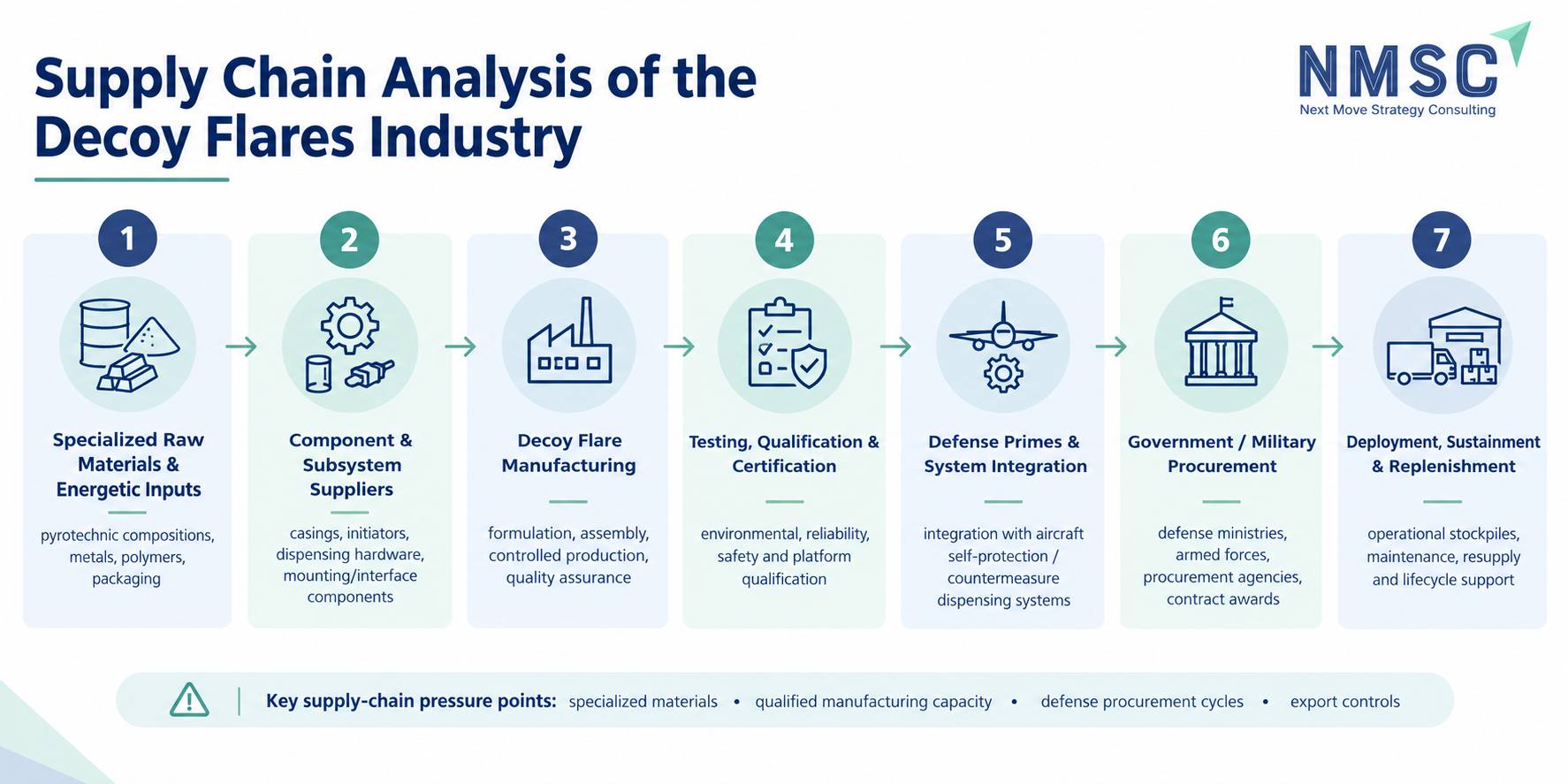
Supply Chain Analysis of the Decoy Flares Industry

Supply Chain Analysis of the Decoy Flares Industry
The above infographic provides a detailed supply chain analysis of the decoy flares industry, outlining a specialized seven-step process from raw materials to deployment. It traces the flow from sourcing energetic inputs and manufacturing components through rigorous testing, system integration, and government procurement. The analysis further highlights key supply chain pressure points, such as qualified manufacturing capacity and defense procurement cycles. Ultimately, it illustrates the complex, highly regulated pathway required to deliver these critical defense countermeasures to the armed forces.

Growth Opportunities

Our analysis shows that three whitespace opportunities stand out for manufacturers and integration partners positioning ahead of 2035 demand in the Decoy Flares Market.

Can Spectral Flare Qualification for Next-Generation Platform Programs Unlock New Multi-Year Production Volume?

Manufacturers that complete qualification of multi-spectral and broadband flare payloads for next-generation stealth aircraft programs, including low-observable rotary-wing and advanced strike platforms under active development across NATO and allied nations, can capture multi-year production contracts tied directly to new-build delivery schedules. This opportunity primarily benefits the Spectral Flares product type segment and Airborne platform segment as qualification timelines for new-build programs run concurrently with production ramp rather than as retrofit additions.

Does Naval Vessel Self-Protection System Expansion Create Value for Integrated Decoy System Providers?

Vendors that develop and qualify integrated shipborne flare dispensing systems compatible with multi-layer naval self-protection architectures, incorporating infrared decoy, chaff, and soft-kill electronic warfare within a unified countermeasures management system, can capture rising demand from surface combatant and amphibious vessel modernization programs across Europe, Asia-Pacific, and the Middle East. This opportunity benefits the Naval platform segment and Automated deployment mode as centralized threat management systems replace manual operator-initiated countermeasure release.

Can Indigenous Production Partnership Models Expand Market Access in High-Growth Regions?

Companies that structure licensed production agreements, joint venture arrangements, or co-development programs with in-country defense manufacturers in India, South Korea, and the UAE can reduce dependence on imported countermeasure deliveries and align production with domestic offset and local-content requirements. This model benefits the Expendable Decoy Flares segment and Military and Law Enforcement end user segment as host-nation production agreements typically target high-volume expendable cartridge procurement rather than complex electronic sub-system manufacturing.

Regional Outlook

2025 (USD Billion)
2035 (USD Billion)
North Americ
Asia-Pacific
Europe
Middle East
Latin Americ
Region 2025 (USD Billion) 2035 (USD Billion) CAGR (%)
North America $10.0 USD Billion $40.0 USD Billion 9.0%
Asia-Pacific $17.1 USD Billion $51.1 USD Billion 27.0%
Europe $24.2 USD Billion $62.2 USD Billion 25.0%
Middle East & Africa $31.3 USD Billion $73.3 USD Billion 23.0%
Latin America $38.4 USD Billion $84.4 USD Billion 12.0%

Regional data is locked

Unlock complete regional numbers for this market.

Unlock Full Data

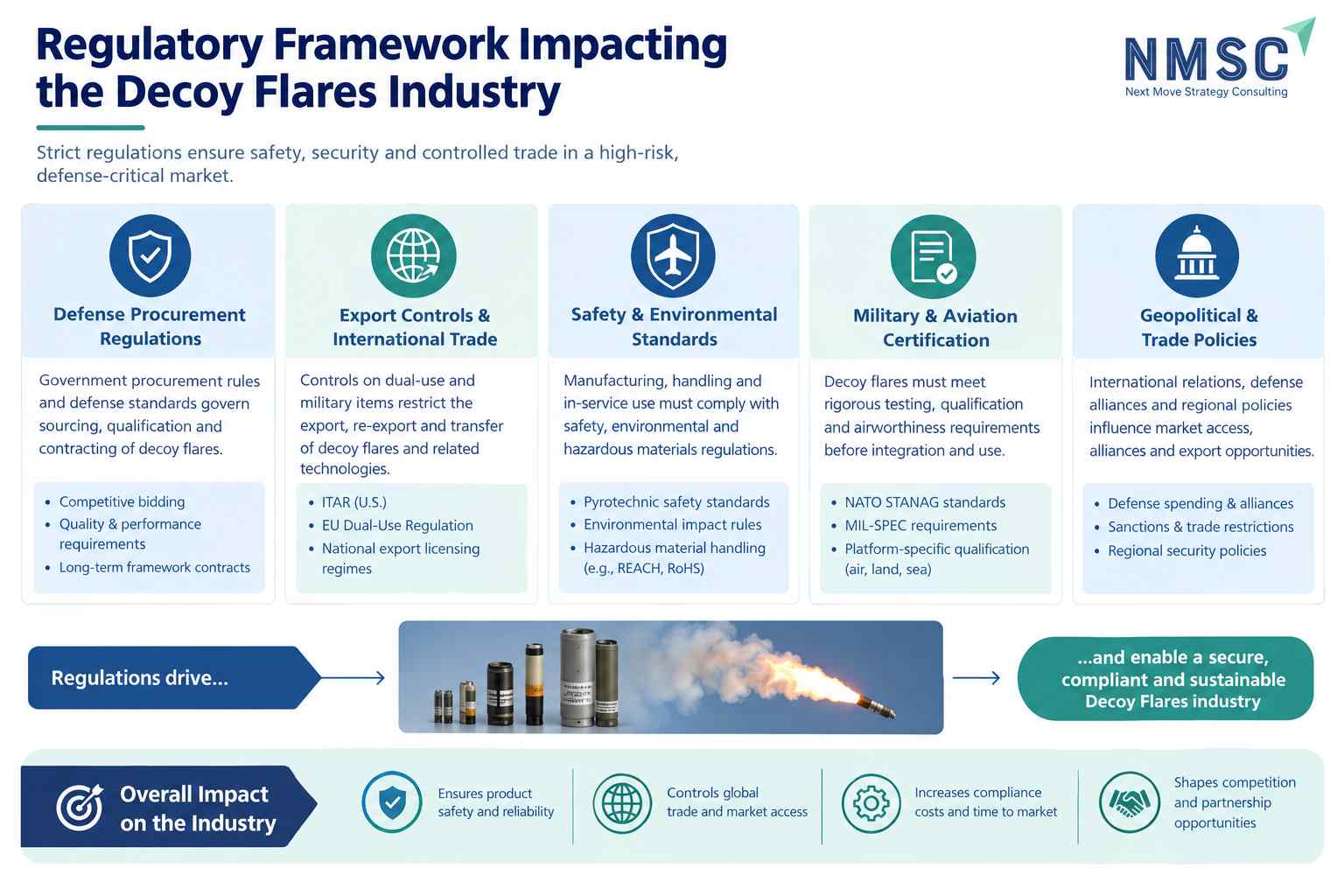
Regulatory Framework Impacting the Decoy Flares Industry

The above infographic outlines the regulatory framework impacting the decoy flares industry, highlighting five key areas that govern this high-risk, defense-critical market. It details strict rules covering defense procurement, export controls, safety standards, and military certification, alongside the influence of geopolitical trade policies. The analysis shows that these regulations collectively drive a secure and compliant industry, though they also increase compliance costs and shape market competition. Ultimately, it emphasizes that adherence to these stringent standards is essential for ensuring product safety, enabling global trade, and sustaining reliable defense operations.

Competitive Landscape

Our assessment indicates that the competitive landscape spans integrated defense electronics and energetics prime contractors, specialist pyrotechnic ordnance manufacturers, and national-champion producers, each competing on spectral performance breadth, qualification depth across platform programs, and export authorization positioning within allied procurement frameworks.

Dimension Description
Dimension Assessment
Market Structure Moderately concentrated; top 10 companies hold the majority of market share, led by U.S.-domiciled integrated countermeasure prime contractors alongside European and Asian specialist manufacturers with deep platform qualification portfolios
Innovation Focus Multi-spectral payload formulation, reprogrammable dispensing controller architectures, reduced-smoke low-observable compatible variants, and integrated threat warning and countermeasure management system development
M&A Activity Selective capability acquisitions targeting pyrotechnic formulation and dispensing system integration assets, with larger prime contractors acquiring specialist energetics firms to internalize IP and secure qualified production capacity

How Do Companies Compete in the Decoy Flares Market?

Companies compete primarily on spectral payload performance breadth and platform qualification depth, since defense ministry procurement regulations require individual flare cartridge qualification against each specific airframe's susceptibility reduction requirements before production delivery. Our findings suggest that vendors holding the broadest portfolio of qualified expendable countermeasure cartridges across multiple platform types maintain a structural procurement advantage, as re-qualification costs and timeline risks make switching suppliers during active production programs prohibitively disruptive for platform program offices.

Which Competitive Archetypes Dominate the Decoy Flares Market?

Integrated defense electronics primes such as Northrop Grumman dominate through combined threat warning system, dispensing controller, and flare cartridge ecosystems spanning multiple platform programs, while specialist pyrotechnic manufacturers including Chemring Group and Lacroix Defense differentiate through focused energetics formulation expertise and pyrotechnic manufacturing depth that scale-constrained electronics primes cannot fully replicate internally. National-champion producers including Bharat Dynamics Limited and Hanwha compete on government-mandated domestic sourcing requirements and cost-competitive production for high-volume standardized expendable cartridge specifications.

What Innovation and Differentiation Strategies Are Companies Pursuing?

We observed that leading companies are investing in multi-spectral payload formulation that addresses near-infrared and mid-wave imaging seeker threats, combined with reprogrammable dispensing controller development that allows field-level threat library updates without hardware exchange. Differentiation increasingly centers on low-observable platform compatibility, as next-generation stealth airframe programs impose dispenser integration constraints that favor vendors with established co-design relationships with airframe OEMs.

What M&A and Partnership Activity Is Shaping the Decoy Flares Market?

Recent activity reflects selective acquisition and capability integration involving specialist energetics and pyrotechnic manufacturing assets. Chemring Group's focus on countermeasure portfolio consolidation across its U.S. and European manufacturing bases illustrates the capability-integration strategy used to expand supply capacity and offer broader countermeasure solutions to platform program offices.

Key Market Players

Based on research conducted by NMSC, the following companies represent the validated set of leading participants across decoy flare products, dispensing systems, and countermeasure integration.

Chemring Group PLC Northrop Grumman Corporation BAE Systems PLC Elbit Systems Ltd. Rheinmetall AG Leonardo S.p.A. Lacroix Defense SAS Alloy Surfaces Company, Inc. Moog Inc. Bharat Dynamics Limited Hanwha Corporation Denel SOC Ltd. Radiator Inc. Israel Aerospace Industries Ltd. Saab AB Singapore Technologies Engineering Ltd. Norinco Group (China North Industries Group Corporation Limited) Nammo AS Aerojet Rocketdyne Holdings, Inc. Diehl Defence GmbH & Co. KG

Latest Developments

We found that recent corporate and governmental activity reflects continued spectral technology investment, multi-year production contract awards, and platform qualification program launches across the Decoy Flares Market through 2025 and 2026.

Date Event
June 2026 Chemring secured agreements enabling Alloy Surfaces to restart sustained manufacturing of pyrophoric airborne decoys. The production IDIQ has a maximum value of USD 300 million over five years, with USD 35 million annual minimums for three years; a separate USD 45 million OTA supports manufacturing restart and IP transfer.
June 2025 - LACROIX unveiled four advanced decoy demonstrators, LIR 110F, LIR 113, LIR 112 and LIR 115, covering flash saturation, scene confusion, kinematic MTV and spectral deception

Investment Opportunities

Where Are Capital Inflows Concentrating in the Decoy Flares Market?

Capital is concentrating in multi-spectral flare payload development and reprogrammable dispensing controller integration, reflected in sustained research and development investment disclosures from Chemring Group, Northrop Grumman, and BAE Systems across their official annual report filings. This investment pattern evidences capital allocation toward performance-differentiated variants capable of defeating advanced imaging seekers, which command meaningfully higher unit prices and generate longer-duration supply relationships than commodity expendable cartridge production, supporting durable revenue quality improvement alongside volume growth.

How Is Infrastructure Investment Shaping Long-Term Capacity?

Our findings suggest that infrastructure investment is shifting toward expanded pyrotechnic energetics manufacturing capacity and automated cartridge assembly lines that improve throughput consistency for multi-spectral flare production relative to labor-intensive manual fill-and-close processes. The U.S. Army's Public-Private Partnership investment in the Radford Army Ammunition Plant and the McAlester Army Ammunition Plant, documented in official Army annual budget justification documents, reflects how government-funded infrastructure recapitalization is expanding the industrial base capacity available to decoy flare manufacturers that rely on government-owned contractor-operated production facilities.

What ESG Considerations Are Influencing Investment Decisions?

Environmental, social, and governance considerations in the Decoy Flares Market center on pyrotechnic ordnance disposal and range contamination management, export control compliance, and workforce safety in energetics manufacturing environments. Investors evaluate manufacturers on export-control compliance, end-use certification, controlled technology transfer, and workforce safety requirements applicable to defense countermeasure products.

Key Benefits for Stakeholders

How Does This Report Benefit Defense Industry Leaders?

Defense industry leaders gain segment-level revenue forecasts and CAGR benchmarks across product type, platform, end user, and deployment mode axes, enabling product-roadmap and capital allocation decisions grounded in the 2025–2035 figures used consistently throughout this analysis. Our findings on regional growth differentials and platform-specific demand concentration further support market-entry sequencing, qualification investment prioritization, and allied procurement partnership strategy decisions for companies operating across multiple national defense industrial bases.

How Does This Report Benefit Investors and Financial Analysts?

Investors and financial analysts gain a reconciled market-sizing model, competitive landscape assessment, and named-company development tracking that support defense sector valuation and capital allocation decisions. The Growth Catalyst and Risk Assessment Matrix provides modeled directional impacts for scenario analysis across defense electronics and energetics manufacturing portfolios.

How Does This Report Benefit Technology Vendors and Product Teams?

Technology vendors and product teams gain visibility into offering and customer-type segments, including Spectral Flares and advanced platform applications, that show higher growth rates in the current model, informing engineering investment and qualification program sequencing through 2035. NMSC's analysis of countermeasure integration requirements and dispenser-controller adoption trends provides insight for R&D teams scoping next-generation payload and controller architecture development roadmaps.

Key Market Segments Evaluated

By Product Type

  • Expendable Decoy Flares 
    • Pyrophoric Flares
      • Magnesium-Teflon-Viton Flares
      • Zirconium-based Flares
    • Kinematic Flares
  • Towed Decoy Flares 
    • Fiber-Optic Towed Decoys
    • Radar and Infrared Combined Towed Decoys
  • Spectral Flares 
    • Dual-band Spectral Flares
    • Broadband Multi-spectral Flares

By Platform

  • Airborne 
    • Fixed-Wing Aircraft
      • Fighter and Attack Aircraft
      • Transport and Utility Aircraft
    • Rotary-Wing Aircraft
      • Combat Helicopters
      • Utility and Transport Helicopters
    • Unmanned Aerial Vehicles
  • Naval 
    • Surface Combatants
    • Amphibious Vessels
    • Patrol and Offshore Vessels
  • Ground-Based 
    • Armored and Protected Mobility Vehicles
    • Fixed Ground Installation Systems
  • Space

By End User

  • Military and Law Enforcement 
    • Air Force
    • Army Aviation
    • Navy and Coast Guard
    • Special Operations Forces
    • Law Enforcement Aviation Units
  • Homeland Security 
    • Border Surveillance and Patrol Aviation
    • Critical Infrastructure Protection Aviation

By Deployment Mode

  • Manual 
    • Pilot-Initiated Single-Shot Release
    • Crew-Operated Dispenser Systems
  • Automated 
    • Threat-Cued Automatic Release Systems
    • Reprogrammable Sequencing Controller Systems

By Region

  • North America 
    • U.S.
    • Canada
    • Mexico
  • Europe 
    • UK
    • Germany
    • France
    • Italy
    • Spain
    • Sweden
    • Denmark
    • Finland
    • Netherlands
    • Rest of Europe
  • Asia-Pacific 
    • China
    • India
    • Japan
    • South Korea
    • Taiwan
    • Indonesia
    • Vietnam
    • Australia
    • Philippines
    • Malaysia
    • Rest of APAC
  • Middle East & Africa 
    • Saudi Arabia
    • UAE
    • Egypt
    • Israel
    • Turkey
    • Nigeria
    • South Africa
    • Rest of MEA
  • Latin America 
    • Brazil
    • Argentina
    • Chile
    • Colombia
    • Rest of LATAM

Conclusion & Recommendations

The long-term outlook remains structurally positive, with the market expanding from USD 1.27 Billion in 2026 to USD 2.34 Billion by 2035 at a 7.0% CAGR, driven by sustained airborne platform modernization, rising rotary-wing countermeasure installation mandates, and the technology-driven revenue premium of multi-spectral and programmable flare variants. We observed that this growth trajectory is underpinned by durable threat-environment and fleet-recapitalization tailwinds rather than speculative demand, supporting sustained manufacturer investment in spectral payload and dispensing controller innovation.

What Strategic Positioning Do We Recommend?

Our assessment indicates that manufacturers should prioritize multi-spectral payload qualification programs for next-generation platform initiatives and integrated digital countermeasure-management capabilities to address the faster-growing Spectral Flares and advanced platform segments. Companies without established dispensing-controller integration capability should pursue platform OEM co-development partnerships rather than standalone cartridge supplier strategies where procurement programs require integrated survivability solutions.

How Attractive Is the Decoy Flares Market for Investment?

Investment focus is concentrated in Asia-Pacific and advanced platform applications, given their higher stated CAGR profiles in the current model, while North America offers the largest absolute revenue base with government-funded multi-year contract demand. We found that spectral flare and reprogrammable dispenser revenue streams are positioned toward higher-value applications than mature standardized expendable cartridge production alone.

What Are the Market Shifts and Key Risks?

Key risks include export-control licensing requirements constraining allied procurement timelines and environmental regulation of pyrotechnic ordnance production increasing compliance requirements in European markets. Our analysis shows that companies unable to demonstrate safe energetics manufacturing practices and responsible export-control compliance face heightened regulatory scrutiny that can slow production authorization timelines.

What Are the Primary Growth Pathways Through 2035?

Primary growth pathways include spectral flare qualification for next-generation platform programs, naval vessel self-protection system integration, and indigenous production partnership agreements in high-growth markets including India, South Korea, and the UAE. We observed that companies combining advanced spectral technology, naval platform expansion, and allied-nation co-production can address multiple demand pathways within the projected USD 1.07 Billion market expansion between 2026 and 2035.

FAQs

About the Author

Mayurima Roy

Mayurima Roy

Mayurima Roy is Research Analyst at Next Move Strategy Consulting, where she has spent 4 years working across the firm's full industry coverage rather than a single fixed vertical. Her work centers on structured research, ongoing trend tracking, competitive assessment, and insight-led content development, translating complex market data into clear, decision-ready narratives that support informed client decision-making across diverse global industries, market sectors, and world regions every day.

About the Reviewer

Supradip Baul

Supradip Baul

Supradip Baul is an accomplished business consultant and strategist with over a decade of rich experience in market intelligence, strategy, technology, and business transformation. His work has included rigorous qualitative and quantitative analysis across multiple industries, helping clients shape investment decisions and long-term roadmaps. Earlier in his career, he was associated with Gartner, where he contributed to industry-leading reports and market share analyses. He has worked with leading global companies and holds an MBA with a dual specialization in Marketing and Finance.

Download Free Sample

Gaurav Jaiswal

GAURAV JAISWAL

Founder & CEO

Yano Charge Private Limited

The EV Charging market research report provided by the NextMSC was exceptionally detailed and insightful. It offered a comprehensive analysis that proved to be a game-changer for our strategic planning. Truly a testament to the NextMSC’s expertise and thoroughness in EV market landscape & analysis.

Amos Chang

AMOS CHANG

Strategy Consultant

Kardex Group

I have bought the intralogistics market reports from NMSC two times so far. Joseph and his team are always very helpful and flexible in responding to any customization requirements on the report. Their expertise in market reports really helps us steer the day-to-day business. I will definitely recommend and come back myself whenever there is a need.

Nishant Awate

NISHANT AWATE

Business Development Global Sales

Zehnder Group Deutschland GmbH

Our experience working with Next Move Strategy Consulting was positive. The team was responsive, professional, and open to incorporating our specific requirements throughout the project. The India AHU market study was comprehensive and well structured, covering market value and volume forecasts, product and application segments, and key industry trends. The inclusion of both AHU and residential MVHR market insights made the study particularly relevant for our strategic market assessment. Overall, the report provides a solid foundation for evaluating market potential, identifying priority segments, and supporting business-development decisions in India.

Diana Trejo

DIANA TREJO

Assistant Manager

Sumitomo Corporation de Mexico, S.A. de C.V.

Recently, we purchased a report on the Mexico Data Center Market from Next Move Strategy Consulting. The service has been excellent, with support that is always timely and thoroughly professional. The information provided is interesting, highly useful, and delivered with clarity. I would highly recommend NextMSC for anyone seeking insightful and dependable analysis.

Mohit Agarwal

MOHIT AGARWAL

Chief Manager

DryChem India Pvt. Ltd.

Next Move Strategy Consulting is an amazing team of consultants. We required a market study report for our investors on top priority and the team went above and beyond our expectations to deliver the same with ample supporting data within a short time span enabling us to secure the investments and keep our project timeline maintained. Their professionalism, attention to detail, and timely delivery of actionable recommendations have left a lasting impression on our organization.

Custom Market Research Services

We will customize the research for you if the listed report does not fully match your requirements.

Get 30% Free Customization

Select License

This website uses cookies to ensure you get the best experience on our website. Learn more

✖