SAR Active Decoy Systems Market Size, Share, Growth & Forecast By Product Type (Airborne Active Decoys: Expendable RF, Towed RF, Integrated Suites; Naval Active Decoys: Expendable RF, Shipborne Soft-Kill, Active Torpedo Decoys; Land Active Protection Decoys; Countermeasure Control Systems; Sustainment Products), By Platform (Air, Naval, Land), By Technology (RF, Acoustic, Multispectral, Integrated Active Protection), By Customer (Government Defense, Defense Industry), — Global Analysis 2026–2035
Industry: Aerospace & Defense | Publishing Date: July 13, 2026 | Last Updated: September 30, 2026 | No of Pages: N/A | No. of Tables: N/A | No. of Figures: N/A | Format: PDF | Report Code: AD5103
What Is the SAR Active Decoy Systems Market Size?
The global SAR Active Decoy Systems Market was valued at USD 3.8 billion in 2025 and is projected to reach USD 4.0 billion in 2026. Escalating threat environments, rising defense budgets across NATO and Indo-Pacific nations, and the rapid proliferation of precision-guided munitions are projected to propel the market to USD 6.7 billion by 2035, advancing at a CAGR of 5.8% from 2026 to 2035. Key growth drivers include the modernization of legacy airborne self-protection suites, expanding naval soft-kill countermeasure programs, growing demand for multi-domain active protection systems, and increasing procurement of unmanned platform decoy technologies across leading defense forces worldwide.
| Parameters | Details |
|
Market Size in 2025 |
USD 3.8 Billion |
|
Market Size in 2026 |
USD 4.0 Billion |
|
Revenue Forecast in 2035 |
USD 6.7 Billion |
|
Growth Rate |
CAGR of 5.8% from 2026 to 2035 |
|
Analysis Period |
2025–2035 |
|
Base Year Considered |
2025 |
|
Forecast Period |
2026–2035 |
|
Market Size Estimation |
USD Billion |
|
Companies Profiled |
20 |
|
Countries Covered |
33 |
|
Market Share |
Top 10 |
SAR Active Decoy Systems Market Overview
What Is the SAR Active Decoy Systems Market?
The SAR Active Decoy Systems Market encompasses the development, production, integration, and sustainment of active electronic and acoustic countermeasure systems designed to protect military platforms from radar-guided, infrared, acoustic, and multi-spectral threat systems. These decoy technologies operate by generating false radar signatures, acoustic signatures, or optical emissions that seduce, confuse, or defeat incoming threat seekers. The market spans airborne, naval, and land-based platforms and includes expendable and towed systems, integrated electronic warfare suites, and supporting countermeasure control systems across the global defense industrial base.
How Has the SAR Active Decoy Systems Market Evolved?
Based on NMSC's research, the SAR Active Decoy Systems Market has evolved through three distinct phases. The first phase centered on analog and narrowband expendable radar chaff and early analog active repeater decoys primarily serving Cold War-era airborne self-protection needs. The second phase introduced digital radio-frequency memory technology and towed decoy systems that could precisely replicate platform radar cross-section signatures in real time. The current phase is defined by networked multi-spectral decoy suites, software-defined countermeasure architectures, and integrated management systems capable of simultaneous threat assessment and multi-domain decoy deployment across air, naval, and land platforms.
How Do Regulations and Defense Policies Influence the SAR Active Decoy Systems Market Trends?
Defense export control frameworks significantly shape the SAR Active Decoy Systems Market structure. The U.S. International Traffic in Arms Regulations and the Arms Export Control Act govern the export of advanced electronic warfare and decoy systems, restricting market access for non-allied nations while creating structural advantages for U.S.-aligned defense primes. The European Union's Common Foreign and Security Policy and NATO interoperability requirements drive harmonization of airborne self-protection standards among member states. The Missile Technology Control Regime and Wassenaar Arrangement further regulate technology transfer of precision electronic countermeasure components to non-member states.
How Is Technology Adoption Expanding Across the SAR Active Decoy Systems Market?
Technology adoption across the SAR Active Decoy Systems Market is accelerating as armed forces worldwide prioritize survivability in contested electromagnetic environments. Software-defined digital radio-frequency memory architectures now enable real-time jamming waveform adaptation against agile threat radars. NMSC's analysis indicates that integration of decoy systems with onboard electronic warfare suites and mission computer networks is becoming a standard procurement requirement across NATO air forces. Meanwhile, naval programs are transitioning from single-threat decoy launchers toward multi-threat automated countermeasure suites capable of simultaneously addressing anti-ship missile and torpedo threats across emerging multi-domain operational scenarios.
|
Key Takeaways |
|
By product type, Airborne Active Decoys held the largest share of the SAR Active Decoy Systems Market at USD 1.9 billion in 2025, driven by continuous self-protection upgrade programs across fighter and multi-role combat aircraft fleets operated by U.S., NATO, and Indo-Pacific air forces. Towed RF Active Decoys within the airborne segment represent the largest revenue sub-segment due to their operational effectiveness against radar-guided missile threats. |
|
By product type, Integrated Airborne Decoy Suites are the fastest-growing sub-segment within the Airborne Active Decoys category of the SAR Active Decoy Systems Market, advancing at a CAGR of 7.2% from 2026 to 2035, as armed forces increasingly demand mission-programmable, networked self-protection architectures that integrate decoy management units with full-spectrum electronic warfare suites |
|
By technology, RF Decoys account for the largest technology segment of the SAR Active Decoy Systems Market at USD 2.4 billion in 2025, with Digital RF Memory Decoys constituting the dominant sub-segment due to their ability to precisely replicate and retransmit platform radar signatures against modern pulse-Doppler and active electronically scanned array threat radars. |
|
By technology Multispectral Decoys represent the fastest-growing technology category in the SAR Active Decoy Systems Market at a CAGR of 7.8% from 2026 to 2035, driven by growing demand for combined infrared, electro-optical, and laser decoy systems that counter advanced multi-spectral seeker threats fielded by adversary surface-to-air and air-to-air missile systems. |
|
By customer, the Government Defense segment dominates the SAR Active Decoy Systems Market share at USD 3.4 billion in 2025, with Air Force procurement representing the largest buyer sub-segment globally, reflecting the sustained priority assigned to airborne survivability enhancements across the defense budgets of the United States, United Kingdom, France, Germany, Israel, and major Indo-Pacific defense spenders. |
|
By revenue stream, New System Sales held the largest share at USD 2.6 billion in 2025, while Sustainment revenue is the fastest-growing stream at a CAGR of 6.4% from 2026 to 2035, as aging decoy system fleets reach refurbishment cycles and defense organizations increasingly invest in through-life support and upgrade program contracts. |
|
North America dominates the SAR Active Decoy Systems Market at USD 1.7 billion in 2025, representing 44.7% of global market revenue, anchored by the United States Department of Defense's sustained investment in airborne self-protection, naval countermeasures, and land active protection across all major service branches. |
|
Asia-Pacific is the fastest-growing major region in the SAR Active Decoy Systems Market at a CAGR of 7.1% from 2026 to 2035, advancing from USD 0.7 billion in 2025 to USD 1.4 billion by 2035, driven by large-scale defense modernization programs in India, South Korea, Japan, and Australia responding to regional threat escalation. |
|
The United States is the single largest national market in the SAR Active Decoy Systems Market, representing over 80% of North American revenue in 2025, anchored by the world's most extensive airborne self-protection fleet, the AN/ALE-47 family upgrade programs, and continuous naval countermeasures investment across carrier strike group assets. |
|
Israel is the fastest-growing national market within the Middle East and Africa SAR Active Decoy Systems Market, driven by sustained defense investment in next-generation airborne and ground vehicle active protection systems operated by the Israel Defense Forces and exported to allied nations under government-to-government defense agreements. |
Key Emerging Trends in the SAR Active Decoy Systems Market
How Is the Integration of Software-Defined Electronic Warfare Reshaping the SAR Active Decoy Systems Market?
Software-defined electronic warfare architectures are fundamentally transforming the SAR Active Decoy Systems Market by enabling real-time waveform reprogramming of active decoy systems against evolving threat libraries. From our research, we found that programs such as the U.S. Air Force's Reprogramming Line and the NATO Electronic Warfare Advisory Committee's threat library updates allow decoy systems to be rapidly reconfigured via mission data updates without hardware modification. This capability is compelling platform operators worldwide to transition from fixed-function expendable decoys toward programmable digital RF memory systems, significantly extending operational utility and reducing lifecycle upgrade costs across combat aircraft fleets.
What Role Is UAV Proliferation Playing in Reshaping the SAR Active Decoy Systems Market?
The rapid proliferation of unmanned aerial vehicles is creating structurally new demand within the SAR Active Decoy Systems Market. Through our market assessment, we observed that the expanding operational deployment of MALE and HALE UAVs by U.S., Israeli, Turkish, and Chinese defense forces is generating requirements for miniaturized, low-power active decoy systems compatible with UAV platform constraints. Programs such as the U.S. Air Force's MQ-9 Reaper survivability enhancement initiative illustrate how UAV self-protection is becoming a priority acquisition area. Additionally, UAVs are increasingly used as active decoys themselves, with dedicated expendable drone-based decoy concepts entering advanced development stages.
How Is Multi-Domain Operations Doctrine Driving Innovation in the SAR Active Decoy Systems Market?
The adoption of multi-domain operations doctrine across U.S., NATO, and allied armed forces is driving investment in networked and cross-domain countermeasure architectures within the SAR Active Decoy Systems Market. Our analysis shows that modern operational concepts require decoy systems on air, naval, and land platforms to operate as part of a coordinated electronic warfare network, sharing threat information and cueing countermeasures across domains. This doctrine shift is compelling defense primes to develop integrated countermeasure management systems capable of synchronizing decoy deployment across platform types and service branches, creating new system integration revenue opportunities beyond traditional platform-specific procurements.
How Are Advanced Seeker Technologies Creating New Decoy Performance Requirements in the SAR Active Decoy Systems Market?
The fielding of advanced multi-mode seekers in modern anti-ship missiles, surface-to-air missiles, and air-to-air missiles is elevating performance requirements across the SAR Active Decoy Systems Market. NMSC's analysis indicates that adversary missile systems increasingly combine radar, infrared, electro-optical, and anti-radiation guidance modes to defeat single-spectrum countermeasures. This trend is driving demand for multispectral active decoy systems that generate simultaneous false signatures across multiple spectral bands. Programs such as the Royal Navy's Sea Decoy and the U.S. Navy's Netted Emulation of Multi-Element Signature Against Radar Threats reflect the operational urgency now assigned to multi-spectral decoy capability development.
What Are the Key Market Drivers, Breakthroughs, and Investment Opportunities that Will Shape the SAR Active Decoy Systems Industry in the Next Decade?
|
Drivers / Trends / Restraints |
(+/-) % Impact on CAGR Forecast |
Geographic Relevance |
Impact Timeline |
|
Rising Defense Budgets and Platform Survivability Programs |
+1.4% |
Global (led by North America, Europe) |
2025–2030 |
|
UAV Platform Decoy System Integration |
+1.1% |
North America, Asia-Pacific, Middle East |
2025–2032 |
|
Multi-Spectral Seeker Proliferation Driving Broadband Decoys |
+0.9% |
Global |
2026–2035 |
|
Software-Defined EW Architecture Adoption |
+0.8% |
North America, Europe, Australia |
2025–2030 |
|
Naval Multi-Threat Countermeasure Modernization |
+0.7% |
North America, Europe, Asia-Pacific |
2026–2035 |
|
Land Active Protection System Proliferation |
+0.6% |
Middle East, Europe, Asia-Pacific |
2026–2035 |
|
Sustainment and Replenishment Demand Growth |
+0.5% |
All regions |
Ongoing |
|
Export Control and ITAR Compliance Complexity |
-0.9% |
Non-NATO regions |
Ongoing |
|
High Development and Integration Cost for Multi-Spectral Systems |
-0.6% |
Emerging defense markets |
2025–2030 |
|
Budget Volatility in Emerging Defense Economies |
-0.4% |
Latin America, Southeast Asia |
2025–2028 |
What Are the Growth Drivers of the SAR Active Decoy Systems Market?
How Are Rising Global Defense Budgets and Platform Survivability Programs Driving the SAR Active Decoy Systems Market?
Sustained growth in global defense expenditure is the primary structural driver of the SAR Active Decoy Systems Market. NATO's Defense Investment Pledge commits member nations to allocating a minimum of 2% of GDP to defense spending, and multiple alliance members have recently exceeded this threshold in response to heightened threat environments. The U.S. Department of Defense's FY2025 budget allocated substantial resources to aircraft survivability equipment programs across the Air Force, Navy, and Army, including continued procurement under the AN/ALE-47 countermeasures dispenser system program. These sustained budget commitments create durable, multi-year procurement pipelines for active decoy system manufacturers and system integrators operating across the global defense industrial base.
How Does the Proliferation of Advanced Anti-Ship and Surface-to-Air Missiles Stimulate SAR Active Decoy Systems Market Growth?
The global proliferation of advanced radar-guided, infrared-homing, and multi-mode anti-ship missiles, surface-to-air missiles, and air-to-air missile systems is a foundational threat-driven growth catalyst for the SAR Active Decoy Systems Market. Our findings suggest that the fielding of systems such as the Russian S-400, Chinese HQ-9, and various advanced active radar homing air-to-air missile classes has compelled allied armed forces to accelerate investment in next-generation active decoy capabilities. According to the U.S. Defense Intelligence Agency, adversary integrated air defense system coverage has expanded significantly, elevating the operational priority of electronic countermeasures and active decoy investments across combat aviation, naval surface forces, and armored vehicle programs.
How Is the Expansion of Naval Self-Defense Programs Contributing to SAR Active Decoy Systems Market Demand?
Naval self-defense programs represent a significant and growing revenue stream within the SAR Active Decoy Systems Market. Our assessment indicates that navies worldwide are transitioning from single-threat expendable countermeasure systems toward integrated multi-threat defense architectures capable of simultaneously addressing anti-ship missile and torpedo threats. The U.S. Navy's Surface Ship Torpedo Defense program, the Royal Navy's investment in next-generation decoy systems, and the French Navy's SYLENA launcher system modernization represent major procurement programs. Furthermore, the expanding surface combatant fleet programs across South Korea, India, Japan, and Australia are generating new long-term procurement demand for modern naval active decoy and soft-kill countermeasure systems throughout the forecast period.
What Are the Growth Inhibitors of the SAR Active Decoy Systems Market?
How Do Export Control Restrictions and ITAR Compliance Constrain the SAR Active Decoy Systems Market?
Export control frameworks, particularly the U.S. International Traffic in Arms Regulations administered by the U.S. State Department's Directorate of Defense Trade Controls, represent a significant structural constraint on the SAR Active Decoy Systems Market. Advanced digital RF memory decoys, integrated electronic warfare suites, and multi-spectral countermeasure systems are classified under Category XII of the United States Munitions List, requiring individual export licenses for each foreign military sale. This regulatory framework limits market access for U.S. and allied manufacturers in non-partner nations, extends procurement timelines for allied customers requiring technology release approvals, and creates structural barriers for emerging defense markets seeking to acquire advanced active decoy capabilities outside government-to-government framework agreements.
How Does the High Development Cost of Multi-Spectral Decoy Systems Limit Market Expansion?
The development and integration costs associated with advanced multi-spectral active decoy systems represent a material barrier to adoption among smaller defense forces and emerging market customers. Through our analysis, we found that multi-spectral decoy systems require simultaneous engineering investment in RF, infrared, electro-optical, and acoustic countermeasure subsystems, along with complex integration with onboard electronic warfare management systems. The U.S. Government Accountability Office has documented similar cost drivers in electronic warfare modernization programs, noting that software-defined EW systems require substantially larger development investment than their legacy analog predecessors. These factors restrict total addressable market expansion beyond established NATO and major Indo-Pacific defense customer segments.
What Are the Growth Opportunities in the SAR Active Decoy Systems Market?
How Does the Rapid Expansion of UAV Fleets Create a High-Growth Opportunity in the SAR Active Decoy Systems Market?
The global proliferation of unmanned aerial vehicles across military operations presents one of the most significant near-term growth opportunities in the SAR Active Decoy Systems Market. The U.S. Air Force's Replicator initiative, which aims to deploy thousands of autonomous systems across multiple operational domains, and the expanding UAV procurement programs of India, South Korea, Australia, and Gulf Cooperation Council nations are generating structured demand for compact, lightweight active decoy systems compatible with unmanned platform constraints. Our analysis shows that defense programs specifically designating UAV survivability enhancement as a priority acquisition requirement are increasing in number, creating durable multi-year procurement demand for miniaturized active decoy system developers.
What Opportunity Does the Land Active Protection System Segment Represent for the SAR Active Decoy Systems Market?
Land-based active protection systems represent a structurally growing opportunity within the SAR Active Decoy Systems Market, driven by the proven operational effectiveness of soft-kill and hybrid protection systems in recent conflict environments. The Israeli Trophy and Iron Fist Active Protection Systems, which achieved verified missile defeat performance in operational scenarios, have stimulated procurement interest across U.S. Army Abrams M1A2 SEPv3, German Bundeswehr Leopard 2, and British Army Challenger 3 main battle tank programs. The U.S. Army's Active Protection System program management office has designated APS as a fleet-wide modernization priority, creating a substantial multibillion-dollar long-term procurement opportunity for land active protection decoy system manufacturers and integrators.
How Do Sustainment and Replenishment Programs Create Recurring Revenue Opportunities in the SAR Active Decoy Systems Market?
Sustainment, replenishment, and upgrade programs represent an increasingly important and recurring revenue opportunity within the SAR Active Decoy Systems Market. Active decoy systems deployed across large combat aircraft fleets generate substantial consumable expenditure through training exercises, operational deployments, and fleet maintenance cycles. The NIST Manufacturing Extension Partnership has highlighted through-life support as a high-value defense industrial activity, and the U.S. Department of Defense's Performance-Based Logistics framework increasingly bundles decoy replenishment with system upgrades and software support under long-term sustainment contracts. These arrangements provide manufacturers with predictable, multi-year revenue streams beyond initial system sales, significantly improving program economics for established market participants.
SWOT Analysis of the SAR Active Decoy Systems Market
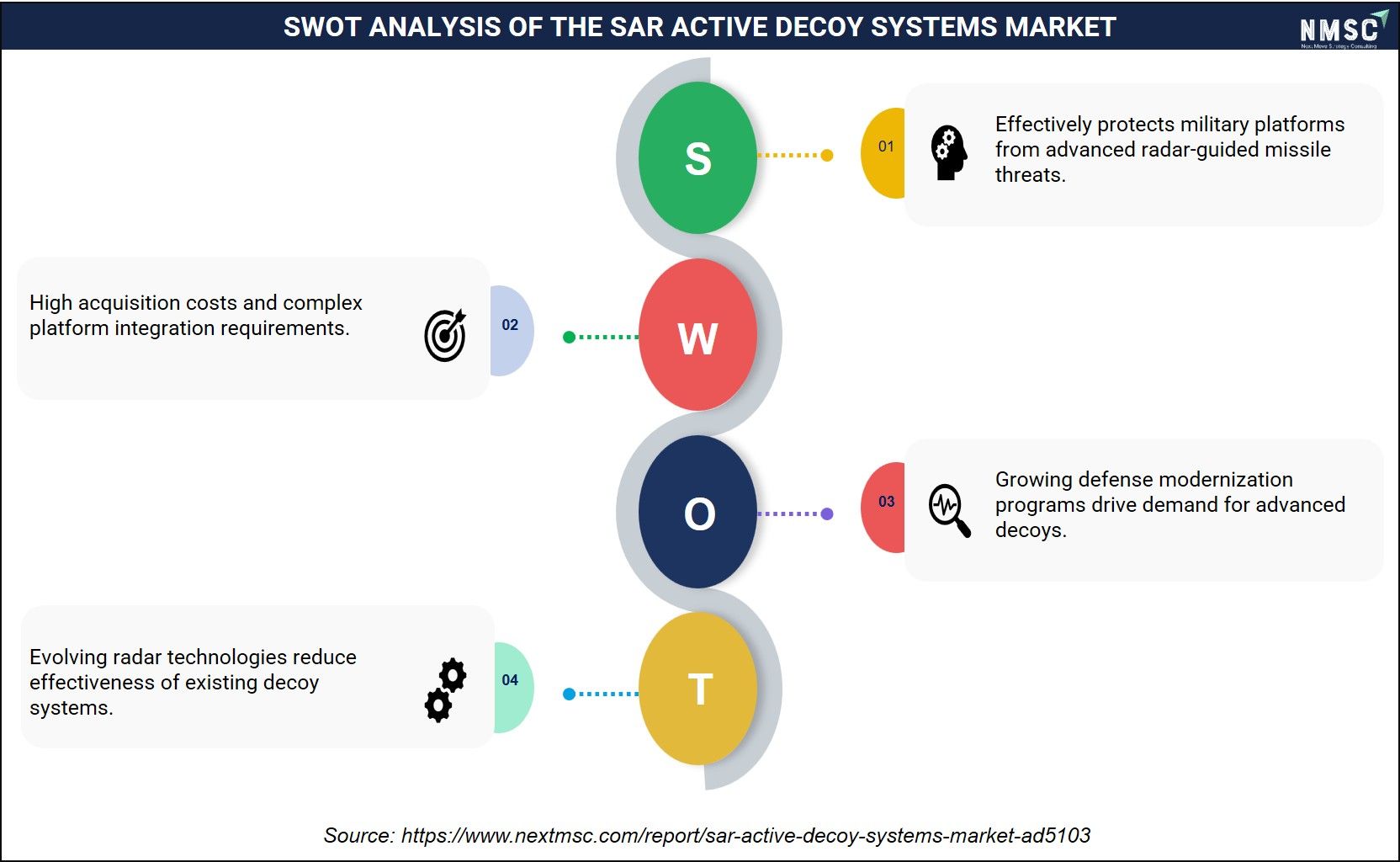
The SWOT analysis highlights the key factors influencing the growth trajectory of the SAR Active Decoy Systems Market. The market benefits from its critical role in enhancing platform survivability against increasingly sophisticated radar-guided threats, while challenges remain related to high development costs and complex system integration requirements. Significant opportunities are emerging from global defense modernization programs and rising investments in electronic warfare capabilities. However, rapid advancements in adversary radar technologies and counter-countermeasure systems continue to create competitive and technological pressures, requiring continuous innovation and performance enhancement from industry participants.
How Is the SAR Active Decoy Systems Market Segmented in This Report, and What Are the Key Insights from the Segmentation Analysis?
How Does Product Type Segmentation Reveal the Structural Composition of the SAR Active Decoy Systems Market?
|
Product Type Segment |
2025 (USD Bn) |
2035 (USD Bn) |
CAGR (%) |
|
Airborne Active Decoys |
1.9 |
3.3 |
5.7% |
|
Naval Active Decoys |
1.1 |
1.9 |
5.6% |
|
Land Active Protection Decoys |
0.4 |
0.8 |
7.2% |
|
Countermeasure Control Systems |
0.2 |
0.4 |
7.2% |
|
Sustainment Products and Services |
0.2 |
0.3 |
4.1% |
Based on our analysis of global defense program structures and platform survivability investment priorities, we observed that the SAR Active Decoy Systems Market is segmented into Airborne Active Decoys, Naval Active Decoys, Land Active Protection Decoys, Countermeasure Control Systems, and Sustainment Products and Services. Airborne Active Decoys continue to dominate the market, with Towed RF Active Decoys representing the highest-value airborne sub-segment due to their effectiveness against pulse-Doppler radar-guided threats. Expendable RF Active Decoys hold the largest volume within the airborne category across fighter, strike, and UAV platforms. Integrated Airborne Decoy Suites are the fastest-growing airborne sub-segment as mission programmability requirements drive procurement of comprehensive decoy management and EW integration solutions.
How Do Platform Categories Shape Demand Dynamics Within the SAR Active Decoy Systems Market?
|
Platform Segment |
2025 (USD Bn) |
2035 (USD Bn) |
CAGR (%) |
|
Air Platforms |
2.1 |
3.7 |
5.8% |
|
Naval Platforms |
1.2 |
2.1 |
5.7% |
|
Land Platforms |
0.5 |
0.9 |
6.0% |
Through our market assessment, we observed that the SAR Active Decoy Systems Market is segmented across Air, Naval, and Land Platforms. Air Platforms generate the largest revenue share, with Fighter Aircraft representing the dominant sub-segment due to the high unit value and survivability investment priority of front-line combat aircraft across NATO and allied air forces. Attack Aircraft and ISR Aircraft follow as significant procurement categories. Within naval platforms, Destroyers and Frigates are the primary buyers of shipborne soft-kill and active torpedo decoy systems, driven by continuous surface combatant fleet modernization programs. UAVs represent the fastest-growing air platform sub-segment, while Unmanned Ground Vehicles are emerging as an early-stage but structurally significant land platform category.
Which Technology Segments Are Driving Revenue Growth in the SAR Active Decoy Systems Market?
|
Technology Segment |
2025 (USD Bn) |
2035 (USD Bn) |
CAGR (%) |
|
RF Decoys |
2.4 |
3.9 |
5.0% |
|
Acoustic Decoys |
0.5 |
0.8 |
4.8% |
|
Multispectral Decoys |
0.5 |
1.1 |
7.8% |
|
Integrated Active Protection |
0.4 |
0.9 |
8.4% |
NMSC's analysis indicates that the SAR Active Decoy Systems Market is segmented by technology into RF Decoys, Acoustic Decoys, Multispectral Decoys, and Integrated Active Protection systems. RF Decoys dominate technology revenue, with Digital RF Memory Decoys representing the highest-value sub-segment due to their ability to replicate precise radar cross-section signatures of protected platforms in real time. Active Repeater Decoys and Broadband RF Decoys are growing sub-segments serving broadened spectral threat environments. Multispectral Decoys are the fastest-growing technology category, driven by demand for simultaneous infrared, electro-optical, and laser decoy capability. Integrated Active Protection systems combining soft-kill and hard-kill capabilities are emerging as the highest-growth technology architecture for land vehicle protection applications.
How Does the Customer Segmentation Reflect Procurement Patterns in the SAR Active Decoy Systems Market?
|
Customer Segment |
2025 (USD Bn) |
2035 (USD Bn) |
CAGR (%) |
|
Government Defense |
3.4 |
6 |
5.8% |
|
Defense Industry |
0.4 |
0.7 |
5.8% |
Based on our evaluation of defense procurement structures, we noticed that the SAR Active Decoy Systems Market is segmented into Government Defense and Defense Industry customers. Government Defense customers, comprising Army, Navy, Air Force, and Joint Commands, represent the overwhelming majority of revenue due to direct national defense procurement of active decoy systems for operational platform programs. Air Force commands are the largest government defense buyers globally, followed by Navy commands with substantial surface ship and submarine countermeasure programs. Defense Industry customers, encompassing Platform OEMs and Prime System Integrators, represent a growing procurement category as defense contractors incorporate active decoy subsystems into new-build aircraft, vessel, and vehicle programs under prime contractor responsibilities.
How Do Revenue Stream Categories Reflect the Commercial Structure of the SAR Active Decoy Systems Market?
|
Revenue Stream Segment |
2025 (USD Bn) |
2035 (USD Bn) |
CAGR (%) |
|
New System Sales |
2.6 |
4.5 |
5.7% |
|
Sustainment |
0.9 |
1.6 |
5.9% |
|
Engineering Services |
0.3 |
0.6 |
7.2% |
Our findings suggest that the SAR Active Decoy Systems Market is structured around three primary revenue streams: New System Sales, Sustainment, and Engineering Services. New System Sales dominate, encompassing both new platform installation and platform retrofit programs that represent the majority of near-term revenue. New Platform Installation is driven by next-generation aircraft, naval vessel, and armored vehicle production programs incorporating active decoy systems from manufacture. Platform Retrofit programs generate significant recurring revenue as operating forces upgrade legacy platforms with modern digital countermeasure systems. Sustainment revenue, covering consumables, maintenance, upgrade programs, and software support, is the fastest-growing stream as large deployed decoy system fleets reach scheduled refurbishment cycles and digital architecture refresh milestones.
How Do Sales Channel Dynamics Shape Go-to-Market Strategies in the SAR Active Decoy Systems Market?
|
Sales Channel Segment |
2025 (USD Bn) |
2035 (USD Bn) |
CAGR (%) |
|
Direct Government Contracts |
2.8 |
4.9 |
5.7% |
|
Platform OEM Supply |
0.7 |
1.2 |
5.5% |
|
Prime Contractor Subcontracts |
0.3 |
0.6 |
7.2% |
From our assessment of defense procurement channels, we found that the SAR Active Decoy Systems Market is distributed across Direct Government Contracts, Platform OEM Supply, and Prime Contractor Subcontract channels. Direct Government Contracts, encompassing both domestic and export contracts, represent the dominant channel as national defense ministries and armed forces procurement agencies maintain direct supplier relationships for active decoy system programs. Domestic contracts held by U.S., European, and Israeli manufacturers constitute the highest-value segment. Export contracts are growing under Foreign Military Sales and direct commercial sale frameworks. Prime Contractor Subcontracts represent the fastest-growing channel as large defense primes increasingly integrate active decoy systems as embedded subsystems within broader aircraft survivability equipment, naval combat system, and armored vehicle protection packages.
Regional Outlook
Geographic Performance Snapshot
|
Region |
2025 (USD Bn) |
2035 (USD Bn) |
CAGR (%) |
Key Driver |
|
North America |
1.7 |
3 |
5.9% |
U.S. DoD procurement, NATO programs |
|
Europe |
1 |
1.8 |
6.1% |
NATO modernization, Ukraine conflict response |
|
Asia-Pacific |
0.7 |
1.4 |
7.1% |
India, South Korea, Japan, Australia |
|
Middle East & Africa |
0.3 |
0.4 |
2.9% |
Gulf defense spending, Israel EW leadership |
|
Latin America |
0.1 |
0.1 |
2.0% |
Brazil, Chile defense budgets |
North America SAR Active Decoy Systems Market
North America is the dominant region in the SAR Active Decoy Systems Market, contributing USD 1.7 billion in 2025 and projected to reach USD 3.0 billion by 2035 at a CAGR of 5.9%. The region benefits from the world's largest operational combat aircraft fleet, continuous naval shipbuilding programs, and the most mature defense electronic warfare industrial base. Regulatory frameworks governing defense procurement, including the Federal Acquisition Regulation and Defense Federal Acquisition Regulation Supplement, support structured long-term program investment. The convergence of platform survivability modernization cycles and threat environment expansion sustains North American market leadership throughout the forecast period.
U.S. SAR Active Decoy Systems Market
Based on our analysis, we found that the United States represents over 80% of North American SAR Active Decoy Systems Market revenue and is the world's single largest national market. U.S. Air Force Aircraft Survivability Equipment programs, including the AN/ALE-47 and next-generation towed decoy system procurements, represent the largest sustained national investment in active decoy technologies. The U.S. Navy's surface ship torpedo defense and airborne countermeasures programs, managed through the Naval Air Systems Command, further reinforce domestic market leadership. The U.S. Army's Active Protection System fielding program for M1A2 Abrams and Bradley IFV platforms is creating additional demand for land active protection decoy systems across domestic procurement channels.
Canada SAR Active Decoy Systems Market
Through our analysis, we observed that Canada represents approximately 12% of North American SAR Active Decoy Systems Market revenue. The Royal Canadian Air Force's Future Fighter Capability Project, focused on F-35 fleet acquisition, is incorporating advanced airborne self-protection suite requirements, including active decoy system provisions, into platform sustainment planning. Canada's defense procurement operates under the National Defence Strong, Secure, Engaged policy framework, which prioritizes interoperability with NATO allies. Canadian defense industry participants benefit from Industrial and Technological Benefits policies that encourage domestic content in major platform programs, creating supply chain participation opportunities in active decoy subsystem production.
Mexico SAR Active Decoy Systems Market
From our assessment, Mexico represents a small but nascent demand center within the North American SAR Active Decoy Systems Market. The Mexican Air Force and Navy operate legacy combat aircraft and naval platforms with limited advanced active decoy suite integration to date. Mexico's defense procurement priorities and budgetary constraints limit near-term market growth. However, evolving regional security dynamics and the country's participation in U.S. defense cooperation frameworks may generate incremental demand for legacy platform countermeasure upgrade programs in the medium-term outlook. Market development in Mexico will primarily be driven through U.S. Foreign Military Sales channels and platform-level system integration activities.
Europe SAR Active Decoy Systems Market
Europe is the second-largest region in the SAR Active Decoy Systems Market, contributing USD 1.0 billion in 2025 and forecast to reach USD 1.8 billion by 2035 at a CAGR of 6.1%. The conflict environment on Europe's eastern flank has accelerated defense spending commitments across NATO member states, directly driving procurement of advanced aircraft survivability equipment and naval countermeasure systems. European defense industrial consolidation, led by BAE Systems, Leonardo, Rheinmetall, Thales, and Saab, provides a strong indigenous supply base for active decoy system development and production across the region throughout the forecast period.
UK SAR Active Decoy Systems Market
According to our evaluation, the United Kingdom is Europe's largest individual country market for SAR Active Decoy Systems, representing approximately 24% of European revenue in 2025. The Royal Air Force's Typhoon and F-35B Lightning fleet survivability programs, managed through Defence Equipment and Support at Bristol, drive sustained procurement of advanced airborne active decoy and electronic warfare integration systems. The Royal Navy's investment in next-generation surface ship soft-kill countermeasures for Type 26 City-class frigates and Type 45 Dastardly-class destroyers generates significant naval decoy demand. BAE Systems maintains a leading domestic supply position across both airborne and naval active decoy programs in the UK market.
Germany SAR Active Decoy Systems Market
Based on NMSC's research, Germany represents the second-largest European market for SAR Active Decoy Systems, driven by the Bundeswehr's substantial aircraft fleet modernization, armored vehicle active protection programs, and a defense budget that surpassed the NATO 2% GDP threshold in 2024 under the Zeitenwende defense policy transformation. German Eurofighter Typhoon self-protection programs, Puma IFV active protection system integration, and Leopard 2 APS procurement programs generate structured demand. HENSOLDT AG, headquartered in Taufkirchen, holds a leading domestic position in German electronic warfare and decoy system supply, benefiting from the Bundeswehr's preference for domestically sourced defense electronic systems.
France SAR Active Decoy Systems Market
Through our analysis, France is the third-largest European market for SAR Active Decoy Systems, driven by the French Air and Space Force's Rafale fleet survivability programs, the French Navy's FREMM frigate surface ship defense systems, and France's commitment to sovereign defense industrial capabilities under the Loi de Programmation Militaire. The DGA (Direction Generale de l'Armement) administers French defense procurement, prioritizing domestically developed systems. Thales SA holds a leading position in French naval countermeasure systems, including the SYLENA decoy launcher suite. French defense export activity further supports domestic industrial investment in advanced active decoy system capabilities.
Italy SAR Active Decoy Systems Market
According to evaluation, Italy represents a significant European market for SAR Active Decoy Systems, driven by the Italian Air Force's F-35A/B and Eurofighter Typhoon fleet programs and the Marina Militare's FREMM frigate and LHD amphibious ship countermeasure requirements. The Segredifesa (Italian Defence General Secretariat) oversees procurement, with Leonardo S.p.A. and Elettronica S.p.A. holding leading domestic positions across airborne electronic warfare and active decoy system supply chains. Italy's participation in Joint Strike Fighter program partnerships and NATO integrated air defense modernization supports sustained demand for compatible active decoy system technologies throughout the forecast period.
Spain SAR Active Decoy Systems Market
Based on our market evaluation, Spain demonstrates growing momentum in the SAR Active Decoy Systems Market, supported by the Spanish Air Force's EF-18 Hornet and Eurofighter Typhoon fleet survivability upgrade programs and the Spanish Navy's F-110 frigate new construction program incorporating advanced countermeasure requirements. Spain's defense budget has been growing toward the NATO 2% target under the directive of the Ministry of Defense. Indra Sistemas, headquartered in Madrid, plays a significant role in Spanish defense electronic warfare and self-protection system supply. Export collaboration through NATO interoperability frameworks supports domestic technology development investment.
Sweden SAR Active Decoy Systems Market
Our findings suggest that Sweden occupies a uniquely capable position in the SAR Active Decoy Systems Market, hosting Saab AB, one of the world's leading independent active decoy and electronic warfare system developers. The Swedish Air Force's Gripen E/F program incorporates advanced integrated self-protection suites with active decoy management capabilities designed by Saab. Sweden's pending NATO membership has accelerated interoperability investment and may increase access to NATO collective defense programs. The Swedish Defence Materiel Administration (FMV) manages procurement with strong domestic content requirements, supporting Saab's market position across airborne self-protection system supply chains.
Denmark SAR Active Decoy Systems Market
Through our analysis, Denmark is an active participant in the SAR Active Decoy Systems Market through its F-35A acquisition program and Stanflex-based naval vessel countermeasure programs. Denmark's Defence Agreement 2024-2033 commits the country to a substantial increase in defense spending, including investments in aircraft survivability equipment and naval self-defense capabilities. Terma A/S, headquartered in Aarhus, is Denmark's leading defense electronics company and a major producer of active countermeasure dispenser systems, including the BOP-L and CMDS systems widely used across NATO-allied air forces, providing Denmark with a globally significant industrial position in the Market.
Finland SAR Active Decoy Systems Market
From our assessment, Finland has emerged as an active buyer within the European SAR Active Decoy Systems Market following its NATO accession in 2023. Finland's selection of the F-35A as its multi-role fighter replacement for the Finnish Air Force, under the HX Fighter Programme, creates structured long-term demand for advanced airborne active decoy and self-protection system procurements. The Finnish Defence Forces' force structure modernization, accelerated by NATO integration requirements, is driving survivability equipment investment across air, naval, and land domains. Finland's procurement is managed through the Defence Command Finland and administered under NATO collective defense planning frameworks.
Netherlands SAR Active Decoy Systems Market
Based on our analysis, the Netherlands is a significant European buyer within the SAR Active Decoy Systems Market, anchored by the Royal Netherlands Air Force's F-35A fleet acquisition and the Royal Netherlands Navy's HNLMS frigate countermeasure modernization programs. The Netherlands Defence Materiel Organisation administers procurement in alignment with NATO interoperability standards. The Dutch industrial base participates in F-35 program supply chains, creating domestic involvement in active self-protection component manufacturing. NATO Airborne Warning and Control System and Alliance Ground Surveillance program participation further drives Dutch investment in compatible electronic warfare and countermeasure technologies.
Rest of Europe SAR Active Decoy Systems Market
The Rest of Europe, encompassing Poland, Norway, Belgium, Switzerland, Czech Republic, Romania, and other NATO and partner nations, collectively represents a growing segment of the European SAR Active Decoy Systems Market. Poland's substantial F-35A acquisition and armored vehicle modernization programs are generating significant new demand for advanced active decoy and active protection systems. Norway's F-35A fleet program drives airborne self-protection investment. Belgium's F-35A acquisition under its CaMo program adds further demand. Switzerland's F-35A procurement and Czech Republic's F-35A acquisition announcement reflect a broader Central European alignment toward advanced active self-protection capabilities compatible with NATO interoperability standards.
Asia-Pacific SAR Active Decoy Systems Market
Asia-Pacific is the fastest-growing major region in the SAR Active Decoy Systems Market, advancing from USD 0.7 billion in 2025 to an estimated USD 1.4 billion by 2035 at a CAGR of 7.1%. Regional threat escalation driven by North Korean ballistic missile proliferation, Chinese naval expansion, and South China Sea territorial disputes is compelling regional defense forces to accelerate active decoy and electronic warfare investment. Defense modernization programs in India, South Korea, Japan, and Australia represent the primary demand drivers, with each nation investing in next-generation combat aircraft, surface combatants, and armored vehicle active protection systems.
China SAR Active Decoy Systems Market
According to evaluation, China represents a self-contained and opaque market within the Asia-Pacific SAR Active Decoy Systems Market, operating primarily through domestic defense industrial entities including AVIC, CSSC, and CASC. China's People's Liberation Army has invested substantially in airborne self-protection systems for J-20, J-16, and J-10C platforms, and naval active decoy suites for Type 055 destroyers and Type 052D cruisers. Chinese active decoy programs are not accessible to non-domestic suppliers due to national defense industrial policy and technology classification. China's defense electronics capabilities are assessed as advancing rapidly, with domestic digital RF memory and multispectral decoy programs in active development and production.
India SAR Active Decoy Systems Market
Based on NMSC's research, India is among the fastest-growing national markets within the Asia-Pacific SAR Active Decoy Systems Market, driven by a large and expanding combat aircraft fleet, a substantial naval shipbuilding program, and the Make in India defense industrial initiative. The Indian Air Force's Rafale fleet and Tejas Mk1A aircraft programs incorporate advanced self-protection system requirements. The Indian Navy's Project 17A frigate program includes provision for next-generation active decoy and soft-kill countermeasure systems. India's Defence Acquisition Procedure 2020 mandates domestic content requirements, driving partnerships between Indian defense companies such as DRDO, BEL, and international active decoy system suppliers across joint development and production programs.
Japan SAR Active Decoy Systems Market
Through our market assessment, Japan represents the second-largest Asia-Pacific national market for SAR Active Decoy Systems, supported by Japan Air Self-Defense Force's F-35A/B fleet acquisition program, F-2 aircraft survivability upgrade initiatives, and Japan Maritime Self-Defense Force's next-generation destroyer and submarine countermeasure programs. Japan's National Defense Strategy 2022 committed the country to doubling defense spending to 2% of GDP by 2027, creating unprecedented procurement investment levels. Mitsubishi Electric, Toshiba, and NEC hold domestic positions in electronic warfare and countermeasure system supply. Japan's defense procurement is administered through the Acquisition, Technology and Logistics Agency.
South Korea SAR Active Decoy Systems Market
From our assessment, South Korea demonstrates high and growing SAR Active Decoy Systems Market engagement, anchored by the Republic of Korea Air Force's F-35A fleet acquisition, KF-21 Boramae indigenous fighter development program, and the Republic of Korea Navy's KDX-III Batch II destroyer construction program incorporating advanced naval countermeasures. South Korea's Defense Acquisition Program Administration manages procurement with growing emphasis on domestic industrial participation. LIG Nex1 and Hanwha Systems play active roles in South Korean electronic warfare and self-protection system development. The KF-21 program specifically incorporates domestic active decoy and EW integration requirements, creating long-term domestic industrial demand throughout the forecast period.
Taiwan SAR Active Decoy Systems Market
According to our evaluation, Taiwan is an active buyer within the Asia-Pacific SAR Active Decoy Systems Market, driven by continuous investment in Republic of China Air Force F-16V survivability enhancements and Republic of China Navy frigate countermeasure programs. U.S. Foreign Military Sales are the primary procurement channel for Taiwan's advanced active decoy systems due to ITAR restrictions on third-country supply of advanced electronic warfare technologies. Taiwan's sustained defense investment in survivability equipment reflects the operational priority assigned to contested air domain operations in regional threat scenarios. The Chungshan Institute of Science and Technology maintains domestic research and development programs for indigenous countermeasure technologies.
Indonesia SAR Active Decoy Systems Market
Based on our analysis, Indonesia represents an emerging growth market within the Asia-Pacific SAR Active Decoy Systems Market, driven by the Indonesian Air Force's F-15ID and Rafale acquisitions incorporating advanced self-protection requirements, and the Indonesian Navy's ongoing frigate and corvette modernization programs. Indonesia's defense procurement strategy under Minimum Essential Force doctrine includes active countermeasure capability development. PT Dirgantara Indonesia and PT Len Industri participate in the domestic defense industrial base. International supplier engagement occurs primarily through government-to-government frameworks under the U.S. FMS program and direct commercial sale channels with European manufacturers.
Vietnam SAR Active Decoy Systems Market
Through our analysis, Vietnam is an emerging market for SAR Active Decoy Systems, primarily driven by Vietnam People's Air Force Su-30MK2 fleet survivability modernization and Vietnam People's Navy's Gepard-class frigate naval countermeasure programs. Vietnam's defense procurement is influenced by its strategic positioning between major power relationships, creating demand for countermeasure systems from both Western and non-Western suppliers. While advanced active decoy procurement from U.S. suppliers is constrained by export control considerations, European manufacturers including Thales and Saab have pursued engagement. Long-term market development will depend on Vietnam's defense modernization trajectory and regional security environment evolution.
Australia SAR Active Decoy Systems Market
Based on NMSC's research, Australia is the most mature active decoy systems buyer in Asia-Pacific outside of Northeast Asia. The Royal Australian Air Force's F-35A fleet and Super Hornet survivability enhancement programs drive structured airborne active decoy procurement, while the Royal Australian Navy's Hunter-class frigate and SEA 5000 surface combatant programs generate long-term naval countermeasure demand. Australia's Defence Strategic Review emphasizes undersea warfare and air domain survivability as priorities, directly supporting active decoy investment. The Defence Capability Assessment Framework and AUKUS trilateral security partnership create structured interoperability requirements aligned with U.S. and UK active decoy system architectures.
Philippines SAR Active Decoy Systems Market
From our assessment, the Philippines represents an early-stage market for SAR Active Decoy Systems, driven by the Philippine Air Force's F-16V acquisition and the Philippine Navy's corvette and frigate procurement programs under the Revised Armed Forces of the Philippines Modernization Act. The Philippines Department of National Defense manages defense procurement with increasing engagement under the U.S.-Philippines Mutual Defense Treaty framework, providing access to U.S. Foreign Military Sales channels for compatible active decoy systems. Growing South China Sea territorial disputes are elevating operational priority for platform survivability investments across Philippine air and naval force modernization programs.
Malaysia SAR Active Decoy Systems Market
According to evaluation, Malaysia is a mid-tier buyer within the Asia-Pacific SAR Active Decoy Systems Market, supported by Royal Malaysian Air Force's F/A-18D Hornet and Su-30MKM fleet survivability programs and the Royal Malaysian Navy's Littoral Combat Ship and patrol vessel countermeasure requirements. Malaysia's Twelfth Malaysia Plan emphasizes defense capability development, including platform survivability enhancements. The procurement of Rafale aircraft by the Malaysian Air Force, if confirmed, would create additional structured demand for advanced airborne active decoy integration programs. European suppliers including Thales, Saab, and MBDA maintain active commercial engagement with Malaysian defense procurement authorities.
Rest of Asia-Pacific SAR Active Decoy Systems Market
The Rest of Asia-Pacific, comprising Thailand, Bangladesh, Pakistan, Sri Lanka, New Zealand, Singapore, and smaller Pacific nations, collectively represents an early-stage but developing portion of the regional SAR Active Decoy Systems Market. Singapore's defense establishment, one of the most technologically advanced in Southeast Asia, operates F-15SG and F-16C/D fleets with advanced survivability equipment and maintains active procurement engagement with leading U.S. and European countermeasure manufacturers. Thailand's F-16 fleet survivability programs represent a legacy demand center. New Zealand participates in collaborative Five Eyes defense electronic warfare programs with Australia, UK, U.S., and Canada, supporting interoperable active decoy system adoption.
Middle East and Africa SAR Active Decoy Systems Market
The Middle East and Africa region contributes USD 0.3 billion to the SAR Active Decoy Systems Market in 2025, projected to reach USD 0.4 billion by 2035 at a CAGR of 2.9%. The region's market is defined by two distinct demand clusters: Israel's highly advanced domestic active decoy system development and export program, and Gulf Cooperation Council nations' large-scale defense equipment procurement from Western suppliers. South Africa maintains a modest domestic defense electronics industrial base. African sub-regional demand is limited and driven primarily by FMS transfers to Egypt and Morocco for legacy platform upgrade programs.
Saudi Arabia SAR Active Decoy Systems Market
Based on our evaluation, Saudi Arabia is the largest non-Israeli defense equipment buyer in the Middle East within the SAR Active Decoy Systems Market. The Royal Saudi Air Force's F-15SA fleet, comprising over 80 aircraft with advanced electronic warfare suites, generates ongoing demand for active decoy system replenishment and upgrade programs. Saudi Arabia Vision 2030's defense localization initiative, administered by the General Authority for Military Industries, is creating opportunities for joint ventures between international active decoy manufacturers and Saudi industrial partners. U.S. Foreign Military Sales channels represent the dominant procurement pathway for advanced active countermeasure systems acquired by Saudi defense programs.
UAE SAR Active Decoy Systems Market
Through our market assessment, the UAE is a significant buyer within the Middle East SAR Active Decoy Systems Market, driven by UAE Air Force F-16E/F Block 60 Desert Falcon fleet survivability programs and the planned acquisition of F-35A aircraft. The UAE's F-35 acquisition process, subject to technology security review frameworks, includes provisions for integrated electronic warfare and active decoy systems. The Abu Dhabi-based defence industry cluster, supported by EDGE Group, is developing domestic capabilities in electronic warfare systems under the UAE's industrial localization strategy. U.S. and European manufacturers maintain active engagement with UAE defence procurement authorities through FMS and direct commercial sale channels.
Egypt SAR Active Decoy Systems Market
According to our evaluation, Egypt is a mid-tier buyer within the Africa and Middle East SAR Active Decoy Systems Market, driven by the Egyptian Air Force's F-16C/D and Rafale fleet survivability programs and the Egyptian Navy's FREMM frigate countermeasure requirements. Egypt's defense procurement benefits from U.S. Foreign Military Financing allocations that fund FMS-channel active decoy system acquisitions. France's strategic defense partnership with Egypt, including the Rafale sale, creates additional European supplier engagement opportunities. The Egyptian government's defense industrial development programs aspire to greater domestic content, though current active decoy capability resides predominantly with international suppliers.
Israel SAR Active Decoy Systems Market
Based on our analysis, Israel occupies a uniquely dominant position within the Middle East SAR Active Decoy Systems Market as both the most sophisticated regional buyer and a globally significant active decoy system developer and exporter. Rafael Advanced Defense Systems, Elbit Systems, and Israel Aerospace Industries represent Israel's world-class active decoy industrial base, developing systems including the Towed Decoy System, Trophy Active Protection System, and advanced airborne self-protection suites deployed across Israeli Air Force F-35I Adir, F-16I Sufa, and F-15I Ra'am platforms. Israeli systems have achieved internationally recognized operational effectiveness, generating export demand across NATO-allied and Indo-Pacific defense customers worldwide.
Turkey SAR Active Decoy Systems Market
Through our evaluation, Turkey is an active and growing participant in the SAR Active Decoy Systems Market, with a maturing domestic defense electronics industrial base. ASELSAN A.S. has developed the HEWS Electronic Warfare Suite and AKKOR Active Protection System for Turkish F-16 and armored vehicle platforms. Turkey's exclusion from the F-35 program has accelerated domestic active decoy and EW development investment. The TF-X/KAAN fifth-generation fighter program is incorporating indigenous electronic warfare and active decoy integration requirements. Turkey's defense procurement is managed through the Presidency of Defence Industries, which prioritizes domestic content and technology transfer provisions in international procurement programs.
Nigeria SAR Active Decoy Systems Market
From our assessment, Nigeria represents an early-stage market for SAR Active Decoy Systems, with demand primarily driven by the Nigerian Air Force's JF-17 Thunder and Alpha Jet fleet survivability requirements and the Nigerian Navy's offshore patrol vessel programs. Nigeria's defense procurement operates under the Nigerian Defence Industries Corporation framework with growing aspirations for domestic production participation. Advanced active decoy system acquisition is subject to significant budget constraints and export control considerations. Near-term market activity is expected to focus on legacy platform survivability upgrades and basic countermeasure dispenser replenishment programs available through applicable export channels.
South Africa SAR Active Decoy Systems Market
According to our evaluation, South Africa maintains a modest but technically capable position in the SAR Active Decoy Systems Market through the South African Air Force's Gripen C/D fleet survivability programs and the South African National Defence Force's armored vehicle active protection requirements. Denel Dynamics, the South African state-owned defence company, maintains capability in certain countermeasure technologies, though budget constraints have limited modernization investment. The Gripen fleet's integrated self-protection architecture, developed in partnership with Saab, provides a structured pathway for compatible active decoy system procurement aligned with Swedish and European supplier offerings across the forecast period.
Rest of MEA SAR Active Decoy Systems Market
The Rest of Middle East and Africa, encompassing Kuwait, Qatar, Bahrain, Oman, Jordan, Morocco, Kenya, and other nations, collectively represents a small but commercially active segment of the SAR Active Decoy Systems Market. GCC nations including Kuwait, Qatar, and Bahrain operate substantial fleets of U.S.-origin combat aircraft with compatible active decoy system requirements managed through FMS procurement channels. Morocco operates F-16C/D aircraft with self-protection suite provisions, and its planned F-35 acquisition would create structured next-generation decoy system demand. Jordan's F-16 fleet generates legacy replenishment demand. Sub-Saharan African markets outside Nigeria and South Africa represent limited near-term procurement potential.
Latin America SAR Active Decoy Systems Market
Latin America contributes USD 0.1 billion to the SAR Active Decoy Systems Market in 2025, with limited growth projected through 2035 at a CAGR of 2.0%. Regional defense budgets are constrained relative to threat environment requirements, and procurement of advanced active decoy systems is predominantly limited to Brazil's AMX modernization and Gripen E/F acquisition programs. Chile and Colombia operate limited active countermeasure inventories on legacy U.S. and European aircraft platforms. Regional market growth will be driven by gradual fleet modernization programs and legacy platform survivability upgrade activities across the forecast period.
Brazil SAR Active Decoy Systems Market
Based on NMSC's research, Brazil is the largest market for SAR Active Decoy Systems in Latin America, anchored by the Brazilian Air Force's Gripen E/F acquisition program and the Brazilian Navy's AF-1 Skyhawk carrier-borne aircraft survivability programs. Brazil's Gripen NG program, developed in partnership with Saab and EMBRAER, incorporates advanced integrated self-protection suite requirements including active decoy management capabilities. Brazil's defense procurement framework under the Ministerio da Defesa emphasizes domestic industrial participation and technology transfer, creating opportunities for Brazilian Tier 2 industrial engagement in active decoy subsystem production and integration activities throughout the aircraft lifecycle.
Argentina SAR Active Decoy Systems Market
Through our analysis, Argentina represents a modest market for SAR Active Decoy Systems, currently constrained by significant defense budget limitations and an aging combat aircraft fleet. Argentina's planned F-16 acquisition from Denmark, approved under a government-to-government transfer arrangement, would create near-term demand for compatible active countermeasure system upgrades and replenishment programs. The Argentine Air Force's operational requirements for survivability equipment are managed through the Fuerza Aerea Argentina procurement framework. Budget predictability constraints and economic volatility have historically limited Argentina's ability to sustain advanced defense electronics procurement programs at levels commensurate with regional threat environments.
Chile SAR Active Decoy Systems Market
From our assessment, Chile maintains a small but stable SAR Active Decoy Systems Market position, supported by the Chilean Air Force's F-16C/D Block 50/52 fleet survivability programs and modernization planning. Chile's defense procurement benefits from one of Latin America's more stable defense budget environments, supported by the Ley de Cobre copper revenue funding mechanism. F-16 fleet self-protection suite maintenance and limited upgrade activities represent the primary demand drivers. The Chilean Navy operates a modest frigate and patrol vessel fleet with basic countermeasure provisions. Long-term market development will be influenced by Chile's eventual combat aircraft replacement program decision and associated survivability equipment requirements.
Colombia SAR Active Decoy Systems Market
According to our evaluation, Colombia represents an early-stage market for SAR Active Decoy Systems, with demand primarily driven by the Colombian Air Force's Kfir and F-16 fleet survivability maintenance requirements and ongoing counterinsurgency operational needs. Colombia's defense procurement is administered through the Ministerio de Defensa Nacional with U.S. military cooperation providing the primary framework for advanced defense technology access. The eventual replacement of aging Colombian Air Force combat aircraft platforms is expected to create structured procurement opportunities for compatible active self-protection systems. Near-term demand remains limited due to budget constraints and the legacy nature of the current operational platform inventory.
Rest of LATAM SAR Active Decoy Systems Market
The Rest of Latin America, including Peru, Ecuador, Venezuela, Bolivia, Uruguay, and Central American nations, collectively represents a limited demand segment within the SAR Active Decoy Systems Market. Peru operates Mirage 2000 aircraft with basic electronic warfare provisions, while Ecuador's fleet of Kfir aircraft includes limited self-protection capabilities. These markets generate minimal near-term procurement activity due to constrained defense budgets and the legacy status of operational platform inventories. Long-term market development across the broader Latin American region will be contingent on combat aircraft fleet renewal decisions and the availability of suitable active decoy systems compatible with chosen replacement platform architectures.
Competitive Landscape
Competitive Dynamics and M&A Landscape
| Key Takeaways | Details |
|
Market Structure |
The SAR Active Decoy Systems Market features highly concentrated competition among a limited number of vertically integrated defense electronics specialists, including Rafael Advanced Defense Systems, BAE Systems, Thales, Saab, Leonardo, and Northrop Grumman, competing alongside specialized decoy system manufacturers such as Terma, LACROIX Defense, Chemring, and Elettronica. |
|
Innovation Focus |
Innovation is concentrated in software-defined digital RF memory decoy architectures, multi-spectral countermeasure integration, miniaturized active decoy systems for UAV platforms, and networked decoy management system capabilities that enable simultaneous multi-threat assessment and countermeasure deployment across integrated platform electronic warfare architectures. |
|
M&A Activity |
Consolidation in the SAR Active Decoy Systems Market has included Chemring Group's sustained investment in its countermeasures dispensing business, Rheinmetall's acquisition of electronic protection capabilities to complement its armored vehicle active protection portfolio, and ongoing strategic partnership formation between Israeli and U.S. defense industry leaders to jointly develop next-generation land and airborne active protection solutions. |
How Do Companies Compete in the SAR Active Decoy Systems Market?
The SAR Active Decoy Systems Market is characterized by highly specialized competition among a relatively small number of vertically integrated defense electronics companies with classified technology portfolios and deep customer relationships with national defense procurement agencies. Market structure reflects the security-sensitive nature of active countermeasure technologies, where access to classified threat libraries and platform integration certification creates substantial barriers to entry. Competitive strategies center on technological differentiation in digital RF memory fidelity, multi-spectral capability breadth, and integration compatibility with platform electronic warfare architectures. Geographic expansion occurs primarily through government-to-government Foreign Military Sales arrangements and licensed production partnerships with national defense industries in export target markets.
Which Kind of Companies Dominate the SAR Active Decoy Systems Market?
Three categories of companies dominate the SAR Active Decoy Systems Market. First, vertically integrated defense electronic warfare specialists including BAE Systems, Northrop Grumman, Thales, Leonardo, Saab, and Elbit Systems provide comprehensive airborne, naval, and land active decoy solutions as part of broader electronic warfare system portfolios. Second, specialized active decoy and countermeasures manufacturers including Rafael Advanced Defense Systems, Terma, LACROIX Defense, Chemring Group, and Elettronica deliver purpose-built decoy systems with deep platform integration expertise. Third, domestic defense electronics companies including ASELSAN and HENSOLDT hold significant positions in their home market procurements through government industrial policy support and classified technology development programs.
AI-Native Differentiation and Open Standards Drive Market Success in the SAR Active Decoy Systems Market
Innovation differentiation in the SAR Active Decoy Systems Market is increasingly centered on artificial intelligence-enabled threat discrimination, autonomous countermeasure selection, and software-defined platform adaptability. Our analysis shows that leading competitors are investing in machine learning-based threat identification algorithms that enable decoy management systems to autonomously select and sequence countermeasure responses without pilot intervention, reducing response latency in high-threat operational environments. Platform-agnostic software architectures compatible with military open systems standards including the Future Airborne Capability Environment are differentiating suppliers capable of supporting multi-platform fleet-wide procurement and reducing certification costs for defense force customers.
Market Players to Opt for Merger and Acquisition Strategies to Expand Their Presence in the SAR Active Decoy Systems Market
Mergers, acquisitions, and strategic partnerships are reshaping the competitive architecture of the SAR Active Decoy Systems Market. Rheinmetall's active protection system acquisitions and partnerships reflect a strategic intent to integrate soft-kill decoy capabilities with hard-kill kinetic systems for comprehensive land vehicle protection. Israeli defense industry leaders including Rafael and Elbit Systems have expanded international market presence through licensed production arrangements and joint venture structures with European and Indo-Pacific industrial partners. Ongoing consolidation among medium-sized countermeasure manufacturers is expected as prime contractors seek to internalize specialized active decoy system capabilities within broader electronic warfare portfolio structures.
Key Market Players in the SAR Active Decoy Systems Market
-
Rafael Advanced Defense Systems Ltd.
-
Leonardo S.p.A.
-
BAE Systems plc
-
Rheinmetall AG
-
Elbit Systems Ltd.
-
ASELSAN A.S.
-
Thales S.A.
-
Saab AB
-
Northrop Grumman Corporation
-
HENSOLDT AG
-
Israel Aerospace Industries Ltd.
-
Terma A/S
-
LACROIX Defense
-
QinetiQ Group plc
-
Indra Sistemas, S.A.
-
Chemring Group PLC
-
RTX Corporation
-
L3Harris Technologies, Inc.
-
Ultra Electronics Holdings Limited
-
Elettronica S.p.A.
What Are the Latest Developments in the SAR Active Decoy Systems Industry?
|
Date |
Event |
|
Sep 2025 |
Rheinmetall AG unveiled MASS nova, the next-generation Multi Ammunition Softkill System (MASS), featuring new decoy technologies, increased launcher capacity, and enhanced naval self-protection capabilities. Relevant to naval active/passive decoy markets. |
|
Sep 2025 |
Rheinmetall AG announced acquisition agreement for Naval Vessels Lürssen (NVL), strengthening Rheinmetall's naval systems portfolio and future integration opportunities for shipborne decoy and soft-kill systems. |
Expert Insights
 “We need decoy systems such that if the enemy is looking at us through the electromagnetic spectrum, they can’t pinpoint us. They might be able to see us, but they can’t understand us. We need to be able to raise the noise floor of the signal-to-noise ratio, such that they might be able to see that we are in a generalized location, but the enemy won’t be able to pinpoint or target our capabilities.”
— Maj. Gen. Paul Stanton, Commander, U.S. Army Cyber Center of Excellence
Statement made during discussions on the U.S. Army’s development and deployment of electromagnetic-spectrum decoy and obfuscation capabilities to counter increasingly sophisticated enemy sensing and targeting systems.
Market Interpretation
The statement highlights the growing strategic importance of advanced active decoy and electromagnetic deception technologies in modern warfare. As adversaries deploy increasingly sophisticated radar, electronic surveillance, and precision-targeting capabilities, military forces are investing in decoy systems that can obscure, manipulate, or imitate electromagnetic signatures. Rather than merely hiding assets, next-generation active decoys are designed to create uncertainty, degrade enemy situational awareness, and prevent accurate targeting. This trend is driving demand for software-defined electronic warfare solutions, expendable active decoys, and AI-enabled deception systems across land, naval, and airborne defense platforms, supporting the long-term growth of the SAR Active Decoy Systems Market.
What Are the Investment Opportunities in the SAR Active Decoy Systems Market?
Capital Inflows and Venture Activity
The SAR Active Decoy Systems Market attracts capital primarily through government-directed defense industrial investment rather than commercial venture activity, given the classified and regulated nature of the technology domain. National defense budget allocations represent the dominant capital flow mechanism, with the U.S. Department of Defense's Research, Development, Test and Evaluation budget providing sustained funding for next-generation active decoy technology programs. The NATO Defense Investment Pledge commitment, which has driven defense budget increases across multiple member states, is generating incremental capital flows into electronic warfare and countermeasure research programs through national defense industrial partnership structures. Private equity investment in defense electronics companies with active decoy portfolios is also increasing as defense sector performance premiums attract institutional capital.
Infrastructure Investment
Infrastructure investment in the SAR Active Decoy Systems Market encompasses advanced manufacturing capabilities for precision electronic components, software-defined hardware integration facilities, classified testing and evaluation ranges, and digital mission data development systems. Governments including the United States, United Kingdom, and Israel have invested in national electronic warfare testing infrastructure that enables active decoy performance validation against classified threat systems. The U.S. Department of Defense's Electronic Warfare Executive Committee oversees coordinated investment in EW testing infrastructure, directly supporting the development and qualification programs upon which active decoy system manufacturers depend for system acceptance and production contract award.
ESG and Sustainable Defense Industrial Investment
ESG considerations are influencing investment decisions in the SAR Active Decoy Systems Market through defense industry sustainability commitments and responsible sourcing frameworks. Leading manufacturers including BAE Systems, Thales, and Leonardo have published comprehensive Environmental, Social, and Governance reporting frameworks in accordance with Task Force on Climate-related Financial Disclosures standards. Active decoy system manufacturing involves precision electronics, propulsion materials, and specialized composites subject to environmental compliance requirements under European Union REACH regulations and U.S. Environmental Protection Agency standards. Institutional investors applying ESG screening criteria increasingly evaluate defense electronics manufacturers' responsible business conduct, supply chain ethics, and environmental footprint as components of investment thesis assessment.
Digital Transformation and Manufacturing Innovation
Digital transformation is enabling significant manufacturing innovation investment within the SAR Active Decoy Systems Market. Advanced manufacturing techniques including additive manufacturing for precision countermeasure body components, model-based engineering for system integration documentation, and digital twin simulation for decoy performance validation are reducing production costs and accelerating qualification timelines. The U.S. Department of Defense's Manufacturing Technology program and the UK's Defence and Security Industrial Strategy both identify advanced manufacturing investment as a strategic industrial resilience priority directly applicable to active decoy and countermeasure production capacity. These investments improve supply chain resilience, reduce dependence on single-source components, and enhance throughput capacity for high-demand procurement scenarios.
Private Equity and Strategic M&A Activity
Private equity activity in the SAR Active Decoy Systems Market is concentrated around mid-tier defense electronics specialists with proprietary active decoy system portfolios and long-term government program relationships. Strategic M&A consolidation is driven by prime contractor strategies to internalize specialized countermeasure capabilities within broader electronic warfare system portfolios. Investors should monitor acquisition activity around expendable decoy manufacturers with established NATO qualification programs, and companies with demonstrated capability in multi-spectral and UAV-compatible active decoy system development. The defense electronics sector's long-term contracted revenue streams, cost-plus program structures, and platform-lifetime sustainment commitments represent structurally attractive return characteristics for defense-specialist private equity investors.
Key Benefits for Stakeholders
For Defense Procurement Organizations
Defense procurement organizations gain comprehensive, vendor-neutral intelligence on the SAR Active Decoy Systems Market, including quantitative sizing across all product types, platform categories, technology segments, and geographic markets. This intelligence supports survivability equipment acquisition strategy development, vendor capability evaluation, and through-life support program planning. Our competitive landscape analysis enables procurement teams to benchmark supplier technology maturity, production capacity, and program track records across airborne, naval, and land active decoy system categories with analytical rigor aligned to operational requirements.
For Investors and Financial Analysts
Investors and financial analysts gain a structured, data-rich assessment of the SAR Active Decoy Systems Market's growth trajectory, competitive dynamics, M&A pipeline, and segment-level revenue forecasts through 2035. The CAGR analysis by segment, region, and platform type enables precise portfolio construction and valuation modeling for defense electronics companies with active decoy portfolios. Detailed competitive analysis of all 20 covered market participants, combined with latest development tracking, provides an early-signal framework for identifying acquisition targets, emerging leaders, and technology differentiation themes within the global active decoy and countermeasure industry.
For Active Decoy System Manufacturers and Integrators
Active decoy system manufacturers and integrators gain actionable intelligence on white-space opportunities, competitive positioning gaps, and fastest-growing subsegments within the SAR Active Decoy Systems Market. Product type and technology segmentation analysis reveals high-growth areas including multi-spectral decoy systems, UAV-compatible active decoy solutions, and integrated countermeasure management systems. Our regional outlook sections identify geographic expansion priorities with procurement framework and technology transfer context. The platform segmentation analysis enables manufacturers to optimize product development roadmaps aligned with the highest-growth platform categories including UAVs, new-generation fighters, and next-generation naval surface combatants.
For Government Defense Industrial Policy Bodies
Government defense industrial policy bodies gain a structured analysis of how national procurement frameworks, export control regimes, offset policies, and defense industrial strategies are shaping the global SAR Active Decoy Systems Market competitive landscape. Country-level insights provide policymakers with evidence-based perspectives on how industrial policy choices affect domestic defense electronics supply chain resilience, technology sovereignty, and international competitiveness. The competitive landscape analysis offers direct relevance to national defense industrial base assessment, identifying capability gaps that may require directed investment or international partnership development to sustain operational platform survivability requirements.
Regulatory Framework Impacting the SAR Active Decoy Systems Market
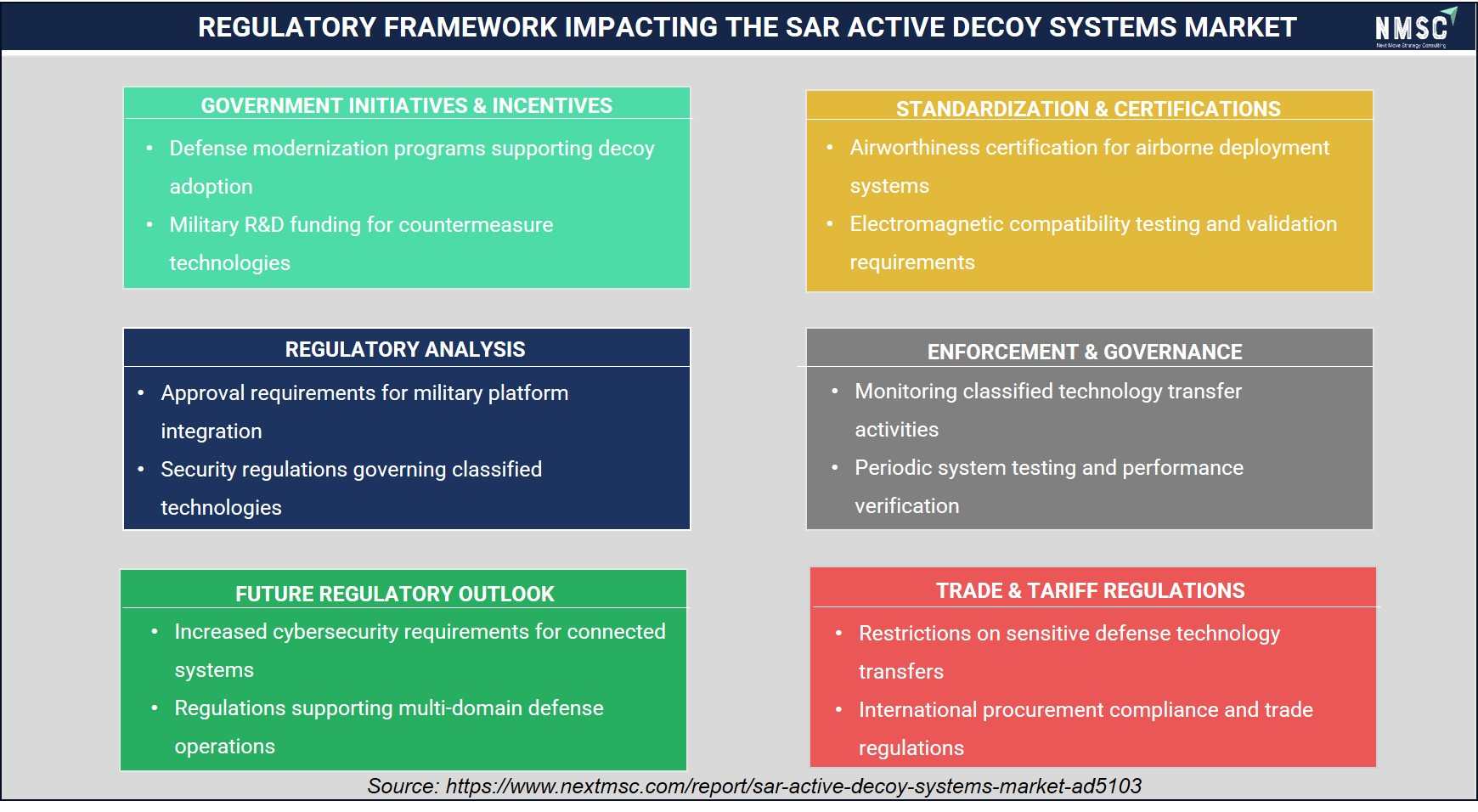
The regulatory framework plays a pivotal role in shaping the SAR Active Decoy Systems Market by governing the development, certification, deployment, and international trade of advanced defense countermeasure technologies. Defense agencies worldwide are strengthening procurement standards, export control policies, cybersecurity requirements, and platform integration regulations to ensure operational reliability and national security compliance. Additionally, increasing investments in electronic warfare modernization and indigenous defense manufacturing initiatives are encouraging innovation while maintaining strict oversight. These evolving regulations are expected to influence technology adoption, market entry strategies, and long-term industry competitiveness across global defense sectors.
Key Market Segments
By Product Type
-
Airborne Active Decoys
-
Expendable RF Active Decoys
-
Fighter Aircraft Decoys
-
Strike Aircraft Decoys
-
UAV Decoys
-
-
Towed RF Active Decoys
-
Fighter Aircraft Towed Decoys
-
Maritime Patrol Aircraft Towed Decoys
-
Special Mission Aircraft Towed Decoys
-
-
Integrated Airborne Decoy Suites
-
Decoy Management Units
-
Integrated EW and Decoy Suites
-
Mission Programming Modules
-
-
-
Naval Active Decoys
-
Expendable RF Active Decoys
-
Hovering Active Missile Decoys
-
Offboard RF Seduction Decoys
-
-
Shipborne Soft-Kill Decoy Systems
-
Automated Decoy Launch Systems
-
Multi-Threat Decoy Suites
-
Integrated Countermeasure Systems
-
-
Active Torpedo Decoy Systems
-
Towed Torpedo Decoys
-
Expendable Torpedo Decoys
-
Integrated Anti-Torpedo Suites
-
-
-
Land Active Protection Decoys
-
Soft-Kill Active Protection Systems
-
RF Jamming Systems
-
EO and IR Deception Systems
-
Multispectral Obscuration Systems
-
-
Hybrid Active Protection Systems
-
Soft-Kill Dominant Systems
-
Soft-Kill and Hard-Kill Systems
-
-
-
Countermeasure Control Systems
-
Decoy Launch Controllers
-
Threat Evaluation Units
-
Countermeasure Management Systems
-
Mission Programming Software
-
-
Sustainment Products and Services
-
Replacement Decoys
-
Refurbishment Kits
-
Upgrade Modules
-
Software Updates
-
Lifecycle Support
-
By Platform
-
Air Platforms
-
Fighter Aircraft
-
Attack Aircraft
-
ISR Aircraft
-
Transport Aircraft
-
Rotary Wing Aircraft
-
Unmanned Aerial Vehicles
-
-
Naval Platforms
-
Aircraft Carriers
-
Destroyers
-
Frigates
-
Corvettes
-
Patrol Vessels
-
Amphibious Ships
-
Submarines
-
Auxiliary Ships
-
-
Land Platforms
-
Main Battle Tanks
-
Infantry Fighting Vehicles
-
Armored Personnel Carriers
-
Reconnaissance Vehicles
-
Tactical Vehicles
-
Unmanned Ground Vehicles
-
By Technology
-
RF Decoys
-
Digital RF Memory Decoys
-
Active Repeater Decoys
-
Broadband RF Decoys
-
-
Acoustic Decoys
-
Towed Acoustic Decoys
-
Expendable Acoustic Decoys
-
-
Multispectral Decoys
-
Electro-Optical Decoys
-
Infrared Decoys
-
Laser Decoys
-
Combined Spectrum Decoys
-
-
Integrated Active Protection
-
Soft-Kill Systems
-
Hybrid Systems
-
By Customer
-
Government Defense
-
Army
-
Navy
-
Air Force
-
Joint Commands
-
-
Defense Industry
-
Platform OEMs
-
Prime System Integrators
-
By Revenue Stream
-
New System Sales
-
New Platform Installation
-
Platform Retrofit
-
-
Sustainment
-
Consumables
-
Maintenance
-
Upgrade Programs
-
Software Support
-
-
Engineering Services
-
Integration
-
Qualification
-
Testing
-
Training
-
By Sales Channel
-
Direct Government Contracts
-
Domestic Contracts
-
Export Contracts
-
-
Platform OEM Supply
-
Factory Installation
-
Retrofit Programs
-
-
Prime Contractor Subcontracts
-
Domestic Programs
-
International Programs
-
By Region
-
North America: U.S., Canada, and Mexico.
-
Europe: UK, Germany, France, Italy, Spain, Sweden, Denmark, Finland, the Netherlands, and the rest of Europe.
-
Asia Pacific: China, India, Japan, South Korea, Taiwan, Indonesia, Vietnam, Australia, Philippines, Malaysia and the rest of APAC.
-
Middle East & Africa (MEA): Saudi Arabia, UAE, Egypt, Israel, Turkey, Nigeria, South Africa, and the rest of MEA.
-
Latin America: Brazil, Argentina, Chile, Colombia, and the rest of LATAM.
Conclusion and Recommendations
Long-Term Outlook
The SAR Active Decoy Systems Market is entering a sustained growth phase driven by the convergence of elevated global threat environments, comprehensive defense fleet modernization programs, and the technological transition toward software-defined multi-spectral countermeasure architectures. The market is forecast to grow from USD 4.0 billion in 2026 to USD 6.7 billion by 2035 at a CAGR of 5.8%. Our analysis further indicates that this growth reflects both expanded procurement of next-generation active decoy systems across new platform programs and the increasing value density of each system driven by digital RF memory, multi-spectral capability integration, and networked countermeasure management architecture requirements.
Strategic Positioning Recommendations
Active decoy system manufacturers should prioritize software-defined architecture investment, enabling platform-agnostic product families compatible with FACE and MOSA open systems standards that reduce integration costs and accelerate multi-program market penetration. Multi-spectral capability development is non-negotiable for vendors targeting next-generation program competitions as armed forces universally require countermeasure performance against multi-mode seeker threats. UAV-compatible miniaturized active decoy system development represents the highest near-term organic growth investment priority given the accelerating pace of unmanned platform fleet expansion across global defense programs throughout the forecast period.
Investment Attractiveness
The SAR Active Decoy Systems Market represents a strategically attractive investment environment characterized by long-term government program commitments, recurring sustainment revenue streams, high technology barriers to entry, and structural demand drivers tied to irreversible threat proliferation trends. Our assessment indicates that the highest-conviction investment themes include multi-spectral decoy system development, UAV active protection platforms, land active protection system integration, and digital mission data development. Defense electronics companies with established platform certification programs, classified threat library access, and long-term government framework agreements occupy structurally defensible competitive positions.
Market Shifts and Key Risks
The most significant market shift underway is the transition from platform-specific, hardware-centric decoy system procurement toward software-defined, mission-programmable active countermeasure architectures capable of cross-platform deployment. This shift benefits vendors with open-architecture software development capabilities and penalizes hardware-only specialists without software upgrade roadmaps. Key risks for the SAR Active Decoy Systems Market include export control regulatory tightening constraining market access, defense budget sequestration or continuing resolution scenarios disrupting program timelines in key markets, and rapid adversary anti-decoy technology development that may require accelerated capability refresh investment cycles beyond current program planning timelines.
Growth Pathways
Organizations seeking to maximize value from the SAR Active Decoy Systems Market should pursue a three-horizon strategic roadmap. In the near term through 2027, prioritize integration of software-defined digital RF memory upgrades into existing platform programs and expand UAV-compatible active decoy product portfolio development. In the mid-term through 2031, invest in multi-spectral capability integration combining RF, infrared, and electro-optical countermeasure modes, and develop networked decoy management architectures compatible with multi-domain operations doctrine. In the long term through 2035, position for artificial intelligence-enabled autonomous countermeasure selection platforms and directed energy countermeasure decoy system development as next-generation threat environments mature.
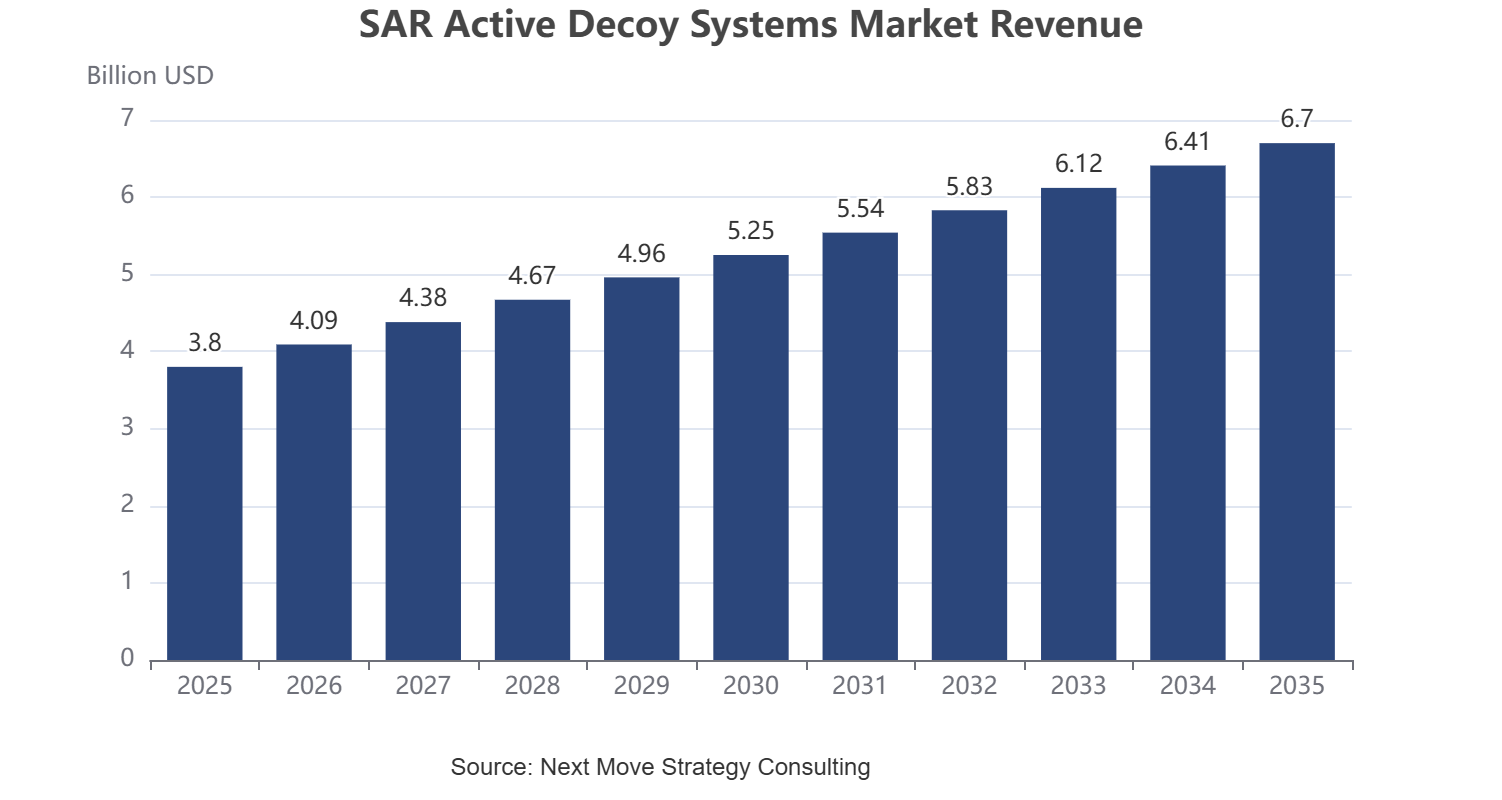
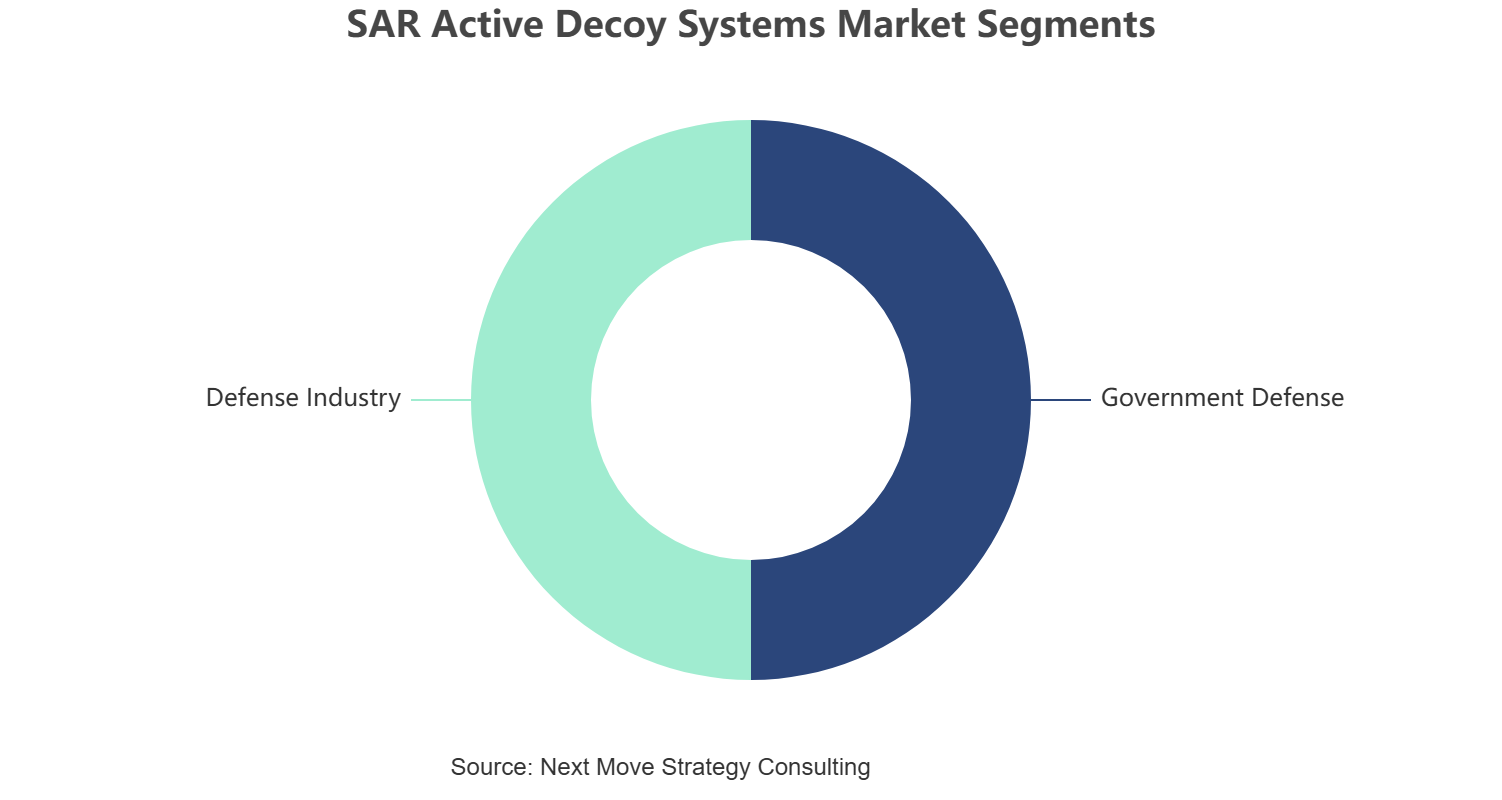
About the Author
 Mihul Sharma
— Mihul Sharma is Research Associate at Next Move Strategy Consulting, where he has covered technology, industrial, and healthcare markets for 3 years. His work applies structured business research, market analysis, and secondary-source review to assess market trends, competitive developments, and growth opportunities. He supports report development by fully synthesizing industry data, company information, and market signals into concise findings for strategy and investment-focused research teams.
Mihul Sharma
— Mihul Sharma is Research Associate at Next Move Strategy Consulting, where he has covered technology, industrial, and healthcare markets for 3 years. His work applies structured business research, market analysis, and secondary-source review to assess market trends, competitive developments, and growth opportunities. He supports report development by fully synthesizing industry data, company information, and market signals into concise findings for strategy and investment-focused research teams.
About the Reviewer
 Supradip Baul
— Supradip Baul is an accomplished business consultant and strategist with over a decade of rich experience in market intelligence, strategy, technology, and business transformation. His work has included rigorous qualitative and quantitative analysis across multiple industries, helping clients shape investment decisions and long-term roadmaps. Earlier in his career, he was associated with Gartner, where he contributed to industry-leading reports and market share analyses. He has worked with leading global companies and holds an MBA with a dual specialization in Marketing and Finance.
Supradip Baul
— Supradip Baul is an accomplished business consultant and strategist with over a decade of rich experience in market intelligence, strategy, technology, and business transformation. His work has included rigorous qualitative and quantitative analysis across multiple industries, helping clients shape investment decisions and long-term roadmaps. Earlier in his career, he was associated with Gartner, where he contributed to industry-leading reports and market share analyses. He has worked with leading global companies and holds an MBA with a dual specialization in Marketing and Finance.
At Next Move Strategy Consulting, we understand that insightful market research is the cornerstone of successful business decisions. That's why we employ a robust and multifaceted approach, combining various methodologies to deliver the most accurate and actionable data for our clients.

Research Landscape
We navigate the world of research with two primary approaches:
Qualitative Approach
Our qualitative research methodologies involve immersive techniques such as in-depth interviews, focus groups, and observational studies. By engaging directly with individuals and stakeholders, we uncover valuable insights that quantitative data alone may overlook.

Quantitative Research
In tandem with qualitative methodologies, NMSC leverages the power of Quantitative Research to provide a robust foundation of numerical insights. Through systematic data collection and analysis, we quantify patterns, preferences, and market trends, offering a comprehensive view of the business landscape.
Our quantitative research approach employs diverse tools, including surveys, experiments, and statistical modelling. These methodologies enable us to gather data from a large and representative sample, ensuring the statistical significance of our findings. By employing structured questionnaires and standardized data collection methods, we guarantee the reliability and validity of the information we present to our clients.
Quantitative research is particularly effective in measuring the prevalence of trends, assessing market size, and gauging the impact of various factors on consumer behavior. The numerical precision attained through this approach equips our clients with actionable insights, facilitating data-driven decision-making and strategy formulation.


Our Specialized Toolbox for Industry-Specific Market Research
We deploy a specialized arsenal of techniques tailored to meet your unique requirements. Here's a glimpse into our comprehensive toolbox:

Information Procurement
The stage entails acquiring market data or relevant information through various sources and methodologies.


Market Research Approach
We utilize both top-down and bottom-up approaches in market research analysis to achieve a comprehensive understanding of the market dynamics, leveraging the broad perspective of industry trends and macroeconomic factors alongside detailed insights from specific segments and individual companies.

Porters Five Forces Analysis
We conduct Porter's Five Forces analysis to evaluate the competitive landscape of an industry, providing us with insights into factors that affect profitability and strategic positioning.

SWOT Analysis

Forecasting
We utilize a forecasting model to predict future consumption by considering parameters like population, economics, regulations, market competition, drivers, constraints, technology, and pricing. We also employ statistical techniques such as multilinear regression, exponential smoothing, moving average, ARIMA, and Monte Carlo simulations for accurate predictions. In econometric forecasting, we analyzed short-term and long-term event impacts, attributing values based on regulatory frameworks, economic factors, and market events.





 Speak to Our Analyst