Signal Detection Market Size, Share, Growth & Forecast By Offering (Hardware: RF Detection Systems, Acoustic & Sonar, EOIR, Magnetic), By Technology Domain (RF, Acoustic & Sonar, EOIR, Magnetic & Seismic), By Platform (Airborne, Naval Surface), By End User (Defence & Military, Intelligence Agencies), By Application (Threat Warning, Intelligence Collection), and By Distribution Channel (Direct Government Sale, Contractor & System Integrator, Direct Commercial Sale) — Global Analysis 2025–2035
Industry: Aerospace & Defense | Publishing Date: July 7, 2026 | Last Updated: September 30, 2026 | No of Pages: N/A | No. of Tables: N/A | No. of Figures: N/A | Format: PDF | Report Code: AD5009
What Is the Signal Detection Market Size?
The global Signal Detection Market was valued at USD 1.45 billion in 2025 and is estimated to reach USD 1.58 billion in 2026. Sustained defence modernisation programmes, multi-domain warfare requirements, and rising investment in intelligence, surveillance, and reconnaissance (ISR) capabilities are projected to propel the market to USD 3.70 billion by 2035, advancing at a CAGR of 9.9% from 2026 to 2035. Key growth drivers include escalating geopolitical tensions across multiple theatres, accelerated procurement of electronic warfare (EW) and electronic support measures (ESM), proliferation of advanced threat emitters, and growing demand for passive detection technologies that operate below adversary detection thresholds.
|
Parameters |
Details |
|
Market Size in 2025 |
USD 1.45 Billion |
|
Market Size in 2026 |
USD 1.58 Billion |
|
Revenue Forecast in 2035 |
USD 3.70 Billion |
|
Growth Rate |
CAGR of 9.9% from 2026 to 2035 |
|
Analysis Period |
2025–2035 |
|
Base Year Considered |
2025 |
|
Forecast Period |
2026–2035 |
|
Market Size Estimation |
Billion USD |
|
Companies Profiled |
12 |
|
Countries Covered |
33 |
|
Market Share |
Top 10 |
Signal Detection Market Overview
What Is the Signal Detection Market?
The Signal Detection Market encompasses hardware, software, and services deployed by defence forces, intelligence agencies, and homeland security organisations to detect, intercept, classify, and geo-locate electromagnetic, acoustic, electro-optical/infrared (EOIR), and seismic signals emanating from threat platforms and activities. Systems range from shipborne radar warning receivers and airborne ESM suites to ground-based spectrum monitoring networks and underwater acoustic sensor arrays. NMSC's analysis indicates that the market supports a critical layer of situational awareness infrastructure that underpins modern multi-domain operations, integrated air and missile defence, and real-time electronic intelligence collection.
How Has the Signal Detection Market Evolved?
The Signal Detection Market has evolved through three distinct phases. The first phase, spanning the Cold War era, focused on narrowband analogue receivers and fixed-site SIGINT collection. The second phase, emerging through the 1990s and 2000s, introduced digital signal processing (DSP), software-defined radio (SDR) architectures, and networked sensor grids. Our analysis of procurement programmes and defence white papers indicates that the current phase is centred on cognitive electronic warfare, AI-enabled signal classification, and multi-sensor fusion platforms capable of operating across contested electromagnetic environments where adversaries deploy advanced jamming and low probability of intercept/detection (LPI/LPD) waveforms.
How Do Regulations Influence the Signal Detection Market?
Regulatory and export control frameworks exert significant structural influence on the Signal Detection Market. The U.S. International Traffic in Arms Regulations (ITAR) and Export Administration Regulations (EAR) govern the export of RF receivers, ELINT collection systems, and electronic warfare suites, limiting technology transfer to allied and partner nations without licence. NATO standardisation agreements (STANAGs) and the Five Eyes SIGINT Sharing Framework shape interoperability requirements for sensor systems procured by member states. Defence ministry acquisition policies in key markets, including the U.S. National Defense Authorization Act (NDAA), the UK Defence and Security Industrial Strategy, and France's Loi de Programmation Militaire, directly drive procurement funding and technology prioritisation within the market.
How Is Technology Adoption Expanding Across the Signal Detection Market?
Technology adoption across the Signal Detection Market is accelerating as defence establishments integrate AI-enabled signal processing, open architecture standards, and multi-INT fusion platforms into legacy and next-generation sensor systems. The U.S. Department of Defense's Joint All-Domain Command and Control (JADC2) programme and the European Defence Agency's Software Defined Radio initiatives are compelling vendors to develop open, modular signal intelligence architectures. Through our market assessment, we observed that consumption of commercial off-the-shelf (COTS) processing hardware and field-programmable gate arrays (FPGAs) is reducing unit costs for airborne and naval signal detection systems while accelerating upgrade cycles.
|
Key Takeaways |
|
By Offering, Hardware dominated the Signal Detection Market at USD 1.03 billion in 2025, accounting for approximately 71% of total market revenue. RF Detection Systems represent the largest hardware sub-segment, driven by the proliferation of advanced radar, COMINT, and ESM programmes across major defence budgets globally. |
|
Software is the fastest-growing primary segment within the Signal Detection Market at an estimated CAGR of 13.3% from 2026 to 2035, as AI-enabled signal processing software, threat library databases, and sensor fusion platforms command increasing procurement share across all platform categories. |
|
By Technology Domain, RF remains the dominant technology domain in the Signal Detection Market, representing approximately 52% of total revenue in 2025, underpinned by the pervasiveness of radar-based and communications-based threat signals across all operational environments. |
|
EOIR is the fastest-growing technology domain in the Signal Detection Market at an estimated CAGR of 12.6% from 2026 to 2035, driven by proliferating missile threats and the deployment of Missile Approach Warning Systems (MAWS) and laser warning receivers across tactical aircraft fleets worldwide. |
|
By Platform, Airborne platforms dominate the Signal Detection Market, accounting for an estimated USD 0.48 billion in 2025, supported by large-scale integrated EW suite programmes on tactical aircraft, maritime patrol aircraft, and rotary-wing platforms across NATO and Indo-Pacific allies. |
|
Space-based Signal Detection is the fastest-growing platform segment at an estimated CAGR of 13.9% from 2026 to 2035, propelled by investment in satellite-based RF monitoring, SIGINT collection constellations, and space domain awareness architectures by the U.S. Space Force, ESA, and allied space agencies. |
|
By End User, Defence and Military is the dominant end user category, representing approximately 78% of Signal Detection Market revenue in 2025, driven by large-scale procurement programmes for integrated EW, ISR, and electronic support systems across all service branches. |
|
Intelligence Agencies represent the fastest-growing end user segment within the Signal Detection Market at an estimated CAGR of 12.0% from 2026 to 2035, as national intelligence communities globally invest in persistent SIGINT collection capabilities for strategic competition. |
|
By Application, Threat Warning is the largest application segment in the Signal Detection Market, accounting for an estimated USD 0.38 billion in 2025, driven by radar warning receiver and missile approach warning system integration across tactical aircraft and surface combatant programmes. |
|
Spectrum Monitoring is the fastest-growing application segment at an estimated CAGR of 12.2% from 2026 to 2035, as spectrum congestion and electromagnetic interference in contested environments compel defence and government users to invest in continuous RF situational awareness capabilities. |
|
North America dominates the Signal Detection Market at an estimated USD 0.69 billion in 2025 and is projected to reach USD 1.72 billion by 2035 at a CAGR of 10.7%, anchored by U.S. Department of Defense electronic warfare and SIGINT investment programmes that represent the world's largest single defence electronics budget. |
|
Asia-Pacific is the fastest-growing major region in the Signal Detection Market at an estimated CAGR of 12.7% from 2026 to 2035, driven by India's EW modernisation initiatives, Japan's DEFENSE BUILD-UP PLAN investments, and Australia's AUKUS-related signal intelligence upgrades. |
|
The United States is the single largest country market in the Signal Detection Market, representing over 83% of North American revenue in 2025, supported by the world's largest investment in electronic warfare, SIGINT, and electromagnetic spectrum operations programmes. |
|
India is the fastest-growing national market in Asia-Pacific within the Signal Detection Market, advancing at an estimated CAGR of 9.8% from 2026 to 2035, propelled by the iDEX innovation framework, Make in India defence programmes, and large-scale EW suite requirements across IAF and IN platforms. |
Key Emerging Trends in the Signal Detection Market
How Is AI-Enabled Signal Classification Transforming the Signal Detection Market?
AI-enabled signal classification is fundamentally reshaping the Signal Detection Market by accelerating the identification of novel and adaptive threat emitters. Our research found that traditional crystal-video and superheterodyne receiver architectures required human-curated threat libraries to classify signals, limiting response speed against LPI/LPD waveforms. Modern AI-driven ESM systems employ deep learning classifiers trained on large electromagnetic signature datasets to autonomously identify previously uncharacterised signals. L3Harris Technologies has integrated machine learning inference engines into its AN/ALQ-254 Viper Shield system, while HENSOLDT AG's KALAETRON Airborne demonstrator employs neural network-based emitter identification. This transition compresses decision timelines from seconds to milliseconds and is redefining upgrade requirements across legacy and next-generation platforms.
How Is the Shift to Open Architecture Electronic Warfare Reshaping Signal Detection System Procurement?
Open architecture electronic warfare (OAEW) frameworks are structurally altering how governments procure and sustain signal detection capabilities. The U.S. DoD's Open Systems Architecture for EW (OSA-EW) initiative mandates modular hardware interfaces and standardised software environments, enabling rapid waveform updates without full system replacement. NMSC's assessment indicates that this shift reduces vendor lock-in, enables competitive upgrades, and accelerates threat-library refresh cycles. BAE Systems' EPAWSS and Northrop Grumman's AN/ALQ-257 IVEWS are designed around open architectures. European programmes under EDA's Electronic Warfare Operational Concept are adopting comparable frameworks, creating a global structural demand pull for modular signal detection hardware and software across the forecast period.
What Role Is Space-Based Signal Intelligence Playing in the Evolving Signal Detection Market?
Space-based signal intelligence (SIGINT) collection is emerging as one of the most consequential growth vectors in the Signal Detection Market. The proliferation of small satellite constellations optimised for RF signal monitoring is enabling persistent wide-area surveillance at costs inaccessible through traditional geostationary architectures. The U.S. Space Force's Electro-Optical Deep Space Surveillance (GEODSS) and commercial SIGINT ventures are creating layered detection grids. From our assessment, we observed that allied nations including the UK (Skynet-6), France (CERES constellation), and Japan (DSN series) are investing in indigenous space-based signal collection to reduce dependence on coalition sharing arrangements, directly expanding addressable market revenue within the Signal Detection Market through 2035.
How Is Multi-Domain Signal Fusion Driving Next-Generation Platform Requirements in the Signal Detection Market?
Multi-domain signal fusion, combining RF, EOIR, acoustic, and seismic detection streams into coherent situational pictures, is driving demand for next-generation integrated ISR and EW suites across all platform categories. Through NMSC's analysis of programme of record documents and industry capability roadmaps, we found that navies are investing in integrated undersea surveillance systems combining towed array sonar with RF spectrum monitoring to detect hybrid surface and subsurface threats. The U.S. Navy's AN/SQQ-89A surface ship sonar suite and the Royal Navy's SONAR 2087 represent existing multi-sensor architectures. Emerging multi-INT fusion architectures on unmanned platforms are further expanding the addressable hardware and software opportunity within the Signal Detection Market.
What Are the Key Market Drivers, Breakthroughs, and Investment Opportunities that will Shape the Signal Detection Market in the Next Decade?
|
Drivers / Trends / Restraints |
(+/-) % Impact on CAGR Forecast |
Geographic Relevance |
Impact Timeline |
|
Escalating multi-domain threat proliferation driving EW and SIGINT investment |
+1.6% |
Global (led by North America, Asia-Pacific, Europe) |
2025–2035 |
|
AI-enabled cognitive EW and real-time signal classification |
+1.2% |
North America, Europe, Israel |
2026–2032 |
|
Space-based SIGINT constellation investment |
+0.9% |
North America, Europe, APAC |
2026–2035 |
|
Open architecture EW mandates expanding upgrade market |
+0.7% |
North America, UK, Australia |
2025–2030 |
|
Growth of spectrum monitoring for homeland security |
+0.6% |
North America, Europe, MEA |
2025–2033 |
|
Spectrum congestion constraining detection bandwidth |
-0.5% |
All regions |
Ongoing |
|
Export control regimes limiting technology transfer |
-0.7% |
Asia, MEA, LATAM |
Ongoing |
|
High programme development cost and acquisition timeline |
-0.4% |
Emerging defence markets globally |
2025–2028 |
|
Undersea warfare modernisation and anti-submarine sonar investment |
+1.1% |
North America, UK, Australia, Japan |
2026–2035 |
|
Proliferation of unmanned systems requiring cross-platform signal detection |
+0.8% |
Global |
2026–2035 |
What Are the Growth Drivers of the Signal Detection Market?
How Is Escalating Geopolitical Competition and Threat Proliferation Accelerating Signal Detection Market Growth?
Rising geopolitical tensions across Eastern Europe, the Indo-Pacific, and the Middle East are generating historic levels of defence electronics investment that directly expand the Signal Detection Market. The U.S. National Defense Authorization Act for FY2025 authorised USD 895 billion in defence spending, with significant allocations to electronic warfare and SIGINT modernisation. NATO allies have committed to sustained defence spending above 2% of GDP under the Vilnius and Washington Summit pledges, translating into multi-year procurement programmes for radar warning receivers, ESM suites, and integrated EW systems. Our analysis indicates that adversary deployment of advanced counter-stealth radar networks, directed energy weapons, and hypersonic platforms is creating continuous threat-driven demand for upgraded signal detection capabilities across all service branches.
How Is the Proliferation of Unmanned and Autonomous Platforms Driving Demand in the Signal Detection Market?
The rapid proliferation of unmanned aerial systems (UAS), unmanned surface vehicles (USV), and unmanned underwater vehicles (UUV) is generating substantial new platform-specific demand for miniaturised, power-efficient signal detection payloads. The U.S. Air Force's Collaborative Combat Aircraft (CCA) programme, the Royal Navy's Autonomous Minesweeper programme, and the U.S. Navy's Orca UUV represent large-scale acquisition programmes that require integrated EW, sonar, and spectrum monitoring payloads without human crew constraints. NMSC's assessment indicates that unmanned platform procurement is expected to more than double across NATO and allied militaries through 2035, creating a structurally new demand layer for compact and low-SWaP (size, weight, and power) signal detection systems that cannot be served by legacy manned-platform architectures.
How Is the Global Anti-Submarine Warfare Build-up Expanding the Signal Detection Market?
Resurgent concern over near-peer submarine activity across the Atlantic, Pacific, and Arctic theatres is compelling major navies to substantially increase procurement of acoustic and sonar detection systems. The U.S. Navy's FY2025 budget allocated USD 3.8 billion to undersea warfare programmes, including sonobuoy production, towed array sonar upgrades, and hull-mounted sonar systems for next-generation frigates. The Royal Australian Navy's AUKUS Pillar II agreement includes advanced undersea warfare cooperation, directly driving sonar and acoustic sensor procurement. From our research, we found that growing investments in anti-submarine patrol aircraft, maritime unmanned systems, and fixed undersea surveillance arrays are collectively expanding the acoustic and sonar sub-segment of the Signal Detection Market at an above-average pace through 2035.
Ecosystem Analysis of the Signal Detection Market
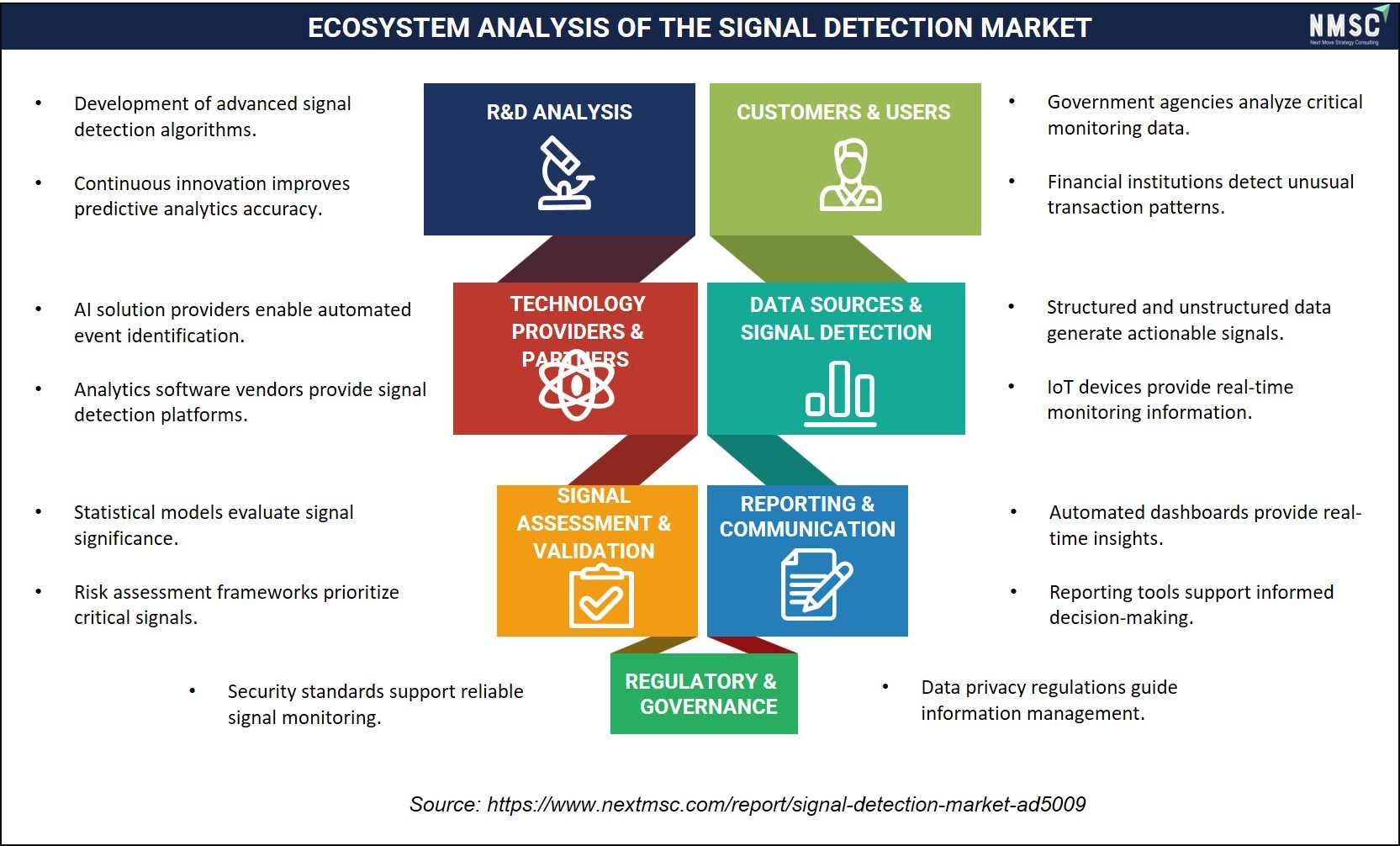
The Signal Detection Market ecosystem comprises research organizations, technology providers, data sources, end users, and regulatory bodies working together to identify, analyze, and manage meaningful signals from large volumes of data. Advanced analytics, artificial intelligence, and real-time monitoring technologies support signal detection and validation processes. Effective reporting, communication, and governance frameworks ensure timely decision-making, risk mitigation, regulatory compliance, and improved operational outcomes across various industries utilizing signal detection solutions.
What Are the Growth Inhibitors of the Signal Detection Market?
How Do Export Control Regimes Constrain Signal Detection Market Expansion?
Stringent export control frameworks, most notably ITAR and the Wassenaar Arrangement, impose significant constraints on the international Signal Detection Market by restricting the transfer of advanced RF receivers, ELINT collection systems, and integrated EW suites to non-allied countries. The Bureau of Industry and Security's Entity List and the State Department's USML Category XI classifications limit which foreign defence customers can access leading-edge U.S.-origin signal detection technology. Our market evaluation found that the EU's common position on arms exports and individual member-state licensing regimes create additional approval uncertainty for European vendors pursuing Middle Eastern and Asian contracts. These constraints channel competition toward export-controlled allied programmes while creating regulatory opacity that extends procurement timelines for international buyers.
How Do Programme Complexity and Lengthy Acquisition Cycles Inhibit Signal Detection Market Growth?
Advanced signal detection platforms involve multi-year engineering development programmes that create significant revenue concentration risk and growth volatility within the Signal Detection Market. The U.S. Government Accountability Office has repeatedly documented cost growth and schedule delays across major defence electronics programmes, noting that integration complexity, shifting threat requirements, and security classification challenges are primary contributors. Major EW programmes such as the Next Generation Jammer Mid-Band (NGJ-MB) experienced multi-year schedule revisions. NMSC's analysis indicates that these acquisition dynamics create uneven annual revenue recognition for prime contractors, complicate vendor planning, and reduce the pace at which next-generation signal detection capabilities enter operational service.
What Are the Growth Opportunities in the Signal Detection Market?
How Does the NATO Alliance's Electromagnetic Spectrum Operations Initiative Create a Multi-Billion Dollar Opportunity in the Signal Detection Market?
NATO's Electromagnetic Spectrum Operations (EMSO) concept and associated national implementation plans represent a multi-billion dollar procurement opportunity for signal detection vendors. The alliance's recognition of the electromagnetic spectrum as an operational domain, formalised in the NATO EMSO Policy adopted at the Brussels Summit, is compelling member states to invest in spectrum awareness, ESM, and electronic attack capabilities beyond legacy Cold War inventories. The U.S. DoD's Electromagnetic Spectrum Superiority Strategy and the UK's Defence Science and Technology Laboratory EMSO roadmap are creating durable multi-year demand for RF signal detection infrastructure upgrades. From NMSC's assessment, we found that smaller NATO members including Poland, Romania, and the Baltic States are initiating first-generation ESM procurement programmes, expanding the addressable customer base significantly.
How Is the Integration of Commercial Satellite SIGINT Creating New Market Opportunities for Signal Detection Vendors?
The emergence of commercially operated SIGINT satellite constellations is creating both competitive pressure and partnership opportunities for established signal detection system vendors. Companies such as HawkEye 360 and Spire Global are deploying RF monitoring satellite constellations that provide government customers with complementary persistent coverage. The U.S. National Reconnaissance Office (NRO) and the UK's GCHQ are expanding contracts with commercial SIGINT providers as part of broader intelligence community diversification strategies. Through our market evaluation, we observed that traditional defence-prime signal detection vendors are pursuing teaming arrangements and subsystem supply relationships with commercial space SIGINT operators, creating a new revenue stream that did not exist within the Signal Detection Market five years prior.
How Does Homeland Security Spectrum Monitoring Represent a Structural Growth Opportunity in the Signal Detection Market?
The growing threat from improvised UAS, counter-drone requirements at critical infrastructure, and electromagnetic spectrum management for public safety agencies is expanding the Signal Detection Market beyond its traditional defence-and-intelligence customer base. The U.S. Federal Aviation Administration (FAA) Counter-UAS Programme and the Department of Homeland Security's Science and Technology Directorate are funding spectrum monitoring and radio frequency detection systems for border security and critical infrastructure protection. European Horizon programmes fund RF detection for electromagnetic compatibility and critical infrastructure monitoring. Our analysis shows that these civilian-adjacent applications create a structurally distinct and less export-controlled market segment that broadens revenue diversification opportunities for signal detection system vendors.
Regulatory Framework Impacting the Signal Detection Market
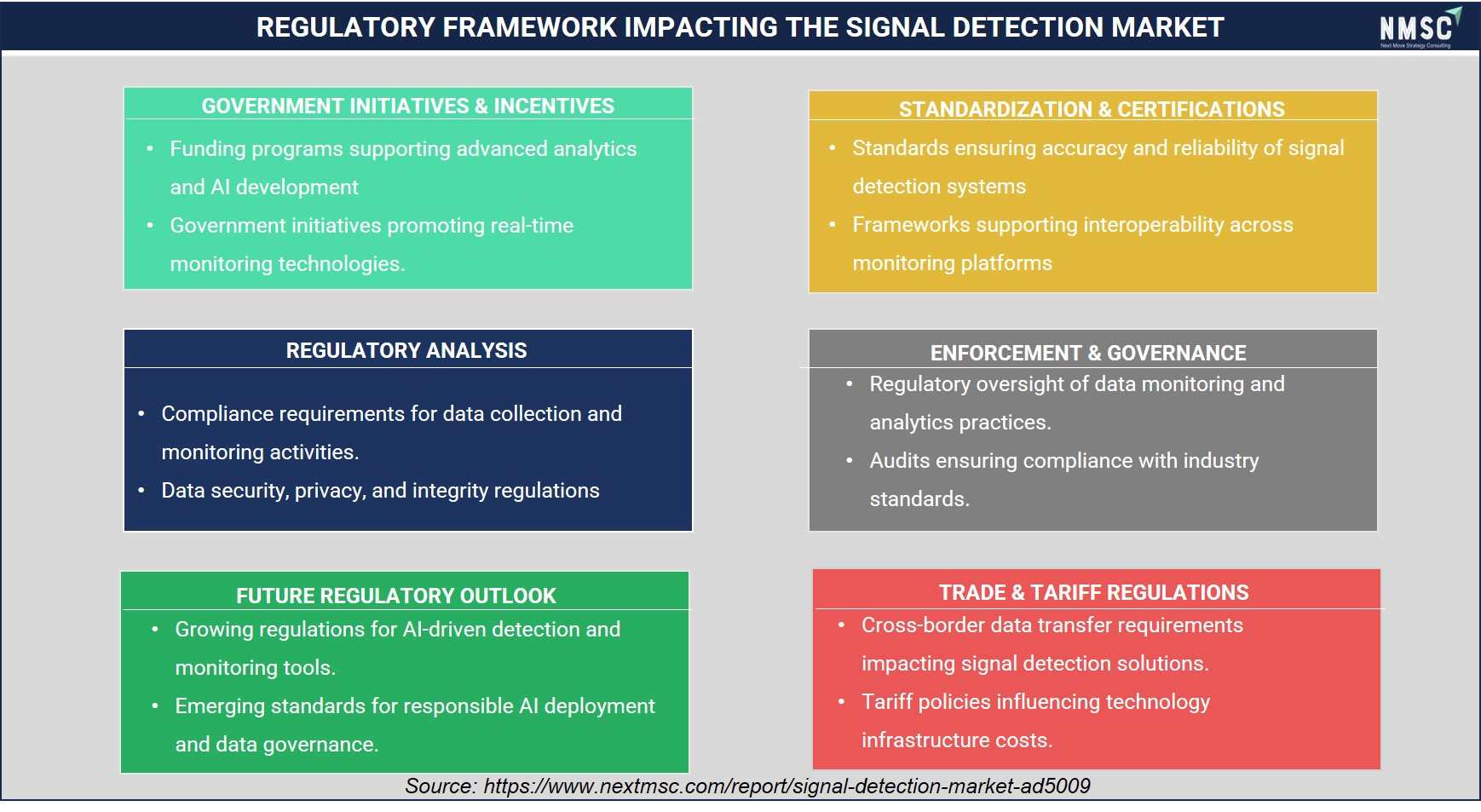
The regulatory framework impacting the Signal Detection Market focuses on ensuring secure, accurate, and compliant monitoring and analytics operations. Government initiatives encourage the adoption of advanced analytics and AI-driven detection technologies, while industry standards promote system reliability and interoperability. Regulatory oversight, data privacy requirements, and governance policies support responsible data management. Additionally, evolving regulations for AI deployment and cross-border data transfer requirements are shaping market development and technology adoption worldwide.
How Is the Signal Detection Market Segmented in This Report, and What Are the Key Insights from the Segmentation Analysis?
How Does the Offering Segmentation Reveal the Structural Composition of the Signal Detection Market?
|
Offering Segment |
2025 (USD Bn) |
2035 (USD Bn) |
CAGR (%) |
|
Hardware |
1.03 |
2.55 |
10.6% |
|
RF Detection Systems |
0.38 |
0.95 |
10.7% |
|
Acoustic & Sonar Detection Systems |
0.28 |
0.71 |
10.9% |
|
EOIR Detection Systems |
0.15 |
0.43 |
12.4% |
|
Magnetic & Seismic Detection Systems |
0.09 |
0.20 |
13.9% |
|
Multi-Sensor Suites |
0.13 |
0.26 |
8.0% |
|
Software |
0.23 |
0.71 |
13.3% |
|
Services |
0.19 |
0.45 |
10.1% |
Based on our analysis of defence procurement budgets and platform programme structures, the Signal Detection Market is segmented into Hardware, Software, and Services. Hardware dominates at USD 1.03 billion in 2025, with RF Detection Systems forming the largest sub-segment due to the pervasive deployment of radar warning receivers, ESM receivers, and COMINT collection systems across tactical aircraft, surface combatants, and land platforms. Acoustic and Sonar Detection Systems represent the second-largest hardware sub-segment, supported by sustained anti-submarine warfare investment. Software is the fastest-growing primary segment, driven by AI-enabled signal classification, sensor fusion, and mission management platforms. Services, encompassing system integration, sustainment, and training simulation, provide stable recurring revenue with strong contract retention characteristics.
How Does Technology Domain Segmentation Shape Revenue Distribution Across the Signal Detection Market?
|
Technology Domain |
2025 (USD Bn) |
2035 (USD Bn) |
CAGR (%) |
|
RF |
0.76 |
1.85 |
10.4% |
|
Acoustic and Sonar |
0.32 |
0.82 |
11.0% |
|
EOIR |
0.20 |
0.58 |
12.6% |
|
Magnetic and Seismic |
0.08 |
0.18 |
9.4% |
|
Multi-Domain and Other |
0.09 |
0.27 |
13.0% |
On the basis of technology domain, the Signal Detection Market is segmented into RF, Acoustic and Sonar, EOIR, Magnetic and Seismic, and Multi-Domain and Other. From our analysis, RF remains the dominant technology domain at USD 0.76 billion in 2025, reflecting the breadth of radar, communications intelligence, and electronic support applications supported by RF detection technologies across airborne, naval, land, and space platforms. The EOIR domain is the fastest-growing at an estimated CAGR of 12.6%, driven by missile approach warning system procurement and the growing deployment of advanced IR surveillance payloads on tactical platforms. Multi-Domain and Other is the second-fastest-growing domain as programmes increasingly demand integrated sensor fusion architectures that fuse data across multiple physical domains for coherent threat pictures.
How Does Platform Segmentation Influence Adoption Patterns in the Signal Detection Market?
|
Platform Segment |
2025 (USD Bn) |
2035 (USD Bn) |
CAGR (%) |
|
Airborne |
0.48 |
1.14 |
10.1% |
|
Naval Surface |
0.33 |
0.85 |
11.1% |
|
Naval Subsurface |
0.19 |
0.50 |
11.4% |
|
Land |
0.27 |
0.68 |
10.8% |
|
Space |
0.09 |
0.29 |
9.3% |
|
Cross-Platform |
0.09 |
0.24 |
11.5% |
We observed that the Signal Detection Market is segmented by platform into Airborne, Naval Surface, Naval Subsurface, Land, Space, and Cross-Platform categories. Airborne platforms dominate at USD 0.48 billion in 2025, driven by the scale of integrated EW suite upgrades on fourth- and fifth-generation tactical aircraft, maritime patrol platforms, and rotary-wing EW assets. Naval Surface platforms represent the second-largest segment, reflecting large-scale warship ESM and ELINT upgrade programmes. Space is the fastest-growing platform at an estimated CAGR of 13.9% from 2026 to 2035, as SIGINT satellite constellation investments across the U.S. Space Force, allied agencies, and emerging commercial operators expand the addressable market substantially. Cross-Platform programmes, which develop signal detection architectures spanning multiple platform types, are gaining programmatic traction under joint EW concept frameworks.
Which End Users Are Driving Purchasing Decisions in the Signal Detection Market?
|
End User Segment |
2025 (USD Bn) |
2035 (USD Bn) |
CAGR (%) |
|
Defence and Military |
1.13 |
2.82 |
10.7% |
|
Intelligence Agencies |
0.18 |
0.50 |
12.0% |
|
Homeland Security and Law Enforcement |
0.09 |
0.24 |
11.5% |
|
Other Government |
0.05 |
0.14 |
12.1% |
Based on our analysis of government procurement patterns, the Signal Detection Market is segmented into Defence and Military, Intelligence Agencies, Homeland Security and Law Enforcement, and Other Government end users. Defence and Military dominates at USD 1.13 billion in 2025, reflecting the scale of tactical EW and ISR procurement across all global service branches. Intelligence Agencies represent the fastest-growing customer segment at an estimated CAGR of 12.0%, as national intelligence communities expand persistent SIGINT collection for strategic competition and counter-proliferation missions. Other Government, including regulatory spectrum management agencies and emergency communications authorities, is the highest-growth segment in proportional terms as civilian electromagnetic spectrum management requirements expand.
How Do Application Segments Reflect Operational Priorities in the Signal Detection Market?
|
Application Segment |
2025 (USD Bn) |
2035 (USD Bn) |
CAGR (%) |
|
Threat Warning |
0.38 |
0.91 |
10.2% |
|
Intelligence Collection |
0.32 |
0.83 |
11.2% |
|
Surveillance |
0.28 |
0.72 |
11.1% |
|
Target Acquisition |
0.20 |
0.48 |
10.2% |
|
Spectrum Monitoring |
0.16 |
0.45 |
12.2% |
|
Countermeasure Cueing |
0.08 |
0.21 |
11.3% |
|
Other Application |
0.03 |
0.10 |
14.3% |
NMSC's analysis of operational doctrine and programme requirements indicates that the Signal Detection Market is segmented into Threat Warning, Intelligence Collection, Surveillance, Target Acquisition, Spectrum Monitoring, Countermeasure Cueing, and Other Application segments. Threat Warning is the largest application at USD 0.38 billion in 2025, reflecting the universal deployment of radar warning receivers and missile approach warning systems across military platforms globally. Spectrum Monitoring is the fastest-growing application at an estimated CAGR of 12.2%, driven by electromagnetic spectrum management requirements in congested and contested environments. Countermeasure Cueing, which links signal detection outputs to electronic attack and decoy systems, is gaining procurement momentum as net-centric EW architectures mature.
How Are Distribution Channels Shaping Go-to-Market Strategies in the Signal Detection Market?
|
Distribution Channel |
2025 (USD Bn) |
2035 (USD Bn) |
CAGR (%) |
|
Direct Government Sale |
0.86 |
2.13 |
10.6% |
|
Contractor and System Integrator |
0.53 |
1.36 |
11.0% |
|
Direct Commercial Sale |
0.06 |
0.21 |
14.9% |
We observed that the Signal Detection Market is distributed through Direct Government Sale, Contractor and System Integrator, and Direct Commercial Sale channels. Direct Government Sale dominates at USD 0.86 billion in 2025, reflecting the government-prime contracting structure that governs defence electronics procurement across North America, Europe, and Asia-Pacific. Contractor and System Integrator channels are the primary route for complex platform integration programmes where primes such as RTX, Lockheed Martin, and Northrop Grumman integrate signal detection subsystems into complete platform EW suites. Direct Commercial Sale is the fastest-growing channel at an estimated CAGR of 14.9%, driven by homeland security and spectrum monitoring procurement outside classified defence channels.
Regional Outlook
Geographic Performance Snapshot
|
Region |
2025 (USD Bn) |
2035 (USD Bn) |
CAGR (%) |
Key Driver |
|
North America |
0.69 |
1.72 |
10.7% |
U.S. DoD EW/SIGINT investment, NDAA allocations |
|
Europe |
0.35 |
0.91 |
11.2% |
NATO EMSO implementation, Ukraine-driven procurement |
|
Asia-Pacific |
0.26 |
0.76 |
12.7% |
Indo-Pacific security architecture, India & Japan build-up |
|
Middle East & Africa |
0.08 |
0.19 |
10.1% |
Gulf modernisation, Israel technology exports |
|
Latin America |
0.07 |
0.12 |
6.2% |
Limited defence budgets, border surveillance |
North America Signal Detection Market
North America is the global epicentre of the Signal Detection Market, accounting for USD 0.69 billion in 2025 and projected to reach USD 1.72 billion by 2035 at a CAGR of 10.7%. The region benefits from the world's largest defence electronics procurement budget, headquartering of the majority of global prime contractors, and an unparalleled intelligence community investment cycle. The U.S. DoD's Electromagnetic Spectrum Superiority Strategy, JADC2 programme, and the National Security Agency's SIGINT modernisation initiatives underpin sustained demand. Regulatory frameworks including ITAR and NDAA domestic sourcing requirements shape supply chain dynamics and reinforce the competitive position of U.S.-domiciled signal detection vendors.
U.S. Signal Detection Market
Based on our analysis, the United States represents over 83% of North American Signal Detection Market revenue and is the world's single largest national market. The FY2025 NDAA's electronic warfare provisions, the Air Force's EPAWSS and IRST21 programmes, the Navy's AN/SLQ-32(V)7 SEWIP Block 3 upgrade, and the Army's Multi-Function Electronic Warfare (MFEW) programme collectively represent multi-billion dollar signal detection procurement activity. U.S. Space Force investment in space domain awareness and SIGINT satellites adds an emerging layer of demand. The competitive landscape is dominated by RTX, Northrop Grumman, L3Harris, and BAE Systems' Electronic Systems division, all headquartered or primarily operating within the United States for classified programme execution.
Canada Signal Detection Market
Through our analysis, Canada represents approximately 10% of North American Signal Detection Market revenue, supported by Canadian Armed Forces modernisation commitments and the NORAD recapitalisation programme. The NORAD Modernisation investment of CAD 38.6 billion over 20 years, announced by the Government of Canada, directly funds over-the-horizon radar upgrades, Arctic surveillance sensors, and signals intelligence infrastructure. Canadian defence policy emphasises interoperability with U.S. and Five Eyes partners, creating procurement demand for NATO-standard signal detection architectures. Defence industry policy under the Industrial and Technological Benefits programme incentivises technology transfer partnerships between U.S. primes and Canadian industry.
Mexico Signal Detection Market
From our assessment, Mexico represents the smallest North American Signal Detection Market, with procurement concentrated in border surveillance, counter-narcotics spectrum monitoring, and communications intelligence for domestic security operations. The Mexican Secretariat of National Defense (SEDENA) and Secretary of the Navy (SEMAR) maintain modest signal detection inventories primarily focused on law enforcement support rather than peer-competitor EW programmes. Export control constraints limit access to leading-edge U.S. EW systems. Demand is driven by spectrum monitoring for border electromagnetic management and limited ISR procurement through ITAR-licensed channels with U.S. defence industrial partners.
Europe Signal Detection Market
Europe is the second-largest region in the Signal Detection Market, contributing USD 0.35 billion in 2025 and projected to reach USD 0.91 billion by 2035 at a CAGR of 11.2%. The Ukraine conflict has fundamentally altered European defence investment priorities, with NATO allies committing to sustained procurement increases above 2% GDP that directly fund EW, SIGINT, and signal detection modernisation. Germany's EUR 100 billion Sondervermögen special defence fund, Poland's historic defence spending increases, and Sweden's NATO accession-linked procurement programmes are creating significant near-term demand. The European Defence Agency's EW and EMSO programmes coordinate multinational interoperability requirements.
UK Signal Detection Market
Based on our engagements, the United Kingdom represents the largest individual European market for signal detection, driven by Royal Air Force Typhoon and F-35B EW suite investments, Royal Navy Type 26 frigate integrated EW systems, and GCHQ signals intelligence infrastructure. The UK's Defence and Security Industrial Strategy prioritises sovereign electronic warfare capability through the EW Operational Centre (EWOC) and Dstl research programmes. BAE Systems and Leonardo DRS are primary suppliers for UK platforms. Post-Brexit, the UK's participation in European EW cooperation through bilateral agreements with France and Germany ensures continued interoperability investment.
Germany Signal Detection Market
According to our evaluation, Germany is the second-largest European Signal Detection Market, energised by the Zeitenwende defence policy shift and the EUR 100 billion Bundeswehr special fund. HENSOLDT AG, headquartered in Taufkirchen, is Europe's leading dedicated electronic warfare and SIGINT company, supplying Eurofighter EW suites, TRS-4D naval radars, and KALAETRON airborne ESM systems. Procurement under the Eurofighter ECR electronic combat and reconnaissance role and Tiger attack helicopter EW modernisation represent near-term market opportunities. Bundesnachrichtendienst (BND) SIGINT infrastructure investment further expands the intelligence agency customer segment.
France Signal Detection Market
Through our analysis, France is the third-largest European Signal Detection Market, characterised by strong indigenous defence industrial capability through Thales and MBDA. The French CERES satellite SIGINT constellation, operated by the DGA (Direction Générale de l'Armement), represents a USD 500 million-plus space-based signal intelligence investment. Rafale F4 EW suite upgrades, FREMM frigate electronic warfare systems, and France's participation in European MALE drone programmes with integrated SIGINT payloads drive sustained hardware and software procurement. The Loi de Programmation Militaire 2024–2030, committing EUR 413 billion to French defence, directly funds signal detection system development.
Italy Signal Detection Market
From our assessment, Italy is a mid-tier European Signal Detection Market anchored by Leonardo S.p.A., which is one of Europe's principal EW and SIGINT system suppliers. Italy's F-35A programme includes BEL (Electronic Warfare Suite) procurement, while the Italian Navy's FREMM frigates and Cavour carrier air wing require integrated ESM and electronic attack systems. The Agenzia Informazioni e Sicurezza Esterna (AISE) and SISMI intelligence structures maintain SIGINT collection infrastructure. Italy's participation in NATO EMSO capability development creates demand for interoperable signal detection architectures aligned with alliance standards.
Spain Signal Detection Market
Based on our evaluation, Spain demonstrates growing momentum in the Signal Detection Market driven by Eurofighter Typhoon EW upgrades, F-35A prospective acquisition, and SNA sonar modernisation for the S-80 submarine class. Indra Sistemas is Spain's national champion in defence electronics, producing electronic warfare suites, radar systems, and SIGINT platforms. The Spanish Ministry of Defence's investment plan under NATO burden-sharing commitments is expanding procurement budgets toward 2% GDP. Counter-terrorism spectrum monitoring requirements for the Centro Nacional de Inteligencia (CNI) add an intelligence agency revenue stream to Spain's signal detection procurement.
Sweden Signal Detection Market
Sweden's Signal Detection Market has been fundamentally reshaped by NATO accession, which aligns Swedish Försvarets materielverk (FMV) procurement standards with alliance interoperability requirements. Saab AB is Sweden's primary signal detection systems vendor, producing the Gripen EW suite, GlobalEye airborne ISR platform, and submarine SIGINT systems for the Swedish Armed Forces. Swedish Defence Research Institute (FOI) research in advanced EW and spectrum management reinforces national technology sovereignty. NATO membership expands Sweden's addressable programme participation in multinational EW development.
Denmark Signal Detection Market
From our analysis, Denmark's Signal Detection Market is driven by F-35A EW suite procurement, Royal Danish Navy frigates, and expanding Arctic surveillance requirements under the NORAD-aligned Arctic defence framework. Denmark's Defence Intelligence Service (Forsvarets Efterretningsstjeneste, FE) operates signals intelligence collection infrastructure aligned with Five Eyes partnership arrangements. Defence spending increases above 2% GDP under NATO burden-sharing commitments are funding EW and spectrum monitoring procurements that represent long-term growth for established system suppliers.
Finland Signal Detection Market
Through our assessment, Finland represents a high-importance border-security signal detection market, with land-based electronic intelligence collection against Russian military activity representing a primary requirement. The Finnish Defence Forces' procurement of F-35A fighters includes full EW suite deliveries, while land forces electronic warfare investments are expanding. The Finnish Intelligence and Security Service (Suojelupoliisi, Supo) maintains domestic signals monitoring capability. NATO accession creates new interoperability procurement requirements and access to alliance intelligence sharing that drive system upgrade investment.
Netherlands Signal Detection Market
Based on our analysis, the Netherlands is a NATO-active Signal Detection Market participant, with F-35A EW suites, De Zeven Provinciën frigate upgrades, and intelligence community SIGINT investments driving demand. The MIVD (Military Intelligence and Security Service) maintains SIGINT collection infrastructure. The Netherlands Aerospace Centre (NLR) supports national EW research. Dutch industrial partners including Thales Netherlands participate as tier-2 and tier-3 suppliers in major EW programmes across European and North American prime contractor supply chains.
Rest of Europe Signal Detection Market
Rest of Europe, encompassing Poland, Romania, Norway, Belgium, Czech Republic, and other nations, collectively represents a rapidly expanding segment of the European Signal Detection Market. Poland's historic defence spending surge above 4% GDP is funding F-35A acquisitions with EW suites, AH-64E helicopters with ELINT payloads, and national SIGINT infrastructure expansion. Romania's military modernisation includes F-16 EW upgrades and NATO-standard ESM procurement. Norway's P-8A maritime patrol aircraft programme includes advanced sonar and SIGINT capabilities. Baltic States are investing in ground-based RF detection and spectrum monitoring for territorial defence.
Asia-Pacific Signal Detection Market
Asia-Pacific is the fastest-growing major region in the Signal Detection Market, advancing from USD 0.26 billion in 2025 to an estimated USD 0.76 billion by 2035 at a CAGR of 12.7%. The region's growth is propelled by India's comprehensive defence modernisation programme, Japan's historic defence build-up, Australia's AUKUS-driven investments, and South Korea's advanced indigenous EW development. Intensifying maritime territorial disputes, North Korean missile proliferation, and China's rapid military-technological development are creating sustained threat-driven demand for EW and SIGINT capabilities across allied and partner nations in the region.
China Signal Detection Market
Through our assessment, China's Signal Detection Market is the largest in Asia-Pacific by total installed base, driven by the People's Liberation Army's comprehensive programme of EW modernisation across all service branches. China's approach to the market differs from Western models in that indigenous procurement is government-directed through entities such as CETC, AVIC, and CASIC. China's J-20 and H-6K platforms feature advanced indigenous EW suites, while naval ESM upgrades across Type 052D destroyers and Type 055 cruisers represent large-scale sensor procurement. International market assessment is limited by classification and opacity of Chinese defence procurement, but the overall trajectory of investment is structurally expansive based on open-source defence white papers and platform programme analysis.
India Signal Detection Market
Based on our research, India is the fastest-growing national market in Asia-Pacific for Signal Detection, advancing at an estimated CAGR of 9.8% from 2026 to 2035. The Indian Air Force's EW suite requirements for Tejas Mk1A fighters, the Indian Navy's P-8I and MH-60R maritime aircraft ESM payloads, and the Army's ElSA electronic support measure vehicle programme represent near-term procurement opportunities. The iDEX Defence Innovation Organisation and Make in India defence manufacturing initiatives are driving domestic content requirements that are opening subcontract opportunities for foreign-Indian joint ventures. Bharat Electronics Limited (BEL) and Electronic Corporation of India Limited (ECIL) are primary indigenous suppliers.
Japan Signal Detection Market
From our evaluation, Japan is the second-largest Asia-Pacific Signal Detection Market, propelled by the Five-Year Defence Build-up Plan (2023–2027) that increased annual defence spending toward USD 80 billion. Japan's F-35A and F-35B EW suites, P-1 maritime patrol aircraft integrated SIGINT systems, and destroyer-class electronic warfare upgrades represent multi-billion dollar procurement activity. The Japan Defense Intelligence Headquarters (DIH) maintains strategic SIGINT collection infrastructure. Japanese EW industrial participation through Mitsubishi Electric and NEC is increasing under offset and domestic content frameworks, creating a growing indigenous supply base within the Signal Detection Market.
South Korea Signal Detection Market
Based on NMSC's research, South Korea demonstrates high EW system maturity and strong domestic development capability within the Signal Detection Market. Korea Aerospace Industries (KAI) and LIG Nex1 are developing indigenous EW suites for the KF-21 Boramae fighter programme, which directly competes with foreign import options. South Korea's Agency for Defense Development (ADD) invests in advanced SIGINT, ECM, and ESM technologies. North Korean asymmetric warfare capabilities, including GPS jamming and EMP threats, create distinct domestic threat-driven demand that sustains EW procurement above baseline alliance-sharing levels.
Taiwan Signal Detection Market
Through our assessment, Taiwan's Signal Detection Market is driven by acute cross-strait threat requirements that necessitate comprehensive air, naval, and ground-based signal detection infrastructure. F-16V Viper EW upgrades, P-3C Orion maritime patrol aircraft SIGINT systems, and coast defence ESM networks represent Taiwan's primary procurement categories. The National Chung Shan Institute of Science and Technology (NCSIST) develops indigenous EW and signal detection capabilities. U.S. Foreign Military Sales (FMS) remain the dominant acquisition channel, subject to Taiwan Relations Act provisions and periodic ITAR approval cycles.
Indonesia Signal Detection Market
From our assessment, Indonesia's Signal Detection Market is in early-stage development, primarily driven by maritime patrol requirements across the world's largest archipelago. The Indonesian Air Force's F-16 fleet and prospective Rafale acquisition include EW suites. The Indonesian Navy operates coast surveillance radar networks and maritime patrol aircraft with SIGINT capabilities. Government procurement is governed by the Ministry of Defence's defence planning document (Rencana Pembangunan Pertahanan). Offset and technology transfer requirements under Peraturan Menteri Pertahanan influence prime contractor participation strategies in Indonesian EW tenders.
Vietnam Signal Detection Market
Based on our analysis, Vietnam's Signal Detection Market is driven by modernisation of the Vietnam People's Air Force and coastal defence requirements in the South China Sea. Vietnam has procured Russian-origin Su-30MK2 fighters with integrated EW suites and Russian EW ground station systems. Growing interest in Western and Israeli EW systems under strategic diversification policies is creating prospective market opportunities for vendors from non-Russian suppliers. The Vietnam Defence Ministry's modernisation doctrine emphasises electronic warfare capability development as a priority given regional threat dynamics, driving sustained signal detection procurement through the forecast period.
Australia Signal Detection Market
From our analysis, Australia is the most advanced Signal Detection Market in the Indo-Pacific outside Northeast Asia, with AUKUS-driven investments substantially expanding procurement commitments. Australia's EA-18G Growler fleet, P-8A Poseidon maritime patrol aircraft, and Air Warfare Destroyer-class ESM systems represent established signal detection programmes. AUKUS Pillar II advanced capability cooperation includes EW technology sharing with the U.S. and UK, directly expanding Australia's access to leading-edge signal detection technologies. The Australian Signals Directorate (ASD) funds SIGINT infrastructure. Australian industrial participation through EOS Defence Systems and CEA Technologies is growing under AUKUS industrial base development frameworks.
Philippines Signal Detection Market
Through our assessment, the Philippines Signal Detection Market is driven by the Horizon 3 Armed Forces Modernisation Programme and maritime domain awareness requirements in the South China Sea. The Philippine Air Force's FA-50 and prospective advanced fighter acquisitions include EW suite requirements. Coastal surveillance radar networks and maritime patrol vessels with signal detection payloads represent growing procurement priorities. U.S. Mutual Defense Treaty cooperation and the Enhanced Defense Cooperation Agreement (EDCA) provide access to U.S. defence technology under FMS channel arrangements, shaping procurement options within the Signal Detection Market.
Malaysia Signal Detection Market
From our assessment, Malaysia's Signal Detection Market is shaped by modest defence budgets and competing procurement priorities. The Royal Malaysian Air Force's F/A-18D and Hawk fleet EW systems represent existing signal detection inventories. Coastal surveillance and maritime patrol requirements in disputed South China Sea waters create incremental demand. The Royal Malaysian Navy's next-generation frigate replacement programme includes ESM system requirements. Malaysia's defence procurement is influenced by diversified supply relationships spanning the U.S., UK, Russia, and China, creating a fragmented competitive landscape.
Rest of APAC Signal Detection Market
The Rest of Asia-Pacific, comprising New Zealand, Singapore, Thailand, Bangladesh, Pakistan, and Sri Lanka, collectively represents a growing share of the regional Signal Detection Market. Singapore's advanced defence electronics capability through ST Engineering and DSO National Laboratories represents a regionally significant indigenous development base. New Zealand's participation in the Five Eyes intelligence alliance drives SIGINT infrastructure investment. Pakistan's signal detection procurement spans both Western and Chinese supplier ecosystems. Thailand's F-16 fleet EW upgrades and maritime patrol requirements create steady procurement demand across the rest of the Asia-Pacific region.
Middle East and Africa Signal Detection Market
The Middle East and Africa Signal Detection Market accounts for USD 0.08 billion in 2025 and is projected to advance to USD 0.19 billion by 2035 at a CAGR of 10.1%. The region is characterised by a bifurcated growth pattern, with the Gulf Cooperation Council (GCC) driving premium procurement of advanced EW and SIGINT systems, while Israel operates as both a major indigenous developer and export hub for signal detection technologies. Sub-Saharan Africa remains in early-stage adoption with procurement driven by counter-terrorism and border surveillance applications.
Saudi Arabia Signal Detection Market
Based on our engagements, Saudi Arabia is the largest Signal Detection Market in the MEA region, driven by the Royal Saudi Air Force's Eurofighter and F-15SA fleet EW requirements, Royal Saudi Land Forces electronic warfare programmes, and Vision 2030-linked defence indigenisation initiatives. The Saudi Vision 2030 defence manufacturing target of 50% domestic content is creating joint venture opportunities for EW and signal detection system manufacturers. SAMI (Saudi Arabian Military Industries) is coordinating industrial partnerships with L3Harris, Thales, and Leonardo for indigenous signal detection system development and sustainment.
UAE Signal Detection Market
Through our analysis, the UAE is the second-largest MEA Signal Detection Market, supported by Mirage 2000 and F-16 EW upgrade programmes, Baynunah corvette electronic warfare systems, and the UAE's ambitions as a regional defence technology hub. EDGE Group, the UAE's defence industrial conglomerate, is pursuing domestic signal detection capability development through subsidiaries including SIGN4L and HALCON. Abu Dhabi ship building programmes include integrated ESM system requirements. The UAE's strategic position as a Five Eyes-adjacent partner creates procurement access to advanced U.S. and UK signal detection technologies under FMS channel arrangements.
Egypt Signal Detection Market
From our assessment, Egypt maintains one of the largest armed forces in Africa and the Arab world, with corresponding signal detection procurement requirements. The Egyptian Air Force's F-16 fleet and Rafale acquisitions include EW system deliveries. Egyptian Navy ESM upgrades on FREMM frigates represent ongoing naval signal detection investment. The Egyptian Technical Research Centre maintains domestic signals intelligence infrastructure. Egypt's procurement diversification across U.S., French, and Russian suppliers creates a complex competitive landscape, with Western vendors benefiting from elevated access through the Egypt-Israel peace treaty framework and associated U.S. military assistance programmes.
Israel Signal Detection Market
Based on our analysis, Israel occupies a unique position within the Signal Detection Market as both a leading indigenous technology developer and a major export hub for advanced EW and SIGINT systems. Elbit Systems and Israel Aerospace Industries (IAI) develop and export radar warning receivers, ESM suites, missile approach warning systems, and airborne SIGINT platforms to dozens of allied and partner customers globally. Israel's conflict experience in Gaza, Lebanon, and against Iranian-proxy threats has created an unparalleled operational proving ground for signal detection technologies, which directly accelerates product maturation and export credibility. The Israeli intelligence community's SIGINT architecture, anchored by Unit 8200, drives domestic advanced signal processing demand.
Turkey Signal Detection Market
Through our assessment, Turkey's Signal Detection Market is distinguished by a growing indigenous defence electronics sector and evolving NATO membership dynamics. ASELSAN, Turkey's national defence electronics champion, has developed the ARES radar warning receiver, PASAJ ESM system, and ANKA UAV EW payload. Turkey's F-16 fleet modernisation includes indigenous Turkish Electronic Warfare Development System (HEWS) integration. NATO membership provides interoperability standards alignment while Turkey's balanced foreign policy approach creates procurement flexibility across Western, Israeli, and domestic supply options within the signal detection system vendor base.
Nigeria Signal Detection Market
Based on our assessment, Nigeria's Signal Detection Market is primarily driven by counter-terrorism requirements in the Lake Chad Basin, Boko Haram monitoring, and maritime surveillance of the Gulf of Guinea. Nigeria's procurement is concentrated in tactical ESM systems for ground-based operations and airborne SIGINT payloads for the Nigerian Air Force's ISR platforms. The Nigerian Defence Industries Corporation (DICON) provides limited domestic assembly capability. Western defence cooperation programmes under AFRICOM and bilateral U.S.-Nigeria military agreements support limited FMS-channel signal detection procurement for counter-terrorism applications.
South Africa Signal Detection Market
From our assessment, South Africa is the most technologically advanced Signal Detection Market in Sub-Saharan Africa, anchored by Denel Dynamics and Reutech Radar Systems' domestic development capabilities. South African National Defence Force (SANDF) EW requirements include Gripen fighter EW suite sustainment and naval ESM systems for SAS vessels. The South African government's arms embargo limitations and the country's non-aligned procurement approach create a distinctive competitive landscape that favours European and Israeli suppliers alongside limited domestic capability. Border surveillance and maritime domain awareness requirements in the Southern African Development Community (SADC) region add a growing government-security revenue stream.
Rest of MEA Signal Detection Market
The Rest of Middle East and Africa, encompassing Kuwait, Qatar, Bahrain, Oman, Jordan, Morocco, Kenya, Ethiopia, and other nations, collectively represents a growing procurement segment within the Signal Detection Market. GCC countries outside Saudi Arabia and UAE are upgrading legacy signal detection systems on F/A-18 and Eurofighter platforms under U.S. and European FMS channel programmes. Morocco's acquisition of F-16 fighters with integrated EW suites represents a recent near-term procurement event. Kenya, Ethiopia, and other African nations with U.S. AFRICOM cooperation agreements maintain modest signal detection capabilities for counter-terrorism and border security applications.
Latin America Signal Detection Market
Latin America is the smallest and slowest-growing major region in the Signal Detection Market at a CAGR of 2.4% from 2026 to 2035, constrained by limited defence budgets, low threat intensity relative to other global regions, and restricted access to advanced EW technologies under ITAR controls. Brazil and Colombia collectively account for approximately 60% of regional revenue. Drug interdiction, border surveillance, and counter-terrorism missions drive the majority of signal detection procurement across the region, with legacy platforms receiving incremental upgrades rather than full next-generation system replacements.
Brazil Signal Detection Market
Based on our analysis, Brazil is the largest Latin American Signal Detection Market, with the Brazilian Air Force's F-39 Gripen procurement representing the single largest near-term signal detection opportunity as the programme includes EW suites produced by Saab in partnership with Brazilian industry. Brazilian Navy sonar systems on frigate and submarine platforms constitute the primary naval signal detection inventory. The Agência Brasileira de Inteligência (ABIN) maintains domestic SIGINT infrastructure. Brazil's defence-industrial base, supported by Embraer Defence and the Departamento de Ciência e Tecnologia Aeroespacial (DCTA), provides limited domestic EW system development capability.
Argentina Signal Detection Market
Through our assessment, Argentina's Signal Detection Market is constrained by severe fiscal limitations and an aging defence electronics inventory. The Argentine Air Force's F-16 acquisition from Denmark, approved in 2023 and including EW suite deliveries, represents the most significant near-term signal detection procurement event. Naval sonar systems for ARA San Juan-class submarine replacements and naval patrol vessels represent incremental opportunities. The Instituto de Investigaciones Científicas y Técnicas para la Defensa (CITEDEF) provides limited domestic defence electronics research capability.
Chile Signal Detection Market
From our assessment, Chile maintains one of the most capable and well-funded defence establishments in Latin America, supporting a proportionately significant Signal Detection Market. Chile's F-16 fleet EW sustainment, EF-101 maritime patrol aircraft SIGINT requirements, and Scorpène submarine sonar systems constitute the core procurement base. Chile's Agencia Nacional de Inteligencia (ANI) and military intelligence organisations maintain SIGINT collection infrastructure. Chile's stable political environment and consistent defence budget management create a relatively predictable procurement environment for signal detection system vendors.
Colombia Signal Detection Market
Based on our analysis, Colombia's Signal Detection Market is uniquely shaped by counter-narcotics and counter-insurgency requirements that create demand for SIGINT and spectrum monitoring capabilities beyond typical armed-force sizes. U.S. Plan Colombia and successor security cooperation programmes have funded signal detection systems for intercepting narcotics trafficking communications. The Colombian Air Force's Kfir and A-29 Super Tucano fleets include EW systems. Colombia's strategic security cooperation relationship with the United States provides ongoing FMS channel access to signal detection technologies appropriate for internal security and border surveillance missions.
Rest of LATAM Signal Detection Market
The Rest of Latin America, including Peru, Ecuador, Venezuela, Bolivia, Paraguay, Uruguay, and Central American nations, collectively represents a marginal segment of the global Signal Detection Market. Peru operates Mirage 2000 and MiG-29 fighters with inherited EW systems and has initiated F-16 acquisition feasibility studies. Ecuador and Bolivia maintain minimal signal detection inventories. Security cooperation with the United States under SOUTHCOM provides limited access to basic signal detection technologies for counter-drug and border surveillance applications. Overall, Rest of LATAM procurement activity is expected to remain constrained throughout the 2025–2035 forecast period.
Competitive Landscape
Competitive Dynamics and M&A Landscape
|
Key Takeaways |
Details |
|
Market Structure |
The Signal Detection Market features oligopolistic competition among Western defence primes (RTX, Northrop Grumman, L3Harris, BAE Systems, Thales), European specialists (Leonardo, HENSOLDT, Saab), and Israeli firms (Elbit Systems, IAI), competing on programme capture, technology depth, and platform integration credentials. The market is highly consolidated at the tier-1 level due to security classification requirements and high development costs. |
|
Innovation Focus |
Innovation in the Signal Detection Market centres on AI-enabled signal classification, cognitive EW software, open-architecture modular hardware, space-based SIGINT systems, and multi-sensor fusion platforms. Vendors are competing to integrate machine learning capabilities into legacy and next-generation EW suites to address the challenge of modern adaptive threat emitters. |
|
M&A Activity |
L3 Technologies and Harris Corporation merged in 2019 to form L3Harris, creating one of the world's leading EW and SIGINT companies. Northrop Grumman's acquisition of Orbital ATK expanded its space-based signal intelligence payload capability. RTX (formerly Raytheon Technologies) maintains a dominant EW position through organic development. PE-backed consolidation of smaller tier-2 signal processing software vendors is ongoing. |
How Do Companies Compete in the Signal Detection Market?
The Signal Detection Market is characterised by highly concentrated tier-1 competition among a small number of Western defence primes and regional specialists, with competition structured primarily around programme capture rather than commodity pricing. RTX Corporation competes through its Advanced Electronics Systems portfolio and legacy ALQ-184 jamming system family. Northrop Grumman dominates the airborne electronic attack segment through the AN/ALQ-257 and Integrated Defense Systems. L3Harris competes on airborne EW, shipborne ESM, and SIGINT collection through a broad portfolio built from the Harris Corporation heritage. Competitive dynamics are shaped by incumbent platform relationships, security clearance access, ITAR-controlled technology restrictions, and the programmatic switching cost embedded in multi-year sustainment contracts.
Which Kind of Companies Dominate the Signal Detection Market?
Three distinct categories of companies dominate the Signal Detection Market. First, U.S. defence mega-primes including RTX Corporation, Northrop Grumman, L3Harris Technologies, and General Dynamics leverage scale, classified programme access, and platform integration credentials to capture the largest share of DoD and allied nation EW and SIGINT procurement. Second, European national champion defence electronics companies including Thales, Leonardo, HENSOLDT, BAE Systems, and Saab serve their home markets under domestic content preferences and compete internationally through export licensing and industrial partnership arrangements. Third, Israeli firms including Elbit Systems and IAI compete on exportability, cost-competitive pricing, and operationally-proven system performance, serving markets where U.S. and European ITAR restrictions create access limitations.
AI-Native Differentiation and Open Standards Drive Market Success in the Signal Detection Market
Innovation focus across the Signal Detection Market is increasingly concentrated in cognitive EW and AI-enabled signal processing architectures that can autonomously classify novel threat emitters, adapt EW responses in real time, and share threat library updates across networked platform ecosystems. Vendors that successfully demonstrate AI classification performance on operationally-classified threat datasets and earn DoD or allied nation programme-of-record authorisation are capturing superior pricing power and long-term sustainment contracts. Open architecture adoption under OSA-EW and NATO EMSO standards is differentiating vendors capable of separating hardware refresh from software upgrade cycles, reducing through-life cost for platform owners and enabling more frequent capability updates.
Market Players to Opt for Merger and Acquisition Strategies to Expand Their Presence in the Signal Detection Market
Mergers and acquisitions are reshaping the competitive map of the Signal Detection Market as firms seek to address portfolio gaps in software, space-based SIGINT, and AI-enabled processing. The creation of L3Harris Technologies through the 2019 L3-Harris merger established a formidable combined EW and ISR portfolio. HENSOLDT's dual-listing and Airbus Group equity stake reflect European defence consolidation pressures. Private equity-backed acquisitions of niche signal processing software companies are enabling primes to accelerate AI and cognitive EW capability development. Further consolidation is expected around space-based SIGINT payload providers, AI signal classification software developers, and unmanned platform-specific EW system specialists through the 2025–2030 timeframe.
Who Are the Key Market Players in the Signal Detection Market?
-
RTX Corporation
-
Lockheed Martin Corporation
-
Northrop Grumman Corporation
-
BAE Systems plc
-
L3Harris Technologies, Inc.
-
Thales S.A.
-
Leonardo S.p.A.
-
General Dynamics Corporation
-
Elbit Systems Ltd.
-
Saab AB
-
Israel Aerospace Industries Ltd.
-
HENSOLDT AG
What Are the Latest Developments in the Signal Detection Market?
|
Date |
Event |
|
September 2025 |
HENSOLDT announced that it would showcase its latest sensor technologies at DSEI 2025, focusing on active and passive threat detection and software-defined defence solutions. |
|
July 2024 |
Lockheed Martin demonstrated an AI-powered Synthetic Aperture Radar (SAR) Automatic Target Recognition (ATR) capability that can automatically detect, recognize, and track maritime targets during flight tests. |
What Are the Investment Opportunities in the Signal Detection Market?
Capital Inflows and Venture Activity
The Signal Detection Market continues to attract substantial institutional and strategic capital, though the classified nature of programmes limits public visibility of investment flows. U.S. venture capital into defence-tech EW and SIGINT startups has accelerated under the DoD's DIU (Defense Innovation Unit) and AFWERX programs. Companies including Epirus (directed energy and EW), Dedrone (counter-UAS signal detection), and Silvus Technologies (spectrum monitoring) have raised venture funding exceeding USD 200 million collectively in recent periods. The National Venture Capital Association reports that defence and national security technology accounted for a growing share of U.S. venture investments from 2023 through 2025, driven by geopolitical risk awareness among institutional allocators.
Infrastructure Investment
Physical infrastructure investment in signal detection systems is substantial and is primarily driven by government capital programmes. The U.S. Space Force's FY2025 budget allocated USD 2.4 billion to space-based surveillance and SIGINT infrastructure development. The UK's Joint Intelligence Organisation is expanding its SIGINT collection ground station network. Australia's ASD is investing in expanded signals intelligence infrastructure under AUKUS Pillar II. These capital programmes directly expand the installed base of signal detection hardware, drive sustainment service revenue, and create long-cycle replacement procurement pipelines for participating system vendors across the forecast period.
ESG and Dual-Use Considerations
Environmental, Social, and Governance (ESG) considerations increasingly influence investment decisions in the Signal Detection Market through the lens of dual-use technology governance. Institutional investors applying responsible arms investment frameworks examine signal detection companies' exposure to non-democratic customer markets, export compliance records, and AI ethics governance for EW applications. The UN Group of Governmental Experts on autonomous weapons systems is developing norms that will increasingly affect how AI-enabled signal detection and countermeasure systems are evaluated. Signal detection vendors with strong export compliance records, transparent customer reporting, and documented human-oversight architectures for AI-based detection systems are better positioned to attract ESG-aligned institutional capital.
Digital Transformation Enablement
Signal detection platforms serve as foundational sensors within the broader defence digital transformation investment cycles, making them structurally integral to multi-year modernisation programmes. Armed forces undergoing JADC2 implementation, NATO EMSO capability development, and national digital battlefield programmes require signal detection system integration, software-defined architecture upgrades, and open API development to connect EW and SIGINT outputs to command networks. The NIST Cybersecurity Framework and NATO's Cyber Defence Framework explicitly reference signals intelligence and spectrum awareness as critical digital infrastructure components, creating durable and policy-mandated demand tied to broader defence technology refresh cycles across the 2025–2035 forecast period.
Private Equity and Strategic M&A Activity
Private equity firms are deploying significant capital into mid-tier signal detection software and services companies that are positioned to benefit from DoD open architecture mandates. Veritas Capital, AEI Partners, and Compass Group have historically been active acquirers of defence electronics software companies in the EW and SIGINT segment. Strategic M&A is accelerating as platform-level primes seek to acquire cognitive EW algorithms, AI training dataset companies, and space-based SIGINT payload specialists. Structurally attractive M&A targets in the 2025–2028 timeframe include AI-based signal classification software developers, commercial SIGINT constellation operators, counter-UAS spectrum detection companies, and unmanned platform EW payload specialists within the Signal Detection Market ecosystem.
Key Benefits for Stakeholders
For Defence Procurement Authorities
Defence procurement authorities gain comprehensive, vendor-neutral insights into the Signal Detection Market, including quantitative sizing across all offering categories, technology domains, platforms, and applications through 2035. This intelligence supports capability gap analysis, programme business case development, vendor evaluation, and multi-year technology investment roadmaps for EW and SIGINT modernisation. NMSC's competitive landscape analysis enables procurement teams to benchmark vendor capability portfolios and evaluate make-versus-buy decisions for signal detection system components and software with analytical rigour.
For Investors and Financial Analysts
Investors and financial analysts access a structured, data-rich assessment of the Signal Detection Market's growth trajectory, competitive dynamics, M&A pipeline, and segment-level revenue forecasts through 2035. The CAGR analysis by offering, technology domain, platform, and geography enables precise portfolio construction and valuation modelling. Detailed competitive profiling of all 12 covered vendors combined with latest development tracking provides an early-signal framework for identifying acquisition targets, emerging leaders, and at-risk incumbents within the global signal detection industry.
For Signal Detection System Vendors
Signal detection system vendors gain actionable intelligence on white-space opportunities, competitive positioning gaps, and fastest-growing sub-segments within the Signal Detection Market. Technology domain analysis reveals underserved areas including space-based SIGINT and AI-enabled cognitive EW. Regional outlook sections identify geographic expansion priorities with regulatory context. The end-user and distribution channel analysis enables vendors to refine go-to-market strategies, identify cross-sell opportunities between hardware and software segments, and optimise channel mix between direct government sale and contractor/system integrator routes.
For Government and Policy Bodies
Government agencies and policy bodies gain a structured analysis of how defence acquisition frameworks, export control regimes, and electromagnetic spectrum management policies are shaping the Signal Detection Market's competitive structure and technology development priorities. Country-level insights provide policymakers with evidence-based perspectives on how regulatory design choices affect national industrial base competitiveness, technology sovereignty, and alliance interoperability. The competitive landscape analysis offers direct relevance to national EW strategy development and defence industrial base investment decisions.
Key Market Segments
By Offering
-
Hardware
-
RF Detection Systems
-
Radar Warning Receivers
-
ESM and ELINT Receivers
-
COMINT Collection Systems
-
Spectrum Monitoring and Direction Finding Systems
-
Other RF Detection Systems
-
-
-
Acoustic and Sonar Detection Systems
-
Sonobuoys
-
Towed Array Sonar Systems
-
Hull Mounted and Bow Sonar Systems
-
Dipping Sonar Systems
-
Underwater Acoustic Sensor Networks
-
Other Acoustic Detection Systems
-
-
EOIR Detection Systems
-
Missile Approach Warning Systems
-
Laser Warning Receivers
-
Other EOIR Detection Systems
-
-
Magnetic and Seismic Detection Systems
-
Magnetic Anomaly Detection Systems
-
Seismic Sensors
-
Other Ground Detection Systems
-
-
Multi-Sensor Suites
-
Integrated EW Suites
-
Integrated ISR Suites
-
Other Multi-Sensor Suites
-
-
Software
-
Signal Processing Software
-
Sensor Fusion Software
-
Mission Management Software
-
Threat Library Software
-
Simulation and Test Software
-
Other Software
-
-
Services
-
System Integration and Installation
-
Sustainment and Support
-
Managed Detection and Monitoring Services
-
Training Simulation and Exercise Services
-
Consulting and Engineering Services
-
Other Services
-
By Technology Domain
-
RF
-
Acoustic and Sonar
-
EOIR
-
Magnetic and Seismic
-
Multi-Domain and Other
By Platform
-
Airborne
-
Naval Surface
-
Naval Subsurface
-
Land
-
Space
-
Cross-Platform
By End User
-
Defence and Military
-
Intelligence Agencies
-
Homeland Security and Law Enforcement
-
Other Government
By Application
-
Threat Warning
-
Intelligence Collection
-
Surveillance
-
Target Acquisition
-
Spectrum Monitoring
-
Countermeasure Cueing
-
Other Application
By Distribution Channel
-
Direct Government Sale
-
Contractor and System Integrator
-
Direct Commercial Sale
By Region
-
North America: U.S., Canada, and Mexico.
-
Europe: UK, Germany, France, Italy, Spain, Sweden, Denmark, Finland, the Netherlands, and the rest of Europe.
-
Asia Pacific: China, India, Japan, South Korea, Taiwan, Indonesia , Vietnam, Australia, Philippines, Malaysia and the rest of APAC.
-
Middle East & Africa (MEA): Saudi Arabia, UAE, Egypt, Israel, Turkey, Nigeria, South Africa, and the rest of MEA.
-
Latin America: Brazil, Argentina, Chile, Colombia, and the rest of LATAM.
Conclusion and Recommendations
Long-Term Outlook
The Signal Detection Market is entering a consequential growth decade driven by sustained geopolitical competition, multi-domain warfare doctrine adoption, and AI-driven signal processing innovation. The market is forecast to grow from USD 1.58 billion in 2026 to USD 3.70 billion by 2035, at a CAGR of 9.9%. Our analysis indicates this growth reflects both rising threat-driven demand for upgraded detection capabilities and the structural shift from narrowband analogue systems to broadband, software-defined, and AI-augmented signal detection architectures across airborne, naval, land, and space platforms globally.
Strategic Positioning Recommendations
Platform vendors should prioritise AI-native signal classification capability through integration of deep learning inference engines within RF and EOIR detection subsystems. Organisations that embed cognitive EW capabilities within governable and certifiable AI frameworks, rather than treating AI as an experimental overlay, will capture premium programme awards and superior sustainment economics. Open architecture investment is non-negotiable for vendors targeting DoD and NATO programme competitions, as OSA-EW compliance is increasingly a mandatory evaluation criterion in U.S. and allied EW system source selections.
Investment Attractiveness
The Signal Detection Market represents a highly attractive long-term investment environment given durable multi-decade geopolitical demand drivers, classified programme switching cost dynamics that generate long-cycle recurring revenue, and the structural shift from hardware-centric to software-and-services-rich business models. The highest-conviction investment themes include space-based SIGINT platforms (9.3% CAGR), AI cognitive EW software, spectrum monitoring for homeland security, and undersea warfare signal detection programmes. Investors should monitor space-based signal intelligence company formation activity and consolidation plays in AI signal classification software and counter-UAS detection system segments.
Market Shifts and Key Risks
The most significant market shift underway is the migration from fixed-frequency threat libraries to dynamic, AI-augmented emitter classification systems that can characterise novel signals without prior programming. This shift benefits cognitive EW software vendors and platform-level primes that have invested in AI training infrastructure at the expense of companies relying on manually updated threat databases. Key risks for the Signal Detection Market include escalating electromagnetic environment complexity outpacing detection system update cycles, export control regime tightening reducing international addressable market access, advanced adversary spectrum denial creating operational environments where passive detection yields insufficient tactical utility, and quantum sensing breakthroughs altering fundamental detection physics beyond 2030.
Growth Pathways
Organisations seeking to maximise value from the Signal Detection Market should pursue a three-horizon strategy. In the near term (2025–2027), prioritise AI signal classification integration and open architecture compliance certification to position for USAF, USN, and NATO platform EW upgrade contract awards. In the mid-term (2027–2031), invest in space-based SIGINT payload development and unmanned platform EW system miniaturisation to capture the fastest-growing new platform segments. In the long term (2031–2035), position for multi-domain signal fusion architecture integration across joint force command networks as data link capacity and AI processing enable real-time cross-domain signal intelligence dissemination.
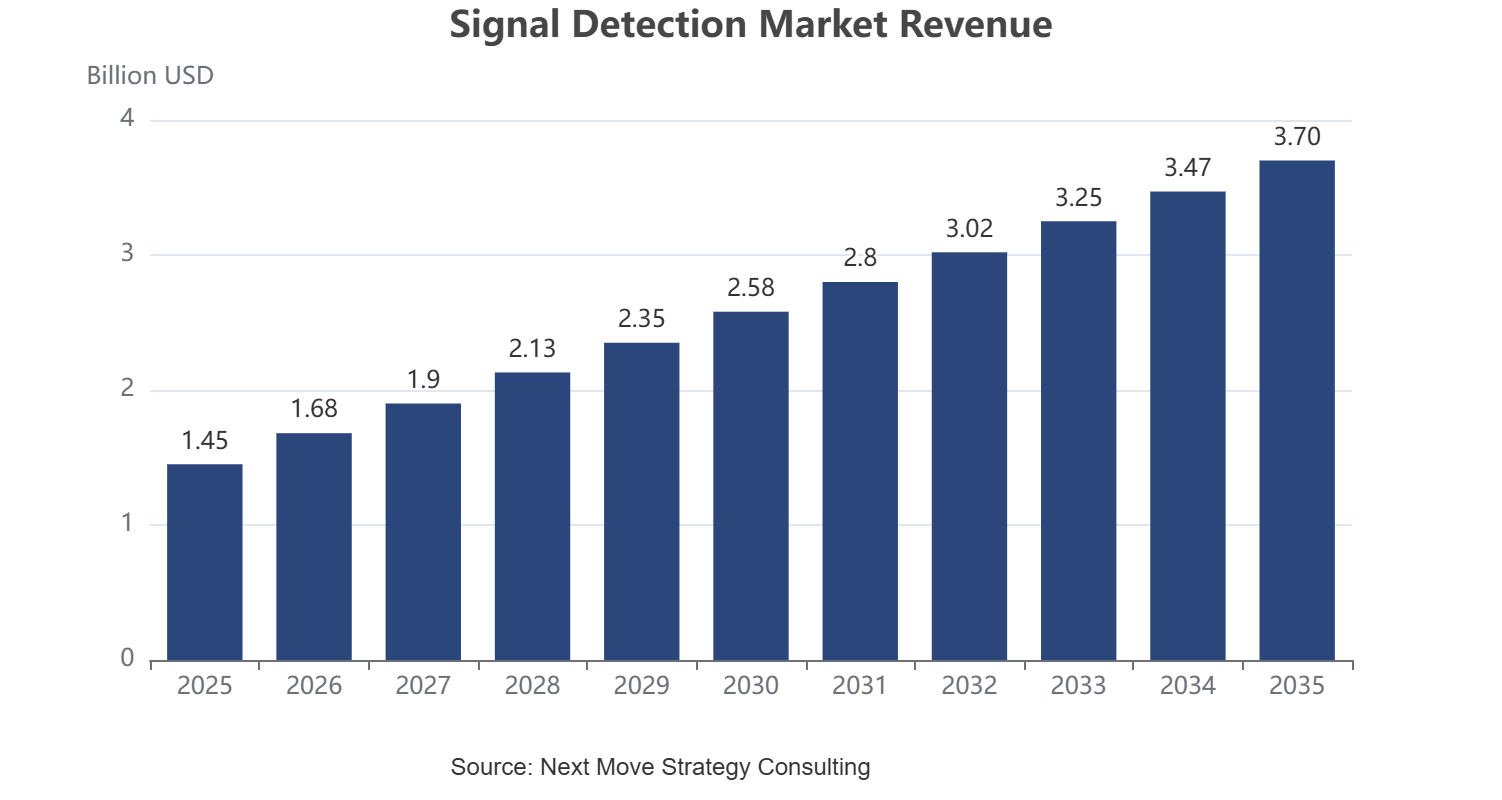
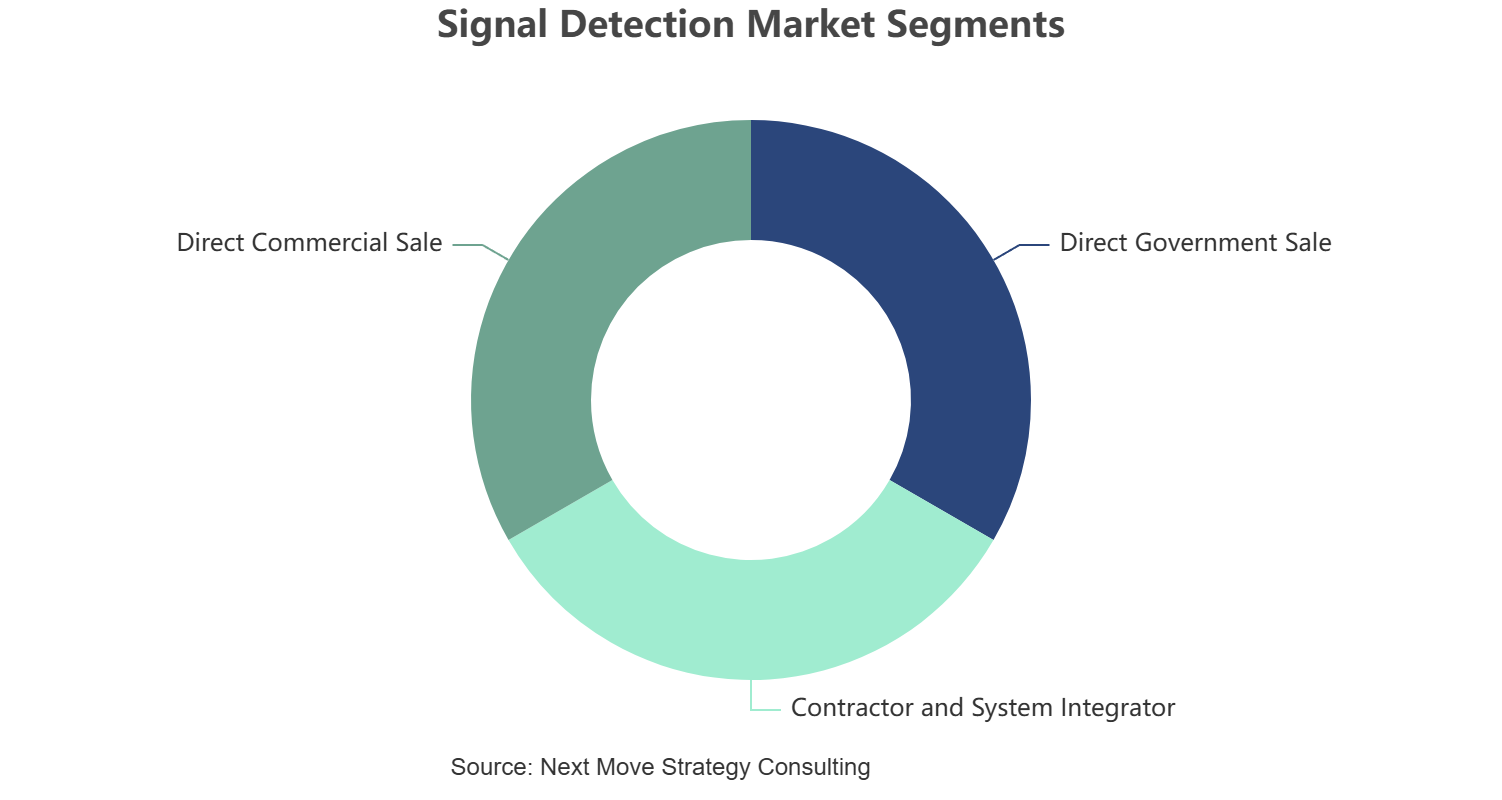
About the Author
 Liza Phukan
— Liza Phukan is Research Associate at Next Move Strategy Consulting, where she has covered emerging industries and market research across sectors for 3.5 years. Her work includes analyzing industry developments, validating market data, and developing structured business content from research findings. She uses secondary research and data-validation practices to turn complex market information into clear decision-useful market analysis for business audiences and support report development and B2B.
Liza Phukan
— Liza Phukan is Research Associate at Next Move Strategy Consulting, where she has covered emerging industries and market research across sectors for 3.5 years. Her work includes analyzing industry developments, validating market data, and developing structured business content from research findings. She uses secondary research and data-validation practices to turn complex market information into clear decision-useful market analysis for business audiences and support report development and B2B.
About the Reviewer
 Supradip Baul
— Supradip Baul is an accomplished business consultant and strategist with over a decade of rich experience in market intelligence, strategy, technology, and business transformation. His work has included rigorous qualitative and quantitative analysis across multiple industries, helping clients shape investment decisions and long-term roadmaps. Earlier in his career, he was associated with Gartner, where he contributed to industry-leading reports and market share analyses. He has worked with leading global companies and holds an MBA with a dual specialization in Marketing and Finance.
Supradip Baul
— Supradip Baul is an accomplished business consultant and strategist with over a decade of rich experience in market intelligence, strategy, technology, and business transformation. His work has included rigorous qualitative and quantitative analysis across multiple industries, helping clients shape investment decisions and long-term roadmaps. Earlier in his career, he was associated with Gartner, where he contributed to industry-leading reports and market share analyses. He has worked with leading global companies and holds an MBA with a dual specialization in Marketing and Finance.
At Next Move Strategy Consulting, we understand that insightful market research is the cornerstone of successful business decisions. That's why we employ a robust and multifaceted approach, combining various methodologies to deliver the most accurate and actionable data for our clients.

Research Landscape
We navigate the world of research with two primary approaches:
Qualitative Approach
Our qualitative research methodologies involve immersive techniques such as in-depth interviews, focus groups, and observational studies. By engaging directly with individuals and stakeholders, we uncover valuable insights that quantitative data alone may overlook.

Quantitative Research
In tandem with qualitative methodologies, NMSC leverages the power of Quantitative Research to provide a robust foundation of numerical insights. Through systematic data collection and analysis, we quantify patterns, preferences, and market trends, offering a comprehensive view of the business landscape.
Our quantitative research approach employs diverse tools, including surveys, experiments, and statistical modelling. These methodologies enable us to gather data from a large and representative sample, ensuring the statistical significance of our findings. By employing structured questionnaires and standardized data collection methods, we guarantee the reliability and validity of the information we present to our clients.
Quantitative research is particularly effective in measuring the prevalence of trends, assessing market size, and gauging the impact of various factors on consumer behavior. The numerical precision attained through this approach equips our clients with actionable insights, facilitating data-driven decision-making and strategy formulation.


Our Specialized Toolbox for Industry-Specific Market Research
We deploy a specialized arsenal of techniques tailored to meet your unique requirements. Here's a glimpse into our comprehensive toolbox:

Information Procurement
The stage entails acquiring market data or relevant information through various sources and methodologies.


Market Research Approach
We utilize both top-down and bottom-up approaches in market research analysis to achieve a comprehensive understanding of the market dynamics, leveraging the broad perspective of industry trends and macroeconomic factors alongside detailed insights from specific segments and individual companies.

Porters Five Forces Analysis
We conduct Porter's Five Forces analysis to evaluate the competitive landscape of an industry, providing us with insights into factors that affect profitability and strategic positioning.

SWOT Analysis

Forecasting
We utilize a forecasting model to predict future consumption by considering parameters like population, economics, regulations, market competition, drivers, constraints, technology, and pricing. We also employ statistical techniques such as multilinear regression, exponential smoothing, moving average, ARIMA, and Monte Carlo simulations for accurate predictions. In econometric forecasting, we analyzed short-term and long-term event impacts, attributing values based on regulatory frameworks, economic factors, and market events.





 Speak to Our Analyst