Fixed-Wing Drone Market By Operational Range (Less than 20 km, 21–100 km, Others), By Payload Capacity (Less than 2 kg, 2–10 kg, Others), By Propulsion System (Electric, Internal Combustion Engine, Others), By Endurance (Less than 1 hour, 1–4 hours, 5–8 hours, Others), By Level of Autonomy (Remotely Piloted, Semi-Autonomous, Others), By Airframe Configuration (Conventional Fixed-Wing, Others), By Commercial Model (Unit Sales, Leasing, Others), and Others – Global Analysis & Forecast, 2025–2035
Industry: Aerospace & Defense | Publishing Date: September 11, 2026 | Last Updated: October 16, 2026 | No of Pages: N/A | No. of Tables: N/A | No. of Figures: N/A | Format: PDF | Report Code: AD4257
Industry Outlook
The global Fixed-Wing Drone Market size was valued at USD 13.35 billion in 2025 and is expected to reach USD 17.63 billion by 2026. Looking ahead, the industry is projected to expand significantly, reaching USD 61.53 billion by 2035, registering a CAGR of 14.9% from 2026 to 2035.
Fixed-Wing Drone Market Size & Forecast
|
Parameters |
Details |
|
Market Size in 2026 |
USD 17.63 Billion |
|
Revenue Forecast in 2035 |
USD 61.53 Billion |
|
Growth Rate |
CAGR of 14.9% from 2026 to 2035 |
|
Analysis Period |
2025–2035 |
|
Base Year Considered |
2025 |
|
Forecast Period |
2026–2035 |
|
Market Size Estimation |
Million (USD) |
|
Companies Profiled |
20 |
|
Countries Covered |
33 |
|
Market Share |
Available for 10 companies |
Based on NMSC’s primary industry assessments and involvement in pilot-phase fixed-wing drone programs across defense and commercial environments, we found the fixed-wing drone market as a mature and operationally validated segment within the broader unmanned systems landscape. Through direct engagement with operators, mission planners, and post-deployment performance review teams, we also observed that fixed-wing platforms are consistently selected for applications where endurance, range, and cost-efficient coverage are decisive, including defense surveillance, border monitoring, large-area geospatial mapping, environmental monitoring, precision agriculture, and linear energy infrastructure inspection.
Advances in autonomous flight control, high-resolution sensor integration, and secure command-and-control architectures have enabled these systems to move decisively beyond pilot-led experimentation into repeatable, mission-critical workflows, reinforcing confidence among government, commercial, and institutional users.
Moreover, across our interactions with system integrators, certification authorities, and regulatory stakeholders involved in multi-region deployment programs, we observed that adoption is increasingly shaped by airspace authorization pathways, airworthiness certification maturity, and cybersecurity resilience rather than platform performance alone. North America and Europe continue to benefit from established defense procurement mechanisms and civil aviation frameworks that support operational scaling, while emerging regions are accelerating adoption to address infrastructure monitoring, disaster response, and remote-area operational requirements.
From an industry perspective, the market is clearly advancing toward routine BVLOS execution, higher onboard autonomy, and tighter integration between aerial data capture and downstream analytics ecosystems. Vendors that demonstrate proven operational reliability under real-world conditions, compliance readiness across jurisdictions, and application-specific validation are expected to command long-term trust and sustained market relevance.
What Are the Key Trends in the Fixed-Wing Drone Industry?
How did Autonomy and Endurance Reshape Operational Efficiency in Fixed-wing Drone Deployments?
Based on our continuous monitoring and hands-on assessment of active fixed-wing drone operations, we observed that advances in autonomous flight control and endurance fundamentally reshaped how these platforms performed in real-world mission environments. As part of our ongoing primary research, we engaged directly with mission planners, UAV operators, and post-mission analysis teams across defence, infrastructure, and environmental monitoring programs. Operational evaluations consistently indicated improved mission persistence, reduced operator intervention, and higher sortie completion rates following the deployment of autonomy-enabled fixed-wing platforms. Our internal review of flight telemetry, mission execution logs, and post-flight performance records also showed that adaptive waypoint navigation and fail-safe autonomy significantly reduced mid-mission disruptions during extended operations. However, our assessments also revealed that autonomy effectiveness remained constrained by communication link stability and airspace access limitations.
How did BVLOS Authorisation and Airspace Integration Redefine Adoption Scalability?
Through direct input from aviation regulators, certification bodies, and system integrators engaged in multi-region fixed-wing drone programs, we identified routine beyond-visual-line-of-sight (BVLOS) authorisation as the primary determinant of scalable adoption within the fixed-wing drone market. Insights shared by program operators and regulatory stakeholders consistently showed that organisations securing repeatable BVLOS approvals transitioned more rapidly from pilot deployments to mission-critical operations, particularly in border surveillance, linear infrastructure inspection, and environmental monitoring. Also, platforms supported by documented airworthiness frameworks, validated detect-and-avoid capabilities, and redundant communication architectures progressed more efficiently through approval pathways. Conversely, stakeholders repeatedly highlighted that delayed or conditional BVLOS clearance remained the dominant bottleneck limiting operational scale, outweighing incremental gains in platform performance.
How is the Fixed-Wing Drone Market Advancing Through AI-Driven Intelligence?
Based on our evaluation of operational deployments and system-level performance across defence and commercial environments, the market is increasingly integrating AI-driven intelligence to move beyond basic flight automation toward mission-level autonomy. AI in fixed-wing drones now supports adaptive mission planning, onboard data prioritisation, anomaly detection, and real-time decision support. These capabilities are being embedded directly into flight control and payload systems, enabling drones to operate reliably across long-endurance and BVLOS missions with reduced human intervention. As a result, fixed-wing platforms are evolving into intelligent aerial systems capable of delivering consistent, actionable insights across surveillance, infrastructure monitoring, and environmental assessment applications.
How are Fixed-Wing Drones Transitioning from Pilot Deployments to Long-Term Operational Infrastructure?
Drawing on our longitudinal analysis of programs evolving within the fixed-wing drone market, transitioning beyond pilot phases, we observed a clear shift toward treating these platforms as long-term operational infrastructure. Our review of fleet management strategies, maintenance planning, and lifecycle performance records showed growing emphasis on standardisation, reliability, and cost predictability. We also found that consistent performance across repeated sorties and resilience under real-world environmental conditions are decisive factors in platform selection. Organisations favoured vendors with validated operational histories, application-specific optimisation, and regulatory continuity. As fixed-wing drones become embedded within routine surveillance, monitoring, and logistics workflows, vendors combining proven operational reliability, compliance maturity, and integrated data capabilities are positioned to secure long-term trust and sustained market relevance.
Strategic Interpretation
-
Scalability and regulatory readiness now outweigh platform innovation, as fixed-wing drones transition from pilot deployments to mission-critical operational infrastructure.
-
Routine BVLOS execution, cybersecurity assurance, and compliance continuity have become the primary trust and adoption drivers for enterprise and government buyers.
-
Vendors with proven operational histories and integrated data workflows are best positioned to secure long-term contracts, predictable returns, and sustained market leadership.
Industry Ecosystem Analysis of Fixed-Wing Drone Market
The infographic illustrates the fixed-wing drone market as an interconnected ecosystem where value creation begins with R&D analysis and upstream suppliers & patterns, which together define airframe design, autonomy, sensors, and subsystem performance. These capabilities flow into manufacturing & production, where standardization, integration, and quality assurance enable scalable output, and then into distribution & logistics, which is shaped by defense procurement channels, system integrators, and export or localization requirements. On the demand side, end users across defense, infrastructure, environmental monitoring, and mapping applications shape requirements for endurance, reliability, and regulatory-compliant operations.
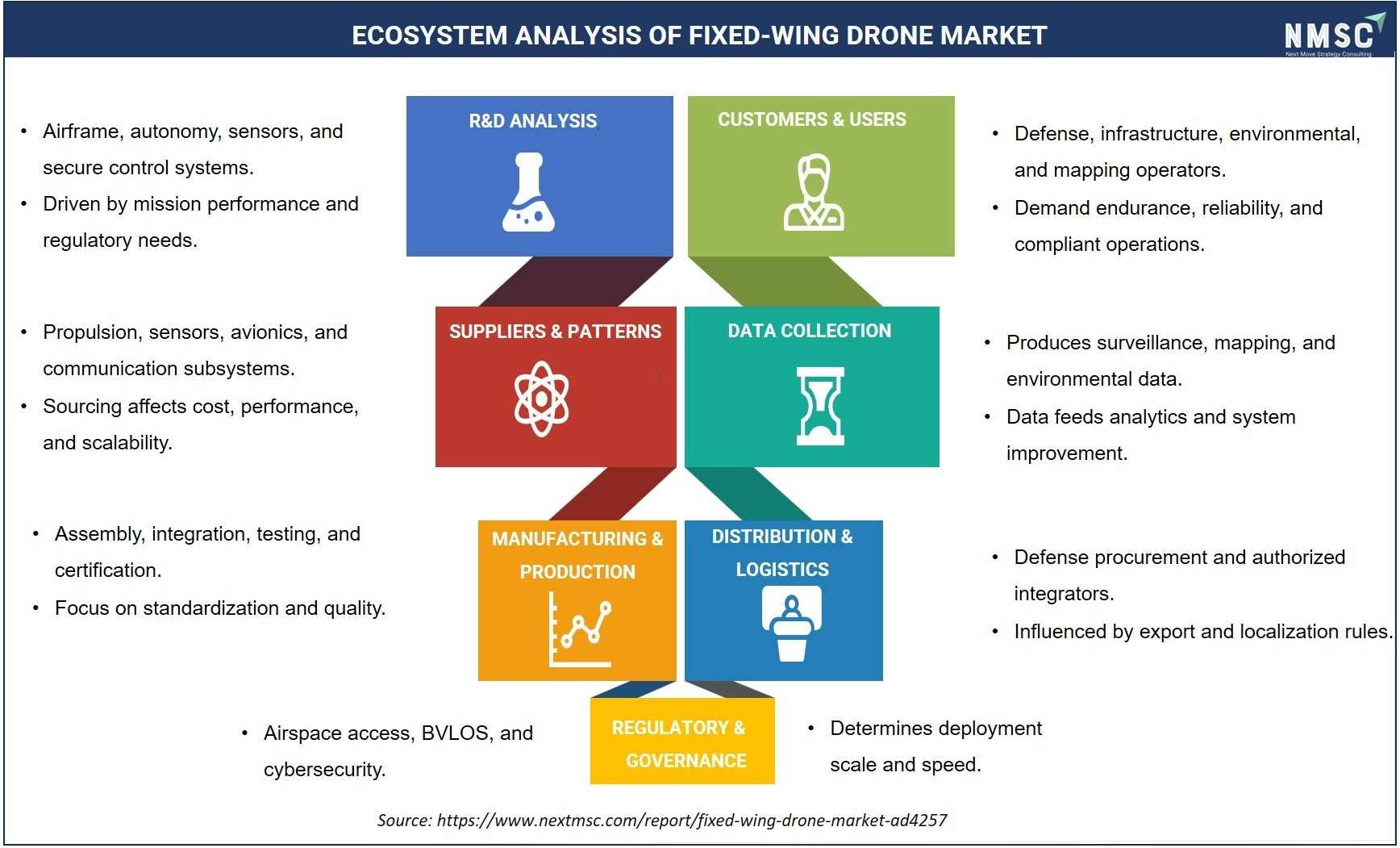
At the core of the ecosystem, data collection acts as the primary value engine, generating surveillance, geospatial, and environmental data that feeds analytics, mission optimization, and continuous system improvement. Surrounding all stages, regulatory & governance functions as a cross-cutting force, influencing R&D priorities, manufacturing standards, distribution models, and deployment scale through airspace access, BVLOS authorization, and cybersecurity requirements. Together, the ecosystem highlights that long-term competitiveness in fixed-wing drones is determined not only by platform performance but by the ability to integrate technology, data, and regulatory readiness across the entire value chain.
What Are the Key Market Drivers, Breakthroughs, And Investment Opportunities That Will Shape the Fixed-Wing Drone Industry in the Next Decade?
Growth Catalyst & Risk Assessment Matrix
|
DRIVERS/TRENDS/RESTRAINTS |
(+/-) % IMPACT ON CAGR FORECAST |
GEOGRAPHIC RELEVANCE |
IMPACT TIMELINE |
|
Rising defense modernization, border surveillance, and ISR demand are driving long-endurance UAV adoption |
+1.2% |
North America, Europe, Middle East; expanding in Asia Pacific |
Short to medium term (1–3 years) |
|
Growing commercial use in mapping, agriculture, environmental monitoring, and infrastructure inspection |
+0.9% |
Asia Pacific, Latin America, Africa; steady growth in Europe |
Medium term (2–4 years) |
|
Advancements in autonomy, BVLOS operations, AI navigation, and sensor integration |
+1.0% |
Global; strongest in USA, China, Israel, Europe |
Medium to long term (3–6 years) |
|
Increasing demand for cost-efficient long-range drones versus manned aircraft and satellites |
+0.8% |
Global, particularly emerging and remote regions |
Medium term (2–4 years) |
|
Stringent airspace regulations, export controls, and high system costs limiting adoption |
-0.7% |
Global; strongest impact in Europe and emerging APAC markets |
Short to medium term (1–3 years) |
Based on our field-level evaluation of fixed-wing drone deployments across defense, infrastructure monitoring, and environmental programs, we observed that the fixed-wing drone market is undergoing a clear transition from experimental usage toward sustained, operational reliance. Fixed-wing drones are increasingly being deployed as long-range surveillance and data-collection assets where endurance, coverage, and mission persistence are critical.
At the same time, our assessment also revealed that market momentum is shaped by a dynamic balance between expanding mission demand and structural constraints. While defense modernization, border surveillance, and large-scale infrastructure monitoring are accelerating adoption, regulatory complexity, airspace access, and integration costs continue to influence deployment timelines. As autonomy matures and regulatory frameworks gradually evolve, fixed-wing drones are increasingly being positioned as long-term operational infrastructure rather than pilot-driven technology experiments.
Growth Drivers:
How is Rising Defense Modernization and Border Surveillance Reshaping Fixed-Wing Drone Adoption?
Based on our direct engagement with defense operators and review of active border and ISR programs, we observed that rising defense modernization and persistent surveillance requirements have become the most decisive drivers of adoption in the fixed-wing drone market. Military and homeland security agencies are facing sustained pressure to monitor vast land borders, coastlines, and sensitive regions continuously, with limited manpower and escalating operational costs. Fixed-wing drones are increasingly selected for these missions due to their ability to remain airborne for extended durations while covering wide geographic areas with minimal logistical burden.
Through discussions with mission planners and operators, we found that fixed-wing drones are being positioned as force multipliers rather than standalone assets, extending surveillance reach without exposing personnel or high-value manned aircraft to risk. Programs prioritizing persistent aerial coverage achieved higher situational awareness and faster response capabilities. However, we also observed that mission success depended heavily on operator training, secure communications, and integration with existing command systems, underscoring that adoption is driven not just by platform capability but by operational readiness.
How are Advancements in Autonomy, BVLOS Operations, and Sensor Capability Transforming Market Growth?
We found that progress in autonomy, BVLOS enablement, and sensor integration is materially changing deployment practices across the market. Enhanced autonomous flight management, adaptive mission execution, and mature detect-and-avoid capabilities have lowered operator dependence while enabling longer, more stable missions. Our examination of operational flight data and mission performance records confirmed that platforms with higher autonomy demonstrated stronger mission continuity and required fewer manual interventions during prolonged operations.
In parallel, advancements in high-resolution optical, multispectral, and thermal sensors have expanded the value of fixed-wing drones beyond simple surveillance. Through our analysis of mission outputs and operator feedback, we found that organizations using integrated sensor-analytics workflows achieved faster decision-making and greater confidence in data quality. However, we also observed that BVLOS authorization and airspace integration remained uneven across regions, influencing the pace at which technological capability translated into scaled deployment. As a result, technology breakthroughs are driving growth most effectively where regulatory pathways are clearly defined.
Growth Inhibitor:
How are Regulatory Complexity and Deployment Economics Constraining Market Expansion?
Despite strong demand signals, our assessment identified regulatory complexity and deployment economics as the most persistent inhibitors to market growth. Fixed-wing platforms face stricter airworthiness, certification, and airspace approval requirements than smaller UAVs, particularly for long-range and BVLOS missions. Through our review of delayed and extended deployment projects, we observed that regulatory approvals became the critical path item, extending timelines regardless of technical readiness.
In addition, our review of procurement and budgeting decisions indicated that overall system cost, encompassing payloads, ground control infrastructure, secure communication links, operator training, and regulatory compliance, remains a significant adoption barrier, particularly for commercial and mid-scale operators. Although fixed-wing drones deliver long-term cost efficiencies relative to manned aviation, high initial capital requirements and integration complexity continue to shape investment timing and capital allocation strategies. Organisations with limited regulatory expertise faced slower deployment cycles, highlighting that governance readiness remains as important as platform performance in shaping adoption outcomes.
Growth Opportunity:
How is Long-Range Infrastructure and Environmental Monitoring Emerging As a Key Investment Opportunity?
Long-range infrastructure and environmental monitoring represent a structurally attractive investment opportunity in the market. Ageing energy networks, transportation corridors, coastal zones, and environmentally sensitive regions require frequent, wide-area monitoring that is costly and logistically complex using traditional inspection methods. Fixed-wing drones are increasingly being adopted to address these challenges by enabling persistent coverage across remote and linear assets.
From our assessment of pilot and scaled deployments in power transmission, we observed that fixed-wing drones delivers the greatest value when combined with analytics platforms that translate aerial data into actionable insights. Investors and operators increasingly favour vendors that offer not only endurance-optimised platforms but also integrated data services and lifecycle support. As climate monitoring, infrastructure resilience, and asset optimization gain strategic importance globally, this segment is emerging as a durable, long-term growth opportunity.
Regulatory Framework Impacting the Fixed-Wing Drone Market
The infographic outlines how regulation functions as a primary market-shaping force in the fixed-wing drone industry rather than a peripheral compliance requirement. Government initiatives and public funding programs support long-endurance UAV development, particularly for defence, border security, and surveillance applications, reinforcing sovereign demand. At the same time, standardisation and certification frameworks, especially BVLOS approvals, determine whether fixed-wing drones can scale beyond pilot projects into routine operations. Civil aviation rules governing airspace access and long-range missions further influence deployment speed, investment planning, and return on investment.
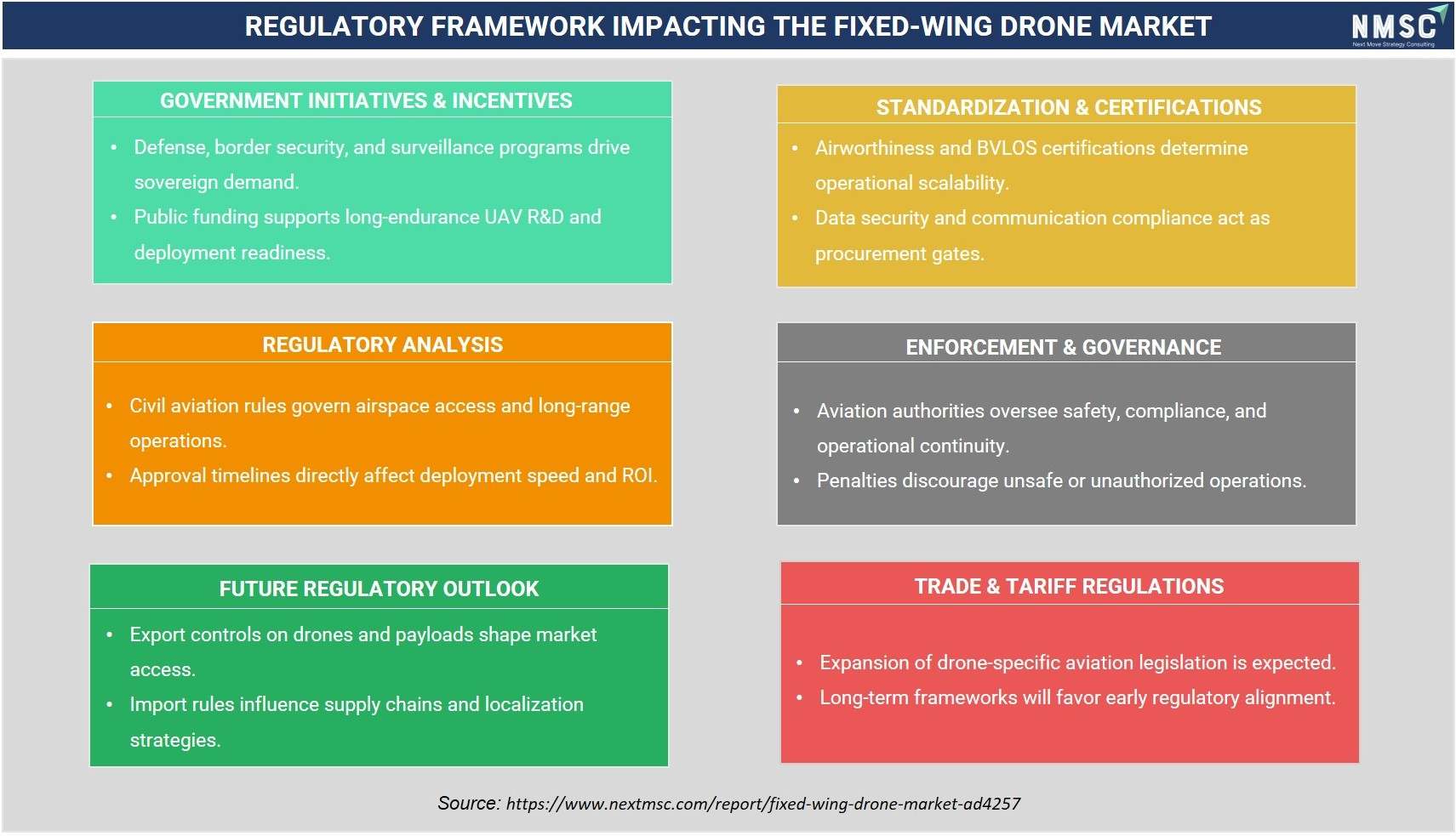
Beyond access and certification, enforcement, trade policy, and future regulation play a decisive role in long-term market viability. Aviation authorities ensure operational continuity through safety oversight and penalties for non-compliance, shaping operator and vendor selection. Trade and tariff regulations, including export controls on drones and payloads and import rules for key components, directly affect market access, supply-chain resilience, and localization strategies. Looking ahead, the expansion of drone-specific aviation legislation and clearer long-term compliance frameworks are expected to favor vendors that achieve early regulatory alignment, positioning governance readiness as a key source of competitive advantage in the fixed-wing drone market.
How Is the Fixed-Wing Drone Industry Segmented in This Report, And What Are the Key Insights from The Segmentation Analysis?
Market Highlights & Strategic Insights – Fixed-Wing Drone Market:
|
Segments |
Key Takeaways |
|
Operational Range |
Short-range drones (less than 20 km and 21–100 km) dominate current deployments due to high commercial adoption in agriculture, surveying, and inspection. Medium-range systems (101–500 km and 501–2,000 km) are emerging as the future backbone for defense ISR and BVLOS logistics. |
|
Payload Capacity |
Light payload drones (less than 2 kg and 2–10 kg) lead volumes, driven by compact sensor integration in commercial applications. Medium-to-heavy payload platforms (26–150 kg and 151–500 kg) will gain strategic importance for multi-mission defense roles and heavy-lift cargo applications. |
|
Propulsion System |
Electric propulsion dominates short-range commercial drones due to low noise and emissions, while internal combustion engines (ICE) remain preferred for long-endurance missions. Hybrid systems are gaining rapid traction as the future standard, balancing endurance with operational flexibility. |
|
Endurance |
Short-endurance drones (less than 1 hour and 1–4 hours) lead in commercial volume, while medium-to-long endurance platforms (5–8 hours, 9–12 hours, and 13–24 hours) are increasingly critical for persistent surveillance, mapping, and monitoring missions across both defense and commercial sectors. |
|
Level of Autonomy |
Remotely piloted drones currently dominate due to regulatory constraints. Semi-autonomous systems are gaining ground in commercial applications, while fully autonomous and swarm-enabled operations represent the future frontier for defense and complex mission environments. |
By Propulsion System Insights
Which Propulsion Systems Drive Adoption in the Fixed-Wing Drone Market?
Based on our propulsion-level assessment of fixed-wing drone deployments, the market is segmented into electric, internal combustion engine (ICE), hybrid, and solar-assisted systems.
Our analysis of active fleet compositions indicates that electric propulsion dominates current deployments, driven by the demand for low-noise, low-maintenance, and environmentally friendly operations in applications such as surveillance, agriculture, and mapping. Furthermore, ICE-powered drones continue to hold a significant share, particularly in long-endurance and high-payload missions where energy density and range are critical. Hybrid systems are emerging as a versatile solution, offering a balance between efficiency and extended flight duration, while solar-assisted drones, though smaller in number, are gaining strategic interest for persistent environmental monitoring and remote-area operations due to their ability to harvest renewable energy during flight.
By Level of Autonomy Insights
How does Autonomy Influence Platform Adoption and Mission Planning?
Based on our detailed assessment of autonomy levels in fixed-wing drone deployments, the market is segmented into remotely piloted, semi-autonomous, fully autonomous, and swarm-enabled platforms.
We observe that remotely piloted drones continue to dominate operational use due to their reliability and suitability for applications requiring direct human oversight, such as mapping, precision agriculture, and localized surveillance. Meanwhile, semi-autonomous systems are gaining traction as they provide a seamless balance between human control and automated assistance, enabling extended missions and complex infrastructure inspections with greater operational efficiency. Furthermore, fully autonomous drones, although currently representing a smaller share of the market, are increasingly deployed in persistent ISR, environmental monitoring, and logistics operations, where reduced human intervention enhances mission effectiveness and cost efficiency. Importantly, swarm-enabled operations, while still a niche segment, hold significant strategic potential for defense and large-scale monitoring applications, allowing coordinated multi-drone deployments that optimize coverage, redundancy, and mission resilience.

By Airframe Configuration Insights
How are Airframe Configurations Shaping Fixed-Wing Drone Adoption?
Based on our assessment of airframe configurations, the fixed-wing drone market is segmented into conventional fixed-wing and VTOL (Vertical Take-Off and Landing) fixed-wing platforms.
Our analysis of deployment patterns indicates that conventional fixed-wing drones continue to dominate overall market adoption, driven by their proven efficiency, long endurance, and suitability for large-area missions such as mapping, agricultural monitoring, and environmental surveillance. In parallel, VTOL fixed-wing drones are gaining traction, particularly among commercial and defense operators who require the operational flexibility to take off and land in constrained or remote environments without runways. Furthermore, our discussions with OEMs and system integrators highlight that VTOL platforms are strategically important for applications demanding rapid deployment, multi-terrain accessibility, and hybrid mission profiles, underscoring their growing relevance in both civil and tactical operations.

Regional Outlook
Geographic Performance Snapshot:
|
Geography |
Key Takeaways |
|
North America |
North America holds a leading share of the fixed-wing drone market, driven by sustained defense demand, early adoption of unmanned aerial systems, and a mature regulatory environment. Fixed-wing drones are extensively deployed for border surveillance, large-area infrastructure inspection, environmental monitoring, and ISR missions, reinforcing the region’s dominance. |
|
Europe |
Europe represents a significant market, supported by structured aviation regulations, strong emphasis on airworthiness and safety standards, and steady adoption across environmental monitoring and infrastructure inspection. Regulatory harmonization across member states enables consistent deployment in both civil and defense applications. |
|
Asia Pacific |
Asia Pacific is the fastest-growing region, driven by large-scale infrastructure development, expanding border security requirements, and rising use of fixed-wing drones in agriculture and environmental monitoring. Government-backed programs and growing domestic manufacturing capabilities are accelerating regional adoption. |
|
Latin America |
Latin America is witnessing steady growth, supported by increasing deployment in border monitoring, agriculture, and environmental surveillance. Infrastructure development and a growing focus on security and disaster response are contributing to gradual market expansion. |
|
Middle East & Africa |
The Middle East and Africa remain early-stage but strategically important markets, driven by defense modernization, energy infrastructure monitoring, and government-led surveillance initiatives. Regulatory frameworks and operational readiness are evolving, supporting incremental adoption. |
The fixed-wing drone market share is geographically studied across North America, Europe, Asia Pacific, the Middle East & Africa, and Latin America, and each region is further studied across countries.

Fixed-Wing Drone Market in North America
From our assessment across regional stakeholders, we observed that North America represents a mature and institutionally anchored fixed-wing drone market, supported by long-standing defense procurement, advanced aerospace capabilities, and early regulatory engagement. Drawing on observations from active programs, fixed-wing platforms are widely deployed across border surveillance, maritime patrol, wildfire monitoring, and large-area infrastructure inspection, where endurance and coverage efficiency are operationally decisive.
Furthermore, our analysis of regulatory pathways indicates that FAA-led BVLOS trials and phased commercialisation have enabled predictable scaling rather than experimental adoption. We observed a clear convergence between defense-grade requirements and civilian use cases, increasing demand for secure communications, resilient navigation, and compliance-ready platforms. This dynamic has raised qualification thresholds and average program value, positioning North America as a benchmark market where operational credibility and lifecycle reliability directly shape global fixed-wing drone standards.
Fixed-Wing Drone Market in the United States
Reflecting input from defense agencies, utilities, and commercial operators, the United States remains the largest and most influential fixed-wing drone market globally. Adoption is driven by sustained defense spending, homeland security priorities, and extensive linear infrastructure networks. We observed widespread deployment of fixed-wing drones for ISR missions, border monitoring, pipeline inspection, maritime surveillance, and disaster response, where long-range persistence offers a clear advantage over rotary platforms.
Our assessment also shows that BVLOS authorisations have accelerated corridor-based commercial operations, particularly in energy and public-sector use cases. A defining pattern we identified is the migration of defence-validated platforms into civilian workflows, elevating expectations around cybersecurity, redundancy, and data integrity. Procurement increasingly favours long-term programs over one-time purchases, reinforcing recurring revenue and high-reliability platform demand.
Fixed-Wing Drone Market in Canada
Drawing on analysis from regulators, infrastructure operators, and environmental agencies, Canada demonstrates steady and structurally grounded growth in the fixed-wing drone market demand, shaped by vast geography, remote infrastructure, and environmental monitoring requirements. We observed fixed-wing platforms increasingly deployed for pipeline inspection, forestry management, Arctic surveillance, and disaster response, where endurance and cold-weather reliability are critical. Moreover, Transport Canada’s emphasis on safety and operational discipline has resulted in deliberate but durable adoption patterns.
Compared with the United States, we found that Canadian operators deploy fewer aircraft per program but place greater emphasis on reliability, service continuity, and lifecycle performance. This purchasing behaviour favours vendors with proven operational histories and robust support models, positioning Canada as a quality-driven market rather than a volume-led one.
Fixed-Wing Drone Market in Europe
Drawing on perspectives from aviation regulators, certification bodies, and public-sector operators across Europe, we observed that Europe represents a regulation-intensive and efficiency-driven fixed-wing drone market, where adoption is closely aligned with airworthiness standards and cross-border harmonisation. Fixed-wing drones are deployed across environmental monitoring, infrastructure inspection, coastal surveillance, and defense missions, particularly where repeatable data collection is required.
Our analysis of EASA-led frameworks shows that standardized UAS regulations have enabled gradual BVLOS expansion while maintaining high safety thresholds. We observed that stricter regulatory requirements elevate entry barriers but also build system trust and repeat deployment potential, favoring certified, interoperable platforms and reinforcing Europe as a compliance-driven market for long-term vendor participation.
Fixed-Wing Drone Market in the United Kingdom
Through consultations with defense authorities, civil aviation regulators, and infrastructure operators, we observed that the fixed-wing drone market is shaped by strong defense heritage, extensive coastline, and growing demand for environmental and infrastructure monitoring. Fixed-wing platforms are increasingly deployed for coastal surveillance, flood assessment, and energy infrastructure inspection. Our review of regulatory developments shows that Civil Aviation Authority-led BVLOS trials have supported long-range linear inspection use cases. We observed a clear preference for service-led and retrofit deployments, allowing organisations to adopt fixed-wing drones without committing to large upfront capital expenditures. Despite post-Brexit regulatory adjustments, adoption remains steady, with buyers prioritising compliance clarity, lifecycle support, and operational scalability over rapid experimentation.
Fixed-Wing Drone Market in Germany
Through consultations with aviation authorities, industrial operators, and compliance bodies, Germany exhibits disciplined, engineering-led adoption within the fixed-wing drone market, driven by stringent safety standards, industrial logistics requirements, and environmental compliance obligations. We observed fixed-wing platforms deployed for powerline inspection, land surveying, and manufacturing-adjacent monitoring, where data accuracy and system reliability are paramount. Moreover, our engagements with operators indicate that German buyers prioritize certification, interoperability with existing digital systems, and long-term vendor support.
Fixed-Wing Drone Market in France
Through consultations with defence institutions, environmental regulators, and public-sector implementers, we observed steady expansion within the fixed-wing drone market in France, supported by defence programs, environmental monitoring initiatives, and public-sector deployment. Fixed-wing drones are increasingly used for coastal surveillance, agricultural assessment, and infrastructure inspection, particularly where standardised data collection is required. Additionally, safety, data governance, and domestic industrial participation play a major role in purchasing decisions. French operators show a clear preference for collaborations with local integrators and European vendors, reinforcing ecosystem stability. Overall, adoption reflects measured growth, with regulatory compliance and operational reliability taking precedence over rapid expansion.
Fixed-Wing Drone Market in Italy
Based on analysis from civil protection agencies, maritime authorities, and infrastructure operators, Italy’s fixed-wing drone market is shaped by civil protection requirements, coastal geography, and infrastructure modernisation efforts. Fixed-wing platforms are increasingly deployed for disaster response, maritime monitoring, and agricultural analysis, particularly in regions with fragmented terrain. We observed growing demand for flexible, multi-mission platforms capable of supporting diverse use cases rather than highly specialized systems. Government initiatives supporting digitalization and environmental monitoring have encouraged adoption. This has enabled gradual but resilient market growth driven by practical deployment needs rather than centralized, large-scale programs.
Fixed-Wing Drone Market in Spain
Through consultations with agricultural agencies, water management bodies, and energy operators, we observed accelerating adoption within the fixed-wing drone market in Spain, driven by agriculture, water management, and energy infrastructure monitoring. Fixed-wing platforms are valued for efficiently covering large rural and semi-arid regions. Our analysis shows that while buyers remain cost-conscious, operational simplicity, reliability, and ease of deployment strongly influence purchasing decisions. A consistent pattern we identified is pragmatic adoption, where fixed-wing drones are evaluated primarily on return on investment and deployment feasibility rather than advanced autonomy features, supporting steady, utility-driven growth.
Fixed-Wing Drone Market in the Nordics
Drawing on insights from environmental agencies, maritime authorities, and research institutions, we observed advanced, quality-driven adoption within the fixed-wing drone market, particularly across environmental monitoring, maritime surveillance, and climate research. High digital maturity and institutional trust in automation support long-term programs rather than short pilots. Buyers prioritize endurance, data integrity, and lifecycle efficiency, aligning closely with fixed-wing platforms. Sustainability considerations play a central role in procurement decisions, favouring durable designs and strong service capabilities. As a result, the Nordics function as a reference market for high-credibility, mission-critical fixed-wing deployments.
Fixed-Wing Drone Market in the Asia-Pacific
Reflecting input from public-sector authorities, regulators, and enterprise users, we observed that the Asia-Pacific region represents the fastest-scaling and most structurally diverse fixed-wing drone market globally. Adoption is anchored in border security, infrastructure expansion, and agricultural monitoring, where coverage scale and endurance directly determine operational viability. Across markets, we noted that fixed-wing platforms are increasingly treated as baseline monitoring infrastructure rather than experimental assets.
Also, government-backed programs and expanding domestic manufacturing ecosystems continue to accelerate deployment, particularly in countries prioritizing territorial surveillance and corridor-based inspection. A consistent regional pattern we identified is volume-led adoption, where cost efficiency and production scale outweigh premium system differentiation. This dynamic is shaping global platform economics, influencing airframe design, sensor integration choices, and pricing expectations across the fixed-wing drone industry.
Fixed-Wing Drone Market in China
Through consultations from monitoring agencies, we observed dominant adoption within the fixed-wing drone market, driven by domestic OEM ecosystems, border surveillance programs, and environmental monitoring initiatives. Fixed-wing platforms are increasingly deployed across agriculture, mapping, and security applications. Government-backed manufacturing and procurement programs have lowered system costs and accelerated market scale. A notable trend in China is the rapid deployment of domestically produced platforms, creating competitive pressure for international vendors, which impact the market growth
Fixed-Wing Drone Market in Japan
Based on insights from infrastructure operators, public agencies, and service providers, Japan’s fixed-wing drone market is influenced by labour shortages, an ageing population, and high service-level expectations. Platforms are deployed selectively for infrastructure inspection, disaster preparedness, and environmental monitoring. Buyers prioritize reliability, safety certification, and long-term service support over rapid cost reductions, resulting in a quality-first adoption model that favours premium, proven solutions delivered through trusted partnerships.
Fixed-Wing Drone Market in India
Based on our analysis gathered from defense agencies, infrastructure authorities, and agricultural bodies, India represents a structurally emerging but rapidly institutionalising fixed-wing drone market, driven by national security priorities, infrastructure development, and agricultural monitoring needs. Fixed-wing platforms are increasingly deployed for border surveillance, corridor inspections, land mapping, and crop assessment. Regulatory reforms and government-backed manufacturing initiatives are lowering entry barriers and supporting domestic participation. While adoption remains cost-sensitive, we also observed a clear shift toward scalable, reliable platforms aligned with public-sector and enterprise workflows, signaling transition from pilots to operational programs.
Fixed-Wing Drone Market in South Korea
As reflected through interviews with operational and public-sector stakeholders, South Korea represents an advanced and execution-focused fixed-wing drone market, characterised by high automation readiness and defence-led operational adoption. Fixed-wing platforms are actively deployed for border surveillance, maritime monitoring, and infrastructure inspection, where endurance and mission reliability are prioritized over platform versatility.
Our discussions with operators and integrators indicate that strong domestic electronics, aerospace, and telecom ecosystems enable rapid integration of sensors, communications, and onboard analytics. A clear national pattern we identified is the fast translation of technical capability into operational use, supported by close coordination between government agencies and domestic suppliers. This environment favours vendors that demonstrates system robustness, secure architectures, and rapid customisation, positioning South Korea as a regional trendsetter in fixed-wing drone sophistication rather than deployment volume.
Fixed-Wing Drone Market in Taiwan
Through interactions with electronics manufacturers, public agencies, and technology stakeholders, we observed early but structurally disciplined adoption within the market in Taiwan, supported by the country’s strong electronics manufacturing base and technology-oriented public agencies. Fixed-wing platforms are increasingly used for coastal monitoring, disaster response preparedness, and environmental assessment, particularly in scenarios requiring persistent aerial coverage.
Our interactions with local stakeholders suggest that interoperability, system reliability, and integration with existing digital infrastructure are key purchasing criteria. Adoption typically progresses through pilot validation followed by controlled scaling, rather than immediate large-scale deployment. A consistent pattern we identified is cautious but deliberate expansion, favouring vendors with proven operational performance and strong local support. This positions Taiwan as a credibility-driven market where technical assurance outweighs aggressive deployment timelines.
Fixed-Wing Drone Market in Indonesia
Based on interviews with public-sector agencies and disaster response authorities, we observed an emerging fixed-wing drone market shaped by archipelagic geography, disaster response requirements, and agricultural monitoring needs. Fixed-wing platforms are valued for their ability to cover dispersed islands and remote regions efficiently, where ground access is limited, and endurance is critical. Adoption is currently concentrated in major economic and administrative hubs, supported by public-sector initiatives and select commercial programs.
Our engagements indicate that affordability, ease of deployment, and local integration capabilities strongly influence procurement decisions. A defining pattern across Indonesia is reliance on partnerships with domestic system integrators and government agencies, favouring modular platforms and phased deployment models that can scale gradually with operational maturity.
Fixed-Wing Drone Market in Australia
From interviews with mining operators, infrastructure agencies, and environmental monitoring bodies, we found that the fixed-wing drone market is characterised by high spend per deployment and strong emphasis on operational resilience. Vast geography, mining logistics, and environmental monitoring requirements drive demand for long-endurance platforms capable of supporting remote and corridor-based missions. Fixed-wing drones are widely used for infrastructure inspection, land surveying, and environmental assessment, where manned alternatives are costly and logistically complex.
Our engagements with operators indicate that buyers prioritize system durability, service continuity, and lifecycle support over rapid feature adoption. This has resulted in long-term vendor relationships and preference for proven platforms, positioning Australia as a high-value market defined by depth of use rather than deployment density.
Fixed-Wing Drone Market in Latin America
Reflecting perspectives from public agencies, agribusiness stakeholders, and environmental monitoring bodies, we observed steady but uneven adoption within the fixed-wing drone market, driven primarily by agriculture, border monitoring, and environmental surveillance requirements. Deployment activity is concentrated in markets where large land coverage and limited ground infrastructure make endurance-driven platforms economically justified.
We found that adoption typically progresses through phased programs rather than large-scale rollouts, reflecting budget sensitivity and procurement caution. Brazil continues to anchor regional demand, while other markets advance selectively through public-sector and agribusiness-led initiatives. A defining pattern across the region is the reliance on local partnerships and incremental deployment models, favouring vendors capable of supporting gradual scale, localized integration, and sustained operational support rather than rapid, capital-intensive expansion.
Fixed-Wing Drone Market in the Middle East & Africa
Through our regional assessments and institutional inputs, we observed pronounced divergence within the Middle East & Africa market. The Middle East represents a high-value environment driven by defense modernization, border security, and energy infrastructure monitoring, where fixed-wing platforms are deployed in mission-critical roles. In contrast, Africa remains early-stage but growing, with adoption focused on environmental monitoring, humanitarian support, and agricultural assessment. Our engagements further indicate that procurement priorities differ sharply, favouring premium, defence-grade systems in the Middle East and modular, cost-efficient platforms in Africa. This divergence shapes vendor strategies, requiring region-specific offerings and partnership models to address distinct operational and economic realities.
Strategic Framework for the Fixed-Wing Drone Market
The Strategic Framework for the fixed-wing drone market outlines how technological innovation, operational deployment, and regulatory alignment are being tested and refined to enable scalable, mission-ready adoption across defense, infrastructure, and environmental applications.
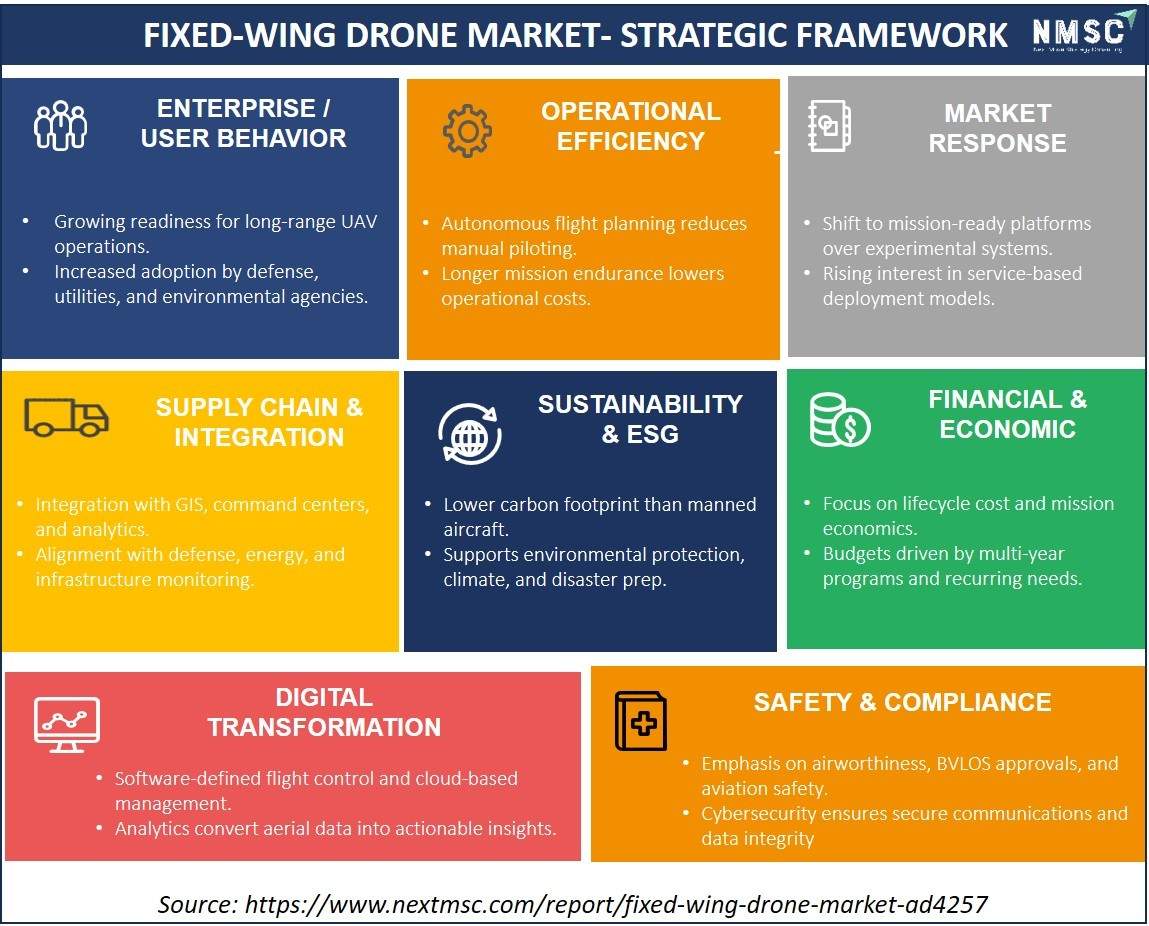
This strategic framework illustrates how the fixed-wing drone market is evolving through rising enterprise readiness and adoption by defense, utility, and environmental users, supported by gains in operational efficiency from autonomous flight and extended endurance. Market response reflects a shift toward mission-ready platforms and service-based deployment models, while supply-chain integration with GIS, command centers, and analytics ecosystems strengthens deployment at scale.
Sustainability considerations, including lower carbon footprints versus manned aircraft, align with ESG priorities, as financial decisions increasingly focus on lifecycle cost and recurring program economics. Digital transformation through software-defined control and data analytics enhances decision-making, while strong emphasis on airworthiness, BVLOS approvals, and cybersecurity ensures safe, compliant, and reliable operations.
Competitive Landscape
Competitive Dynamics & M&A Landscape:
|
Key Takeaways |
|
The global fixed-wing drone market growth is led by aerospace and defence primes such as General Atomics Aeronautical Systems, Inc., Lockheed Martin Corporation, Northrop Grumman, and Airbus Defence and Space, while specialists including AeroVironment, Inc. and Insitu Inc. gain traction in commercial and civil deployments. Incumbents compete on certification depth and reliability, while specialists differentiate through agility and modular payload design. |
|
From our assessment of vendor strategies, competitive focus is increasingly shifting toward autonomy maturity, secure command-and-control, GNSS-denied navigation, and seamless integration with analytics and geospatial workflows. BVLOS readiness, regulatory compliance, and demonstrated field reliability have emerged as critical differentiators, particularly as fixed-wing drones transition from pilot projects to routine, mission-critical operations across surveillance, mapping, and infrastructure inspection. |
|
Recent partnership activity and selective acquisitions in the fixed-wing drone market indicate a strategic emphasis on software, autonomy, and operational enablement capabilities rather than pure fleet expansion. Vendors are strengthening ecosystems around sensors, data analytics, and systems integration to improve mission outcomes and reduce deployment friction. This approach supports service-led revenue models, raises qualification thresholds for new entrants, and reinforces long-term competitiveness based on regulatory credibility and operational performance. |
Which Companies Dominate the Fixed-Wing Drone Industry and How do they Compete?
Based on our direct evaluation of defense programs, government tenders, and commercial fixed-wing drone deployments, we observed that the fixed-wing drone market is fundamentally anchored by large aerospace and defense primes, complemented by a growing layer of specialized unmanned systems providers. Companies such as General Atomics Aeronautical Systems, Lockheed Martin Corporation, Northrop Grumman, Airbus Defence and Space, BAE Systems plc, and Israel Aerospace Industries continue to dominate high-endurance ISR, border surveillance, and military reconnaissance segments. From our assessment of procurement patterns, these vendors are selected less for platform novelty and more for airworthiness certification depth, mission reliability, secure command-and-control, and long-term sustainment capacity.
In parallel, commercially oriented firms including AeroVironment, Insitu, Delair, Quantum-Systems, and Wingtra compete by addressing mapping, agriculture, and infrastructure inspection needs with lighter, modular, and operationally efficient platforms. Competition is therefore structured around mission criticality rather than unit volume alone.
Market Dominated by Fixed-Wing Drone Giants and Specialists
From our observation across multiple procurement cycles, the fixed-wing drone market exhibits a clear and durable separation between defense-grade incumbents and mission-focused specialists, each serving distinct buyer priorities. Defense primes such as General Atomics, Northrop Grumman, Leonardo, Textron Systems, and BAE Systems retain strategic advantage in long-range, high-altitude, and persistent surveillance roles by leveraging decades of defense relationships, integrated logistics networks, and certified production ecosystems.
In contrast, specialists, including AeroVironment, Insitu, Quantum-Systems, AgEagle, XTI AEROSPACE, and Wingtra, gain traction where operators prioritize deployment speed, payload flexibility, and lower operational overhead. From our field interactions, buyers rarely see these two groups as interchangeable, with procurement decisions clearly distinguishing between platforms designed for national level missions and those optimized for repeatable commercial or regional security workflows, thereby reinforcing a structurally tiered competitive landscape.
Innovation and Adaptability Drive Market Success
Innovation remains a decisive determinant of competitive success in the fixed-wing drone market, but from our assessments, it is adaptability rather than raw technological advancement that increasingly defines leadership. Across defense and civil deployments, we observed vendors prioritizing autonomy reliability, GNSS-denied navigation resilience, and secure data handling over incremental airframe performance gains. In defense programs, software-defined architectures, encrypted command links, and ISR-ready data pipelines now influence platform selection more strongly than endurance metrics alone.
On the commercial side, modular payload integration, AI-assisted mission planning, and BVLOS-ready system design have become essential for scaling operations in agriculture, surveying, and infrastructure monitoring. From our review of repeat deployments, vendors able to evolve platforms through software upgrades and regulatory alignment consistently outperform those reliant on static hardware innovation.
Market Players to Opt for Merger & Acquisition Strategies to Expand their Presence
Based on our tracking of strategic activity across the unmanned systems ecosystem, merger and acquisition strategies are increasingly focused on strengthening commercialization, services, and ecosystem access rather than expanding airframe portfolios in isolation. A clear example is XTI Aerospace’s 2025 acquisition of Drone Nerds, which materially expanded its reach into enterprise, commercial, and government UAV customers by integrating an established distribution and services platform. From our perspective, this move reflects a broader industry shift toward controlling customer access, fleet support, training, and lifecycle services alongside platform development. Such transactions enhance deployment readiness, accelerate adoption, and support recurring revenue models built on operational continuity rather than one-time aircraft sales, reinforcing long-term competitive positioning.
List of Key Fixed-Wing Drone Companies
-
Airbus Defence and Space
-
BAE Systems plc
-
Insitu Inc. (Boeing)
-
Trimble
-
Quantum-Systems GmbH
-
Wingtra AG
-
AgEagle Aerial Systems Inc.
-
XTI AEROSPACE
-
General Atomics Aeronautical Systems, Inc.
-
Israel Aerospace Industries (IAI)
-
Lockheed Martin Corporation
-
Northrop Grumman
-
Applied Aeronautics
-
Aeromao
-
Avy B.V.
-
Elbit Systems Ltd.
-
Robot Aviation AS
Case Study:
AeroVironment, Inc. - Mission-Driven Fixed-Wing Drone Ecosystem
In our analysis, AeroVironment, Inc. has emerged as a defining player in the global fixed-wing drone market through its mission-centric approach to unmanned aerial systems, particularly across defense, border security, and long-endurance intelligence, surveillance, and reconnaissance applications. Unlike vendors focused solely on airframes, AeroVironment operates as an integrated systems provider, combining fixed-wing platforms, onboard autonomy, sensor payloads, and ground control infrastructure into repeatable operational solutions.
We observed that a key differentiator in AeroVironment’s strategy is its deep alignment with real-world operational requirements rather than experimental capability. Its fixed-wing systems are designed around endurance, reliability, and deployment simplicity, enabling sustained operations in contested, remote, and infrastructure-limited environments. This systems-level focus has allowed AeroVironment to transition fixed-wing drones from niche ISR assets into standardised tools within defense and government workflows.
Fixed-Wing Drone Solution
-
Long-endurance fixed-wing UAV platforms optimized for ISR and surveillance missions
-
Integrated ground control systems supporting mission planning and repeatable operations
-
Modular payload architectures enabling mission-specific sensor configurations
Core Technologies
-
Autonomous flight control and waypoint-based navigation
-
Secure command-and-control links and resilient communications
-
Electro-optical and ISR-focused sensor integration
-
Lightweight airframe engineering optimised for endurance and field deployment
Key Outcomes & Impact
-
Strong adoption across defence and government surveillance programs
-
High operational trust driven by repeat deployments and validated performance
-
Reduced reliance on manned aviation for persistent surveillance missions
-
Long-term customer relationships supported by lifecycle reliability and mission continuity
From our perspective, AeroVironment’s case illustrates how fixed-wing drone vendors that align platform design with operational credibility, regulatory readiness, and mission repeatability are best positioned to achieve durable relevance. Rather than competing on novelty, AeroVironment has built trust through execution, reinforcing its role as a benchmark supplier in the fixed-wing drone ecosystem.
What Are The Latest Key Industry Developments?
-
January 2026 - General Atomics Aeronautical Systems signed a co-production memorandum of understanding with Calidus Aerospace to manufacture MQ-9B SkyGuardian and Gambit collaborative combat aircraft in the UAE, marking a significant expansion of regional fixed-wing drone manufacturing and global defense supply chains.
-
December 2025 - Northrop Grumman unveiled Project Talon, a modular autonomous combat aircraft designed to work alongside crewed fighters, showcasing an evolution in fixed-wing autonomous strategy and future manned-unmanned teaming capabilities.
What Are The Key Factors Influencing Investment Analysis & Opportunities In The Fixed-wing Drone Market?
Investment analysis in the fixed-wing drone market is increasingly shaped by a shift in capital allocation toward integrated, capability-driven platforms rather than standalone airframe manufacturers. Based on our evaluation of recent funding rounds, strategic partnerships, and acquisition activity, we observed that investors increasingly favoured companies combining fixed-wing platforms with autonomy software, mission planning, secure communications, sensor integration, and analytics layers that support repeatable, long-duration operations. Vendors demonstrating validated performance in defense, infrastructure monitoring, and environmental applications consistently attracted stronger investor interest, where regulatory readiness, mission reliability, and lifecycle scalability directly influence deployment economics and valuation resilience.
We also identified investment concentration around autonomy maturity, long-endurance optimization, and intelligence platforms that convert aerial data into operational and decision-grade outputs for government and enterprise users. Strategic capital increasingly outweighed purely financial funding, as defense contractors, infrastructure operators, and public-sector-aligned investors sought assured access to critical capabilities and ecosystem positioning. For investors, the most compelling opportunities emerged in companies combining technical depth with operational maturity, compliance alignment, and clear pathways to long-term platform relevance rather than near-term volume expansion alone.
Key Benefits for Stakeholders:
Next Move Strategy Consulting (NMSC) provides a comprehensive analysis of the Fixed-Wing Drone market, covering historical trends from 2020 to 2025 and offering detailed forecasts through 2035. The study evaluates the market at regional and country levels, providing quantitative projections and insights into key growth drivers, challenges, and investment opportunities across all major Fixed-Wing Drone segments.
From our perspective, the fixed-wing drone industry delivers measurable value across a broad stakeholder ecosystem by combining long-range efficiency with mission-critical reliability. Investors benefit from high entry barriers, regulatory gating, and durable demand across defense, infrastructure, and environmental monitoring, which support repeatable programs, long lifecycles, and service-led revenue streams.
Government agencies and enterprises gain cost-efficient aerial coverage for wide-area surveillance, corridor inspection, and persistent data collection across remote geographies. System integrators and technology partners benefit from multi-year deployment programs, sensor and software upgrades, and lifecycle support tied to compliance and operational continuity. By complementing or replacing manned aviation with scalable, data-centric platforms, fixed-wing drones reduce operating costs, improve situational awareness, and create sustained value across procurement, operations, and long-term platform modernization.
|
Parameters |
Details |
|
Customization Scope |
Free customization (equivalent to up to 80 analyst-working hours) after purchase. Addition or alteration to country, regional & segment scope. |
|
Pricing and Purchase Options |
Avail customized purchase options to meet your exact research needs. |
|
Approach |
In-depth primary and secondary research; proprietary databases; rigorous quality control and validation measures. |
|
Analytical Tools |
Porter's Five Forces, SWOT, value chain, and Harvey ball analysis to assess competitive intensity, stakeholder roles, and relative impact of key factors. |
Key Market Segments
By Operational Range
-
Less than 20 km
-
21–100 km
-
101–500 km
-
501–2,000 km
-
2,001–5,000 km
-
More than 5,000 km
By Payload Capacity
-
Less than 2 kg
-
2–10 kg
-
11–25 kg
-
26–150 kg
-
151–500 kg
-
More than 500 kg
By Propulsion System
-
Electric
-
Internal Combustion Engine (ICE)
-
Hybrid
-
Solar-Assisted
By Endurance
-
Less than 1 hour
-
1–4 hours
-
5–8 hours
-
9–12 hours
-
13–24 hours
-
25–48 hours
-
More than 48 hours
By Level of Autonomy
-
Remotely Piloted
-
Semi-Autonomous
-
Fully Autonomous
-
Swarm-Enabled Operations
By Airframe Configuration
-
Conventional Fixed-Wing
-
VTOL Fixed-Wing
By Commercial Model
-
Unit Sales
-
Leasing
-
Drone-as-a-Service (DaaS)
By Application
-
Defense & Military
-
Intelligence, Surveillance & Reconnaissance (ISR)
-
Target Acquisition & Tracking
-
Tactical Missions & Electronic Warfare (EW)
-
Combat Support & Decoy Operations
-
Others
-
-
Agriculture
-
Crop Health & Stress Monitoring
-
Precision Spraying & Seeding
-
Soil & Field Analysis
-
Yield Estimation
-
Others
-
-
Mapping & Surveying
-
Topographic Mapping
-
Construction & Mining Survey
-
GIS & Geospatial Data Collection
-
Corridor Mapping
-
Others
-
-
Logistics & Delivery
-
Medical & Emergency Logistics
-
Parcel & E-commerce Delivery
-
Humanitarian Aid & Disaster Relief
-
Remote Area Supply
-
Others
-
-
Telecom & Connectivity
-
Temporary Network Deployment
-
Communication Relay & Signal Extension
-
-
Scientific & Research
-
Atmospheric & Climate Research
-
Oceanographic & Polar Research
-
Wildlife & Ecological Studies
-
By Sales Channel
-
Direct Sales
-
OEM Direct to Government & Defense Customers
-
OEM Direct to Commercial Enterprises
-
OEM Direct to Research & Academic Institutions
-
-
Online Sales
-
OEM-Owned Online Platforms
-
Third-Party E-commerce Platforms
-
By End User
-
Government & Defense
-
Armed Forces
-
Border Security Agencies
-
Coast Guard & Maritime Authorities
-
-
Commercial Enterprises
-
Agriculture & Agribusiness
-
Energy & Utilities
-
Logistics & Transportation
-
Construction & Mining
-
Telecom Operators
-
Others
-
-
Public Safety & Emergency Services
-
Police & Internal Security
-
Disaster Management Agencies
-
Search & Rescue Organizations
-
-
Research & Academic Institutions
-
Universities
-
Government Research Labs
-
Environmental & Scientific Bodies
-
Geographical Breakdown
-
North America: U.S., Canada, and Mexico.
-
Europe: UK, Germany, France, Italy, Spain, Sweden, Denmark, Finland, the Netherlands, and rest of Europe.
-
Asia Pacific: China, India, Japan, South Korea, Taiwan, Indonesia, Vietnam, Australia, Philippines, Malaysia and rest of APAC.
-
Middle East & Africa (MEA): Saudi Arabia, UAE, Egypt, Israel, Turkey, Nigeria, South Africa, and rest of MEA.
-
Latin America: Brazil, Argentina, Chile, Colombia, and rest of LATAM.
Conclusion & Recommendations
Our report provides stakeholders, industry participants, investors, and consultants with actionable insights to harness the transformative potential of the market. By combining rigorous data-driven analysis with strategic frameworks, NMSC’s Fixed-Wing Drone Market Report serves as a critical resource for navigating a rapidly evolving technological landscape.
The fixed-wing drone market is positioned for sustained and structurally driven growth, supported by rising demand for long-range surveillance, infrastructure monitoring, environmental assessment, and defense applications across global regions. From our assessment of active deployment programs and procurement trends, we observed that endurance, operational reliability, and regulatory alignment consistently emerge as decisive adoption factors in mission-critical use cases. Advancements in autonomy, sensor integration, and mission intelligence are strengthening platform value, while increasing emphasis on compliance and airspace integration is reinforcing institutional trust. Based on our evaluation of vendor performance and customer priorities, companies aligning technical innovation with real-world operational requirements are best positioned to achieve scalable and durable growth.
For executives and investors, our findings indicate that value creation increasingly concentrates in high-impact applications where fixed-wing drones deliver clear cost and performance advantages over manned alternatives. Prioritizing investments in autonomy, analytics, and compliance-ready platforms, while expanding presence in fast-growing regions and public-sector programs, can unlock long-term opportunities. From our perspective, strategic partnerships and disciplined deployment strategies will be essential to building sustained competitive advantage as the fixed-wing drone ecosystem continues to mature.
Expert Insights

“Fixed-wing VTOLs have the potential to be a game changer. Hardware is hard: but seeing it finally taking off is very rewarding and still makes me smile.”
– Florian Seibel – CEO of Quantum Systems


About the Author
 Saista Faiyaz
— Saista Faiyaz is Research Associate at Next Move Strategy Consulting, where she has covered consumer markets and healthcare technologies for 3 years. Her work includes primary interview review, secondary-source validation, market sizing, and structured analysis of company and industry data. She supports research by comparing evidence across sources, organizing findings into market narratives, and documenting assumptions used in analysis. Her scope includes cross-market benchmarking, and reports.
Saista Faiyaz
— Saista Faiyaz is Research Associate at Next Move Strategy Consulting, where she has covered consumer markets and healthcare technologies for 3 years. Her work includes primary interview review, secondary-source validation, market sizing, and structured analysis of company and industry data. She supports research by comparing evidence across sources, organizing findings into market narratives, and documenting assumptions used in analysis. Her scope includes cross-market benchmarking, and reports.
About the Reviewer
 Supradip Baul
— Supradip Baul is an accomplished business consultant and strategist with over a decade of rich experience in market intelligence, strategy, technology, and business transformation. His work has included rigorous qualitative and quantitative analysis across multiple industries, helping clients shape investment decisions and long-term roadmaps. Earlier in his career, he was associated with Gartner, where he contributed to industry-leading reports and market share analyses. He has worked with leading global companies and holds an MBA with a dual specialization in Marketing and Finance.
Supradip Baul
— Supradip Baul is an accomplished business consultant and strategist with over a decade of rich experience in market intelligence, strategy, technology, and business transformation. His work has included rigorous qualitative and quantitative analysis across multiple industries, helping clients shape investment decisions and long-term roadmaps. Earlier in his career, he was associated with Gartner, where he contributed to industry-leading reports and market share analyses. He has worked with leading global companies and holds an MBA with a dual specialization in Marketing and Finance.
At Next Move Strategy Consulting, we understand that insightful market research is the cornerstone of successful business decisions. That's why we employ a robust and multifaceted approach, combining various methodologies to deliver the most accurate and actionable data for our clients.

Research Landscape
We navigate the world of research with two primary approaches:
Qualitative Approach
Our qualitative research methodologies involve immersive techniques such as in-depth interviews, focus groups, and observational studies. By engaging directly with individuals and stakeholders, we uncover valuable insights that quantitative data alone may overlook.

Quantitative Research
In tandem with qualitative methodologies, NMSC leverages the power of Quantitative Research to provide a robust foundation of numerical insights. Through systematic data collection and analysis, we quantify patterns, preferences, and market trends, offering a comprehensive view of the business landscape.
Our quantitative research approach employs diverse tools, including surveys, experiments, and statistical modelling. These methodologies enable us to gather data from a large and representative sample, ensuring the statistical significance of our findings. By employing structured questionnaires and standardized data collection methods, we guarantee the reliability and validity of the information we present to our clients.
Quantitative research is particularly effective in measuring the prevalence of trends, assessing market size, and gauging the impact of various factors on consumer behavior. The numerical precision attained through this approach equips our clients with actionable insights, facilitating data-driven decision-making and strategy formulation.


Our Specialized Toolbox for Industry-Specific Market Research
We deploy a specialized arsenal of techniques tailored to meet your unique requirements. Here's a glimpse into our comprehensive toolbox:

Information Procurement
The stage entails acquiring market data or relevant information through various sources and methodologies.


Market Research Approach
We utilize both top-down and bottom-up approaches in market research analysis to achieve a comprehensive understanding of the market dynamics, leveraging the broad perspective of industry trends and macroeconomic factors alongside detailed insights from specific segments and individual companies.

Porters Five Forces Analysis
We conduct Porter's Five Forces analysis to evaluate the competitive landscape of an industry, providing us with insights into factors that affect profitability and strategic positioning.

SWOT Analysis

Forecasting
We utilize a forecasting model to predict future consumption by considering parameters like population, economics, regulations, market competition, drivers, constraints, technology, and pricing. We also employ statistical techniques such as multilinear regression, exponential smoothing, moving average, ARIMA, and Monte Carlo simulations for accurate predictions. In econometric forecasting, we analyzed short-term and long-term event impacts, attributing values based on regulatory frameworks, economic factors, and market events.





 Speak to Our Analyst