Dynamic Data Grid Managers Software Market

Dynamic data grid managers software market size was USD 1.40 billion in 2025, projected to reach USD 4.80 billion by 2035 at a 13.2% CAGR from 2026–2035, per this report.

Download Free Sample PDF
Base Year (2025)
$1.40 Billion
Forecast (2035)
$4.80 Billion
CAGR (2026-2035)
13.2%
Top Region
North America

What Is the Dynamic Data Grid Managers Software Market Size?

The global dynamic data grid managers software market size was valued at USD 1.40 billion in 2025 and is estimated at USD 1.58 billion in 2026, forecast to reach USD 4.80 billion by 2035, expanding at a 13.2% CAGR between 2026 and 2035. North America leads with approximately 42% share, while Web and JavaScript Frameworks dominate all other platform segments with approximately 46% share.

We observed that growth is broad-based across every segmentation axis, with AI-enabled grid interaction and healthcare sector adoption driving the dominant structural shifts through 2035.

Dynamic Data Grid Managers Software Market Revenue Forecast

Values in USD Billion

2025 $1.40 Billion
2025
2026 $1.58 Billion
2026
2027 $1.79 Billion
2027
2028 $2.03 Billion
2028
2029 $2.30 Billion
2029
2030 $2.60 Billion
2030
2031 $2.95 Billion
2031
2032 $3.33 Billion
2032
2033 $3.77 Billion
2033
2034 $4.27 Billion
2034
2035 $4.80 Billion
2035

Key Takeaways

By Platform: Web and JavaScript Frameworks held the largest share of approximately 46% (USD 0.64 billion) in 2025; Mobile Frameworks is the fastest-growing sub-segment at 16.0% CAGR from 2026–2035.

By License Type: Commercial License held the largest share of the license type category in 2025; Open Source Commercial Support is the fastest-growing sub-segment through 2035 on rising enterprise adoption of dual-licensed grid libraries.

By Grid Type: Enterprise Data Grid held the largest share of approximately 42% (USD 0.59 billion) in 2025; Pivot Grid is the fastest-growing sub-segment at 17.5% CAGR from 2026–2035.

By Deployment Mode: On-Premise held the largest share of the deployment mode category in 2025; Cloud is the fastest-growing sub-segment through 2035 on accelerating cloud-native application development.

By Organization Size: Large Enterprises held the largest share of the organization size category in 2025; SMEs is the fastest-growing sub-segment through 2035 on expanding low-cost and community-licensed grid adoption.

By End User Industry: BFSI held the largest share of approximately 30% (USD 0.42 billion) in 2025; Healthcare is the fastest-growing sub-segment at 17.5% CAGR from 2026–2035.

Dominant Region: North America dominated with approximately 42% revenue share (USD 0.59 billion) in 2025.

Fastest-Growing Region: Asia-Pacific is expected to register the highest CAGR of 17.4% during 2026–2035.

Dominant Country: U.S. led with approximately USD 0.48 billion in 2025.

Fastest-Growing Country: India is the fastest-growing country at approximately 21.8% CAGR from 2026–2035.

Market Opportunity: The dynamic data grid managers software market is expected to create an absolute dollar opportunity of USD 3.22 billion between 2026 and 2035, presenting significant investment potential across the enterprise application, cloud-native development, and AI-assisted UI tooling value chain.

According to Next Move Strategy Consulting analysis, component vendors are increasingly embedding natural-language and AI-agent interaction layers directly into grid controls rather than treating AI as a separate add-on tool, a shift that favors vendors with integrated AI coding assistants and prompt-driven data manipulation over component libraries offering only conventional sort, filter, and export functionality as enterprise development teams adopt AI-assisted workflows through 2035.

What Does the Dynamic Data Grid Managers Software Market Encompass?

The dynamic data grid managers software market encompasses UI component libraries and controls that render, sort, filter, group, and edit large tabular datasets within web, .NET, mobile, and desktop applications, forming a foundational building-block layer within the broader low-code application platform ecosystem. Our assessment indicates that the scope spans standard, enterprise, pivot, and spreadsheet-style grid types supplied under commercial, open source, and freemium licensing models to SMEs and large enterprises across BFSI, IT and software, healthcare, and government end markets. The category has evolved from static tabular display controls into dynamic, virtualized, and increasingly AI-interactive data management components.
Regulatory frameworks have limited direct influence on this market, though data accessibility standards and enterprise software procurement requirements shape adoption timelines across regulated industries such as BFSI and healthcare. We observed that technology adoption is shifting toward AI-enabled grids that combine natural-language prompting, semantic search, and agentic UI generation with conventional sorting, filtering, and grouping capabilities. Next Move Strategy Consulting's analysis indicates that this structural shift, combined with rising cloud-native and mobile application development, is redefining vendor selection criteria across the dynamic data grid managers software market.

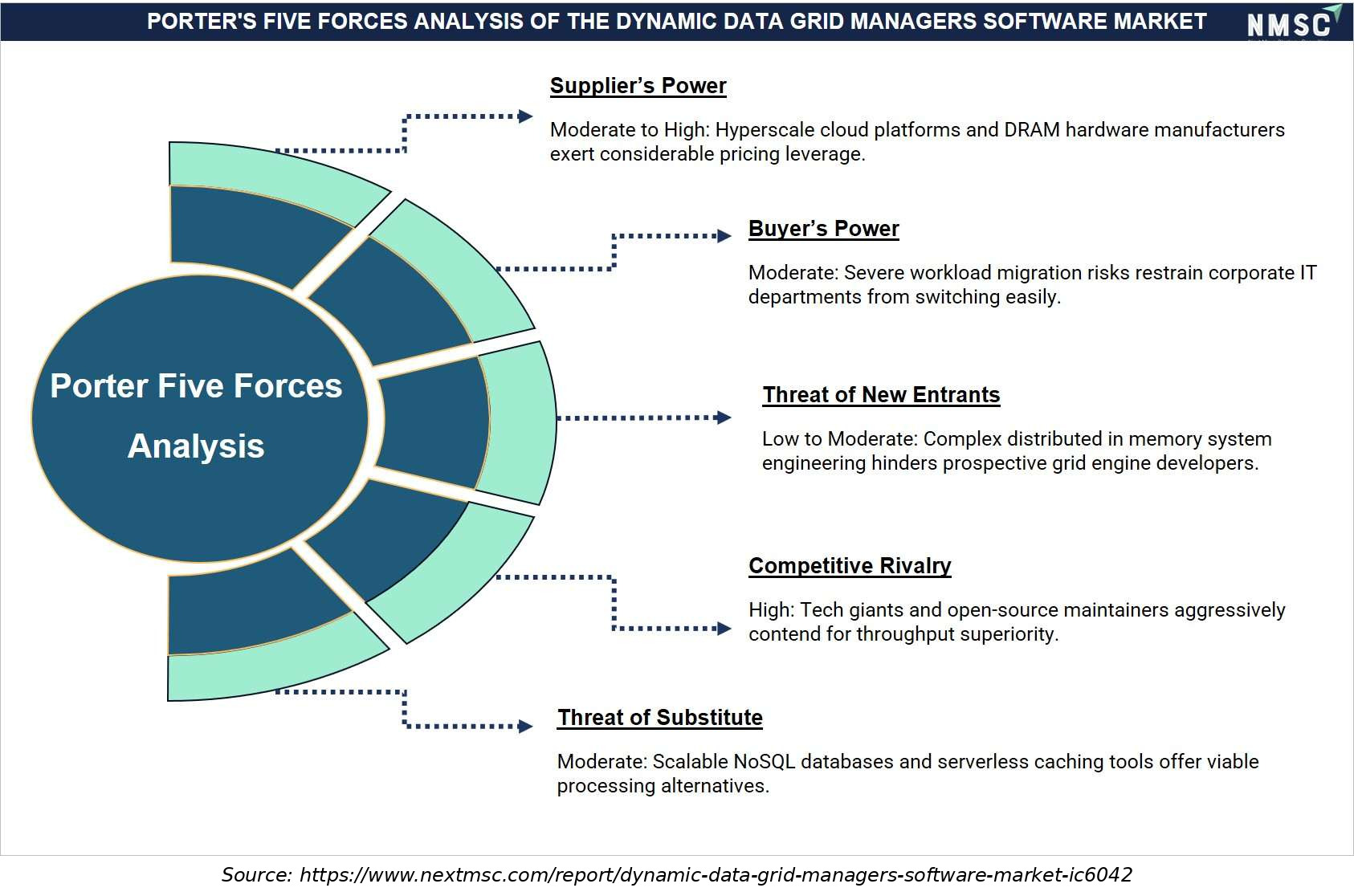
Porter's Five Forces Analysis of the Dynamic Data Grid Managers Software Market

The Porter’s Five Forces analysis of the Dynamic Data Grid Managers Software Market evaluates the competitive intensity and long-term attractiveness of the industry. It examines supplier bargaining power, buyer bargaining power, the threat of new entrants, the threat of substitute technologies, and competitive rivalry among existing vendors. The framework helps stakeholders understand market dynamics, competitive positioning, and strategic opportunities influencing growth and innovation.

Market Drivers & Dynamics

Interactive Dataset
Rising enterprise adoption of AI-assisted development tooling driver +2.6% North America, Europe 2026–2035
Expanding cloud-native and mobile application development driver +2.2% Asia-Pacific, North America 2026–2035
Growing BFSI and healthcare data-intensive dashboard demand driver +1.8% Global 2026–2035
Increasing agentic AI code generation adoption among development teams driver +1.5% North America, Europe 2026–2033
Rising Asia-Pacific software development outsourcing and IT investment driver +1.9% Asia-Pacific 2027–2035
Expanding cross-framework component parity requirements driver +1.1% Global 2026–2033
Open source and freemium alternatives limiting commercial license pricing power restraint −1.3% Global 2026–2035
Framework fragmentation increasing vendor development and support costs restraint −0.8% Global 2026–2032
Slow legacy enterprise application modernization cycles restraint −0.5% Europe, North America 2026–2035
Source: Next Move Strategy Consulting

Growth Drivers

What Is the Primary Growth Driver of the Dynamic Data Grid Managers Software Market?

Rising enterprise adoption of AI-assisted development tooling is the primary driver of the market. Progress Software's December 2025 introduction of its Agentic UI Generator, capable of producing fully styled, enterprise-grade page layouts including data grids from natural language prompts, illustrates the scale of AI integration entering the category. We observed that this structural shift, reinforced by expanding cloud-native and mobile application development, continues to anchor baseline demand for Web and JavaScript Frameworks and Enterprise Data Grid segments.

How Is Agentic AI Code Generation Driving Dynamic Data Grid Managers Software Market Growth?

Agentic AI code generation is accelerating market growth toward integrated, AI-native component platforms. Progress Software's February 2026 Q1 release, which combined natural-language prompting, keyword search, and semantic search into a single AI-enabled DataGrid experience, illustrates the pace of innovation entering the market. Our assessment indicates that this shift, combined with twelve new component-level AI coding assistants introduced in December 2025, is compressing development cycles and increasing the strategic value of AI-integrated grid components.

Growth Inhibitors

What Is Restraining Dynamic Data Grid Managers Software Market Expansion?

Open source and freemium alternatives restrain commercial license pricing power as development teams increasingly evaluate no-cost grid libraries before purchasing commercial suites. Framework fragmentation across React, Angular, Vue, Blazor, and other ecosystems further increases vendor development and support costs. We found that this pricing and fragmentation pressure is concentrating commercial differentiation around AI-native features and enterprise support, areas where open source alternatives have historically lagged.

Segmentation Analysis

2025 (USD Billion)
2035 (USD Billion)
Web and JavaScript Frameworks 2025: $0.64 Billion | 2035: $2.40 Billion
Web and Java
.NET Frameworks 2025: $0.45 Billion | 2035: $1.25 Billion
.NET Framewo
Mobile Frameworks 2025: $0.20 Billion | 2035: $0.86 Billion
Mobile Frame
Desktop Frameworks 2025: $0.11 Billion | 2035: $0.29 Billion
Desktop Fram
Web and JavaScript Frameworks $0.64 Billion $2.40 Billion 14.3%
.NET Frameworks $0.45 Billion $1.25 Billion 10.5%
Mobile Frameworks $0.20 Billion $0.86 Billion 16.0%
Desktop Frameworks $0.11 Billion $0.29 Billion 9.9%

Which Platform Segment Dominates the Dynamic Data Grid Managers Software Market?

Web and JavaScript Frameworks led the market with USD 0.64 billion in 2025, supported by the dominant position of web application development across enterprise software portfolios. We observed that Mobile Frameworks is the fastest-growing platform segment, expanding at a 16.0% CAGR from 2026 to 2035, as enterprises increasingly demand data-dense grid functionality within native and cross-platform mobile applications for field service, sales, and operational reporting use cases.

2025 (USD Billion)
2035 (USD Billion)
Commercial L
Open-Source
Freemium
Segment Item 2025 (USD Billion) 2035 (USD Billion) CAGR
Commercial License $10.0 USD Billion $40.0 USD Billion 25.0%
Open-Source Commercial Support $17.1 USD Billion $51.1 USD Billion 11.0%
Freemium $24.2 USD Billion $62.2 USD Billion 25.0%

Segment-wise data is locked

Unlock complete segment-wise numbers for By License Type.

Unlock Full Data
2025 (USD Billion)
2035 (USD Billion)
Enterprise D
Standard Dat
Spreadsheet
Pivot Grid
Segment Item 2025 (USD Billion) 2035 (USD Billion) CAGR
Enterprise Data Grid $10.0 USD Billion $40.0 USD Billion 27.0%
Standard Data Grid $17.1 USD Billion $51.1 USD Billion 9.0%
Spreadsheet Style Grid $24.2 USD Billion $62.2 USD Billion 19.0%
Pivot Grid $31.3 USD Billion $73.3 USD Billion 17.0%

Segment-wise data is locked

Unlock complete segment-wise numbers for By Grid Type.

Unlock Full Data

Which Grid Type Leads Dynamic Data Grid Managers Software Market Demand?

Enterprise Data Grid remained the leading grid type within the market, valued at USD 0.59 billion in 2025 given sustained demand for advanced grouping, virtualization, and multi-column filtering in data-intensive business applications. Our findings suggest that Pivot Grid is the fastest-growing grid type, registering a 17.5% CAGR from 2026 to 2035, as BFSI and healthcare organizations increasingly embed OLAP-style summarization and cross-tabulation capability directly within operational dashboards.

2025 (USD Billion)
2035 (USD Billion)
Cloud
On-Premise
Segment Item 2025 (USD Billion) 2035 (USD Billion) CAGR
Cloud $10.0 USD Billion $40.0 USD Billion 14.0%
On-Premise $17.1 USD Billion $51.1 USD Billion 24.0%

Segment-wise data is locked

Unlock complete segment-wise numbers for By Deployment Mode.

Unlock Full Data
2025 (USD Billion)
2035 (USD Billion)
SMEs
Large Enterp
Segment Item 2025 (USD Billion) 2035 (USD Billion) CAGR
SMEs $10.0 USD Billion $40.0 USD Billion 24.0%
Large Enterprises $17.1 USD Billion $51.1 USD Billion 22.0%

Segment-wise data is locked

Unlock complete segment-wise numbers for By Organization Size.

Unlock Full Data
2025 (USD Billion)
2035 (USD Billion)
BFSI
IT and Softw
Retail and E
Healthcare
Government a
Segment Item 2025 (USD Billion) 2035 (USD Billion) CAGR
BFSI $10.0 USD Billion $40.0 USD Billion 23.0%
IT and Software $17.1 USD Billion $51.1 USD Billion 9.0%
Retail and E-commerce $24.2 USD Billion $62.2 USD Billion 19.0%
Healthcare $31.3 USD Billion $73.3 USD Billion 13.0%
Government and Public Sector $38.4 USD Billion $84.4 USD Billion 10.0%

Segment-wise data is locked

Unlock complete segment-wise numbers for By End User Industry.

Unlock Full Data

Which End User Industry Leads Dynamic Data Grid Managers Software Adoption?

BFSI remained the leading end user industry within the market, valued at USD 0.42 billion in 2025 given sustained demand for high-density trading, risk, and account management dashboards. Our analysis shows that Healthcare is the fastest-growing end user industry, registering a 17.5% CAGR from 2026 to 2035, as electronic health record and clinical operations platforms increasingly embed data grid components to manage patient, scheduling, and billing datasets at scale.

Growth Opportunities

Our analysis shows that three forward-looking opportunities stand out for stakeholders positioning within the dynamic data grid managers software market over the 2026–2035 forecast period.

How Can AI-Native Grid Interaction Unlock Value for Component Vendors?

AI-native grid interaction presents a whitespace opportunity for component vendors seeking premium licensing revenue from enterprise development teams. Vendors that replicate Progress Software's natural-language and semantic search DataGrid model stand to capture differentiated pricing as enterprises increasingly evaluate AI capability depth alongside conventional sorting and filtering functionality when selecting commercial grid libraries.

Where Does Healthcare Data Management Create New Revenue for Enterprise Grid Vendors?

Healthcare technology platforms represent an underpenetrated opportunity for enterprise-grade grid vendors as electronic health record and clinical operations software modernizes legacy interfaces. Vendors that develop validated, compliance-aware grid components optimized for large patient and clinical datasets can secure long-term licensing agreements with healthcare software providers pursuing improved data density and usability.

How Can Cross-Framework Component Suites Benefit Vendors Serving Multi-Stack Enterprises?

Enterprises standardizing on multiple frontend frameworks represent an underpenetrated opportunity for vendors offering unified, cross-framework component suites. Vendors that deliver consistent grid functionality and AI capability across Blazor, React, Angular, and Vue simultaneously can differentiate with large enterprises seeking to avoid framework lock-in while maintaining consistent AI-assisted development experiences across their application portfolio.

Regional Outlook

2025 (USD Billion)
2035 (USD Billion)
North Americ
Europe
Asia-Pacific
Latin Americ
Middle East
Region 2025 (USD Billion) 2035 (USD Billion) CAGR (%)
North America $10.0 USD Billion $40.0 USD Billion 9.0%
Europe $17.1 USD Billion $51.1 USD Billion 27.0%
Asia-Pacific $24.2 USD Billion $62.2 USD Billion 25.0%
Latin America $31.3 USD Billion $73.3 USD Billion 23.0%
Middle East & Africa $38.4 USD Billion $84.4 USD Billion 12.0%

Regional data is locked

Unlock complete regional numbers for this market.

Unlock Full Data

Competitive Landscape

We observed that the dynamic data grid managers software market features a moderately consolidated competitive landscape, with diversified UI component suite majors competing alongside specialized grid-focused vendors on AI capability depth and framework coverage. Key Takeaways

Dimension Description
Market Structure Moderately consolidated; the top companies profiled in this report collectively account for a majority of global dynamic data grid managers software market revenue, while numerous specialized vendors serve niche pivot grid and spreadsheet-style grid demand.
Innovation Focus AI-enabled natural-language grid interaction, agentic UI generation, and cross-framework component parity dominate current innovation pipelines across leading vendors.
M&A Activity Selective portfolio consolidation, exemplified by GrapeCity's rebrand and integration under MESCIUS inc., combining ComponentOne, Wijmo, and SpreadJS into a unified enterprise component portfolio.

How Do Companies Compete in the Dynamic Data Grid Managers Software Market?

Companies compete primarily on AI capability depth, framework coverage breadth, and performance optimization across the industry. Diversified suite vendors such as Progress Software and Syncfusion leverage broad, multi-component portfolios spanning grids, charts, and schedulers to serve enterprise development teams, while specialized vendors such as AG Grid and Handsoncode compete on deep, purpose-built grid performance and virtualization capability for data-intensive applications.

Which Competitive Archetypes Dominate the Dynamic Data Grid Managers Software Market?

Two archetypes dominate the market: diversified UI component suite vendors offering broad, multi-control portfolios, and specialized grid-focused vendors concentrated exclusively on data grid performance and functionality. Progress Software and Syncfusion exemplify the diversified archetype through combined grid, chart, and scheduler suites, while AG Grid and Handsoncode exemplify the specialist archetype through deep, purpose-built grid and spreadsheet-style engineering.

How Are Companies Differentiating Through Innovation in Dynamic Data Grid Managers Software?

Innovation and differentiation strategy increasingly center on AI-native interaction and agentic code generation. Progress Software's December 2025 Agentic UI Generator and February 2026 AI-enabled DataGrid, combining natural-language prompting with semantic search, illustrate how leading vendors differentiate through integrated AI capability. Our analysis shows that vendors unable to demonstrate AI-assisted development tooling risk exclusion from enterprise procurement shortlists increasingly weighted toward AI-native development platforms.

What M&A and Expansion Activity Is Shaping the Dynamic Data Grid Managers Software Market?

Portfolio consolidation and AI feature expansion continue to shape competitive positioning within the industry more than large-scale acquisition activity. MESCIUS inc.'s integration of ComponentOne, Wijmo, and SpreadJS under a unified brand illustrates how vendors are consolidating previously separate component lines to present unified enterprise portfolios, while Progress Software continues to expand its AI-native feature set across successive quarterly Telerik and Kendo UI releases.

Key Market Players

Our assessment indicates that the following 17 companies are actively shaping component innovation, AI capability development, and framework coverage within the global dynamic data grid managers software market.

Progress Software Corporation (Telerik, Kendo UI) Developer Express Inc. (DevExpress) Syncfusion, Inc. AG Grid Ltd. Infragistics, Inc. MESCIUS inc. Idera, Inc. (Sencha Ext JS) Vaadin Ltd. PrimeTek Informatics Xceed Software Inc. Handsoncode sp. z o.o. (Handsontable) Bryntum AB DHTMLX Ltd XB Software Ltd (Webix) Radzen Ltd. Flexmonster LLC jQWidgets Ltd

Latest Developments

We found that recent developments within the dynamic data grid managers software market are concentrated on AI capability expansion across successive product releases, reflecting the industry's shift toward AI-native component design.

Date Event
June 2025 Progress Software announced the Q2 2025 release of Telerik and Kendo UI, introducing AI Coding Assistants for Blazor and KendoReact, AI-powered theme generation, GenAI-powered Reporting Insights, and performance-optimized Data Grids. The release was designed to enhance developer productivity and provide faster, more responsive data handling, including for applications working with significant amounts of data. These enhancements are relevant to the Dynamic Data Grid Managers Software Market.

Expert Insights

Mark Lockareff

President & CEO | GridGain

"The data infrastructure and data analytics markets are experiencing explosive growth, driven by the increasing demand for real-time insights, as well as the rise of AI and cloud computing."

Analyst Interpretation

The statement underscores the rapid expansion of enterprise data infrastructure driven by artificial intelligence, cloud computing, and the need for real-time analytics. As organizations increasingly require low-latency access to distributed data, Dynamic Data Grid Managers Software is becoming a critical technology for enabling scalable in-memory data processing, distributed caching, and real-time analytics across cloud-native and hybrid IT environments. This trend is accelerating adoption of dynamic data grid platforms in industries such as banking, retail, telecommunications, manufacturing, and healthcare.

Investment Opportunities

What Capital Inflows Are Targeting the Dynamic Data Grid Managers Software Market?

Capital inflows into the dynamic data grid managers software market are increasingly directed toward AI feature development and agentic tooling capability. Progress Software's successive 2025 and 2026 AI-focused Telerik and Kendo UI releases illustrate the scale of investment committed to AI-native component development. We observed that investors favor vendors demonstrating consistent AI feature delivery cadence, viewing release velocity as a proxy for long-term enterprise development team retention.

How Is Infrastructure Investment Supporting Dynamic Data Grid Managers Software Development?

Infrastructure investment is expanding AI model integration and cloud-based development tooling to support rising demand for AI-assisted grid interaction. Progress Software's February 2026 semantic search and natural-language DataGrid capability exemplifies the scale of infrastructure investment entering the market. Our findings suggest that vendors are investing in performance-optimized virtualization and AI inference infrastructure to support both conventional and AI-driven grid interaction across North America, Europe, and Asia-Pacific.

What ESG Considerations Are Shaping Dynamic Data Grid Managers Software Investment Decisions?

Governance considerations are increasingly relevant to investment decisions across the industry, with accessibility compliance and responsible AI feature design as key criteria. Progress Software's continued investment in accessibility improvements alongside its AI-generated UI capabilities illustrates how vendors are balancing innovation with inclusive design requirements. We found that investors increasingly favor vendors demonstrating accessibility-compliant, transparent AI feature design, treating it as a governance indicator alongside conventional software quality metrics.

Key Benefits for Stakeholders

How Does This Report Benefit Enterprise and Industry Leaders?

Enterprise and industry leaders gain access to validated segmentation, competitive benchmarking, and regional demand forecasts that support sourcing and platform-selection decisions across the dynamic data grid managers software industry. Our analysis shows that detailed platform, grid type, and end-user industry breakdowns help procurement teams align specifications with development and integration requirements while identifying underserved segments for portfolio expansion.

How Does This Report Benefit Investors and Financial Analysts?

Investors and financial analysts benefit from consistent, single-point market size and CAGR estimates that support valuation and capital-allocation decisions across the dynamic data grid managers software supply chain. We observed that the report's regional and segment-level growth differentials help identify which vendors are best positioned to capture above-market growth in Asia-Pacific and healthcare end-user categories through 2035.

How Does This Report Benefit Technology Vendors and Product Teams?

Technology vendors and product teams gain insight into emerging component requirements, including AI-native interaction, cross-framework parity, and performance-optimized virtualization, that are reshaping the industry. Our findings suggest that this analysis helps R&D teams prioritize development roadmaps around AI feature integration and framework coverage increasingly required by enterprise development team specifications.

Key Market Segments Evaluated

By Platform

  • Web and JavaScript Frameworks
  • .NET Frameworks
  • Mobile Frameworks
  • Desktop Frameworks

By License Type

  • Commercial License
  • Open-Source Commercial Support
  • Freemium

By Grid Type

  • Enterprise Data Grid
  • Standard Data Grid
  • Spreadsheet Style Grid
  • Pivot Grid

By Deployment Mode

  • Cloud
  • On-Premise

By Organization Size

  • SMEs
  • Large Enterprises

By End User Industry

  • BFSI
  • IT and Software
  • Retail and E-commerce
  • Healthcare
  • Government and Public Sector
  • Other Industries

Conclusion & Recommendations

The long-term outlook remains highly favorable, with the market expected to grow more than threefold from USD 1.58 billion in 2026 to USD 4.80 billion by 2035 at a 13.2% CAGR. We observed that this trajectory rests on rising enterprise AI-assisted development adoption, expanding cloud-native and mobile application build activity, and growing healthcare and BFSI data-intensive dashboard demand that together sustain growth across the forecast period.

What Strategic Positioning Should Stakeholders Pursue?

Stakeholders should pursue AI-native component strategies combined with broad cross-framework coverage to compete against both diversified suite vendors and specialized grid-only competitors. Our assessment indicates that vendors integrating natural-language interaction with performance-optimized virtualization, following the pattern of Progress Software's successive AI-focused releases, are best positioned to secure long-term enterprise development team contracts across the dynamic data grid managers software market.

How Attractive Is the Dynamic Data Grid Managers Software Market for New Investment?

The dynamic data grid managers software industry presents an attractive investment case, supported by a USD 3.22 billion absolute dollar opportunity between 2026 and 2035 and above-average growth in Asia-Pacific and healthcare end-user categories. We found that investment attractiveness is highest for vendors combining AI-native interaction capability with cross-framework parity, positioning them to serve both large enterprise and SME development team segments simultaneously.

What Market Shifts and Key Risks Should Stakeholders Monitor?

Stakeholders should monitor open source and freemium competitive pressure, framework fragmentation costs, and slow legacy enterprise modernization cycles as key risks to the dynamic data grid managers software market. Our analysis shows that vendors unable to demonstrate differentiated AI capability risk losing commercial licensing revenue to free or low-cost alternatives, particularly as development teams increasingly default to open source libraries for standard, non-AI grid functionality.

What Are the Key Growth Pathways for the Dynamic Data Grid Managers Software Market?

Key growth pathways include scaling AI-native natural-language grid interaction, expanding mobile framework coverage, and deepening healthcare and BFSI vertical-specific component capability. Next Move Strategy Consulting's analysis indicates that vendors pursuing these pathways while maintaining core cross-framework parity will be best positioned to capture the dynamic data grid managers software market's projected growth through 2035.

FAQs

About the Author

Mayurima Roy

Mayurima Roy

Mayurima Roy is Research Analyst at Next Move Strategy Consulting, where she has spent 4 years working across the firm's full industry coverage rather than a single fixed vertical. Her work centers on structured research, ongoing trend tracking, competitive assessment, and insight-led content development, translating complex market data into clear, decision-ready narratives that support informed client decision-making across diverse global industries, market sectors, and world regions every day.

About the Reviewer

Supradip Baul

Supradip Baul

Supradip Baul is an accomplished business consultant and strategist with over a decade of rich experience in market intelligence, strategy, technology, and business transformation. His work has included rigorous qualitative and quantitative analysis across multiple industries, helping clients shape investment decisions and long-term roadmaps. Earlier in his career, he was associated with Gartner, where he contributed to industry-leading reports and market share analyses. He has worked with leading global companies and holds an MBA with a dual specialization in Marketing and Finance.

Download Free Sample

Amos Chang

AMOS CHANG

Strategy Consultant

Kardex Group

I have bought the intralogistics market reports from NMSC two times so far. Joseph and his team are always very helpful and flexible in responding to any customization requirements on the report. Their expertise in market reports really helps us steer the day-to-day business. I will definitely recommend and come back myself whenever there is a need.

Pratyush Kumar Das

PRATYUSH KUMAR DAS

Assistant Manager

Polycab India Limited

We would like to express our appreciation for the data and insights provided by nextmsc. We are very pleased with the quality and depth of the information, which has proven to be highly valuable and beneficial for our business decision-making.

Robert Sean Trevino

ROBERT SEAN TREVINO

Sr. Director, Head of Strategic Insights & Analytics

Foundation Medicine

I realized that it was a reliable source of information. These days, there are many people who are looking for authentic data, and this is one of the only sources that can offer them with what they need;

Nishant Awate

NISHANT AWATE

Business Development Global Sales

Zehnder Group Deutschland GmbH

Our experience working with Next Move Strategy Consulting was positive. The team was responsive, professional, and open to incorporating our specific requirements throughout the project. The India AHU market study was comprehensive and well structured, covering market value and volume forecasts, product and application segments, and key industry trends. The inclusion of both AHU and residential MVHR market insights made the study particularly relevant for our strategic market assessment. Overall, the report provides a solid foundation for evaluating market potential, identifying priority segments, and supporting business-development decisions in India.

Gustaf Hummel Burstrom

GUSTAF HUMMEL BURSTROM

Founder

Revline Tools AB

Joseph and the team at Next Move Strategy Consulting have been excellent to work with, in supplying us with relevant market data and forecasts for our specific category. We had some special requirements and they were able to do a custom package to suit our needs. We would definitely recommend them to any other company needing market data and forecasts

Custom Market Research Services

We will customize the research for you if the listed report does not fully match your requirements.

Get 30% Free Customization

Select License

This website uses cookies to ensure you get the best experience on our website. Learn more

✖