Egypt Room Air Conditioner Market By Product Type (Window AC, Portable AC, Single Split AC, Multi Split, & Others), By Speed Type (Fixed Speed & Inverter), By Cooling Capacity (≤ 1.0 Ton, >1.0 to ≤1.5 Ton, >1.5 to ≤2.0 Ton, & Others), By Efficiency Band (Entry, Standard, & Others), By Refrigerant (R22, R410A, R32, Hydrocarbon, & Others), By Function (Cooling Only, Heat Pump, Cooling with Electric Heat, & Others), By End-User (Residential & Commercial) – Analysis & Forecast, 2026-2035
Industry: Retail and Consumer | Latest Edition: September 30, 2026 | No of Pages: 306 | No. of Tables: 172 | No. of Figures: 156 | Format: PDF | Report Code: RC4865
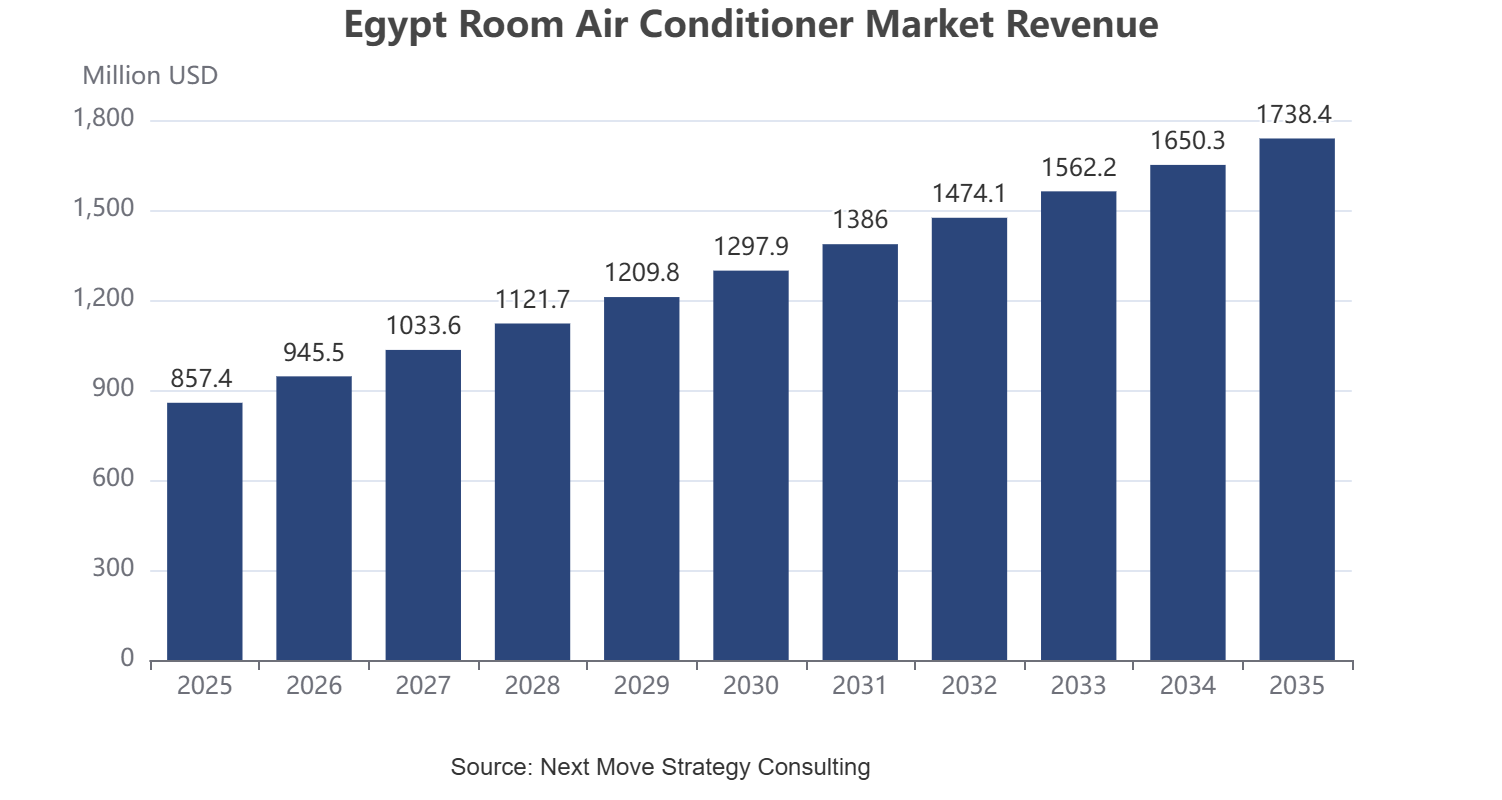
Egypt Room Air Conditioner Market Size & Forecast
|
Parameters |
Details |
|
Market Size in 2026 |
USD 988.1 million |
|
Revenue Forecast in 2035 |
USD 1738.4 million |
|
Growth Rate |
CAGR of 6.48% from 2026 to 2035 |
|
Market Volume in 2026 |
1832 thousand units |
|
Volume Forecast in 2035 |
3468 thousand units |
|
Growth Rate |
CAGR of 7.35% from 2026 to 2035 |
|
Analysis Period |
2025–2035 |
|
Base Year Considered |
2025 |
|
Forecast Period |
2026–2035 |
|
Market Size Estimation |
Million (USD) |
|
Companies Profiled |
15 |
|
Market Share |
Available for 10 companies |
Industry Outlook
The Egypt Room Air Conditioner Market size was valued at USD 857.4 million in 2025, and is expected to be valued at USD 988.1 million by the end of 2026. The industry is projected to grow, hitting USD 1738.4 million by 2035, with a CAGR of 6.48% between 2026 and 2035. In terms of volume, the market recorded 1551 thousand units in 2025, with forecasts indicating growth to 1832 thousand units by 2026 and further to 3468 thousand units by 2035, reflecting a CAGR of 7.35% over the same period.
PESTEL Analysis of the Egypt Room Air Conditioner Market:
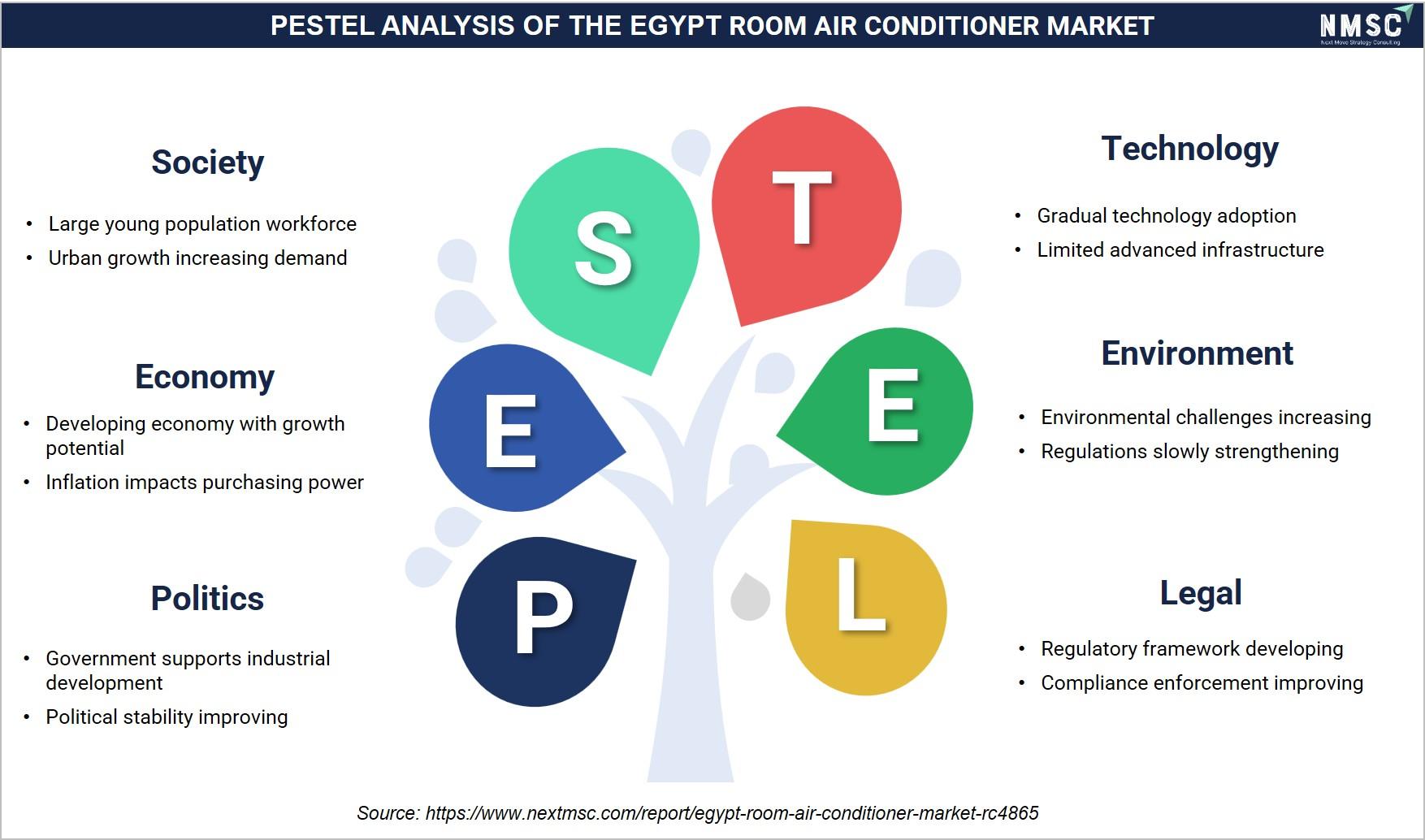
The infographic above depicts that extreme summer temperatures continue to generate strong environmental and social demand for cooling solutions across both urban and rural regions. Economic factors, particularly inflation and currency fluctuations, directly affect consumer affordability and the cost of imported components. Political and legal conditions play an important role in shaping trade policies, energy-efficiency regulations, and manufacturing incentives across the market. Technological advancements in inverter compressors and smart control systems are creating stronger product differentiation opportunities, while environmental mandates are accelerating the transition toward eco-friendly refrigerants. This structured framework provides stakeholders with a reliable lens to assess Egypt’s climate-driven demand dynamics, regulatory environment, and ongoing economic pressures.
What are the Key Market Drivers, Breakthroughs, and Investment Opportunities that will Shape the Egypt Room Air Conditioner Market in the Next Decade?
Growth Catalyst & Risk Assessment Matrix
|
DRIVERS / TRENDS / RESTRAINTS |
(+/–) % IMPACT ON CAGR FORECAST |
GEOGRAPHIC RELEVANCE |
IMPACT TIMELINE |
|
Rising temperatures increasing dependence on residential cooling systems |
+4.73% |
Cairo, Alexandria, densely populated urban regions |
Short to Medium term (1–4 years) |
|
Rapid urban expansion supporting RAC installations in residential developments |
+4.05% |
Greater Cairo and expanding urban housing corridors |
Medium to Long term (3–6 years) |
|
Increasing residential cooling dependence strengthening RAC penetration |
+3.67% |
Urban apartment-based housing markets across Egypt |
Medium to Long term (3–6 years) |
|
Growing demand for affordable AC units expanding first-time adoption |
+3.42% |
Middle-income urban households and emerging consumer markets |
Medium to Long term (3–6 years) |
|
Economic constraints limiting affordability of advanced RAC systems |
-3.88% |
Price-sensitive consumer segments across Egypt |
Short to Medium term (1–4 years) |
The Egypt room air conditioner market is experiencing gradual expansion, supported by rising temperature levels, accelerating urban development, and increasing residential demand for affordable cooling solutions. We observed that prolonged heat exposure across major Egyptian cities is steadily increasing reliance on room air conditioners, particularly in densely populated urban areas where indoor heat accumulation remains high during extended summer periods. Rapid urban expansion in cities is further strengthening installation demand, with growing apartment construction and mixed-use residential projects creating wider deployment opportunities for split and window AC systems. At the same time, improving awareness regarding indoor comfort and cooling accessibility is encouraging broader adoption across middle-income households. However, economic pressures and affordability concerns continue to influence purchasing decisions, particularly for premium systems. Despite these limitations, the rising demand for cost-effective and entry-level air conditioning units continues to support stable market expansion across Egypt.
Growth Drivers:
How are Rising Temperatures Supporting Demand in the Egypt Room Air Conditioner Market?
Rising temperature intensity across Egypt is steadily increasing structural dependence on room air conditioners across residential and commercial environments. Our assessment indicates that prolonged summer periods combined with consistently elevated daytime temperatures are intensifying indoor thermal discomfort, particularly across densely populated urban regions where residential buildings retain heat for extended durations. This has significantly increased reliance on mechanical cooling systems to maintain indoor comfort, improve residential living conditions, and support productivity within workplaces and commercial establishments. In apartment-based urban housing, limited airflow and compact construction patterns further amplify indoor heat accumulation, making air conditioning systems increasingly necessary during peak seasonal periods. Higher operational intensity during warmer months also accelerates equipment wear and maintenance requirements, contributing to stronger replacement-driven demand across existing installations. This sustained climate-driven cooling dependence continues to reinforce a stable long-term demand structure across the room air conditioner market in Egypt.
How is Rapid Urban Expansion Supporting AC Adoption in the Egypt Room Air Conditioner Market?
From our analysis, we found that rapid urban expansion across Egypt is playing a major role in strengthening room air conditioner adoption by continuously increasing the scale of residential and mixed-use infrastructure development. Growing urban population concentration is driving the construction of apartment complexes, integrated housing communities, and commercial developments, where standalone cooling systems remain the most practical and widely deployed solution for indoor climate management. This development pattern naturally supports stronger penetration of split and compact air conditioning systems designed for urban residential layouts. At the same time, large-scale housing projects aimed at accommodating expanding urban populations are increasing installation opportunities across both new developments and retrofit applications. Rising residential density is also intensifying indoor temperature buildup in multi-family housing structures, further strengthening demand for localised cooling appliances. As urban construction activity continues to expand, installation volumes across Egypt’s residential cooling market are expected to maintain steady upward momentum.
How is Residential Cooling Dependence Increasing Across Urban Egypt?
Dependence on residential cooling systems is steadily increasing across urban Egypt as households place greater emphasis on indoor comfort and climate-controlled living environments. Rising exposure to prolonged indoor heat conditions, combined with changing urban lifestyle expectations, is encouraging consumers to prioritize air conditioners as part of essential household appliance ownership. This trend is particularly evident in densely populated metropolitan areas where apartment-based living structures and limited ventilation efficiency contribute to consistently elevated indoor temperatures during warmer periods. Further, consumers are increasingly viewing room air conditioners as long-term utility investments that improve living quality, support healthier indoor environments, and enhance day-to-day residential comfort. In addition, improving product awareness and expanding retail accessibility are supporting broader first-time adoption across middle-income and emerging urban consumer groups. This gradual transformation in residential consumption behaviour continues to strengthen long-term market penetration across Egypt’s urban cooling sector.
Growth Inhibitor:
How do Economic Constraints Limit Growth in the Egypt Room Air Conditioner Market?
Economic constraints continue to remain a significant structural challenge affecting purchasing behaviour and limiting faster expansion within the Egypt room air conditioner market. Inflationary pressure, uneven income growth, and broader affordability concerns are reducing household flexibility for higher-value appliance purchases, particularly across middle- and lower-income consumer segments. This environment strongly influences product selection, with consumers prioritizing low-cost systems while frequently postponing upgrades to premium or energy-efficient models. Rising manufacturing costs, imported component expenses, and retail pricing pressures are also contributing to affordability limitations across the market. At the same time, financing accessibility remains uneven for several consumer groups, further restricting large-scale adoption of technologically advanced cooling systems. These financial pressures continue to concentrate demand within entry-level and budget-oriented product categories while moderating premium segment penetration across the market.
Growth Opportunity:
How is Demand for Affordable AC Units Creating Opportunities in the Egypt Room Air Conditioner Market?
Through NMSC's assessment, we found that growing demand for affordable air conditioning systems is creating substantial long-term opportunities across the Egypt room air conditioner market by expanding accessibility among price-sensitive urban households. The rising exposure to prolonged heat conditions and increasing urban residential density are encouraging consumers to seek practical cooling solutions that balance affordability, operational reliability, and acceptable energy performance. Manufacturers are increasingly responding by expanding entry-level and mid-range product portfolios tailored toward middle-income and emerging consumer groups. Wider retail distribution networks, appliance financing schemes, and instalment-based purchasing models are also improving accessibility for first-time buyers across major urban centers. In addition, replacement demand from older low-efficiency systems is supporting a gradual migration toward newer, affordable models that offer improved cooling efficiency and lower maintenance requirements. This affordability-driven adoption cycle continues to broaden the consumer base and reinforce stable long-term growth across Egypt’s residential cooling market.
How is the Egypt Room Air Conditioner Market segmented in this report, and what are the key insights from the segmentation analysis?
By Efficiency Band Insights
How are Efficiency Bands Influencing Consumer Purchasing Behaviour in the Egypt Room Air Conditioner Market?
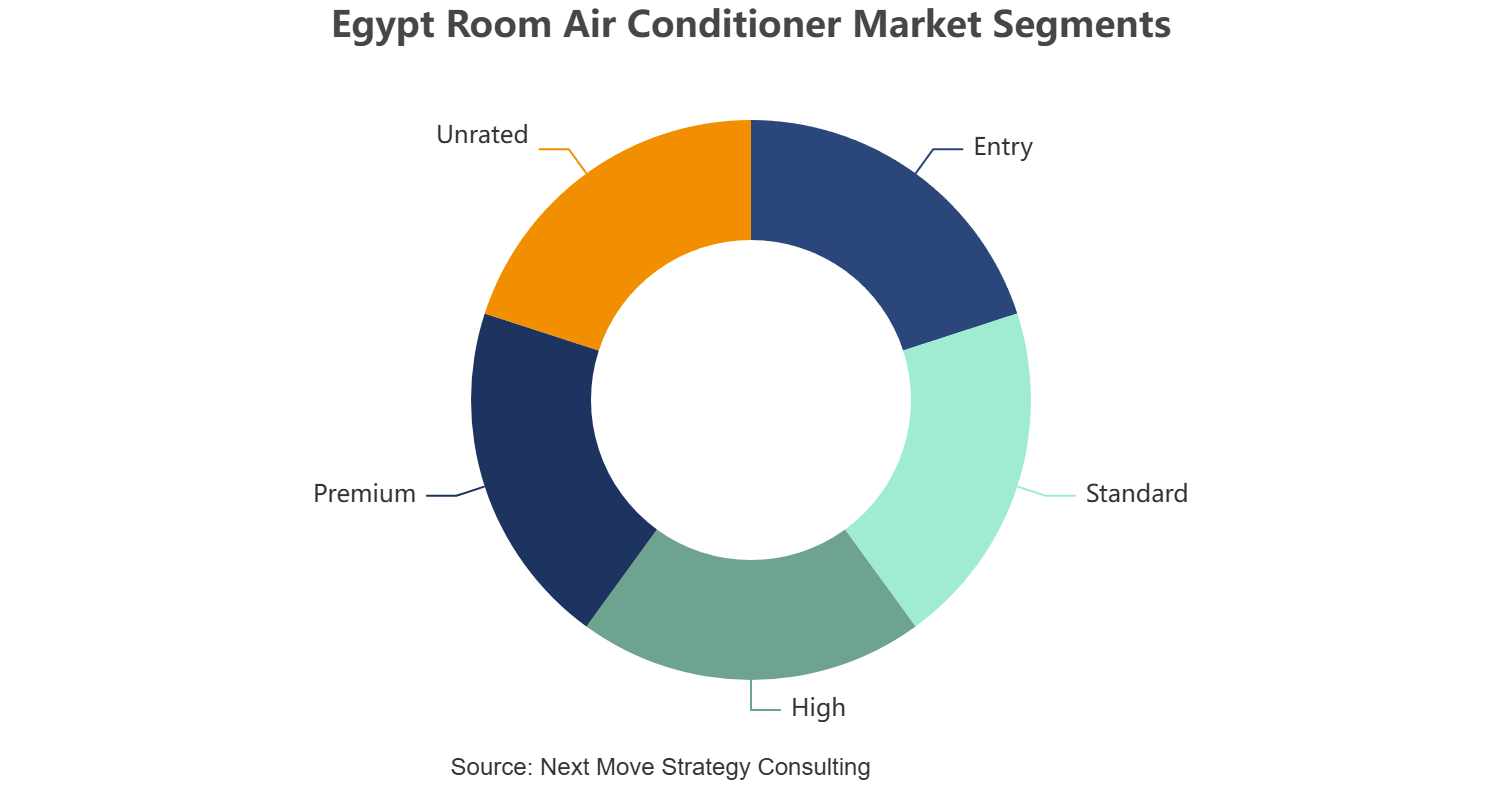
Based on efficiency band, the Egypt room air conditioner market is segmented into entry, standard, high, premium, and unrated.
In our observation, we found that entry efficiency band room air conditioners continue to witness substantial demand in Egypt, particularly across price-sensitive households where affordability and basic cooling functionality remain the primary purchasing priorities. This demand gradually transitions into standard efficiency systems, which maintain broad acceptance among middle-income consumers seeking a balance between electricity consumption and practical cooling performance for everyday residential use. High-efficiency units are steadily gaining traction as awareness around energy savings and long-term operating cost optimization increases across urban markets. Premium efficiency band products are increasingly associated with higher-income residential developments and modern commercial spaces where advanced features, smart controls, and enhanced performance efficiency influence buying decisions. Further, unrated systems continue to remain present within fragmented replacement channels and informal market structures, largely supported by older installations and cost-driven procurement behaviour across select consumer groups.
By End-User Insights
How are Residential and Commercial Applications Influencing Demand?
Based on end-user, the Egypt room air conditioner market is segmented into residential and commercial.
Our findings suggest that residential applications continue to generate substantial demand in the Egypt room air conditioner market, supported by rising urban population density, expanding apartment-based housing, and increasing dependence on indoor cooling during prolonged high-temperature periods. Growing consumer focus on household comfort and wider appliance penetration across middle-income families further strengthen residential installation activity. Commercial demand is also expanding steadily through investments in hospitality infrastructure, retail establishments, office spaces, healthcare facilities, and mixed-use urban developments requiring continuous indoor climate management. The need to maintain occupant comfort and operational efficiency in high-temperature environments further reinforces adoption across commercial settings. Both end-user segments are benefiting from Egypt’s broader urban expansion and increasing structural reliance on room air conditioning across residential and economic activity centers.
Competitive Landscape
The Egypt room air conditioner industry is evolving within a demand environment shaped by rising urban population density, intensifying summer temperatures, and expanding residential construction activity across major metropolitan areas. Based on NMSC analysis, we found that cooling adoption is increasingly transitioning from a discretionary appliance category toward a functional household requirement, particularly among middle-income urban consumers. At the same time, inflationary pressure and electricity cost sensitivity continue to influence purchasing behaviour, encouraging stronger demand for energy-efficient inverter models and competitively priced cooling solutions. Market activity is also benefiting from expanding modern retail infrastructure and broader availability of instalment-based consumer financing, which is improving accessibility across a wider consumer base.
Strategic Developments:
-
January 2026- LG Electronics Egypt introduced its new DUALCOOL AI Air residential air conditioner series during its annual RAC distributors conference in Egypt. The launch highlighted AI-based cooling optimization, energy-saving functionality, and locally manufactured inverter AC systems tailored for Egyptian households and high-temperature operating conditions.
-
April 2025- Hisense International partnered with El Araby Group to expand manufacturing and distribution operations in Egypt, including air conditioners and home appliances. The collaboration involves planned investments of nearly USD 170 million and aims to strengthen localized production capabilities while increasing employment opportunities across the Egyptian appliance sector.
-
February 2025- Daikin officially inaugurated its new upgraded headquarters in New Cairo’s District 5. This strategic facility includes a state-of-the-art training center and showroom. It is designed to streamline operations and accommodate future growth, with the potential to house a local manufacturing facility to serve the growing residential and commercial markets.
Key Players of the Egypt Room Air Conditioner Market:
-
Daikin Egypt LLC
-
Gree Electric Appliances Egypt LLC
-
Midea Egypt LLC
-
Panasonic Marketing Middle East & Africa FZE – Egypt Branch
-
Trane Egypt LLC
-
Hitachi Air Conditioning Egypt LLC
-
Fujitsu General Egypt LLC
-
Beko Egypt LLC
-
TCL Electronics Egypt LLC
-
El Araby Group Co.
-
Carrier Egypt LLC
-
Fresh Electric for Home Appliances Co.
-
Unionaire Group Co.
Competitive activity across Egypt reflects a balance between premium HVAC engineering brands and mass-market appliance manufacturers targeting affordability-driven residential demand. Daikin Egypt LLC, Trane Egypt LLC, and Hitachi Air Conditioning Egypt LLC continue to maintain visibility within higher-end residential and commercial cooling applications where long-term operational efficiency and durability remain important purchasing considerations. Meanwhile, LG Electronics Egypt S.A.E. and Samsung Electronics Egypt Ltd. are strengthening their market presence through smart-enabled cooling systems, modern retail branding strategies, and premium lifestyle-oriented appliance positioning. In the broader residential segment, Midea Egypt LLC and Gree Electric Appliances Egypt LLC are competing aggressively through affordability-focused inverter portfolios and extensive dealer distribution networks.
Additionally, Panasonic Marketing Middle East & Africa FZE - Egypt Branch continues to reinforce its presence through energy-efficient product offerings and established regional distribution capabilities. Overall, the market is increasingly defined by the balance between cost accessibility, energy consumption efficiency, and growing preference for technologically advanced residential cooling systems.
SWOT Analysis of the Egypt Room Air Conditioner Market:
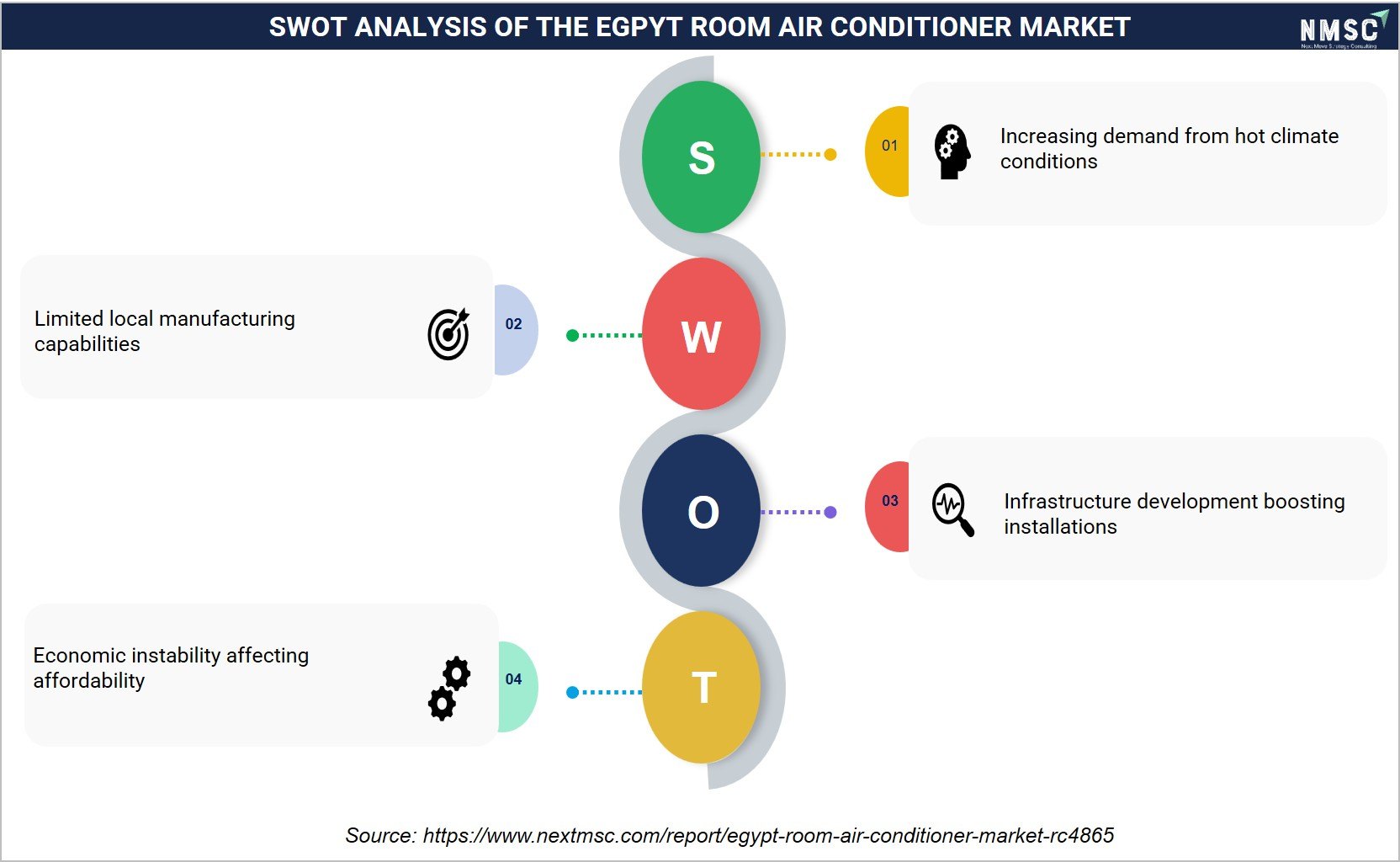
The infographic above indicates that a key strength lies in rising cooling demand driven by consistently hot climatic conditions across both residential and commercial sectors. However, limited domestic manufacturing capabilities continue to create structural dependence on imported products and components. Expanding infrastructure development presents a significant opportunity by supporting new installations across housing, hospitality, and commercial construction projects. At the same time, economic instability remains a major challenge, directly influencing consumer affordability and overall purchasing power. This structured framework provides stakeholders with a reliable lens to evaluate the balance between climate-driven demand growth, manufacturing limitations, infrastructure expansion potential, and economic volatility shaping the Egypt room air conditioner market.
Egypt Room Air Conditioner Market Key Segments
By Product Type
-
Window AC
-
Fixed Chassis
-
Through-the-Wall
-
-
Portable AC
-
Single Hose
-
Dual Hose
-
-
Single Split AC
-
Wall Mounted
-
Floor Standing
-
Ceiling Cassette
-
Ceiling Suspended
-
Ducted Single Zone
-
-
Multi Split AC
-
2 Indoor Units
-
3 Indoor Units
-
4+ Indoor Units
-
-
Packaged Room AC
-
Packaged Terminal AC
-
Vertical Packaged
-
Other Packaged
-
-
Other Room AC
By Speed Type
-
Fixed Speed
-
Inverter (Variable Speed)
By Cooling Capacity
-
≤ 1.0 Ton
-
>1.0 to ≤1.5 Ton
-
>1.5 to ≤2.0 Ton
-
>2.0 to ≤3.0 Ton
-
>3.0 Ton
By Efficiency Band
-
Entry
-
Standard
-
High
-
Premium
-
Unrated
By Refrigerant
-
R22
-
R410A
-
R32
-
Low-GWP HFO/HFC Blend
-
Hydrocarbon
-
Other Refrigerant
By Function
-
Cooling Only
-
Heat Pump
-
Cooling with Electric Heat
-
Other Function
By Distribution Channel
-
Retail (Brick and Mortar)
-
Multi-Brand Store
-
Brand Exclusive Store
-
Hypermarkets
-
-
Dealer Network
-
HVAC Dealers
-
Distributor & Wholesaler
-
-
Online
-
Marketplace
-
Brand Website
-
-
Project Sales
-
Real Estate Developer
-
Hospitality Chain
-
Institutional
-
OEM
-
By End-User
-
Residential
-
Commercial
-
Retail
-
Hospitality
-
Office
-
Healthcare
-
Education
-
Government/Public
-
Other Commercial
-
Key Benefits for Stakeholders:
Next Move Strategy Consulting (NMSC) presents a comprehensive analysis of the Egypt room air conditioner market trends, covering historical trends from 2020 through 2025 and offering detailed forecasts through 2035. Our study examines the market at regional and country levels, providing quantitative projections and insights into key growth drivers, challenges, and investment opportunities across all major room air conditioner segments.
From our analysis of the Egypt room air conditioner market, we found cooling adoption is increasingly transitioning from an urban convenience-driven purchase toward a broader household necessity as prolonged heat conditions and dense residential expansion intensify indoor comfort requirements. Investors benefit from a market where rising first-time appliance ownership and widening penetration across developing urban communities create strong long-term volume potential, particularly within affordable and mid-range product categories. Customers gain access to increasingly diverse cooling solutions tailored to varying income levels, enabling broader adoption of energy-conscious and space-efficient systems across apartment-based living environments. We also noticed that gradual improvements in retail accessibility, product availability, and efficiency awareness are strengthening consumer confidence while encouraging more structured and quality-focused purchasing behaviour across residential segments.
|
Parameters |
Details |
|
Customization Scope |
Free customization (equivalent to up to 80 analyst-working hours) after purchase. |
|
Pricing and Purchase Options |
Avail customized purchase options to meet your exact research needs. |
|
Approach |
In-depth primary and secondary research; proprietary databases; rigorous quality control and validation measures. |
|
Analytical Tools |
Porter's Five Forces, SWOT, value chain, and Harvey ball analysis to assess competitive intensity, stakeholder roles, and relative impact of key factors. |
About the Author
 Mayurima Roy
— Mayurima Roy is Research Analyst at Next Move Strategy Consulting, where she has spent 4 years working across the firm's full industry coverage rather than a single fixed vertical. Her work centers on structured research, ongoing trend tracking, competitive assessment, and insight-led content development, translating complex market data into clear, decision-ready narratives that support informed client decision-making across diverse global industries, market sectors, and world regions every day.
Mayurima Roy
— Mayurima Roy is Research Analyst at Next Move Strategy Consulting, where she has spent 4 years working across the firm's full industry coverage rather than a single fixed vertical. Her work centers on structured research, ongoing trend tracking, competitive assessment, and insight-led content development, translating complex market data into clear, decision-ready narratives that support informed client decision-making across diverse global industries, market sectors, and world regions every day.
About the Reviewer
 Supradip Baul
— Supradip Baul is an accomplished business consultant and strategist with over a decade of rich experience in market intelligence, strategy, technology, and business transformation. His work has included rigorous qualitative and quantitative analysis across multiple industries, helping clients shape investment decisions and long-term roadmaps. Earlier in his career, he was associated with Gartner, where he contributed to industry-leading reports and market share analyses. He has worked with leading global companies and holds an MBA with a dual specialization in Marketing and Finance.
Supradip Baul
— Supradip Baul is an accomplished business consultant and strategist with over a decade of rich experience in market intelligence, strategy, technology, and business transformation. His work has included rigorous qualitative and quantitative analysis across multiple industries, helping clients shape investment decisions and long-term roadmaps. Earlier in his career, he was associated with Gartner, where he contributed to industry-leading reports and market share analyses. He has worked with leading global companies and holds an MBA with a dual specialization in Marketing and Finance.
At Next Move Strategy Consulting, we understand that insightful market research is the cornerstone of successful business decisions. That's why we employ a robust and multifaceted approach, combining various methodologies to deliver the most accurate and actionable data for our clients.

Research Landscape
We navigate the world of research with two primary approaches:
Qualitative Approach
Our qualitative research methodologies involve immersive techniques such as in-depth interviews, focus groups, and observational studies. By engaging directly with individuals and stakeholders, we uncover valuable insights that quantitative data alone may overlook.

Quantitative Research
In tandem with qualitative methodologies, NMSC leverages the power of Quantitative Research to provide a robust foundation of numerical insights. Through systematic data collection and analysis, we quantify patterns, preferences, and market trends, offering a comprehensive view of the business landscape.
Our quantitative research approach employs diverse tools, including surveys, experiments, and statistical modelling. These methodologies enable us to gather data from a large and representative sample, ensuring the statistical significance of our findings. By employing structured questionnaires and standardized data collection methods, we guarantee the reliability and validity of the information we present to our clients.
Quantitative research is particularly effective in measuring the prevalence of trends, assessing market size, and gauging the impact of various factors on consumer behavior. The numerical precision attained through this approach equips our clients with actionable insights, facilitating data-driven decision-making and strategy formulation.


Our Specialized Toolbox for Industry-Specific Market Research
We deploy a specialized arsenal of techniques tailored to meet your unique requirements. Here's a glimpse into our comprehensive toolbox:

Information Procurement
The stage entails acquiring market data or relevant information through various sources and methodologies.


Market Research Approach
We utilize both top-down and bottom-up approaches in market research analysis to achieve a comprehensive understanding of the market dynamics, leveraging the broad perspective of industry trends and macroeconomic factors alongside detailed insights from specific segments and individual companies.

Porters Five Forces Analysis
We conduct Porter's Five Forces analysis to evaluate the competitive landscape of an industry, providing us with insights into factors that affect profitability and strategic positioning.

SWOT Analysis

Forecasting
We utilize a forecasting model to predict future consumption by considering parameters like population, economics, regulations, market competition, drivers, constraints, technology, and pricing. We also employ statistical techniques such as multilinear regression, exponential smoothing, moving average, ARIMA, and Monte Carlo simulations for accurate predictions. In econometric forecasting, we analyzed short-term and long-term event impacts, attributing values based on regulatory frameworks, economic factors, and market events.





 Speak to Our Analyst