Egypt Warehouse Robotics Market By Type [Automated Guided Vehicles (AGVs) (Laser Guidance, Magnetic Guidance, Optical Tape Guidance, Vision Guidance, and Others), Autonomous Mobile Robots (AMRs) (Tow Vehicle, Tug Vehicle, Unit Load Vehicle), Articulated Robots, Collaborative Robots (Cobots), Scara and Cylindrical Robots, and Others], By Offering (Hardware, Software, and Service), By Payload Capacity, By Application, and By End User – Opportunity Analysis and Industry Forecast, 2025–2035
Industry: ICT & Media | Latest Edition: September 30, 2026 | No of Pages: 227 | No. of Tables: 108 | No. of Figures: 98 | Format: PDF | Report Code: IC5172
Egypt Warehouse Robotics Market Size & Forecast 2025–2035
|
Parameters |
Details |
|
Market Size in 2025 |
USD 28.49 Million |
|
Market Size in 2026 |
USD 41.45 Million |
|
Revenue Forecast in 2035 |
USD 119.40 Million |
|
Growth Rate |
CAGR of 12.47% from 2026 to 2035 |
|
Market Volume in 2025 |
3 Thousand Units |
|
Market Volume in 2026 |
4 Thousand Units |
|
Volume Forecast in 2035 |
12 Thousand Units |
|
Growth Rate |
CAGR of 13.34% from 2026 to 2035 |
|
Analysis Period |
2025–2035 |
|
Base Year Considered |
2025 |
|
Forecast Period |
2026–2035 |
|
Market Size Estimation |
Million (USD) |
Industry Outlook
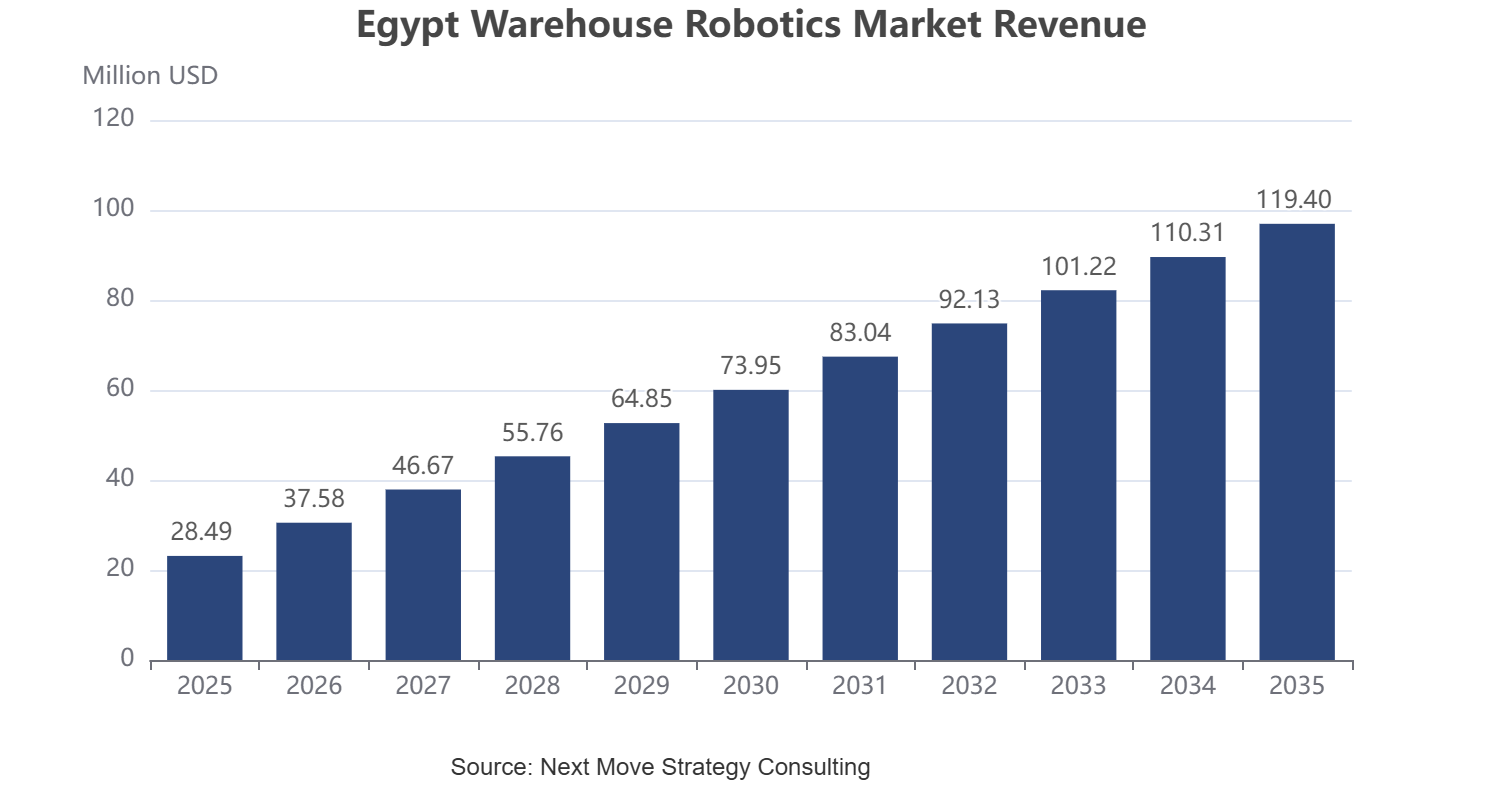
The Egypt Warehouse Robotics Market was valued at USD 28.49 million in 2025 and reached USD 41.45 million in 2026. Looking ahead, the market is projected to experience steady growth, reaching USD 119.40 million by 2035, registering a CAGR of 12.47% from 2026 to 2035. In terms of volume, the market recorded 3 thousand units in 2025, with forecasts indicating growth to 4 thousand units by 2026 and further to 12 thousand units by 2035, reflecting a CAGR of 13.34% over the same period.
What Are the Key Drivers, Restraints, and Opportunities Shaping the Egypt Warehouse Robotics Market?
|
Drivers / Trends / Restraints |
(+/–) % Impact on CAGR Forecast |
Geographic Relevance |
Impact Timeline |
|
Egypt Vision 2030, industrial modernization initiatives, and government investments in smart logistics are accelerating warehouse automation adoption |
+1.9% |
Egypt |
Medium to long term (3–10 years) |
|
Rapid expansion of e-commerce, modern retail distribution networks, and omnichannel fulfillment is increasing demand for warehouse robotics solutions |
+1.7% |
Egypt |
Short to medium term (1–5 years) |
|
Growing pharmaceutical, food & beverage, and manufacturing industries are driving investments in automated material handling and warehouse robotics |
+1.4% |
Egypt |
Medium term (2–7 years) |
|
Limited local technical expertise, skilled robotics workforce, and integration capabilities continue to restrain large-scale warehouse robotics deployment |
–1.1% |
Egypt |
Short to medium term (1–5 years) |
|
Development of Egypt as a regional logistics hub connecting Africa and the Middle East, along with rising FDI in logistics parks and free zones, is creating significant growth opportunities |
+1.3% |
Egypt, Middle East & Africa |
Long term (4–10 years) |
The Egypt Warehouse Robotics Market is evolving under the influence of several interconnected factors, including government policy, industrial transformation, and expanding logistics infrastructure. Egypt Vision 2030, combined with the rapid growth of e-commerce, modern retail, and manufacturing industries, is driving the adoption of automated warehouse solutions across the country. At the same time, limited local technical expertise and workforce skill gaps continue to present challenges for large-scale deployment. Nevertheless, growing foreign direct investment (FDI) in logistics infrastructure, the expansion of industrial and free zones, and Egypt's strategic position as a regional trade gateway connecting Africa and the Middle East are creating significant long-term opportunities for warehouse robotics adoption.
Growth Drivers:
How Are Egypt's Vision 2030 Objectives and Industrial Policy Initiatives Driving Warehouse Robotics Adoption?
Egypt's Vision 2030 development framework and associated industrial modernization programs are creating a favorable environment for warehouse robotics investments by prioritizing manufacturing competitiveness, logistics efficiency, and digital infrastructure development. Government-backed initiatives including the establishment of industrial zones, smart logistics corridors, and investment incentive packages are attracting multinational companies seeking to automate their Egyptian supply chain operations. Public sector procurement programs targeting automation in state-affiliated warehouses and distribution networks further amplify demand, establishing a strong policy foundation that underpins long-term warehouse robotics market growth across Egypt.
In What Ways Is the Rapid Expansion of E-commerce and Modern Retail Distribution Networks Propelling Warehouse Robotics Demand in Egypt?
Egypt's e-commerce sector has experienced accelerated growth driven by increasing internet penetration, a youthful digitally engaged population, and the proliferation of mobile payment platforms. As online retailers scale their fulfillment capabilities to meet rising consumer expectations for faster and more accurate delivery, the need for robotic order picking, sorting, and dispatch automation has intensified substantially. Leading logistics operators are investing in automated warehouse infrastructure at strategically positioned distribution centers to reduce operational costs, minimize fulfillment errors, and gain competitive advantages in an increasingly dynamic Egyptian retail landscape.
How Does the Growth of Egypt's Pharmaceutical and Food & Beverage Manufacturing Sectors Contribute to Warehouse Robotics Market Expansion?
Egypt's pharmaceutical industry, one of the largest in Africa, and its substantial food and beverage manufacturing sector are increasingly relying on robotic warehouse automation to maintain strict quality standards, improve inventory traceability, and achieve regulatory compliance. Temperature-sensitive storage requirements in pharmaceutical logistics and the need for hygienic, high-speed handling in food processing environments are accelerating the adoption of specialized robotic systems. As both sectors expand capacity to serve domestic and export markets, investment in collaborative robots, AGVs, and automated palletizing solutions within warehouse and distribution facilities is growing consistently.
Growth Inhibitor:
What Barriers Do Limited Robotics Expertise and High Capital Requirements Pose for Warehouse Automation Expansion in Egypt?
The market faces meaningful growth constraints stemming from a shortage of locally trained robotics engineers, system integration specialists, and ongoing maintenance technicians. This skills gap increases reliance on expatriate expertise and inflates total project implementation costs, particularly for mid-sized operators. Simultaneously, the substantial capital expenditure associated with purchasing, installing, and integrating robotic systems remains prohibitive for small and medium-sized enterprises, which represent a significant portion of Egypt's warehousing and logistics sector. Limited access to affordable financing instruments further restricts the pace of automation adoption among cost-sensitive operators.
Growth Opportunity:
What Strategic Opportunities Are Emerging from Egypt's Regional Logistics Hub Positioning and Rising FDI in Automated Logistics Parks?
Egypt's unique geographic position connecting Sub-Saharan Africa, the Middle East, and Mediterranean trade routes positions it as a strategic regional logistics hub, creating compelling demand for high-throughput automated warehouse infrastructure. The development of the Suez Canal Economic Zone and expanded free trade zones is attracting multinational logistics operators and manufacturers who require sophisticated robotic systems to manage cross-border cargo flows efficiently. Rising foreign direct investment in purpose-built, technology-enabled logistics parks is accelerating warehouse robotics deployment timelines, offering significant growth opportunities for solution providers capable of delivering scalable and internationally compliant automation ecosystems within Egypt.
Swot Analysis Of The Egypt Warehouse Robotics Market
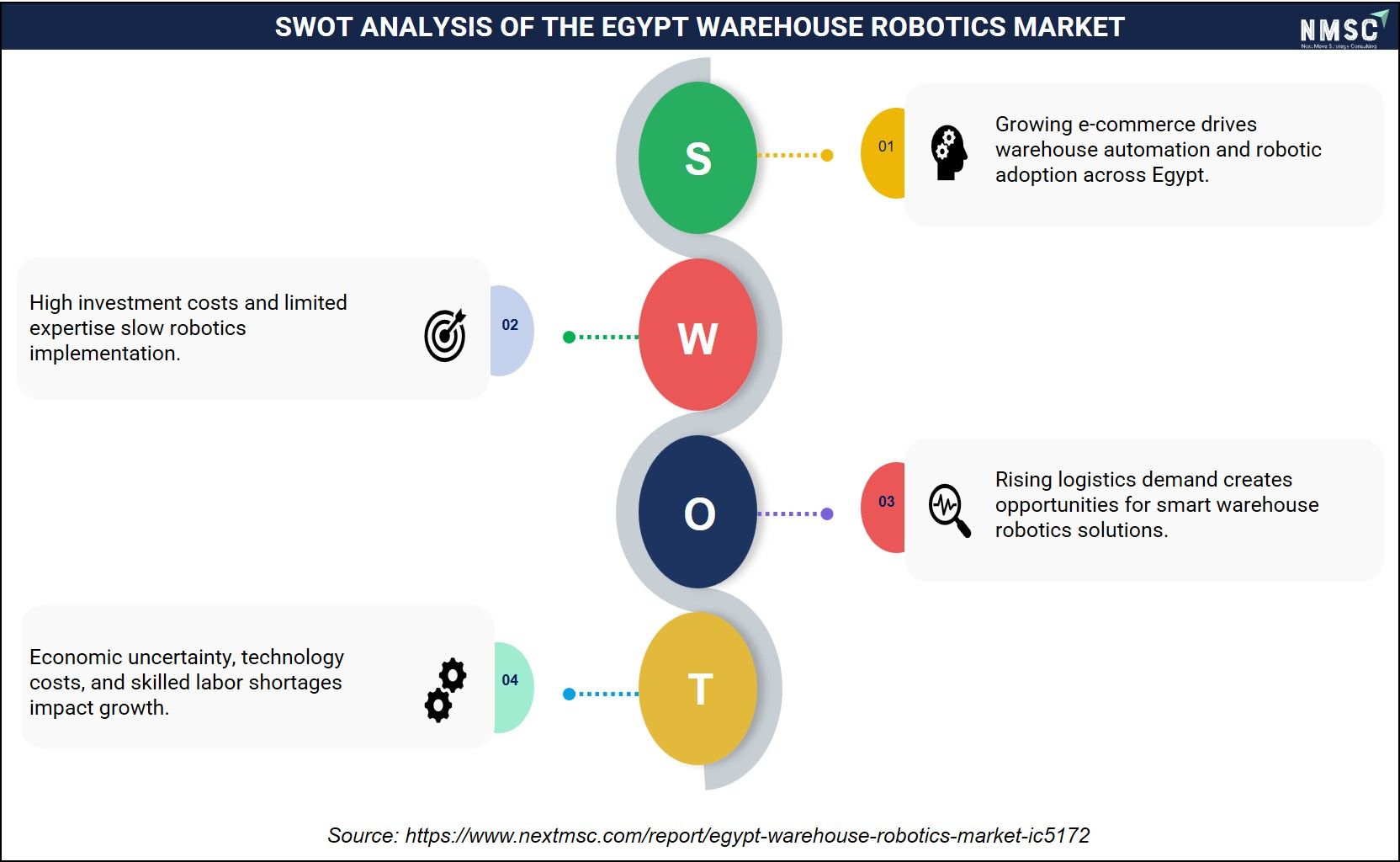
The SWOT analysis of the Egypt Warehouse Robotics Market highlights strong growth opportunities driven by expanding e-commerce, increasing warehouse automation, and rising logistics demand. The market benefits from growing investments in smart warehousing and digital supply chain transformation. However, high implementation costs, limited technical expertise, and skilled labor shortages remain key challenges. Economic uncertainties and technology investment requirements may restrain adoption, while continued modernization of logistics infrastructure is expected to create significant long-term opportunities for warehouse robotics deployment across Egypt.
How Is the Egypt Warehouse Robotics Market Segmented in This Report, and What Are the Key Insights from the Segmentation Analysis?
By Type Insights
Is Type Segmentation Influencing Automation Adoption Across the Egypt Warehouse Robotics Market?
Based on type, the market is segmented into Automated Guided Vehicles (AGVs), Autonomous Mobile Robots (AMRs), Articulated Robots, Collaborative Robots (Cobots), SCARA Robots and Cylindrical Robots, and Others.
Based on our analysis, we observed that the adoption of warehouse robotics technologies across Egypt is influenced by warehouse infrastructure, operational requirements, automation objectives, and workforce availability. Automated Guided Vehicles (AGVs) continue to play a significant role in material transportation and repetitive warehouse operations due to their reliability, cost-effectiveness, and suitability for structured warehouse environments. Meanwhile, Autonomous Mobile Robots (AMRs) are witnessing increasing adoption owing to their flexibility, intelligent navigation capabilities, and ability to operate efficiently in dynamic warehouse settings. In addition, articulated robots, cobots, and SCARA robots are increasingly deployed for picking, palletizing, sorting, packaging, and material handling applications. Furthermore, continuous advancements in artificial intelligence, machine vision, and autonomous navigation technologies are supporting broader adoption of specialized robotic systems across Egypt's expanding logistics and warehousing sector.
By Application Insights
Is Application Segmentation Driving Warehouse Automation Adoption Across the Egypt Warehouse Robotics Market?
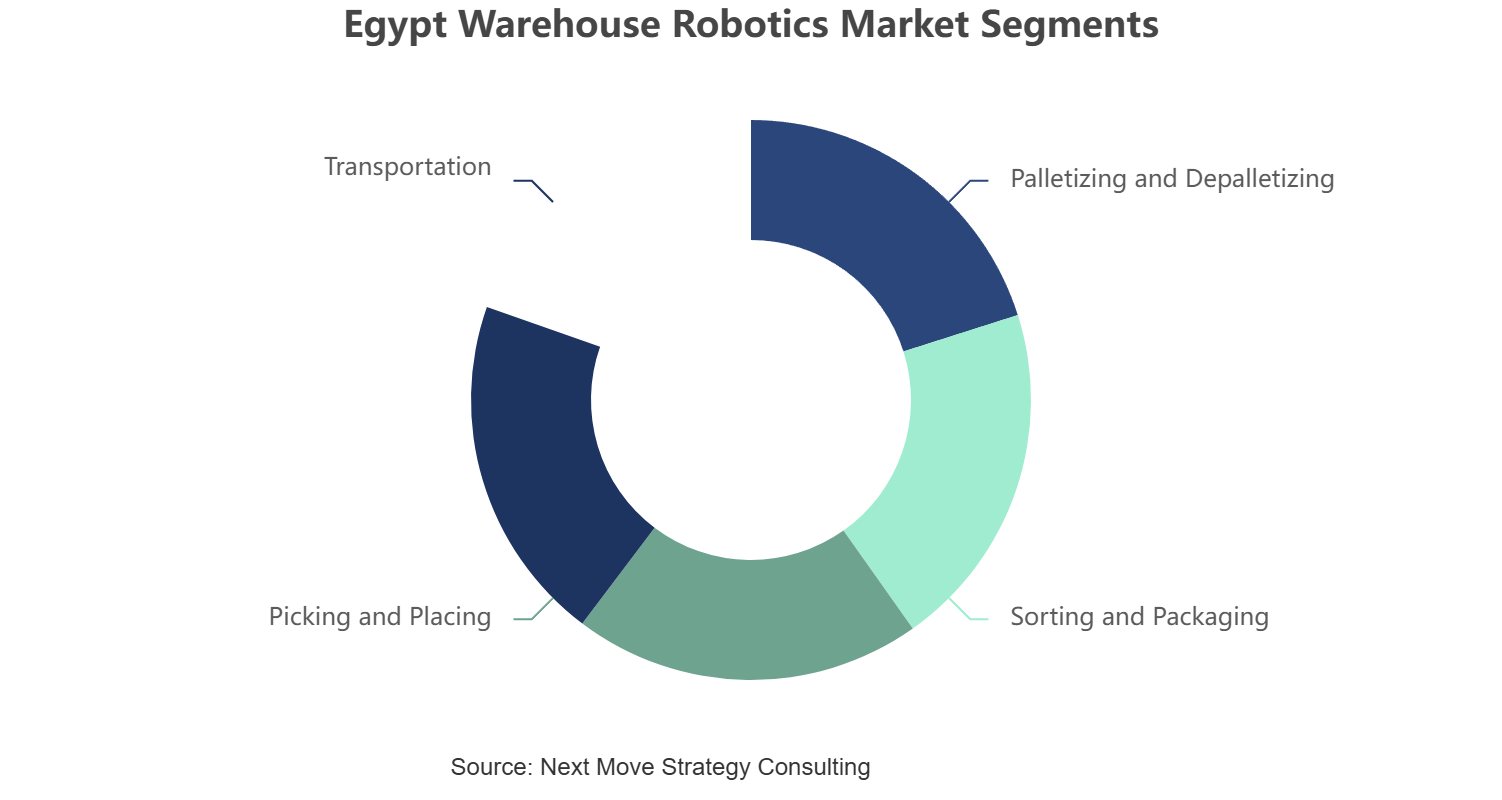
Based on application, the market is segmented into Palletizing and Depalletizing, Sorting and Packaging, Picking and Placing, and Transportation.
Based on our evaluation, we identified that demand for warehouse robotics solutions in Egypt is increasingly influenced by diverse warehouse applications and the growing need for operational efficiency across logistics and distribution facilities. Transportation and Palletizing and Depalletizing applications continue to support automation of repetitive material handling processes, while Picking and Placing solutions are gaining importance for improving order accuracy and inventory management. Meanwhile, the Sorting and Packaging segment is expected to witness the fastest growth during the forecast period, driven by the rapid expansion of e-commerce fulfillment, increasing parcel volumes, and rising demand for high-speed, error-free order processing. Furthermore, the growing adoption of automated sorting technologies across retail, pharmaceutical, food & beverage, and third-party logistics (3PL) warehouses is expected to accelerate the deployment of warehouse robotics throughout Egypt
Competitive Landscape
The market is characterized by a competitive landscape comprising a mix of established global automation technology leaders and emerging regional solution integrators. Market participants are actively pursuing strategies centered on local partnership development, after-sales service network expansion, and software platform integration to strengthen their competitive positions. Product portfolio differentiation through modular robotic architectures, AI-driven fleet management capabilities, and application-specific customization is becoming an increasingly important dimension of competitive rivalry, particularly as end users across diverse Egyptian industries become more sophisticated in their automation procurement decisions.
Key Players
-
KUKA Robotics Egypt L.L.C.
-
InnoVision Robotics L.L.C.
-
FANUC Corporation
-
Jungheinrich AG
-
Murata Machinery, Ltd.
-
STILL GmbH
-
Geekplus Middle East FZCO
-
SEW-EURODRIVE GmbH & Co KG
The competitive dynamics of the Egypt Warehouse Robotics Market are shaped by the active presence of globally recognized automation leaders alongside specialized regional players. ABB Arab S.A.E. and KUKA Robotics Egypt L.L.C. leverage deep engineering capabilities to address complex automation requirements, while Honeywell Egypt L.L.C. and FANUC Corporation bring extensive software ecosystem integration expertise. Jungheinrich AG and STILL GmbH are expanding intralogistics solutions, and Geekplus Middle East FZCO is advancing AMR-based fulfillment platforms. InnoVision Robotics L.L.C., Murata Machinery, Ltd., and SEW-EURODRIVE GmbH & Co KG continue to strengthen their regional service infrastructure and solution customization offerings across Egypt's evolving warehouse automation sector.
Key Segments
By Type
-
Automated Guided Vehicles (AGVs)
-
Laser Guidance
-
Magnetic Guidance
-
Optical Tape Guidance
-
Vision Guidance
-
Others
-
-
Autonomous Mobile Robots (AMRs)
-
Tow Vehicle
-
Tug Vehicle
-
Unit Load Vehicle
-
Pallet Truck
-
Forklift Vehicle
-
Other Type
-
-
Articulated Robots
-
Collaborative Robots (Cobots)
-
SCARA Robots and Cylindrical Robots
-
Others
By Offering
-
Hardware
-
Software
-
Warehouse Management System (WMS)
-
Warehouse Execution System (WES)
-
Warehouse Control System (WCS)
-
-
Services
By Payload Capacity
-
≤ 100 KG
-
101–200 KG
-
201–500 KG
-
501–1000 KG
-
1001–2000 KG
-
2001–5000 KG
-
More than 5000 KG
By Application
-
Palletizing and Depalletizing
-
Sorting and Packaging
-
Picking and Placing
-
Transportation
By End User
-
E-commerce
-
Automotive
-
Food & Beverages
-
Pharmaceutical
-
Chemical and Materials
-
Semiconductor and Electronics
-
Others
Supply Chain Structure Of The Egypt Warehouse Robotics Market
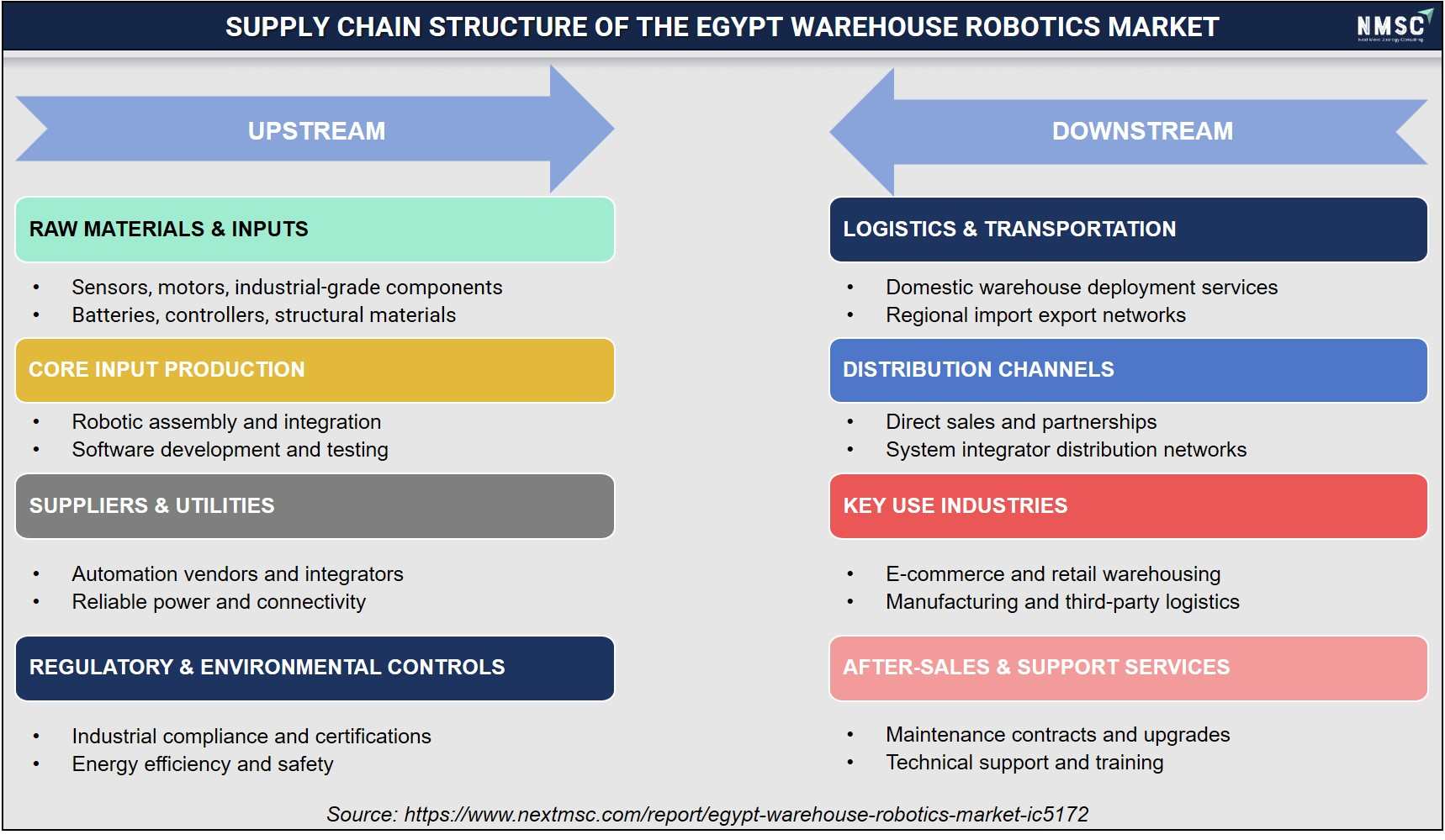
The supply chain structure of the Egypt Warehouse Robotics Market encompasses upstream activities such as raw material sourcing, robotic assembly, software development, and component integration, supported by automation vendors and regulatory compliance. Downstream operations include logistics, transportation, distribution, system integration, and after-sales services that enable efficient deployment and maintenance of warehouse robotics. Rising demand from e-commerce, manufacturing, and third-party logistics (3PL) sectors continues to strengthen the supply chain ecosystem, supporting the adoption of advanced warehouse automation solutions across Egypt.
Key Benefits for Stakeholders
This syndicated market research report on the Egypt Warehouse Robotics Market delivers comprehensive, data-driven intelligence enabling manufacturers, investors, logistics operators, and policymakers to make informed strategic decisions. The report offers granular segmentation analysis across robot type, offering, payload capacity, application, and end-user dimensions, providing stakeholders with a nuanced understanding of high-value growth pockets. Robust historical data validated against verified industry benchmarks, combined with a decade-long revenue and volume forecast through 2035, equips corporate planners and capital allocators with the quantitative precision required for long-range investment and market entry strategies.
Beyond quantitative market intelligence, this report provides stakeholders with actionable qualitative insights including in-depth competitive landscape assessments, regulatory environment analysis, and technology trend evaluations specific to the Egyptian market context. Private equity firms, venture capital investors, technology solution providers, and government agencies will find the report's strategic recommendations and opportunity mapping particularly valuable for identifying untapped segments and partnership prospects. The report's customizable structure allows each stakeholder group to tailor insights to their specific organizational objectives, ensuring maximum relevance across the full Egypt warehouse robotics value chain and adjacent automation ecosystems.
|
Parameters |
Details |
|
Customization Scope |
Free customization (equivalent to up to 80 analyst-working hours) after purchase. |
|
Pricing and Purchase Options |
Avail customized purchase options to meet your exact research needs. |
|
Approach |
In-depth primary and secondary research; proprietary databases; rigorous quality control and validation measures. |
|
Analytical Tools |
Porter's Five Forces, SWOT, value chain, and Harvey ball analysis to assess competitive intensity, stakeholder roles, and relative impact of key factors. |
Conclusion
The Egypt Warehouse Robotics Market is positioned for strong and sustained growth over the 2026–2035 forecast period, underpinned by Egypt's Vision 2030 industrial modernization agenda, accelerating e-commerce expansion, and growing pharmaceutical and food and beverage manufacturing demand. While high capital expenditure requirements and a limited pool of skilled robotics technicians present near-term adoption barriers, the country's strategic geographic positioning as a regional logistics hub and rising foreign direct investment in automated logistics parks offer compelling long-term opportunities. Established global players and innovative regional entrants will continue to shape a dynamic competitive landscape throughout the forecast horizon.
About the Author
 Liza Phukan
— Liza Phukan is Research Associate at Next Move Strategy Consulting, where she has covered emerging industries and market research across sectors for 3.5 years. Her work includes analyzing industry developments, validating market data, and developing structured business content from research findings. She uses secondary research and data-validation practices to turn complex market information into clear decision-useful market analysis for business audiences and support report development and B2B.
Liza Phukan
— Liza Phukan is Research Associate at Next Move Strategy Consulting, where she has covered emerging industries and market research across sectors for 3.5 years. Her work includes analyzing industry developments, validating market data, and developing structured business content from research findings. She uses secondary research and data-validation practices to turn complex market information into clear decision-useful market analysis for business audiences and support report development and B2B.
About the Reviewer
 Supradip Baul
— Supradip Baul is an accomplished business consultant and strategist with over a decade of rich experience in market intelligence, strategy, technology, and business transformation. His work has included rigorous qualitative and quantitative analysis across multiple industries, helping clients shape investment decisions and long-term roadmaps. Earlier in his career, he was associated with Gartner, where he contributed to industry-leading reports and market share analyses. He has worked with leading global companies and holds an MBA with a dual specialization in Marketing and Finance.
Supradip Baul
— Supradip Baul is an accomplished business consultant and strategist with over a decade of rich experience in market intelligence, strategy, technology, and business transformation. His work has included rigorous qualitative and quantitative analysis across multiple industries, helping clients shape investment decisions and long-term roadmaps. Earlier in his career, he was associated with Gartner, where he contributed to industry-leading reports and market share analyses. He has worked with leading global companies and holds an MBA with a dual specialization in Marketing and Finance.
At Next Move Strategy Consulting, we understand that insightful market research is the cornerstone of successful business decisions. That's why we employ a robust and multifaceted approach, combining various methodologies to deliver the most accurate and actionable data for our clients.

Research Landscape
We navigate the world of research with two primary approaches:
Qualitative Approach
Our qualitative research methodologies involve immersive techniques such as in-depth interviews, focus groups, and observational studies. By engaging directly with individuals and stakeholders, we uncover valuable insights that quantitative data alone may overlook.

Quantitative Research
In tandem with qualitative methodologies, NMSC leverages the power of Quantitative Research to provide a robust foundation of numerical insights. Through systematic data collection and analysis, we quantify patterns, preferences, and market trends, offering a comprehensive view of the business landscape.
Our quantitative research approach employs diverse tools, including surveys, experiments, and statistical modelling. These methodologies enable us to gather data from a large and representative sample, ensuring the statistical significance of our findings. By employing structured questionnaires and standardized data collection methods, we guarantee the reliability and validity of the information we present to our clients.
Quantitative research is particularly effective in measuring the prevalence of trends, assessing market size, and gauging the impact of various factors on consumer behavior. The numerical precision attained through this approach equips our clients with actionable insights, facilitating data-driven decision-making and strategy formulation.


Our Specialized Toolbox for Industry-Specific Market Research
We deploy a specialized arsenal of techniques tailored to meet your unique requirements. Here's a glimpse into our comprehensive toolbox:

Information Procurement
The stage entails acquiring market data or relevant information through various sources and methodologies.


Market Research Approach
We utilize both top-down and bottom-up approaches in market research analysis to achieve a comprehensive understanding of the market dynamics, leveraging the broad perspective of industry trends and macroeconomic factors alongside detailed insights from specific segments and individual companies.

Porters Five Forces Analysis
We conduct Porter's Five Forces analysis to evaluate the competitive landscape of an industry, providing us with insights into factors that affect profitability and strategic positioning.

SWOT Analysis

Forecasting
We utilize a forecasting model to predict future consumption by considering parameters like population, economics, regulations, market competition, drivers, constraints, technology, and pricing. We also employ statistical techniques such as multilinear regression, exponential smoothing, moving average, ARIMA, and Monte Carlo simulations for accurate predictions. In econometric forecasting, we analyzed short-term and long-term event impacts, attributing values based on regulatory frameworks, economic factors, and market events.





 Speak to Our Analyst